EP0425670A1 - Farbdynamisches dekomaterial - Google Patents
Farbdynamisches dekomaterial Download PDFInfo
- Publication number
- EP0425670A1 EP0425670A1 EP89908287A EP89908287A EP0425670A1 EP 0425670 A1 EP0425670 A1 EP 0425670A1 EP 89908287 A EP89908287 A EP 89908287A EP 89908287 A EP89908287 A EP 89908287A EP 0425670 A1 EP0425670 A1 EP 0425670A1
- Authority
- EP
- European Patent Office
- Prior art keywords
- colour
- sections
- protective layer
- translucent
- carrying surface
- Prior art date
- Legal status (The legal status is an assumption and is not a legal conclusion. Google has not performed a legal analysis and makes no representation as to the accuracy of the status listed.)
- Withdrawn
Links
Images



Classifications
-
- E—FIXED CONSTRUCTIONS
- E04—BUILDING
- E04F—FINISHING WORK ON BUILDINGS, e.g. STAIRS, FLOORS
- E04F13/00—Coverings or linings, e.g. for walls or ceilings
- E04F13/07—Coverings or linings, e.g. for walls or ceilings composed of covering or lining elements; Sub-structures therefor; Fastening means therefor
- E04F13/08—Coverings or linings, e.g. for walls or ceilings composed of covering or lining elements; Sub-structures therefor; Fastening means therefor composed of a plurality of similar covering or lining elements
- E04F13/0871—Coverings or linings, e.g. for walls or ceilings composed of covering or lining elements; Sub-structures therefor; Fastening means therefor composed of a plurality of similar covering or lining elements having an ornamental or specially shaped visible surface
-
- B—PERFORMING OPERATIONS; TRANSPORTING
- B44—DECORATIVE ARTS
- B44C—PRODUCING DECORATIVE EFFECTS; MOSAICS; TARSIA WORK; PAPERHANGING
- B44C5/00—Processes for producing special ornamental bodies
- B44C5/04—Ornamental plaques, e.g. decorative panels, decorative veneers
-
- B—PERFORMING OPERATIONS; TRANSPORTING
- B44—DECORATIVE ARTS
- B44F—SPECIAL DESIGNS OR PICTURES
- B44F1/00—Designs or pictures characterised by special or unusual light effects
- B44F1/02—Designs or pictures characterised by special or unusual light effects produced by reflected light, e.g. matt surfaces, lustrous surfaces
-
- B—PERFORMING OPERATIONS; TRANSPORTING
- B44—DECORATIVE ARTS
- B44F—SPECIAL DESIGNS OR PICTURES
- B44F1/00—Designs or pictures characterised by special or unusual light effects
- B44F1/02—Designs or pictures characterised by special or unusual light effects produced by reflected light, e.g. matt surfaces, lustrous surfaces
- B44F1/04—Designs or pictures characterised by special or unusual light effects produced by reflected light, e.g. matt surfaces, lustrous surfaces after passage through surface layers, e.g. pictures with mirrors on the back
-
- B—PERFORMING OPERATIONS; TRANSPORTING
- B44—DECORATIVE ARTS
- B44F—SPECIAL DESIGNS OR PICTURES
- B44F1/00—Designs or pictures characterised by special or unusual light effects
- B44F1/08—Designs or pictures characterised by special or unusual light effects characterised by colour effects
-
- E—FIXED CONSTRUCTIONS
- E04—BUILDING
- E04F—FINISHING WORK ON BUILDINGS, e.g. STAIRS, FLOORS
- E04F13/00—Coverings or linings, e.g. for walls or ceilings
- E04F13/07—Coverings or linings, e.g. for walls or ceilings composed of covering or lining elements; Sub-structures therefor; Fastening means therefor
- E04F13/08—Coverings or linings, e.g. for walls or ceilings composed of covering or lining elements; Sub-structures therefor; Fastening means therefor composed of a plurality of similar covering or lining elements
- E04F13/14—Coverings or linings, e.g. for walls or ceilings composed of covering or lining elements; Sub-structures therefor; Fastening means therefor composed of a plurality of similar covering or lining elements stone or stone-like materials, e.g. ceramics concrete; of glass or with an outer layer of stone or stone-like materials or glass
- E04F13/145—Coverings or linings, e.g. for walls or ceilings composed of covering or lining elements; Sub-structures therefor; Fastening means therefor composed of a plurality of similar covering or lining elements stone or stone-like materials, e.g. ceramics concrete; of glass or with an outer layer of stone or stone-like materials or glass with an outer layer of glass
Definitions
- the present invention relates to the field of construction, architecture and design and in particular to a decorative finishing of external and internal surfaces of buildings and structures.
- the invention may be also used in the development of design of lighting fixtures, stained-glass panels, decorative crockery and other articles in whose finishing use is made of translucent materials.
- the invention allows the manufacturing of various construction and finishing articles and materials made primarily of glass, such as colourdynamic finishing glass plates, glass blocks, glass shapes, decorative stained-glass panels etc., as well as ceramic, concrete, polymeric and other decorative articles and materials in combinations with sheet translucent materials, individual translucent elements or translucent coatings.
- a disadvantage of decorative materials with a colourdynamic surface consists in that in use their highly-developed texture readily accumulates dirt.
- use may be made of a translucent protective layer with a smooth face, which sometimes causes a decrease in colour-variation activity of the material due to the refraction of light beams in the translucent layer which gives rise to the necessity (in order to preserve the activity) to increase the texture factor of the internal colour carrying surface.
- the texture factor increase is not always possible and expedient. For instance, the manufacture of pressed ceramic tiles with a high texture factor is hindered by stricking of the ceramic mass in the process of pressing.
- the panel includes a fibrous material bonded to the primer with the coloured balls from 1.0 to 2.28 mm in diameter spread in disorder and the balls from 1.14 to 4.00 mm in diameter made of a material with a light-tightness factor of 80 per cent and more, arranged on the upper surface in one layer and interconnected by means of a cement mortar.
- the translucent balls of the upper surface i.e., of the face as well as the coloured balls beneath, are arranged in disorder.
- the decorative effect is ensured by the translucent balls forming an external layer of the panel, functioning as a chaotic raster optical elements and focusing different visual angles on different sections of the internal surface containing the fibrous material with the coloured balls.
- an optical element i.e., the translucent ball is focused on any colour, say, red ball of the internal surface
- this optical element functioning as a lens
- the other balls of the external layer may acquire green, yellow, blue and other colours if they are focused on the internal balls of respective colours.
- colour flickering effect of the panel is obtained.
- the effect is produced by the "flashing" of different coloured points on the panel when viewed from different visual angles. Hence, each point changes its colour with the change of the visual angle.
- the invention resides in producing an active colourdynamic effect on materials both, provided and not provided with a variable-colour textured surface, and improving the material external surface characteristics.
- the invention consists in that in a decorative colourdynamic material containing a colour carrying suface having sections differing in colour and/or optical properties, and at least one translucent protective layer arranged above the colour-carrying surface, according to the invention, at least one of the sides of the translucent protective layer has three-dimensional translucent optical elements, the arrangement of the similar in colour and/or optical properties sections of the colour-carrying surface with respect to the closest optical elements of the protective layer arranged above them being repeated at least for a part of similar optical elements.
- the colour-carrying surface may be both, textured and colourdynamic and textureless, smooth, but the best effect is achieved when the arrangement of the similar in colour and/or optical properties sections of the colour-carrying surface relative to the closest optical elements of the protective layer arranged above them is repeated for all similar optical elements.
- a decorative material with the colour-carrying surface sections of a similar colour and/or similar optical properties and the translucent protective layer optical elements periodically arranged have a number of production and decorative advantages.
- a colourdynamic decorative moire effect can be obtained due to the difference of arrangement period of the similar in colour sections of the colour-carrying surface and the arrangement period of the protective layer optical elements in one or several directions.
- the colour-carrying surface should have the sections of at least three different colours and/or their different optical properties.
- the minimum distance between the most distant points of the colour-carrying surface and the translucent protective layer external surface should exceed a double focal length of the optical elements and be no less than half the size of the opaque sections of the protective layer.
- Arranged on the translucent layer instead of the three-dimensional optical elements and in a similar manner may be alternating translucent, opaque and semitranslucent sections. Such material also possesses all the advantages inherent in optical elements, but the protective layer surface remains smooth.
- Convex formations of lenticular, prismatic, pyramidal or any other shape made of glass or other translucent material are referred to in the present application as three-dimensional optical elements.
- Any three-dimensional optical elements are capable, to a certain extent, of focusing the light flux, i.e., operating optically as a lens, therefore, in discussing the design and operating principle of a variable-colour material with optical elements use can be made of materials provided with lenticular elements.
- the arrangement of optical elements relative to colour three-dimensional texture elements may in a general case be arbitrary.
- Illustrated in Figure 1 is a sectional view of a fragment of a raster colourdynamic decorative material made of foam concrete and shaped glass.
- the material comprises a colourdynamic textured surface 1 formed by irregularly arranged concrete surface texture elements whose similarly oriented sections have a similar colour creating a colourdynamic effect, and a translucent protective layer 3 with lenticular optical elements 4.
- the protective layer 3 has a smooth face 5.
- the translucent layer 3 is made in the form of relief glass sheet bonded or otherwise secured to the foam-concrete plate around the edges.
- the number of the optical elements 4 focused on the sections of one particular colour increases due to the fact that the internal colour-carrying surface itself is a colourdynamic one, i.e., oriented in the colour respect, all the optical elements viewed at some angle will take the colour of the one-colour sections they have focused upon. It is essential that the colourdynamic effect, i.e., the effect of an integral change of the material surface colour taking place with the change of the angle of vision is observed in this case from any distances, including the distances from which individual optical raster elements are no longer discernible.
- the colour changing activity of the material incresses relative to the material with an identical colourdynamic texture and a plane-parallel translucent layer having no optical elements, and with the optical elements geometry and distance between the translucent layer and colour-carrying surface respectively selected, a decorative material possesing a higher decorative-colour activity than that of the colourdynamic texture surface can be obtained.
- the texture factor of the material external face may be equal to unity when this face is smooth as in a material shown in Figure 1, or be very insignificant, several times smaller than the texture factor of the internal colour-carrying surface in the case when the optical elements are arranged on the translucent protective layer external surface which ensures the improvement of the material performance characteristics.
- the possibility can be materialized by a uniform arrangement of the colour sections of the colour-carrying surface relative to the closest optical elements arranged directly over them.
- the regularity of both the internal colour-carrying surface and the external one formed by the optical elements is not compulsory, but the irregularity or regularity of the internal surface should be, respectively, repeated by the regularity or irregularity of the external surface.
- a relative correspondence in the arrangement of the colour sections and optical elements which is necessary for obtaining the consistent colour separation can be achieved by many suitable techniques and processes.
- Illustrated in Figure 2 is a sectional view of a fragment of a colourdynamic material made in the form of glazed tile.
- the material comprises an irregular colourdynamic textured surface 6 with all three-dimensional elements 7 of the texture painted with colour glazes in different colours on different sides in such a way that the similarly oriented sides of the elements have a similar colour, and a system of optical elements 8 made of translucent glaze and forming a descretely interrupted translucent protective layer.
- the optical elements 8 may be obtained as a result of application of a special coating to the peaks of the texture three-dimensional elements. The coating protects the texture elements from moistening during roasting and causes the formation of translucent glaze drops which function as the optical elements 8.
- FIG 3 Illustrated In Figure 3 is a sectional view of colourdynamic ceramic tile.
- the tile comprises a colourdynamic surface 10 obtained by pressing with a relief punch followed by colouring the texture three-dimensional elements in different colours from different sides, and optical elements 11 shaped as glass balls. The latter are spread over the surface of the tile in one layer, the size of the balls being so selected that each ball fills one of the cells of the colourdynamic textured surface. After all the cells have been filled, the tile is subjected to heat treatment as a result of which the balls are fixed by fusing to one another and to the surface of the tile. The fusing of the balls causes the formation of a new face 12, shown by dash-and-dot lines in Figure 3, with a lower texture factor than that of the initial surface formed by balls.
- other methods of securing the glass balls to the texture surface for instance, with the aid of a translucent cement are applicable.
- the invention can not be embodied without a translucent material, it is quite naturally to apply it in the production of glass finishing materials.
- the rear surface of a translucent layer may be used as the colour-carrying surface.
- Figures 4 and 5 represent a fragment of the face of a colourdynamic facing glass tile and a sectional view thereof.
- the external surface of the tile is formed by reticulent optical elements 13, while its colourdynamic surface 14 is formed by pyramidal three-dimensional elements 15 which have different colours on different sides.
- Figure 6 illustrates a fragment of the back surface 14 (shown in Figures 4 and 5) of the tile formed by the three-dimensional elements 15 of the texture.
- the structure of the colourdynamic material provided with optical elements allows to remove this limitation, thus substantially extending the scope of possibilities of obtaining deverse modifications of the colourdynamic effect.
- This embodiment is associated with the use of a translucent protective layer having alternating translucent and opaque sections.
- the opaque sections of the protective layer located at some distance from the colour-carrying surface function as screens overlapping various colour sections of the internal colour-carrying surface at different visual angles thus excluding these sections from the colour perceptions.
- Figure 7 Illustrated In Figure 7 is a fragment of the face of colourdynamic glass tile, and Figure 8 is a sectional view of Figure 7 taken at VII - VII.
- Figure 6 illustrates a back textured colourdynamic surface 14 of the same tile.
- the external surface of the tile is formed by alternating translucent sections 16 and sections 17 ( Figures 7, 8), while the back surface is formed by three-dimensional elements 15 ( Figures 6, 8) coloured in four different colours on its four different sides.
- Each opaque element 17 ( Figures 7, 8) may simultaneously overlap two different-in-colour sections of the back colour-carrying surface 14 (Figs 6, 8). For instance, with each element 15 of the back textured surface coloured on different sides red, green, yellow and blue, the tile will look blue, green in case of overlapping at some visual angle the red and yellow sections by the screening sections 17, and, respectively, orange in case of overlapping the blue and green sections.
- the opaque screening sections 17 may be obtained directly in tote process of pressing the tile by punches provided with a fine cut capable of producing a dull finish on the respective sections of the surface and also by colouring the surface using stencils and other methods.
- the back surface of the tile ensures its reliable securing with the aid of a special cement mortar owing to the well-developed texture.
- the application of the solutions similar to the above-described ones allows obtaining the decorative stained-glass panels, various glass shapes, glass blocks, etc.
- the glass blocks one of its internal surfaces and also a special glass raster colour plate sealed-in between two halves of a block (which at the same time improves its heat insulation properties due to the formation of two isolated air chambers) may function as a colour-carrying surface.
- the optical elements or opaque sections may be located both on the internal and external surfaces of the block.
- the invention makes it possible to produce various sheet and roll raster colourdynamic materials on the basis of translucent polymers.
- a colourdynamic textured surface used as colour-carrying one, the role of an optical or screening raster formed by optical elements, or alternating opaque sections boils down to the amplification and modifying of the already existing colourdynamic effect observed on the texture surface.
- the optical and screening rasters may function not only as additional, but also as main colour separating systems.
- the colour-carrying surface may be made smooth in the form of flat colour raster; however, the correspondence of the relative arrangement of the colour-carrying surface sections and optical elements or protective layer opaque sections ensuring the consistent colour separation becomes an obligatory condition of obtaining the colourdynamic effect.
- the use of a flat raster as a colour-carrying surface presents a number of serious advantages as compared with the use of the texture surfaces.
- the basic advantage consists in possibility of wide employment of a highly productive polygraphic and other well-known production processes allowing to obtain a colour-printing on paper, board, fabrics, flat ceramic plates, etc., and also on various synthetic, sheet, roll (including film) materials.
- the colour-carrying surface may be formed either directly on the translucent layer back surface or on the surface of other material with which the translucent layer is connected.
- the first version can be most naturally applied in the production of translucent raster film with a flat colour raster typographically printed on the back surface, and with optical elements or opaque sections formed on the face in the process of rolling.
- use can be made of a mechanized or automated colouring through a system of special stencils.
- the problem of a precise and unambiguous combination may be solved by using special fixing elements of two basic types referred to as perimetrical and raster, or a combination of these too types of fixators.
- the perimetrical fixators are applicable, mainly, in the production of per piece articles.
- a stamped ceramic tile with a flat colour raster formed on its smooth surface by the silk screen printing method may have recesses around its periphery coincident with projection of a thin raster glass plate provided with optical elements.
- the glass plate may be secured to the ceramic tile by bonding or perimetrical fusing of glass in the process of roasting.
- the raster i.e., multiple fixators favourably compare with the perimetrical ones in ensuring a higher combination accuracy and a high reliability of securing the articles and materials to the surface they are facing.
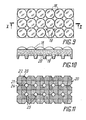
- Figure 9 illustrates a fragment of the face of a glass facing raster tile with lenticular optical elements 18.
- Figure 10 is sectional view of Figure 9 taken at X-X.
- the sectional view demonstrates pins 18 located in plan between the optical elements 18 ( Figures 9, 10) on the back surface of the tile (in Figure 9 fixing elements 19 are shown by dash-and-dot line).
- Figure 11 illustrates a surface of a colour raster backing 20 made of board.
- the backing 20 has differing-in-colour printed sections 21, 22, 23, 24 and a perforation in the form of holes 25 (Figure 11), the diameter and layout of holes 25 being in compliance with the diameter and layout of the fixing elements (pins) 19 of the tile (Figs 9, 10).
- Figure 10 is a sectional view the combination of the raster backing 20 with the tile in which the pins 19 are inserted into holes 25 of the backing 20.
- the raster backing 20 (Figs 10, 11) is bonded to the back surface of the tile, but after facing a part of the wall with the tile using a special cement mortar in the backing becomes monolithic and insulated from the environmental effects.
- the pins 19 (Fig. 10) are also secured in the mortar and function as multiple rater anchors fixing reliably the tile of the wall.
- a carpet When facing the wall panels with such carpets, a carpet is placed on the mould bottom with the backing and pins upward. After placing of the necessary fittings in the mould, it is filled with concrete which enters the additional holes located in the joints between the individual glass tiles and fills these joints from the face side thus insulating the backing from the atmospheric effects and providing for an additional securing of the tile.
- the tiles are provided with a thin perimetrical frame projecting as high as the optical elements.
- the raster pins may also be used in other cases for a precise combination of a translucent layer with any other material provided with a colour raster on its surface.
- a ceramic tile for instance, may have respective hollows on the face side to receive the pins of the glass raster plate with optical elements.
- the numerous pins of the protective layer made of a translucent polymer may be inserted into punched holes of a thin colour-carrying layer, whereupon the portions of the pins projecting from the back side may be fused just ensuring a reliable bonding of the layers without cement.
- the moire effect which is frequently used in creating various materials as a decorative effect, occurs as a result of superimposing two or several lattices or several raster surfaces in which the elements arrangement period differs by one or several directions.
- the moire effect also occurs as a result of the superimposition of two similar lattices if each of them is turned relative to the other through some angle in the plane of their imposition.
- use is made of a tone or single-colour moire percepted as a system of periodical thickenings and thinnings obtained on the surface.
- Figure 14 represents a sectional view of a glass facing tile whose facial side carries periodically arranged optical elements and the back surface has periodically arranged three-dimensional elements 31 with different colours imparted to their different sides in such a way that the similarly oriented sides of the elements have one colour.
- the three-dimensional elements 31 form a colourdynamic textured surface, their arrangement period being two times less than that of the optical elements 30.
- the moire effect can be obtained using not only textured, but also flat raster as colour-carrying surfaces, while the translucent layer may be made using the optical elements, opaque sections or a combination of both.
- the colour sections of a textured or flat coloured raster, as well as the optical elements or opaque sections of the protective layer nay be made as fine as possible, whereby rather thin translucent films and plates, or thin translucent coatings are made use of in the present invention.
Landscapes
- Engineering & Computer Science (AREA)
- Architecture (AREA)
- Civil Engineering (AREA)
- Structural Engineering (AREA)
- Chemical & Material Sciences (AREA)
- Ceramic Engineering (AREA)
- Finishing Walls (AREA)
- Laminated Bodies (AREA)
- Nitrogen And Oxygen Or Sulfur-Condensed Heterocyclic Ring Systems (AREA)
- Application Of Or Painting With Fluid Materials (AREA)
Applications Claiming Priority (3)
| Application Number | Priority Date | Filing Date | Title |
|---|---|---|---|
| PCT/SU1989/000064 WO1990011196A1 (fr) | 1989-03-17 | 1989-03-17 | Matiere decorative chromodynamique |
| AU62504/90A AU647409B2 (en) | 1989-03-17 | 1990-09-13 | Colourdynamic decorative material |
| CA002025387A CA2025387A1 (en) | 1989-03-17 | 1990-09-14 | Colourdynamic decorative material |
Publications (2)
| Publication Number | Publication Date |
|---|---|
| EP0425670A1 true EP0425670A1 (de) | 1991-05-08 |
| EP0425670A4 EP0425670A4 (en) | 1991-10-16 |
Family
ID=25633600
Family Applications (1)
| Application Number | Title | Priority Date | Filing Date |
|---|---|---|---|
| EP19890908287 Withdrawn EP0425670A4 (en) | 1989-03-17 | 1989-03-17 | Decorative colour-dynamic material |
Country Status (4)
| Country | Link |
|---|---|
| EP (1) | EP0425670A4 (de) |
| JP (1) | JPH0788119B2 (de) |
| AU (1) | AU647409B2 (de) |
| CA (1) | CA2025387A1 (de) |
Cited By (9)
| Publication number | Priority date | Publication date | Assignee | Title |
|---|---|---|---|---|
| GB2249974A (en) * | 1990-11-20 | 1992-05-27 | Swintex | Coloured material |
| US5987831A (en) * | 1997-02-24 | 1999-11-23 | Marlux N.V. | Building materials |
| WO2003026904A3 (en) * | 2001-09-24 | 2004-04-08 | Koray Kapkin | Changing appearance glass tile |
| WO2004024644A3 (de) * | 2002-09-16 | 2004-10-28 | Deco Glass Sp Z O O | Glaserzeugnis und verfahren zur verzierung dieses glaserzeugnisses |
| WO2007057097A1 (de) * | 2005-11-18 | 2007-05-24 | Hülsta-Werke Hüls Gmbh & Co. Kg | Bauelement und set aus wenigstens einem bauelement und einer optischen einrichtung |
| CN103264608A (zh) * | 2013-04-28 | 2013-08-28 | 四川长虹电器股份有限公司 | 一种具有3d视觉效果的装饰件及其制造方法 |
| US8778481B2 (en) | 2005-02-18 | 2014-07-15 | Giesecke & Devrient Gmbh | Security element and method for the production thereof |
| EP2789439A1 (de) | 2013-04-09 | 2014-10-15 | Niels Pieter Gerard Nieuweboer | Verfahren zum Herstellen mehrerer ästhetischer Betonoberflächen durch das Verwenden von Metallformen und einem magnetischen Substrat |
| CN115492430A (zh) * | 2022-10-28 | 2022-12-20 | 金螳螂精装科技(苏州)有限公司 | 一种节能降耗型影音室的装配式设计结构 |
Families Citing this family (5)
| Publication number | Priority date | Publication date | Assignee | Title |
|---|---|---|---|---|
| JP4580584B2 (ja) * | 2001-04-27 | 2010-11-17 | 大日本印刷株式会社 | 潜像表示体 |
| JP4997092B2 (ja) * | 2007-12-27 | 2012-08-08 | トッパン・フォームズ株式会社 | 偽造防止媒体 |
| JP5022890B2 (ja) * | 2007-12-27 | 2012-09-12 | トッパン・フォームズ株式会社 | 偽造防止媒体 |
| JP4997093B2 (ja) * | 2007-12-27 | 2012-08-08 | トッパン・フォームズ株式会社 | 偽造防止媒体 |
| KR101469024B1 (ko) * | 2014-07-16 | 2014-12-04 | 이동열 | 디자인 필름 |
Family Cites Families (6)
| Publication number | Priority date | Publication date | Assignee | Title |
|---|---|---|---|---|
| JPS4737747Y1 (de) * | 1969-09-18 | 1972-11-15 | ||
| US4126727A (en) * | 1976-06-16 | 1978-11-21 | Congoleum Corporation | Resinous polymer sheet materials having selective, decorative effects |
| US4405676A (en) * | 1981-05-13 | 1983-09-20 | Minnesota Mining & Manufacturing Company | Decorative ribbon or sheet material |
| US4420221A (en) * | 1982-03-19 | 1983-12-13 | Sparks Lawrence N | Passive animated, or pattern changing sign |
| US4634220A (en) * | 1983-02-07 | 1987-01-06 | Minnesota Mining And Manufacturing Company | Directionally imaged sheeting |
| US4916007A (en) * | 1985-10-18 | 1990-04-10 | Tarkett Inc. | Underprinted inlaid sheet materials having unique decorative design effects |
-
1989
- 1989-03-17 JP JP1507953A patent/JPH0788119B2/ja not_active Expired - Lifetime
- 1989-03-17 EP EP19890908287 patent/EP0425670A4/en not_active Withdrawn
-
1990
- 1990-09-13 AU AU62504/90A patent/AU647409B2/en not_active Ceased
- 1990-09-14 CA CA002025387A patent/CA2025387A1/en not_active Abandoned
Cited By (12)
| Publication number | Priority date | Publication date | Assignee | Title |
|---|---|---|---|---|
| GB2249974A (en) * | 1990-11-20 | 1992-05-27 | Swintex | Coloured material |
| GB2249974B (en) * | 1990-11-20 | 1994-10-12 | Swintex | Coloured material |
| US5987831A (en) * | 1997-02-24 | 1999-11-23 | Marlux N.V. | Building materials |
| WO2003026904A3 (en) * | 2001-09-24 | 2004-04-08 | Koray Kapkin | Changing appearance glass tile |
| WO2004024644A3 (de) * | 2002-09-16 | 2004-10-28 | Deco Glass Sp Z O O | Glaserzeugnis und verfahren zur verzierung dieses glaserzeugnisses |
| US8778481B2 (en) | 2005-02-18 | 2014-07-15 | Giesecke & Devrient Gmbh | Security element and method for the production thereof |
| WO2007057097A1 (de) * | 2005-11-18 | 2007-05-24 | Hülsta-Werke Hüls Gmbh & Co. Kg | Bauelement und set aus wenigstens einem bauelement und einer optischen einrichtung |
| EP2789439A1 (de) | 2013-04-09 | 2014-10-15 | Niels Pieter Gerard Nieuweboer | Verfahren zum Herstellen mehrerer ästhetischer Betonoberflächen durch das Verwenden von Metallformen und einem magnetischen Substrat |
| WO2014166625A1 (en) | 2013-04-09 | 2014-10-16 | Nieuweboer Niels Pieter Gerard | Method for manufacturing a variety of esthetic concrete surfaces using metal molds and a flexible sheet with at least one magnetic side |
| CN103264608A (zh) * | 2013-04-28 | 2013-08-28 | 四川长虹电器股份有限公司 | 一种具有3d视觉效果的装饰件及其制造方法 |
| CN103264608B (zh) * | 2013-04-28 | 2016-06-22 | 四川长虹电器股份有限公司 | 一种具有3d视觉效果的装饰件及其制造方法 |
| CN115492430A (zh) * | 2022-10-28 | 2022-12-20 | 金螳螂精装科技(苏州)有限公司 | 一种节能降耗型影音室的装配式设计结构 |
Also Published As
| Publication number | Publication date |
|---|---|
| AU6250490A (en) | 1992-03-19 |
| CA2025387A1 (en) | 1992-03-15 |
| EP0425670A4 (en) | 1991-10-16 |
| AU647409B2 (en) | 1994-03-24 |
| JPH03505711A (ja) | 1991-12-12 |
| JPH0788119B2 (ja) | 1995-09-27 |
Similar Documents
| Publication | Publication Date | Title |
|---|---|---|
| EP0425670A1 (de) | Farbdynamisches dekomaterial | |
| US9278577B2 (en) | Decorative coverings | |
| CA2972525C (en) | Laminated asphalt roofing shingle and method of making thereof | |
| CN101115894A (zh) | 具有倾斜图案的地板系统 | |
| CN100594278C (zh) | 具有多个接合点的地板系统 | |
| EP0358495A1 (de) | Verzierungselemente | |
| US9746590B2 (en) | Retroreflective sheeting having a halftone printed front surface | |
| EP1509790B1 (de) | Rückreflektierendes schichtsystem mit an eine luftschicht grenzenden mikrostrukturen | |
| US3575773A (en) | Light reflective device | |
| JPH072440B2 (ja) | 動的色彩装飾材料及びその製造方法 | |
| US12448773B2 (en) | Defect-hiding surface textures | |
| JPH08118577A (ja) | 立体模様を有する内装材 | |
| RU24816U1 (ru) | Керамическая плитка, снабженная декором | |
| CN112462456B (zh) | 一种光学薄膜、制作方法及搭载其的电子设备盖板 | |
| CN102736150B (zh) | 一种改进的微棱镜逆反射材料结构 | |
| AU625647B2 (en) | Colourdynamic decorative materials and method of obtaining them | |
| US3889027A (en) | Retroreflective film | |
| US4053340A (en) | Method for producing display sign panel | |
| JP2835823B2 (ja) | 装飾板 | |
| CN109475054B (zh) | 一种装饰薄膜、模具及电子设备盖板 | |
| US3274041A (en) | Method of making sheet material | |
| US2287653A (en) | Floor covering tile | |
| CN101845877A (zh) | 一种新型凸棱抛光板材及其制作方法 | |
| JPH1122167A (ja) | 不織布が2層構成の床材 | |
| WO1990011196A1 (fr) | Matiere decorative chromodynamique |
Legal Events
| Date | Code | Title | Description |
|---|---|---|---|
| PUAI | Public reference made under article 153(3) epc to a published international application that has entered the european phase |
Free format text: ORIGINAL CODE: 0009012 |
|
| 17P | Request for examination filed |
Effective date: 19901116 |
|
| AK | Designated contracting states |
Kind code of ref document: A1 Designated state(s): AT BE CH DE FR GB IT LI NL SE |
|
| A4 | Supplementary search report drawn up and despatched |
Effective date: 19910829 |
|
| AK | Designated contracting states |
Kind code of ref document: A4 Designated state(s): AT BE CH DE FR GB IT LI NL SE |
|
| 17Q | First examination report despatched |
Effective date: 19940211 |
|
| RAP1 | Party data changed (applicant data changed or rights of an application transferred) |
Owner name: TOVARISCHESTVO S OGRANICHENNOI OTVETSTVENNOST JU N |
|
| GRAG | Despatch of communication of intention to grant |
Free format text: ORIGINAL CODE: EPIDOS AGRA |
|
| STAA | Information on the status of an ep patent application or granted ep patent |
Free format text: STATUS: THE APPLICATION IS DEEMED TO BE WITHDRAWN |
|
| 18D | Application deemed to be withdrawn |
Effective date: 19961011 |