EP0415211A2 - 3-Aryl-pyrrolidin-2,4-dion-derivate - Google Patents
3-Aryl-pyrrolidin-2,4-dion-derivate Download PDFInfo
- Publication number
- EP0415211A2 EP0415211A2 EP90115872A EP90115872A EP0415211A2 EP 0415211 A2 EP0415211 A2 EP 0415211A2 EP 90115872 A EP90115872 A EP 90115872A EP 90115872 A EP90115872 A EP 90115872A EP 0415211 A2 EP0415211 A2 EP 0415211A2
- Authority
- EP
- European Patent Office
- Prior art keywords
- alkyl
- halogen
- formula
- alkoxy
- stands
- Prior art date
- Legal status (The legal status is an assumption and is not a legal conclusion. Google has not performed a legal analysis and makes no representation as to the accuracy of the status listed.)
- Granted
Links
- 0 **1C(*)=CCC(C(C(CC2=CCB*CC22)=O)=C2O)C(*)=C1 Chemical compound **1C(*)=CCC(C(C(CC2=CCB*CC22)=O)=C2O)C(*)=C1 0.000 description 4
Classifications
-
- C—CHEMISTRY; METALLURGY
- C07—ORGANIC CHEMISTRY
- C07D—HETEROCYCLIC COMPOUNDS
- C07D513/00—Heterocyclic compounds containing in the condensed system at least one hetero ring having nitrogen and sulfur atoms as the only ring hetero atoms, not provided for in groups C07D463/00, C07D477/00 or C07D499/00 - C07D507/00
- C07D513/02—Heterocyclic compounds containing in the condensed system at least one hetero ring having nitrogen and sulfur atoms as the only ring hetero atoms, not provided for in groups C07D463/00, C07D477/00 or C07D499/00 - C07D507/00 in which the condensed system contains two hetero rings
- C07D513/04—Ortho-condensed systems
-
- A—HUMAN NECESSITIES
- A01—AGRICULTURE; FORESTRY; ANIMAL HUSBANDRY; HUNTING; TRAPPING; FISHING
- A01N—PRESERVATION OF BODIES OF HUMANS OR ANIMALS OR PLANTS OR PARTS THEREOF; BIOCIDES, e.g. AS DISINFECTANTS, AS PESTICIDES OR AS HERBICIDES; PEST REPELLANTS OR ATTRACTANTS; PLANT GROWTH REGULATORS
- A01N43/00—Biocides, pest repellants or attractants, or plant growth regulators containing heterocyclic compounds
- A01N43/90—Biocides, pest repellants or attractants, or plant growth regulators containing heterocyclic compounds having two or more relevant hetero rings, condensed among themselves or with a common carbocyclic ring system
-
- A—HUMAN NECESSITIES
- A01—AGRICULTURE; FORESTRY; ANIMAL HUSBANDRY; HUNTING; TRAPPING; FISHING
- A01N—PRESERVATION OF BODIES OF HUMANS OR ANIMALS OR PLANTS OR PARTS THEREOF; BIOCIDES, e.g. AS DISINFECTANTS, AS PESTICIDES OR AS HERBICIDES; PEST REPELLANTS OR ATTRACTANTS; PLANT GROWTH REGULATORS
- A01N47/00—Biocides, pest repellants or attractants, or plant growth regulators containing organic compounds containing a carbon atom not being member of a ring and having no bond to a carbon or hydrogen atom, e.g. derivatives of carbonic acid
- A01N47/02—Biocides, pest repellants or attractants, or plant growth regulators containing organic compounds containing a carbon atom not being member of a ring and having no bond to a carbon or hydrogen atom, e.g. derivatives of carbonic acid the carbon atom having no bond to a nitrogen atom
- A01N47/06—Biocides, pest repellants or attractants, or plant growth regulators containing organic compounds containing a carbon atom not being member of a ring and having no bond to a carbon or hydrogen atom, e.g. derivatives of carbonic acid the carbon atom having no bond to a nitrogen atom containing —O—CO—O— groups; Thio analogues thereof
-
- C—CHEMISTRY; METALLURGY
- C07—ORGANIC CHEMISTRY
- C07D—HETEROCYCLIC COMPOUNDS
- C07D277/00—Heterocyclic compounds containing 1,3-thiazole or hydrogenated 1,3-thiazole rings
- C07D277/02—Heterocyclic compounds containing 1,3-thiazole or hydrogenated 1,3-thiazole rings not condensed with other rings
- C07D277/04—Heterocyclic compounds containing 1,3-thiazole or hydrogenated 1,3-thiazole rings not condensed with other rings having no double bonds between ring members or between ring members and non-ring members
- C07D277/06—Heterocyclic compounds containing 1,3-thiazole or hydrogenated 1,3-thiazole rings not condensed with other rings having no double bonds between ring members or between ring members and non-ring members with carbon atoms having three bonds to hetero atoms with at the most one bond to halogen, e.g. ester or nitrile radicals, directly attached to ring carbon atoms
-
- C—CHEMISTRY; METALLURGY
- C07—ORGANIC CHEMISTRY
- C07D—HETEROCYCLIC COMPOUNDS
- C07D279/00—Heterocyclic compounds containing six-membered rings having one nitrogen atom and one sulfur atom as the only ring hetero atoms
- C07D279/04—1,3-Thiazines; Hydrogenated 1,3-thiazines
- C07D279/06—1,3-Thiazines; Hydrogenated 1,3-thiazines not condensed with other rings
-
- C—CHEMISTRY; METALLURGY
- C07—ORGANIC CHEMISTRY
- C07D—HETEROCYCLIC COMPOUNDS
- C07D279/00—Heterocyclic compounds containing six-membered rings having one nitrogen atom and one sulfur atom as the only ring hetero atoms
- C07D279/10—1,4-Thiazines; Hydrogenated 1,4-thiazines
Definitions
- the invention relates to new 3-aryl-pyrrolidine-2,4-dione derivatives, several processes for their preparation and their use as herbicides, insecticides and acaricides.
- EP-A 0 262 399 discloses similarly structured compounds (3-aryl-pyrrolidine-2,4-diones), of which no herbicidal, fungicidal, antifungal, tickicidal, insecticidal or acaricidal activity has become known.
- Phenyl, optionally substituted phenylalkyl, substituted hetaryl, substituted phenoxyalkyl and substituted hetaryloxyalkyl and R 2 stands for optionally halogen-substituted alkyl, cycloalkyl, alkenyl, alkoxyalkyl, polyalkoxyalkyl and optionally substituted phenyl, and the enantiomerically pure forms of compounds of the formula (I).
- AB represents -S-CH 2 -, -SO-CH 2 -, -SO 2 -CH 2 -, -CH 2 -S-, -CH 2 -SO-, -CH 2 -SO 2 -, -S-, -SO-, -SOz-
- X represents C 1 -C 4 alkyl, halogen, C 1 -C 4 alkoxy
- Y represents hydrogen, C 1 -C 6 alkyl, halogen, C 1 -C 4 alkoxy, C 1 -C 2 haloalkyl stands for Z 1 -C 4 alkyl, halogen, C 1 -C 4 alkoxy
- n stands for a number from 0-3,
- R stands for hydrogen (la) or for the groups of the formula or E (Id), in which E represents a metal cation equivalent or an ammonium ion, R 1 represents optionally substituted by halogen: C 1 -C 16 alkyl
- Compounds of the formula (Ila) are, for example, from the phenylacetic acid halides of the formula (VII) and amino acids of the formula (Vla), in which A and B have the meaning given above, available from Schotten-Baumann (Organikum 9th edition 44) (1970) VEB Deutscher Verlag dermaschineen, Berlin).
- reaction temperatures can be varied within a substantial range when carrying out process (A) according to the invention. In general, temperatures between 0 C and 25 C, preferably between 50 ° C and 150 ° C.
- Process (A) according to the invention is generally carried out under normal pressure.
- reaction components of the formulas (11) and the deprotonating bases are generally employed in approximately equimolar amounts. However, it is also possible to use one or the other component in a larger excess (up to 3 moles).
- the process (A) is characterized in that compounds of the formula (11) in which X, Y, Z, m, n and R 3 have the meaning given above are subjected to intramolecular condensation in the presence of bases.
- All customary inert organic solvents can be used as diluents in process (A) according to the invention.
- Hydrocarbons such as cyclohexane, toluene and xylene, furthermore ethers such as dibutyl ether, tetrahydrofuran, dioxane, glycol dimethyl ether and diglycol dimethyl ether, and also polar solvents such as dimethyl sulfoxide, sulfolane, dimethylformamide and N-methyl-pyrrolidone are preferably usable.
- All conventional proton acceptors can be used as deprotonating agents when carrying out process (A) according to the invention.
- Alkali metal and alkaline earth metal oxides, hydroxides and carbonates such as sodium hydroxide, potassium hydroxide, magnesium oxide, calcium oxide, sodium carbonate, potassium carbonate and calcium carbonate, which are also present in the presence of phase transfer catalysts such as e.g. Triethylbenzylammoniumchlorid, Tetrabutylammoniumbromid, Adogen 464 or TDA 1 can be used.
- alkali metal and alkaline earth metal amides and hydrides such as sodium amide, sodium hydride and calcium hydride, and also alkali metal alcoholates such as sodium methylate, sodium methylate and potassium tert-butoxide can also be used.
- Process (Ba) is characterized in that compounds of the formula (Ia) are reacted with carboxylic acid halides of the formula (III).
- All solvents which are inert towards these compounds can be used as diluents in the process (Ba) according to the invention when using the acid halides.
- Hydrocarbons such as gasoline, benzene, toluene, xylene and tetralin are preferably usable, furthermore halogenated hydrocarbons such as methylene chloride, chloroform, carbon tetrachloride, chlorobenzene and o-dichlorobenzene, also ketones such as acetone and methylisopropyl ketone, furthermore ethers such as diethyl ether, tetrahydrofuran and dioxane, in addition carboxylic acid esters, such as ethyl acetate, and also strongly polar solvents, such as dimethyl sulfoxide and sulfolane. If the hydrolysis stability of the acid halide permits, the reaction can also be carried out in the presence of water.
- Adogen 464 methyltrialkyl (C 8 -C 10 ) ammonium chloride
- TDA 1 tris (methoxyethoxylethyl) amine
- all customary acid acceptors are suitable as acid binders for the reaction according to process (B ⁇ ) according to the invention.
- Tertiary amines such as triethylamine, pyridine, DABCO, DBU, DBA, Hunig base and N, N-dimethylaniline, furthermore alkaline earth metal oxides, such as magnesium and calcium oxide, and also alkali metal and alkaline earth metal carbonates, such as sodium carbonate, can preferably be used , Potassium carbonate and calcium carbonate.
- reaction temperatures can also be varied within a relatively wide range in the process (B ⁇ ) according to the invention, even when using carboxylic acid halides.
- NEN is carried out at temperatures between -20 C and + 150 ° C, preferably between 0 ° C and 100 ° C.
- the starting materials of the formula (Ia) and the carboxylic acid halide of the formula (III) are generally used in approximately equivalent amounts. However, it is also possible to use the carboxylic anhydride in a larger excess (up to 5 mol). The processing takes place according to usual methods.
- the process (Bß) is characterized in that compounds of the formula (Ia) are reacted with carboxylic acid hydrides of the formula (IV).
- the diluents which can preferably be used are those which are also preferred when using acid halides. Otherwise, an excess of carboxylic acid hydride can also act as a diluent.
- reaction temperatures can also be varied within a substantial range even when using carboxylic anhydrides. In general, temperatures between -20 ° C and + 150 ° C, preferably between 0 ° C and 100 ° C.
- the starting materials of the formula (Ia) and the carboxylic anhydride of the formula (IV) are generally used in approximately equivalent amounts. However, it is also possible to use the carboxylic anhydride in a larger excess (up to 5 mol). The processing takes place according to usual methods.
- the general procedure is to remove diluent and excess carboxylic acid hydride and the carboxylic acid formed by distillation or by washing with an organic solvent or with water.
- Process (C) is characterized in that compounds of the formula (Ia) are reacted with chloroformates of the formula (V).
- corresponding chloroformic acid esters are used, all customary acid acceptors are suitable as acid binders in the reaction according to process (C) according to the invention.
- Tertiary amines such as triethylamine, pyridine, DABCO, DBC, DBA, Hunig base and N, N-dimethylaniline, furthermore alkaline earth metal oxides, such as magnesium and calcium oxide, and also alkali metal and alkaline earth metal carbonates, are preferably usable. such as sodium carbonate, potassium carbonate and calcium carbonate.
- All solvents which are inert to these compounds can be used as diluents in process (C) according to the invention when using the chloroformate.
- Hydrocarbons such as gasoline, benzene, toluene, xylene and tetralin are preferably usable, furthermore halogenated hydrocarbons such as methylene chloride, chloroform, carbon tetrachloride, chlorobenzene and o-dichlorobenzene, furthermore ketones such as acetone and methylisopropyl ketone, furthermore ethers such as diethyl ether, tetrahydrofuran and dioxane, in addition Carboxylic acid esters such as ethyl acetate and also strongly polar solvents such as dimethyl sulfoxide and sulfolane.
- reaction temperatures when carrying out process (C) according to the invention can be varied within a substantial range. If one works in the presence of a diluent and an acid binder, the reaction temperatures are generally between -20 ° C and + 100 ° C, preferably between 0 C and 50 C.
- Process (C) according to the invention is generally carried out under normal pressure.
- the starting materials of the formula (Ia) and the corresponding (chloroformic acid ester of the formula (V) are generally used in approximately equivalent amounts. However, it is also possible to use one or the other component in a larger excess
- the mixture is then worked up by customary methods, in general the procedure is to remove precipitated salts and to concentrate the remaining reaction mixture by stripping off the diluent.
- Process (D) is characterized in that compounds of the formula (Ia) are reacted with acetal hydroxides (VIII) or amines (IX).
- ethers such as tetrahydrofuran, dioxane, diethyl ether or alcohols such as methanol, ethanol, isopropanol, but also water can preferably be used in the process according to the invention.
- Process (D) according to the invention is generally carried out under normal pressure.
- the reaction temperatures are generally between -20 C and 100 ° C, preferably between 0 ° C and 50 C.
- the starting materials of the formula (la) or (IX) are generally used in approximately equimolar amounts. However, it is also possible to use one or the other component in a larger excess (up to 2 mol). In general, the procedure is that the reaction mixture is concentrated by stripping off the diluent.
- Suitable oxidants for the process (E) according to the invention are all sulfur-oxidizing reagents, for example halogen such as chlorine and bromine and their aqueous solutions, alkali peroxides such as sodium peroxide and potassium peroxide, salts of halogen oxygen acids such as potassium chlorate, potassium bromate, sodium periodate and sodium perborate, and furthermore inorganic persalts such as potassium permanganate , Potassium peroxodisulfate and potassium peroxomonosulfate, but also H 2 0 2 in the presence of transition metal salts such as sodium tungstate and ammonium molybdate.
- Organic peroxides such as tert-butyl hydroperoxide but also organic peracids such as peracetic acid, perpropionic acid and m-chloroperbenzoic acid (MCPBA) can also be used.
- Hydrocarbons such as gasoline, benzene, toluene, xylene and tetralin are preferably usable, furthermore halogenated hydrocarbons such as methylene chloride, chloroform, chlorobenzene and dichlorobenzene, and also organic acids such as acetic acid and propionic acid and water.
- reaction temperatures when carrying out process (E) according to the invention can be varied within a substantial range.
- the reaction temperatures are between -30 C and + 150 ° C, preferably between 0 C and 100 C.
- Process (E) according to the invention is generally carried out under normal pressure.
- the starting materials of the formulas (Ia) to (Ic) and the corresponding oxidizing agent are used in approximately twice equimolar amounts. However, it is also possible to use the oxidizing agent in a larger excess (up to 2 mol). The processing takes place according to the usual methods.
- Suitable oxidants for process (F) according to the invention are all sulfur-oxidizing reagents, for example halogen such as chlorine and bromine and their aqueous solutions, alkali peroxides such as sodium peroxide and potassium peroxide, salts of halogen oxygen acids such as potassium chlorate, potassium bromate, sodium periodate and sodium perborate, and furthermore inorganic persalts such as potassium pers ganate, potassium peroxodisulfate and potassium peroxomonosulfate, but also H 2 0 2 in the presence of transition metal salts such as sodium tungstate and ammonium molybdate.
- Organic peroxides such as tert-butyl hydroperoxide but also organic peracids such as peracetic acid, perpropionic acid and m-chloroperbenzoic acid (MCPBA) can also be used.
- Hydrocarbons such as gasoline, benzene, toluene, xylene and tetralin are preferably usable, furthermore halogenated hydrocarbons such as methylene chloride, chloroform, chlorobenzene and dichlorobenzene, and also organic acids such as acetic acid and propionic acid and water.
- reaction temperatures when carrying out process (F) according to the invention can be varied within a substantial range.
- the reaction temperatures are between -30 ° C and + 150 ° C, preferably between 0 ° C and 100 ° C.
- Process (F) according to the invention is generally carried out under normal pressure.
- Plant-parasitic nematodes include Pratylenchus spp., Radopholus similis, Ditylenchus dipsaci, Tylenchulus semipenetrans, Heterodera spp., Globodera ssp., Meloidogyne spp., Aphelenchoides spp., Longidorus spp., Tripichema spp.
- the active compounds according to the invention can furthermore be used as defoliants, desiccants, haulm killers and in particular as weed killers. Weeds in the broadest sense are understood to mean all plants that grow up in places where they are undesirable. Whether the substances according to the invention act as total or selective herbicides depends essentially on the amount used.
- the compounds according to the invention have a selective activity against monocotyledon weeds in monocotyledon and dicotyledon crops in the pre- and post-process (pre- and post-mergence) with good crop tolerance.
- the active compounds according to the invention can be used, for example, in the following plants: monocotyledon weeds of the genera: Echinochloa, Setaria, Panicum, Digitaria, Phleum, Poa, Festuca, Eleusine, Brachiaria, Lolium, Bromus, Avena, Cyperus, Sorghum, Agropyron, Cynodon, Monochoria , Fimbristylis, Sagittaria, Eleocharis, Scirpus, Paspalum, Ischaemum, Sphenoclea, Dactyloctenium, Agrostis, Alopecurus, Apera.
- Monocot cultures of the genera Oryza, Zea, Triticum, Hordeum, Avena, Secale, Sorghum, Panicum, Saccharum, Pineapple, Asparagus, Allium.
- the compounds are suitable for total weed control, e.g. on industrial and track systems and on paths and squares with and without tree cover.
- the compounds for weed control in permanent crops e.g. Forests, ornamental trees, fruit, wine, citrus, nut, banana, coffee, tea, rubber, oil palm, cocoa, berry fruit and hop plants and for selective weed control in annual crops.
- the active compounds according to the invention show good compatibility with important crop plants, such as, for. As wheat, cotton, soybeans, citrus fruits and sugar beets, and can therefore be used as selective weed control agents.
- the active ingredients can be converted into the customary formulations, such as solutions, emulsions, suspensions, powders, foams, pastes, granules, aerosols, active ingredient-impregnated natural and synthetic substances, very fine encapsulations in polymeric substances and in coating compositions for seeds, and also in formulations with Fuel sets, such as smoking cartridges, cans, spirals, etc., as well as ULV cold and warm fog Wording.
- customary formulations such as solutions, emulsions, suspensions, powders, foams, pastes, granules, aerosols, active ingredient-impregnated natural and synthetic substances, very fine encapsulations in polymeric substances and in coating compositions for seeds, and also in formulations with Fuel sets, such as smoking cartridges, cans, spirals, etc., as well as ULV cold and warm fog Wording.
- formulations are made in a known manner, e.g. by mixing the active ingredients with extenders, that is to say liquid solvents, pressurized liquefied gases and / or solid carriers, if appropriate using surface-active agents, that is to say emulsifiers and / or dispersants and / or foam-generating agents. If water is used as an extender, e.g. organic solvents can also be used as auxiliary solvents.
- extenders that is to say liquid solvents, pressurized liquefied gases and / or solid carriers, if appropriate using surface-active agents, that is to say emulsifiers and / or dispersants and / or foam-generating agents.
- surface-active agents that is to say emulsifiers and / or dispersants and / or foam-generating agents.
- water e.g. organic solvents can also be used as auxiliary solvents.
- aromatics such as xylene, toluene, or alkylnaphthalenes
- chlorinated aromatics or chlorinated aliphatic hydrocarbons such as chlorobenzenes, chlorethylenes or methylene chloride
- aliphatic hydrocarbons such as cyclohexane or paraffins, e.g.
- Petroleum fractions Petroleum fractions, alcohols, such as butanol or glycol, and their ethers and esters, ketones, such as acetone, methyl ethyl ketone, methyl isobutyl ketone or cyclohexanone, strongly polar solvents, such as dimethylformamide and dimethyl sulfoxide, and water;
- liquefied gaseous extenders or carriers mean liquids which are gaseous at normal temperature and pressure, e.g. Aerosol propellants, such as halogenated hydrocarbons and butane, propane, nitrogen and carbon dioxide; solid carriers are possible: e.g.
- natural rock powders such as kaolins, clays, talc, chalk, quartz, attapulgite, montmorillonite or diatomaceous earth and synthetic rock powders such as highly disperse silica, aluminum oxide and silicates; as solid carriers for granules are possible: e.g. broken and fractionated natural rocks such as calcite, marble, pumice, sepiolite, dolomite and synthetic granules from inorganic and organic flours and granules from organic material such as sawdust, coconut shells, corn cobs and tobacco stems; as emulsifiers and / or foaming agents are possible: e.g.
- nonionic and anionic emulsifiers such as polyoxyethylene fatty acid esters, polyoxyethylene fatty alcohol ethers, e.g. Alkylaryl polyglycol ethers, alkyl sulfonates, alkyl sulfates, aryl sulfonates and protein hydrolyzates;
- Possible dispersants are: e.g. Lignin sulfite liquor and methyl cellulose.
- Adhesives such as carboxymethyl cellulose, natural and synthetic polymers in the form of powders, granules or latices, such as gum arabic, polyvinyl alcohol, polyvinyl acetate, and also natural phospholipids, such as cephalins and lecithins, and synthetic phospholipids can be used in the formulations.
- Other additives can be mineral and vegetable oils.
- Dyes such as inorganic pigments, e.g. Iron oxide, titanium oxide, ferrocyan blue and organic dyes such as alizarin, azo and metal phthalocyanine dyes and trace nutrients such as salts of iron, manganese, boron, copper, cobalt, molybdenum and zinc can be used.
- the formulations generally contain between 0.1 and 95 percent by weight of active compound, preferably between 0.5 and 90%.
- the active compounds according to the invention can be present in their commercially available formulations and in the use forms prepared from these formulations in a mixture with other active compounds, such as insecticides, attractants, sterilants, acaricides, nematicidal herbicides or fungicides.
- Insecticides include, for example, phosphoric acid esters, carbamates, carboxylic acid esters, chlorinated hydrocarbons, phenylureas, substances produced by microorganisms, etc.
- the active compounds according to the invention can furthermore be present in their commercially available formulations and in the use forms prepared from these formulations in a mixture with synergists.
- Synergists are compounds that increase the effectiveness of the active ingredients without the added synergist itself having to be active.
- the active substance content of the use forms prepared from the commercially available formulations can vary within wide ranges.
- the active substance concentration of the use forms can be from 0.0000001 to 95% by weight of active substance, preferably between 0.0001 and 1% by weight.
- the application takes place in a customary manner adapted to the application forms.
- the active ingredients can be used as such, in the form of their formulations or the use forms prepared therefrom by further dilution or by combination with emulsifiable oils, surface-active substances and further additions, such as ready-to-use solutions, suspensions, emulsions, powders, pastes and granules. They are used in the usual way, e.g. by pouring, spraying, spraying, sprinkling.
- the active compounds according to the invention can be applied as herbicides both before and after emergence of the plants.
- the amount of active ingredient used can vary over a wide range. It essentially depends on the type of effect desired. In general, the application rates are between 0.01 and 15 kg of active ingredient per hectare of soil, preferably between 0.1 and 5 kg per ha.
- the active compounds which can be used according to the invention are also suitable for combating mites and ticks etc. in the field of animal husbandry and cattle breeding, whereby by combating the pests better results, for example higher milk yields, higher weight, more beautiful animal fur, longer lifespan etc. can be achieved.
- the active ingredients which can be used according to the invention are used in this field in a known manner, such as by oral use in the form of, for example, tablets, capsules, drinkers, granules, by dermal or external use in the form of, for example, dipping (dipping), spraying (spraying), pouring on (pour-on and spot-on) and powdering, as well as by parenteral use in the form of, for example, injection and also by the "feed-through” method. It can also be used as a shaped body (collar, ear tag).
- Solvent 7 parts by weight of dimethylformamide emulsifier: 1 part by weight of alkylaryl polyglycol ether
- active compound 1 part by weight of active compound is mixed with the stated amount of solvent and the stated amount of emulsifier, and the concentrate is diluted with water to the desired concentration.
- Bean plants Phaseolus vulgaris
- Bean plants which are severely affected by all stages of development of the common spider mite or bean spider mite (Tetranychus urticae)
- the kill is determined in%. 100% means that all spider mites have been killed; 0% means that no spider mites have been killed.
- Solvent 7 parts by weight of dimethylformamide emulsifier: 1 part by weight of alkylaryl polyglycol ether
- active compound 1 part by weight of active compound is mixed with the stated amount of solvent and the stated amount of emulsifier, and the concentrate is diluted with water to the desired concentration.
- Rice seedlings (Oryza sativa) are treated by dipping into the active ingredient preparation of the desired concentration and populated with larvae of the green leafhopper (Nephotettix cincticeps) while the seedlings are still moist.
- the kill is determined in%. 100% means that all cicadas have been killed; 0% means that none of the cicadas have been killed.
- Solvent 5 parts by weight of acetone emulsifier: 1 part by weight of alkylaryl polyglycol ether
- active compound 1 part by weight of active compound is mixed with of the stated amount of solvent, add the stated amount of emulsifier and dilute the concentrate with water to the desired concentration.
- Solvent 5 parts by weight of acetone emulsifier: 1 part by weight of alkylaryl polyglycol ether
- active compound 1 part by weight of active compound is mixed with the stated amount of solvent, the stated amount of emulsifier is added and the concentrate is diluted with water to the desired concentration.
- Test plants which have a height of 5-15 cm are sprayed with the active substance preparation in such a way that the desired amounts of active substance are applied per unit area.
- the concentration of the spray liquor is chosen so that the particular amounts of active compound desired are applied in 2000 l of water / ha.
- the degree of damage to the plants is rated in% damage compared to the development of the untreated control.
Landscapes
- Organic Chemistry (AREA)
- Chemical & Material Sciences (AREA)
- Life Sciences & Earth Sciences (AREA)
- Environmental Sciences (AREA)
- Agronomy & Crop Science (AREA)
- Engineering & Computer Science (AREA)
- Dentistry (AREA)
- General Health & Medical Sciences (AREA)
- Wood Science & Technology (AREA)
- Zoology (AREA)
- Plant Pathology (AREA)
- Pest Control & Pesticides (AREA)
- Health & Medical Sciences (AREA)
- Agricultural Chemicals And Associated Chemicals (AREA)
- Plural Heterocyclic Compounds (AREA)
- Indole Compounds (AREA)
- Nitrogen- Or Sulfur-Containing Heterocyclic Ring Compounds With Rings Of Six Or More Members (AREA)
- Nitrogen And Oxygen Or Sulfur-Condensed Heterocyclic Ring Systems (AREA)
- Pyrrole Compounds (AREA)
- Nitrogen Condensed Heterocyclic Rings (AREA)
Abstract
Description
- Die Erfindung betrifft neue 3-Aryl-pyrrolidin-2,4-dion-Derivate, mehrere Verfahren zu ihrer Herstellung und ihre Verwendung als Herbizide, Insektizide und Akarizide.
- Von 3-Acyl-pyrrolidin-2,4-dionen sind pharmazeutische Eigenschaften vorbeschrieben (S. Suzuki et. al. Chem. Pharm. bull. 15 1120 (1967)). Weiterhin wurden N-Phenylpyrrolidin-2,4-dione von R. Schmierer und H. Mildenberger Liebigs Ann. Chem. 1985 1095 synthetisiert. Eine biologische Wirksamkeit dieser Verbindungen wurde nicht beschrieben.
- In EP-A 0 262 399 werden ähnlich strukturierte Verbindungen (3-Aryl-pyrrolidin-2,4-dione) offenbart, von denen jedoch keine herbizide, fungizide, antimykotische, tickizide, insektizide oder akarizide Wirksamkeit bekannt geworden ist.
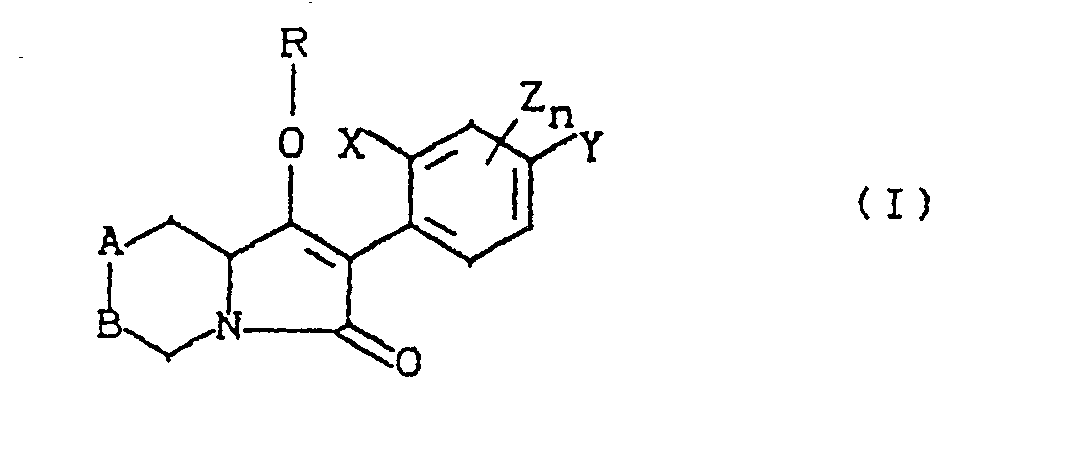
- Es wurden nun neue 3-Aryl-pyrrolidin-2,4-dion-Derivate gefunden, die durch die Formel (I) dargestellt sind,

- Im folgenden seien die folgenden Untergruppen definiert:
- (la): Verbindungen der Formel (I), worin R = Wasserstoff,
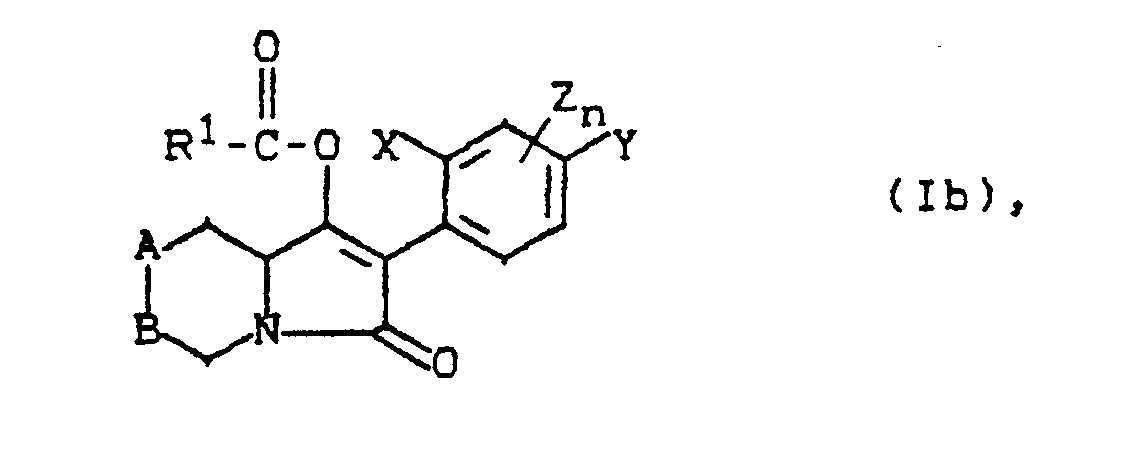
- (Ib): Verbindungen der Formel (I), worin R = COR1,
- (Ic): Verbindungen der Formel (I), worin R = COOR2,
- (Id): Verbindungen der Formel (I), worin R = ein Metallionäquivalent oder ein Ammoniumion.
- (le): Verbindungen der Formel (I), worin A-B = -SO-CH2-, -CH2-SO oder -SO-,
- (If): Verbindungen der Formel (I), worin A-B = -S02-CH2-, -CH2-SO2-, -S02- darstellt.
- Weiterhin wurde gefunden, daß man 3-Aryl-pyrrolidin-2,4-dione bzw. deren Enole der Formel (la)

- (A)
- N-Acylaminosäureester der Formel (II),

- (B) Außerdem wurde gefunden, daß man Verbindungen der Formel (Ib)


- (C) Ferner wurde gefunden, daß man Verbindungen der Formel (Ic)



- (D) Weiterhin wurde gefunden, daß man Verbindungen der Formel (Id),


- (E) Ferner wurde gefunden, daß man Verbindungen der Formel (le),


- (F) Außerdem wurde gefunden, daß man Verbindungen der Formel (If),


- Überraschenderweise wurde gefunden, daß die neuen 3-Arylpyrrolidin-2,4-dione der Formel (I) sich durch hervorragende herbizide, insektizide, antimykotische und akarizide Wirkungen auszeichnen.
- Bevorzugt sind kondensierte 1,5-Alkylen-3-aryl-pyrrolidin-2,4-dione und deren entsprechende Enolester der Formel (I), in welcher A-B für -S-CH2-, -SO-CH2-, -SOz-CHz-, -CH2-S-, -CH2-SO-, -CH2-SO2-, -S-, -SOz-, -SOz- steht, X für C1-C6-Alkyl, Halogen, C1-C6-Alkoxy steht, Y für Wasserstoff, C1-C6-Alkyl Halogen, C1-C6-Alkoxy, C1-C3-Halogenalkyl steht, Z für C1-C6-Alkyl, Halogen, C1-C6-Alkoxy steht, n für eine Zahl von 0-3 steht, R für Wasserstoff (la) oder für die Gruppen der Formel

- Besonders bevorzugt sind Verbindungen der Formel (I), in welcher A-B für -S-CH2-, -SO-CH2-, -SO2-CH2-, -CH2-S-, -CH2-SO-, -CH2-SO2-, -S-, -SO-, -SOz- steht, X für C1-C4-Alkyl, Halogen, C1-C4-Alkoxy steht, Y für Wasserstoff, C1-C6-Alkyl, Halogen, C1-C4-Alkoxy, C1-C2-Halogenalkyl steht, Z für C1-C4-Alkyl, Halogen, C1-C4-Alkoxy steht, n für eine Zahl von 0-3 steht, R für Wasserstoff (la) oder für die Gruppen der Formel

- Ganz besonders bevorzugt sind Verbindungen der Formel (I), in welcher A-B für -S-CH2-, -SO-CH2-, -SO2-CH2-, -CHz-S-, -CH2-SO-, -CH2SO2-, -S-, -SO-, -SOz steht X für Methyl, Ethyl, Propyl, i-Propyl, Fluor, Chlor, Brom, Methoxy und Ethoxy steht, Y für Wasserstoff, Methyl, Ethyl, Propyl, i-Propyl, Butyl, i-Butyl, tert.-Butyl, Chlor, Brom, Methoxy, Ethoxy und Trifluormethyl steht, Z für Methyl, Ethyl, i-Propyl, Butyl, i-Butyl, tert.-Butyl, Chlor, Brom, Methoxy und Ethoxy steht, n für eine Zahl von 0-3 steht, R für Wasserstoff (la) oder für die Gruppen der Formel

- Verwendet man gemäß Verfahren (A) N-(2,6-Dichlorphenylacetyl)-1,4-thiomorpholin-3-carbonsäureethyl- ester, so kann der Verlauf des erfindungsgemäßen Verfahrens durch folgendes Reaktionsschema wiedergegeben werden:

- Verwendet man gemäß Verfahren (B) (Variante a) 3-(2,4,6-Trimethylphenyl)-1,5-ethylmercaptomethyl- pyrrolidin-2,4-dion und Pivaloylchlorid als Ausgangsstoff, so kann der Verlauf des erfindungsgemäßen Verfahrens durch folgendes Reaktionsschema wiedergegeben werden.

- Verwendet man gemäß Verfahren B (Variante β) 3-(2,4,5-Trimethylphenyl)-1,5-methylmercaptoethyl- pyrrolidin-2,4-dion und Acetanhydrid, so kann der Verlauf des erfindungsgemäßen Verfahrens durch folgendes Reaktionsschema wiedergegeben werden.

- Verwendet man gemäß Verfahren (C) 3-(2,4-Dichlorphenyl)-1,5-methylmercaptoethyl-pyrrolidin-2,4-dion und Chlorameisensäureethoxyethylester, so kann der Verlauf des erfindungsgemäßen Verfahrens durch folgendes Reaktionsschema wiedergegeben werden.

- Verwendet man gemäß Verfahren (D) 3-(2,4,6-Trimethylphenyl-1,5-ethylmercaptomethyl-pyrrolidin-2,4-dion und NaOH, so kann der Verlauf des erfindungsgemäßen Verfahrens durch folgendes Reaktionsschema wiedergegeben werden:

- Verwendet man gemäß Verfahren (E) 3-(2,6-Dichlorphenyl)-1,5-ethylmercaptomethyl-pyrrolidin-2,4-dion und äquimolare Mengen an m-Chlorperbenzoesäure, so kann der Verlauf des erfindungsgemäßen Verfahren durch folgendes Reaktionsschema wiedergegeben werden:

- Verwendet man gemäß Verfahren (F) 4-(Pivaloyloxy)-3-2,4,6-trimethylphenyl)-1,5-ethylmercaptomethyl-3-pyrrolin-2-on und doppelt äquimolare Mengen m-Chlorperbenzoesäure, so kann der Verlauf des erfindungsgemäßen Verfahrens durch folgendes Reaktionsschema wiedergegeben werden:

- Die bei dem obigen Verfahren (A) als Ausgangsstoffe benötigten Verbindungen der Formel (11),

- a) Aminosäureester der Formel (VI),


- Verbindungen der Formel (Ila) sind beispielsweise aus den Phenylessigsäurehalogeniden der Formel (VII) und Aminosäuren der Formel (Vla),

- Verbindungen der Formel (VI) und (Vla) sind bekannte Verbindungen und lassen sich in einfacher Weise darstellen.
- Beispielhaft sind folgende Verbindungen der Formel (11) genannt:
- 1) N-(2,4-Dichlorphenylacetyl)-1,4-thiomorpholin-3-carbonsäureethylester
- 2) N-(2,6-Dichlorphenylacetyl)-1,4-thiomorpholin-3-carbonsäureethylester
- 3) N-(2,4,6-Trichlorphenylacetyl)-1,4-thiomorpholin-3-carbonsäureethylester
- 4) N-(2,4-Dimethylphenylacetyl)-1,4-thiomorpholin-3-carbonsäureethylester
- 5) N-(2,6-Dimethylphenylacetyl)-1,4-thiomorpholin-3-carbonsäureester
- 6) N-(2,4,6-Trimethylphenylacetyl)-1,4-thiomorpholin-3-carbonsäureester
- 7) N-(2-Chlor-6-fluorphenylacetyl)-1,4-thiomorpholin-3-carbonsäureethylester
- 8) N-(2,6-Dichlor-4-trifluormethylphenylacetyl)-1,4-thiomorpholin-3-carbonsäureethylester
- 9) N-(2,4-Dichlorphenylacetyl)-1,3-thiomorpholin-4-carbonsäureethylester
- 10) N-(2,6-Dichlorphenylacetyl)-1,3-thiomorpholin-4-carbonsäureethylester
- 11) N-(2,4,6-Trichlorphenylacetyl)-1,3-thiomorpholin-4-carbonsäureethylester
- 12) N-(2,4-Dimethylphenylacetyl)-1,3-thiomorpholin-4-carbonsäureethylester
- 13) N-(2,6-Dimethylphenylacetyl)-1,3-thiomorpholin-4-carbonsäureethylester
- 14) N-(2,4,6-Trimethylphenylacetyl)-1,3-thiomorpholin-4-carbonsäureethylester
- 15) N-(2-Chlor-6-fluorphenylacetyl)-1,3-thiomorpholin-4-carbonsäureethylester
- 16) N-(2,6-Dichlor-4-trifluormethylphenylacetyl)-1,3-thiomorpholin-4-carbonsäureethylester
- 17) N-(2,4-Dichlorphenylacetyl)-thiazolidin-4-carbonsäureethylester
- 18) N-(2,6-Dichlorphenylacetyl)-thiazolidin-4-carbonsäureethylester
- 19) N-(2,4,6-Trichlorphenylacetyl)-thiazolidin-4-carbonsäureethylester
- 20) N-(2,4-Dimethylphenylacetyl)-thiazolidin-4-carbonsäureethylester
- 21) N-(2,6-Dimethylphenylacetyl)-thiazolidin-4-carbonsäureethylester
- 22) N-(2,4,6-Trimethylphenylacetyl)-thiazolidin-4-carbonsäureethylester
- 23) N-(2-Chlor-6-fluorphenylacetyl)-thiazolidin-4-carbonsäureethylester
- 24) N-(2,6-Dichlor-4-trifluormethylphenylacetyl)-4-thiazolidin-carbonsäureethylester.
- Die Reaktionstemperaturen können bei der Durchführung des erfindungsgemäßen Verfahrens (A) innerhalb eines größeren Bereiches variiert werden. Im allgemeinen arbeitet man bei Temperaturen zwischen 0 C und 25 C, vorzugsweise zwischen 50° C und 150° C.
- Das erfindungsgemäße Verfahren (A) wird im allgemeinen unter Normaldruck durchgeführt.
- Bei der Durchführung des erfindungsgemäßen Verfahrens (A) setzt man die Reaktionskomponenten der Formeln (11) und die deprotonierenden Basen im allgemeinen in etwa äquimolaren Mengen ein. Es ist jedoch auch möglich, die eine oder andere Komponente in einem größeren Überschuß (bis zu 3 Mol) zu verwenden.
- Das Verfahren (A) ist dadurch gekennzeichnet, daß Verbindungen der Formel (11) in welcher X, Y, Z, m, n und R3 die obenangegebene Bedeutung haben in Gegenwart von Basen einer intramolekularen Kondensation unterwirft.
- Als Verdünnungsmittel können bei dem erfindungsgemäßen Verfahren (A) alle üblichen inerten organischen Solventien eingesetzt werden. Vorzugsweise verwendbar sind Kohlenwasserstoffe, wie Cyclohexan, Toluol und Xylol, ferner Ether, wie Dibutylether, Tetrahydrofuran, Dioxan, Glylkoldimethylether und Diglykoldimethylether, außerdem polare Lösungsmittel, wie Dimethylsulfoxid, Sulfolan, Dimethylformamid und N-Methyl-pyrrolidon.
- Als Deprotonierungsmittel können bei der Durchführung des erfindungsgemäßen Verfahrens (A) alle üblichen Protonenakzeptoren eingesetzt werden. Vorzugsweise verwendbar sind Alkalimetall- und Erdalkalimetall-oxide, -hydroxide und -carbonate, wie Natriumhydroxid, Kaliumhydroxid, Magnesiumoxid, Calciumoxid, Natriumcarbonat, Kaliumcarbonat und Calciumcarbonat, die auch in Gegen wart von Phasentransferkatalysatoren wie z.B. Triethylbenzylammoniumchlorid, Tetrabutylammoniumbromid, Adogen 464 oder TDA 1 eingesetzt werden können. Ferner sind Alkalimetall- und Erdalkalimetallamide und -hydride, wie Natriumamid, Natriumhydrid und Calciumhydrid und außerdem auch Alkalimetall-alkoholate wie Natriummethylat, Natriummethylat und Kalium-tert.-butylat einsetzbar.
- Das Verfahren (Ba) ist dadurch gekennzeichnet, daß man Verbindungen der Formel (la) mit Carbonsäurehalogeniden der Formel (111) umsetzt.
- Als Verdünnungsmittel können bei dem erfindungsgemäßen Verfahren (Ba) bei Verwendung der Säurehalogenide alle gegenüber diesen Verbindungen inerten Solventien eingesetzt werden. Vorzugsweise verwendbar sind Kohlenwasserstoffe, wie Benzin, Benzol, Toluol, Xylol und Tetralin, ferner Halogenkohlenwasserstoffe, wie Methylenchlorid, Chloroform, Tetrachlorkohlenstoff, Chlorbenzol und o-Dichlorbenzol, außerdem Ketone, wie Aceton und Methylisopropylketon, weiterhin Ether, wie Diethylether, Tetrahydrofuran und Dioxan, darüber hinaus Carbonsäureester, wie Ethylacetat, und auch stark polare Solventien, wie Dimethylsulfoxid und Sulfolan. Wenn die Hydrolysestabilität des Säurehalogenids es zuläßt, kann die Umsetzung auch in Gegenwart von Wasser durchgeführt werden.
- Adogen 464 = Methyltrialkyl(C8-C10)ammoniumchlorid TDA 1 = Tris-(methoxyethoxylethyl)-amin
- Verwendet man die entsprechenden Carbonsäurehalogenide, so kommen als Säurebindemittel bei der Umsetzung nach dem erfindungsgemäßen Verfahren (Bα) alle üblichen Säureakzeptoren in Betracht. Vorzugsweise verwendbar sind tertiäre Amine, wie Triethylamin, Pyridin, DABCO, DBU, DBA, Hünig-Base und N,N-Dimethyl-anilin, ferner Erdalkalimetalloxide, wie Magnesium- und Calciumoxid, außerdem Alkali-und Erdalkali-metall-carbonate, wie Natriumcarbonat, Kaliumcarbonat und Calciumcarbonat.
- Die Reaktionstemperaturen können auch bei dem erfindungsgemäßen Verfahren (Bα) auch bei der Verwendung von Carbonsäurehalogeniden innerhalb eines größeren Bereiches variiert werden. Im allgemeinen arbeitet man bei Temperaturen zwischen -20 C und +150°C, vorzugsweise zwischen 0°C und 100°C.
- Bei der Durchführung des erfindungsgemäßen Verfahrens (Ba) werden die Ausgangsstoffe der Formel (la) und das Carbonsäurehalogenid der Formel (III) im allgemeinen in angenähert äquivalenten Mengen verwendet. Es ist jedoch auch möglich, das Carbonsäureanhydrid in einem größeren Überschuß (bis zu 5 Mol) einzusetzen. Die Aufarbeitung erfolgt nach üblichen Methoden.
- Das Verfahren (Bß) ist dadurch gekennzeichnet, daß man Verbindungen der Formel (la) mit Carbonsäurehydriden der Formel (IV) umsetzt.
- Verwendet man bei dem erfindungsgemäßen Verfahren (Bß) als Reaktionskomponente der Formel (IV) Carbonsäureanhydride, so können als Verdünnungsmittel vorzugsweise diejenigen Verdünnungsmittel verwendet werden, die auch bei der Verwendung von Säurehalogeniden vorzugsweise in Betracht kommen. Im übrigen kann auch ein im Überschuß eingesetztes Carbonsäurehydrid gleichzeitig als Verdünnungsmittel fungieren.
- Die Reaktionstemperaturen können auch bei dem erfindungsgemäßen Verfahren (Bβ) auch bei der Verwendung von Carbonsäureanhydriden innerhalb eines größeren Bereiches variiert werden. Im allgemeinen arbeitet man bei Temperaturen zwischen -20°C und +150°C, vorzugsweise zwischen 0°C und 100°C.
- Bei der Durchführung des erfindungsgemäßen Verfahrens werden die Ausgangsstoffe der Formel (la) und das Carbonsäureanhydrid der Formel (IV) im allgemeinen in angenähert äquivalenten Mengen verwendet. Es ist jedoch auch möglich, das Carbonsäureanhydrid in einem größeren Überschuß (bis zu 5 Mol) einzusetzen. Die Aufarbeitung erfolgt nach üblichen Methoden.
- Im allgemeinen geht man so vor, daß man Verdünnungsmittel und im Überschuß vorhandenes Carbonsäurenhydrid sowie die entstehende Carbonsäure durch Destillation oder durch Waschen mit einem organischen Lösungsmittel oder mit Wasser entfernt.
- Das Verfahren (C) ist dadurch gekennzeichnet, daß man Verbindungen der Formel (la) mit Chlorameisensäureestern der Formel (V) umsetzt.
- Verwendet man die entsprechenden Chlorameisensäureester so kommen als Säurebindemittel bei der Umsetzung nach dem erfindungsgemäßen Verfahren (C) alle üblichen Säureakzeptoren in Betracht. Vorzugsweise verwendbar sind tertiäre Amine, wie Triethylamin, Pyridin, DABCO, DBC, DBA, Hünig-Base und N,N-Dimethyl-anilin, ferner Erdalkalimetalloxide, wie Magnesium- und Calcium-oxid, außerdem Alkali- und Erdalkali-metall-carbonate, wie Natriumcarbonat, Kaliumcarbonat und Calciumcarbonat.
- Als Verdünnungsmittel können bei dem erfindungsgemäßen Verfahren (C) bei Verwendung der Chlorameisensäureester alle gegenüber diesen Verbindungen inerten Solventien eingesetzt werden. Vorzugsweise verwendbar sind Kohlenwasserstoffe, wie Benzin, Benzol, Toluol, Xylol und Tetralin, ferner Halogenkohlenwasserstoffe wie Methylenchlorid, Chloroform Tetrachlorkohlenwasserstoff, Chlorbenzol und o-Dichlorbenzol, außerdem Ketone, wie Aceton und Methylisopropylketon, weiterhin Ether, wie Diethylether, Tetrahydrofuran und Dioxan, darüber hinaus Carbonsäureester wie Ethylacetat und auch stark polare Solventien, wie Dimethylsulfoxid und Sulfolan.
- Bei Verwendung der Chlorameisensäureester als Carbonsäure-Derivate der Formel (V) können die Reaktionstemperaturen bei der Durchführung des erfindungsgemäßen Verfahrens (C) innerhalb eines größeren Bereiches variiert werden. Arbeitet man in Gegenwart eines Verdünnungsmittels und eines Säurebindemittels, so liegen die Reaktionstemperaturen im allgemeinen zwischen -20° C und + 100°C, vorzugsweise zwischen 0 C und 50 C.
- Das erfindungsgemäße Verfahren (C) wird im allgemeinen unter Normaldruck durchgeführt.
- Bei der Durchführung des erfindungsgemäßen Verfahrens (C) werden die Ausgangsstoffe der Formel (la) und der entsprechende (Chlorameisensäureester der Formel (V) im allgemeinen in angenähert äquivalenten Mengen verwendet. Es ist jedoch auch möglich, die eine oder andere Komponente in einem größeren Überschuß (bis zu 2 Mol) einzusetzen. Die Aufarbeitung erfolgt dann nach üblichen Methoden. Im allgemeinen geht man so vor, daß man ausgefallene Salze entfernt und das verbleibende Reaktionsgemisch durch Abziehen des Verdünnungsmittels einengt.
- Das Verfahren (D) ist dadurch gekennzeichnet, daß man Verbindungen der Formel (la) mit Acetalhydroxiden (VIII) oder Aminen(IX) umsetzt.
- Als Verdünnungsmittel können bei dem erfindungsgemäßen Verfahen vorzugsweise Ether wie Tetrahydrofuran, Dioxan, Diethylether oder aber Alkohole wie Methanol, Ethanol, Isopropanol, aber auch Wasser eingesetzt werden. Das erfindungsgemäße Verfahren (D) wird im allgemeinen unter Normaldruck durchgeführt. Die Reaktionstemperaturen liegen im allgemeinen zwischen -20 C und 100°C, vorzugsweise zwischen 0°C und 50 C.
- Bei der Durchführung des erfindungsgemäßen Verfahrens (D) werden die Ausgangsstoffe der Formel (la) bzw. (IX) im allgemeinen in angenähert äquimolaren Mengen verwendet. Es ist jedoch auch möglich, die eine oder andere Komponente in einem größeren Überschuß (bis zu 2 Mol) einzusetzen. Im allgmeinen geht man so vor, daß man das Reaktionsgemisch durch Abziehen des Verdünnungsmittels einengt.
- Bei der Durchführung des erfindungsgemäßen Verfahrens (E) werden die Ausgangsstoffe der Formel (la) bis (ic) und das entsprechende Oxidationsmittel in angenähert äquimolaren Mengen eingesetzt. Die Aufarbeitung erfolgt nach den üblichen Methoden.
- Als Oxidationsmittel kommen für das erfindungsgemäße Verfahren (E) alle schwefeloxidierenden Reagenzien in Frage, z.B. Halogen wie Chlor und Brom und deren wäßrige Lösungen, Alkaliperoxide wie Natriumperoxid und Kaliumperoxid, Salze von Halogensauerstoffsäuren wie Kaliumchlorat, Kaliumbromat, Natriumperjodat und Natriumperborat, weiterhin anorganische Persalze wie Kaliumpermanganat, Kaliumperoxodisulfat und Kaliumperoxomonosulfat, aber auch H202 in Gegenwart von Übergangsmetallsalzen wie Natriumwolframat und Ammoniummolybdat. Weiterhin verwendbar sind organische Peroxide wie tert.-Butylhydroperoxid aber auch organische Persäuren wie Peressigsäure, Perpropionsäure und m-Chlorperbenzoesäure (MCPBA).
- Als Verdünnungsmittel können bei dem erfindungsgemäßen Verfahren (E) alle gegenüber diesen Verbindungen inerten Solventien eingesetzt werden. Vorzugsweise verwendbar sind Kohlenwasserstoffe wie Benzin, Benzol, Toluol, Xylol und Tetralin ferner Halogenkohlenwasserstoffe wie Methylenchlorid, Chloroform, Chlorbenzol und Dichlorbenzol, außerdem organische Säuren wie Essigsäure und Propionsäure und Wasser.
- Arbeitet man in Gegenwart eines Verdünnungsmittels, so können die Reaktionstemperaturen bei der Durchführung des erfindungsgemäßen Verfahrens (E) innerhalb eines größeren Bereiches variiert werden. Im allgemeinen liegen die Reaktionstemperaturen zwischen -30 C und +150°C, vorzugsweise zwischen 0 C und 100 C.
- Das erfindungsgemäße Verfahren (E) wird im allgemeinen unter Normaldruck durchgeführt.
- Bei der Durchführung des erfindungsgemäßen Verfahrens (F) werden die Ausgangsstoffe der Formel (la) bis (Ic) und das entsprechende Oxidationsmittel in angenähert doppelt äquimolaren Mengen eingesetzt. Es ist jedoch auch möglich, das Oxidationsmittel in einem größeren Überschuß (bis zu 2 Mol) einzusetzen. Die Aufarbeitung erfolgt nach den üblichen Methoden.
- Als Oxidationsmittel kommen für das erfindungsgemäße Verfahren (F) alle schwefeloxidierenden Reagenzien in Frage, z.B. Halogen wie Chlor und Brom und deren wäßrige Lösungen, Alkaliperoxide wie Natriumperoxid und Kaliumperoxid, Salze von Halogensauerstoffsäuren wie Kaliumchlorat, Kaliumbromat, Natriumperjodat und Natriumperborat, weiterhin anorganische Persalze wie Kaliumperman ganat, Kaliumperoxodisulfat und Kaliumperoxomonosulfat, aber auch H202 in Gegenwart von Übergangsmetallsalzen wie Natriumwolframat und Ammoniummolybdat. Weiterhin verwendbar sind organische Peroxide wie tert.-Butylhydroperoxid aber auch organische Persäuren wie Peressigsäure, Perpropionsäure und m-Chlorperbenzoesäure (MCPBA).
- Als Verdünnungsmittel können bei dem erfindungsgemäßen Verfahren (F) alle gegenüber diesen Verbindungen inerten Solventien eingesetzt werden. Vorzugsweise verwendbar sind Kohlenwasserstoffe wie Benzin, Benzol, Toluol, Xylol und Tetralin, ferner Halogenkohlenwasserstoffe wie Methylenchlorid, Chloroform, Chlorbenzol und Dichlorbenzol, außerdem organische Säuren wie Essigsäure und Propionsäure und Wasser.
- Arbeitet man in Gegenwart eines Verdünnungsmittels, so können die Reaktionstemperaturen bei der Durchführung des erfindungsgemäßen Verfahrens (F) innerhalb eines größeren Bereiches variiert werden. Im allgemeinen liegen die Reaktionstemperaturen zwischen -30° C und +150°C, vorzugsweise zwischen 0°C und 100° C.
- Das erfindungsgemäße Verfahren (F) wird im allgemeinen unter Normaldruck durchgeführt.
-

-

-

- 1H-NMR (200 MHz, CDCl3): δ = 2.13, 2.14 (2s, 6H, Ar-2-CH3, Ar-6-CH3), 2.28 (s, 3H, Ar-4-CH3), 2.43-2.8 (m, 3H, CH 2-S-CH 2), 2.97-3.25 (m, 2H), 4.57 (ABq, 1 H), 4.

-

-

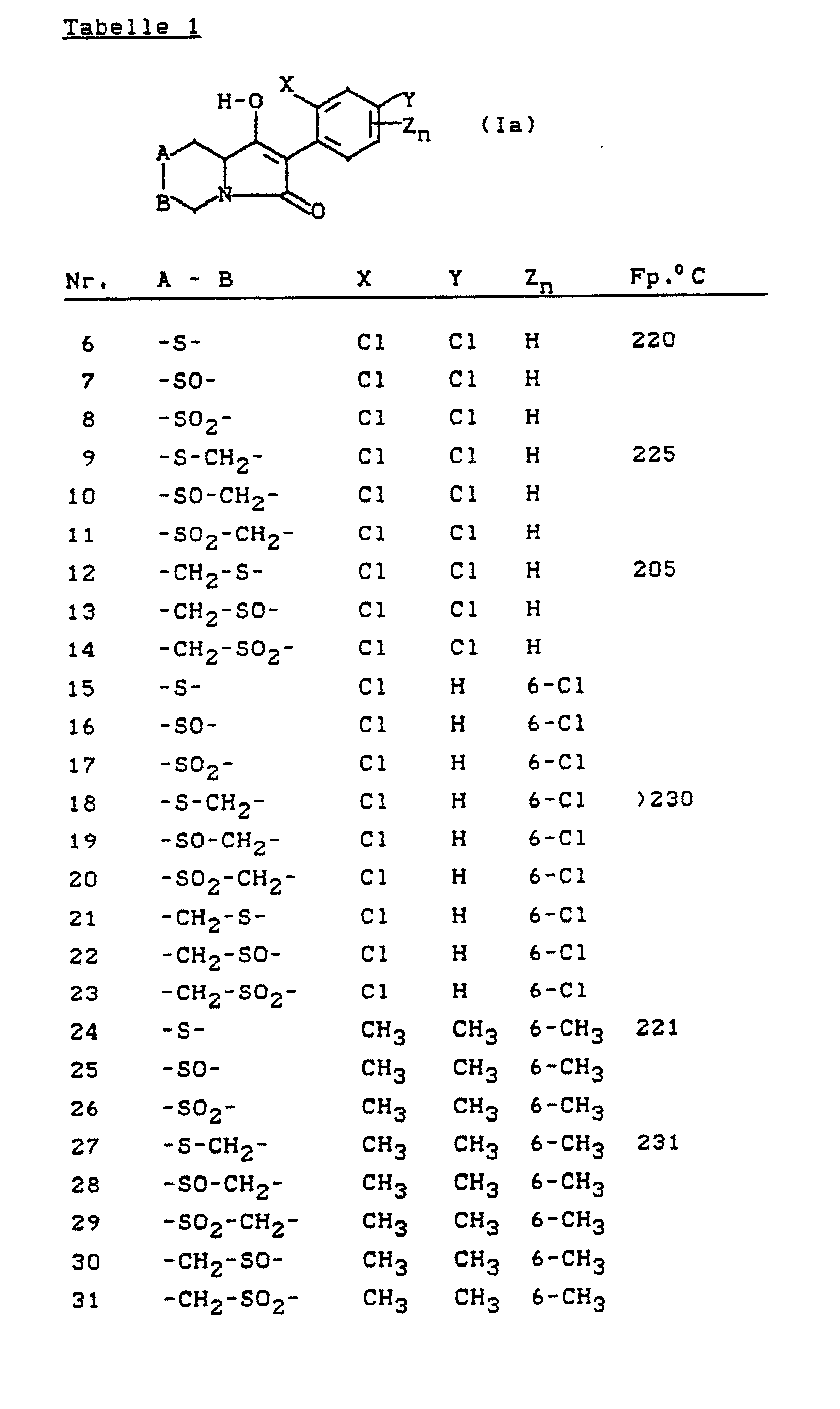
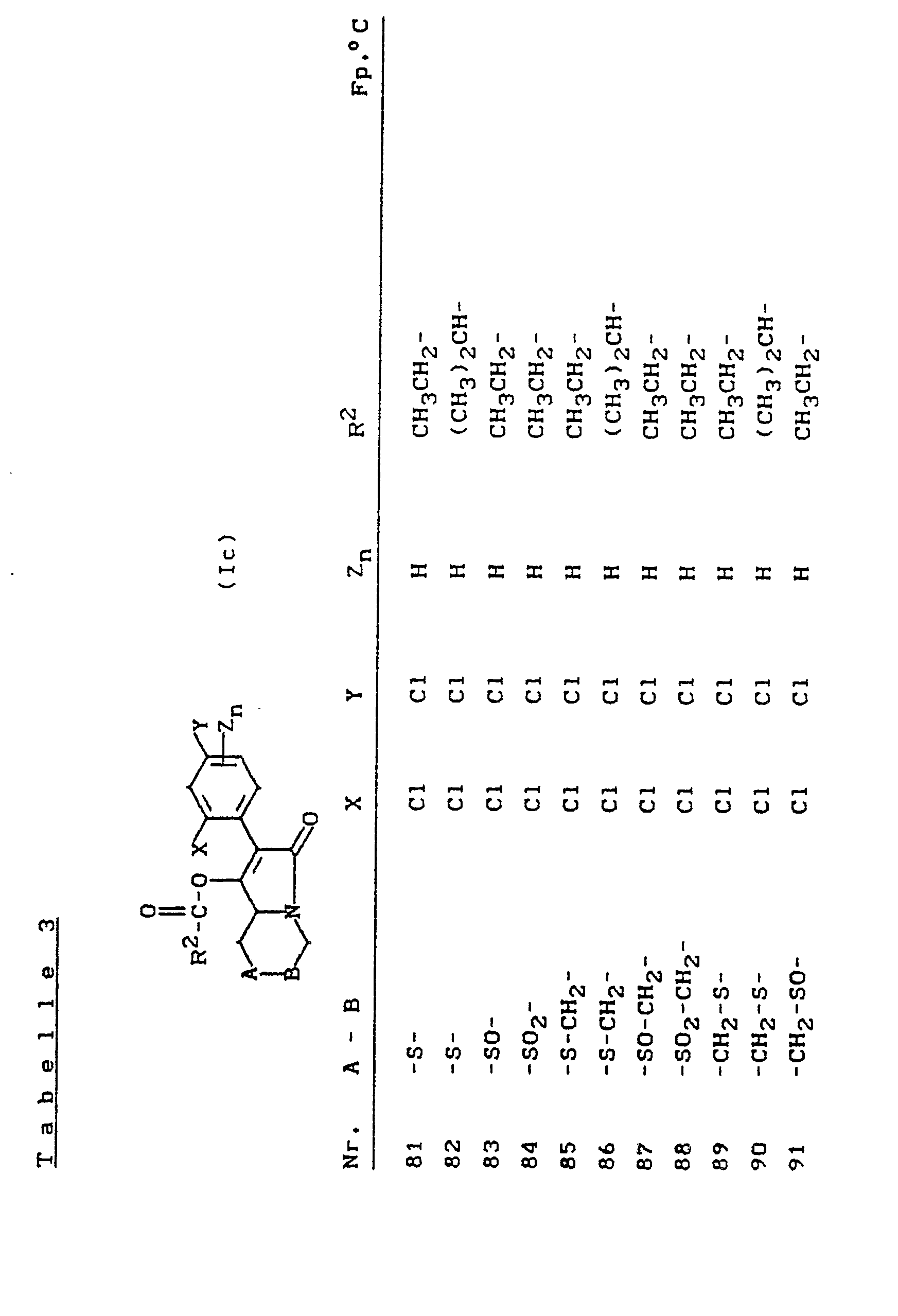
- In entsprechender Weise zu den Herstellungsbeispielen und gemäß den allgemeinen Angaben zur Herstellung erhält man die in den nachfolgenden Tabellen 1 bis 3 formelmäßig aufgeführten 3-Aryl- pyrrolidin-2,4-dion-Derivate der Formel (la) bis (le).




-

- IH-NMR (200 MHz, CDCla): 6 = 1.25 (t, 3H, CH2CH 3), 2.18 (s, 6H, Ar-2-CH3, Ar-6-CHa), 2.21 (s, 3H, Ar-4-CH3), 4.2 (q, 2H, - CH 2-CH3),


- Die Wirkstoffe eignen sich zur Bekämpfung von tierischen Schädlingen, vorzugsweise Arthropoden und Nematoden, insbesondere Insekten und Spinnentieren, die in der Landwirtschaft, in Forsten, im Vorrats- und Materialschutz sowie auf dem Hygienesektor vorkommen. Sie sind gegen normal sensible und resistente Arten sowie gegen alle oder einzelne Entwicklungsstadien wirksam. Zu den oben erwähnten Schädlingen gehören:
- Aus der Ordnung der Isopoda z.B. Oniscus asellus, Armadillidium vulgare, Porcellio scaber.
- Aus der Ordnung der Diplopoda z.B. Blaniulus guttulatus.
- Aus der Ordnung der Chilopoda z.B. Geophilus carpophagus, Scutigera spec.
- Aus der Ordnung der Symphyla z.B. Scutigerella immaculata.
- Aus der Ordnung der Thysanura z.B. Lepisma saccharina.
- Aus der Ordnung der Collembola z.B. Onychiurus armatus.
- Aus der Ordnung der Orthoptera z.B. Blatta orientalis,
- Periplaneta americana, Leucophaea maderae, Blattella germanica, Acheta domesticus, Gryllotalpa spp., Locusta migratoria migratorioides, Melanoplus differentialis, Schistocerca gregaria.
- Aus der Ordnung der Dermaptera z.B. Forficula auricularia.
- Aus der Ordnung der Isoptera z.B. Reticulitermes spp..
- Aus der Ordnung der Anoplura z.B. Phylloxera vastatrix, Pemphigus spp., Pediculus humanus corporis, Haematopinus spp., Linognathus spp.
- Aus der Ordnung der Mallophaga z.B. Trichodectes spp., Damalinea spp.
- Aus der Ordnung der Thysanoptera z.B. Hercinothrips femoralis, Thrips tabaci.
- Aus der Ordnung der Heteroptera z.B. Eurygaster spp., Dysdercus intermedius, Piesma quadrata, Cimex lectularius, Rhodnius prolixus, Triatoma spp.
- Aus der Ordnung der Homoptera z.B. Aleurodes brassicae, Bemisia tabaci, Trialeurodes vaporariorum, Aphis gossypii, Brevicoryne brassicae, Cryptomyzus ribis, Aphis fabae, Doralis pomi, Eriosoma lanigerum, Hyalopterus arundinis, Macrosiphum avenae, Myzus spp., Phorodon humuli, Rhopalosiphum padi, Empoasca spp., Euscelis bilobatus, Nephotettix cincticeps, Lecanium corni, Saissetia oleae, Laodelphax striatellus, Nilaparvata lugens, Aonidiella aurantii, Aspidiotus hederae, Pseudococcus spp. Psylla spp.
- Aus der Ordnung der Lepidoptera z.B. Pectinophora gossypiella, Bupalus piniarius, Cheimatobia brumata, Lithocolletis blancardella, Hyponomeuta padella, Plutella maculipennis, Malacosoma neustria, Euproctis chrysorrhoea, Lymantria spp. Bucculatrix thurberiella, Phyllocnistis citrefla, Agrotis spp., Euxoa spp., Feltia spp., Earias insulana, Heliothis spp., Spodoptera exigua, Mamestra brassicae, Panolis flammea, Prodenia litura, Spodoptera spp., Trichoplusia ni, Carpocapsa pomonella, Pieris spp., Chilo spp., Pyrausta nubilalis, Ephestia kuehniella, Galleria mellonella, Tineola bisselliella, Tinea pellionella, Hofmannophila pseudospretella, Cacoecia podana, Capua reticulana, Choristoneura fumiferana, Clysia ambiguella, Homona magnanima, Tortrix viridana.
- Aus der Ordnung der Coleoptera z.B. Anobium punctatum, Rhizopertha dominica, Acanthoscelides obtectus, Acanthoscelides obtectus, Hylotrupes bajulus, Agelastica alni, Leptinotarsa decemlineata, Phaedon cochleariae, Diabrotica spp., Psylliodes chrysocephala, Epilachna varivestis, Atomaria spp., Oryzaephilus surinamensis, Anthonomus spp., Sitophilus spp., Otiorrhynchus sulcatus, Cosmopolites sordidus, Ceuthorrhynchus assimilis, Hypera postica, Dermestes spp., Trogoderma spp., Anthrenus spp., Attagenus spp., Lyctus spp., Meligethes aeneus, Ptinus spp., Niptus hololeucus, Gibbium psylloides, Tribolium spp., Tenebrio molitor, Agriotes spp., Conoderus spp., Melolontha melolontha, Amphimallon solstitialis, Costelytra zealandica. Aus der Ordnung der Hymenoptera z.B. Diprion spp., Hoplocampa spp., Lasius spp., Monomorium pharaonis, Vespa spp.
- Aus der Ordnung der Diptera z.B. Aedes spp., Anopheles spp., Culex spp., Drosophila melanogaster, Musca spp., Fannia spp., Calliphora erythrocephala, Lucilia spp., Chrysomyia spp., Cuterebra spp., Gastrophilus spp., Hyppobosca spp., Stomoxys spp., Oestrus spp., Hypoderma spp., Tabanus spp. Tannia spp., Bibio hortulanus, Oscinella frit, Phorbia spp., Pegomyia hyoscyami, Ceratitis capitata, Dacus oleae, Tipula paludosa.
- Aus der Ordnung der Siphonaptera z.B. Xenopsylla cheopis, Ceratophyllus spp..
- Aus der Ordnung der Arachnida z.B. Scorpio maurus, Latrodectus mactans.
- Aus der Ordnung der Acarina z.B. Acarus siro, Argas spp., Ornithodoros spp., Dermanyssus gallinae, Eriophyes ribis, Phyllocoptruta oleivora, Boophilus spp., Rhipicephalus spp., Amblyomma spp., Hyalomma spp., Ixodes spp., Psoroptes spp., Chorioptes spp., Sarcoptes spp., Tarsonemus spp., Bryobia praetiosa, Panonychus spp., Tetranychus spp..
- Zu den pflanzenparasitären Nematoden gehören Pratylenchus spp., Radopholus similis, Ditylenchus dipsaci, Tylenchulus semipenetrans, Heterodera spp., Globodera ssp., Meloidogyne spp., Aphelenchoides spp., Longidorus spp., Xiphinema spp., Trichodorus spp..
- Die erfindungsgemäßen Wirkstoffe können weiterhin als Defoliants, Desiccants, Krautabtötungsmittel und insbesondere als Unkrautvernichtungsmittel verwendet werden. Unter Unkraut im weitesten Sinne sind alle Pflanzen zu verstehen, die an Orten aufwachsen, wo sie unerwünscht sind. Ob die erfindungsgemäßen Stoffe als totale oder selektive Herbizide wirken, hängt im wesentlichen von der angewendeten Menge ab.
- Charakteristisch für die erfindungsgemäßen Verbindungen ist, daß sie eine selektive Wirksamkeit gegen monokotyle Unkräuter in monokotylen und dikotylen Kulturen im Vor-und Nachlaufverfahren (Pre- und Postemergence) bei guter Kulturflanzenverträglichkeit aufweisen.
- Die erfindungsgemäßen Wirkstoffe können z.B. bei den folgenden Pflanzen verwendet werden: Monokotyle Unkräuter der Gattungen: Echinochloa, Setaria, Panicum, Digitaria, Phleum, Poa, Festuca, Eleusine, Brachiaria, Lolium, Bromus, Avena, Cyperus, Sorghum, Agropyron, Cynodon, Monochoria, Fimbristylis, Sagittaria, Eleocharis, Scirpus, Paspalum, Ischaemum, Sphenoclea, Dactyloctenium, Agrostis, Alopecurus, Apera.
Monokotyle Kulturen der Gattungen: Oryza, Zea, Triticum, Hordeum, Avena, Secale, Sorghum, Panicum, Saccharum, Ananas, Asparagus, Allium.
Dikotyle Kulturen der Gattungen: Gossypium, Glycine, Beta, Daucus, Phaseolus, Pisum, Solanum, Linum, Ipomoea, Vicia, Nicotiana, Lycopersicon, Arachis, Brassica, Lactuca, Cucumis, Cucurbita. - Die Verwendung der erfindungsgemäßen Wirkstoffe ist jedoch keineswegs auf diese Gattungen beschränkt, sondern erstreckt sich in gleicher Weise auch auf andere Pflanzen.
- Die Verbindungen eignen sich in Abhängigkeit von der Konzentration zur Totalunkrautbekämpfung z.B. auf Industrie- und Gleisanlagen und auf Wegen und Plätzen mit und ohne Baumbewuchs. Ebenso können die Verbindungen zur Unkrautbekämpfung in Dauerkulturen, z.B. Forst, Ziergehölz-, Obst-, Wein-, Citrus-, Nuß-, Bananen-, Kaffee-, Tee-, Gummi-, Ölpalm-, Kakao-, Beerenfrucht- und Hopfenanlagen und zur selektiven Unkrautbekämpfung in einjährigen Kulturen eingesetzt werden.
- Dabei zeigen die erfindungsgemäßen Wirkstoffe neben einer hervorragenden Wirkung gegen Schadpflanzen gute Verträglichkeit gegenüber wichtigen Kulturpflanzen, wie z. B. Weizen, Baumwolle, Sojabohnen, Citrusfrüchten und Zuckerrüben, und können daher als selektive Unkrautbekämpfungsmittel eingesetzt werden.
- Die Wirkstoffe können in die üblichen Formulierungen übergeführt werden, wie Lösungen, Emulsionen, Suspensionen, Pulver, Schäume, Pasten, Granulate, Aerosole, Wirkstoff-imprägnierte Natur- und synthetische Stoffe, Feinstverkapselungen in polymeren Stoffen und in Hüllmassen für Saatgut, ferner in Formulierungen mit Brennsätzen, wie Räucherpatronen, -dosen, -spiralen u.ä., sowie ULV-Kalt- und Warmnebel-Formulierungen.
- Diese Formulierungen werden in bekannter Weise hergestellt, z.B. durch Vermischen der Wirkstoffe mit Streckmitteln, also flüssigen Lösungsmitteln, unter Druck stehenden verflüssigten Gasen und/oder festen Trägerstoffen, gegebenenfalls unter Verwendung von oberflächenaktiven Mitteln, also Emulgiermitteln und/oder Dispergiermitteln und/oder schaumerzeugenden Mitteln. Im Falle der Benutzung von Wasser als Streckmittel können z.B. auch organische Lösungsmittel als Hilfslösungsmittel verwendet werden. Als flüssige Lösungsmittel kommen im wesentlichen in Frage: Aromaten, wie Xylol, Toluol, oder Alkylnaphthaline, chlorierte Aromaten oder chlorierte aliphatische Kohlenwasserstoffe, wie Chlorbenzole, Chlorethylene oder Methylenchlorid, aliphatische Kohlenwasserstoffe, wie Cyclohexan oder Paraffine, z.B. Erdöl fraktionen, Alkohole, wie Butanol oder Glycol sowie deren Ether und Ester, Ketone, wie Aceton, Methylethylketon, Methylisobutylketon oder Cyclohexanon, stark polare Lösungsmittel, wie Dimethylformamid und Dimethylsulfoxid, sowie Wasser; mit verflüssigten gasförmigen Streckmitteln oder Trägerstoffen sind solche Flüssigkeiten gemeint, welche bei normaler Temperatur und unter Normaldruck gasförmig sind, z.B. Aerosol-Treibgas, wie Halogenkohlenwasserstoffe sowie Butan, Propan, Stickstoff und Kohlendioxid; als feste Trägerstoffe kommen in Frage: z.B. natürliche Gesteinsmehle, wie Kaoline, Tonerden, Talkum, Kreide, Quarz, Attapulgit, Montmorillonit oder Diatomeenerde und synthetische Gesteinsmehle, wie hochdisperse Kieselsäure, Aluminiumoxid und Silikate; als feste Trägerstoffe für Granulate kommen in Frage: z.B. gebrochene und fraktionierte natürliche Gesteine wie Calcit, Marmor, Bims, Sepiolith, Dolomit sowie synthetische Granulate aus anorganischen und organischen Mehlen sowie Granulate aus organischem Material wie Sägemehl, Kokosnußschalen, Maiskolben und Tabakstengel; als Emulgier und/oder schaumerzeugende Mittel kommen in Frage: z.B. nichtionogene und anionische Emulgatoren, wie Polyoxyethylen-Fettsäure-Ester, Polyoxyethylen-Fettalkohol-Ether, z.B. Alkylarylpolyglykol-Ether, Alkylsulfonate, Alkylsulfate, Arylsulfonate sowie Eiweißhydrolysate; als Dispergiermittel kommen in Frage: z.B. Lignin-Sulfitablaugen und Methylcellulose.
- Es können in den Formulierungen Haftmittel wie Carboxymethylcellulose, natürliche und synthetische pulverige, körnige oder latexförmige Polymere verwendet werden, wie Gummiarabicum, Polyvinylalkohol, Polyvinylacetat, sowie natürliche Phospholipide, wie Kephaline und Lecithine, und synthetische Phospholipide. Weitere Additive können mineralische und vegetabile Öle sein.
- Es können Farbstoffe wie anorganische Pigmente, z.B. Eisenoxid, Titanoxid, Ferrocyanblau und organische Farbstoffe, wie Alizarin-, Azo- und Metallphthalocyaninfarbstoffe und Spurennährstoffe wie Salze von Eisen, Mangan, Bor, Kupfer, Kobalt, Molybdän und Zink verwendet werden.
- Die Formulierungen enthalten im allgemeinen zwischen 0,1 und 95 Gewichtsprozent Wirkstoff, vorzugsweise zwischen 0,5 und 90 %.
- Die erfindungsgemäßen Wirkstoffe können in ihren handelsüblichen Formulierungen sowie in den aus diesen Formulierungen bereiteten Anwendungsformen in Mischung mit anderen Wirkstoffen, wie Insektiziden, Lockstoffen, Sterilantien, Akariziden, Nematiziden Herbiziden oder Fungiziden vorliegen. Zu den Insektiziden zählen beispielsweise Phosphorsäureester, Carbamate, Carbonsäureester, chlorierte Kohlenwasserstoffe, Phenylharnstoffe, durch Mikroorganismen hergestellte Stoffe u.a.
- Die erfindungsgemäßen Wirkstoffe können ferner in ihren handelsüblichen Formulierungen sowie in den aus diesen Formulierungen bereiteten Anwendungsformen in Mischung mit Synergisten vorliegen. Synergisten sind Verbindun gen, durch die die Wirkung der Wirkstoffe gesteigert wird, ohne daß der zugesetzte Synergist selbst aktiv wirksam sein muß.
- Der Wirkstoffgehalt der aus den handelsüblichen Formulierungen bereiteten Anwendungsformen kann in weiten Bereichen variieren. Die Wirkstoffkonzentration der Anwendungsformen kann von 0,0000001 bis zu 95 Gew.-% Wirkstoff, vorzugsweise zwischen 0,0001 und 1 Gew.-% liegen.
- Die Anwendung geschieht in einer den Anwendungsformen angepaßten üblichen Weise.
- Z.B. können die Wirkstoffe als solche, in Form ihrer Formulierungen oder den daraus durch weiteres Verdünnen bzw. durch Kombination mit emulgierbaren Ölen, oberflächenaktiven Substanzen und weiteren Additionen bereiteten Anwendungsformen, wie gebrauchsfertige Lösungen, Suspensionen, Emulsionen, Pulver, Pasten und Granulate angewandt werden. Die Anwendung geschieht in üblicher Weise, z.B. durch Gießen, Spritzen, Sprühen, Streuen.
- Die erfindungsgemäßen Wirkstoffe können als Herbizide sowohl vor als auch nach dem Auflaufen der Pflanzen appliziert werden.
- Sie können auch vor der Saat in den Boden eingearbeitet werden.
- Die angewandte Wirkstoffmenge kann in einem größeren Bereich schwanken. Sie hängt im wesentlichen von der Art des gewünschten Effektes ab. Im allgemeinen liegen die Aufwandmengen zwischen 0,01 und 15 kg Wirkstoff pro Hektar Bodenfläche, vorzugsweise zwischen 0,1 und 5 kg pro ha.
- Die erfindungsgemäß verwendbaren Wirkstoffe eignen sich auch zur Bekämpfung von Milben, Zecken usw. auf dem Gebiet der Tierhaltung und Viehzucht, wobei durch die Bekämpfung der Schädlinge bessere Ergebnisse, z.B. höhere Milchleistungen, höheres Gewicht, schöneres Tierfell, längere Lebensdauer usw. erreicht werden können.
- Die Anwendung der erfindungsgemäß verwendbaren Wirkstoffe geschieht auf diesem Gebiet in bekannter Weise wie durch orale Anwendung in Form von beispielsweise Tabletten, Kapseln, Tränken, Granulaten, durch dermale bzw. äußerliche Anwendung in Form beispielsweise des Tauchens (Dippen), Sprühens (Sprayen), Aufgießens (pour-on and spot-on) und des Einpuderns sowie durch parenterale Anwendung in Form beispielsweise der Injektion sowie ferner durch das "feed-through"-Verfahren. Daneben ist auch eine Anwendung als Formkörper (Halsband, Ohrmarke) möglich.
- Die Verwendung der erfindungsgemäßen Wirkstoffe geht aus den nachfolgenden Beispielen hervor.
- Lösungsmittel: 7 Gewichtsteile Dimethylformamid Emulgator: 1 Gewichtsteil Alkylarylpolyglykolether
- Zur Herstellung einer zweckmäßigen Wirkstoffzubereitung vermischt man 1 Gewichtsteil Wirkstoff mit der angegebenen Menge Lösungsmittel und der angegebene Menge Emulgator und verdünnt das Konzentrat mit Wasser auf die gewünschte Konzentration.
- Bohnenpflanzen (Phaseolus vulgaris), die stark von allen Entwicklungsstadien der gemeinen Spinnmilbe oder Bohnenspinnmilbe (Tetranychus urticae) befallen sind, werden durch Tauchen in die Wirkstoffzubereitung der gewünschten Konzentration behandelt.
- Nach der gewünschten Zeit wird die Abtötung in % bestimmt. Dabei bedeutet 100 %, daß alle Spinnmilben abgetötet wurden; 0 % bedeutet, daß keine Spinnmilben abgetötet wurden.
- Bei diesem Test zeigen z.B. die folgenden Verbindungen der Herstellungsbeispiele überlegene Wirksamkeit gegenüber dem Stand der Technik:
- Lösungsmittel: 7 Gewichtsteile Dimethylformamid Emulgator: 1 Gewichtsteil Alkylarylpolyglykolether
- Zur Herstellung einer zweckmäßigen Wirkstoffzubereitung vermischt man 1 Gewichtsteil Wirkstoff mit der angegebenen Menge Lösungsmittel und der angegebene Menge Emulgator und verdünnt das Konzentrat mit Wasser auf die gewünschte Konzentration.
- Reiskeimlinge (Oryza sativa) werden durch Tauchen in die Wirkstoffzubereitung der gewünschten Konzentration behandelt und mit Larven der Grünen Reiszikade (Nephotettix cincticeps) besetzt, solange die Keimlinge noch feucht sind.
- Nach der gewünschten Zeit wird die Abtötung in % bestimmt. Dabei bedeutet 100 %, daß alle Zikaden abgetötet wurden; 0 % bedeutet, daß keine Zikaden abgetötet wurden.
- Bei diesem Test zeigen z.B. die folgenden Verbindungen der Herstellungsbeispiele überlegene Wirksamkeit gegenüber dem Stand der Technik:
- Lösungsmittel: 5 Gewichtsteile Aceton Emulgator: 1 Gewichtsteil Alkylarylpolyglykolether
- Zur Herstellung einer zweckmäßigen Wirkstoffzubereitung vermischt man 1 Gewichtsteil Wirkstoff mit der angegebenen Menge Lösungsmittel, gibt die angegebene Menge Emulgator zu und verdünnt das Konzentrat mit Wasser auf die gewünschte Konzentration.
- Samen der Testpflanzen werden in normalen Boden ausgesät und nach 24 Stunden mit der Wirkstoffzubereitung begossen. Dabei hält man die Wassermenge pro Flächeneinheit zweckmäßigerweise konstant. Die Wirkstoffkonzentration in der Zubereitung spielt keine Rolle, entscheidend ist nur die Aufwandmenge des Wirkstoffs pro Flächeneinheit. Nach drei Wochen wird der Schädigungsgrad der Pflanzen bonitiert in % Schädigung im Vergleich zur Entwicklung der unbehandelten Kontrolle. Es bedeuten:
- 0 % = keine Wirkung (wie unbehandelte Kontrolle)
- 100 % = totale Vernichtung
- Lösungsmittel: 5 Gewichtsteile Aceton Emulgator: 1 Gewichtsteil Alkylarylpolyglykolether
- Zur Herstellung einer zweckmäßigen Wirkstoffzubereitung vermischt man 1 Gewichtsteil Wirkstoff mit der angegebenen Menge Lösungsmittel, gibt die angegebene Menge Emulgator zu und verdünnt das Konzentrat mit Wasser auf die gewünschte Konzentration.
- Mit der Wirkstoffzubereitung spritzt man Testpflanzen, welche eine Höhe von 5 - 15 cm haben so, daß die jeweils gewünschten Wirkstoffmengen pro Flächeneinheit ausgebracht werden. Die Konzentration der Spritzbrühe wird so gewählt, daß in 2000 I Wasser/ha die jeweils gewünschten Wirkstoffmengen ausgebracht werden. Nach drei Wochen wird der Schädigungsgrad der Pflanzen bonitiert in % Schädigung im Vergleich zur Entwicklung der unbehandelten Kontrolle.
- Es bedeuten:
- 0 % = keine Wirkung (wie unbehandelte Kontrolle)
- 100 % = totale Vernichtung
Claims (11)




Applications Claiming Priority (2)
| Application Number | Priority Date | Filing Date | Title |
|---|---|---|---|
| DE3929087 | 1989-09-01 | ||
| DE3929087A DE3929087A1 (de) | 1989-09-01 | 1989-09-01 | 3-aryl-pyrrolidin-2,4-dion-derivate |
Publications (3)
| Publication Number | Publication Date |
|---|---|
| EP0415211A2 true EP0415211A2 (de) | 1991-03-06 |
| EP0415211A3 EP0415211A3 (en) | 1992-01-15 |
| EP0415211B1 EP0415211B1 (de) | 1994-12-21 |
Family
ID=6388446
Family Applications (1)
| Application Number | Title | Priority Date | Filing Date |
|---|---|---|---|
| EP90115872A Expired - Lifetime EP0415211B1 (de) | 1989-09-01 | 1990-08-18 | 3-Aryl-pyrrolidin-2,4-dion-derivate |
Country Status (9)
| Country | Link |
|---|---|
| US (1) | US5116836A (de) |
| EP (1) | EP0415211B1 (de) |
| JP (1) | JP3154715B2 (de) |
| KR (1) | KR910006304A (de) |
| BR (1) | BR9004336A (de) |
| CA (1) | CA2024357A1 (de) |
| DD (1) | DD299305A5 (de) |
| DE (2) | DE3929087A1 (de) |
| ZA (1) | ZA906952B (de) |
Cited By (60)
| Publication number | Priority date | Publication date | Assignee | Title |
|---|---|---|---|---|
| EP0442077A3 (en) * | 1990-02-14 | 1992-03-11 | Bayer Ag | 3-aryl-pyrrolidine-2,4-dione derivatives |
| US5494890A (en) * | 1991-03-19 | 1996-02-27 | Ciba-Geigy Corporation | Herbicidally, acaricidally and insecticidally active pyrazolidine compounds |
| US5811374A (en) * | 1991-02-07 | 1998-09-22 | Bayer Aktiengesellschaft | 3-aryl-pyrrolidine-2,4-dione derivatives |
| WO2004111042A1 (de) | 2003-06-12 | 2004-12-23 | Bayer Cropscience Aktiengesellschaft | N-heterocyclyl-phenylsubstituierte cyclische ketoenole |
| WO2005048710A1 (de) | 2003-11-22 | 2005-06-02 | Bayer Cropscience Aktiengesellschaft | 2-ethyl-4,6-dimethyl-phenyl-substituierte tetramsäure-derivate als schädlingsbek ämpfungsmittel und/oder herbizide |
| WO2005044791A3 (de) * | 2003-11-05 | 2005-08-11 | Bayer Cropscience Ag | 2-halogen-6-alkyl-phenyl-substituierte tetramsäure-derivate |
| WO2005092897A2 (de) | 2004-03-25 | 2005-10-06 | Bayer Cropscience Ag | 2,4,6-phenylsubstituierte cyclische ketoenole |
| WO2007096058A1 (de) | 2006-02-21 | 2007-08-30 | Bayer Cropscience Ag | Cycloalkyl-phenylsubstituierte cyclische ketoenole |
| CN100371512C (zh) * | 2002-12-10 | 2008-02-27 | 津田驹工业株式会社 | 打纬时间计算方法及投纬条件设定方法 |
| DE102007009957A1 (de) | 2006-12-27 | 2008-07-03 | Bayer Cropscience Ag | Verfahren zur verbesserten Nutzung des Produktionsptentials transgener Pflanzen |
| EP1992614A1 (de) * | 2007-05-16 | 2008-11-19 | Bayer CropScience Aktiengesellschaft | 3-(2-Alkoxy-phenyl)-substituierte Tetramate |
| EP2014169A1 (de) | 2007-07-09 | 2009-01-14 | Bayer CropScience AG | Wasserlösliche Konzentrate von 3-(2-Alkoxy-4-chlor-6-alkyl-phenyl)-substituierten Tetramaten und ihren korrespondierenden Enolen |
| WO2009015801A1 (de) | 2007-08-02 | 2009-02-05 | Bayer Cropscience Ag | Oxaspirocyclische-spiro-substituierte tetram- und tetronsäure-derivate |
| WO2009039975A1 (de) | 2007-09-25 | 2009-04-02 | Bayer Cropscience Ag | Halogenalkoxyspirocyclische tetram- und tetronsäure-derivate |
| EP2103615A1 (de) | 2008-03-19 | 2009-09-23 | Bayer CropScience AG | 4'4'-Dioxaspiro-spirocyclisch substituierte Tetramate |
| EP2127522A1 (de) | 2008-05-29 | 2009-12-02 | Bayer CropScience AG | Wirkstoffkombinationen mit insektiziden und akariziden Eigenschaften |
| US7727933B2 (en) | 2003-11-22 | 2010-06-01 | Bayer Cropscience Ag | 2-ethyl-4,6-dimethyl-phenyl-substituted spirocyclic tetramic acid derivatives |
| WO2010086095A1 (en) | 2009-01-29 | 2010-08-05 | Bayer Cropscience Ag | Method for improved utilization of the production potential of transgenic plants introduction |
| EP2216316A1 (de) | 2004-11-04 | 2010-08-11 | Bayer CropScience Aktiengesellschaft | Phenylessigsäurederivate |
| EP2218710A1 (de) | 2004-11-04 | 2010-08-18 | Bayer CropScience AG | Verfahren zur Herstellung von 2,6-Diethyl-4-methylphenylessigsäure |
| WO2010102758A2 (de) | 2009-03-11 | 2010-09-16 | Bayer Cropscience Ag | Halogenalkylmethylenoxy-phenyl-substituierte ketoenole |
| DE102009028001A1 (de) | 2009-07-24 | 2011-01-27 | Bayer Cropscience Ag | Wirkstoffkombinationen mit insektiziden und akariziden Eigenschaften |
| DE102010008643A1 (de) | 2010-02-15 | 2011-08-18 | Bayer Schering Pharma Aktiengesellschaft, 13353 | Zyklische Ketoenole zur Therapie |
| DE102010008642A1 (de) | 2010-02-15 | 2011-08-18 | Bayer Schering Pharma Aktiengesellschaft, 13353 | Zyklische Ketoenole zur Therapie |
| WO2011098433A1 (de) | 2010-02-15 | 2011-08-18 | Bayer Schering Pharma Aktiengesellschaft | Zyklische ketoenole zur therapie |
| WO2011098443A1 (de) | 2010-02-10 | 2011-08-18 | Bayer Cropscience Ag | Spiroheterocyclisch-substituierte tetramsäure-derivate |
| WO2011098440A2 (de) | 2010-02-10 | 2011-08-18 | Bayer Cropscience Ag | Biphenylsubstituierte cyclische ketoenole |
| WO2011131623A1 (de) | 2010-04-20 | 2011-10-27 | Bayer Cropscience Ag | Insektizide und/oder herbizide zusammensetzung mit verbesserter wirkung auf basis von spiroheterocyclisch-substituierten tetramsäure-derivaten |
| US8143193B2 (en) | 2003-07-08 | 2012-03-27 | Bayer Cropscience Ag | Active agents combination exhibiting insecticidal and acaricide properties |
| US8173697B2 (en) | 2006-06-02 | 2012-05-08 | Bayer Cropscience Ag | Alkoxyalkyl-substituted cyclic keto-enols |
| US8211931B2 (en) | 2006-06-16 | 2012-07-03 | Bayer Cropscience Ag | Active compound combinations having insecticidal and acaricidal properties |
| DE102011011040A1 (de) | 2011-02-08 | 2012-08-09 | Bayer Pharma Aktiengesellschaft | (5s,8s)-3-(4'-Chlor-3'-fluor-4-methylbiphenyl-3-yl)-4-hydroxy-8-methoxy-1-azaspiro[4.5]dec-3-en-2-on (Verbindung A) zur Therapie |
| US8247351B2 (en) | 2005-12-13 | 2012-08-21 | Bayer Cropscience Ag | Insecticidal compositions having improved effect |
| WO2012110518A1 (de) | 2011-02-17 | 2012-08-23 | Bayer Pharma Aktiengesellschaft | Substituierte 3-(biphenyl-3-yl)-8,8-difluor-4-hydroxy-1-azaspiro[4.5]dec-3-en-2-one zur therapie |
| WO2012116960A1 (de) | 2011-03-01 | 2012-09-07 | Bayer Cropscience Ag | 2-acyloxy-pyrrolin-4-one |
| WO2013017600A1 (de) | 2011-08-04 | 2013-02-07 | Bayer Intellectual Property Gmbh | Substituierte 3-(biphenyl-3-yl)-4-hydroxy-8-methoxy-1-azaspiro[4.5]dec-3-en-2-one |
| DE102011080405A1 (de) | 2011-08-04 | 2013-02-07 | Bayer Pharma AG | Substituierte 3-(Biphenyl-3-yl)-8,8-difluor-4-hydroxy-1-azaspiro[4.5]dec-3-en-2-one zur Therapie |
| US8389443B2 (en) | 2008-12-02 | 2013-03-05 | Bayer Cropscience Ag | Geminal alkoxy/alkylspirocyclic substituted tetramate derivatives |
| WO2013110612A1 (en) | 2012-01-26 | 2013-08-01 | Bayer Intellectual Property Gmbh | Phenyl-substituted ketoenols for controlling fish parasites |
| US8507537B2 (en) | 2006-10-25 | 2013-08-13 | Bayer Cropscience Ag | Trifluromethoxyphenyl-substituted tetramic acid derivatives pesticides and/or herbicides |
| US8821898B2 (en) | 2003-12-04 | 2014-09-02 | Bayer Cropscience Ag | Active compound combinations having insecticidal and acaricidal properties |
| US8846946B2 (en) | 2008-12-02 | 2014-09-30 | Bayer Cropscience Ag | Germinal alkoxy/alkylspirocyclic substituted tetramate derivatives |
| US8993782B2 (en) | 2006-12-04 | 2015-03-31 | Bayer Cropscience Ag | Cis-alkoxyspirocyclic biphenyl-substituted tetramic acid derivatives |
| US9000189B2 (en) | 2006-12-04 | 2015-04-07 | Bayer Cropscience Ag | Biphenyl-substituted spirocyclic ketoenols |
| WO2019219587A1 (de) | 2018-05-15 | 2019-11-21 | Bayer Aktiengesellschaft | 2-brom-6-alkoxyphenyl-substituierte pyrrolin-2-one und deren verwendung als herbizide |
| WO2019219588A1 (de) | 2018-05-15 | 2019-11-21 | Bayer Aktiengesellschaft | Speziell substituierte 2-alkyl-6-alkoxyphenyl-3-pyrroliin-2-one und deren verwendung als herbizide |
| WO2019219585A1 (de) | 2018-05-15 | 2019-11-21 | Bayer Aktiengesellschaft | Neue 3-(4-alkinyl-6-alkoxy-2-chlorphenyl)-3-pyrrolin-2-one und deren verwendung als herbizide |
| WO2019219584A1 (de) | 2018-05-15 | 2019-11-21 | Bayer Aktiengesellschaft | Neue spirocyclohexylpyrrolin-2-one und deren verwendung als herbizide |
| WO2019228788A1 (de) | 2018-05-29 | 2019-12-05 | Bayer Aktiengesellschaft | 2-brom-6-alkoxyphenyl-substituierte pyrrolin-2-one und deren verwendung als herbizide |
| WO2019228787A1 (de) | 2018-05-29 | 2019-12-05 | Bayer Aktiengesellschaft | Speziell substituierte 2-alkyl-6-alkoxyphenyl-3-pyrrolin-2-one und deren verwendung als herbizide |
| WO2020187629A1 (de) | 2019-03-15 | 2020-09-24 | Bayer Aktiengesellschaft | 3-(2-brom-4-alkinyl-6-alkoxyphenyl)-substituierte 5-spirocyclohexyl-3-pyrrolin-2-one und deren verwendung als herbizide |
| WO2020187627A1 (de) | 2019-03-15 | 2020-09-24 | Bayer Aktiengesellschaft | Neue 3-(2-brom-4-alkinyl-6-alkoxyphenyl)-3-pyrrolin-2-one und deren verwendung als herbizide |
| WO2020187628A1 (de) | 2019-03-15 | 2020-09-24 | Bayer Aktiengesellschaft | Speziell substituierte 3-(2-alkoxy-6-alkyl-4-propinylphenyl)-3-pyrrolin-2-one und deren verwendung als herbizide |
| WO2020187626A1 (de) | 2019-03-15 | 2020-09-24 | Bayer Aktiengesellschaft | Speziell substituierte 3-phenyl-5-spirocyclopentyl-3-pyrrolin-2-one und deren verwendung als herbizide |
| WO2020187623A1 (de) | 2019-03-15 | 2020-09-24 | Bayer Aktiengesellschaft | Speziell substituierte 3-(2-halogen-6-alkyl-4-propinylphenyl)-3-pyrrolin-2-one und deren verwendung als herbizide |
| WO2021204884A1 (de) | 2020-04-09 | 2021-10-14 | Bayer Aktiengesellschaft | 3-(4-alkenyl-phenyl)-3-pyrrolin-2-one und deren verwendung als herbizide |
| WO2021209486A1 (de) | 2020-04-15 | 2021-10-21 | Bayer Aktiengesellschaft | Speziell substituierte pyrrolin-2-one und deren verwendung als herbizide |
| US11178868B2 (en) | 2015-10-06 | 2021-11-23 | Bayer Cropscience Aktiengesellschaft | Alkynyl-substituted 3-phenylpyrrolidine-2,4-diones and use thereof as herbicides |
| WO2021239673A1 (de) | 2020-05-27 | 2021-12-02 | Bayer Aktiengesellschaft | Substituierte pyrrolin-2-one und deren verwendung als herbizide |
| WO2023274869A1 (de) | 2021-06-29 | 2023-01-05 | Bayer Aktiengesellschaft | 3-(4-alkenyl-phenyl)-3-pyrrolin-2-one und deren verwendung als herbizide |
Families Citing this family (28)
| Publication number | Priority date | Publication date | Assignee | Title |
|---|---|---|---|---|
| US5585384A (en) * | 1991-01-31 | 1996-12-17 | Bayer Aktiengesellschaft | Substituted bicyclic 3-aryl-pyrrolidine-2,4-dione derivatives |
| WO1995001971A1 (de) * | 1993-07-05 | 1995-01-19 | Bayer Aktiengesellschaft | Substituierte aryl-ketoenolheterocyclen |
| US6500948B1 (en) * | 1995-12-08 | 2002-12-31 | Agouron Pharmaceuticals, Inc. | Metalloproteinase inhibitors-compositions, uses preparation and intermediates thereof |
| CA2250417A1 (en) | 1996-04-02 | 1997-10-09 | Bayer Aktiengesellschaft | Substituted phenyl keto enols as pesticides and herbicides |
| CN1156470C (zh) * | 1996-05-10 | 2004-07-07 | 拜尔公司 | 新的取代的吡啶基酮烯醇 |
| CN100339352C (zh) | 1996-08-05 | 2007-09-26 | 拜尔公司 | 2-和2,5-取代的苯基酮烯醇 |
| DE19808261A1 (de) * | 1998-02-27 | 1999-10-28 | Bayer Ag | Arylphenylsubstituierte cyclische Ketoenole |
| DE19813354A1 (de) * | 1998-03-26 | 1999-09-30 | Bayer Ag | Arylphenylsubstituierte cyclische Ketoenole |
| DE19818732A1 (de) | 1998-04-27 | 1999-10-28 | Bayer Ag | Arylphenylsubstituierte cyclische Ketoenole |
| DE19935963A1 (de) | 1999-07-30 | 2001-02-01 | Bayer Ag | Biphenylsubstituierte cyclische Ketoenole |
| DE19946625A1 (de) | 1999-09-29 | 2001-04-05 | Bayer Ag | Trifluormethylsubstituierte spirocyclische Ketoenole |
| DE10016544A1 (de) | 2000-04-03 | 2001-10-11 | Bayer Ag | C2-phenylsubstituierte Ketoenole |
| AR029677A1 (es) * | 2000-06-29 | 2003-07-10 | Bayer Ag | Combinaciones de compuestos activos con propiedades insecticidas y acaricidas |
| DE10042736A1 (de) | 2000-08-31 | 2002-03-14 | Bayer Ag | Wirkstoffkombinationen mit insektiziden und akariziden Eigenschaften |
| DE10043610A1 (de) * | 2000-09-05 | 2002-03-14 | Bayer Ag | Wirkstoffkombinationen mit insektiziden und akariziden Eigenschaften |
| DE10049804A1 (de) * | 2000-10-09 | 2002-04-18 | Bayer Ag | Wirkstoffkombinationen mit fungiziden und akariziden Eigenschaften |
| DE10055941A1 (de) | 2000-11-10 | 2002-05-23 | Bayer Ag | Wirkstoffkombinationen mit insektiziden und akariziden Eigenschaften |
| DE10062422A1 (de) * | 2000-12-14 | 2002-06-20 | Bayer Ag | Verwendung von Acetyl-CoA Carboxylase zum Identifizieren von insektizid wirksamen Verwendung |
| DE10139465A1 (de) * | 2001-08-10 | 2003-02-20 | Bayer Cropscience Ag | Selektive Herbizide auf Basis von substituierten, cayclischen Ketoenolen und Safenern |
| DE10301804A1 (de) * | 2003-01-20 | 2004-07-29 | Bayer Cropscience Ag | 2,4-Dihalogen-6-(C2-C3-alkyl)-phenyl substituierte Tetramsäure-Derivate |
| DE10311300A1 (de) * | 2003-03-14 | 2004-09-23 | Bayer Cropscience Ag | 2,4,6-Phenylsubstituierte cyclische Ketoenole |
| DE102004035133A1 (de) * | 2004-07-20 | 2006-02-16 | Bayer Cropscience Ag | Selektive Insektizide auf Basis von substituierten, cyclischen Ketoenolen und Safenern |
| DE102004044827A1 (de) | 2004-09-16 | 2006-03-23 | Bayer Cropscience Ag | Jod-phenylsubstituierte cyclische Ketoenole |
| DE102005008021A1 (de) | 2005-02-22 | 2006-08-24 | Bayer Cropscience Ag | Spiroketal-substituierte cyclische Ketoenole |
| DE102005008033A1 (de) * | 2005-02-22 | 2006-08-24 | Bayer Cropscience Ag | Wirkstoffkombinationen mit insektiziden und akariziden Eigenschaften |
| DE102006018828A1 (de) | 2006-04-22 | 2007-10-25 | Bayer Cropscience Ag | Alkoxyalkyl-substituierte cyclische Ketoenole |
| EP2039248A1 (de) * | 2007-09-21 | 2009-03-25 | Bayer CropScience AG | Wirkstoffkombinationen mit insektiziden und akariziden Eigenschaften |
| CA3020637A1 (en) * | 2016-04-14 | 2017-10-19 | Bayer Cropscience Aktiengesellschaft | Anellated 3-phenyl tetramic acid derivatives having a herbicidal effect |
Family Cites Families (4)
| Publication number | Priority date | Publication date | Assignee | Title |
|---|---|---|---|---|
| US4104043A (en) * | 1972-12-12 | 1978-08-01 | Union Carbide Corporation | Esters of 3-hydroxyindone compounds as herbicides and miticides |
| US4139364A (en) * | 1977-08-09 | 1979-02-13 | E. I. Du Pont De Nemours And Company | Triazolone herbicides |
| IT1153963B (it) * | 1982-03-22 | 1987-01-21 | Montedison Spa | Derivati dell'acido 2 0 4-tiazolidin-carbossilico 3-acil sostituiti ad azione fitoregolatrice e biostimolanti |
| US4925868A (en) * | 1986-08-29 | 1990-05-15 | Takeda Chemical Industries, Ltd. | 4-Hydroxy-3-pyrrolin-2-ones and treatment of circulatory disorders therewith |
-
1989
- 1989-09-01 DE DE3929087A patent/DE3929087A1/de not_active Withdrawn
-
1990
- 1990-08-15 US US07/567,872 patent/US5116836A/en not_active Expired - Lifetime
- 1990-08-18 EP EP90115872A patent/EP0415211B1/de not_active Expired - Lifetime
- 1990-08-18 DE DE59008063T patent/DE59008063D1/de not_active Expired - Fee Related
- 1990-08-29 JP JP22544290A patent/JP3154715B2/ja not_active Expired - Fee Related
- 1990-08-30 CA CA002024357A patent/CA2024357A1/en not_active Abandoned
- 1990-08-30 KR KR1019900013472A patent/KR910006304A/ko not_active Withdrawn
- 1990-08-31 BR BR909004336A patent/BR9004336A/pt not_active IP Right Cessation
- 1990-08-31 ZA ZA906952A patent/ZA906952B/xx unknown
- 1990-09-03 DD DD90343786A patent/DD299305A5/de not_active IP Right Cessation
Cited By (83)
| Publication number | Priority date | Publication date | Assignee | Title |
|---|---|---|---|---|
| EP0442077A3 (en) * | 1990-02-14 | 1992-03-11 | Bayer Ag | 3-aryl-pyrrolidine-2,4-dione derivatives |
| US5811374A (en) * | 1991-02-07 | 1998-09-22 | Bayer Aktiengesellschaft | 3-aryl-pyrrolidine-2,4-dione derivatives |
| US5494890A (en) * | 1991-03-19 | 1996-02-27 | Ciba-Geigy Corporation | Herbicidally, acaricidally and insecticidally active pyrazolidine compounds |
| US5506193A (en) * | 1991-03-19 | 1996-04-09 | Ciba-Geigy Corporation | Herbicidally, acaricidally and insecticidally active pyrazolidine compounds |
| CN100371512C (zh) * | 2002-12-10 | 2008-02-27 | 津田驹工业株式会社 | 打纬时间计算方法及投纬条件设定方法 |
| WO2004111042A1 (de) | 2003-06-12 | 2004-12-23 | Bayer Cropscience Aktiengesellschaft | N-heterocyclyl-phenylsubstituierte cyclische ketoenole |
| US8143193B2 (en) | 2003-07-08 | 2012-03-27 | Bayer Cropscience Ag | Active agents combination exhibiting insecticidal and acaricide properties |
| WO2005044791A3 (de) * | 2003-11-05 | 2005-08-11 | Bayer Cropscience Ag | 2-halogen-6-alkyl-phenyl-substituierte tetramsäure-derivate |
| CN100562515C (zh) * | 2003-11-05 | 2009-11-25 | 拜尔农作物科学股份公司 | 2-卤代-6-烷基苯基取代的特特拉姆酸衍生物 |
| WO2005048710A1 (de) | 2003-11-22 | 2005-06-02 | Bayer Cropscience Aktiengesellschaft | 2-ethyl-4,6-dimethyl-phenyl-substituierte tetramsäure-derivate als schädlingsbek ämpfungsmittel und/oder herbizide |
| EP2218330A1 (de) | 2003-11-22 | 2010-08-18 | Bayer CropScience AG | Verfahren zur Herstellung von 2-Ethyl-4,6-dimethylphenylessigsäure durch Umsetzung von 2-Ethyl-4,6-dimethylbrombenzol mit tert.-Butylacetat |
| US7727933B2 (en) | 2003-11-22 | 2010-06-01 | Bayer Cropscience Ag | 2-ethyl-4,6-dimethyl-phenyl-substituted spirocyclic tetramic acid derivatives |
| US8821898B2 (en) | 2003-12-04 | 2014-09-02 | Bayer Cropscience Ag | Active compound combinations having insecticidal and acaricidal properties |
| WO2005092897A2 (de) | 2004-03-25 | 2005-10-06 | Bayer Cropscience Ag | 2,4,6-phenylsubstituierte cyclische ketoenole |
| EP2253207A1 (de) | 2004-11-04 | 2010-11-24 | Bayer CropScience AG | Substituierte Phenylessigsäureester |
| EP2218710A1 (de) | 2004-11-04 | 2010-08-18 | Bayer CropScience AG | Verfahren zur Herstellung von 2,6-Diethyl-4-methylphenylessigsäure |
| EP2216317A1 (de) | 2004-11-04 | 2010-08-11 | Bayer CropScience AG | Phenylessigsäurehalogenide |
| EP2216316A1 (de) | 2004-11-04 | 2010-08-11 | Bayer CropScience Aktiengesellschaft | Phenylessigsäurederivate |
| US8247351B2 (en) | 2005-12-13 | 2012-08-21 | Bayer Cropscience Ag | Insecticidal compositions having improved effect |
| WO2007096058A1 (de) | 2006-02-21 | 2007-08-30 | Bayer Cropscience Ag | Cycloalkyl-phenylsubstituierte cyclische ketoenole |
| EP2184275A1 (de) | 2006-02-21 | 2010-05-12 | Bayer CropScience AG | Cycloalkyl-phenylsubstituierte cyclische Ketoenole |
| EP2186791A1 (de) | 2006-02-21 | 2010-05-19 | Bayer CropScience AG | Cycloalkyl-phenylsubstituierte cyclische Ketoenole |
| EP2186805A1 (de) | 2006-02-21 | 2010-05-19 | Bayer CropScience AG | Cycloalkyl-phenylsubstituierte cyclische Ketoenole |
| US8173697B2 (en) | 2006-06-02 | 2012-05-08 | Bayer Cropscience Ag | Alkoxyalkyl-substituted cyclic keto-enols |
| EP3001905A1 (de) | 2006-06-16 | 2016-04-06 | Bayer Intellectual Property GmbH | Wirkstoffkombinationen mit insektiziden und akariziden eigenschaften |
| US8211931B2 (en) | 2006-06-16 | 2012-07-03 | Bayer Cropscience Ag | Active compound combinations having insecticidal and acaricidal properties |
| US8658688B2 (en) | 2006-06-16 | 2014-02-25 | Bayer Cropscience Ag | Active compound combinations having insecticidal and acaricidal properties |
| US8507537B2 (en) | 2006-10-25 | 2013-08-13 | Bayer Cropscience Ag | Trifluromethoxyphenyl-substituted tetramic acid derivatives pesticides and/or herbicides |
| US8993782B2 (en) | 2006-12-04 | 2015-03-31 | Bayer Cropscience Ag | Cis-alkoxyspirocyclic biphenyl-substituted tetramic acid derivatives |
| US9000189B2 (en) | 2006-12-04 | 2015-04-07 | Bayer Cropscience Ag | Biphenyl-substituted spirocyclic ketoenols |
| DE102007009957A1 (de) | 2006-12-27 | 2008-07-03 | Bayer Cropscience Ag | Verfahren zur verbesserten Nutzung des Produktionsptentials transgener Pflanzen |
| WO2008138551A3 (de) * | 2007-05-16 | 2009-02-26 | Bayer Cropscience Ag | 3-(2-alkoxy-phenyl)-substituierte tetramate |
| EP1992614A1 (de) * | 2007-05-16 | 2008-11-19 | Bayer CropScience Aktiengesellschaft | 3-(2-Alkoxy-phenyl)-substituierte Tetramate |
| EP2014169A1 (de) | 2007-07-09 | 2009-01-14 | Bayer CropScience AG | Wasserlösliche Konzentrate von 3-(2-Alkoxy-4-chlor-6-alkyl-phenyl)-substituierten Tetramaten und ihren korrespondierenden Enolen |
| US8859466B2 (en) | 2007-08-02 | 2014-10-14 | Bayer Cropscience Ag | Oxaspirocyclic spiro-substituted tetramic acid and tetronic acid derivatives |
| WO2009015801A1 (de) | 2007-08-02 | 2009-02-05 | Bayer Cropscience Ag | Oxaspirocyclische-spiro-substituierte tetram- und tetronsäure-derivate |
| WO2009039975A1 (de) | 2007-09-25 | 2009-04-02 | Bayer Cropscience Ag | Halogenalkoxyspirocyclische tetram- und tetronsäure-derivate |
| EP2103615A1 (de) | 2008-03-19 | 2009-09-23 | Bayer CropScience AG | 4'4'-Dioxaspiro-spirocyclisch substituierte Tetramate |
| WO2009115262A1 (de) | 2008-03-19 | 2009-09-24 | Bayer Cropscience Ag | 4'4'-dioxaspiro-spirocyclisch substituierte tetramate |
| EP2127522A1 (de) | 2008-05-29 | 2009-12-02 | Bayer CropScience AG | Wirkstoffkombinationen mit insektiziden und akariziden Eigenschaften |
| US8846946B2 (en) | 2008-12-02 | 2014-09-30 | Bayer Cropscience Ag | Germinal alkoxy/alkylspirocyclic substituted tetramate derivatives |
| US8389443B2 (en) | 2008-12-02 | 2013-03-05 | Bayer Cropscience Ag | Geminal alkoxy/alkylspirocyclic substituted tetramate derivatives |
| WO2010086095A1 (en) | 2009-01-29 | 2010-08-05 | Bayer Cropscience Ag | Method for improved utilization of the production potential of transgenic plants introduction |
| EP3153503A1 (de) | 2009-03-11 | 2017-04-12 | Bayer Intellectual Property GmbH | Zwischenprodukte für halogenalkylmethylenoxy-phenyl-substituierte ketoenole |
| US8518985B2 (en) | 2009-03-11 | 2013-08-27 | Bayer Cropscience Ag | Haloalkylmethyleneoxyphenyl-substituted ketoenols |
| WO2010102758A2 (de) | 2009-03-11 | 2010-09-16 | Bayer Cropscience Ag | Halogenalkylmethylenoxy-phenyl-substituierte ketoenole |
| EA024266B1 (ru) * | 2009-03-11 | 2016-09-30 | Байер Интеллектуэль Проперти Гмбх | Кетоенолы, замещенные галоидалкилметиленоксифенилом, и их применение |
| WO2010102758A3 (de) * | 2009-03-11 | 2011-01-20 | Bayer Cropscience Ag | Halogenalkylmethylenoxy-phenyl-substituierte ketoenole |
| US9045390B2 (en) | 2009-03-11 | 2015-06-02 | Bayer Cropscience Ag | Haloalkylmethyleneoxyphenyl-substituted ketoenols |
| DE102009028001A1 (de) | 2009-07-24 | 2011-01-27 | Bayer Cropscience Ag | Wirkstoffkombinationen mit insektiziden und akariziden Eigenschaften |
| WO2011098440A2 (de) | 2010-02-10 | 2011-08-18 | Bayer Cropscience Ag | Biphenylsubstituierte cyclische ketoenole |
| WO2011098443A1 (de) | 2010-02-10 | 2011-08-18 | Bayer Cropscience Ag | Spiroheterocyclisch-substituierte tetramsäure-derivate |
| DE102010008642A1 (de) | 2010-02-15 | 2011-08-18 | Bayer Schering Pharma Aktiengesellschaft, 13353 | Zyklische Ketoenole zur Therapie |
| DE102010008643A1 (de) | 2010-02-15 | 2011-08-18 | Bayer Schering Pharma Aktiengesellschaft, 13353 | Zyklische Ketoenole zur Therapie |
| DE102010008644A1 (de) | 2010-02-15 | 2011-08-18 | Bayer Schering Pharma Aktiengesellschaft, 13353 | Zyklische Ketoenole zur Therapie |
| WO2011098433A1 (de) | 2010-02-15 | 2011-08-18 | Bayer Schering Pharma Aktiengesellschaft | Zyklische ketoenole zur therapie |
| WO2011131623A1 (de) | 2010-04-20 | 2011-10-27 | Bayer Cropscience Ag | Insektizide und/oder herbizide zusammensetzung mit verbesserter wirkung auf basis von spiroheterocyclisch-substituierten tetramsäure-derivaten |
| DE102011011040A1 (de) | 2011-02-08 | 2012-08-09 | Bayer Pharma Aktiengesellschaft | (5s,8s)-3-(4'-Chlor-3'-fluor-4-methylbiphenyl-3-yl)-4-hydroxy-8-methoxy-1-azaspiro[4.5]dec-3-en-2-on (Verbindung A) zur Therapie |
| US8946124B2 (en) | 2011-02-17 | 2015-02-03 | Bayer Intellectual Property Gmbh | Substituted 3-(biphenyl-3-yl)-8,8-difluoro-4-hydroxy-1-azaspiro[4.5]dec-3-en-2-ones for therapy and halogen-substituted spirocyclic ketoenols |
| WO2012110519A1 (de) | 2011-02-17 | 2012-08-23 | Bayer Cropscience Ag | Substituierte 3-(biphenyl-3-yl)-8,8-difluor-4-hydroxy-1-azaspiro[4.5]dec-3-en-2-one zur therapie und halogensubstituierte spirocyclische ketoenole |
| WO2012110518A1 (de) | 2011-02-17 | 2012-08-23 | Bayer Pharma Aktiengesellschaft | Substituierte 3-(biphenyl-3-yl)-8,8-difluor-4-hydroxy-1-azaspiro[4.5]dec-3-en-2-one zur therapie |
| US9204640B2 (en) | 2011-03-01 | 2015-12-08 | Bayer Intellectual Property Gmbh | 2-acyloxy-pyrrolin-4-ones |
| WO2012116960A1 (de) | 2011-03-01 | 2012-09-07 | Bayer Cropscience Ag | 2-acyloxy-pyrrolin-4-one |
| DE102011080406A1 (de) | 2011-08-04 | 2013-02-07 | Bayer Pharma AG | Substituierte 3-(Biphenyl-3-yl)-4-hydroxy-8-methoxy-1-azaspiro8[4.5]dec-3-en-2-one |
| DE102011080405A1 (de) | 2011-08-04 | 2013-02-07 | Bayer Pharma AG | Substituierte 3-(Biphenyl-3-yl)-8,8-difluor-4-hydroxy-1-azaspiro[4.5]dec-3-en-2-one zur Therapie |
| WO2013017600A1 (de) | 2011-08-04 | 2013-02-07 | Bayer Intellectual Property Gmbh | Substituierte 3-(biphenyl-3-yl)-4-hydroxy-8-methoxy-1-azaspiro[4.5]dec-3-en-2-one |
| WO2013110612A1 (en) | 2012-01-26 | 2013-08-01 | Bayer Intellectual Property Gmbh | Phenyl-substituted ketoenols for controlling fish parasites |
| US11178868B2 (en) | 2015-10-06 | 2021-11-23 | Bayer Cropscience Aktiengesellschaft | Alkynyl-substituted 3-phenylpyrrolidine-2,4-diones and use thereof as herbicides |
| WO2019219587A1 (de) | 2018-05-15 | 2019-11-21 | Bayer Aktiengesellschaft | 2-brom-6-alkoxyphenyl-substituierte pyrrolin-2-one und deren verwendung als herbizide |
| WO2019219585A1 (de) | 2018-05-15 | 2019-11-21 | Bayer Aktiengesellschaft | Neue 3-(4-alkinyl-6-alkoxy-2-chlorphenyl)-3-pyrrolin-2-one und deren verwendung als herbizide |
| WO2019219584A1 (de) | 2018-05-15 | 2019-11-21 | Bayer Aktiengesellschaft | Neue spirocyclohexylpyrrolin-2-one und deren verwendung als herbizide |
| WO2019219588A1 (de) | 2018-05-15 | 2019-11-21 | Bayer Aktiengesellschaft | Speziell substituierte 2-alkyl-6-alkoxyphenyl-3-pyrroliin-2-one und deren verwendung als herbizide |
| WO2019228788A1 (de) | 2018-05-29 | 2019-12-05 | Bayer Aktiengesellschaft | 2-brom-6-alkoxyphenyl-substituierte pyrrolin-2-one und deren verwendung als herbizide |
| WO2019228787A1 (de) | 2018-05-29 | 2019-12-05 | Bayer Aktiengesellschaft | Speziell substituierte 2-alkyl-6-alkoxyphenyl-3-pyrrolin-2-one und deren verwendung als herbizide |
| WO2020187628A1 (de) | 2019-03-15 | 2020-09-24 | Bayer Aktiengesellschaft | Speziell substituierte 3-(2-alkoxy-6-alkyl-4-propinylphenyl)-3-pyrrolin-2-one und deren verwendung als herbizide |
| WO2020187627A1 (de) | 2019-03-15 | 2020-09-24 | Bayer Aktiengesellschaft | Neue 3-(2-brom-4-alkinyl-6-alkoxyphenyl)-3-pyrrolin-2-one und deren verwendung als herbizide |
| WO2020187626A1 (de) | 2019-03-15 | 2020-09-24 | Bayer Aktiengesellschaft | Speziell substituierte 3-phenyl-5-spirocyclopentyl-3-pyrrolin-2-one und deren verwendung als herbizide |
| WO2020187623A1 (de) | 2019-03-15 | 2020-09-24 | Bayer Aktiengesellschaft | Speziell substituierte 3-(2-halogen-6-alkyl-4-propinylphenyl)-3-pyrrolin-2-one und deren verwendung als herbizide |
| WO2020187629A1 (de) | 2019-03-15 | 2020-09-24 | Bayer Aktiengesellschaft | 3-(2-brom-4-alkinyl-6-alkoxyphenyl)-substituierte 5-spirocyclohexyl-3-pyrrolin-2-one und deren verwendung als herbizide |
| WO2021204884A1 (de) | 2020-04-09 | 2021-10-14 | Bayer Aktiengesellschaft | 3-(4-alkenyl-phenyl)-3-pyrrolin-2-one und deren verwendung als herbizide |
| WO2021209486A1 (de) | 2020-04-15 | 2021-10-21 | Bayer Aktiengesellschaft | Speziell substituierte pyrrolin-2-one und deren verwendung als herbizide |
| WO2021239673A1 (de) | 2020-05-27 | 2021-12-02 | Bayer Aktiengesellschaft | Substituierte pyrrolin-2-one und deren verwendung als herbizide |
| WO2023274869A1 (de) | 2021-06-29 | 2023-01-05 | Bayer Aktiengesellschaft | 3-(4-alkenyl-phenyl)-3-pyrrolin-2-one und deren verwendung als herbizide |
Also Published As
| Publication number | Publication date |
|---|---|
| CA2024357A1 (en) | 1991-03-02 |
| JPH0393785A (ja) | 1991-04-18 |
| US5116836A (en) | 1992-05-26 |
| DE59008063D1 (de) | 1995-02-02 |
| EP0415211B1 (de) | 1994-12-21 |
| JP3154715B2 (ja) | 2001-04-09 |
| BR9004336A (pt) | 1991-09-03 |
| KR910006304A (ko) | 1991-04-29 |
| EP0415211A3 (en) | 1992-01-15 |
| DE3929087A1 (de) | 1991-03-07 |
| DD299305A5 (de) | 1992-04-09 |
| ZA906952B (en) | 1991-07-31 |
Similar Documents
| Publication | Publication Date | Title |
|---|---|---|
| EP0415211B1 (de) | 3-Aryl-pyrrolidin-2,4-dion-derivate | |
| EP0377893B1 (de) | 3-Aryl-pyrrolidin-2,4-dion-Derivate | |
| EP0442073B1 (de) | Polycyclische 3-Aryl-pyrrolidin-2,4,-dion-Derivate | |
| EP0355599B1 (de) | 3-Aryl-pyrrolidin-2,4-dione | |
| EP0528156B1 (de) | 3-Aryl-4-hydroxy-delta3-dihydrofuranon- und 3-Aryl-4-hydroxy-delta3-dihydrothiophenon-Derivate | |
| EP0613885B1 (de) | Substituierte 1-H-3-Phenyl-5-cycloalkylpyrrolidin-2,4-dione, ihre Herstellung und ihre Verwendung als Schädlingsbekämpfungsmittel und Herbizide | |
| EP0521334B1 (de) | Substituierte 1-H-3-Aryl-pyrrolidin-2,4-dion-Derivate, deren Herstellung und deren Verwendung als Insektizide, Akarizide und Herbizide | |
| EP0647637B1 (de) | 3-Aryl-4-hydroxy-3-dihydrofuranon-Derivate | |
| EP0508126B1 (de) | 3-Hydroxy-4-aryl-5-oxo-pyrazolin Derivate | |
| EP0613884B1 (de) | Dialkyl-1-H-3-(2,4-dimethylphenyl)-pyrrolidin-2,4-dione, ihre Herstellung und ihre Verwendung als Schädlingsbekämpfungsmittel und Herbizide | |
| EP0596298A2 (de) | 5-Spiro-substituierte 1-H-3-Aryl-pyrrolidin-2,4-dion-Derivate als Herbizide, Insektizide und Akarizide | |
| EP0706527A1 (de) | Substituierte spiroheterocyclische 1h-3-aryl-pyrrolidin-2,4-dion-derivate, verfahren zu deren herstellung und deren verwendung als schädlingsbekämpfungsmittel | |
| DE3913682A1 (de) | 3-aryl-pyrrolidin-2,4-dione | |
| EP0497127B1 (de) | Substituierte 3-Aryl-pyrrolidin-2,4-dione | |
| EP0591806A1 (de) | Substituierte 2-Arylpyrrole | |
| EP0501129B1 (de) | Substituierte bicyclische 3-Aryl-pyrrolidin-2,4-dion-Derivate | |
| WO1994001401A1 (de) | Herbizide und insektizide 3-benzoyl-pyrrolidin-2,4-dion-derivate | |
| DE4326909A1 (de) | Substituierte 1-H-3-Aryl-pyrrolidin-2,4-dion-Derivate | |
| DE4337853A1 (de) | 3-Aryl-4-hydroxy-DELTA·3·-dihydrofuranon-Derivate | |
| EP0655999A1 (de) | 1,2,4-dithiazolium-iodide und ihre verwendung als schädlingsbekämpfungsmittel | |
| EP0167019A1 (de) | Diaryl-ethylamino-Derivate | |
| DE3923657A1 (de) | 2-halogen-3-phenoxy-1,4-naphthochinon-derivate |
Legal Events
| Date | Code | Title | Description |
|---|---|---|---|
| PUAI | Public reference made under article 153(3) epc to a published international application that has entered the european phase |
Free format text: ORIGINAL CODE: 0009012 |
|
| 17P | Request for examination filed |
Effective date: 19900820 |
|
| AK | Designated contracting states |
Kind code of ref document: A2 Designated state(s): BE CH DE DK FR GB IT LI NL |
|
| PUAL | Search report despatched |
Free format text: ORIGINAL CODE: 0009013 |
|
| AK | Designated contracting states |
Kind code of ref document: A3 Designated state(s): BE CH DE DK FR GB IT LI NL |
|
| 17Q | First examination report despatched |
Effective date: 19930817 |
|
| GRAA | (expected) grant |
Free format text: ORIGINAL CODE: 0009210 |
|
| AK | Designated contracting states |
Kind code of ref document: B1 Designated state(s): BE CH DE DK FR GB IT LI NL |
|
| PG25 | Lapsed in a contracting state [announced via postgrant information from national office to epo] |
Ref country code: DK Effective date: 19941221 |
|
| ITF | It: translation for a ep patent filed | ||
| REF | Corresponds to: |
Ref document number: 59008063 Country of ref document: DE Date of ref document: 19950202 |
|
| GBT | Gb: translation of ep patent filed (gb section 77(6)(a)/1977) |
Effective date: 19950110 |
|
| ET | Fr: translation filed | ||
| PLBE | No opposition filed within time limit |
Free format text: ORIGINAL CODE: 0009261 |
|
| STAA | Information on the status of an ep patent application or granted ep patent |
Free format text: STATUS: NO OPPOSITION FILED WITHIN TIME LIMIT |
|
| 26N | No opposition filed | ||
| PGFP | Annual fee paid to national office [announced via postgrant information from national office to epo] |
Ref country code: GB Payment date: 19960809 Year of fee payment: 7 |
|
| PGFP | Annual fee paid to national office [announced via postgrant information from national office to epo] |
Ref country code: BE Payment date: 19960828 Year of fee payment: 7 |
|
| PGFP | Annual fee paid to national office [announced via postgrant information from national office to epo] |
Ref country code: NL Payment date: 19960831 Year of fee payment: 7 |
|
| PG25 | Lapsed in a contracting state [announced via postgrant information from national office to epo] |
Ref country code: GB Free format text: LAPSE BECAUSE OF NON-PAYMENT OF DUE FEES Effective date: 19970818 |
|
| PG25 | Lapsed in a contracting state [announced via postgrant information from national office to epo] |
Ref country code: BE Free format text: LAPSE BECAUSE OF NON-PAYMENT OF DUE FEES Effective date: 19970831 |
|
| BERE | Be: lapsed |
Owner name: BAYER A.G. Effective date: 19970831 |
|
| PG25 | Lapsed in a contracting state [announced via postgrant information from national office to epo] |
Ref country code: NL Free format text: LAPSE BECAUSE OF NON-PAYMENT OF DUE FEES Effective date: 19980301 |
|
| GBPC | Gb: european patent ceased through non-payment of renewal fee |
Effective date: 19970818 |
|
| NLV4 | Nl: lapsed or anulled due to non-payment of the annual fee |
Effective date: 19980301 |
|
| PGFP | Annual fee paid to national office [announced via postgrant information from national office to epo] |
Ref country code: DE Payment date: 20070801 Year of fee payment: 18 |
|
| REG | Reference to a national code |
Ref country code: CH Ref legal event code: PFA Owner name: BAYER AKTIENGESELLSCHAFT Free format text: BAYER AKTIENGESELLSCHAFT# #D-51368 LEVERKUSEN (DE) -TRANSFER TO- BAYER AKTIENGESELLSCHAFT# #D-51368 LEVERKUSEN (DE) |
|
| PGFP | Annual fee paid to national office [announced via postgrant information from national office to epo] |
Ref country code: CH Payment date: 20070815 Year of fee payment: 18 |
|
| PGFP | Annual fee paid to national office [announced via postgrant information from national office to epo] |
Ref country code: IT Payment date: 20070828 Year of fee payment: 18 |
|
| PGFP | Annual fee paid to national office [announced via postgrant information from national office to epo] |
Ref country code: FR Payment date: 20070808 Year of fee payment: 18 |
|
| REG | Reference to a national code |
Ref country code: CH Ref legal event code: PL |
|
| REG | Reference to a national code |
Ref country code: FR Ref legal event code: ST Effective date: 20090430 |
|
| PG25 | Lapsed in a contracting state [announced via postgrant information from national office to epo] |
Ref country code: CH Free format text: LAPSE BECAUSE OF NON-PAYMENT OF DUE FEES Effective date: 20080831 Ref country code: LI Free format text: LAPSE BECAUSE OF NON-PAYMENT OF DUE FEES Effective date: 20080831 |
|
| PG25 | Lapsed in a contracting state [announced via postgrant information from national office to epo] |
Ref country code: IT Free format text: LAPSE BECAUSE OF NON-PAYMENT OF DUE FEES Effective date: 20080818 Ref country code: FR Free format text: LAPSE BECAUSE OF NON-PAYMENT OF DUE FEES Effective date: 20080901 Ref country code: DE Free format text: LAPSE BECAUSE OF NON-PAYMENT OF DUE FEES Effective date: 20090303 |