EP0415266A2 - Composition pour réserves positives sensibles aux rayonnements - Google Patents
Composition pour réserves positives sensibles aux rayonnements Download PDFInfo
- Publication number
- EP0415266A2 EP0415266A2 EP90116166A EP90116166A EP0415266A2 EP 0415266 A2 EP0415266 A2 EP 0415266A2 EP 90116166 A EP90116166 A EP 90116166A EP 90116166 A EP90116166 A EP 90116166A EP 0415266 A2 EP0415266 A2 EP 0415266A2
- Authority
- EP
- European Patent Office
- Prior art keywords
- resist composition
- positive resist
- resin
- composition according
- molecular weight
- Prior art date
- Legal status (The legal status is an assumption and is not a legal conclusion. Google has not performed a legal analysis and makes no representation as to the accuracy of the status listed.)
- Withdrawn
Links
- 0 C*C(C1)(CCC(CC2)C(*)(C(CCC(C)(C3)C4*5CCC4)CC35O)C(CCC(C)(C3)*4*5CCC4)CCC35O)C(*)(CCCC3)C3C12O Chemical compound C*C(C1)(CCC(CC2)C(*)(C(CCC(C)(C3)C4*5CCC4)CC35O)C(CCC(C)(C3)*4*5CCC4)CCC35O)C(*)(CCCC3)C3C12O 0.000 description 3
- SKRPSNPFGVDNGJ-UHFFFAOYSA-N CC(C)(CC(C)(C(C=CC(C1)=O)=C1O)Oc1c2)c1ccc2O Chemical compound CC(C)(CC(C)(C(C=CC(C1)=O)=C1O)Oc1c2)c1ccc2O SKRPSNPFGVDNGJ-UHFFFAOYSA-N 0.000 description 1
Images
Classifications
-
- G—PHYSICS
- G03—PHOTOGRAPHY; CINEMATOGRAPHY; ANALOGOUS TECHNIQUES USING WAVES OTHER THAN OPTICAL WAVES; ELECTROGRAPHY; HOLOGRAPHY
- G03F—PHOTOMECHANICAL PRODUCTION OF TEXTURED OR PATTERNED SURFACES, e.g. FOR PRINTING, FOR PROCESSING OF SEMICONDUCTOR DEVICES; MATERIALS THEREFOR; ORIGINALS THEREFOR; APPARATUS SPECIALLY ADAPTED THEREFOR
- G03F7/00—Photomechanical, e.g. photolithographic, production of textured or patterned surfaces, e.g. printing surfaces; Materials therefor, e.g. comprising photoresists; Apparatus specially adapted therefor
- G03F7/20—Exposure; Apparatus therefor
- G03F7/22—Exposing sequentially with the same light pattern different positions of the same surface
-
- G—PHYSICS
- G03—PHOTOGRAPHY; CINEMATOGRAPHY; ANALOGOUS TECHNIQUES USING WAVES OTHER THAN OPTICAL WAVES; ELECTROGRAPHY; HOLOGRAPHY
- G03F—PHOTOMECHANICAL PRODUCTION OF TEXTURED OR PATTERNED SURFACES, e.g. FOR PRINTING, FOR PROCESSING OF SEMICONDUCTOR DEVICES; MATERIALS THEREFOR; ORIGINALS THEREFOR; APPARATUS SPECIALLY ADAPTED THEREFOR
- G03F7/00—Photomechanical, e.g. photolithographic, production of textured or patterned surfaces, e.g. printing surfaces; Materials therefor, e.g. comprising photoresists; Apparatus specially adapted therefor
- G03F7/004—Photosensitive materials
- G03F7/022—Quinonediazides
-
- C—CHEMISTRY; METALLURGY
- C07—ORGANIC CHEMISTRY
- C07C—ACYCLIC OR CARBOCYCLIC COMPOUNDS
- C07C39/00—Compounds having at least one hydroxy or O-metal group bound to a carbon atom of a six-membered aromatic ring
- C07C39/12—Compounds having at least one hydroxy or O-metal group bound to a carbon atom of a six-membered aromatic ring polycyclic with no unsaturation outside the aromatic rings
- C07C39/15—Compounds having at least one hydroxy or O-metal group bound to a carbon atom of a six-membered aromatic ring polycyclic with no unsaturation outside the aromatic rings with all hydroxy groups on non-condensed rings, e.g. phenylphenol
-
- G—PHYSICS
- G03—PHOTOGRAPHY; CINEMATOGRAPHY; ANALOGOUS TECHNIQUES USING WAVES OTHER THAN OPTICAL WAVES; ELECTROGRAPHY; HOLOGRAPHY
- G03F—PHOTOMECHANICAL PRODUCTION OF TEXTURED OR PATTERNED SURFACES, e.g. FOR PRINTING, FOR PROCESSING OF SEMICONDUCTOR DEVICES; MATERIALS THEREFOR; ORIGINALS THEREFOR; APPARATUS SPECIALLY ADAPTED THEREFOR
- G03F7/00—Photomechanical, e.g. photolithographic, production of textured or patterned surfaces, e.g. printing surfaces; Materials therefor, e.g. comprising photoresists; Apparatus specially adapted therefor
- G03F7/004—Photosensitive materials
- G03F7/022—Quinonediazides
- G03F7/0226—Quinonediazides characterised by the non-macromolecular additives
-
- G—PHYSICS
- G03—PHOTOGRAPHY; CINEMATOGRAPHY; ANALOGOUS TECHNIQUES USING WAVES OTHER THAN OPTICAL WAVES; ELECTROGRAPHY; HOLOGRAPHY
- G03F—PHOTOMECHANICAL PRODUCTION OF TEXTURED OR PATTERNED SURFACES, e.g. FOR PRINTING, FOR PROCESSING OF SEMICONDUCTOR DEVICES; MATERIALS THEREFOR; ORIGINALS THEREFOR; APPARATUS SPECIALLY ADAPTED THEREFOR
- G03F7/00—Photomechanical, e.g. photolithographic, production of textured or patterned surfaces, e.g. printing surfaces; Materials therefor, e.g. comprising photoresists; Apparatus specially adapted therefor
- G03F7/004—Photosensitive materials
- G03F7/022—Quinonediazides
- G03F7/023—Macromolecular quinonediazides; Macromolecular additives, e.g. binders
- G03F7/0233—Macromolecular quinonediazides; Macromolecular additives, e.g. binders characterised by the polymeric binders or the macromolecular additives other than the macromolecular quinonediazides
- G03F7/0236—Condensation products of carbonyl compounds and phenolic compounds, e.g. novolak resins
Definitions
- the present invention relates to a radiation-sensitive resist composition which is sensitive to ultraviolet rays, far ultraviolet rays (excimer laser and so on), electron rays, ion beam and radio-active rays, e.g. X-rays.
- the positive photoresist now in practical use is checked from this standpoint, its sensitivity, resolving power and heat resistance are not necessarily satisfactory.
- the positive photoresist has lower sensitivity than the negative photoresist and improvement in the sensitivity of the former is desired.
- This method has a very serious disadvantage because the heat resistance of the photoresist deteriorates. Moreover, it encounters some problems, e.g. large film thickness loss in an unexposed area (reduction of socalled film thickness retention), worsening the shape of the pattern, deterioration of the ⁇ -value because of small differences in the dissolving rates in the developing solution between the exposed area and the unexposed area.
- One object of the present invention is to provide a positive resist composition which can overcome the above problems associated with conventional positive resist compositions.
- a positive resist composition comprising a 1,2-quinonediazide compound and an alkali-soluble resin (A) which comprises a resin (I), obtainable through a condensation reaction of a mixture of m-cresol, 2,3,5-trimethylphenol and optionally p-cresol with an aldehyde, and a low molecular weight novolak (II) having a weight average molecular weight of 200 to 2000 as compared to polystyrene standards.
- resin (I) obtainable through a condensation reaction of a mixture of m-cresol, 2,3,5-trimethylphenol and optionally p-cresol with an aldehyde
- II low molecular weight novolak
- a positive resist composition comprising a 1,2-quinonediazide compound and an alkali-soluble resin (B) which comprises a resin (I), obtainable through a condensation reaction of a mixture of m-cresol, 2,3,5-trimethylphenol and optionally p-cresol with an aldehyde, and a compound of the general formula (III): wherein R1, R2 and R3 are respectively a C1-C5 alkyl group or a C1-C5 alkoxy group, l, m and n are respectively a number of 0 to 3, R′ is a hydrogen atom or a C1-C3 alkyl group.
- a positive resist composition comprising 1,2-quinonediazide compound and an alkali-soluble resin (C) which comprises a resin (IV) obtainable through a condensation reaction of a mixture of m-methoxyphenol and 2,3,5-trimethylphenol in a molar ratio of 80:20 to 30:70 with an aldehyde.
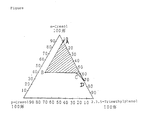
- Figure is a ternary diagram indicating a preferred molar ratio among m-cresol, p-cresol and 2,3,5-trimethylphenol for the preparation of the resin (I).
- the resin (I) is prepared through a condensation reaction of m-cresol, 2,3,5-trimethylphenol and optionally p-cresol with an aldehyde in the presence of an acid catalyst. This condensation reaction is carried out at a temperature of from 60 to 120°C for 2 to 30 hours.
- aldehyde examples include formaldehyde paraformaldehyde, acetaldehyde, propylaldehyde, benzaldehyde, phenylacetaldehyde, ⁇ -phenylpropylaldehyde, ⁇ -phenylpropylaldehyde, o-hydroxy benzaldehyde, m-hydroxybenzaldehyde, p-hydroxybenzaldehyde, glutaraldehyde, glyoxal, o-methylbenzaldehyde, p-methylbenzaldehyde and so on. They may be used alone or in combination. In particular, formaldehyde which is commercially mass produced is suitably used.
- the acid catalyst any of the conventionally used ones such as organic acids, inorganic acid or divalent metal salts can be used.
- the acid catalyst are oxalic acid, hydrochloric acid, sulfuric acid, perchloric acid, p-toluenesulfonic acid, trichloroacetic acid, phosphoric acid, formic acid, zinc acetate, manganese acetate, etc.
- the condensation reaction may be carried out in the presence or absence of a solvent.
- a solvent ethylcellosolve acetate is preferably used, since ethylcellosolve acetate can be used as a resist solvent and the photoresist composition exhibits improved heat resistance.
- a ratio of 2,3,5-trimethylphenol contained in the mixture is larger, the heat resistance of the photoresist composition is more improved.
- a molar ratio of m-cresol, p-cresol and 2,3,5-trimethylphenol is preferably selected from a hatched area (including the border lines) in a ternary diagram of Figure.
- the hatched area is defined by four vertexes A, B, C and D: A: m-cresol 90 % by mole p-cresol 0 % by mole 2,3,5-trimethylphenol 10 % by mole B: m-cresol 40 % by mole p-cresol 50 % by mole 2,3,5-trimethylphenol 10 % by mole C: m-cresol 40 % by mole p-cresol 5 % by mole 2,3,5-trimethylphenol 55 % by mole D: m-cresol 30 % by mole p-cresol 0 % by mole 2,3,5-trimethylphenol 70 % by mole
- the resin (I) which is characterized in the following area ratio in a gel permeation chromatographic pattern (GPC pattern) measured by using a UV light (254 nm) detector is used:
- An area ratio of a range in which the molecular weight as compared to polystyrene standards is not larger than 900 dose not exceed 25 %, more preferably, an area ration of a range in which the molecular weight as compared to polystyrene standards is not larger than 6000 is from 40 % to 65 %, especially from 50 to 65 %. This is because, under such conditions, the heat resistance is much improved and a developing residue is hardly produced.
- the resin (I) characterized as above is obtained through crystallization, fractionation, etc.
- a synthesized resin (I) is dissolved in a good solvent, and water is poured in a resulting solution to precipitate the resin (I).
- a synthesized resin (I) is poured in heptane, hexane, pentane, cyclohexane and the like to fractionate it.
- the good solvent examples include alcohols (e.g. methanol, ethanol, etc.), ketones (e.g. acetone, methyl ethyl ketone, methyl isobutyl ketone, etc.), ethylene glycol and its ethers or ether esters (e.g. ethylcellosolve, ethylcellosolve acetate, etc.), tetrahydrofuran and so on.
- alcohols e.g. methanol, ethanol, etc.
- ketones e.g. acetone, methyl ethyl ketone, methyl isobutyl ketone, etc.
- ethylene glycol and its ethers or ether esters e.g. ethylcellosolve, ethylcellosolve acetate, etc.
- the resin (I) which is obtained by the above method and has a weight average molecular weight of 2000 to 20,000 as compared to polystyrene standards is more preferably used.
- the low molecular weight novolak (II) is prepared through a condensation reaction of a phenol compound with an aldehyde in the presence of an acid catalyst.
- phenol compound which is condensed with the aldehyde examples include phenol, o-cresol, m-cresol, p-cresol, 3,5-xylenol, 2,5-xylenol, 2,3-xylenol, 2,4-xylenol, 2,6-xylenol, 3,4-xylenol, 2,3,5-trimethylphenol, resorcinol and so on.
- cresol isomers are preferably used.
- phenol compounds may be used alone or in combination by taking their solubility in an alkaline developing solution into consideration.
- aldehyde is formaldehyde, paraformaldehyde, acetaldehyde, glyoxal and so on.
- formalin which is commercially mass produced is suitably used.
- This condensation reaction is carried out at a temperature of 30 to 250°C for 2 to 30 hours.
- the reaction may be carried out in the presence or absence of a solvent.
- the low molecular weight novolak (II) has a weight average molecular weight of 200 to 2000, more preferably 200 to 1000, as compared to polystyrene standards.
- the photoresist composition exhibits excellent sensitivity, adhesion to a substrate and heat resistance.
- the molecular weight of the low molecular weight novolak (II) is easily controlled through control of a molar ratio of the aldehyde to the phenol compound.
- a molar ratio of m-cresol to formaldehyde in the condensation reaction is preferably from 0.65 to 0.05.
- unreacted monomers are removed through distillation.
- the following compounds are preferably used: more preferably, Most preferred compounds are
- the compound (III) can be prepared by a condensation reaction of a phenol compound with a carbonyl compound in the presence of an acid catalyst.
- phenol compound which is condensed with the carbonyl compound examples include phenol, o-cresol, m-cresol, p-cresol, 3,5-xylenol, 2,5-xylenol, 2,3-xylenol, 2,4-xylenol, 2,6-xylenol, 3,4-xylenol, 2,3,5-trimethylphenol, 4-tert.-butylphenol, 2,-tert.-butylphenol, 3-tert.-butylphenol, 4-methoxyphenol, 3-methoxyphenol, 2-methoxyphenol, 2,3-dimethoxyphenol, 2,5-dimethoxyphenol, 3,5-dimethoxyphenol, 3-ethylphenol, 2-ethylphenol, 4-ethylphenol, 2,3,5-triethylphenol, 3,5-diethylphenol, 2,5-diethylphenol, 2,3-diethylphenol and so on.
- phenol compounds may be used alone or in combination.
- Examples of the carbonyl compound include benzaldehyde, o-hydroxybenzaldehyde, m-hydroxybenzaldehyde, p-hydroxybenzaldehyde, o-hydroxyacetophenone, m-hydroxyacetophenone, p-hydroxyacetophenone, 3-methoxy-4-hydroxybenzaldehyde and so on.
- These carbonyl compounds may be used alone or in combination.
- Examples of the acid catalyst to be used in this condensation reaction include organic acids or inorganic acids (e.g. oxalic acid, formic acid, p-toluenesulfonic acid, trichloroacetic acid, hydrochloric acid, sulfuric acid, perchloric acid, phosphoric acid, etc.), salts of divalent metals (e.g. zinc acetate, zinc chloride, magnesium acetate, etc.) and so on.
- organic acids or inorganic acids e.g. oxalic acid, formic acid, p-toluenesulfonic acid, trichloroacetic acid, hydrochloric acid, sulfuric acid, perchloric acid, phosphoric acid, etc.
- salts of divalent metals e.g. zinc acetate, zinc chloride, magnesium acetate, etc.
- the amount of the carbonyl compound to be used in the condensation reaction is from 0.02 to 3 moles per mole of the phenol compound.
- the amount of the acid catalyst to be used in the condensation reaction is from 0.01 to 0.7 mole per mole of the carbonyl compound.
- This condensation reaction may be carried out at a temperature of 30 to 250°C for 2 to 30 hours.
- the reaction may be carried out in the presence or absence of a solvent.
- Suitable solvents include water, alcohols (e.g. methanol, ethanol, isopropanol, n-butanol, isoamyl alcohol, etc.), ethylcellosolve acetate, ethylcellosolve, methyl-cellosolve, methyl isobutyl ketone, methyl ethyl ketone, hexane, cyclohexane, heptane, benzene, toluene, xylene and so on.
- alcohols e.g. methanol, ethanol, isopropanol, n-butanol, isoamyl alcohol, etc.
- ethylcellosolve acetate ethylcellosolve, methyl-cellosolve, methyl isobutyl ketone, methyl ethyl ketone, hexane, cyclohexane, heptane,
- the amount of the solvent is from 10 to 500 parts by weight per 100 parts by weight of the total weight of phenol compound and the carbonyl compound.
- the condensation product After removing the metal ions, the condensation product can be purified by a suitable method such as recrystallization and reprecipitation.
- the product is dissolved in an organic solvent which can be separated from a mixture with water, and washed with ion-exchanged water.
- organic solvent examples include methyl isobutyl ketone, ethylcellosolve acetate, ethyl acetate and so on.
- Another method for the removal of the metal ions is as follow:
- the product is dissolved in an organic solvent which is not separated from a mixture with water, and charged into ion-exchanged water to precipitate the product.
- organic solvent include methanol, ethanol, acetone and so on. This method is preferred, because the removal of the metal ions and purification of the condensation product are done at the same time.
- Additional alkali-soluble resin other than the resin (I) and the low molecular weight novolak (II) can be added to the alkali-soluble resin (A) insofar as the effects of the present invention are achieved.
- Additional alkali-soluble resin other than the resin (I) and the compound (III) can be added to the alkali-soluble resin (B) insofar as the effects of the present invention are achieved.
- the other alkali-soluble resins are polyvinylphenol, a novolak resin and so on.
- the novolak resin is prepared by an addition condensation reaction of a phenol compound with formaldehyde.
- Specific examples of the phenol compound used as one of the raw materials for the synthesis of the novolak resin include phenol, o-cresol, m-cresol, p-cresol, 2,5-xylenol, 3,5-xylenol, 3,4-xylenol, 2,3,5-trimethylphenol, 4-tert.-butylphenol, 2-tert.-butylphenol, 3-tert.-butylphenol, 3-ethylphenol, 2-ethylphenol, 4-ethylphenol, 2-naphthol, 1,3-dihydroxynaphthalene, 1,7-dihydroxynaphthalene, 1,5-dihydroxynaphthalene, etc. These phenols may be used alone or in combination.
- the amount of the low molecular weight novolak (II) is from 4 to 50 parts by weight per 100 parts by weight of the alkali-soluble resin (A). When the amount of the low molecular weight novolak (II) is in this range, it is easy to develop and make pattern.
- the amount of the compound (III) is from 4 to 40 parts by weight per 100 parts by weight of the alkali-soluble resin (B). When the amount of the compound (III) is in this range, it is easy to develop and make the pattern.
- the novolak (IV) is prepared through a condensation reaction of m-methoxyphenol and 2,3,5-trimethylphenol with an aldehyde in the presence of an acid catalyst.
- the condensation reaction may be carried out at a temperature of 60 to 120°C for 2 to 30 hours.
- aldehyde examples include formaldehyde, paraformaldehyde, acetaldehyde, propylaldehyde, benzaldehyde, phenylacetaldehyde, ⁇ -phenylpropylaldehyde, ⁇ -phenylpropylaldehyde, o-hydroxybenzaldehyde, m-hydroxybenzaldehyde, p-hydroxybenzaldehyde, glutaraldehyde, glyoxal, o-methylbenzaldehyde, p-methylbenzaldehyde and so on.
- formaldehyde which is commercially mass produced is suitably used.
- Examples of the acid catalyst to be used in this condensation reaction includes organic or inorganic acids (e.g. oxalic acid, formic acid, p-toluenesulfonic acid, trichloroacetic acid, hydrochloric acid, sulfuric acid, perchloric acid, phosphoric acid, etc.), salts of divalent metals (e.g. zinc acetate, magnesium acetate, etc.) and so on.
- organic or inorganic acids e.g. oxalic acid, formic acid, p-toluenesulfonic acid, trichloroacetic acid, hydrochloric acid, sulfuric acid, perchloric acid, phosphoric acid, etc.
- salts of divalent metals e.g. zinc acetate, magnesium acetate, etc.
- the reaction may be carried out in the presence or absence of a solvent.
- the molar ratio of m-methoxyphenol to 2,3,5-trimethylphenol is preferably from 80:20 to 30:70.
- the resin (IV) having the weight average molecular weigh of from 2000 to 20,000, in particular, from 4000 to 15,000 is preferably used.
- the photoresist composition contains the alkali-soluble resin (C) which comprises the resin (IV) and the compound (III), particularly the resin (IV) which is characterized in that an area ratio of a range in which the molecular weight as compared to polystyrene standards is not larger than 900 is not more than 15 %.
- the compound (III) is used in an amount of 4 to 40 parts by weight per 100 parts by weight of the total weight of the alkali-soluble resin (C). When the amount of the compound (III) is in this range, it is easy to make the pattern.
- the resin having the above characteristic is prepared through a conventional condensation reaction and the above described post-treatment such as fractionation and the like.
- Additional alkali-soluble resin other than the resin (IV) and the low molecular weight novolak (II) can be added to the alkali-soluble resin (C) insofar as the effects of the present invention are achieved.
- the other alkali-soluble resins are polyvinylphenol, a novolak resin and so on.
- the novolak resin is prepared by an addition condensation reaction of a phenol compound with formaldehyde.
- Specific examples of the phenol compound used as one of the raw materials for the synthesis of the novolak resin include phenol, o-cresol, m-cresol, p-cresol, 2,5-xylenol, 3,5-xylenol, 3,4-xylenol, 2,3,5-trimethylphenol, 4-tert.-butylphenol, 2-tert.-butylphenol, 3-tert.-butylphenol, 3-ethylphenol, 2-ethylphenol, 4-ethylphenol, 2-naphthol, 1,3-dihydroxynaphthalene, 1,7-dihydroxynaphthalene, 1,5-di-hydroxynaphthalene, etc. These phenols may be used alone or in combination.
- the 1,2-quinone diazide compound to be used as a sensitizer in the positive resist composition of the present invention is not limited.
- Specific examples of the 1,2-quinone diazide compound are 1,2-benzoquinone diazide-4-sulfonic acid ester, 1,2-naphthoquinone diazide-4-sulfonic acid ester, 1,2-naphthoquinone diazide-5-sulfonic acid ester, etc.
- esters may be prepared by per se conventional methods.
- the ester is prepared by a condensation reaction of a compound having a hydroxyl group with 1,2-naphthoquinone diazide sulfonyl chloride or benzoquinone diazide sulfonyl chloride in the presence of a weak alkali.
- Examples of the compound having a hydroxyl group are hydroquinone, resorcinol, phloroglucin, 2,4-dihydroxybenzophenone, 2,3,4-trihydroxybenzophenone, 2,3,4,4′-tetrahydroxybenzophenone, 2,2′,4,4′-tetrahydroxybenzophenone, bis(p-hydroxyphenyl)methane, bis(2,4-dihydroxyphenyl)methane, bis(2,3,4-trihydroxyphenyl)methane, 2,2-bis(p-hydroxypehnyl)propane, 2,2-bis(2,4-dihydroxyphenyl)propane, 2,2-bis(2,3,4-trihydroxyphenyl)-propane, hydroxyflavan compounds and the like.
- ester of 2,3,4,4′-tetrahydroxybenzophenone at least two hydroxy groups on the average are esterified
- hydrofravan compounds at least two hydroxy groups on the average are esterifired
- q is a number of 0 to 4
- r is a number of 1 to 5
- R4, R5 and R6 are respectively a hydrogen atom, an alkyl group, an alkenyl group, a cyclohexyl group or an aryl group, with 1,2-naphthoquinonediazide-5-sulfonic acid are preferably used as 1,2-quinonediazide compounds.
- the positive resist composition of the present invention may contain two or more 1,2-quinonediazide compounds in combination.
- the positive resist composition is prepared by mixing and dissolving the 1,2-quinonediazide compound and the alkali-soluble resin in a solvent.
- the amount of the 1,2-quinonediazide compound is 5 to 100, preferably 10 to 50 parts by weight per 100 parts by weight of the alkali-soluble resin.
- the amount of the 1,2-quinonediazide compound is less than 5 parts by weight, it is difficult to make the pattern because the composition easily dissolves in the developer.
- the amount of the 1,2-quinonediazide compound exceeds 100 parts by weight, the irradiation cannot decompose all the 1,2-quinonediazide compound added. A large irradiation dose will deteriorate the sensitivity.
- the used solvent evaporates at a suitable drying grate to give a uniform and smooth coating film.
- a solvent includes ethylcellosolve acetate, methylcellosolve acetate, ethylcellosolve, methylcellosolve, propyleneglycol monomethyl ether acetate, butyl acetate, methyl isobutyl ketone, xylene, etc.
- the resist composition of the present invention has better sensitivity and also improved resolution and heat resistance in comparison with the conventional ones.
- a temperature in a clean oven at which the resist pattern begins to soften and flow is
- the weight average molecular weight was measured by GPC. The result is shown in the Table 1.
- the weight average molecular weight was measured by GPC. The result is shown in the Table 1.
- the weight average molecular weight was measured by GPC. The result is shown in the Table 1.
- the weight average molecular weight was measured by GPC. The result is shown in the Table 2.
- the weight average molecular weight was measured by GPC. The result is shown in the Table 2.
- the weight average molecular weight was measured by GPC. The result is shown in the Table 2.
- the weight average molecular weight measured by GPC was 9600 as compared to polystyrene standards.
- the weight average molecular weight measured by GPC was 15500 as compared to polystyrene standards.
- the area ratio II was 7 %.
- the weight average molecular weight measured by GPC was 330.
- Each of the novolak A obtained in Synthetic Example 25, the compound (a) obtained in Synthetic Example 26 and the novolak resins obtained in Synthetic Examples 1-24 was dissolved together with a sensitizer in ethylcellosolve acetate in amounts in Table 3 to prepare a resist solution.
- the amount of the solvent was adjusted to form a film having a thickness of 1.28 ⁇ m when the resist solution was applied under the coating conditions below.
- Each composition was filtered through a Teflon (trade mark) filter of 0.2 ⁇ m in pore size to prepare a resist solution.
- the solution was then coated on a silicon wafer, which had been rinsed in a usual manner, by means of a spinner at 4000 rpm.
- the coated silicon wafer was baked for one minute on a vacuum adsorption-type hot plate kept at 100°C and exposed to light the exposure time of which was varied stepwise at each shot by means of a reduction projection exposure apparatus with an extra-high pressure mercury lamp as a light source. Thereafter, the silicon wafer was developed in a developer (SOPD (trade name) manufactured by Sumitomo Chemical Company, Limited) to obtain a positive pattern.
- SOPD trade name
- the amount of film thickness loss for each shot was plotted against the exposure time to calculate sensitivity.
- the film thickness retention was calculated from the remaining film thickness in the unexposed area.
- the silicon wafer having a resist pattern was placed for 30 minutes in a clean oven set at various temperatures in the air, and the heat resistance was evaluated by observing the resist pattern by means of a scanning electron microscope.
- Example 2 The same procedures as in Example 1 were repeated, except that the novolak A and the compound (a) were not added to prepare a resist composition.
- the weight average molecular weight was measured by GPC. The result is shown in the Table 4.
- the weight average molecular weight measured by GPC was 9010.
- the area ratio II was 18.8 %.
- the weight average molecular weight as compared to polystyrene standards Mw The area ratio I The area ratio II 37 27 9010 53.1 18.8 38 28 11230 46.4 16.1 39 29 12620 45.3 16.1 40 30 8210 51.4 15.2 41 31 9540 47.9 15.7 42 31 7190 64.7 18.3 43 32 11510 43.7 15.1 44 32 9010 57.3 17.6 45 33 9820 52.2 19.5 46 34 11640 45.7 16.4 47 35 12500 43.7 15.1 48 29 16300 - 0.9 49 34 9150 - 18.3
- Each of the novolak A obtained in Synthetic Example 25, the compound (a) obtained in Synthetic Example 26 and the novolak resins obtained in Synthetic Example 23, 24 and 27-49 was dissolved together with a sensitizer in ethyl-cellosolve acetate in amounts in Table 6 to prepare a resist solution.
- the amount of the solvent was adjusted to form a film having a thickness of 1.28 ⁇ m when the resist solution was applied under the coating conditions below.
- Each composition was filtered through a Teflon (trade mark) filter of 0.2 ⁇ m in pore size to prepare a resist solution.
- the solution was then coated on a silicon wafer, which had been rinsed in a usual manner, by means of a spinner at 4000 rpm.
- the coated silicon wafer was baked for one minute on a vacuum adsorption-type hot plate kept at 100°C and exposed to light the exposure time of which was varied stepwise at each shot by means of a reduction projection exposure apparatus with a extra-high pressure mercury lamp as a light source. Thereafter, the silicon wafer was developed in a developer (SOPD (trade name) manufactured by Sumitomo Chemical Company, Limited) to obtain a positive pattern.
- SOPD trade name
- the amount of film thickness loss for each shot was plotted against the exposure time to calculate sensitivity.
- the film thickness retention was calculated from the remaining film thickness in the unexposed area.
- the silicon wafer having a resist pattern was placed for 30 minutes in a clean oven set at various temperatures in the air, and the heat resistance was evaluated by observing the resist pattern by means of a scanning electron microscope.
- Example 2 The same procedures as in Example 1 were repeated, except that the novolak A or the compound (a) were not added to prepare a resist composition.
- the weight average molecular weight measured by GPC was 4410.
- novolak resin ethylcellosolve acetate obtained in Synthetic Example 50 (the content of the novolak resin, 40.0 %) (100 g) was added to a 3 liter separable flask, and then ethylcellosolve acetate (433.3 g) and n-heptane (286.0 g) were added. After stirring for 30 minutes at 20°C, the resulting mixture was left standing and separated. n-Heptane in the recovered lower layer was removed by an evaporator to obtain a novolak resin in ethylcellosolve acetate.
- the weight average molecular weight measured by GPC was 8270.
- the area ratio II was 7.7 %.
- the amount of film thickness loss for each shot was plotted against the exposure time to calculate sensitivity.
- the film thickness retention was calculated from the remaining film thickness in the unexposed area.
- the silicon wafer having a resist pattern was placed for 30 minutes in a clean oven set at various temperatures in the air, and the heat resistance was scanning electron microscope.
- Example 31 The same procedures as in Example 31 were repeated, except that the compound (a) was not added to prepare a resist composition.
Landscapes
- Physics & Mathematics (AREA)
- General Physics & Mathematics (AREA)
- Spectroscopy & Molecular Physics (AREA)
- Chemical & Material Sciences (AREA)
- Organic Chemistry (AREA)
- Phenolic Resins Or Amino Resins (AREA)
- Exposure And Positioning Against Photoresist Photosensitive Materials (AREA)
- Materials For Photolithography (AREA)
Applications Claiming Priority (18)
| Application Number | Priority Date | Filing Date | Title |
|---|---|---|---|
| JP219194/89 | 1989-08-24 | ||
| JP21919489 | 1989-08-24 | ||
| JP21908989 | 1989-08-25 | ||
| JP219089/89 | 1989-08-25 | ||
| JP234380/89 | 1989-09-08 | ||
| JP23438089 | 1989-09-08 | ||
| JP261375/89 | 1989-10-05 | ||
| JP26137589 | 1989-10-05 | ||
| JP262712/89 | 1989-10-06 | ||
| JP26271289 | 1989-10-06 | ||
| JP26271389 | 1989-10-06 | ||
| JP262713/89 | 1989-10-06 | ||
| JP341459/89 | 1989-12-27 | ||
| JP341458/89 | 1989-12-27 | ||
| JP34145989 | 1989-12-27 | ||
| JP34145789 | 1989-12-27 | ||
| JP341457/89 | 1989-12-27 | ||
| JP34145889 | 1989-12-27 |
Publications (2)
| Publication Number | Publication Date |
|---|---|
| EP0415266A2 true EP0415266A2 (fr) | 1991-03-06 |
| EP0415266A3 EP0415266A3 (en) | 1992-06-03 |
Family
ID=27577627
Family Applications (1)
| Application Number | Title | Priority Date | Filing Date |
|---|---|---|---|
| EP19900116166 Withdrawn EP0415266A3 (en) | 1989-08-24 | 1990-08-23 | Radiation-sensitive positive resist composition |
Country Status (5)
| Country | Link |
|---|---|
| US (3) | US5792585A (fr) |
| EP (1) | EP0415266A3 (fr) |
| JP (1) | JP2929684B2 (fr) |
| KR (1) | KR910005098A (fr) |
| CA (1) | CA2023791A1 (fr) |
Cited By (8)
| Publication number | Priority date | Publication date | Assignee | Title |
|---|---|---|---|---|
| EP0550009A1 (fr) * | 1991-12-27 | 1993-07-07 | Sumitomo Chemical Company, Limited | Composition de photoréserve positive |
| EP0559204A1 (fr) * | 1992-03-05 | 1993-09-08 | Sumitomo Chemical Company, Limited | Composition pour réserve de type positif |
| EP0571988A3 (fr) * | 1992-05-27 | 1994-11-09 | Sumitomo Chemical Co | Composition formant photoréserve positive. |
| EP0650091A1 (fr) * | 1993-10-19 | 1995-04-26 | Sumitomo Chemical Company, Limited | Composition pour photoréserve positive |
| US5514515A (en) * | 1995-05-24 | 1996-05-07 | Shipley Company, L.L.C. | Photoactive compounds having a heterocyclic group used in photoresist compositions |
| US5601961A (en) * | 1994-03-29 | 1997-02-11 | Tokyo Ohka Kogyo Co., Ltd. | High-sensitivity positive-working photoresist composition |
| US5618932A (en) * | 1995-05-24 | 1997-04-08 | Shipley Company, L.L.C. | Photoactive compounds and compositions |
| US5753405A (en) * | 1994-01-24 | 1998-05-19 | Agfa-Gevaert Ag | Positive-working recording material containing aluminum base and mat-finished quinone diazide layer developable in weak alkaline developers |
Families Citing this family (15)
| Publication number | Priority date | Publication date | Assignee | Title |
|---|---|---|---|---|
| JP2927014B2 (ja) * | 1990-02-20 | 1999-07-28 | ジェイエスアール株式会社 | 感放射線性樹脂組成物 |
| US5739313A (en) | 1995-11-13 | 1998-04-14 | Regents Of The University Of Minnesota | Radionuclide labeling of vitamin B12 and coenzymes thereof |
| JP3562673B2 (ja) * | 1996-01-22 | 2004-09-08 | 富士写真フイルム株式会社 | ポジ型フォトレジスト組成物 |
| JP4006815B2 (ja) * | 1997-06-11 | 2007-11-14 | Jsr株式会社 | 感放射線性樹脂組成物 |
| US6045966A (en) * | 1997-12-15 | 2000-04-04 | Clariant Finance (Bvi) Limited | Fractionated novolak resin and photoresist composition therefrom |
| JP4068260B2 (ja) * | 1999-04-02 | 2008-03-26 | Azエレクトロニックマテリアルズ株式会社 | 感放射線性樹脂組成物 |
| US6512087B1 (en) * | 2000-10-13 | 2003-01-28 | Clariant Finance (Bvi) Limited | Fractionation of resins using a static mixer and a liquid-liquid centrifuge |
| US6713225B2 (en) * | 2002-03-15 | 2004-03-30 | Toyo Gosei Kogyo Co., Ltd. | 1,2-Naphthoquinone-2-diazidesulfonate ester photosensitive agent, method for producing the photosensitive agent, and photoresist composition |
| JP4347110B2 (ja) * | 2003-10-22 | 2009-10-21 | 東京応化工業株式会社 | 電子線又はeuv用ポジ型レジスト組成物 |
| KR101308431B1 (ko) * | 2006-04-26 | 2013-09-30 | 엘지디스플레이 주식회사 | 인쇄용 레지스트 및 이를 이용한 패턴형성방법 |
| JP6031905B2 (ja) * | 2011-09-21 | 2016-11-24 | 住友ベークライト株式会社 | ノボラック型フェノール樹脂の製造方法、フォトレジスト用樹脂組成物の製造方法および液晶デバイスの製造方法 |
| US8822123B2 (en) | 2012-07-13 | 2014-09-02 | Momentive Specialty Chemicals Inc. | Polymeric materials and methods for making the polymeric materials |
| TWI485520B (zh) * | 2013-06-11 | 2015-05-21 | Chi Mei Corp | 負型感光性樹脂組成物及其應用 |
| US10723684B2 (en) * | 2014-05-27 | 2020-07-28 | University Of Delaware | Bisphenol alternative derived from renewable substituted phenolics and their industrial application |
| TWI722135B (zh) * | 2016-04-13 | 2021-03-21 | 日商迪愛生股份有限公司 | 酚醛清漆型樹脂及抗蝕劑材料 |
Family Cites Families (24)
| Publication number | Priority date | Publication date | Assignee | Title |
|---|---|---|---|---|
| NL130248C (fr) * | 1959-01-21 | |||
| JPS60150047A (ja) * | 1984-01-17 | 1985-08-07 | Fuji Photo Film Co Ltd | ポジ型感光性組成物 |
| JPS616647A (ja) * | 1984-06-20 | 1986-01-13 | Konishiroku Photo Ind Co Ltd | ポジ型感光性平版印刷版用感光性組成物 |
| JPS61141441A (ja) * | 1984-12-14 | 1986-06-28 | Tokyo Ohka Kogyo Co Ltd | ポジ型ホトレジスト組成物 |
| US4626492A (en) * | 1985-06-04 | 1986-12-02 | Olin Hunt Specialty Products, Inc. | Positive-working o-quinone diazide photoresist composition containing a dye and a trihydroxybenzophenone compound |
| JPH0654384B2 (ja) * | 1985-08-09 | 1994-07-20 | 東京応化工業株式会社 | ポジ型ホトレジスト組成物 |
| EP0227487B1 (fr) * | 1985-12-27 | 1992-07-15 | Japan Synthetic Rubber Co., Ltd. | Composition résineuse photosensible positive |
| EP0239423B1 (fr) * | 1986-03-28 | 1996-03-20 | Japan Synthetic Rubber Co., Ltd. | Composition résineuse positive photosensible |
| JP2590342B2 (ja) * | 1986-11-08 | 1997-03-12 | 住友化学工業株式会社 | ポジ型フォトレジスト用ノボラック樹脂及びそれを含有するポジ型フォトレジスト組成物 |
| US5128230A (en) * | 1986-12-23 | 1992-07-07 | Shipley Company Inc. | Quinone diazide containing photoresist composition utilizing mixed solvent of ethyl lactate, anisole and amyl acetate |
| DE3752371T2 (de) * | 1986-12-23 | 2004-04-15 | Shipley Co. Inc., Marlborough | Fotoresistzusammensetzungen und ihre Bestandteile |
| JPS63262084A (ja) * | 1987-04-20 | 1988-10-28 | Fujitsu Ltd | 振動低減制御方式 |
| JPH0768435B2 (ja) * | 1987-09-30 | 1995-07-26 | 日本合成ゴム株式会社 | 感放射線性樹脂組成物 |
| JP2552891B2 (ja) * | 1988-01-26 | 1996-11-13 | 富士写真フイルム株式会社 | ポジ型フオトレジスト組成物 |
| DE3810631A1 (de) * | 1988-03-29 | 1989-10-12 | Hoechst Ag | Positiv arbeitendes lichtempfindliches gemisch und daraus hergestelltes aufzeichnungsmaterial mit hohem waermestand |
| US4920028A (en) * | 1988-03-31 | 1990-04-24 | Morton Thiokol, Inc. | High contrast high thermal stability positive photoresists with mixed cresol and hydroxybenzaldehyde prepared novolak and photosensitive diazoquinone |
| MX169700B (es) * | 1988-06-13 | 1993-07-19 | Sumitomo Chemical Co | Composicion de capa protectora |
| DE68928823T2 (de) * | 1988-07-07 | 1999-02-25 | Sumitomo Chemical Co., Ltd., Osaka | Strahlungsempfindliche, positiv arbeitende Resistzusammensetzung |
| US5456995A (en) * | 1988-07-07 | 1995-10-10 | Sumitomo Chemical Company, Limited | Radiation-sensitive positive resist composition |
| US5248582A (en) * | 1988-09-07 | 1993-09-28 | Fuji Photo Film Co., Ltd. | Positive-type photoresist composition |
| JP2623778B2 (ja) * | 1988-10-18 | 1997-06-25 | 日本合成ゴム株式会社 | 感放射線性樹脂組成物 |
| JP2800217B2 (ja) * | 1989-01-11 | 1998-09-21 | ジェイエスアール株式会社 | 集積回路製造用感放射線性樹脂組成物 |
| US5215856A (en) * | 1989-09-19 | 1993-06-01 | Ocg Microelectronic Materials, Inc. | Tris-(hydroxyphenyl) lower alkane compounds as sensitivity enhancers for o-quinonediazide containing radiation-sensitive compositions and elements |
| US5283155A (en) * | 1991-01-11 | 1994-02-01 | Sumitomo Chemical Company, Limited | Positive resist composition comprising an alkali-soluble resin and a quinone diazide sulfonic acid ester of a hydroxy flavan derivative |
-
1990
- 1990-08-22 CA CA002023791A patent/CA2023791A1/fr not_active Abandoned
- 1990-08-23 EP EP19900116166 patent/EP0415266A3/en not_active Withdrawn
- 1990-08-24 JP JP2222769A patent/JP2929684B2/ja not_active Expired - Fee Related
- 1990-08-24 KR KR1019900013121A patent/KR910005098A/ko not_active Withdrawn
-
1994
- 1994-03-25 US US08/217,892 patent/US5792585A/en not_active Expired - Fee Related
-
1995
- 1995-06-14 US US08/490,511 patent/US5736292A/en not_active Expired - Fee Related
- 1995-06-14 US US08/490,512 patent/US5783355A/en not_active Expired - Fee Related
Cited By (11)
| Publication number | Priority date | Publication date | Assignee | Title |
|---|---|---|---|---|
| EP0550009A1 (fr) * | 1991-12-27 | 1993-07-07 | Sumitomo Chemical Company, Limited | Composition de photoréserve positive |
| US5468590A (en) * | 1991-12-27 | 1995-11-21 | Sumitomo Chemical Company, Limited | Positive resist composition |
| EP0559204A1 (fr) * | 1992-03-05 | 1993-09-08 | Sumitomo Chemical Company, Limited | Composition pour réserve de type positif |
| US5326665A (en) * | 1992-03-05 | 1994-07-05 | Sumitomo Chemical Company, Limited | Positive type resist composition |
| EP0571988A3 (fr) * | 1992-05-27 | 1994-11-09 | Sumitomo Chemical Co | Composition formant photoréserve positive. |
| US5429904A (en) * | 1992-05-27 | 1995-07-04 | Sumitomo Chemical Company, Ltd. | Positive resist composition |
| EP0650091A1 (fr) * | 1993-10-19 | 1995-04-26 | Sumitomo Chemical Company, Limited | Composition pour photoréserve positive |
| US5753405A (en) * | 1994-01-24 | 1998-05-19 | Agfa-Gevaert Ag | Positive-working recording material containing aluminum base and mat-finished quinone diazide layer developable in weak alkaline developers |
| US5601961A (en) * | 1994-03-29 | 1997-02-11 | Tokyo Ohka Kogyo Co., Ltd. | High-sensitivity positive-working photoresist composition |
| US5514515A (en) * | 1995-05-24 | 1996-05-07 | Shipley Company, L.L.C. | Photoactive compounds having a heterocyclic group used in photoresist compositions |
| US5618932A (en) * | 1995-05-24 | 1997-04-08 | Shipley Company, L.L.C. | Photoactive compounds and compositions |
Also Published As
| Publication number | Publication date |
|---|---|
| US5783355A (en) | 1998-07-21 |
| CA2023791A1 (fr) | 1991-02-25 |
| JP2929684B2 (ja) | 1999-08-03 |
| US5792585A (en) | 1998-08-11 |
| US5736292A (en) | 1998-04-07 |
| JPH03228059A (ja) | 1991-10-09 |
| EP0415266A3 (en) | 1992-06-03 |
| KR910005098A (ko) | 1991-03-30 |
Similar Documents
| Publication | Publication Date | Title |
|---|---|---|
| EP0358871B1 (fr) | Compositions pour réserves positives sensibles aux rayonnements | |
| EP0415266A2 (fr) | Composition pour réserves positives sensibles aux rayonnements | |
| JP2629356B2 (ja) | ポジ型レジスト組成物 | |
| KR100247843B1 (ko) | 양화 내성 조성물 | |
| EP0571988B1 (fr) | Composition formant photoréserve positive | |
| EP0461654B1 (fr) | Composition pour une réserve positive sensible aux rayonnements | |
| JP2629990B2 (ja) | ポジ型レジスト用組成物 | |
| US5456996A (en) | Radiation-sensitive positive resist composition | |
| EP0435181B1 (fr) | Composition pour réserves positives sensibles aux rayonnements | |
| EP0443607B1 (fr) | Composition pour réserve positive sensible aux rayonnements | |
| EP0461388B1 (fr) | Composition de réserve positive | |
| JP2814721B2 (ja) | ポジ型感放射線性レジスト組成物 | |
| KR100247825B1 (ko) | 포지티브형 레지스트 조성물 | |
| EP0416544B1 (fr) | Compositions pour réserves positives sensibles aux rayonnements | |
| US5861229A (en) | Radiation-sensitive positive resist composition comprising a 1,2-quinone diazide compound, an alkali-soluble resin and a polyphenol compound | |
| US5288587A (en) | Radiation-sensitive positive resist composition comprising an o-quinone diazide, an alkali-soluble resin and a polyphenol compound | |
| JP2830197B2 (ja) | ポジ型レジスト組成物 | |
| US5232819A (en) | Selected block phenolic oligomers and their use in phenolic resin compositions and in radiation-sensitive resist compositions | |
| JP2002244285A (ja) | 感放射線性樹脂組成物 | |
| JP3063197B2 (ja) | 感放射線性樹脂組成物 | |
| JPH08202034A (ja) | ポジ型レジスト組成物 | |
| JPH04211256A (ja) | ポジ型感放射線性レジスト組成物 | |
| JPH09179294A (ja) | ポジ型感放射線性樹脂組成物 |
Legal Events
| Date | Code | Title | Description |
|---|---|---|---|
| PUAI | Public reference made under article 153(3) epc to a published international application that has entered the european phase |
Free format text: ORIGINAL CODE: 0009012 |
|
| 17P | Request for examination filed |
Effective date: 19901228 |
|
| AK | Designated contracting states |
Kind code of ref document: A2 Designated state(s): BE DE FR GB IT NL |
|
| PUAL | Search report despatched |
Free format text: ORIGINAL CODE: 0009013 |
|
| AK | Designated contracting states |
Kind code of ref document: A3 Designated state(s): BE DE FR GB IT NL |
|
| 17Q | First examination report despatched |
Effective date: 19960702 |
|
| STAA | Information on the status of an ep patent application or granted ep patent |
Free format text: STATUS: THE APPLICATION IS DEEMED TO BE WITHDRAWN |
|
| 18D | Application deemed to be withdrawn |
Effective date: 19980108 |