EP0415905A2 - Procédé pour découdre et gagner des substances essentielles de jus de fruit et de légume - Google Patents
Procédé pour découdre et gagner des substances essentielles de jus de fruit et de légume Download PDFInfo
- Publication number
- EP0415905A2 EP0415905A2 EP90890238A EP90890238A EP0415905A2 EP 0415905 A2 EP0415905 A2 EP 0415905A2 EP 90890238 A EP90890238 A EP 90890238A EP 90890238 A EP90890238 A EP 90890238A EP 0415905 A2 EP0415905 A2 EP 0415905A2
- Authority
- EP
- European Patent Office
- Prior art keywords
- resin
- fruit
- acids
- acid
- exchange resin
- Prior art date
- Legal status (The legal status is an assumption and is not a legal conclusion. Google has not performed a legal analysis and makes no representation as to the accuracy of the status listed.)
- Granted
Links
Images






Classifications
-
- A—HUMAN NECESSITIES
- A23—FOODS OR FOODSTUFFS; TREATMENT THEREOF, NOT COVERED BY OTHER CLASSES
- A23L—FOODS, FOODSTUFFS OR NON-ALCOHOLIC BEVERAGES, NOT OTHERWISE PROVIDED FOR; PREPARATION OR TREATMENT THEREOF
- A23L2/00—Non-alcoholic beverages; Dry compositions or concentrates therefor; Preparation or treatment thereof
Definitions
- the subject invention relates to a method for the separation and recovery of the essential ingredients of fruit or vegetable juices, preferably following the separation of the flavorings by distillation.
- the flavorings contained in the fruit and vegetable juices consist of relatively volatile alcohols, aldehydes and esters, which can be obtained from the juices by distillation in a simple manner. It is known to separate the flavorings from the juices.
- the organic acids contained in fruit and vegetable juices are mainly malic, tartaric and citric acids, which have so far mostly been produced by biological fermentation or by extraction from tartar. Large-scale insulation from fruit juices is not yet known. These acids are important as flavorings in the food industry.
- the object of the invention is based, inter alia, on the task of obtaining these acids in their original fruit state.
- the sugar obtained from sugar cane or sugar beet is a disaccharide made up of one mole of glucose and one mole of fructose - the so-called sucrose. and in a small amount from the sugar alcohol sorbitol. For nutritional reasons, these monosugars have recently become increasingly important.
- the composition of the original fruit sweeteners varies depending on the type of fruit. For example, depending on the variety, pear juice in the dry matter contains 50% to 60% by weight of fructose, 15% to 20% by weight of glucose and 10% to 15% by weight of sorbitol and only about 10% by weight sucrose. Other sugars are contained in small amounts up to about 5% by weight.
- the sweetness in the grape juice consists almost of finally, approximately equal parts from glucose and fructose, whereas sorbitol and sucrose are almost completely absent in this juice.
- the original fruit sweeteners have recently been registered under the name of fruit sweetness in the food code and are defined as "a product made from fruit that contains the sweetening substances of the respective fruit species in their original ratio". A recovery of these original fruit sweeteners as such has not yet been described. From the relevant literature it only appears that the use of ion exchangers has been proposed for cleaning fruit or maple juices from impurities introduced or originally contained taste-disturbing admixtures.
- a fruit-original potassium can advantageously be used for this purpose.
- the basic minerals mentioned can remain at least partially in the solution containing the original fruit sweetener.
- a concentrate of the same or an optionally at least partially rediluted concentrate of the same for separating off the acids contained is passed through an anion exchanger, whereupon the organic acids by means of aqueous mineral acid solutions from the loaded Resin is displaced and obtained from the displacement solution, whereupon the substrate is at least partially freed from dyes after the removal of the acids, if appropriate by the action of an adsorption resin, and the substrate is thickened to give an original fruit sweetener, the basic minerals being optionally assisted by the action of the anion exchange resin a cation exchange resin is at least partially removed from the juice and by rinsing the resin it can be obtained with aqueous acid solutions.
- the cation exchanger used in the separation of the minerals is preferably a macroporous, crosslinked, strongly acidic resin based on sulfonated polystyrene. This resin binds the cations contained in the juice, such as the alkali and alkaline earth metal cations and heavy metal cations.
- the separation of the heavy metal ions is particularly important with regard to the health aspects of the products obtained by the process according to the invention.
- the cation exchanger As soon as the cation exchanger is sufficiently loaded, it is first freed of the cations by rinsing with an aqueous acid solution. The resin is then backwashed mechanically with water and regenerated using sulfuric acid. Short intermediate rinses with water can take place between the individual process steps.
- the first acid flushing of the loaded cation exchanger is preferably carried out using sulfuric acid, which is preferably used as the volatile acid in the food industry.
- concentration of the acid solution is preferably between 1% and 10%, calculated as sulfuric acid, or from 250mVal / l to 2 500mVal / l.
- the displacement of the SO2 from this solution is preferably carried out by adding fruit acids, in particular those such as are obtained later in the course of the process, a boiling process then being carried out.
- the juice which has been freed from the cations, goes into a container filled with an anion exchanger, in which the original fruit acids are separated at the same time as other acids which may be present.
- a weakly basic, macroporous anion exchange resin with a styrene-divinylbenzene polymer matrix and functional tertiary amino groups bonded to it has proven to be advantageous as a resin for this purpose.
- the bound organic acids can be displaced from such a resin by rinsing with an aqueous mineral acid solution, as a result of which the fruit acids are obtained as such in an aqueous solution.
- volatile mineral acids such as sulfuric acid, carbonic acid or optionally hydrochloric acid
- the aqueous acid solution can be freed from the mineral acid relatively easily. It is preferred to use sulfuric acid or carbonic acid, which can be easily removed from the solution by heating to temperatures up to 100 ° C. under reduced pressure.
- the concentration of the acid solution to displace the acid anions from the anion exchange resin is of the same order of magnitude as in the rinsing of the cation exchanger.
- the solution is also thickened, which is necessary to obtain the acids.
- the resin is regenerated by mechanical backwashing with water using dilute sodium hydroxide solution. The mechanical backwashing processes prior to the regeneration of the resins serve to loosen the resin bed and to remove deposits from the fruit juice as well as resin debris from the ion exchanger container.
- the substrate After treatment with cation and anion exchangers, the substrate essentially only contains the fruit's own sweeteners, namely mainly fructose, glucose and sorbitol and - depending on the type of fruit - small amounts of sucrose.
- the ratio of the sugar components to each other varies depending on the type of fruit juices used. Since this ratio is not changed during the entire treatment, the sweetener obtained by this process retains the original type, variety, ripeness, location and the like. the fruits receive certain proportions of the sweetener components.
- the substrate treated in the manner described so far depends, among other things, can be heavily colored by phenolic compounds, it is at least partially freed of these dyes with the aid of adsorbents, usually resin-based. This process is known as polishing. Highly porous, cross-linked acrylic polymer resins are best suited for this stage of the process. However, other adsorbents are also possible for this purpose.
- the process is carried out discontinuously.
- the residual juice in the system is pressed completely out of the resins by means of water, which prepares them for further treatment or regeneration. Mixing of the successive products, in particular mixing of fruit juice and water, must be prevented.
- the liquid withdrawing from the polisher represents the cleaned sweetener solution, which preferably has a syrup-like consistency is concentrated. This enables simple filling and manipulation. Drying of the sweeteners obtained is conceivable, but due to the hygroscopic properties of the substance, it is very expensive.
- the method according to the invention produces, inter alia, a neutral-tasting sweetener which is also excellently suitable in the bakery industry, in particular in the sugar bakery, as a sweetener for beverages, milk mix products, yoghurt, ice cream, jam, compotes, etc.
- the products produced with it receive a pleasant fruity sweetness and a special fullness of taste.
- a plant for carrying out the method according to the invention contains an anion exchanger tank and a polisher and optionally a cation exchanger tank, which tanks are connected to one another via lines, and devices for rinsing and regenerating the exchanger and adsorption resins.
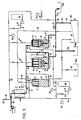
- This system has a pump 1, from which a line 18 with a valve 14 leads to a filter 2.
- a line 13 with a valve 15 opens into this line 18.
- a line 20 leads from the filter 2 either directly or via the cation exchanger container 3 and a line 38 to the anion exchanger container 4.
- a drain line 34 leads to a product tank 34a.
- a line 44 leads from the anion exchanger container 4 directly to a product tank 44a or a line 48 leads to the polisher 5, from which a line 58 leads to at least one tank 59a for the finished product.
- the starting product for this is a fruit juice or a fruit juice concentrate, which e.g. has a dry matter content of about 30%.
- This substrate is fed to the cation exchanger container 3 by means of the pump 1 via line 18, via line 2, which is designed as a fine sieve, preferably in the form of a bag filter, and a valve 29. In this it is passed with the aid of a distribution device 31 over a cation exchange resin 32 located in the container 3, which rests on a sieve 33.
- the substrate When the cation exchange resin 32 is penetrated, the substrate is decationized, as a result of which the alkali and alkaline earth metal ions, which act as ash formers, are removed in particular. Under the sieve 33, the decationized substrate is drawn off by a drainage device.
- the substrate is then passed into the anion exchanger container 4 via a valve 36, via the line 38 and via a valve 39. In this it is by means of a distribution device 41 distributed over an anion exchange resin 42 located in this container 4.
- the anion exchange resin 42 rests on a sieve 43. Below the sieve 43, the de-ionized substrate passes through a drainage device and a valve 46 into the line 48, via which it is fed to the polisher 5 through a valve 49.
- the substrate is distributed by means of a distributor device 51 via an adsorption resin 52 resting on a sieve 53 and passes through it.
- the substrate which reaches line 58 via a drainage device and in which valves 56 and 59 are located, is deionized and freed from dyes.
- the sugar content of this substrate is measured by a refractometer 57.
- the substrate is discharged into the product tank 59a via the valve 59 with an adjustable minimum dry content of, for example, 5%.
- water still in the system is drained into a waste water tank 80 via a line 67 with a valve 66.
- the system can also be used to achieve the desired flexibility in such a way that only the anion exchanger container 4 and / or the polisher 5 are operated.
- conductometers 45 and 55 namely conductivity measuring devices, by means of which the degree of exhaustion of the ion exchange resins 42, 52 is measured and displayed.
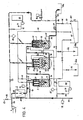
- a signal is emitted by the relevant conductometer 45 or 55, whereupon the valve 16 at the beginning of the system and then the valve 17 are switched over in such a way that - as shown in FIG. 4 - Water flows through a line 61 and briefly also through the filter 2 into the container 3, which is passed through the containers 3, 4 and 5 in the same way as described above for the substrate.
- the substrate in the system is conveyed into the product tank 59a by the water. Mixing zones are formed in the upper regions of the containers 4 and 5 by the inflow of the water.
- deionized water can be supplied to the upper regions of the containers 4 and 5 via a pipe 71.
- FIG. 7 shows the backwashing, which serves to mechanically clean the resins by removing the solids present in them.
- normal water is fed via line 61 to the cation exchanger tank 3 and deionized water is fed via line 71 to the anion exchanger tank 4 and the polisher 5.
- the water flows to these containers 3, 4 and 5 from below and leaves them via outlets provided in the upper area, whereupon it reaches the waste water container 80 via a line 62.
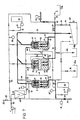
- FIG. 8 shows the flow diagram for the regeneration of the resins contained in the containers 3, 4 and 5.
- a tank 60 with concentrated sulfuric acid is provided.
- a line 63 mixes sulfuric acid with tap water supplied via line 61, whereby preferably 2% diluted sulfuric acid is passed through a valve 64 in counterflow to the flow of the substrate, i.e. from bottom to top, is passed through the cation exchange resin 32.
- the counterflow ensures good efficiency during the regeneration process.
- the discharge takes place via the distributor device 31 and via a further valve 65, the regeneration liquid flowing out into the waste water container 80.
- a sieve 81 is provided, through which resin particles carried along are separated. This is followed by rinsing with water, the rinsing taking place in the same direction as the regeneration rinsing.
- the anion exchange resin 42 is regenerated by mixing it from a further provided tank 70, which is filled with 50% sodium hydroxide solution, to the deionized water supplied via line 71, whereupon preferably 2% diluted sodium hydroxide solution is added via line 72, a valve 73 and the filter 2 leads to the polisher 5 by means of the line 28 and is applied via the distributor device 51.
- This liquid passes through the polishing resin 52 and reaches the anion exchanger container 4 via a line 75 and a valve 76, where it is applied via the distributor device 41 via the anion exchanger resin 42.
- this regeneration liquid is also subsequently fed via the valve 66 to the collection container 80.
- a rinse with softened water is then carried out in the same way.
- the acidity is determined by an acid meter 85 and the caustic strength is determined by a caustic device 86.
- the flow rates are controlled by a flow meter 90 and the pressure is controlled by a high pressure switch 91.
- the sieves 33, 43 and 53 in the containers 3, 4 and 5 and the drainage devices underneath are embedded in concrete in order to achieve the required stability.
Landscapes
- Health & Medical Sciences (AREA)
- Nutrition Science (AREA)
- Life Sciences & Earth Sciences (AREA)
- Chemical & Material Sciences (AREA)
- Engineering & Computer Science (AREA)
- Food Science & Technology (AREA)
- Polymers & Plastics (AREA)
- Non-Alcoholic Beverages (AREA)
- Coloring Foods And Improving Nutritive Qualities (AREA)
- Preparation Of Fruits And Vegetables (AREA)
- Seasonings (AREA)
- Treatment Of Water By Ion Exchange (AREA)
Applications Claiming Priority (2)
| Application Number | Priority Date | Filing Date | Title |
|---|---|---|---|
| AT2028/89 | 1989-08-29 | ||
| AT0202889A AT401996B (de) | 1989-08-29 | 1989-08-29 | Verfahren zur behandlung von entaromatisierten frucht- bzw. gemüsesäften |
Publications (4)
| Publication Number | Publication Date |
|---|---|
| EP0415905A2 true EP0415905A2 (fr) | 1991-03-06 |
| EP0415905A3 EP0415905A3 (en) | 1991-05-08 |
| EP0415905B1 EP0415905B1 (fr) | 1993-10-27 |
| EP0415905B2 EP0415905B2 (fr) | 1997-04-16 |
Family
ID=3526251
Family Applications (1)
| Application Number | Title | Priority Date | Filing Date |
|---|---|---|---|
| EP90890238A Expired - Lifetime EP0415905B2 (fr) | 1989-08-29 | 1990-08-09 | Procédé pour découdre et gagner des substances essentielles de jus de fruit et de légume |
Country Status (3)
| Country | Link |
|---|---|
| EP (1) | EP0415905B2 (fr) |
| AT (2) | AT401996B (fr) |
| DE (1) | DE59003223D1 (fr) |
Cited By (3)
| Publication number | Priority date | Publication date | Assignee | Title |
|---|---|---|---|---|
| US5746940A (en) * | 1995-01-31 | 1998-05-05 | Merck Patent Gesellschaft Mit Beschrankter Haftung | Liquid crystalline material comprising terpenoids |
| WO2003028485A1 (fr) * | 2001-09-28 | 2003-04-10 | Tropicana Products, Inc. | Desacidification d'un jus non concentre dans une colonne echangeuse d'ions |
| ITAN20130049A1 (it) * | 2013-03-07 | 2014-09-08 | Aeb Spa | Impianto per la stabilizzazione tartarica del vino. |
Family Cites Families (6)
| Publication number | Priority date | Publication date | Assignee | Title |
|---|---|---|---|---|
| FR943976A (fr) * | 1946-03-28 | 1949-03-23 | Hawahan Pineapple Company | Traitement du jus d'ananas ou de liquides semblables |
| FR2041431A5 (en) * | 1969-04-24 | 1971-01-29 | Buitoni Guiseppe | Tomato or fruit juice ph adjustment by - anion exchange |
| US4006032A (en) * | 1976-01-30 | 1977-02-01 | The United States Of America As Represented By The Secretary Of Agriculture | Process for removing off-flavor from maple sirup |
| DE2655765C3 (de) * | 1976-12-09 | 1980-09-18 | Permutit Gmbh, 1000 Berlin | Senken des Gehaltes und/oder Bedarfes an schwefliger Säure in Getränken |
| ES523411A0 (es) * | 1982-06-28 | 1985-04-01 | Calgon Carbon Corp | Un procedimiento de purificacion de una solucion endulzadora |
| US4522836A (en) * | 1983-05-19 | 1985-06-11 | Mitco Water Laboratories, Inc. | Upflow ion exchange treatment of natural edible juices containing high acidity and suspended solids |
-
1989
- 1989-08-29 AT AT0202889A patent/AT401996B/de not_active IP Right Cessation
-
1990
- 1990-08-09 AT AT90890238T patent/ATE96287T1/de not_active IP Right Cessation
- 1990-08-09 EP EP90890238A patent/EP0415905B2/fr not_active Expired - Lifetime
- 1990-08-09 DE DE90890238T patent/DE59003223D1/de not_active Expired - Fee Related
Cited By (5)
| Publication number | Priority date | Publication date | Assignee | Title |
|---|---|---|---|---|
| US5746940A (en) * | 1995-01-31 | 1998-05-05 | Merck Patent Gesellschaft Mit Beschrankter Haftung | Liquid crystalline material comprising terpenoids |
| WO2003028485A1 (fr) * | 2001-09-28 | 2003-04-10 | Tropicana Products, Inc. | Desacidification d'un jus non concentre dans une colonne echangeuse d'ions |
| US6730343B2 (en) | 2001-09-28 | 2004-05-04 | Yongsoo Chung | Single strength juice deacidification incorporating juice dome |
| ITAN20130049A1 (it) * | 2013-03-07 | 2014-09-08 | Aeb Spa | Impianto per la stabilizzazione tartarica del vino. |
| WO2014135578A3 (fr) * | 2013-03-07 | 2014-11-06 | Aeb Spa | Système de stabilisation tartrique de vin |
Also Published As
| Publication number | Publication date |
|---|---|
| ATA202889A (de) | 1996-06-15 |
| EP0415905B1 (fr) | 1993-10-27 |
| AT401996B (de) | 1997-01-27 |
| EP0415905B2 (fr) | 1997-04-16 |
| ATE96287T1 (de) | 1993-11-15 |
| DE59003223D1 (de) | 1993-12-02 |
| EP0415905A3 (en) | 1991-05-08 |
Similar Documents
| Publication | Publication Date | Title |
|---|---|---|
| DE69715204T2 (de) | Verfahren zur fraktionierung einer lösung durch ein simuliertes wanderbett chromatographieverfahren | |
| DE69417292T2 (de) | Verfahren zur Enthartung von zuckerenthaltenden Säften wie Melasse und Verwendung desselben zu einem Verfahren zur Gewinnung der in dieser Melasse enthaltenden Zuckern | |
| EP0050813B1 (fr) | Filtre d'adsorption à contre-courant pour traiter des liquides et procédé pour son fonctionnement | |
| JP2010517522A (ja) | 高果糖の果糖シロップの調製方法およびその設備 | |
| CH664068A5 (de) | Verfahren zur gewinnung von fluessigkeit aus bei der entsaftung landwirtschaftlicher produkte anfallenden rueckstaenden und vorrichtungen zur durchfuehrung desselben. | |
| DE60005242T2 (de) | Verfahren zur Demineralisierung von Molke | |
| DE69618152T2 (de) | Verfahren zur herstellung haltbarer gemüsepresssäfte | |
| DE69426085T2 (de) | Aus natürlichen Johannisbrotzuckern bestehender Sirup und Verfahren zur Herstellung desselben | |
| CH622004A5 (fr) | ||
| DE69912200T2 (de) | Verfahren zur entsalzung einer zuckerlösung | |
| EP0415905B2 (fr) | Procédé pour découdre et gagner des substances essentielles de jus de fruit et de légume | |
| CH679459A5 (fr) | ||
| US2564820A (en) | Mixed bed sugar purification | |
| DE3779787T2 (de) | Verfahren zur wirkungsvollen abtrennung und wiedergewinnung von fluechtigen aroma- und geschmacksstoffen. | |
| DE60020077T2 (de) | Verfahren zur Weinsteinstabilisierung von Wein und Vorrichtung zu deren Implementierung | |
| JP3383193B2 (ja) | 液体甘味料及びその製造方法 | |
| EP0006162A1 (fr) | Procédé pour la production de xylitol à partir de sirop final dérivé de la cristallisation de xylitol | |
| DE2424954A1 (de) | Verfahren zum herstellen eines weines mit niedrigem alkoholgehalt | |
| DE924620C (de) | Entionisieren und Reinigen von Zuckerloesungen mit Ionenaustauschern | |
| DE893180C (de) | Verfahren zum Reinigen von Fluessigkeiten, insbesondere von waessrigen Loesungen organischer Stoffe, wie Zuckerloesungen od. dgl. | |
| AT76202B (de) | Herstellung von klaren, Pektinstoffe enthaltenden konzentrierten Lösungen für die Fabrikation von Gelees, Marmeladen und dgl. | |
| AT273843B (de) | Verfahren zur Reinigung von Rohsaft der Zuckerindustrie | |
| CH306361A (de) | Verfahren zur Herstellung von raffinierten Zuckersirupen aus Früchten. | |
| WO1992003066A1 (fr) | Boisson hypocalorique et procede et installation pour sa preparation | |
| DE483329C (de) | Verfahren zur Herstellung von Presshefe |
Legal Events
| Date | Code | Title | Description |
|---|---|---|---|
| PUAI | Public reference made under article 153(3) epc to a published international application that has entered the european phase |
Free format text: ORIGINAL CODE: 0009012 |
|
| AK | Designated contracting states |
Kind code of ref document: A2 Designated state(s): AT CH DE LI |
|
| PUAL | Search report despatched |
Free format text: ORIGINAL CODE: 0009013 |
|
| AK | Designated contracting states |
Kind code of ref document: A3 Designated state(s): AT CH DE LI |
|
| 17P | Request for examination filed |
Effective date: 19910626 |
|
| RAP1 | Party data changed (applicant data changed or rights of an application transferred) |
Owner name: YBBSTALER FRUCHTSAFT GESELLSCHAFT M.B.H. |
|
| 17Q | First examination report despatched |
Effective date: 19920717 |
|
| GRAA | (expected) grant |
Free format text: ORIGINAL CODE: 0009210 |
|
| AK | Designated contracting states |
Kind code of ref document: B1 Designated state(s): AT CH DE LI |
|
| REF | Corresponds to: |
Ref document number: 96287 Country of ref document: AT Date of ref document: 19931115 Kind code of ref document: T |
|
| REF | Corresponds to: |
Ref document number: 59003223 Country of ref document: DE Date of ref document: 19931202 |
|
| PLBI | Opposition filed |
Free format text: ORIGINAL CODE: 0009260 |
|
| 26 | Opposition filed |
Opponent name: RUDOLF WILD GMBH & CO KG Effective date: 19940727 |
|
| PLAW | Interlocutory decision in opposition |
Free format text: ORIGINAL CODE: EPIDOS IDOP |
|
| PLAW | Interlocutory decision in opposition |
Free format text: ORIGINAL CODE: EPIDOS IDOP |
|
| PUAH | Patent maintained in amended form |
Free format text: ORIGINAL CODE: 0009272 |
|
| STAA | Information on the status of an ep patent application or granted ep patent |
Free format text: STATUS: PATENT MAINTAINED AS AMENDED |
|
| 27A | Patent maintained in amended form |
Effective date: 19970416 |
|
| AK | Designated contracting states |
Kind code of ref document: B2 Designated state(s): AT CH DE LI |
|
| REG | Reference to a national code |
Ref country code: CH Ref legal event code: AEN Free format text: AUFRECHTERHALTUNG DES PATENTES IN GEAENDERTER FORM |
|
| PGFP | Annual fee paid to national office [announced via postgrant information from national office to epo] |
Ref country code: DE Payment date: 20020817 Year of fee payment: 13 |
|
| PGFP | Annual fee paid to national office [announced via postgrant information from national office to epo] |
Ref country code: CH Payment date: 20020822 Year of fee payment: 13 Ref country code: AT Payment date: 20020822 Year of fee payment: 13 |
|
| PG25 | Lapsed in a contracting state [announced via postgrant information from national office to epo] |
Ref country code: AT Free format text: LAPSE BECAUSE OF NON-PAYMENT OF DUE FEES Effective date: 20030809 |
|
| PG25 | Lapsed in a contracting state [announced via postgrant information from national office to epo] |
Ref country code: LI Free format text: LAPSE BECAUSE OF NON-PAYMENT OF DUE FEES Effective date: 20030831 Ref country code: CH Free format text: LAPSE BECAUSE OF NON-PAYMENT OF DUE FEES Effective date: 20030831 |
|
| PG25 | Lapsed in a contracting state [announced via postgrant information from national office to epo] |
Ref country code: DE Free format text: LAPSE BECAUSE OF NON-PAYMENT OF DUE FEES Effective date: 20040302 |
|
| REG | Reference to a national code |
Ref country code: CH Ref legal event code: PL |