EP0416535B1 - Cathode pour tube électronique - Google Patents
Cathode pour tube électronique Download PDFInfo
- Publication number
- EP0416535B1 EP0416535B1 EP90116972A EP90116972A EP0416535B1 EP 0416535 B1 EP0416535 B1 EP 0416535B1 EP 90116972 A EP90116972 A EP 90116972A EP 90116972 A EP90116972 A EP 90116972A EP 0416535 B1 EP0416535 B1 EP 0416535B1
- Authority
- EP
- European Patent Office
- Prior art keywords
- alkaline earth
- cathode
- earth metal
- carbonate
- layer
- Prior art date
- Legal status (The legal status is an assumption and is not a legal conclusion. Google has not performed a legal analysis and makes no representation as to the accuracy of the status listed.)
- Expired - Lifetime
Links
Images




Classifications
-
- H—ELECTRICITY
- H01—ELECTRIC ELEMENTS
- H01J—ELECTRIC DISCHARGE TUBES OR DISCHARGE LAMPS
- H01J1/00—Details of electrodes, of magnetic control means, of screens, or of the mounting or spacing thereof, common to two or more basic types of discharge tubes or lamps
- H01J1/02—Main electrodes
- H01J1/13—Solid thermionic cathodes
- H01J1/14—Solid thermionic cathodes characterised by the material
-
- H—ELECTRICITY
- H01—ELECTRIC ELEMENTS
- H01J—ELECTRIC DISCHARGE TUBES OR DISCHARGE LAMPS
- H01J1/00—Details of electrodes, of magnetic control means, of screens, or of the mounting or spacing thereof, common to two or more basic types of discharge tubes or lamps
- H01J1/02—Main electrodes
- H01J1/13—Solid thermionic cathodes
- H01J1/14—Solid thermionic cathodes characterised by the material
- H01J1/142—Solid thermionic cathodes characterised by the material with alkaline-earth metal oxides, or such oxides used in conjunction with reducing agents, as an emissive material
-
- H—ELECTRICITY
- H01—ELECTRIC ELEMENTS
- H01J—ELECTRIC DISCHARGE TUBES OR DISCHARGE LAMPS
- H01J9/00—Apparatus or processes specially adapted for the manufacture, installation, removal, maintenance of electric discharge tubes, discharge lamps, or parts thereof; Recovery of material from discharge tubes or lamps
- H01J9/02—Manufacture of electrodes or electrode systems
- H01J9/04—Manufacture of electrodes or electrode systems of thermionic cathodes
- H01J9/042—Manufacture, activation of the emissive part
Definitions
- This invention relates to a cathode for electron tube employed in image receiving tubes and image pickup tubes more particularly, to a so-called oxide coated cathode for electron tubes.
- the invention also relates to a method for fabricating a cathode of the type mentioned above.
- cathode or cathodes Ordinarily employed oxide coated cathodes (hereinafter referred to simply as cathode or cathodes) mostly include a metal substrate mainly composed of nickel (Ni) and several percent of tungsten (W) and the like used as a reducing agent and a coating formed on the substrate and made of a ternary alkaline earth metal oxide consisting of barium (Ba), strontium (Sr) and calcium (Ca).
- a lower working temperature is more advantageous not only saving the consumption power for heaters for the cathode, but also in the improvement of the life characteristic of the cathode. More particularly, it is known that the life characteristic is greatly influenced by the intermediate layer formed owing to the thermal reaction between the oxide and the coated metal substrate during operation. The lowering of the working temperature of the cathode brings about a prolonged life by suppressing the formation of the intermediate layer.
- indium (In) in the form of indium oxide (In2O3) is adapted for improving the capability of electron radiation with a working temperature for the same level of radiation current being reduced. This is disclosed in Japanese Patent Publication No. 38-2334.
- In2O3 has a sublimation temperature of about 850°C which is lower than the thermal decomposition temperature of alkaline earth metal carbonates. Accordingly, most In2O3 which has been added to the alkaline earth metal carbonates will be lost from the cathode layer during a step where the carbonates are heated at 1000 to 1100°C and decomposed into oxides during evacuation under vacuum or during the so-called thermal decomposition activation step for the cathode.
- the results of the analysis on the composition of the oxide cathode prior to and after the thermal decomposition and activation reveal, as shown in Tables 1 and 2, that the oxide cathode layer prior to the thermal decomposition and activation contains 2 to 3 atomic percent of In3+ whereas the oxide cathode layer after the thermal decomposition and activation has a considerably reduced content of In3+ of not larger than 0.005 atomic percent.
- the small amount of remaining In contributes to good electron radiation characteistics of the cathode. Too large particles of In or In compounds existing prior to the activation step may cause their neighboring regions to be molten depending on the thermal decomposition and activation conditions, resulting in bad influences on the electron radiation characteristics.
- the amount of an additive element necessary for improving the electron radiation capability should be small sufficient to have it incorporated in the crystals of alkaline earth metal carbonates and that particles of an additional element or its compound not incorporated in the crystals should be preliminarily removed from the carbonate composition prior to the activation, which is important for obtaining the stable capability of electron radiation.
- An object of the invention is to provide a cathode for electron tubes which has high capability of electron radiation and is stable by removing an additional additive element or its compound from carbonate crystals.
- Another object of the invention to provide a cathode for electron tubes wherein an element capable of producing an amphoteric compound is used as an additive element.
- a further object of the invention is to provide a method for fabricating the cathode mentioned above.
- a cathode for electron tubes which comprises a metal substrate mainly composed of nickel and a reducing agent and a coating layer formed on the metal substrate, said layer comprising alkaline earth metal carbonates, the alkaline earth metal carbonates in the coating layer being adapted to be converted into corresponding metal oxides, during the cathode activation treatment, characterized in that in the alkaline earth metal carbonate crystals is incorporated at least one of zinc (Zn) and aluminium (Al).
- a method for fabricating a cathode for electron tubes which comprises the steps of: dissolving at least one element of Zn and Al or its compound in a solution of water-soluble salts of alkaline earth metals; adding a carbonate precipitant to the solution thereby causing co-precipitation to obtain a powder mainly composed of a multi-component alkaline earth metal carbonate; immersing the powder in an alkaline aqueous solution and subjecting the resulting mixture to filtration to obtain an alkaline earth metal carbonate containing Al and/or Zn from which the Al and/or Zn in excess is removed by dissolution; applying, onto a substrate metal, a cathodic material composition obtained by mixing the alkaline earth metal carbonate and a binder therefor to form a layer of the cathodic material composition; and heating the thus formed layer in an evacuated closed system to convert the layer into an oxide layer.
- the cathode obtained above has not only high capability of electron radiation as in the case where In is added, but also more stable characteristics than in the case of adding In. This is considered for the reason that the addition of Zn or Al in small amounts has the effect of enhancing the capability of electron radiation as in the case where In is added and that the additive element is incorporated in the crystals of the alkaline earth metal carbonate prior to activation of the cathode.
- An additional additive element or its compound which is not incorporated in the crystals and which is amphoteric in nature is dissolved by the use of an alkaline solution and removed sufficiently.
- the cathode has a heater 1 for heating the cathode to a working temperature and a cathode sleeve 2 in which the heater is built, and a substrate metal 3 provided at one end of the sleeve 2 and made primarily of nickel. On the substrate metal 2 is further formed an oxide layer 4 mainly compose of alkaline earth metal oxides and serving to emit electrons.
- a cathode is used as an electron gun according to an ordinary arrangement and is built in an electron tube.
- Fig. 2 is a flow chart showing a fabrication procedure of a cathode according to the invention. This fabrication procedure is illustrated in more detail.
- Barium carbonate (BaCO3), strontium carbonate (SrCO3) and calcium carbonate (CaCO3) are weighed at ratios by weight of 62:35.5:2.5 and dissolved in and mixed with a dilute nitric acid aqueous solution, to which ZnO is added for dissolution in amounts of from 1 to 3 wt% based on the total amount of the alkaline earth metal carbonates.
- an ammonium carbonate ((NH4)2CO3) aqueous solution (about 1.5 mols/l) while sufficiently agitating, thereby causing a precipitate mainly composed of a quaternary carbonate of Ba, Sr, C and Zn and containing Zn or a Zn compound, followed by filtration.
- the thus obtained precipitate is immersed in an ammonium hydroxide ((NH4OH) aqueous solution (about 3 mols/l) or ammonium carbonate ((NH4)2CO3) aqueous solution (about 3 mols/l), sufficiently agitated and filtered.
- an ammonium hydroxide (NH4OH) aqueous solution (about 3 mols/l) or ammonium carbonate ((NH4)2CO3) aqueous solution (about 3 mols/l)
- quaternary carbonate crystals have such an irregular structure on the surface thereof as is schematically shown in Fig. 3, which is considered to result from the incorporation of Zn in the alkaline earth metal carbonate crystals.
- the crystals of a ternary carbonate of Ba. Sr and Ca obtained without addition of any Zn for comparison have a smooth surface as is schematically shown in Fig. 4.
- the thus obtained quaternary carbonate powder and nitro cellulose used as a binder are added to and mixed with a mixed organic solvent of ethyl acetate and isoamyl acetate to prepare a paste composition for cathode material.
- the above cathode material composition is spray coated, n a thickness of 100 ⁇ m at a density of 0.8 g/cm3, on a substrate metal; which consists of nickel containing 4 wt% of tungsten as a reducing agent and which is provided at one end of the cathode sleeve to form a coating layer of the cathode material.
- an electron gun is assembled using the cathode and built in an electron tube.
- the electron tube is evacuated and subjected to thermal decomposition and activation treatment at a temperature of 1000 to 1100°C.
- thermal decomposition and activation treatment the quaternary carbonate contained in the cathode material coated layer is converted into oxides, thereby producing an oxide layer having good capability of electron emission.
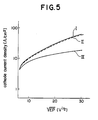
- Thirty cathodes are fabricated in this manner and are subjected to measurement of a pulse emission characteristic.
- a single pulse with a pulse width of 45 microseconds and a voltage of EpV is passed between the cathode and an electrode at the high voltage side, after which the voltage Ep is changed to measure a current density at the cathode.
- Fig. 5 shows a typical pulse emission characteristic curve among the results of the measurement.
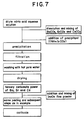
- a cathode to which In is added according to a known technique is fabricated according to the flow chart shown Fig. 7. The fabrication procedure is described in detail.
- BaCO3, SrCO3 and CaCO3 are weighed at ratios of 62:35.5:2.5 and dissolved in and mixed with a dilute nitric acid aqueous solution.
- a dilute nitric acid aqueous solution To the resultant ternary nitrate aqueous solution (about 0.4 mols/l) is gradually added an (NH4)2CO3 aqueous solution (about 1.5 mols/l) while sufficiently agitating, thereby causing a precipitate of a ternary carbonate of Ba, Sr and Ca, followed by filtration. This ternary carbonate is washed with hot pure water and dried.
- the addition of Zn and/or Al is effective in improving the electron radiation capability to an extent equal to that conventionally attained by the addition of In.
- the best use is made of characteristic features of Zn and Al which are elements capable of producing amphoteric compounds, i.e. additive elements or compounds thereof, which are considered as harmful and have not been incorporated in alkaline earth metal carbonates, can be sufficiently removed, ensuring the characteristics to be readily stabilized.
- the improvement in the electron radiation capability will bring about a reduced working temperature of the cathode and a prolonged life of the cathode.
Landscapes
- Engineering & Computer Science (AREA)
- Manufacturing & Machinery (AREA)
- Solid Thermionic Cathode (AREA)
Claims (7)
- Cathode pour tube électronique, laquelle comprend un substrat en métal essentiellement constitué par du nickel et par un agent de réduction et une couche de revêtement formée sur le substrat en métal, ladite couche comprenant des carbonates de métaux terreux alcalins, les carbonates de métaux terreux alcalins contenus dans la couche de revêtement étant adaptés pour être convertis en oxydes métalliques correspondants pendant le traitement d'activation de cathode, caractérisée en ce que dans les cristaux de carbonates de métaux terreux alcalins est incorporé au moins un élément pris parmi le zinc (Zn) et l'aluminium (Al).
- Cathode selon la revendication 1, dans laquelle lesdits carbonates de métaux terreux alcalins contiennent du Ba, du Sr et du Ca en même temps.
- Procédé de fabrication d'une cathode pour tube électronique, lequel comprend les étapes de :
dissolution d'au moins un élément pris parmi le Zn et l'Al ou de son composé dans une solution de sels solubles à l'eau de métaux terreux alcalins ;
ajout d'un précipitant de carbonate à la solution pour ainsi provoquer une co-précipitation afin d'obtenir une poudre essentiellement constituée par un carbonate de métaux terreux alcalins multi-composant ;
immersion de la poudre dans une solution aqueuse alcaline et soumission du mélange résultant à une filtration afin d'obtenir un carbonate de métaux terreux alcalins contenant de l'Al et/ou du Zn dont l'Al et/ou le Zn en excès est ôté par dissolution ;
application, sur un métal de substrat, d'une composition de matériau cathodique obtenue en mélangeant le carbonate de métaux terreux alcalins et un liant à cette fin afin de former une couche de la composition de matériau cathodique ; et
chauffage de la couche ainsi formée dans un système fermé soumis sous vide afin de convertir la couche en une couche d'oxyde. - Procédé selon la revendication 3, dans lequel les sels solubles à l'eau des métaux terreux alcalins sont du BaCO₃, du SrCO₃ et du CaCO₃.
- Procédé selon la revendication 3, dans lequel ledit précipitant de carbonate est du (NH₄)₂CO₃ ou du Na₂CO₃.
- Procédé selon la revendication 3, dans lequel le composé de Zn et/ou d'Al est du ZnO et/ou de l'Al(OH)₃.
- Procédé selon la revendication 3, dans lequel le composé de Zn et/ou d'Al est ajouté selon une quantité comprise entre 1 à 3% en poids de la quantité totale des carbonates de métaux terreux alcalins.
Applications Claiming Priority (2)
| Application Number | Priority Date | Filing Date | Title |
|---|---|---|---|
| JP228433/89 | 1989-09-05 | ||
| JP1228433A JPH0393126A (ja) | 1989-09-05 | 1989-09-05 | 電子管用陰極 |
Publications (3)
| Publication Number | Publication Date |
|---|---|
| EP0416535A2 EP0416535A2 (fr) | 1991-03-13 |
| EP0416535A3 EP0416535A3 (en) | 1991-05-08 |
| EP0416535B1 true EP0416535B1 (fr) | 1994-03-16 |
Family
ID=16876413
Family Applications (1)
| Application Number | Title | Priority Date | Filing Date |
|---|---|---|---|
| EP90116972A Expired - Lifetime EP0416535B1 (fr) | 1989-09-05 | 1990-09-04 | Cathode pour tube électronique |
Country Status (4)
| Country | Link |
|---|---|
| EP (1) | EP0416535B1 (fr) |
| JP (1) | JPH0393126A (fr) |
| KR (1) | KR100198909B1 (fr) |
| DE (1) | DE69007383T2 (fr) |
Families Citing this family (3)
| Publication number | Priority date | Publication date | Assignee | Title |
|---|---|---|---|---|
| KR930009170B1 (ko) * | 1991-10-24 | 1993-09-23 | 삼성전관 주식회사 | 함침형 음극의 제조방법 |
| WO1997032330A1 (fr) * | 1996-02-29 | 1997-09-04 | Matsushita Electronics Corporation | Cathode de tube electronique |
| CN102543617A (zh) * | 2011-12-15 | 2012-07-04 | 宁波盈旺通信设备有限公司 | 金属陶瓷气体放电管的电子发射材料 |
Family Cites Families (3)
| Publication number | Priority date | Publication date | Assignee | Title |
|---|---|---|---|---|
| FR911627A (fr) * | 1945-01-19 | 1946-07-16 | Sadir Carpentier | Perfectionnement aux cathodes des tubes à décharge électronique |
| FR1274476A (fr) * | 1959-08-06 | 1961-10-27 | Philips Nv | Procédé pour la fabrication d'une cathode à oxydes et cathode ainsi fabriquée |
| US3625759A (en) * | 1967-04-03 | 1971-12-07 | Varian Associates | Process for making oxide cathodes having improved thermal emissivity |
-
1989
- 1989-09-05 JP JP1228433A patent/JPH0393126A/ja active Pending
-
1990
- 1990-08-29 KR KR1019900013353A patent/KR100198909B1/ko not_active Expired - Fee Related
- 1990-09-04 DE DE69007383T patent/DE69007383T2/de not_active Expired - Fee Related
- 1990-09-04 EP EP90116972A patent/EP0416535B1/fr not_active Expired - Lifetime
Also Published As
| Publication number | Publication date |
|---|---|
| EP0416535A2 (fr) | 1991-03-13 |
| KR100198909B1 (ko) | 1999-06-15 |
| DE69007383D1 (de) | 1994-04-21 |
| JPH0393126A (ja) | 1991-04-18 |
| KR910007027A (ko) | 1991-04-30 |
| EP0416535A3 (en) | 1991-05-08 |
| DE69007383T2 (de) | 1994-10-06 |
Similar Documents
| Publication | Publication Date | Title |
|---|---|---|
| DE69736205T2 (de) | Aluminumnitridsinterkörper, Gegenstand mit eingebettetem Metall, elektronisch funktionalem Material und elektrostatische Einspannvorrichtung | |
| DE69834778T2 (de) | Haltevorrichtung für Halbleiter | |
| DE69101797T2 (de) | Elektronenröhrenkathode. | |
| DE69219452T2 (de) | Katalysator aus Platinumlegierung und Verfahren für seine Herstellung | |
| EP0638520B1 (fr) | Poudre de cobalt et d'oxyde de cobalt, procédé de sa préparation et son utilisation | |
| DE2344936A1 (de) | Thermische kathode fuer elektronenroehren und verfahren zu deren herstellung | |
| EP0416535B1 (fr) | Cathode pour tube électronique | |
| US5347194A (en) | Oxide cathode with rare earth addition | |
| DE2530076C3 (de) | Elektrode für Hochdruck-Entladungslampen | |
| DE3300317C2 (de) | Verfahren zur galvanischen Abscheidung von Chrom aus einem Chrom-III-Ionen enthaltenden Bad | |
| CA1101479A (fr) | Traduction non-disponible | |
| DE4041890C2 (fr) | ||
| KR920001337B1 (ko) | 전자관음극 및 그 제조방법 | |
| DE2947313C2 (de) | Elektronenröhrenkathode | |
| DE69719452T2 (de) | Kathode für eine Elektronenröhre und Herstellungsverfahren | |
| KR100294485B1 (ko) | 산화물음극 | |
| EP1189253B1 (fr) | Tube à rayons cathodiques avec cathode à oxydes dopée | |
| KR100192035B1 (ko) | 음극의 제조방법 | |
| DE856489C (de) | Elektronenentladungsvorrichtung mit einer Sekundaeremissionselektrode und Verfahren zur Herstellung derselben | |
| US4078900A (en) | Method of making a high current density long life cathode | |
| US5369091A (en) | Process for the manufacture of 95% by weight single phase YCBO powder in one combustion step, comprising the use of citrate complex compounds as starting materials | |
| DE10247447B4 (de) | Direkt beheizte Oxidkathode | |
| JPS5936380B2 (ja) | 電子放射性物質の製造方法 | |
| KR920006999B1 (ko) | 전자방출물질의 제조방법 | |
| RU2060570C1 (ru) | Способ изготовления оксидного катода |
Legal Events
| Date | Code | Title | Description |
|---|---|---|---|
| PUAI | Public reference made under article 153(3) epc to a published international application that has entered the european phase |
Free format text: ORIGINAL CODE: 0009012 |
|
| 17P | Request for examination filed |
Effective date: 19901220 |
|
| AK | Designated contracting states |
Kind code of ref document: A2 Designated state(s): DE FR GB |
|
| PUAL | Search report despatched |
Free format text: ORIGINAL CODE: 0009013 |
|
| AK | Designated contracting states |
Kind code of ref document: A3 Designated state(s): DE FR GB |
|
| 17Q | First examination report despatched |
Effective date: 19930513 |
|
| GRAA | (expected) grant |
Free format text: ORIGINAL CODE: 0009210 |
|
| AK | Designated contracting states |
Kind code of ref document: B1 Designated state(s): DE FR GB |
|
| REF | Corresponds to: |
Ref document number: 69007383 Country of ref document: DE Date of ref document: 19940421 |
|
| ET | Fr: translation filed | ||
| PLBE | No opposition filed within time limit |
Free format text: ORIGINAL CODE: 0009261 |
|
| STAA | Information on the status of an ep patent application or granted ep patent |
Free format text: STATUS: NO OPPOSITION FILED WITHIN TIME LIMIT |
|
| 26N | No opposition filed | ||
| PGFP | Annual fee paid to national office [announced via postgrant information from national office to epo] |
Ref country code: DE Payment date: 20010828 Year of fee payment: 12 |
|
| PGFP | Annual fee paid to national office [announced via postgrant information from national office to epo] |
Ref country code: GB Payment date: 20010905 Year of fee payment: 12 |
|
| PGFP | Annual fee paid to national office [announced via postgrant information from national office to epo] |
Ref country code: FR Payment date: 20010911 Year of fee payment: 12 |
|
| REG | Reference to a national code |
Ref country code: GB Ref legal event code: IF02 |
|
| PG25 | Lapsed in a contracting state [announced via postgrant information from national office to epo] |
Ref country code: GB Free format text: LAPSE BECAUSE OF NON-PAYMENT OF DUE FEES Effective date: 20020904 |
|
| PG25 | Lapsed in a contracting state [announced via postgrant information from national office to epo] |
Ref country code: DE Free format text: LAPSE BECAUSE OF NON-PAYMENT OF DUE FEES Effective date: 20030401 |
|
| GBPC | Gb: european patent ceased through non-payment of renewal fee |
Effective date: 20020904 |
|
| PG25 | Lapsed in a contracting state [announced via postgrant information from national office to epo] |
Ref country code: FR Free format text: LAPSE BECAUSE OF NON-PAYMENT OF DUE FEES Effective date: 20030603 |
|
| REG | Reference to a national code |
Ref country code: FR Ref legal event code: ST |