EP0416661A2 - Verfahren zur Herstellung reiner Monoglyceride, reiner Diglyceride und/oder reiner Triglyceride - Google Patents
Verfahren zur Herstellung reiner Monoglyceride, reiner Diglyceride und/oder reiner Triglyceride Download PDFInfo
- Publication number
- EP0416661A2 EP0416661A2 EP90117318A EP90117318A EP0416661A2 EP 0416661 A2 EP0416661 A2 EP 0416661A2 EP 90117318 A EP90117318 A EP 90117318A EP 90117318 A EP90117318 A EP 90117318A EP 0416661 A2 EP0416661 A2 EP 0416661A2
- Authority
- EP
- European Patent Office
- Prior art keywords
- column
- extractant
- monoglycerides
- separation
- triglycerides
- Prior art date
- Legal status (The legal status is an assumption and is not a legal conclusion. Google has not performed a legal analysis and makes no representation as to the accuracy of the status listed.)
- Granted
Links
- OGBUMNBNEWYMNJ-UHFFFAOYSA-N batilol Chemical class CCCCCCCCCCCCCCCCCCOCC(O)CO OGBUMNBNEWYMNJ-UHFFFAOYSA-N 0.000 title claims abstract description 58
- 150000003626 triacylglycerols Chemical class 0.000 title claims abstract description 57
- 238000000034 method Methods 0.000 title claims abstract description 44
- 238000004519 manufacturing process Methods 0.000 title claims abstract description 10
- PEDCQBHIVMGVHV-UHFFFAOYSA-N Glycerine Chemical compound OCC(O)CO PEDCQBHIVMGVHV-UHFFFAOYSA-N 0.000 claims abstract description 80
- 239000000203 mixture Substances 0.000 claims abstract description 53
- 125000005456 glyceride group Chemical group 0.000 claims abstract description 44
- 238000000605 extraction Methods 0.000 claims abstract description 16
- 230000008569 process Effects 0.000 claims abstract description 14
- XPDWGBQVDMORPB-UHFFFAOYSA-N Fluoroform Chemical compound FC(F)F XPDWGBQVDMORPB-UHFFFAOYSA-N 0.000 claims abstract description 12
- 150000002430 hydrocarbons Chemical class 0.000 claims abstract description 11
- 229930195733 hydrocarbon Natural products 0.000 claims abstract description 10
- 239000004215 Carbon black (E152) Substances 0.000 claims abstract description 6
- 238000000926 separation method Methods 0.000 claims description 56
- ATUOYWHBWRKTHZ-UHFFFAOYSA-N Propane Chemical compound CCC ATUOYWHBWRKTHZ-UHFFFAOYSA-N 0.000 claims description 42
- 238000005194 fractionation Methods 0.000 claims description 29
- 239000001294 propane Substances 0.000 claims description 21
- 238000010992 reflux Methods 0.000 claims description 12
- OTMSDBZUPAUEDD-UHFFFAOYSA-N Ethane Chemical compound CC OTMSDBZUPAUEDD-UHFFFAOYSA-N 0.000 claims description 10
- 230000009467 reduction Effects 0.000 claims description 10
- 239000007791 liquid phase Substances 0.000 claims description 9
- OFBQJSOFQDEBGM-UHFFFAOYSA-N n-pentane Natural products CCCCC OFBQJSOFQDEBGM-UHFFFAOYSA-N 0.000 claims description 6
- 230000010349 pulsation Effects 0.000 claims description 5
- UFTFJSFQGQCHQW-UHFFFAOYSA-N triformin Chemical compound O=COCC(OC=O)COC=O UFTFJSFQGQCHQW-UHFFFAOYSA-N 0.000 claims description 5
- QQONPFPTGQHPMA-UHFFFAOYSA-N Propene Chemical compound CC=C QQONPFPTGQHPMA-UHFFFAOYSA-N 0.000 claims description 4
- VXNZUUAINFGPBY-UHFFFAOYSA-N 1-Butene Chemical compound CCC=C VXNZUUAINFGPBY-UHFFFAOYSA-N 0.000 claims description 2
- VGGSQFUCUMXWEO-UHFFFAOYSA-N Ethene Chemical compound C=C VGGSQFUCUMXWEO-UHFFFAOYSA-N 0.000 claims description 2
- 239000001273 butane Substances 0.000 claims description 2
- IAQRGUVFOMOMEM-UHFFFAOYSA-N butene Natural products CC=CC IAQRGUVFOMOMEM-UHFFFAOYSA-N 0.000 claims description 2
- IJDNQMDRQITEOD-UHFFFAOYSA-N n-butane Chemical compound CCCC IJDNQMDRQITEOD-UHFFFAOYSA-N 0.000 claims description 2
- 229910052799 carbon Inorganic materials 0.000 claims 1
- 125000004432 carbon atom Chemical group C* 0.000 claims 1
- YWAKXRMUMFPDSH-UHFFFAOYSA-N pentene Chemical compound CCCC=C YWAKXRMUMFPDSH-UHFFFAOYSA-N 0.000 claims 1
- 235000011187 glycerol Nutrition 0.000 abstract description 23
- 239000000047 product Substances 0.000 description 45
- 230000008929 regeneration Effects 0.000 description 39
- 238000011069 regeneration method Methods 0.000 description 39
- 235000021588 free fatty acids Nutrition 0.000 description 24
- 238000011068 loading method Methods 0.000 description 21
- 239000012071 phase Substances 0.000 description 15
- 235000021355 Stearic acid Nutrition 0.000 description 9
- OQCDKBAXFALNLD-UHFFFAOYSA-N octadecanoic acid Natural products CCCCCCCC(C)CCCCCCCCC(O)=O OQCDKBAXFALNLD-UHFFFAOYSA-N 0.000 description 9
- 239000008117 stearic acid Substances 0.000 description 9
- QIQXTHQIDYTFRH-UHFFFAOYSA-N octadecanoic acid Chemical compound CCCCCCCCCCCCCCCCCC(O)=O QIQXTHQIDYTFRH-UHFFFAOYSA-N 0.000 description 8
- 230000003247 decreasing effect Effects 0.000 description 7
- 238000012856 packing Methods 0.000 description 7
- 239000002244 precipitate Substances 0.000 description 7
- CURLTUGMZLYLDI-UHFFFAOYSA-N Carbon dioxide Chemical compound O=C=O CURLTUGMZLYLDI-UHFFFAOYSA-N 0.000 description 6
- WRIDQFICGBMAFQ-UHFFFAOYSA-N (E)-8-Octadecenoic acid Natural products CCCCCCCCCC=CCCCCCCC(O)=O WRIDQFICGBMAFQ-UHFFFAOYSA-N 0.000 description 5
- LDVVTQMJQSCDMK-UHFFFAOYSA-N 1,3-dihydroxypropan-2-yl formate Chemical compound OCC(CO)OC=O LDVVTQMJQSCDMK-UHFFFAOYSA-N 0.000 description 5
- LQJBNNIYVWPHFW-UHFFFAOYSA-N 20:1omega9c fatty acid Natural products CCCCCCCCCCC=CCCCCCCCC(O)=O LQJBNNIYVWPHFW-UHFFFAOYSA-N 0.000 description 5
- QSBYPNXLFMSGKH-UHFFFAOYSA-N 9-Heptadecensaeure Natural products CCCCCCCC=CCCCCCCCC(O)=O QSBYPNXLFMSGKH-UHFFFAOYSA-N 0.000 description 5
- 239000005642 Oleic acid Substances 0.000 description 5
- ZQPPMHVWECSIRJ-UHFFFAOYSA-N Oleic acid Natural products CCCCCCCCC=CCCCCCCCC(O)=O ZQPPMHVWECSIRJ-UHFFFAOYSA-N 0.000 description 5
- 239000003795 chemical substances by application Substances 0.000 description 5
- 238000001514 detection method Methods 0.000 description 5
- 235000014113 dietary fatty acids Nutrition 0.000 description 5
- 229930195729 fatty acid Natural products 0.000 description 5
- 239000000194 fatty acid Substances 0.000 description 5
- 150000004665 fatty acids Chemical class 0.000 description 5
- QXJSBBXBKPUZAA-UHFFFAOYSA-N isooleic acid Natural products CCCCCCCC=CCCCCCCCCC(O)=O QXJSBBXBKPUZAA-UHFFFAOYSA-N 0.000 description 5
- 235000013310 margarine Nutrition 0.000 description 5
- 239000003264 margarine Substances 0.000 description 5
- 238000000199 molecular distillation Methods 0.000 description 5
- 238000004904 shortening Methods 0.000 description 5
- CSCPPACGZOOCGX-UHFFFAOYSA-N Acetone Chemical compound CC(C)=O CSCPPACGZOOCGX-UHFFFAOYSA-N 0.000 description 4
- 239000003995 emulsifying agent Substances 0.000 description 4
- IPCSVZSSVZVIGE-UHFFFAOYSA-N hexadecanoic acid Chemical compound CCCCCCCCCCCCCCCC(O)=O IPCSVZSSVZVIGE-UHFFFAOYSA-N 0.000 description 4
- 239000007788 liquid Substances 0.000 description 4
- ZQPPMHVWECSIRJ-KTKRTIGZSA-N oleic acid Chemical compound CCCCCCCC\C=C/CCCCCCCC(O)=O ZQPPMHVWECSIRJ-KTKRTIGZSA-N 0.000 description 4
- 239000002253 acid Substances 0.000 description 3
- 150000007513 acids Chemical class 0.000 description 3
- 230000015572 biosynthetic process Effects 0.000 description 3
- 229910002092 carbon dioxide Inorganic materials 0.000 description 3
- 230000008859 change Effects 0.000 description 3
- KRKNYBCHXYNGOX-UHFFFAOYSA-N citric acid Chemical compound OC(=O)CC(O)(C(O)=O)CC(O)=O KRKNYBCHXYNGOX-UHFFFAOYSA-N 0.000 description 3
- 239000006184 cosolvent Substances 0.000 description 3
- 238000007323 disproportionation reaction Methods 0.000 description 3
- 239000003925 fat Substances 0.000 description 3
- 239000012530 fluid Substances 0.000 description 3
- 239000003921 oil Substances 0.000 description 3
- IIZPXYDJLKNOIY-JXPKJXOSSA-N 1-palmitoyl-2-arachidonoyl-sn-glycero-3-phosphocholine Chemical compound CCCCCCCCCCCCCCCC(=O)OC[C@H](COP([O-])(=O)OCC[N+](C)(C)C)OC(=O)CCC\C=C/C\C=C/C\C=C/C\C=C/CCCCC IIZPXYDJLKNOIY-JXPKJXOSSA-N 0.000 description 2
- PVNIQBQSYATKKL-UHFFFAOYSA-N Glycerol trihexadecanoate Natural products CCCCCCCCCCCCCCCC(=O)OCC(OC(=O)CCCCCCCCCCCCCCC)COC(=O)CCCCCCCCCCCCCCC PVNIQBQSYATKKL-UHFFFAOYSA-N 0.000 description 2
- UPYKUZBSLRQECL-UKMVMLAPSA-N Lycopene Natural products CC(=C/C=C/C=C(C)/C=C/C=C(C)/C=C/C1C(=C)CCCC1(C)C)C=CC=C(/C)C=CC2C(=C)CCCC2(C)C UPYKUZBSLRQECL-UKMVMLAPSA-N 0.000 description 2
- GQPLMRYTRLFLPF-UHFFFAOYSA-N Nitrous Oxide Chemical compound [O-][N+]#N GQPLMRYTRLFLPF-UHFFFAOYSA-N 0.000 description 2
- 229920002472 Starch Polymers 0.000 description 2
- 238000007792 addition Methods 0.000 description 2
- 238000004458 analytical method Methods 0.000 description 2
- 239000001569 carbon dioxide Substances 0.000 description 2
- 150000001746 carotenes Chemical class 0.000 description 2
- 235000005473 carotenes Nutrition 0.000 description 2
- 150000005690 diesters Chemical class 0.000 description 2
- 238000009826 distribution Methods 0.000 description 2
- 230000001804 emulsifying effect Effects 0.000 description 2
- 238000005516 engineering process Methods 0.000 description 2
- 230000032050 esterification Effects 0.000 description 2
- 238000005886 esterification reaction Methods 0.000 description 2
- 150000002148 esters Chemical class 0.000 description 2
- 235000019197 fats Nutrition 0.000 description 2
- 235000013305 food Nutrition 0.000 description 2
- 238000010438 heat treatment Methods 0.000 description 2
- 239000000787 lecithin Substances 0.000 description 2
- 235000010445 lecithin Nutrition 0.000 description 2
- 229940067606 lecithin Drugs 0.000 description 2
- 238000002844 melting Methods 0.000 description 2
- 230000008018 melting Effects 0.000 description 2
- 238000001556 precipitation Methods 0.000 description 2
- 235000019698 starch Nutrition 0.000 description 2
- 239000008107 starch Substances 0.000 description 2
- 239000000126 substance Substances 0.000 description 2
- NCYCYZXNIZJOKI-UHFFFAOYSA-N vitamin A aldehyde Natural products O=CC=C(C)C=CC=C(C)C=CC1=C(C)CCCC1(C)C NCYCYZXNIZJOKI-UHFFFAOYSA-N 0.000 description 2
- 238000005406 washing Methods 0.000 description 2
- XLYOFNOQVPJJNP-UHFFFAOYSA-N water Substances O XLYOFNOQVPJJNP-UHFFFAOYSA-N 0.000 description 2
- 102000002322 Egg Proteins Human genes 0.000 description 1
- 108010000912 Egg Proteins Proteins 0.000 description 1
- 108010068370 Glutens Proteins 0.000 description 1
- 235000021314 Palmitic acid Nutrition 0.000 description 1
- 229910018503 SF6 Inorganic materials 0.000 description 1
- FAPWRFPIFSIZLT-UHFFFAOYSA-M Sodium chloride Chemical compound [Na+].[Cl-] FAPWRFPIFSIZLT-UHFFFAOYSA-M 0.000 description 1
- 235000020167 acidified milk Nutrition 0.000 description 1
- 235000015173 baked goods and baking mixes Nutrition 0.000 description 1
- 230000008901 benefit Effects 0.000 description 1
- VBICKXHEKHSIBG-UHFFFAOYSA-N beta-monoglyceryl stearate Natural products CCCCCCCCCCCCCCCCCC(=O)OCC(O)CO VBICKXHEKHSIBG-UHFFFAOYSA-N 0.000 description 1
- 239000003054 catalyst Substances 0.000 description 1
- 238000006243 chemical reaction Methods 0.000 description 1
- 239000003086 colorant Substances 0.000 description 1
- 235000009508 confectionery Nutrition 0.000 description 1
- 239000002537 cosmetic Substances 0.000 description 1
- 238000000354 decomposition reaction Methods 0.000 description 1
- 238000006073 displacement reaction Methods 0.000 description 1
- 238000004821 distillation Methods 0.000 description 1
- 239000003651 drinking water Substances 0.000 description 1
- 235000020188 drinking water Nutrition 0.000 description 1
- 230000000694 effects Effects 0.000 description 1
- 235000013345 egg yolk Nutrition 0.000 description 1
- 210000002969 egg yolk Anatomy 0.000 description 1
- 239000000839 emulsion Substances 0.000 description 1
- 230000002255 enzymatic effect Effects 0.000 description 1
- 230000002349 favourable effect Effects 0.000 description 1
- 239000000796 flavoring agent Substances 0.000 description 1
- 235000019634 flavors Nutrition 0.000 description 1
- 235000021312 gluten Nutrition 0.000 description 1
- 235000015243 ice cream Nutrition 0.000 description 1
- 238000010348 incorporation Methods 0.000 description 1
- 238000000622 liquid--liquid extraction Methods 0.000 description 1
- 239000001788 mono and diglycerides of fatty acids Substances 0.000 description 1
- 235000010935 mono and diglycerides of fatty acids Nutrition 0.000 description 1
- WQEPLUUGTLDZJY-UHFFFAOYSA-N n-Pentadecanoic acid Natural products CCCCCCCCCCCCCCC(O)=O WQEPLUUGTLDZJY-UHFFFAOYSA-N 0.000 description 1
- 235000019645 odor Nutrition 0.000 description 1
- 235000019198 oils Nutrition 0.000 description 1
- 238000002360 preparation method Methods 0.000 description 1
- 235000020183 skimmed milk Nutrition 0.000 description 1
- 235000002639 sodium chloride Nutrition 0.000 description 1
- 239000011780 sodium chloride Substances 0.000 description 1
- 238000000638 solvent extraction Methods 0.000 description 1
- 230000000087 stabilizing effect Effects 0.000 description 1
- SFZCNBIFKDRMGX-UHFFFAOYSA-N sulfur hexafluoride Chemical compound FS(F)(F)(F)(F)F SFZCNBIFKDRMGX-UHFFFAOYSA-N 0.000 description 1
- 229960000909 sulfur hexafluoride Drugs 0.000 description 1
- 239000006188 syrup Substances 0.000 description 1
- 235000020357 syrup Nutrition 0.000 description 1
- TXEYQDLBPFQVAA-UHFFFAOYSA-N tetrafluoromethane Chemical compound FC(F)(F)F TXEYQDLBPFQVAA-UHFFFAOYSA-N 0.000 description 1
- 230000008719 thickening Effects 0.000 description 1
- 238000005809 transesterification reaction Methods 0.000 description 1
- 150000005691 triesters Chemical class 0.000 description 1
- 125000005457 triglyceride group Chemical group 0.000 description 1
- 238000005292 vacuum distillation Methods 0.000 description 1
- 235000013311 vegetables Nutrition 0.000 description 1
- 239000011782 vitamin Substances 0.000 description 1
- 229940088594 vitamin Drugs 0.000 description 1
- 229930003231 vitamin Natural products 0.000 description 1
- 235000013343 vitamin Nutrition 0.000 description 1
Images


Classifications
-
- C—CHEMISTRY; METALLURGY
- C07—ORGANIC CHEMISTRY
- C07C—ACYCLIC OR CARBOCYCLIC COMPOUNDS
- C07C67/00—Preparation of carboxylic acid esters
- C07C67/48—Separation; Purification; Stabilisation; Use of additives
- C07C67/58—Separation; Purification; Stabilisation; Use of additives by liquid-liquid treatment
Definitions
- Mono- and diglycerides are partial esters of glycerol with higher molecular fatty acids.
- Commercial monoglycerides consist of mixtures of mono- and diesters with a low proportion of triesters. Since the mono- and diesters of glycerol are edible, they are used in various branches of the food industry, pharmacy and cosmetics because of their emulsifying, stabilizing, plasticizing and thickening properties.
- the equilibrium mixture formed in the production of the glycerides can be used immediately for many, in particular technical, purposes after the unreacted glycerol has been separated off.
- the production of high-proof monoglycerides and diglycerides is desired for various fields of application.
- Monoglycerides obtained by molecular distillation with a monoglyceride content of over 90% are mainly used in the food industry (dough, confectionery and baking supplies, margarine, ice cream).
- shortening literally means shortening and goes back to the baking properties. Due to the special structure, the monoglycerides are able to change the plasticizing effect of starch and gluten in the preparation of the dough by inserting them into the homogeneous plasticates in a fine distribution, interrupting them and thus making the dough smoother, ie shortening it. At the same time, the incorporation of air is made easier, so that together baked goods with increased volume and better "brevity" are created.
- the essential components of margarine are edible fats and oils, drinking water and emulsifiers.
- Lecithin, egg yolk and / or mono- and diglycerides of fatty acids are used as emulsifiers.
- the margarine can also contain odors and flavors (flavorings), acidified milk, skimmed milk, table salt, starch syrup, citric acid and / or other edible acids, vitamins and approved coloring agents (generally carotene or carotene-containing oils).
- Emulsifiers are indispensable auxiliaries in the production of margarine because they enable the formation of water-in-oil emulsions. The most common are monoglycerides and vegetable lecithin, which support each other in their emulsifying effects.
- Mono- and diglycerides are accessible by esterifying glycerin with fatty acids.
- esterifying glycerin with fatty acids By transesterification of triglycerides with glycerin or by reaction of glycerin with fatty acids in the presence of catalysts, mixtures are formed which are composed of glycerin, mono-, di- and triglycerides and free fatty acids.
- the enzymatic decomposition of triglycerides has recently found its way into technology. All methods lead to a mixture of mono- and triglycerides.
- an equilibrium mixture is obtained which, after removal of the glycerol, contains about 60% mono-, 35% di- and 5% triglycerides.
- the starting mixture in the esterification is therefore chosen so that the monoglycerides are obtained as the main product in equilibrium.
- the mixture is usually made by Molecular distillation separated.
- disproportionation occurs to a small extent, so that mono- or diglycerides contain small amounts of the other two esters and small amounts of free fatty acids.
- the ratio of 1-monoglycerides to 2-monoglycerides is shifted in favor of 2-monoglycerides.
- the object of the invention is to provide a process for the production of pure mono- and pure diglycerides through a simplified and more economical process.
- a process for the production of monoglycerides and possibly diglycerides and / or triglycerides and possibly glycerin from glyceride mixtures or glycerol-containing glyceride mixtures by countercurrent extraction with a circulating extractant is proposed, which is characterized in that a hydrocarbon with a density of more than 180 kg / m3 and / or trifluoromethane with a density of more than 180 kg / m3 is used as a separate phase-forming extractant.
- the temperature and pressure are selected so that the system of the glyceride mixture or glycerol-containing glyceride mixture and the extractant in the separation column and in the fractionation columns is two-phase.
- This is possible in a density range of volatile hydrocarbons with 2 to 5 hydrocarbon atoms from 180 to 800 kg / m3.
- the system of glyceride mixture and hydrocarbon becomes single phase, so that a separation operation is impossible.
- the loading of the extractant is too low for economical work.
- the use of low molecular weight hydrocarbons e.g. Ethane, propane, butane, pentane, ethene, propene, butene and trifluoromethane or their mixtures as supercritical extractants can achieve high separation factors in conjunction with a relatively high load.
- Substances are to be described as supercritical, the temperature of which is higher than the critical temperature at corresponding pressures or the pressure of which is higher than the critical pressure at the corresponding temperature (hatched field, according to FIG. 1).
- Preferred work takes place in the so-called “near-critical" state.
- the "near-critical" state is understood to mean working conditions in which the pressure and temperature are chosen such that they are close to the limits of the hatched area in FIG. 1. For example, also work at a temperature below the critical temperature if the appropriate pressure above the critical pressure is selected.
- the preferred density range in the procedure according to the invention is 200 to 800 kg / m3 for hydrocarbons and 300 to 1100 kg / m3 for trifluoromethane.
- the separation factors between monoglycerides and diglycerides and between diglycerides and triglycerides are so large in the density range mentioned that the glyceride mixture can be broken down into monoglycerides, diglycerides and triglycerides in one operation. In this density range it is also possible to break down a glycerol-containing glyceride mixture into glycerol, mono-, di- and triglycerides.
- the separation e.g. the glycerides of C18- and C16 acids with the aid of molecular distillation requires temperatures of about 200 ° C in the evaporator.
- the temperatures in the "near critical fluid extraction" are given by the melting temperatures of the glycerides.
- the glycerides of stearic acid between 70 and 80 ° C.
- the separation of stearic acid glycerides can be carried out at temperatures of 90 to 110 ° C.
- the melting points of the oleic acid glycerides are around 30 °. In this case, temperatures of 40 to 60 ° C will be preferred for the separation.
- suitable working conditions result for the separation of glyceride mixtures or glycerol-containing glyceride mixtures at temperatures from 10 to 120 ° C., preferably from 20 to 80 ° C. and pressures from 50 to 500 bar, preferably from 100 to 350 bar .
- the density of ethane is e.g. at 20 ° C and a pressure of 300 atm 450 kg / m3.
- the loading of the ethane in equilibrium with a glyceride mixture of 59% by weight monoglycerides, 36% by weight diglycerides, 4.6% by weight triglycerides of oleic acid and 0.4% by weight free fatty acids is 1% by weight under the conditions mentioned.
- the loading during regeneration of the extractant can be reduced to values of less than 0.02% by weight.
- Temperatures from 40 to 150 ° C, preferably from 60 to 120 ° C and pressures from 40 to 350 bar, preferably from 70 to 250 bar are appropriate if propane is used as an extractant.
- the density of the propane is e.g. at 110 ° C and a pressure of 85 bar 360 kg / m3.
- the equilibrium loading of the propane with a glyceride mixture of 61 wt.% Monoglycerides, 35 wt.% Diglycerides, 3.5 wt.% Triglycerides of stearic acid and 0.5 wt.% Free fatty acids is 5.4 wt. %.
- the separation of the monoglycerides from a glyceride mixture is also possible below the critical temperature, for example of the propane at 80 ° C.
- the density of the propane is 410 kg / m3.
- the equilibrium loading of the propane with a glyceride mixture of 61% by weight monoglycerides, 35% by weight diglycerides, 3.5% by weight triglycerides of stearic acid and 0.5% by weight free fatty acids is 6% by weight under these conditions.
- the load can be reduced to values of less than 0.02% by weight.
- the density of the propane is below these conditions 57 kg / m3.
- the monoglycerides do not appear as the top product but rather as the bottom product in the countercurrent column, hereinafter also referred to as the separation column or column.
- the extractant at the top of the column contains the di- and triglycerides as extract, which can subsequently be separated from the extractant by fractional precipitation.
- Two fractionation columns can be used for the fractional precipitation. If fractional separation of the di and triglycerides is dispensed with, a fractionation column is sufficient.
- the circulating extract is single-phase between the top of the separation column and the expansion valve. During the relaxation, the dissolved components precipitate out as a liquid phase. The liquid phase formed is separated off in the fractionation columns. Thereafter, the circulating extractant is single phase.
- the liquid phase flows downward in countercurrent.
- the latter becomes impoverished on di- and triglycerides on the way down until finally a bottom product with a monoglyceride content of over 99% is obtained.
- the extractant emerging at the top of this column contains, in addition to a slight residue of monoglycerides, the proportions of di- and triglycerides present in the feed.
- the extracting agent leaving the separation column is added to the subsequent column, also referred to below as the fractionation column, approximately in the middle. Due to the reduction in density, the diglycerides, which flow down as the liquid phase, preferentially precipitate out in the fractionation column. On the way down, the precipitated liquid depletes of triglycerides until finally a bottom product with a high diglyceride content is obtained. A portion of the bottom product obtained in the fractionation column can be added to the separation column as reflux and the rest can be removed as a product which contains diglycerides in high purity.
- the extractant emerging at the top of the fractionation column contains, in addition to a small residue of diglycerides, the triglycerides present in the feed.
- the extractant leaving the fractionation column is fed to the third column, which is also referred to as the regeneration column, in the middle part.
- the regeneration column As a result of the reduction in density, the hardly volatile substances still dissolved in the extractant precipitate out practically completely in the regeneration column and flow downwards as the liquid phase.
- a portion of the glycerides precipitated in the regeneration column can be returned to the fractionation column as reflux and the rest can be removed as a product which mainly contains triglycerides.
- a portion of the circulating gas, ie the extractant regenerated in the regeneration column, is added again after an appropriate increase in density, for example (by increasing the pressure and / or a decrease in temperature at the bottom of the separation column, and flows from the bottom to the top.
- an appropriate increase in density for example (by increasing the pressure and / or a decrease in temperature at the bottom of the separation column, and flows from the bottom to the top.
- a portion of the regenerated extractant can be added to the base after a corresponding increase in density fed to the fractionation column will.
- the mixture of mono-, di- and triglycerides can be separated into three fractions, each containing the monoglycerides, the diglycerides and the triglycerides in high purity, in one operation, without being complex Control and analysis equipment must be used that continuously corrects the composition of the extractant.
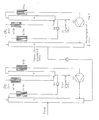
- the apparatus consists of three columns, one of which, the separation column 1, serves to separate the monoglycerides from the glyceride mixture.
- the monoglycerides are obtained as a bottom product.
- the second column serves as a fractionation column for separating the diglycerides in high purity.
- the third column, the regeneration column is used to separate the remaining extracted components from the cycle gas.
- the glyceride mixture which was previously freed of glycerol, is fed into the middle part of the separation column.
- the circulating extractant is preferably loaded with di- and triglycerides in the separation column. At the same time, the extractant dissolves in the downward flowing liquid phase, which is enriched with monoglycerides.
- the loaded extractant is expanded via the pressure reducing valve EV1 and fed into the middle of the fractionation column 2 after passing through the heat exchanger WT1b.
- the pressure and temperature in the fractionation column 2 are selected such that diglycerides and the small remainder of monoglycerides are preferably deposited.
- the condensed phase is withdrawn from the bottom of the fractionation column and divided into product P2 and reflux R1.
- the return flow is fed in after passing through the heat exchanger WT1a at the top of the separation column 1.
- the regeneration column 3 there is a density reduction due to pressure and / or temperature change, so that the extracting agent leaving the column is free of non-volatile components.
- the condensed phase which in addition to triglycerides also contains free fatty acids and small amounts of diglycerides, is withdrawn from the bottom of the regeneration column 3 and divided into product P3 and reflux R2.
- the reflux from the regeneration column 3 is passed in after passing through the heat exchanger WT2a at the top of the fractionation column 2.
- the regenerated extractant leaves the regeneration column 3 at the top and is returned to the separation column 1 with the aid of a compressor K after passing through the heat exchanger WT3. A smaller part of the regenerated circulating gas is partially released via the pressure reducing valve EV3 and fed to the fractionation column 2 at the bottom.
- High-percentage diglycerides are obtained as the bottom product from the fractionation column 2 and a bottom product rich in triglyceride is obtained from the regeneration column 3.
- the three different sump products are continuously drawn off and expanded into containers.
- the released amounts of gaseous extractant are returned to the circuit via a compressor.
- the pressure in the fractionation column 2 is reduced by about 5 to 60 bar, preferably by up to 40 bar, compared to the pressure in the separation column 1 in the isothermal procedure. Fractionation can also be carried out isobarically. In this case, the temperature in the fractionating column 2 is increased by 10 to 80 ° C., preferably from 20 to 50 ° C., compared to the temperature in the separation column 1. A combination of reducing the pressure and increasing the temperature is also possible.
- the extraction agent is regenerated either by relaxation alone or by relaxation with a simultaneous increase in temperature. The pressure during regeneration is 25 to 80 bar in the temperature range from 40 to 120 ° C.
- a temperature difference between the top and bottom of the column of 5 to 30 ° C., preferably 10 to 20 ° C., is advantageous. It is also expedient to provide a temperature gradient between the top and bottom of the fractionating column 2. In this case, the temperature difference between head and bottom is 5 to 40 ° C, preferably 10 to 30 ° C.
- FIG. 3 A further embodiment of the method according to the invention is shown in the schematic illustration in FIG. 3:
- the apparatus consists of two countercurrent columns with separate circuits which are connected in series in a cascade.
- the glycerol-containing feed of the glyceride mixture is fed to the first column 1 in the middle part.
- the operating conditions are chosen so that the circulating extractant prefers the di and Triglyceride dissolves.
- the extractant dissolves in the downward-flowing liquid that enriches with glycerol and monoglycerides.
- a mixture of glycerol and monoglycerides is obtained as the bottom product.
- the glycerin can be removed from the monoglycerides by water washing or vacuum distillation.
- the extractant loaded with di- and triglycerides is expanded in the pressure reducing valve EV1 and heated in the heat exchanger WT1a.
- the dissolved di- and triglycerides precipitate out. They are separated from the extractant stream in cyclone Z1.
- the extractant freed from liquid droplets is returned to the column 1 above the sump using the circuit compressor K1.
- Part of the product separated off in cyclone 21 is returned to the top of column 1 as reflux. The rest is transferred to column 2.
- column 2 the pressure and temperature are chosen so that the triglycerides are removed as the top product.
- the extracting agent loaded with triglyceride leaves column 2 at the top, is expanded in the pressure reducing valve EV2 and heated in the heat exchanger WT2a.
- the triglycerides dissolved in the extractant precipitate out.
- cyclone Z2 the high-purity triglycerides that have precipitated are separated from the extractant.
- the regenerated extractant is recirculated in column 2 above the sump with the aid of the circulating gas compressor K2.
- the liquid separated in the cyclone is divided into the reflux of column 2 and the product P3.
- the reflux is returned to column 2.
- the bottom product of column 2 consists of diglycerides, which are obtained in great purity.
- FIG. 4 Another embodiment of the method according to the invention is shown in Fig. 4.
- the plant consists of the separation column 1, the regeneration column 2, the further separation column 3 and the regeneration column 4.
- the feed which has been freed of glycerol by water washing or distillation is fed to the column 1 in the middle. Pressure and temperature are chosen so that the triglycerides are removed with the extractant at the top of the column.
- the extractant loaded with the triglycerides leaves column 1 at the top, is expanded in the pressure reducing valve EV1 and heated in the heat exchanger WT1b.
- the triglycerides dissolved in the extractant precipitate out and are separated off in the regeneration column 2.
- the triglycerides obtained as bottom product P2 are drawn off and some of them are returned to the top of the separation column 1 as reflux R1 after passing through the heat exchanger WT1a.
- the circulating gas leaving the regeneration column 2 passes through the heat exchanger WT2 and is introduced into the separation column 1 above the sump with the aid of the compressor K1.
- the bottom product P1 from column 1 contains mono- and diglycerides and is fed to the separation column 3 with the aid of a compressor as a feed.
- the pressure and temperature are chosen so that the diglycerides preferably dissolve in the circulating extractant.
- the extractant dissolves in the downward-flowing liquid phase that enriches with the monoglycerides.
- the extractant loaded with the more soluble diglycerides leaves the rectifying section of the countercurrent column 3 at the top.
- the loaded extractant is expanded via the pressure reducing valve EV2 and heated in the heat exchanger WT3b.
- the dissolved diglycerides precipitate out as droplets.
- the condensed phase is separated from the extractant.
- the three different products P2, P3, P4 obtained are continuously drawn off and relaxed in containers to atmospheric pressure.
- the quantities of gaseous extractant that are released are returned to the circuits via a compressor.
- the pressure in column 3 is increased by approximately up to 60 bar, preferably by 15 to 40 bar, compared to the pressure in column 1.
- the temperature in column 3 is reduced by 10 to 80 ° C, preferably by 20 to 50 ° C, compared to the temperature in column 1, i.e. compared to column 1, the density of the extractant is increased for column 3.
- this can also be achieved by combining a decrease in temperature and an increase in pressure.
- the glyceride mixture or glycerol-containing glyceride mixture is preferably fed in the middle of the different columns.
- the method according to the invention can also be carried out with the aid of pressure pulsation.
- the pulsation device is preferably attached above the bottom of the separation column. It is designed as a piston machine with straight thrust crank drive. A ratio of displaced volume to column volume between 1:40 and 1: 200 is favorable for the process according to this invention.
- the pulsation device is equipped with a frequency control in order to be able to optimally adapt to the conditions.
- the volume displacement generated in the fluid pulser is sinusoidal.
- the packing customary for liquid-liquid extraction and rectification technology such as Raschig rings, wire mesh packs, Berlsaddles, wire helices etc.
- the packing customary for liquid-liquid extraction and rectification technology are suitable for the equipment of the columns.
- Good results are obtained especially with ordered wire mesh packs such as Sulzer CY. Equipping the columns with sieve trays is also possible.
- a glyceride mixture of 59% by weight monoglycerides, 36% by weight diglycerides, 4.6% by weight triglycerides of oleic acid and 0.4% by weight free fatty acids was at a temperature of 20 ° C and a pressure of 300 bar (at a Density of 450 kg / m3) pumped into a countercurrent column at the top and extracted with pure ethane as the extractant.
- the column was 6 m high and equipped with a Sulzer wire mesh packing CY.
- the loading of the extractant when leaving the column at the top was 0.66% by weight.
- the extract stream leaving the separation column was transferred to the middle part of the regeneration column.
- the regeneration conditions were 54 bar and 102 ° C (the density of ethane is 66 kg / m3 under these conditions).
- the loading of the extractant decreased to 0.02% by weight.
- the regenerated extractant was cooled to 20 ° C. and returned to the separation column above the sump with the aid of a circulation compressor.
- the bottom product obtained contained 91% by weight of monoglycerides, 8.5% by weight of diglycerides and 0.5% by weight of free fatty acids.
- the concentration of the triglycerides was below the detection limit of 0.1% by weight.
- the product obtained in the regeneration column contained 21.3% by weight of monoglycerides, 68% by weight of diglycerides, 10% by weight of triglycerides and 0.7% by weight of free fatty acids.
- a glyceride mixture of 61% by weight of monoglycerides, 35% by weight of diglycerides, 3.5% by weight of triglycerides of stearic acid and 0.5% by weight of free fatty acids was subjected to a countercurrent column at a temperature of 110 ° C. and a pressure of 85 bar Pumped head and extracted with propane as an extractant.
- the density of the propane is 366 kg / m3.
- the column was 6 m high and equipped with a Sulzer wire mesh packing CY.
- the loading of the extractant leaving the column at the top was 3.8% by weight.
- the extract stream leaving the separation column at the top was fed to the regeneration column in the middle part.
- the regeneration conditions were 35 bar and 120 ° C.
- the density of the propane is 66 kg / m3.
- the loading of the extractant decreased to 0.04% by weight.
- the regenerated extractant was cooled to 100 ° C. and fed into the Extraction column returned above the bottom.
- the bottom product obtained from the separation column contained 99% by weight of monoglycerides, 0.7% by weight of diglycerides and 0.3% by weight of free fatty acids.
- the concentration of the triglycerides was below the detection limit of 0.1% by weight.
- the product obtained in the regeneration column contained 31.5% by weight of monoglycerides, 61.6% by weight of diglycerides, 6.2% by weight of triglycerides and 0.7% by weight of free fatty acids.
- a glyceride mixture of 50% by weight of monoglycerides, 37.5% by weight of diglycerides, 11% by weight of triglycerides of stearic acid and 1.5% by weight of free fatty acids was subjected to a countercurrent column at a temperature of 100 ° C. and a pressure of 140 bar Pumped head and extracted with a mixture of ethane and propane.
- the extractant with a propane content of% by weight is supercritical under these conditions, i.e. single phase. Its density is 354 kg / m3.
- the column was 12 m high and equipped with a Sulzer wire mesh packing CY.
- the loading of the extractant when leaving the column at the top was 1.2% by weight.
- the extract stream leaving the separating column at the top was fed to the regeneration column in the middle part and relaxed to 40 bar and heated to 120 ° C.
- the loading of the extractant with glycerides and free fatty acids was reduced to 0.03% by weight.
- the density of the extractant is 57 kg / m3 under these conditions.
- the regenerated extractant was cooled to 100 ° C. and fed to the countercurrent column above the sump with the aid of a circulation compressor.
- the product drawn off at the bottom of the extraction column contained 85% by weight of monoglycerides, 12% by weight of diglycerides, 2% by weight Triglycerides and 1% by weight of free fatty acids.
- the product separated during the regeneration contained 35% by weight of monoglycerides, 48% by weight of diglycerides, 15% by weight of triglycerides and 2% by weight of free fatty acids.
- a glyceride mixture of 59% by weight of monoglycerides, 36% by weight of diglycerides, 4.3% by weight of triglycerides of oleic acid and 0.7% by weight of free fatty acids was subjected to a countercurrent column at a temperature of 60 ° C. and a pressure of 80 bar Pumped up head and extracted with propane. Its density under these conditions was 465 kg / m3.
- the column was 6 m high and equipped with a Sulzer wire mesh packing CY.
- the loading of the extractant with low volatility was 5.7% by weight.
- the extract stream leaving the separation column at the top was fed to the regeneration column in the middle part.
- the working conditions during regeneration were 35 bar and 100 ° C (propane density 83 kg / m3).
- the loading of the extractant decreased to 0.06% by weight.
- the regenerated extractant was cooled to 60 ° C. and returned to the extraction column above the sump with the aid of a circulation compressor.
- the bottom product of the separation column contained 99.5% by weight of monoglycerides, 0.3% by weight of diglycerides and 0.2% by weight of free fatty acids.
- the concentration of the triglycerides was below the detection limit of 0.1% by weight.
- the product obtained in the regeneration column contained 9.5% by weight of monoglycerides, 80.5% by weight of diglycerides, 9% by weight of triglycerides and 1% by weight of free fatty acids.
- a glyceride mixture of 58% by weight of monoglycerides, 38% by weight of diglycerides, 3.5% by weight of triglycerides of stearic acid and 0.5% by weight of free fatty acids was subjected to a countercurrent column 1 at a temperature of 110 ° C. and a pressure of 85 bar Pumped in meters above the sump and subjected to extraction. Pure propane served as the extractant. Its density is 370 kg / m3 under the given conditions. The column was 6 m high and equipped with a Sulzer wire mesh packing CY. The loading of the extractant with glycerides was 4% by weight.
- the extract stream leaving the separation column at the top was transferred to the regeneration column.
- the regeneration conditions were 34.5 bar and 120 ° C.
- the density of the propane under these conditions is 66 kg / m3. Due to the simultaneous reduction in pressure and heating, the loading of the extractant decreased to 0.04% by weight.
- the extractant regenerated in this way was cooled to 100 ° C. and returned to the extraction column at the bottom using a circulation compressor.
- Part of the product obtained in the regeneration column was pumped back to the top of the separation column.
- the product obtained in the regeneration column contained 5% by weight of monoglycerides, 51.5% by weight of diglycerides, 42% by weight of triglycerides and 1.5% by weight of free fatty acids.
- the bottom product obtained contained 62.8% by weight of monoglycerides, 36.8% by weight of diglycerides and 0.4% by weight of free fatty acids.
- the concentration of the triglycerides was in the range of the detection limit of 0.1% by weight.
- the bottom product of the first column was in a second Partial step at a temperature of 110 ° C and a pressure of 85 bar pumped into a second countercurrent column in the middle and subjected to the extraction.
- Pure propane served as the extractant.
- the column was 12 m high and equipped with a Sulzer wire mesh packing CY.
- the loading of the extractant with glycerides was 3.4% by weight.
- the extract stream leaving the second separation column at the top was transferred to the second regeneration column.
- the regeneration conditions were 34.5 bar and 120 ° C. Due to the simultaneous reduction in pressure and heating, the loading of the extractant decreased to 0.04% by weight.
- the extractant regenerated in this way was cooled to 100 ° C. and returned to the second extraction column on the bottom with the aid of a second circulation compressor.
- Part of the product obtained in the second regeneration column was returned to the top of the second separation column.
- the product obtained in the regeneration column contained 7.4% by weight of monoglycerides, 90% by weight of diglycerides and 0.6% by weight of free fatty acids.
- the concentration of the triglycerides was 2% by weight.
- the bottom product obtained contained 99% by weight of monoglycerides, 0.7% by weight of diglycerides and 0.3% by weight of free fatty acids.
- the concentration of the triglycerides was below the detection limit of 0.1% by weight.
Landscapes
- Chemical & Material Sciences (AREA)
- Organic Chemistry (AREA)
- Organic Low-Molecular-Weight Compounds And Preparation Thereof (AREA)
- Fats And Perfumes (AREA)
Abstract
Description
- Mono- und Diglyceride sind partielle Ester des Glycerins mit höhermolekularen Fettsäuren. Handelsübliche Monoglyceride bestehen aus Mischungen von Mono- und Diestern mit geringen Anteilen an Triestern. Da die Mono- und Diester des Glycerins eßbar sind, werden sie wegen ihrer emulgierenden, stabilisierenden, plastifizierenden und verdickenden Eigenschaften in verschiedenen Zweigen der Nahrungsmittelindustrie, der Pharmazie und Kosmetik eingesetzt. Für viele, namentlich technische Zwecke kann das bei der Herstellung der Glyceride entstehende Gleichgewichtsgemisch nach Abtrennung des nicht umgesetzten Glycerins unmittelbar verwendet werden. Darüberhinaus ist aber für verschiedene Anwendungsgebiete die Erzeugung von hochprozentigen Monoglyceriden und Diglyceriden erwünscht. So werden durch Molekulardestillation gewonnene Monoglyceride mit einem Monoglyceridgehalt von über 90% hauptsächlich in der Nahrungsmittelindustrie (Teig-, Süß- und Backhilfswaren, Margarine, Speiseeis) verwendet.
- Durch Zusatz von Monoglycerid (bis zu 5% Palmitin/Stearinsäure-monoglycerid 90 %-ig oder 10% Palmitin/Stearinsäure-mono/diglycerid) erreicht man selbstemulgierende Eigenschaften der zu Backzwecken bestimmten Backfette (superglycerolated shortenings).
- Der Ausdruck "shortening" bedeutet wörtlich verkürzend und geht auf die Backeigenschaften zurück. Aufgrund der besonderen Struktur vermögen die Monoglyceride die plastifizierende Wirkung von Stärke und Gluten bei der Teigbereitung zu verändern, indem sie sich in feiner Verteilung in die homogenen Plastikate einschieben, sie unterbrechen und damit den Teig geschmeidiger machen, d.h. verkürzen. Gleichzeitig wird die Einarbeitung von Luft erleichtert, so daß zusammengenommen Backwaren mit vergrößertem Volumen und besserer "Kürze" entstehen.
- Die wesentlichen Bestandteile der Margarine sind Speisefette und -öle, Trinkwasser und Emulgatoren. Als Emulgatoren dienen Lecithin, Eigelb und/oder Mono- und Diglyceride von Speisefettsäuren. Außerdem kann die Margarine noch Geruchs- und Geschmacksstoffe (Aromastoffe), gesäuerte Milch, Magermilch, Speisesalz, Stärkesirup, Zitronensäure und/oder andere Genußsäuren, Vitamine sowie zugelassene Farbstoffe (im allgemeinen Carotin oder carotinhaltige Öle) enthalten. Emulgatoren sind unerläßliche Hilfsstoffe bei der Margarineherstellung, da sie die Bildung von Wasser-in-Öl-Emulsionen ermöglichen. Am gebräuchlichsten sind Monoglyceride und pflanzliches Lecithin, die sich in ihrer emulgierenden Wirkung unterstützen. Zur praktischen Anwendung kommen Produkte mit etwa 40% bzw. etwa 90% Monoglyceriden von C₁₆/C₁₈-Säuren (Palmitinsäure, Stearinsäure, auch im Gemisch mit Ölsäure), die daneben 60% bzw. 10% Diglyceride enthalten. Zusätze von bis zu 0,5% bzw. 0,25%, entsprechend etwa 0,2% Monoglycerid, bezogen auf die Fettphase, sind üblich. Zur Herstellung von Halbfettmargarine benötigt man gewöhnlich höhere Emulgatoranteile.
- Mono- und Diglyceride sind durch Verestern von Glycerin mit Fettsäuren zugänglich. Durch Umesterung von Triglyceriden mit Glycerin oder durch Umsetzung von Glycerin mit Fettsäuren in Gegenwart von Katalysatoren entstehen Gemische, die aus Glycerin, Mono-, Di- und Triglyceriden und freien Fettsäuren zusammengesetzt sind. Weiterhin hat die enzymatische Zerlegung von Triglyceriden in neuerer Zeit Eingang in die Technik gefunden. Alle Methoden führen zu einem Gemisch von Mono- Diund Triglyceriden. Bei der Veresterung stellt sich z.B. ein Gleichgewichtsgemisch ein, das nach Entfernen des Glycerins etwa 60% Mono-, 35% Di- und 5% Triglyceride enthält. Das Ausgangsgemisch bei der Veresterung wird daher so gewählt, daß im Gleichgewicht als Hauptprodukt die Monoglyceride erhalten werden. Das Gemisch wird gewöhnlich durch Molekulardestillation getrennt. Bei den hohen Temperaturen im Filmverdampfer erfolgt in geringem Maße Disproportionierung, so daß Mono- oder Diglyceride kleine Mengen der anderen beiden Ester und geringe Mengen an freien Fettsäuren enthalten. Außerdem wird das Verhältnis von 1-Monoglyceriden zu 2-Monoglyceriden zu Gunsten von 2-Monoglyceriden verschoben.
- Wegen der Disproportionierung bei den Temperaturen im Filmverdampfer sind Monoglyceride mit Gehalten über 95% mit der Molekulardestillation wirtschaftlich nicht erhältlich. Es besteht aber Interesse an Monoglyceriden, die eine Reinheit von 99% und darüber besitzen.
- Es ist bekannt, daß Monoglyceride aus einem Gemisch von Mono-, Di- und Triglyceriden mit Hilfe von dichtem Kohlendioxid abgetrennt werden können. Dazu sind jedoch Drücke von über 350 atm bei Temperaturen von 40°C erforderlich. Außerdem ist die Beladung selbst bei Drücken von 350 atm noch so gering (weniger als 0,5%), daß eine wirtschaftliche Gewinnung hochprozentiger Monoglyceride nicht möglich ist.
- Auch wurde die Verwendung von Aceton als Schleppmittel vorgeschlagen (DE-OS 23 40 566.5). Dabei gelangen die Monoglyceride als die leichter löslichen Komponenten in das Kopfprodukt bei der Gegenstromextraktion. Die Trennfaktoren sind dabei jedoch relativ gering, so daß die Gewinnung reiner Monoglyceride wirtschaftlich nicht interessant ist, zumal die erreichten Beladungen mit 0,5 bis 1,5% gering sind. Außerdem ist die Entfernung des Schleppmittels Aceton aus dem Produkt aufwendig.
- Weiterhin wurde die Verwendung von Kohlenwasserstoffen als Kosolvens zu einem überkritischen Extraktionsmittel wie Kohlendioxid, N₂O, Schwefelhexafluorid, Trifluormethan oder Tetrafluormethan vorgeschlagen (deutsche Patentanmeldung P 38 25 248.1). Dieses Verfahren hat die oben genannten Nachteile nicht. Jedoch ist die Verteilung von Kosolvens (Schleppmittel) und überkritischer Komponente zwischen fluider und flüssiger Phase nicht gleichmäßig. Dadurch werden beim Ausschleusen der Produkte unterschiedliche Mengen an Kosolvens und überkritischer Komponente aus dem Extraktionsmittelkreislauf ausgeschleust. Deswegen muß mit Hilfe einer etwas aufwendigen Regel- und Analysenvorrichtung die Zusammensetzung des Extraktionsmittels laufend korrigiert werden.
- Aufgabe der Erfindung ist die Schaffung eines Verfahrens zur Gewinnung reiner Mono- und reiner Diglyceride durch einen vereinfachten und wirtschaftlicheren Verfahrensablauf.
- Dies konnte nun überraschenderweise mit dem Verfahren der vorliegenden Erfindung erzielt werden.
- Erfindungsgemäß wird nun ein Verfahren zur Gewinnung von Monoglyceriden und ggf. Diglyceriden und/oder Triglyceriden sowie ggf. Glycerin aus Glyceridgemischen bzw. glycerinhaltigen Glyceridgemischen durch Gegenstromextraktion mit einem im Kreislauf gehaltenen Extraktionsmittel vorgeschlagen, welches dadurch gekennzeichnet ist, daß ein Kohlenwasserstoff mit einer Dichte von mehr als 180 kg/m³ und/oder Trifluormethan mit einer Dichte von mehr als 180 kg/m³ als eine separate Phase bildendes Extraktionsmittel verwendet wird.
- Bei dem erfindungsgemäßen Verfahren werden Temperatur und Druck so gewählt, daß das System aus dem Glyceridgemisch oder glycerinhaltigen Glyceridgemisch und dem Extraktionsmittel in der Trennsäule und in den Fraktionierkolonnen zweiphasig ist. Das ist in einem Dichtebereich der leichtflüchtigen Kohlenwasserstoffe mit 2 bis 5 Kohlenwasserstoffatomen von 180 bis 800 kg/m³ möglich. Bei höheren Dichten wird das System aus Glyceridgemisch und Kohlenwasserstoff einphasig, so daß eine Trennoperation unmöglich ist. Bei geringeren Dichten ist die Beladung des Extraktionsmittels für wirtschaftliches Arbeiten zu gering.
- Es wurde überraschenderweise gefunden, daß in dem angewendeten Dichtebereich Arbeitsbedingungen angewandt werden können, bei denen einerseits das System aus Glyceridgemisch und leicht flüchtigem Kohlenwasserstoff zweiphasig ist und andererseits die Beladung des Extraktionsmittels bei ausreichenden Trennfaktoren wirtschaftliches Arbeiten möglich macht. Bei dem erfindungsgemäßen Verfahren ist der Zusatz einer überkritischen Komponente mit schlechtem Lösevermögen wie z.B. CO₂ zur Erzeugung von Zweiphasigkeit nicht erforderlich.
- Nach dem Verfahren dieser Erfindung sind durch die Verwendung von niedermolekularen Kohlenwasserstoffen, wie z.B. Ethan, Propan, Butan, Pentan, Ethen, Propen, Buten sowie Trifluormethan oder deren Gemische als überkritische Extraktionsmittel hohe Trennfaktoren in Verbindung mit relativ hoher Beladung realisierbar. Dabei sollen Substanzen als überkritisch bezeichnet werden, deren Temperatur bei entsprechenden Drücken höher als die kritische Temperatur bzw. deren Druck bei der entsprechenden Temperatur höher als der kritische Druck ist (schraffiertes Feld, gemäß Fig. 1). Bevorzugtes Arbeiten findet im sogenannten "Near-critical"-Zustand statt. Unter dem "Near-critical"-Zustand werden Arbeitsbedingungen verstanden, bei denen Druck und Temperatur so gewählt werden, daß sie nahe der Grenzen des schraffierten Bereichs in Fig. 1 liegen. So kann z.B. auch bei einer Temperatur unterhalb der kritischen Temperatur gearbeitet werden, wenn der entsprechende Druck überhalb des kritischen Drucks gewählt wird.
- Der bevorzugte Dichtebereich bei der erfindungsgemäßen Arbeitsweise liegt für Kohlenwasserstoffe bei 200 bis 800 kg/m³ und für Trifluormethan bei 300 bis 1100 kg/m³.
- Die Trennfaktoren zwischen Monoglyceriden und Diglyceriden und zwischen Diglyceriden und Triglyceriden sind im genannten Dichtebereich so groß, daß eine Zerlegung des Glyceridgemisches in Monoglyceride, Diglyceride und Triglyceride in einem Arbeitsgang möglich ist. Ebenso ist in diesem Dichtebereich die Zerlegung eines glycerinhaltigen Glyceridgemisches in Glycerin, Mono-, Di- und Triglyceride möglich.
- Ein weiterer wesentlicher Vorteil des neuen Verfahrens ist die geringe thermische Belastung der Produkte. Die Trennung z.B. der Glyceride der C₁₈- und der C₁₆-Säuren mit Hilfe der Molekulardestillation erfordert im Verdampfer Temperaturen von etwa 200°C. Dagegen sind die Temperaturen bei der "near critical fluid extraction" durch die Schmelztemperaturen der Glyceride gegeben. So schmelzen z.B. die Glyceride der Stearinsäure zwischen 70 und 80°C. Demnach kann bei der Trennung von Stearinsäureglyceriden bei Temperaturen von 90 bis 110°C gearbeitet werden. Die Schmelzpunkte der Ölsäureglyceride liegen um 30°. In diesem Fall wird man deshalb Temperaturen von 40 bis 60°C für die Trennung vorziehen. Durch die erforderlichen niedrigen Temperaturen des erfindungsgemäßen Verfahrens ist auch die Gefahr der Disproportionierung der Glyceride, die bei der Molekulardestillation gegeben ist, wesentlich reduziert, wodurch die Herstellung von Produkten mit einem Monoglyceridgehalt von 99 bis 99,5% ermöglicht wird.
- Wird beispielsweise Ethan als Extraktionsmittel verwendet, so ergeben sich geeignete Arbeitsbedingungen für die Trennung von Glyceridgemischen oder glycerinhaltigen Glyceridgemischen bei Temperaturen von 10 bis 120°C, vorzugsweise von 20 bis 80°C und Drücken von 50 bis 500 bar, vorzugsweise von 100 bis 350 bar.
- Die Dichte von Ethan beträgt z.B. bei 20°C und einem Druck von 300 atm 450 kg/m³. Die Beladung des Ethans im Gleichgewicht mit einem Glyceridgemisch aus 59 Gew.% Monoglyceriden, 36 Gew.% Diglyceriden, 4,6 Gew.% Triglyceriden der Ölsäure und 0,4 Gew.% freien Fettsäuren beträgt unter den genannten Bedingungen 1 Gew.%. Durch Erhöhen der Temperatur auf etwa 100°C und Verminderung des Druckes auf etwa 50 atm kann die Beladung bei der Regenerierung des Extraktionsmittels auf Werte von weniger als 0,02 Gew.% vermindert werden.
- Temperaturen von 40 bis 150°C, vorzugsweise von 60 bis 120°C und Drücken von 40 bis 350 bar, vorzugsweise von 70 bis 250 bar sind zweckmäßig, wenn Propan als Extraktionsmittel verwendet wird.
- Die Dichte des Propans beträgt z.B. bei 110°C und einem Druck von 85 bar 360 kg/m³. Die Beladung des Propans im Gleichgewicht mit einem Glyceridgemisch aus 61 Gew.% Monoglyceriden, 35 Gew.% Diglyceriden, 3,5 Gew.% Triglyceriden der Stearinsäure und 0,5 Gew.% freien Fettsäuren liegt unter diesen Bedingungen bei 5,4 Gew.%. Durch Erhöhen der Temperatur auf etwa 120°C und Verminderung des Druckes auf etwa 35 bar kann die Beladung bei der Regenerierung des Extraktionsmittels auf Werte von weniger als 0,04 Gew.% vermindert werden.
- Aber auch unterhalb der kritischen Temperatur z.B. des Propans bei 80°C ist die Trennung der Monoglyceride aus einem Glyceridgemisch möglich. Bei 80°C und einem Druck von 60 bar beträgt die Dichte des Propans 410 kg/m³. Die Beladung des Propans im Gleichgewicht mit einem Glyceridgemisch aus 61 Gew.% Monoglyceriden, 35 Gew.% Diglyceriden, 3,5 Gew.% Triglyceriden der Stearinsäure und 0,5 Gew.% freien Fettsäuren liegt unter diesen Bedingungen bei 6 Gew.%. Durch Erhöhen der Temperatur auf etwa 110°C und Verminderung des Drucks auf etwa 30 bar kann die Beladung auf Werte von weniger als 0,02 Gew.% herabgesetzt werden. Die Dichte des Propans beträgt unter diesen Bedingungen 57 kg/m³.
- Allgemein kann gesagt werden, daß zur Regenerierung des Extraktionsmittels dessen Dichte vorzugsweise auf 1/5 bis 1/7 der ursprünglichen Dichte vermindert wird.
- Nach dem Verfahren dieser Erfindung erscheinen im Gegensatz zu dem in der DE-OS 23 40 566.5 beschrieben Verfahren die Monoglyceride nicht als Kopfprodukt sondern als Sumpfprodukt in der Gegenstromkolonne, im folgenden auch als Trennsäule oder Trennkolonne bezeichnet. Als Extrakt enthält das Extraktionsmittel am Kopf der Kolonne die Di- und Triglyceride, die nachfolgend durch fraktionierte Ausfällung aus dem Extraktionsmittel abgetrennt werden können. Zur fraktionierten Ausfällung können zwei Fraktionierkolonnen verwendet werden. Wenn auf fraktionierte Abscheidung der Diund Triglyceride verzichtet wird, genügt eine Fraktionierkolonne. In der Trennsäule und in den Fraktionierkolonnen liegen zwei Phasen vor. Zwischen Kopf der Trennsäule und Entspannungsventil ist der zirkulierende Extrakt einphasig. Bei der Entspannung fallen die gelösten Komponenten als flüssige Phase aus. In den Fraktionierkolonnen wird die entstandene flüssige Phase abgetrennt. Danach ist das zirkulierende Extraktionsmittel einphasig.
- In einer Ausführungsform des erfindungsgemäßen Verfahrens, bei dem in einer Gegenstromkolonne das Extraktionsmittel von unten nach oben strömt und das zu trennende Glyceridgemisch in der Mitte oder am Kopf zugegeben wird, fließt im Gegenstrom die flüssige Phase nach unten. Letztere verarmt auf dem Weg nach unten an Di- und Triglyceriden, bis schließlich ein Sumpfprodukt mit einem Monoglyceridgehalt von über 99% anfällt. Das am Kopf dieser Kolonne austretende Extraktionsmittel enthält neben einem geringfügigen Rest an Monoglyceriden die im Zulauf vorhandenen Anteile an Di- und Triglyceriden. Nach entsprechender Verminderung der Dichte z.B. durch Druckverminderung und/oder Temperaturerhöhung wird das die Trennkolonne verlassende Extraktionsmittel der anschließenden Kolonne, im folgenden auch als Fraktionierkolonne bezeichnet, etwa in der Mitte zugegeben. Durch die Dichteverminderung fallen in der Fraktionierkolonne bevorzugt die Diglyceride aus, die als flüssige Phase nach unten fließen. Auf dem Weg nach unten verarmt die ausgefällte Flüssigkeit an Triglyceriden, bis schließlich ein Sumpfprodukt mit hohem Gehalt an Diglyceriden anfällt. Ein Teil des in der Fraktionierkolonne angefallenen Sumpfproduktes kann als Rücklauf auf die Trennkolonne gegeben und der Rest als Produkt, welches Diglyceride in großer Reinheit enthält, entnommen werden.
- Das am Kopf der Fraktionierkolonne austretende Extraktionsmittel enthält neben einem geringfügigen Rest an Diglyceriden die im Zulauf vorhandenen Anteile an Triglyceriden. Nach weiterer Verminderung der Dichte wird das die Fraktionierkolonne verlassende Extraktionsmittel der dritten Kolonne, die auch als Regenerierkolonne bezeichnet wird, im mittleren Teil zugeführt. Infolge der Dichteverminderung fallen in der Regenerierkolonne die noch im Extraktionsmittel gelösten schwerflüchtigen Stoffe praktisch vollständig aus und fließen als flüssige Phase nach unten. Ein Teil der in der Regenerierkolonne ausgefällten Glyceride kann als Rücklauf auf die Fraktionierkolonne zurückgeführt und der Rest als Produkt, das hauptsächlich Triglyceride enthält, entnommen werden.
- Ein Teil des Kreisgases, d.h. des in der Regenerierkolonne regenerierten Extraktionsmittels, wird nach entsprechender Dichteerhöhung z.B. (durch Druckerhöhung und/oder Temperaturverminderung am Boden der Trennkolonne wieder zugegeben und strömt von unten nach oben. Ebenso kann ein Teil des regenerierten Extraktionsmittels nach entsprechender Dichteerhöhung am Boden der Fraktionierkolonne zugeführt werden.
- Auf diese Weise gelingt es nach dem Verfahren dieser Erfindung die Auftrennung des Gemisches aus Mono-, Di- und Triglyceriden in drei Fraktionen, die jeweils die Monoglyceride, die Diglyceride und die Triglyceride in hoher Reinheit enthalten, in einem Arbeitsgang, ohne daß dabei eine aufwendige Regel- und Analyseneinrichtung verwendet werden muß, die laufend die Zusammensetzung des Extraktionsmittels korrigiert.
- Anhand der schematischen Darstellung in Fig. 2 sei eine Ausführungsform des erfindungsgemäßen Verfahrens näher erläutert: Die Apparatur besteht aus drei Kolonnen, von denen die eine, die Trennkolonne 1 zur Abtrennung der Monoglyceride aus dem Glyceridgemisch dient. Die Monoglyceride werden als Sumpfprodukt erhalten. Die zweite Kolonne dient als Fraktionierkolonne zur Abtrennung der Diglyceride in hoher Reinheit. Die dritte Kolonne, die Regenerierkolonne, dient zur Abtrennung der restlichen extrahierten Komponenten aus dem Kreisgas. Das Glyceridgemisch, das zuvor von Glycerin befreit wurde, wird im mittleren Teil der Trennkolonne zugeführt. Das zirkulierende Extraktionsmittel belädt sich in der Trennkolonne bevorzugt mit Di- und Triglyceriden. Gleichzeitig löst sich das Extraktionsmittel in der sich mit Monoglyceriden anreichernden nach unten strömenden Flüssigphase auf.
- Das mit den leichter löslichen Komponenten, den Di- und Triglyceriden, beladene Extraktionsmittel verläßt den Verstärkerteil der Trennkolonne 1 am Kopf. Das beladene Extraktionsmittel wird über das Druckreduzierventil EV1 entspannt und im mittleren Teil der Fraktionierkolonne 2 nach Durchlaufen des Wärmetauschers WT1b zugeführt. Zur Dichteänderung werden Druck und Temperatur in der Fraktionierkolonne 2 so gewählt, daß bevorzugt Diglyceride und der geringe Rest an Monoglyceriden abgeschieden werden.
- Die kondensierte Phase wird aus dem Sumpf der Fraktionierkolonne abgezogen und in Produkt P2 und Rücklauf R1 geteilt. Der Rücklauf wird nach Durchlaufen des Wärmetauschers WT1a am Kopf der Trennkolonne 1 aufgegeben.
- Der mit vorwiegend Triglyceriden beladene Extraktionsmittelstrom aus der Fraktionierkolonne 2 wird über das Druckreduzierventil EV2 und nach Durchlaufen des Wärmetauschers WT2b in die Regenerierkolonne 3 entspannt. In der Regenerierkolonne 3 erfolgt eine durch Druck- und/oder Temperaturänderung bedingte Dichteverminderung, so daß das die Kolonne verlassende Extraktionsmittel frei von schwerflüchtigen Komponenten ist. Die kondensierte Phase, die neben Triglyceriden noch freie Fettsäuren und geringe Mengen an Diglyceriden enthält, wird aus dem Sumpf der Regenerierkolonne 3 abgezogen und in Produkt P3 und Rücklauf R2 geteilt. Der Rücklauf aus Regenerierkolonne 3 wird nach Durchlaufen des Wärmetauschers WT2a am Kopf der Fraktionierkolonne 2 aufgegeben.
- Das regenerierte Extraktionsmittel verläßt die Regenerierkolonne 3 am Kopf und wird mit Hilfe eines Kompressors K nach Durchlaufen des Wärmetauschers WT3 der Trennkolonne 1 wieder zugeführt. Ein kleinerer Teil des regenerierten Kreisgases wird über das Druckreduzierventil EV3 teilentspannt und am Boden der Fraktionierkolonne 2 zugeführt.
- Aus der Fraktionierkolonne 2 werden hochprozentige Diglyceride als Sumpfprodukt und aus der Regenerierkolonne 3 ein triglyceridreiches Sumpfprodukt erhalten. Die anfallenden drei verschiedenen Sumpfprodukte werden kontinuierlich abgezogen und in Behälter entspannt. Die sich dabei entlösenden Mengen an gasförmigem Extraktionsmittel werden über einen Kompressor in den Kreislauf, zurückgegeben.
- Bei Fraktionierung der im Extraktionsmittel gelösten Komponenten wird bei isothermer Fahrweise der Druck in der Fraktionierkolonne 2 um etwa 5 bis 60 bar, vorzugsweise um bis 40 bar, gegenüber dem Druck in der Trennkolonne 1 vermindert. Die Fraktionierung kann auch isobar erfolgen. In diesem Fall wird die Temperatur in der Fraktionierkolonne 2 um 10 bis 80°C, vorzugsweise von 20 bis 50°C, gegenüber der Temperatur in der Trennkolonne 1 erhöht. Eine Kombination von Verminderung des Druckes und Erhöhung der Temperatur ist ebenfalls möglich. Die Regenerierung des Extraktionsmittels erfolgt entweder durch Entspannung allein oder durch Entspannung bei gleichzeitiger Temperaturerhöhung. Der Druck bei der Regenerierung beträgt 25 bis 80 bar im Temperaturbereich von 40 bis 120°C.
- Um die Entstehung der Einphasigkeit in der Trennkolonne infolge abnehmenden Gehaltes an Monoglyceriden im Verstärkerteil der Trennkolonne 1 zu verhindern, ist es zweckmäßig, die Temperatur zum Kolonnenkopf hin zu erhöhen. Je nach der Zusammensetzung des Glyceridgemisches in Hinsicht auf die beteiligten Fettsäuren ist eine Temperaturdifferenz zwischen Kopf und Sumpf der Kolonne von 5 bis 30°C, vorzugsweise von 10 bis 20°C, vorteilhaft. Ebenso ist es zweckmäßig, ein Temperaturgefälle zwischen Kopf und Sumpf der Fraktionierkolonne 2 vorzusehen. In diesem Fall beträgt die Temperaturdifferenz zwischen Kopf und Sumpf 5 bis 40°C, vorzugsweise 10 bis 30°C.
- Eine weitere Ausführungsform des erfindungsgemäßen Verfahrens ist anhand der schematischen Darstellung in Fig. 3 dargestellt: Die Apparatur besteht aus zwei Gegenstromkolonnen mit separaten Kreisläufen, die in einer Kaskade hintereinander geschaltet sind. Der glycerinhaltige Zulauf des Glyceridgemisches wird der ersten Kolonne 1 im mittleren Teil zugeführt. Die Betriebsbedingungen werden so gewählt, daß das zirkulierende Extraktionsmittel bevorzugt die Di- und Triglyceride löst. Gleichzeitig löst sich das Extraktionsmittel in der sich mit Glycerin und Monoglyceriden anreichernden nach unten fließenden Flüssigkeit auf. Als Sumpfprodukt wird ein Gemisch aus Glycerin und Monoglyceriden erhalten. Das Glycerin kann von den Monoglyceriden durch Wasserwäsche oder Vakuumdestillation entfernt werden.
- Das mit Di- und Triglyceriden beladene Extraktionsmittel wird im Druckreduzierventil EV1 entspannt und im Wärmetauscher WT1a erwärmt. Dabei fallen die gelösten Di- und Triglyceride aus. Sie werden im Zyklon Z1 aus dem Extraktionsmittelstrom abgetrennt. Das von Flüssigkeitströpfchen befreite Extraktionsmittel wird nach Durchlaufen des Wärmetauschers WT1b mit Hilfe des Kreislaufkompressors K1 oberhalb des Sumpfes in die Kolonne 1 zurückgeführt. Ein Teil des im Zyklon 21 abgetrennten Produktes wird als Rücklauf auf den Kopf der Kolonne 1 zurückgegeben. Der Rest wird in die Kolonne 2 übergeführt.
- In der Kolonne 2 werden Druck und Temperatur so gewählt, daß die Triglyceride als Kopfprodukt abgetrennt werden. Das mit Triglycerid beladene Extraktionsmittel verläßt die Kolonne 2 am Kopf, wird im Druckreduzierventil EV2 entspannt und im Wärmetauscher WT2a erwärmt. Dabei fallen die im Extraktionsmittel gelösten Triglyceride aus. Im Zyklon Z2 werden die ausgefallenen Triglyceride hoher Reinheit vom Extraktionsmittel abgetrennt. Das regenerierte Extraktionsmittel wird nach Durchlaufen des Wärmetauschers WT2b mit Hilfe des Kreisgaskompressors K2 oberhalb des Sumpfes in Kolonne 2 rezirkuliert. Die im Zyklon abgeschiedene Flüssigkeit wird in den Rücklauf der Kolonne 2 und das Produkt P3 geteilt. Der Rücklauf wird auf die Kolonne 2 zurückgegeben. Das Sumpfprodukt der Kolonne 2 besteht aus Diglyceriden, welche in großer Reinheit gewonnen werden.
- Eine weitere Ausführungsform des erfindungsgemäßen Verfahrens ist in Fig. 4 gezeigt. Die Anlage besteht aus der Trennkolonne 1, der Regenerierkolonne 2, der weiteren Trennkolonne 3 und der Regenerierkolonne 4. Der zuvor durch Wasserwäsche oder Destillation von Glycerin befreite Feed wird der Kolonne 1 in der Mitte zugeführt. Druck und Temperatur werden so gewählt, daß die Triglyceride mit dem Extraktionsmittel am Kopf der Säule abgeführt werden. Das mit den Triglyceriden beladene Extraktionsmittel verläßt die Kolonne 1 am Kopf, wird im Druckreduzierventil EV1 entspannt und im Wärmetauscher WT1b erwärmt. Dabei fallen die im Extraktionsmittel gelösten Triglyceride aus und werden in der Regenerierkolonne 2 abgeschieden. Die als Sumpfprodukt P2 anfallenden Triglyceride werden abgezogen und ein Teil derselben als Rücklauf R1 nach Durchlaufen des Wärmetauschers WT1a auf den Kopf der Trennkolonne 1 zurückgeführt. Das die Regenerierkolonne 2 verlassende Kreisgas passiert den Wärmetauscher WT2 und wird oberhalb des Sumpfes in die Trennkolonne 1 mit Hilfe des Kompressors K1 gegeben.
- Das Sumpfprodukt P1 aus Kolonne 1 enthält Mono- und Diglyceride und wird der Trennkolonne 3 mit Hilfe eines Kompressors als Feed zugeführt. In der Trennkolonne 3 werden Druck und Temperatur so gewählt, daß sich die Diglyceride bevorzugt im zirkulierenden Extraktionsmittel lösen. Gleichzeitig löst sich das Extraktionsmittel in der sich mit den Monoglyceriden anreichernden nach unten fließenden Flüssigphase. Das mit den leichter löslichen Diglyceriden beladene Extraktionsmittel verläßt den Verstärkerteil der Gegenstromkolonne 3 am Kopf. Das beladene Extraktionsmittel wird über das Druckreduzierventil EV2 entspannt und im Wärmetauscher WT3b erwärmt. Dabei fallen die gelösten Diglyceride als Tröpfchen aus. In der Regenerierkolonne 4 wird die kondensierte Phase vom Extraktionsmittel abgetrennt. Ein Teil der kondensierten Phase wird nach Durchlaufen des Wärmetauschers WT3a auf den Kopf der Kolonne 3 als Rücklauf R2 zurückgeführt und der Rest als Produkt P4 entnommen. Das regenerierte Kreisgas verlaßt die Regenerierkolonne 4 am Kopf und wird nach Passieren des Wärmetauschers WT4 mit Hilfe des Kreislaufkompressors K2 in die Kolonne 3 oberhalb des Sumpfes zurückgegeben. Die Monoglyceride fallen in der Kolonne 3 als Sumpfprodukt P3 an.
- Die angefallenen drei verschiedenen Produkte P2, P3, P4 werden kontinuierlich abgezogen und in Behälter auf Atmosphärendruck entspannt. Die sich dabei entlösenden Mengen an gasförmigen Extraktionsmittel werden über einen Kompressor in die Kreisläufe zurückgegeben.
- Bei isothermer Fahrweise wird der Druck in Kolonne 3 um etwa bis 60 bar, vorzugsweise um 15 bis 40 bar, gegenüber dem Druck in Kolonne 1 erhöht. Bei isobarer Fahrweise wird die Temperatur in der Kolonne 3 um 10 bis 80°C, vorzugsweise um 20 bis 50°C, gegenüber der Temperatur in der Kolonne 1 vermindert, d.h. gegenüber Kolonne 1 erfolgt für Kolonne 3 eine Dichteerhöhung des Extraktionsmittels. Dies kann jedoch auch durch Kombination von Verminderung der Temperatur und Erhöhung des Druckes erzielt werden.
- Um die Entstehung von Einphasigkeit infolge abnehmenden Gehaltes der schwerlöslichen Komponenten in den Verstärkerteilen der Kolonnen zu verhindern, ist es zweckmäßig, die Temperatur im Kolonnenkopf gegenüber der Temperatur im Sumpf zu erhöhen. Je nach der Zusammensetzung des Glyceridgemisches, bezogen auf die beteiligten Fettsäuren, ist eine Temperaturdifferenz zwischen Kopf und Sumpf der Kolonne von 5 bis 40°C, vorzugsweise von 10 bis 30°C, vorteilhaft.
- In den oben beschriebenen Ausführungsformen wird das Glyceridgemisch bzw. glycerinhaltige Glyceridgemisch bevorzugt in der Mitte der verschiedenen Kolonnen zugeführt. Prinzipiell ist es aber auch möglich, das Gemisch am Kopf der entspechenden Säulen oder bei einigen Ausführungsformen auch in einem Bereich zwischen Sumpf und Mitte der Kolonne aufzugeben.
- Das erfindungsgemäße Verfahren kann auch mit Hilfe von Druckpulsation durchgeführt werden. Die Pulsationsvorrichtung wird hierbei vorzugsweise oberhalb des Sumpfes der Trennkolonne angebracht. Sie ist als Kolbenmaschine mit Geradschubkurbeltrieb ausgeführt. Ein Verhältnis von verdrängtem Volumen zum Kolonnenvolumen zwischen 1:40 und 1:200 ist für das Verfahren nach dieser Erfindung günstig. Neben einer variablen Hubverstellung wird die Pulsationsvorrichtung mit einer Frequenzregelung ausgestattet, um sich den Bedingungen optimal anpassen zu können. Die im Fluid-Pulser erzeugte Volumenverdrängung ist sinusförmig.
- Für die Ausrüstung der Kolonnen sind im Prinzip die bei der Flüssig-Flüssig-Extraktion und der Rektifikationstechnik üblichen Packungen wie Raschigringe, Drahtgewebepackungen, Berlsättel, Drahtwendeln usw. geeignet. Gute Ergebnisse werden besonders mit geordneten Drahtgewebepackungen wie beispielsweise Sulzer CY erhalten. Eine Ausrüstung der Kolonnen mit Siebböden ist ebenfalls möglich.
- Ein Glyceridgemisch aus 59 Gew.% Monoglyceriden, 36 Gew.% Diglyceriden, 4,6 Gew.% Triglyceriden der Ölsäure und 0,4 Gew.% freien Fettsäuren wurde bei einer Temperatur von 20°C und einem Druck von 300 bar (bei einer Dichte von 450 kg/m³) einer Gegenstromkolonne am Kopf zugepumpt und mit reinem Ethan als Extraktionsmittel extrahiert. Die Kolonne war 6 m hoch und mit einer Sulzer-Drahtgewebepackung CY ausgerüstet. Die Beladung des Extraktionsmittels bei Verlassen der Kolonne am Kopf betrug 0,66 Gew.%.
- Der die Trennkolonne verlassende Extraktstrom wurde in den mittleren Teil der Regenerierkolonne übergeführt. Die Regenerierbedingungen waren 54 bar und 102°C (die Dichte des Ethans beträgt unter diesen Bedingungen 66 kg/m3). Infolge der Druckverminderung und gleichzeitigen Temperaturerhöhung nahm die Beladung des Extraktionsmittels auf 0,02 Gew.% ab. Das regenerierte Extraktionsmittel wurde auf 20°C gekühlt und mit Hilfe eines Umlaufkompressors in die Trennkolonne oberhalb des Sumpfes zurückgeführt.
- Das erhaltene Sumpfprodukt enthielt 91 Gew.% Monoglyceride, 8,5 Gew.% Diglyceride und 0,5 Gew.% freie Fettsäuren. Die Konzentration der Triglyceride lag unterhalb der Nachweisgrenze von 0,1 Gew.%. Das in der Regenerierkolonne anfallende Produkt enthielt 21,3 Gew.% Monoglyceride, 68 Gew.% Diglyceride, 10 Gew.% Triglyceride und 0,7 Gew.% freie Fettsäuren.
- Ein Glyceridgemisch aus 61 Gew.% Monoglyceriden, 35 Gew.% Diglyceriden, 3,5 Gew.% Triglyceriden der Stearinsäure und 0,5 Gew.% freien Fettsäuren wurde bei einer Temperatur von 110°C und einem Druck von 85 bar einer Gegenstromkolonne am Kopf zugepumpt und mit Propan als Extraktionsmittel extrahiert. Die Dichte des Propans beträgt dabei 366 kg/m³. Die Kolonne war 6 m hoch und mit einer Sulzer-Drahtgewebepakkung CY ausgerüstet. Die Beladung des die Kolonne am Kopf verlassenden Extraktionsmittels betrug 3,8 Gew.%. Der die Trennkolonne am Kopf verlassende Extraktstrom wurde der Regenerierkolonne im mittleren Teil zugeführt. Die Regenerierbedingungen waren 35 bar und 120°C. Unter diesen Bedingungen beträgt (die Dichte des Propans 66 kg/m³. Infolge der Druckverminderung und gleichzeitigen Temperaturerhöhung nahm die Beladung des Extraktionsmittels auf 0,04 Gew.% ab. Das regenerierte Extraktionsmittel wurde auf 100°C gekühlt und mit Hilfe eines Umlaufkompressors in die Extraktionskolonne oberhalb des Sumpfes zurückgeführt.
- Das erhaltene Sumpfprodukt der Trennkolonne enthielt 99 Gew.% Monoglyceride, 0,7 Gew.% Diglyceride und 0,3 Gew.% freie Fettsäuren. Die Konzentration der Triglyceride lag unterhalb der Nachweisgrenze von 0,1 Gew.%. Das in der Regenerierkolonne anfallende Produkt enthielt 31,5 Gew.% Monoglyceride, 61,6 Gew.% Diglyceride, 6,2 Gew.% Triglyceride und 0,7 Gew.% freie Fettsäuren.
- Ein Glyceridgemisch aus 50 Gew.% Monoglyceriden, 37,5 Gew.% Diglyceriden, 11 Gew.% Triglyceriden der Stearinsäure und 1,5 Gew.% freien Fettsäuren wurde bei einer Temperatur von 100°C und einem Druck von 140 bar einer Gegenstromkolonne am Kopf zugepumpt und mit einem Gemisch aus Ethan und Propan extrahiert. Das Extraktionsmittel mit einem Propangehalt von Gew.% ist unter diesen Bedingungen überkritisch, d.h. einphasig. Seine Dichte beträgt 354 kg/m³. Die Kolonne war 12 m hoch und mit einer Sulzer-Drahtgewebepackung CY ausgerüstet. Die Beladung des Extraktionsmittels beim Verlassen der Kolonne am Kopf betrug 1,2 Gew.%.
- Der die Trennkolonne am Kopf verlassende Extraktstrom wurde der Regenerierkolonne im mittleren Teil zugeführt und dabei auf 40 bar entspannt und auf 120°C aufgeheizt. Dadurch wurde die Beladung des Extraktionsmittels mit Glyceriden und freien Fettsäuren auf 0,03 Gew.% vermindert. Die Dichte des Extraktionsmittels beträgt unter diesen Bedingungen 57 kg/m³.
- Das regenerierte Extraktionsmittel wurde auf 100°C gekühlt und mit Hilfe eines (Umlaufkompressors der Gegenstromkolonne oberhalb des Sumpfes zugeführt.
- Das am Sumpf der Extraktionskolonne abgezogene Produkt enthielt 85 Gew.% Monoglyceride, 12 Gew.% Diglyceride, 2 Gew.% Triglyceride und 1 Gew.% freie Fettsäuren. Das bei der Regenerierung abgeschiedene Produkt enthielt 35 Gew.% Monoglyceride, 48 Gew.% Diglyceride, 15 Gew.% Triglyceride und 2 Gew.% freie Fettsäuren.
- Ein Glyceridgemisch aus 59 Gew.% Monoglyceriden, 36 Gew.% Diglyceriden, 4,3 Gew.% Triglyceriden der Ölsäure und 0,7 Gew.% freien Fettsäuren wurde bei einer Temperatur von 60°C und einem Druck von 80 bar einer Gegenstromkolonne am Kopf zugepumpt und mit Propan extrahiert. Seine Dichte betrug unter diesen Bedingungen 465 kg/m³.
- Die Kolonne war 6 m hoch und mit einer Sulzer-Drahtgewebepakkung CY ausgerüstet. Die Beladung des Extraktionsmittels mit Schwerflüchtigem betrug 5,7 Gew.%.
- Der die Trennkolonne am Kopf verlassende Extraktstrom wurde der Regenerierkolonne im mittleren Teil zugeführt. Die Arbeitsbedingungen bei der Regenerierung waren 35 bar und 100°C (Propandichte 83 kg/m³). Infolge der Druckverminderung und der gleichzeitigen Temperaturerhöhung nahm die Beladung des Extraktionsmittels auf 0,06 Gew.% ab. Das regenerierte Extraktionsmittel wurde auf 60°C gekühlt und mit Hilfe eines Umlaufkompressors in die Extraktionskolonne oberhalb des Sumpfes zurückgeführt.
- Das Sumpfprodukt der Trennkolonne enthielt 99,5 Gew.% Monoglyceride, 0,3 Gew.% Diglyceride und 0,2 Gew.% freie Fettsäuren. Die Konzentration der Triglyceride lag unterhalb der Nachweisgrenze von 0,1 Gew.%. Das in der Regenerierkolonne anfallende Produkt enthielt 9,5 Gew.% Monoglyceride, 80,5 Gew.% Diglyceride, 9 Gew.% Triglyceride und 1 Gew.% freie Fettsäuren.
- Ein Glyceridgemisch aus 58 Gew.% Monoglyceriden, 38 Gew.% Diglyceriden, 3,5 Gew.% Triglyceriden der Stearinsäure und 0,5 Gew.% freien Fettsäuren wurde bei einer Temperatur von 110°C und einem Druck von 85 bar einer Gegenstromkolonne 1 Meter oberhalb des Sumpfes zugepumpt und der Extraktion unterzogen. Dabei diente reines Propan als Extraktionsmittel. Seine Dichte beträgt unter den gegebenen Bedingungen 370 kg/m³. Die Kolonne war 6 m hoch und mit einer Sulzer-Drahtgewebepackung CY ausgerüstet. Die Beladung des Extraktionsmittels mit Glyceriden betrug 4 Gew.%.
- Der die Trennkolonne am Kopf verlassende Extraktstrom wurde in die Regenerierkolonne überführt. Die Regenerierbedingungen waren 34,5 bar und 120°C. Die Dichte des Propans beträgt unter diesen Bedingungen 66 kg/m³. Durch die gleichzeitige Druckverminderung und Erwärmung nahm die Beladung des Extraktionsmittels auf 0,04 Gew.% ab.
- Das so regenerierte Extraktionsmittel wurde auf 100 °C gekühlt und mit Hilfe eines Umlaufkompressors in die Extraktionskolonne am Boden zurückgeführt.
- Ein Teil des in der Regenerierkolonne anfallenden Produktes wurde zum Kopf der Trennkolonne zurückgepumpt.
- Das in der Regenerierkolonne anfallende Produkt enthielt 5 Gew.% Monoglyceride, 51,5 Gew.% Diglyceride, 42 Gew.% Triglyceride und 1,5 Gew.% freie Fettsäuren.
- Das erhaltene Sumpfprodukt enthielt 62,8 Gew.% Monoglyceride, 36,8 Gew.% Diglyceride und 0,4 Gew.% freie Fettsäuren. Die Konzentration der Triglyceride lag im Bereich der Nachweisgrenze von 0,1 Gew.%.
- Das Sumpfprodukt der ersten Kolonne wurde in einem zweiten Teilschritt bei einer Temperatur von 110°C und einem Druck von 85 bar einer zweiten Gegenstromkolonne in der Mitte zugepumpt und der Extraktion unterzogen. Dabei diente reines Propan als Extraktionsmittel. Die Kolonne war 12 m hoch und mit einer Sulzer-Drahtgewebepackung CY ausgerüstet. Die Beladung des Extraktionsmittels mit Glyceriden betrug 3,4 Gew.%.
- Der die zweite Trennkolonne am Kopf verlassende Extraktstrom wurde in die zweite Regenerierkolonne überführt. Die Regenerierbedingungen waren 34,5 bar und 120°C. Durch die gleichzeitige Druckminderung und Erwärmung nahm die Beladung des Extraktionsmittels auf 0,04 Gew.% ab.
- Das so regenerierte Extraktionsmittel wurde auf 100°C gekühlt und mit Hilfe eines zweiten Umlaufkompressors in die zweite Extraktionskolonne am Boden zurückgeführt.
- Ein Teil des in der zweiten Regenerierkolonne anfallenden Produkts wurde zum Kopf der zweiten Trennkolonne zurückgeführt.
- Das in der Regenerierkolonne anfallende Produkt enthielt 7,4 Gew.% Monoglyceride, 90 Gew.% Diglyceride und 0,6 Gew.% freie Fettsäuren. Die Konzentration der Triglyceride betrug 2 Gew.%.
- Das erhaltene Sumpfprodukt enthielt 99 Gew.% Monoglyceride, 0,7 Gew.% Diglyceride und 0,3 Gew.% freie Fettsäuren. Die Konzentration der Triglyceride lag unterhalb der Nachweisgrenze von 0,1 Gew.%.
Claims (18)
Applications Claiming Priority (2)
| Application Number | Priority Date | Filing Date | Title |
|---|---|---|---|
| DE3930026A DE3930026A1 (de) | 1988-07-25 | 1989-09-08 | Verfahren zur herstellung reiner monoglyceride, reiner diglyceride und/oder reiner triglyceride |
| DE3930026 | 1989-09-08 |
Publications (3)
| Publication Number | Publication Date |
|---|---|
| EP0416661A2 true EP0416661A2 (de) | 1991-03-13 |
| EP0416661A3 EP0416661A3 (en) | 1992-03-04 |
| EP0416661B1 EP0416661B1 (de) | 1994-11-30 |
Family
ID=6389002
Family Applications (1)
| Application Number | Title | Priority Date | Filing Date |
|---|---|---|---|
| EP90117318A Expired - Lifetime EP0416661B1 (de) | 1989-09-08 | 1990-09-07 | Verfahren zur Herstellung reiner Monoglyceride, reiner Diglyceride und/oder reiner Triglyceride |
Country Status (11)
| Country | Link |
|---|---|
| US (1) | US5434280A (de) |
| EP (1) | EP0416661B1 (de) |
| JP (1) | JP2623362B2 (de) |
| AT (1) | ATE114632T1 (de) |
| AU (1) | AU632847B2 (de) |
| BR (1) | BR9004449A (de) |
| CA (1) | CA2024773C (de) |
| DE (1) | DE59007834D1 (de) |
| ES (1) | ES2067610T3 (de) |
| MY (1) | MY107301A (de) |
| PT (1) | PT95218A (de) |
Cited By (1)
| Publication number | Priority date | Publication date | Assignee | Title |
|---|---|---|---|---|
| WO1998012169A1 (de) * | 1996-09-19 | 1998-03-26 | Siegfried Peter | Verfahren zur herstellung von fettsäureestern |
Families Citing this family (10)
| Publication number | Priority date | Publication date | Assignee | Title |
|---|---|---|---|---|
| DE3825248A1 (de) * | 1988-07-25 | 1990-02-01 | Peter Siegfried | Verfahren zur herstellung von reinen monoglyceriden und reinen diglyceriden aus einem gemisch, das mono-, di- und triglyceride enthaelt |
| US5104587A (en) * | 1990-05-16 | 1992-04-14 | The Procter & Gamble Company | Countercurrent liquid/liquid extraction to fractionate complex mixtures containing medium and long chain fatty acid triglycerides |
| US5859270A (en) * | 1996-03-13 | 1999-01-12 | Cargill, Incorporated | Method for preparation of purified monoglycerides; and, products |
| US5959128A (en) * | 1996-03-13 | 1999-09-28 | Cargill Incorporated | Method for preparation of purified glycerides and products |
| US5908655A (en) * | 1997-10-21 | 1999-06-01 | Danisco A/S | Shortening system, products therewith, and methods for making and using the same |
| US7002026B2 (en) * | 2004-06-21 | 2006-02-21 | Lyondell Chemical Technology, L.P. | Removal of propylene glycol and/or propylene glycol ethers from aqueous streams |
| US7687096B2 (en) | 2005-12-28 | 2010-03-30 | Caravan Ingredients Inc. | Non-hydrogenated vegetable oil based margarine for puff pastry containing an elevated diglyceride emulsifier |
| WO2011108107A1 (ja) | 2010-03-04 | 2011-09-09 | トヨタ自動車株式会社 | 車両用ベルト式無段変速機 |
| CN105263321B (zh) | 2013-03-28 | 2018-07-27 | 哥伦比亚大学纽约管理委员会 | 用omega-3甘油酯再灌注促进对用于移植的供体器官的保护 |
| CN116903461A (zh) * | 2023-06-05 | 2023-10-20 | 浙江工业大学 | 一种超声强化溶剂萃取分离单甘酯和双甘酯的方法 |
Family Cites Families (8)
| Publication number | Priority date | Publication date | Assignee | Title |
|---|---|---|---|---|
| DE2340566C2 (de) | 1973-08-10 | 1985-11-07 | Peter, Siegfried, Prof.Dr., 8520 Erlangen | Verfahren zur Trennung von Komponenten von Stoffgemischen mit niedrigem Dampfdruck mit Hilfe eines komprimierten Gases unter überkritischen Bedingungen und einer weiteren, den Trenneffekt beeinflussenden Substanz |
| US4018806A (en) * | 1975-10-06 | 1977-04-19 | The Procter & Gamble Company | Process for recovering symmetrical diglycerides from glyceride mixtures |
| JPS6229550A (ja) * | 1985-07-31 | 1987-02-07 | Agency Of Ind Science & Technol | 多価不飽和脂肪酸エステルと飽和脂肪酸エステルの選択的分離法 |
| DE3630676A1 (de) * | 1986-09-09 | 1988-03-17 | Peter Siegfried | Verfahren zur gewinnung von phosphatidylcholin aus einem gemisch von phosphatiden |
| EP0269904B1 (de) * | 1986-11-11 | 1991-11-13 | Asahi Denka Kogyo Kabushiki Kaisha | Verfahren zum Raffinieren von Fett |
| JPS63208549A (ja) * | 1987-02-25 | 1988-08-30 | Agency Of Ind Science & Technol | 高級脂肪酸エステル混合物の分離方法 |
| DE3825248A1 (de) * | 1988-07-25 | 1990-02-01 | Peter Siegfried | Verfahren zur herstellung von reinen monoglyceriden und reinen diglyceriden aus einem gemisch, das mono-, di- und triglyceride enthaelt |
| GB8911819D0 (en) * | 1989-05-23 | 1989-07-12 | Unilever Plc | Counter current dry fractional crystallization |
-
1990
- 1990-09-05 AU AU62150/90A patent/AU632847B2/en not_active Ceased
- 1990-09-05 PT PT95218A patent/PT95218A/pt not_active Application Discontinuation
- 1990-09-06 CA CA002024773A patent/CA2024773C/en not_active Expired - Fee Related
- 1990-09-06 BR BR909004449A patent/BR9004449A/pt unknown
- 1990-09-06 MY MYPI90001536A patent/MY107301A/en unknown
- 1990-09-07 ES ES90117318T patent/ES2067610T3/es not_active Expired - Lifetime
- 1990-09-07 AT AT90117318T patent/ATE114632T1/de not_active IP Right Cessation
- 1990-09-07 JP JP2238803A patent/JP2623362B2/ja not_active Expired - Lifetime
- 1990-09-07 EP EP90117318A patent/EP0416661B1/de not_active Expired - Lifetime
- 1990-09-07 DE DE59007834T patent/DE59007834D1/de not_active Expired - Fee Related
-
1993
- 1993-11-22 US US08/155,923 patent/US5434280A/en not_active Expired - Fee Related
Cited By (1)
| Publication number | Priority date | Publication date | Assignee | Title |
|---|---|---|---|---|
| WO1998012169A1 (de) * | 1996-09-19 | 1998-03-26 | Siegfried Peter | Verfahren zur herstellung von fettsäureestern |
Also Published As
| Publication number | Publication date |
|---|---|
| JPH03118347A (ja) | 1991-05-20 |
| PT95218A (pt) | 1991-05-22 |
| BR9004449A (pt) | 1991-09-10 |
| CA2024773C (en) | 1997-07-08 |
| MY107301A (en) | 1995-10-31 |
| ES2067610T3 (es) | 1995-04-01 |
| DE59007834D1 (de) | 1995-01-12 |
| CA2024773A1 (en) | 1991-03-09 |
| EP0416661B1 (de) | 1994-11-30 |
| ATE114632T1 (de) | 1994-12-15 |
| AU632847B2 (en) | 1993-01-14 |
| JP2623362B2 (ja) | 1997-06-25 |
| US5434280A (en) | 1995-07-18 |
| EP0416661A3 (en) | 1992-03-04 |
| AU6215090A (en) | 1991-03-14 |
Similar Documents
| Publication | Publication Date | Title |
|---|---|---|
| EP0352667B1 (de) | Verfahren zur Herstellung von reinen Monoglyceriden und reinen Diglyceriden aus einem Gemisch, das Mono-, Di- und Triglyceride enthält | |
| DE69807449T2 (de) | Reinigung mehrfach ungesättigter fettsäureglyceride | |
| US5959128A (en) | Method for preparation of purified glycerides and products | |
| EP0416661B1 (de) | Verfahren zur Herstellung reiner Monoglyceride, reiner Diglyceride und/oder reiner Triglyceride | |
| US4504503A (en) | Fractionation of butterfat using a liquefied gas or a gas in the supercritical state | |
| DE3136742C2 (de) | ||
| DE2055036C3 (de) | Verfahren zur Herstellung von gießfähiger Margarine Margarinbolaget AB, Stockholm | |
| DE4222153C2 (de) | Verfahren zur Entölung von Rohlecithin | |
| DE1593309B1 (de) | Verfahren zur kontinuierlichen Herstellung von Benzoldicarbonsaeure-bis-glycolestern | |
| DE69114495T2 (de) | Flüssigkeit/flüssigkeit gegenstromextraktion zur fraktionierung von komplexen mischungen mit triglyceride von mittelmässig- und langkettigen fettsäuren. | |
| DE3930026A1 (de) | Verfahren zur herstellung reiner monoglyceride, reiner diglyceride und/oder reiner triglyceride | |
| DE1114475B (de) | Kontinuierliches Verfahren zur Gewinnung reiner, gasfoermiger, ungesaettigter Kohlenwasserstoffe aus einer wenigstens ternaeren Gasmischung mittels Extraktion durch Loesungsmittel | |
| EP0259836A2 (de) | Verfahren zur Gewinnung von Phosphatidylcholin aus einem Gemisch von Phosphatiden | |
| DE4118487C2 (de) | Verfahren zur Entfernung von Glycerin aus Glyceriden | |
| US7064223B2 (en) | Method for producing technical oleic acid methyl esters | |
| DE10037515C1 (de) | Verfahren zur Abtrennung von Sterinen und/oder deren Derivaten aus einer Lipidmatrix mit Hilfe komprimierter Kohlenwasserstoffe | |
| DD291240A5 (de) | Verfahren zur herstellung fluessiger shortenings | |
| DE878690C (de) | Verfahren zur Raffination von Fetten, OElen od. dgl. | |
| DE19724604A1 (de) | Verfahren zur Herstellung von ölfreiem Eilecithin mit einem reduzierten Cholesteringehalt | |
| DE1692541A1 (de) | Konsistente Fettkomposition aus Glyceriden von Fettsaeuren mittlerer Kettenlaenge und Verfahren zu ihrer Herstellung | |
| DE10250312A1 (de) | Verfahren zur Abtrennung von freien Fettsäuren |
Legal Events
| Date | Code | Title | Description |
|---|---|---|---|
| PUAI | Public reference made under article 153(3) epc to a published international application that has entered the european phase |
Free format text: ORIGINAL CODE: 0009012 |
|
| AK | Designated contracting states |
Kind code of ref document: A2 Designated state(s): AT BE CH DE DK ES FR GB IT LI NL SE |
|
| PUAL | Search report despatched |
Free format text: ORIGINAL CODE: 0009013 |
|
| AK | Designated contracting states |
Kind code of ref document: A3 Designated state(s): AT BE CH DE DK ES FR GB IT LI NL SE |
|
| 17P | Request for examination filed |
Effective date: 19920424 |
|
| 17Q | First examination report despatched |
Effective date: 19931029 |
|
| ITF | It: translation for a ep patent filed | ||
| GRAA | (expected) grant |
Free format text: ORIGINAL CODE: 0009210 |
|
| AK | Designated contracting states |
Kind code of ref document: B1 Designated state(s): AT BE CH DE DK ES FR GB IT LI NL SE |
|
| PG25 | Lapsed in a contracting state [announced via postgrant information from national office to epo] |
Ref country code: DK Effective date: 19941130 Ref country code: BE Effective date: 19941130 |
|
| REF | Corresponds to: |
Ref document number: 114632 Country of ref document: AT Date of ref document: 19941215 Kind code of ref document: T |
|
| REF | Corresponds to: |
Ref document number: 59007834 Country of ref document: DE Date of ref document: 19950112 |
|
| ET | Fr: translation filed | ||
| GBT | Gb: translation of ep patent filed (gb section 77(6)(a)/1977) |
Effective date: 19950109 |
|
| PG25 | Lapsed in a contracting state [announced via postgrant information from national office to epo] |
Ref country code: SE Effective date: 19950228 |
|
| REG | Reference to a national code |
Ref country code: ES Ref legal event code: FG2A Ref document number: 2067610 Country of ref document: ES Kind code of ref document: T3 |
|
| PG25 | Lapsed in a contracting state [announced via postgrant information from national office to epo] |
Ref country code: AT Effective date: 19950907 |
|
| PGFP | Annual fee paid to national office [announced via postgrant information from national office to epo] |
Ref country code: NL Payment date: 19950929 Year of fee payment: 6 |
|
| PG25 | Lapsed in a contracting state [announced via postgrant information from national office to epo] |
Ref country code: LI Effective date: 19950930 Ref country code: CH Effective date: 19950930 |
|
| PLBE | No opposition filed within time limit |
Free format text: ORIGINAL CODE: 0009261 |
|
| STAA | Information on the status of an ep patent application or granted ep patent |
Free format text: STATUS: NO OPPOSITION FILED WITHIN TIME LIMIT |
|
| 26N | No opposition filed | ||
| REG | Reference to a national code |
Ref country code: CH Ref legal event code: PL |
|
| PGFP | Annual fee paid to national office [announced via postgrant information from national office to epo] |
Ref country code: ES Payment date: 19960909 Year of fee payment: 7 |
|
| PG25 | Lapsed in a contracting state [announced via postgrant information from national office to epo] |
Ref country code: NL Effective date: 19970401 |
|
| NLV4 | Nl: lapsed or anulled due to non-payment of the annual fee |
Effective date: 19970401 |
|
| PG25 | Lapsed in a contracting state [announced via postgrant information from national office to epo] |
Ref country code: ES Free format text: LAPSE BECAUSE OF THE APPLICANT RENOUNCES Effective date: 19970908 |
|
| PGFP | Annual fee paid to national office [announced via postgrant information from national office to epo] |
Ref country code: GB Payment date: 20000911 Year of fee payment: 11 |
|
| PGFP | Annual fee paid to national office [announced via postgrant information from national office to epo] |
Ref country code: FR Payment date: 20000914 Year of fee payment: 11 |
|
| PGFP | Annual fee paid to national office [announced via postgrant information from national office to epo] |
Ref country code: DE Payment date: 20001117 Year of fee payment: 11 |
|
| REG | Reference to a national code |
Ref country code: ES Ref legal event code: FD2A Effective date: 20001102 |
|
| PG25 | Lapsed in a contracting state [announced via postgrant information from national office to epo] |
Ref country code: GB Free format text: LAPSE BECAUSE OF NON-PAYMENT OF DUE FEES Effective date: 20010907 |
|
| PG25 | Lapsed in a contracting state [announced via postgrant information from national office to epo] |
Ref country code: DE Free format text: LAPSE BECAUSE OF NON-PAYMENT OF DUE FEES Effective date: 20020501 |
|
| PG25 | Lapsed in a contracting state [announced via postgrant information from national office to epo] |
Ref country code: FR Free format text: LAPSE BECAUSE OF NON-PAYMENT OF DUE FEES Effective date: 20020531 |
|
| REG | Reference to a national code |
Ref country code: FR Ref legal event code: ST |
|
| PG25 | Lapsed in a contracting state [announced via postgrant information from national office to epo] |
Ref country code: IT Free format text: LAPSE BECAUSE OF NON-PAYMENT OF DUE FEES;WARNING: LAPSES OF ITALIAN PATENTS WITH EFFECTIVE DATE BEFORE 2007 MAY HAVE OCCURRED AT ANY TIME BEFORE 2007. THE CORRECT EFFECTIVE DATE MAY BE DIFFERENT FROM THE ONE RECORDED. Effective date: 20050907 |