EP0417410A2 - Alkenyl-phosphon- und -phosphin-säureester, Verfahren zu ihrer Herstellung, ihre Verwendung sowie unter deren Verwendung hergestellte Hydrogele - Google Patents
Alkenyl-phosphon- und -phosphin-säureester, Verfahren zu ihrer Herstellung, ihre Verwendung sowie unter deren Verwendung hergestellte Hydrogele Download PDFInfo
- Publication number
- EP0417410A2 EP0417410A2 EP90112009A EP90112009A EP0417410A2 EP 0417410 A2 EP0417410 A2 EP 0417410A2 EP 90112009 A EP90112009 A EP 90112009A EP 90112009 A EP90112009 A EP 90112009A EP 0417410 A2 EP0417410 A2 EP 0417410A2
- Authority
- EP
- European Patent Office
- Prior art keywords
- general formula
- acid
- compounds
- formula
- methyl
- Prior art date
- Legal status (The legal status is an assumption and is not a legal conclusion. Google has not performed a legal analysis and makes no representation as to the accuracy of the status listed.)
- Granted
Links
- 239000000017 hydrogel Substances 0.000 title claims abstract description 15
- 238000000034 method Methods 0.000 title claims abstract description 9
- 238000002360 preparation method Methods 0.000 title claims abstract description 8
- ACVYVLVWPXVTIT-UHFFFAOYSA-N phosphinic acid Chemical class O[PH2]=O ACVYVLVWPXVTIT-UHFFFAOYSA-N 0.000 title description 3
- 150000001875 compounds Chemical class 0.000 claims abstract description 29
- 229910052739 hydrogen Inorganic materials 0.000 claims description 16
- SMZOUWXMTYCWNB-UHFFFAOYSA-N 2-(2-methoxy-5-methylphenyl)ethanamine Chemical compound COC1=CC=C(C)C=C1CCN SMZOUWXMTYCWNB-UHFFFAOYSA-N 0.000 claims description 13
- NIXOWILDQLNWCW-UHFFFAOYSA-N 2-Propenoic acid Natural products OC(=O)C=C NIXOWILDQLNWCW-UHFFFAOYSA-N 0.000 claims description 13
- -1 phosphonic acid ester chloride Chemical class 0.000 claims description 13
- 239000000203 mixture Substances 0.000 claims description 12
- 239000000178 monomer Substances 0.000 claims description 11
- MTHSVFCYNBDYFN-UHFFFAOYSA-N diethylene glycol Chemical compound OCCOCCO MTHSVFCYNBDYFN-UHFFFAOYSA-N 0.000 claims description 9
- 229920000642 polymer Polymers 0.000 claims description 7
- 125000004178 (C1-C4) alkyl group Chemical group 0.000 claims description 6
- LFQSCWFLJHTTHZ-UHFFFAOYSA-N Ethanol Chemical compound CCO LFQSCWFLJHTTHZ-UHFFFAOYSA-N 0.000 claims description 6
- ZTWTYVWXUKTLCP-UHFFFAOYSA-N vinylphosphonic acid Chemical compound OP(O)(=O)C=C ZTWTYVWXUKTLCP-UHFFFAOYSA-N 0.000 claims description 6
- 125000002947 alkylene group Chemical group 0.000 claims description 5
- SZXQTJUDPRGNJN-UHFFFAOYSA-N dipropylene glycol Chemical compound OCCCOCCCO SZXQTJUDPRGNJN-UHFFFAOYSA-N 0.000 claims description 5
- 125000002496 methyl group Chemical group [H]C([H])([H])* 0.000 claims description 5
- ZIBGPFATKBEMQZ-UHFFFAOYSA-N triethylene glycol Chemical compound OCCOCCOCCO ZIBGPFATKBEMQZ-UHFFFAOYSA-N 0.000 claims description 5
- UFHFLCQGNIYNRP-UHFFFAOYSA-N Hydrogen Chemical compound [H][H] UFHFLCQGNIYNRP-UHFFFAOYSA-N 0.000 claims description 4
- CERQOIWHTDAKMF-UHFFFAOYSA-N Methacrylic acid Chemical compound CC(=C)C(O)=O CERQOIWHTDAKMF-UHFFFAOYSA-N 0.000 claims description 4
- 238000007334 copolymerization reaction Methods 0.000 claims description 4
- 239000003431 cross linking reagent Substances 0.000 claims description 4
- 239000001257 hydrogen Substances 0.000 claims description 4
- 150000003839 salts Chemical class 0.000 claims description 4
- XHZPRMZZQOIPDS-UHFFFAOYSA-N 2-Methyl-2-[(1-oxo-2-propenyl)amino]-1-propanesulfonic acid Chemical compound OS(=O)(=O)CC(C)(C)NC(=O)C=C XHZPRMZZQOIPDS-UHFFFAOYSA-N 0.000 claims description 3
- HRPVXLWXLXDGHG-UHFFFAOYSA-N Acrylamide Chemical compound NC(=O)C=C HRPVXLWXLXDGHG-UHFFFAOYSA-N 0.000 claims description 3
- 230000015572 biosynthetic process Effects 0.000 claims description 3
- LDHQCZJRKDOVOX-NSCUHMNNSA-N crotonic acid Chemical compound C\C=C\C(O)=O LDHQCZJRKDOVOX-NSCUHMNNSA-N 0.000 claims description 3
- 125000001495 ethyl group Chemical group [H]C([H])([H])C([H])([H])* 0.000 claims description 3
- 238000003786 synthesis reaction Methods 0.000 claims description 3
- LDHQCZJRKDOVOX-UHFFFAOYSA-N trans-crotonic acid Natural products CC=CC(O)=O LDHQCZJRKDOVOX-UHFFFAOYSA-N 0.000 claims description 3
- 229920000536 2-Acrylamido-2-methylpropane sulfonic acid Polymers 0.000 claims description 2
- 239000004971 Cross linker Substances 0.000 claims description 2
- ABLZXFCXXLZCGV-UHFFFAOYSA-N Phosphorous acid Chemical compound OP(O)=O ABLZXFCXXLZCGV-UHFFFAOYSA-N 0.000 claims description 2
- UYMKPFRHYYNDTL-UHFFFAOYSA-N ethenamine Chemical class NC=C UYMKPFRHYYNDTL-UHFFFAOYSA-N 0.000 claims description 2
- 125000001436 propyl group Chemical group [H]C([*])([H])C([H])([H])C([H])([H])[H] 0.000 claims description 2
- VEXZGXHMUGYJMC-UHFFFAOYSA-M Chloride anion Chemical compound [Cl-] VEXZGXHMUGYJMC-UHFFFAOYSA-M 0.000 claims 1
- 125000003342 alkenyl group Chemical group 0.000 claims 1
- YXFVVABEGXRONW-UHFFFAOYSA-N Toluene Chemical compound CC1=CC=CC=C1 YXFVVABEGXRONW-UHFFFAOYSA-N 0.000 description 75
- ZMANZCXQSJIPKH-UHFFFAOYSA-N Triethylamine Chemical compound CCN(CC)CC ZMANZCXQSJIPKH-UHFFFAOYSA-N 0.000 description 30
- XLYOFNOQVPJJNP-UHFFFAOYSA-N water Substances O XLYOFNOQVPJJNP-UHFFFAOYSA-N 0.000 description 23
- 238000006243 chemical reaction Methods 0.000 description 21
- 238000003756 stirring Methods 0.000 description 18
- WEVYAHXRMPXWCK-UHFFFAOYSA-N Acetonitrile Chemical compound CC#N WEVYAHXRMPXWCK-UHFFFAOYSA-N 0.000 description 12
- 229910052799 carbon Inorganic materials 0.000 description 12
- 229910052698 phosphorus Inorganic materials 0.000 description 12
- 238000006116 polymerization reaction Methods 0.000 description 12
- 238000001816 cooling Methods 0.000 description 11
- 238000004821 distillation Methods 0.000 description 11
- 239000000243 solution Substances 0.000 description 11
- GYTPJBLRBFIDLC-UHFFFAOYSA-N 1-[chloro(methyl)phosphoryl]ethene Chemical compound CP(Cl)(=O)C=C GYTPJBLRBFIDLC-UHFFFAOYSA-N 0.000 description 10
- 239000000706 filtrate Substances 0.000 description 10
- ILWRPSCZWQJDMK-UHFFFAOYSA-N triethylazanium;chloride Chemical compound Cl.CCN(CC)CC ILWRPSCZWQJDMK-UHFFFAOYSA-N 0.000 description 10
- HEMHJVSKTPXQMS-UHFFFAOYSA-M Sodium hydroxide Chemical compound [OH-].[Na+] HEMHJVSKTPXQMS-UHFFFAOYSA-M 0.000 description 9
- 239000002253 acid Substances 0.000 description 8
- 239000010409 thin film Substances 0.000 description 8
- PEDCQBHIVMGVHV-UHFFFAOYSA-N Glycerine Chemical compound OCC(O)CO PEDCQBHIVMGVHV-UHFFFAOYSA-N 0.000 description 7
- 239000000499 gel Substances 0.000 description 7
- 239000000047 product Substances 0.000 description 7
- WERYXYBDKMZEQL-UHFFFAOYSA-N butane-1,4-diol Chemical compound OCCCCO WERYXYBDKMZEQL-UHFFFAOYSA-N 0.000 description 6
- VLKZOEOYAKHREP-UHFFFAOYSA-N n-Hexane Chemical compound CCCCCC VLKZOEOYAKHREP-UHFFFAOYSA-N 0.000 description 6
- 150000001298 alcohols Chemical class 0.000 description 5
- XXMIOPMDWAUFGU-UHFFFAOYSA-N hexane-1,6-diol Chemical compound OCCCCCCO XXMIOPMDWAUFGU-UHFFFAOYSA-N 0.000 description 5
- 235000019394 potassium persulphate Nutrition 0.000 description 5
- 238000010992 reflux Methods 0.000 description 5
- CIWBSHSKHKDKBQ-JLAZNSOCSA-N Ascorbic acid Chemical compound OC[C@H](O)[C@H]1OC(=O)C(O)=C1O CIWBSHSKHKDKBQ-JLAZNSOCSA-N 0.000 description 4
- UIIMBOGNXHQVGW-UHFFFAOYSA-M Sodium bicarbonate Chemical compound [Na+].OC([O-])=O UIIMBOGNXHQVGW-UHFFFAOYSA-M 0.000 description 4
- 239000012043 crude product Substances 0.000 description 4
- 239000003999 initiator Substances 0.000 description 4
- USHAGKDGDHPEEY-UHFFFAOYSA-L potassium persulfate Chemical compound [K+].[K+].[O-]S(=O)(=O)OOS([O-])(=O)=O USHAGKDGDHPEEY-UHFFFAOYSA-L 0.000 description 4
- YMWUJEATGCHHMB-UHFFFAOYSA-N Dichloromethane Chemical compound ClCCl YMWUJEATGCHHMB-UHFFFAOYSA-N 0.000 description 3
- 239000004698 Polyethylene Substances 0.000 description 3
- 125000004432 carbon atom Chemical group C* 0.000 description 3
- 235000011187 glycerol Nutrition 0.000 description 3
- OHMBHFSEKCCCBW-UHFFFAOYSA-N hexane-2,5-diol Chemical compound CC(O)CCC(C)O OHMBHFSEKCCCBW-UHFFFAOYSA-N 0.000 description 3
- SYSQUGFVNFXIIT-UHFFFAOYSA-N n-[4-(1,3-benzoxazol-2-yl)phenyl]-4-nitrobenzenesulfonamide Chemical class C1=CC([N+](=O)[O-])=CC=C1S(=O)(=O)NC1=CC=C(C=2OC3=CC=CC=C3N=2)C=C1 SYSQUGFVNFXIIT-UHFFFAOYSA-N 0.000 description 3
- 150000002903 organophosphorus compounds Chemical class 0.000 description 3
- 239000004033 plastic Substances 0.000 description 3
- 229920003023 plastic Polymers 0.000 description 3
- 229920000573 polyethylene Polymers 0.000 description 3
- 239000007787 solid Substances 0.000 description 3
- DELJNDWGTWHHFA-UHFFFAOYSA-N 1-azaniumylpropyl(hydroxy)phosphinate Chemical compound CCC(N)P(O)(O)=O DELJNDWGTWHHFA-UHFFFAOYSA-N 0.000 description 2
- ZWEHNKRNPOVVGH-UHFFFAOYSA-N 2-Butanone Chemical compound CCC(C)=O ZWEHNKRNPOVVGH-UHFFFAOYSA-N 0.000 description 2
- SVTBMSDMJJWYQN-UHFFFAOYSA-N 2-methylpentane-2,4-diol Chemical compound CC(O)CC(C)(C)O SVTBMSDMJJWYQN-UHFFFAOYSA-N 0.000 description 2
- IRLPACMLTUPBCL-KQYNXXCUSA-N 5'-adenylyl sulfate Chemical compound C1=NC=2C(N)=NC=NC=2N1[C@@H]1O[C@H](COP(O)(=O)OS(O)(=O)=O)[C@@H](O)[C@H]1O IRLPACMLTUPBCL-KQYNXXCUSA-N 0.000 description 2
- CSCPPACGZOOCGX-UHFFFAOYSA-N Acetone Chemical compound CC(C)=O CSCPPACGZOOCGX-UHFFFAOYSA-N 0.000 description 2
- VDIFMFWKPVNKBM-UHFFFAOYSA-N CC=CP(=O)Cl Chemical compound CC=CP(=O)Cl VDIFMFWKPVNKBM-UHFFFAOYSA-N 0.000 description 2
- XDTMQSROBMDMFD-UHFFFAOYSA-N Cyclohexane Chemical compound C1CCCCC1 XDTMQSROBMDMFD-UHFFFAOYSA-N 0.000 description 2
- LRHPLDYGYMQRHN-UHFFFAOYSA-N N-Butanol Chemical compound CCCCO LRHPLDYGYMQRHN-UHFFFAOYSA-N 0.000 description 2
- 101710145642 Probable Xaa-Pro aminopeptidase P Proteins 0.000 description 2
- JUJWROOIHBZHMG-UHFFFAOYSA-N Pyridine Chemical compound C1=CC=NC=C1 JUJWROOIHBZHMG-UHFFFAOYSA-N 0.000 description 2
- WYURNTSHIVDZCO-UHFFFAOYSA-N Tetrahydrofuran Chemical compound C1CCOC1 WYURNTSHIVDZCO-UHFFFAOYSA-N 0.000 description 2
- DAKWPKUUDNSNPN-UHFFFAOYSA-N Trimethylolpropane triacrylate Chemical compound C=CC(=O)OCC(CC)(COC(=O)C=C)COC(=O)C=C DAKWPKUUDNSNPN-UHFFFAOYSA-N 0.000 description 2
- 239000007864 aqueous solution Substances 0.000 description 2
- 235000010323 ascorbic acid Nutrition 0.000 description 2
- 229960005070 ascorbic acid Drugs 0.000 description 2
- 239000011668 ascorbic acid Substances 0.000 description 2
- 239000002537 cosmetic Substances 0.000 description 2
- HWQXBVHZYDELQG-UHFFFAOYSA-L disodium 2,2-bis(6-methylheptyl)-3-sulfobutanedioate Chemical compound C(CCCCC(C)C)C(C(C(=O)[O-])S(=O)(=O)O)(C(=O)[O-])CCCCCC(C)C.[Na+].[Na+] HWQXBVHZYDELQG-UHFFFAOYSA-L 0.000 description 2
- 239000011521 glass Substances 0.000 description 2
- 239000012442 inert solvent Substances 0.000 description 2
- 239000000463 material Substances 0.000 description 2
- 238000006386 neutralization reaction Methods 0.000 description 2
- 238000000746 purification Methods 0.000 description 2
- 239000002516 radical scavenger Substances 0.000 description 2
- 229910000030 sodium bicarbonate Inorganic materials 0.000 description 2
- 235000017557 sodium bicarbonate Nutrition 0.000 description 2
- HRZFUMHJMZEROT-UHFFFAOYSA-L sodium disulfite Chemical compound [Na+].[Na+].[O-]S(=O)S([O-])(=O)=O HRZFUMHJMZEROT-UHFFFAOYSA-L 0.000 description 2
- 235000010262 sodium metabisulphite Nutrition 0.000 description 2
- 150000003512 tertiary amines Chemical class 0.000 description 2
- 230000001960 triggered effect Effects 0.000 description 2
- DNIAPMSPPWPWGF-VKHMYHEASA-N (+)-propylene glycol Chemical compound C[C@H](O)CO DNIAPMSPPWPWGF-VKHMYHEASA-N 0.000 description 1
- ZWVMLYRJXORSEP-UHFFFAOYSA-N 1,2,6-Hexanetriol Chemical compound OCCCCC(O)CO ZWVMLYRJXORSEP-UHFFFAOYSA-N 0.000 description 1
- YPFDHNVEDLHUCE-UHFFFAOYSA-N 1,3-propanediol Substances OCCCO YPFDHNVEDLHUCE-UHFFFAOYSA-N 0.000 description 1
- LGJCFVYMIJLQJO-UHFFFAOYSA-N 1-dodecylperoxydodecane Chemical compound CCCCCCCCCCCCOOCCCCCCCCCCCC LGJCFVYMIJLQJO-UHFFFAOYSA-N 0.000 description 1
- AKUNSTOMHUXJOZ-UHFFFAOYSA-N 1-hydroperoxybutane Chemical compound CCCCOO AKUNSTOMHUXJOZ-UHFFFAOYSA-N 0.000 description 1
- LVKKFNORSNCNPP-UHFFFAOYSA-N 2,2-bis(prop-2-enoylamino)acetic acid Chemical compound C=CC(=O)NC(C(=O)O)NC(=O)C=C LVKKFNORSNCNPP-UHFFFAOYSA-N 0.000 description 1
- OZAIFHULBGXAKX-UHFFFAOYSA-N 2-(2-cyanopropan-2-yldiazenyl)-2-methylpropanenitrile Chemical compound N#CC(C)(C)N=NC(C)(C)C#N OZAIFHULBGXAKX-UHFFFAOYSA-N 0.000 description 1
- NGNBDVOYPDDBFK-UHFFFAOYSA-N 2-[2,4-di(pentan-2-yl)phenoxy]acetyl chloride Chemical compound CCCC(C)C1=CC=C(OCC(Cl)=O)C(C(C)CCC)=C1 NGNBDVOYPDDBFK-UHFFFAOYSA-N 0.000 description 1
- FRIBMENBGGCKPD-UHFFFAOYSA-N 3-(2,3-dimethoxyphenyl)prop-2-enal Chemical compound COC1=CC=CC(C=CC=O)=C1OC FRIBMENBGGCKPD-UHFFFAOYSA-N 0.000 description 1
- BXAAQNFGSQKPDZ-UHFFFAOYSA-N 3-[1,2,2-tris(prop-2-enoxy)ethoxy]prop-1-ene Chemical compound C=CCOC(OCC=C)C(OCC=C)OCC=C BXAAQNFGSQKPDZ-UHFFFAOYSA-N 0.000 description 1
- 239000004342 Benzoyl peroxide Substances 0.000 description 1
- OMPJBNCRMGITSC-UHFFFAOYSA-N Benzoylperoxide Chemical compound C=1C=CC=CC=1C(=O)OOC(=O)C1=CC=CC=C1 OMPJBNCRMGITSC-UHFFFAOYSA-N 0.000 description 1
- 0 C*P(CC*)(C(N)=CC)=*=* Chemical compound C*P(CC*)(C(N)=CC)=*=* 0.000 description 1
- VEXZGXHMUGYJMC-UHFFFAOYSA-N Hydrochloric acid Chemical compound Cl VEXZGXHMUGYJMC-UHFFFAOYSA-N 0.000 description 1
- 229910002567 K2S2O8 Inorganic materials 0.000 description 1
- 239000005062 Polybutadiene Substances 0.000 description 1
- OKKRPWIIYQTPQF-UHFFFAOYSA-N Trimethylolpropane trimethacrylate Chemical compound CC(=C)C(=O)OCC(CC)(COC(=O)C(C)=C)COC(=O)C(C)=C OKKRPWIIYQTPQF-UHFFFAOYSA-N 0.000 description 1
- 239000007983 Tris buffer Substances 0.000 description 1
- LXEKPEMOWBOYRF-UHFFFAOYSA-N [2-[(1-azaniumyl-1-imino-2-methylpropan-2-yl)diazenyl]-2-methylpropanimidoyl]azanium;dichloride Chemical compound Cl.Cl.NC(=N)C(C)(C)N=NC(C)(C)C(N)=N LXEKPEMOWBOYRF-UHFFFAOYSA-N 0.000 description 1
- KWKOTMDQAMKXQF-UHFFFAOYSA-N [2-methyl-2-(prop-2-enoylamino)propyl]phosphonic acid Chemical compound OP(=O)(O)CC(C)(C)NC(=O)C=C KWKOTMDQAMKXQF-UHFFFAOYSA-N 0.000 description 1
- 239000002250 absorbent Substances 0.000 description 1
- 230000002745 absorbent Effects 0.000 description 1
- 238000010521 absorption reaction Methods 0.000 description 1
- 150000001335 aliphatic alkanes Chemical class 0.000 description 1
- 239000003513 alkali Substances 0.000 description 1
- 150000001447 alkali salts Chemical class 0.000 description 1
- 150000003863 ammonium salts Chemical class 0.000 description 1
- 150000004945 aromatic hydrocarbons Chemical class 0.000 description 1
- 239000011324 bead Substances 0.000 description 1
- 235000019400 benzoyl peroxide Nutrition 0.000 description 1
- PMMYEEVYMWASQN-IMJSIDKUSA-N cis-4-Hydroxy-L-proline Chemical compound O[C@@H]1CN[C@H](C(O)=O)C1 PMMYEEVYMWASQN-IMJSIDKUSA-N 0.000 description 1
- 239000000084 colloidal system Substances 0.000 description 1
- 229920001577 copolymer Polymers 0.000 description 1
- VKONPUDBRVKQLM-UHFFFAOYSA-N cyclohexane-1,4-diol Chemical compound OC1CCC(O)CC1 VKONPUDBRVKQLM-UHFFFAOYSA-N 0.000 description 1
- 238000009792 diffusion process Methods 0.000 description 1
- 239000012153 distilled water Substances 0.000 description 1
- 238000001035 drying Methods 0.000 description 1
- 150000002148 esters Chemical class 0.000 description 1
- DTMAWRDZMPCAPO-UHFFFAOYSA-N ethenyl(ethoxy)phosphinic acid hydrochloride Chemical compound Cl.CCOP(O)(=O)C=C DTMAWRDZMPCAPO-UHFFFAOYSA-N 0.000 description 1
- ZTWTYVWXUKTLCP-UHFFFAOYSA-L ethenyl-dioxido-oxo-$l^{5}-phosphane Chemical compound [O-]P([O-])(=O)C=C ZTWTYVWXUKTLCP-UHFFFAOYSA-L 0.000 description 1
- 150000002170 ethers Chemical class 0.000 description 1
- 238000001704 evaporation Methods 0.000 description 1
- 230000008020 evaporation Effects 0.000 description 1
- 238000009472 formulation Methods 0.000 description 1
- 150000008282 halocarbons Chemical class 0.000 description 1
- 238000010438 heat treatment Methods 0.000 description 1
- 229930195733 hydrocarbon Natural products 0.000 description 1
- 150000002430 hydrocarbons Chemical class 0.000 description 1
- IXCSERBJSXMMFS-UHFFFAOYSA-N hydrogen chloride Substances Cl.Cl IXCSERBJSXMMFS-UHFFFAOYSA-N 0.000 description 1
- 229910000041 hydrogen chloride Inorganic materials 0.000 description 1
- 125000004029 hydroxymethyl group Chemical group [H]OC([H])([H])* 0.000 description 1
- 238000012688 inverse emulsion polymerization Methods 0.000 description 1
- 239000007788 liquid Substances 0.000 description 1
- FPYJFEHAWHCUMM-UHFFFAOYSA-N maleic anhydride Chemical compound O=C1OC(=O)C=C1 FPYJFEHAWHCUMM-UHFFFAOYSA-N 0.000 description 1
- 238000002844 melting Methods 0.000 description 1
- 230000008018 melting Effects 0.000 description 1
- GUAWMXYQZKVRCW-UHFFFAOYSA-N n,2-dimethylaniline Chemical compound CNC1=CC=CC=C1C GUAWMXYQZKVRCW-UHFFFAOYSA-N 0.000 description 1
- SLCVBVWXLSEKPL-UHFFFAOYSA-N neopentyl glycol Chemical compound OCC(C)(C)CO SLCVBVWXLSEKPL-UHFFFAOYSA-N 0.000 description 1
- 239000012454 non-polar solvent Substances 0.000 description 1
- 239000003960 organic solvent Substances 0.000 description 1
- WXZMFSXDPGVJKK-UHFFFAOYSA-N pentaerythritol Chemical compound OCC(CO)(CO)CO WXZMFSXDPGVJKK-UHFFFAOYSA-N 0.000 description 1
- 150000002978 peroxides Chemical class 0.000 description 1
- 239000003495 polar organic solvent Substances 0.000 description 1
- 239000002798 polar solvent Substances 0.000 description 1
- 229920002857 polybutadiene Polymers 0.000 description 1
- 239000003505 polymerization initiator Substances 0.000 description 1
- 229920000166 polytrimethylene carbonate Polymers 0.000 description 1
- 239000000843 powder Substances 0.000 description 1
- 238000012673 precipitation polymerization Methods 0.000 description 1
- 230000001681 protective effect Effects 0.000 description 1
- UMJSCPRVCHMLSP-UHFFFAOYSA-N pyridine Natural products COC1=CC=CN=C1 UMJSCPRVCHMLSP-UHFFFAOYSA-N 0.000 description 1
- 230000005855 radiation Effects 0.000 description 1
- 239000011541 reaction mixture Substances 0.000 description 1
- 239000000126 substance Substances 0.000 description 1
- 150000005846 sugar alcohols Polymers 0.000 description 1
- YLQBMQCUIZJEEH-UHFFFAOYSA-N tetrahydrofuran Natural products C=1C=COC=1 YLQBMQCUIZJEEH-UHFFFAOYSA-N 0.000 description 1
- 239000002562 thickening agent Substances 0.000 description 1
- 125000005270 trialkylamine group Chemical group 0.000 description 1
Classifications
-
- C—CHEMISTRY; METALLURGY
- C07—ORGANIC CHEMISTRY
- C07F—ACYCLIC, CARBOCYCLIC OR HETEROCYCLIC COMPOUNDS CONTAINING ELEMENTS OTHER THAN CARBON, HYDROGEN, HALOGEN, OXYGEN, NITROGEN, SULFUR, SELENIUM OR TELLURIUM
- C07F9/00—Compounds containing elements of Groups 5 or 15 of the Periodic Table
- C07F9/02—Phosphorus compounds
- C07F9/547—Heterocyclic compounds, e.g. containing phosphorus as a ring hetero atom
- C07F9/6561—Heterocyclic compounds, e.g. containing phosphorus as a ring hetero atom containing systems of two or more relevant hetero rings condensed among themselves or condensed with a common carbocyclic ring or ring system, with or without other non-condensed hetero rings
-
- C—CHEMISTRY; METALLURGY
- C07—ORGANIC CHEMISTRY
- C07F—ACYCLIC, CARBOCYCLIC OR HETEROCYCLIC COMPOUNDS CONTAINING ELEMENTS OTHER THAN CARBON, HYDROGEN, HALOGEN, OXYGEN, NITROGEN, SULFUR, SELENIUM OR TELLURIUM
- C07F9/00—Compounds containing elements of Groups 5 or 15 of the Periodic Table
- C07F9/02—Phosphorus compounds
- C07F9/28—Phosphorus compounds with one or more P—C bonds
- C07F9/30—Phosphinic acids [R2P(=O)(OH)]; Thiophosphinic acids ; [R2P(=X1)(X2H) (X1, X2 are each independently O, S or Se)]
- C07F9/32—Esters thereof
- C07F9/3205—Esters thereof the acid moiety containing a substituent or a structure which is considered as characteristic
- C07F9/3217—Esters of acyclic unsaturated acids
-
- C—CHEMISTRY; METALLURGY
- C07—ORGANIC CHEMISTRY
- C07F—ACYCLIC, CARBOCYCLIC OR HETEROCYCLIC COMPOUNDS CONTAINING ELEMENTS OTHER THAN CARBON, HYDROGEN, HALOGEN, OXYGEN, NITROGEN, SULFUR, SELENIUM OR TELLURIUM
- C07F9/00—Compounds containing elements of Groups 5 or 15 of the Periodic Table
- C07F9/02—Phosphorus compounds
- C07F9/28—Phosphorus compounds with one or more P—C bonds
- C07F9/30—Phosphinic acids [R2P(=O)(OH)]; Thiophosphinic acids ; [R2P(=X1)(X2H) (X1, X2 are each independently O, S or Se)]
- C07F9/32—Esters thereof
- C07F9/3258—Esters thereof the ester moiety containing a substituent or a structure which is considered as characteristic
- C07F9/3264—Esters with hydroxyalkyl compounds
-
- C—CHEMISTRY; METALLURGY
- C07—ORGANIC CHEMISTRY
- C07F—ACYCLIC, CARBOCYCLIC OR HETEROCYCLIC COMPOUNDS CONTAINING ELEMENTS OTHER THAN CARBON, HYDROGEN, HALOGEN, OXYGEN, NITROGEN, SULFUR, SELENIUM OR TELLURIUM
- C07F9/00—Compounds containing elements of Groups 5 or 15 of the Periodic Table
- C07F9/02—Phosphorus compounds
- C07F9/28—Phosphorus compounds with one or more P—C bonds
- C07F9/38—Phosphonic acids [RP(=O)(OH)2]; Thiophosphonic acids ; [RP(=X1)(X2H)2(X1, X2 are each independently O, S or Se)]
- C07F9/40—Esters thereof
- C07F9/4003—Esters thereof the acid moiety containing a substituent or a structure which is considered as characteristic
- C07F9/4015—Esters of acyclic unsaturated acids
-
- C—CHEMISTRY; METALLURGY
- C07—ORGANIC CHEMISTRY
- C07F—ACYCLIC, CARBOCYCLIC OR HETEROCYCLIC COMPOUNDS CONTAINING ELEMENTS OTHER THAN CARBON, HYDROGEN, HALOGEN, OXYGEN, NITROGEN, SULFUR, SELENIUM OR TELLURIUM
- C07F9/00—Compounds containing elements of Groups 5 or 15 of the Periodic Table
- C07F9/02—Phosphorus compounds
- C07F9/28—Phosphorus compounds with one or more P—C bonds
- C07F9/38—Phosphonic acids [RP(=O)(OH)2]; Thiophosphonic acids ; [RP(=X1)(X2H)2(X1, X2 are each independently O, S or Se)]
- C07F9/40—Esters thereof
- C07F9/4071—Esters thereof the ester moiety containing a substituent or a structure which is considered as characteristic
- C07F9/4075—Esters with hydroxyalkyl compounds
-
- Y—GENERAL TAGGING OF NEW TECHNOLOGICAL DEVELOPMENTS; GENERAL TAGGING OF CROSS-SECTIONAL TECHNOLOGIES SPANNING OVER SEVERAL SECTIONS OF THE IPC; TECHNICAL SUBJECTS COVERED BY FORMER USPC CROSS-REFERENCE ART COLLECTIONS [XRACs] AND DIGESTS
- Y10—TECHNICAL SUBJECTS COVERED BY FORMER USPC
- Y10S—TECHNICAL SUBJECTS COVERED BY FORMER USPC CROSS-REFERENCE ART COLLECTIONS [XRACs] AND DIGESTS
- Y10S524/00—Synthetic resins or natural rubbers -- part of the class 520 series
- Y10S524/916—Hydrogel compositions
Definitions
- the invention relates to new alkenyl phosphonic and phosphinic acid esters of polyhydric alcohols, processes for their preparation, their use and hydrogels produced using them.
- German patent application P 38 17 425-1 describes alkenylphosphonic and phosphinic acid esters of 1,1,1-tris (hydroxymethyl) alkanes and of 2,2-bishydroxymethyl-1,3-propanediol.
- the object of the present invention is to provide new, water-soluble, polymerizable compounds which act as crosslinking agents and, by using them, hydrogels having improved properties with regard to gel strength and water retention are obtained.
- R1 and R1 ′ independently of one another are hydrogen or (C1-C4) alkyl, R2 (C1-C4) alkyl, n 0 or 1 and A straight-chain or branched (C2-C12) alkylene, or a group of formula II where m is 0 or 1, or a group of formula III wherein R3 and R4 are independently (C1-C4) alkyl and p is 0 or 1 or a group of formula IV -CH2CH2 (OCH2CH2) x - (IV) where x is 1 to 12 or a group of formula V -C3H6 (OC3H6) x (V) where x is 1 to 12 or a group of formula VI wherein B represents straight-chain or branched (C3-C12) alkylene and R1, R1 ', R2 and n are as defined above, mean.
- R1 and R1 ' are preferably hydrogen or methyl.
- R2 is preferably methyl, ethyl or propyl.
- An alkylene group for A or B preferably has 3 to 8 carbon atoms.
- R3 and R4 are preferably methyl and ethyl.
- x is preferably 1 to 4.
- A preferably stands for propylene-1,3, butylene-1,4, hexylene-1,6, hexylene-2,5, 2,2-dimethylpropylene-1,3, cyclohexylene-1,4, 2-methyl-pentylene- 2,4 as well as for the residues derived from diethylene glycol, triethylene glycol and dipropylene glycol.
- the compounds of general formula I according to the invention can be prepared by reacting an alkenylphosphonic acid ester chloride of general formula VII or an alkenylphosphinic acid chloride of the general formula VIII wherein R1, R1 'and R2 are as defined above, with an alcohol of the general formula IX HO-A-OH (IX) or with an alcohol of the general formula X HO- -OH (X) wherein A and B are as defined above.
- suitable tertiary amines are preferably used as acid scavengers.
- Suitable tertiary amines are, for example, trialkylamines having 1 to 4 carbon atoms per alkyl radical, such as e.g. Triethylamine, dialkylanilines with 1 to 4 carbon atoms in the alkyl radical, e.g. N, N'-dimethylaniline and pyridine.
- the reactions are preferably carried out with molar ratios of organophosphorus compound: acid scavenger: alcohol of the general formula IX of 2: 2: 1 or organophosphorus compound: acid scavenger: alcohol of the general formula X of 3: 3: 1.
- the reactions are preferably carried out with cooling at -10 to +40 o C in suitable inert solvents.
- Suitable inert solvents are, for example, halogenated hydrocarbons such as methylene chloride, aromatic hydrocarbons such as toluene, ethers such as tetrahydrofuran or aliphatic nitriles such as acetonitrile.
- the products obtained in the processes given can be purified in part under high vacuum by distillation, in particular with the aid of a thin-film evaporator. In some cases, however, they can also be processed directly as a raw product.
- the alcohols of the general formulas IX and X are known and are commercially available or can be prepared by known methods.
- Examples of dihydric alcohols of the general formula IX are 1,3-propanediol, 1,4-butanediol, 1,6-hexanediol, 2,5-hexanediol, 2,2-dimethyl-1,3-propanediol, 2-methyl-2, 4-pentanediol, cyclohexane-1,4-diol, diethylene glycol, triethylene glycol and dipropylene glycol.
- Alcohols of the general formula IX which introduce a group of the formula III into the compounds according to the invention are described, for example, in DE 11 51 813.
- Trihydric alcohols of the general formula X are, for example, glycerol and 1,2,6-hexanetriol.
- organophosphorus compounds of the general formulas VII and VIII are commercially available or can be obtained by customary methods (e.g. Houben-Weyl, Methods of Organic Chemistry, Georg Thieme Verlag, Stuttgart, Vol. 12/1, 1963 pages 217 ff and 338 ff).
- a preferred compound of the general formula VII is vinylphosphonic acid ethyl ester chloride, that of the general formula VIII is methylvinylphosphinic acid chloride.
- the compounds of the general formula I according to the invention are used as so-called crosslinkers, that is to say as polymerizable, polyunsaturated monomers, in the synthesis of polymers, in particular water-swellable hydrogels from unsaturated monomers.
- crosslinkers that is to say as polymerizable, polyunsaturated monomers
- An essential The advantage here is their very good solubility in both polar and non-polar solvents.
- trimethylolpropane triacrylate or trimethylolpropane trimethacrylate the compounds of the general formula I are miscible with water in any ratio. It is also a non-volatile, low-odor substance. As a further advantage, this results in a significantly reduced tendency to diffusion or evaporation during the polymerization process.
- the present invention also relates to water-swellable hydrogels which can be prepared by copolymerizing hydrophilic monomers and which are characterized in that compounds of the general formula I are used as crosslinking agents in the copolymerization.
- Particularly suitable hydrophilic monomers are acrylic acid, methacrylic acid, crotonic acid, 2-acrylamido-2-methylpropanesulfonic acid and phosphonic acid, vinylphosphonic acid, vinylphosphonic acid half-esters, their salts, acrylamide, N-vinylamides or mixtures thereof. Acrylic acid and its salts are preferred.
- the compounds of general formula I are preferably used in amounts of 0.05 to 20% by weight, based on the total monomer weight.
- the polymerization can be carried out in a homogeneous phase, for example in aqueous solution as a so-called gel polymerization or by the inverse emulsion polymerization method.
- a further possibility for the synthesis of the hydrogels according to the invention is offered by precipitation polymerization from organic solvents, such as alcohols, preferably tert. Butanol, or hydrocarbons such as hexane or cyclohexane.
- the polymerization can be triggered by radical formers such as organic or inorganic peroxides and azo compounds.
- radical formers such as organic or inorganic peroxides and azo compounds. Examples are benzoyl peroxide, tert. Butyl hydroperoxide, cumene hydroperoxide, (NH4) 2S2O8, K2S2O8, H2O2 azo-diisobutyronitrile. Redox systems are also outstandingly suitable as polymerization initiators.
- the polymerization can also be triggered by high-energy radiation.
- hydrogels according to the invention are outstandingly suitable as absorbents for aqueous liquids and for the formulation of cosmetic preparations.
- Copolymers of acrylic acid and the compounds of the general formula I according to the invention behave particularly advantageously as so-called super absorbing polymers (SAP) when used in hygiene articles, such as, for example, Diapers, where the acrylic acid can be partially present as an alkali or ammonium salt.
- SAP super absorbing polymers
- the neutralization can take place both before and after the polymerization.
- the water-swellable hydrogels according to the invention are distinguished from the compounds of the prior art by a more homogeneous network structure, since the compounds of the general formula I according to the invention are completely soluble both in water and in polar organic solvents. As a result, the hydrogels have high absorption capacities in addition to high gel strength.
- the Initia gates a redox system consisting of 4.4 g of potassium peroxydisulfate, dissolved in 170 g of water, 2.2 g of 2,2-azobisamidinopropane dihydrochloride, dissolved in 120 g of water, and 6.0 g of sodium pyrosulfite, dissolved in 120 g of water , added one after the other and stirred well.
- the reaction solution is then left without stirring, whereby the temperature rises to about 85 ensuing polymerization, in the course o C, a solid gel is formed. This is then mechanically crushed, dried at temperatures above 80 o and ground.
- the product described above was worked into a baby diaper in a conventional manner and was distinguished here by a particularly good fluid retention.
- the initiators At a temperature of 6-8 o C, the initiators, a redox system consisting of 2.2 g of 2,2'-azobisamidinopropane dihydrochloride, dissolved in 20 g of water, 4.4 g of potassium peroxydisulfate, dissolved in 170 g of water, and 6 g of sodium pyrosulfite, dissolved in 120 g of water, added in succession and stirred well.
- the reaction solution is then left without stirring, whereby the temperature rises to about 85 ensuing polymerization, in the course o C, a solid gel is formed. This is then mechanically crushed, dried at temperatures above 80 o and ground.
- the reflux condenser is replaced by a water separator and o C distilled off by heating up the oil bath to 140 within 90-95 minutes, 100 ml of water.
- the colorless crosslinked beads obtained are filtered off with suction through a glass frit filter G1, washed once with 100 ml of acetone and dried at 50 ° / 200 torr for 30 minutes.
- the product described above was worked into a baby diaper in a conventional manner and was distinguished here by a particularly good fluid retention.
Landscapes
- Chemical & Material Sciences (AREA)
- Organic Chemistry (AREA)
- Health & Medical Sciences (AREA)
- Life Sciences & Earth Sciences (AREA)
- Biochemistry (AREA)
- General Health & Medical Sciences (AREA)
- Molecular Biology (AREA)
- Addition Polymer Or Copolymer, Post-Treatments, Or Chemical Modifications (AREA)
- Colloid Chemistry (AREA)
Abstract
Description
- Die Erfindung betrifft neue Alkenyl-phosphon- und -phosphin-säureester mehrwertiger Alkohole, Verfahren zu ihrer Herstellung, ihre Verwendung sowie unter deren Verwendung hergestellte Hydrogele.
- Bei der Herstellung von Hydrogelen in wässriger Lösung werden als Vernetzer üblicherweise Verbindungen wie Bisacrylamidoessigsäure, Trimethylolpropantriacrylat, Tetraallyloxyethan oder ähnliche eingesetzt.
- Des weiteren sind in der Deutschen Patentanmeldung P 38 17 425-1 Alkenyl-phosphon- und -phosphin-säureester von 1,1,1-Tris(hydroxymethyl)alkanen und von 2,2-Bishydroxymethyl-1,3-propandiol beschrieben.
- Aufgabe vorliegender Erfindung ist es, neue, wasserlösliche, als Vernetzer wirkende polymerisierbare Verbindungen bereitzustellen, durch deren Verwendung Hydrogele mit verbesserten Eigenschaften hinsichtlich Gelstärke und Wasserrückhaltevermögen erhalten werden.
- Diese Aufgabe wird überraschenderweise gelöst durch die Verbindungen der allgemeinen Formel I

R¹ und R¹′ unabhängig voneinander Wasserstoff oder (C₁-C₄)-Alkyl,
R² (C₁-C₄)-Alkyl,
n 0 oder 1 und
A geradkettiges oder verzweigtes (C₂-C₁₂)-Alkylen, oder eine Gruppe der Formel II
oder eine Gruppe der Formel III
oder eine Gruppe der Formel IV
-CH₂CH₂ (OCH₂CH₂)x- (IV)
worin x 1 bis 12 ist
oder eine Gruppe der Formel V
-C₃H₆ (OC₃H₆)x (V)
worin x 1 bis 12 ist
oder eine Gruppe der Formel VI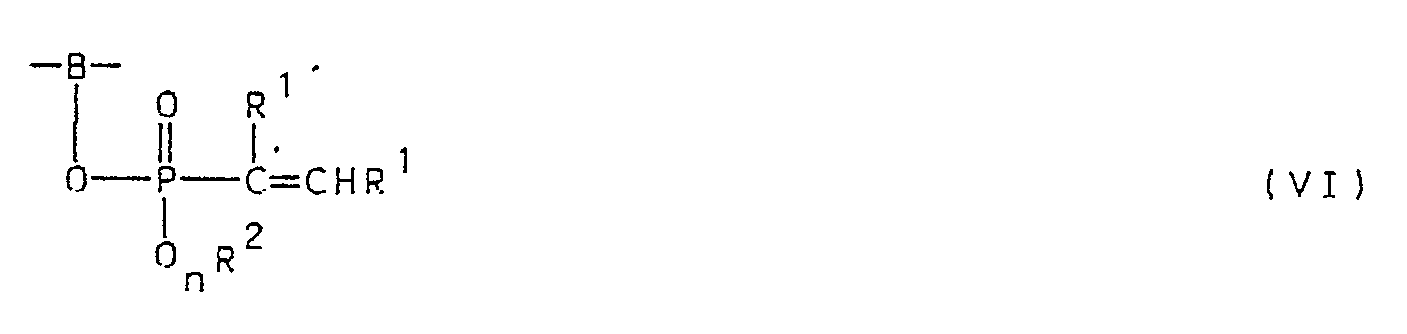
- R¹ und R¹′ bedeuten bevorzugt Wasserstoff oder Methyl.
R² bedeutet bevorzugt Methyl, Ethyl oder Propyl.
Eine für A beziehungsweise für B stehende Alkylengruppe hat bevorzugt 3 bis 8 Kohlenstoffatome.
In der Gruppe der Formel III bedeuten R³ und R⁴ bevorzugt Methyl und Ethyl.
In den Gruppen der Formeln IV und V steht x bevorzugt für 1 bis 4. - A steht bevorzugt für Propylen-1,3, Butylen-1,4, Hexylen-1,6, Hexylen-2,5, 2,2-Dimethylpropylen-1,3, Cyclohexylen-1,4, 2-Methyl-pentylen-2,4 sowie für die von Diethylenglykol, Triethylenglykol und Dipropylenglykol abgeleiteten Reste.
- Die erfindungsgemäßen Verbindungen der allgemeinen Formel I können hergestellt werden durch Umsetzung eines Alkenylphosphonsäureesterchlorids der allgemeinen Formel VII


HO-A-OH (IX)
oder mit einem Alkohol der allgemeinen Formel X
HO--OH (X)
worin A und B wie oben definiert sind. - Um bei der Reaktion freiwerdenden Chlorwassertoff zu binden, werden bevorzugt geeignete tertiäre Amine als Säurefänger eingesetzt.
- Geeignete tertiäre Amine sind beispielsweise Trialkylamine mit 1 bis 4 Kohlenstoffatomen pro Alkylrest, wie z.B. Triethylamin, Dialkylaniline mit 1 bis 4 Kohlenstoffatomen im Alkylrest, wie z.B. N,N′-Dimethylanilin und Pyridin.
- Bevorzugterweise werden die Umsetzungen mit Molverhältnissen phosphororganische Verbindung : Säurefänger : Alkohol der allgemeinen Formel IX von 2:2:1 beziehungsweise phosphororganische Verbindung : Säurefänger : Alkohol der allgemeinen Formel X von 3:3:1 ausgeführt.
- Die Umsetzungen werden vorzugsweise unter Kühlung bei -10 bis +40oC in geeigneten inerten Lösungsmitteln ausgeführt.
- Geeignete inerte Lösungsmittel sind beispielsweise halogenierte Kohlenwasserstoffe, wie z.B. Methylenchlorid, aromatische Kohlenwasserstoffe, wie z.B. Toluol, Ether, wie z.B. Tetrahydrofuran oder aliphatische Nitrile, wie z.B. Acetonitril.
- Die bei den angegebenen Verfahren anfallenden Produkte können zum Teil durch Destillation, insbesondere mit Hilfe eines Dünnschichtverdampfers, im Hochvakuum gereinigt werden. Teilweise können sie aber auch direkt als Rohprodukt weiterverarbeitet werden.
- Die Alkohole der allgemeinen Formeln IX und X sind bekannt und sind käuflich oder können nach bekannten Methoden hergestellt werden. Zweiwertige Alkohole der allgemeinen Formel IX sind beispielsweise Propandiol-1,3, Butandiol-1,4, Hexandiol-1,6, Hexandiol-2,5, 2,2-Dimethyl-1,3-propandiol, 2-Methyl-2,4-pentandiol, Cyclohexan-1,4-diol, Diethylenglykol, Triethylenglykol und Dipropylenglykol.
Alkohole der allgemeinen Formel IX, die eine Gruppe der Formel III in die erfindungsgemäßen Verbindungen einführen, sind beispielsweise in der DE 11 51 813 beschrieben. Dreiwertige Alkohole der allgemeinen Formel X sind beispielsweise Glycerin und Hexantriol-1,2,6. - Die phosphororganischen Verbindungen der allgemeinen Formeln VII und VIII sind käuflich oder nach gängigen Methoden zugänglich (z.B. Houben-Weyl, Methoden der Organischen Chemie, Georg Thieme Verlag, Stuttgart, Bd. 12/1, 1963 Seiten 217 ff und 338 ff).
- Eine bevorzugte Verbindung der allgemeinen Formel VII ist Vinylphosphonsäureethylesterchlorid, eine solche der allgemeinen Formel VIII Methylvinylphosphinsäurechlorid.
- Die erfindungsgemäßen Verbindungen der allgemeinen Formel I finden Verwendung als sogenannte Vernetzer, das heißt als polymerisierbare, mehrfach ungesättigte Monomere, bei der Synthese von Polymeren, insbesondere von wasserquellbaren Hydrogelen aus ungesättigten Monomeren. Ein wesent licher Vorteil ist dabei deren sehr gute Löslichkeit sowohl in polaren als auch in unpolaren Lösungsmitteln. So sind die Verbindungen der allgemeinen Formel I im Gegensatz zu Trimethylolpropantriacrylat oder Trimethylolpropantrimethacrylat in jedem Verhältnis mit Wasser mischbar. Es handelt sich darüber hinaus um schwerflüchtige, geruchsarme Substanzen. Daraus resultiert als weiterer Vorteil eine wesentlich verringerte Neigung zur Diffusion oder Verdunstung während des Polymerisationsprozesses.
- Gegenstand vorliegender Erfindung sind auch wasserquellbare Hydrogele, die durch Copolymerisation hydrophiler Monomere herstellbar und dadurch gekennzeichnet sind, daß bei der Copolymerisation Verbindungen der allgemeinen Formel I als Vernetzer eingesetzt werden. Als hydrophile Monomere kommen insbesondere Acrylsäure, Methacrylsäure, Crotonsäure, 2-Acrylamido-2-methylpropansulfonsäure und -phosphonsäure, Vinylphosphonsäure, Vinylphosphonsäurehalbester, deren Salze, Acrylamid, N-Vinylamide oder Gemische davon in Frage. Bevorzugt ist Acrylsäure und deren Salze.
- Die Verbindungen der allgemeinen Formel I werden vorzugsweise in Mengen von 0,05 bis 20 Gew.%, bezogen auf das Gesamtmonomerengewicht, eingesetzt.
- Die Polymerisation kann in homogener Phase z.B. in wässriger Lösung als sog. Gelpolymerisation oder nach dem Verfahren der Inversemulsionspolymerisation durchgeführt werden. Eine weitere Möglichkeit zur Synthese der erfindungsgemäßen Hydrogele bietet die Fällungspolymerisation aus organischen Lösungsmitteln, wie zum Beispiel Alkoholen, bevorzugt tert. Butanol, oder Kohlenwasserstoffen wie Hexan oder Cyclohexan.
- Die Polymerisation kann durch Radikalbildner wie zum Beispiel organische oder anorganische Peroxide sowie Azoverbindungen ausgelöst werden. Beispiele sind Benzoylperoxid, tert. Butylhydroperoxid, Cumolhydroperoxid, (NH₄)₂S₂O₈, K₂S₂O₈, H₂O₂ Azo-diisobutyronitril. Auch Redoxsysteme eignen sich in hervorragender Weise als Polymerisationsinitiatoren.
- Die Polymerisation kann schließlich auch durch energiereiche Strahlung ausgelöst werden.
- Die erfindungsgemäßen Hydrogele eignen sich in hervorragender Weise als Absorbentien für wässrige Flüssigkeiten und zur Formulierung kosmetischer Zubereitungen.
- Besonders vorteilhaft verhalten sich Copolymere aus Acrylsäure und den erfindungsgemäßen Verbindungen der allgemeinen Formel I als sogenannte super absorbing polymers (SAP) beim Einsatz in Hygieneartikeln, wie z.B. Windeln, wobei die Acrylsäure teilweise als Alkali- oder Ammoniumsalz vorliegen kann. Die Neutralisation kann sowohl vor als auch nach der Polymerisation erfolgen.
- Die erfindungsgemäßen wasserquellbaren Hydrogele zeichnen sich gegenüber den Verbindungen des Standes der Technik durch eine homogenere Netzwerkstruktur aus, da die erfindungsgemäßen Verbindungen der allgemeinen Formel I sowohl in Wasser als auch in polaren organischen Lösungsmitteln völlig löslich sind. Dadurch weisen die Hydrogele hohe Absorptionskapazitäten neben hoher Gelstärke auf.
- Die folgenden Beispiele 1 bis 9 erläutern die vorliegende Erfindung bezüglich der Verbindungen der allgemeinen Formel I, die Beispiele 10 bis 30 bezüglich der Hydrogele.
- 36 g (0,4 mol) Butandiol-1,4 wurden zusammen mit 81 g (0,8 mol) Triethylamin in 270 ml Toluol gegeben. Unter lebhaftem Rühren wurden 99,6 g (0,8 mol) Methyl-vinylphosphinsäurechlorid unter Kühlung bei 20-25oC zugetropft. Dann wurde 20 Stunden nachgerührt und anschließend das gebildete Triethylaminhydrochlorid abgesaugt. Es wurde mit Toluol gewaschen und das Filtrat durch Destillation im Vakuum vom Toluol befreit. Der Rückstand wurde bei 0,093 kPa und einer Badtemperatur von 190oC über einen Dünnschichtverdampfer destilliert. Man erhielt 92 g.
n
C₁₀H₂₀O₄P₂ (266) ber.: 45,11 % C 7,52 % H 23,31 % P gef.: 45,1 % C 7,4 % H 22,9 % P - 59,1 g (0,5 mol) Hexandiol-1,6 wurden zusammen mit 101 g (1 mol) Triethylamin in 200 ml Toluol gegeben. Unter lebhaftem Rühren wurden 124,5 g (1 mol) Methyl-vinylphosphinsäurechlorid unter Kühlung bei 20oC zugetropft. Dann wurde 18 Stunden nachgerührt und anschließend das gebildete Triethylaminhydrochlorid abgesaugt. Es wurde mit Toluol gewaschen und das Filtrat durch Destillation im Vakuum vom Toluol befreit. Der Rückstand wurde bei 0,067 kPa und einer Badtemperatur von 205oC über einen Dünnschichtverdampfer destilliert. Man erhielt 135 g.
n
C₁₂H₂₄O₄P₂ (294) ber.: 48,98 % C 8,16 % H 21,09 % P gef.: 48,9 % C 8,3 % H 21,0 % P - 59,1 g (0,5 mol) Hexandiol-2,5 wurden zusammen mit 101 g (1 mol) Triethylamin in 200 ml Toluol begeben. Unter lebhaftem Rühren wurden 124,5 g (1 mol) Methyl-vinylphosphinsäurechlorid unter Kühlung bei 20oC zugetropft. Dann wurde 18 Stunden nachgerührt und anschließend das gebildete Triethylaminhydrochlorid abgesaugt. Es wurde mit Toluol gewaschen und das Filtrat durch Destillation im Vakuum vom Toluol befreit. Der Rückstand wurde bei 0,2 kPa und einer Badtemperatur von 200oC über einen Dünnschichtverdampfer destilliert. Man erhielt 130 g. Das anfallende Produkt hatte die Säurezahl 44. Es stellte ein Rohprodukt dar. Die Ausbeute betrug 92% d.Th.
C₁₂H₂₄O₄P₂ (294) -
- 15,6 g (0,15 mol) 2,2-Dimethylpropandiol-1,3 wurden zusammen mit 30,4 g (0,3 mol) Triethylamin in 75 ml Toluol gegeben. Unter lebhaftem Rühren wurden 37,35 g (0,3 mol) Methyl-vinylphosphinsäurechlorid unter Kühlung bei 20-25oC zugetropft. Dann wurde nachgerührt und anschließend das gebildete Triethylaminhydrochlorid abgesaugt. Es wurde mit Toluol gewaschen und Filtrat im Vakuum vom Toluol befreit. Es verblieben 40 g. Das anfallende Produkt hatte die Säurezahl 49. Es stellte ein Rohprodukt dar. Die Ausbeute betrug 97% d.Th.
C₁₁H₁₆O₄P₂ (274) - 23,2 g (0,2 mol) Cyclohexandiol-1,4 wurden zusammen mit 40,5 g (0,4 mol) Triethylamin in 90 ml Toluol gegeben. Unter lebhaftem Rühren wurden 49,8 g (0,4 mol) Methylvinylphosphinsäurechlorid unter Kühlung bei 20oC zugetropft. Nach dem Nachrühren wurde das gebildete Triethylaminhydrochlorid abgesaugt. Es wurde mit Toluol gewaschen und das Filtrat durch Destillation im Vakuum vom Toluol befreit. Der Rückstand kristallisierte. Durch Digerieren mit Ethylmethylketon wurde das Produkt gewonnen. Schmelzpunkt: 80 bis 82oC.
C₁₂H₂₂O₄P₂ (292) ber.: 49,32 % C 7,53 % H 21,23 % P gef.: 48,52 % C 8,02 % H 21,0 % P -
- 37,6 g (0,25 mol) Triethylenglykol wurden zusammen mit 50,6 g (0,5 mol) Triethylamin in 100 ml Toluol gegeben. Unter lebhaftem Rühren wurden 62,25 g (0,5 mol) Methylvinylphosphinsäurechlorid unter Kühlung bei 20oC zugetropft. Nach dem Nachrühren wurde das gebildete Triethylaminhydrochlorid abgesaugt. Es wurde mit Toluol gewaschen und das Filtrat durch Destillation im Vakuum vom Toluol befreit. Der Rückstand wurde bei 0,027 kPa und einer Badtemperatur von 240 bis 245oC über einen Dünnschichtverdampfer destilliert. Man erhielt 65 g.
n
C₁₂H₂₄O₆P₂ (326) ber.: 44,17 % C 7,36 % H 19.02 % P gef.: 44,4 % C 7,4 % H 18,8 % P - 33,6 g (0,25 mol) Dipropylenglykol (Isomerengemisch) wurden zusammen mit 50,6 g (0,5 mol) Triethylamin mit 100 ml Toluol gegeben. Unter lebhaftem Rühren wurden 62,25 g (0,5 mol) Methyl-vinylphosphinsäurechlorid unter Kühlung bei 20oC während 1,5 Std. zugetropft. 18 Std. wurde nachgerührt. Dann wurde das gebildete Triethylaminhydrochlorid abgesaugt. Es wurde mit Toluol gewaschen und das Filtrat durch Destillation im Vakuum vom Toluol befreit. Man erhielt 77,5 g als Rohprodukt.
n
- Eine Reinigung durch Destillation mit Hilfe eines Dünnschichtverdampfers bei einer Badtemperatur von ca. 220oC und 0,027 kPa war möglich. Die Ausbeute betrug 100% d.Th.
C₁₂H₂₄O₅P₂ (310) ber.: 46,45 % C 7,74 % H 20,00 % P gef.: 46,4 % C 7,7 % H 19,8 % P - 28,6 g (0,242 mol) Hexandiol-1,6 wurden zusammen mit 49 g (0,484 mol) Triethylamin in 100 ml Toluol gegeben. Unter lebhaftem Rühren wurden 74,9 g (0,484 mol) Methyl-vinylphosphonsäureethylesterchlorid unter Kühlung bei 20oC zugetropft. Nach dem Nachrühren wurde das ausgebildete Triethylaminhydrochlorid abgesaugt. Es wurde mit Toluol gewaschen und das Filtrat durch Destillation im Vakuum vom Toluol befreit. Man erhielt 84 g. Eine destillative Reinigung mit Hilfe eines Dünnschichtverdampfers bei einer Badtemperatur von 250 bis 260oC und 0,04 kPa war möglich.
n
C₁₄H₂₈O₆P₂ (354) ber.: 47,46 % C 7,91 % H 17,52 % P gef.: 47,4 % C 7,8 % H 17,4 % P - 9,2 g (0,1 mol) Glycerin wurden zusammen mit 30,4 g (0,3 mol) Triethylamin in 70 ml Acetonitril gegeben. Unter lebhaftem Rühren wurden 37,4 g (0,3 mol) Methyl-vinylphosphinsäurechlorid während 45 Minuten unter Kühlung bei 20 bis 25oC zugetropft. Dann wurde 20 Stunden nachgerührt und anschließend das gebildete Triethylaminhydrochlorid abgesaugt. Es wurde mit eiskaltem Acetonitril gewaschen und das Filtrat durch Destillation im Vakuum vom Acetonitril befreit. Man erhielt 43,5 g, die erneut über eine Fritte gesaugt wurden, um Restmengen an Triethylaminhydrochlorid abzutrennen. Das Filtrat stellte das Rohprodukt dar. Es wies eine Säurezahl von 140 auf.
n
Es konnte bei einer Badtemperatur von 240oC und 0,107 kPa über einen Dünnschichtverdampfer destilliert werden.
C₁₂H₂₃O₆P₃ (356) - In einem durch geschäumtes Kunststoffmaterial gut isolierten Polyethylengefäß mit einem Fassungsvermögen von 10 l werden 5180 g entsalztes Wasser vorgelegt, 1740 g Natriumbicarbonat darin dispergiert und langsam 1985 g Acrylsäure so zudosiert, daß ein überschäumen der Reaktionslösung vermieden wird, wobei sich diese auf eine Temperatur von ca. 10 - 8oC abkühlt. Es werden nun 15 g der erfindungsgemäßen Verbindung, hergestellt gemäß Beispiel 4, und 10 g eines Natrium-Diisooctylsulfosuccinates (Rewopol V 2133 der Firma REWO, Steinau) zugegeben. Bei einer Temperatur von 1-10oC werden die Initia toren, ein Redoxsystem, bestehend aus 4,4 g Kaliumperoxidisulfat, gelöst in 170 g Wasser, 2,2 g 2,2.-Azobisamidinopropan-Dihydrochlorid, gelöst in 120 g Wasser, sowie 6,0 g Natriumpyrosulfit, gelöst in 120 g Wasser, nacheinander zugegeben und gut verrührt. Die Reaktionslösung wird daraufhin ohne Rühren stehen gelassen, wobei durch einsetzende Polymerisation, in dessen Verlauf die Temperatur bis auf ca. 85oC ansteigt, ein festes Gel entsteht. Dieses wird anschließend mechanisch zerkleinert, bei Temperaturen über 80o getrocknet und gemahlen.
- Das vorstehend beschriebene Produkt wurde in herkömmlicher Weise in eine Babywindel eingearbeitet und zeichnete sich hier durch eine besonders gute Flüssigkeitsretention aus.
- In einem 10 Liter-Kunststoffgefäß werden 4576 g Eis und 1978 g Acrylsäure vorgelegt und langsam 1642 g NaOH 50%ig zudosiert, anschließend 22 g der erfindungsgemäßen Verbindung, hergestellt gemäß Beispiel 2, gelöst in 100 g Wasser und 10 g Rewopol V 2133 zugegeben. Die Reaktionslösung wird auf 20oC eingestellt und anschließend mit den Initiatoren, ein Redoxsystem bestehend aus 6 g Kaliumperoxidisulfat, gelöst in 170 g Wasser, und 0,2 g Ascorbinsäure, gelöst in 120 g Wasser, versetzt und ohne Rühren stehen gelassen. Das durch Polymerisation entstehende Gel wird anschließend mechanisch zerkleinert, bei Temperaturen über 80oC getrocknet und gemahlen.
- In einem 10-Liter-Polyethylengefäß werden 5250 g entsalztes Wasser, 1988 g Acrylsäure und 12 g der erfindungsgemäßen Verbindung, hergestellt gemäß Beispiel 1, vorgelegt. Nach Einstellen der Reaktionslösung auf 18-20oC werden die Initiatoren, 6 g Kaliumperoxidisulfat in 170 g Wasser und 0,2 g Ascorbinsäure in 20 g Wasser nacheinander zugegeben und das Reaktionsgemisch gut isoliert ohne Rühren stehen gelassen. Nach einsetzender Reaktion steigt die Temperatur bis auf ca. 90oC an, und es entsteht ein festes Gel. Dieses wird mechanisch durch einen Extruder zerkleinert, dem kontinuierlich 1555 g NaOH 50%ig zudosiert werden, wobei teilweise Verdampfung des Wassers erfolgt. Das flockige Polymer wird anschließend bei Temperaturen über 80oC endgetrocknet und gemahlen.
- In einen durch geschäumtes Kunststoffmaterial gut isolierten Polyethylengefäß mit einem Fassungsvermögen von 10 l werden 5280 g entsalztes Wasser vorgelegt, 1740 g Natriumbicarbonat darin dispergiert und langsam 1985 g Acrylsäure so zudosiert, daß ein überschäumen der Reaktionslösung vermieden wird, wobei sich diese auf eine Temperatur von ca. 10 - 8oC abkühlt. Es werden nun 15 g der erfindungsgemäßen Verbindung, hergestellt gemäß Beispiel 6, und 10 g eines Natrium-Diisooctylsulfosuccinates (Rewopol V 2133 der Firma REWO, Steinau) zugegeben. Bei einer Temperatur von 6-8oC werden die Initiatoren, ein Redoxsystem, bestehend aus 2,2 g 2,2′-Azobisamidinopropan-Dihydrochlorid, gelöst in 20 g Wasser, 4,4 g Kaliumperoxidisulfat, gelöst in 170 g Wasser, und 6 g Natriumpyrosulfit, gelöst in 120 g Wasser, nacheinander zugegeben und gut verrührt. Die Reaktionslösung wird daraufhin ohne Rühren stehen gelassen, wobei durch einsetzende Polymerisation, in dessen Verlauf die Temperatur bis auf ca. 85oC ansteigt, ein festes Gel entsteht. Dieses wird anschließend mechanisch zerkleinert, bei Temperaturen über 80o getrocknet und gemahlen.
- In einem 700 ml Quickfitkolben, der mit einem wandgängigen, u-förmigen Rührer, Thermometer und einem Rückflußkühler versehen ist, werden 300 ml Cyclohexan vorgelegt und 2 g des Schutzkolloids, copolymerisiert aus einem Polybutadienöl und Maleinsäureanhydrid, gelöst. In 10 Minuten wird die Monomerlösung zusammen mit dem Initiator bei 20-25oC zugetropft.
- Es werden 58,2 g Acrylsäure, 1,2 g Methacrylsäure in 80 ml destilliertem Wasser gelöst und anschließend unter Eiskühlung mit 49,8 g 50%ige NaOH-Lösung auf einen pH-Wert von 5 bis 5,5 eingestellt. Anschließend werden noch 0,6 g der erfindungsgemäßen Verbindung, hergestellt gemäß Beispiel 1, und 3 ml 1%iger wäßriger (NH₄)₂S₂O₈-Lösung zugegeben.
- Dann wird das Ölbad in 50 Minuten auf eine Temperatur von 80oC geheizt, was eine Innentemperatur von 71-72oC ergibt, und mit einer Geschwindigkeit von 180 U/Min gerührt. Die Polymerisation läuft in 75-90 Minuten ab, wobei noch 60 Minuten nachgerührt wird.
- Nun wird der Rückflußkühler durch einen Wasserabscheider ausgetauscht und durch Hochheizen des Ölbades auf 140oC innerhalb von 90-95 Minuten 100 ml Wasser abdestilliert.
- Die erhaltenen farblosen vernetzten Perlen werden über eine Glasfrittennutsche-G1- abgesaugt, einmal mit 100 ml Aceton gewaschen und bei 50o/200 Torr 30 Minuten getrocknet.
- Das vorstehend beschriebene Produkt wurde in herkömmlicher Weise in eine Babywindel eingearbeitet und zeichnete sich hier durch eine besonders gute Flüssigkeitsretention aus.
- In einem 1 Liter-Polymerisationskolben aus Glas, versehen mit Rührwerk, Thermometer und Rückflußkühler werden 600 ml Hexan vorgelegt und 98,9 g Acrylsäure sowie 1,1 g der erfindungsgemäßen Verbindung, hergestellt gemäß Beispiel 9, darin gelöst. Unter Einleiten eines schwachen N₂-Stromes wird mittels eines elektrisch beheizten Wasserbades auf 68oC angeheizt, worauf die Zugabe von 1,0 g Di-Laurylperoxid erfolgt. Nach Einsetzen der Polymerisation tritt deutlicher Rückfluß ein, und das entstandene Polymer flockt aus. Es wird 3 Stunden unter Rückfluß nachgerührt, dann das Polymer abgesaugt und im Trockenschrank bis zur Gewichtskonstanz getrocknet. Man erhält 100 g eines weißen Pulvers, das als saurer Verdicker in kosmetischen Zübereitungen eingesetzt werden kann.
- Weitere Beispiele zur Herstellung erfindungsgemäßer Polymerisate gemäß der hier beschriebenen Beispiele 10 bis 15 sind in folgender Tabelle zusammengefaßt. Die Mengenangaben bedeuten Gewichtsprozente, bezogen auf Gesamtmonomeranteil.
- Folgende Abkürzungen werden benutzt:
AS: Acrylsäure
MAS: Methacrylsäure
CTS: Crotonsäure
VPS: Vinylphosphonsäure VPE: Vinylphosphonsäurehalbester
AMPS: 2-Acrylamido-2-methyl-propansulfonsäure
AMPP: 2-Acrylamido-2-methyl-propanphosphonsäure
AM: AcrylamidTabelle Beisp. hergest. analog Beispiel As % MAS % AMPS % AMPP % VPS % VPE % CTS % AM % erfindungsgemäße Verbindung Neutralisationsgrad % gemäß Beisp. % 16 13 79,25 20,00 1 0,75 75 17 11 98,50 3 1,50 75 18 13 99,25 8 0,75 75 19 13 99,25 9 0,75 65 20 13 99,25 5 0,75 65 21 14 80,0 10,0 9,5 9 0,5 48 22 12 70,0 25,0 4,0 2 1,0 75 23 12 75,0 20,0 4,0 3 1,0 75 24 12 85,0 10,0 4,0 7 1,0 70 25 13 40,0 25,0 4,0 30,0 6 1,0 80 26 13 75,0 19,3 5,0 8 0,7 55 27 13 95,0 4,6 8 0,4 45 28 13 85,0 10 4,5 8 0,5 70 29 12 97,4 8 2,6 80 30 13 99,4 9 0,60 85
Claims (9)

R¹ und R¹′ unabhängig voneinander Wasserstoff oder (C₁-C₄)-Alkyl,
R² (C₁-C₄)-Alkyl,
n 0 oder 1 und
A geradkettiges oder verzweigtes (C₂-C₁₂)-Alkylen, oder eine Gruppe der Formel II

oder eine Gruppe der Formel III
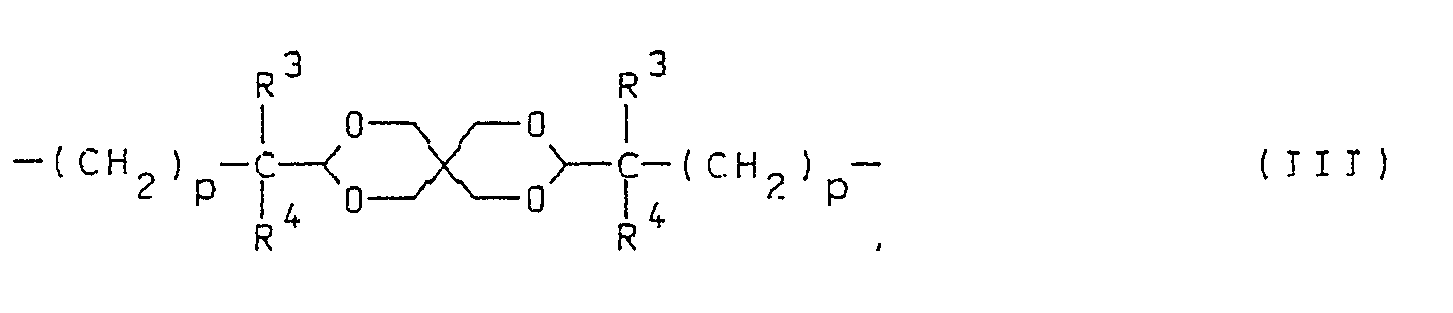
oder eine Gruppe der Formel IV
-CH₂CH₂ (OCH₂ CH₂)x- (IV)
worin x 1 bis 12 ist
oder eine Gruppe der Formel V
-C₃H₆ (OC₃H₆)x (V)
worin x 1 bis 12 ist
oder eine Gruppe der Formel VI


HO-A-OH (IX)
oder mit einem Alkohol der allgemeinen Formel X
HO-

worin A und B wie in Anspruch 1 angegeben definiert sind, umgesetzt wird.
Applications Claiming Priority (2)
| Application Number | Priority Date | Filing Date | Title |
|---|---|---|---|
| DE3922327 | 1989-07-07 | ||
| DE3922327A DE3922327A1 (de) | 1989-07-07 | 1989-07-07 | Alkenyl-phosphon- und -phosphin-saeureester, verfahren zu ihrer herstellung, ihre verwendung sowie unter deren verwendung hergestellte hydrogele |
Publications (3)
| Publication Number | Publication Date |
|---|---|
| EP0417410A2 true EP0417410A2 (de) | 1991-03-20 |
| EP0417410A3 EP0417410A3 (en) | 1991-11-06 |
| EP0417410B1 EP0417410B1 (de) | 1996-01-31 |
Family
ID=6384469
Family Applications (1)
| Application Number | Title | Priority Date | Filing Date |
|---|---|---|---|
| EP90112009A Expired - Lifetime EP0417410B1 (de) | 1989-07-07 | 1990-06-25 | Alkenyl-phosphon- und -phosphin-säureester, Verfahren zu ihrer Herstellung, ihre Verwendung sowie unter deren Verwendung hergestellte Hydrogele |
Country Status (4)
| Country | Link |
|---|---|
| US (1) | US5068298A (de) |
| EP (1) | EP0417410B1 (de) |
| JP (1) | JPH0348691A (de) |
| DE (2) | DE3922327A1 (de) |
Families Citing this family (3)
| Publication number | Priority date | Publication date | Assignee | Title |
|---|---|---|---|---|
| US5204426A (en) * | 1989-04-27 | 1993-04-20 | National Research Development Corporation | Command-curable composition |
| US7619033B2 (en) * | 2004-03-18 | 2009-11-17 | Bostik, Inc. | Process for preparing an aqueous dispersion of a quaternary ammonium salt containing vinyl copolymer |
| JP4517078B2 (ja) * | 2005-08-30 | 2010-08-04 | 独立行政法人産業技術総合研究所 | 新規ビスホスフィノイル化合物、その製造方法及びそれを有効成分とした医薬 |
Family Cites Families (8)
| Publication number | Priority date | Publication date | Assignee | Title |
|---|---|---|---|---|
| US3163627A (en) * | 1957-06-06 | 1964-12-29 | Monsanto Co | Modified polyester resins |
| DE1243192B (de) * | 1965-03-09 | 1967-06-29 | Hoechst Ag | Verfahren zur Herstellung von Vinylphosphonaten |
| US3641202A (en) * | 1969-05-28 | 1972-02-08 | Stauffer Chemical Co | Unsaturated polyester compositions containing vinyl polyphosphonat compounds |
| DE2918568A1 (de) * | 1979-05-09 | 1980-11-20 | Hoechst Ag | Organische phosphor-verbindungen mit 3-hydroxyalkylphosphonsaeureestergruppen |
| DE3803030C2 (de) * | 1988-02-02 | 1995-04-06 | Boehme Chem Fab Kg | Verwendung von Phosphonaten als Flammschutzmittel in Kunststoffen |
| EP0329595B1 (de) * | 1988-02-19 | 1996-05-08 | Hoechst Aktiengesellschaft | Verfahren zur Herstellung von Alkenylphosphinsäurealkylestern |
| DE3817424A1 (de) * | 1988-05-21 | 1989-11-23 | Hoechst Ag | Alkenylphosphon- und -phosphinsaeureester, verfahren zu ihrer herstellung und durch strahlung polymerisierbares gemisch, das diese verbindungen enthaelt |
| DE3817425A1 (de) * | 1988-05-21 | 1989-11-23 | Cassella Ag | Alkenyl-phosphon- und -phosphin-saeureester, verfahren zu ihrer herstellung sowie unter deren verwendung hergestellte hydrogele und deren verwendung |
-
1989
- 1989-07-07 DE DE3922327A patent/DE3922327A1/de not_active Withdrawn
-
1990
- 1990-06-25 EP EP90112009A patent/EP0417410B1/de not_active Expired - Lifetime
- 1990-06-25 DE DE59010099T patent/DE59010099D1/de not_active Expired - Fee Related
- 1990-06-25 US US07/542,763 patent/US5068298A/en not_active Expired - Fee Related
- 1990-07-06 JP JP2177606A patent/JPH0348691A/ja active Pending
Also Published As
| Publication number | Publication date |
|---|---|
| US5068298A (en) | 1991-11-26 |
| DE3922327A1 (de) | 1991-01-17 |
| EP0417410B1 (de) | 1996-01-31 |
| EP0417410A3 (en) | 1991-11-06 |
| DE59010099D1 (de) | 1996-03-14 |
| JPH0348691A (ja) | 1991-03-01 |
Similar Documents
| Publication | Publication Date | Title |
|---|---|---|
| EP0343427B1 (de) | Unter Verwendung von Alkenyl-phosphon- und -phosphinsäureester als Vernetzer hergestellte Hydrogele. | |
| DE69413065T2 (de) | Urea- und urethan-monomere für kontaktlinsenmaterialien | |
| EP1296634B1 (de) | Phosphonsäuren enthaltendes dentalmaterial | |
| DE1103027B (de) | Verfahren zur Herstellung praktisch wasserfreier Massen, die in waessrigen Medien glatte Schleime bilden koennen | |
| DE3421060C2 (de) | ||
| DE3844444A1 (de) | Strahlungsempfindliche, ethylenisch ungesaettigte, copolymerisierbare verbindungen und verfahren zu deren herstellung | |
| EP0343470A2 (de) | Alkenylphosphon- und -phosphinsäureester, Verfahren zu ihrer Herstellung und durch Strahlung polymerisierbares Gemisch, das diese Verbindungen enthält | |
| EP0373385A1 (de) | Verwendung von Perfluoralkylgruppen aufweisenden (Meth-)acrylsäureestern in der Dentaltechnik | |
| EP1792923A1 (de) | Polymerzusammensetzung mit hohem Brechungsindex | |
| DE2501678C2 (de) | ||
| EP0444508B1 (de) | Ethylenisch ungesättigte, fluorhaltige Urethanderivate und Verfahren zu ihrer Herstellung | |
| DE3215918C2 (de) | Wasserabsorbierende Kontaktlinse und Verfahren zu ihrer Herstellung | |
| DE4137076C2 (de) | ||
| EP0417410B1 (de) | Alkenyl-phosphon- und -phosphin-säureester, Verfahren zu ihrer Herstellung, ihre Verwendung sowie unter deren Verwendung hergestellte Hydrogele | |
| DE69132656T2 (de) | Organische polymerverbindung und ihre herstellung | |
| DE19612004A1 (de) | Multifunktionelle Vinylcyclopropan-Derivate | |
| EP2507207A2 (de) | N-allylcarbamat-verbindungen und deren verwendung, insbesondere in strahlungshärtenden beschichtungen | |
| EP0481370B1 (de) | Verwendung von Phosphonsäurediglycidylestern als Vernetzer bei Hydrogelen | |
| EP0318020A1 (de) | Strahlenschutzabdeckung für elektronische Bauelemente | |
| EP0032251B1 (de) | Vinylpyrrolidonpolymerisate, ihre Herstellung, ihre Verwendung zur Herstellung von Blutersatzflüssigkeiten und diese Blutersatzflüssigkeiten | |
| EP0164663A2 (de) | Kunststoff mit hoher UV-Durchlässigkeit und Verfahren zu seiner Herstellung | |
| EP0148401A1 (de) | Neue Amine, Verfahren zu deren Herstellung sowie deren Verwendung in radikalisch polymerisierbaren Massen | |
| DE3609491A1 (de) | Phosphorsaeureester | |
| DE3817468A1 (de) | Ethylenisch ungesaettigte harnstoffderivate und verfahren zu ihrer herstellung | |
| DE69119134T2 (de) | Wässrige Emulsionspolymere, hergestellt mit vernetzbaren nichtionischen Emulgiermitteln |
Legal Events
| Date | Code | Title | Description |
|---|---|---|---|
| PUAI | Public reference made under article 153(3) epc to a published international application that has entered the european phase |
Free format text: ORIGINAL CODE: 0009012 |
|
| 17P | Request for examination filed |
Effective date: 19901203 |
|
| AK | Designated contracting states |
Kind code of ref document: A2 Designated state(s): BE CH DE FR GB LI NL |
|
| PUAL | Search report despatched |
Free format text: ORIGINAL CODE: 0009013 |
|
| AK | Designated contracting states |
Kind code of ref document: A3 Designated state(s): BE CH DE FR GB LI NL |
|
| 17Q | First examination report despatched |
Effective date: 19940505 |
|
| RAP1 | Party data changed (applicant data changed or rights of an application transferred) |
Owner name: HOECHST AKTIENGESELLSCHAFT |
|
| GRAA | (expected) grant |
Free format text: ORIGINAL CODE: 0009210 |
|
| AK | Designated contracting states |
Kind code of ref document: B1 Designated state(s): BE CH DE FR GB LI NL |
|
| PG25 | Lapsed in a contracting state [announced via postgrant information from national office to epo] |
Ref country code: NL Free format text: LAPSE BECAUSE OF FAILURE TO SUBMIT A TRANSLATION OF THE DESCRIPTION OR TO PAY THE FEE WITHIN THE PRESCRIBED TIME-LIMIT Effective date: 19960131 Ref country code: GB Effective date: 19960131 Ref country code: FR Effective date: 19960131 Ref country code: BE Effective date: 19960131 |
|
| REF | Corresponds to: |
Ref document number: 59010099 Country of ref document: DE Date of ref document: 19960314 |
|
| EN | Fr: translation not filed | ||
| NLV1 | Nl: lapsed or annulled due to failure to fulfill the requirements of art. 29p and 29m of the patents act | ||
| GBV | Gb: ep patent (uk) treated as always having been void in accordance with gb section 77(7)/1977 [no translation filed] |
Effective date: 19960131 |
|
| PLBE | No opposition filed within time limit |
Free format text: ORIGINAL CODE: 0009261 |
|
| STAA | Information on the status of an ep patent application or granted ep patent |
Free format text: STATUS: NO OPPOSITION FILED WITHIN TIME LIMIT |
|
| 26N | No opposition filed | ||
| PGFP | Annual fee paid to national office [announced via postgrant information from national office to epo] |
Ref country code: CH Payment date: 19970528 Year of fee payment: 8 |
|
| PGFP | Annual fee paid to national office [announced via postgrant information from national office to epo] |
Ref country code: DE Payment date: 19970814 Year of fee payment: 8 |
|
| PG25 | Lapsed in a contracting state [announced via postgrant information from national office to epo] |
Ref country code: LI Free format text: LAPSE BECAUSE OF NON-PAYMENT OF DUE FEES Effective date: 19980630 Ref country code: CH Free format text: LAPSE BECAUSE OF NON-PAYMENT OF DUE FEES Effective date: 19980630 |
|
| REG | Reference to a national code |
Ref country code: CH Ref legal event code: PL |
|
| PG25 | Lapsed in a contracting state [announced via postgrant information from national office to epo] |
Ref country code: DE Free format text: LAPSE BECAUSE OF NON-PAYMENT OF DUE FEES Effective date: 19990401 |