EP0318020A1 - Strahlenschutzabdeckung für elektronische Bauelemente - Google Patents
Strahlenschutzabdeckung für elektronische Bauelemente Download PDFInfo
- Publication number
- EP0318020A1 EP0318020A1 EP88119625A EP88119625A EP0318020A1 EP 0318020 A1 EP0318020 A1 EP 0318020A1 EP 88119625 A EP88119625 A EP 88119625A EP 88119625 A EP88119625 A EP 88119625A EP 0318020 A1 EP0318020 A1 EP 0318020A1
- Authority
- EP
- European Patent Office
- Prior art keywords
- phosphazene
- radicals
- covering layer
- layer according
- groups
- Prior art date
- Legal status (The legal status is an assumption and is not a legal conclusion. Google has not performed a legal analysis and makes no representation as to the accuracy of the status listed.)
- Granted
Links
Classifications
-
- H—ELECTRICITY
- H10—SEMICONDUCTOR DEVICES; ELECTRIC SOLID-STATE DEVICES NOT OTHERWISE PROVIDED FOR
- H10W—GENERIC PACKAGES, INTERCONNECTIONS, CONNECTORS OR OTHER CONSTRUCTIONAL DETAILS OF DEVICES COVERED BY CLASS H10
- H10W42/00—Arrangements for protection of devices
- H10W42/20—Arrangements for protection of devices protecting against electromagnetic or particle radiation, e.g. light, X-rays, gamma-rays or electrons
- H10W42/25—Arrangements for protection of devices protecting against electromagnetic or particle radiation, e.g. light, X-rays, gamma-rays or electrons against alpha rays, e.g. for outer space applications
-
- H—ELECTRICITY
- H10—SEMICONDUCTOR DEVICES; ELECTRIC SOLID-STATE DEVICES NOT OTHERWISE PROVIDED FOR
- H10W—GENERIC PACKAGES, INTERCONNECTIONS, CONNECTORS OR OTHER CONSTRUCTIONAL DETAILS OF DEVICES COVERED BY CLASS H10
- H10W74/00—Encapsulations, e.g. protective coatings
- H10W74/40—Encapsulations, e.g. protective coatings characterised by their materials
- H10W74/47—Encapsulations, e.g. protective coatings characterised by their materials comprising organic materials, e.g. plastics or resins
Definitions
- the invention relates to a cover layer for microelectronic components and highly integrated circuits with high absorption capacity for alpha radiation.
- circuits are made from high-purity starting materials that have only minimal contamination of radioactive elements or isotopes.
- the circuits are provided with radiation protection cover layers.
- These layers are usually made of photocrosslinkable polyimide lacquers and provide reliable protection of the circuit against alpha rays from a layer thickness of approx. 30 ⁇ m.
- the "raw" uncrosslinked polyimide resin is applied over the entire surface of the wafer containing the circuit.
- the resin layer is then crosslinked in the areas provided above the circuits (only over the later chips) by means of UV light and finally developed After peeling off the unexposed areas, the remaining polyimide layer is left in a temperature of several hours treatment hardened up to approx. 250 ° C.
- the polyimide layers shrink, which can be up to 50% of the original volume. This also mechanically loads the circuit below and can be damaged or even destroyed.
- a cover layer of the type mentioned at the outset in that the cover layer is produced by crosslinking a negative resist layer initiated by means of UV light, the negative residue being an essential component which absorbs the alpha radiation and is a phosphazene derived from the general structure (I) contains in which the radicals R1 to R6 are each bonded to the phosphorus via an oxygen atom and are independently alkyloxy, aryloxy, alkylcarbonyloxy or arylcarbonyloxy groups which can be substituted as desired, with the proviso that on average at least one of the radicals R1 until R6 carries a photosensitive group capable of polymerization. With two or more such groups, the monomer can be used as a crosslinker.
- radicals carrying the photosensitive groups are substituted acrylate groups.
- Organopolyphosphazenes derived from hexachlorotriphosphazene have long been known as "inorganic rubber” and are used in many ways as elastomers in homo- and copolymers.
- organic rubber Organopolyphosphazenes derived from hexachlorotriphosphazene have long been known as "inorganic rubber” and are used in many ways as elastomers in homo- and copolymers.
- An overview of the representation and properties of, for example, fluoroalkyl polyphosphazenes can be found in the book "New Commercial Polymers" by H.- G. Elias, pages 164 to 169 (London 1977).
- the phosphazenes according to the invention are mixed together with photoinitiators, optionally crosslinking enhancers and other customary additives.
- the finished resist is applied over the entire surface of the wafer containing the integrated circuits, for example by spin coating, dried, structured or crosslinked with UV light and finally developed.
- the crosslinked resist structures do not require any further curing and, because of the high degree of crosslinking, show remarkable thermal stability. Because of the low ratio of the photosensitive groups in (uncrosslinked) phosphazene to the molecular size of the phosphazene, there is only very little shrinkage when the resist layer is hardened. Sufficient alpha radiation protection is already achieved with layer thicknesses of approx. 15 to 30 ⁇ m.
- Acrylic acids selected as photosensitive groups which can be directly esterified with the hexachlorotriphosphazene used as the starting material, cinnamic acid, furanacrylic acid and the like are preferred, since these acids are sufficient Adequate light sensitivity and, consequently, a sufficiently high crosslinking rate of the negative resist is achieved.
- acids such as acrylic or methacrylic acid or derivatives of the compounds mentioned are also suitable.
- the number of light-sensitive groups per phosphor molecule must not be set too high, otherwise the products tend to self-crosslink.
- 1 to 3 radicals per phosphazene ring carrying light-sensitive groups are particularly preferred, the other radicals advantageously being phenolate groups.
- a Phospazen I By reacting the hexachlorotriphosphazene with a mixture of photosensitive and non-photosensitive alcohols, a Phospazen I can be obtained, the photosensitivity and crosslinking ability of which can be adjusted via the alcoholate mixture ratio.
- Suitable combinations are, for example, mixtures of the sodium alcoholates of allyl and benzyl alcohol in a molar ratio of 1: 3 to 1: 6.
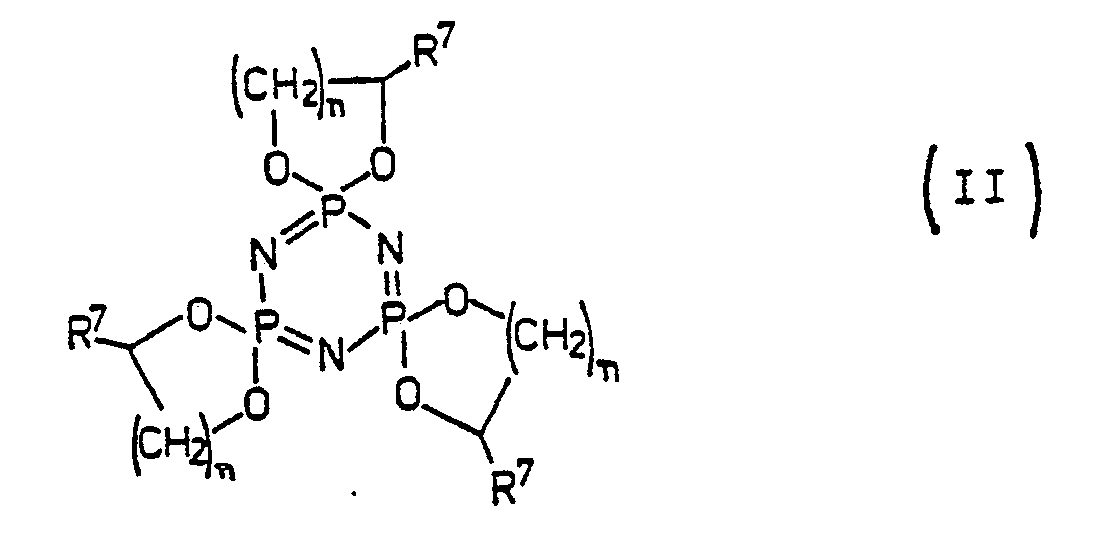
- a further advantageous embodiment of the invention avoids self-crosslinking in that the two radicals bonded to one and the same phosphorus atom together with the phosphorus atom form an (n + 4) -linked heterocycle and represent the modification (II) which obeys the general phosphazene structure (I): in which n represents an integer with 1 ⁇ n ⁇ 3 and the radical R7 bears the photosensitive group which is selected from the compounds mentioned above.
- n represents an integer with 1 ⁇ n ⁇ 3
- the radical R7 bears the photosensitive group which is selected from the compounds mentioned above.
- covering layer according to the invention can be achieved by admixing further UV-curable resist materials. If suitable resist mixtures are selected for this which already have good dielectric and thermal properties, these can also be transferred to mixtures with phosphazene and advantageously combined with their good alpha radiation protection.
- the chemical nature of the residues R1 to R7 on the phosphazene is crucial for the selection of suitable resists, in particular the type of the photosensitive group.
- the most suitable resist admixture also has these groups.
- polymers of the araldite type which are obtainable by reaction of bisphenols with epichlorohydrin and subsequent esterification with photosensitive acrylic acids and are known, for example, from German patent application P 37 08 057.1, a useful combination for a cover layer is achieved.
- the phospazen can represent the largest proportion of the resist mixture in terms of quantity, or can only be present in a smaller proportion.
- the variable number of photosensitive groups bonded to the phosphazene ring also enables use as a reactive diluent in UV-curing formulations, as a result of which the degree of crosslinking of such a mixture is influenced and the thermal and mechanical properties of the cover layer can be improved.
- the ketal IV is saponified at 90 ° C. using 1 N sulfuric acid, the glycerol-1-cinnamic acid ester V being obtained after customary working up.
Landscapes
- Materials For Photolithography (AREA)
- Non-Metallic Protective Coatings For Printed Circuits (AREA)
- Compositions Of Macromolecular Compounds (AREA)
- Paints Or Removers (AREA)
- Structures Or Materials For Encapsulating Or Coating Semiconductor Devices Or Solid State Devices (AREA)
- Exposure And Positioning Against Photoresist Photosensitive Materials (AREA)
Abstract
Description
- Die Erfindung betrifft eine Abdeckschicht für mikroelektronische Bauelemente und höchstintegrierte Schaltungen mit hohem Absorptionsvermögen für Alphastrahlung.
- Im Zuge der zunehmenden Miniaturisierung von höchstintegrierten Schaltungen werden neben den Geometrien auch die elektrischen Werte, wie zum Beispiel die Kapazität einer als Kondensator aufgebauten Speicherzelle auf einen minimalen Wert reduziert. Dadurch werden derartige Schaltungen auch zunehmend anfälliger gegen äußere Störungen, wie zum Beispiel radioaktive Strahlung. Vor allem die stark ionisierende Alphastrahlung kann in Speicherzellen enthaltenden Schaltungen das Verfälschen und Löschen von als Ladungen gespeicherten Daten bewirken.
- Als Schutz gegen Alphastrahlung "von innen¨ werden für derartige Schaltungen hochreine Ausgangsmaterialien verwendet, die nur minimale Verunreinigungen an radioaktiven Elementen bzw. Isotopen aufweisen. Zum Schutz gegen "äußere Strahlung" werden die Schaltungen mit Strahlenschutzabdeckschichten versehen.
- Diese Schichten werden üblicherweise aus photovernetzbaren Polyimidlacken gefertigt und gewähren ab einer Schichtdicke von ca. 30 µm einen sicheren Schutz der Schaltung gegen Alphastrahlen.
- Doch weisen diese Schichten noch verschiedene Nachteile auf. In einem Verfahren zum Aufbringen dieser Schichten wird das "rohe¨ unvernetzte Polyimidharz ganzflächig auf den die Schaltung enthaltenden Wafer aufgebracht. Mittels UV-Licht wird die Harzschicht dann in den dafür vorgesehenen Bereichen über den Schaltungen (nur über den späteren Chips) vernetzt und schließlich entwickelt. Nach Ablösen der unbelichteten Bereiche wird die verbleibende Polyimidschicht in einer mehrstündigen Temperatur behandlung bis ca. 250°C nachgehärtet. Bei diesem Temperprozeß tritt eine Schrumpfung der Polyimidschichten auf, die bis zu 50 % des ursprünglichen Volumens betragen kann. Dadurch wird auch die darunterliegende Schaltung mechanisch belastet und kann dabei beschädigt oder gar zerstört werden.
- Aufgabe der vorliegenden Erfindung ist es daher, eine hochwärmebeständige Abdeckschicht für mikroelektronische Bauelemente anzugeben, die sowohl einen guten Alphastrahlenschutz gewährleistet, als auch in einem einfachen und schnellen Verfahren aufzubringen ist und keine Schrumpfung bei der Härtung zeigt.
- Diese Aufgabe wird durch eine Abdeckschicht der eingangs erwähnten Art erfindungsgemäß dadurch gelöst, daß die Abdeckschicht durch eine mittels UV-Licht initiierte Vernetzung einer Negativresistschicht erzeugt wird, wobei der Negativrest als wesentlichen, die Alphastrahlung absorbierenden Bestandteil ein von der allgemeinen Struktur (I) abgeleitetes Phosphazen enthält,

- Weiterhin liegt es im Rahmen der Erfindung, daß die die lichtempfindlichen Gruppen tragenden Reste substituierte Acrylatgruppierungen sind.
- Weitere Ausgestaltungen der Erfindung ergeben sich aus den Unteransprüchen.
- Vom Hexachlortriphosphazen abgeleitete Organopolyphosphazene sind schon lange als "anorganischer Kautschuk¨ bekannt und finden vielseitige Verwendung als Elastomere in Homo- und Copolymeren. Eine Übersicht über die Darstellung und Eigenschaften von zum Beispiel Fluoralkylpolyphosphazenen findet sich in dem Buch "New Commercial Polymers¨ von H.-G. Elias, Seiten 164 bis 169 (London 1977).
- Neu ist es dagegen, Phosphazene geeignet zu substituieren, mit lichtempfindlichen Gruppen zu verknüpfen und in Negativresists als Strahlenschutzbestandteil einzusetzen. Dieser Strahlenschutz leitet sich aus den gegenüber anderen lichtempfindlichen Polymeren hohen Atommassen der das Polymer aufbauenden Elemente, insbesondere des Phosphors ab.
- Zum Herstellen eines einsatzfähigen Negativresists werden die erfindungsgemäßen Phosphazene zusammen mit Photoinitiatoren, gegebenenfalls Vernetzungsverstärkern und anderen üblichen Zusätzen vermengt.
- Der fertige Resist wird ganzflächig auf dem die integrierten Schaltungen enthaltenden Wafer zum Beispiel durch Aufschleudern aufgebracht, getrocknet, mit UV-Licht strukturiert bzw. vernetzt und schließlich entwickelt. Die vernetzten Resiststrukturen benötigen keine weitere Härtung und zeigen aufgrund des hohen Vernetzungsgrades eine bemerkenswerte thermische Stabilität. Wegen des niedrigen Verhältnisses der lichtempfindlichen Gruppen in (unvernetztem) Phosphazen zur Molekülgröße des Phosphazens tritt beim Härten der Resistschicht nur eine sehr geringe Schrumpfung auf. Ausreichender Alphastrahlenschutz wird bereits bei Schichtdicken von ca. 15 bis 30 µm erreicht.
- Als lichtempfindliche Gruppen ausgewählte Acrylsäuren, die direkt mit dem als Ausgangsmaterial eingesetzten Hexachlortriphosphazen verestert werden können, sind Zimtsäure, Furanacrylsäure und ähnliche bevorzugt, da mit diesen Säuren eine ausrei chend gute Lichtempfindlichkeit und infolgedessen auch eine ausreichend hohe Vernetzungsgeschwindigkeit des Negativresists erzielt wird. Doch sind auch Säuren wie Acryl-oder Methacrylsäure oder Derivate der genannten Verbindungen geeignet.
- Die Anzahl lichtempfindlicher Gruppen pro Phospazenmolekül darf nicht zu hoch eingestellt werden, da die Produkte sonst zur Eigenvernetzung neigen. Besonders bevorzugt sind im statistischen Mittel 1 bis 3 lichtempfindliche Gruppen tragende Reste pro Phosphazenring, wobei die übrigen Reste vorteilhafterweise Phenolatgruppen sind.
- Auch durch Umsetzung des Hexachlortriphosphazen mit einer Mischung von lichtempfindlichen und nicht lichtempfindlichen Alkoholen läßt sich ein Phospazen I erhalten, dessen Lichtempfindlichkeit und Vernetzungsfähigkeit über das Alkoholatmischungsverhältnis eingestellt werden können. Geeignete Kombinationen stellen zum Beispiel Gemische der Natriumalkoholate von Allyl- und Benzylalkohol im Molverhältnis von 1 : 3 bis 1 : 6 dar.
- Eine weitere vorteilhafte Ausgestaltung der Erfindung vermeidet eine Eigenvernetzung, indem jeweils die zwei an ein und dasselbe Phosphoratom gebundenen Reste mit dem Phosphoratom zusammen einen (n + 4)-gliedrigen Heterozyklus bilden und die der allgemeinen Phosphazenstruktur (I) gehorchende Modifikation (II) darstellen:
- Weitere strukturelle Verbesserungen der erfindungsgemäßen Abdeckschicht lassen sich durch Zumischen weiterer UV-härtbarer Resistmaterialien erzielen. Werden dazu geeignete Resistmischungen gewählt, die für sich bereits gute dielektrische und thermische Eigenschaften aufweisen, so lassen sich diese auch auf Mischungen mit Phosphazen übertragen und in vorteilhafter Weise mit deren guter Alphastrahlenschutzwirkung kombinieren.
- Für die Auswahl geeigneter Resists ist die chemische Natur der Reste R1 bis R7 am Phosphazen entscheidend, insbesondere die Art der lichtempfindlichen Gruppe. Ist diese zum Beispiel ein Ester der Zimtsäure, der Furanacrylsäure oder einer ihrer Abkömmlinge, so weist die am besten geeignete Resistzumischung ebenfalls diese Gruppen auf. Insbesondere durch eine Zugabe von Polymeren des Araldit-Typs, die durch Reaktion von Bisphenolen mit Epichlorhydrin und anschließender Veresterung mit lichtempfindlichen Acrylsäuren erhältlich und zum Beispiel aus der deutschen Patentanmeldung P 37 08 057.1 bekannt sind, wird eine brauchbare Kombination für eine Abdeckschicht erzielt.
- Doch sind auch Kombinationen mit anderen Resists denkbar, sofern eine chemische Verwandtschaft mit den lichtempfindlichen Resten R gegeben ist. Dabei kann das Phospazen sowohl den mengenmäßig größten Anteil der Resistmischung darstellen, als auch nur in einem geringeren Anteil enthalten sein. Die variierbare Anzahl der an den Phosphazenring gebundenen lichtempfindlichen Gruppen ermöglicht auch einen Einsatz als reaktiver Verdünner in UV-härtenden Formulierungen, wodurch der Vernetzungsgrad einer solchen Mischung beeinflußt und thermische und mechanische Eigenschaften der Abdeckschicht verbessert werden können.
- Im folgenden wird die Herstellung eines für die erfindungsgemäße Abdeckschicht bevorzugt verwendeten Phosphazens anhand eines Formelschemas und der entsprechenden Synthesevorschriften näher beschrieben.
- Ausgehend von als 1,3-Dioxolan geschütztem Glycerin III wird mit Zimtsäurechlorid der entsprechende Ester IV erhalten. Von diesem wird die Schutzgruppe Aceton abgespalten und der so erhaltene Ester V schließlich mit Hexachlortriphosphazen zum lichtempfindlich eingestellten Phospazen VI umgesetzt.

- Zu äquimolaren Mengen ± 2,2-Dimethyl-4-hydroxymethyl-1,3-dioxolan (III) und trockenem Pyridin in absolutem Toluol wird unter Kühlung bei 0° C eine entsprechende Menge Zimtsäurechlorid in absolutem Toluol getropft und mehrere Stunden bei langsam auf Raumtemperatur steigender Temperatur gerührt. Es wird in üblicher Weise aufgearbeitet und schließlich das Produkt IV erhalten, das chromatographisch über Kieselgel gereinigt werden kann.
- Mittels 1-N-Schwefelsäure wird das Ketal IV bei 90°C verseift, wobei man nach üblicher Aufarbeitung den Glycerin-1-Zimtsäureester V erhält.
- Bei -15° wird der Ester V mit Hexachlortriphosphazen und einer Base umgesetzt, mehrere Stunden bei Raumtemperatur gerührt und schließlich in üblicher Weise aufgearbeitet. Nach Waschen und Trocknen verbleibt ein farbloser klebriger Feststoff, der aufgrund des racemischen Eduktes V und der Spirostrukturen aus den verschiedenen Diastereomeren des Phosphazens VI besteht.
Claims (8)


Priority Applications (1)
| Application Number | Priority Date | Filing Date | Title |
|---|---|---|---|
| AT88119625T ATE78954T1 (de) | 1987-11-26 | 1988-11-24 | Strahlenschutzabdeckung fuer elektronische bauelemente. |
Applications Claiming Priority (2)
| Application Number | Priority Date | Filing Date | Title |
|---|---|---|---|
| DE3740168 | 1987-11-26 | ||
| DE3740168 | 1987-11-26 |
Publications (2)
| Publication Number | Publication Date |
|---|---|
| EP0318020A1 true EP0318020A1 (de) | 1989-05-31 |
| EP0318020B1 EP0318020B1 (de) | 1992-07-29 |
Family
ID=6341369
Family Applications (1)
| Application Number | Title | Priority Date | Filing Date |
|---|---|---|---|
| EP88119625A Expired - Lifetime EP0318020B1 (de) | 1987-11-26 | 1988-11-24 | Strahlenschutzabdeckung für elektronische Bauelemente |
Country Status (6)
| Country | Link |
|---|---|
| US (1) | US4925772A (de) |
| EP (1) | EP0318020B1 (de) |
| JP (1) | JPH021958A (de) |
| KR (1) | KR890008969A (de) |
| AT (1) | ATE78954T1 (de) |
| DE (1) | DE3873277D1 (de) |
Families Citing this family (11)
| Publication number | Priority date | Publication date | Assignee | Title |
|---|---|---|---|---|
| US5248585A (en) * | 1991-12-18 | 1993-09-28 | Hoechst Celanese Corporation | Polyphosphazene binder resins for photoresists comprising as photosensitizers o-quinone diazide esters |
| JP3475528B2 (ja) * | 1994-11-18 | 2003-12-08 | 東洋インキ製造株式会社 | 紫外線硬化型樹脂組成物およびこれを含む被覆剤 |
| JP2003502449A (ja) | 1999-06-10 | 2003-01-21 | ハネウエル・インターナシヨナル・インコーポレーテツド | フォトリソグラフィ用スピンオンガラス反射防止コーティング |
| US6824879B2 (en) | 1999-06-10 | 2004-11-30 | Honeywell International Inc. | Spin-on-glass anti-reflective coatings for photolithography |
| JP3977997B2 (ja) * | 2001-05-11 | 2007-09-19 | 松下電器産業株式会社 | 半導体装置およびその製造方法 |
| WO2003044600A1 (en) | 2001-11-15 | 2003-05-30 | Honeywell International Inc. | Spin-on anti-reflective coatings for photolithography |
| US8053159B2 (en) | 2003-11-18 | 2011-11-08 | Honeywell International Inc. | Antireflective coatings for via fill and photolithography applications and methods of preparation thereof |
| US8642246B2 (en) | 2007-02-26 | 2014-02-04 | Honeywell International Inc. | Compositions, coatings and films for tri-layer patterning applications and methods of preparation thereof |
| US8557877B2 (en) | 2009-06-10 | 2013-10-15 | Honeywell International Inc. | Anti-reflective coatings for optically transparent substrates |
| US8864898B2 (en) | 2011-05-31 | 2014-10-21 | Honeywell International Inc. | Coating formulations for optical elements |
| JP6803842B2 (ja) | 2015-04-13 | 2020-12-23 | ハネウェル・インターナショナル・インコーポレーテッドHoneywell International Inc. | オプトエレクトロニクス用途のためのポリシロキサン製剤及びコーティング |
Citations (1)
| Publication number | Priority date | Publication date | Assignee | Title |
|---|---|---|---|---|
| US3711389A (en) * | 1969-07-15 | 1973-01-16 | Moleculon Res Corp | Process for treating polymeric substrates with high-energy radiation |
Family Cites Families (5)
| Publication number | Priority date | Publication date | Assignee | Title |
|---|---|---|---|---|
| US4242491A (en) * | 1978-09-08 | 1980-12-30 | The Firestone Tire & Rubber Company | Polyphosphazene polymers containing substituents of acrylate functionality |
| US4221904A (en) * | 1978-09-08 | 1980-09-09 | The Firestone Tire & Rubber Company | Polyphosphazene copolymers containing substituents derived from pyruvate esters |
| FR2595587B1 (fr) * | 1986-03-12 | 1988-07-29 | Oreal | Dispositif pour l'application sur un support d'une substance de consistance liquide a pateuse |
| JPS6357593A (ja) * | 1986-08-29 | 1988-03-12 | Shin Nisso Kako Co Ltd | ホスホニトリル酸エステル類とその製造法 |
| US4946734A (en) * | 1986-11-21 | 1990-08-07 | Hitachi, Ltd. | Resin composition for printed circuit board and such board formed by use thereof |
-
1988
- 1988-11-04 US US07/267,179 patent/US4925772A/en not_active Expired - Fee Related
- 1988-11-24 AT AT88119625T patent/ATE78954T1/de not_active IP Right Cessation
- 1988-11-24 DE DE8888119625T patent/DE3873277D1/de not_active Expired - Lifetime
- 1988-11-24 JP JP63299376A patent/JPH021958A/ja active Pending
- 1988-11-24 EP EP88119625A patent/EP0318020B1/de not_active Expired - Lifetime
- 1988-11-25 KR KR1019880015538A patent/KR890008969A/ko not_active Withdrawn
Patent Citations (1)
| Publication number | Priority date | Publication date | Assignee | Title |
|---|---|---|---|---|
| US3711389A (en) * | 1969-07-15 | 1973-01-16 | Moleculon Res Corp | Process for treating polymeric substrates with high-energy radiation |
Non-Patent Citations (2)
| Title |
|---|
| PATENT ABSTRACTS OF JAPAN, Band 10, Nr. 133 (E-404)[2190], 17. Mai 1986; & JP-A-60 262 429 (HITACHI KASEI KOGYO K.K.) 25-12-1985 * |
| RUSSIAN CHEMICAL REVIEWS, Band 50, Nr. 12, Dezember 1981, Seiten 1186-1200, Letelworth, Herts, GB; V.V. KIREEV et al.: "Oligomeric alkoxyphosphazens" * |
Also Published As
| Publication number | Publication date |
|---|---|
| US4925772A (en) | 1990-05-15 |
| EP0318020B1 (de) | 1992-07-29 |
| KR890008969A (ko) | 1989-07-13 |
| JPH021958A (ja) | 1990-01-08 |
| ATE78954T1 (de) | 1992-08-15 |
| DE3873277D1 (de) | 1992-09-03 |
Similar Documents
| Publication | Publication Date | Title |
|---|---|---|
| EP0126341B1 (de) | Verfahren zur Herstellung von (Meth)-acrylsäureestern und deren Verwendung | |
| DE2744184C3 (de) | Partiell ausgehärtete Beschichtungsfilme und Verfahren zur Herstellung von abriebfesten beschichteten Formteilen | |
| DE2643701A1 (de) | Ueberzugszusammensetzung | |
| EP0318020B1 (de) | Strahlenschutzabdeckung für elektronische Bauelemente | |
| DE3444740C2 (de) | ||
| EP0262629A2 (de) | Photopolymerisierbare Aufzeichnungsmasse, insbesondere zur Herstellung von Druckplatten und Reliefformen | |
| EP0033295B1 (de) | Isolierband zur Herstellung einer mit einer Heisshärtenden Epoxidharz-Säureanhydrid-Mischung imprägnierten Isolierhülse für elektrische Leiter | |
| DE2660982C2 (de) | Verwendung von Esterderivaten von Cumylphenol als nichtreaktive Weichmacher für Polyurethan- und Polyvinylchloridharze | |
| DE3804820A1 (de) | Cyclocarbonathaltige ester und verfahren zu ihrer herstellung | |
| DE112017003006T5 (de) | Epoxy (meth)acrylatharz und resistelement | |
| DE2232822C2 (de) | Lichthärtbare Masse | |
| DE2849996C2 (de) | Photodepolymerisierbares Gemisch und ein Verfahren zur Herstellung eines Positivbildes | |
| DE3825002C2 (de) | ||
| EP0101864A1 (de) | Ungesättigte, homo- und/oder copolymerisierbare Polyester, Verfahren zu ihrer Herstellung und ihre Verwendung | |
| EP0251049B1 (de) | Photopolymerisierbare Aufzeichnungsmaterialien sowie Photoresistschichten und Flachdruckplatten auf Basis dieser Aufzeichnungsmaterialien | |
| DE2215711A1 (de) | Hochfrequenz-spruehaetzmethode | |
| EP0206158A2 (de) | Photopolymere auf Polyetherbasis | |
| DE2407301B2 (de) | Härtbare Beschichtungszusammensetzung und Verfahren zu ihrer Herstellung | |
| EP0770608A2 (de) | Strahlungshärtung von Dihydrofuranderivaten | |
| EP0102487B1 (de) | Ungesättigte, homo- und/oder copolymerisierbare Poylester, Verfahren zu ihrer Herstellung und ihre Verwendung | |
| EP0111043A1 (de) | Elektrische Isolierung mit Stabilisator | |
| DE2263653B2 (de) | Verfahren zum aufbringen eines films aus copolymerisaten auf flexible substrate | |
| DE2459419C2 (de) | Verfahren zur Herstellung von Schichtstoffen | |
| DE3841413C2 (de) | ||
| EP0417410A2 (de) | Alkenyl-phosphon- und -phosphin-säureester, Verfahren zu ihrer Herstellung, ihre Verwendung sowie unter deren Verwendung hergestellte Hydrogele |
Legal Events
| Date | Code | Title | Description |
|---|---|---|---|
| PUAI | Public reference made under article 153(3) epc to a published international application that has entered the european phase |
Free format text: ORIGINAL CODE: 0009012 |
|
| AK | Designated contracting states |
Kind code of ref document: A1 Designated state(s): AT DE FR GB IT NL |
|
| 17P | Request for examination filed |
Effective date: 19890627 |
|
| 17Q | First examination report despatched |
Effective date: 19910410 |
|
| GRAA | (expected) grant |
Free format text: ORIGINAL CODE: 0009210 |
|
| AK | Designated contracting states |
Kind code of ref document: B1 Designated state(s): AT DE FR GB IT NL |
|
| PG25 | Lapsed in a contracting state [announced via postgrant information from national office to epo] |
Ref country code: IT Free format text: LAPSE BECAUSE OF FAILURE TO SUBMIT A TRANSLATION OF THE DESCRIPTION OR TO PAY THE FEE WITHIN THE PRE;WARNING: LAPSES OF ITALIAN PATENTS WITH EFFECTIVE DATE BEFORE 2007 MAY HAVE OCCURRED AT ANY TIME BEFORE 2007. THE CORRECT EFFECTIVE DATE MAY BE DIFFERENT FROM THE ONE RECORDED.SCRIBED TIME-LIMIT Effective date: 19920729 Ref country code: NL Effective date: 19920729 Ref country code: FR Effective date: 19920729 Ref country code: GB Effective date: 19920729 |
|
| REF | Corresponds to: |
Ref document number: 78954 Country of ref document: AT Date of ref document: 19920815 Kind code of ref document: T |
|
| REF | Corresponds to: |
Ref document number: 3873277 Country of ref document: DE Date of ref document: 19920903 |
|
| PG25 | Lapsed in a contracting state [announced via postgrant information from national office to epo] |
Ref country code: AT Effective date: 19921124 |
|
| EN | Fr: translation not filed | ||
| NLV1 | Nl: lapsed or annulled due to failure to fulfill the requirements of art. 29p and 29m of the patents act | ||
| GBV | Gb: ep patent (uk) treated as always having been void in accordance with gb section 77(7)/1977 [no translation filed] |
Effective date: 19920729 |
|
| PLBE | No opposition filed within time limit |
Free format text: ORIGINAL CODE: 0009261 |
|
| STAA | Information on the status of an ep patent application or granted ep patent |
Free format text: STATUS: NO OPPOSITION FILED WITHIN TIME LIMIT |
|
| 26N | No opposition filed | ||
| PG25 | Lapsed in a contracting state [announced via postgrant information from national office to epo] |
Ref country code: DE Effective date: 19930803 |