EP0417593A2 - Prozesssteuerungsgerät - Google Patents
Prozesssteuerungsgerät Download PDFInfo
- Publication number
- EP0417593A2 EP0417593A2 EP90116891A EP90116891A EP0417593A2 EP 0417593 A2 EP0417593 A2 EP 0417593A2 EP 90116891 A EP90116891 A EP 90116891A EP 90116891 A EP90116891 A EP 90116891A EP 0417593 A2 EP0417593 A2 EP 0417593A2
- Authority
- EP
- European Patent Office
- Prior art keywords
- variable
- control operation
- parameters
- model
- process model
- Prior art date
- Legal status (The legal status is an assumption and is not a legal conclusion. Google has not performed a legal analysis and makes no representation as to the accuracy of the status listed.)
- Granted
Links
Images









Classifications
-
- G—PHYSICS
- G05—CONTROLLING; REGULATING
- G05B—CONTROL OR REGULATING SYSTEMS IN GENERAL; FUNCTIONAL ELEMENTS OF SUCH SYSTEMS; MONITORING OR TESTING ARRANGEMENTS FOR SUCH SYSTEMS OR ELEMENTS
- G05B1/00—Comparing elements, i.e. elements for effecting comparison directly or indirectly between a desired value and existing or anticipated values
- G05B1/01—Comparing elements, i.e. elements for effecting comparison directly or indirectly between a desired value and existing or anticipated values electric
-
- G—PHYSICS
- G05—CONTROLLING; REGULATING
- G05B—CONTROL OR REGULATING SYSTEMS IN GENERAL; FUNCTIONAL ELEMENTS OF SUCH SYSTEMS; MONITORING OR TESTING ARRANGEMENTS FOR SUCH SYSTEMS OR ELEMENTS
- G05B13/00—Adaptive control systems, i.e. systems automatically adjusting themselves to have a performance which is optimum according to some preassigned criterion
- G05B13/02—Adaptive control systems, i.e. systems automatically adjusting themselves to have a performance which is optimum according to some preassigned criterion electric
- G05B13/04—Adaptive control systems, i.e. systems automatically adjusting themselves to have a performance which is optimum according to some preassigned criterion electric involving the use of models or simulators
- G05B13/042—Adaptive control systems, i.e. systems automatically adjusting themselves to have a performance which is optimum according to some preassigned criterion electric involving the use of models or simulators in which a parameter or coefficient is automatically adjusted to optimise the performance
Definitions
- This invention relates to a process control device which controls the process, and in particular to the process control device which has function to automatically adjust control constant such as proportional constant (P) and integral constant (I) to an optimum value.
- This invention relates in still more detail to the process control device having a process model internally to estimate the dynamic characteristic of the process to be controlled, wherein PI operation parameters are detetermined based upon the estimate result by the process model.
- Figs. 1 to 5 are block diagrams which show the configuration of the conventional apparatus.
- Fig. 1 shows the conventional process control device of the open loop type.
- switch 1 In normal control state, switch 1 is connected to control operation means 2 side.
- Both set value SV and process variable PV are inputted to deviation operation means 3 in which the deviation between these inputs is calculated.
- the deviation signal is inputted to control operation means 2 in which manipulated variable is calculated by using PID operation parameter, and the obtained manipulated variable is outputted to process 4.
- Switch 1 is connected to identification signal generator 5 side periodically or when the deviation becomes large, and a step signal like a pulse signal is outputted from identification signal generator 5 to process 4 as an identification signal. Based upon the response from process 4, control operation parameters are calculated in accordance with Ziegler-Nichols method etc. and set to control operation means 2.
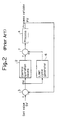
- Fig. 2 shows the conventional process control device of the limit sensitivity type.
- a deviation signal from deviation operation means 3 is applied to control operation means 2 and limit cycle generator 6.
- Adding means 7 adds outputs of control operation means 2 and limit cycle generator 6, and generates an output signal to process 4 as a manipulated variable.
- Limit cycle generator 6 functions to change the manipulated variable outputted to process 4 to a maximum value and to a minimum value periodically. Based upon the limit cycle or limit sensitivity at that time, the control operation parameters are calculated in accordance with Ziegler-Nichols method etc. and is set to control operation means 2.
- Fig. 3 shows the conventional process control device of the response waveform type (for example, USP No.4,602,326).
- response waveform rule applying means 8 set value SV and deviation DV are applied.
- Response waveform rule applying means 8 is configured by such tuning rule as Fuzzy rule etc.
- the control operation parameters are obtained by applying these rules to the overshoot of the process quantity, the attenuation ratio, the attenuation period, etc., and obtained parameters are set in control operation means 2.
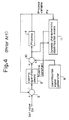
- Fig. 4 shows the conventional process control device of the adaptive control type.
- Adding means 10 adds outputs of control operation means 2 and identification signal generator 9, and generates an output to process 4.
- dynamic characteristic identification means 11 receives process variable and the output of adding means 10, estimates control operation parameters, and sets the estimated parameters in control operation means 2. That is, very small disturbance is generated in identification signal generator 9.
- the control operation parameter is obtained from the dynamic characteristic of the process variable at that time and the obtained result is set in control operation means 2.
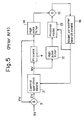
- Fig. 5 show the conventional process control device of the type equipped with the process model (e.g., ISA Transaction Vol. 22, No. 3, p.50, 51, and USP No. 4,385,326).
- a signal from control operation means 2 is outputted to process 4 and also applied to process model 13 through high pass filter 12.
- Process model 13 modeling process 4 is so configured that its parameters can be changed.
- Difference operation means 15 calculates the difference between the signal applied from process 4 through high pass filter 14 and the signal applied from process model 13.
- Model parameter search means 16 receives a difference signal from difference operation means 15, and searches parameters that makes the difference signal minimum. The searched parameters are set as the parameters of process model 13. And based on the parameters searched by model parameter search means 16, control operation parameters are obtained, and the obtained control operation parameters are set in control operation means 2.
- the above explained conventional process control device has following problems.
- the open loop type and the adoptive control type apparatus must give the identification signals to the process, and the limit sensitivity type apparatus must generate persistent oscillation.
- disturbance is applied to the process, and therefore, in case when we would obtain the control constant while the process control device is in operation, there occurs many restrictions.
- the calculation is carried out continuously at model parameter search means 16, and thus, the amount of calculation increases as the whole.
- the load of a microprocessor becomes heavy when the function of each part is executed in accordance with the program installed in the microprocessor.
- a main object of this invention is to provide a process control device wherein control constant can be reset in a short time without giving disturbance to process.
- object of this invention is to provide a process control device wherein the amount of calculation can be reduced and the load of the microprocessor can be minimized.
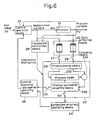
- Fig. 6 is a structural block diagram which shows one embodiment of the process control device in accordance with the invention.
- 20 is control operation means, to which set value SV as a desired value and process variable PV which is the output of process 21 are inputted.
- control operation means 20 such operation, as proportional operation, integral operation, or differential operation is applied to the difference between set value SV and process variable PV so as to obtain manipulated variable MV.
- Manipulated variable MV which is the output of control operation means 20, is applied to process 21 to be controlled, and from process 21, process variable PV is outputted.
- manipulated variable MV and process variable PV are inputted and these data are held as time series data for a predetermined period.
- preprocessing means 23 is modeling means in which preprocessing means 231, process model 232, internal parameter adjusting means 233 and comparing means 234 are provided. Preprocessing such as filtering is applied, at preprocessing means 231, to the outputs of data gathering means 22. Then, manipulated variable MV is inputted to process model 232 and process variable PV is inputted to comparing means 234. Process, model 232 simulates process 21. The output of process model 232 is inputted to comparing means 234, and compared with process variable PV separately applied. This comparison result is inputted to internal parameter adjusting means 233 which functions to adjust the internal parameter in process model 232 so that the output of process model 232 may match the output of process 21.
- Control operation means 20 calculates manipulated variable MV based upon this new control parameter.
- 26 is calculation instruction means, wherein process variable PV and manipulated variable MV are inputted and the output is generated to manipulate switches 27 - 30 when the changes of the inputs exceed a predetermined value. Based upon this, a calculation instruction signal is applied to modeling means 23 so as to cause modeling means 23 to start its operation.
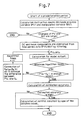
- Fig. 7 is a flowchart which shows one example of the functionof this embodiment.
- Data gathering, means 22 gathers manipulated variable MV and process variable PV as time series data at a predetermined period without any relation to this modeling operation.
- calculation instruction means 26 reads process variable (PV) and manipulated variable (MV) every predetermined period and functions to judge whether those changes are larger than the predetermined value. If the change is less than the predetermined value, the operation ends without giving any calculation instruction.
- this judgment is derived from such calculation, as shown in Fig. 8, that the area (slash part) is calculated by integrating the deviation of the process variable and the manipulated variable from respective steady states.
- modeling means 23 reads time series data ⁇ PV ⁇ concerning process variable PV and time series data ⁇ MV ⁇ concerning manipulated variable MV gathered by data gathering means 22.
- Preprocessing means 231 serves to eliminate the DC component and noise component thereof by filtering.
- Filtered time series data PV F , MV F concerning the process variable and the manipulated variable respectively are applied to process model 232 in which calculation of model output is carried out.
- This calculation is repeated until the repetition number reaches the maximum value, or until output O n of the process model becomes sufficiently close to time series data PV F concerning the process variable.
- accuracy K of process model 232 is calculated by estimation accuracy operating means 24.
- This accuracy K is calculated, for example, by following equation (3) or (4).
- K 1 - [ ⁇ PV F (i) - O(i) ⁇ 2 / ⁇ PV F (i)2] (3)
- K ⁇ PV F (i) ⁇ 2 / ⁇ O(i) ⁇ 2 (4)
- PV F (i) time series data of the process variable at time i
- O(i) output of process model 232 at time i.
- control operation-parameter operating means 25 calculates proportion/integration/differentiation constants, that is, control operation parameters, by using Ziegler-Nichols method, based upon obtained process model 232 of the first order lag process model.
- Control operation means 20 calculates manipulated variable MV by using this control operation parameter newly obtained.
- the process model is not necessarily such a first order system as shown by equation (2). Further, when there exists such measurable disturbance as load fluctuation in process 21, this disturbance can be used for the model calculation.
- gain K M is calculated based upon the integration ratio of the process variable and the output of the process model when the process gain is made 1, and dead time L M and first order lag coefficient ⁇ M are obtained by the repetition search method.
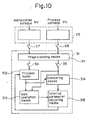
- Fig. 10 shows the structure of this embodiment. In this figure, other portions than the modeling means and data gathering means 22 are omitted since these portions are the same as shown in Fig. 6.
- 31 is modeling means which has similar function to modeling means 23 in Fig. 6.
- 311 is preprocessing means which has similar function to preprocessing means 231 in Fig. 6. Namely, process variable PV and manipulated variable MV stored in data gathering means 22 are filtered so as to eliminate the DC component and the noise component.
- 312 is process model which simulates the real process like process model 232. To this process model, the manipulated variable preprocessed by preprocessing means 311 is inputted. 313 is gain operation means, wherein the output of process model 312 and the process variable are inputted and the gain of process model 312 is calculated.
- 314 is comparing means for comparing the output of process model 312 and the process variable.
- 315 is internal adjusting means, wherein the output of comparing means 314 and the output of gain operation means 313 are inputted and the internal parameters are changed so that the difference between the output of process model 312 and the process variable may be enough small.
- the output of internal parameter adjusting means 315 is applied both to estimation accuracy operating means 24 and control operation-parameter operating means 25 in Fig. 6 so as to obtain the control operation parameters of control operation means 20.
- Switches 27, 28, 34 and 35 are controlled by calculation instruction means 26. Function of this embodiment is explained in the following.
- Fig. 11 is a flowchart which shoMs the function of this embodiment.
- Calculation instruction means 26 shown in Fig. 6 reads periodically manipulated variable brv and process variable PV, and only when those fluctuations become large, the following steps are executed.
- time series data ⁇ PV ⁇ and ⁇ MV ⁇ concerning the manipulated variable and the process variable respectively are filtered so as to eliminate the DC component and the noise component, and then the output of the process model is calculated by process model 312.
- process gain K M is calculated by use of following equation (6).
- K M [ ⁇ O(n)*PV F (n) ⁇ ]/ ⁇ O(n)2 ⁇ (6)
- O(n) the value obtained by the above equation (5), that is, the output of process model 312 when process gain K M is made 1.
- dead time L M of process model 312 and first order lag coefficient ⁇ M are adjusted so as to minimize the above difference. Then, process model 312 is restarted, and such operations are carried out, that the output is calculated in accordance with equation (5) and that process gain K M is calculated in accordance with equation (6).
- control operation-parameter operating means 25 calculates proportion/ integration/ differentiation constant, that is, control operation parameters, by using Ziegler-Nichols method, based upon obtained process model 312 of the first order lag process model.
- Control operation means 20 calculates the manipulated variable by using this control operation parameter newly obtained. Further, internal parameter adjusting means 315 calculates dead time L M and first order lag coefficient ⁇ M by the repetition search method which uses simplex method.
- process gain K M is automatically determined when dead time K M and first order lag coefficient ⁇ M are determined, and thus, the numbers of repetition search can be reduced.
- simplex method can be used for a method in case when internal parameter adjusting means 315 searches the internal parameter of process model 312.
- simplex method some points having geometrical arrangement on R n are chosen, and search is carried out by comparing the values of the object function at these points.
- This method is disclosed on p.284 - 287, "Non-linear Programming" by Hiroshi Imano and Hiroshi Yamashita, published from "Nippon Kagaku Gijustu Rengou”.
- the I/O data of the usual simplex method are discrete values in principle. Therefore, such problem occurs, that since the object function enters into the space of the discrete values, search becomes impossible. Further, there is such restriction that parameters such as time constant and dead time must be positive numbers.
- Fig. 12 shows procedure of the simplex method, in which the above mentioned restrictions are eliminated.
- the process data gathered by data gathering means 22 corresponds to geometrical points x on R n
- the object function corresponds to function f( ) of at this geometrical point.
- the search is carried out by comparing the values of the object function f( ).
- x h is replaced by x c .
- x l is replaced by (x i + X l )/2, and the operation returns to the step that x h , x s , x l and x m were decided.
- each component side which composes an initial polygon is made longer than sampling period and although the initial polygon is remade at least once, it is also possible that either of these two conditions is satisfied.
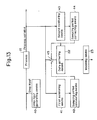
- Fig. 13 shows a still other embodiment.
- initial values for proportional constant, integral constant and differential constant, and sampling period must be set prior to the control operation. If these values are not set properly, automatic adjustment of the control operation parameters can not be done properly, and as the result, the control characteristic becomes worse.
- both the control operation parameters and the sampling period are previously tuned.
- the same reference numerals are attached to the same components as in Fig. 6 and the explanation for these components is omitted.
- 40 is step input generating means which applies step like manipulated variable to process 21.
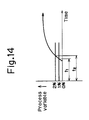
- the process increases gradually as shown in Fig. 14.
- 41 is first monitoring means which monitors the process variable of process 21. Namely, after application of the step like manipulated variable from step input generating means 40, time width t1 (first time width) until the process variable reaches a first predetermined value, for example, 1% of full scale, is measured.
- sampling period calculating means wherein the first time width measured by the first monitoring means 41 is inputted and based upon this, sampling period of data gathering means 22 is calculated.
- 43 is a second monitoring means which monitors the process variable from process 21. Namely, after application of the step like manipulated variable from step input generating means 40, time width t2 (second time width) until the process variable reaches a second predetermined value larger than the first predetermined value, for example, 2% of full scale, is measured.
- sampling period correcting means wherein the second time width measured by the second monitoring means 43 is inputted and the sampling period calculated by sampling period calculating means 42 is corrected.
- this switch is a switch which composes a sampler. In the first place, this switch is made ON every period calculated by sampling period calculating means 42, and later, is made ON every period corrected by sampling period correcting means 44. And, in accordance with these sampling periods, the process data is introduced into data gathering means 22. The gathered data is inputted to modeling means 23, and its internal parameters are adjusted, as explained in the embodiment of Fig. 6, until the output of process model 232 may coincide with the process variable. Based upon this internal parameters, control constant are calculated.
- interpolation is applied to previously gathered data so as to use these data as the data for new sampling period t s .
- step (3) data gathering operation of the process variable terminates, and arrangement of time series data ⁇ PV ⁇ and ⁇ MV ⁇ with respect to the process variable and the manipulated variable, stored in data gathering means 22, is carried out. Based upon these time series data, the internal parameters of process model is adjusted by modeling means 23, and control constants are obtained.
- control constants are used as an initial value. Then, data gathering is carried out by sampling period t s , and the control parameters are calculated in accordance with the procedure explained in Fig. 7.
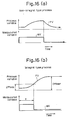
- step like manipulated variable is applied once at the beginning of control.
- process variable PV can settle by one time application of the step like manipulated variable as shown in Fig. 16(a).
- Applied period T of the step like manipulated variable is set to a fixed time or a time until the process variable reaches ⁇ P max .
- control constants are derived from the internal parameters of the modeling means by use of Ziegler-Nichols method, least square method or maximum likelihood degree method can be used.
- process data is gathered by the data gathering means and the modeling means is started so as to correct the internal parameters of the process model only when the change occurs in the process data. Then, estimation accuracy of the process model is calculated, and the control constants are calculated. Therefore, in this embodiments, identification signals are unnecessary, and thus, these embodiments have such advantage that extra disturbances are not applied to the process.
- the search time can be shortened.
- Fig. 17 shows a structural block diagram of a still other embodiment in accordance with this invention.
- estimation accuracy operating means 24 shown in Fig. 6 is omitted.
- manual instruction means 50 and step signal generating means 51 are provided, wherein step signal generating means 51 generates a step like pulse signal to process 21 based upon the instruction applied from instruction means 50.
- Fig. 18 is a flowchart which shows tuning operation for calculating the control operation parameters, started at a predetermined period in the embodiment in Fig. 17.
- step 1 judgment as to whether instruction for generating the step signal (the instruction from instruction means 50) exists, is conducted (step 1).
- a step signal having a fixed width is generated from step signal generating means 51 and is applied to manipulated variable MV in control operation means 20 (step 2).
- step 2 is skipped.
- Fig. 19 is a waveform diagram of manipulated variable MV and process variable PV, wherein the change of the process variable PV is shown when the step like signal is applied to manipulated variable MV.
- process variable PV When the manipulated variable changing step-like as shown in (a) is applied to process variable PV, process variable PV responds in such a manner as shown in (b) in accordance with its dynamic characteristic.
- Data gathering means 22 receives manipuiated variable MV and process variable PV, and holds these data as time series data for a predetermined period (step 3).
- Calculation instruction means 26 reads manipulated variable MV and process variable PV, and monitors, at every identification period, whether the fluctuation of these signals exceeds a predetermined value (step 5). When the fluctuation of these signals is less than the predetermined value, it is judged that the control is satisfactory state, and the operation terminates without generating a trigger signal. As shown in Fig. 8, the above judgment is done based upon the size of areas (slash parts) calculated by integrating the deviation of process variable PV from its steady state and the deviation of manipulated variable MV from its steady state for a fixed time.
- Modeling means 23 when it receives calculation instruction TRG, functions to estimate the dynamic characteristic of process 21 by using the change of manipulated variable MV and the response waveform of process variable PV from process 21, based upon the data applied, for a predetermined time, from data gathering means (steps 6 to 9).
- control operation means 20 calculates, based upon the obtained parameters of process model 232, proportion(PB)/ integration(TI)/ differentiation(TD) parameters in accordance with following equation (7), for example, by use of Ziegler-Nichols method, and the obtained operation parameters are set in control operation means 25 (steps 10 and 11).
- Control operation means 20 calculates manipulated signal MV by using newly set operation parameters.
- Step signal generating means 51 applies a pulse signal in place of the step signal when the process is integral type process.
- PI operation parameter can be set to an optimum value arbitrarily, if necessary, by applying a step like signal to the manipulated variable in automatic control state, in accordance with the instruction signal. And therefore, operability of this embodiment can be improved sufficiently.
- the amount of calculation can be reduced as the whole.
- Fig. 20 is a structural block diagram which shows a still other embodiment in accordance with the invention.
- drawbacks of the prior art shown in Fig. 5 are overcome.
- the signal to process model 13 is applied from control operation means 2 through high pass filter 12.
- DC and noise components can be eliminated from the signal and it has such feature that calculation in the process model becomes comparatively simple.
- this prior art has following drawbacks.
- process model 13 is a linear characteristic type so that model parameter search means 16 may search accurately the parameters which reduce the difference signal applied from difference operation means 15. Therefore, it is impossible to set high-low-limit in the output and also to use a nonlinear characteristic type model for the process model.
- the embodiment shown in Fig. 20 overcomes these problems, wherein the amount of calculation in the process model or in searching the parameters can be reduced, the calculation in the process model can be done accurately corresponding to the real process, and non-linear characteristic type model can be used for the process model.
- Signal MV from control operation means 20 is applied to process model 232 through data gathering means 22.
- Signal MO from process model 232 is applied to a first band pass filter so as to eliminate the DC and noise components.
- Signal PV from process 21 is applied to a second band pass filter 236 having the same characteristic as that of first band pass filter 235, through data gathering means 22.
- first and second band pass filters 235, 236 conduct such filtering calculation as shown in the following equation (8).
- PVF (1 - ⁇ )*PVF + a*(PV - PVo) (8)
- PVF applied time series data
- PVo DC and noise components
- ⁇ filter constant.
- Calculation instruction means 26 receives signal PV from process 21 and signal PVF from second band pass filter 236, and when either of these signals changes, calculation instruction signal TRG is generated.
- Model parameter search means 233 receives signal MOF from first band pass filter 235 and signal PVF from second band pass filter 236, and based upon calculation instruction signal TRG from calculation instruction means 26, searches parameters that make the difference of the signals applied from the first and second, band pass filters minimum. And the parameters of process model 232 is varied based upon searched parameters.
- Control operation-parameter operating means 25 calculates operation-parameters of control operation means 20 and sets these values in control operation means 20.
- Calculation instruction signal TRG from calculation instruction means 26 is applied, in addition to model parameter search means 23, to process model 232, first band pass filter 235 and control operation parameter operating means 25 simultaneously, which start calculation based upon the calculation instruction signal.
- model parameter search means 23 to process model 232, first band pass filter 235 and control operation parameter operating means 25 simultaneously, which start calculation based upon the calculation instruction signal.
- Fig. 21 is a flowchart which shows tuning action for control operation parameter, started at a predetermined period.
- Second band pass filter 236 receives process variable PV from process 21, and conducts such filtering calculation as shown by equation (8) (step 1).
- Calculation instruction means 26 reads the time series data concerning process variable PV and output time series data PVF of second band pass filter 236, and monitors, at every identification period, whether the change of these data is larger than a predetermined value (step 4).
- calculation instruction means 26 When the change of PV or PVF exceeds the fixed value, calculation instruction means 26 generates calculation instruction signal TRG.
- Process model 232 which receives this calculation instruction signal TRG, reads the time series data of manipulated variable MV gathered at step 2 (the same signal as the manipulated variable applied to process 21), and calculates model output MO in accordance with equation (5) (step 5).
- Output MO of process model 232 is applied to first band pass filter 235 in which filtering calculation is carried out in accordance with equation (8) (step 6). By the filtering operation, the DC and noise components included in model output MO are eliminated.
- Model parameter search means 233 receives time series data MOF from first band pass filter 235 and time series data PVF from second band pass filter 236, and conducts calculation for searching optimum parameters for process model 232.
- parameter search means 23 functions to search the best combination of time constant T M and dead time L M of the model, by which evaluation function CRIT is made minimum.
- gain K M of process model 232, dead time L M , and first order lag coefficient ⁇ M are corrected respectively until the output of process model 232 becomes sufficiently close to the output of process 21 (i.e., the difference of process model becomes less than a fixed value), by repeating the operation from step 5 to step 9.
- control operation-parameter operating means 25 calculates, based upon the obtained parameters of process model 232, proportion (PB)/ integration(TI)/ differentiation(TD) parameters in accordance with equation (7), for example, by use of Ziegler-Nichols method, and the obtained operation parameters are set in control operation means 20 (steps 10 and 11).
- Control operation means 20 calculates manipulated variable MV by using newly set operation parameters.
- Process model 232 is not necessarily first order lag type system. Further, when measurable disturbance such as load fluctuation exists in process 21, this disturbance can be used for the model calculation.
- gain K M is determined by totalizing ratio of the process variable and the output of the process model when the gain of process model is made 1. Then, dead time L M and first order lag coefficient ⁇ M are determined by, using repetition search method.
- This embodiment has following advantages in comparison with the conventional apparatus shown in Fig. 5.
Landscapes
- Engineering & Computer Science (AREA)
- Physics & Mathematics (AREA)
- General Physics & Mathematics (AREA)
- Automation & Control Theory (AREA)
- Health & Medical Sciences (AREA)
- Artificial Intelligence (AREA)
- Computer Vision & Pattern Recognition (AREA)
- Evolutionary Computation (AREA)
- Medical Informatics (AREA)
- Software Systems (AREA)
- Feedback Control In General (AREA)
Applications Claiming Priority (4)
| Application Number | Priority Date | Filing Date | Title |
|---|---|---|---|
| JP238222/89 | 1989-09-13 | ||
| JP1238222A JP2551166B2 (ja) | 1989-09-13 | 1989-09-13 | プロセス制御装置 |
| JP1249927A JP2757039B2 (ja) | 1989-09-26 | 1989-09-26 | セルフチューニング調節計 |
| JP249927/89 | 1989-09-26 |
Publications (3)
| Publication Number | Publication Date |
|---|---|
| EP0417593A2 true EP0417593A2 (de) | 1991-03-20 |
| EP0417593A3 EP0417593A3 (en) | 1991-11-13 |
| EP0417593B1 EP0417593B1 (de) | 1996-07-24 |
Family
ID=26533586
Family Applications (1)
| Application Number | Title | Priority Date | Filing Date |
|---|---|---|---|
| EP90116891A Expired - Lifetime EP0417593B1 (de) | 1989-09-13 | 1990-09-03 | Prozesssteuerungsgerät |
Country Status (6)
| Country | Link |
|---|---|
| US (1) | US5166873A (de) |
| EP (1) | EP0417593B1 (de) |
| KR (1) | KR940010393B1 (de) |
| CN (1) | CN1044522C (de) |
| BR (1) | BR9004557A (de) |
| SG (1) | SG44891A1 (de) |
Cited By (4)
| Publication number | Priority date | Publication date | Assignee | Title |
|---|---|---|---|---|
| EP0533498A1 (de) * | 1991-09-20 | 1993-03-24 | Omron Corporation | PID-Regeleinrichtung |
| WO1994017458A1 (en) * | 1993-01-26 | 1994-08-04 | Honeywell Inc. | A method of multivariable predictive control utilizing range control |
| CN101707189B (zh) * | 2008-08-06 | 2011-04-13 | 东京毅力科创株式会社 | 将多层/多输入/多输出(mlmimo)模型用于金属栅结构 |
| GB202405323D0 (en) | 2024-04-15 | 2024-05-29 | High Temperature Mat Systems Ltd | Improvements in ceramic matrix composite materials |
Families Citing this family (37)
| Publication number | Priority date | Publication date | Assignee | Title |
|---|---|---|---|---|
| US5541833A (en) * | 1987-03-30 | 1996-07-30 | The Foxboro Company | Multivariable feedforward adaptive controller |
| EP0460892B1 (de) * | 1990-06-04 | 1996-09-04 | Hitachi, Ltd. | Steuerungsvorrichtung für die Steuerung einer gesteuerten Anlage und Steuerungsverfahren dafür |
| US5930136A (en) * | 1990-06-04 | 1999-07-27 | Hitachi, Ltd. | Control device for controlling a controlled apparatus, and a control method therefor |
| US5394322A (en) * | 1990-07-16 | 1995-02-28 | The Foxboro Company | Self-tuning controller that extracts process model characteristics |
| US5406474A (en) * | 1990-07-16 | 1995-04-11 | The Foxboro Company | Self-tuning controller |
| JPH04121770A (ja) * | 1990-09-12 | 1992-04-22 | Brother Ind Ltd | 熱定着装置 |
| JP2539540B2 (ja) * | 1990-09-19 | 1996-10-02 | 株式会社日立製作所 | プロセス制御装置 |
| GB2252424B (en) * | 1990-11-24 | 1994-10-05 | Dowty Aerospace Gloucester | Adaptive control servosystems |
| JPH04308901A (ja) * | 1991-04-05 | 1992-10-30 | Nec Corp | 状態推定器と磁気ディスク装置の位置決め制御回路 |
| DE69212721T2 (de) * | 1991-06-11 | 1997-01-23 | Toshiba Kawasaki Kk | Prozesssteuerung |
| US5231341A (en) * | 1991-09-18 | 1993-07-27 | Samsung Electronics Co., Ltd. | Limiter circuit of servo motor control apparatus |
| US5568379A (en) * | 1991-11-25 | 1996-10-22 | Siemens Aktiengesellschaft | Method for controlling dynamic nth-order systems |
| US5402333A (en) * | 1992-06-15 | 1995-03-28 | E. I. Du Pont De Nemours & Co., Inc. | System and method for improving model product property estimates |
| US5568377A (en) * | 1992-10-29 | 1996-10-22 | Johnson Service Company | Fast automatic tuning of a feedback controller |
| US5687076A (en) * | 1993-02-04 | 1997-11-11 | Siemens Aktiengesellschaft | Method for adjusting scale factors of fuzzy logic controllers and conventional nonlinear controllers |
| US5801963A (en) * | 1995-11-13 | 1998-09-01 | The University Of Kentucky Research Foundation | Method of predicting optimum machining conditions |
| DE19548909A1 (de) * | 1995-12-27 | 1997-07-03 | Siemens Ag | Verfahren zur Regelung eines verzögerungsbehafteten Prozesses mit Ausgleich sowie Regeleinrichtung zur Durchführung des Verfahrens |
| DE19722431A1 (de) * | 1997-05-28 | 1998-12-03 | Siemens Ag | Verfahren zur Regelung eines verzögerungsbehafteten Prozesses mit Ausgleich sowie Regeleinrichtung zur Durchführung des Verfahrens |
| US6654649B2 (en) * | 1999-12-22 | 2003-11-25 | Aspen Technology, Inc. | Computer method and apparatus for optimized controller in a non-linear process |
| US6957172B2 (en) | 2000-03-09 | 2005-10-18 | Smartsignal Corporation | Complex signal decomposition and modeling |
| ATE303618T1 (de) * | 2000-03-10 | 2005-09-15 | Smiths Detection Inc | Steuerung für einen industriellen prozes mit einer oder mehreren multidimensionalen variablen |
| US7233886B2 (en) * | 2001-01-19 | 2007-06-19 | Smartsignal Corporation | Adaptive modeling of changed states in predictive condition monitoring |
| DE10129141A1 (de) | 2001-06-16 | 2002-12-19 | Abb Research Ltd | Steuer- und Regelverfahren un Regeleinrichtung zum An- oder Abfahren einer verfahrenstechnischen Komponente eines technischen Prozesses |
| EP1304605A1 (de) * | 2001-10-19 | 2003-04-23 | Siemens Aktiengesellschaft | Automatische Parametererfassung |
| WO2003095404A1 (en) * | 2002-05-09 | 2003-11-20 | University Of Mississippi | Cembranoids with chemopreventive activity |
| US7242989B2 (en) * | 2003-05-30 | 2007-07-10 | Fisher-Rosemount Systems, Inc. | Apparatus and method for batch property estimation |
| US20050222835A1 (en) * | 2004-04-02 | 2005-10-06 | Fridolin Faist | Method for automatic modeling a process control system and corresponding process control system |
| DE102004040282A1 (de) * | 2004-08-19 | 2006-03-09 | Siemens Ag | Parameteridentifikation für Feldgeräte in der Automatisierungstechnik |
| US7660639B2 (en) | 2006-03-27 | 2010-02-09 | Hitachi, Ltd. | Control system for control subject having combustion unit and control system for plant having boiler |
| JP4952025B2 (ja) * | 2006-03-31 | 2012-06-13 | 株式会社日立製作所 | 運転制御方法,運転制御装置及び運転制御システム |
| US8275577B2 (en) | 2006-09-19 | 2012-09-25 | Smartsignal Corporation | Kernel-based method for detecting boiler tube leaks |
| US8311774B2 (en) | 2006-12-15 | 2012-11-13 | Smartsignal Corporation | Robust distance measures for on-line monitoring |
| JP4286880B2 (ja) * | 2007-04-25 | 2009-07-01 | 本田技研工業株式会社 | 制御パラメータを探索するためのプログラム |
| US8825185B2 (en) * | 2011-01-04 | 2014-09-02 | Johnson Controls Technology Company | Delay compensation for feedback controllers |
| EP2573631B1 (de) * | 2011-09-23 | 2015-10-21 | Honeywell spol s.r.o. | Steuergerät zur Abschätzung von verzögerten manipulierten Variablen |
| JP6662310B2 (ja) * | 2017-01-11 | 2020-03-11 | 横河電機株式会社 | データ処理装置、データ処理方法及びプログラム |
| CN111266004B (zh) * | 2020-03-20 | 2021-07-23 | 大唐环境产业集团股份有限公司 | 一种SCR脱硝反应器入口NOx延迟估计系统 |
Family Cites Families (10)
| Publication number | Priority date | Publication date | Assignee | Title |
|---|---|---|---|---|
| US3601588A (en) * | 1966-05-23 | 1971-08-24 | Foxboro Co | Method and apparatus for adaptive control |
| US3767900A (en) * | 1971-06-23 | 1973-10-23 | Cons Paper Inc | Adaptive controller having optimal filtering |
| US3828171A (en) * | 1972-08-14 | 1974-08-06 | Phillips Petroleum Co | Process apparatus control system for optimizing objective variable quality |
| FR2423806A1 (fr) * | 1977-05-26 | 1979-11-16 | Anvar | Procede de regulation a modele de reference et regulateur mettant en oeuvre ce procede |
| JPS5413883A (en) * | 1977-07-04 | 1979-02-01 | Hitachi Ltd | Abnormalness detector of automatic controller |
| US4368510A (en) * | 1980-10-20 | 1983-01-11 | Leeds & Northrup Company | Automatic identification system for self tuning process controller |
| US4407013A (en) * | 1980-10-20 | 1983-09-27 | Leeds & Northrup Company | Self tuning of P-I-D controller by conversion of discrete time model identification parameters |
| US4607325A (en) * | 1981-10-21 | 1986-08-19 | Honeywell Inc. | Discontinuous optimization procedure modelling the run-idle status of plural process components |
| JPS61243505A (ja) * | 1985-04-19 | 1986-10-29 | Omron Tateisi Electronics Co | 離散時間制御装置 |
| JPH01302402A (ja) * | 1988-03-17 | 1989-12-06 | Toshiba Corp | プロセス最適化制御装置 |
-
1990
- 1990-08-30 US US07/575,211 patent/US5166873A/en not_active Expired - Lifetime
- 1990-09-03 EP EP90116891A patent/EP0417593B1/de not_active Expired - Lifetime
- 1990-09-03 SG SG1996009064A patent/SG44891A1/en unknown
- 1990-09-12 BR BR909004557A patent/BR9004557A/pt not_active IP Right Cessation
- 1990-09-12 CN CN90107562A patent/CN1044522C/zh not_active Expired - Fee Related
- 1990-09-13 KR KR1019900014475A patent/KR940010393B1/ko not_active Expired - Fee Related
Cited By (5)
| Publication number | Priority date | Publication date | Assignee | Title |
|---|---|---|---|---|
| EP0533498A1 (de) * | 1991-09-20 | 1993-03-24 | Omron Corporation | PID-Regeleinrichtung |
| US5331541A (en) * | 1991-09-20 | 1994-07-19 | Omron Corporation | PiD control unit |
| WO1994017458A1 (en) * | 1993-01-26 | 1994-08-04 | Honeywell Inc. | A method of multivariable predictive control utilizing range control |
| CN101707189B (zh) * | 2008-08-06 | 2011-04-13 | 东京毅力科创株式会社 | 将多层/多输入/多输出(mlmimo)模型用于金属栅结构 |
| GB202405323D0 (en) | 2024-04-15 | 2024-05-29 | High Temperature Mat Systems Ltd | Improvements in ceramic matrix composite materials |
Also Published As
| Publication number | Publication date |
|---|---|
| CN1044522C (zh) | 1999-08-04 |
| CN1051629A (zh) | 1991-05-22 |
| KR940010393B1 (ko) | 1994-10-22 |
| US5166873A (en) | 1992-11-24 |
| KR910006807A (ko) | 1991-04-29 |
| EP0417593B1 (de) | 1996-07-24 |
| SG44891A1 (en) | 1997-12-19 |
| EP0417593A3 (en) | 1991-11-13 |
| BR9004557A (pt) | 1991-09-10 |
Similar Documents
| Publication | Publication Date | Title |
|---|---|---|
| EP0417593B1 (de) | Prozesssteuerungsgerät | |
| US5043863A (en) | Multivariable adaptive feedforward controller | |
| US4602326A (en) | Pattern-recognizing self-tuning controller | |
| US5541833A (en) | Multivariable feedforward adaptive controller | |
| US5748467A (en) | Method of adapting and applying control parameters in non-linear process controllers | |
| US4864490A (en) | Auto-tuning controller using fuzzy reasoning to obtain optimum control parameters | |
| US6330484B1 (en) | Method and apparatus for fuzzy logic control with automatic tuning | |
| EP0710902B1 (de) | Verfahren und Vorrichtung zur Steuerung von Mehrgrössen-/nichtlinearen Systemen | |
| US5587896A (en) | Self-tuning controller | |
| EP0260259B1 (de) | Verfahren und vorrichtung zum selbsttätigen einstellen eines prozessregulators | |
| US4881160A (en) | Self-tuning controller | |
| KR900005546B1 (ko) | 적응프로세스 제어장치 | |
| EP0139243A2 (de) | Prozesssteuerapparat | |
| USRE33267E (en) | Pattern-recognizing self-tuning controller | |
| US4959767A (en) | Parameter estimation technique for closed loop system | |
| Kaya | Tuning PI controllers for stable processes with specifications on gain and phase margins | |
| US5812428A (en) | Process controller having non-integrating control function and adaptive bias | |
| EP0307466B1 (de) | Adaptive mehrgrössensteuerung | |
| US6480750B2 (en) | Controlling system and method for operating a controlling system | |
| JP2802791B2 (ja) | セルフチューニング調節計 | |
| EP0554442B1 (de) | Adaptive Mehrgrössensteuerung mit Vorwärtskopplung | |
| De Carli et al. | A fuzzy-PI control strategy | |
| JP2551166B2 (ja) | プロセス制御装置 | |
| JPH06102905A (ja) | フィードフォワード/フィードバック制御装置 | |
| EP0610189B1 (de) | Selbsteinstellender regler |
Legal Events
| Date | Code | Title | Description |
|---|---|---|---|
| PUAI | Public reference made under article 153(3) epc to a published international application that has entered the european phase |
Free format text: ORIGINAL CODE: 0009012 |
|
| 17P | Request for examination filed |
Effective date: 19900928 |
|
| AK | Designated contracting states |
Kind code of ref document: A2 Designated state(s): GB NL |
|
| TCNL | Nl: translation of patent claims filed | ||
| PUAL | Search report despatched |
Free format text: ORIGINAL CODE: 0009013 |
|
| AK | Designated contracting states |
Kind code of ref document: A3 Designated state(s): GB NL |
|
| 17Q | First examination report despatched |
Effective date: 19931228 |
|
| GRAH | Despatch of communication of intention to grant a patent |
Free format text: ORIGINAL CODE: EPIDOS IGRA |
|
| GRAH | Despatch of communication of intention to grant a patent |
Free format text: ORIGINAL CODE: EPIDOS IGRA |
|
| GRAA | (expected) grant |
Free format text: ORIGINAL CODE: 0009210 |
|
| AK | Designated contracting states |
Kind code of ref document: B1 Designated state(s): GB NL |
|
| REG | Reference to a national code |
Ref country code: GB Ref legal event code: 746 Effective date: 19970307 |
|
| PLBE | No opposition filed within time limit |
Free format text: ORIGINAL CODE: 0009261 |
|
| STAA | Information on the status of an ep patent application or granted ep patent |
Free format text: STATUS: NO OPPOSITION FILED WITHIN TIME LIMIT |
|
| 26N | No opposition filed | ||
| REG | Reference to a national code |
Ref country code: GB Ref legal event code: IF02 |
|
| PGFP | Annual fee paid to national office [announced via postgrant information from national office to epo] |
Ref country code: GB Payment date: 20020828 Year of fee payment: 13 |
|
| PGFP | Annual fee paid to national office [announced via postgrant information from national office to epo] |
Ref country code: NL Payment date: 20020930 Year of fee payment: 13 |
|
| PG25 | Lapsed in a contracting state [announced via postgrant information from national office to epo] |
Ref country code: GB Free format text: LAPSE BECAUSE OF NON-PAYMENT OF DUE FEES Effective date: 20030903 |
|
| PG25 | Lapsed in a contracting state [announced via postgrant information from national office to epo] |
Ref country code: NL Free format text: LAPSE BECAUSE OF NON-PAYMENT OF DUE FEES Effective date: 20040401 |
|
| GBPC | Gb: european patent ceased through non-payment of renewal fee | ||
| NLV4 | Nl: lapsed or anulled due to non-payment of the annual fee |
Effective date: 20040401 |