EP0417870A2 - Chelatbildner zur Komplexierung von radioaktiven Isotopen, deren Metallkomplexe sowie ihre Verwendung in Diagnostik und Therapie - Google Patents
Chelatbildner zur Komplexierung von radioaktiven Isotopen, deren Metallkomplexe sowie ihre Verwendung in Diagnostik und Therapie Download PDFInfo
- Publication number
- EP0417870A2 EP0417870A2 EP90250214A EP90250214A EP0417870A2 EP 0417870 A2 EP0417870 A2 EP 0417870A2 EP 90250214 A EP90250214 A EP 90250214A EP 90250214 A EP90250214 A EP 90250214A EP 0417870 A2 EP0417870 A2 EP 0417870A2
- Authority
- EP
- European Patent Office
- Prior art keywords
- ppm
- arh
- radical
- hours
- amino
- Prior art date
- Legal status (The legal status is an assumption and is not a legal conclusion. Google has not performed a legal analysis and makes no representation as to the accuracy of the status listed.)
- Granted
Links
Classifications
-
- C—CHEMISTRY; METALLURGY
- C07—ORGANIC CHEMISTRY
- C07D—HETEROCYCLIC COMPOUNDS
- C07D243/00—Heterocyclic compounds containing seven-membered rings having two nitrogen atoms as the only ring hetero atoms
- C07D243/06—Heterocyclic compounds containing seven-membered rings having two nitrogen atoms as the only ring hetero atoms having the nitrogen atoms in positions 1 and 4
- C07D243/08—Heterocyclic compounds containing seven-membered rings having two nitrogen atoms as the only ring hetero atoms having the nitrogen atoms in positions 1 and 4 not condensed with other rings
-
- C—CHEMISTRY; METALLURGY
- C07—ORGANIC CHEMISTRY
- C07C—ACYCLIC OR CARBOCYCLIC COMPOUNDS
- C07C249/00—Preparation of compounds containing nitrogen atoms doubly-bound to a carbon skeleton
- C07C249/04—Preparation of compounds containing nitrogen atoms doubly-bound to a carbon skeleton of oximes
-
- A—HUMAN NECESSITIES
- A61—MEDICAL OR VETERINARY SCIENCE; HYGIENE
- A61K—PREPARATIONS FOR MEDICAL, DENTAL OR TOILETRY PURPOSES
- A61K51/00—Preparations containing radioactive substances for use in therapy or testing in vivo
- A61K51/02—Preparations containing radioactive substances for use in therapy or testing in vivo characterised by the carrier, i.e. characterised by the agent or material covalently linked or complexing the radioactive nucleus
- A61K51/04—Organic compounds
- A61K51/0474—Organic compounds complexes or complex-forming compounds, i.e. wherein a radioactive metal (e.g. 111In3+) is complexed or chelated by, e.g. a N2S2, N3S, NS3, N4 chelating group
- A61K51/0478—Organic compounds complexes or complex-forming compounds, i.e. wherein a radioactive metal (e.g. 111In3+) is complexed or chelated by, e.g. a N2S2, N3S, NS3, N4 chelating group complexes from non-cyclic ligands, e.g. EDTA, MAG3
-
- A—HUMAN NECESSITIES
- A61—MEDICAL OR VETERINARY SCIENCE; HYGIENE
- A61K—PREPARATIONS FOR MEDICAL, DENTAL OR TOILETRY PURPOSES
- A61K51/00—Preparations containing radioactive substances for use in therapy or testing in vivo
- A61K51/02—Preparations containing radioactive substances for use in therapy or testing in vivo characterised by the carrier, i.e. characterised by the agent or material covalently linked or complexing the radioactive nucleus
- A61K51/04—Organic compounds
- A61K51/08—Peptides, e.g. proteins, carriers being peptides, polyamino acids, proteins
- A61K51/10—Antibodies or immunoglobulins; Fragments thereof, the carrier being an antibody, an immunoglobulin or a fragment thereof, e.g. a camelised human single domain antibody or the Fc fragment of an antibody
- A61K51/1093—Antibodies or immunoglobulins; Fragments thereof, the carrier being an antibody, an immunoglobulin or a fragment thereof, e.g. a camelised human single domain antibody or the Fc fragment of an antibody conjugates with carriers being antibodies
-
- A—HUMAN NECESSITIES
- A61—MEDICAL OR VETERINARY SCIENCE; HYGIENE
- A61P—SPECIFIC THERAPEUTIC ACTIVITY OF CHEMICAL COMPOUNDS OR MEDICINAL PREPARATIONS
- A61P35/00—Antineoplastic agents
-
- C—CHEMISTRY; METALLURGY
- C07—ORGANIC CHEMISTRY
- C07C—ACYCLIC OR CARBOCYCLIC COMPOUNDS
- C07C215/00—Compounds containing amino and hydroxy groups bound to the same carbon skeleton
- C07C215/46—Compounds containing amino and hydroxy groups bound to the same carbon skeleton having hydroxy groups bound to carbon atoms of at least one six-membered aromatic ring and amino groups bound to acyclic carbon atoms or to carbon atoms of rings other than six-membered aromatic rings of the same carbon skeleton
- C07C215/48—Compounds containing amino and hydroxy groups bound to the same carbon skeleton having hydroxy groups bound to carbon atoms of at least one six-membered aromatic ring and amino groups bound to acyclic carbon atoms or to carbon atoms of rings other than six-membered aromatic rings of the same carbon skeleton with amino groups linked to the six-membered aromatic ring, or to the condensed ring system containing that ring, by carbon chains not further substituted by hydroxy groups
- C07C215/50—Compounds containing amino and hydroxy groups bound to the same carbon skeleton having hydroxy groups bound to carbon atoms of at least one six-membered aromatic ring and amino groups bound to acyclic carbon atoms or to carbon atoms of rings other than six-membered aromatic rings of the same carbon skeleton with amino groups linked to the six-membered aromatic ring, or to the condensed ring system containing that ring, by carbon chains not further substituted by hydroxy groups with amino groups and the six-membered aromatic ring, or the condensed ring system containing that ring, bound to the same carbon atom of the carbon chain
-
- C—CHEMISTRY; METALLURGY
- C07—ORGANIC CHEMISTRY
- C07C—ACYCLIC OR CARBOCYCLIC COMPOUNDS
- C07C323/00—Thiols, sulfides, hydropolysulfides or polysulfides substituted by halogen, oxygen or nitrogen atoms, or by sulfur atoms not being part of thio groups
- C07C323/23—Thiols, sulfides, hydropolysulfides or polysulfides substituted by halogen, oxygen or nitrogen atoms, or by sulfur atoms not being part of thio groups containing thio groups and nitrogen atoms, not being part of nitro or nitroso groups, bound to the same carbon skeleton
- C07C323/31—Thiols, sulfides, hydropolysulfides or polysulfides substituted by halogen, oxygen or nitrogen atoms, or by sulfur atoms not being part of thio groups containing thio groups and nitrogen atoms, not being part of nitro or nitroso groups, bound to the same carbon skeleton having the sulfur atom of at least one of the thio groups bound to a carbon atom of a six-membered aromatic ring of the carbon skeleton
- C07C323/32—Thiols, sulfides, hydropolysulfides or polysulfides substituted by halogen, oxygen or nitrogen atoms, or by sulfur atoms not being part of thio groups containing thio groups and nitrogen atoms, not being part of nitro or nitroso groups, bound to the same carbon skeleton having the sulfur atom of at least one of the thio groups bound to a carbon atom of a six-membered aromatic ring of the carbon skeleton having at least one of the nitrogen atoms bound to an acyclic carbon atom of the carbon skeleton
-
- C—CHEMISTRY; METALLURGY
- C07—ORGANIC CHEMISTRY
- C07C—ACYCLIC OR CARBOCYCLIC COMPOUNDS
- C07C331/00—Derivatives of thiocyanic acid or of isothiocyanic acid
- C07C331/16—Isothiocyanates
- C07C331/28—Isothiocyanates having isothiocyanate groups bound to carbon atoms of six-membered aromatic rings
-
- C—CHEMISTRY; METALLURGY
- C07—ORGANIC CHEMISTRY
- C07D—HETEROCYCLIC COMPOUNDS
- C07D233/00—Heterocyclic compounds containing 1,3-diazole or hydrogenated 1,3-diazole rings, not condensed with other rings
- C07D233/54—Heterocyclic compounds containing 1,3-diazole or hydrogenated 1,3-diazole rings, not condensed with other rings having two double bonds between ring members or between ring members and non-ring members
- C07D233/66—Heterocyclic compounds containing 1,3-diazole or hydrogenated 1,3-diazole rings, not condensed with other rings having two double bonds between ring members or between ring members and non-ring members with hetero atoms or with carbon atoms having three bonds to hetero atoms with at the most one bond to halogen, e.g. ester or nitrile radicals, directly attached to ring carbon atoms
- C07D233/91—Nitro radicals
-
- C—CHEMISTRY; METALLURGY
- C07—ORGANIC CHEMISTRY
- C07D—HETEROCYCLIC COMPOUNDS
- C07D245/00—Heterocyclic compounds containing rings of more than seven members having two nitrogen atoms as the only ring hetero atoms
- C07D245/02—Heterocyclic compounds containing rings of more than seven members having two nitrogen atoms as the only ring hetero atoms not condensed with other rings
-
- C—CHEMISTRY; METALLURGY
- C07—ORGANIC CHEMISTRY
- C07D—HETEROCYCLIC COMPOUNDS
- C07D309/00—Heterocyclic compounds containing six-membered rings having one oxygen atom as the only ring hetero atom, not condensed with other rings
- C07D309/16—Heterocyclic compounds containing six-membered rings having one oxygen atom as the only ring hetero atom, not condensed with other rings having one double bond between ring members or between a ring member and a non-ring member
- C07D309/28—Heterocyclic compounds containing six-membered rings having one oxygen atom as the only ring hetero atom, not condensed with other rings having one double bond between ring members or between a ring member and a non-ring member with hetero atoms or with carbon atoms having three bonds to hetero atoms with at the most one bond to halogen, e.g. ester or nitrile radicals, directly attached to ring carbon atoms
- C07D309/30—Oxygen atoms, e.g. delta-lactones
-
- C—CHEMISTRY; METALLURGY
- C07—ORGANIC CHEMISTRY
- C07D—HETEROCYCLIC COMPOUNDS
- C07D405/00—Heterocyclic compounds containing both one or more hetero rings having oxygen atoms as the only ring hetero atoms, and one or more rings having nitrogen as the only ring hetero atom
- C07D405/02—Heterocyclic compounds containing both one or more hetero rings having oxygen atoms as the only ring hetero atoms, and one or more rings having nitrogen as the only ring hetero atom containing two hetero rings
- C07D405/12—Heterocyclic compounds containing both one or more hetero rings having oxygen atoms as the only ring hetero atoms, and one or more rings having nitrogen as the only ring hetero atom containing two hetero rings linked by a chain containing hetero atoms as chain links
-
- C—CHEMISTRY; METALLURGY
- C07—ORGANIC CHEMISTRY
- C07D—HETEROCYCLIC COMPOUNDS
- C07D409/00—Heterocyclic compounds containing two or more hetero rings, at least one ring having sulfur atoms as the only ring hetero atoms
- C07D409/02—Heterocyclic compounds containing two or more hetero rings, at least one ring having sulfur atoms as the only ring hetero atoms containing two hetero rings
- C07D409/04—Heterocyclic compounds containing two or more hetero rings, at least one ring having sulfur atoms as the only ring hetero atoms containing two hetero rings directly linked by a ring-member-to-ring-member bond
-
- A—HUMAN NECESSITIES
- A61—MEDICAL OR VETERINARY SCIENCE; HYGIENE
- A61K—PREPARATIONS FOR MEDICAL, DENTAL OR TOILETRY PURPOSES
- A61K2123/00—Preparations for testing in vivo
Definitions
- Radioactive metal ions mostly bound to a complexing agent, have been used for in vivo diagnostics for a long time.
- Technetium-99m (Tc-99m) is due to its almost ideal physical properties for this purpose - good absorption of radiation in appropriate detection devices (gamma camera, SPECT devices) compared to low absorption in the human organism and easy availability via a molybdenum / technetium Generator - the radio nuclide most commonly used in clinical nuclear medicine. Its short half-life of 6.02 h guarantees that the patient is only exposed to gamma radiation to a small extent, especially since the daughter nuclide Technetium-99 has only negligible residual radiation.
- a disadvantage of the technetium is its complex and not yet fully known complex chemistry.
- Technetium can exist in a number of oxidation states (+7 to -1), which can change the pharmacological properties by changing the charge of a complex. It is therefore necessary to synthesize complexes that bind the technetium in a defined oxidation state and prevent redox reactions that could lead to redistribution of the drug.
- a number of such Tc-99m complexing agents are already known and are being used clinically. Neutral complexes are often systems in which the Tc-99m is bonded between 2-4 nitrogen atoms and 0-2 sulfur atoms (N2S2, - N3S and propylene amine oxime complexes).
- chelating agents for radioactive metal ions in particular Tc-99m, can be coupled to substances that selectively accumulate in diseased tissues.
- the chelating agents can also be used to complex these isotopes.
- the re-isotopes mentioned are ⁇ -emitters.
- the selectively enriching substances complexed with rhenium instead of technetium can also be used in tumor therapy.
- Such bifunctional ligands enable a specific, chemically defined binding of technetium to a wide variety of biological materials, even if so-called prelabeling is carried out. Since, according to this method, the labeling with Tc-99m and the isolation of the complexes are carried out first and only in a second step this complex is linked to a selectively enriching molecule, the labeled compounds are obtained with a high degree of purity.
- chelating agents coupled to monoclonal antibodies e.g. European Patent App. 0 247 866 and 0 188 256
- fatty acids European Patent Appl. 0 200 492
- N2S2 systems are used as chelating agents, which are not very suitable due to their low stability.
- the somewhat more stable N3S chelates, coupled to monoclonal antibodies, did not show such a great loss of Tc-99m from the conjugates (J. Lister-James; J. Nucl. Med. 30: 793 and European Patent Appl. 0 284 071).
- the object of the invention is therefore to provide stable chelating agents which contain a functional group for coupling to a selectively enriching compound or a selectively enriching compound coupled with the aid of this functional group.
- R1, R2 and R5 are the same or different and represent hydrogen or a C1 ⁇ 6-alkyl radical optionally substituted with a hydroxyl group
- R3 and R4 are the same or different and represent a hydrogen atom, a C1 ⁇ 6 alkyl, an amino (C1 ⁇ 6) alkyl, a carboxymethyl, a (C1 ⁇ 6 alkoxycarbonyl) methyl or a (C1 ⁇ 6-alkoxycarbonyl) benzyl radical
- R6 represents a C1 ⁇ 6 alkylene radical
- R7 and R8 are the same or different and are hydrogen or a C1 ⁇ 6-alkyl radical
- R x is a
- Preferred according to the invention are those compounds according to claim 1 in which R1, R2, R7 and R8 are hydrogen atoms or methyl radicals and those compounds according to claim 1 in which the functional group C optionally present in A for a carboxyl, an amino a C2 ⁇ 6-Alkenyl, a C2 ⁇ 6-alkynyl, a nitrile, a tetrahydropyranyloxy, a nitrophenyl, an oxiranyl, an aminophenyl or a phenylisothiocyanate radical and the selectively enriching compound T, optionally contained in A, for monoclonal antibodies, the Fragments, biotin or misonidazole is available.
- the amino groups are optionally alkylated in a manner known per se and existing protective groups are split off and the compounds obtained in these equivalent ways, if appropriate before the generation of the free functional group C, protects the amino groups present with protective ions, for example as a Cu complex, and then, if desired, the compounds obtained in this way via the functional group C present in A selectively enriching compounds T. couples and the aromatic substituents B and B 'complexed with the desired radioactive isotope if desired, whereby any protective ions present in the product are removed beforehand by methods known per se from the literature and the sequence of the steps of complexation with technetium or rhenium isotopes and coupling to T can be exchanged.
- hydroxyl protective groups are the benzyl, 4-methoxybenzyl, 4-nitrobenzyl, trityl, diphenylmethyl, trimethylsilyl, dimethyl-t-butylsilyl and diphenyl-t-butylsilyl group in question.
- the hydroxy groups can also be in the form of ketals with e.g. Acetone, acetaldehyde, cyclohexanone or benzaldehyde must be protected.
- the hydroxy groups can also e.g. as THP ether, ⁇ -alkoxyethyl ether, MEM ether or as ester with aromatic or aliphatic carboxylic acids, e.g.
- Acetic acid or benzoic acid can be prepared according to the literature methods known to the person skilled in the art, e.g. by hydrogenolysis, reductive cleavage with lithium / ammonia, acid treatment of the ethers and ketals or alkali treatment of the esters (see, for example, "Protective Groups in Organic Synthesis", T.W. Greene, John Wiley and Sons 1981).
- Amino protecting groups e.g. Trifluoroacetyl, t-butoxycarbonyl, 2,2,2-trichloroethoxycarbonyl, benzoxycarbonyl and acetyl groups.
- the amino protecting groups can be used according to methods known from the literature, e.g. be eliminated by basic or acid hydrolysis, reductive cleavage with zinc in acetic acid or hydrogenolysis.
- C1 ⁇ 6-alkyl radicals or benzyl thioethers are suitable as mercapto protecting groups.
- the mercapto protecting groups are split off either with alkali alkyl thiolates, alkali alcoholates or alkali metals, preferably with sodium methyl thiolate in a polar solvent, preferably in HMPT, DMF or dimethylacetamide or by reductive cleavage with sodium / ammonia.
- Non-symmetrical compounds can be prepared using commercially available mixed malonic esters, which allow a selective conversion of initially only one of the two different ester functions to the carboxamide.
- these are methyl, benzyl or t-butyl esters, which can easily be saponified alongside other carboxylic acid esters, for example an ethyl ester, using methods known from the literature.
- the one from it The resulting free carboxylic acid function is converted into the corresponding carboxylic acid chloride in a manner known per se and then reacted with an optionally substituted primary amine to form a secondary carboxylic acid amide.
- the remaining ester function is then, as already described, converted into a primary carboxamide with ammonia, and the two different acid amide functions are then reduced to the differently substituted amines in a manner known per se.
- the primary amino group can be reacted with a compound of the formula III or IV to give the corresponding imine.
- the remaining secondary amino group can then be reacted under reductive alkylation conditions in a manner known per se with a compound of the formula III or IV, the imino function being reduced to the amine at the same time.
- the radical C is suitable for producing a stable connection to proteins or other selectively enriching molecules.
- the appropriate choice of the functional group C enables coupling under gentle reaction conditions which do not influence the biological function and / or selectivity.
- the coupling to the desired compounds also takes place according to methods known per se (eg Fritzberg et al .; J. Nucl. Med .: 26, 7 [1987]), for example by reaction of group C with nucleophilic groups of the selectively enriching molecule or, if group C is itself a nucleophile, with activated groups of the selectively enriching molecule.
- Group C represents each substituent, which on the one hand is a functional group which allows coupling to a selectively enriching molecule under mild conditions (e.g. by acylation or amidation) and any activated group which is linked to nucleophilic groups of proteins, antibodies, hormones or other biomolecules can react, such as the amino, phenol, sulfhydryl, formyl or imidazole group.
- An activated group is understood to mean a function capable of forming a conjugate with a nucleophilic substituent of a selectively enriching molecule or the complex ligand even in aqueous solution within a reasonably short time, under reaction conditions which do not result in denaturation or loss of biological activity have to respond.
- C is preferably a monoanhydride, acid chloride, acid hydrazide, mixed anhydride, activated esters (such as phenol or imide esters), nitrene or isothiocyanate, in particular for coupling with nucleophilic groups of amino acids or an aliphatic or aromatic primary amine for coupling to carbohydrate residues of proteins.
- the group C can react with activated groups of a selectively enriching molecule, including groups of the molecule which have been reacted with so-called "cross-linking reagents", such as homobifunctional imidoesters, homobifunctional N- Hydroxysuccinimide esters (NHS) and heterobifunctional "cross-linkers", which contain different functional groups, such as NHS esters, pyridyl disulfides and activated halogens, such as ⁇ -keto halides.
- cross-linking reagents such as homobifunctional imidoesters, homobifunctional N- Hydroxysuccinimide esters (NHS) and heterobifunctional “cross-linkers”, which contain different functional groups, such as NHS esters, pyridyl disulfides and activated halogens, such as ⁇ -keto halides.
- cross-linkers are commercially available.
- Ligands for steroid hormone receptors have shown the possibility of improved diagnosis of breast and prostate carcinomas (SJ Brandes & JA Katzenellenbogen, Nucl. Med. Biol. 15: 53, 1988).
- Different tumor cells have a changed density of receptors for peptide hormones or growth factors, such as the "epidermal growth factor" (EGF).
- EGF epidermatitis
- concentration differences could be used for the selective enrichment of cytostatics in tumor cells (E.
- ligands labeled with positron-emitting isotopes could be used for neuroreceptors for the diagnosis of various brain diseases (JJ Forst, Trends in Pharmacol. Sci. 7: 490, 1987).
- Other biomolecules are metabolites that can be infiltrated into the metabolism of the cells, which make an altered metabolism recognizable; these include, for example, fatty acid, saccharides, peptides and amino acids. Fatty acids coupled to the more unstable N2S2 chelating agents have been described in EPA 0 200 492.
- biotin-containing compounds according to the invention enable the radioactive conjugates to be bound to avidin- or streptavidin-containing ones Substances. This can be used to enrich antibody-streptavidin conjugates on the tumor and to apply the radioactive biotin-containing component only later, which leads to a reduced exposure of the patient to radioactive radiation (DJ Hnatowich et al., J. Nucl. Med. 28: 1294, 1987). By complexing the conjugates with Tc-99m or rhenium isotopes, diagnosis and therapy of tumors can be made possible.
- compositions according to the invention are prepared in a manner known per se by adding the complexing agents according to the invention with the addition of a reducing agent, preferably tin (II) salts such as chloride or tartrate - and optionally with the addition of the additives customary in galenics - dissolves in aqueous medium and then sterile filtered.
- a reducing agent preferably tin (II) salts such as chloride or tartrate -
- Suitable additives are, for example, physiologically harmless buffers (e.g. tromethamine), small additions of electrolytes (e.g. sodium chloride), stabilizers (e.g. gluconate, phosphates or phosphonates).
- the pharmaceutical composition according to the invention is in the form of a solution or in lyophilized form and is added shortly before application with a solution of Tc-99m pertechnetate, eluted from commercially available generators, or a perrhenate solution.
- the agents according to the invention are dosed in amounts of 1 ⁇ 10 ⁇ to 5 ⁇ 104 nmol / kg body weight, preferably in amounts between 1 ⁇ 10 ⁇ 3 and 5 ⁇ 102 nmol / kg body weight.
- the amount of radioactivity for diagnostic applications is between 0.05 and 50 mCi, preferably 5 to 30 mCi per application. Between 5 and 500 mCi, preferably 10-350 mCi, are applied for therapeutic applications.
- the application is normally carried out by intravenous, intraarterial, peritoneal or intratumoral injection of 0.1 to 2 ml of a solution of the agents according to the invention. Intravenous administration is preferred.
- the solvent is removed on a rotary evaporator, the residue is mixed with water and extracted several times with ethyl acetate (250 ml each). The combined organic extracts are washed with saturated saline and dried over sodium sulfate. After the solvent has been stripped off, pale yellow crystals remain. The recrystallization is carried out from dimethylformamide (DMF) / water.
- DMF dimethylformamide
- the diamide [2] (5.0 g) is absent in 25 ml abs. Tetrahydrofuran suspended in a 250 ml two-necked flask with a reflux condenser and drying tube and a septum. The flask is cooled down in an ice bath and then the borane solution in THF is added through the septum using a 20 or 50 ml disposable syringe. After the required amount of the borane solution (80 ml of a 1 M solution in THF) has been added, the mixture is allowed to warm to room temperature. After 30 minutes the mixture is refluxed for 4 hours. After cooling to room temperature, the excess borane is carefully hydrolyzed with water (a total of 16 ml of water).
- the editorial mixture is transferred quantitatively into a 500 ml round-bottomed flask and the solvent is carefully removed on a rotary evaporator, a white precipitate remains.
- This precipitate is mixed with 125 ml of 6N HCl and refluxed for 3 hours.
- the hydrochloric acid is then slowly drawn off on a rotary evaporator.
- the residue is taken up in the minimal amount of water (approx. 50-70 ml) and placed on a prepared ion exchange column (strongly basic) and the pure amine eluted with distilled water.
- the free diamine is collected (pH control) and the combined fractions are concentrated on a rotary evaporator.
- a pale yellow oil remains as a residue.
- connection is shown according to connection [2]. Melting point: 225-228 o C Yield 98% 1 H NMR data in DMSO / TMS 3.1 ppm (d, 2H, CH2Ar); 3.4 ppm (t, 1H, CH); 7.1 ppm (s, 4H, NH2); 7.4 ppm (d, 2H, ArH); 8.2 ppm (d, 2H, ArH)
- connection [5] Yield: 90% 1 H-NMR data in CDCl3 / TMS 1.6 ppm (m, 1H, CH); 2.5 ppm (m, 4H, CH2NH); 2.8 ppm (d, 2H, CH2Ar); 3.9 ppm (m, 4H, ArCH2NH); 6.9 ppm (m, 4H, ArH); 7.1-7.3 ppm (m, 6H, ArH); 8.1 ppm (d, 2H, ArH)
- connection [6] Yield: 84% 1 H NMR data in DMSO / TMS 1.5 ppm (m, 1H, CH); 2.5 ppm (m, 4H, CH2NH2); 2.7 ppm (t, 2H, CH2Ar); 4.1 ppm (m, 4H, ArCH2NH); 6.8-7.5 ppm (m, 12H, ArH)
- connection [5] Yield: 38% 1 H-NMR data in CDCl3 / TMS 1.6 ppm (m, 1H, CH); 2.5 ppm (m, 4H, CH2NH); 2.9 ppm (s, 2H, CH2Ar); 4.0 ppm (m, 4H, ArCH2NH); 6.5-7.3 ppm (m, 8H, ArH); 8.2 ppm (d, 2H, ArH)
- connection [5] Yield: 61% 1 H-NMR data in CDCl3 / TMS 1.2-1.9 ppm (m, 13H, CH, CH2, OTHP); 2.7 ppm (m, 4H, CH2NH); 3.4-3.6 ppm (m, 4H, OTHP, CH2OR); 4.5 ppm (t, 1H, OTHP); 6.5-7.3 ppm (m, 8H, ArH)
- connection is shown according to connection [17]. Yield: 78% 1 H-NMR data in CDCl3 / TMS 1.4 ppm (s, 3H, Me); 1.2-2.0 ppm (m, 12H, CH2); 3.5-3.8 ppm (m, 4H, OTHP); 3.7 ppm (s, 6H, COOMe); 4.6 ppm (t, 1H, OTHP)
- connection is shown according to connection [18]. Yield: 86% 1 H NMR data in DMSO / TMS 1.3 ppm (s, 3H, Me); 1.2-2.0 ppm (m, 12H, CH2); 3.1-4.0 ppm (m, 4H, OTHP); 4.5 ppm (t, 1H, OTHP); 7.1 ppm (s (br), 4H, CONH2)
- connection is shown according to connection [19]. Yield: 64% 1 H-NMR data in CDCl3 / TMS 0.9 ppm (s, 3H, Me); 1.2-1.9 ppm (m, 12H, CH2); 2.7 ppm (m, 4H, CH2NH2); 3.3-3.8 ppm (m, 4H, OTHP); 4.5 ppm (t, 1H, OTHP)
- connection [5] This connection is shown according to connection [5]. Yield: 89% 1 H NMR data in DMSO / TMS 1.0 ppm (s, 3H, Me); 1.2-1.8 ppm (m, 12H, OTHP + CH2); 2.8-3.1 ppm (m, 4H, CH2NH2); 3.3-3.9 ppm (m, 8H, OTHP + ArCH2NH); 4.5 ppm (t, 1H, OTHP); 7.0 ppm (m, 4H, ArH); 7.3-7.5 ppm (m, 4H, ArH)
- connection is shown according to connection [17]. Yield: 69% 1 H-NMR data in CDCl3 / TMS 0.9 ppm (t, 3H, Me); 1.2-2 ppm (m, 18H, CH2); 3.3-3.9 ppm (m, 4H, OTHP); 3.7 ppm (s, 6H, COOMe); 4.6 ppm (t, 1H, OTHP)
- connection is shown according to connection [18]. Yield: 86% 1 H NMR data in DMSO / TMS 0.9 ppm (t, 3H, Me); 1.3-2.2 ppm (m, 18H, CH2); 3.1-3.9 ppm (m, 4H, OTHP); 4.5 ppm (t, 1H, OTHP)
- connection is shown according to connection [19]. Yield: 70% 1 H-NMR data in CDCl3 / TMS 0.9 ppm (t, 3H, Me); 1.2-1.9 ppm (m, 18H, CH2); 2.5-2.9 ppm (m, 4H, CH2NH2); 3.3-4.1 ppm (m, 4H, OTHP); 4.6 ppm (t, 1H, OTHP)
- connection [5] Yield: 71% 1 H-NMR data in CDCl3 / TMS 0.9 ppm (t, 3H, Me); 1.2-1.9 ppm (m, 18H, CH2); 2.4 ppm (m, 4H, CH2NH); 3.3-4.1 ppm (m, 8H, OTHP + ArCH2NH); 4.6 ppm (t, 1H, OTHP); 6.1-6.6 ppm (m, 6H, ArH)
- connection [4] Yield: 63% 1 H-NMR data in CDCl3 / TMS 1.4-1.5 ppm (m, 3H, CH + CH2 CHOH); 2.5 ppm (m, 4H, CH2NH); 2.8 ppm (m, 2H, CHOH- CH2- NR2); 3.9-4.1 ppm (m, 5H, C H OH + ArCH2NH); 6.9-7.4 ppm (m, 10H, ArH)
- connection [1] Yield: 76%
- connection [5] Yield: 52% 1 H-NMR data in CDCl3 / TMS 1.0 ppm (s, 3H, Me); 2.6 ppm (m, 4H, CH2NH); 2.9 ppm (s, 2H, CH2Ar); 4.0 ppm (m, 4H, ArCH2NH); 6.9-7.4 ppm (m, 8H, ArH); 7.6-7.9 ppm (m, 6H, ArH); 8.3 ppm (d, 2H, ArH)
- connection [6] Yield: 72% 1 H-NMR data in CDCl3 / TMS 1.1 ppm (s, 3H, Me); 2.6 ppm (m, 4H, CH2NH); 2.9 ppm (s, 2H, CH2Ar); 3.9ppm (m, 4H, ArCH2NH); 6.9-7.4 ppm (m, 8H, ArH); 7.6-7.9 ppm (m, 6H, ArH); 8.3 ppm (d, 2H, ArH)
- connection [5] Yield: 76% 1 H-NMR data in CDCl3 / TMS 1.4 ppm (m, 1H, CH); 2.5 ppm (m, 4H, CH2NH); 2.8 ppm (d, 2H, CH2Ar); 3.8 ppm (m, 4H, ArCH2NH); 6.7 ppm (m, 2H, ArH); 6.8 ppm (m, 4H, ArH); 7.4 ppm (m, 2H, ArH); 8.2 ppm (d, 2H, ArH)
- connection [6] Yield: 88% 1 H NMR data in DMSO / TMS 1.2 ppm (m, 1H, CH); 2.4-2.5 ppm (m, 6H, CH2NH + CH2Ar); 3.8 ppm (m, 4H, ArCH2NH); 6.5-6.6 ppm (m, 4H, ArH); 6.8-6.9 ppm (m, 6H, ArH)
- connection [1] Yield: 66% 1 H-NMR data in CDCl3 / TMS 1.5 ppm (s, 3H, Me); 2.0 ppm (t, 1H, CCH); 2.8 ppm (m, 2H, CH2); 3.8 ppm (s, 6H, COOMe)
- connection [2] Yield: 72% 1 H NMR data in DMSO / TMS 1.5 ppm (s, 3H, Me); 1.9 ppm (m, 1H, CCH); 2.6 ppm (m, 2H, CH2)
- connection is shown according to connection [36]. Yield: 57% 1 H-NMR data in CDCl3 / TMS 1.5 ppm (s, 3H, Me); 1.9 ppm (m, 1H, CCH); 2.5 ppm (m, 6H, CH2C + CH2N)
- connection [5] Yield: 78% 1 H-NMR data in CDCl3 / TMS 1.5 ppm (s, 3H, Me); 2.0 ppm (t, 1H, CCH); 2.6-2.8 ppm (m, 6H, CH2CC + CH2NH); 4.0 ppm (m, 4H, ArCH2NH); 6.9-7.4 ppm (m, 8H, ArH)
- 25 ⁇ g of the compound [68] in 50 ⁇ l NaCl solution pH 9 are first mixed with 10 ⁇ l of a saturated tin tartrate solution and 1 mCi Tc-99m pertechnetate from one Mo99 / Tc99m generator added.
- the resulting reaction mixture is then left to stand at room temperature for 5 minutes.
- the thin-layer chromatographic examination of the reaction mixture shows a complete reduction of the pertechnetate and the complexation of the reduced technetium by the ligand.
- the radioactivity is detected using an HPLC radioactivity monitor LB 506 C-1 from Berthold.
- the radiochemical purity of the Tc-99m complex obtained is greater than 92%.
- connection [70] Yield: 58% 1 H-NMR data in CDCl3 / TMS 1.2-1.8 ppm (m, 7H, CH, CH2); 3.3 ppm (m, 4H, ArCH2NH); 3.5 ppm (m, 4H, NHCH2); 4.1 ppm (s, 4H, SCH2Ar); 4.3 ppm (t, 2H, CH2OAr); 7.1-7.8 ppm (m, 23H, ArH)
- connection [73] This connection is shown according to connection [73]. Yield: 73% 1 H NMR data in DMSO / TMS 1.2-1.8 ppm (m, 7H, CH, CH2); 3.3 ppm (m, 4H, ArCH2NH); 3.5 ppm (m, 4H, NHCH2); 4.3 ppm (t, 2H, CH2OAr); 7.1-8.3 ppm (m, 12H, ArH)
- a solution of 5.0 mg [6] in water is brought to pH 11 with 0.1N NaOH and then 1 ml of EtOH is added and the solution is made up to 10 ml with water. 400 ⁇ l of this solution are added with 80 ⁇ l of a saturated tin tartrate solution and 8 mCi Tc-99m pertechnetate from a Mo99 / Tc99m generator and left to stand for 5 minutes. This solution is then extracted three times with 2 ml of chloroform, the organic phase is dried over a short sodium sulfate column, mixed with 50 .mu.l thiophosgene and incubated for 5 minutes at room temperature. 100 ⁇ l of isopropanol are then added, the chloroform is evaporated off with argon and 900 ⁇ l of a 1% PVP solution in water are added to the residue.
- the monoclonal antibody 17-1A is obtained according to methods known from the literature after application of 107 of the corresponding hybridoma cells in the abdominal cavity of a Balb / c mouse and aspiration of the ascitic fluid after 7-10 days.
- the purification is carried out according to methods also known from the literature by ammonium sulfate precipitation and affinity chromatography over protein A-Sepharose.
- the purified antibody (10 mg / ml) is treated at pH 3.5 for 2 hours with 25 ⁇ g / ml pepsin and then isolated using FPLC. Before coupling with the chelating agent, the fragments are dialyzed at 4 ° C.
- the conjugate can be stored in acid-cleaned glass vessels at 4 ° C after sterile filtration.
- the coupling to the antibody fragments can also be carried out after complexing the chelating agents with Tc-99m.
- Monoclonal antibody 17-1A is obtained as described in Example 17.
- the purification is also carried out as in Example 17 by ammonium sulfate precipitation and affinity chromatography on Protein A-Sepharose.
- the purified antibody (10 mg / ml) is treated at pH 3.5 for 2 hours with 25 ⁇ g / ml pepsin and then isolated using FPLC.
- the fragments are dialyzed at 4 ° C. for 12-24 hours against 0.1 M KH2PO4 / 0.1 M NaHCO3, pH 8.5.
- the protein concentration is adjusted to 10 mg / ml.
- Tc-99m complex produced analogously to Example 16 is added to the protein solution in a molar ratio 1:10 (complex: protein). The mixture is incubated at 37 ° C. for one hour to form the conjugate. The organ distribution in night mice is carried out analogously to Example 19 and gives similar results.
- mice are administered intravenously with 20 .mu.g of the chelate conjugate labeled with 200 .mu.Ci [Example 17].
- the conjugates are first freed from low molecular weight constituents by gel filtration on PD 10 columns from Bio-Rad.
- the immunoreactivity of the conjugates is determined by binding to an excess of cellular antigen and is 70-80%. Biodistribution is carried out 24 hours after application of the conjugate by killing the animals, removing the organs and measuring the Radioactivity determined in the organs.
- the following table shows the radioactivity levels found and shows a clear accumulation of the chelate in the antigen-positive tumor.
- Tc-labeled misonidazole derivative The binding of the Tc-labeled misonidazole derivative is demonstrated in vitro to Morris hepatoma 7777 cells. These cells have the property of growing in the form of spheroids or large floating cell aggregates and thus resemble a tumor more than single cells. For an incubation at different oxygen concentrations, the cells are sown in 60 mm culture dishes and the dishes are placed in a gas-tight sealable glass vessel heated to 37 ° C. The vessel is rinsed well for 30 minutes with a mixture of N2, 5% CO2 and 0% or 10% O2.
Landscapes
- Chemical & Material Sciences (AREA)
- Organic Chemistry (AREA)
- Health & Medical Sciences (AREA)
- Life Sciences & Earth Sciences (AREA)
- Proteomics, Peptides & Aminoacids (AREA)
- Medicinal Chemistry (AREA)
- Pharmacology & Pharmacy (AREA)
- Animal Behavior & Ethology (AREA)
- General Health & Medical Sciences (AREA)
- Public Health (AREA)
- Veterinary Medicine (AREA)
- Physics & Mathematics (AREA)
- Optics & Photonics (AREA)
- Epidemiology (AREA)
- Immunology (AREA)
- Chemical Kinetics & Catalysis (AREA)
- General Chemical & Material Sciences (AREA)
- Nuclear Medicine, Radiotherapy & Molecular Imaging (AREA)
- Medicines Containing Antibodies Or Antigens For Use As Internal Diagnostic Agents (AREA)
- Medicines That Contain Protein Lipid Enzymes And Other Medicines (AREA)
- Organic Low-Molecular-Weight Compounds And Preparation Thereof (AREA)
- Pyrrole Compounds (AREA)
- Heterocyclic Carbon Compounds Containing A Hetero Ring Having Oxygen Or Sulfur (AREA)
- Pharmaceuticals Containing Other Organic And Inorganic Compounds (AREA)
- Acyclic And Carbocyclic Compounds In Medicinal Compositions (AREA)
- Heterocyclic Compounds Containing Sulfur Atoms (AREA)
- Epoxy Compounds (AREA)
- Peptides Or Proteins (AREA)
- Pyrane Compounds (AREA)
- Plural Heterocyclic Compounds (AREA)
Abstract
Description
- Seit längerer Zeit werden radioaktive Metallionen, meist gebunden an einen Komplexbildner, für die in vivo-Diagnostik verwendet. Hiervon ist Technetium-99m (Tc-99m) aufgrund seiner für diese Zwecke nahezu idealen physikalischen Eigenschaften - gute Absorption der Strahlung in entsprechenden Detektionsgeräten (Gammakamera, SPECT-Geräte) gegenüber einer geringen Absorption im menschlichen Organismus und leichte Verfügbarkeit über einen Molybdän/Technetium-Generator - das am häufigsten in der klinischen Nuklearmedizin verwendete Radio-nuklid. Seine kurze Halbwertszeit von 6,02 h garantiert eine nur geringe Belastung des Patienten mit Gammastrahlung, zumal auch das Tochternuklid Technetium-99 nur eine vernachlässigbare Reststrahlung besitzt. Ein Nachteil des Technetiums ist allerdings seine komplizierte und noch nicht vollständig bekannte Komplex-Chemie. Technetium kann in einer Reihe von Oxidationsstufen (+7 bis -1) vorliegen, die die pharmakologischen Eigenschaften durch Veränderung der Ladung eines Komplexes stark verändern können. Es ist deswegen nötig, Komplexe zu synthetisieren, die das Technetium in einer definierten Oxidationstufe binden und Redox-Reaktionen, die zu einer Redistribution des Pharmakons führen könnten, verhindern. Eine Reihe solcher Tc-99m-Komplexbildner sind bereits bekannt und werden klinisch angewendet. Bei neutralen Komplexen handelt es sich vielfach um Systeme, in denen das Tc-99m zwischen 2-4 Stickstoffatomen und 0-2 Schwefelatomen gebunden wird (N₂S₂,- N₃S- und Propylenaminoximkomplexe). Vielfach ist jedoch die ungenügende Stabilität dieser Tc-99m-Komplexe ein wesentlicher Nachteil (Hung, J.C. et al.; J. Nucl. Med. 29: 1568, 1988). In der klinischen Anwendung muß deswegen z.B. HMPAO (Hexamethyl-propylenaminoxim) kurz nach seiner Markierung mit Pertechnetat appliziert werden, damit der Anteil an Zerfallsprodukten, die die diagnostische Aussagekraft vermindern, nicht zu hoch wird. Eine Kopplung dieser Chelate bzw. Chelatbildner an andere, sich selektiv in Krankheitsherden anreichernde Substanzen ist nicht möglich. Daher verteilen sich die meisten der erwähnten Komplexe entsprechend der Durchblutung und/oder metabolischen Aktivität eines Organs (z.B. Europ. Patent Appl. 0 194 843), so daß z.B. nekrotische oder ischämische Regionen nach Infarkt oder Schlaganfall in einem Szintigramm dargestellt werden können.
- Für eine erfolgreiche Diagnostik von Tumoren, neurologischen Erkrankungen oder Herz-Kreislauferkrankungen sind jedoch Substanzen vielversprechender, die molekulare Veränderungen der erkrankten Gewebe darstellen können, indem sie spezifisch an diese erkrankten Gewebe binden bzw. in deren Stoffwechsel eingeschleust werden. Die Erkenntnisse der biologischen und biochemischen Grundlagenforschung erlauben die Auswahl einer Reihe von Substanzen, die sich in Krankheitsherden selektiv anreichern: Diverse Tumoren entwickeln erhöhte oder erniedrigte Oberflächenkonzentrationen an Rezeptoren z.B. für Wachstumsfaktoren oder Steroidhormone (Sledge, G.W.; Adv. Cancer Res. 38: 61-75 [1983]). Auch bei neurologischen Erkrankungen kommt es zu einer Veränderung der Konzentration von Rezeptoren für Neurotransmitter in bestimmten Bereichen des Hirns (Frost, J.J.; Trends Pharmacol. Sci. 7: 490-496 [1987]). Weiterhin zeigen erkrankte, geschädigte oder zu Tumorzellen transformierte Zellen oft starke Veränderungen ihres Metabolismus und einen Sauerstoffmangel im Innern des Tumors. Die Ausnutzung solcher physiologischer Besonderheiten kann der in vivo-Diagnostik dienen, indem z.B. Hormone, Wachstumsfaktoren, Neurotransmitter oder bestimmte Stoffwechselprodukte wie Fettsäuren, Saccharide, Peptide oder Aminosäuren an Chelatbildner für Tc-99m gekoppelt werden. Auch Substanzen wie Misonidazol (ein Radiosensitizer) bzw. andere in Abwesenheit von Sauerstoff sich zu Radikalen umsetzende Verbindungen können zur spezifischen Anreicherung von radioaktiven Isotopen und somit bildlichen Darstellung von Tumoren oder ischämischen Regionen herangezogen werden. Schließlich ist auch die Kopplung an monoklonale Antikörper möglich, die aufgrund ihrer hohen Spezifität zu einem vielversprechenden Instrument in der Tumordiagnostik geworden sind.
- Für die Herstellung von Diagnostika nach dem beschriebenen Prinzip ist es notwendig, daß Chelatbildner für radioaktive Metallionen, insbesondere Tc-99m, an in erkrankten Geweben sich selektiv anreichernde Substanzen gekoppelt werden können.
- Da die Isotope des Rheniums (Re-188 und Re-186) ähnliche chemische Eigenschaften wie Tc-99m besitzen, können die Chelatbildner auch zur Komplexierung dieser Isotope verwendet werden. Die genannten Re-Isotope sind β-Strahler. Somit sind die sich selektiv anreichernden Substanzen mit Rhenium statt mit Technetium komplexiert auch in der Tumortherapie einsetzbar.
- Die bisher bekannten Ansätze zur Kopplung von Chelatbildnern an sich selektiv anreichernde Substanzen können vielfach als nicht zufriedenstellend betrachtet werden. Werden die funktionellen Gruppen des Komplexbildners zur Bindung des Chelatbildners an ein solches Molekül benutzt, so kommt es häufig zu einer Abschwächung der Komplexstabilität, d.h. ein diagnostisch nicht tolerierbarer Anteil des Isotops wird aus dem Konjugat freigesetzt. (Brechbiel, M. W. et.al., Inorg. Chem. 25:2772 [1986]). Es ist deswegen notwendig bifunktionelle Komplexbildner herzustellen, d.h. Komplexbildner, die sowohl funktionelle Gruppen zur koordinativen Bindung des gewünschten Metallions als auch eine (andere) funktionelle Gruppe zur Bindung des sich selektiv anreichernden Moleküls tragen. Solche bifunktionellen Liganden ermöglichen eine spezifische, chemisch definierte Bindung von Technetium an verschiedenste biologische Materialien, auch dann, wenn ein sogenanntes Prelabeling durchgeführt wird. Da nach dieser Methode zuerst die Markierung mit Tc-99m und die Isolierung der Komplexe durchgeführt und erst in einem zweiten Schritt dieser Komplex mit einem sich selektiv anreicherndem Molekül verknüpft wird, erhält man die markierten Verbindungen mit einem hohen Reinheitsgrad.
- Es wurden einige Chelatbildner gekoppelt an monoklonale Antikörper (z.B. Europ. Patent App. 0 247 866 und 0 188 256) oder Fettsäuren (Europ. Patent Appl. 0 200 492) beschrieben. Als Chelatbildner werden jedoch die bereits erwähnten N₂S₂-Systeme verwendet, die aufgrund ihrer geringen Stabilität wenig geeignet sind. Die etwas stabileren N₃S-Chelate zeigten gekoppelt an monoklonale Antikörper keinen so starken Verlust des Tc-99m aus den Konjugaten (J. Lister-James; J. Nucl. Med. 30: 793 und Europ. Patent Appl. 0 284 071).
- Da sowohl die sich selektiv anreichernden Substanzen in ihren Eigenschaften, sowie auch die Mechanismen, nach denen sie angereichert werden, sehr unterschiedlich sind, ist es weiterhin notwendig, den kopplungsfähigen Chelatbildner variieren und den physiologischen Anforderungen des Kopplungspartners hinsichtlich Lipo- und Hydrophilie, Membranpermeabilität bzw. -impermeabilität etc. anpassen zu können.
- Es besteht aus diesen Gründen ein dringlicher Bedarf an stabilen Komplexverbindungen, die gekoppelt oder fähig zur Kopplung an unterschiedliche sich selektiv anreichernde Verbindungen sind.
- Aufgabe der Erfindung ist es somit, stabile Chelatbildner, die eine funktionelle Gruppe zur Kopplung an eine sich selektiv anreichernde Verbindung oder eine mit Hilfe dieser funktionellen Gruppe gekoppelte sich selektiv anreichernde Verbindung enthalten, zur Verfügung zu stellen.
- Erfindungsgemäß wird diese Aufgabe durch die Verbindungen der allgemeinen Formel I gelöst,

R³ und R⁴ gleich oder unterschiedlich sind und für ein Wasserstoffatom, einen C₁₋₆-Alkyl-, einen Amino(C₁₋₆)-alkyl-, einen Carboxymethyl-, einen (C₁₋₆-Alkoxycarbonyl)methyl- oder einen (C₁₋₆-Alkoxycarbonyl)benzylrest,
R⁶ für einen C₁₋₆-Alkylenrest,
R⁷ und R⁸ gleich oder unterschiedlich sind und für Wasserstoff oder einen C₁₋₆-Alkylrest und
B und B′ gleich oder unterschiedlich sind und für einen mit 1-3 Hydroxylgruppen substituierten Phenyl-, Naphthyl-, 2-Mercaptophenyl-, Thienyl-, Pyrrolyl- oder einen Nitrosomethylrest der Formel
worin Rx einen C₁₋₆-Alkylrest, der gegebenenfalls zusammen mit R¹ bzw. R² über eine Trimethylen- oder Tetramethylengruppe zu einem 5- bzw. 6-Ring cyclisiert ist, bedeutet
und A eine funktionelle Gruppe C darstellt,
wobei C für einen Amino-, einen Hydrazino- oder Hydrazido-, einen Carboxy-, einen C₂₋₆-Alkinyl- oder -Alkenyl-, einen Hydroxyl-, einen Aminophenyl-, einen Oxiranyl-, einen fluorierten Phenoxycarbonyl-, einen Halogen-, einen Formyl-, einen Nitril-, einen Phenylisothiocyanato- oder einen gegebenenfalls mit einem Natriumsulfatrest substituierten Succinimidoxycarbonylrest steht,
oder eine - mit Hilfe der funktionellen Gruppe C gebundene - sich selektiv in Läsionen oder bestimmten Geweben anreichernde Verbindung T enthält,
wobei T für monoklonale Antikörper oder deren Fragmente, Hormone, Enzyme, Wachstumsfaktoren, Liganden für Zellmembranrezeptoren, Steroide, Neurotransmitter, Lipide, Sacharide, Aminosäuren und Oligopeptide, Biotin, sowie Radiosensitizer, wie z.B. Misonidazol steht,
deren Komplexe mit - zur Diagnostik und Tumortherapie geeigneten - radioaktiven Metallionen, sowie deren Salze mit anorganischen und organischen Säuren. - Erfindungsgemäß bevorzugt sind diejenigen Verbindungen gemäß Anspruch 1, in denen R¹, R², R⁷ und R⁸ Wasserstoffatome oder Methylreste bedeuten sowie diejenigen Verbindungen gemäß Anspruch 1, in denen die gegebenenfalls in A enthaltene funktionelle Gruppe C für einen Carboxyl-, einen Amino- einen C₂₋₆-Alkenyl-, einen C₂₋₆-Alkinyl- einen Nitril-, einen Tetrahydropyranyloxy-, einen Nitrophenyl-, einen Oxiranyl-, einen Aminophenyl- oder einen Phenylisothiocyanatorest und die gegebenenfalls in A enthaltene sich selektiv anreichernde Verbindung T für monoklonale Antikörper, deren Fragmente, Biotin oder Misonidazol steht.
- Überraschenderweise zeigten viele der synthetisierten und mit Tc-99m markierten Chelate eine höhere Stabilität als die vergleichbaren N₂S₂-, N₃S- und Propylenaminoxim-Chelate. So konnten z.B. bei einer erfindungsgemäßen Substanz (Beispiel 12), die über einen Aminophenylrest an Biotin gekoppelt wurde, keine Zersetzung-Produkte nach 5 Std. beobachtet werden, während dies bei dem vergleichbaren, literaturbekannten HMPAO der Fall war (Hung, J.C. et al.; J. Nucl. Med. 29: 1568, 1988). Auch durch Kompetitionsversuche konnte festgestellt werden, daß die in dieser Erfindung beschriebenen Chelate Tc-99m besser als die vergleichbaren N₂S₂-, N₃S- und Propylenaminoxim-Chelaten komplexieren. Die in der Erfindung beschriebenen Chelate sind damit eindeutig besser für diagnostische und therapeutische Zwecke geeignet als die bisher bekannten Chelate.
- Die Herstellung der Verbindungen gemäß Anspruch 1 erfolgt, indem man ein 1,3-Propandiamin der allgemeinen Formel II

mit einer Verbindung der allgemeinen Formel III bzw. IV
B - R¹C=O (III)
B′- R²C=O (IV),
in denen R¹ = R², B = B′ gilt und R¹, R², B und B′ die oben genannten Bedeutungen haben,
in einem polaren Lösungsmittel, vorzugsweise Ethanol, oder unter Verwendung eines Wasserabscheiders in einem unpolaren Lösungsmittel, vorzugsweise Benzol, bei Temperaturen von 25 - 180°C innerhalb von 6 Stunden bis 3 Tagen umsetzt,
die Iminofunktion in an sich bekannter Weise, vorzugsweise mit Natriumborhydrid in einem polaren Lösungsmittel, vorzugsweise einem Methanol/Wasser-Gemisch, bei Temperaturen von 25 - 100°C innerhalb von 0,5 bis 24 Stunden, vorzugsweise 2 Stunden, reduziert,
oder
indem man ein Propandiamin der allgemeinen Formel II
mit einer Verbindung der allgemeinen Formel V bzw. VI
B - CO-X (V)
B′- CO-X (VI),
in denen B = B′ gilt und B und B′ die oben genannten Bedeutungen haben, in B enthaltene Hydroxyl-, Mercapto- und Aminogruppen in geschützter Form vorliegen und X für ein Halogenatom, vorzugsweise für ein Chloratom steht,
oder substituierte Malonsäurehalogenide, vorzugsweise Malonsäurechloride der allgemeinen Formel VII,
mit einem Amin der allgemeinen Formel VIII bzw. IX
in einem aprotischen Lösungsmittel, vorzugsweise Dichlormethan, bei Temperaturen von 0 - 180°C, vorzugsweise bei Raumtemperatur, innerhalb von 2 bis 24 Stunden, vorzugsweise 4 Stunden, unter Zusatz von Triethylamin umsetzt,
die Amidfunktion in an sich bekannter Weise, vorzugsweise mit Boran in THF oder mit Lithiumaluminiumhydrid in einem aprotischen Lösungsmittel, vorzugsweise Diethylether, bei Temperaturen von 25 - 150°C innerhalb von 0,5 bis 24 Stunden, vorzugsweise 8 Stunden, zur entsprechenden Aminofunktion reduziert,
die Aminogruppen gegebenenfalls in an sich bekannter Weise alkyliert und vorhandene Schutzgruppen abspaltet
und die auf diesen gleichwertigen Wegen erhaltenen Verbindungen gegebenenfalls vor Generierung der freien funktionellen Gruppe C die vorhandenen Aminogruppen mit Schutzionen, z.B. als Cu-Komplex, schützt und anschließend die so erhaltenen Verbindungen gewünschtenfalls über die in A vorhandene funktionelle Gruppe C an sich selektiv anreichernde Verbindungen T koppelt und die Aromat-Substituenten B und B′ gewünschtenfalls mit dem jeweils gewünschten radioaktiven Isotop komplexiert, wobei man vorher im Produkt gegebenenfalls vorhandene Schutzionen nach an sich literaturbekannten Methoden entfernt und die Reihenfolge der Schritte Komplexierung mit Technetium- oder Rhenium-Isotopen und Kopplung an T vertauscht werden kann. - Als Hydroxyschutzgruppen kommen z.B. die Benzyl-, 4-Methoxybenzyl-, 4-Nitrobenzyl-, Trityl-, Diphenylmethyl-, Trimethylsilyl, Dimethyl-t-butylsilyl- und Diphenyl-t-butylsilyl-gruppe infrage. Im Falle von Polyolen können die Hydroxygruppen auch in Form von Ketalen mit z.B. Aceton, Acetaldehyd, Cyclohexanon oder Benzaldehyd geschützt sein. Ferner können die Hydroxygruppen auch z.B. als THP-Ether, α-Alkoxyethylether, MEM-Ether oder als Ester mit aromatischen oder aliphatischen Carbonsäuren, wie z.B. Essigsäure oder Benzoesäure, vorliegen. Die Hydroxyschutzgruppen können nach den dem Fachmann bekannten Literaturmethoden, z.B. durch Hydrogenolyse, reduktive Spaltung mit Lithium / Ammoniak, Säurebehandlung der Ether und Ketale oder Alkalibehandlung der Ester freigesetzt werden (siehe z.B. "Protective Groups in Organic Synthesis", T.W. Greene, John Wiley and Sons 1981).
- Als Aminoschutzgruppen kommen z.B. Trifluoracetyl-, t-Butoxycarbonyl-, 2,2,2-Trichloroethoxycarbonyl-, Benzoxycarbonyl- und Acetylgruppen infrage. Die Aminoschutzgruppen können nach literaturbekannten Methoden, z.B. durch basische oder saure Hydrolyse, reduktive Spaltung mit Zink in Essigsäure oder Hydrogenolyse abgespalten werden.
- Als Mercaptoschutzgruppen kommen C₁₋₆-Alkylreste oder Benzylthioether infrage. Die Abspaltung der Mercaptoschutzgruppen erfolgt wahlweise mit Alkalialkylthiolaten, Alkalialkoholaten oder Alkalimetallen, vorzugsweise mit Natriummethylthiolat in einem polaren Lösungsmittel, vorzugsweise in HMPT, DMF oder Dimethylacetamid oder durch reduktive Spaltung mit Natrium / Ammoniak.
- Nicht symmetrische Verbindungen (B ≠ B′) lassen sich über kommerziell erhältliche, gemischte Malonsäureester darstellen, die eine selektive Umsetzung von zunächst nur einer der beiden unterschiedlichen Esterfunktionen zum Carbonsäureamid erlauben. Insbesondere sind dies Methyl-, Benzyl- oder t-Butylester, die sich nach literaturbekannten Methoden leicht neben anderen Carbonsäureestern, z.B. einem Ethylester, selektiv verseifen lassen. Die daraus resultierende freie Carbonsäurefunktion wird in an sich bekannter Weise in das entsprechende Carbonsäurechlorid überführt und anschließend mit einem gegebenenfalls substituierten primären Amin zu einem sekundären Carbonsäureamid umgesetzt. Die verbleibende Esterfunktion wird anschließend, wie bereits beschrieben, mit Ammoniak in ein primäres Carbonsäureamid überführt und anschließend die beiden unterschiedlichen Säureamidfunktionen in an sich bekannter Weise zu den unterschiedlich substituierten Aminen reduziert.
- Die Primäre Aminogruppe läßt sich, wie bereits beschrieben, mit einer Verbindung der Formel III oder IV zu dem entsprechenden Imin umsetzen. Die verbleibende sekundäre Aminogruppe kann anschließend unter reduktiven Alkylierungsbedingungen in an sich bekannter Weise mit einer Verbindung der Formel III oder IV umgesetzt werden, wobei gleichzeitig die Iminofunktion zum Amin reduziert wird.
- Der Rest C ist dazu geeignet, eine stabile Verbindung zu Proteinen oder anderen sich selektiv anreichernden Molekülen herzustellen. Durch die entsprechende Wahl der funkionellen Gruppe C gelingt die Kopplung unter schonenden Reaktionsbedingungen, die die biologische Funktion und/oder Selektivität nicht beeinflussen.
- Die Kopplung an die gewünschten Verbindungen erfolgt ebenfalls nach an sich bekannten Methoden, (z.B. Fritzberg et al.; J. Nucl. Med.: 26, 7[1987]), beispielsweise durch Reaktion der Gruppe C mit nucleophilen Gruppen des sich selektiv anreichernden Moleküls oder, wenn es sich bei der Gruppe C selbst um ein Nucleophil handelt, mit aktivierten Gruppen des sich selektiv anreichernden Moleküls.
- Die Gruppe C repräsentiert jeden Substituenten, der einerseits eine funktionelle Gruppe darstellt, die eine Kopplung an ein sich selektiv anreicherndes Molekül unter milden Bedingungen erlaubt (z.B. durch Acylierung oder Amidierung) sowie jede aktivierte Gruppe, die mit nucleophilen Gruppen von Proteinen, Antikörpern, Hormonen oder anderen Biomolekülen reagieren kann, wie der Amino-, Phenol-, Sulfhydryl-, Formyl- oder Imidazol-Gruppe. Unter aktivierter Gruppe wird eine Funktion verstanden, die fähig ist, unter Bildung eines Konjugates mit einem nucleophilen Substituenten eines sich selektiv anreichernden Moleküls oder des Komplexliganden selbst in wässriger Lösung innerhalb einer angemessen kurzen Zeit, unter Reaktionsbedingungen, die weder Denaturierung noch Verlust der biologischen Aktivität zufolge haben, zu reagieren. Beispiele dafür sind Imidester, Alkylimidester, Amidoalkylimidester, Succinimidester, Acylsuccinimide, Phenolester, substituierte Phenolester, Tetrafluorphenolester, Anhydride, Hydrazide, Alkylhalogenide und Michael-Akzeptoren. C is bevorzugt ein Monoanhydrid, Säurechlorid, Säurehydrazid, gemischtes Anhydrid, aktivierter Ester (wie Phenol- oder Imid-Ester), Nitren oder Isothiocyanat, insbesondere für die Kopplung mit nucleophilen Gruppen von Aminosäuren oder ein aliphatisches oder aromatisches primäres Amin für die Kopplung an Kohlenhydratresten von Proteinen.
- Handelt es sich bei der Gruppe C selbst um ein Nucleophil, kann sie mit aktivierten Gruppen eines sich selektiv anreichernden Moleküls reagieren, wobei auch mit sogenannten "Cross-linking-reagents" umgesetzte Gruppen des Moleküls mit eingeschlossen sind, wie homobifunktionelle Imidoester, homobifunktionelle N-Hydroxysuccinimidester (NHS) und heterobifunktionelle "Cross-Linker", die unterschiedliche funktionelle Gruppen, wie NHS-Ester, Pyridyl-Disulfide und aktivierte Halogene, wie α-Keto-Halogenide enthalten. Solche Cross-Linker sind kommerziell erhältlich.
- Als Kopplungspartner (= Verbindung T) sind u.a. verschiedene Biomoleküle vorgesehen: Liganden, die an spezifische Rezeptoren binden und so ein in ihrer Rezeptordichte verändertes Gewebe erkennen können; hierzu gehören u.a. Peptid- und Steroidhormone, Wachstumsfaktoren und Neurotransmitter. Mit Liganden für Steroidhormon-Rezeptoren wurde die Möglichkeit einer verbesserten Diagnostik von Brust- und Prostatacarcinomen aufgezeigt (S.J. Brandes & J.A. Katzenellenbogen, Nucl. Med. Biol. 15: 53, 1988). Verschiedentlich weisen Tumorzellen eine veränderte Dichte von Rezeptoren für Peptidhormone oder Wachstumsfaktoren, wie z.B. den "epidermal growth factor" (EGF) auf. Die Konzentrationsunterschiede konnten zur selektiven Anreicherung von Cytostatika in Tumorzellen genutzt werden (E. Aboud-Pirak et al., Proc. Natl. Acad. Sci. USA 86: 3778, 1989). Vielfach konnten mit Positronen-emittierenden Isotopen markierte Liganden für Neurorezeptoren zur Diagnostik verschiedener Hirnerkrankungen herangezogen werden (J.J. Forst, Trends in Pharmacol. Sci. 7: 490, 1987). Weitere Biomoleküle sind in den Metabolismus der Zellen einschleusbare Metaboliten, die einen veränderten Stoffwechsel erkennbar machen; hierzu gehören beispielsweise Fettsäure, Saccharide, Peptide und Aminosäuren. Fettsäuren gekoppelt an die unstabileren N₂S₂-Chelatbildner wurden in der EPA 0 200 492 beschrieben. Andere Stoffwechselprodukte wie Saccharide (Dexoxyglucose), Lactat, Pyruvat und Aminosäuren (Leucin, Methylmethionin, Glycin) wurden mit Hilfe der PET-Technik zur bildlichen Darstellung von veränderten Stoffwechselvorgängen herangezogen (R. Weinreich, Swiss Med. 8, 10, 1986). Auch nicht-biologische Substanzen wie Misonidazol und seine Derivate, die sich in Geweben bzw. Gewebeteilen mit reduzierter Sauerstoffkonzentration irreversibel an Zellbestandteile binden, können zur spezifischen Anreicherung von radioaktiven Isotopen und somit bildlichen Darstellung von Tumoren oder ischämischen Regionen herangezogen werden (M.E. Shelton, J. Nucl. Med. 30: 351, 1989). Schließlich ist auch die Kopplung der bifunktionellen Chelatbildner an monoklonale Antikörper bzw. deren Fragmente möglich. Die Biotin enthaltenden erfindungsgemäßen Verbindungen ermöglichen die Bindung der radioaktiven Konjugate an Avidin- oder Streptavidin-haltige Substanzen. Dies kann genutzt werden, um Antikörper-Streptavidin-Konjugate am Tumor anzureichern und die radioaktive Biotin-haltige Komponente erst später zu applizieren, was zu einer verringerten Exposition des Patienten mit radioaktiver Strahlung führt (D.J. Hnatowich et al., J. Nucl. Med. 28: 1294, 1987). Durch Komplexierung der Konjugate mit Tc-99m bzw. Rhenium-Isotopen kann eine Diagnostik und Therapie von Tumoren ermöglicht werden.
- Es ist unerheblich, ob eine Markierung der Chelatbildner mit Tc-99m oder einem Rhenium-Isotop vor oder nach der Kopplung an das sich selektiv anreichernde Molekül durchgeführt wird. Für eine Kopplung an das sich selektiv anreichernde Molekül nach einer Komplexierung ist jedoch Voraussetzung, daß die Umsetzung des radioaktiven Komplexes mit der sich anreichernden Verbindung schnell, unter schonenden Bedingungen und nahezu quantitativ abläuft, sowie keine anschließenden Aufreinigung erforderlich ist.
- Die Herstellung der erfindungsgemäßen pharmazeutischen Mittel erfolgt in an sich bekannter Weise, in dem man die erfindungsgemäßen Komplexbildner unter Zusatz eines Reduktionsmittels, vorzugsweise Zinn-(II)-salzen wie -chlorid oder -tartrat - und gegebenenfalls unter Zugabe der in der Galenik üblichen Zusätze - in wäßrigem Medium löst und anschließend sterilfiltriert. Geeignete Zusätze sind beispielsweise physiologisch unbedenkliche Puffer (z.B. Tromethamin), geringe Zusätze von Elektrolyten (z.B. Natriumchlorid), Stabilisatoren (z.B. Gluconat, Phosphate oder Phosphonate). Das erfindungsgemäße pharmazeutische Mittel liegt in Form einer Lösung oder in lyophilisierter Form vor und wird kurz vor der Applikation mit einer Lösung Tc-99m-Pertechnetat, eluiert aus kommerziell erhältlichen Generatoren, oder einer Perrhenatlösung versetzt.
- Bei der nuklearmedizinischen In-vivo-Anwendung werden die erfindungsgemäßen Mittel in Mengen von 1·10⁻⁵ bis 5·10⁴ nmol/kg Körpergewicht, vorzugsweise in Mengen zwischen 1·10⁻³ und 5·10² nmol/kg Körpergewicht dosiert. Ausgehend von einem mittleren Körpergewicht von 70 kg beträgt die Radioaktivitätsmenge für diagnostische Anwendungen zwischen 0,05 und 50 mCi, vorzugsweise 5 bis 30 mCi pro Applikation. Für therapeutische Anwendungen werden zwischen 5 und 500 mCi, vorzugsweise 10 - 350 mCi appliziert. Die Applikation wird normalerweise durch intravenöse, intraarterielle, peritoneale oder intratumorale Injektion von 0,1 bis 2 ml einer Lösung der erfindungsgemäßen Mittel erfolgen. Bevorzugt ist die intravenöse Applikation.
- Die nachfolgenden Beispiele dienen der näheren Erläuterung des Erfindungsgegenstandes.
- Es werden 11.5 g (0.5 mol) Natrium unter einem Stickstoffstrom in einen trockenen 1000 ml fassenden Dreihalskolben mit Rückflußkühler und Trockenrohr sowie Tropftrichter mit Druckausgleich gegeben. Anschließend werden vorsichtig 350 ml Methanol zugetropft und solange gerührt, bis das Natrium vollständig gelöst ist. In die noch warme Natriummethanolat-Lösung wird sehr langsam die methanolische Lösung von 87 g (0.5 mol) Methylmalonsäurediethylester zugetropft. Nach beendeter Zugabe wird noch 30 Minuten gerührt und dann portionsweise mit Hilfe eines Pulvertrichters das 4-Nitrobenzylbromid zugegeben. Nachdem sich alles gelöst hat wird zunächst 2 Stunden unter Rückfluß erhitzt und anschließend über Nacht bei Raumtemperatur gerührt. Das Lösungsmittel wird am Rotationsverdampfer abgezogen, der Rückstand mit Wasser versetzt und mehrmals mit Ethylacetat (je 250 ml) extrahiert. Die vereinigten organischen Extrakte werden mit gesättigter Kochsalzlösung gewaschen und über Natriumsulfat getrocknet. Nach Abziehen des Lösungsmittels verbleiben schwach gelbe Kristalle. Die Umkristallisation erfolgt aus Dimethylformamid (DMF)/Wasser.
Schmelzpunkt: 94.5 - 95.0oC
Ausbeute: 74%
¹H-NMR-Daten in DMSO/TMS
1.4 ppm (s,3H,Me); 3.5 ppm (s,2H,CH₂Ar); 3.8 ppm (s,6H,MeOOC); 7.2 ppm (d,2H, ArH); 8.2 ppm (d, 2H,ArH) - In einen 500 ml Rundkolben werden 5.0 g des Esters [1] eingewogen und in 200 ml Methanol gelöst. In diese methanolische Lösung wird bis zur Sättigung Ammoniak eingeleitet, anschließend die katalytische Menge Natrium zugegeben und nach Beendigung der Gasentwicklung der Kolben mit einem Absaugstück mit Luftballon verschlossen und mindestens 1 Woche bei Raumtemperatur stehen gelassen. Es fällt nach einigen Tagen ein weißer Niederschlag aus. Nachdem sämtliches Edukt umgesetzt ist (DC-Kontrolle), wird der ausgefallene Niederschlag abgesaugt und die verbleibende Lösung im Tief kühlschrank auf -20oC abgekühlt und erneut abgesaugt. Die Mutterlauge wird am Rotationsverdampfer weiter eingeengt und der ausgefallende Niederschlag wieder abgesaugt. Die Umkristallisation der vereinigten Kristallfraktionen erfolgt aus Acetonitril. Das weiße kristalline Produkt wird im Vakuumexsikkator getrocknet.
Schmelzpunkt: 179 oC
Ausbeute: 91%
¹H-NMR-Daten in DMSO/TMS
1.2 ppm (s,3H,Me); 3.3 ppm (s,2H,CH₂Ar); 7.1 ppm (s(br),4H,CONH₂); 7.3 ppm (d,2H, ArH); 8.1 ppm (d,2H,ArH) - Das Diamid [2] (5.0 g) wird unter Ausschluß von Luftfeuchtigkeit in 25 ml abs. Tetrahydrofuran in einem 250 ml Zweihalskolben mit Rückflußkühler und Trockenrohr sowie einem Septum suspendiert. Der Kolben wird in einem Eisbad heruntergekühlt und anschließend die Boran-Lösung in THF mit Hilfe einer 20 bzw. 50 ml-Einwegspritze durch das Septum zugegeben. Nachdem die erforderliche Menge der Boran-Lösung (80 ml einer 1 M Lösung in THF) zugegeben wurde, läßt man auf Raumtemperatur erwärmen. Nach 30 Minuten wird das Gemisch für 4 Stunden unter Rückfluß gekocht. Nach Abkühlung auf Raumtemperatur wird der Überschuß an Boran mit Wasser vorsichtig hydrolisiert (insgesamt 16 ml wasser). Nach Beendigung der Gasentwicklung wird das Redaktionsgemisch quantitativ in einen 500 ml Rundkolben überführt und das Lösungsmittel am Rotationsverdampfer vorsichtig abgezogen, es verbleibt ein weißer Niederschlag. Dieser Niederschlag wird mit 125 ml 6 N HCl versetzt und 3 Stunden unter Rückfluß gekocht. Anschließend wird die Salzsäure am Rotationsverdampfer langsam abgezogen. Der Rückstand wird in der minimalen Menge Wasser aufgenommen (ca. 50-70 ml) und auf eine präparierte Ionenaustauschersäule (stark basisch) gegeben und das reine Amin mit destilliertem Wasser eluiert. Das freie Diamin wird aufgefangen (pH-Kontrolle) und die vereinigten Fraktionen werden am Rotationsverdampfer eingeengt. Als Rückstand verbleibt ein schwach gelbes Öl.
Schmelzpunkt (Hydrochlorid); 270 oC
Ausbeute: 80%
¹H-NMR-Daten in DMSO/TMS
1.0 ppm (s,3H,Me); 2.9 ppm (m,4H,CH₂NH₂); 3.0 ppm (s,2H,CH₂Ar); 7.5 ppm (d.2H,ArH); 8.2 ppm (d,2H,ArH); 8.5 ppm (s(br),4H,NH₂) - Zu einer Lösung von 5.6 g Diamin [3] in 75 ml Ethanol abs. wird unter Rühren eine Lösung von 5.5 g Salicylaldehyd in 75 ml Ethanol abs. zugetropft. Die resultierende Lösung verfärbt sich langsam intensiv gelb. Es wird noch 3 Stunden bei Raumtemperatur gerührt, dabei fällt ein gelber Niederschlag aus, der nach Abkühlen auf -20 oC abfiltriert wird. Insgesamt werden 7.5 g des Diimins erhalten.
Schmelzpunkt: 103 oC
Ausbeute: 77%
¹H-NMR-Daten in CDCl₃/TMS
1,1 ppm (s,3H,Me); 3,0 ppm (s,2H,CH₂Ar); 3,5 ppm (m,4H,CH₂N=C); 6,9 ppm (m,4H,ArH); 7,3-7,4 ppm (m,8H,ArH); 8,2 ppm (d,2H,ArH); 8,4 ppm (s,2H,CH=N) - Zu einer Lösung von 2 g Diimin [4] in 50 ml Ethanol werden unter Rühren 300 mg Natriumborhydrid zugegeben und 2 Stunden bei 0 oC gerührt. Anschließend werden 20 ml Wasser zugetropft und 1 Stunde bei Raumtemperatur gerührt, danach das Lösungsmittel am Rotationsverdampfer abgezogen und der Rückstand in Wasser aufgenommen. Mit einer gesättigten Kaliumcarbonatlösung wird auf pH 11 gebracht und der Niederschlag in Chloroform aufgenommen. Nach Trocknen über Natriumsulfat und abziehen des Lösungsmittels verbleibt ein kristalliner Rückstand. Nach Umkristallisation aus Acetonitril verbleiben weiße Kristalle.
Schmelzpunkt: 151 oC
Ausbeute: 81%
¹H-NMR-Daten in CDCl₃/TMS
0,9 ppm (s,3H,Me); 2,5 ppm (m,4H,CH₂NH); 2,8 ppm (s,2H,CH₂Ar); 3,9ppm (m,4H,ArCH₂NH); 6,8 ppm (m,4H,ArH); 7,0-7,3 ppm (m,6H,ArH); 8,2 ppm (d,2H,ArH) - In einem 50 ml Zweihalskolben werden 20 mg 10% Pd/C in 25 ml MeOH suspendiert und mit Wasserstoff gesättigt. Anschsließend wird die Lösung von 218 mg [5] (0.5 mmol) in 4 ml Methanol und 833 µl 6N Salzsäure mit einer 5 ml Einwegspritze durch ein Septum zugegeben. Nach Beendigung der Wasserstoffaufnahme wird vom Katalysator abgetrennt und das Lösungsmittel im Vakuum abgezogen. Es verbleiben weiße Kristalle. Die Umkristallisation erfolgt aus Methanol.
Ausbeute: 73%
¹H-NMR-Daten in DMSO/TMS
1,0 ppm (s,3H,Me); 2,5 ppm (m,4H,CH₂NH); 2,8 ppm (s,2H,CH₂Ar); 4,1 ppm (m,4H,ArCH₂NH); 6,8-7,5 ppm (m,12H,ArH) - Eine 85%ige Lösung von Thiophosgen in Tetrachlorkohlenstoff (0,2 ml, 2,23 mmol) wird zu der Lösung von Verbindung [6] (0,16 mmol) in 4 ml Salzsäure (3 M) gegeben. Das Reaktionsgemisch wird 6 Stunden bei Raumtemperatur gerührt und dann im Vakuum bis zur Trockene eingeengt.
Ausbeute: 87%
¹H-NMR-Daten in DMSO/TMS
1,0 ppm (s,3H,Me); 2,8 ppm (m,4H,CH₂HN); 3,0 ppm (s,2H,CH₂Ar); 4,1ppm (m,4H,ArCH₂NH); 6,8-7,4 ppm (m,12H,ArH) - Es werden 21.4 g Lithiumdiisopropylamid zu 210 ml wasserfreiem Tetrahydrofuran unter einem Stickstoffstrom in einem trockenen Dreihalskolben mit Trockenrohr und Tropftrichter mit Druckausgleich gegeben. Anschließend werden bei Raumtemperatur 58.0 g Malonsäurediethylester in 100 ml wasserfreiem Tetrahydrofuran innerhalb von 40 Minuten zugetropft. Nach 30 Minuten wird die Reaktionslösung auf -62 oC abgekühlt und 39.1 g 4-Nitrobenzylbromid in Tetrahydrofuran langsam unter starkem Rühren zugetropft, eine weitere Stunde bei -62 oC gerührt und anschließend wird der gebildete Niederschlag in der Kälte abfiltriert. Das Filtrat wird am Rotationsverdampfer eingeengt, der Rückstand in 300 ml Ethanol bei 65 oC in Lösung gebracht und vom unlöslichen Rückstand abgetrennt. Nach dem Abkühlen erhält man 34.7 g schwach gelbliche Kristalle.
Schmelzpunkt: 57 - 58 oC
Ausbeute: 65%
¹H-NMR-Daten in CDCl₃/TMS
1.2 ppm (t,6H,CH₂CH₃) 3.3 ppm (d,2H,CH₂Ar); 3.6 ppm (t,1H,CH); 4.1 ppm (q,4H,CH₂CH₃); 7.4 ppm (d,2H,ArH); 8.1 ppm (d,2H, ArH) - Diese Verbindung wird entsprechend der Verbindung [2] dargestellt.
Schmelzpunkt: 225 - 228 oC
Ausbeute 98%
¹H-NMR-Daten in DMSO/TMS
3.1 ppm (d,2H,CH₂Ar); 3.4 ppm (t,1H,CH); 7.1 ppm (s,4H,NH₂); 7.4 ppm (d,2H,ArH); 8.2 ppm (d,2H,ArH) - Diese Verbindung wird entsprechend der Verbindung [3] dargestellt.
Schmelzpunkt (Hydrochlorid): 273 -275 oC
¹H-NMR-Daten in D₂O
1.3 ppm (t,1H,CH); 3.1 ppm (d,4H,CH₂NH₂); 3.2 ppm (d,2H,CH₂Ar); 7.5 ppm (d,2H,ArH); 8.2 ppm (d,2H,ArH) - Diese Verbindung wird entsprechend der Verbindung [4] dargestellt.
Schmelzpunkt: 75 oC
Ausbeute: 68%
¹H-NMR-Daten in CDCl₃/TMS
1.5 ppm (m,1H,CH); 3,2 ppm (d,2H,CH₂Ar); 3,5 ppm (m,4H,CH₂N=C); 7.1 ppm (m,4H,ArH); 7,3-7,4 ppm (m,8H,ArH); 8,2 ppm (d,2H,ArH); 8,4 ppm (s,2H,CH=N) - Diese Verbindung wird entsprechend der Verbindung [5] dargestellt.
Ausbeute: 90 %
¹H-NMR-Daten in CDCl₃/TMS
1.6 ppm (m,1H,CH); 2,5 ppm (m,4H,CH₂NH); 2,8 ppm (d,2H,CH₂Ar); 3,9 ppm (m,4H,ArCH₂NH); 6,9 ppm (m,4H,ArH); 7,1-7,3 ppm (m,6H, ArH); 8,1 ppm (d,2H,ArH) - Diese Verbindung wird entsprechend der Verbindung [6] dargestellt.
Ausbeute: 84 %
¹H-NMR-Daten in DMSO/TMS
1.5 ppm (m,1H,CH); 2,5 ppm (m,4H,CH₂NH₂); 2,7 ppm (t,2H,CH₂Ar); 4,1 ppm (m,4H,ArCH₂NH); 6,8-7,5 ppm (m,12H,ArH) - Diese Verbindung wird entsprechend der Verbindung [4] dargestellt.
Ausbeute: 76%
¹H-NMR-Daten in CDCl₃/TMS
1.5 ppm (m,1H,CH); 3,1 ppm (d,2H,CH₂Ar); 3,5 ppm (m,4H,CH₂N=C); 6,8-7,0ppm (m,8H,ArH); 7.4 ppm (m,2H,ArH); 8,2 ppm (d,2H,ArH); 8,4ppm (s,2H,CH=N) - Diese Verbindung wird entsprechend der Verbindung [5] dargestellt.
Ausbeute: 38%
¹H-NMR-Daten in CDCl₃/TMS
1.6 ppm (m,1H,CH); 2,5 ppm (m,4H,CH₂NH); 2,9 ppm (s,2H,CH₂Ar); 4,0 ppm (m,4H,ArCH₂NH); 6,5-7,3 ppm (m,8H,ArH); 8,2 ppm (d,2H,ArH) - Es werden 250 mg der Nitroverbindung [15] in 30ml 50%igem Methanol (pH 11) gelöst und bei Raumtemperatur unter Zusatz von 25 mg Pd/Alox hydriert. Nach Abtrennen des Katalysators und Einengen verbleiben 60 mg eines kristallinen Festkörpers.
Ausbeute: 27%
¹H-NMR-Daten in DMSO/TMS
1.5 ppm (m,1H,CH); 2,5 ppm (m,4H,CH₂NH₂); 2,7 ppm (t,2H,CH₂Ar); 4,1 ppm (m,4H,ArCH₂NH); 6,6-7,5 ppm (m,12H,ArH) - 7,9 g (0.3 mol) Natrium werden in einem 500 ml Dreihalskolben mit Rückflußkühler und Trockenrohr sowie Tropftrichter mit Druckausgleich unter einem Stickstoffstrom gegeben. Anschließend werden vorsichtig 250 ml Methanol wasserfrei zugetropft und solange gerührt, bis dat Natrium vollständig gelöst ist. In die noch warme Natriummethanolat-Lösung wird sehr langsam die methanolische Lösung von 95,4 g (0.58 mol) Malonsäurediethylesters zugetropft. Nach beendeter Zugabe wird noch 1 Stunde unter Rückfluß gekocht und dann langsam 0.5 mol 1-Chlor-4-tetrahydro-pyranyloxybutan zugetropft. Nach beendeter Zugabe wird über Nacht unter Rückfluß gekocht. Das Lösungsmittel wird am Rotationsverdampfer abgezogen, der Rückstand mit Wasser versetzt und mehrmals mit Ethylacetat extrahiert. Die vereinigten organischen Extrakte werden mit gesättigter Kochsalzlösung gewaschen und über Natriumsulfat getrocknet. Nach Abziehen des Lösungsmittels verbleibt ein farbloses Öl. Nach Destillation im Vakuum verbleiben 66.4 g des substituierten Malonesters.
Siedepunkt 1mm: 148oC
Ausbeute: 70%
¹H-NMR-Daten in CDCl₃/TMS
1.6-2 ppm (m,12H,CH₂); 3.5-3,7 ppm (m,5H,CH+OTHP); 3.7 ppm (s,6H,COOMe); 4.6 ppm (t,1H,OTHP) - In einem 1000 ml Rundkolben werden 40 g des substituierten Malonesters [17] eingewogen und mit 700 ml Methanol versetzt. Diese Lösung wird auf -40 oC abgekühlt und bis zur Sättigung mit Ammoniakgas versetzt, anschließend mit einer katalytischen Menge Natrium versetzt und bei dieser Temperatur 4 Stunden gerührt. Nach Erwärmen auf Raumtemperatur wird der ausgefallende Niederschlag abgesaugt und die verbleibende Lösung im Tiefkühlschrank auf -20 oC abgekühlt und erneut abgesaugt. Die Um-kristallisation der vereinigten Kristallfraktionen erfolgt aus Acetonitril.
Ausbeute: 82%
¹H-NMR-Daten in DMSO/TMS
1.3-2.1 ppm (m,12H,CH₂); 3.1-4,0 ppm (m,5H,CH,OTHP); 4.5 ppm (t, 1H,OTHP); 7.2 ppm (s(br),4H,CONH₂) - In einem 1000 ml fassenden Rundkolben mit Rückflußkühler und Tropftrichter werden unter Feuchtigkeitsausschluß zu 400 ml THF abs. 6.8 g (0.18 mol) Lithium-aluminiumhydrid gegeben. Anschließend werden 15.5 g (0.06 mol) des substituierten Malonsäureamids [18] in 100 ml THF abs. langsam zugetropft und 4 Stunden unter Rückfluß erhitzt, dann auf 0 oC abgekühlt, vorsichtig 8 ml Wasser zugegeben, mit 6 ml einer 20%igen Natronlauge und erneut mit 30 ml Wasser versetzt. Es wird abfiltriert und der verbleibende Niederschlag zweimal mit THF ausgekocht. Die vereinigten Filtrate werden mit gesättigter Kochsalzlösung gewaschen, über Natriumsulfat getrocknet, das Lösungsmittel am Rotationsverdampfer abgezogen und der Rückstand im Vakuum destilliert.
Ausbeute: 70%
¹H-NMR-Daten in CDCL₃/TMS
1,2-1,8 ppm (m,13H,CH,CH₂); 2,7-3.1 ppm (m,4H,CH₂NH₂); 3,4-3,6 ppm (m,4H,OTHP); 4,5 ppm (t,1H, OTHP) - Diese Verbindung wird entsprechend der Verbindung [4] dargestellt.
Ausbeute: 70%
¹H-NMR-Daten in CDCl₃/TMS
1,2-1,9 ppm (m,13H,CH,CH₂,OTHP); 3,2-3,7 ppm (m,8H,CH₂N=C, OTHP); 4,5 ppm (t,1H,OTHP); 6,8-7,1ppm (m,8H,ArH); 8,4 ppm (s,2H,CH=N) - Diese Verbindung wird entsprechend der Verbindung [5] dargestellt.
Ausbeute: 61%
¹H-NMR-Daten in CDCl₃/TMS
1,2-1,9 ppm (m,13H,CH,CH₂,OTHP); 2,7 ppm (m,4H,CH₂NH); 3,4-3,6 ppm (m,4H, OTHP,CH₂OR); 4,5 ppm (t,1H,OTHP); 6,5-7,3 ppm (m,8H, ArH) - Diese Verbindung wird entsprechend der Verbindung [17] dargestellt.
Ausbeute: 78%
¹H-NMR-Daten in CDCl₃/TMS
1,4 ppm (s,3H,Me); 1,2-2,0 ppm (m,12H,CH₂); 3,5-3,8 ppm (m,4H, OTHP); 3,7 ppm (s,6H,COOMe); 4,6 ppm (t,1H,OTHP) - Diese Verbindung wird entsprechend der Verbindung [18] dargestellt.
Ausbeute: 86%
¹H-NMR-Daten in DMSO/TMS
1,3 ppm (s,3H,Me); 1.2-2.0 ppm (m,12H,CH₂); 3.1-4,0 ppm (m,4H, OTHP); 4.5 ppm (t,1H,OTHP); 7.1 ppm (s(br),4H,CONH₂) - Diese Verbindung wird entsprechend der Verbindung [19] dargestellt.
Ausbeute: 64%
¹H-NMR-Daten in CDCl₃/TMS
0,9 ppm (s,3H,Me); 1,2-1,9 ppm (m,12H,CH₂); 2,7 ppm (m,4H, CH₂NH₂); 3,3-3,8 ppm (m,4H,OTHP); 4,5 ppm (t,1H,OTHP) - Diese Verbindung wird entsprechend der Verbindung [4] dargestellt.
Ausbeute: 77 %
¹H-NMR-Daten in CDCl₃/TMS
1,0 ppm (s,3H,Me); 1,2-1,9 ppm (m,12H,OTHP+CH₂); 3,2-3,7 ppm (m, 8H,OTHP+CH₂N=C); 4,5 ppm (t,1H,OTHP); 7,0 ppm (m,4H,ArH); 7,3-7,5 ppm (m,4H,ArH); 8,3 ppm (s,2H,CH=N) -
- Diese Verbindung wird entsprechend der Verbindung [5] dargestellt.
Ausbeute: 89 %
¹H-NMR-Daten in DMSO/TMS
1,0 ppm (s,3H,Me); 1,2-1,8 ppm (m,12H,OTHP+CH₂); 2,8-3,1 ppm (m,4H,CH₂NH₂); 3,3-3,9 ppm (m,8H,OTHP+ArCH₂NH); 4,5 ppm (t,1H,OTHP); 7,0 ppm (m,4H,ArH); 7,3-7,5 ppm (m,4H,ArH) - Zu einer Suspension von 913 mg [26] (2 mmol) in 50 ml Methanol werden 400 mg Kupferacetat (2 mmol) in 20 ml Methanol getropft und bei Raumtemperatur gerührt. Nach Abziehen des Lösungsmittels am Rotationsverdampfer und Trocknung an der Vakuumpumpe verbleibt ein öliger Rückstand. Nach Umkristallisation aus Pyridin/Chloroform verbleibt ein kristalliner Rückstand.
Ausbeute: 76% - In eine Lösung von 0,3 ml konzentrierter Schwefelsäure in 5ml Methanol wird die Lösung von 877 mg [27] (1,7 mmol) in 5 ml Methanol getropft und 15 Stunden bei Raumtemperatur gerührt. Nach Abkühlung auf 0oC wird vorsichtig unter Rühren und Kühlen mit einer Natriumcarbonat neutralisiert. Nach dem Abziehen des Lösungsmittels wird der Rückstand mit Ether extrahiert, mit gesättigter Kochsalzlösung gewaschen und über Natriumsulfat getrocknet.
Ausbeute: 68% - Zu einer gerührten Suspension von 3,23 g PCC in 20 ml wasserfreiem Dichlormethan werden 4,32 g [28] (10 mmol), gelöst in 20 ml Dichlormethan, auf einmal zugefügt und das Gemisch 2 Stunden bei Raumtemperatur gerührt. Nach Zugabe von 50 ml wasserfreiem Ether wird dekantiert, der schwarze Rückstand dreimal mit je 50 ml Ether gewa schen, und die vereinigten Etherlösungen über Kieselgel filtriert. Nach Abziehen des Lösungsmittels verbleibt ein öliger Rückstand.
Ausbeute: 59% - Diese Verbindung wird entsprechend der Verbindung [17] dargestellt.
Ausbeute: 69%
¹H-NMR-Daten in CDCl₃/TMS
0.9 ppm (t,3H,Me); 1.2-2 ppm (m,18H,CH₂); 3,3-3,9 ppm (m,4H,OTHP); 3.7 ppm (s,6H,COOMe); 4.6 ppm (t,1H,OTHP) - Diese Verbindung wird entsprechend der Verbindung [18] dargestellt.
Ausbeute: 86%
¹H-NMR-Daten in DMSO/TMS
0.9 ppm (t,3H,Me); 1.3-2.2 ppm (m,18H,CH₂); 3.1-3,9 ppm (m,4H,OTHP); 4.5 ppm (t,1H,OTHP) - Diese Verbindung wird entsprechend der Verbindung [19] dargestellt.
Ausbeute: 70%
¹H-NMR-Daten in CDCl₃/TMS
0,9 ppm (t,3H,Me); 1,2-1,9 ppm (m,18H,CH₂); 2,5-2,9 ppm (m,4H,CH₂NH₂); 3,3-4,1 ppm (m,4H,OTHP); 4,6 ppm (t,1H,OTHP) - Diese Verbindung wird entsprechend der Verbindung [4] dargestellt
Ausbeute: 74%
¹H-NMR-Daten in CDCl₃/TMS
0,9 ppm (t,3H,Me); 1,2-1,9 ppm (m,18H,CH₂); 3,3-4,1 ppm (m, 8H, OTHP+ CH₂N=C); 4,6 ppm (t,1H,OTHP); 6,2 ppm (m,2H,ArH); 6,4 ppm (m, 2H,ArH); 6,8 ppm (m,2H,ArH); 8,0 ppm (s,2H,CH=N) - Diese Verbindung wird entsprechend der Verbindung [5] dargestellt
Ausbeute: 71%
¹H-NMR-Daten in CDCl₃/TMS
0,9 ppm (t,3H,Me); 1,2-1,9 ppm (m,18H,CH₂); 2,4 ppm (m, 4H, CH₂NH); 3,3-4,1 ppm (m,8H,OTHP + ArCH₂NH); 4,6 ppm (t,1H,OTHP); 6,1-6,6 ppm (m, 6H, ArH) - Diese Verbindung wird entsprechend der Verbindung [2] dargestellt.
Schmelzpunkt: 168.5 - 169 oC
Ausbeute: 94%
¹H-NMR-Daten in DMSO/TMS
2,4 ppm (m,2H,CH₂CH=CH₂); 3.0 ppm (t,1H,CH); 5.0 ppm (m,2H,CH=CH₂); 5.7 ppm (m,1H,CH₂CH=CH₂); 7.0 ppm (s br,2H,CONH₂); 7.3 ppm (s br,2H,CONH₂) - Zu einer Suspension von 1.52 g Lithiumaluminiumhydrid in 50 ml wasserfreiem Tetrahydrofuran wird unter Eiskühlung langsam die Suspension von 3.12 g des Diamids [35] in 50 ml wasserfreiem Tetrahydrofuran zugegeben. Man läßt langsam auf Raumtemperatur erwärmen und erhitzt das Reaktionsgemisch anschließend 8 Stunden unter Rückfluß. Nach Abkühlung auf Raumtemperatur werden tropfenweise 10 ml Wasser, dann 10 ml 10%ige Kaliumhydroxidlösung und wiederum 10 ml Wasser zugegeben. Ausgefallenes Aluminiumhydroxid wird abfiltriert und zweimal mit je 50 ml Tetrahydrofuran kurz ausgekocht. Die vereinigten Filtrate werden mit gesättigter Kochsalzlösung gewaschen, über Natriumsulfat getrocknet und der Rückstand nach Abdampfen des Lösungsmittels im Vakuum destilliert.
Ausbeute: 65%
¹H-NMR-Daten in CDCl₃/TMS
1.9 ppm (m,1H,CH); 2.1 ppm (d,2H,CH₂CH=CH₂); 2,7 ppm (d,4H,CH₂NH); 5.1 ppm (m,2H,CH₂CH=CH₂); 5.8 ppm (m,1H,CH₂CH=CH₂) - Diese Verbindung wird entsprechend der Verbindung [4] dargestellt.
Ausbeute: 83 %
¹H-NMR-Daten in CDCl₃/TMS
1,5 ppm(m,1H,CH); 2,2-2,4 ppm (m,2H,CH₂CH=CH₂); 3,5 ppm (m,4H,CH₂N=C); 4,9 ppm (m,2H,CH=CH₂); 5,6 ppm (m,1H, CH=CH₂); 6,8-7,1 ppm (m,8H,ArH); 8,4 ppm (s,2H,CH=N) - Eine Lösung von 3.22 g [37] (10 mmol) in 50 ml THF/Wasser 6:1 wird mit 1.78 g NBS (10 mmol) versetzt und bei Raumtemperatur unter Lichtausschluß 2 Tage gerührt. Das Gemisch wird in 250 ml Wasser gegossen und mehrmals mit je 50 ml Essigester extrahiert, getrocknet, eingeengt und der Rückstand aus Acetonitril umkristallisiert.
Ausbeute: 32%
¹H-NMR-Daten in CDCl₃/TMS
1.5 ppm (m,3H,CH+CH₂CHOH); 3.5 ppm (m,4H,CH₂N=C); 3,8 ppm (d,2H,CH₂Br); 4,1 ppm (m,1H,CHOH); 6,9 ppm (m,4H,ArH); 7,3 ppm (m,4H,ArH); 8,4 ppm (s,2H, CH=N) - Eine Lösung von 7,6 g [38] (18 mmol) in 100 ml Methanol wird zu einer Lösung von 5,4 g Kaliumcarbonat in 15 ml Wasser gegeben und 1 Stunde bei Raumtemperatur gerührt. Es wird filtriert, eingeengt, der Rückstand mit 30 ml Wasser verdünnt, mit Chloroform extrahiert, über Natriumsulfat getrocknet und eingeengt.
Ausbeute: 76 %
¹H-NMR-Daten in CDCl₃/TMS
1,5 ppm (m,3H,CH+CH₂CHOR); 2,6 ppm (m,2H,Epoxid); 3,1 ppm (m,1H,Epoxid); 3.5 ppm (m,4H,CH₂N=C); 6,9 ppm (m,4H,ArH); 7,3 ppm (m,4H,ArH); 8.4 ppm (s, 2H,CH=N) - In einem 10 ml Rundkolben wird das Gemisch aus 250 mg 2-Nitroimidazol (2,2 mmol), 475 mg 1,8-Bis-(dimethylamino)-naphthalin (2,2 mmol) und 920 mg [39] (2,2 mmol) in 5 ml DMSO unter Rühren 24 Stunden auf 80 oC erwärmt. Nach dem Abkühlen wird mit 50 ml Wasser verdünnt, mehrmals mit Essigester extrahiert, anschließend mti verdünnter Salzsäure und Wasser gewaschen, über Natriumsulfat getrocknet und eingeengt. Der Rückstand wird aus Methanol/Wasser umkristallisiert.
Ausbeute: 28%
¹H-NMR-Daten in CDCl₃/TMS
1,4-1,5 ppm (m,3H,CH+CH₂CHOH); 2,9 ppm (m,2H,CHOH-CH₂-NR₂); 3,5 ppm (m,4H,CH₂N=C); 4,0 ppm (m,1H,CHOH); 6,9-7,4 ppm (m,10H,ArH); 8.4 ppm (s,2H,CH=N) - Diese Verbindung wird entsprechend der Verbindung [4] dargestellt.
Ausbeute: 63 %
¹H-NMR-Daten in CDCl₃/TMS
1,4-1,5 ppm (m,3H,CH+CH₂CHOH); 2,5 ppm (m,4H,CH₂NH); 2,8 ppm (m,2H,CHOH-CH₂-NR₂); 3,9-4,1 ppm (m,5H,CHOH+ArCH₂NH); 6,9-7,4 ppm (m,10H, ArH) - Diese Verbindung wird entsprechend der Verbindung [1] dargestellt.
Ausbeute: 76%
Siedepunkt: 25mbar 106-107 oC
¹H-NMR-Daten in CDCl₃/TMS
1.3 ppm (t,6H,COOCH₂CH₃); 1.4 ppm (s,3H,Me); 2,6 ppm (d,2H,CH₂CH=CH₂); 4,2 ppm (q,4H,COOCH₂CH₃); 5.0 ppm (d br,1H,CH₂CH=CH₂); 5.1 ppm (d br,1H,CH₂CH=CH₂); 5.7 ppm (m,1H,CH₂CH=CH₂) - Diese Verbindung wird entsprechend der Verbindung [2] dargestellt.
Ausbeute: 89%
¹H-NMR-Daten in DMSO/TMS
1.3 ppm (s,3H,Me); 2.2 ppm (d,2H,CH₂CH=CH₂); 4.9 ppm (d br, 1H, CH₂CH=CH₂); 5.0 ppm (d br,1H,CH₂CH=CH₂); 5.8 ppm (m,1H,CH₂CH=CH₂) - Diese Verbindung wird entsprechend der Verbindung [36] dargestellt.
Ausbeute: 62 %
¹H-NMR-Daten in CDCl₃/TMS
1,0 ppm (s,3H,Me); 2,2 ppm (d,2H,CH₂CH=CH₂); 2,5 ppm (m,4H,CH₂NH); 4.9 ppm (d br,1H,CH₂CH=CH₂); 5.0 ppm (d br,1H,CH₂CH=CH₂); 5.8 ppm (m,1H, CH₂CH=CH₂) - Diese Verbindung wird entsprechend der Verbindung [4] dargestellt.
Ausbeute: 76%
¹H-NMR-Daten in CDCl₃/TMS
1,0 ppm (s,3H,Me); 2,2 ppm (d,2H,CH₂CH=CH₂); 3,7 ppm (m,4H,CH₂N); 5.1 ppm (m,2H,CH₂CH=CH₂); 5.8 ppm (m,1H,CH₂CH=CH₂); 6,9-7,4 ppm (8H, ArH); 8,4 ppm (s, 2H, CH=N); 13,5 ppm (s, 2H, ArOH) - Diese Verbindung wird entsprechend der Verbindung [5] dargestellt.
Ausbeute: 73%
¹H-NMR-Daten in CDCl₃/TMS
1,1 ppm (s,3H,Me); 2,3 ppm (d,2H,CH₂CH=CH₂); 2,8 ppm (m,4H,CH₂NH); 4,1 ppm (m, 4H, ArCH₂NH); 5.1 ppm (m,2H,CH₂CH=CH₂); 5.8 ppm (m,1H,CH₂CH=CH₂); 6,8-7,4 ppm (8H, ArH); 13,5 ppm (s, 2H, ArOH) - Diese Verbindung wird entsprechend der Verbindung [4] dargestellt
Ausbeute: 80 %
¹H-NMR-Daten in CDCl₃/TMS
1,2 ppm (s,3H,Me); 3,0 ppm (s,2H,CH₂Ar); 3,8 ppm (m,4H,CH₂N=C); 7,0 ppm (d,2H,ArH); 7,3-7,4 ppm (m,6H,ArH); 7.6-7,9 ppm (m,6H,ArH); 8,3 ppm (d,2H, ArH); 8,9 ppm (s,2H,CH=N) - Diese Verbindung wird entsprechend der Verbindung [5] dargestellt
Ausbeute: 52 %
¹H-NMR-Daten in CDCl₃/TMS
1,0 ppm (s,3H,Me); 2,6 ppm (m,4H,CH₂NH); 2,9 ppm (s,2H,CH₂Ar); 4,0 ppm (m,4H,ArCH₂NH); 6,9-7,4 ppm (m,8H,ArH); 7,6-7,9 ppm (m,6H,ArH); 8,3 ppm (d,2H,ArH) - Diese Verbindung wird entsprechend der Verbindung [6] dargestellt
Ausbeute: 72 %
¹H-NMR-Daten in CDCl₃/TMS
1,1 ppm (s,3H,Me); 2,6 ppm (m,4H,CH₂NH); 2,9 ppm (s,2H,CH₂Ar); 3,9ppm (m,4H,ArCH₂NH); 6,9-7,4 ppm (m,8H,ArH); 7,6-7,9 ppm (m,6H,ArH); 8.3 ppm (d,2H,ArH) - Diese Verbindung wird entsprechend der Verbindung [4] dargestellt
Ausbeute: 91 %
¹H-NMR-Daten in CDCl₃/TMS
1,4 ppm (m,1H,CH); 3,2 ppm (d,2H,CH₂Ar); 3,5 ppm (m,4H,CH₂N=C); 6,9 ppm (m,4H,ArH); 7.2-7,4 ppm (m,4H,ArH); 8,2 ppm (d,2H,ArH); 8,3 ppm (s,2H,CH=N) - Diese Verbindung wird entsprechend der Verbindung [5] dargestellt
Ausbeute: 76 %
¹H-NMR-Daten in CDCl₃/TMS
1,4 ppm (m,1H,CH); 2,5 ppm (m,4H,CH₂NH); 2,8 ppm (d,2H,CH₂Ar); 3,8 ppm (m,4H,ArCH₂NH); 6,7 ppm (m,2H,ArH); 6,8 ppm (m,4H,ArH); 7,4 ppm (m,2H,ArH); 8,2 ppm (d,2H,ArH) - Diese Verbindung wird entsprechend der Verbindung [6] dargestellt
Ausbeute: 88 %
¹H-NMR-Daten in DMSO/TMS
1,2 ppm (m,1H,CH); 2,4-2,5 ppm (m,6H,CH₂NH+CH₂Ar); 3,8 ppm (m,4H, ArCH₂NH); 6,5-6,6 ppm (m,4H,ArH); 6,8-6,9 ppm (m,6H,ArH) - Diese Verbindung wird entsprechend der Verbindung [1] dargestellt.
Ausbeute: 66%
¹H-NMR-Daten in CDCl₃/TMS
1,5 ppm (s,3H,Me); 2,0 ppm (t,1H,CCH); 2,8 ppm (m,2H,CH₂); 3,8 ppm (s,6H,COOMe) - Diese Verbindung wird entsprechend der Verbindung [2] dargestellt.
Ausbeute: 72%
¹H-NMR-Daten in DMSO/TMS
1,5 ppm (s,3H,Me); 1,9 ppm (m,1H,CCH); 2,6 ppm (m,2H,CH₂) - Diese Verbindung wird entsprechend der Verbindung [36] dargestellt.
Ausbeute: 57%
¹H-NMR-Daten in CDCl₃/TMS
1,5 ppm (s,3H,Me); 1,9 ppm (m,1H,CCH); 2,5 ppm(m,6H, CH₂C+CH₂N) - Diese Verbindung wird entsprechend der Verbindung [4] dargestellt.
Ausbeute: 77%
¹H-NMR-Daten in CDCl₃/TMS
1,5 ppm (s,3H,Me); 2,0 ppm (t,1H,CCH); 2,6 ppm (m,2H,CH₂); 3,7 ppm (m,4H,CH₂N); 6,9-7,4 ppm (m,8H,ArH); 8,3 ppm (s,2H, CH=N) - Diese Verbindung wird entsprechend der Verbindung [5] dargestellt.
Ausbeute: 78%
¹H-NMR-Daten in CDCl₃/TMS
1,5 ppm (s,3H,Me); 2,0 ppm (t,1H,CCH); 2,6-2,8 ppm (m,6H,CH₂CC+ CH₂NH); 4,0 ppm (m, 4H, ArCH₂NH); 6,9-7,4 ppm (m,8H,ArH) - Es werden 23.7 g [53] (127 mmol) in 200 ml Methanol gelöst und dazu eine Lösung von 28.3 g NaOH (708 mmol) in 50 ml Wasser langsam zugetropft. Anschließend wird 2 Stunden im Wasserbad auf 50oC erwärmt, das Lösungsmittel am Rotationsverdampfer abgezogen und der Rückstand in Wasser aufgenommen. Es wird mit halbkonzentrierter Salzsäure angesäuert und die freie Carbonsäure mit Chloroform extrahiert, gewaschen und getrocknet.
Ausbeute: 84%
¹H-NMR-Daten in DMSO/TMS
1,4 ppm (s,3H,Me); 2,6 ppm (d,2H, CH₂); 2,9 ppm (t,1H, CCH) - Die Mischung aus 3.40 g [58] und 8.9 g Thionylchlorid und einem Tropfen DMF wird unter Feuchtigkeitsausschluß unter Rühren zum Sieden erhitzt. Nach Beendigung der Gasentwicklung wird der Überschuß Thionylchlorid bei Raumtemperatur im Vakuum abgezogen und der Rückstand im Vakuum destilliert.
Ausbeute: 91%
Siedepunkt: 125 oC/14mm - Zu dem Gemisch aus 6,67 g 2-Methoxybenzylamin (48,6 mmol) und 5,06 g Triethylamin (50 mmol) in 100 ml Dichlormethan wird unter Ausschluß von Feuchtigkeit 4,69 g [59] (24,3 mmol) in 100 ml Dichlormethan vorsichtig zugetropft. Es wird noch 3 Stunden bei Raumtemperatur gerührt, dann zunächst Wasser zugegeben und mehrmals mit Chloroform extrahiert. Die organische Phase wird nacheinander mit 1N HCl, gesättigter Kaliumcarbonatlösung und Wasser gewaschen und über Natriumsulfat getrocknet.
Ausbeute: 64%
¹H-NMR-Daten in CDCL₃/TMS
1,5 ppm (s,3H,Me); 2,0 ppm (t,1H, CCH); 2,8 ppm (d,2H,CH₂CC); 3,8 ppm (s,6H), OMe); 4,4 ppm (d,4H,CH₂NH); 6,9-7,3 ppm (m,8H,ArH) - Diese Verbindung wird entsprechend der Verbindung [44] dargestellt.
¹H-NMR-Daten in CDCl₃/TMS
1,5 ppm (s,3H,Me); 2,0 ppm (t,1H,CCH); 2,6-2,8 ppm (m,6H,CH₂CC+ CH₂NH); 3,8 ppm (s,6H,OMe); 4,2 ppm (m, 4H, ArCH₂NH); 6,9-7,3 ppm (m,8H,ArH) - Eine Lösung von 338 mg [61] (1,0 mmol) in 15 ml Dichlormethan wird unter Ausschluß von Feuchtigkeit unter einer Stickstoff-Atmosphäre auf 0oC abgekühlt und unter Rühren mit Hilfe einer Einwegspritze 1,75 g Bortribromid (7,0 mmol) in 20 ml Dichlormethan zugetropft und über Nacht bei Raumtemperatur gerührt. Es wird mit Wasser hydrolisiert, mit gesättigter Kaliumcarbonat-Lösung schwach alkalisiert, mit Dichlormethan extrahiert und die organischen Extrakte mit gesättigter Kochsalzlösung gewaschen. Nach Abziehen des Lösungsmittels verbleibt ein fester Rückstand.
Ausbeute: 79% - Es werden 3.9 g Diamin [10] in 90 ml Methanol gelöst und auf 0 oC abgekühlt, anschließend werden unter Rühren 6.5 g 2-Chlor-2-methyl-3-nitrosobutan zugegeben. Nach Erwärmen auf Raumtemperatur wird 2 Stunden gerührt, weitere 2 Stunden unter Rück-fluß gekocht, das Lösungsmittel abgezogen und der verbleibende Festkörper in Wasser gelöst. Es wird mit Natriumhydrogencarbonat neutralisiert, eingeengt und der verbleibende Niederschlag aus Ethanol umkristallisiert.
Schmelzpunkg: 197 -198 oC
Ausbeute: 27%
¹H-NMR-Daten in DMSO/TMS
1.3 ppm (s,12H,MeCNH); 1.8 ppm (s,6H,MeC=N); 2.3 ppm (m,1H,CH); 2.5 ppm (m,4H,CH₂NH); 2.8 ppm (d,2H,CH₂Ar); 7.4 ppm (d,2H,ArH); 8.2 ppm (d,2H,ArH); 10.8 ppm (s,2H,HON=C) - Es werden 250 mg der Nitroverbindung [62] in 30ml 50%igem Methanol (pH 11) gelöst und bei Raumtemperatur unter Zusatz von 25 mg Pd/Alox hydriert. Nach Abtrennen des Katalysators und Einengen verbleiben 60 mg eines kristallinen Festkörpers.
Ausbeute: 26%
¹H-NMR-Daten in D₂O
1.2 ppm (s,12H,MeCNH); 1.7 ppm (s,6H,MeC=N); 1.9 ppm (m,1H,CH); 2.5 ppm (m,4H,CH₂NH); 2.4 ppm (d,2H,CH₂Ar); 6.5 ppm (d,2H,ArH); 6.9 ppm (d,2H,ArH) - Diese Verbindung wird entsprechend der Verbindung [27] dargestellt
Ausbeute: 45% - Zu einer Lösung von 439 mg [64] (1 mmol) in 10 ml DMSO werden 680 mg NHS-Biotin (2 mmol) unter Rühren dazugegeben und 3 Stunden auf 50 oC erwärmt. Nach Abkühlen auf Raumtemperatur wird noch 15 Stunden gerührt. Anschließend wird das Lösungsmittel im Vakuum abgezogen und der Rückstand mittels MPLC gereinigt (Kieselgel, Dichlormethan/Ethanol/konzentriertes Ammoniak 20:20:3).
Ausbeute: 75% - Zu einer Lösung von 600 mg [65] in 70 ml Wasser werden bei 40 oC 500 mg Kaliumcyanid zugegeben und noch 2 Stunden gerührt. Anschließend wird auf ca. 10 ml eingeengt und der Rückstand mittels MPLC gereinigt (Kieselgel, Acetonitril/konzentriertes Ammoniak 40:3).
Ausbeute: 41%
- Zu einer Lösung von 1,86 * 10⁻⁶ mol [62] in 1 ml EtOH/H₂O 4:6 werden 5,6 * 10⁻³ mol Kaliumtartrat in 1 ml H₂O, 4,8 * 10⁻⁸ mol Zinnchlorid in 1 ml H₂O und 5 mCi Tc-99m-Pertechnetat gegeben und 10 Minuten inkubiert. Der entsprechende Technetium-Komplex wird in einer Reinheit >90% erhalten.
- Diese Verbindung wird entsprechend der Verbindung [7] dargestellt.
¹H-NMR-Daten in D₂O
1.2 ppm (s,12H,MeCNH); 1.7 ppm (s,6H,MeC=N); 1.9 ppm (m,1H,CH); 2.6 ppm (m,4H,CH₂NH); 2.4 ppm (d,2H,CH₂Ar); 6.7 ppm (d,2H,ArH); 7.2 ppm (d,2H,ArH) - In einem 5 ml Rundkolben werden bei Raumtemperatur 100 mg Hydrochlorid des Anilins [6] (0,194 mmol) in 10 ml Wasser gelöst, und dazu wird die frisch hergestellte Lösung von 66,3 mg Biotin-NHS (0,194 mmol) in 1 ml Dimethylformamid zugegeben und anschließend unter Rühren mit 80 µl Triethylamin versetzt. Nach 15 Stunden wird das Reaktionsgemisch im Vakuum eingeengt und der Rückstand in Dimethoxyethan aufgenommen. Die Reinigung erfolgt mittels HPLC. Säule: M&W 250x4,6 mm, Nucleosil 100 C-18,5 µm; Laufmittel ([Acetonitril]/[0,05M KH₂PO₄, pH 4,8]) 50:50 (v/v); Fluß: 1,0 ml/min UV-Detektor 280 nm.
¹H-NMR-Daten inDMSO
1,1 ppm (s,3H,Me); 1,5-1,6 ppm (m,6H,CH₂); 2,5-2,8 ppm (m,8H,CH₂S,CH₂NH,CH₂CO); 2,9 ppm (s,2H,CH₂Ar); 3,1 ppm (m,1H,CHS); 4,0-4,3 ppm (m,6H,ArCH₂NH,Biotin-H); 6,4 ppm (s,2H,NH); 6,8-7,8 ppm (m,12H, ArH) - 25 µg der Verbindung [68] in 50 µl NaCl-Lösung pH 9 werden zunächst mit 10 µl einer gesättigten Zinntartrat-Lösung versetzt und 1 mCi Tc-99m-Pertechnetat aus einem Mo99/Tc99m-Generator zugegeben. Das resultierende Reaktionsgemisch wird anschließend 5 Minuten bei Raumtemperatur stehengelassen.
Die dünnschichtchromatographische Untersuchung des Reaktionsgemisches zeigt eine vollständige Reduktion des Pertechnetats und die Komplexierung des reduzierten Technetiums durch den Liganden. - Für die Analyse werden PRP-1 HPLC-Säulen der Firma Hamilton, 150x4,1 mm, 5 um Poly(styroldivinylbenzol) Copolymer verwendet.
Laufmittel: {Acetonitril/[(KH₂PO₄ pH7 0,01M) + 1% Methanol]} 50:50 (v/v), Flußrate 1,5 ml/min. Die Detektion der Radioaktivität wird mit Hilfe eines HPLC Radioaktivitätsmonitor LB 506 C-1 der Fa. Berthold durchgeführt. Die erhaltene radiochemische Reinheit des Tc-99m-Komplexes ist größer als 92 %. - Zu einer Lösung von 49 ml 1N NaOH (49 mmol) und einer Lösung von 2,59 g [3] (11,6 mmol) in 100 ml Benzol werden tropfenweise 6,0 g S-Benzylthiosalicylsäurechlorid (22,8 mmol) in einer Lösung aus 100 ml Benzol und 60 ml Dichlormethan innerhalb einer Stunde langsam zugetropft. Die Lösung wird anschließend auf 0oC gekühlt, mit Wasser versetzt und die wässrige Phase mehrmals mit Dichlormethan extrahiert und über Natriumsulfat getrocknet. Nach abziehen des Lösungsmittels verbleibt ein gelbes Öl.
Ausbeute: 77%
¹H-NMR-Daten in CDCl₃/TMS
1,0 ppm (s,3H, Me); 3,0 ppm (s,2H, CH₂Ar); 3,5 ppm (m,4H, NHCH₂); 4,1 ppm (s,4H, SCH₂Ar); 6,7 ppm (t,2H, CONH); 7,1-7,6 ppm (m,20H, ArH), 8,2 ppm (d,2H, ArH) - Zu einer Lösung von 2,98 g [69] (4,6 mmol) in 10 ml THF wird bei 0oC 27,6 ml einer 1M Boran-Lösung in THF zugetropft, 2 Stunden unter Rückfluß erhitzt, nach dem Abkühlen 10 ml eines 1:1 Gemisches HCl/Wasser zugegeben und das Lösungsmittel am Rotationsverdampfer abgezogen. Nach Neutralisierung mit 1N NaOH wird mit Dichlormethan extrahiert, über Natriumsulfat getrocknet und das Lösungsmittel abgezogen. Es verbleibt ein schwach gelbes Öl.
Ausbeute: 58%
¹H-NMR-Daten in CDCl₃/TMS
1,0 ppm (s,3H, Me); 2,9 ppm (s,2H, CH₂Ar); 3,1 ppm (m,4H, NHCH₂); 3,3 ppm (m,4H, ArCH₂NH); 4,1 ppm (s,4H, SCH₂Ar); 7,1-7,6 ppm (m,20H, ArH), 8.2 ppm (d,2H, ArH) - Eine Lösung von 1,24 g [70] (2,0 mmol) in 30 ml flüssigem Ammoniak wird mit soviel Natrium versetzt, bis eine bleibende Blaufärbung erhalten wird. Nach 30 Minuten wird durch Zugabe von Ammoniumchlorid der Überschuß Natrium zerstört. Nach Abdampfen des Ammoniaks wird der verbleibende Rückstand in Wasser aufgenommen und mit Chloroform extrahiert. Nach Trocknen und Abziehen des Lösungsmittels verbleibt ein weißer Rückstand.
Ausbeute: 69%
¹H-NMR-Daten in CDCl₃/TMS
1,1ppm (s,3H, Me); 2,9 ppm (s,2H, CH₂Ar); 3,0 ppm (m,4H, NHCH₂); 3,3 ppm (m,4H, ArCH₂NH); 6,9-7,4ppm (m,10H, ArH), 8,2 ppm (d,2H, ArH) - Zu einer Lösung von 49 ml 1N NaOH (49 mmol) und einer Lösung von 2,34 g 2-(4′-phenoxy)butyl-1,3-propandiamin (11,6 mmol) in 100 ml Benzol werden tropfenweise 6,0 g S-Benzylthiosalicylsäurechlorid (22,8 mmol) in einer Lösung aus 100 ml Benzol und 60 ml Dichlormethan innerhalb einer Stunde langsam zugetropft. Die Lösung wird anschließend auf 0oC gekühlt, mit Wasser versetzt und die wässrige Phase mehrmals mit Dichlormethan extrahiert und über Natriumsulfat getrocknet. Nach abziehen des Lösungsmittels verbleibt ein gelbes Öl.
Ausbeute: 68%
¹H-NMR-Daten in CDCl₃/TMS
1,2-1,8 ppm (m,7H,CH, CH₂); 3,5 ppm (m,4H, NHCH₂); 4,1 ppm (s,4H, SCH₂Ar); 4,3 ppm (t,2H,CH₂OAr); 6,7 ppm (t,2H, CONH); 7,1-7,8 ppm (m,23H, ArH) - Diese Verbindung wird entsprechend der Verbindung [70] dargestellt.
Ausbeute: 58%
¹H-NMR-Daten in CDCl₃/TMS
1,2-1,8 ppm (m,7H,CH, CH₂); 3,3 ppm (m,4H,ArCH₂NH); 3,5 ppm (m,4H, NHCH₂); 4,1 ppm (s,4H, SCH₂Ar); 4,3 ppm (t,2H,CH₂OAr); 7,1-7,8 ppm (m,23H, ArH) - Eine Lösung von 1,29 g [73] (2 mmol) in 50 ml Eisessig/48% HBr (80:20 v/v) wird unter Argon 4 Tage auf 95 oC erhitzt. Nach Abziehen des Lösungsmittels verbleibt ein fester Rückstand.
Ausbeute: 69%
¹H-NMR-Daten in DMSO/TMS
1,2-1,8 ppm (m,7H,CH, CH₂); 3,3 ppm (m,4H,ArCH₂NH); 3,4-3,6 ppm (m,6H,CH₂OBr, NHCH₂); 4,1 ppm (s,4H, SCH₂Ar); 7,1-7,8 ppm (m,23H, ArH) - Zu der Suspension von 1,2 g Natriumhydrid (50 mmol) in 25 ml DMF wird langsam die Lösung von 8,31 g 4-Hydroxybenzoesäureethylester (50 mmol) in 25 ml DMF zugetropft und noch 30 Minuten gerührt. Anschließend wird die Lösung von 31,6 g [74] in 75 ml DMF vorsichtig zugetropft und 6 Stunden auf 80 oC erwärmt. Nach Abkühlung auf Raumtemperatur wird das Gemisch mit Eiswasser verdünnt, die alkalische Lösung schwach angesäuert, mit Dichlormethan mehrmals extrahiert und nach dem Trocknen das Lösungsmittel abgezogen. Es verbleibt ein fester Rückstand.
Ausbeute: 64%
¹H-NMR-Daten in DMSO/TMS
1,2-1,8 ppm (m,7H,CH, CH₂); 3,3 ppm (m,4H,ArCH₂NH); 3,5 ppm (m,4H, NHCH₂); 4,1 ppm (s,4H, SCH₂Ar); 4,3 ppm (t,2H,CH₂OAr); 7,1-8,2 ppm (m,22H, ArH) - Diese Verbindung wird entsprechend der Verbindung [73] dargestellt.
Ausbeute: 73%
¹H-NMR-Daten in DMSO/TMS
1,2-1,8 ppm (m,7H,CH, CH₂); 3,3 ppm (m,4H,ArCH₂NH); 3,5 ppm (m,4H, NHCH₂); 4,3 ppm (t,2H,CH₂OAr); 7,1-8,3 ppm (m,12H, ArH) - Zu einer auf 0oC gekühlten Lösung von 2,47 g der Carbonsäure [76] (5 mmol) und 830 mg 2,3,5,6-Tetrafluorphenol (5 mmol) in 20 ml Acetonitril wird die Lösung von 1,04 g 1-(3-Dimethylaminopropyl)-3-ethylcarbodiimid (5,5 mmol) in 20 ml Acetonitril innerhalb von 5 Minuten zugetropft und 4 Stunden auf 60 oC erwärmt. Nach Zugabe von 25 µl Essigsäure wird eine weitere Stunde gerührt, danach filtriert und der Rückstand zweimal mit heißem Acetonitril extrahiert. Die vereinigten Filtrate werden zur Trockne eingeengt und der Rückstand umkristallisiert.
Ausbeute: 55%
¹H-NMR-Daten in CDCl₃/TMS
1,1-1,9 ppm (m,7H,CH, CH₂); 3,2 ppm (m,4H,ArCH₂NH); 3,5 ppm (m,4H, NHCH₂); 4,1 ppm (t,2H,CH₂OAr); 7,1-8,3 ppm (m,13H, ArH) - Eine Lösung von 5,0 mg [6] in Wasser wird mit 0,1N NaOH auf pH 11 gebracht und anschließend 1 ml EtOH dazugegeben und auf 10 ml mit Wasser aufgefüllt. 400 µl dieser Lösung werden mit 80 µl einer gesättigten Zinntartrat-Lösung und 8 mCi Tc-99m-Pertechnetat aus einem Mo99/Tc99m-Generator zugegeben und 5 Minuten stehen gelassen. Anschließend wird diese Lösung je dreimal mit 2 ml Chloroform extrahiert, die organische Phase über eine kurze Natriumsulfatsäule getrocknet, mit 50 µl Thiophosgen versetzt und 5 Minuten bei Raumtemperatur inkubiert. Anschließend wird mit 100 µl Isopropanol versetzt, mit Argon das Chloroform abgedampft und zu dem Rückstand 900 µl einer 1% igen PVP-Lösung in Wasser gegeben.
- Am Beispiel von F(ab)₂-Fragmenten des monoklonalen Antikörpers 17-1A soll die Kopplung von Isothiocyanat-haltigen Tc-Chelatbildnern [Verbindung 7] an Proteine beschrieben werden. Anstelle der Antikörper-Fragmente kann jedes andere Protein bzw. eine Aminogruppen-haltige Substanz verwendet werden.
- Der monoklonale Antikörper 17-1A wird entsprechend literaturbekannter Methoden nach Applikation von 10⁷ der entsprechenden Hybridomazellen in den Bauchraum einer Balb/c-Maus und Aspiration der Ascitesflüssigkeit nach 7 - 10 Tagen gewonnen. Die Reinigung erfolgt nach ebenfalls literaturbekannten Methoden durch Ammoniumsulfatfällung und Affinitätschromatographie über Protein A-Sepharose. Der gereinigte Antikörper (10 mg/ml) wird bei pH 3,5 für 2 Std. mit 25 µg/ml Pepsin behandelt und anschließend mittels FPLC isoliert. Vor der Kopplung mit dem Chelatbildner werden die Fragmente bei 4 °C für 12 - 24 Std. gegen 0,1 M KH₂PO₄ / 0,1 M NaHCO₃, pH 8,5, dialysiert. Die Proteinkonzentration wird auf 10 mg/ml eingestellt. Ein 5facher molarer Überschuß des NCS-haltigen Chelatbildners [Beispiel 1] wird in möglichst wenig des gleichen Puffers gelöst und zur Proteinlösung hinzugegeben. Zur Konjugatbildung wird die Mischung für 3 Std. bei 37 °C inkubiert. Anschließend wird das Konjugat für 24 - 48 Std. mit mehrfachem Pufferwechsel gegen PBS (Phosphat-gepufferte Saline) dialysiert und die Proteinkonzentration danach nötigenfalls wieder auf 10 mg/ml eingestellt. Bis zur Markierung mit Tc-99m kann das Konjugat nach Sterilfiltration bei 4 °C in säuregereinigten Glasgefäßen aufbewahrt werden.
- Die Markierung von 1 mg des mit dem Chelatbildner [7] gekoppelten Antikörper-Fragments mit Tc-99m erfolgt durch Zugabe von 10 mCi Pertechnetatlösung (= 1 - 2 ml) und 100 µg Zinn-II-chlorid in einer Argon-gespülten Na-Pyrophosphat-Lösung (1mg/ml) oder durch Ligandenaustausch z.B. durch Zugabe der Lösung eines mit Pertechnetat versetzten kommerziell erhältlichen Glucoheptonat-Kits.
- Die Kopplung an die Antikörper-Fragmente kann auch nach Komplexierung der Chelatbildner mit Tc-99m durchgeführt werden. Der monoklonale Antikörper 17-1A wird wie in Beispiel 17 beschrieben gewonnen. Die Reinigung erfolgt ebenfalls wie in Beispiel 17 durch Ammoniumsulfatfällung und Affinitätschromatographie über Protein A-Sepharose. Der gereinigte Antikörper (10 mg/ml) wird bei pH 3,5 für 2 Std. mit 25 µg/ml Pepsin behandelt und anschließend mittels FPLC isoliert. Vor der Kopplung mit dem Chelatbildner werden die Fragment bei 4 °C für 12 - 24 Std. gegen 0,1 M KH₂PO₄ / 0,1 M NaHCO₃, pH 8,5, dialysiert. Die Proteinkonzentration wird auf 10 mg/ml eingestellt. Der analog Beispiel 16 hergestellte Tc-99m-Komplex wird in einem molaren Verhältnis 1 : 10 (Komplex : Protein) zur Proteinlösung hinzugegeben. Zur Konjugatbildung wird die Mischung für eine Stunde bei 37 °C inkubiert. Die Organverteilung in Nachtmäusen wird analog Beispiel 19 durchgeführt uns liefert ähnlich Ergebnisse.
- Am Beispiel eines mit Tc-99m markierten Konjugates aus F(ab)2-Fragmenten des monoklonalen Antikörpers 17-1A und der in Beispiel 1 hergestellten Verbindung [7] soll die Bioverteilung von Protein-gebundenen Chelaten beschrieben werden. Der Antikörper, aus dem die Fragmente gewonnen werden, erkennt ein Antigen, das von der menschlichen Carcinomzellinie "HT-29" exprimiert wird. Eine Kontrollzellinie, die ebenfalls aus einem menschlichen Carcinom (MX-1) gewonnen wird, exprimiert dieses Antigen nicht. Isolierte Zellen beider Linien werden immundefizienten Nacktmäusen subcutan appliziert. Nachdem die Tumoren zu einer Größe von 300 - 800 mg herangewachsen sind, werden den Mäusen intravenös 20 µg des mit 200 µCi markierten Chelat-Konjugates [Beispiel 17] verabreicht. Die Konjugate werden zuvor durch eine Gelfiltration auf PD 10-Säulen der Fa. Bio-Rad von niedermolekularen Bestandteilen befreit. Die Immunreaktivität der Konjugate wird mittels der Bindung an einen Überschuß von zellständigem Antigen bestimmt und beträgt 70 - 80 %. Die Bioverteilung wird 24 Std. nach Applikation des Konjugates durch Tötung der Tiere, Entnahme der Organe und Messung der Radioaktivität in den Organen bestimmt. Die folgende Tabelle stellt die gefundenen Radioaktivitätsmengen dar und zeigt eine deutliche Anreicherung des Chelats in dem Antigen-positiven Tumor.
Organ % der applizierten Dosis pro Gramm Gewebe Milz 0,3 Leber 1,2 Nieren 2,8 Lunge 0,8 Muskel 0,1 Blut 0,6 MX-1 1,8 HT29 12,1 - 20 µl eines kommerziell erhältlichen Streptavidin-gekoppelten Sepharose-Gels (entsprechend 20 µg Streptavidin) werden einer 200 g schweren Ratte in den Muskel des linken Hinterbeins appliziert. Etwa 30 min danach erfolgt die intravenöse Applikation von 5 µg der in Beispiel 12 hergestellten Verbindung markiert mit 200 µCi Tc-99m. Die Bestimmung der Radioaktivität in den einzelnen Organen der Ratte erfolgt nach 4 Stunden. Eine 14fach höhere Radioaktivität, die im linken Hinterlaufmuskel im Vergleich zum rechten Hinterlaufmuskel gefunden wird, zeigt eine deutliche spezifische Anreicherung des Tc-Komplexes durch Bindung an Streptavidin-Sepharose. In allen anderen Organen wird nach 4 Stunden keine Aktivitäten über 1% der applizierten Dosis pro Gramm Gewebe detektiert.
- Die höchste Anreicherung nach dem linken Hinterlaufmuskel (1,4% der applizierten Dosis pro Gramm Gewebe) findet sich in den Nieren mit 0,6% der appl. Dosis pro Gramm Gewebe. Etwa 93 % der applizierten Radioaktivität werden nach 4 Stunden im Harn gefunden.
- Die Bindung des Tc-markierten Misonidazol-Derivates wird in vitro an Zellen des Morris Hepatoms 7777 nachgewiesen. Diese Zellen besitzen die Eigenschaft in Form von Sphäroiden bzw. großen flotierenden Zellaggregaten zu wachsen und ähneln somit einem Tumor mehr als Einzelzellen. Für eine Inkubation bei verschiedenen Sauerstoffkonzentrationen werden die Zellen in 60 mm-Kulturschalen ausgesät und die Schalen in ein gasdicht verschließbares auf 37 °C erwärmtes Glasgefäß gestellt. Das Gefäß wird 30 min gut mit einer Mischung aus N₂, 5% CO₂ und 0% bzw. 10% O₂ gespült. Anschließend werden durch eine Silikonmembran mittels einer Injektionskanüle 50 µmol/l der mit 50µCi Tc-99m markierten Verbindung [Beispiel 7] hinzugegeben und für eine gute Durchmischung gesorgt. Nach einer Stunde wird das Gefäß geöffnet, die Zellaggregate durch Zentrifugation vom Nährmedium getrennt, einmal mit Nährmedium gewaschen und eine weitere Stunde in Nährmedium ohne Zusatz der Verbindung [Beispiel 7] in normaler Atmosphäre unter Zusatz von 5% CO₂ bei 37 °C inkubiert. Anschließend werden die Zellen isoliert und die Radioaktivität bezogen auf die Proteinmenge bestimmt. Es zeigt sich, daß bezogen auf die gleiche Proteinmenge eine etwa 2,8-fach höhere Radioaktivitätsmenge in den ohne Sauerstoff inkubierten Zellen zu finden ist. Dies zeigt die Anreicherung der Verbindung [Beispiel 7] in hypoxischen Zellen.
Claims (7)

R³ und R⁴ gleich oder unterschiedlich sind und für ein Wasserstoffatom, einen C₁₋₆-Alkyl-, einen Amino(C₁₋₆)-alkyl-, einen Carboxymethyl-, einen (C₁₋₆-Alkoxycarbonyl)methyl- oder einen (C₁₋₆-Alkoxycarbonyl)benzylrest,
R⁶ für einen C₁₋₆-Alkylenrest,
R⁷ und R⁸ gleich oder unterschiedlich sind und für Wasserstoff oder einen C₁₋₆-Alkylrest und
B und B′ gleich oder unterschiedlich sind und für einen mit 1-3 Hydroxylgruppen substituierten Phenyl-, Naphthyl-, 2-Mercaptophenyl-, Thienyl-, Pyrrolyl- oder einen Nitrosomethylrest der Formel

worin Rx einen C₁₋₆-Alkylrest, der gegebenenfalls zusammen mit R¹ bzw. R² über eine Trimethylen- oder Tetramethylengruppe zu einem 5- bzw. 6-Ring cyclisiert ist, bedeutet
und A eine funktionelle Gruppe C darstellt,
wobei C für einen Amino-, einen Hydrazino- oder Hydrazido-, einen Carboxy-, einen C₂₋₆-Alkinyl- oder -Alkenyl-, einen Hydroxyl-, einen Aminophenyl-, einen Oxiranyl-, einen fluorierten Phenoxycarbonyl-, einen Halogen-, einen Formyl-, einen Nitril-, einen Phenylisothiocyanato- oder einen gegebenenfalls mit einem Natriumsulfatrest substituierten Succinimidoxycarbonylrest steht,
oder eine - mit Hilfe der funktionellen Gruppe C gebundene - sich selektiv in Läsionen oder bestimmten Geweben anreichernde Verbindung T enthält,
wobei T für monoklonale Antikörper oder deren Fragmente, Hormone, Enzyme, Wachstumsfaktoren, Liganden für Zellmembranrezeptoren, Steroide, Neurotransmitter, Lipide, Sacharide, Aminosäuren und Oligopeptide, Biotin, sowie Radiosensitizer, wie z.B. Misonidazol steht,
deren Komplexe mit - zur Diagnostik und Tumortherapie geeigneten - radioaktiven Metallionen, sowie deren Salze mit anorganischen und organischen Säuren.

R³ und R⁴ gleich oder unterschiedlich sind und für ein Wasserstoffatom, einen C₁₋₆-Alkyl-, einen Amino(C₁₋₆)-alkyl-, einen Carboxymethyl-, einen (C₁₋₆-Alkoxycarbonyl)methyl- oder einen (C₁₋₆-Alkoxycarbonyl)benzylrest,
R⁶ für einen C₁₋₆-Alkylenrest,
R⁷ und R⁸ gleich oder unterschiedlich sind und für Wasserstoff oder einen C₁₋₆-Alkylrest und
B und B′ gleich oder unterschiedlich sind und für einen mit 1-3 Hydroxylgruppen substituierten Phenyl-, Naphthyl-, 2-Mercaptophenyl-, Thienyl-, Pyrrolyl- oder einen Nitrosomethylrest der Formel

worin Rx einen C₁₋₆-Alkylrest, der gegebenenfalls zusammen mit R¹ bzw. R² über eine Trimethylen- oder Tetramethylengruppe zu einem 5- bzw. 6-Ring cyclisiert ist, bedeutet
und A eine funktionelle Gruppe C darstellt,
wobei C für einen Amino-, einen Hydrazino- oder Hydrazido-, einen Carboxy-, einen C₂₋₆-Alkinyl- oder -Alkenyl-, einen Hydroxyl-, einen Aminophenyl-, einen Oxiranyl-, einen fluorierten Phenoxycarbonyl-, einen Halogen-, einen Formyl-, einen Nitril-, einen Phenylisothiocyanato- oder einen gegebenenfalls mit einem Natriumsulfatrest substituierten Succinimidoxycarbonylrest steht,
oder eine - mit Hilfe der funktionellen Gruppe C gebundene - sich selektiv in Läsionen oder bestimmten Geweben anreichernde Verbindung T enthält,
wobei T für monoklonale Antikörper oder deren Fragmente, Hormone, Enzyme, Wachstumsfaktoren, Liganden für Zellmembranrezeptoren, Steroide, Neurotransmitter, Lipide, Sacharide, Aminosäuren und Oligopeptide, Biotin, sowie Radiosensitizer, wie z.B. Misonidazol steht,
deren Komplexe mit - zur Diagnostik und Tumortherapie geeigneten - radioaktiven Metallionen, sowie deren Salze mit anorganischen und organischen Säuren,
dadurch gekennzeichnet, daß man ein 1,3-Propandiamin der allgemeinen Formel II

mit einer Verbindung der allgemeinen Formel III bzw. IV
B - R¹C=O (III)
B′- R²C=O (IV),
in denen R¹ = R², B = B′ gilt und R¹, R², B und B′ die oben genannten Bedeutungen haben,
in einem polaren Lösungsmittel, vorzugsweise Ethanol, oder unter Verwendung eines Wasserabscheiders in einem unpolaren Lösungsmittel, vorzugsweise Benzol, bei Temperaturen von 25 - 180°C innerhalb von 6 Stunden bis 3 Tagen umsetzt,
die Iminofunktion in an sich bekannter Weise, vorzugsweise mit Natriumborhydrid in einem polaren Löungsmsittel, vorzugsweise einem Methanol/Wasser-Gemisch, bei Temperaturen von 25 - 100°C innerhalb von 0,5 bis 24 Stunden, vorzugsweise 2 Stunden, reduziert,
oder
indem man ein Propandiamin der allgemeinen Formel II
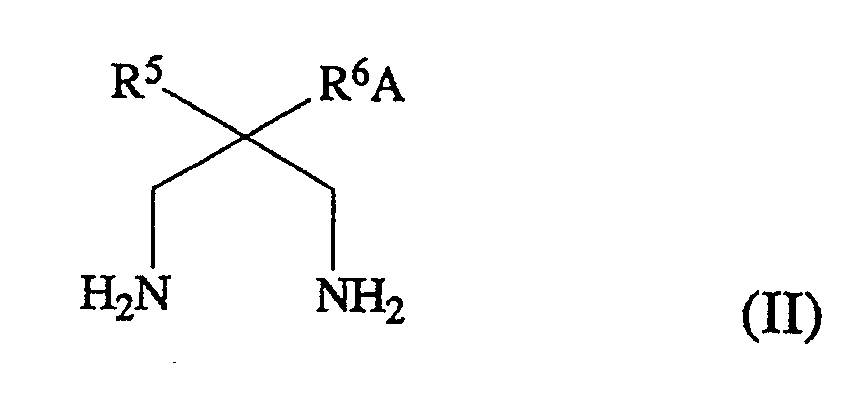
mit einer Verbindung der allgemeinen Formel V bzw. VI
B - CO-X (V)
B′- CO-X (VI),
in denen B = B′ gilt und B und B′ die oben genannten Bedeutungen haben, in B enthaltene Hydroxyl-, Mercapto- und Aminogruppen in geschützter Form vorliegen und X für ein Halogenatom, vorzugsweise für ein Chloratom steht,
oder substituierte Malonsäurehalogenide, vorzugsweise Malonsäurechloride der allgemeinen Formel VII,

mit einem Amin der allgemeinen Formel VIII bzw. IX

in einem aprotischen Lösungsmittel, vorzugsweise Dichlormethan, bei Temperaturen von 0 - 180°C, vorzugsweise bei Raumtemperatur, innerhalb von 2 bis 24 Stunden, vorzugsweise 4 Stunden, unter Zusatz von Triethylamin umsetzt,
die Amidfunktion in an sich bekannter Weise, vorzugsweise mit Boran in THF oder mit Lithiumaluminiumhydrid in einem aprotischen Lösungsmittel, vorzugsweise Diethylether, bei Temperaturen von 25 - 150°C innerhalb von 0,5 bis 24 Stunden, vorzugsweise 8 Stunden, zur entsprechenden Aminofunktion reduziert,
die Aminogruppen gegebenenfalls in an sich bekannter Weise alkyliert und vorhandene Schutzgruppen abspaltet
und die auf diesen gleichwertigen Wegen erhaltenen Verbindungen gegebenenfalls vor Generierung der freien funktionellen Gruppe C an den vorhandenen Aminogruppen mit Schutzionen, z.B. als Cu-Komplex, schützt und anschließend die so erhaltenen Verbindungen gewünschtenfalls über die in A vorhandene funktionelle Gruppe C an sich selektiv anreichernde Verbindungen T koppelt und die Aromat-Substituenten B und B′ gewünschtenfalls mit dem jeweils gewünschten radioaktiven Isotop komplexiert, wobei man vorher im Produkt gegebenenfalls vorhandene Schutzionen nach an sich literaturbekannten Methoden entfernt und die Reihenfolge der Schritte Komplexierung mit Technetium- oder Rhenium-Isotopen und Kopplung an T vertauscht werden kann.
Applications Claiming Priority (2)
| Application Number | Priority Date | Filing Date | Title |
|---|---|---|---|
| DE3930674 | 1989-09-11 | ||
| DE3930674A DE3930674A1 (de) | 1989-09-11 | 1989-09-11 | Bifunktionelle chelatbildner zur komplexierung von tc- und re-isotopen, verfahren zu ihrer herstellung und darstellung von konjugaten daraus sowie deren verwendung in diagnostik und therapie |
Publications (3)
| Publication Number | Publication Date |
|---|---|
| EP0417870A2 true EP0417870A2 (de) | 1991-03-20 |
| EP0417870A3 EP0417870A3 (en) | 1991-06-26 |
| EP0417870B1 EP0417870B1 (de) | 1994-07-20 |
Family
ID=6389390
Family Applications (1)
| Application Number | Title | Priority Date | Filing Date |
|---|---|---|---|
| EP90250214A Expired - Lifetime EP0417870B1 (de) | 1989-09-11 | 1990-08-20 | Chelatbildner zur Komplexierung von radioaktiven Isotopen, deren Metallkomplexe sowie ihre Verwendung in Diagnostik und Therapie |
Country Status (18)
| Country | Link |
|---|---|
| US (1) | US5302370A (de) |
| EP (1) | EP0417870B1 (de) |
| JP (1) | JPH03188048A (de) |
| KR (1) | KR910006220A (de) |
| AT (1) | ATE108771T1 (de) |
| AU (1) | AU641421B2 (de) |
| CA (1) | CA2023595A1 (de) |
| DD (1) | DD297636A5 (de) |
| DE (2) | DE3930674A1 (de) |
| DK (1) | DK0417870T3 (de) |
| ES (1) | ES2060002T3 (de) |
| FI (1) | FI102892B (de) |
| HU (1) | HUT59370A (de) |
| IE (1) | IE69543B1 (de) |
| IL (1) | IL95547A (de) |
| NO (1) | NO173234C (de) |
| PT (1) | PT95256B (de) |
| ZA (1) | ZA906634B (de) |
Cited By (13)
| Publication number | Priority date | Publication date | Assignee | Title |
|---|---|---|---|---|
| EP0474323A1 (de) * | 1990-08-10 | 1992-03-11 | INSTITUT FÜR DIAGNOSTIKFORSCHUNG GmbH, c/o FU KLINIKUM RUDOLF VIRCHOW | Reduzierende Chelatbildner, deren Technetium- und Rhenium-Komplexe, Verfahren zu ihrer Herstellung sowie deren Verwendung in Diagnostik und Therapie |
| EP0502594A1 (de) * | 1991-03-07 | 1992-09-09 | INSTITUT FÜR DIAGNOSTIKFORSCHUNG GmbH AN DER FREIEN UNIVERSITÄT BERLIN | Chelate, deren Metallkomplexe sowie ihre Verwendung in Diagnostik und Therapie |
| EP0544412A3 (en) * | 1991-10-29 | 1993-08-25 | E.R. Squibb & Sons, Inc. | Rhenium and technetium complexes containing a hypoxia-localizing moiety |
| WO1994008949A3 (en) * | 1992-10-08 | 1994-06-09 | Amersham Int Plc | Metal-oxime chelates for use as radiopharmaceutical agents |
| US5387692A (en) * | 1991-06-21 | 1995-02-07 | Amersham International Plc | Metal chelating ligands for hypoxic cells |
| WO1995004552A3 (en) * | 1993-08-04 | 1995-03-23 | Amersham Int Plc | Radiometal complexes that localise in hypoxic tissue |
| US5608110A (en) * | 1993-06-15 | 1997-03-04 | Bracco International B.V. | Heteroatom-bearing ligands and metal complexes thereof |
| US5651954A (en) * | 1994-01-12 | 1997-07-29 | Bracco International B.V. | Method of using hydrazone containing ligands and metal complexes thereof |
| US5688487A (en) * | 1991-10-29 | 1997-11-18 | Bracco International B.V. | Diagnostic imaging methods using rhenium and technetium complexes containing a hypoxia-localizing moiety |
| EP0716647B1 (de) * | 1993-09-03 | 1999-03-24 | Resolution Pharmaceuticals Inc. | N2s2-chelatoren des hydrazino-typs |
| WO2000039350A1 (de) * | 1998-12-23 | 2000-07-06 | H.C. Starck Gmbh & Co. Kg | Verfahren zur extraktion von anionen der ivb bis viii metalle mittels alkylsubstituierter 1,3-diaminopropane |
| US6699458B2 (en) | 1991-10-29 | 2004-03-02 | Bracco International B.V. | Rhenium and technetium complexes containing a hypoxia-localizing moiety |
| EP1813607A3 (de) * | 1997-03-28 | 2007-08-15 | Poniard Pharmaceuticals, Inc. | Tetraaza- oder N2S2-Komplexbildner und deren Verwendung bei der Strahlendiagnostik oder Strahlentherapie |
Families Citing this family (17)
| Publication number | Priority date | Publication date | Assignee | Title |
|---|---|---|---|---|
| US5965107A (en) * | 1992-03-13 | 1999-10-12 | Diatide, Inc. | Technetium-99m labeled peptides for imaging |
| WO1994020148A1 (en) * | 1993-03-12 | 1994-09-15 | Mallinckrodt Medical, Inc. | Imidazole based nitrogen-sulfur ligands useful in radiographic imaging agents |
| US6203775B1 (en) * | 1993-03-19 | 2001-03-20 | The General Hospital Corporation | Chelating polymers for labeling of proteins |
| CA2190727C (en) * | 1994-05-19 | 2006-07-18 | Sudhakar Kasina | Aromatic amine substituted bridged nitrogen and sulfur donor atom ligands for imaging |
| US5892071A (en) * | 1994-09-30 | 1999-04-06 | The Reagents Of The University Of California | Cationic transport reagents |
| WO1997001360A2 (en) * | 1995-06-26 | 1997-01-16 | Concat, Ltd. | Compounds with chelation affinity and selectivity for first transition series elements and their use in medical therapy and diagnosis |
| DE19603033A1 (de) * | 1996-01-19 | 1997-07-24 | Schering Ag | Perfluoralkylhaltige Metallkomplexe, Verfahren zu deren Herstellung und ihre Verwendung in der NMR-Diagnostik |
| WO1997034634A1 (en) * | 1996-03-20 | 1997-09-25 | Sloan-Kettering Institute For Cancer Research | Single chain fv constructs of anti-ganglioside gd2 antibodies |
| WO2000053577A1 (en) * | 1999-03-12 | 2000-09-14 | The Government Of The United States Of America, As Represented By The Secretary, Department Of Health And Human Services, The National Institutes Of Health | Hydrazide inhibitors of hiv-1 integrase |
| US6767741B1 (en) | 1999-08-27 | 2004-07-27 | Invitrogen Corporation | Metal binding compounds and their use in cell culture medium compositions |
| KR100360606B1 (ko) * | 2000-04-03 | 2002-11-13 | 임진태 | 샷틀리스 직기 및 환편기의 위사공급용 실린더 크릴 |
| GB0116815D0 (en) | 2001-07-10 | 2001-08-29 | Nycomed Amersham Plc | Improved chelator conjugates |
| US7446190B2 (en) * | 2002-05-28 | 2008-11-04 | Sloan-Kettering Institute For Cancer Research | Nucleic acids encoding chimeric T cell receptors |
| KR100675356B1 (ko) * | 2005-04-29 | 2007-02-01 | 경희대학교 산학협력단 | 액체 또는 초임계상태의 유체를 이용하여 금속이온 및금속산화물을 추출하는 금속추출에 사용되는 신규한 아미드화합물을 포함하는 킬레이트제와 상기 킬레이트제를이용한 금속추출방법 및 금속추출시스템 |
| EP2483239A4 (de) * | 2009-09-28 | 2014-09-03 | Univ Kentucky Res Found | Thiolhaltige verbindungen zur entfernung von elementen aus einer kontaminierten umgebung und verwendungsverfahren dafür |
| EP2639227A1 (de) * | 2012-03-14 | 2013-09-18 | Bracco Imaging S.p.A | Neue Klasse von Diazepinderivatchelatbildnern und Komplexe mit paramagnetischen Metallen als MRI-Kontrastmittel |
| CN106749167B (zh) * | 2017-03-29 | 2019-06-11 | 齐鲁工业大学 | 二(噻吩-2-亚甲基)丙烷-1,3-二胺的制备和用途 |
Family Cites Families (14)
| Publication number | Priority date | Publication date | Assignee | Title |
|---|---|---|---|---|
| US2624759A (en) * | 1950-11-01 | 1953-01-06 | Frederick C Bersworth | Substituted poly aralkyl alkylene poly amino poly acetic acids and salts |
| US2876236A (en) * | 1952-08-26 | 1959-03-03 | American Home Prod | Heterocyclic diamines and salts thereof |
| US3933913A (en) * | 1971-06-01 | 1976-01-20 | Smithkline Corporation | N,N'-bis[3-substituted-4-hydroxypheyl)-2-hydroxyethyl)]-polymethylenediamines |
| US4152345A (en) * | 1975-11-11 | 1979-05-01 | W. R. Grace & Co. | Metal chelates |
| US4069249A (en) * | 1975-11-11 | 1978-01-17 | W. R. Grace & Co. | N,N-di-(hydroxybenzyl)-trimethylene diaminediacetic acids |
| US4758682A (en) * | 1983-03-17 | 1988-07-19 | California Institute Of Technology | Homogeneous coordination compounds as oxidation catalysts |
| US4615876A (en) * | 1983-04-25 | 1986-10-07 | Curators Of The University Of Missouri | Macrocyclic complexes of technetium-99m for use as diagnostic radionuclides |
| EP0188256B1 (de) * | 1985-01-14 | 1991-08-21 | NeoRx | Metall-Radionuklid markiertes Protein für Diagnose und Therapie |
| DE3786000T3 (de) * | 1986-08-18 | 1997-08-21 | Dow Chemical Co | Conjugate dichter Sterne. |
| EP0284071B1 (de) * | 1987-03-26 | 1994-06-08 | Neorx Corporation | Metall-Radionuklid-markierte Proteine und Glykoproteine zur Diagnose und Therapie |
| US4994560A (en) * | 1987-06-24 | 1991-02-19 | The Dow Chemical Company | Functionalized polyamine chelants and radioactive rhodium complexes thereof for conjugation to antibodies |
| US5071965A (en) * | 1988-07-19 | 1991-12-10 | Mallinckrodt Medical, Inc. | Novel tc-99m complexes |
| US5101041A (en) * | 1989-04-26 | 1992-03-31 | The Curators Of The University Of Missouri | Triamines and their derivatives as bifunctional chelating agents |
| US5104638A (en) * | 1990-10-29 | 1992-04-14 | Mallinckrodt Medical, Inc. | Method of making a radiopharmaceutical complex from a kit |
-
1989
- 1989-09-11 DE DE3930674A patent/DE3930674A1/de not_active Ceased
-
1990
- 1990-08-13 NO NO903551A patent/NO173234C/no unknown
- 1990-08-15 HU HU905026A patent/HUT59370A/hu unknown
- 1990-08-15 FI FI904039A patent/FI102892B/fi not_active IP Right Cessation
- 1990-08-16 IE IE296590A patent/IE69543B1/en not_active IP Right Cessation
- 1990-08-20 ES ES90250214T patent/ES2060002T3/es not_active Expired - Lifetime
- 1990-08-20 DE DE59006490T patent/DE59006490D1/de not_active Expired - Lifetime
- 1990-08-20 EP EP90250214A patent/EP0417870B1/de not_active Expired - Lifetime
- 1990-08-20 DK DK90250214.5T patent/DK0417870T3/da active
- 1990-08-20 CA CA002023595A patent/CA2023595A1/en not_active Abandoned
- 1990-08-20 AT AT90250214T patent/ATE108771T1/de not_active IP Right Cessation
- 1990-08-21 ZA ZA906634A patent/ZA906634B/xx unknown
- 1990-08-22 US US07/572,140 patent/US5302370A/en not_active Expired - Fee Related
- 1990-08-23 AU AU61290/90A patent/AU641421B2/en not_active Ceased
- 1990-08-31 KR KR1019900013594A patent/KR910006220A/ko not_active Withdrawn
- 1990-08-31 IL IL9554790A patent/IL95547A/en not_active IP Right Cessation
- 1990-09-05 DD DD90343845A patent/DD297636A5/de not_active IP Right Cessation
- 1990-09-10 PT PT95256A patent/PT95256B/pt not_active IP Right Cessation
- 1990-09-11 JP JP2239148A patent/JPH03188048A/ja active Pending
Cited By (25)
| Publication number | Priority date | Publication date | Assignee | Title |
|---|---|---|---|---|
| EP0474323A1 (de) * | 1990-08-10 | 1992-03-11 | INSTITUT FÜR DIAGNOSTIKFORSCHUNG GmbH, c/o FU KLINIKUM RUDOLF VIRCHOW | Reduzierende Chelatbildner, deren Technetium- und Rhenium-Komplexe, Verfahren zu ihrer Herstellung sowie deren Verwendung in Diagnostik und Therapie |
| EP0502594A1 (de) * | 1991-03-07 | 1992-09-09 | INSTITUT FÜR DIAGNOSTIKFORSCHUNG GmbH AN DER FREIEN UNIVERSITÄT BERLIN | Chelate, deren Metallkomplexe sowie ihre Verwendung in Diagnostik und Therapie |
| US5387692A (en) * | 1991-06-21 | 1995-02-07 | Amersham International Plc | Metal chelating ligands for hypoxic cells |
| US5506345A (en) * | 1991-06-21 | 1996-04-09 | Amersham International Plc | Metal complexes for hypoxic cells |
| EP0544412A3 (en) * | 1991-10-29 | 1993-08-25 | E.R. Squibb & Sons, Inc. | Rhenium and technetium complexes containing a hypoxia-localizing moiety |
| US6958141B2 (en) | 1991-10-29 | 2005-10-25 | Bracco International B.V. | Rhenium and technetium complexes containing a hypoxia-localizing moiety |
| US6699458B2 (en) | 1991-10-29 | 2004-03-02 | Bracco International B.V. | Rhenium and technetium complexes containing a hypoxia-localizing moiety |
| US6184361B1 (en) | 1991-10-29 | 2001-02-06 | Bracco International B.V. | Rhenium and technetium complexes containing a hypoxia-localizing moiety |
| US5808091A (en) * | 1991-10-29 | 1998-09-15 | Bracco International B.V. | Rhenium and technetium complexes containing a hypoxia localizing moiety |
| US5688487A (en) * | 1991-10-29 | 1997-11-18 | Bracco International B.V. | Diagnostic imaging methods using rhenium and technetium complexes containing a hypoxia-localizing moiety |
| WO1994008949A3 (en) * | 1992-10-08 | 1994-06-09 | Amersham Int Plc | Metal-oxime chelates for use as radiopharmaceutical agents |
| US5665329A (en) * | 1993-06-15 | 1997-09-09 | Bracco International B.V. | Heteroatom-bearing ligands and metal complexes thereof |
| US5627286A (en) * | 1993-06-15 | 1997-05-06 | Bracco International B.V. | Heteroatom-bearing ligands and metal complexes thereof |
| US5656254A (en) * | 1993-06-15 | 1997-08-12 | Bracco International B.V. | Polyaza heteroatom-bearing ligands and metal complexes thereof for imaging or radiotherapy |
| US5741912A (en) * | 1993-06-15 | 1998-04-21 | Bracco International B.V. | Methods for preparing heteroatom-bearing ligands and metal complexes thereof |
| US5608110A (en) * | 1993-06-15 | 1997-03-04 | Bracco International B.V. | Heteroatom-bearing ligands and metal complexes thereof |
| WO1995004552A3 (en) * | 1993-08-04 | 1995-03-23 | Amersham Int Plc | Radiometal complexes that localise in hypoxic tissue |
| US5997843A (en) * | 1993-08-04 | 1999-12-07 | Amersham International Plc | Radiometal complexes that localise in hypoxic tissue |
| EP0716647B1 (de) * | 1993-09-03 | 1999-03-24 | Resolution Pharmaceuticals Inc. | N2s2-chelatoren des hydrazino-typs |
| US5651954A (en) * | 1994-01-12 | 1997-07-29 | Bracco International B.V. | Method of using hydrazone containing ligands and metal complexes thereof |
| US6660246B1 (en) | 1994-01-12 | 2003-12-09 | Bracco International, Bv | Ligands and metal complexes thereof |
| US5663307A (en) * | 1994-01-12 | 1997-09-02 | Bracco International B.V. | Hydrazone containing ligands and metal complexes thereof |
| EP1813607A3 (de) * | 1997-03-28 | 2007-08-15 | Poniard Pharmaceuticals, Inc. | Tetraaza- oder N2S2-Komplexbildner und deren Verwendung bei der Strahlendiagnostik oder Strahlentherapie |
| WO2000039350A1 (de) * | 1998-12-23 | 2000-07-06 | H.C. Starck Gmbh & Co. Kg | Verfahren zur extraktion von anionen der ivb bis viii metalle mittels alkylsubstituierter 1,3-diaminopropane |
| US6709641B1 (en) | 1998-12-23 | 2004-03-23 | H.C. Starck Gmbh & Co. Kg | Method for extracting anions |
Also Published As
| Publication number | Publication date |
|---|---|
| FI102892B1 (fi) | 1999-03-15 |
| KR910006220A (ko) | 1991-04-27 |
| IE69543B1 (en) | 1996-10-02 |
| DD297636A5 (de) | 1992-01-16 |
| NO903551L (no) | 1991-03-12 |
| US5302370A (en) | 1994-04-12 |
| EP0417870A3 (en) | 1991-06-26 |
| ES2060002T3 (es) | 1994-11-16 |
| PT95256B (pt) | 1997-06-30 |
| CA2023595A1 (en) | 1991-03-12 |
| NO173234C (no) | 1993-11-17 |
| AU641421B2 (en) | 1993-09-23 |
| ATE108771T1 (de) | 1994-08-15 |
| HUT59370A (en) | 1992-05-28 |
| NO903551D0 (no) | 1990-08-13 |
| PT95256A (pt) | 1991-05-22 |
| IL95547A (en) | 1996-05-14 |
| FI102892B (fi) | 1999-03-15 |
| DE3930674A1 (de) | 1991-03-21 |
| EP0417870B1 (de) | 1994-07-20 |
| ZA906634B (en) | 1991-06-26 |
| IE902965A1 (en) | 1991-03-27 |
| DK0417870T3 (da) | 1994-11-21 |
| DE59006490D1 (de) | 1994-08-25 |
| NO173234B (no) | 1993-08-09 |
| FI904039A0 (fi) | 1990-08-15 |
| IL95547A0 (en) | 1991-06-30 |
| HU905026D0 (en) | 1991-01-28 |
| AU6129090A (en) | 1991-03-14 |
| JPH03188048A (ja) | 1991-08-16 |
Similar Documents
| Publication | Publication Date | Title |
|---|---|---|
| EP0417870B1 (de) | Chelatbildner zur Komplexierung von radioaktiven Isotopen, deren Metallkomplexe sowie ihre Verwendung in Diagnostik und Therapie | |
| DE68921941T2 (de) | Macrocyclische bifunktionelle Chelatbildner, Komplexe davon und ihre konjugierten Antikörper. | |
| DE69837038T2 (de) | Tetraaza- oder n2s2-komplexanten, und deren verwendung in der radiodiagnostik oder radiotherapie | |
| EP0692976B1 (de) | Chelatbildner vom typ xn 1?s 1?o 1? für radioaktive isotope, deren metallkomplexe und ihre verwendung in diagnostik und therapie | |
| DE60127951T2 (de) | Kleine technetium-99m und rhenium markierte mittel und verfahren zum tumor-imaging | |
| DE19536781A1 (de) | Bifunktionelle sulfidhaltige Sulfonamid-Chelatbildner vom Typ XSNS für radioaktive Isotope | |
| DE19536783A1 (de) | Bifunktionelle Nicotinamid-Chelatbildner vom Typ N¶2¶S¶2¶ für radioaktive Isotope | |
| EP0502595A2 (de) | Amid-Chelate, deren Metallkomplexe sowie ihre Verwendung in Diagnostik und Therapie | |
| EP0502594A1 (de) | Chelate, deren Metallkomplexe sowie ihre Verwendung in Diagnostik und Therapie | |
| EP0851770A2 (de) | Bifunktionelle sulfidhaltige sulfonamid-chelatbildner vom typ s?2 ny für radioaktive isotope | |
| EP0692981B1 (de) | Chelatbildner vom typ xn 1?s 1?x' für radioaktive isotope, deren metallkomplexe und ihre verwendung in diagnostik und therapie | |
| DE69501981T2 (de) | Liganden und deren metallkomplexe | |
| DE4025788C2 (de) | Technetium- und Rhenium-Komplexe, Verfahren zu ihrer Herstellung sowie deren Verwendung in Diagnostik und Therapie | |
| DE19860289A1 (de) | Neue Chelatoren sowie deren Tricarbonyl-Komplexe mit Technetium und Rhenium | |
| EP0692980B1 (de) | Chelatbildner vom typ s3n2 für radioaktive isotope, deren metallkomplexe und ihre verwendung in diagnostik und therapie | |
| DE69023616T2 (de) | Radionukleid-chelatverbindungen zur radiomarkierung von proteinen. | |
| DE4425781A1 (de) | Technetium-Sulfonamid-Komplexe, deren Verwendung, diese enthaltende pharmazeutische Mittel, sowie Verfahren zur Herstellung der Komplexe und Mittel | |
| DE19536780A1 (de) | Bifunktionelle sulfidhaltige Sulfonamid-Chelatbildner vom Typ XSNY für radioaktive Isotope |
Legal Events
| Date | Code | Title | Description |
|---|---|---|---|
| PUAI | Public reference made under article 153(3) epc to a published international application that has entered the european phase |
Free format text: ORIGINAL CODE: 0009012 |
|
| 17P | Request for examination filed |
Effective date: 19901105 |
|
| AK | Designated contracting states |
Kind code of ref document: A2 Designated state(s): AT BE CH DE DK ES FR GB GR IT LI LU NL SE |
|
| PUAL | Search report despatched |
Free format text: ORIGINAL CODE: 0009013 |
|
| AK | Designated contracting states |
Kind code of ref document: A3 Designated state(s): AT BE CH DE DK ES FR GB GR IT LI LU NL SE |
|
| 17Q | First examination report despatched |
Effective date: 19930308 |
|
| RAP1 | Party data changed (applicant data changed or rights of an application transferred) |
Owner name: INSTITUT FUER DIAGNOSTIKFORSCHUNG GMBH AN DER FREI |
|
| GRAA | (expected) grant |
Free format text: ORIGINAL CODE: 0009210 |
|
| AK | Designated contracting states |
Kind code of ref document: B1 Designated state(s): AT BE CH DE DK ES FR GB GR IT LI LU NL SE |
|
| ITF | It: translation for a ep patent filed | ||
| REF | Corresponds to: |
Ref document number: 108771 Country of ref document: AT Date of ref document: 19940815 Kind code of ref document: T |
|
| REF | Corresponds to: |
Ref document number: 59006490 Country of ref document: DE Date of ref document: 19940825 |
|
| ET | Fr: translation filed | ||
| REG | Reference to a national code |
Ref country code: ES Ref legal event code: FG2A Ref document number: 2060002 Country of ref document: ES Kind code of ref document: T3 |
|
| REG | Reference to a national code |
Ref country code: DK Ref legal event code: T3 |
|
| GBT | Gb: translation of ep patent filed (gb section 77(6)(a)/1977) |
Effective date: 19941110 |
|
| REG | Reference to a national code |
Ref country code: GR Ref legal event code: FG4A Free format text: 3013723 |
|
| EAL | Se: european patent in force in sweden |
Ref document number: 90250214.5 |
|
| PLBE | No opposition filed within time limit |
Free format text: ORIGINAL CODE: 0009261 |
|
| STAA | Information on the status of an ep patent application or granted ep patent |
Free format text: STATUS: NO OPPOSITION FILED WITHIN TIME LIMIT |
|
| 26N | No opposition filed | ||
| PGFP | Annual fee paid to national office [announced via postgrant information from national office to epo] |
Ref country code: DE Payment date: 19980804 Year of fee payment: 9 |
|
| PGFP | Annual fee paid to national office [announced via postgrant information from national office to epo] |
Ref country code: SE Payment date: 19980813 Year of fee payment: 9 |
|
| PGFP | Annual fee paid to national office [announced via postgrant information from national office to epo] |
Ref country code: LU Payment date: 19980814 Year of fee payment: 9 |
|
| PGFP | Annual fee paid to national office [announced via postgrant information from national office to epo] |
Ref country code: FR Payment date: 19980818 Year of fee payment: 9 |
|
| PGFP | Annual fee paid to national office [announced via postgrant information from national office to epo] |
Ref country code: CH Payment date: 19980825 Year of fee payment: 9 |
|
| PGFP | Annual fee paid to national office [announced via postgrant information from national office to epo] |
Ref country code: AT Payment date: 19980826 Year of fee payment: 9 |
|
| PGFP | Annual fee paid to national office [announced via postgrant information from national office to epo] |
Ref country code: DK Payment date: 19980827 Year of fee payment: 9 |
|
| PGFP | Annual fee paid to national office [announced via postgrant information from national office to epo] |
Ref country code: NL Payment date: 19980828 Year of fee payment: 9 Ref country code: GR Payment date: 19980828 Year of fee payment: 9 Ref country code: ES Payment date: 19980828 Year of fee payment: 9 |
|
| PGFP | Annual fee paid to national office [announced via postgrant information from national office to epo] |
Ref country code: BE Payment date: 19980914 Year of fee payment: 9 |
|
| PGFP | Annual fee paid to national office [announced via postgrant information from national office to epo] |
Ref country code: GB Payment date: 19980921 Year of fee payment: 9 |
|
| PG25 | Lapsed in a contracting state [announced via postgrant information from national office to epo] |
Ref country code: LU Free format text: LAPSE BECAUSE OF NON-PAYMENT OF DUE FEES Effective date: 19990820 Ref country code: GB Free format text: LAPSE BECAUSE OF NON-PAYMENT OF DUE FEES Effective date: 19990820 Ref country code: AT Free format text: LAPSE BECAUSE OF NON-PAYMENT OF DUE FEES Effective date: 19990820 |
|
| PG25 | Lapsed in a contracting state [announced via postgrant information from national office to epo] |
Ref country code: ES Free format text: LAPSE BECAUSE OF NON-PAYMENT OF DUE FEES Effective date: 19990821 |
|
| PG25 | Lapsed in a contracting state [announced via postgrant information from national office to epo] |
Ref country code: SE Free format text: THE PATENT HAS BEEN ANNULLED BY A DECISION OF A NATIONAL AUTHORITY Effective date: 19990830 |
|
| PG25 | Lapsed in a contracting state [announced via postgrant information from national office to epo] |
Ref country code: LI Free format text: LAPSE BECAUSE OF NON-PAYMENT OF DUE FEES Effective date: 19990831 Ref country code: GR Free format text: LAPSE BECAUSE OF NON-PAYMENT OF DUE FEES Effective date: 19990831 Ref country code: DK Free format text: LAPSE BECAUSE OF NON-PAYMENT OF DUE FEES Effective date: 19990831 Ref country code: CH Free format text: LAPSE BECAUSE OF NON-PAYMENT OF DUE FEES Effective date: 19990831 Ref country code: BE Free format text: LAPSE BECAUSE OF NON-PAYMENT OF DUE FEES Effective date: 19990831 |
|
| BERE | Be: lapsed |
Owner name: INSTITUT FUR DIAGNOSTIKFORSCHUNG G.M.B.H. AN DER Effective date: 19990831 |
|
| PG25 | Lapsed in a contracting state [announced via postgrant information from national office to epo] |
Ref country code: NL Free format text: LAPSE BECAUSE OF NON-PAYMENT OF DUE FEES Effective date: 20000301 |
|
| PG25 | Lapsed in a contracting state [announced via postgrant information from national office to epo] |
Ref country code: DE Free format text: LAPSE BECAUSE OF THE APPLICANT RENOUNCES Effective date: 20000328 |
|
| GBPC | Gb: european patent ceased through non-payment of renewal fee |
Effective date: 19990820 |
|
| REG | Reference to a national code |
Ref country code: CH Ref legal event code: PL |
|
| PG25 | Lapsed in a contracting state [announced via postgrant information from national office to epo] |
Ref country code: FR Free format text: LAPSE BECAUSE OF NON-PAYMENT OF DUE FEES Effective date: 20000428 |
|
| REG | Reference to a national code |
Ref country code: DK Ref legal event code: EBP |
|
| EUG | Se: european patent has lapsed |
Ref document number: 90250214.5 |
|
| NLV4 | Nl: lapsed or anulled due to non-payment of the annual fee |
Effective date: 20000301 |
|
| REG | Reference to a national code |
Ref country code: FR Ref legal event code: ST |
|
| REG | Reference to a national code |
Ref country code: ES Ref legal event code: FD2A Effective date: 20000911 |
|
| PG25 | Lapsed in a contracting state [announced via postgrant information from national office to epo] |
Ref country code: IT Free format text: LAPSE BECAUSE OF NON-PAYMENT OF DUE FEES;WARNING: LAPSES OF ITALIAN PATENTS WITH EFFECTIVE DATE BEFORE 2007 MAY HAVE OCCURRED AT ANY TIME BEFORE 2007. THE CORRECT EFFECTIVE DATE MAY BE DIFFERENT FROM THE ONE RECORDED. Effective date: 20050820 |