EP0419096B1 - Kornverfeinerung des Zirkoniums mittels Silizium - Google Patents
Kornverfeinerung des Zirkoniums mittels Silizium Download PDFInfo
- Publication number
- EP0419096B1 EP0419096B1 EP90309777A EP90309777A EP0419096B1 EP 0419096 B1 EP0419096 B1 EP 0419096B1 EP 90309777 A EP90309777 A EP 90309777A EP 90309777 A EP90309777 A EP 90309777A EP 0419096 B1 EP0419096 B1 EP 0419096B1
- Authority
- EP
- European Patent Office
- Prior art keywords
- zirconium
- tube
- ppm
- alloy
- cladding
- Prior art date
- Legal status (The legal status is an assumption and is not a legal conclusion. Google has not performed a legal analysis and makes no representation as to the accuracy of the status listed.)
- Expired - Lifetime
Links
- QCWXUUIWCKQGHC-UHFFFAOYSA-N Zirconium Chemical compound [Zr] QCWXUUIWCKQGHC-UHFFFAOYSA-N 0.000 title claims description 51
- 229910052726 zirconium Inorganic materials 0.000 title claims description 49
- 229910052710 silicon Inorganic materials 0.000 title claims description 29
- 239000010703 silicon Substances 0.000 title claims description 29
- XUIMIQQOPSSXEZ-UHFFFAOYSA-N Silicon Chemical compound [Si] XUIMIQQOPSSXEZ-UHFFFAOYSA-N 0.000 title description 27
- 238000005253 cladding Methods 0.000 claims description 21
- 229910001093 Zr alloy Inorganic materials 0.000 claims description 20
- 238000004519 manufacturing process Methods 0.000 claims description 10
- 238000000034 method Methods 0.000 claims description 8
- 239000000463 material Substances 0.000 claims description 7
- 239000003758 nuclear fuel Substances 0.000 claims description 5
- XLYOFNOQVPJJNP-UHFFFAOYSA-N water Substances O XLYOFNOQVPJJNP-UHFFFAOYSA-N 0.000 claims description 5
- 238000001125 extrusion Methods 0.000 claims description 3
- 238000010791 quenching Methods 0.000 claims description 3
- 230000000171 quenching effect Effects 0.000 claims description 3
- 238000010438 heat treatment Methods 0.000 claims description 2
- 229910045601 alloy Inorganic materials 0.000 claims 3
- 239000000956 alloy Substances 0.000 claims 3
- 230000001747 exhibiting effect Effects 0.000 claims 1
- 238000005482 strain hardening Methods 0.000 claims 1
- XEEYBQQBJWHFJM-UHFFFAOYSA-N iron Substances [Fe] XEEYBQQBJWHFJM-UHFFFAOYSA-N 0.000 description 39
- 229910052742 iron Inorganic materials 0.000 description 17
- 239000000446 fuel Substances 0.000 description 8
- 239000012535 impurity Substances 0.000 description 7
- 238000007792 addition Methods 0.000 description 6
- 230000004888 barrier function Effects 0.000 description 6
- 238000009826 distribution Methods 0.000 description 6
- 238000000137 annealing Methods 0.000 description 5
- 238000005336 cracking Methods 0.000 description 5
- 238000002474 experimental method Methods 0.000 description 5
- 230000003993 interaction Effects 0.000 description 5
- 230000015572 biosynthetic process Effects 0.000 description 4
- 238000002844 melting Methods 0.000 description 4
- 230000008018 melting Effects 0.000 description 4
- 239000008188 pellet Substances 0.000 description 4
- 230000008901 benefit Effects 0.000 description 3
- 238000005260 corrosion Methods 0.000 description 3
- 230000000694 effects Effects 0.000 description 3
- 239000000047 product Substances 0.000 description 3
- 238000001953 recrystallisation Methods 0.000 description 3
- ZCYVEMRRCGMTRW-UHFFFAOYSA-N 7553-56-2 Chemical compound [I] ZCYVEMRRCGMTRW-UHFFFAOYSA-N 0.000 description 2
- 229910052782 aluminium Inorganic materials 0.000 description 2
- XAGFODPZIPBFFR-UHFFFAOYSA-N aluminium Chemical compound [Al] XAGFODPZIPBFFR-UHFFFAOYSA-N 0.000 description 2
- 230000007797 corrosion Effects 0.000 description 2
- 230000002939 deleterious effect Effects 0.000 description 2
- 239000011630 iodine Substances 0.000 description 2
- 229910052740 iodine Inorganic materials 0.000 description 2
- 229910052751 metal Inorganic materials 0.000 description 2
- 239000002184 metal Substances 0.000 description 2
- 239000002244 precipitate Substances 0.000 description 2
- 230000009467 reduction Effects 0.000 description 2
- 238000007670 refining Methods 0.000 description 2
- 239000010936 titanium Substances 0.000 description 2
- 238000011282 treatment Methods 0.000 description 2
- WEAMLHXSIBDPGN-UHFFFAOYSA-N (4-hydroxy-3-methylphenyl) thiocyanate Chemical compound CC1=CC(SC#N)=CC=C1O WEAMLHXSIBDPGN-UHFFFAOYSA-N 0.000 description 1
- 229910000519 Ferrosilicon Inorganic materials 0.000 description 1
- RTAQQCXQSZGOHL-UHFFFAOYSA-N Titanium Chemical compound [Ti] RTAQQCXQSZGOHL-UHFFFAOYSA-N 0.000 description 1
- 239000004411 aluminium Substances 0.000 description 1
- QVGXLLKOCUKJST-UHFFFAOYSA-N atomic oxygen Chemical compound [O] QVGXLLKOCUKJST-UHFFFAOYSA-N 0.000 description 1
- 238000009835 boiling Methods 0.000 description 1
- 238000006243 chemical reaction Methods 0.000 description 1
- 238000001816 cooling Methods 0.000 description 1
- RKTYLMNFRDHKIL-UHFFFAOYSA-N copper;5,10,15,20-tetraphenylporphyrin-22,24-diide Chemical compound [Cu+2].C1=CC(C(=C2C=CC([N-]2)=C(C=2C=CC=CC=2)C=2C=CC(N=2)=C(C=2C=CC=CC=2)C2=CC=C3[N-]2)C=2C=CC=CC=2)=NC1=C3C1=CC=CC=C1 RKTYLMNFRDHKIL-UHFFFAOYSA-N 0.000 description 1
- 239000013078 crystal Substances 0.000 description 1
- 230000004992 fission Effects 0.000 description 1
- 238000005242 forging Methods 0.000 description 1
- 230000006872 improvement Effects 0.000 description 1
- 230000006698 induction Effects 0.000 description 1
- XWHPIFXRKKHEKR-UHFFFAOYSA-N iron silicon Chemical compound [Si].[Fe] XWHPIFXRKKHEKR-UHFFFAOYSA-N 0.000 description 1
- 238000009533 lab test Methods 0.000 description 1
- 238000003754 machining Methods 0.000 description 1
- 238000005259 measurement Methods 0.000 description 1
- 229910001092 metal group alloy Inorganic materials 0.000 description 1
- 150000002739 metals Chemical class 0.000 description 1
- 239000000203 mixture Substances 0.000 description 1
- 239000001301 oxygen Substances 0.000 description 1
- 229910052760 oxygen Inorganic materials 0.000 description 1
- OOAWCECZEHPMBX-UHFFFAOYSA-N oxygen(2-);uranium(4+) Chemical compound [O-2].[O-2].[U+4] OOAWCECZEHPMBX-UHFFFAOYSA-N 0.000 description 1
- 239000002245 particle Substances 0.000 description 1
- 230000003389 potentiating effect Effects 0.000 description 1
- 238000001556 precipitation Methods 0.000 description 1
- 230000002285 radioactive effect Effects 0.000 description 1
- 239000000126 substance Substances 0.000 description 1
- 239000000758 substrate Substances 0.000 description 1
- 229910052719 titanium Inorganic materials 0.000 description 1
- FCTBKIHDJGHPPO-UHFFFAOYSA-N uranium dioxide Inorganic materials O=[U]=O FCTBKIHDJGHPPO-UHFFFAOYSA-N 0.000 description 1
- -1 zirconium metals Chemical class 0.000 description 1
- 229910021355 zirconium silicide Inorganic materials 0.000 description 1
Images

Classifications
-
- C—CHEMISTRY; METALLURGY
- C22—METALLURGY; FERROUS OR NON-FERROUS ALLOYS; TREATMENT OF ALLOYS OR NON-FERROUS METALS
- C22C—ALLOYS
- C22C16/00—Alloys based on zirconium
Definitions
- the present invention relates to the control of grain structure in unalloyed zirconium metal and, more particularly, to the control of grain structure in zirconium metals containing less than 300 parts per million Fe.
- Zirconium tubing containing an outer layer of zirconium metal alloy and an inner layer of unalloyed zirconium metal is used extensively in nuclear power reactors and, in particular, in boiling water reactors.
- the tubing is used to form a cladding to contain and support nuclear fuel pellets, usually made of uranium dioxide.
- the purpose of the pure or unalloyed zirconium liner is to reduce or prevent local chemical or mechanical interaction, or both, between the fuel pellets during the operation of the reactor and the more susceptible and more reactive outer zirconium alloy sheath. Such interactions between the fuel pellets and the cladding material is believed to be responsible for what is termed 'iodine assisted stress corrosion cracking' of the outer zirconium alloy (Zircaloy) sheath.
- the resultant cracking of the sheath is deleterious to the safety of the reactor operation and to the lifetime of the fuel as it permits radioactive gaseous products of the fission reactions to diffuse therethrough and escape into the reactor vessel as well as permitting water or steam to contact the fuel elements directly.
- GB-A-2,172,737 discloses the use of zirconium of moderate purity, less than 5000 ppm total impurities with an iron content of from 250 to 1000 ppm. Further improvement in this relatively inert unreactive liner which provides the ductility required to prevent the pellet-cladding interactions described is achieved by the use of substantially pure zirconium.
- US-A-4 390 497 discloses the use of a cladding of such substantially pure zirconium, being defined as containing less than 5000 ppm impurities, with an iron content of 1500 ppm or less and a silicon content of 120 ppm or less.
- JP-A-62 298 791 teaches the use of a liner of pure zirconium where the total amount of aluminium and silicon is controlled to 70 ppm or less in order to improve the resistance to stress-corrosion cracking.
- the metallurgical grain size of the zirconium in the liner tends to increase.
- impurities such as iron when present in amounts above its solubility limit in zirconium tend to pin grain boundaries in place during the thermal processing required in the manufacture of the liner if the iron is present as a finely dispersed intermetallic second phase.
- secondary grain growth occurs which contributes to the formation of a non-uniform bi-modal grain size distribution where many smaller grains coexist with many larger grains. This bi-modal or duplex distribution creates problems during the subsequent fabrication processing for making barrier tube shells into finished tubing.
- a zirconium alloy tube mated to an unalloyed zirconium tube are tube reduced in a Pilger mill which reduces the size of the tube to the eventual size of the combination for its cladding function.
- the purity of the zirconium liner has reduced the pinning function of some impurities and a bi-modal grain distribution has formed, local microcracking begins to occur at the grain boundaries between the clusters of large and small grains. It is believed that the local deformation inhomogeneities present between clusters or aggregates of large grains and aggregates or clusters of small grains, causes the zirconium to respond differently to deformation induced straining. It appears that the stresses created in the tube reducing operation can exceed the cohesive strength of the grain boundaries. The resultant microcracks, if numerous or deep enough, will significantly reduce the liner's ability to prevent the local pellet-cladding interactions previously described.
- Uniform small diameter grain sizes are achieved in substantially pure zirconium containing generally less than 300 parts per million of Fe, by the addition of small amounts of silicon to the zirconium compacts during electrode formation for subsequent vacuum arc melting to produce zirconium ingots. Silicon is added in amounts of from 40 parts per million to 120 parts per million and most preferably in amounts of 60 to 90 parts per million to achieve the objects and advantages described herein.
- a method of making a two component cladding element using the substantially pure zirconium of the invention is claimed in claims 3 to 7.
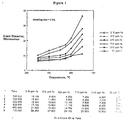
- Figure 1 is a graph of average grain diameter vs. annealing temperature at constant time from a range of iron and silicon in unalloyed zirconium.
- Figure 2 is a graph of average grain diameter for different concentrations of Silicon in zirconium for unquenched billets and beta quenched billets.
- Silicon is known to be a potent grain refiner for a variety of metals including iron, titanium and aluminum as well as zirconium.
- the atomistic nature of grain refinement in zirconium is believed to occur because silicon combines with zirconium to form a tetragonal crystal structure, Zr3Si.
- Precipitation of extremely fine (less than 10-6m) zirconium silicide (Zr3Si.) particles occurs during cooling from the beta or body center cubic phase of zirconium. These fine Zr3Si precipitates serve to retard grain boundary movement. By doing this, grain growth is retarded and secondary recrystallization is prevented.
- the grains follow the classical log-normal size vs.
- a barrier tube shell for nuclear reactor fuel cladding there is an external layer of zirconium alloy and an internal or barrier layer of unalloyed zirconium.
- an ingot of zirconium alloy typically Zircaloy 2
- rotary forged machined into billets and beta quenched into water from about 1050-1150°C.
- An ingot of unalloyed zirconium is produced by multiple vacuum arc melting and is press forged and rotary forged into logs. The logs are machined into billets with an internal hole bored down the central axis, the length of the billet.
- the zirconium billets are extruded in the alpha temperature range into tubes.
- the extruded zirconium tube is cut to length and machined to fit a central hole bored through the Zircaloy billet.
- the liner tube and Zircaloy billet are cleaned, assembled and welded together.
- the assembled billet and liner tube are heated into the alpha range (600°C to 700°C) and coextruded into a barrier tubeshell. During coextrusion the barrier layer becomes intimately bonded to the Zircaloy substrate.
- the coextruded tubeshells are then annealed in the alpha range and can then be subjected to a series of cold reduction steps and alpha annealing treatments, typically using a Pilger mill.
- the final size fuel cladding is achieved,
- Uniform fine grain size is achieved by multiple cold reductions followed by recrystallization anneals. Annealing is limited to a temperature of less than 700°c for 2 hrs. and preferably in the range of from 620°C to 675°c to less than 650°c for 1 hr.
- the grain size of coextruded zirconium liner thus treated has an ASTM grain size of 9.5 to 11.
- Advantages of the current invention include achieving a uniform fine grain size while controlling overall level of impurities (especially iron) to a much lower level than previously employed or than required by some proposed practices described in German Patent Application DE 3609074A1 filed March 18, 1986 by Daniel Charquet and Marc Perez. Additionally, no further special heat treatments or quenching operations are required to ensure the effectiveness of the silicon addition. Because no additional process steps are required, the manufacturing costs are not increased over conventional practice.
- the first series of experiments consisted of arc melting 250 grams buttons of pure zirconium with intentional additions of iron and silicon to compare the effectiveness of silicon vs. iron.
- the iron levels varied from 215 ppm to 1240 ppm.
- Silicon was added at the 90 ppm level to a low iron (245 ppm Fe) button.
- the buttons were remelted into small rectangular ingots which were then hot rolled to an intermediate thickness of 5.08 mm (0.2").
- the hotband thus produced was vacuum annealed at 625°C for 2 hours.
- the annealed hotband was cold rolled to 2.54 mm (0.1") thick and again vacuum annealed at 625°C for 2 hours.
- the strip was further cold rolled to 1.016 mm (0.040") thick. Vacuum or air final anneals were performed over the ranges of 500°C to 700°C and 1.0 hr to 10 hrs. All specimens were metallographically prepared and photomicrographs were obtained. From the photomicrographs, a line intercept counting technique was used to determine average grain diameter in micrometers.
- Figure 1 displays a plot of average grain diameter vs. annealing temperature (annealing time 2 hrs.) for the range of iron and silicon compositions mentioned above. One can see that in the non-quenched condition, the sample containing 92 ppm Si and 245 ppm Fe has a smaller grain size than does the sample with the highest iron level of 1240 ppm.
- buttons were melted to give a range of silicon from 12 ppm to 94 ppm.
- the buttons were drop cast into rectangular ingots, hot rolled, annealed, cold rolled and final annealed at 625°C for 0.1-10 hrs., as in the first experiment.
- the average grain diameter for a 625°C - 10 hr. final anneal was obtained and is shown in Figure 2 plotted against the silicon content.
- the hotband was split into two equal quantities and one half was beta quenched while the other half was not.
- the optimum level of silicon is greater than 40 ppm and less than 100 ppm with most grain refinement occurring by about 60 ppm.
- Beta quenching of zirconium containing less than 300 ppm iron was found to have no effect on the efficacy of the silicon's grain refining ability.
- a third experiment was conducted, whereby the laboratory experiments were scaled up into a production sized environment.
- a 355.6 mm (14") diameter pure Zr liner ingot was produced to the chemistry shown in Table 1. Notice that the silicon addition is aimed at 60 ppm and iron is intentionally kept at about 300 ppm or below. Preferably the iron-silicon was added as ferrosilicon.
- the ingot was forged to 190.5 mm (7 1/2") diameter and sawed into extrusion billet lengths.
- One billet was beta solution treated (900-950°C for 3-4 minutes) and water quenched. A second billet did not receive this treatment. Both billets were extruded in the alpha phase at 700°C maximum furnace set temperture.
- Zircaloy 2 billets were prepared by forging, machining, induction beta quenched and final machined to receive the finished liners according to current state-of-the-art.
- the two coextrusion billets were assembled, welded, coextruded to 63.5 mm (2.5") OD x 11.176 mm (0.44") wall tubeshells.
- the tubeshells were vacuum annealed at 620°C for 60 minutes. Liner samples were obtained from the lead and tail ends of the coextruded tubeshell. The grain size was measured and is shown in Table II.
- barrier tubeshell made in accordance with standard production procedures and incorporating 60 ppm silicon shows a fine uniform grain size of 8.2 micrometers or less. Measurements made on liner grain size from production material without silicon additions shows an average grain size of 16 micrometers. Moreover, the silicon bearing liner microstructure shows no evidence of secondary recrystallization as evidenced by a duplex grain size distribution. Table 1 Heat 355838 Ingot Chemistry Zr Liner Ingot 348 mm (13.7'') x 553.7 mm (21.8'') L x 1606Ks (730 Ibs).
- this invention is such that it would be applicable to other zirconium or zirconium alloy product forms.
- commercially pure zirconium referred to as UNS Grade R60702
- UNS Grade R60702 would benefit from the grain refining effects of silicon at the upper levels (100-120 ppm) of the current invention.
- the finer grained, more homogeneous product thus produced would lend itself to improving formability, specifically of sheet parts.
Landscapes
- Chemical & Material Sciences (AREA)
- Engineering & Computer Science (AREA)
- Materials Engineering (AREA)
- Mechanical Engineering (AREA)
- Metallurgy (AREA)
- Organic Chemistry (AREA)
- Manufacture And Refinement Of Metals (AREA)
- Extrusion Of Metal (AREA)
- Forging (AREA)
Claims (7)
- Im wesentlichen reines Zirkonium zur Verwendung als Hüllmaterial für Kernbrennstoffelemente, das zwischen 40 ppm bis 120 ppm Silicium und weniger als 300 ppm Fe enthält.
- Zirkonium nach Anspruch 1, bei dem die mittlere endgültige ASTM-Korngröße weniger als etwa 11 beträgt.
- Verfahren zur Herstellung eines zweikomponenten-Hüllelements für die Aufnahme von Kernbrennstoff, bei dem eine Außenschale des genannten Elements im wesentlichen aus einer Zirkoniumlegierung besteht und die Innenschale des genannten Elements aus einem nicht legierten Zirkoniumrohr besteht, das zusammen mit der genannten äußeren Legierungsschale unter Bildung eines einheitlichen Gegenstandes koextrudiert wurde, das die Schritte umfaßt Bildung eines äußeren Rohr-Walzblocks mit vorgegebenen Abmessungen aus einer Zirkoniumlegierung; Erhitzen der genannten Legierung auf eine Temperatur in der β-Phase und Abschrecken der genannten Legierung,
Formen eines Rohrs aus im wesentlichen reinem Zirkonium, wie es in Anspruch 1 und Anspruch 2 beansprucht wird, mit vorgegebenen Abmessungen, das erhalten wurde durch Extrusion bei einer Temperatur in der α-Phase, wobei die genannten vorgegebenen Abmessungen so sind, daß das genannte nicht legierte Zirkoniumrohr genau in das genannte Rohr aus der Zirkoniumlegierung eingepaßt ist, so daß dazwischen eine Grenzfläche ausgebildet wird, Koextrudieren des genannten Rohrs und des genannten Walzblocks unter Bildung eines einheitlichen Hüllrohres. - Verfahren nach Anspruch 3, bei dem das koextrudierte Hüllrohr unter Vakuum bei einer Temperatur von 600°C bis 700°C geglüht wird, um das genannte Zirkonium und die Zirkoniumlegierung für weitere Kaltumform-Bedingungen zu rekristallisieren, wobei die Auskleidung aus nicht legiertem Zirkonium des koextrudierten einheitlichen Hüllrohrs dadurch gekennzeichnet ist, daß sie zwischen 40 ppm und 120 ppm Silicium und weniger als 300 ppm Fe enthält und eine feine gleichförmige Korngröße von weniger als 7 µm aufweist.
- Verfahren nach Anspruch 4, bei dem das koextrudierte Hüllrohr bei einer Temperatur von etwa 620°C für etwa 20 Minuten im Vakuum geglüht wird.
- Verfahren nach irgendeinem der Ansprüche 1 bis 5, bei dem das genannte innere Rohr aus im wesentlichen reinem Zirkonium vor der Koextrusion zusammen mit dem genannten äußeren Rohr aus einer Zirkoniumlegierung in der α-Phase bei einer Temperatur von etwa 700°C extrudiert wird.
- Verfahren nach Anspruch 6, bei dem das genannte innere Rohr aus im wesentlichen reinem Zirkonium in der β-Phase bei einer Temperatur von 900°C bis 950°C einer Lösungsbehandlung unterzogen wird und mit Wasser abgeschreckt wird, bevor die Extrusion in der α-Phase erfolgt.
Applications Claiming Priority (2)
| Application Number | Priority Date | Filing Date | Title |
|---|---|---|---|
| US409081 | 1989-09-19 | ||
| US07/409,081 US5076488A (en) | 1989-09-19 | 1989-09-19 | Silicon grain refinement of zirconium |
Publications (2)
| Publication Number | Publication Date |
|---|---|
| EP0419096A1 EP0419096A1 (de) | 1991-03-27 |
| EP0419096B1 true EP0419096B1 (de) | 1996-01-10 |
Family
ID=23618980
Family Applications (1)
| Application Number | Title | Priority Date | Filing Date |
|---|---|---|---|
| EP90309777A Expired - Lifetime EP0419096B1 (de) | 1989-09-19 | 1990-09-06 | Kornverfeinerung des Zirkoniums mittels Silizium |
Country Status (5)
| Country | Link |
|---|---|
| US (1) | US5076488A (de) |
| EP (1) | EP0419096B1 (de) |
| JP (1) | JPH03163396A (de) |
| CA (1) | CA2024604A1 (de) |
| DE (1) | DE69024727T2 (de) |
Families Citing this family (13)
| Publication number | Priority date | Publication date | Assignee | Title |
|---|---|---|---|---|
| JP2580273B2 (ja) * | 1988-08-02 | 1997-02-12 | 株式会社日立製作所 | 原子炉用燃料集合体およびその製造方法並びにその部材 |
| SE9103052D0 (sv) * | 1991-10-21 | 1991-10-21 | Asea Atom Ab | Zirkoniumbaserad legering foer komponenter i kaernreaktorer |
| DE9206038U1 (de) * | 1992-02-28 | 1992-07-16 | Siemens AG, 80333 München | Werkstoff und Strukturteil aus modifiziertem Zirkaloy |
| US5278882A (en) * | 1992-12-30 | 1994-01-11 | Combustion Engineering, Inc. | Zirconium alloy with superior corrosion resistance |
| US5618356A (en) * | 1993-04-23 | 1997-04-08 | General Electric Company | Method of fabricating zircaloy tubing having high resistance to crack propagation |
| US5437747A (en) * | 1993-04-23 | 1995-08-01 | General Electric Company | Method of fabricating zircalloy tubing having high resistance to crack propagation |
| US5517540A (en) * | 1993-07-14 | 1996-05-14 | General Electric Company | Two-step process for bonding the elements of a three-layer cladding tube |
| KR100441562B1 (ko) * | 2001-05-07 | 2004-07-23 | 한국수력원자력 주식회사 | 우수한 내식성과 기계적 특성을 갖는 지르코늄 합금핵연료 피복관 및 그 제조 방법 |
| US7625453B2 (en) * | 2005-09-07 | 2009-12-01 | Ati Properties, Inc. | Zirconium strip material and process for making same |
| JP2014077152A (ja) * | 2012-10-09 | 2014-05-01 | Tohoku Univ | Zr合金及びその製造方法 |
| US11014265B2 (en) * | 2017-03-20 | 2021-05-25 | Battelle Energy Alliance, Llc | Methods and apparatus for additively manufacturing structures using in situ formed additive manufacturing materials |
| RU2688086C1 (ru) * | 2018-12-20 | 2019-05-17 | Общество с ограниченной ответственностью "Сталь-Дон-Титан" | Сплав для поглощения тепловых нейтронов на основе циркония |
| CN121161098A (zh) * | 2025-11-19 | 2025-12-19 | 上海核工程研究设计院股份有限公司 | 一种高温高强锆合金及其制造方法 |
Family Cites Families (12)
| Publication number | Priority date | Publication date | Assignee | Title |
|---|---|---|---|---|
| US4200492A (en) * | 1976-09-27 | 1980-04-29 | General Electric Company | Nuclear fuel element |
| FR2334763A1 (fr) * | 1975-12-12 | 1977-07-08 | Ugine Aciers | Procede permettant d'ameliorer la tenue a chaud du zirconium et de ses alliages |
| US4372817A (en) * | 1976-09-27 | 1983-02-08 | General Electric Company | Nuclear fuel element |
| US4390497A (en) * | 1979-06-04 | 1983-06-28 | General Electric Company | Thermal-mechanical treatment of composite nuclear fuel element cladding |
| SE436078B (sv) * | 1983-03-30 | 1984-11-05 | Asea Atom Ab | Brenslestav for kernreaktor brenslestav for kernreaktor |
| JPS60165580A (ja) * | 1984-02-08 | 1985-08-28 | 株式会社日立製作所 | 原子炉燃料用被覆管の製造法 |
| FR2579122B1 (fr) * | 1985-03-19 | 1989-06-30 | Cezus Co Europ Zirconium | Procede de fabrication de tubes-gaines composites pour combustible nucleaire et produits obtenus |
| JPH0625389B2 (ja) * | 1985-12-09 | 1994-04-06 | 株式会社日立製作所 | 高耐食低水素吸収性ジルコニウム基合金及びその製造法 |
| JPS62298791A (ja) * | 1986-06-18 | 1987-12-25 | 日本核燃料開発株式会社 | 核燃料要素 |
| US4783311A (en) * | 1986-10-17 | 1988-11-08 | Westinghouse Electric Corp. | Pellet-clad interaction resistant nuclear fuel element |
| US4894203A (en) * | 1988-02-05 | 1990-01-16 | General Electric Company | Nuclear fuel element having oxidation resistant cladding |
| US4942016A (en) * | 1988-09-19 | 1990-07-17 | General Electric Company | Nuclear fuel element |
-
1989
- 1989-09-19 US US07/409,081 patent/US5076488A/en not_active Expired - Lifetime
-
1990
- 1990-09-04 CA CA002024604A patent/CA2024604A1/en not_active Abandoned
- 1990-09-06 DE DE69024727T patent/DE69024727T2/de not_active Expired - Fee Related
- 1990-09-06 EP EP90309777A patent/EP0419096B1/de not_active Expired - Lifetime
- 1990-09-17 JP JP2246928A patent/JPH03163396A/ja active Pending
Also Published As
| Publication number | Publication date |
|---|---|
| JPH03163396A (ja) | 1991-07-15 |
| US5076488A (en) | 1991-12-31 |
| DE69024727D1 (de) | 1996-02-22 |
| EP0419096A1 (de) | 1991-03-27 |
| CA2024604A1 (en) | 1991-03-20 |
| DE69024727T2 (de) | 1996-08-29 |
Similar Documents
| Publication | Publication Date | Title |
|---|---|---|
| EP0071193B1 (de) | Verfahren zur Herstellung einer Legierung auf der Basis von Zirkonium | |
| US5620536A (en) | Manufacture of zirconium cladding tube with internal liner | |
| EP0419096B1 (de) | Kornverfeinerung des Zirkoniums mittels Silizium | |
| EP0674721B1 (de) | Theromechanische behandlung von metallische werkstoffe | |
| EP1111623B1 (de) | Zirkonium-Niob-Zinn-Legierungen für Kernreaktorbrennstäbe und Bauteile, die einen hohen Abbrand ermöglichen | |
| EP0098996B2 (de) | Zirkoniumlegierung mit guter Korrosionsbeständigkeit | |
| JPH0625389B2 (ja) | 高耐食低水素吸収性ジルコニウム基合金及びその製造法 | |
| KR101630403B1 (ko) | 다단 열간압연을 적용한 핵연료용 지르코늄 부품의 제조방법 | |
| CN115921577B (zh) | 一种热中子吸收用硼不锈钢无缝管的制备方法 | |
| US20100108204A1 (en) | Zirconium alloy composition for nuclear fuel cladding tube forming protective oxide film, zirconium alloy nuclear fuel cladding tube manufactured using the composition, and method of manufacturing the zirconium alloy nuclear fuel cladding tube | |
| KR100411943B1 (ko) | 핵원자로의연료집합체에사용되는지르코늄기지합금튜브와그제조방법 | |
| US3645800A (en) | Method for producing wrought zirconium alloys | |
| RU2141540C1 (ru) | Сплав на основе циркония | |
| KR910007917B1 (ko) | 원자로 연료용 합성 피복관의 제조공정 및 그 생산물 | |
| EP0899747B1 (de) | Verfahren zur Herstellung von Zirkonium-Zinn-Eisen-Legierungen für Kernreaktorbrennstäbe und Bauteile, die einen hohen Abbrand ermöglichen | |
| US5190721A (en) | Zirconium-bismuth-niobium alloy for nuclear fuel cladding barrier | |
| EP2943597B1 (de) | Bearbeitungsverfahren für eine zirkoniumlegierung | |
| EP0425465A1 (de) | Verfahren zur Herstellung von Kapselrohren für Brennstäbe von Kernreaktoren | |
| US6149738A (en) | Fuel boxes and a method for manufacturing fuel boxes | |
| Wood et al. | The all-beta titanium alloy (Ti-13V-11Cr-3Al) | |
| KR100835830B1 (ko) | β-니오븀 석출물의 분포 제어를 통한 내식성이 우수한지르코늄 합금 핵연료피복관의 제조방법 | |
| KR102049430B1 (ko) | 핵연료피복관 및 그의 제조 방법 | |
| JPH1081929A (ja) | ジルコニウム合金および合金管とその製造方法 | |
| La Vake et al. | VANADIUM PURIFICATION. Final Report. | |
| JPH05117793A (ja) | 低被曝性で耐応力腐食割れ性の良好な高強度Ni−Cr合金 |
Legal Events
| Date | Code | Title | Description |
|---|---|---|---|
| PUAI | Public reference made under article 153(3) epc to a published international application that has entered the european phase |
Free format text: ORIGINAL CODE: 0009012 |
|
| AK | Designated contracting states |
Kind code of ref document: A1 Designated state(s): DE FR GB SE |
|
| 17P | Request for examination filed |
Effective date: 19910829 |
|
| 17Q | First examination report despatched |
Effective date: 19931217 |
|
| GRAA | (expected) grant |
Free format text: ORIGINAL CODE: 0009210 |
|
| AK | Designated contracting states |
Kind code of ref document: B1 Designated state(s): DE FR GB SE |
|
| REF | Corresponds to: |
Ref document number: 69024727 Country of ref document: DE Date of ref document: 19960222 |
|
| PG25 | Lapsed in a contracting state [announced via postgrant information from national office to epo] |
Ref country code: SE Effective date: 19960410 |
|
| ET | Fr: translation filed | ||
| PG25 | Lapsed in a contracting state [announced via postgrant information from national office to epo] |
Ref country code: GB Effective date: 19960906 |
|
| PLBE | No opposition filed within time limit |
Free format text: ORIGINAL CODE: 0009261 |
|
| STAA | Information on the status of an ep patent application or granted ep patent |
Free format text: STATUS: NO OPPOSITION FILED WITHIN TIME LIMIT |
|
| 26N | No opposition filed | ||
| GBPC | Gb: european patent ceased through non-payment of renewal fee |
Effective date: 19960906 |
|
| PGFP | Annual fee paid to national office [announced via postgrant information from national office to epo] |
Ref country code: FR Payment date: 20040920 Year of fee payment: 15 |
|
| PGFP | Annual fee paid to national office [announced via postgrant information from national office to epo] |
Ref country code: DE Payment date: 20041102 Year of fee payment: 15 |
|
| PG25 | Lapsed in a contracting state [announced via postgrant information from national office to epo] |
Ref country code: DE Free format text: LAPSE BECAUSE OF NON-PAYMENT OF DUE FEES Effective date: 20060401 |
|
| PG25 | Lapsed in a contracting state [announced via postgrant information from national office to epo] |
Ref country code: FR Free format text: LAPSE BECAUSE OF NON-PAYMENT OF DUE FEES Effective date: 20060531 |
|
| REG | Reference to a national code |
Ref country code: FR Ref legal event code: ST Effective date: 20060531 |