EP0419152A2 - Méthode pour la fabrication d'un moule pour le coulage en barbotine d'articles creux en céramique utilisés dans le moulage avec insert et utilisation de ce moule - Google Patents
Méthode pour la fabrication d'un moule pour le coulage en barbotine d'articles creux en céramique utilisés dans le moulage avec insert et utilisation de ce moule Download PDFInfo
- Publication number
- EP0419152A2 EP0419152A2 EP90310092A EP90310092A EP0419152A2 EP 0419152 A2 EP0419152 A2 EP 0419152A2 EP 90310092 A EP90310092 A EP 90310092A EP 90310092 A EP90310092 A EP 90310092A EP 0419152 A2 EP0419152 A2 EP 0419152A2
- Authority
- EP
- European Patent Office
- Prior art keywords
- mold
- article
- slip casting
- ceramics
- hollow ceramics
- Prior art date
- Legal status (The legal status is an assumption and is not a legal conclusion. Google has not performed a legal analysis and makes no representation as to the accuracy of the status listed.)
- Granted
Links
Images


Classifications
-
- B—PERFORMING OPERATIONS; TRANSPORTING
- B28—WORKING CEMENT, CLAY, OR STONE
- B28B—SHAPING CLAY OR OTHER CERAMIC COMPOSITIONS; SHAPING SLAG; SHAPING MIXTURES CONTAINING CEMENTITIOUS MATERIAL, e.g. PLASTER
- B28B1/00—Producing shaped prefabricated articles from the material
- B28B1/26—Producing shaped prefabricated articles from the material by slip-casting, i.e. by casting a suspension or dispersion of the material in a liquid-absorbent or porous mould, the liquid being allowed to soak into or pass through the walls of the mould; Moulds therefor ; specially for manufacturing articles starting from a ceramic slip; Moulds therefor
- B28B1/261—Moulds therefor
- B28B1/262—Mould materials; Manufacture of moulds or parts thereof
Definitions
- This invention relates to a method for producing a slip casting mold to be used for the production of a hollow ceramics article for insert casting, e.g. an article for an exhaust gas system of internal combustion engine, and a method for producing a hollow ceramics article for insert casting by the use of the slip casting mold.
- the object of the present invention is to solve the above described problems and to provide a method, which can make the surface roughness of a hollow ceramics article into a large value to increase the adhesion of the ceramics article with metal without increasing its dimensional dispersion, whereby the stress concentration in the hollow ceramics article can be relaxed.
- the inventor has made various investigations in order to attain the above described object and found out that the object can be attained by a method, wherein a slip casting mold itself, which is used for the production of a hollow ceramics article, is not treated with sandblast or the like, but a particular treatment is carried out in the production of a mold to be used for the production of the slip casting mold.
- the term "mold” is used as a general term for master model, so-called master mold and case mold produced by transferring the master mold, as explained later. That is, the term “mold” may have a meaning of master model, master mold or case mold.
- One of the features of the present invention lies in a method for producing a slip casting mold to be used for the production of a hollow ceramics article for insert casting, comprising adhering granules to the surface of a mold, which corresponds to the surface shape of the hollow ceramics article for insert casting, to produce a mold having a 10 point average surface roughness R z of at least 30 ⁇ m, and producing the slip casting mold by the use of the above treated mold.
- Another feature of the present invention lies in a method for producing a hollow ceramics article for insert casting, wherein a ceramics raw material is molded into a green hollow ceramics article by the use of the above obtained slip casting mold, and the green hollow ceramics article is fired.
- a slip casting mold is generally produced from a master model through a master mold and a case mold produced by transferring the master mold.
- the treating method of the present invention can be applied to any of the master model, master mold and case mold.
- the present invention will be explained hereinafter with respect to an embodiment, wherein the case mold is treated, in order to explain the present invention in a simple manner.
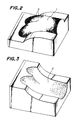
- a case mold 1 illustrated in Fig. 2 which corresponds to the surface shape of a port liner consisting of a hollow ceramics article for insert casting, is produced from gypsum or the like in the same manner as in a conventional method.
- the thus obtained case mold 1 is a case mold having a small dimensional dispersion so as to be used for the production of a slip casting mold 2, which is used in the production of a hollow ceramics article for insert casting.
- granules 3 are adhered to the surface of a case mold 1, which corresponds to the mold area, to give a 10 point average roughness R z of at least 30 ⁇ m to the surface.
- granule 3 ceramics abrasive grains or the like are used.
- the 10 point average surface roughness R z of at least 30 ⁇ m can be advantageously formed by a method, wherein an adhesive is previously applied to the surface of a case mold 1, granules 3 having an average grain size of at least 30 ⁇ m are spread thereon, and granules not adhered thereto are removed.
- the reason why the 10 point average surface roughness R z is set to at least 30 ⁇ m is that a hollow ceramics article 4 for insert casting is produced by using a case mold 1 having a surface having a 10 point average roughness R z of less than 30 ⁇ m is poor in the adhesion of the surface to a metal. Further, when granules 3 are adhered to the surface of a case mold 1 in one layer, a smaller dimensional dispersion can be maintained.
- the resulting slip casting mold 2 has a mold area having a 10 point average surface roughness R z of at least 30 ⁇ m.
- the materials of the slip casting mold 2 there are used gypsum and resin.
- a ceramics raw material consisting mainly of, for example, aluminum titanate is poured into the interior of the above obtained slip casting mold 2 and molded into a green shaped article therein, and the resulting green shaped article is dried and then fired, a hollow ceramics article 4 for insert casting having a 10 point average surface roughness R z of at least 30 ⁇ m as illustrated in Fig. 4 can be obtained.
- the hollow ceramics article 4 for insert casting produced according to the method of the present invention is small in the dimensional dispersion and has no drawbacks, which are caused in a conventional hollow ceramics article for insert casting having a surface treated with sandblast. Moreover, when the hollow ceramics article 4 for insert casting produced according to the method of the present invention is insert cast in a cast metal, such as aluminum or the like, the ceramics article 4 has a high adhesion to metal and is free from the risk of peeling of the metal from the ceramics article 4. Accordingly, the stress concentration, which is apt to occur in the branched portion (concave portion) and the like of a hollow ceramics article 4 for insert casting, can be relaxed, and formation of cracks in the ceramics article 4 can be effectively prevented.
- a phenolic resin adhesive was applied to the surface of a case mold, which had been obtained by transferring a master mold of port liner, by means of a spray gun to form a thin uniform layer of the adhesive on the case mold surface, and then abrasive grains having an average grain size of 60 ⁇ m were blown to the case mold surface to form one layer of the adhesive grains thereon.
- a slip casting mold was produced from gypsum by the use of the above obtained case mold having the abrasive grain layer formed on its surface, and a ceramics port liner was produced by the use of the above obtained slip casting mold according to an ordinary method, and then the resulting green ceramics port liner was fired.
- the fired ceramics port liner had a 10 point average surface roughness R z of 60 ⁇ m and a dimensional dispersion of not larger than ⁇ 0.2 mm.
- a ceramics port liner was produced in the same manner as described in Example 1, except that abrasive grains having an average grain size of 30 ⁇ m were used in place of those having an average grain size of 60 ⁇ m used in Example 1.
- the resulting fired ceramics port liner had a 10 point average surface roughness R z of 30 ⁇ m and a dimensional dispersion same as that of the port liner obtained in Example 1.
- a slip casting mold made of gypsum was produced through an ordinary method by the use of a case mold obtained by transferring a master mold used in Example 1, and the mold area of the resulting slip casting mold was subjected to a blast treatment, wherein abrasive grains of #46 size were blown to its mold area by means of a pressurized air kept under a pressure of 2.5 kg/cm2.
- a ceramics port liner was produced by the use of the blast-treated slip casting mold, and the resulting green ceramics port liner was fired.
- the fired ceramics port liner had a 10 point average surface roughness R z of 58 ⁇ m.
- the dimension of each portion of the resulting ceramics port liner was 0.6 mm smaller in average than the given dimension, and the dimensional dispersion of the resulting ceramics port liner was as large as ⁇ 0.5 mm based on the value of (given dimension-0.6 mm).
- granules are adhered to the surface of a mold to produce a mold having a 10 point average surface roughness R z of at least 30 ⁇ m, and the above treated mold is used in the production of a slip casting mold, whereby a hollow ceramics article having a large surface roughness can be obtained without increasing the dimensional dispersion.
- the hollow ceramics article produced by the above described method has a small dimensional dispersion, and moreover can relax the stress concentration during the insert casting, and hence the hollow ceramics article can be effectively prevented from being cracked.
Landscapes
- Engineering & Computer Science (AREA)
- Chemical & Material Sciences (AREA)
- Ceramic Engineering (AREA)
- Dispersion Chemistry (AREA)
- Manufacturing & Machinery (AREA)
- Mechanical Engineering (AREA)
- Producing Shaped Articles From Materials (AREA)
Applications Claiming Priority (2)
| Application Number | Priority Date | Filing Date | Title |
|---|---|---|---|
| JP243193/89 | 1989-09-19 | ||
| JP1243193A JPH03104604A (ja) | 1989-09-19 | 1989-09-19 | 鋳ぐるみ用中空セラミック体の成形型の製法及びこの成形型を用いた鋳ぐるみ用中空セラミック体の製法 |
Publications (3)
| Publication Number | Publication Date |
|---|---|
| EP0419152A2 true EP0419152A2 (fr) | 1991-03-27 |
| EP0419152A3 EP0419152A3 (en) | 1991-11-13 |
| EP0419152B1 EP0419152B1 (fr) | 1993-07-07 |
Family
ID=17100217
Family Applications (1)
| Application Number | Title | Priority Date | Filing Date |
|---|---|---|---|
| EP90310092A Expired - Lifetime EP0419152B1 (fr) | 1989-09-19 | 1990-09-14 | Méthode pour la fabrication d'un moule pour le coulage en barbotine d'articles creux en céramique utilisés dans le moulage avec insert et utilisation de ce moule |
Country Status (4)
| Country | Link |
|---|---|
| US (1) | US5169578A (fr) |
| EP (1) | EP0419152B1 (fr) |
| JP (1) | JPH03104604A (fr) |
| DE (1) | DE69002144T2 (fr) |
Families Citing this family (11)
| Publication number | Priority date | Publication date | Assignee | Title |
|---|---|---|---|---|
| US5298213A (en) * | 1993-01-13 | 1994-03-29 | Yan-Fei Ju | Method of making a ceramic burner head |
| US6010655A (en) * | 1998-08-28 | 2000-01-04 | Seagull Decor Co., Ltd. | Method of making a ceramic ornament having short undercuts on surface thereof |
| US6086801A (en) * | 1998-10-06 | 2000-07-11 | Board Of Trustees Of The University Of Arkansas | Method for forming a breast prosthesis |
| US6408567B1 (en) * | 2001-03-12 | 2002-06-25 | Knight Manufacturing Co., Inc. | Fishing lures and methods and molds for making same |
| US6933056B2 (en) * | 2001-11-15 | 2005-08-23 | Mathson Industries | Exhaust manifold and method of making the same |
| US7058439B2 (en) * | 2002-05-03 | 2006-06-06 | Contourmed, Inc. | Methods of forming prostheses |
| KR20040045559A (ko) * | 2002-11-25 | 2004-06-02 | 이병노 | 도자재 등잔 |
| US6805949B1 (en) * | 2003-03-25 | 2004-10-19 | Ford Motor Company | Method for enhancing adhesion of metal particles to ceramic models |
| US7562694B2 (en) | 2004-10-01 | 2009-07-21 | Magneco/Metrel, Inc. | Refractory casting method |
| DE102005005097B3 (de) * | 2005-02-04 | 2006-08-03 | Sama Maschinenbau Gmbh | Verfahren und Vorrichtung zur Herstellung von Gussformen für kleine Keramikgegenstände |
| CN115781912B (zh) * | 2022-11-11 | 2025-10-28 | 曹树梁 | 陶瓷泥饼柱化浆成型陶瓷太阳板的方法及装置 |
Family Cites Families (7)
| Publication number | Priority date | Publication date | Assignee | Title |
|---|---|---|---|---|
| US2172466A (en) * | 1937-05-14 | 1939-09-12 | Edwardes John | Mold |
| US3568723A (en) * | 1967-06-23 | 1971-03-09 | Du Pont | Metal-ceramic composite structures |
| US4338272A (en) * | 1979-01-11 | 1982-07-06 | Canadian Patents & Development Limited | Slip-casting system |
| JPS6331710A (ja) * | 1986-07-26 | 1988-02-10 | 東陶機器株式会社 | 陶磁器加圧成形用多孔質型の製法 |
| US4867662A (en) * | 1987-01-29 | 1989-09-19 | Inax Corporation | Slip casting mold |
| FR2626809B1 (fr) * | 1988-02-05 | 1990-08-03 | Elmetherm | Procede de fabrication de moules destines en particulier a la realisation de pieces en matieres ceramiques et moules ainsi obtenus |
| JPH01241368A (ja) * | 1988-03-23 | 1989-09-26 | Ngk Insulators Ltd | 鋳ぐるみ用の中空セラミック体及びその製造方法 |
-
1989
- 1989-09-19 JP JP1243193A patent/JPH03104604A/ja active Granted
-
1990
- 1990-09-14 EP EP90310092A patent/EP0419152B1/fr not_active Expired - Lifetime
- 1990-09-14 DE DE90310092T patent/DE69002144T2/de not_active Expired - Fee Related
- 1990-09-19 US US07/584,613 patent/US5169578A/en not_active Expired - Fee Related
Also Published As
| Publication number | Publication date |
|---|---|
| US5169578A (en) | 1992-12-08 |
| EP0419152B1 (fr) | 1993-07-07 |
| JPH0542922B2 (fr) | 1993-06-30 |
| DE69002144D1 (de) | 1993-08-12 |
| EP0419152A3 (en) | 1991-11-13 |
| DE69002144T2 (de) | 1994-01-13 |
| JPH03104604A (ja) | 1991-05-01 |
Similar Documents
| Publication | Publication Date | Title |
|---|---|---|
| EP0419152B1 (fr) | Méthode pour la fabrication d'un moule pour le coulage en barbotine d'articles creux en céramique utilisés dans le moulage avec insert et utilisation de ce moule | |
| US5055435A (en) | Ceramic materials to be insert-cast | |
| US5985205A (en) | Reducing wear between structural fiber reinforced ceramic matrix composite parts | |
| AU6677196A (en) | Fiber reinforced ceramic matrix composite cylinder head and cylinder head liner for an internal combustion engine | |
| JP4288644B2 (ja) | セラミックハニカム構造体およびその製造方法 | |
| US4647414A (en) | Method of manufacturing ceramics | |
| EP0312322B1 (fr) | Procédé pour la fabrication d'articles creux en céramique | |
| US5260116A (en) | Ceramicm port liners | |
| US6527038B1 (en) | Tooling production | |
| EP0403743A2 (fr) | Procédé de moulage de poudres | |
| US6265078B1 (en) | Reducing wear between structural fiber reinforced ceramic matrix composite automotive engine parts in sliding contacting relationship | |
| US4539224A (en) | Method for reinforcing a ceramic shaped body | |
| Graule et al. | DIRECT COAGULATION CASTING(DCC): FUNDAMENTALS OF A NEW FORMING PROCESS FOR CERAMICS | |
| US5863481A (en) | Process for forming a high temperature resistant, flexible, pliable elements curable by false-melt technique | |
| JPH0513522Y2 (fr) | ||
| CN120645298A (zh) | 一种生产薄壁陶瓷质手套模具的方法 | |
| Butler et al. | Shaping complex ceramic components by green machining | |
| JPH04369505A (ja) | 分岐筒状セラミックスポートライナの製造方法 | |
| JPH0615164B2 (ja) | 成形型からの転写によるセラミックスの粗面化法 | |
| EP0919346A1 (fr) | Procédé pour préparer rapidement un moule pour la fabrication d'articles en argile | |
| JPH01241368A (ja) | 鋳ぐるみ用の中空セラミック体及びその製造方法 | |
| JPH1024359A (ja) | スライドゲート用ノズル及びその製造方法 | |
| JP2968626B2 (ja) | セラミックスの鋳込み成形方法及び成形用鋳型 | |
| JPH0818301B2 (ja) | セラミックポートライナーの製造方法 | |
| JP2000309008A (ja) | セラミックス板の製造方法 |
Legal Events
| Date | Code | Title | Description |
|---|---|---|---|
| PUAI | Public reference made under article 153(3) epc to a published international application that has entered the european phase |
Free format text: ORIGINAL CODE: 0009012 |
|
| AK | Designated contracting states |
Kind code of ref document: A2 Designated state(s): BE DE FR GB IT SE |
|
| PUAL | Search report despatched |
Free format text: ORIGINAL CODE: 0009013 |
|
| AK | Designated contracting states |
Kind code of ref document: A3 Designated state(s): BE DE FR GB IT SE |
|
| 17P | Request for examination filed |
Effective date: 19920211 |
|
| 17Q | First examination report despatched |
Effective date: 19920814 |
|
| GRAA | (expected) grant |
Free format text: ORIGINAL CODE: 0009210 |
|
| AK | Designated contracting states |
Kind code of ref document: B1 Designated state(s): BE DE FR GB IT SE |
|
| REF | Corresponds to: |
Ref document number: 69002144 Country of ref document: DE Date of ref document: 19930812 |
|
| ITF | It: translation for a ep patent filed | ||
| ET | Fr: translation filed | ||
| PLBE | No opposition filed within time limit |
Free format text: ORIGINAL CODE: 0009261 |
|
| STAA | Information on the status of an ep patent application or granted ep patent |
Free format text: STATUS: NO OPPOSITION FILED WITHIN TIME LIMIT |
|
| 26N | No opposition filed | ||
| EAL | Se: european patent in force in sweden |
Ref document number: 90310092.3 |
|
| PGFP | Annual fee paid to national office [announced via postgrant information from national office to epo] |
Ref country code: GB Payment date: 19950904 Year of fee payment: 6 |
|
| PGFP | Annual fee paid to national office [announced via postgrant information from national office to epo] |
Ref country code: FR Payment date: 19950914 Year of fee payment: 6 |
|
| PGFP | Annual fee paid to national office [announced via postgrant information from national office to epo] |
Ref country code: SE Payment date: 19950918 Year of fee payment: 6 Ref country code: DE Payment date: 19950918 Year of fee payment: 6 |
|
| PGFP | Annual fee paid to national office [announced via postgrant information from national office to epo] |
Ref country code: BE Payment date: 19950920 Year of fee payment: 6 |
|
| PG25 | Lapsed in a contracting state [announced via postgrant information from national office to epo] |
Ref country code: GB Effective date: 19960914 |
|
| PG25 | Lapsed in a contracting state [announced via postgrant information from national office to epo] |
Ref country code: SE Effective date: 19960915 |
|
| PG25 | Lapsed in a contracting state [announced via postgrant information from national office to epo] |
Ref country code: FR Effective date: 19960930 Ref country code: BE Effective date: 19960930 |
|
| BERE | Be: lapsed |
Owner name: NGK INSULATORS LTD Effective date: 19960930 |
|
| GBPC | Gb: european patent ceased through non-payment of renewal fee |
Effective date: 19960914 |
|
| PG25 | Lapsed in a contracting state [announced via postgrant information from national office to epo] |
Ref country code: DE Effective date: 19970603 |
|
| EUG | Se: european patent has lapsed |
Ref document number: 90310092.3 |
|
| REG | Reference to a national code |
Ref country code: FR Ref legal event code: ST |
|
| REG | Reference to a national code |
Ref country code: FR Ref legal event code: ST |
|
| PG25 | Lapsed in a contracting state [announced via postgrant information from national office to epo] |
Ref country code: IT Free format text: LAPSE BECAUSE OF NON-PAYMENT OF DUE FEES;WARNING: LAPSES OF ITALIAN PATENTS WITH EFFECTIVE DATE BEFORE 2007 MAY HAVE OCCURRED AT ANY TIME BEFORE 2007. THE CORRECT EFFECTIVE DATE MAY BE DIFFERENT FROM THE ONE RECORDED. Effective date: 20050914 |