EP0419156A2 - Elastomères thermodurcissables et biodégradables - Google Patents
Elastomères thermodurcissables et biodégradables Download PDFInfo
- Publication number
- EP0419156A2 EP0419156A2 EP90310107A EP90310107A EP0419156A2 EP 0419156 A2 EP0419156 A2 EP 0419156A2 EP 90310107 A EP90310107 A EP 90310107A EP 90310107 A EP90310107 A EP 90310107A EP 0419156 A2 EP0419156 A2 EP 0419156A2
- Authority
- EP
- European Patent Office
- Prior art keywords
- poly
- hydroxy functionality
- thermoset
- bioerodible
- polyol
- Prior art date
- Legal status (The legal status is an assumption and is not a legal conclusion. Google has not performed a legal analysis and makes no representation as to the accuracy of the status listed.)
- Withdrawn
Links
Images



Classifications
-
- C—CHEMISTRY; METALLURGY
- C08—ORGANIC MACROMOLECULAR COMPOUNDS; THEIR PREPARATION OR CHEMICAL WORKING-UP; COMPOSITIONS BASED THEREON
- C08G—MACROMOLECULAR COMPOUNDS OBTAINED OTHERWISE THAN BY REACTIONS ONLY INVOLVING UNSATURATED CARBON-TO-CARBON BONDS
- C08G65/00—Macromolecular compounds obtained by reactions forming an ether link in the main chain of the macromolecule
- C08G65/34—Macromolecular compounds obtained by reactions forming an ether link in the main chain of the macromolecule from hydroxy compounds or their metallic derivatives
-
- A—HUMAN NECESSITIES
- A61—MEDICAL OR VETERINARY SCIENCE; HYGIENE
- A61K—PREPARATIONS FOR MEDICAL, DENTAL OR TOILETRY PURPOSES
- A61K9/00—Medicinal preparations characterised by special physical form
- A61K9/20—Pills, tablets, discs, rods
- A61K9/2004—Excipients; Inactive ingredients
- A61K9/2022—Organic macromolecular compounds
- A61K9/2031—Organic macromolecular compounds obtained otherwise than by reactions only involving carbon-to-carbon unsaturated bonds, e.g. polyethylene glycol, polyethylene oxide, poloxamers
- A61K9/204—Polyesters, e.g. poly(lactide-co-glycolide)
-
- A—HUMAN NECESSITIES
- A61—MEDICAL OR VETERINARY SCIENCE; HYGIENE
- A61K—PREPARATIONS FOR MEDICAL, DENTAL OR TOILETRY PURPOSES
- A61K9/00—Medicinal preparations characterised by special physical form
- A61K9/20—Pills, tablets, discs, rods
- A61K9/2072—Pills, tablets, discs, rods characterised by shape, structure or size; Tablets with holes, special break lines or identification marks; Partially coated tablets; Disintegrating flat shaped forms
Definitions
- a gastric retention platform as disclosed in U.S. Patent Nos. 4,735,804 and 4,758,436, is a drug delivery device comprised of a resilient polymer combined with an active ingredient.
- the platform is maintained in a first compressed state from the time of manufacture until ingestion. Subsequent to ingestion, the platform expands to a second relaxed state, thereby releasing the active ingredient to an environment of use (such as the stomach).
- the prolonged stress and strain suffered during storage limits the resilience of linear, thermoplastic polymer platforms and impedes their ability to expand to the second relaxed state subsequent to ingestion.
- Covalently cross-linked poly(ortho ester)s which exhibit greatly improved resiliency subsequent to prolonged periods of stress and strain as compared to previously known poly(ortho ester)s.
- the materials of the instant invention are thermoset, i.e., polymer chain slip is minimized under stress because the polymers are interlocked in a covalent, three-dimensional network.
- These thermoset, covalently cross-linked poly(ortho ester)s are synthesized by reacting either monomeric or polymeric polyols with diketene acetals.
- monomeric polyols with a functionality of at least three, and/or polymeric polyols having a hydroxy functionality of at least two must be used to produce the resilient, thermoset, covalently cross-linked bioerodible poly(ortho ester)s.
- Such monomeric or polymeric polyols do not exhibit resilient or elastic characteristics before reaction with diketene acetals. Rather, we have discovered that resiliency or elasticity is a latent property of those polyols that only becomes expressed upon reaction with diketene acetals to form the polymer.
- These polymers are suitable as carriers or matrices for drugs and other beneficial agents. Upon contact with an aqueous environment of use, the polymer degrades to release the drug or beneficial agent.
- the polymer may also constitute a structural member of a device requiring elasticity, resilience, and erodibility features.
- Polymeric polyols which can be reacted with diketene acetals to form the thermoset, covalently linked poly(ortho ester)s of the present invention include: Poly(butadiene) hydroxy terminated (PBD); Poly(isobutylene) hydroxy terminated (PIBD); Poly(isoprene) hydroxy terminated (PIPD); Poly(dimethylsiloxane) hydroxy terminated (PDMSD); Poly(butadiene-co-styrene) hydroxy terminated; Poly(ethylene-co-propylene) hydroxy terminated; and Poly(chloroprene) hydroxy terminated.
- PBD Poly(butadiene) hydroxy terminated
- PIBD Poly(isobutylene) hydroxy terminated
- PIPD Poly(isoprene) hydroxy terminated
- PDMSD Poly(dimethylsiloxane) hydroxy terminated
- polymeric polyols must have hydroxy functionality (number of hydroxyl groups per molecule) of at least two to effect polymerization with functionality greater than two effecting cross-linking.
- hydroxy functionality number of hydroxyl groups per molecule
- Monomeric polyols which may be admixed with the polymeric polyols and then reacted with diketene acetals to form the polymers claimed herein can be represented generally by the formula: wherein R is a linear or branched hydrocarbon chain of 3 to 12 carbon atoms and y is 0 to 3.
- Typical monomeric polyols include: 1, 2, 6-hexanetriol; 2-ethyl-2-(hydroxymethyl)-1,3-propanediol; 1, 5, 10-decanetriol; and pentaerythritol; and the like.
- FIG. 1 A generalized reaction scheme for synthesizing the elastomers of the present invention is disclosed in Fig. 1.
- Our elastomers can also be modified by adding appropriate fillers, plasticizers and stabilizers (e.g., antioxidants) such as those described in the "Encyclopedia of Polymer Science and Technology", Fillers, Vol. 6, p. 740; Plasticizers, Vol. 10, p. 286; Antioxidants and Stabilizers, Vol. 2, pg 171. (John Wiley & Sons, Inc., New York).
- appropriate fillers e.g., antioxidants
- plasticizers and stabilizers e.g., antioxidants
- Fillers serve as reinforcing agents and processing aids and can include: silicates such as clay, talc, feldspar, calcium silicate, and magnesium silicate; oxides such as aluminum oxide, titanium dioxide, zinc oxide, magnesium oxide, silica, quartz, and diatomaceous earth; carbonates such as calcium carbonate, barium carbonate and magnesium carbonate; sulfates such as barium sulfate and calcium sulfate; carbons such as carbon black and; polymeric fibers such as KEVLAR® aramid pulp (KEVLAR® is a registered trademark of the Dupont Corporation).
- silicates such as clay, talc, feldspar, calcium silicate, and magnesium silicate
- oxides such as aluminum oxide, titanium dioxide, zinc oxide, magnesium oxide, silica, quartz, and diatomaceous earth
- carbonates such as calcium carbonate, barium carbonate and magnesium carbonate
- sulfates such as barium sulfate and calcium sulfate
- carbons such as carbon black
- Plasticizers can also be added to the elastomers of the present invention, e.g., to lower the glass transition temperature, Tg.
- plasticizers include plasticizing oils such as SUNDEX® 170 (SUNDEX® is a registered Trademark of the Sun Oil Co.); phthalic esters; citrate esters; phosphate esters; adipic esters; azelaic esters; stearic esters; and complex linear polyesters and polymeric plasticizers.
- Antioxidants retard oxidation and extend the polymer's useful life. They include diarylamines, substituted phenols, disubstituted cresols, bisphenols, derivatives of cathecol, benzoates and ketone-amine resins. Specific examples include butylated hydroxyanisole, butylated hydroxytoluene, propyl gallate and t-butyl hydroquinone.
- thermoset elastomers of the present invention can be used as structural components of drug delivery devices and as tissue prostheses. They are also useful in the manufacture of matrices or other contolled release devices into which , or onto which, beneficial agents are included for subsequent use as implants or controlled release oral formulations.
- thermoset polymers are uniquely suited to this application because they are bioerodible and because they retain their resiliency after compression for extended periods of time.
- Our bioerodible, thermoset, covalently cross-linked elastomers may also serve as matrices for the controlled release of drugs.
- a drug may be associated with the matrix in different ways, depending on the physical and chemical properties of the drug.
- the drug may be dispersed as a solution or suspension within the erodible elastomeric polymer matrix. As the matrix erodes within the gastrointestinal tract or implant site, the drug is released at a controlled rate.
- the amount of drug or beneficial substance incorporated into the polymer matrix will vary greatly depending on the particular drug, the desired therapeutic effect and the time span over which the polymer matrix is eroded to release the particular drug. Thus, there is no critical upper limit to the amount of drug incorporated into the erodible elastomeric polymer matrix. In general, the amount of polymer employed in the practice of the invention will usually range from about 10% to 99% by weight of the device. The remaining portion of the composition contains the drug, and other excipients and additives.
- the example elastomers When exposed to simulated gastric fluid (pH 1.25) the example elastomers hydrolytically degrade to regenerate the polyols, pentaerythritol dipropionate, and pentaerythritol.
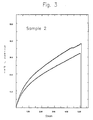
- Figs. 2 and 3 show the elongation of elastomeric samples #1 and #2 as a function of force/unit area (InstronTM data). The absence of yield-upon-elongation indicates good resilience. Polymers that yield with elongation will not recover the initial configuration (poor resilience) and are considered poor elastomers. While other properties (tensile or otherwise) can be used to characterize elastomeric nature, the property of reversible elongation or reversible deformation is a desirable characteristic of an elastomeric polymer. Figs. 2 and 3 show that sample #1 is stronger (harder) than sample #2.
- sample #1 The tensile properties of sample #1 analyzed with an INSTRONTM instrument.
- the crosslink density of the synthesized polymer is directly proportional to the weight percent of crosslinker and to the functionality (the hydroxyl number) of the polymeric polyol used.
- the synthesis of the elastomers is depicted in the generalized overall reaction scheme of Fig. 1 where the R of the generalized diketene acetal structure represents a quadrivalent grouping that is part of a spiro or a non-spiro structure.
- the tensile behavior (Instron test) of our polymer samples is shown in Fig. 2 and the summarized properties are listed in Table 1.
- Example 1 The procedure of Example 1 was followed except that HT was omitted.
- the elastomer synthesized was labelled sample #2.
- the tensile properties of sample#2 were analyzed and are illustrated in Fig. 3 and summarized in Table 1.
- DETOSU is reacted with PBD, PIBD, PIPD, or PDMSD, in the presence of varying amounts of crosslinker (0 to 50% w/w) in the manner described in Examples 1 and 2.
- the elastomers thus synthesized are used to fabricate the tetrahedral device of Fig. 4.
- the open tetrahedron measures 2x2x2 cm and when compressed fits into a No. 000 gelatin capsule.
- a biologically active compound may be incorporated into the elastomer.
- Example 4 The procedure of Example 4 was followed except that the stoichiometry (S) was equal to 1. This was accomplished by increasing the DETOSU level to 90.82 g.
- Example 4 The procedure of Example 4 was followed except that the stoichiometry (S) was equal to 1.2. This was accomplised by increasing the DETOSU level to 108.98 g.
Landscapes
- Health & Medical Sciences (AREA)
- Chemical & Material Sciences (AREA)
- Medicinal Chemistry (AREA)
- Public Health (AREA)
- Epidemiology (AREA)
- Life Sciences & Earth Sciences (AREA)
- Animal Behavior & Ethology (AREA)
- General Health & Medical Sciences (AREA)
- Pharmacology & Pharmacy (AREA)
- Veterinary Medicine (AREA)
- Chemical Kinetics & Catalysis (AREA)
- Polymers & Plastics (AREA)
- Organic Chemistry (AREA)
- Addition Polymer Or Copolymer, Post-Treatments, Or Chemical Modifications (AREA)
- Medicinal Preparation (AREA)
- Polyethers (AREA)
- Materials For Medical Uses (AREA)
Applications Claiming Priority (2)
| Application Number | Priority Date | Filing Date | Title |
|---|---|---|---|
| US07/409,908 US5047464A (en) | 1989-09-20 | 1989-09-20 | Bioerodible thermoset elastomers |
| US409908 | 1989-09-20 |
Publications (2)
| Publication Number | Publication Date |
|---|---|
| EP0419156A2 true EP0419156A2 (fr) | 1991-03-27 |
| EP0419156A3 EP0419156A3 (en) | 1991-10-16 |
Family
ID=23622453
Family Applications (1)
| Application Number | Title | Priority Date | Filing Date |
|---|---|---|---|
| EP19900310107 Withdrawn EP0419156A3 (en) | 1989-09-20 | 1990-09-17 | Bioerodible thermoset elastomers |
Country Status (4)
| Country | Link |
|---|---|
| US (1) | US5047464A (fr) |
| EP (1) | EP0419156A3 (fr) |
| JP (1) | JPH03128934A (fr) |
| CA (1) | CA2025480A1 (fr) |
Cited By (6)
| Publication number | Priority date | Publication date | Assignee | Title |
|---|---|---|---|---|
| US5254345A (en) * | 1991-10-11 | 1993-10-19 | Merck & Co., Inc. | Poly(orthocarbonate acetal) bioerodible polymers |
| WO1997025366A1 (fr) * | 1996-01-05 | 1997-07-17 | Advanced Polymer Systems, Inc. | Polymeres a etat physique et erodabilite maitrises |
| US5968543A (en) * | 1996-01-05 | 1999-10-19 | Advanced Polymer Systems, Inc. | Polymers with controlled physical state and bioerodibility |
| US6280745B1 (en) | 1997-12-23 | 2001-08-28 | Alliance Pharmaceutical Corp. | Methods and compositions for the delivery of pharmaceutical agents and/or the prevention of adhesions |
| US7045589B2 (en) | 2002-11-15 | 2006-05-16 | A.P. Pharma, Inc. | Bioerodible poly(ortho esters) from dioxane-based di(ketene acetals), and block copolymers containing them |
| US7220414B2 (en) | 2000-09-06 | 2007-05-22 | A.P. Pharma, Inc. | Degradable polyacetal polymers |
Families Citing this family (16)
| Publication number | Priority date | Publication date | Assignee | Title |
|---|---|---|---|---|
| US5211951A (en) * | 1991-07-24 | 1993-05-18 | Merck & Co., Inc. | Process for the manufacture of bioerodible poly (orthoester)s and polyacetals |
| US5556905A (en) * | 1994-03-30 | 1996-09-17 | Reilly Industries, Inc. | Physically-modified degradable thermoplastic compositions |
| IL133196A0 (en) | 1999-11-29 | 2001-03-19 | Yissum Res Dev Co | Gastroretentive controlled release pharmaceutical dosage forms |
| CA2385140C (fr) * | 2001-05-07 | 2011-07-26 | Queen's University At Kingston | Elastomere biodegradable et methodes de preparation |
| US20030152630A1 (en) * | 2001-05-11 | 2003-08-14 | Ng Steven Y. | PEG-POE, PEG-POE-PEG, and POE-PEG-POE block copolymers |
| US6590059B2 (en) * | 2001-05-11 | 2003-07-08 | Ap Pharma, Inc. | Bioerodible polyorthoesters from dioxolane-based diketene acetals |
| US6524606B1 (en) | 2001-11-16 | 2003-02-25 | Ap Pharma, Inc. | Bioerodible polyorthoesters containing amine groups |
| US20130143867A1 (en) | 2011-12-02 | 2013-06-06 | Sychroneuron Inc. | Acamprosate formulations, methods of using the same, and combinations comprising the same |
| WO2014197744A1 (fr) | 2013-06-05 | 2014-12-11 | Synchroneuron, Inc. | Formulations d'acamprosate, procédés d'utilisation de celles-ci, et combinaisons comprenant celles-ci |
| NZ727659A (en) | 2014-06-11 | 2021-12-24 | Massachusetts Inst Technology | Residence structures and related methods |
| US20170266112A1 (en) | 2014-06-11 | 2017-09-21 | Massachusetts Institute Of Technology | Residence structures and related methods |
| US11576859B2 (en) | 2015-10-23 | 2023-02-14 | Lyndra Therapeutics, Inc. | Gastric residence systems for sustained release of therapeutic agents and methods of use thereof |
| WO2017100367A1 (fr) | 2015-12-08 | 2017-06-15 | Lyndra, Inc. | Configurations géométriques de systèmes à résidence gastrique |
| CN109310639A (zh) | 2016-05-27 | 2019-02-05 | 林德拉有限公司 | 用于胃驻留系统的材料结构 |
| JP2019532947A (ja) | 2016-09-30 | 2019-11-14 | リンドラ,インコーポレイティド | アダマンタン系薬物の持続的送達のための胃内滞留システム |
| CA3066658A1 (fr) | 2017-06-09 | 2018-12-13 | Lyndra, Inc. | Systemes gastriques a demeure avec films modulant le taux de liberation |
Family Cites Families (4)
| Publication number | Priority date | Publication date | Assignee | Title |
|---|---|---|---|---|
| US4304767A (en) * | 1980-05-15 | 1981-12-08 | Sri International | Polymers of di- (and higher functionality) ketene acetals and polyols |
| US4549010A (en) * | 1984-06-27 | 1985-10-22 | Merck & Co., Inc. | Bioerodible poly(ortho ester) thermoplastic elastomer from diketene diacetal |
| US4735804A (en) * | 1985-05-10 | 1988-04-05 | Merck & Co., Inc. | Drug delivery device which can be retained in the stomach for a controlled period of time |
| US4758436A (en) * | 1985-05-29 | 1988-07-19 | Merck & Co., Inc. | Drug delivery device which can be retained in the stomach for a controlled period of time |
-
1989
- 1989-09-20 US US07/409,908 patent/US5047464A/en not_active Expired - Fee Related
-
1990
- 1990-09-17 CA CA002025480A patent/CA2025480A1/fr not_active Abandoned
- 1990-09-17 EP EP19900310107 patent/EP0419156A3/en not_active Withdrawn
- 1990-09-19 JP JP2247625A patent/JPH03128934A/ja active Pending
Cited By (6)
| Publication number | Priority date | Publication date | Assignee | Title |
|---|---|---|---|---|
| US5254345A (en) * | 1991-10-11 | 1993-10-19 | Merck & Co., Inc. | Poly(orthocarbonate acetal) bioerodible polymers |
| WO1997025366A1 (fr) * | 1996-01-05 | 1997-07-17 | Advanced Polymer Systems, Inc. | Polymeres a etat physique et erodabilite maitrises |
| US5968543A (en) * | 1996-01-05 | 1999-10-19 | Advanced Polymer Systems, Inc. | Polymers with controlled physical state and bioerodibility |
| US6280745B1 (en) | 1997-12-23 | 2001-08-28 | Alliance Pharmaceutical Corp. | Methods and compositions for the delivery of pharmaceutical agents and/or the prevention of adhesions |
| US7220414B2 (en) | 2000-09-06 | 2007-05-22 | A.P. Pharma, Inc. | Degradable polyacetal polymers |
| US7045589B2 (en) | 2002-11-15 | 2006-05-16 | A.P. Pharma, Inc. | Bioerodible poly(ortho esters) from dioxane-based di(ketene acetals), and block copolymers containing them |
Also Published As
| Publication number | Publication date |
|---|---|
| EP0419156A3 (en) | 1991-10-16 |
| CA2025480A1 (fr) | 1991-03-21 |
| JPH03128934A (ja) | 1991-05-31 |
| US5047464A (en) | 1991-09-10 |
Similar Documents
| Publication | Publication Date | Title |
|---|---|---|
| US5047464A (en) | Bioerodible thermoset elastomers | |
| EP0473223B1 (fr) | Implants bioérodibles | |
| EP0260415B1 (fr) | Synthèse et utilisation de polyanhydrides à haut poids moléculaire | |
| US4806621A (en) | Biocompatible, bioerodible, hydrophobic, implantable polyimino carbonate article | |
| EP0386757B1 (fr) | Esters de polyphospho biodégradables | |
| DE69805071T2 (de) | Zweistufige lösungspolymerisation von hochmolekularen poly(phosphorestern) | |
| EP0309463B1 (fr) | Polyurethanes radio-opaques et catheters composes de ces materiaux | |
| US5176907A (en) | Biocompatible and biodegradable poly (phosphoester-urethanes) | |
| Kohn et al. | Poly (iminocarbonates) as potential biomaterials | |
| US5256765A (en) | Biodegradable poly(phosphate esters) | |
| EP1988108B1 (fr) | Copolymère séquence sensible à la température et au pH doté d'une excellente résistance au gel, son procédé de préparation et système d'administration de médicaments l'utilisant | |
| Penco et al. | Degradation behaviour of block copolymers containing poly (lactic-glycolic acid) and poly (ethylene glycol) segments | |
| EP0524831A1 (fr) | Procédé de préparation de poly(ortho esters) et polyacétals bioérodibles | |
| JP3054451B2 (ja) | 加水分解性樹脂組成物 | |
| US5217712A (en) | Bioerodible thermoset elastomers | |
| CA2064889C (fr) | Materiaux polymeres | |
| US20020155092A1 (en) | Phosphate based biodegradable polymers | |
| EP0258780A2 (fr) | Polyesters contenant des séquences d'oxyde d'alkylène et leur utilisation comme systèmes de libération de médicaments | |
| US12251443B2 (en) | Drug formulations comprising polyoxazolines as matrix excipient | |
| KR20090110355A (ko) | 치료제 전달용 생분해성 질내 기구 | |
| JP2007516220A (ja) | アクリルポリマー接着剤を含有する熱成形組成物の製造方法、医薬製剤および該製剤の製造方法 | |
| JPH05214093A (ja) | ポリ(オルトカーボネートアセタール)生体分解性ポリマー | |
| US20240042105A1 (en) | Hydrophilic silicone rubber serving as medical catheter, preparation method thereof and application thereof | |
| JP2003526708A (ja) | ポリマー組成物およびその製造方法 | |
| Banakar | Materials Used in Controlled Release Technology–A Primer |
Legal Events
| Date | Code | Title | Description |
|---|---|---|---|
| PUAI | Public reference made under article 153(3) epc to a published international application that has entered the european phase |
Free format text: ORIGINAL CODE: 0009012 |
|
| AK | Designated contracting states |
Kind code of ref document: A2 Designated state(s): CH DE FR GB IT LI NL |
|
| PUAL | Search report despatched |
Free format text: ORIGINAL CODE: 0009013 |
|
| AK | Designated contracting states |
Kind code of ref document: A3 Designated state(s): CH DE FR GB IT LI NL |
|
| 17P | Request for examination filed |
Effective date: 19920304 |
|
| STAA | Information on the status of an ep patent application or granted ep patent |
Free format text: STATUS: THE APPLICATION HAS BEEN WITHDRAWN |
|
| 17Q | First examination report despatched |
Effective date: 19940609 |
|
| 18W | Application withdrawn |
Withdrawal date: 19940630 |