EP0419201B1 - Système de commande communication entre calculateurs parallèles - Google Patents
Système de commande communication entre calculateurs parallèles Download PDFInfo
- Publication number
- EP0419201B1 EP0419201B1 EP90310181A EP90310181A EP0419201B1 EP 0419201 B1 EP0419201 B1 EP 0419201B1 EP 90310181 A EP90310181 A EP 90310181A EP 90310181 A EP90310181 A EP 90310181A EP 0419201 B1 EP0419201 B1 EP 0419201B1
- Authority
- EP
- European Patent Office
- Prior art keywords
- node
- data
- destination
- nodes
- scope
- Prior art date
- Legal status (The legal status is an assumption and is not a legal conclusion. Google has not performed a legal analysis and makes no representation as to the accuracy of the status listed.)
- Expired - Lifetime
Links
Images










Classifications
-
- G—PHYSICS
- G06—COMPUTING OR CALCULATING; COUNTING
- G06F—ELECTRIC DIGITAL DATA PROCESSING
- G06F15/00—Digital computers in general; Data processing equipment in general
- G06F15/16—Combinations of two or more digital computers each having at least an arithmetic unit, a program unit and a register, e.g. for a simultaneous processing of several programs
- G06F15/163—Interprocessor communication
- G06F15/173—Interprocessor communication using an interconnection network, e.g. matrix, shuffle, pyramid, star, snowflake
- G06F15/17356—Indirect interconnection networks
- G06F15/17368—Indirect interconnection networks non hierarchical topologies
- G06F15/17381—Two dimensional, e.g. mesh, torus
Definitions
- the present invention relates to a communication system of parallel computers in a field of a multi-processor system i,e., MIMD (multiple instruction stream multiple data stream) in which a plurality of programs operate in parallel and more particularly to a communication in a network between parallel computers connected in N-dimensional torus connection (in which one end node is connected to the other end node) or N-dimensional matrix connection where a broadcast communication or a simultaneous communication for simultaneously transmitting the same content to many receiving nodes by designating the scope of the destinated nodes.
- MIMD multiple instruction stream multiple data stream
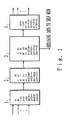
- a conventional communication system for performing a broadcast communication is shown in Figure 1.
- This system transmits data by designating the coordinate ID of the destination nodes.
- a receiving process unit 1 receives data transmitted from other nodes and a destination detection unit 2 detects the destination coordinate of the data.
- a destination judgment unit 3 judges whether the destination coordinate is the self (or local) node or other node and obtains the data when the destination coordinate designates the self node.
- a transmission process unit 4 transmits the data to the other node if the destination coordinate is for the other node.
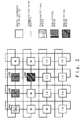
- the transmission data designates the coordinate of receiving node N67 and the data transmitted from node N61 is transferred to node N67 by being relayed via nodes N62 and N63.
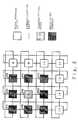
- Respective receiving nodes can only relay or receive the data. Therefore, as shown in Figure 3, the present network performs a broadcast communication from node N76 to nodes N71, N72, N73, N75, N77, N79, N710 and N711 as follows.
- the transmission source node repeats the data transmission at times corresponding to the number of the receiving node.
- a transmission is repeated so that the message is transmitted from one node to a plurality of other nodes one by one. Therefore, there is a problem that the broadcast communication cannot be performed with high speed and high efficiency.
- control of the node for relaying the data which is performed by designating the coordinates is complex.
- EP-A-0 132 926 discloses a communication control system having the features of the preamble of accompanying claim 1.
- the data being transmitted has an address specifying a unique destination node (terminal).
- a communication control system between parallel computers for performing a broadcast communication in a network between parallel nodes in which each of said nodes comprises:
- the broadcast communication is performed by worm-hole routing with high speed and high efficiency by transmitting the message divided into flits each constituting a unit of data transmission.
- a header flit selected from the flits is given the destination information specifying the scope of the broadcast transmission, thereby enabling a receiving node to refer to the scope information to preserve the message in the same node and to transmit the message to all other nodes within the scope.
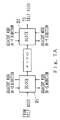
- Figure 4 shows a block diagram of a principle of the present invention by explaining a structure of node 10.
- the receiving process units 11, 12 ... 1N, and 21, 22,... 2N receive the data transmitted from the other nodes in respective directions.
- a destination detecting unit 13 detects the destination information designating the scope of the destination node from the data between-node distance processing unit for obtaining a node distance between the particular computer node and the destination computer node based on the destination information.
- a destination judgment unit 15 judges whether the data should be obtained by the self node and then obtains the data. Simultaneously, the destination judgment unit 15 determines whether or not the distance is 0 based on the obtained between-node distance and then determines the direction in which the data is further transmitted. It then provides the data to the transmission processing units in respective directions. Transmission processing units 31, 32...3N, and 41, 42, 4N transmit the data provided from the destination judgment unit 15 to the destination node.
- the message is divided into transmission units of flits 51.
- Header flit 51-1 having the scope information of the broadcast communication, is provided at the head of the message and the end flit 51-2 is provided at the end of the message.
- the message is sequentially transmitted from one node 10a to the other node 10b in the network.
- the receiving node 10 refers to header flit 51-1 and when the scope information designates that the message should be transmitted to the other node 10, the scope information is updated and header flit 51-1 is transmitted to the other node 10 in the transmission direction and the following flits 51 transmitted after the header flit 51-1 are sequentially transmitted until the end flit 51-2 is transmitted.
- the scope information of the broadcast communication is provided to header flit 51-1 at the head of the flit 51 obtained by dividing the message into transmission units and then flits 51 are sequentially transmitted.
- Node 10b which receives the flit, refers to the scope information, preserves the message in the self node and transmits it to the other node 10 in the transmission direction. This operation is repeated, thereby achieving a high speed and efficient broadcast communication in the worm-hole routing.
- Figure 5A shows an example of a data flow of a broadcast communication in a one dimensional network.
- 10a is a transmission node and the hatched nodes 10b designate the receiving nodes.
- the scope information of the transmission is 2 and thus the message is broadcast to the node provided two nodes ahead in both directions from transmission node 10a.
- Figure 5B shows an example of data of a broadcast communication in a two dimensional network.
- 10a designates a transmission node and the hatched nodes 10b designate the receiving nodes.
- the scope information of the transmission is 2 in the X direction and 1 in the Y direction.
- the message is broadcast to the node two nodes ahead in the +X and -X directions and is broadcast to the node provided one node ahead in the +Y and -Y directions from transmission node 10a.
- FIG. 5C shows an example of a flit.
- Flit 1 is obtained by dividing the message into transmission units (for example, units of several bytes).
- the message comprises a header flit 51-1 provided at the head of the message, flits with data and an end flit 51-2 provided at the end of the message.
- the scope information of the transmission in the broadcast communication is stored in the header flit 51-1.
- the scope information of the transmission designates the number of nodes through which the message is transmitted in a one-dimensional network and designates the number of nodes through which the message is transmitted in *X direction and *Y direction in the two-dimensional network.
- the end flit 51-2 designates EOD (end of file or the end of the flit) by making the end bit "1".
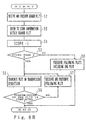
- Step S3 determines whether the content of the header flit is other than 0.
- the flits (including the header flit and the other flits) are sequentially transmitted in the transmission direction through steps S4 to S7.
- the self node is the end node of the broadcast communication and the header flit is not transmitted to the other node.
- the following flits, including the end flit, are preserved at step S8.
- step S4 1 is subtracted from the scope information of the transmission.
- the scope information of the transmission is thereby judged as being other than 0 in step S3 and transmission of the message to the other node is required.
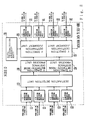
- Figure 8 shows a process block diagram of a node 10 according to the present embodiment.
- the transmission node N31 performs a broadcast communication toward respective receiving nodes in a two-dimensional lattice network as shown in Figure 9.
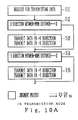
- step S24 then transmits data in the +Y direction.
- step S25 determines that the data should be transmitted in the Y direction, and at step S26, data is transmitted in the +Y and the -Y directions.
- the step S21 corresponds to -X direction receiving process unit 11 and destination detection unit 13 shown in Figure 4, the step S22 between-node distance process unit 14, the step S23 destination judgement unit 15, and the step S24 +X direction transmission process unit 31.
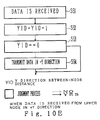
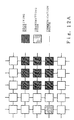
- Figure 10C and Figure 10E show respectively the process for receiving the data from a right node in the +X direction in accordance with steps S31 to S36 and the process for receiving data from an upper node in the +Y direction in accordance with steps S51 to S54.
- the scope of the broadcast communication is designated and transmitted to the data transmission request part 108, thereby forming the data designating the scope of the broadcast communication and transmitting the data to the destination judgment unit 115, in accordance with the block diagram shown in Figure 8.
Landscapes
- Engineering & Computer Science (AREA)
- Physics & Mathematics (AREA)
- Computer Hardware Design (AREA)
- Theoretical Computer Science (AREA)
- Mathematical Physics (AREA)
- Software Systems (AREA)
- General Engineering & Computer Science (AREA)
- General Physics & Mathematics (AREA)
- Multi Processors (AREA)
Claims (6)
- Système de commande de communication entre ordinateurs parallèles destiné à effectuer une communication de diffusion dans un réseau entre noeuds parallèles (10), dans lequel chacun desdits noeuds (10) comprend :des moyens de réception de données (11, 12,... 1N ; 21, 22, .... 2N), servant à recevoir les données émises depuis d'autres noeuds dans des directions respectives;un moyen (13) de détection de destination, servant à détecter une information de destination à partir des données ;un moyen (14) de traitement de distance entre noeuds, servant à obtenir une information de distance entre un noeud d'ordinateur particulier et le noeud de destination, sur la base de l'information de destination ;un moyen (15) de prise de décision sur la destination, servant à déterminer si les données doivent ou non être obtenues par un noeud local, à déterminer si les données doivent ou non être transmises à un autre noeud et à déterminer la direction de la transmission, sur la base de l'information de distance ; etun moyen de traitement de transmission (31, 32 3N, 41, 42, ...4N), servant à transmettre les données dont la destination a été déterminée, eu égard à une direction particulière ;caractérisé en ce que ladite information de destination indique un domaine de noeuds de destination pour les données, et en ce que ledit moyen de traitement de transmission est destiné à transmettre les données à tous les autres noeuds se trouvant à l'intérieur dudit domaine.
- Système de commande de communication selon la revendication 1, où ledit domaine des noeuds de destination est déterminé comme étant une aire symétrique qui a comme centre un noeud d'origine.
- Système de commande de communication selon la revendication 1, où le domaine des noeuds de destination est décalé dans un sens par rapport à un domaine symétrique des noeuds de destination ayant le noeud d'origine comme centre.
- Système de commande de communication selon la revendication 1, où ledit domaine des noeuds de destination est déterminé sans qu'il soit prévu un noeud d'origine à l'intérieur du domaine des noeuds de destination.
- Système de commande de communication selon la revendication 1, où lesdits noeuds parallèles (10) comprennent des ordinateurs connectés dans une connexion en tore à N-dimensions ou dans une connexion en matrice à N-dimensions.
- Système de commande de communication selon la revendication 1, comprenant en outre un moyen servant à diviser les données en une pluralité de zones constituant des unités de transmission de ladite communication, lesquelles zones comprennent :une zone d'en-tête se trouvant au début de ladite donnée, qui contient ladite information de destination indiquant un domaine de noeuds de destination, et une zone de fin se trouvant à la fin de ladite donnée ; etoù, dans chaque dit noeud (10), en réponse à la réception de ladite zone d'en-tête par ledit moyen de réception de données, ledit moyen de détection de destination (13), ledit noeud (14) de traitement de distance entre noeuds, ledit moyen (15) de prise de décision sur la destination et ledit moyen de traitement de transmission mettent à jour le domaine de la transmission et transmettent la zone d'en-tête à un autre noeud disposé dans la direction de transmission, lorsque l'information de domaine se trouvant dans ladite zone d'en-tête indique que le message doit être transmis à d'autres noeuds, de sorte qu'il y a transmission séquentielle des zones faisant suite à la zone d'en-tête jusqu'à transmission de la zone de fin.
Applications Claiming Priority (4)
| Application Number | Priority Date | Filing Date | Title |
|---|---|---|---|
| JP240186/89 | 1989-09-18 | ||
| JP01240186A JP3087900B2 (ja) | 1989-09-18 | 1989-09-18 | 並列計算機を構成する計算機ノード |
| JP279055/89 | 1989-10-26 | ||
| JP1279055A JPH088569B2 (ja) | 1989-10-26 | 1989-10-26 | 放送通信方式 |
Publications (3)
| Publication Number | Publication Date |
|---|---|
| EP0419201A2 EP0419201A2 (fr) | 1991-03-27 |
| EP0419201A3 EP0419201A3 (en) | 1992-05-13 |
| EP0419201B1 true EP0419201B1 (fr) | 1996-11-27 |
Family
ID=26534616
Family Applications (1)
| Application Number | Title | Priority Date | Filing Date |
|---|---|---|---|
| EP90310181A Expired - Lifetime EP0419201B1 (fr) | 1989-09-18 | 1990-09-18 | Système de commande communication entre calculateurs parallèles |
Country Status (4)
| Country | Link |
|---|---|
| US (1) | US5553078A (fr) |
| EP (1) | EP0419201B1 (fr) |
| AU (1) | AU633352B2 (fr) |
| DE (1) | DE69029239T2 (fr) |
Families Citing this family (9)
| Publication number | Priority date | Publication date | Assignee | Title |
|---|---|---|---|---|
| JP3639319B2 (ja) * | 1994-01-25 | 2005-04-20 | 富士通株式会社 | 並列計算機システム,データ転送制御方法および送受信制御装置 |
| US5822605A (en) * | 1994-03-24 | 1998-10-13 | Hitachi, Ltd. | Parallel processor system with a broadcast message serializing circuit provided within a network |
| US5996020A (en) * | 1995-07-21 | 1999-11-30 | National Security Agency | Multiple level minimum logic network |
| US6289021B1 (en) | 1997-01-24 | 2001-09-11 | Interactic Holdings, Llc | Scaleable low-latency switch for usage in an interconnect structure |
| JPH10254843A (ja) * | 1997-03-06 | 1998-09-25 | Hitachi Ltd | クロスバスイッチ、該クロスバスイッチを備えた並列計算機及びブロードキャスト通信方法 |
| US5881243A (en) * | 1997-05-07 | 1999-03-09 | Zaumen; William T. | System for maintaining multiple loop free paths between source node and destination node in computer network |
| US7027413B2 (en) * | 2001-09-28 | 2006-04-11 | Sun Microsystems, Inc. | Discovery of nodes in an interconnection fabric |
| US20070140244A1 (en) * | 2005-12-21 | 2007-06-21 | International Business Machines Corporation | Optimal algorithm for large message broadcast |
| US8274987B2 (en) * | 2010-03-22 | 2012-09-25 | International Business Machines Corporation | Contention free pipelined broadcasting within a constant bisection bandwidth network topology |
Family Cites Families (13)
| Publication number | Priority date | Publication date | Assignee | Title |
|---|---|---|---|---|
| US4484325A (en) * | 1982-09-02 | 1984-11-20 | Burroughs Corporation | Four way selector switch for a five port module as a node asynchronous speed independent network of concurrent processors |
| US4598400A (en) * | 1983-05-31 | 1986-07-01 | Thinking Machines Corporation | Method and apparatus for routing message packets |
| JPS60181962A (ja) * | 1984-02-29 | 1985-09-17 | Fujitsu Ltd | 並列計算機における通信方式 |
| JPH0628361B2 (ja) * | 1984-11-27 | 1994-04-13 | 国際電信電話株式会社 | パケツト交換方式 |
| US4742511A (en) * | 1985-06-13 | 1988-05-03 | Texas Instruments Incorporated | Method and apparatus for routing packets in a multinode computer interconnect network |
| CA1252168A (fr) * | 1985-07-24 | 1989-04-04 | Kenneth A. Bobey | Reseau de communication |
| JP2900359B2 (ja) * | 1986-10-30 | 1999-06-02 | 株式会社日立製作所 | マルチプロセッサシステム |
| US4933933A (en) * | 1986-12-19 | 1990-06-12 | The California Institute Of Technology | Torus routing chip |
| US4984235A (en) * | 1987-04-27 | 1991-01-08 | Thinking Machines Corporation | Method and apparatus for routing message packets and recording the roofing sequence |
| DE3855567T2 (de) * | 1987-07-20 | 1997-02-06 | Matsushita Electric Ind Co Ltd | Übertragungssystem |
| US5105424A (en) * | 1988-06-02 | 1992-04-14 | California Institute Of Technology | Inter-computer message routing system with each computer having separate routinng automata for each dimension of the network |
| JP3072646B2 (ja) * | 1989-03-20 | 2000-07-31 | 富士通株式会社 | 並列計算機間通信制御方式 |
| US5175733A (en) * | 1990-12-27 | 1992-12-29 | Intel Corporation | Adaptive message routing for multi-dimensional networks |
-
1990
- 1990-09-18 EP EP90310181A patent/EP0419201B1/fr not_active Expired - Lifetime
- 1990-09-18 DE DE69029239T patent/DE69029239T2/de not_active Expired - Fee Related
- 1990-09-18 AU AU62640/90A patent/AU633352B2/en not_active Ceased
-
1995
- 1995-01-13 US US08/372,825 patent/US5553078A/en not_active Expired - Fee Related
Also Published As
| Publication number | Publication date |
|---|---|
| EP0419201A3 (en) | 1992-05-13 |
| DE69029239D1 (de) | 1997-01-09 |
| AU633352B2 (en) | 1993-01-28 |
| EP0419201A2 (fr) | 1991-03-27 |
| DE69029239T2 (de) | 1997-03-27 |
| US5553078A (en) | 1996-09-03 |
| AU6264090A (en) | 1991-03-21 |
Similar Documents
| Publication | Publication Date | Title |
|---|---|---|
| US5175733A (en) | Adaptive message routing for multi-dimensional networks | |
| US7889725B2 (en) | Computer cluster | |
| JP3679813B2 (ja) | 並列計算機 | |
| CA2015968C (fr) | Acheminement adaptatif dans les systemes informatiques paralleles | |
| EP0197103B1 (fr) | Equilibrage de la charge pour noeuds de commutation par paquets | |
| EP0169455B1 (fr) | Noms non-uniques pour message de diffusion | |
| Su et al. | Adaptive deadlock-free routing in multicomputers using only one extra virtual channel | |
| US6304568B1 (en) | Interconnection network extendable bandwidth and method of transferring data therein | |
| US5546596A (en) | Method and apparatus for integrated local and express routing in a multiprocessor | |
| EP0419201B1 (fr) | Système de commande communication entre calculateurs parallèles | |
| US5398317A (en) | Synchronous message routing using a retransmitted clock signal in a multiprocessor computer system | |
| JP2004533035A (ja) | クラス・ネットワーク経路指定 | |
| US5825773A (en) | Switching system for transferring broadcast packet held in broadcast buffer received from input port to output ports according to the state of each output port | |
| US20050201356A1 (en) | Adaptive routing for hierarchical interconnection network | |
| JP3087900B2 (ja) | 並列計算機を構成する計算機ノード | |
| JP3683211B2 (ja) | ノード間データ転送方法及びノード間データ転送装置 | |
| Ni et al. | A VLSI router design for hypercube multiprocessors | |
| JPH07262155A (ja) | 並列計算機およびメッセージ放送方法 | |
| JP2749725B2 (ja) | 並列計算機の通信方法 | |
| JPH01162452A (ja) | 自律形ルーチング方式 | |
| JP3409862B2 (ja) | 並列プロセッサシステム | |
| JPH1166024A (ja) | クロスバスイッチ切換システム | |
| JPH04167845A (ja) | ノード間のデータ転送方式 | |
| JPH088569B2 (ja) | 放送通信方式 | |
| Shepherd et al. | A gateway development system |
Legal Events
| Date | Code | Title | Description |
|---|---|---|---|
| PUAI | Public reference made under article 153(3) epc to a published international application that has entered the european phase |
Free format text: ORIGINAL CODE: 0009012 |
|
| AK | Designated contracting states |
Kind code of ref document: A2 Designated state(s): DE FR GB |
|
| PUAL | Search report despatched |
Free format text: ORIGINAL CODE: 0009013 |
|
| AK | Designated contracting states |
Kind code of ref document: A3 Designated state(s): DE FR GB |
|
| 17P | Request for examination filed |
Effective date: 19920702 |
|
| 17Q | First examination report despatched |
Effective date: 19950405 |
|
| GRAG | Despatch of communication of intention to grant |
Free format text: ORIGINAL CODE: EPIDOS AGRA |
|
| GRAH | Despatch of communication of intention to grant a patent |
Free format text: ORIGINAL CODE: EPIDOS IGRA |
|
| RBV | Designated contracting states (corrected) |
Designated state(s): DE GB |
|
| GRAH | Despatch of communication of intention to grant a patent |
Free format text: ORIGINAL CODE: EPIDOS IGRA |
|
| GRAA | (expected) grant |
Free format text: ORIGINAL CODE: 0009210 |
|
| AK | Designated contracting states |
Kind code of ref document: B1 Designated state(s): DE GB |
|
| REF | Corresponds to: |
Ref document number: 69029239 Country of ref document: DE Date of ref document: 19970109 |
|
| PLBE | No opposition filed within time limit |
Free format text: ORIGINAL CODE: 0009261 |
|
| STAA | Information on the status of an ep patent application or granted ep patent |
Free format text: STATUS: NO OPPOSITION FILED WITHIN TIME LIMIT |
|
| 26N | No opposition filed | ||
| PG25 | Lapsed in a contracting state [announced via postgrant information from national office to epo] |
Ref country code: DE Free format text: LAPSE BECAUSE OF NON-PAYMENT OF DUE FEES Effective date: 19980603 |
|
| REG | Reference to a national code |
Ref country code: GB Ref legal event code: IF02 |
|
| PGFP | Annual fee paid to national office [announced via postgrant information from national office to epo] |
Ref country code: GB Payment date: 20050914 Year of fee payment: 16 |
|
| GBPC | Gb: european patent ceased through non-payment of renewal fee |
Effective date: 20060918 |
|
| PG25 | Lapsed in a contracting state [announced via postgrant information from national office to epo] |
Ref country code: GB Free format text: LAPSE BECAUSE OF NON-PAYMENT OF DUE FEES Effective date: 20060918 |