EP0419409B1 - Complexes d'iridium, procédé pour les préparer et leur utilisation - Google Patents
Complexes d'iridium, procédé pour les préparer et leur utilisation Download PDFInfo
- Publication number
- EP0419409B1 EP0419409B1 EP90810684A EP90810684A EP0419409B1 EP 0419409 B1 EP0419409 B1 EP 0419409B1 EP 90810684 A EP90810684 A EP 90810684A EP 90810684 A EP90810684 A EP 90810684A EP 0419409 B1 EP0419409 B1 EP 0419409B1
- Authority
- EP
- European Patent Office
- Prior art keywords
- formula
- phenyl
- substituted
- group
- compound according
- Prior art date
- Legal status (The legal status is an assumption and is not a legal conclusion. Google has not performed a legal analysis and makes no representation as to the accuracy of the status listed.)
- Expired - Lifetime
Links
- 0 C*(*)CC1(O)OC(C)(C)OC1C* Chemical compound C*(*)CC1(O)OC(C)(C)OC1C* 0.000 description 4
Classifications
-
- C—CHEMISTRY; METALLURGY
- C07—ORGANIC CHEMISTRY
- C07F—ACYCLIC, CARBOCYCLIC OR HETEROCYCLIC COMPOUNDS CONTAINING ELEMENTS OTHER THAN CARBON, HYDROGEN, HALOGEN, OXYGEN, NITROGEN, SULFUR, SELENIUM OR TELLURIUM
- C07F15/00—Compounds containing elements of Groups 8, 9, 10 or 18 of the Periodic Table
- C07F15/0006—Compounds containing elements of Groups 8, 9, 10 or 18 of the Periodic Table compounds of the platinum group
- C07F15/0033—Iridium compounds
- C07F15/004—Iridium compounds without a metal-carbon linkage
Definitions
- the invention relates to iridium halogen complexes of trivalent iridium which contain ditertiary diphosphine or diphosphinite ligands; a process for their preparation and their use as optionally enantioselective and / or chemoselective catalysts for the hydrogenation of N-substituted imines.
- EP-A-0 301 457 and EP-A-0 256 982 describe the asymmetric hydrogenation of N-substituted imines with mononuclear complexes of monovalent iridium which contain olefin ligands and optically active diphosphine or diphosphinite ligands. High yields and enantiomeric excesses are achieved, but the catalyst is quickly deactivated. Carbon double bonds present in imine are generally also hydrogenated.
- the invention relates to compounds of the general formulas I or Ia or mixtures thereof wherein the PLP groups represent a ligand from the group of ditertiary diphosphine or diphosphinite, the phosphine groups or phosphinite groups P of which are linked via 2 to 4 carbon atoms and which form a 5-, 6- or 7-membered ring with the Ir atoms, X , X1, X2, X3, X4, X5 and X6 are independently Cl, Br or I, or X1 and X6 are H and X2, X3, X4 and X5 are independently Cl, Br or I, or X1 and X5 are H and X2, X3, X4 and X6 independently of one another stand for Cl, Br or I, and M al stands for an alkali metal cation or quaternary ammonium.
- the PLP groups represent a ligand from the group of ditertiary diphosphine or diphosphinite, the
- the phosphine and phosphinite groups preferably contain two identical or different, particularly identical hydrocarbon radicals with 1 to 20, in particular 1 to 12, carbon atoms.
- Preferred compounds of the formula I are those in which the phosphine and phosphinite groups are two identical or different radicals from the group consisting of linear or branched C1-C12-alkyl, unsubstituted or substituted by C1-C6-alkyl, C5-C8-cycloalkyl, phenyl or benzyl, or with C1-C6-alkoxy (e.g. methoxy), (C1-C6-alkyl) 2N- (e.g. dimethylamino), F, -SO3H, -SO3Na or -COO-C1-C6-alkyl (e.g. -COOCH3) substituted phenyl or Contain benzyl.
- the phosphine and phosphinite groups are two identical or different radicals from the group consisting of linear or branched C1-C12-alkyl, unsubstituted or substituted by C1-C6-al
- alkyl which preferably contains 1 to 6 carbon atoms
- alkyl which preferably contains 1 to 6 carbon atoms
- alkyl which preferably contains 1 to 6 carbon atoms
- alkyl which preferably contains 1 to 6 carbon atoms
- alkyl which preferably contains 1 to 6 carbon atoms
- examples of cycloalkyl optionally substituted with alkyl are cyclopentyl, cyclohexyl, methyl- or ethylcyclohexyl and dimethylcyclohexyl.
- phenyl and benzyl substituted with alkyl are methylphenyl, dimethylphenyl, ethylphenyl and methylbenzyl.
- Preferred radicals are t-butyl, cyclohexyl, benzyl and especially phenyl.
- Preferred compounds of the formula I are those in which L in the group PLP is unsubstituted or substituted by C1-C6-alkyl, C5- or C6-cycloalkyl, phenyl, naphthyl or benzyl linear C2-C4-alkylene; 1,2- or 1,3-cycloalkylene or cycloalkenylene, bicycloalkylene or bicycloalkenylene with 4 to 10 carbon atoms, which are unsubstituted or are substituted with C1-C6 alkyl, phenyl or benzyl; or such cyclic radicals, which in the 1- and / or 2-positions or which contain methylene or C2-C4-alkylidene in the 3-position; in 2,3 position with substituted 1,4-butylene which is unsubstituted in the 1,4-positions or substituted by C1-C6-alkyl, phenyl or benzyl, where R1 and R2 independently of one another
- L in the group P-L-P can be one or more, e.g. Contain 1 to 3, especially 1 or 2 chiral carbon atoms and are in the form of racemates or optical isomers.
- Compounds of the formula I in which the groups P-L-P stand for an enantiomer or diastereoisomer of a ditertiary diphosphine or diphosphinite are particularly preferred.
- a preferred subgroup of compounds of formula I are those in which the PLP group has the formulas corresponds to, where Y is -P (phenyl) 2, R4, R5 and R6 are H, C1-C4-alkyl, cyclohexyl, phenyl or benzyl, R1 and R2 H, C1-C4-alkyl, phenyl or benzyl and R7 H or Are C1-C4-alkyl, and R3 is H, C1-C4-alkyl, phenyl, benzyl, C1-C6-alkoxy-CO-, C1-C6-alkyl-CO-, phenyl-CO-, naphthyl-CO- or C1-C4-alkylNH-CO- stands.
- Suitable diphosphines and diphosphinites are e.g. by H.B. Kagan in Chiral Ligands for Asymmetric Catalysis, Asymmetric Synthesis, Volume 5, pp. 13-23, Academic Press, Inc., N.Y. (1985).
- diphosphinites is the preferred 1-O-phenyl-4,6-O- (R) -benzylidene-2,3-O-bis (diphenylphosphino) - ⁇ -D-glucopyranoside of the formula
- a preferred embodiment are those compounds of the formula I in which the group PLP of the formula corresponds.
- X2 to X5 or X1 to X6 are halogen atoms, they are particularly the same halogen atoms, especially I.
- X1 and X6 can be H and X2 to X5 each represent Cl, Br or especially I.
- X1 and X5 can stand for H and X2, X3, X4 and X6 each mean Cl, Br or I.
- X1 to X6 can also each represent Cl, Br or especially I.
- the four X in formula Ia preferably each represent Cl, Br and especially I.
- M ⁇ in formula Ia preferably represents Li ⁇ , Na ⁇ or K ⁇ or (C1 ⁇ C6-alkyl) 4N ⁇ .
- Another object of the invention is a process for the preparation of compounds of the formulas I, Ia or mixtures thereof, which is characterized in that a compound of the formula II in which Z represents two olefin ligands or one diene ligand, A ⁇ represents the anion of an oxygen acid or complex acid and the group PLP has the meaning given above, with an excess of a salt of the formula III M ⁇ X ⁇ (III), wherein M ⁇ is an alkali metal or quaternary ammonium and X is Cl, Br or I, or reacted with mixtures of these salts.
- Z can be used as an olefin ligand e.g. Butene, propene and especially ethylene and the diene ligand is preferably an open-chain or cyclic diene whose diene groups are separated by one or two carbon atoms.
- the diene is preferably hexadiene, cyclooctadiene or norbornadiene.
- Examples of A ⁇ in formula II are ClO4 ⁇ , CF3SO3 ⁇ , BF4 ⁇ , B (phenyl) 4 ⁇ , PF6 ⁇ , SbCl6 ⁇ , AsF6 ⁇ and SbF6 ⁇ .
- the iridium compounds of the formula II are known or can be prepared by known processes, see, for example, R. Uson et al., Inorg. Chim. Acta 73, pp. 275 ff (1983); S. Brunie et al., Journal of Organometallic Chemistry, 114 (1976), pp. 225-235 and M. Green et al., J. Chem. Soc. (A), pp. 2334 ff (1971).
- the iridium compounds of the formula II can be used as isolated compounds. It is convenient to make the compounds in situ and use them directly.
- the reaction can be carried out at temperatures from 40 to 200 ° C., preferably 50 to 150 ° C.
- Suitable ketones as solvents are e.g. Acetone, methyl ethyl ketone, methyl isobutyl ketone, cyclopentanone, cyclohexanone and methylcyclohexanone.
- the molar ratio of compounds of formula II to compounds of formula III can e.g. 1: 5 to 1: 100, preferably 1:10 to 1:50.
- the reaction is advantageously carried out under an inert gas atmosphere, e.g. Noble gases performed.
- the reaction is generally carried out by dissolving the compound of formula II in a solvent and then adding the compound of formula III. Then you heat for some time, e.g. 2 to 10 hours, and the reaction mixture is allowed to cool. To isolate the desired compounds, the solid precipitate is separated off and purified by recrystallization.
- Mixtures of compounds of the formulas I ′, I ⁇ , I ′′′ and Ia are generally initially formed using the processes according to the invention:
- the compounds of the formula I Formel and I ′′′ can be formed by water in the reaction mixture, which is formed by aldol condensation of the ketones used as solvents.
- the composition of the mixture essentially depends on the choice of the diphosphine P-L-P.
- the open chain ligand P-L-P forms a five-membered ring with the Ir atom, mainly compounds of formula Ia can be formed, e.g. with a share of up to 95%. If the ligand P-L-P forms a six- or seven-membered ring with the Ir atom, or if L is a divalent cyclic or polycyclic radical, compounds of the formula I ⁇ are predominantly formed, e.g. with a share of up to 95%. The individual compounds can be produced in a simple manner by recrystallization in pure form.
- the compounds of the formulas I and Ia are excellent homogeneous catalysts for the hydrogenation of N-substituted imines under mild reaction conditions. They have a high catalytic activity and high yields of up to 100% can be achieved. A particular advantage is the reusability of the catalyst, which can be recovered after the reaction and shows practically no loss of activity. Furthermore, these compounds have good stability towards oxygen, so that complete exclusion of air does not have to be ensured during the entire hydrogenation.
- diphosphine or diphosphinite contains chiral carbon atoms and their enantiomers or diastereomers are bound in the compounds of the formulas I and Ia, the hydrogenation takes place enantioselectively when prochiral imines are used, good optical yields being achieved.
- the compounds of formula Ia and I ⁇ are surprisingly characterized by a high chemoselectivity. It has been found that, for example, keto groups, -CN, -NO2, carbon double bonds, N-oxides, aromatic halogen groups and amide groups are not hydrogenated, but the imine group is.
- the invention further relates to the use of compounds of the formulas I, Ia or mixtures thereof as homogeneous catalysts for the hydrogenation of N-substituted imines, in particular for the chemoselective hydrogenation of imines with the functional groups mentioned above.
- Preferred is the use in which the group P-L-P in formula I and Ia is an enantiomer or diastereomer of a ditertiary diphosphine or diphosphinite, for the asymmetric and optionally chemoselective hydrogenation of N-substituted prochiral imines.
- Another object of the invention is a process for the preparation of secondary amines by hydrogenation of N-substituted imines with hydrogen at a temperature of -20 to 80 ° C and a hydrogen pressure of 105 to 5 ⁇ 107 Pa in the presence of an iridium complex as a homogeneous catalyst, which is characterized in that a catalyst of the formula I, Ia or mixtures thereof is used as catalyst.
- Preferred is a process for the preparation of optically active secondary amines, which is characterized in that in formula I and Ia the group P-L-P is an enantiomer or diastereomer of a ditertiary diphosphine or diphosphinite and a prochiral N-substituted imine is used.
- the process is preferably carried out at a temperature of from -20 to 80 ° C., in particular from -20 to 50 ° C., and preferably at a hydrogen pressure of from 2 ⁇ 105 to 3 ⁇ 106 Pa, particularly 8 ⁇ 105 to 3 ⁇ 106 Pa.
- the compounds of the formulas I and Ia or mixtures thereof are preferably used in amounts of 0.001 to 10 mol%, particularly 0.01 to 10 mol%, and in particular 0.1 to 5 mol%, based on the imine.
- a preferred procedure is characterized in that an ammonium or alkali metal chloride, bromide or iodide is also used.
- the chlorides, bromides and iodides are preferably used in amounts of 0.01 to 200, in particular 0.05 to 100 mol% and in particular 0.5 to 50 mol%, based on the compounds of the formula I.
- the chlorides are preferred as salts.
- Ammonium is preferably tetraalkylammonium with 1 to 6 carbon atoms in the alkyl groups and sodium, lithium or potassium is preferred as the alkali metal.
- Suitable solvents which can be used alone or as a mixture of solvents, are especially aprotic solvents. Examples are:
- Aliphatic and aromatic hydrocarbons e.g. Pentane, hexane, cyclohexane, methylcyclohexane, benzene, toluene and xylene; Ethers such as Diethyl ether, diethylene glycol dimethyl ether, tetrahydrofuran and dioxane; Halogenated hydrocarbons, e.g. Methylene chloride, chloroform, 1,1,2,2-tetrachloroethane and chlorobenzene; Esters and lactones, e.g. Ethyl acetate, butyrolactone and valerolactone; Acid amides and lactams, e.g. Dimethylformamide, dimethylacetamide and N-methylpyrrolidone.
- Ethers such as Diethyl ether, diethylene glycol dimethyl ether, tetrahydrofuran and dioxane
- Halogenated hydrocarbons e.g. Methylene chlor
- reaction solutions obtained in the preparation of the compounds of the formulas I and Ia can also be used directly for the hydrogenation.
- the N-substituted imines can of the general formula IV correspond in which R8 is linear or branched C1-C12 alkyl, cycloalkyl having 3 to 8 ring C atoms, heterocycloalkyl having 3 to 8 ring atoms and 1 or 2 heteroatoms from the group O, S and NR11 bonded via a C atom, is a C7-C16-aralkyl bonded via an alkyl-C or C1-C12-alkyl substituted by said cycloalkyl or heterocycloalkyl or heteroaryl, or wherein R8 is C6-C12 aryl or a C4-C11 heteroaryl bonded via a ring C atom with 1 or 2 heteroatoms in the ring, where R monyi with C1-C12-alkyl, C1-C12-alkoxy, C1-C12-alkylthio , C1-C6 haloalkyl, -OH, C6-C
- R8, R9 and R10 can be substituted in any position with the same or different radicals, for example with 1 to 5, preferably 1 to 3, substituents.
- Suitable substituents for R8 and R9 and R10 are: C1-C12-, preferably C1-C6- and especially C1-C4-alkyl, alkoxy or alkylthio, for example methyl, ethyl, propyl, n-, i- and t-butyl, the isomers of pentyl, hexyl, octyl, Nonyl, decyl, undecyl and dodecyl, as well as corresponding alkoxy and alkylthio radicals; C1-C6-, preferably C1-C4-haloalkyl with preferably F and Cl as halogen, for example trifluoromethyl or trichloromethyl, difluorochloromethyl, fluorodichloromethyl, 1,1-difluoroeth-1-yl, 1,1-dichloroeth-1-yl, 1 , 1,1-trichloro- or trifluoroeth-2-
- R11 is C1-C12-, preferably C1-C6-alkyl, which can be linear or branched, for example methyl, ethyl, n- and i-propyl, n-, i- and t-butyl, and the isomers of pentyl, hexyl, heptyl, octyl, nonyl, decyl, undecyl and dodecyl.
- R8, R9 and R10 can in particular functional groups such as e.g. Contain keto groups, -CN, -NO2, carbon double bonds, N-O, aromatic halogen groups and amide groups.
- R8 as aryl is preferably unsubstituted or substituted naphthyl and especially phenyl.
- R8 as heteroaryl is preferably a 5- or 6-membered ring with 1 or 2 identical or different heteroatoms, especially O, S or N, which preferably contains 4 or 5 carbon atoms and which can be condensed with benzene.
- heteroaromatics from which R8 can be derived are furan, pyrrole, thiophene, pyridine, pyrimidine, indole and quinoline.
- R8 as alkyl substituted with heteroaryl is preferably derived from a 5- or 6-membered ring with 1 or 2 identical or different heteroatoms, especially O, S or N, which preferably contains 4 or 5 carbon atoms and which are condensed with benzene can.
- heteroaromatics are furan, pyrrole, thiophene, pyridine, pyrimidine, indole and quinoline.
- R8 as heterocycloalkyl or as substituted with heterocycloalkyl preferably contains 4 to 6 ring atoms and 1 or 2 identical or different heteroatoms from the group O, S and NR11. It can with benzene be condensed. For example, it can be derived from pyrrolidine, tetrahydrofuran, tetrahydrothiophene, indane, pyrazolidine, oxazolidine, piperidine, piperazine or morpholine.
- R8, R9 and R10 as alkyl are preferably unsubstituted or substituted C1-C6-, especially C1-C4-alkyl, which can be linear or branched. Examples are methyl, ethyl, i- and n-propyl, i-, n- and t-butyl, the isomers of pentyl, hexyl, heptyl, octyl, nonyl, decyl, undecyl and dodecyl.
- R8, R9 and R10 as unsubstituted or substituted cycloalkyl preferably contain 3 to 6, especially 5 or 6 ring C atoms. Examples are cyclopropyl, cyclobutyl, cyclopentyl, cyclohexyl, cycloheptyl and cyclooctyl.
- R8, R9 and R10 as aryl are preferably unsubstituted or substituted naphthyl and especially phenyl.
- R8, R9 and R10 as aralkyl are preferably unsubstituted or substituted phenylalkyl having 1-10, preferably 1 to 6 and especially 1 to 4 carbon atoms in the alkylene, where the alkylene can be linear or branched.
- Examples are particularly benzyl, and 1-phenyleth-1-yl, 2-phenyleth-1-yl, 1-phenylprop-1-yl, 1-phenylprop-2-yl, 1-phenylprop-3-yl, 2-phenylprop- 1-yl, 2-phenylprop-2-yl and 1-phenylbut-4-yl.
- R11 and R12 are preferably C1-C6-, especially C1-C4-alkyl or R11 and R12 together are tetramethylene, pentamethylene or 3-oxapentylene. Examples of alkyl have been mentioned above.
- R9 and R10 together or bonded to R R R10 as alkylene are preferably interrupted by 1 -O-, -S- or -NR11-, preferably -O-.
- the preferences mentioned above apply to the substituents.
- condensed alkylene R9 and R10 together or R10 bonded R10 are preferably alkylene condensed with benzene or pyridine.
- alkylene examples include: ethylene, 1,2- or 1,3-propylene, 1,2-, 1,3- or 1,4-butylene, 1,5-pentylene and 1,6-hexylene.
- R8 is 2,6-dimethylphen-1-yl or 2-methyl-6-ethylphen-1-yl
- R9 is methyl
- R10 is methoxymethyl
- Another preferred group are prochiral imines in which R9 and R10 are different from each other and do not mean hydrogen.
- Imines of the formula IV are known or they can be prepared from aldehydes or ketones and primary amines by known processes. In one embodiment of the process, the imines of the formula IV can also be prepared in situ.
- the amines that can be produced according to the invention are biologically active substances or intermediates for the production of such substances, in particular in the field of the production of pharmaceuticals and agrochemicals.
- o, o-dialkylarylketamine derivatives in particular those with alkyl and / or alkoxyalkyl groups, have a particular effect as fungicides as herbicides.
- the derivatives can be amine salts, acid amides, for example chloroacetic acid, tertiary amines and ammonium salts (see, for example, EP-A-0 077 755 and EP-A-01 15 470).
- Example 6 is repeated but refluxed for 20 hours. After standing for 2 days, 580 mg of [Ir (DPPE) I4] Li are obtained
- Example 8-11 The procedure is analogous to Example 8.
- the reaction conditions and yields are given in Table 1.
- the reaction temperature in Examples 8-11 is 25 ° C, in Example 12 30 ° C.
- Example 3 100 2.5 CH2Cl2 24th 100 43 (R) 12th
- Example 14 Analogously to Example 14, the imines given in Table 2 are hydrogenated, but 20 ml of solvent are used.
Landscapes
- Chemical & Material Sciences (AREA)
- Organic Chemistry (AREA)
- Organic Low-Molecular-Weight Compounds And Preparation Thereof (AREA)
- Catalysts (AREA)
- Low-Molecular Organic Synthesis Reactions Using Catalysts (AREA)
Claims (20)
- Composés de formules générales I et Ia et mélanges de ces composés
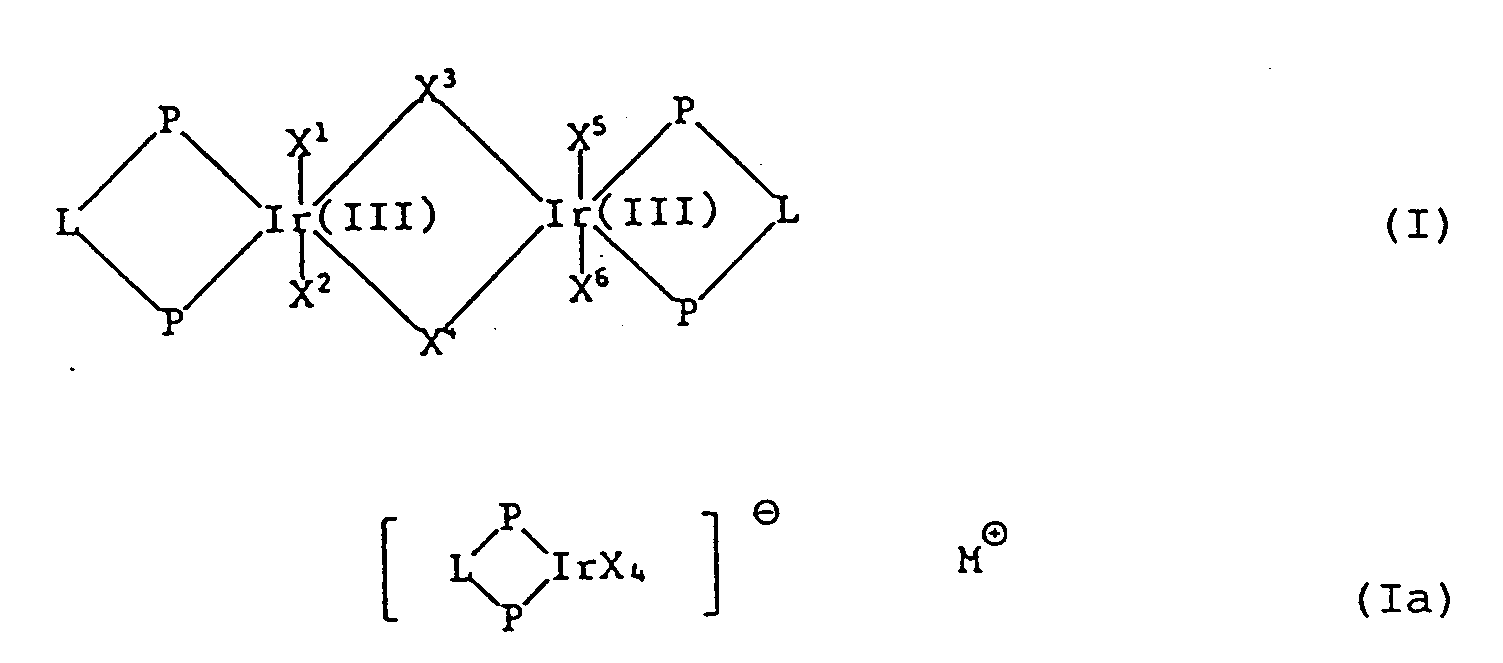
les groupes P-L-P représentent des ligands de la catégorie de diphosphines et de diphosphinites ditertiaires, dont les groupes de phosphines ou de phosphinites P sont reliés par 2 à 4 atomes de carbone et qui forment avec les atomes d'iridium des cycles à 5, 6 ou 7 chaînons, X¹, X², X³, X⁴, X⁵ et X⁶ représentent chacun indépendamment les uns des autres le chlore, le brome ou l'iode, ou bien X¹ et X⁶ l'hydrogène et X², X³, X⁴ et X⁵ le chlore, le brome ou l'iode, ou encore X¹ et X⁵ l'hydrogène et X², X³, X⁴ et X⁶ le chlore, le brome ou l'iode, et M⊕ désigne un cation de métal alcalin ou ammonium quaternaire. - Composés selon la revendication 1, dans lesquels les groupes de phosphine et phosphinite comportent deux radicaux identiques ou différents pris parmi des C₁-C₁₂-alkyles linéaires ou ramifiés, des C₅-C₈-cycloalkyles non substitués ou portant un C₁-C₆-alkyle, et les radicaux phényle et benzyle éventuellement substitués par un C₁-C₆-alcoxy, un (C₁-C₆-alkyle)₂N-, F, ou un groupe -SO₃H, -SO₃Na ou -COO-C₁-C₆-alkyle.
- Composés selon la revendication 2, dans lesquels les groupes de phosphine et phosphinite comportent chacun deux radicaux phényle.
- Composés selon la revendication 1, dans lesquels L est un C₂-C₄-alkylène linéaire sans substituants ou avec comme substituants un C₁-C₆-alkyle, un C₅- ou C₆-cycloalkyle, un phényle, un naphtyle ou un benzyle ; un 1,2- ou 1,3-cycloalkylène ou -cycloalcénylène, -bicycloalkylène ou -bicycloalcénylène avec de 4 à 10 atomes de carbone, qui peuvent être sans substituants ou substitués par un C₁-C₆-alkyle, un phényle ou un benzyle ; ou encore de tels radicaux cycliques avec un groupe méthylène ou C₂-C₄-alkylidène aux positions 1 et/ou 2 ou à la position 3 ; un 1,4-butylène avec à la position 2,3 un groupe

- Composés selon la revendication 1, dans lesquels L est le radical dioxyle d'un mono- ou disaccharide protégé et P un radical de phosphine secondaire monovalent.
- Composés selon la revendication 1, dans lesquels les groupes P-L-P représentent un énantiomère ou un diastéréo-isomère d'une diphosphine ou d'un diphosphinite ditertiaire.
- Composés selon la revendication 1, dans lesquels le groupe P-L-P est l'un des suivants :

- Composés selon la revendication 7, dans lesquels le groupe P-L-P est un groupe de formule

- Composés selon la revendication 1, dans lesquels, dans la formule I, X¹ et X⁶ représentent l'hydrogène et X² à X⁵ chacun Cl, Br ou I, ou bien X¹ et X⁵ sont l'hydrogène et X², X³, X⁴ et X⁶ chacun Cl, Br ou I.
- Composés selon la revendication 9, dans lesquels, dans la formule I, X² à X⁵ ou bien X², X³, X⁴ et X⁶ sont chacun l'iode.
- Composés selon la revendication 1, dans lesquels, dans la formule I, X¹ à X⁶ sont chacun le chlore, le brome ou l'iode.
- Composés selon la revendication 11, dans lesquels, dans la formule I, X¹ à X⁶ sont chacun l'iode.
- Composés selon la revendication 1, dans lesquels, dans la formule Ia, les quatre X sont le chlore, le brome ou l'iode.
- Composés selon la revendication 13, dans lesquels, dans la formule Ia, les quatre X sont chacun l'iode.
- Composés selon la revendication 1, dans lesquels, dans la formule Ia, M⊕ désigne Li⊕, Na⊕, K⊕ ou un cation (C₁-C₆-alkyl)₄N⊕.
- Procédé de préparation des composés de formules I et Ia ou de mélanges de ces composés, selon la revendication 1, procédé caractérisé en ce que l'on fait réagir à une température élevée dans une cétone comme solvant un composé de formule II

M⊕X⊖ (III)
M⊕ désignant un cation de métal alcalin ou ammonium quaternaire et X le chlore, le brome ou l'iode, ou avec plusieurs de ces sels à la fois. - Emploi de composés de formule I ou Ia ou de leurs mélanges selon la revendication 1 comme catalyseurs homogènes pour l'hydrogénation d'imines substituées sur l'azote.
- Emploi selon la revendication 17, dans lequel, dans les formules I et Ia, le groupe P-L-P est un énantiomère ou un diastéréomère d'une diphosphine ou d'un diphosphinite ditertiaire, pour l'hydrogénation asymétrique d'imines prochirales substituées sur l'azote.
- Procédé de préparation d'amines secondaires par hydrogénation d'imines N-substituées avec de l'hydrogène à une température de -20 à 80°C et sous une pression d'hydrogène de 10⁵ à 5.10⁷ Pa en présence d'un complexe d'iridium comme catalyseur homogène, procédé caractérisé en ce que le catalyseur est un composé de formule I ou Ia selon la revendication 1 ou un mélange de plusieurs de ces composés.
- Procédé selon la revendication 19, pour la préparation d'amines secondaires optiquement actives, procédé caractérisé en ce que, dans les formules I et Ia, le groupe P-L-P représente un énantiomère ou un diastéréomère d'une diphosphine ou d'un diphosphinite ditertiaire et en ce que l'on utilise une imine N-substituée prochirale.
Applications Claiming Priority (2)
| Application Number | Priority Date | Filing Date | Title |
|---|---|---|---|
| CH338789 | 1989-09-18 | ||
| CH3387/89 | 1989-09-18 |
Publications (3)
| Publication Number | Publication Date |
|---|---|
| EP0419409A2 EP0419409A2 (fr) | 1991-03-27 |
| EP0419409A3 EP0419409A3 (en) | 1991-08-21 |
| EP0419409B1 true EP0419409B1 (fr) | 1995-11-02 |
Family
ID=4254868
Family Applications (1)
| Application Number | Title | Priority Date | Filing Date |
|---|---|---|---|
| EP90810684A Expired - Lifetime EP0419409B1 (fr) | 1989-09-18 | 1990-09-11 | Complexes d'iridium, procédé pour les préparer et leur utilisation |
Country Status (5)
| Country | Link |
|---|---|
| US (1) | US5112999A (fr) |
| EP (1) | EP0419409B1 (fr) |
| JP (1) | JP2877929B2 (fr) |
| CA (1) | CA2025458C (fr) |
| DE (1) | DE59009835D1 (fr) |
Families Citing this family (13)
| Publication number | Priority date | Publication date | Assignee | Title |
|---|---|---|---|---|
| CN1139930A (zh) * | 1994-02-02 | 1997-01-08 | 希巴-盖吉股份公司 | 加氢催化剂及其制备方法和加氢方法 |
| SK281759B6 (sk) | 1994-02-02 | 2001-07-10 | Novartis Ag | Spôsob hydrogenácie imínov |
| UA51652C2 (uk) * | 1995-06-08 | 2002-12-16 | Новартіс Аг | Спосіб гідрування імінів |
| HRP960302A2 (en) * | 1995-07-26 | 1998-04-30 | Ciba Geigy Ag | Process for the hydrogenation of imines |
| TW330194B (en) * | 1995-07-27 | 1998-04-21 | Novartis Ag | Process for the hydrogenation of imines |
| AU6733496A (en) * | 1995-07-27 | 1997-02-26 | Novartis Ag | Iridium-diphosphine complexes and process for the hydrogenation of imines |
| DE69833365T2 (de) * | 1997-03-06 | 2006-09-28 | Mitsui Chemicals, Inc. | Verfahren zur herstellung optisch aktiver amine |
| EP0909762B1 (fr) * | 1997-10-14 | 2003-04-09 | Lonza A.G. | Complexes binucléaires d' iridium portant des ligands phosphines, et leur utilisation dans l'hydroamination d'oléfines |
| GB9920285D0 (en) * | 1999-08-27 | 1999-10-27 | Johnson Matthey Plc | Improved catalytic process |
| JP4658289B2 (ja) * | 2000-06-08 | 2011-03-23 | 東ソ−・エフテック株式会社 | 光学活性な含フッ素アミノ酸誘導体の製造方法 |
| EP1485351A4 (fr) * | 2002-03-19 | 2006-05-03 | Bristol Myers Squibb Co | Procede de fabrication de lactames substitues en position 3 et optiquement actifs, par hydrogenation asymetrique de 3-alkylidenelactames |
| CN102153589B (zh) | 2011-02-28 | 2013-01-02 | 大连多相触媒有限公司 | 一种亚胺的不对称加氢催化剂及其合成方法和应用 |
| CN115417777B (zh) * | 2022-08-02 | 2024-08-02 | 西安近代化学研究所 | 一种(s)-2-乙基-n-(1-甲氧基-2-丙基)-6-甲基苯胺的制备方法 |
Family Cites Families (2)
| Publication number | Priority date | Publication date | Assignee | Title |
|---|---|---|---|---|
| US4994615A (en) * | 1986-08-04 | 1991-02-19 | Ciba-Geigy Corporation | Process for the preparation of optically active secondary arylamines |
| US5011995A (en) * | 1987-07-28 | 1991-04-30 | Ciba-Geigy Corporation | Process for the preparation of optically active secondary amines |
-
1990
- 1990-09-11 US US07/580,711 patent/US5112999A/en not_active Expired - Lifetime
- 1990-09-11 EP EP90810684A patent/EP0419409B1/fr not_active Expired - Lifetime
- 1990-09-11 DE DE59009835T patent/DE59009835D1/de not_active Expired - Fee Related
- 1990-09-14 CA CA002025458A patent/CA2025458C/fr not_active Expired - Fee Related
- 1990-09-18 JP JP2246386A patent/JP2877929B2/ja not_active Expired - Fee Related
Non-Patent Citations (3)
| Title |
|---|
| JOURNAL OF ORGANOMETALLIC CHEMISTRY, Band 118, Nr. 2, 05. Oktober 1976; M.A. BENNETT et al., Seiten 205-232 * |
| JOURNAL OF THE CHEMICAL SOCIETY, CHEMICAL COMMUNICATIONS, Band 12, 1990; Y. NG CHEONG CHAN et al., Seiten 869-871 * |
| JOURNAL OF THE CHEMICAL SOCIETY, CHEMICAL COMMUNICATIONS, Nr. 20, 1986; N.W. ALCOCK et al., Seiten 1532-1534 * |
Also Published As
| Publication number | Publication date |
|---|---|
| CA2025458A1 (fr) | 1991-03-19 |
| EP0419409A3 (en) | 1991-08-21 |
| CA2025458C (fr) | 2001-04-24 |
| EP0419409A2 (fr) | 1991-03-27 |
| DE59009835D1 (de) | 1995-12-07 |
| JPH03112995A (ja) | 1991-05-14 |
| US5112999A (en) | 1992-05-12 |
| JP2877929B2 (ja) | 1999-04-05 |
Similar Documents
| Publication | Publication Date | Title |
|---|---|---|
| EP0301457B1 (fr) | Procédé de préparation d'amines secondaires optiquement actives | |
| EP0256982B1 (fr) | Procédé pour la fabrication d'amines aryles secondaires optiquement actives | |
| DE69505312T2 (de) | Verfahren zur hydrierung von iminen | |
| EP0582692B1 (fr) | Ligands diphosphiniques | |
| EP0419409B1 (fr) | Complexes d'iridium, procédé pour les préparer et leur utilisation | |
| EP0794957B1 (fr) | Procede de production de phosphines de metallocenyle optiquement actives | |
| EP0564406A1 (fr) | Ferrocenyldiphosphine comme ligandes de catalyseurs homogènes | |
| DE69605794T2 (de) | Verfahren zur hydrierung von iminen | |
| EP0583433B1 (fr) | Ligands diphosphiniques | |
| DE69223240T2 (de) | Chirale dreizahnige bis-phospholan-liganden | |
| DE19548399A1 (de) | Rutheniumkomplexe mit einem chiralen, zweizähnigen Phosphinoxazolin-Liganden zur enantioselektiven Transferhydrierung von prochiralen Ketonen | |
| DE602004002114T2 (de) | Substituierte ferrocenyldiphosphinligande für homogene hydrogenieringskatalysatoren | |
| DE19523891C1 (de) | Chirale Mangan-triazanonankomplexe und Verfahren zu ihrer Herstellung | |
| EP0553778B1 (fr) | Hydrogénation asymmétrique | |
| EP0218970A2 (fr) | Complexes chiraux de rhodium et de diphosphines pour l'hydrogénation catalytique | |
| DE69614864T2 (de) | Iridium-diphosphin-komplexe und verfahren zur hydrierung von iminen | |
| EP0839135B1 (fr) | Procede de preparation de 1-(p-methoxybenzyl)-1,2,3,4,5,6,7,8-octahydroisoquinoleine optiquement active | |
| EP0302021A2 (fr) | Procédé de préparation d'arylamines secondaires optiquement actives | |
| EP2107065A1 (fr) | Complexe de ruthénium contenant des ligands donneurs de di-phosphore coordonnés (P-P) et leur procédé de fabrication | |
| DE69610563T2 (de) | Verfahren zur hydrierung von iminen | |
| DE4001019A1 (de) | Verfahren zur asymmetrischen hydrierung von (alpha)-ketocarbonylverbindungen zu optisch aktiven (alpha)-hydroxycarbonylverbindungen | |
| DE69607628T2 (de) | Verfahren zur hydrierung von iminen | |
| EP0246196B1 (fr) | Complexes d'iridium optiquement actifs, leur procédé de préparation et leur usage | |
| DE19827163A1 (de) | Verfahren zur katalytischen, unsymmetrischen Disubstitution von Carbonsäureamiden mit 2 unterschiedlichen Grignardreagenzien | |
| EP2220100A2 (fr) | Complexes de platine cycloplatinés chiraux, procédé de preparation et leur utilisation |
Legal Events
| Date | Code | Title | Description |
|---|---|---|---|
| PUAI | Public reference made under article 153(3) epc to a published international application that has entered the european phase |
Free format text: ORIGINAL CODE: 0009012 |
|
| 17P | Request for examination filed |
Effective date: 19900911 |
|
| AK | Designated contracting states |
Kind code of ref document: A2 Designated state(s): BE CH DE FR GB IT LI NL |
|
| PUAL | Search report despatched |
Free format text: ORIGINAL CODE: 0009013 |
|
| AK | Designated contracting states |
Kind code of ref document: A3 Designated state(s): BE CH DE FR GB IT LI NL |
|
| 17Q | First examination report despatched |
Effective date: 19931124 |
|
| GRAA | (expected) grant |
Free format text: ORIGINAL CODE: 0009210 |
|
| AK | Designated contracting states |
Kind code of ref document: B1 Designated state(s): BE CH DE FR GB IT LI NL |
|
| ITF | It: translation for a ep patent filed | ||
| REF | Corresponds to: |
Ref document number: 59009835 Country of ref document: DE Date of ref document: 19951207 |
|
| GBT | Gb: translation of ep patent filed (gb section 77(6)(a)/1977) |
Effective date: 19960115 |
|
| ET | Fr: translation filed | ||
| PLBE | No opposition filed within time limit |
Free format text: ORIGINAL CODE: 0009261 |
|
| STAA | Information on the status of an ep patent application or granted ep patent |
Free format text: STATUS: NO OPPOSITION FILED WITHIN TIME LIMIT |
|
| 26N | No opposition filed | ||
| REG | Reference to a national code |
Ref country code: CH Ref legal event code: PFA Free format text: CIBA-GEIGY AG TRANSFER- NOVARTIS AG |
|
| REG | Reference to a national code |
Ref country code: GB Ref legal event code: 732E |
|
| NLS | Nl: assignments of ep-patents |
Owner name: NOVARTIS AG |
|
| REG | Reference to a national code |
Ref country code: FR Ref legal event code: TP |
|
| REG | Reference to a national code |
Ref country code: CH Ref legal event code: PUE Owner name: NOVARTIS AG TRANSFER- SYNGENTA PARTICIPATIONS AG |
|
| REG | Reference to a national code |
Ref country code: GB Ref legal event code: IF02 |
|
| BECA | Be: change of holder's address |
Free format text: 20020220 *SYNGENTA PARTICIPATIONS A.G.:SCHWARZWALDALLEE 215, CH-4058 BASEL |
|
| REG | Reference to a national code |
Ref country code: CH Ref legal event code: NV Representative=s name: SOLVIAS AG |
|
| PGFP | Annual fee paid to national office [announced via postgrant information from national office to epo] |
Ref country code: GB Payment date: 20030827 Year of fee payment: 14 |
|
| PGFP | Annual fee paid to national office [announced via postgrant information from national office to epo] |
Ref country code: NL Payment date: 20030828 Year of fee payment: 14 |
|
| PGFP | Annual fee paid to national office [announced via postgrant information from national office to epo] |
Ref country code: CH Payment date: 20030901 Year of fee payment: 14 |
|
| PGFP | Annual fee paid to national office [announced via postgrant information from national office to epo] |
Ref country code: DE Payment date: 20030903 Year of fee payment: 14 |
|
| PGFP | Annual fee paid to national office [announced via postgrant information from national office to epo] |
Ref country code: FR Payment date: 20030904 Year of fee payment: 14 |
|
| PGFP | Annual fee paid to national office [announced via postgrant information from national office to epo] |
Ref country code: BE Payment date: 20031001 Year of fee payment: 14 |
|
| NLS | Nl: assignments of ep-patents |
Owner name: SYNGENTA PARTICIPATIONS AG |
|
| REG | Reference to a national code |
Ref country code: FR Ref legal event code: TP |
|
| PG25 | Lapsed in a contracting state [announced via postgrant information from national office to epo] |
Ref country code: GB Free format text: LAPSE BECAUSE OF NON-PAYMENT OF DUE FEES Effective date: 20040911 |
|
| PG25 | Lapsed in a contracting state [announced via postgrant information from national office to epo] |
Ref country code: LI Free format text: LAPSE BECAUSE OF NON-PAYMENT OF DUE FEES Effective date: 20040930 Ref country code: CH Free format text: LAPSE BECAUSE OF NON-PAYMENT OF DUE FEES Effective date: 20040930 Ref country code: BE Free format text: LAPSE BECAUSE OF NON-PAYMENT OF DUE FEES Effective date: 20040930 |
|
| BERE | Be: lapsed |
Owner name: *SYNGENTA PARTICIPATIONS A.G. Effective date: 20040930 |
|
| PG25 | Lapsed in a contracting state [announced via postgrant information from national office to epo] |
Ref country code: NL Free format text: LAPSE BECAUSE OF NON-PAYMENT OF DUE FEES Effective date: 20050401 Ref country code: DE Free format text: LAPSE BECAUSE OF NON-PAYMENT OF DUE FEES Effective date: 20050401 |
|
| GBPC | Gb: european patent ceased through non-payment of renewal fee |
Effective date: 20040911 |
|
| REG | Reference to a national code |
Ref country code: CH Ref legal event code: PL |
|
| PG25 | Lapsed in a contracting state [announced via postgrant information from national office to epo] |
Ref country code: FR Free format text: LAPSE BECAUSE OF NON-PAYMENT OF DUE FEES Effective date: 20050531 |
|
| NLV4 | Nl: lapsed or anulled due to non-payment of the annual fee |
Effective date: 20050401 |
|
| REG | Reference to a national code |
Ref country code: FR Ref legal event code: ST |
|
| PG25 | Lapsed in a contracting state [announced via postgrant information from national office to epo] |
Ref country code: IT Free format text: LAPSE BECAUSE OF NON-PAYMENT OF DUE FEES;WARNING: LAPSES OF ITALIAN PATENTS WITH EFFECTIVE DATE BEFORE 2007 MAY HAVE OCCURRED AT ANY TIME BEFORE 2007. THE CORRECT EFFECTIVE DATE MAY BE DIFFERENT FROM THE ONE RECORDED. Effective date: 20050911 |
|
| BERE | Be: lapsed |
Owner name: *SYNGENTA PARTICIPATIONS A.G. Effective date: 20040930 |