EP0419963A2 - 1,2,3,4-Tetrahydro-5-nitro-pyrimidin-Derivate - Google Patents
1,2,3,4-Tetrahydro-5-nitro-pyrimidin-Derivate Download PDFInfo
- Publication number
- EP0419963A2 EP0419963A2 EP90117702A EP90117702A EP0419963A2 EP 0419963 A2 EP0419963 A2 EP 0419963A2 EP 90117702 A EP90117702 A EP 90117702A EP 90117702 A EP90117702 A EP 90117702A EP 0419963 A2 EP0419963 A2 EP 0419963A2
- Authority
- EP
- European Patent Office
- Prior art keywords
- carbon atoms
- optionally
- cycloalkyl
- mono
- substituted
- Prior art date
- Legal status (The legal status is an assumption and is not a legal conclusion. Google has not performed a legal analysis and makes no representation as to the accuracy of the status listed.)
- Granted
Links
- OLDWKFGUURSDNE-UHFFFAOYSA-N 5-nitro-1,2,3,4-tetrahydropyrimidine Chemical class [O-][N+](=O)C1=CNCNC1 OLDWKFGUURSDNE-UHFFFAOYSA-N 0.000 title claims abstract description 10
- 125000004432 carbon atom Chemical group C* 0.000 claims abstract description 85
- 125000000217 alkyl group Chemical group 0.000 claims abstract description 40
- 125000000753 cycloalkyl group Chemical group 0.000 claims abstract description 40
- 125000000113 cyclohexyl group Chemical group [H]C1([H])C([H])([H])C([H])([H])C([H])(*)C([H])([H])C1([H])[H] 0.000 claims abstract description 20
- 125000005842 heteroatom Chemical group 0.000 claims abstract description 20
- IJGRMHOSHXDMSA-UHFFFAOYSA-N Atomic nitrogen Chemical compound N#N IJGRMHOSHXDMSA-UHFFFAOYSA-N 0.000 claims abstract description 16
- 125000001316 cycloalkyl alkyl group Chemical group 0.000 claims abstract description 13
- 239000002253 acid Substances 0.000 claims abstract description 12
- 125000000999 tert-butyl group Chemical group [H]C([H])([H])C(*)(C([H])([H])[H])C([H])([H])[H] 0.000 claims abstract description 9
- 125000000623 heterocyclic group Chemical group 0.000 claims abstract description 8
- 229910052757 nitrogen Inorganic materials 0.000 claims abstract description 8
- 125000004076 pyridyl group Chemical group 0.000 claims abstract description 8
- 150000003839 salts Chemical class 0.000 claims abstract description 8
- NINIDFKCEFEMDL-UHFFFAOYSA-N Sulfur Chemical compound [S] NINIDFKCEFEMDL-UHFFFAOYSA-N 0.000 claims abstract description 7
- 125000003545 alkoxy group Chemical group 0.000 claims abstract description 7
- QVGXLLKOCUKJST-UHFFFAOYSA-N atomic oxygen Chemical compound [O] QVGXLLKOCUKJST-UHFFFAOYSA-N 0.000 claims abstract description 7
- 125000006310 cycloalkyl amino group Chemical group 0.000 claims abstract description 7
- 125000004663 dialkyl amino group Chemical group 0.000 claims abstract description 7
- 125000004473 dialkylaminocarbonyl group Chemical group 0.000 claims abstract description 7
- 239000001301 oxygen Substances 0.000 claims abstract description 7
- 229910052760 oxygen Inorganic materials 0.000 claims abstract description 7
- 125000003884 phenylalkyl group Chemical group 0.000 claims abstract description 7
- 239000011593 sulfur Substances 0.000 claims abstract description 7
- 229910052717 sulfur Inorganic materials 0.000 claims abstract description 7
- 125000000335 thiazolyl group Chemical group 0.000 claims abstract description 7
- 125000005073 adamantyl group Chemical group C12(CC3CC(CC(C1)C3)C2)* 0.000 claims abstract description 4
- 239000000575 pesticide Substances 0.000 claims abstract description 4
- -1 fluoro-tert-butyl Chemical group 0.000 claims description 106
- 150000001875 compounds Chemical class 0.000 claims description 69
- 238000002360 preparation method Methods 0.000 claims description 39
- 238000000034 method Methods 0.000 claims description 19
- 229910052731 fluorine Inorganic materials 0.000 claims description 17
- 239000011737 fluorine Substances 0.000 claims description 17
- PXGOKWXKJXAPGV-UHFFFAOYSA-N Fluorine Chemical compound FF PXGOKWXKJXAPGV-UHFFFAOYSA-N 0.000 claims description 15
- 125000003118 aryl group Chemical group 0.000 claims description 14
- RAHZWNYVWXNFOC-UHFFFAOYSA-N Sulphur dioxide Chemical compound O=S=O RAHZWNYVWXNFOC-UHFFFAOYSA-N 0.000 claims description 12
- ZAMOUSCENKQFHK-UHFFFAOYSA-N Chlorine atom Chemical compound [Cl] ZAMOUSCENKQFHK-UHFFFAOYSA-N 0.000 claims description 9
- 239000000460 chlorine Substances 0.000 claims description 9
- 229910052801 chlorine Inorganic materials 0.000 claims description 9
- 125000001188 haloalkyl group Chemical group 0.000 claims description 9
- 229920006395 saturated elastomer Polymers 0.000 claims description 9
- 125000001309 chloro group Chemical group Cl* 0.000 claims description 8
- 241000607479 Yersinia pestis Species 0.000 claims description 7
- 239000000126 substance Substances 0.000 claims description 7
- 150000001412 amines Chemical class 0.000 claims description 6
- 239000003085 diluting agent Substances 0.000 claims description 6
- 229910052736 halogen Inorganic materials 0.000 claims description 6
- 150000002367 halogens Chemical group 0.000 claims description 6
- 150000007513 acids Chemical class 0.000 claims description 5
- 125000002496 methyl group Chemical group [H]C([H])([H])* 0.000 claims description 5
- 239000004606 Fillers/Extenders Substances 0.000 claims description 4
- 125000004851 cyclopentylmethyl group Chemical group C1(CCCC1)C* 0.000 claims description 4
- 125000002023 trifluoromethyl group Chemical group FC(F)(F)* 0.000 claims description 4
- 230000002378 acidificating effect Effects 0.000 claims description 3
- 239000003054 catalyst Substances 0.000 claims description 3
- 125000004210 cyclohexylmethyl group Chemical group [H]C([H])(*)C1([H])C([H])([H])C([H])([H])C([H])([H])C([H])([H])C1([H])[H] 0.000 claims description 3
- 125000001797 benzyl group Chemical group [H]C1=C([H])C([H])=C(C([H])=C1[H])C([H])([H])* 0.000 claims description 2
- 125000003917 carbamoyl group Chemical group [H]N([H])C(*)=O 0.000 claims description 2
- 125000001511 cyclopentyl group Chemical group [H]C1([H])C([H])([H])C([H])([H])C([H])(*)C1([H])[H] 0.000 claims description 2
- 125000006260 ethylaminocarbonyl group Chemical group [H]N(C(*)=O)C([H])([H])C([H])([H])[H] 0.000 claims description 2
- 125000001153 fluoro group Chemical group F* 0.000 claims description 2
- WSFSSNUMVMOOMR-NJFSPNSNSA-N methanone Chemical compound O=[14CH2] WSFSSNUMVMOOMR-NJFSPNSNSA-N 0.000 claims description 2
- 125000000286 phenylethyl group Chemical group [H]C1=C([H])C([H])=C(C([H])=C1[H])C([H])([H])C([H])([H])* 0.000 claims description 2
- 125000001436 propyl group Chemical group [H]C([*])([H])C([H])([H])C([H])([H])[H] 0.000 claims description 2
- 239000004094 surface-active agent Substances 0.000 claims description 2
- 125000004429 atom Chemical group 0.000 claims 1
- CSCPPACGZOOCGX-UHFFFAOYSA-N Acetone Chemical compound CC(C)=O CSCPPACGZOOCGX-UHFFFAOYSA-N 0.000 description 39
- 239000004480 active ingredient Substances 0.000 description 33
- 239000002689 soil Substances 0.000 description 22
- 241000238631 Hexapoda Species 0.000 description 19
- 241001465754 Metazoa Species 0.000 description 19
- 239000000203 mixture Substances 0.000 description 19
- 239000002904 solvent Substances 0.000 description 17
- RTZKZFJDLAIYFH-UHFFFAOYSA-N Diethyl ether Chemical compound CCOCC RTZKZFJDLAIYFH-UHFFFAOYSA-N 0.000 description 16
- 239000003995 emulsifying agent Substances 0.000 description 14
- 230000009885 systemic effect Effects 0.000 description 14
- WSFSSNUMVMOOMR-UHFFFAOYSA-N Formaldehyde Chemical compound O=C WSFSSNUMVMOOMR-UHFFFAOYSA-N 0.000 description 13
- 240000007124 Brassica oleracea Species 0.000 description 11
- 238000009472 formulation Methods 0.000 description 11
- XLYOFNOQVPJJNP-UHFFFAOYSA-N water Substances O XLYOFNOQVPJJNP-UHFFFAOYSA-N 0.000 description 10
- 241000196324 Embryophyta Species 0.000 description 9
- ZMXDDKWLCZADIW-UHFFFAOYSA-N N,N-Dimethylformamide Chemical compound CN(C)C=O ZMXDDKWLCZADIW-UHFFFAOYSA-N 0.000 description 9
- 241000238657 Blattella germanica Species 0.000 description 8
- VEXZGXHMUGYJMC-UHFFFAOYSA-N Hydrochloric acid Chemical compound Cl VEXZGXHMUGYJMC-UHFFFAOYSA-N 0.000 description 8
- 235000003899 Brassica oleracea var acephala Nutrition 0.000 description 7
- 235000011301 Brassica oleracea var capitata Nutrition 0.000 description 7
- 235000001169 Brassica oleracea var oleracea Nutrition 0.000 description 7
- 241001608567 Phaedon cochleariae Species 0.000 description 7
- 235000012211 aluminium silicate Nutrition 0.000 description 7
- 230000000694 effects Effects 0.000 description 7
- 229920000151 polyglycol Polymers 0.000 description 7
- 239000010695 polyglycol Substances 0.000 description 7
- QTBSBXVTEAMEQO-UHFFFAOYSA-N Acetic acid Chemical compound CC(O)=O QTBSBXVTEAMEQO-UHFFFAOYSA-N 0.000 description 6
- 239000005995 Aluminium silicate Substances 0.000 description 6
- YMWUJEATGCHHMB-UHFFFAOYSA-N Dichloromethane Chemical compound ClCCl YMWUJEATGCHHMB-UHFFFAOYSA-N 0.000 description 6
- LFQSCWFLJHTTHZ-UHFFFAOYSA-N Ethanol Chemical compound CCO LFQSCWFLJHTTHZ-UHFFFAOYSA-N 0.000 description 6
- 241000254179 Sitophilus granarius Species 0.000 description 6
- YXFVVABEGXRONW-UHFFFAOYSA-N Toluene Chemical compound CC1=CC=CC=C1 YXFVVABEGXRONW-UHFFFAOYSA-N 0.000 description 6
- 125000002877 alkyl aryl group Chemical group 0.000 description 6
- 239000012141 concentrate Substances 0.000 description 6
- 239000002917 insecticide Substances 0.000 description 6
- NLYAJNPCOHFWQQ-UHFFFAOYSA-N kaolin Chemical compound O.O.O=[Al]O[Si](=O)O[Si](=O)O[Al]=O NLYAJNPCOHFWQQ-UHFFFAOYSA-N 0.000 description 6
- 230000002147 killing effect Effects 0.000 description 6
- 241001124076 Aphididae Species 0.000 description 5
- 241001425390 Aphis fabae Species 0.000 description 5
- WKBOTKDWSSQWDR-UHFFFAOYSA-N Bromine atom Chemical compound [Br] WKBOTKDWSSQWDR-UHFFFAOYSA-N 0.000 description 5
- 0 CC1CC2C3=CCCCC3OC3(CC*CC3)C2CC1 Chemical compound CC1CC2C3=CCCCC3OC3(CC*CC3)C2CC1 0.000 description 5
- 241000254173 Coleoptera Species 0.000 description 5
- 241000084475 Delia antiqua Species 0.000 description 5
- GDTBXPJZTBHREO-UHFFFAOYSA-N bromine Substances BrBr GDTBXPJZTBHREO-UHFFFAOYSA-N 0.000 description 5
- 229910052794 bromium Inorganic materials 0.000 description 5
- 238000011156 evaluation Methods 0.000 description 5
- 239000008187 granular material Substances 0.000 description 5
- 125000001424 substituent group Chemical group 0.000 description 5
- 235000011303 Brassica alboglabra Nutrition 0.000 description 4
- 235000011302 Brassica oleracea Nutrition 0.000 description 4
- CURLTUGMZLYLDI-UHFFFAOYSA-N Carbon dioxide Chemical compound O=C=O CURLTUGMZLYLDI-UHFFFAOYSA-N 0.000 description 4
- 241000257166 Lucilia cuprina Species 0.000 description 4
- NBIIXXVUZAFLBC-UHFFFAOYSA-N Phosphoric acid Chemical compound OP(O)(O)=O NBIIXXVUZAFLBC-UHFFFAOYSA-N 0.000 description 4
- 239000013543 active substance Substances 0.000 description 4
- 239000000969 carrier Substances 0.000 description 4
- 238000006243 chemical reaction Methods 0.000 description 4
- VYPSYNLAJGMNEJ-UHFFFAOYSA-N silicon dioxide Inorganic materials O=[Si]=O VYPSYNLAJGMNEJ-UHFFFAOYSA-N 0.000 description 4
- ZWEHNKRNPOVVGH-UHFFFAOYSA-N 2-Butanone Chemical compound CCC(C)=O ZWEHNKRNPOVVGH-UHFFFAOYSA-N 0.000 description 3
- UHOVQNZJYSORNB-UHFFFAOYSA-N Benzene Chemical compound C1=CC=CC=C1 UHOVQNZJYSORNB-UHFFFAOYSA-N 0.000 description 3
- OFOBLEOULBTSOW-UHFFFAOYSA-N Malonic acid Chemical compound OC(=O)CC(O)=O OFOBLEOULBTSOW-UHFFFAOYSA-N 0.000 description 3
- MUBZPKHOEPUJKR-UHFFFAOYSA-N Oxalic acid Chemical compound OC(=O)C(O)=O MUBZPKHOEPUJKR-UHFFFAOYSA-N 0.000 description 3
- OFBQJSOFQDEBGM-UHFFFAOYSA-N Pentane Chemical compound CCCCC OFBQJSOFQDEBGM-UHFFFAOYSA-N 0.000 description 3
- 239000012876 carrier material Substances 0.000 description 3
- KRKNYBCHXYNGOX-UHFFFAOYSA-N citric acid Chemical class OC(=O)CC(O)(C(O)=O)CC(O)=O KRKNYBCHXYNGOX-UHFFFAOYSA-N 0.000 description 3
- 230000006378 damage Effects 0.000 description 3
- 150000002170 ethers Chemical class 0.000 description 3
- 235000013312 flour Nutrition 0.000 description 3
- 125000005843 halogen group Chemical group 0.000 description 3
- 230000000749 insecticidal effect Effects 0.000 description 3
- 239000007788 liquid Substances 0.000 description 3
- VLKZOEOYAKHREP-UHFFFAOYSA-N n-Hexane Chemical compound CCCCCC VLKZOEOYAKHREP-UHFFFAOYSA-N 0.000 description 3
- 239000003960 organic solvent Substances 0.000 description 3
- 150000003254 radicals Chemical class 0.000 description 3
- 239000011435 rock Substances 0.000 description 3
- 239000007787 solid Substances 0.000 description 3
- 239000007858 starting material Substances 0.000 description 3
- RFFLAFLAYFXFSW-UHFFFAOYSA-N 1,2-dichlorobenzene Chemical compound ClC1=CC=CC=C1Cl RFFLAFLAYFXFSW-UHFFFAOYSA-N 0.000 description 2
- ALNDHUQPXHHNON-UHFFFAOYSA-N 2-chloro-5-[[2-(nitromethylidene)imidazolidin-1-yl]methyl]pyridine Chemical compound [O-][N+](=O)C=C1NCCN1CC1=CC=C(Cl)N=C1 ALNDHUQPXHHNON-UHFFFAOYSA-N 0.000 description 2
- BMYNFMYTOJXKLE-UHFFFAOYSA-N 3-azaniumyl-2-hydroxypropanoate Chemical compound NCC(O)C(O)=O BMYNFMYTOJXKLE-UHFFFAOYSA-N 0.000 description 2
- DWMVUWJLTQPBBS-UHFFFAOYSA-N 4-(2-cyclohexylpropan-2-yl)cyclohexan-1-amine Chemical compound C1CC(N)CCC1C(C)(C)C1CCCCC1 DWMVUWJLTQPBBS-UHFFFAOYSA-N 0.000 description 2
- 241000238876 Acari Species 0.000 description 2
- 241000238421 Arthropoda Species 0.000 description 2
- CIWBSHSKHKDKBQ-JLAZNSOCSA-N Ascorbic acid Chemical class OC[C@H](O)[C@H]1OC(=O)C(O)=C1O CIWBSHSKHKDKBQ-JLAZNSOCSA-N 0.000 description 2
- HEDRZPFGACZZDS-UHFFFAOYSA-N Chloroform Chemical compound ClC(Cl)Cl HEDRZPFGACZZDS-UHFFFAOYSA-N 0.000 description 2
- XDTMQSROBMDMFD-UHFFFAOYSA-N Cyclohexane Chemical compound C1CCCCC1 XDTMQSROBMDMFD-UHFFFAOYSA-N 0.000 description 2
- LCGLNKUTAGEVQW-UHFFFAOYSA-N Dimethyl ether Chemical compound COC LCGLNKUTAGEVQW-UHFFFAOYSA-N 0.000 description 2
- IAZDPXIOMUYVGZ-UHFFFAOYSA-N Dimethylsulphoxide Chemical compound CS(C)=O IAZDPXIOMUYVGZ-UHFFFAOYSA-N 0.000 description 2
- LYCAIKOWRPUZTN-UHFFFAOYSA-N Ethylene glycol Chemical compound OCCO LYCAIKOWRPUZTN-UHFFFAOYSA-N 0.000 description 2
- VZCYOOQTPOCHFL-OWOJBTEDSA-N Fumaric acid Chemical compound OC(=O)\C=C\C(O)=O VZCYOOQTPOCHFL-OWOJBTEDSA-N 0.000 description 2
- 241000258937 Hemiptera Species 0.000 description 2
- 241000257303 Hymenoptera Species 0.000 description 2
- XEEYBQQBJWHFJM-UHFFFAOYSA-N Iron Chemical class [Fe] XEEYBQQBJWHFJM-UHFFFAOYSA-N 0.000 description 2
- UQSXHKLRYXJYBZ-UHFFFAOYSA-N Iron oxide Chemical compound [Fe]=O UQSXHKLRYXJYBZ-UHFFFAOYSA-N 0.000 description 2
- KFZMGEQAYNKOFK-UHFFFAOYSA-N Isopropanol Chemical compound CC(C)O KFZMGEQAYNKOFK-UHFFFAOYSA-N 0.000 description 2
- AFVFQIVMOAPDHO-UHFFFAOYSA-N Methanesulfonic acid Chemical compound CS(O)(=O)=O AFVFQIVMOAPDHO-UHFFFAOYSA-N 0.000 description 2
- 241000721621 Myzus persicae Species 0.000 description 2
- LRHPLDYGYMQRHN-UHFFFAOYSA-N N-Butanol Chemical compound CCCCO LRHPLDYGYMQRHN-UHFFFAOYSA-N 0.000 description 2
- IMNFDUFMRHMDMM-UHFFFAOYSA-N N-Heptane Chemical compound CCCCCCC IMNFDUFMRHMDMM-UHFFFAOYSA-N 0.000 description 2
- PVNIIMVLHYAWGP-UHFFFAOYSA-N Niacin Chemical class OC(=O)C1=CC=CN=C1 PVNIIMVLHYAWGP-UHFFFAOYSA-N 0.000 description 2
- CTQNGGLPUBDAKN-UHFFFAOYSA-N O-Xylene Chemical compound CC1=CC=CC=C1C CTQNGGLPUBDAKN-UHFFFAOYSA-N 0.000 description 2
- 229920003171 Poly (ethylene oxide) Polymers 0.000 description 2
- ATUOYWHBWRKTHZ-UHFFFAOYSA-N Propane Chemical compound CCC ATUOYWHBWRKTHZ-UHFFFAOYSA-N 0.000 description 2
- QAOWNCQODCNURD-UHFFFAOYSA-N Sulfuric acid Chemical compound OS(O)(=O)=O QAOWNCQODCNURD-UHFFFAOYSA-N 0.000 description 2
- WYURNTSHIVDZCO-UHFFFAOYSA-N Tetrahydrofuran Chemical compound C1CCOC1 WYURNTSHIVDZCO-UHFFFAOYSA-N 0.000 description 2
- 240000006677 Vicia faba Species 0.000 description 2
- 235000010749 Vicia faba Nutrition 0.000 description 2
- 150000001298 alcohols Chemical class 0.000 description 2
- 150000001338 aliphatic hydrocarbons Chemical class 0.000 description 2
- 229910000147 aluminium phosphate Inorganic materials 0.000 description 2
- 239000007864 aqueous solution Substances 0.000 description 2
- WPYMKLBDIGXBTP-UHFFFAOYSA-N benzoic acid Chemical compound OC(=O)C1=CC=CC=C1 WPYMKLBDIGXBTP-UHFFFAOYSA-N 0.000 description 2
- 235000010233 benzoic acid Nutrition 0.000 description 2
- 229910002092 carbon dioxide Inorganic materials 0.000 description 2
- 239000003795 chemical substances by application Substances 0.000 description 2
- MVPPADPHJFYWMZ-UHFFFAOYSA-N chlorobenzene Chemical compound ClC1=CC=CC=C1 MVPPADPHJFYWMZ-UHFFFAOYSA-N 0.000 description 2
- JHIVVAPYMSGYDF-UHFFFAOYSA-N cyclohexanone Chemical compound O=C1CCCCC1 JHIVVAPYMSGYDF-UHFFFAOYSA-N 0.000 description 2
- XBDQKXXYIPTUBI-UHFFFAOYSA-N dimethylselenoniopropionate Natural products CCC(O)=O XBDQKXXYIPTUBI-UHFFFAOYSA-N 0.000 description 2
- 239000002270 dispersing agent Substances 0.000 description 2
- 239000000975 dye Substances 0.000 description 2
- 244000078703 ectoparasite Species 0.000 description 2
- 239000013057 ectoparasiticide Substances 0.000 description 2
- 150000008282 halocarbons Chemical class 0.000 description 2
- PNDPGZBMCMUPRI-UHFFFAOYSA-N iodine Chemical compound II PNDPGZBMCMUPRI-UHFFFAOYSA-N 0.000 description 2
- BDAGIHXWWSANSR-UHFFFAOYSA-N methanoic acid Chemical class OC=O BDAGIHXWWSANSR-UHFFFAOYSA-N 0.000 description 2
- 239000003208 petroleum Substances 0.000 description 2
- XNGIFLGASWRNHJ-UHFFFAOYSA-N phthalic acid Chemical class OC(=O)C1=CC=CC=C1C(O)=O XNGIFLGASWRNHJ-UHFFFAOYSA-N 0.000 description 2
- 239000004033 plastic Substances 0.000 description 2
- 229920003023 plastic Polymers 0.000 description 2
- 239000000843 powder Substances 0.000 description 2
- BDERNNFJNOPAEC-UHFFFAOYSA-N propan-1-ol Chemical compound CCCO BDERNNFJNOPAEC-UHFFFAOYSA-N 0.000 description 2
- 238000005507 spraying Methods 0.000 description 2
- VZGDMQKNWNREIO-UHFFFAOYSA-N tetrachloromethane Chemical compound ClC(Cl)(Cl)Cl VZGDMQKNWNREIO-UHFFFAOYSA-N 0.000 description 2
- VZCYOOQTPOCHFL-UHFFFAOYSA-N trans-butenedioic acid Natural products OC(=O)C=CC(O)=O VZCYOOQTPOCHFL-UHFFFAOYSA-N 0.000 description 2
- 239000008096 xylene Substances 0.000 description 2
- 125000004178 (C1-C4) alkyl group Chemical group 0.000 description 1
- BJEPYKJPYRNKOW-REOHCLBHSA-N (S)-malic acid Chemical compound OC(=O)[C@@H](O)CC(O)=O BJEPYKJPYRNKOW-REOHCLBHSA-N 0.000 description 1
- 125000004529 1,2,3-triazinyl group Chemical group N1=NN=C(C=C1)* 0.000 description 1
- 125000001376 1,2,4-triazolyl group Chemical group N1N=C(N=C1)* 0.000 description 1
- 125000004506 1,2,5-oxadiazolyl group Chemical group 0.000 description 1
- WSLDOOZREJYCGB-UHFFFAOYSA-N 1,2-Dichloroethane Chemical compound ClCCCl WSLDOOZREJYCGB-UHFFFAOYSA-N 0.000 description 1
- RYHBNJHYFVUHQT-UHFFFAOYSA-N 1,4-Dioxane Chemical compound C1COCCO1 RYHBNJHYFVUHQT-UHFFFAOYSA-N 0.000 description 1
- DURPTKYDGMDSBL-UHFFFAOYSA-N 1-butoxybutane Chemical compound CCCCOCCCC DURPTKYDGMDSBL-UHFFFAOYSA-N 0.000 description 1
- XNWFRZJHXBZDAG-UHFFFAOYSA-N 2-METHOXYETHANOL Chemical compound COCCO XNWFRZJHXBZDAG-UHFFFAOYSA-N 0.000 description 1
- LBLYYCQCTBFVLH-UHFFFAOYSA-N 2-Methylbenzenesulfonic acid Chemical class CC1=CC=CC=C1S(O)(=O)=O LBLYYCQCTBFVLH-UHFFFAOYSA-N 0.000 description 1
- OKDGRDCXVWSXDC-UHFFFAOYSA-N 2-chloropyridine Chemical compound ClC1=CC=CC=N1 OKDGRDCXVWSXDC-UHFFFAOYSA-N 0.000 description 1
- LATZNTJAPMNLAZ-UHFFFAOYSA-N 2h-pyrimido[4,5-e]thiazine Chemical class N1=CN=C2C=CNSC2=C1 LATZNTJAPMNLAZ-UHFFFAOYSA-N 0.000 description 1
- OSWFIVFLDKOXQC-UHFFFAOYSA-N 4-(3-methoxyphenyl)aniline Chemical class COC1=CC=CC(C=2C=CC(N)=CC=2)=C1 OSWFIVFLDKOXQC-UHFFFAOYSA-N 0.000 description 1
- OQQQMKLWZDFAJM-UHFFFAOYSA-N 7-ethyl-9-nitro-3,4,6,8-tetrahydro-2h-pyrimido[6,1-b][1,3]thiazine Chemical compound C1CCSC2=C([N+]([O-])=O)CN(CC)CN21 OQQQMKLWZDFAJM-UHFFFAOYSA-N 0.000 description 1
- 244000215068 Acacia senegal Species 0.000 description 1
- 241001143309 Acanthoscelides obtectus Species 0.000 description 1
- 241000238818 Acheta domesticus Species 0.000 description 1
- 241000256111 Aedes <genus> Species 0.000 description 1
- 241000902874 Agelastica alni Species 0.000 description 1
- 241001136265 Agriotes Species 0.000 description 1
- 241000218473 Agrotis Species 0.000 description 1
- RGCKGOZRHPZPFP-UHFFFAOYSA-N Alizarin Natural products C1=CC=C2C(=O)C3=C(O)C(O)=CC=C3C(=O)C2=C1 RGCKGOZRHPZPFP-UHFFFAOYSA-N 0.000 description 1
- 244000291564 Allium cepa Species 0.000 description 1
- 235000002732 Allium cepa var. cepa Nutrition 0.000 description 1
- 241001398046 Amphimallon solstitiale Species 0.000 description 1
- 241000411449 Anobium punctatum Species 0.000 description 1
- 241000256186 Anopheles <genus> Species 0.000 description 1
- 241001427556 Anoplura Species 0.000 description 1
- 241000254177 Anthonomus Species 0.000 description 1
- 241001640910 Anthrenus Species 0.000 description 1
- 241001414828 Aonidiella aurantii Species 0.000 description 1
- 241001600407 Aphis <genus> Species 0.000 description 1
- 241001600408 Aphis gossypii Species 0.000 description 1
- 241001095118 Aphis pomi Species 0.000 description 1
- 241000239223 Arachnida Species 0.000 description 1
- 241001162025 Archips podana Species 0.000 description 1
- 241000722809 Armadillidium vulgare Species 0.000 description 1
- 240000003291 Armoracia rusticana Species 0.000 description 1
- 235000011330 Armoracia rusticana Nutrition 0.000 description 1
- 241000387321 Aspidiotus nerii Species 0.000 description 1
- 241001174347 Atomaria Species 0.000 description 1
- 241000221377 Auricularia Species 0.000 description 1
- 241001490249 Bactrocera oleae Species 0.000 description 1
- 241000254127 Bemisia tabaci Species 0.000 description 1
- 241001028523 Bentholebouria blatta Species 0.000 description 1
- 239000005711 Benzoic acid Substances 0.000 description 1
- 241001142392 Bibio Species 0.000 description 1
- 241001573716 Blaniulus guttulatus Species 0.000 description 1
- ZOXJGFHDIHLPTG-UHFFFAOYSA-N Boron Chemical compound [B] ZOXJGFHDIHLPTG-UHFFFAOYSA-N 0.000 description 1
- 241000283690 Bos taurus Species 0.000 description 1
- 241000913391 Brachionus forficula Species 0.000 description 1
- 241000982105 Brevicoryne brassicae Species 0.000 description 1
- 241001517925 Bucculatrix Species 0.000 description 1
- 241001491790 Bupalus piniaria Species 0.000 description 1
- AZGOFFNHYACOHO-UHFFFAOYSA-N CC(CC1)CC(C2)=C1CCC2NC(C)=O Chemical compound CC(CC1)CC(C2)=C1CCC2NC(C)=O AZGOFFNHYACOHO-UHFFFAOYSA-N 0.000 description 1
- ACOSFZBEJALWKR-UHFFFAOYSA-N CCCC(CCC)(C1C2CC(C)CC1)OC1C2=CCCC1 Chemical compound CCCC(CCC)(C1C2CC(C)CC1)OC1C2=CCCC1 ACOSFZBEJALWKR-UHFFFAOYSA-N 0.000 description 1
- 101100232929 Caenorhabditis elegans pat-4 gene Proteins 0.000 description 1
- 229910021532 Calcite Inorganic materials 0.000 description 1
- 241000257163 Calliphora vicina Species 0.000 description 1
- 241001350371 Capua Species 0.000 description 1
- 229920002134 Carboxymethyl cellulose Polymers 0.000 description 1
- 241001107116 Castanospermum australe Species 0.000 description 1
- 241000255579 Ceratitis capitata Species 0.000 description 1
- 241001098608 Ceratophyllus Species 0.000 description 1
- 241000426499 Chilo Species 0.000 description 1
- 241000258920 Chilopoda Species 0.000 description 1
- 241000255942 Choristoneura fumiferana Species 0.000 description 1
- 241001124134 Chrysomelidae Species 0.000 description 1
- 241001327638 Cimex lectularius Species 0.000 description 1
- 244000060011 Cocos nucifera Species 0.000 description 1
- 235000013162 Cocos nucifera Nutrition 0.000 description 1
- 241001427559 Collembola Species 0.000 description 1
- 241000683561 Conoderus Species 0.000 description 1
- RYGMFSIKBFXOCR-UHFFFAOYSA-N Copper Chemical compound [Cu] RYGMFSIKBFXOCR-UHFFFAOYSA-N 0.000 description 1
- 241001212534 Cosmopolites sordidus Species 0.000 description 1
- 241000500845 Costelytra zealandica Species 0.000 description 1
- 241001214984 Crinum thaianum Species 0.000 description 1
- 241001094916 Cryptomyzus ribis Species 0.000 description 1
- 241000256054 Culex <genus> Species 0.000 description 1
- 241000692095 Cuterebra Species 0.000 description 1
- 241001124144 Dermaptera Species 0.000 description 1
- 241001641895 Dermestes Species 0.000 description 1
- FEWJPZIEWOKRBE-JCYAYHJZSA-N Dextrotartaric acid Chemical compound OC(=O)[C@H](O)[C@@H](O)C(O)=O FEWJPZIEWOKRBE-JCYAYHJZSA-N 0.000 description 1
- 241000489975 Diabrotica Species 0.000 description 1
- XTHFKEDIFFGKHM-UHFFFAOYSA-N Dimethoxyethane Chemical compound COCCOC XTHFKEDIFFGKHM-UHFFFAOYSA-N 0.000 description 1
- 241000258963 Diplopoda Species 0.000 description 1
- 241000511318 Diprion Species 0.000 description 1
- 241000255925 Diptera Species 0.000 description 1
- 241000255601 Drosophila melanogaster Species 0.000 description 1
- 241001425477 Dysdercus Species 0.000 description 1
- 241000353522 Earias insulana Species 0.000 description 1
- 241000122098 Ephestia kuehniella Species 0.000 description 1
- 241000462639 Epilachna varivestis Species 0.000 description 1
- 241000917107 Eriosoma lanigerum Species 0.000 description 1
- 241000060469 Eupoecilia ambiguella Species 0.000 description 1
- 241000483001 Euproctis chrysorrhoea Species 0.000 description 1
- 241000515838 Eurygaster Species 0.000 description 1
- 241001585293 Euxoa Species 0.000 description 1
- 241000371383 Fannia Species 0.000 description 1
- 241000233488 Feltia Species 0.000 description 1
- 241000255896 Galleria mellonella Species 0.000 description 1
- 241001660203 Gasterophilus Species 0.000 description 1
- 241000723283 Geophilus carpophagus Species 0.000 description 1
- 241001043186 Gibbium Species 0.000 description 1
- 241001243091 Gryllotalpa Species 0.000 description 1
- 229920000084 Gum arabic Polymers 0.000 description 1
- 241000790933 Haematopinus Species 0.000 description 1
- 241000256257 Heliothis Species 0.000 description 1
- 241001659688 Hercinothrips femoralis Species 0.000 description 1
- 241001466007 Heteroptera Species 0.000 description 1
- 241001201623 Hofmannophila pseudospretella Species 0.000 description 1
- 241000679711 Homona Species 0.000 description 1
- 241001417351 Hoplocampa Species 0.000 description 1
- 241001251909 Hyalopterus pruni Species 0.000 description 1
- 241000832180 Hylotrupes bajulus Species 0.000 description 1
- 241001508566 Hypera postica Species 0.000 description 1
- 241000257176 Hypoderma <fly> Species 0.000 description 1
- 241001495069 Ischnocera Species 0.000 description 1
- 241001149911 Isopoda Species 0.000 description 1
- 241000256602 Isoptera Species 0.000 description 1
- 239000005909 Kieselgur Substances 0.000 description 1
- 241001470017 Laodelphax striatella Species 0.000 description 1
- 241000256686 Lasius <genus> Species 0.000 description 1
- 241000238866 Latrodectus mactans Species 0.000 description 1
- 241000255777 Lepidoptera Species 0.000 description 1
- 241000500881 Lepisma Species 0.000 description 1
- 241000258916 Leptinotarsa decemlineata Species 0.000 description 1
- 241001113970 Linognathus Species 0.000 description 1
- 241000254025 Locusta migratoria migratorioides Species 0.000 description 1
- 241000257162 Lucilia <blowfly> Species 0.000 description 1
- 241000920471 Lucilia caesar Species 0.000 description 1
- 241000721696 Lymantria Species 0.000 description 1
- 241000255685 Malacosoma neustria Species 0.000 description 1
- 241000555303 Mamestra brassicae Species 0.000 description 1
- 241001415015 Melanoplus differentialis Species 0.000 description 1
- 241000254099 Melolontha melolontha Species 0.000 description 1
- NTIZESTWPVYFNL-UHFFFAOYSA-N Methyl isobutyl ketone Chemical compound CC(C)CC(C)=O NTIZESTWPVYFNL-UHFFFAOYSA-N 0.000 description 1
- UIHCLUNTQKBZGK-UHFFFAOYSA-N Methyl isobutyl ketone Natural products CCC(C)C(C)=O UIHCLUNTQKBZGK-UHFFFAOYSA-N 0.000 description 1
- ZOKXTWBITQBERF-UHFFFAOYSA-N Molybdenum Chemical compound [Mo] ZOKXTWBITQBERF-UHFFFAOYSA-N 0.000 description 1
- 241000952627 Monomorium pharaonis Species 0.000 description 1
- 241000257229 Musca <genus> Species 0.000 description 1
- 241000721623 Myzus Species 0.000 description 1
- 241000244206 Nematoda Species 0.000 description 1
- 241000358422 Nephotettix cincticeps Species 0.000 description 1
- 244000061176 Nicotiana tabacum Species 0.000 description 1
- 235000002637 Nicotiana tabacum Nutrition 0.000 description 1
- 241001556089 Nilaparvata lugens Species 0.000 description 1
- 241001385056 Niptus hololeucus Species 0.000 description 1
- GRYLNZFGIOXLOG-UHFFFAOYSA-N Nitric acid Chemical compound O[N+]([O-])=O GRYLNZFGIOXLOG-UHFFFAOYSA-N 0.000 description 1
- IGFHQQFPSIBGKE-UHFFFAOYSA-N Nonylphenol Natural products CCCCCCCCCC1=CC=C(O)C=C1 IGFHQQFPSIBGKE-UHFFFAOYSA-N 0.000 description 1
- 241000384103 Oniscus asellus Species 0.000 description 1
- 241000963703 Onychiurus armatus Species 0.000 description 1
- 241001491877 Operophtera brumata Species 0.000 description 1
- 241000238814 Orthoptera Species 0.000 description 1
- 241000131101 Oryzaephilus surinamensis Species 0.000 description 1
- 241000975417 Oscinella frit Species 0.000 description 1
- 241001147398 Ostrinia nubilalis Species 0.000 description 1
- 241000486438 Panolis flammea Species 0.000 description 1
- 241001450657 Parthenolecanium corni Species 0.000 description 1
- 241000721451 Pectinophora gossypiella Species 0.000 description 1
- 241000517306 Pediculus humanus corporis Species 0.000 description 1
- 241000721454 Pemphigus Species 0.000 description 1
- 241000238675 Periplaneta americana Species 0.000 description 1
- 241001608568 Phaedon Species 0.000 description 1
- 244000046052 Phaseolus vulgaris Species 0.000 description 1
- 235000010627 Phaseolus vulgaris Nutrition 0.000 description 1
- 241001525654 Phyllocnistis citrella Species 0.000 description 1
- 241001517955 Phyllonorycter blancardella Species 0.000 description 1
- 241000690748 Piesma Species 0.000 description 1
- 241000500437 Plutella xylostella Species 0.000 description 1
- 239000004372 Polyvinyl alcohol Substances 0.000 description 1
- 241000908127 Porcellio scaber Species 0.000 description 1
- 235000005805 Prunus cerasus Nutrition 0.000 description 1
- 241000722234 Pseudococcus Species 0.000 description 1
- 241000526145 Psylla Species 0.000 description 1
- 241001180370 Psylliodes chrysocephalus Species 0.000 description 1
- CZPWVGJYEJSRLH-UHFFFAOYSA-N Pyrimidine Chemical compound C1=CN=CN=C1 CZPWVGJYEJSRLH-UHFFFAOYSA-N 0.000 description 1
- 241001509970 Reticulitermes <genus> Species 0.000 description 1
- 241000722249 Rhodnius prolixus Species 0.000 description 1
- 241001510236 Rhyparobia maderae Species 0.000 description 1
- 241000318997 Rhyzopertha dominica Species 0.000 description 1
- 229910006069 SO3H Inorganic materials 0.000 description 1
- 241000316887 Saissetia oleae Species 0.000 description 1
- 241000253973 Schistocerca gregaria Species 0.000 description 1
- 241000522594 Scorpio maurus Species 0.000 description 1
- 241001157779 Scutigera Species 0.000 description 1
- 241001313237 Scutigerella immaculata Species 0.000 description 1
- 239000004113 Sepiolite Substances 0.000 description 1
- 241000258242 Siphonaptera Species 0.000 description 1
- 241000180219 Sitobion avenae Species 0.000 description 1
- 241000254181 Sitophilus Species 0.000 description 1
- 241000256248 Spodoptera Species 0.000 description 1
- 241000256247 Spodoptera exigua Species 0.000 description 1
- 241000985245 Spodoptera litura Species 0.000 description 1
- KDYFGRWQOYBRFD-UHFFFAOYSA-N Succinic acid Natural products OC(=O)CCC(O)=O KDYFGRWQOYBRFD-UHFFFAOYSA-N 0.000 description 1
- LSNNMFCWUKXFEE-UHFFFAOYSA-N Sulfurous acid Chemical compound OS(O)=O LSNNMFCWUKXFEE-UHFFFAOYSA-N 0.000 description 1
- 241000883295 Symphyla Species 0.000 description 1
- 241000255626 Tabanus <genus> Species 0.000 description 1
- FEWJPZIEWOKRBE-UHFFFAOYSA-N Tartaric acid Natural products [H+].[H+].[O-]C(=O)C(O)C(O)C([O-])=O FEWJPZIEWOKRBE-UHFFFAOYSA-N 0.000 description 1
- 241000254109 Tenebrio molitor Species 0.000 description 1
- 241000339374 Thrips tabaci Species 0.000 description 1
- 241001414989 Thysanoptera Species 0.000 description 1
- 241000130771 Tinea pellionella Species 0.000 description 1
- 241000333690 Tineola bisselliella Species 0.000 description 1
- 241000511627 Tipula paludosa Species 0.000 description 1
- GWEVSGVZZGPLCZ-UHFFFAOYSA-N Titan oxide Chemical compound O=[Ti]=O GWEVSGVZZGPLCZ-UHFFFAOYSA-N 0.000 description 1
- 241000018137 Trialeurodes vaporariorum Species 0.000 description 1
- 241001414833 Triatoma Species 0.000 description 1
- 241000254086 Tribolium <beetle> Species 0.000 description 1
- 241001259047 Trichodectes Species 0.000 description 1
- 241000267823 Trogoderma Species 0.000 description 1
- BZHJMEDXRYGGRV-UHFFFAOYSA-N Vinyl chloride Chemical class ClC=C BZHJMEDXRYGGRV-UHFFFAOYSA-N 0.000 description 1
- 241001274788 Viteus vitifoliae Species 0.000 description 1
- 235000013447 Xanthosoma atrovirens Nutrition 0.000 description 1
- 240000001781 Xanthosoma sagittifolium Species 0.000 description 1
- 241000353223 Xenopsylla cheopis Species 0.000 description 1
- 241001466337 Yponomeuta Species 0.000 description 1
- 240000008042 Zea mays Species 0.000 description 1
- 235000005824 Zea mays ssp. parviglumis Nutrition 0.000 description 1
- 235000002017 Zea mays subsp mays Nutrition 0.000 description 1
- HCHKCACWOHOZIP-UHFFFAOYSA-N Zinc Chemical compound [Zn] HCHKCACWOHOZIP-UHFFFAOYSA-N 0.000 description 1
- 241001414985 Zygentoma Species 0.000 description 1
- 239000000205 acacia gum Substances 0.000 description 1
- 235000010489 acacia gum Nutrition 0.000 description 1
- 230000000895 acaricidal effect Effects 0.000 description 1
- 239000000642 acaricide Substances 0.000 description 1
- 239000000654 additive Substances 0.000 description 1
- 239000000853 adhesive Substances 0.000 description 1
- 230000001070 adhesive effect Effects 0.000 description 1
- 239000000443 aerosol Substances 0.000 description 1
- 125000001931 aliphatic group Chemical group 0.000 description 1
- HFVAFDPGUJEFBQ-UHFFFAOYSA-M alizarin red S Chemical compound [Na+].O=C1C2=CC=CC=C2C(=O)C2=C1C=C(S([O-])(=O)=O)C(O)=C2O HFVAFDPGUJEFBQ-UHFFFAOYSA-M 0.000 description 1
- 239000003513 alkali Substances 0.000 description 1
- 150000008055 alkyl aryl sulfonates Chemical class 0.000 description 1
- 150000008051 alkyl sulfates Chemical class 0.000 description 1
- 229940045714 alkyl sulfonate alkylating agent Drugs 0.000 description 1
- 150000008052 alkyl sulfonates Chemical class 0.000 description 1
- 125000004390 alkyl sulfonyl group Chemical group 0.000 description 1
- 125000004414 alkyl thio group Chemical group 0.000 description 1
- BJEPYKJPYRNKOW-UHFFFAOYSA-N alpha-hydroxysuccinic acid Natural products OC(=O)C(O)CC(O)=O BJEPYKJPYRNKOW-UHFFFAOYSA-N 0.000 description 1
- 125000000129 anionic group Chemical group 0.000 description 1
- 125000003710 aryl alkyl group Chemical group 0.000 description 1
- 125000004391 aryl sulfonyl group Chemical group 0.000 description 1
- 235000010323 ascorbic acid Nutrition 0.000 description 1
- 239000011668 ascorbic acid Chemical class 0.000 description 1
- 229960005070 ascorbic acid Drugs 0.000 description 1
- 229960000892 attapulgite Drugs 0.000 description 1
- 239000005667 attractant Substances 0.000 description 1
- 125000002785 azepinyl group Chemical group 0.000 description 1
- SRSXLGNVWSONIS-UHFFFAOYSA-N benzenesulfonic acid Chemical class OS(=O)(=O)C1=CC=CC=C1 SRSXLGNVWSONIS-UHFFFAOYSA-N 0.000 description 1
- 229940092714 benzenesulfonic acid Drugs 0.000 description 1
- 150000001559 benzoic acids Chemical class 0.000 description 1
- 230000004071 biological effect Effects 0.000 description 1
- 230000015572 biosynthetic process Effects 0.000 description 1
- 235000021279 black bean Nutrition 0.000 description 1
- 229910052796 boron Inorganic materials 0.000 description 1
- 238000009395 breeding Methods 0.000 description 1
- 230000001488 breeding effect Effects 0.000 description 1
- 239000001273 butane Substances 0.000 description 1
- KDYFGRWQOYBRFD-NUQCWPJISA-N butanedioic acid Chemical compound O[14C](=O)CC[14C](O)=O KDYFGRWQOYBRFD-NUQCWPJISA-N 0.000 description 1
- 150000004657 carbamic acid derivatives Chemical class 0.000 description 1
- 229910052799 carbon Inorganic materials 0.000 description 1
- 239000001569 carbon dioxide Substances 0.000 description 1
- 125000003178 carboxy group Chemical group [H]OC(*)=O 0.000 description 1
- 239000001768 carboxy methyl cellulose Substances 0.000 description 1
- 235000010948 carboxy methyl cellulose Nutrition 0.000 description 1
- 150000001733 carboxylic acid esters Chemical class 0.000 description 1
- 150000001735 carboxylic acids Chemical class 0.000 description 1
- 239000008112 carboxymethyl-cellulose Substances 0.000 description 1
- 150000008280 chlorinated hydrocarbons Chemical class 0.000 description 1
- FOCAUTSVDIKZOP-UHFFFAOYSA-N chloroacetic acid Chemical class OC(=O)CCl FOCAUTSVDIKZOP-UHFFFAOYSA-N 0.000 description 1
- 229940106681 chloroacetic acid Drugs 0.000 description 1
- 150000008422 chlorobenzenes Chemical class 0.000 description 1
- 235000015165 citric acid Nutrition 0.000 description 1
- 229960004106 citric acid Drugs 0.000 description 1
- 239000004927 clay Substances 0.000 description 1
- 239000008199 coating composition Substances 0.000 description 1
- 239000010941 cobalt Substances 0.000 description 1
- 229910017052 cobalt Inorganic materials 0.000 description 1
- GUTLYIVDDKVIGB-UHFFFAOYSA-N cobalt atom Chemical compound [Co] GUTLYIVDDKVIGB-UHFFFAOYSA-N 0.000 description 1
- 238000001816 cooling Methods 0.000 description 1
- 229910052802 copper Inorganic materials 0.000 description 1
- 239000010949 copper Substances 0.000 description 1
- 235000005822 corn Nutrition 0.000 description 1
- 125000004093 cyano group Chemical group *C#N 0.000 description 1
- GUJOJGAPFQRJSV-UHFFFAOYSA-N dialuminum;dioxosilane;oxygen(2-);hydrate Chemical compound O.[O-2].[O-2].[O-2].[Al+3].[Al+3].O=[Si]=O.O=[Si]=O.O=[Si]=O.O=[Si]=O GUJOJGAPFQRJSV-UHFFFAOYSA-N 0.000 description 1
- 235000014113 dietary fatty acids Nutrition 0.000 description 1
- 125000004177 diethyl group Chemical group [H]C([H])([H])C([H])([H])* 0.000 description 1
- MTHSVFCYNBDYFN-UHFFFAOYSA-N diethylene glycol Chemical compound OCCOCCO MTHSVFCYNBDYFN-UHFFFAOYSA-N 0.000 description 1
- 238000007598 dipping method Methods 0.000 description 1
- 230000009189 diving Effects 0.000 description 1
- 239000010459 dolomite Substances 0.000 description 1
- 229910000514 dolomite Inorganic materials 0.000 description 1
- 230000001984 ectoparasiticidal effect Effects 0.000 description 1
- 235000013601 eggs Nutrition 0.000 description 1
- 239000000839 emulsion Substances 0.000 description 1
- 238000005538 encapsulation Methods 0.000 description 1
- 150000002148 esters Chemical class 0.000 description 1
- 230000012173 estrus Effects 0.000 description 1
- 125000001495 ethyl group Chemical group [H]C([H])([H])C([H])([H])* 0.000 description 1
- 125000006125 ethylsulfonyl group Chemical group 0.000 description 1
- 239000000194 fatty acid Substances 0.000 description 1
- 229930195729 fatty acid Natural products 0.000 description 1
- 230000002349 favourable effect Effects 0.000 description 1
- 238000001914 filtration Methods 0.000 description 1
- 239000006260 foam Substances 0.000 description 1
- 239000004088 foaming agent Substances 0.000 description 1
- 239000008098 formaldehyde solution Substances 0.000 description 1
- 235000019253 formic acid Nutrition 0.000 description 1
- 239000001530 fumaric acid Substances 0.000 description 1
- 239000000417 fungicide Substances 0.000 description 1
- 125000002541 furyl group Chemical group 0.000 description 1
- 239000007789 gas Substances 0.000 description 1
- 238000000227 grinding Methods 0.000 description 1
- 210000004209 hair Anatomy 0.000 description 1
- 239000004009 herbicide Substances 0.000 description 1
- 125000001072 heteroaryl group Chemical group 0.000 description 1
- 239000001257 hydrogen Substances 0.000 description 1
- 229910052739 hydrogen Inorganic materials 0.000 description 1
- 125000002887 hydroxy group Chemical group [H]O* 0.000 description 1
- WGCNASOHLSPBMP-UHFFFAOYSA-N hydroxyacetaldehyde Natural products OCC=O WGCNASOHLSPBMP-UHFFFAOYSA-N 0.000 description 1
- 125000002883 imidazolyl group Chemical group 0.000 description 1
- 239000012442 inert solvent Substances 0.000 description 1
- 229910052500 inorganic mineral Inorganic materials 0.000 description 1
- 239000001023 inorganic pigment Substances 0.000 description 1
- 239000000543 intermediate Substances 0.000 description 1
- 229910052742 iron Inorganic materials 0.000 description 1
- 125000000959 isobutyl group Chemical group [H]C([H])([H])C([H])(C([H])([H])[H])C([H])([H])* 0.000 description 1
- 125000001449 isopropyl group Chemical group [H]C([H])([H])C([H])(*)C([H])([H])[H] 0.000 description 1
- 125000001786 isothiazolyl group Chemical group 0.000 description 1
- 125000000842 isoxazolyl group Chemical group 0.000 description 1
- 150000002576 ketones Chemical class 0.000 description 1
- 230000001418 larval effect Effects 0.000 description 1
- 229920000126 latex Polymers 0.000 description 1
- 239000000787 lecithin Substances 0.000 description 1
- 235000010445 lecithin Nutrition 0.000 description 1
- 229920005610 lignin Polymers 0.000 description 1
- VZCYOOQTPOCHFL-UPHRSURJSA-N maleic acid Chemical compound OC(=O)\C=C/C(O)=O VZCYOOQTPOCHFL-UPHRSURJSA-N 0.000 description 1
- 239000011976 maleic acid Substances 0.000 description 1
- 239000001630 malic acid Substances 0.000 description 1
- 235000011090 malic acid Nutrition 0.000 description 1
- WPBNNNQJVZRUHP-UHFFFAOYSA-L manganese(2+);methyl n-[[2-(methoxycarbonylcarbamothioylamino)phenyl]carbamothioyl]carbamate;n-[2-(sulfidocarbothioylamino)ethyl]carbamodithioate Chemical class [Mn+2].[S-]C(=S)NCCNC([S-])=S.COC(=O)NC(=S)NC1=CC=CC=C1NC(=S)NC(=O)OC WPBNNNQJVZRUHP-UHFFFAOYSA-L 0.000 description 1
- 238000004519 manufacturing process Methods 0.000 description 1
- 239000004579 marble Substances 0.000 description 1
- 239000000463 material Substances 0.000 description 1
- 235000013372 meat Nutrition 0.000 description 1
- 238000002844 melting Methods 0.000 description 1
- 230000008018 melting Effects 0.000 description 1
- 229910052751 metal Inorganic materials 0.000 description 1
- 239000002184 metal Substances 0.000 description 1
- 229940098779 methanesulfonic acid Drugs 0.000 description 1
- 229920000609 methyl cellulose Polymers 0.000 description 1
- 239000001923 methylcellulose Substances 0.000 description 1
- 235000010981 methylcellulose Nutrition 0.000 description 1
- 125000004170 methylsulfonyl group Chemical group [H]C([H])([H])S(*)(=O)=O 0.000 description 1
- 244000005700 microbiome Species 0.000 description 1
- 235000013336 milk Nutrition 0.000 description 1
- 239000008267 milk Substances 0.000 description 1
- 210000004080 milk Anatomy 0.000 description 1
- 239000002480 mineral oil Substances 0.000 description 1
- 238000002156 mixing Methods 0.000 description 1
- 229910052750 molybdenum Inorganic materials 0.000 description 1
- 239000011733 molybdenum Substances 0.000 description 1
- 229910052901 montmorillonite Inorganic materials 0.000 description 1
- IJDNQMDRQITEOD-UHFFFAOYSA-N n-butane Chemical compound CCCC IJDNQMDRQITEOD-UHFFFAOYSA-N 0.000 description 1
- 125000004108 n-butyl group Chemical group [H]C([H])([H])C([H])([H])C([H])([H])C([H])([H])* 0.000 description 1
- 125000004123 n-propyl group Chemical group [H]C([H])([H])C([H])([H])C([H])([H])* 0.000 description 1
- PSZYNBSKGUBXEH-UHFFFAOYSA-N naphthalene-1-sulfonic acid Chemical class C1=CC=C2C(S(=O)(=O)O)=CC=CC2=C1 PSZYNBSKGUBXEH-UHFFFAOYSA-N 0.000 description 1
- 229940042880 natural phospholipid Drugs 0.000 description 1
- 229920005615 natural polymer Polymers 0.000 description 1
- 239000005645 nematicide Substances 0.000 description 1
- 239000011664 nicotinic acid Chemical class 0.000 description 1
- 235000001968 nicotinic acid Nutrition 0.000 description 1
- 229960003512 nicotinic acid Drugs 0.000 description 1
- 229910017604 nitric acid Inorganic materials 0.000 description 1
- 125000000449 nitro group Chemical class [O-][N+](*)=O 0.000 description 1
- JCXJVPUVTGWSNB-UHFFFAOYSA-N nitrogen dioxide Inorganic materials O=[N]=O JCXJVPUVTGWSNB-UHFFFAOYSA-N 0.000 description 1
- SNQQPOLDUKLAAF-UHFFFAOYSA-N nonylphenol Chemical compound CCCCCCCCCC1=CC=CC=C1O SNQQPOLDUKLAAF-UHFFFAOYSA-N 0.000 description 1
- 235000015097 nutrients Nutrition 0.000 description 1
- 230000003287 optical effect Effects 0.000 description 1
- 239000011368 organic material Substances 0.000 description 1
- 235000006408 oxalic acid Nutrition 0.000 description 1
- 125000002971 oxazolyl group Chemical group 0.000 description 1
- 125000003585 oxepinyl group Chemical group 0.000 description 1
- 230000001590 oxidative effect Effects 0.000 description 1
- TWNQGVIAIRXVLR-UHFFFAOYSA-N oxo(oxoalumanyloxy)alumane Chemical compound O=[Al]O[Al]=O TWNQGVIAIRXVLR-UHFFFAOYSA-N 0.000 description 1
- 229910052625 palygorskite Inorganic materials 0.000 description 1
- 239000006072 paste Substances 0.000 description 1
- 125000001997 phenyl group Chemical group [H]C1=C([H])C([H])=C(*)C([H])=C1[H] 0.000 description 1
- 125000003170 phenylsulfonyl group Chemical group C1(=CC=CC=C1)S(=O)(=O)* 0.000 description 1
- 150000003904 phospholipids Chemical class 0.000 description 1
- 150000003014 phosphoric acid esters Chemical class 0.000 description 1
- 239000001007 phthalocyanine dye Substances 0.000 description 1
- 125000004193 piperazinyl group Chemical group 0.000 description 1
- 125000003386 piperidinyl group Chemical group 0.000 description 1
- 239000002798 polar solvent Substances 0.000 description 1
- 239000011118 polyvinyl acetate Substances 0.000 description 1
- 229920002689 polyvinyl acetate Polymers 0.000 description 1
- 229920002451 polyvinyl alcohol Polymers 0.000 description 1
- 239000004540 pour-on Substances 0.000 description 1
- 239000002243 precursor Substances 0.000 description 1
- 125000002924 primary amino group Chemical group [H]N([H])* 0.000 description 1
- 239000001294 propane Substances 0.000 description 1
- 239000003380 propellant Substances 0.000 description 1
- 235000019260 propionic acid Nutrition 0.000 description 1
- 239000011814 protection agent Substances 0.000 description 1
- 239000003531 protein hydrolysate Substances 0.000 description 1
- 239000008262 pumice Substances 0.000 description 1
- 125000003373 pyrazinyl group Chemical group 0.000 description 1
- 125000003226 pyrazolyl group Chemical group 0.000 description 1
- 125000002098 pyridazinyl group Chemical group 0.000 description 1
- 125000000714 pyrimidinyl group Chemical group 0.000 description 1
- 125000000719 pyrrolidinyl group Chemical group 0.000 description 1
- 125000000168 pyrrolyl group Chemical group 0.000 description 1
- 239000010453 quartz Substances 0.000 description 1
- IUVKMZGDUIUOCP-BTNSXGMBSA-N quinbolone Chemical compound O([C@H]1CC[C@H]2[C@H]3[C@@H]([C@]4(C=CC(=O)C=C4CC3)C)CC[C@@]21C)C1=CCCC1 IUVKMZGDUIUOCP-BTNSXGMBSA-N 0.000 description 1
- 239000011541 reaction mixture Substances 0.000 description 1
- 238000010992 reflux Methods 0.000 description 1
- 229910052624 sepiolite Inorganic materials 0.000 description 1
- 235000019355 sepiolite Nutrition 0.000 description 1
- 150000004760 silicates Chemical class 0.000 description 1
- 239000000377 silicon dioxide Substances 0.000 description 1
- 230000000391 smoking effect Effects 0.000 description 1
- 239000000243 solution Substances 0.000 description 1
- 238000009331 sowing Methods 0.000 description 1
- 241000894007 species Species 0.000 description 1
- 239000004544 spot-on Substances 0.000 description 1
- 230000000087 stabilizing effect Effects 0.000 description 1
- 239000000758 substrate Substances 0.000 description 1
- 125000000020 sulfo group Chemical group O=S(=O)([*])O[H] 0.000 description 1
- 239000000725 suspension Substances 0.000 description 1
- 229920001059 synthetic polymer Polymers 0.000 description 1
- 239000000454 talc Substances 0.000 description 1
- 229910052623 talc Inorganic materials 0.000 description 1
- 239000011975 tartaric acid Substances 0.000 description 1
- 235000002906 tartaric acid Nutrition 0.000 description 1
- YLQBMQCUIZJEEH-UHFFFAOYSA-N tetrahydrofuran Natural products C=1C=COC=1 YLQBMQCUIZJEEH-UHFFFAOYSA-N 0.000 description 1
- 125000001544 thienyl group Chemical group 0.000 description 1
- 125000003777 thiepinyl group Chemical group 0.000 description 1
- OGIDPMRJRNCKJF-UHFFFAOYSA-N titanium oxide Inorganic materials [Ti]=O OGIDPMRJRNCKJF-UHFFFAOYSA-N 0.000 description 1
- 230000001988 toxicity Effects 0.000 description 1
- 231100000419 toxicity Toxicity 0.000 description 1
- YNJBWRMUSHSURL-UHFFFAOYSA-N trichloroacetic acid Chemical class OC(=O)C(Cl)(Cl)Cl YNJBWRMUSHSURL-UHFFFAOYSA-N 0.000 description 1
- 235000015112 vegetable and seed oil Nutrition 0.000 description 1
- 239000008158 vegetable oil Substances 0.000 description 1
- 238000005406 washing Methods 0.000 description 1
- 239000002023 wood Substances 0.000 description 1
- 239000011701 zinc Substances 0.000 description 1
- 229910052725 zinc Inorganic materials 0.000 description 1
Classifications
-
- C—CHEMISTRY; METALLURGY
- C07—ORGANIC CHEMISTRY
- C07D—HETEROCYCLIC COMPOUNDS
- C07D487/00—Heterocyclic compounds containing nitrogen atoms as the only ring hetero atoms in the condensed system, not provided for by groups C07D451/00 - C07D477/00
- C07D487/02—Heterocyclic compounds containing nitrogen atoms as the only ring hetero atoms in the condensed system, not provided for by groups C07D451/00 - C07D477/00 in which the condensed system contains two hetero rings
- C07D487/04—Ortho-condensed systems
-
- A—HUMAN NECESSITIES
- A01—AGRICULTURE; FORESTRY; ANIMAL HUSBANDRY; HUNTING; TRAPPING; FISHING
- A01N—PRESERVATION OF BODIES OF HUMANS OR ANIMALS OR PLANTS OR PARTS THEREOF; BIOCIDES, e.g. AS DISINFECTANTS, AS PESTICIDES OR AS HERBICIDES; PEST REPELLANTS OR ATTRACTANTS; PLANT GROWTH REGULATORS
- A01N43/00—Biocides, pest repellants or attractants, or plant growth regulators containing heterocyclic compounds
- A01N43/90—Biocides, pest repellants or attractants, or plant growth regulators containing heterocyclic compounds having two or more relevant hetero rings, condensed among themselves or with a common carbocyclic ring system
Definitions
- the present invention relates to new 1,2,3,4-tetrahydro-5-nitro-pyrimidine derivatives, a process for their preparation and their use in pesticides, in particular as insecticides.
- the new compounds have a pronounced ectoparasiticidal activity.
- n represents the number 0 or 1
- Het represents optionally substituted pyridyl or optionally substituted thiazolyl and R for monohalogen-tert-butyl, for unsubstituted cycloalkyl with 9 to 18 carbon atoms, for cycloalkyl with 7 to 18 carbon atoms to which 1 or 2 carbocycles are fused, for mono- or polysubstituted cyclohexyl which is substituted by: alkoxy, mono- or dialkylamino , Cycloalkylamino, mono- or dialkylaminocarbonyl, cycloalkyl, cycloalkylalkyl and / or by phenylalkyl, for cyclohexyl to which 1 or 2 further carbocycles are fused, for cycloalkylalkyl with 3 to 10 carbon atoms in the cycl
- Some of the new 1,2,3,4-tetrahydro-5-nitro-pyrimidine derivatives of the formula (I) have an asymmetrically substituted carbon atom and can therefore be obtained in the two optical isomer forms.
- the invention affects both the isomer mixtures and the individual isomers.
- Monohalogen-tert-butyl in the definition of R preferably means fluorine, chlorine or bromine, in particular fluorine-tert-butyl.
- Carbocycles which can be fused to other rings, are saturated or unsaturated or aromatic. They preferably form cyclohexyl or phenyl rings with the carbon atoms to which they are fused.
- the carbocycles can carry one or more, identical or different of the substituents listed below. However, they are preferably unsubstituted.
- Heterocyclyl in the definition of R in the general formulas preferably denotes heteroparaffinic, heteroaromatic and heteroolefinic 5- to 7-membered rings with preferably 1 to 3, in particular 1 or 2 identical or different heteroatoms or hetero groups.
- heteroatoms are oxygen, sulfur or nitrogen and as hetero groups SO2 or N- (C1-C4-alkyl).
- pyrrolidinyl piperidinyl, furyl, thiophenyl, pyrazolyl, imidazolyl, 1,2,3- and 1,2,4-triazolyl, oxazolyl, isoxazolyl, thiazolyl, isothiazolyl, 1,2,3-, 1,3,4- , 1,2,4- and 1,2,5-oxadiazolyl, azepinyl, pyrrolyl, isopyrrolyl, pyridyl, piperazinyl, pyridazinyl, pyrimidinyl, pyrazinyl, 1,3,5-, 1,2,4- and 1,2, 3-Triazinyl, 1,2,4-, 1,3,2-, 1,3,6- and 1,2,6-oxazinyl, oxepinyl, thiepinyl and 1,2,4-diazepinyl.
- the optionally substituted radicals in the general formulas can carry one or more, preferably 1 to 3, in particular 1 or 2 identical or different substituents.
- substituents Alkyl with preferably 1 to 4, in particular 1 or 2 carbon atoms, such as methyl, ethyl, n- and i-propyl and n-, i- and t-butyl; Cycloalkyl, cycloalkylamino or cycloalkylalkyl having preferably 3 to 7, in particular 5 or 6 carbon atoms in the cycloalkyl part and preferably 1 to 5, in particular 1 to 4 carbon atoms in the straight-chain or branched alkyl part; Aralkyl, preferably phenylalkyl with preferably 1 to 4, in particular 1 to 3, carbon atoms in the alkyl part; Alkoxy with preferably 1 to 4, in particular 1 or 2, carbon atoms, such as methoxy, ethoxy, n- and i-propoxy and
- the pyridyl and thiazolyl radicals in the definition of Het preferably carry 1 or 2 identical or different substituents, halogen (fluorine, chlorine, bromine and iodine, preferably fluorine or chlorine, in particular chlorine) preferably being mentioned as substituents.
- Het is particularly preferably 2-chloro-1,3-thiazol-5-yl and 2-chloropyridin-5-yl.
- 1,2,3,4-tetrahydro-5-nitro-pyrimidine derivatives of the formula (I) according to the invention are outstandingly outstanding due to their high activity as insecticides and ectoparasiticides.
- the invention preferably relates to compounds of the formula (I) in which n represents the numbers 0 or 1, Het represents pyridyl optionally substituted by halogen or thiazolyl optionally substituted by halogen and R for tert-butyl monosubstituted by fluorine or chlorine, for unsubstituted cycloalkyl with 9 to 16 carbon atoms, for cycloalkyl with 7 to 16 carbon atoms to which 1 or 2 6-membered aromatic or saturated carbocycles are fused, for mono- to trisubstituted cyclohexyl, which is substituted by: alkoxy having 1 to 4 carbon atoms, mono- or dialkylamino each having 1 to 4 carbon atoms in the individual alkyl parts, cycloalkylamino having 3 to 7 carbon atoms, mono- or dialkylaminocarbonyl each having 1 to 4 carbon atoms in the individual alkyl parts, cycloalkyl with 3 to 7 carbon
- Preferred compounds according to the invention are also addition products of acids and the 1,2,3,4-tetrahydro-5-nitro-pyrimidine derivatives of the formula (I).
- the acids which can be added preferably include hydrohalic acids, such as, for example, hydrochloric acid and hydrobromic acid, in particular hydrochloric acid, furthermore phosphoric acid, sulfuric acid, nitric acid, acetic acid, oxalic acid, malonic acid, succinic acid, malic acid, tartaric acid, maleic acid, fumaric acid, Methanesulfonic acid, benzoic acid, substituted benzoic acids, formic acid, chloroacetic acid, toluenesulfonic acid, benzenesulfonic acid, trichloroacetic acid, phthalic acid, naphthalenesulfonic acid, nicotinic acid, citric acid and ascorbic acid.
- hydrohalic acids such as, for example, hydrochloric acid and hydrobromic acid, in particular hydrochloric acid, furthermore phosphoric acid, sulfuric acid, nitric acid, acetic acid, oxalic acid, malonic acid,
- the compounds of the formula (II) to be used as starting materials in the process according to the invention are known and / or can be prepared by known methods (cf., for example, DE-OS 2 514 402, EP-OS 136 636, EP-OS 154 178 and EP-OS 163 855).
- the amines of the formula (III) which are also to be used as starting materials in the process according to the invention are generally known compounds of organic chemistry.
- diluents are water and organic solvents which are inert for the reaction. These preferably include aliphatic and aromatic, optionally halogenated hydrocarbons such as pentane, hexane, Heptane, cyclohexane, petroleum ether, gasoline, ligroin, benzene, toluene, xylene, methylene chloride, ethylene chloride, chloroform, carbon tetrachloride, chlorobenzene and o-dichlorobenzene, ethers such as diethyl and dibutyl ether, glycol dimethyl ether and diglycol dimethyl ether, tetrahydrofuran and dioxane, Ethanol, n-propanol and isopropanol. Mixtures of alcohols and water are preferably used.
- the process according to the invention is optionally carried out in the presence of acidic, non-oxidizing catalysts.
- Hydrogen halides such as hydrochloric acid and hydrobromic acid, phosphoric acid and lower carboxylic acids such as acetic acid and propionic acid have proven particularly useful.
- reaction temperatures can be varied within a wide range in the process according to the invention. In general, temperatures between -20 ° C and +120 ° C, preferably at temperatures between 0 ° C and +80 ° C.
- the process according to the invention is generally carried out under normal pressure. However, it is also possible to work under increased or reduced pressure.
- the amines of formula (III) can optionally be used as aqueous solutions. If gaseous amines of the formula (III) are used, these compounds can be passed through the mixture of diluent, compounds of the formula (II) and formaldehyde. Formaldehyde in aqueous solution is used for the process according to the invention.
- the reactions are generally carried out in a suitable diluent and the reaction mixture is stirred for several hours at the temperature required in each case. Working up is carried out in the method according to the invention in each case by customary methods.
- the acid addition salts of the compounds of formula (I) can in a simple manner by conventional salt formation methods, for. B. by dissolving a compound of formula (I) in a suitable inert solvent and adding the acid, e.g. As hydrochloric acid can be obtained and in a known manner, for. B. by filtering, isolated and optionally cleaned by washing with an inert organic solvent.
- a suitable inert solvent e.g. As hydrochloric acid can be obtained and in a known manner, for. B. by filtering, isolated and optionally cleaned by washing with an inert organic solvent.
- the active substances are suitable for combating animal pests, in particular insects and nematodes, which occur in agriculture, in forests, in the protection of stored goods and materials, and in the hygiene sector. They are effective against normally sensitive and resistant species as well as against all or individual stages of development.
- animal pests in particular insects and nematodes, which occur in agriculture, in forests, in the protection of stored goods and materials, and in the hygiene sector. They are effective against normally sensitive and resistant species as well as against all or individual stages of development.
- the pests mentioned above include:
- the active compounds of the formula (I) according to the invention are notable for excellent insecticidal activity.
- they show an excellent we against maggots such as B. Phorbia antiqua maggots, against beetle larvae, such as. B. Phaedon cochleariae and aphids, such as. B. Aphis fabae.
- the active compounds of the formula (I) according to the invention have an excellent root systemic action, for. B. against Phaedon cochleariae larvae and aphids such as Myzus persicae and are also excellent for seed treatment z. B. against maggots like Phorbia antiqua, against beetle larvae like Phaedon cochleariae and aphids like Aphis fabae.
- the active compounds according to the invention are also outstandingly suitable for controlling ectoparasites such as, for. B. Lucilia cuprina larvae, Blattella germanica and Sitophilus granarius.
- the new compounds are therefore particularly well suited for use to control leaf insects and soil insects, and to treat seeds and control ectoparasites.
- the compounds are particularly preferably used as crop protection agents.
- the active compounds can be converted into the customary formulations, such as solutions, emulsions, suspensions, powders, foams, pastes, granules, aerosols, active substance-impregnated natural and synthetic substances, very fine encapsulations in polymeric substances and in coating compositions for seeds, and also in formulations with Brenn sets, such as smoking cartridges, cans, spirals and. ⁇ ., and ULV cold and warm fog formulations.
- customary formulations such as solutions, emulsions, suspensions, powders, foams, pastes, granules, aerosols, active substance-impregnated natural and synthetic substances, very fine encapsulations in polymeric substances and in coating compositions for seeds, and also in formulations with Brenn sets, such as smoking cartridges, cans, spirals and. ⁇ ., and ULV cold and warm fog formulations.
- formulations are prepared in a known manner, e.g. B. by mixing the active ingredients with extenders, that is to say liquid solvents, pressurized liquefied gases and / or solid carriers, if appropriate using surface-active agents, that is to say emulsifiers and / or dispersants and / or foam-generating agents.
- extenders that is to say liquid solvents, pressurized liquefied gases and / or solid carriers, if appropriate using surface-active agents, that is to say emulsifiers and / or dispersants and / or foam-generating agents.
- organic solvents can also be used as auxiliary solvents.
- aromatics such as xylene, toluene, or alkylnaphthalenes
- chlorinated aromatics or chlorinated aliphatic hydrocarbons such as chlorobenzenes, chlorethylenes or methylene chloride
- aliphatic hydrocarbons such as cyclohexane or paraffins, e.g. B.
- Liquefied gaseous extenders or carriers mean those liquids which are gaseous at normal temperature and pressure, e.g. B. aerosol propellants such as halogenated hydrocarbons and butane, propane, nitrogen and carbon dioxide; as solid carriers come into question: z. B.
- natural rock flours such as kaolins, clays, talc, chalk, quartz, attapulgite, montmorillonite or diatomaceous earth and synthetic rock flours, such as highly disperse silica, aluminum oxide and silicates; as solid carriers for granules come into question: z. B. broken and fractionated natural rocks such as calcite, marble, pumice, sepiolite, dolomite and synthetic granules from inorganic and organic flours and granules from organic material such as sawdust, coconut shells, corn cobs and tobacco stalks; as emulsifiers and / or foaming agents are possible: z. B.
- nonionic and anionic emulsifiers such as polyoxyethylene fatty acid esters, polyoxyethylene fatty alcohol ethers, e.g. B. alkylaryl polyglycol ethers, alkyl sulfonates, alkyl sulfates, aryl sulfonates and protein hydrolyzates; as dispersants come into question: z. B. lignin sulfite and methyl cellulose.
- Adhesives such as carboxymethyl cellulose, natural and synthetic polymers in the form of powders, granules or latices, such as gum arabic, polyvinyl alcohol, polyvinyl acetate, and also natural phospholipids, such as cephalins and lecithins, and synthetic phospholipids can be used in the formulations.
- Other additives can be mineral and vegetable oils.
- Dyes such as inorganic pigments, e.g. B. iron oxide, titanium oxide, ferrocyan blue and organic dyes such as alizarin, azo and metal phthalocyanine dyes and trace nutrients such as salts of iron, manganese, boron, copper, cobalt, molybdenum and zinc can be used.
- inorganic pigments e.g. B. iron oxide, titanium oxide, ferrocyan blue and organic dyes such as alizarin, azo and metal phthalocyanine dyes and trace nutrients such as salts of iron, manganese, boron, copper, cobalt, molybdenum and zinc can be used.
- the formulations generally contain between 0.1 and 95 percent by weight of active compound, preferably between 0.5 and 90%.
- the active compounds according to the invention can be present in their commercially available formulations and in the use forms prepared from these formulations in a mixture with other active compounds, such as insecticides, attractants, sterilants, acaricides, nematicides, fungicides, growth-regulating substances or herbicides.
- Insecticides include, for example, phosphoric acid esters, carbamates, carboxylic acid esters, chlorinated hydrocarbons, phenylureas, substances produced by microorganisms and the like. a ..
- the active compounds according to the invention can furthermore be present in their commercially available formulations and in the use forms prepared from these formulations in a mixture with synergists.
- Synergists are compounds by which the action of the active ingredients is increased without the added synergist itself having to be active.
- the active substance content of the use forms prepared from the commercially available formulations can vary within wide ranges.
- the active substance concentration of the use forms can be from 0.0000001 to 95% by weight of active substance, preferably between 0.0001 and 1% by weight.
- the application takes place in a customary manner adapted to the application forms.
- the active ingredients When used against hygiene pests and pests of stored products, the active ingredients are distinguished by an excellent residual action on wood and clay and by a good stability to alkali on limed substrates.
- the active compounds according to the invention are also suitable for controlling annoying insects, mites, ticks, etc. in the field of animal husbandry and cattle breeding. Better results, eg. B. higher milk yields, higher weight, more beautiful animal fur, etc. can be achieved.
- the active compounds according to the invention are used in this field in a known manner, such as by external application in the form of, for example, diving (dipping), spraying (spraying), pouring on (pour-on and spot-on) and powdering the animals or by the appropriate method Treatment of the environment of the animals (eg animal stables).
- active compound 1 part by weight of active compound is mixed with the stated amount of solvent and the stated amount of emulsifier, and the concentrate is diluted with water to the desired concentration.
- Cabbage leaves (Brassica oleracea) are treated by being dipped into the preparation of active compound of the desired concentration and populated with horseradish leaf beetle larvae (Phaedon cochleariae) while the leaves are still moist.
- the kill is determined in%. 100% means that all beetle larvae have been killed; 0% means that no beetle larvae have been killed.
- active compound 1 part by weight of active compound is mixed with the stated amount of solvent and the stated amount of emulsifier, and the concentrate is diluted with water to the desired concentration.
- Bean sprouts (Vicia faba), which are heavily infested with the black bean louse (Aphis fabae), are treated by immersing them in the active ingredient preparation of the desired concentration.
- the kill is determined in%. 100% means that all aphids have been killed; 0% means that no aphids have been killed.
- Test insect Phorbia antiqua maggot in the soil Solvent: 3 parts by weight of acetone Emulsifier: 1 part by weight of alkylaryl polyglycol ether
- active compound 1 part by weight of active compound is mixed with the stated amount of solvent, the stated amount of emulsifier is added and the concentrate is diluted with water to the desired concentration.
- the active ingredient preparation is intimately mixed with the soil.
- test animals After 24 hours, the test animals are placed in the treated soil and after a further 2 to 7 days, the effectiveness of the active ingredient is determined in% by counting the dead and live test insects. The efficiency is 100% when all test insects have been killed, it is 0% when as many test insects are still alive as in the untreated control.
- Test insect Myzus persicae Solvent: 3 parts by weight of acetone Emulsifier: 1 part by weight of alkylaryl polyglycol ether
- active compound 1 part by weight of active compound is mixed with the stated amount of solvent, the stated amount of emulsifier is added and the concentrate is diluted with water to the desired concentration.
- the active ingredient preparation is intimately mixed with the soil.
- the treated soil is filled into pots and planted with cabbage (Brassica oleracea).
- the active ingredient can be taken up from the soil by the plant roots and transported to the leaves.
- the root systemic effect of the active ingredient is derived from the number of killings. It is 100% if all test animals are killed and 0% if the same number of test insects are still alive as in the untreated control.
- Test insect Phaedon cochleariae larvae
- Solvent 3 parts by weight of acetone
- Emulsifier 1 part by weight of alkylaryl polyglycol ether
- active compound 1 part by weight of active compound is mixed with the stated amount of solvent, the stated amount of emulsifier is added and the concentrate is diluted with water to the desired concentration.
- the active ingredient preparation is intimately mixed with the soil.
- the treated soil is filled into pots and planted with cabbage (Brassica oleracea).
- the active ingredient can be taken up from the soil by the plant roots and transported to the leaves.
- the root systemic effect of the active ingredient is derived from the number of killings. It is 100% if all test animals are killed and 0% if the same number of test insects are still alive as in the untreated control.
- Test insect Phorbia antiqua maggot in the soil
- Test plant Albium cepa Solvent: 1 part by weight of acetone
- Carrier material kaolin
- the active compound is dissolved in acetone and 1 part by weight of active compound / acetone is mixed with 5 parts by weight of kaolin.
- the onion seed is treated with this active ingredient preparation at the required application rates. Sowing takes place in 0.5-liter pots with standardized soils at 20 ° C greenhouse temperature.
- the evaluation takes place after 14 days. The efficiency is 100% if all onion plants remain, 0% if all test plants (as in the untreated control) have been destroyed.
- Test insect Phaedon cochleariae beetle Test plant: Brassica oleracea Solvent: 1 part by weight of acetone Carrier material: kaolin
- the active compound is dissolved in acetone and 1 part by weight of active compound / acetone is mixed with 5 parts by weight of kaolin.
- the cabbage seed is treated with this active ingredient preparation at the required application rates.
- Cabbage is sown in 0.5 l pots with standardized soils at 20 ° C room temperature.
- the active ingredient can be taken up from the soil by the plant roots and transported to the leaves.
- the root systemic effect of the active ingredient is derived from the number of killings. It is 100% when all test animals have been killed and 0% when as many test insects are still alive as in the untreated control.
- Test insect Aphis fabae Test plant: Vicia faba Solvent: 1 part by weight of acetone Carrier material: kaolin
- the active compound is dissolved in acetone and 1 part by weight of active compound / acetone is mixed with 5 parts by weight of kaolin.
- the cabbage seed is treated with this active ingredient preparation at the required application rates.
- Cabbage is sown in 0.5 l pots with standardized soils at 20 ° C room temperature.
- the active ingredient can be taken up from the soil by the plant roots and transported to the leaves.
- the root systemic effect of the active ingredient is derived from the number of killings. It is 100% when all test animals have been killed and 0% when as many test insects are still alive as in the untreated control.
- Emulsifier 35 parts by weight of ethylene glycol monomethyl ether 35 parts by weight of nonylphenol polyglycol ether
- Filter paper discs ( ⁇ 9 cm from Schleicher & Schüll BF) are impregnated in plastic trays with 2.0 ml each of the desired concentration of the test substance.
- the effects are registered at certain times after putting on the Blattella germanica (5 - 360 minutes or 1 - 7 days p.a. after putting on the Blattella germanica.
- the criterion for the onset of the effect is the achievement of the so-called dynamic stage (no signs of life) of the test arthropods.
- Filter paper discs ( ⁇ 9 cm from Schleicher & Schüll BF) are impregnated in plastic trays with 2.0 ml each of the desired concentration of the test substance.
- the trays are closed and 24 hours after the batch are loaded with 10 Sitophilus granarius, each anesthetized with CO2.
- the effects are registered at certain times after the Sitophilus granarius is put on (5 - 360 minutes or 1 - 7 days p.a. after the Sitophilius granarius is put on).
- the criterion for the onset of the effect is the achievement of the so-called dynamic stage (no signs of life) of the test arthropods.
- 100% activity means that all Sitophilus granarius are dead, 0% activity means that no Sitophilus granarius have been killed.
Landscapes
- Chemical & Material Sciences (AREA)
- Organic Chemistry (AREA)
- Life Sciences & Earth Sciences (AREA)
- Agronomy & Crop Science (AREA)
- Pest Control & Pesticides (AREA)
- Plant Pathology (AREA)
- Health & Medical Sciences (AREA)
- Engineering & Computer Science (AREA)
- Dentistry (AREA)
- General Health & Medical Sciences (AREA)
- Wood Science & Technology (AREA)
- Zoology (AREA)
- Environmental Sciences (AREA)
- Agricultural Chemicals And Associated Chemicals (AREA)
- Plural Heterocyclic Compounds (AREA)
- Nitrogen Condensed Heterocyclic Rings (AREA)
Abstract

n für die Zahl 0 oder 1 steht,
Het für gegebenenfalls substituiertes Pyridyl oder gegebenenfalls substituiertes Thiazolyl steht und
R für Monohalogen-tert-Butyl, für unsubstituiertes Cycloalkyl mit 9 bis 18 Kohlenstoffatomen, für Cycloalkyl mit 7 bis 18 Kohlenstoffatomen an welches 1 oder 2 Carbocyclen anelliert sind, für einfach oder mehrfach substituiertes Cyclohexyl welches substituiert ist durch: Alkoxy, Mono- oder Dialkylamino, Cycloalkylamino, Mono- oder Dialkylaminocarbonyl, Cycloalkyl, Cycloalkylalkyl und/oder durch Phenylalkyl, für Cyclohexyl, an welches 1 oder 2 weitere Carbocyclen anelliert sind, für Cycloalkylalkyl mit 3 bis 10 Kohlenstoffatomen im Cycloalkyl- und 1 bis 5 Kohlenstoffatomen im Alkylteil, welches im Cycloalkylteil einfach oder mehrfach substituiert ist, für gegebenenfalls einfach oder mehrfach substituiertes Heterocyclyl mit 2 bis 8 Kohlenstoffatomen und 1 bis 4 Heteroatomen (vorzugsweise Stickstoff, Sauerstoff und/oder Schwefel) oder Heterogruppierungen (vorzugsweise SO₂), an welches gegebenenfalls 1 oder 2 Carbocyclen anelliert sind, für gegebenenfalls einfach oder mehrfach substituiertes Tetrahydrofurylalkyl mit 1 bis 6 Kohlenstoffatomen im Alkylteil oder für gegebenenfalls einfach oder mehrfach substituiertes Piperidylalkyl mit 1 bis 6 Kohlenstoffatomen im Alkylteil, für Adamantyl, Adamantylmethyl oder für eine der folgenden Gruppierungen (A), (B) und (C), welche gegebenenfalls substituiert sind:
Description
- Die vorliegende Erfindung betrifft neue 1,2,3,4-Tetrahydro-5-nitro-pyrimidin-Derivate, ein Verfahren zu ihrer Herstellung und ihre Verwendung in Schädlingsbekämpfungsmitteln, insbesondere als Insektizide.
Darüber hinaus besitzen die neuen Verbindungen eine stark ausgeprägte ektoparasitizide Wirksamkeit. - Es ist bereits bekannt, daß bestimmte Pyrimidino-thiazine wie z. B. 7-Ethyl-9-nitro-3,4,7,8-tetrahydro-(2H,6H)-pyrimidino-[4,3-b]-1,3-thiazin insektizide Eigenschaften aufweisen (vergl. US-PS 4 031 087).
- Weiterhin ist bekannt, daß bestimmte nitrierte Stickstoffheterocyclen insektizide Eigenschaften besitzen (vergleiche EP 0 316 845).
- Es wurden nun die neuen 1,2,3,4-Tetrahydro-5-nitro-pyrimidin-Derivate der Formel (I),

n für die Zahl 0 oder 1 steht,
Het für gegebenenfalls substituiertes Pyridyl oder gegebenenfalls substituiertes Thiazolyl steht und
R für Monohalogen-tert-Butyl, für unsubstituiertes Cycloalkyl mit 9 bis 18 Kohlenstoffatomen, für Cycloalkyl mit 7 bis 18 Kohlenstoffatomen an welches 1 oder 2 Carbocyclen anelliert sind, für einfach oder mehrfach substituiertes Cyclohexyl welches substituiert ist durch: Alkoxy, Mono- oder Dialkylamino, Cycloalkylamino, Mono- oder Dialkylaminocarbonyl, Cycloalkyl, Cycloalkylalkyl und/oder durch Phenylalkyl, für Cyclohexyl, an welches 1 oder 2 weitere Carbocyclen anelliert sind, für Cycloalkylalkyl mit 3 bis 10 Kohlenstoffatomen im Cycloalkyl- und 1 bis 5 Kohlenstoffatomen im Alkylteil, welches im Cycloalkylteil einfach oder mehrfach substituiert ist, für gegebenenfalls einfach oder mehrfach substituiertes Heterocyclyl mit 2 bis 8 Kohlenstoffatomen und 1 bis 4 Heteroatomen (vor zugsweise Stickstoff, Sauerstoff und/oder Schwefel) oder Heterogruppierungen (vorzugsweise SO₂), an welches gegebenenfalls 1 oder 2 Carbocyclen anelliert sind, für gegebenenfalls einfach oder mehrfach substituiertes Tetrahydrofurylalkyl mit 1 bis 6 Kohlenstoffatomen im Alkylteil oder für gegebenenfalls einfach oder mehrfach substituiertes Piperidylalkyl mit 1 bis 6 Kohlenstoffatomen im Alkylteil, für Adamantyl, Adamantylmethyl oder für eine der folgenden Gruppierungen (A), (B) und (C), welche gegebenenfalls substituiert sind:
- Einige der neuen 1,2,3,4-Tetrahydro-5-nitro-pyrimidin-Derivate der Formel (I) besitzen ein asymmetrisch substituiertes Kohlenstoffatom und können deshalb in den beiden optischen Isomerenformen anfallen. Die Erfindung betrifft sowohl die Isomerengemische als auch die einzelnen Isomeren.
- Weiterhin wurde gefunden, daß man die 1,2,3,4-Tetrahydro-5-nitro-pyrimidin-Derivate der Formel (I) und deren Säureadditions-Salze erhält, wenn man Nitromethylen-Derivate der Formel (II),

n und Het die oben angegebenen Bedeutungen haben,
mit Aminen der Formel (III),
R-NH₂ (III)
in welcher
R die oben angegebene Bedeutung hat,
in Gegenwart von mindestens der zweifachen molaren Menge Formaldehyd, gegebenenfalls in Gegenwart von sauren Katalysatoren und gegebenenfalls in Gegenwart von Verdün nungsmitteln umsetzt und gegebenenfalls an die erhaltenen Verbindungen Säuren addiert. - Monohalogen-tert-Butyl in der Definition von R bedeutet vorzugsweise Fluor, Chlor- oder Brom-, insbesondere Fluor-tert-Butyl.
- Carbocyclen, welche an andere Ringe anelliert sein können, sind gesättigt oder ungesättigt oder aromatisch. Sie bilden mit den Kohlenstoffatomen, an die sie anelliert sind, vorzugsweise Cyclohexyl oder Phenylringe. Die Carbocyclen können einen oder mehrere, gleiche oder verschiedene der weiter unten aufgeführten Substituenten tragen. Vorzugsweise sind sie jedoch unsubstituiert.
- Heterocyclyl in der Definition von R bedeutet in den allgemeinen Formeln vorzugsweise heteroparaffinische, heteroaromatische und heteroolef inische 5- bis 7-gliedrige Ringe mit vorzugsweise 1 bis 3, insbesondere 1 oder 2 gleichen oder verschiedenen Heteroatomen oder Heterogruppen. Als Heteroatome stehen Sauerstoff, Schwefel oder Stickstoff und als Heterogruppen SO₂ oder N-(C₁-C₄-Alkyl). Vorzugsweise seien Pyrrolidinyl, Piperidinyl, Furyl, Thiophenyl, Pyrazolyl, Imidazolyl, 1,2,3- und 1,2,4-Triazolyl, Oxazolyl, Isoxazolyl, Thiazolyl, Isothiazolyl, 1,2,3-, 1,3,4-, 1,2,4- und 1,2,5-Oxadiazolyl, Azepinyl, Pyrrolyl, Isopyrrolyl, Pyridyl, Piperazinyl, Pyridazinyl, Pyrimidinyl, Pyrazinyl, 1,3,5-, 1,2,4- und 1,2,3-Triazinyl, 1,2,4-, 1,3,2-, 1,3,6- und 1,2,6-Oxazinyl, Oxepinyl, Thiepinyl und 1,2,4-Diazepinyl genannt.
- Die gegebenenfalls substituierten Reste in den allgemeinen Formeln können einen oder mehrere, vorzugsweise 1 bis 3, insbesondere 1 oder 2 gleiche oder verschiedene Substituenten tragen. Als Substituenten seien vorzugsweise aufgeführt:
Alkyl mit vorzugsweise 1 bis 4, insbesondere 1 oder 2 Kohlenstoffatomen, wie Methyl, Ethyl, n- und i-Propyl und n-, i- und t-Butyl; Cycloalkyl, Cycloalkylamino oder Cycloalkylalkyl mit vorzugsweise 3 bis 7, insbesondere 5 oder 6 Kohlenstoffatomen im Cycloalkylteil und vorzugsweise 1 bis 5, insbesondere 1 bis 4 Kohlenstoffatome im geradkettigen oder verzweigten Alkylteil; Aralkyl, vorzugsweise Phenylalkyl mit vorzugsweise 1 bis 4, insbesondere 1 bis 3 Kohlenstoffatomen im Alkylteil; Alkoxy mit vorzugsweise 1 bis 4, insbesondere 1 oder 2 Kohlenstoffatomen, wie Methoxy, Ethoxy, n- und i-Propoxy und n-, i- und t-Butoxy, Alkylthio mit vorzugsweise 1 bis 4, insbesondere 1 oder 2 Kohlenstoffatomen, wie Methylthio, Ethylthio, n- und i-Propylthio und n-, i- und t-Butylthio; Halogenalkyl mit vorzugsweise 1 bis 4, insbesondere 1 oder 2 Kohlenstoffatomen und vorzugsweise 1 bis 5, insbesondere 1 bis 3 Halogenatomen, wobei die Halogenatome gleich oder verschieden sind und als Halogenatome, vorzugsweise Fluor, Chlor oder Brom, insbesondere Fluor stehen, wie Trifluormethyl; Hydroxy; Halogen, vorzugsweise Fluor, Chlor, Brom und Jod, insbesondere Fluor, Chlor und Brom; Cyano; Nitro; Amino; Monoalkyl- und Dialkylamino oder Mono- und Dialkylaminocarbonyl mit vorzugsweise 1 bis 4, insbesondere 1 oder 2 Kohlenstoffatomen je Alkylgruppe, wie Methylamino, Methyl-ethyl-amino, n- und i-Propyl-amino, und Methyl-n-butylamino; Carboxy; Carbalkoxy mit vorzugsweise 2 bis 4, insbesondere 2 oder 3 Kohlenstoffatomen, wie Carbomethoxy und Carboethoxy; Sulfo (-SO₃H); Alkylsulfonyl mit vorzugsweise 1 bis 4, insbesondere 1 oder 2 Kohlenstoffatomen, wie Methylsulfonyl und Ethylsulfonyl; Arylsulfonyl mit vorzugsweise 6 oder 10 Arylkohlenstoffatomen, wie Phenylsulfonyl. - Die Pyridyl- und Thiazolyl-Reste in der Definition von Het tragen vorzugsweise 1 oder 2 gleiche oder verschiedene Substituenten, wobei als Substituenten vorzugsweise Halogen (Fluor, Chlor, Brom und Jod, vorzugsweise Fluor oder Chlor, insbesondere Chlor) genannt sei. Besonders bevorzugt steht Het für 2-Chlor-1,3-thiazol-5-yl und 2-Chlorpyridin-5-yl.
- Die hier aufgeführten bevorzugten Definitionen gelten auch für die im folgenden aufgeführten bevorzugten Kombinationen der Definitionen in entsprechender Weise.
- Überraschenderweise zeichnen sich die erfindungsgemäßen 1,2,3,4-Tetrahydro-5-nitro-pyrimidin-Derivate der Formel (I) in überragender Weise durch eine hohe Wirksamkeit als Insektizide und Ektoparasitizide aus.
- Die Erfindung betrifft vorzugsweise Verbindungen der Formel (I), in welcher
n für die Zahlen 0 oder 1 steht,
Het für gegebenenfalls durch Halogen substituiertes Pyridyl oder für gegebenenfalls durch Halogen substituiertes Thiazolyl steht und
R für durch Fluor oder Chlor monosubstituiertes tert-Butyl, für unsubstituiertes Cycloalkyl mit 9 bis 16 Kohlenstoffatomen, für Cycloalkyl mit 7 bis 16 Kohlenstoffatomen, an welches 1 oder 2 6-gliedrige aromatische oder gesättigte Carbocyclen anelliert sind, für einfach bis dreifach substituiertes Cyclohexyl, welches substituiert ist durch: Alkoxy mit 1 bis 4 Kohlenstoffatomen, Mono- oder Dialkylamino mit jeweils 1 bis 4 Kohlenstoffatomen in den einzelnen Alkylteilen, Cycloalkylamino mit 3 bis 7 Kohlenstoffatomen, Mono- oder Dialkylaminocarbonyl mit jeweils 1 bis 4 Kohlenstoffatomen in den einzelnen Alkylteilen, Cycloalkyl mit 3 bis 7 Kohlenstoffatomen, Cycloalkylalkyl mit 3 bis 7 Kohlenstoffatomen im Cycloalkyl- und 1 bis 5 Kohlenstoffatomen im Alkylteil und/oder durch Phenylalkyl mit 1 bis 4 Kohlenstoffatomen im Alkylteil, für Cyclohexyl, an welches 1 oder 2 6-gliedrige aromatische oder gesättigte Carbocyclen anelliert sind, für Cycloalkylalkyl mit 3 bis 7 Kohlenstoffatomen im Cycloalkyl- und 1 bis 4 Kohlenstoffatomen im Alkylteil, welches im Cycloalkylteil einfach bis dreifach durch Alkyl oder Halogenalkyl mit jeweils 1 bis 4 Kohlenstoffatomen und gegebenenfalls 1 bis 9 Fluor- und/oder Chloratomen substituiert ist, für gegebenenfalls einfach oder mehrfach durch Alkyl und/oder Halogenalkyl mit jeweils 1 bis 4 Kohlenstoffatomen und gegebenenfalls 1 bis 9 Fluor- und/oder Chloratomen substituiertes Heterocyclyl mit 3 bis 6 Kohlenstoffatomen und 1 bis 3 Heteroatomen oder Heterogruppierungen aus der Reihe Sauerstoff, Schwefel, Stickstoff, SO₂, an welches gegebenenfalls 1 oder 2 6-gliedrige aromatische oder gesättigte Carbocyclen anelliert sind, für gegebenenfalls einfach bis dreifach durch Alkyl und/oder Halogenalkyl mit jeweils 1 bis 4 Kohlenstoffatomen und gegebenenfalls 1 bis 9 Fluor- und/oder Chloratomen substituiertes Tetrahydrofurylalkyl mit 1 bis 4 Kohlenstoffatomen im Alkylteil oder für gegebenenfalls einfach bis dreifach durch Alkyl und/oder Halogenalkyl mit jeweils 1 bis 4 Kohlenstoffatomen und gegebenenfalls 1 bis 9 Fluor- und/oder Chloratomen substituiertes Piperidylalkyl mit 1 bis 4 Kohlenstoffatomen im Alkylteil oder für eine der folgenden Gruppierungen (A) bis (F) steht, welche gegebenenfalls durch Alkyl mit 1 bis 4 Kohlenstoffatomen substituiert sind:

n für die Zahl 0 oder 1 steht,
Het für
R für Fluor-tert-Butyl, für unsubstituiertes Cycloalkyl mit 9 bis 12 Kohlenstoffatomen, für Cycloalkyl mit 7 bis 12 Kohlenstoffatomen, an welches 1 oder 2 6-gliedrige aromatische Carbocyclen anelliert sind, für 1- oder 2fach substituiertes Cyclohexyl, welches substituiert ist durch:
Methoxy, Ethoxy, n- oder i-Propoxy, Methylamino, Dimethylamino, Ethylamino, Diethylamino, Ethylmethylamino, n-Propylamino, Di-(n-propyl)amino, Methyl(n-propyl)amino, Ethyl(n-propyl)amino, Isopropylamino, Di(isopropyl)amino, Methylisopropylamino, Ethylisopropylamino, Isopropyl(n-propyl)amino oder Cyclopentylamino, Cyclohexylamino, Methylaminocarbonyl, Dimethylaminocarbonyl, Ethylaminocarbonyl, Diethylaminocarbonyl, Ethylmethylaminocarbonyl, n-Propylaminocarbonyl, Di(n-propyl)aminocarbonyl, Methyl(n-propyl)aminocarbonyl, Ethyl(n-propyl)aminocarbonyl, Isopropylaminocarbonyl, Di(isopropyl)aminocarbonyl, Methylisopropylaminocarbonyl, Ethylisopropylaminocarbonyl, Isopropyl(n-propyl)aminocarbonyl, Cyclopentyl, Cyclohexyl, Cyclopentlymethyl, Cyclopentylethyl, Cyclopentyl-n-propyl, Cyclopentylisopropyl, Cyclohexylmethyl, Cyclohexylethyl, Cyclohexyl-n-propyl, Cyclohexylisopropyl, Phenylmethyl, Phenylethyl, Phenyl-n-propyl und/oder Phenylisopropyl, für Cyclohexyl an welches 1 oder 2 6-gliedrige aromatische oder gesättigte Carbocyclen anelliert sind, für Cyclopentylmethyl, Cyclopentylethyl, Cyclohexylmethyl oder Cyclohexylethyl, wobei diese Reste im Cycloalkylteil 1- oder 2-fach durch Methyl und/oder Trifluormethyl substituiert sind, für gegebenenfalls einfach bis sechsfach durch Methyl und/oder Trifluormethyl substituiertes Heterocyclyl mit 5 bis 12 Kohlenstoffatomen und 1 oder 2 Heteroatomen oder Heterogruppierungen aus der Reihe Sauerstoff, Schwefel, Stickstoff oder SO₂, an welches gegebenenfalls 1 oder 2 6-gliedrige aromatische Carbocyclen anelliert sind, für Tetrahydrofurylmethyl oder Tetrahydrofurylethyl, für Piperidylmethyl, Piperidylethyl oder Piperidyl-n-propyl oder für eine der folgenden Gruppierungen (A) bis (F):
- Die für die Verbindung der allgemeinen Formel (I) angegebenen allgemeinen und bevorzugten Restedefinitionen gelten auch für die Verbindungen der übrigen allgemeinen Formeln (Zwischen- bzw. Vorprodukte) entsprechend.
- Bevorzugte erfindungsgemäße Verbindungen sind auch Additionsprodukte aus Säuren und den 1,2,3,4-Tetrahydro-5-nitro-pyrimidin-Derivaten der Formel (I).
- Zu den Säuren, die addiert werden können, gehören vorzugsweise Halogenwasserstoffsäuren, wie z B. die Chlorwasserstoffsäure und die Bromwasserstoffsäure, insbesondere die Chlorwasserstoffsäure, ferner Phosphorsäure, Schwefelsäure, Salpetersäure, Essigsäure, Oxalsäure, Malonsäure, Bernsteinsäure, Äpfelsäure, Weinsäure, Maleinsäure, Fumarsäure, Methansulfonsäure, Benzoesäure, substituierte Benzoesäuren, Ameisensäure, Chloressigsäure, Toluolsulfonsäure, Benzolsulfonsäure, Trichloressigsäure, Phthalsäure, Naphthalinsulfonsäure, Nikotinsäure, Citronensäure und Ascorbinsäure.
- Verwendet man beispielsweise für das erfindungsgemäße Verfahren 3-(2-Chlor-pyridin-5-yl-methyl)-2-nitromethylen-imidazolidin, 4-(1-Methyl-1-Cyclohexylethyl)cyclohexylamin und mindestens die zweifache molare Menge Formaldehyd als Ausgangsstoffe, so kann die entsprechende Reaktion durch das folgende Formelschema wiedergegeben werden:

- Die beim erfindungsgemäßen Verfahren als Ausgangsstoffe zu verwendenden Verbindungen der Formel (II) sind bekannt und/oder lassen sich nach bekannten Methoden herstellen (vergl. z. B. DE-OS 2 514 402, EP-OS 136 636, EP-OS 154 178 und EP-OS 163 855).
- Die beim erfindungsgemäßen Verfahren außerdem als Ausgangsstoffe zu verwendenden Amine der Formel (III) sind allgemein bekannte Verbindungen der organischen Chemie.
- Das erfindungsgemäße Verfahren zur Herstellung der neuen Verbindungen der Formel (I) wird vorzugsweise unter Verwendung von Verdünnungsmitteln durchgeführt. Als Verdünnungsmittel kommen dabei Wasser und für die Umsetzung inerte organische Lösungsmittel in Frage. Hierzu gehören vorzugsweise aliphatische und aromatische, gegebenenfalls halogenierte Kohlenwasserstoffe wie Pentan, Hexan, Heptan, Cyclohexan, Petrolether, Benzin, Ligroin, Benzol, Toluol, Xylol, Methylenchlorid, Ethylenchlorid, Chloroform, Tetrachlorkohlenstoff, Chlorbenzol und o-Dichlorbenzol, Ether wie Diethyl- und Dibutylether, Glykoldimethylether und Diglykoldimethylether, Tetrahydrofuran und Dioxan, Alkohole, wie Methanol, Ethanol, n-Propanol und Isopropanol. Bevorzugt werden Gemische aus Alkoholen und Wasser eingesetzt.
- Das erfindungsgemäße Verfahren wird gegebenenfalls in Gegenwart von sauren, nicht oxidierenden Katalysatoren durchgeführt. Besonders bewährt haben sich Halogenwasserstoffsäuren wie Salzsäure und Bromwasserstoffsäure, Phosphorsäure, niedere Carbonsäuren wie Essigsäure und Propionsäure.
- Die Reaktionstemperaturen können bei dem erfindungsgemäßen Verfahren in einem größeren Bereich variiert werden. Im allgemeinen arbeitet man bei Temperaturen zwischen -20 °C und +120 °C, vorzugsweise bei Temperaturen zwischen 0 °C und +80 °C.
- Das erfindungsgemäße Verfahren wird im allgemeinen unter Normaldruck durchgeführt. Es ist jedoch auch möglich, unter erhöhtem oder vermindertem Druck zu arbeiten.
- Zur Durchführung des erfindungsgemäßen Verfahrens setzt man auf 1 Mol Nitromethylen-Derivat der Formel (II), 1 bis 1,5 Mol, vorzugsweise 1 bis 1,2 Mol Amin der Formel (III) und 2 bis 4 Mol, vorzugsweise 2 bis 3 Mol Formaldehyd ein.
- Die Amine der Formel (III) können gegebenenfalls als wäßrige Lösungen eingesetzt werden. Bei der Verwendung von gasförmigen Aminen der Formel (III) können diese Verbindungen durch das Gemisch aus Verdünnungsmittel, Verbindungen der Formel (II) und Formaldehyd geleitet werden. Für das erfindungsgemäße Verfahren wird Formaldehyd in wäßriger Lösung eingesetzt. Die Reaktionen werden im allgemeinen in einem geeigneten Verdünnungsmittel durchgeführt und das Reaktionsgemisch wird mehrere Stunden bei der jeweils erforderlichen Temperatur gerührt. Die Aufarbeitung erfolgt bei dem erfindungsgemäßen Verfahren jeweils nach üblichen Methoden.
- Die Säureadditions-Salze der Verbindungen der Formel (I) können in einfacher Weise nach üblichen Salzbildungsmethoden, z. B. durch Lösung einer Verbindung der Formel (I) in einem geeigneten inerten Lösungsmittel und Hinzufügen der Säure, z. B. Chlorwasserstoffsäure, erhalten werden und in bekannter Weise, z. B. durch Abfiltrieren, isoliert und gegebenenfalls durch Waschen mit einem inerten organischen Lösungsmittel gereinigt werden.
- Die Wirkstoffe eignen sich bei guter Pflanzenverträglichkeit und günstiger Warmblütertoxizität zur Bekämpfung von tierischen Schädlingen, insbesondere Insekten und Nematoden, die in der Landwirtschaft, in Forsten, im Vorrats- und Materialschutz sowie auf dem Hygienesektor vorkommen. Sie sind gegen normal sensible und resistente Arten sowie gegen alle oder einzelne Entwicklungsstadien wirksam. Zu den oben erwähnten Schädlingen gehören:
- Aus der Ordnung der Isopoda z. B. Oniscus asellus, Armadillidium vulgare, Porcellio scaber.
Aus der Ordnung der Diplopoda z. B. Blaniulus guttulatus.
Aus der Ordnung der Chilopoda z. B. Geophilus carpophagus, Scutigera spec.
Aus der Ordnung der Symphyla z. B. Scutigerella immaculata.
Aus der Ordnung der Thysanura z. B. Lepisma saccharina.
Aus der Ordnung der Collembola z. B. Onychiurus armatus.
Aus der Ordnung der Orthoptera z. B. Blatta orientalis, Periplaneta americana, Leucophaea maderae, Blattella germanica, Acheta domesticus, Gryllotalpa spp., Locusta migratoria migratorioides, Melanoplus differentialis, Schistocerca gregaria.
Aus der Ordnung der Dermaptera z. B. Forf icula auricularia.
Aus der Ordnung der Isoptera z. B. Reticulitermes spp..
Aus der Ordnung der Anoplura z. B. Phylloxera vastatrix, Pemphigus spp., Pediculus humanus corporis, Haematopinus spp., Linognathus spp.
Aus der Ordnung der Mallophaga z. B. Trichodectes spp., Damalinea spp.
Aus der Ordnung der Thysanoptera z. B. Hercinothrips femoralis, Thrips tabaci.
Aus der Ordnung der Heteroptera z. B. Eurygaster spp., Dysdercus intermedius, Piesma quadrata, Cimex lectularius, Rhodnius prolixus, Triatoma spp.
Aus der Ordnung der Homoptera z. B. Aleurodes brassicae, Bemisia tabaci, Trialeurodes vaporariorum, Aphis gossypii, Brevicoryne brassicae, Cryptomyzus ribis, Aphis fabae, Doralis pomi, Eriosoma lanigerum, Hyalopterus arundinis, Macrosiphum avenae, Myzus spp., Phorodon humuli, Rhopalosiphum padi, Empoasca spp., Euscelis bilobatus, Nephotettix cincticeps, Lecanium corni, Saissetia oleae, Laodelphax striatellus, Nilaparvata lugens, Aonidiella aurantii, Aspidiotus hederae, Pseudococcus spp. Psylla spp.
Aus der Ordnung der Lepidoptera z. B. Pectinophora gossypiella, Bupalus piniarius, Cheimatobia brumata, Lithocolletis blancardella, Hyponomeuta padella, Plutella maculipennis, Malacosoma neustria, Euproctis chrysorrhoea, Lymantria spp. Bucculatrix thurberiella, Phyllocnistis citrella, Agrotis spp., Euxoa spp., Feltia spp., Earias insulana, Heliothis spp., Spodoptera exigua, Mamestra brassicae, Panolis flammea, Prodenia litura, Spodoptera spp., Trichoplusia ni, Carpocapsa pomonella, Pieris spp., Chilo spp., Pyrausta nubilalis, Ephestia kuehniella, Galleria mellonella, Tineola bisselliella, Tinea pellionella, Hofmannophila pseudospretella, Cacoecia podana, Capua reticulana, Choristoneura fumiferana, Clysia ambiguella, Homona magnanima, Tortrix viridana. - Aus der Ordnung der Coleoptera z. B. Anobium punctatum, Rhizopertha dominica, Acanthoscelides obtectus, Hylotrupes bajulus, Agelastica alni, Leptinotarsa decemlineata, Phaedon cochleariae Diabrotica spp., Psylliodes chrysocephala, Epilachna varivestis, Atomaria spp., Oryzaephilus surinamensis, Anthonomus spp., Sitophilus spp., Otiorrhynchus sulcatus, Cosmopolites sordidus, Ceuthorrhynchus assimilis, Hypera postica, Dermestes spp., Trogoderma spp., Anthrenus spp., Attagenus spp., Lyctus spp., Meligethes aeneus, Ptinus spp., Niptus hololeucus, Gibbium psylloides, Tribolium spp., Tenebrio molitor, Agriotes spp., Conoderus spp., Melolontha melolontha, Amphimallon solstitialis, Costelytra zealandica.
Aus der Ordnung der Hymenoptera z. B. Diprion spp., Hoplocampa spp., Lasius spp., Monomorium pharaonis, Vespa spp.
Aus der Ordnung der Diptera z. B. Aedes spp., Anopheles spp., Culex spp., Drosophila melanogaster, Musca spp., Fannia spp., Calliphora erythrocephala, Lucilia spp., Chrysomyia spp., Cuterebra spp., Gastrophilus spp., Hyppobosca spp., Stomoxys spp., Oestrus spp., Hypoderma spp., Tabanus spp., Tannia spp., Bibio hortulanus, Oscinella frit, Phorbia spp., Pegomyia hyoscyami, Ceratitis capitata, Dacus oleae, Tipula paludosa. - Aus der Ordnung der Siphonaptera z. B. Xenopsylla cheopis, Ceratophyllus spp..
Aus der Ordnung der Arachnida z. B. Scorpio maurus, Latrodectus mactans. - Die erfindungsgemäßen Wirkstoffe der Formel (I) zeichnen sich durch eine hervorragende insektizide Wirksamkeit aus. Sie zeigen insbesondere beim Einsatz als Blattinsektizide und Bodeninsektizide eine hervorragende Wir kung gegen Maden wie z. B. Phorbia antiqua-Maden, gegen Käferlarven, wie z. B. Phaedon cochleariae und Blattläuse, wie z. B. Aphis fabae.
- Weiterhin zeigen die erfindungsgemäßen Wirkstoffe der Formel (I) eine hervorragende Wurzelsystemische Wirkung z. B. gegen Phaedon cochleariae-Larven und Blattläuse wie Myzus persicae und eignen sich darüber hinaus auch ausgezeichnet zur Saatgutbehandlung z. B. gegen Maden wie Phorbia antiqua, gegen Käferlarven wie Phaedon cochleariae und Blattläuse wie Aphis fabae.
- Die erfindungsgemäßen Wirkstoffe eignen sich außerdem hervorragend zur Bekämpfung von Ektoparasiten wie z. B. Lucilia cuprina-Larven, Blattella germanica und Sitophilus granarius.
- Die neuen Verbindungen sind also besonders gut für einen Einsatz zur Bekämpfung von Blattinsekten und Bodeninsekten sowie zur Saatgutbehandlung und Bekämpfung von Ektoparasiten geeignet. Besonders bevorzugt werden die Verbindungen als Pflanzenschutzmittel eingesetzt.
- Die Wirkstoffe können in die üblichen Formulierungen übergeführt werden, wie Lösungen, Emulsionen, Suspensionen, Pulver, Schäume, Pasten, Granulate, Aerosole, Wirkstoff-imprägnierte Natur- und synthetische Stoffe, Feinstverkapselungen in polymeren Stoffen und in Hüllmassen für Saatgut, ferner in Formulierungen mit Brenn sätzen, wie Räucherpatronen, -dosen, -spiralen u. ä., sowie ULV-Kalt- und Warmnebel-Formulierungen.
- Diese Formulierungen werden in bekannter Weise hergestellt, z. B. durch Vermischen der Wirkstoffe mit Streckmitteln, also flüssigen Lösungsmitteln, unter Druck stehenden verflüssigten Gasen und/oder festen Trägerstoffen, gegebenenfalls unter Verwendung von oberflächenaktiven Mitteln, also Emulgiermitteln und/oder Dispergiermitteln und/oder schaumerzeugenden Mitteln. Im Falle der Benutzung von Wasser als Streckmittel können z. B. auch organische Lösungsmittel als Hilfslösungsmittel verwendet werden. Als flüssige Lösungsmittel kommen im wesentlichen in Frage: Aromaten, wie Xylol, Toluol, oder Alkylnaphthaline, chlorierte Aromaten oder chlorierte aliphatische Kohlenwasserstoffe, wie Chlorbenzole, Chlorethylene oder Methylenchlorid, aliphatische Kohlenwasserstoffe, wie Cyclohexan oder Paraffine, z. B. Erdölfraktionen, Alkohole, wie Butanol oder Glycol sowie deren Ether und Ester, Ketone, wie Aceton, Methylethylketon, Methylisobutylketon oder Cyclohexanon, stark polare Lösungsmittel, wie Dimethylformamid und Dimethylsulfoxid, sowie Wasser; mit verflüssigten gasförmigen Streckmitteln oder Trägerstoffen sind solche Flüssigkeiten gemeint, welche bei normaler Temperatur und unter Normaldruck gasförmig sind, z. B. Aerosol-Treibgase, wie Halogenkohlenwasserstoffe sowie Butan, Propan, Stickstoff und Kohlendioxid; als feste Trägerstoffe kommen in Frage: z. B. natürliche Gesteins mehle, wie Kaoline, Tonerden, Talkum, Kreide, Quarz, Attapulgit, Montmorillonit oder Diatomeenerde und synthetische Gesteinsmehle, wie hochdisperse Kieselsäure, Aluminiumoxid und Silikate; als feste Trägerstoffe für Granulate kommen in Frage: z. B. gebrochene und fraktionierte natürliche Gesteine wie Calcit, Marmor, Bims, Sepiolith, Dolomit sowie synthetische Granulate aus anorganischen und organischen Mehlen sowie Granulate aus organischem Material wie Sägemehl, Kokosnußschalen, Maiskolben und Tabakstengel; als Emulgier und/oder schaumerzeugende Mittel kommen in Frage: z. B. nichtionogene und anionische Emulgatoren, wie Polyoxyethylen-Fettsäure-Ester, Polyoxyethylen-Fettalkohol-Ether, z. B. Alkylarylpolyglykol-Ether, Alkylsulfonate, Alkylsulfate, Arylsulfonate sowie Eiweißhydrolysate; als Dispergiermittel kommen in Frage: z. B. Lignin-Sulfitablaugen und Methylcellulose.
- Es können in den Formulierungen Haftmittel wie Carboxymethylcellulose, natürliche und synthetische pulverige, körnige oder latexförmige Polymere verwendet werden, wie Gummiarabicum, Polyvinylalkohol, Polyvinylacetat, sowie natürliche Phospholipide, wie Kephaline und Lecithine, und synthetische Phospholipide. Weitere Additive können mineralische und vegetabile Öle sein.
- Es können Farbstoffe wie anorganische Pigmente, z. B. Eisenoxid, Titanoxid, Ferrocyanblau und organische Farbstoffe, wie Alizarin-, Azo- und Metallphthalocyaninfarbstoffe und Spurennährstoffe wie Salze von Eisen, Mangan, Bor, Kupfer, Kobalt, Molybdän und Zink verwendet werden.
- Die Formulierungen enthalten im allgemeinen zwischen 0,1 und 95 Gewichtsprozent Wirkstoff, vorzugsweise zwischen 0,5 und 90 %.
- Die erfindungsgemäßen Wirkstoffe können in ihren handelsüblichen Formulierungen sowie in den aus diesen Formulierungen bereiteten Anwendungsformen in Mischung mit anderen Wirkstoffen, wie Insektiziden, Lockstoffen, Sterilantien, Akariziden, Nematiziden, Fungiziden, wachstumsregulierenden Stoffen oder Herbiziden vorliegen. Zu den Insektiziden zählen beispielsweise Phosphorsäureester, Carbamate, Carbonsäureester, chlorierte Kohlenwasserstoffe, Phenylharnstoffe, durch Mikroorganismen hergestellte Stoffe u. a..
- Die erfindungsgemäßen Wirkstoffe können ferner in ihren handelsüblichen Formulierungen sowie in den aus diesen Formulierungen bereiteten Anwendungsformen in Mischung mit Synergisten vorliegen. Synergisten sind Verbindungen, durch die die Wirkung der Wirkstoffe gesteigert wird, ohne daß der zugesetzte Synergist selbst aktiv wirksam sein muß.
- Der Wirkstoffgehalt der aus den handelsüblichen Formulierungen bereiteten Anwendungsformen kann in weiten Bereichen variieren. Die Wirkstoffkonzentration der Anwendungsformen kann von 0,0000001 bis zu 95 Gew.-% Wirkstoff, vorzugsweise zwischen 0,0001 und 1 Gew.-% liegen.
- Die Anwendung geschieht in einer den Anwendungsformen angepaßten üblichen Weise.
- Bei der Anwendung gegen Hygiene- und Vorratsschädlinge zeichnen sich die Wirkstoffe durch eine hervorragende Residualwirkung auf Holz und Ton sowie durch eine gute Alkalistabilität auf gekälkten Unterlagen aus.
- Die erfindungsgemäßen Wirkstoffe eignen sich auch zur Bekämpfung von lästigen Insekten, Milben, Zecken usw. auf dem Gebiet der Tierhaltung und Viehzucht, wobei durch die Bekämpfung der Schädlinge bessere Ergebnisse, z. B. höhere Milchleistungen, höheres Gewicht, schöneres Tierfell usw. erreicht werden können.
- Sie zeigen insbesondere beim Einsatz als Ektoparasitizide eine ausgezeichnete Wirkung gegen Blowfly-larven wie z. B. Lucilia cuprina.
- Die Anwendung der erfindungsgemäßen Wirkstoffe geschieht auf diesem Gebiet in bekannter Weise, wie durch äußerliche Anwendung in Form beispielsweise des Tauchens (Dippen), Sprühens (Sprayen), Aufgießen (pour-on and spot-on) und des Einpuderns der Tiere oder durch die entsprechende Behandlung der Umgebung der Tiere (z.B. Tierställe).
- Die Herstellung sowie die biologische Wirksamkeit der erfindungsgemäßen Verbindungen soll anhand der folgenden Beispiele erläutert werden (in den Herstellungsbeispielen bedeutet Raumtemperatur: 18 bis 20°C):
-

- Zu einer Mischung aus 2,54 g (0,01 Mol) 3-(2-Chlorpyridin-5-yl-methyl)-2-nitromethylen-imidazolidin und 2,23 g (0,01 Mol) 4-(1-Methyl-1-Cyclohexylethyl)cyclohexylamin in 90 ml Ethanol werden bei Raumtemperatur 1,5 ml (0,02 Mol) 37 % wäßrige Formaldehydlösung zugetropft und 3 Stunden unter Rückfluß erhitzt. Nach dem Abkühlen auf Raumtemperatur wird das Lösungsmittel im Vakuum entfernt, der Rückstand mit Ether versetzt und abgesaugt.
- Man erhält 3,5 g (70 % der Theorie) 6,7-Dihydro-6-[4-(1-Methyl-1-Cyclohexylethyl)-cyclohexyl]-8-nitro-(5H)-3-(2-chlorpyridin-5-yl-methyl)-imidazolidino-[2,3-f]-pyrimidin vom Schmelzpunkt 115°C (Zers.).
- Analog Beispiel 1 bzw. dem erfindungsgemäßen Verfahren können die in der nachfolgenden Tabelle 1 angegebenen Verbindungen der Formel (I) hergestellt werden:


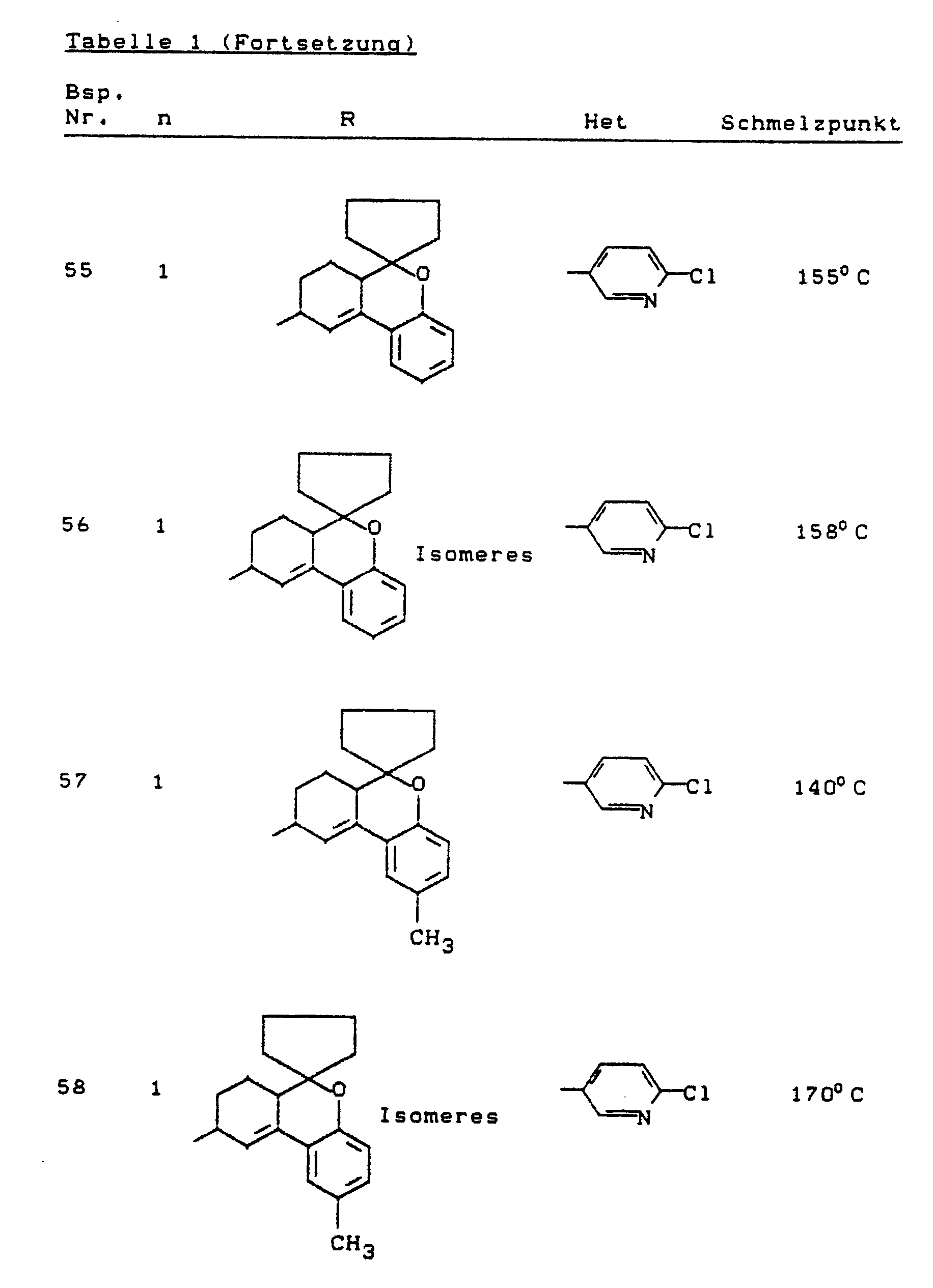


- Lösungsmittel: 7 Gewichtsteile Dimethylformamid
Emulgator: 1 Gewichtsteil Alkylarylpolyglykolether - Zur Herstellung einer zweckmäßigen Wirkstoffzubereitung vermischt man 1 Gewichtsteil Wirkstoff mit der angegebenen Menge Lösungsmittel und der angegebenen Menge Emulgator und verdünnt das Konzentrat mit Wasser auf die gewünschte Konzentration.
- Kohlblätter (Brassica oleracea) werden durch Tauchen in die Wirkstoffzubereitung der gewünschten Konzentration behandelt und mit Meerrettichblattkäfer-Larven (Phaedon cochleariae) besetzt, solange die Blätter noch feucht sind.
- Nach der gewünschten Zeit wird die Abtötung in % bestimmt. Dabei bedeutet 100 %, daß alle Käferlarven abgetötet wurden; 0 % bedeutet, daß keine Käfer-Larven abgetötet wurden.
- Bei diesem Test zeigten z.B. die folgenden Verbindungen der Herstellungsbeispiele 1, 2, 5, 7, 9 bis 40, 70, 71, 74, 77, 78, 79 bis 89, 90 bis 93, 95 bis 97, 100, 101, 103, 104, 106, 108, 109, 111 bis 114, 116 und 117 bei einer beispielhaften Wirkstoffkonzentration von 0,1 % nach 3 Tagen einen Abtötungsgrad von 100 %.
- Lösungsmittel: 7 Gewichtsteile Dimethylformamid
Emulgator: 1 Gewichtsteil Alkylarylpolyglykolether - Zur Herstellung einer zweckmäßigen Wirkstoffzubereitung vermischt man 1 Gewichtsteil Wirkstoff mit der angegebenen Menge Lösungsmittel und der angegebenen Menge Emulgator und verdünnt das Konzentrat mit Wasser auf die gewünschte Konzentration.
- Bohnentriebe (Vicia faba), die stark von der schwarzen Bohnenlaus (Aphis fabae) befallen sind, werden durch Tauchen in die Wirkstoffzubereitung der gewünschten Konzentration behandelt.
- Nach der gewünschten Zeit wird die Abtötung in % bestimmt. Dabei bedeutet 100 %, daß alle Blattläuse abgetötet wurden; 0 % bedeutet, daß keine Blattläuse abgetötet wurden.
- Bei diesem Test zeigten z.B. die folgenden Verbindungen der Herstellungsbeispiele 1, 2, 5, 9, 10, 11, 14, 15, 16, 21, 23, 39, 70, 80, 81, 82, 84, 87, 90, 104, 106 und 109 bei einer beispielhaften Konzentration von 0,1 % nach 3 Tagen einen Abtötungsgrad von 100 %.
- Testinsekt: Phorbia antiqua-Maden im Boden
Lösungsmittel: 3 Gewichtsteile Aceton
Emulgator: 1 Gewichtsteil Alkylarylpolyglykolether - Zur Herstellung einer zweckmäßigen Wirkstoffzubereitung vermischt man 1 Gewichtsteil Wirkstoff mit der angegebenen Menge Lösungsmittel, gibt die angegebene Menge Emulgator zu und verdünnt das Konzentrat mit Wasser auf die gewünschte Konzentration.
- Die Wirkstoffzubereitung wird innig mit dem Boden vermischt. Dabei spielt die Konzentration des Wirkstoffes in der Zubereitung praktisch keine Rolle, entscheidend ist allein die Wirkstoffgewichtsmenge pro Volumeneinheit Boden, welche in ppm (= mg/l) angegeben wird. Man füllt den Boden in Töpfe und läßt diese bei Raumtemperatur stehen.
- Nach 24 Stunden werden die Testtiere in den behandelten Boden gegeben und nach weiteren 2 bis 7 Tagen wird der Wirkungsgrad des Wirkstoffs durch Auszählen der toten und lebenden Testinsekten in % bestimmt. Der Wirkungsgrad ist 100 %, wenn alle Testinsekten abgetötet worden sind, er ist 0 %, wenn noch genau so viele Testinsekten leben wie bei der unbehandelten Kontrolle.
- Bei diesem Test zeigten z.B. die Verbindungen der Herstellungsbeispiele 5, 71, 77 und 84 bei einer beispielhaften Wirkstoffkonzentration von 20 ppm einen Abtötungsgrad von 100 %.
- Testinsekt: Myzus persicae
Lösungsmittel: 3 Gewichtsteile Aceton
Emulgator: 1 Gewichtsteil Alkylarylpolyglykolether - Zur Herstellung einer zweckmäßigen Wirkstoffzubereitung vermischt man 1 Gewichtsteil Wirkstoff mit der angegebenen Menge Lösungsmittel, gibt die angegebene Menge Emulgator zu und verdünnt das Konzentrat mit Wasser auf die gewünschte Konzentration.
- Die Wirkstoffzubereitung wird innig mit dem Boden vermischt. Dabei spielt die Konzentration des Wirkstoffes in der Zubereitung praktisch keine Rolle, entscheidend ist allein die Wirkstoffgewichtsmenge pro Volumeneinheit Boden, welche in ppm (= mg/l) angegeben wird. Man füllt den behandelten Boden in Töpfe und bepflanzt diese mit Kohl (Brassica oleracea). Der Wirkstoff kann so von den Planzenwurzeln aus dem Boden aufgenommen und in die Blätter transportiert werden.
- Für den Nachweis des wurzelsystemischen Effektes werden nach 7 Tagen ausschließlich die Blätter mit den oben genannten Testtieren besetzt. Nach weiteren 2 Tagen erfolgt die Auswertung durch Zählen oder Schätzen der toten Tiere. Aus den Abtötungszahlen wird die wurzelsystemische Wirkung des Wirkstoffs abgeleitet. Sie ist 100 %, wenn alle Testtiere abgetötet sind und 0 %, wenn noch genau so viele Testinsekten leben wie bei der unbehandelten Kontrolle.
- Bei diesem Test zeigten z. B. die Verbindungen der Herstellungsbeispiele 1, 2, 5, 7, 11, 13, 14, 15, 16, 17, 21, 23, 32, 70, 71, 77, 86, 87, 89, 93, 94, 95, 100, 110 und 111 bei einer beispielhaften Wirkstoffkonzentration von 20 ppm eine Abtötung von 100 %.
- Testinsekt: Phaedon cochleariae-Larven
Lösungsmittel: 3 Gewichtsteile Aceton
Emulgator: 1 Gewichtsteil Alkylarylpolyglykolether - Zur Herstellung einer zweckmäßigen Wirkstoffzubereitung vermischt man 1 Gewichtsteil Wirkstoff mit der angegebenen Menge Lösungsmittel, gibt die angegebene Menge Emulgator zu und verdünnt das Konzentrat mit Wasser auf die gewünschte Konzentration.
- Die Wirkstoffzubereitung wird innig mit dem Boden vermischt. Dabei spielt die Konzentration des Wirkstoffes in der Zubereitung praktisch keine Rolle, entscheidend ist allein die Wirkstoffgewichtsmenge pro Volumeneinheit Boden, welche in ppm (= mg/l) angegeben wird. Man füllt den behandelten Boden in Töpfe und bepflanzt diese mit Kohl (Brassica oleracea). Der Wirkstoff kann so von den Planzenwurzeln aus dem Boden aufgenommen und in die Blätter transportiert werden.
- Für den Nachweis des wurzelsystemischen Effektes wegen nach 7 Tagen ausschließlich die Blätter mit den oben genannten Testtieren besetzt. Nach weiteren 2 Tagen erfolgt die Auswertung durch Zählen oder Schätzen der toten Tiere. Aus den Abtötungszahlen wird die wurzelsystemische Wirkung des Wirkstoffs abgeleitet. Sie ist 100 %, wenn alle Testtiere abgetötet sind und 0 %, wenn noch genau so viele Testinsekten leben wie bei der unbehandelten Kontrolle.
- Bei diesem Test zeigten z. B. die Verbindungen der Herstellungsbeispiele 2, 11 und 23 bei einer beispielhaften Wirkstoffkonzentration von 20 ppm einen Abtötungsgrad von 100 %.
- Testinsekt: Phorbia antiqua-Maden im Boden
Testpflanze: Albium cepa
Lösungsmittel: 1 Gewichtsteil Aceton
Trägermaterial: Kaolin - Zur Herstellung einer zweckmäßigen Wirkstoffzubereitung löst man den Wirkstoff in Aceton und vermischt 1 Gewichtsteil Wirkstoff/Aceton mit 5 Gewichtsteilen Kaolin. Das Zwiebelsaatgut wird mit dieser Wirkstoffzubereitung mit den geforderten Aufwandmengen behandelt. Die Aussaat erfolgt in 0,5-l-Töpfen mit standardisierten Böden bei 20 °C Gewächshaustemperatur.
- Nach Auflauf der Zwiebeln werden diese mit Zwiebelfliegeneiern künstlich infiziert.
- Die Auswertung erfolgt nach 14 Tagen. Der Wirkungsgrad ist 100 %, wenn alle Zwiebelpflanzen stehenbleiben, 0 %, wenn alle Testpflanzen (wie in der unbehandelten Kontrolle) vernichtet wurden.
- Bei diesem Test zeigte z. B. die Verbindung des Herstellungsbeispiels 7 bei einer beispielhaften Menge von 2 g Wirkstoff/kg Saatgut einen Wirkungsgrad von 100 %.
- Testinsekt: Phaedon cochleariae-Käfer
Testpflanze: Brassica oleracea
Lösungsmittel: 1 Gewichtsteil Aceton
Trägermaterial: Kaolin - Zur Herstellung einer zweckmäßigen Wirkstoffzubereitung löst man den Wirkstoff in Aceton und vermischt 1 Gewichtsteil Wirkstoff/Aceton mit 5 Gewichtsteilen Kaolin. Das Kohl-Saatgut wird mit dieser Wirkstoffzubereitung mit den geforderten Aufwandmengen behandelt. Die Kohl-Aussaat erfolgt in 0,5-l-Töpfen mit standardisierten Böden bei 20 °C Raumtemperatur.
- Der Wirkstoff kann so von den Pflanzenwurzeln aus dem Boden aufgenommen und in die Blätter transportiert werden.
- Für den Nachweis des wurzelsystemischen Effektes werden nach 14 Tagen ausschließlich die Blätter mit den obengenannten Testtieren besetzt. Nach weiteren 3 Tagen erfolgt die Auswertung durch Zählen oder Schätzen der toten Tiere. Aus den Abtötungszahlen wird die wurzelsystemische Wirkung des Wirkstoffs abgeleitet. Sie ist 100 %, wenn alle Testtiere abgetötet sind und 0 %, wenn noch genau so viele Testinsekten leben wie bei der unbehandelten Kontrolle.
- Bei diesem Test zeigte z. B. die Verbindung des Herstellungsbeispiels 7 bei einer beispielhaften Menge von 2 g Wirkstoff/kg Saatgut einen Wirkungsgrad von 100 %.
- Testinsekt: Aphis fabae
Testpflanze: Vicia faba
Lösungsmittel: 1 Gewichtsteil Aceton
Trägermaterial: Kaolin - Zur Herstellung einer zweckmäßigen Wirkstoffzubereitung löst man den Wirkstoff in Aceton und vermischt 1 Gewichtsteil Wirkstoff/Aceton mit 5 Gewichtsteilen Kaolin. Das Kohl-Saatgut wird mit dieser Wirkstoffzubereitung mit den geforderten Aufwandmengen behandelt. Die Kohl-Aussaat erfolgt in 0,5-l-Töpfen mit standardisierten Böden bei 20 °C Raumtemperatur.
- Der Wirkstoff kann so von den Pflanzenwurzeln aus dem Boden aufgenommen und in die Blätter transportiert werden.
- Für den Nachweis des wurzelsystemischen Effektes werden nach 14 Tagen ausschließlich die Blätter mit den obengenannten Testtieren besetzt. Nach weiteren 3 Tagen erfolgt die Auswertung durch Zählen oder Schätzen der toten Tiere. Aus den Abtötungszahlen wird die wurzelsystemische Wirkung des Wirkstoffs abgeleitet. Sie ist 100 %, wenn alle Testtiere abgetötet sind und 0 %, wenn noch genau so viele Testinsekten leben wie bei der unbehandelten Kontrolle.
- Bei diesem Test zeigte z. B. die Verbindung des Herstellungsbeispiels 5 bei einer beispielhaften Menge von 2 g Wirkstoff/kg Saatgut einen Wirkungsgrad von 100 %.
- Emulgator: 35 Gewichtsteile Ethylenglykolmonomethylether
35 Gewichtsteile Nonylphenolpolyglykolether - Zur Herstellung einer zweckmäßigen Wirkstoffzubereitung vermischt man drei Gewichtsteile Wirkstoff mit sieben Gewichtsteilen des oben angegebenen Gemisches und verdünnnt das so erhaltene Konzentrat mit Wasser auf die jeweils gewünschte Konzentration.
- Etwa 20 Lucilia cuprina res.-Larven werden in ein Teströhrchen gebracht, welches ca. 1 cm³ Pferdefleisch und 0,5 ml der Wirkstoffzubereitung enthält. Nach 24 Stunden wird der Abtötungsgrad bestimmt.
- Bei diesem Test zeigten z.B. die Verbindungen der Herstellungsbeispiele 1, 2, 5, 6, 7, 9, 10 bis 35, 37, 39, 70, 71, 74 bis 104, 106, 108, 109, 111 bis 114, 116 und 117 bei einer beispielhaften Konzentration von 100 ppm eine Abtötung von 100 %.
- Filterpapierscheiben (⌀ 9 cm von Schleicher & Schüll BF) werden in Plastikschalen mit je 2.0 ml der jeweils gewünschten Konzentration der Testsubstanz imprägniert.
- Nach Trocknung der Filter werden die Schalen verschlossen und 24 Stunden nach Ansatz mit jeweils 5 mit CO₂betäubten Blattella germanica beschickt.
Dosierungen: 1000, 100, 10 ppm - Die Registrierung der Wirkung erfolgt zu bestimmten Zeiten nach Aufsetzen der Blattella germanica (5 - 360 Minuten bzw. 1 - 7 Tage p. a. nach Aufsetzen der Blattella germanica.
- Als Kriterium für den Eintritt der Wirkung gilt das Erreichen des sog. adynamischen Stadiums (keine Lebenszeichen) der Testarthropoden.
- 100 % Wirkung bedeutet, daß alle Blattella germanica tot sind, 0 % Wirkung bedeutet, daß keine Blattella germanica getötet wurden.
- Bei diesem Test zeigten z. B. die folgenden Verbindungen der Herstellungsbeispiele 9, 11, 19, 23, 78, 80, 81, 89, 93, 94, 95, 96, 98, 112 und 113 bei einer beispielhaften Konzentration von 1000 ppm eine Abtötung von 100 %.
- Filterpapierscheiben (⌀ 9 cm von Schleicher & Schüll BF) werden in Plastikschalen mit je 2.0 ml der jeweils gewünschten Konzentration der Testsubstanz imprägniert.
- Nach Trocknung der Filter werden die Schalen verschlossen und 24 Stunden nach Ansatz mit jeweils 10 mit CO₂-betäubten Sitophilus granarius beschickt.
- Die Registrierung der Wirkung erfolgt zu bestimmten Zeiten nach Aufsetzen der Sitophilus granarius (5 - 360 Minuten bzw. 1 - 7 Tage p. a. nach Aufsetzen der Sitophilius granarius).
- Als Kriterium für den Eintritt der Wirkung gilt das Erreichen des sog. adynamischen Stadiums (keine Lebenszeichen) der Testarthropoden.
- 100 % Wirkung bedeutet, daß alle Sitophilus granarius tot sind, 0 % Wirkung bedeutet, daß keine Sitophilus granarius getötet wurden.
- Bei diesem Test zeigten z. B. folgende Verbindungen der Herstellungsbeispiele 1, 10 bis 21, 23 bis 30, 32, 34, 35, 37, 70, 78 bis 101, 103, 104, 108, 109, 111 bis 114, 116 und 117 bei einer beispielhaften Konzentration von 1000 ppm eine Abtötung von 100 %.
Claims (8)
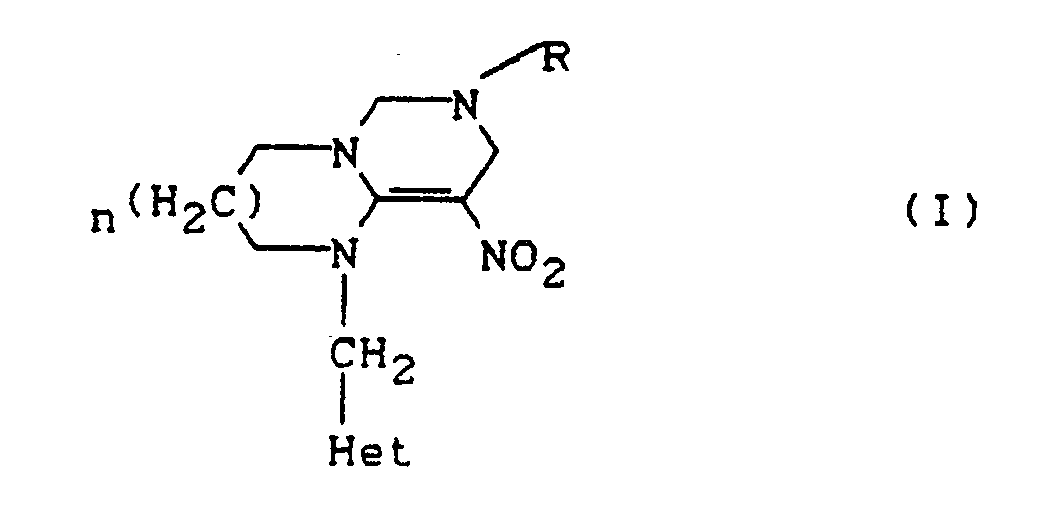
n für die Zahl 0 oder 1 steht,
Het für gegebenenfalls substituiertes Pyridyl oder gegebenenfalls substituiertes Thiazolyl steht und
R für Monohalogen-tert-Butyl, für unsubstituiertes Cycloalkyl mit 9 bis 18 Kohlenstoffatomen, für Cycloalkyl mit 7 bis 18 Kohlenstoffatomen an welches 1 oder 2 Carbocyclen anelliert sind, für einfach oder mehrfach substituiertes Cyclohexyl welches substituiert ist durch: Alkoxy, Mono- oder Dialkylamino, Cycloalkylamino, Mono- oder Dialkylaminocarbonyl, Cycloalkyl, Cycloalkylalkyl und/oder durch Phenyl alkyl, für Cyclohexyl, an welches 1 oder 2 weitere Carbocyclen anelliert sind, für Cycloalkylalkyl mit 3 bis 10 Kohlenstoffatomen im Cycloalkyl- und 1 bis 5 Kohlenstoffatomen im Alkylteil, welches im Cycloalkylteil einfach oder mehrfach substituiert ist, für gegebenenfalls einfach oder mehrfach substituiertes Heterocyclyl mit 2 bis 8 Kohlenstoffatomen und 1 bis 4 Heteroatomen oder Heterogruppierungen, an welches gegebenenfalls 1 oder 2 Carbocyclen anelliert sind, für gegebenenfalls einfach oder mehrfach substituiertes Tetrahydrofurylalkyl mit 1 bis 6 Kohlenstoffatomen im Alkylteil oder für gegebenenfalls einfach oder mehrfach substituiertes Piperidylalkyl mit 1 bis 6 Kohlenstoffatomen im Alkylteil, für Adamantyl, Adamantylmethyl oder für eine der folgenden Gruppierungen (A), (B) und (C), welche gegebenenfalls substituiert sind:

n für die Zahlen 0 oder 1 steht,
Het für gegebenenfalls durch Halogen substituiertes Pyridyl oder für gegebenenfalls durch Halogen substituiertes Thiazolyl steht und
R für durch Fluor oder Chlor monosubstituiertes tert-Butyl, für unsubstituiertes Cycloalkyl mit 9 bis 16 Kohlenstoffatomen, für Cycloalkyl mit 7 bis 16 Kohlenstoffatomen, an welches 1 oder 2 6-gliedrige aromatische oder gesättigte Carbocyclen anelliert sind, für einfach bis dreifach substituiertes Cyclohexyl, welches substituiert ist durch: Alkoxy mit 1 bis 4 Kohlenstoffatomen, Mono- oder Dialkylamino mit jeweils 1 bis 4 Kohlenstoffatomen in den einzelnen Alkylteilen, Cycloalkylamino mit 3 bis 7 Kohlenstoffatomen, Mono- oder Dialkylaminocarbonyl mit jeweils 1 bis 4 Kohlenstoffatomen in den einzelnen Alkylteilen, Cycloalkyl mit 3 bis 7 Kohlenstoffatomen, Cycloalkylalkyl mit 3 bis 7 Kohlenstoffatomen im Cycloalkyl- und 1 bis 5 Kohlenstoffatomen im Alkylteil und/oder durch Phenylalkyl mit 1 bis 4 Kohlenstoffatomen im Alkylteil, für Cyclohexyl, an welches 1 oder 2 6-gliedrige aromatische oder gesättigte Carbocyclen anelliert sind, für Cycloalkylalkyl mit 3 bis 7 Kohlen stoffatomen im Cycloalkyl- und 1 bis 4 Kohlenstoffatomen im Alkylteil, welches im Cycloalkylteil einfach bis dreifach durch Alkyl oder Halogenalkyl mit jeweils 1 bis 4 Kohlenstoffatomen und gegebenenfalls 1 bis 9 Fluor- und/oder Chloratomen substituiert ist, für gegebenenfalls einfach oder mehrfach durch Alkyl und/oder Halogenalkyl mit jeweils 1 bis 4 Kohlenstoffatomen und gegebenenfalls 1 bis 9 Fluor-und/oder Chloratomen substituiertes Heterocyclyl mit 3 bis 6 Kohlenstoffatomen und 1 bis 3 Heteroatomen oder Heterogruppierungen aus der Reihe Sauerstoff, Schwefel, Stickstoff, SO₂, an welches gegebenenfalls 1 oder 2 6-gliedrige aromatische oder gesättigte Carbocyclen anelliert sind, für gegebenenfalls einfach bis dreifach durch Alkyl und/oder Halogenalkyl mit jeweils 1 bis 4 Kohlenstoffatomen und gegebenenfalls 1 bis 9 Fluor- und/oder Chloratomen substituiertes Tetrahydrofurylalkyl mit 1 bis 4 Kohlenstoffatomen im Alkylteil oder für gegebenenfalls einfach bis dreifach durch Alkyl und/oder Halogenalkyl mit jeweils 1 bis 4 Kohlenstoffatomen und gegebenenfalls 1 bis 9 Fluor- und/oder Chloratomen substituiertes Piperidylalkyl mit 1 bis 4 Kohlenstoffatomen im Alkylteil oder für eine der folgenden Gruppierungen (A) bis (F) steht, welche gegebenenfalls durch Alkyl mit 1 bis 4 Kohlenstoffatomen substituiert sind:

n für die Zahl 0 oder 1 steht,
Het für

R für Fluor-tert-Butyl, für unsubstituiertes Cycloalkyl mit 9 bis 12 Kohlenstoffatomen, für Cycloalkyl mit 7 bis 12 Kohlenstoffatomen, an welches 1 oder 2 6-gliedrige aromatische Carbocyclen anelliert sind, für 1- oder 2fach substituiertes Cyclohexyl, welches substituiert ist durch:
Methoxy, Ethoxy, n- oder i-Propoxy, Methylamino, Dimethylamino, Ethylamino, Diethylamino, Ethylmethylamino, n-Propylamino, Di-(n-propyl)amino, Methyl(n-propyl)amino, Ethyl(n-propyl)amino, Isopropylamino, Di(isopropyl)amino, Methylisopropylamino, Ethylisopropylamino, Isopropyl(n-propyl)amino oder Cyclopentylamino, Cyclohexylamino, Methylaminocarbonyl, Dimethylaminocarbonyl, Ethylaminocarbonyl, Diethylaminocarbonyl, Ethylmethylaminocarbonyl, n-Propylaminocarbonyl, Di(n-propyl)aminocarbonyl, Methyl(n-propyl)aminocarbonyl, Ethyl(n-propyl)aminocarbonyl, Isopropylaminocarbonyl, Di(isopropyl)aminocarbonyl, Methylisopropylaminocarbonyl, Ethylisopropylaminocarbonyl, Isopropyl(n-propyl)aminocarbonyl, Cyclopentyl, Cyclohexyl, Cyclopentylmethyl, Cyclopentylethyl, Cyclopentyl-n-propyl, Cyclopentylisopropyl, Cyclohexylmethyl, Cyclohexylethyl, Cyclohexyl-n-propyl, Cyclohexylisopropyl, Phenylmethyl, Phenylethyl, Phenyl-n-propyl und/oder Phenyliso propyl, für Cyclohexyl an welches 1 oder 2 6-gliedrige aromatische oder gesättigte Carbocyclen anelliert sind, für Cyclopentylmethyl, Cyclopentylethyl, Cyclohexylmethyl oder Cyclohexylethyl, wobei diese Reste im Cycloalkylteil 1- oder 2-fach durch Methyl und/oder Trifluormethyl substituiert sind, für gegebenenfalls einfach bis sechsfach durch Methyl und/oder Trifluormethyl substituiertes Heterocyclyl mit 5 bis 12 Kohlenstoffatomen und 1 oder 2 Heteroatomen oder Heterogruppierungen aus der Reihe Sauerstoff, Schwefel, Stickstoff oder SO₂, an welches gegebenenfalls 1 oder 2 6-gliedrige aromatische Carbocyclen anelliert sind, für Tetrahydrofurylmethyl oder Tetrahydrofurylethyl, für Piperidylmethyl, Piperidylethyl oder Piperidyl-n-propyl oder für eine der folgenden Gruppierungen (A) bis (F);


n für die Zahl 0 oder 1 steht,
Het für gegebenenfalls substituiertes Pyridyl oder gegebenenfalls substituiertes Thiazolyl steht und
R für Monohalogen-tert-Butyl, für unsubstituiertes Cycloalkyl mit 9 bis 18 Kohlenstoffatomen, für Cycloalkyl mit 7 bis 18 Kohlenstoffatomen an welches 1 oder 2 Carbocyclen anelliert sind, für einfach oder mehrfach substituiertes Cyclohexyl welches substituiert ist durch: Alkoxy, Mono- oder Dialkylamino, Cycloalkylamino, Mono- oder Dialkylaminocarbonyl, Cycloalkyl, Cycloalkylalkyl und/oder durch Phenylalkyl, für Cyclohexyl, an welches 1 oder 2 weitere Carbocyclen anelliert sind, für Cycloalkylalkyl mit 3 bis 10 Kohlenstoffatomen im Cycloalkyl- und 1 bis 5 Kohlenstoffatomen im Alkylteil, welches im Cycloalkylteil einfach oder mehrfach substituiert ist, für gegebenenfalls einfach oder mehrfach substituiertes Heterocyclyl mit 2 bis 8 Kohlenstoffatomen und 1 bis 4 Heteroatomen oder Heterogruppierungen, an welches gegebenenfalls 1 oder 2 Carbocyclen anelliert sind, für gegebenenfalls einfach oder mehrfach substituiertes Tetrahydrofurylalkyl mit 1 bis 6 Kohlenstoffatomen im Alkylteil oder für gegebenenfalls einfach oder mehrfach substituiertes Piperidylalkyl mit 1 bis 6 Kohlenstoffatomen im Alkylteil, für Adamantyl, Adamantylmethyl oder für eine der folgenden Gruppierungen (A), (B) und (C), welche gegebenenfalls substituiert sind:

dadurch gekennzeichnet, daß man Nitromethylen-Derivate der Formel (II)

n und Het die oben angegebenen Bedeutungen haben,
mit Aminen der Formel (III),
R-NH₂ (III)
in welcher,
R die oben angegebene Bedeutung hat,
in Gegenwart von mindestens der zweifachen molaren Menge Formaldehyd, gegebenenfalls in Gegenwart von sauren Katalysatoren und gegebenenfalls in Gegenwart von Verdünnungsmitteln umsetzt und gegebenenfalls an die erhaltenen Verbindungen Säuren addiert.
Applications Claiming Priority (2)
| Application Number | Priority Date | Filing Date | Title |
|---|---|---|---|
| DE3932167A DE3932167A1 (de) | 1989-09-27 | 1989-09-27 | 1,2,3,4.tetrahydro-5-nitro-pyrimidin-derivate |
| DE3932167 | 1989-09-27 |
Publications (3)
| Publication Number | Publication Date |
|---|---|
| EP0419963A2 true EP0419963A2 (de) | 1991-04-03 |
| EP0419963A3 EP0419963A3 (en) | 1991-11-06 |
| EP0419963B1 EP0419963B1 (de) | 1994-12-07 |
Family
ID=6390260
Family Applications (1)
| Application Number | Title | Priority Date | Filing Date |
|---|---|---|---|
| EP90117702A Expired - Lifetime EP0419963B1 (de) | 1989-09-27 | 1990-09-14 | 1,2,3,4-Tetrahydro-5-nitro-pyrimidin-Derivate |
Country Status (3)
| Country | Link |
|---|---|
| EP (1) | EP0419963B1 (de) |
| JP (1) | JP3037986B2 (de) |
| DE (2) | DE3932167A1 (de) |
Family Cites Families (3)
| Publication number | Priority date | Publication date | Assignee | Title |
|---|---|---|---|---|
| DE3638121A1 (de) * | 1986-05-30 | 1987-12-03 | Bayer Ag | 1,2,3,6-tetrahydro-5-nitro-pyrimidin-derivate |
| DE3739264A1 (de) * | 1987-11-18 | 1989-06-01 | Bayer Ag | 2-chlor-1,3-thiazol-5-yl-methyl substituierte nitrogruppenhaltige imidazolidino-1,2,3,4-tetrahydropyrimidine bzw. hexahydropyrimidino-1,2,3,4-tetrahydropyrimidine |
| DE3739263A1 (de) * | 1987-11-18 | 1989-06-01 | Bayer Ag | Nitrogruppenhaltige imidazolidino-1,2,3,4-tetrahydropyrimidine bzw. hexahydropyrimidino-1,2,3,4-tetrahydropyrimidine |
-
1989
- 1989-09-27 DE DE3932167A patent/DE3932167A1/de not_active Withdrawn
-
1990
- 1990-09-14 DE DE59007923T patent/DE59007923D1/de not_active Expired - Fee Related
- 1990-09-14 EP EP90117702A patent/EP0419963B1/de not_active Expired - Lifetime
- 1990-09-26 JP JP2256794A patent/JP3037986B2/ja not_active Expired - Fee Related
Also Published As
| Publication number | Publication date |
|---|---|
| EP0419963A3 (en) | 1991-11-06 |
| DE59007923D1 (de) | 1995-01-19 |
| JPH03120282A (ja) | 1991-05-22 |
| EP0419963B1 (de) | 1994-12-07 |
| JP3037986B2 (ja) | 2000-05-08 |
| DE3932167A1 (de) | 1991-04-04 |
Similar Documents
| Publication | Publication Date | Title |
|---|---|---|
| EP0247477B1 (de) | 1,2,3,6-Tetrahydro-5-nitro-pyrimidin-Derivate | |
| EP0268915A2 (de) | Trifluormethylcarbonyl-Derivate | |
| EP0285985A1 (de) | 3-Substituierte 1-(2-Chlorthiazol-5-yl-methyl)-2-nitroimino-1,3-diazacycloalkane | |
| EP0316845B1 (de) | 1,2,3,4-Tetrahydro-5-nitro-pyrimidin-Derivate | |
| EP0835245B1 (de) | Substituierte n-methylenthioharnstoffe als schädlingsbekämpfungsmittel | |
| EP0316843B1 (de) | 1,2,3,4-Tetrahydro-5-nitro-pyrimidin-Derivate | |
| DE4005114A1 (de) | Substituierte pyrazolinderivate | |
| DE3618115A1 (de) | Halogenolefine | |
| EP0279259A1 (de) | Thionophosphonsäureester | |
| EP0595125B1 (de) | Substituierte Aza(cyclo) Alkane und ihre Verwendung als Schadlingsbekampfungsmittel | |
| EP0022511A2 (de) | N,N-Dimethyl-O-pyrimidinyl-carbaminsäureester, Verfahren zu ihrer Herstellung sowie ihre Verwendung als Schädlingsbekämpfungsmittel | |
| EP0167894B1 (de) | Phosphorsäureester | |
| EP0419963B1 (de) | 1,2,3,4-Tetrahydro-5-nitro-pyrimidin-Derivate | |
| EP0000198A1 (de) | N,N-Dialkyl-0-pyrimidinyl-carbaminsäureester, Verfahren zu ihrer Herstellung und ihre Verwendung als Insektizide | |
| DE3712072A1 (de) | 1-aralkylpyrazole | |
| WO1994021632A1 (de) | Substituierte stickstoff-heterocyclen und ihre verwendung als schädlingsbekämpfungsmittel | |
| EP0344500A1 (de) | 3-Substituierte 1-Nitro-2-imino-1,3-diazacycloalkane | |
| EP0168704B1 (de) | Pyrimidinyl-thionophosphorsäureester | |
| DD145493A5 (de) | Schaedlingsbekaempfungsmittel | |
| DE3438919A1 (de) | Substituierte phenyl-carbaminsaeureester | |
| DE3927789A1 (de) | Nitrierte stickstoffheterocyclen | |
| DE3640175A1 (de) | Benzoyl(thio)harnstoffe | |
| EP0347684A1 (de) | 2-(Halogen)alkylthio-1,3-oxazol-Derivate | |
| EP0286963A1 (de) | Phosphorsäureesteramide | |
| DE3716299A1 (de) | Thionophosphorsaeureester |
Legal Events
| Date | Code | Title | Description |
|---|---|---|---|
| PUAI | Public reference made under article 153(3) epc to a published international application that has entered the european phase |
Free format text: ORIGINAL CODE: 0009012 |
|
| 17P | Request for examination filed |
Effective date: 19900920 |
|
| AK | Designated contracting states |
Kind code of ref document: A2 Designated state(s): BE CH DE FR GB IT LI NL |
|
| PUAL | Search report despatched |
Free format text: ORIGINAL CODE: 0009013 |
|
| AK | Designated contracting states |
Kind code of ref document: A3 Designated state(s): BE CH DE FR GB IT LI NL |
|
| 17Q | First examination report despatched |
Effective date: 19931015 |
|
| GRAA | (expected) grant |
Free format text: ORIGINAL CODE: 0009210 |
|
| AK | Designated contracting states |
Kind code of ref document: B1 Designated state(s): BE CH DE FR GB IT LI NL |
|
| GBT | Gb: translation of ep patent filed (gb section 77(6)(a)/1977) |
Effective date: 19941212 |
|
| ITF | It: translation for a ep patent filed | ||
| REF | Corresponds to: |
Ref document number: 59007923 Country of ref document: DE Date of ref document: 19950119 |
|
| ET | Fr: translation filed | ||
| PLBE | No opposition filed within time limit |
Free format text: ORIGINAL CODE: 0009261 |
|
| STAA | Information on the status of an ep patent application or granted ep patent |
Free format text: STATUS: NO OPPOSITION FILED WITHIN TIME LIMIT |
|
| 26N | No opposition filed | ||
| REG | Reference to a national code |
Ref country code: GB Ref legal event code: IF02 |
|
| PGFP | Annual fee paid to national office [announced via postgrant information from national office to epo] |
Ref country code: FR Payment date: 20060821 Year of fee payment: 17 |
|
| PGFP | Annual fee paid to national office [announced via postgrant information from national office to epo] |
Ref country code: DE Payment date: 20060824 Year of fee payment: 17 |
|
| PGFP | Annual fee paid to national office [announced via postgrant information from national office to epo] |
Ref country code: GB Payment date: 20060913 Year of fee payment: 17 |
|
| PGFP | Annual fee paid to national office [announced via postgrant information from national office to epo] |
Ref country code: NL Payment date: 20060926 Year of fee payment: 17 |
|
| PGFP | Annual fee paid to national office [announced via postgrant information from national office to epo] |
Ref country code: BE Payment date: 20060927 Year of fee payment: 17 |
|
| PGFP | Annual fee paid to national office [announced via postgrant information from national office to epo] |
Ref country code: IT Payment date: 20060930 Year of fee payment: 17 |
|
| PGFP | Annual fee paid to national office [announced via postgrant information from national office to epo] |
Ref country code: CH Payment date: 20061005 Year of fee payment: 17 |
|
| REG | Reference to a national code |
Ref country code: CH Ref legal event code: PFA Owner name: BAYER AKTIENGESELLSCHAFT Free format text: BAYER AKTIENGESELLSCHAFT# #D-51368 LEVERKUSEN (DE) -TRANSFER TO- BAYER AKTIENGESELLSCHAFT# #D-51368 LEVERKUSEN (DE) |
|
| BERE | Be: lapsed |
Owner name: *BAYER A.G. Effective date: 20070930 |
|
| REG | Reference to a national code |
Ref country code: CH Ref legal event code: PL |
|
| GBPC | Gb: european patent ceased through non-payment of renewal fee |
Effective date: 20070914 |
|
| PG25 | Lapsed in a contracting state [announced via postgrant information from national office to epo] |
Ref country code: NL Free format text: LAPSE BECAUSE OF NON-PAYMENT OF DUE FEES Effective date: 20080401 |
|
| NLV4 | Nl: lapsed or anulled due to non-payment of the annual fee |
Effective date: 20080401 |
|
| PG25 | Lapsed in a contracting state [announced via postgrant information from national office to epo] |
Ref country code: LI Free format text: LAPSE BECAUSE OF NON-PAYMENT OF DUE FEES Effective date: 20070930 Ref country code: CH Free format text: LAPSE BECAUSE OF NON-PAYMENT OF DUE FEES Effective date: 20070930 Ref country code: DE Free format text: LAPSE BECAUSE OF NON-PAYMENT OF DUE FEES Effective date: 20080401 |
|
| PG25 | Lapsed in a contracting state [announced via postgrant information from national office to epo] |
Ref country code: BE Free format text: LAPSE BECAUSE OF NON-PAYMENT OF DUE FEES Effective date: 20070930 |
|
| REG | Reference to a national code |
Ref country code: FR Ref legal event code: ST Effective date: 20080531 |
|
| PG25 | Lapsed in a contracting state [announced via postgrant information from national office to epo] |
Ref country code: FR Free format text: LAPSE BECAUSE OF NON-PAYMENT OF DUE FEES Effective date: 20071001 |
|
| PG25 | Lapsed in a contracting state [announced via postgrant information from national office to epo] |
Ref country code: GB Free format text: LAPSE BECAUSE OF NON-PAYMENT OF DUE FEES Effective date: 20070914 |
|
| PG25 | Lapsed in a contracting state [announced via postgrant information from national office to epo] |
Ref country code: IT Free format text: LAPSE BECAUSE OF NON-PAYMENT OF DUE FEES Effective date: 20070914 |