EP0420233B1 - Dérivé de sel métallique de l'acide phtalique et plaque opacifiante et photosensible contenant ce sel métallique - Google Patents
Dérivé de sel métallique de l'acide phtalique et plaque opacifiante et photosensible contenant ce sel métallique Download PDFInfo
- Publication number
- EP0420233B1 EP0420233B1 EP90118559A EP90118559A EP0420233B1 EP 0420233 B1 EP0420233 B1 EP 0420233B1 EP 90118559 A EP90118559 A EP 90118559A EP 90118559 A EP90118559 A EP 90118559A EP 0420233 B1 EP0420233 B1 EP 0420233B1
- Authority
- EP
- European Patent Office
- Prior art keywords
- group
- alkyl group
- substituted
- copper
- salt
- Prior art date
- Legal status (The legal status is an assumption and is not a legal conclusion. Google has not performed a legal analysis and makes no representation as to the accuracy of the status listed.)
- Expired - Lifetime
Links
- 150000003839 salts Chemical class 0.000 title claims description 48
- 229910052751 metal Inorganic materials 0.000 title claims description 42
- 239000002184 metal Substances 0.000 title claims description 42
- 150000003021 phthalic acid derivatives Chemical class 0.000 title description 10
- 150000001875 compounds Chemical class 0.000 claims description 46
- -1 polypropylene Polymers 0.000 claims description 45
- 229920000642 polymer Polymers 0.000 claims description 27
- 239000010949 copper Substances 0.000 claims description 20
- 150000001879 copper Chemical class 0.000 claims description 17
- 239000000178 monomer Substances 0.000 claims description 17
- 238000000034 method Methods 0.000 claims description 16
- 239000002253 acid Substances 0.000 claims description 13
- 125000006527 (C1-C5) alkyl group Chemical group 0.000 claims description 12
- 229910052802 copper Inorganic materials 0.000 claims description 12
- 125000000843 phenylene group Chemical group C1(=C(C=CC=C1)*)* 0.000 claims description 12
- 125000004435 hydrogen atom Chemical group [H]* 0.000 claims description 11
- 229910052717 sulfur Inorganic materials 0.000 claims description 11
- 150000003585 thioureas Chemical class 0.000 claims description 11
- RYGMFSIKBFXOCR-UHFFFAOYSA-N Copper Chemical compound [Cu] RYGMFSIKBFXOCR-UHFFFAOYSA-N 0.000 claims description 10
- 239000008188 pellet Substances 0.000 claims description 10
- 150000003556 thioamides Chemical class 0.000 claims description 10
- 239000000463 material Substances 0.000 claims description 9
- 239000000203 mixture Substances 0.000 claims description 9
- 239000004793 Polystyrene Substances 0.000 claims description 8
- 239000004417 polycarbonate Substances 0.000 claims description 8
- 229920000515 polycarbonate Polymers 0.000 claims description 8
- 229920002223 polystyrene Polymers 0.000 claims description 8
- 125000005843 halogen group Chemical group 0.000 claims description 7
- 238000002156 mixing Methods 0.000 claims description 7
- 239000011347 resin Substances 0.000 claims description 7
- 229920005989 resin Polymers 0.000 claims description 7
- NINIDFKCEFEMDL-UHFFFAOYSA-N Sulfur Chemical compound [S] NINIDFKCEFEMDL-UHFFFAOYSA-N 0.000 claims description 6
- 125000003710 aryl alkyl group Chemical group 0.000 claims description 6
- 125000003118 aryl group Chemical group 0.000 claims description 6
- 125000004429 atom Chemical group 0.000 claims description 6
- 125000004956 cyclohexylene group Chemical group 0.000 claims description 6
- 125000001424 substituent group Chemical group 0.000 claims description 6
- 239000011593 sulfur Substances 0.000 claims description 6
- 125000002373 5 membered heterocyclic group Chemical group 0.000 claims description 5
- 125000004070 6 membered heterocyclic group Chemical group 0.000 claims description 5
- 239000004698 Polyethylene Substances 0.000 claims description 5
- 239000004743 Polypropylene Substances 0.000 claims description 5
- 125000003342 alkenyl group Chemical group 0.000 claims description 5
- 125000003545 alkoxy group Chemical group 0.000 claims description 5
- 125000000753 cycloalkyl group Chemical group 0.000 claims description 5
- 229910052757 nitrogen Inorganic materials 0.000 claims description 5
- 229910052760 oxygen Inorganic materials 0.000 claims description 5
- 229920000573 polyethylene Polymers 0.000 claims description 5
- 229920001155 polypropylene Polymers 0.000 claims description 5
- 239000004925 Acrylic resin Substances 0.000 claims description 4
- 229910052779 Neodymium Inorganic materials 0.000 claims description 4
- BZHJMEDXRYGGRV-UHFFFAOYSA-N Vinyl chloride Chemical compound ClC=C BZHJMEDXRYGGRV-UHFFFAOYSA-N 0.000 claims description 4
- 230000000379 polymerizing effect Effects 0.000 claims description 4
- 229920000193 polymethacrylate Polymers 0.000 claims description 4
- CERQOIWHTDAKMF-UHFFFAOYSA-M Methacrylate Chemical compound CC(=C)C([O-])=O CERQOIWHTDAKMF-UHFFFAOYSA-M 0.000 claims description 3
- 229910052742 iron Inorganic materials 0.000 claims description 3
- 229910052684 Cerium Inorganic materials 0.000 claims description 2
- 238000013329 compounding Methods 0.000 claims description 2
- 229910052759 nickel Inorganic materials 0.000 claims description 2
- XNGIFLGASWRNHJ-UHFFFAOYSA-M phthalate(1-) Chemical compound OC(=O)C1=CC=CC=C1C([O-])=O XNGIFLGASWRNHJ-UHFFFAOYSA-M 0.000 claims description 2
- 229910052720 vanadium Inorganic materials 0.000 claims description 2
- 125000006702 (C1-C18) alkyl group Chemical group 0.000 claims 4
- 229910052721 tungsten Inorganic materials 0.000 claims 1
- 239000000047 product Substances 0.000 description 37
- 150000002736 metal compounds Chemical class 0.000 description 17
- 239000002244 precipitate Substances 0.000 description 14
- 238000000862 absorption spectrum Methods 0.000 description 13
- 238000002329 infrared spectrum Methods 0.000 description 13
- VVQNEPGJFQJSBK-UHFFFAOYSA-N Methyl methacrylate Chemical compound COC(=O)C(C)=C VVQNEPGJFQJSBK-UHFFFAOYSA-N 0.000 description 11
- CSCPPACGZOOCGX-UHFFFAOYSA-N Acetone Chemical compound CC(C)=O CSCPPACGZOOCGX-UHFFFAOYSA-N 0.000 description 10
- 239000010408 film Substances 0.000 description 10
- XLYOFNOQVPJJNP-UHFFFAOYSA-N water Substances O XLYOFNOQVPJJNP-UHFFFAOYSA-N 0.000 description 10
- 238000002441 X-ray diffraction Methods 0.000 description 9
- 238000010438 heat treatment Methods 0.000 description 9
- 230000009102 absorption Effects 0.000 description 8
- 238000010521 absorption reaction Methods 0.000 description 8
- 230000015572 biosynthetic process Effects 0.000 description 8
- 150000004703 alkoxides Chemical class 0.000 description 7
- 230000000694 effects Effects 0.000 description 7
- 238000002844 melting Methods 0.000 description 7
- 230000008018 melting Effects 0.000 description 7
- 239000003960 organic solvent Substances 0.000 description 7
- 238000006116 polymerization reaction Methods 0.000 description 7
- UIIMBOGNXHQVGW-UHFFFAOYSA-M Sodium bicarbonate Chemical compound [Na+].OC([O-])=O UIIMBOGNXHQVGW-UHFFFAOYSA-M 0.000 description 6
- HEMHJVSKTPXQMS-UHFFFAOYSA-M Sodium hydroxide Chemical compound [OH-].[Na+] HEMHJVSKTPXQMS-UHFFFAOYSA-M 0.000 description 6
- 238000000921 elemental analysis Methods 0.000 description 6
- 239000011521 glass Substances 0.000 description 6
- 240000007817 Olea europaea Species 0.000 description 5
- 239000007864 aqueous solution Substances 0.000 description 5
- 239000007858 starting material Substances 0.000 description 5
- 239000005749 Copper compound Substances 0.000 description 4
- 229920002845 Poly(methacrylic acid) Polymers 0.000 description 4
- 229920002125 Sokalan® Polymers 0.000 description 4
- 229910052783 alkali metal Inorganic materials 0.000 description 4
- 125000000217 alkyl group Chemical group 0.000 description 4
- UMGDCJDMYOKAJW-UHFFFAOYSA-N aminothiocarboxamide Natural products NC(N)=S UMGDCJDMYOKAJW-UHFFFAOYSA-N 0.000 description 4
- 150000001880 copper compounds Chemical class 0.000 description 4
- JZCCFEFSEZPSOG-UHFFFAOYSA-L copper(II) sulfate pentahydrate Chemical compound O.O.O.O.O.[Cu+2].[O-]S([O-])(=O)=O JZCCFEFSEZPSOG-UHFFFAOYSA-L 0.000 description 4
- 150000002148 esters Chemical class 0.000 description 4
- XEEYBQQBJWHFJM-UHFFFAOYSA-N iron Substances [Fe] XEEYBQQBJWHFJM-UHFFFAOYSA-N 0.000 description 4
- 238000004519 manufacturing process Methods 0.000 description 4
- XNGIFLGASWRNHJ-UHFFFAOYSA-N phthalic acid Chemical compound OC(=O)C1=CC=CC=C1C(O)=O XNGIFLGASWRNHJ-UHFFFAOYSA-N 0.000 description 4
- 239000004584 polyacrylic acid Substances 0.000 description 4
- 239000000243 solution Substances 0.000 description 4
- RKYJPYDJNQXILT-UHFFFAOYSA-N 2-(2-prop-2-enoyloxyethoxycarbonyl)benzoic acid Chemical compound OC(=O)C1=CC=CC=C1C(=O)OCCOC(=O)C=C RKYJPYDJNQXILT-UHFFFAOYSA-N 0.000 description 3
- HNNQYHFROJDYHQ-UHFFFAOYSA-N 3-(4-ethylcyclohexyl)propanoic acid 3-(3-ethylcyclopentyl)propanoic acid Chemical compound CCC1CCC(CCC(O)=O)C1.CCC1CCC(CCC(O)=O)CC1 HNNQYHFROJDYHQ-UHFFFAOYSA-N 0.000 description 3
- OYPRJOBELJOOCE-UHFFFAOYSA-N Calcium Chemical compound [Ca] OYPRJOBELJOOCE-UHFFFAOYSA-N 0.000 description 3
- FYYHWMGAXLPEAU-UHFFFAOYSA-N Magnesium Chemical compound [Mg] FYYHWMGAXLPEAU-UHFFFAOYSA-N 0.000 description 3
- XSQUKJJJFZCRTK-UHFFFAOYSA-N Urea Natural products NC(N)=O XSQUKJJJFZCRTK-UHFFFAOYSA-N 0.000 description 3
- HCHKCACWOHOZIP-UHFFFAOYSA-N Zinc Chemical compound [Zn] HCHKCACWOHOZIP-UHFFFAOYSA-N 0.000 description 3
- 239000011358 absorbing material Substances 0.000 description 3
- 229910052791 calcium Inorganic materials 0.000 description 3
- 239000011575 calcium Substances 0.000 description 3
- 125000003178 carboxy group Chemical group [H]OC(*)=O 0.000 description 3
- 150000001732 carboxylic acid derivatives Chemical class 0.000 description 3
- 238000001125 extrusion Methods 0.000 description 3
- 229910052749 magnesium Inorganic materials 0.000 description 3
- 239000011777 magnesium Substances 0.000 description 3
- 125000002496 methyl group Chemical group [H]C([H])([H])* 0.000 description 3
- 229920003023 plastic Polymers 0.000 description 3
- 239000004033 plastic Substances 0.000 description 3
- 229920003229 poly(methyl methacrylate) Polymers 0.000 description 3
- 239000003505 polymerization initiator Substances 0.000 description 3
- 239000004926 polymethyl methacrylate Substances 0.000 description 3
- 229920002689 polyvinyl acetate Polymers 0.000 description 3
- 239000011118 polyvinyl acetate Substances 0.000 description 3
- 239000004800 polyvinyl chloride Substances 0.000 description 3
- 229920000915 polyvinyl chloride Polymers 0.000 description 3
- 239000011369 resultant mixture Substances 0.000 description 3
- 229910000030 sodium bicarbonate Inorganic materials 0.000 description 3
- 235000017557 sodium bicarbonate Nutrition 0.000 description 3
- CURLTUGMZLYLDI-UHFFFAOYSA-N Carbon dioxide Chemical compound O=C=O CURLTUGMZLYLDI-UHFFFAOYSA-N 0.000 description 2
- 239000004677 Nylon Substances 0.000 description 2
- 229920001328 Polyvinylidene chloride Polymers 0.000 description 2
- 230000001070 adhesive effect Effects 0.000 description 2
- 150000001340 alkali metals Chemical class 0.000 description 2
- 239000004566 building material Substances 0.000 description 2
- ARUVKPQLZAKDPS-UHFFFAOYSA-L copper(II) sulfate Chemical compound [Cu+2].[O-][S+2]([O-])([O-])[O-] ARUVKPQLZAKDPS-UHFFFAOYSA-L 0.000 description 2
- 238000001514 detection method Methods 0.000 description 2
- ZUOUZKKEUPVFJK-UHFFFAOYSA-N diphenyl Chemical compound C1=CC=CC=C1C1=CC=CC=C1 ZUOUZKKEUPVFJK-UHFFFAOYSA-N 0.000 description 2
- 125000001495 ethyl group Chemical group [H]C([H])([H])C([H])([H])* 0.000 description 2
- 230000000749 insecticidal effect Effects 0.000 description 2
- VXWSFRMTBJZULV-UHFFFAOYSA-H iron(3+) sulfate hydrate Chemical compound O.[Fe+3].[Fe+3].[O-]S([O-])(=O)=O.[O-]S([O-])(=O)=O.[O-]S([O-])(=O)=O VXWSFRMTBJZULV-UHFFFAOYSA-H 0.000 description 2
- 150000002611 lead compounds Chemical class 0.000 description 2
- PIJPYDMVFNTHIP-UHFFFAOYSA-L lead sulfate Chemical compound [PbH4+2].[O-]S([O-])(=O)=O PIJPYDMVFNTHIP-UHFFFAOYSA-L 0.000 description 2
- 239000007788 liquid Substances 0.000 description 2
- 125000005641 methacryl group Chemical group 0.000 description 2
- 238000000465 moulding Methods 0.000 description 2
- MWCGLTCRJJFXKR-UHFFFAOYSA-N n-phenylethanethioamide Chemical compound CC(=S)NC1=CC=CC=C1 MWCGLTCRJJFXKR-UHFFFAOYSA-N 0.000 description 2
- 239000000025 natural resin Substances 0.000 description 2
- QEFYFXOXNSNQGX-UHFFFAOYSA-N neodymium atom Chemical compound [Nd] QEFYFXOXNSNQGX-UHFFFAOYSA-N 0.000 description 2
- 229920001778 nylon Polymers 0.000 description 2
- 239000003973 paint Substances 0.000 description 2
- 229920000728 polyester Polymers 0.000 description 2
- 229920013716 polyethylene resin Polymers 0.000 description 2
- 229920000098 polyolefin Polymers 0.000 description 2
- 239000005033 polyvinylidene chloride Substances 0.000 description 2
- 239000000126 substance Substances 0.000 description 2
- 239000011701 zinc Chemical class 0.000 description 2
- POILWHVDKZOXJZ-ARJAWSKDSA-M (z)-4-oxopent-2-en-2-olate Chemical compound C\C([O-])=C\C(C)=O POILWHVDKZOXJZ-ARJAWSKDSA-M 0.000 description 1
- KAJICSGLHKRDLN-UHFFFAOYSA-N 1,3-dicyclohexylthiourea Chemical compound C1CCCCC1NC(=S)NC1CCCCC1 KAJICSGLHKRDLN-UHFFFAOYSA-N 0.000 description 1
- GWEHVDNNLFDJLR-UHFFFAOYSA-N 1,3-diphenylurea Chemical compound C=1C=CC=CC=1NC(=O)NC1=CC=CC=C1 GWEHVDNNLFDJLR-UHFFFAOYSA-N 0.000 description 1
- SMZOUWXMTYCWNB-UHFFFAOYSA-N 2-(2-methoxy-5-methylphenyl)ethanamine Chemical compound COC1=CC=C(C)C=C1CCN SMZOUWXMTYCWNB-UHFFFAOYSA-N 0.000 description 1
- NIXOWILDQLNWCW-UHFFFAOYSA-N 2-Propenoic acid Natural products OC(=O)C=C NIXOWILDQLNWCW-UHFFFAOYSA-N 0.000 description 1
- LULAYUGMBFYYEX-UHFFFAOYSA-M 3-chlorobenzoate Chemical compound [O-]C(=O)C1=CC=CC(Cl)=C1 LULAYUGMBFYYEX-UHFFFAOYSA-M 0.000 description 1
- LOXWVAXWPZWIOO-UHFFFAOYSA-N 7-bromo-1-chloronaphthalene Chemical compound C1=C(Br)C=C2C(Cl)=CC=CC2=C1 LOXWVAXWPZWIOO-UHFFFAOYSA-N 0.000 description 1
- IJGRMHOSHXDMSA-UHFFFAOYSA-N Atomic nitrogen Chemical compound N#N IJGRMHOSHXDMSA-UHFFFAOYSA-N 0.000 description 1
- BVKZGUZCCUSVTD-UHFFFAOYSA-M Bicarbonate Chemical compound OC([O-])=O BVKZGUZCCUSVTD-UHFFFAOYSA-M 0.000 description 1
- WKBOTKDWSSQWDR-UHFFFAOYSA-N Bromine atom Chemical compound [Br] WKBOTKDWSSQWDR-UHFFFAOYSA-N 0.000 description 1
- ZAMOUSCENKQFHK-UHFFFAOYSA-N Chlorine atom Chemical compound [Cl] ZAMOUSCENKQFHK-UHFFFAOYSA-N 0.000 description 1
- PXGOKWXKJXAPGV-UHFFFAOYSA-N Fluorine Chemical compound FF PXGOKWXKJXAPGV-UHFFFAOYSA-N 0.000 description 1
- DGAQECJNVWCQMB-PUAWFVPOSA-M Ilexoside XXIX Chemical compound C[C@@H]1CC[C@@]2(CC[C@@]3(C(=CC[C@H]4[C@]3(CC[C@@H]5[C@@]4(CC[C@@H](C5(C)C)OS(=O)(=O)[O-])C)C)[C@@H]2[C@]1(C)O)C)C(=O)O[C@H]6[C@@H]([C@H]([C@@H]([C@H](O6)CO)O)O)O.[Na+] DGAQECJNVWCQMB-PUAWFVPOSA-M 0.000 description 1
- 239000004594 Masterbatch (MB) Substances 0.000 description 1
- CERQOIWHTDAKMF-UHFFFAOYSA-N Methacrylic acid Chemical compound CC(=C)C(O)=O CERQOIWHTDAKMF-UHFFFAOYSA-N 0.000 description 1
- KFFQABQEJATQAT-UHFFFAOYSA-N N,N'-dibutylthiourea Chemical compound CCCCNC(=S)NCCCC KFFQABQEJATQAT-UHFFFAOYSA-N 0.000 description 1
- FLVIGYVXZHLUHP-UHFFFAOYSA-N N,N'-diethylthiourea Chemical compound CCNC(=S)NCC FLVIGYVXZHLUHP-UHFFFAOYSA-N 0.000 description 1
- FCSHMCFRCYZTRQ-UHFFFAOYSA-N N,N'-diphenylthiourea Chemical compound C=1C=CC=CC=1NC(=S)NC1=CC=CC=C1 FCSHMCFRCYZTRQ-UHFFFAOYSA-N 0.000 description 1
- 239000004372 Polyvinyl alcohol Substances 0.000 description 1
- JDXMJIXIWUPRBZ-UHFFFAOYSA-M [Cu+].[O-]C(=O)C1=CC=CC=C1C(=O)OCC1=CC=CC=C1 Chemical compound [Cu+].[O-]C(=O)C1=CC=CC=C1C(=O)OCC1=CC=CC=C1 JDXMJIXIWUPRBZ-UHFFFAOYSA-M 0.000 description 1
- VZLZBGJVQPXXOI-UHFFFAOYSA-N [Cu].[O-][N+]1=CC=CC=C1S Chemical compound [Cu].[O-][N+]1=CC=CC=C1S VZLZBGJVQPXXOI-UHFFFAOYSA-N 0.000 description 1
- GJAROXYKDRBDBI-UHFFFAOYSA-J [W+4].[O-]S([O-])(=O)=O.[O-]S([O-])(=O)=O Chemical compound [W+4].[O-]S([O-])(=O)=O.[O-]S([O-])(=O)=O GJAROXYKDRBDBI-UHFFFAOYSA-J 0.000 description 1
- NIXOWILDQLNWCW-UHFFFAOYSA-M acrylate group Chemical group C(C=C)(=O)[O-] NIXOWILDQLNWCW-UHFFFAOYSA-M 0.000 description 1
- 239000000654 additive Substances 0.000 description 1
- 230000000996 additive effect Effects 0.000 description 1
- 239000000853 adhesive Substances 0.000 description 1
- 229910052784 alkaline earth metal Inorganic materials 0.000 description 1
- 150000001342 alkaline earth metals Chemical class 0.000 description 1
- 238000004458 analytical method Methods 0.000 description 1
- 229910052788 barium Inorganic materials 0.000 description 1
- DSAJWYNOEDNPEQ-UHFFFAOYSA-N barium atom Chemical compound [Ba] DSAJWYNOEDNPEQ-UHFFFAOYSA-N 0.000 description 1
- 125000001797 benzyl group Chemical group [H]C1=C([H])C([H])=C(C([H])=C1[H])C([H])([H])* 0.000 description 1
- 239000004305 biphenyl Substances 0.000 description 1
- 235000010290 biphenyl Nutrition 0.000 description 1
- 239000007767 bonding agent Substances 0.000 description 1
- GDTBXPJZTBHREO-UHFFFAOYSA-N bromine Substances BrBr GDTBXPJZTBHREO-UHFFFAOYSA-N 0.000 description 1
- 229910052794 bromium Inorganic materials 0.000 description 1
- 238000012662 bulk polymerization Methods 0.000 description 1
- 229910052793 cadmium Inorganic materials 0.000 description 1
- BDOSMKKIYDKNTQ-UHFFFAOYSA-N cadmium atom Chemical compound [Cd] BDOSMKKIYDKNTQ-UHFFFAOYSA-N 0.000 description 1
- 125000004432 carbon atom Chemical group C* 0.000 description 1
- 239000001569 carbon dioxide Substances 0.000 description 1
- 229910002092 carbon dioxide Inorganic materials 0.000 description 1
- OZECDDHOAMNMQI-UHFFFAOYSA-H cerium(3+);trisulfate Chemical compound [Ce+3].[Ce+3].[O-]S([O-])(=O)=O.[O-]S([O-])(=O)=O.[O-]S([O-])(=O)=O OZECDDHOAMNMQI-UHFFFAOYSA-H 0.000 description 1
- 229910000333 cerium(III) sulfate Inorganic materials 0.000 description 1
- 239000003795 chemical substances by application Substances 0.000 description 1
- 239000000460 chlorine Substances 0.000 description 1
- 229910052801 chlorine Inorganic materials 0.000 description 1
- 239000011248 coating agent Substances 0.000 description 1
- 238000000576 coating method Methods 0.000 description 1
- 150000001868 cobalt Chemical class 0.000 description 1
- 229910000361 cobalt sulfate Inorganic materials 0.000 description 1
- 229940044175 cobalt sulfate Drugs 0.000 description 1
- KTVIXTQDYHMGHF-UHFFFAOYSA-L cobalt(2+) sulfate Chemical compound [Co+2].[O-]S([O-])(=O)=O KTVIXTQDYHMGHF-UHFFFAOYSA-L 0.000 description 1
- 238000004040 coloring Methods 0.000 description 1
- 229940125904 compound 1 Drugs 0.000 description 1
- 238000007334 copolymerization reaction Methods 0.000 description 1
- 229910000365 copper sulfate Inorganic materials 0.000 description 1
- 229910000366 copper(II) sulfate Inorganic materials 0.000 description 1
- ZKXWKVVCCTZOLD-UHFFFAOYSA-N copper;4-hydroxypent-3-en-2-one Chemical compound [Cu].CC(O)=CC(C)=O.CC(O)=CC(C)=O ZKXWKVVCCTZOLD-UHFFFAOYSA-N 0.000 description 1
- KXGIWENUXVOICJ-UHFFFAOYSA-L copper;4-phenylbenzoate Chemical compound [Cu+2].C1=CC(C(=O)[O-])=CC=C1C1=CC=CC=C1.C1=CC(C(=O)[O-])=CC=C1C1=CC=CC=C1 KXGIWENUXVOICJ-UHFFFAOYSA-L 0.000 description 1
- 125000000113 cyclohexyl group Chemical group [H]C1([H])C([H])([H])C([H])([H])C([H])(*)C([H])([H])C1([H])[H] 0.000 description 1
- 229910001873 dinitrogen Inorganic materials 0.000 description 1
- 238000007598 dipping method Methods 0.000 description 1
- 238000001035 drying Methods 0.000 description 1
- AEOCXXJPGCBFJA-UHFFFAOYSA-N ethionamide Chemical compound CCC1=CC(C(N)=S)=CC=N1 AEOCXXJPGCBFJA-UHFFFAOYSA-N 0.000 description 1
- 239000000706 filtrate Substances 0.000 description 1
- 238000001914 filtration Methods 0.000 description 1
- 239000005357 flat glass Substances 0.000 description 1
- 229910052731 fluorine Inorganic materials 0.000 description 1
- 239000011737 fluorine Substances 0.000 description 1
- 230000005251 gamma ray Effects 0.000 description 1
- 150000004687 hexahydrates Chemical class 0.000 description 1
- XLYOFNOQVPJJNP-UHFFFAOYSA-M hydroxide Chemical compound [OH-] XLYOFNOQVPJJNP-UHFFFAOYSA-M 0.000 description 1
- 230000002427 irreversible effect Effects 0.000 description 1
- 125000000959 isobutyl group Chemical group [H]C([H])([H])C([H])(C([H])([H])[H])C([H])([H])* 0.000 description 1
- 125000001449 isopropyl group Chemical group [H]C([H])([H])C([H])(*)C([H])([H])[H] 0.000 description 1
- 230000031700 light absorption Effects 0.000 description 1
- 239000000155 melt Substances 0.000 description 1
- 150000002739 metals Chemical class 0.000 description 1
- 239000000113 methacrylic resin Substances 0.000 description 1
- 125000006178 methyl benzyl group Chemical group 0.000 description 1
- 239000012778 molding material Substances 0.000 description 1
- 125000004108 n-butyl group Chemical group [H]C([H])([H])C([H])([H])C([H])([H])C([H])([H])* 0.000 description 1
- 125000003136 n-heptyl group Chemical group [H]C([H])([H])C([H])([H])C([H])([H])C([H])([H])C([H])([H])C([H])([H])C([H])([H])* 0.000 description 1
- 125000001280 n-hexyl group Chemical group C(CCCCC)* 0.000 description 1
- BOQKCADLPNLYCZ-UHFFFAOYSA-N n-phenylbenzenecarbothioamide Chemical compound C=1C=CC=CC=1C(=S)NC1=CC=CC=C1 BOQKCADLPNLYCZ-UHFFFAOYSA-N 0.000 description 1
- 125000004123 n-propyl group Chemical group [H]C([H])([H])C([H])([H])C([H])([H])* 0.000 description 1
- 125000001624 naphthyl group Chemical group 0.000 description 1
- 125000004923 naphthylmethyl group Chemical group C1(=CC=CC2=CC=CC=C12)C* 0.000 description 1
- ATINCSYRHURBSP-UHFFFAOYSA-K neodymium(iii) chloride Chemical compound Cl[Nd](Cl)Cl ATINCSYRHURBSP-UHFFFAOYSA-K 0.000 description 1
- 238000006386 neutralization reaction Methods 0.000 description 1
- 230000003472 neutralizing effect Effects 0.000 description 1
- PXHVJJICTQNCMI-UHFFFAOYSA-N nickel Substances [Ni] PXHVJJICTQNCMI-UHFFFAOYSA-N 0.000 description 1
- 150000002815 nickel Chemical class 0.000 description 1
- LGQLOGILCSXPEA-UHFFFAOYSA-L nickel sulfate Chemical compound [Ni+2].[O-]S([O-])(=O)=O LGQLOGILCSXPEA-UHFFFAOYSA-L 0.000 description 1
- 229910000363 nickel(II) sulfate Inorganic materials 0.000 description 1
- 150000004686 pentahydrates Chemical class 0.000 description 1
- 125000001997 phenyl group Chemical group [H]C1=C([H])C([H])=C(*)C([H])=C1[H] 0.000 description 1
- 125000000286 phenylethyl group Chemical group [H]C1=C([H])C([H])=C(C([H])=C1[H])C([H])([H])C([H])([H])* 0.000 description 1
- XNGIFLGASWRNHJ-UHFFFAOYSA-L phthalate(2-) Chemical compound [O-]C(=O)C1=CC=CC=C1C([O-])=O XNGIFLGASWRNHJ-UHFFFAOYSA-L 0.000 description 1
- 229920005990 polystyrene resin Polymers 0.000 description 1
- 229920002451 polyvinyl alcohol Polymers 0.000 description 1
- 239000003755 preservative agent Substances 0.000 description 1
- XQWBMZWDJAZPPX-UHFFFAOYSA-N pyridine-3-carbothioamide Chemical compound NC(=S)C1=CC=CN=C1 XQWBMZWDJAZPPX-UHFFFAOYSA-N 0.000 description 1
- 239000010453 quartz Substances 0.000 description 1
- 230000009257 reactivity Effects 0.000 description 1
- 230000002441 reversible effect Effects 0.000 description 1
- 125000002914 sec-butyl group Chemical group [H]C([H])([H])C([H])([H])C([H])(*)C([H])([H])[H] 0.000 description 1
- VYPSYNLAJGMNEJ-UHFFFAOYSA-N silicon dioxide Inorganic materials O=[Si]=O VYPSYNLAJGMNEJ-UHFFFAOYSA-N 0.000 description 1
- 239000011734 sodium Substances 0.000 description 1
- 229910052708 sodium Inorganic materials 0.000 description 1
- 159000000000 sodium salts Chemical class 0.000 description 1
- 239000002904 solvent Substances 0.000 description 1
- 238000001228 spectrum Methods 0.000 description 1
- 230000001954 sterilising effect Effects 0.000 description 1
- 238000004659 sterilization and disinfection Methods 0.000 description 1
- 125000000999 tert-butyl group Chemical group [H]C([H])([H])C(*)(C([H])([H])[H])C([H])([H])[H] 0.000 description 1
- 229920005992 thermoplastic resin Polymers 0.000 description 1
- 239000010409 thin film Substances 0.000 description 1
- YUKQRDCYNOVPGJ-UHFFFAOYSA-N thioacetamide Chemical compound CC(N)=S YUKQRDCYNOVPGJ-UHFFFAOYSA-N 0.000 description 1
- DLFVBJFMPXGRIB-UHFFFAOYSA-N thioacetamide Natural products CC(N)=O DLFVBJFMPXGRIB-UHFFFAOYSA-N 0.000 description 1
- 125000003944 tolyl group Chemical group 0.000 description 1
- 150000003657 tungsten Chemical class 0.000 description 1
- 150000003681 vanadium Chemical class 0.000 description 1
- VLOPEOIIELCUML-UHFFFAOYSA-L vanadium(2+);sulfate Chemical compound [V+2].[O-]S([O-])(=O)=O VLOPEOIIELCUML-UHFFFAOYSA-L 0.000 description 1
- 239000002966 varnish Substances 0.000 description 1
- 238000003466 welding Methods 0.000 description 1
- 239000002023 wood Substances 0.000 description 1
- 229910052725 zinc Chemical class 0.000 description 1
Images










Classifications
-
- G—PHYSICS
- G03—PHOTOGRAPHY; CINEMATOGRAPHY; ANALOGOUS TECHNIQUES USING WAVES OTHER THAN OPTICAL WAVES; ELECTROGRAPHY; HOLOGRAPHY
- G03C—PHOTOSENSITIVE MATERIALS FOR PHOTOGRAPHIC PURPOSES; PHOTOGRAPHIC PROCESSES, e.g. CINE, X-RAY, COLOUR, STEREO-PHOTOGRAPHIC PROCESSES; AUXILIARY PROCESSES IN PHOTOGRAPHY
- G03C1/00—Photosensitive materials
- G03C1/72—Photosensitive compositions not covered by the groups G03C1/005 - G03C1/705
- G03C1/73—Photosensitive compositions not covered by the groups G03C1/005 - G03C1/705 containing organic compounds
- G03C1/733—Photosensitive compositions not covered by the groups G03C1/005 - G03C1/705 containing organic compounds with macromolecular compounds as photosensitive substances, e.g. photochromic
Definitions
- This invention relates to a novel dibasic acid derivative metal salt, simply termed phthalic acid derivative metal salt.
- the invention relates to a plate containing the metal salt and having a shading property and light-responsive property.
- naphthenic acid metal salts are known as organic metal compounds having a solubility in organic solvents. Since metal salts such as Pb salts, Co salts, Mn salts, etc., of naphthenic acid are resinous, have a high solubility for fat and oil solvents, and has a high metal content, these metal salts are widely used as a dryer for increasing the drying property of a paint and a varnish by adding thereto a small amount thereof. Also, metal salts such as Cu salts, Zn salts, etc., of naphthenic acid have an insecticidal activity and hence are used as insecticidal and germicial agents, a ship bittom coating, wood preservatives, etc. However, since the aforesaid compound itself has no polymerizability and does not have a sufficient solubility for a liquid monomer forming a polymer, the compound can not be utilized as one component for a copolymerization reaction.
- metal salts such as Pb salts, Co salts, M
- a metal alkoxide is generally soluble in an organic solvent and is utilized for producing a functional thin film or layer by a dipping method of a spinner method.
- the metal alkoxlde is hydrolyzed even by the moisture in air owing to the property of being very easily hydrolyzed and further is caused to react with carbon dioxide.
- the operation of dissolving the metal alkoxide in an organic solvent and the operation of recovering it must be performed in a gloved box (replaced with dry nitrogen gas) for preventing the contact with air.
- a closed container in the case of storing a metal alkoxlde, a closed container must be used.
- metal alkoxides other than the alkoxide of alkali metals and alkaline earth metals have a property of being enriched with volatility, thereby they are hard to handle.
- the solubility of metal alkoxides in an organic solvent differs as well as the solubility of metal alkoxides is generally not high. Thus, it is difficult to obtain an organic metal compound showing the characters of the metal according to the kind of the metal.
- the known polymerizable salts have many uses such as molding material, paint, adhesives and others. A use of the known polymerizable substances for the production of a light shading plate is not suggested.
- the known phthalic acid derivative metal salts are used for the production of a bonding agent. A use for the production of a light shading plate is not suggested.
- An object of this invention is to provide an organic metal compound which has a high solubility in an organic solvent and in a monomer, has a high stability, can be easily handled, and takes part in a polymerization reaction by itself.
- object of this invention is to provide a transparent polymer, in particular, a plate or a film by a polymerization reaction of the aforesaid organic metal compound and a monomer utilizing the property of the organic metal compound, said plate or film having a shading effect and a light-responsive effect according to the characters of the metal salt.
- a still other object of this invention is to provide a plate or a film of a transparent polymer having a near infrared ray shading property.
- the aforementioned objects are solved by a novel dibasic acid derivative metal salt as defined in claim 1.
- Claims 2 to 8 concern other solutions to the objects and problems underlying the invention.
- R1 represents a hydrogen atom or a C1 ⁇ 5-alkyl group
- -X- represents -O- or -NH-
- the lower alkyl group in this invention means an alkyl group having from 1 to 5 carbon atoms, such as, in particular, methyl and ethyl, and a halogen atom means preferably chlorine, bromine, fluorine.
- the organic metal compound of this invention shown by general formula (I) has a high solubility in organic solvents and polymerizable monomers such as methyl methacrylate, and can cause a polymerization reaction by itself at the portion of the double bond of the acrylate group (when R1 is H).
- the compound of this invention shown by the general formula (I) can be obtained as precipitates by dispersing a compound (phthalic acid monoester derivative) shown by following general formula (II) in water, adding thereto, for example, sodium hydroxide or sodium hydrogencarbonate, to substitute sodium for the carboxy group and to form an aqueous solution, and adding an aqueous solution of the water-soluble salt of the aforesaid divalent or trivalent metal to the aqueous solution thus formed; wherein X, R1, R2, and R3 have same meaning as in the general formula (I).
- the precipitates formed as above have a different color formed according to the kind of the metal salt and thus each shows a different shading property.
- the compound shown by the aforesaid formula (II) is a viscous transparent liquid which is insoluble in water but by neutralizing the compound into an alkali metal salt, the compound becomes water-soluble.
- the neutralization of the compound into an alkali metal salt can be conducted by using a hydroxide or a bicarbonate, of an alkali metal, such as, preferably sodium hydroxide or sodium hydrogencarbonate.
- water-soluble salt of a divalent or trivalent metal in this invention there are, for example, copper (II) sulfate.penta-hydrate, neodymium chloride hexa-hydrate, iron(III) sulfate n-hydrate.
- the compound of this invention shown by formula (I) is a novel compound in chemical structure and the properties thereof have been confirmed by, for example, infrared absorption spectra.
- the compound is easily soluble, for example in organic solvents and polymerizable monomers, and since the compound itself functions as a monomer, the compound has a high utility value as a functional monomer for a polymer. Furthermore, since the polymer obtained is transparent and shows a specific shading character according to a metal, the polymer can be utilized as various kinds of plates and films, ultraviolet ray cut filters, near infrared ray cut filters or gamma-ray cut filters.
- the invention further relates to such a shading and light-responsive plate (including film in this invention) of the transparent polymer containing the compound of this invention shown by the formula (I).
- the shading and light-responsive plate of the transparent polymer of this invention can be produced by forming a polymer using a methacrylate monomer and by the compound shown by the formula (I) and, if necessary, a thiourea derivative, a thioamide derivative and/or a photochromic material etc., which will be described herein below and molding the polymer thus formed.
- the plate of this invention has a shading effect corresponding to the light-absorption characteristics of the metal salt being used.
- a transparent plate having a shading property and a light-responsive property for a ultraviolet portion by the characteristics of a photochromic material being used can be obtained.
- the compound shown by the formula (I) is added to the monomer(s) for forming the transparent polymer in an amount of from 0.3 to 20% by weight of the weight of the monomers.
- a copper compound or lead compound is selectively used as the metal salt of this invention and by heat-treating a composition composed of the copper compound or lead compound and a thiourea derivative represented by following formula (IV) shown below or a thioamide derivative represented by following formula (III) shown below according to other embodiment of this invention, a transparent plate having a near infrared ray shading effect can be obtained.
- a near infrared shading plate can be formed by uniformly mixing the phthalic acid monoester derivative of the invention and the thioamide derivative or the thiourea derivative and, if wanted, the photochromic material with a plastic already polymerized, heat melting the polymer with pushing out through an extruder and at the same time in this step forming a near infrared absorbing material in the polymer to form near infrared ray absorptive pellets and molding the functional pellets. It is preferable that a cylinder temperature of the extruder is about from 130 to 300°C.
- thermoplastic resins such as polycarbonate, a vinyl chloride resin, polyethylene, polystyrene, polypropylene, nylon, an polyacrylic resin and a polymethacrylic resin, e.g. a polymethyl methacrylic resin.
- a method of uniformly mixing the aforesaid components with the plastic a method of using a tumbler, a mixer or a blender, can be used and it is preferred that the plate is molded in a uniform state through colored pellets once compounded or a master batch step.
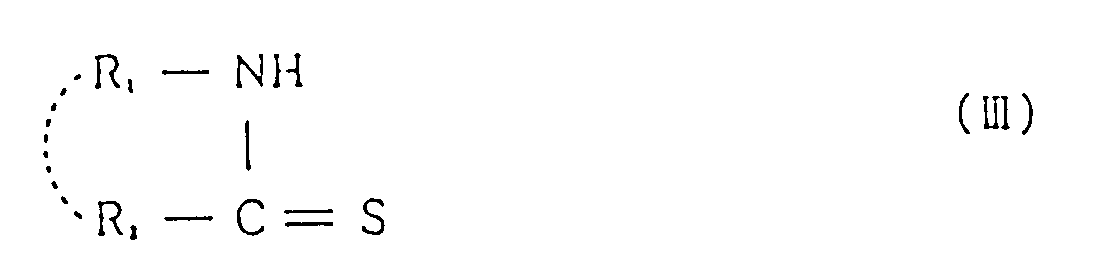
- the thioamide derivative or the thiourea derivative which is required for forming the plate having a near infrared ray shading effect can be shown by following general formula (III) or (IV), respectively.
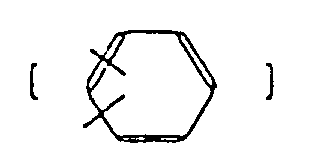
- the thioamide derivative for use in this invention is represented by following general formula (III); wherein R1 and R2 each represents a monovalent group selected from a hydrogen atom, an alkyl group of C1-C18, an alkenyl group, a cycloalkyl group of C3-C9, an aryl group of C6-C18, an aralkyl group of C7-C12, and a 5- or 6-membered heterocyclic group which contains at least one of atoms selected N, S and O, or R2 further represents an alkoxy group, each group may have one or more substituents, and said R1 and R2 may combine with each other to form a ring.
- R1 and R2 each represents a monovalent group selected from a hydrogen atom, an alkyl group of C1-C18, an alkenyl group, a cycloalkyl group of C3-C9, an aryl group of C6-C18, an aralkyl group of C7-C
- the thiourea derivative for use in this invention is represented by following general formula (IV); wherein R1, R2, and R3 have the same meaning as R1 and R2 in formula (III) described above. Each group may have one or more substituents, and said R1 and R2 or said R2 and R3 may combine with each other to form a ring.
- Examples of the aforesaid alkyl group are methyl, ethyl, n-propyl, iso-propyl, n-butyl, sec-butyl, tert-butyl, iso-butyl, n-amyl, n-hexyl, n-heptyl, n-octyl, and n-nonyl.
- cycloalkyl group there are cyclohexyl, p-methylcyclohexyl, etc.
- aralkyl group there are benzyl, methylbenzyl, phenylethyl, naphthylmethyl, etc.
- aryl group there are phenyl, tolyl, biphenyl, naphthyl, etc.
- the raio of copper or lead to sulfur is preferably from about 1:0.5 to 1:10, and more preferably from 1:2 to 1:8.
- the total amounts of the copper salt or lead salt of the phthalic acid derivative and the thiourea derivative or the thioamide derivative to 100 parts by weight of the polymerizable monomer is from about 0.1 to 1.5 parts by weight, and preferably from about 0.2 to 1.0 part by weight.
- a near infrared absorbing, coloring material with heat resistance is formed with heating sufficiently the thiourea derivative, or the thioamide derivative in existence of the copper salt or lead salt of the phthalic acid derivative, for example with heating for dozens of minutes at below 100°C or a few seconds at about from 200 to 300°C.
- photochromic material which can be used in this invention is illustrated below and a suitable compound is spironaphthoxazine but the invention is not limited to these compounds.
- acrylic acid, methacrylic acid, or other well-known monomer(s) are used, and by a well-known polymerization means, a polymer such as polyacrylic acid, polymethacrylic acid, polyacrylic acid ester, polymethacrylic acid ester, polyolefin, polyvinyl chloride, polyvinylidene chloride, polycarbonate, polystyrene, polyester, polyvinyl acetate, polyvinyl alcohol, etc., can be obtained.
- polyacrylic acid polymethacrylic acid, polyacrylic acid ester, polymethacrylic acid ester, polystyrene, polyvinyl acetate, etc.
- polyacrylic acid ester polymethacrylic acid ester
- polystyrene polyvinyl acetate, etc.
- polystyrene polyvinyl acetate, etc.
- polyvinyl chloride polyvinylidene chloride
- polycarbonate polystyrene
- polyester polyvinyl acetate
- the film thereof after polymerizing one or more monomers thereof, the film thereof can be formed by a melt extrusion method.
- polyvinyl chloride polycarbonate, a methacryl resin, polystyrene, polypropylene, and polyethylene
- the plate or film thereof after polymerization, can be formed by a solution flow stretching method.
- a transparent film or plate having a shading property and a light-responsive property in a wide wavelength region can be produced and they can be utilized as, for example, ultraviolet ray cut filters.
- the transparent ultraviolet ray shading and ultraviolet ray-responsive plate can be utilized for the following use.
- the plate since the plate is transparent or transmits visible light, the plate can be used as a sun glass or a window glass capable of shading harmful ultraviolet rays without giving any inconvenience for seeing the seashore, a skiing ground, high mountains or welding.
- a polymer such as polymethacrylate, for example polymethylmethacrylate, polycarbonate, polystyrene, polyethylene, polypropylene or a vinyl chloride resin, nylon and a polyacrylic resin
- the plate using a photochromic material together not only shades ultraviolet rays but also is discolored when irradiated by ultraviolet rays, and hence it can detect invisible ultraviolet rays leaked from, for example, hardening apparatus for hardening a ultraviolet ray hardening resin or ink and at the same time shade the ultraviolet rays.
- the discoloring by ultraviolet rays is generally reversible but becomes irreversible at low temperature and a stable colored state can be maintained at low temperature.
- the plate can be utilized as a detection and shading plate of ultraviolet rays emitted from a ultraviolet lamp being used for the sterilization in a refrigerator or a detection and shading plate for inspecting the state in a sterile room.
- the dry product was stored in a desiccator.
- IR infrared absorption
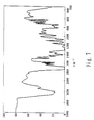
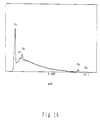
- Fig. 1 The IR spectrum thereof shown in Fig. 1 clearly differed from that of the starting material, acryloyloxyethyl hydrogenphthalate shown in Fig. 7, and from that the absorptions of 2500 to 3300 cm ⁇ 1 originated from the stretching vibration of OH of the carboxylic acid were vanished, the formation of the copper salt of acryloyloxyethyl hydrogenphthalate was confirmed.
- UV-265FS UV-265FS
- the precipitates were slightly sticky in a wet state.
- the precipitates were washed with water, dried, and ground to provide 4.80 g of a dry product.
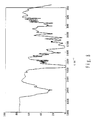
- Fig. 2 The IR spectrum of the product in acetone is shown in Fig. 2 and the visible and ultraviolet absorption spectra of the product are shown in Fig. 12.
- the IR spectrum of the product clearly differs from that of the starting material, acryloyloxyethyl hydrogenphthalate shown in Fig. 7 and also from that the absorptions of 2500 to 3500 cm ⁇ 1 by the stretching vibration of OH of the carboxylic acid were vanished, the formation of organic Nd compound was confirmed.
- Example 2 By following the same procedure as Example 1 using 3.4 g of iron(III) sulfate n-hydrate in place of 2.5 g of copper(II) sulfate penta-hydrate, precipitates were obtained. Furthermore, by performing the same post treatment as in Example 1, 4.55 g of a light brown dry product was obtained.
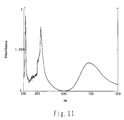
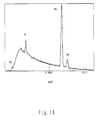
- Fig. 3 The IR spectrum of the product is shown in Fig. 3, and the visible and ultraviolet absorption spectra thereof are shown in Fig. 13.
- Example 2 By following the same procedure as Example 1 using 3.4 g of cerium(III) sulfate n-hydrate in place of 2.5 g of copper(II) sulfate penta-hydrate, light brown precipitates were obtained. The precipitates were washed with water, dried, and ground to provide 4.3 g of a white organic Ce compound.
- Example 2 By following the same procedure as Example 1 using cobalt sulfate, lead sulfate, nickel sulfate, vanadium sulfate, or tungsten sulfate, the cobalt salt (pink color), the lead salt (white color), nickel salt (light blue color), vanadium salt (olive color), or tungsten salt (purple-blue color) of acroyloxyethyl hydrogenphthalate was obtained. From the X-ray analysis and the infrared spectra thereof, the formation of these salts were confirmed.
- Example 2 By following the same procedure as Example 1 using 5 g of acryloyloxypropyl hydrogenphthalate in place of 5 g of acryloyloxyethyl hydrogenphthalate, blue-green precipitates were obtained. Also, by further conducting the same post treatment as in Example 1, 4.75 g of a light green compound was obtained.
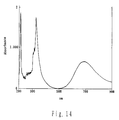
- the IR spectrum of the organic Cu compound obtained is shown in Fig. 5 and the visible and ultraviolet absorption spectra are shown in Fig. 14. The results showed that the IR spectrum of the product clearly differed from that the starting product, acryloyloxypropyl hydrogenphthalate, and also the formation of an organic Cu compound was confirmed.
- Example 2 By following the same procedure as Example 1 using 5 g of methacryloyloxyethyl hydrogenphthalate in place of 5 g of acryloyloxyethyl hydrogenphthalate, blue-green precipitates were obtained. By further conducting the same post treatment as in Example 1, 4.2 g of a light green powdery compound was obtained.
- the IR spectrum of the organic Cu compound obtained is shown in Fig. 6 and the visible and ultraviolet absorption spectra thereof are shown in Fig. 15. The results showed that the IR spectrum of the product clearly differed from that of the starting material, methacryloyloxyethyl hydrogenphthalate shown in Fig. 9 and the formation of the organic Cu compound was confirmed.
- Example 2 In 100 parts by weight of methyl methacrylate was dissolved 1.77 parts by weight of the copper salt of acryloyloxyethyl hydrogenphthalate obtained in Example 1 and after adding thereto 0.5 part by weight of ⁇ , ⁇ '-isobuthyronitrile as a polymerization initiator, the compound was polymerized by heating to 60 to 80°C in a hot water bath. The product was cased on a glass plate while it was visous and further polymerized by heating to 90°C to provide a light blue-green transparent plate having a thickness of 2 mm.
- UVR-1 ultraviolet ray intensity meter
- the plate containing the copper salt of acryloyloxyethyl phthalate shaded about 90% of the ultraviolet rays.
- the intensity of the ultraviolet rays was 0.006 mW/cm2, which showed that the plate completely shaded the ultraviolet rays. In this case, the plate was discolored from light blue-green to dark blue-green.
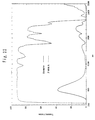
- the plate effectively shades ultraviolet ray portions of from 240 n.m. to 350 n.m. and near infrared ray portions of from 900 n.m. to 2600 n.m. as shown in Fig. 22.
- the plate when used for building materials in an exterior field as a heat-absorbing material having good viewing property, the plate can supply bright and cool light.
- the transparent plate was obtained with the same procedure as the above mentioned procedure using 1.3-bis(m-chlorphenyl)thiourea, dibutylthiourea, 1-oxydiethylene-3-benzyl-2-thiourea or dicyclohexylthiourea in place of dlphenylthiourea.
- the property of the obtained plates were same with the property of the above mentioned plate.
- Example 2 After mixing 0.1 parts by weight of the copper salt of acryloyloxyethyl hydrogenphthalate obtained in Example 1 and 0.4 part by weight of diphenylthiourea with 100 parts by weight of a polystyrene resin as natural resin, the resultant mixture was dry-blended. Then, colored pellets were prepared from the blend using an extruder and the pellets were extrusion molded to provide a light olive transparent plate having a thickness of 3 mm. The ratio of copper to sulfur was 1:9.2(by weight)(Cu:S).
- the plate could shade near infrared rays in the wide range of from 900 n.m. to 2600 n.m. as in Example 10.
- the plate with the same property as the above mentioned plate was obtained using polycarbonate or polymethacrylate instead of polyethylene resin.
- Example 2 After mixing 0.5 part by weight of the copper salt of acryloyloxyethyl hydrogenphthalate obtained in Example 1 and 0.5 part by weight of diethylthiourea with 100 parts by weight of a polyethylene resin as natural resin, the resultant mixture was dry-blended. Then, color pellets were prepared from the blend using an extruder and the pellets were extrusion-molded to provide a light olive transparent film having a thickness of 80 microns. The ratio of copper to sulfur was 1:2.4(by weight)(Cu:S).
- the film could cut about 50% of near infrared rays in the regions of from 950 n.m. to 2600 n.m.
- the ratio of lead(Pb) : sulfur in the product was 1:7.8 by weight ratio.
- the plate could effectively shade ultraviolet rays of from 240 n.m. to 400 n.m. and near infrared rays of fro, 900 n.m. to 2,600 n.m.
Landscapes
- Physics & Mathematics (AREA)
- Spectroscopy & Molecular Physics (AREA)
- Chemical & Material Sciences (AREA)
- Engineering & Computer Science (AREA)
- Materials Engineering (AREA)
- General Physics & Mathematics (AREA)
- Addition Polymer Or Copolymer, Post-Treatments, Or Chemical Modifications (AREA)
- Organic Low-Molecular-Weight Compounds And Preparation Thereof (AREA)
- Optical Filters (AREA)
Claims (8)
- Nouveau sel métallique dérivé d'acide dibasique représenté par la formule générale (I) ci-dessous:



- Nouveau sel métallique dérivé d'acide dibasique tel que revendiqué dans la revendication 1, où le composé représenté par la formule (I) est un sel métallique d'un phtalate acide d'acryloyloxyalkyle représenté par la formule ci-dessous:

- Plaque opacifiante composée d'un polymère transparent, que l'on peut obtenir en mélangeant un monomère de méthacrylate avec le sel métallique dérivé d'acide dibasique représenté par la formule (I) ci-dessous et en les polymérisant à la chaleur;


- Plaque opacifiante et photosensibble du polymère transparent tel que revendiqué dans le revendication 3, dans laquelle le polymère transparent contient en outre une matière photochrome.
- Plaque opacifiante composée d'un polymère transparent, que l'on peut obtenir en polymérisant à la chaleur un mélange contenant un monomère de méthacrylate, un sel de cuivre ou un sel de plomb dérivé d'acide dibasique représenté par la formule générale (I') ci-dessous et un dérivé thioamide représenté par la formule générale (III) ci-dessous ou un dérivé thiourée représenté par la formule générale (IV) ci-dessous;
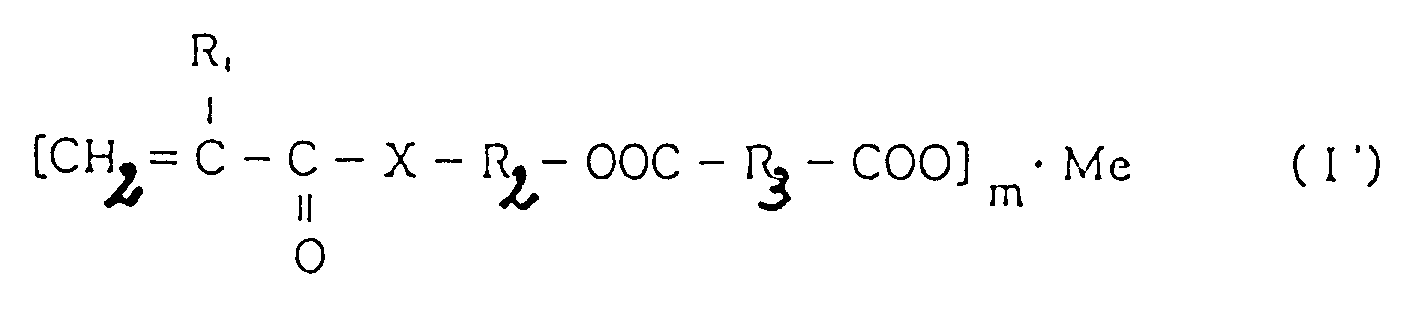


- Plaque opacifiante aux rayons infra-rouges proches, constituée d'un polymère transparent contenant un sel de cuivre ou un sel de plomb dérivé d'acide dibasique représenté par la formule générale (I'), et un dérivé thiamide représenté par la formule générale (III) ci-dessous, le composant principal dudit polymère transparent pouvant être obtenu par mélange à la chaleur dans un procédé à pastille colorée et étant au moins un polymère choisi parmi un polyméthacrylate, un polycarbonate, une résine de chlorure de vinyle, le polypropylène, le polyéthylène, le polystyrène, le nylon et une résine polyacrylique;



- Plaque opacifiante aux rayons infra-rouges proches, constituée d'un polymère transparent pouvant être obtenu par mélange à la chaleur dans un procédé à pastille colorée et contenant un sel de cuivre ou un sel de plomb dérivé d'acide dibasique représenté par la formule générale (I') ci-dessous et un dérivé thiourée représenté par la formule générale (IV) ci-dessous, le composant principal dudit polymère transparent étant au moins un polymère choisi parmi un polyméthacrylate, un polycarbonate, une résine de chlorure de vinyle, le polypropylène, le polyéthylène, le polystyrène, le nylon et une résine polyacrylique;


- Plaque opacifiante aux rayons infra-rouge proches constituée d'un polymère transparent tel que revendiqué dans la revendication 6 ou 7, où le sel de cuivre et/ou le sel de plomb dérivé d'acide dibasique représenté par la formule (I') est combiné avec le dérivé thioamide représenté par la formule (III) et/ou le dérivé thiourée représenté par la formule (IV) dans un rapport de composition du cuivre et/ou du plomb au soufre compris entre 1:0,5 et 1:10.
Applications Claiming Priority (2)
| Application Number | Priority Date | Filing Date | Title |
|---|---|---|---|
| JP25086389 | 1989-09-27 | ||
| JP250863/89 | 1989-09-27 |
Publications (3)
| Publication Number | Publication Date |
|---|---|
| EP0420233A2 EP0420233A2 (fr) | 1991-04-03 |
| EP0420233A3 EP0420233A3 (en) | 1992-02-12 |
| EP0420233B1 true EP0420233B1 (fr) | 1995-11-29 |
Family
ID=17214134
Family Applications (1)
| Application Number | Title | Priority Date | Filing Date |
|---|---|---|---|
| EP90118559A Expired - Lifetime EP0420233B1 (fr) | 1989-09-27 | 1990-09-27 | Dérivé de sel métallique de l'acide phtalique et plaque opacifiante et photosensible contenant ce sel métallique |
Country Status (4)
| Country | Link |
|---|---|
| US (3) | US5202450A (fr) |
| EP (1) | EP0420233B1 (fr) |
| JP (1) | JPH03246256A (fr) |
| DE (1) | DE69023864T2 (fr) |
Families Citing this family (8)
| Publication number | Priority date | Publication date | Assignee | Title |
|---|---|---|---|---|
| US5393443A (en) * | 1991-06-19 | 1995-02-28 | Jujo Paper Co., Ltd. | Hard-coating, heat-absorbing composition and heat-shielding substance |
| JP3206940B2 (ja) * | 1991-12-16 | 2001-09-10 | ダイセル化学工業株式会社 | 近赤外線吸収メタクリル系樹脂組成物及びその成形体 |
| USD385696S (en) * | 1996-03-28 | 1997-11-04 | Gerry Baby Products Company | Child carrier |
| US6399672B1 (en) | 1999-06-02 | 2002-06-04 | Sartomer Technologies Co., Inc. | Oil soluble metal-containing compounds, compositions and methods |
| EP2402997B1 (fr) * | 2010-06-30 | 2012-02-08 | ABB Research Ltd. | Dispositif semi-conducteur de puissance |
| KR20140009558A (ko) * | 2011-06-01 | 2014-01-22 | 미쯔비시 레이온 가부시끼가이샤 | 금속 함유 중합성 단량체 및 그의 제조 방법 |
| CN103992355B (zh) * | 2014-05-19 | 2017-02-15 | 桂林理工大学 | 钴四元配合物[Co(4,4’‑bpt)2(O‑BDC)(H2O)3]NO3·H2O及其制备方法 |
| JP6890580B2 (ja) * | 2016-03-25 | 2021-06-18 | 富士フイルム株式会社 | 赤外線フィルタ、赤外線センサおよび赤外線フィルタ用組成物 |
Family Cites Families (8)
| Publication number | Priority date | Publication date | Assignee | Title |
|---|---|---|---|---|
| US3689427A (en) * | 1969-08-27 | 1972-09-05 | Okura Industrial Co Ltd | Polymerizable mixtures comprising a bivalent metal salt of an acrylate- or methacrylate-phthalate ester of an alkylene glycol |
| JPS552423B2 (fr) * | 1973-02-09 | 1980-01-19 | ||
| US3899382A (en) * | 1973-03-08 | 1975-08-12 | Hideaki Matsuda | Anaerobic bonding agent |
| JPS528303A (en) * | 1975-04-11 | 1977-01-22 | Hitachi Chemical Co Ltd | Filmmlike laminated body |
| US4193803A (en) * | 1977-03-17 | 1980-03-18 | Eastman Kodak Company | Amorphous polyester adhesives for photographic materials comprising phthalic acid, linear and branched aliphatic glycol components |
| US4634651A (en) * | 1984-08-31 | 1987-01-06 | Ricoh Co., Ltd. | Non-aqueous type resin and electrophotographic developer containing the same |
| JPS62109004A (ja) * | 1985-11-08 | 1987-05-20 | Hitachi Ltd | プラスチツク光フアイバ、その製法及び樹脂 |
| EP0281991B1 (fr) * | 1987-03-10 | 1993-07-14 | Daikin Industries, Limited | Ethers vinyliques et copolymères contenant du fluor préparés à partir de ceux-ci |
-
1990
- 1990-09-27 DE DE69023864T patent/DE69023864T2/de not_active Expired - Fee Related
- 1990-09-27 JP JP2258636A patent/JPH03246256A/ja active Pending
- 1990-09-27 EP EP90118559A patent/EP0420233B1/fr not_active Expired - Lifetime
- 1990-09-27 US US07/589,372 patent/US5202450A/en not_active Expired - Lifetime
-
1991
- 1991-08-02 US US07/740,005 patent/US5369199A/en not_active Expired - Lifetime
-
1993
- 1993-08-26 US US08/113,229 patent/US5391666A/en not_active Expired - Fee Related
Non-Patent Citations (1)
| Title |
|---|
| CHEMICAL ABSTRACTS, vol. 111, no. 8, 21 August 1989, Columbus, Ohio,US; abstract no. 58837E, T.OKAMOTO ET. AL.: 'Effect of divalent metal salts of dibasic acid mono(methacryloyloxypropyl) esters on adhesive properties.' page 36 ;column 2 ; & INTERNATIONAL JOURNAL OF ADHESION AND ADHESIVES vol. 9, no. 1, pages 13 - 20 * |
Also Published As
| Publication number | Publication date |
|---|---|
| DE69023864D1 (de) | 1996-01-11 |
| US5202450A (en) | 1993-04-13 |
| US5391666A (en) | 1995-02-21 |
| EP0420233A2 (fr) | 1991-04-03 |
| JPH03246256A (ja) | 1991-11-01 |
| EP0420233A3 (en) | 1992-02-12 |
| DE69023864T2 (de) | 1996-06-13 |
| US5369199A (en) | 1994-11-29 |
Similar Documents
| Publication | Publication Date | Title |
|---|---|---|
| EP0420233B1 (fr) | Dérivé de sel métallique de l'acide phtalique et plaque opacifiante et photosensible contenant ce sel métallique | |
| RU2357985C2 (ru) | Непрозрачно окрашенный, отражающий инфракрасное излучение состав пластиковой пресс-формы | |
| JP2002069305A (ja) | 光学材料及びその製造方法 | |
| US3895029A (en) | Fluoropolymer coating compositions | |
| JP3206940B2 (ja) | 近赤外線吸収メタクリル系樹脂組成物及びその成形体 | |
| US5723075A (en) | Dimerized thiourea derivatives near-infared absorbents comprising the same, and heat wave shielding materials comprising the same | |
| Bucio et al. | Radiation-induced grafting of functional acrylic monomers onto polyethylene and polypropylene films using acryloyl chloride | |
| JP2002071941A (ja) | 光学材料 | |
| RU2036217C1 (ru) | Полимерная композиция для получения пленки | |
| DE3140897A1 (de) | Verfahren zur nutzbarmachung von licht der wellenlaengen 470 bis 600 nm fuer die fotosynthese | |
| JP2701139B2 (ja) | 新規なフタル酸誘導体金属塩を含有する光遮断性及び光感応性のあるプレート | |
| JP2000252482A (ja) | 受光センサ及び該センサを用いた装置 | |
| RU2116634C1 (ru) | Индикатор ультрафиолетового излучения | |
| JPH05163405A (ja) | 近赤外線吸収塩化ビニル系樹脂組成物及びその成形体 | |
| JP2001097984A (ja) | 近赤外吸収化合物 | |
| RU1806152C (ru) | Полимеризуемый состав дл получени прозрачных полимерных материалов | |
| JP2754527B2 (ja) | 近赤外線吸収性色素及びその色素を含有した樹脂成形体 | |
| JP2001049234A (ja) | 近赤外線吸収剤、それを含有する組成物及び樹脂板 | |
| JPH0812617A (ja) | 1,3−ジケトン錯体化合物及びその製造方法 | |
| DE2400418A1 (de) | Lichtabbaubare thermoplastische kunststofformmassen | |
| KR101856837B1 (ko) | 광학 필름 및 포인팅 표시장치 | |
| JPS591300B2 (ja) | 高分子材料の着色方法 | |
| JP3366353B2 (ja) | ネオジム含有透明アクリル樹脂組成物 | |
| JPH0748568A (ja) | フォトクロミック性樹脂組成物 | |
| JPH01153750A (ja) | 蛍光性高分子成形体 |
Legal Events
| Date | Code | Title | Description |
|---|---|---|---|
| PUAI | Public reference made under article 153(3) epc to a published international application that has entered the european phase |
Free format text: ORIGINAL CODE: 0009012 |
|
| 17P | Request for examination filed |
Effective date: 19901224 |
|
| AK | Designated contracting states |
Kind code of ref document: A2 Designated state(s): DE FR GB |
|
| PUAL | Search report despatched |
Free format text: ORIGINAL CODE: 0009013 |
|
| AK | Designated contracting states |
Kind code of ref document: A3 Designated state(s): DE FR GB |
|
| 17Q | First examination report despatched |
Effective date: 19931123 |
|
| RAP1 | Party data changed (applicant data changed or rights of an application transferred) |
Owner name: NIPPON PAPER INDUSTRIES CO., LTD. |
|
| GRAA | (expected) grant |
Free format text: ORIGINAL CODE: 0009210 |
|
| AK | Designated contracting states |
Kind code of ref document: B1 Designated state(s): DE FR GB |
|
| REF | Corresponds to: |
Ref document number: 69023864 Country of ref document: DE Date of ref document: 19960111 |
|
| ET | Fr: translation filed | ||
| PLBE | No opposition filed within time limit |
Free format text: ORIGINAL CODE: 0009261 |
|
| STAA | Information on the status of an ep patent application or granted ep patent |
Free format text: STATUS: NO OPPOSITION FILED WITHIN TIME LIMIT |
|
| 26N | No opposition filed | ||
| REG | Reference to a national code |
Ref country code: GB Ref legal event code: IF02 |
|
| PGFP | Annual fee paid to national office [announced via postgrant information from national office to epo] |
Ref country code: FR Payment date: 20030909 Year of fee payment: 14 |
|
| PGFP | Annual fee paid to national office [announced via postgrant information from national office to epo] |
Ref country code: GB Payment date: 20030924 Year of fee payment: 14 |
|
| PGFP | Annual fee paid to national office [announced via postgrant information from national office to epo] |
Ref country code: DE Payment date: 20031009 Year of fee payment: 14 |
|
| PG25 | Lapsed in a contracting state [announced via postgrant information from national office to epo] |
Ref country code: GB Free format text: LAPSE BECAUSE OF NON-PAYMENT OF DUE FEES Effective date: 20040927 |
|
| PG25 | Lapsed in a contracting state [announced via postgrant information from national office to epo] |
Ref country code: DE Free format text: LAPSE BECAUSE OF NON-PAYMENT OF DUE FEES Effective date: 20050401 |
|
| GBPC | Gb: european patent ceased through non-payment of renewal fee |
Effective date: 20040927 |
|
| PG25 | Lapsed in a contracting state [announced via postgrant information from national office to epo] |
Ref country code: FR Free format text: LAPSE BECAUSE OF NON-PAYMENT OF DUE FEES Effective date: 20050531 |
|
| REG | Reference to a national code |
Ref country code: FR Ref legal event code: ST |