EP0420360A2 - Feuille composite de polyéthylène fibreux - Google Patents
Feuille composite de polyéthylène fibreux Download PDFInfo
- Publication number
- EP0420360A2 EP0420360A2 EP90202606A EP90202606A EP0420360A2 EP 0420360 A2 EP0420360 A2 EP 0420360A2 EP 90202606 A EP90202606 A EP 90202606A EP 90202606 A EP90202606 A EP 90202606A EP 0420360 A2 EP0420360 A2 EP 0420360A2
- Authority
- EP
- European Patent Office
- Prior art keywords
- sheet
- layer
- pulp
- composite sheet
- plexifilamentary
- Prior art date
- Legal status (The legal status is an assumption and is not a legal conclusion. Google has not performed a legal analysis and makes no representation as to the accuracy of the status listed.)
- Ceased
Links
Images
Classifications
-
- D—TEXTILES; PAPER
- D21—PAPER-MAKING; PRODUCTION OF CELLULOSE
- D21H—PULP COMPOSITIONS; PREPARATION THEREOF NOT COVERED BY SUBCLASSES D21C OR D21D; IMPREGNATING OR COATING OF PAPER; TREATMENT OF FINISHED PAPER NOT COVERED BY CLASS B31 OR SUBCLASS D21G; PAPER NOT OTHERWISE PROVIDED FOR
- D21H13/00—Pulp or paper, comprising synthetic cellulose or non-cellulose fibres or web-forming material
- D21H13/10—Organic non-cellulose fibres
- D21H13/12—Organic non-cellulose fibres from macromolecular compounds obtained by reactions only involving carbon-to-carbon unsaturated bonds
- D21H13/14—Polyalkenes, e.g. polystyrene polyethylene
-
- D—TEXTILES; PAPER
- D21—PAPER-MAKING; PRODUCTION OF CELLULOSE
- D21F—PAPER-MAKING MACHINES; METHODS OF PRODUCING PAPER THEREON
- D21F11/00—Processes for making continuous lengths of paper, or of cardboard, or of wet web for fibre board production, on paper-making machines
- D21F11/02—Processes for making continuous lengths of paper, or of cardboard, or of wet web for fibre board production, on paper-making machines of the Fourdrinier type
- D21F11/04—Processes for making continuous lengths of paper, or of cardboard, or of wet web for fibre board production, on paper-making machines of the Fourdrinier type paper or board consisting on two or more layers
-
- D—TEXTILES; PAPER
- D21—PAPER-MAKING; PRODUCTION OF CELLULOSE
- D21H—PULP COMPOSITIONS; PREPARATION THEREOF NOT COVERED BY SUBCLASSES D21C OR D21D; IMPREGNATING OR COATING OF PAPER; TREATMENT OF FINISHED PAPER NOT COVERED BY CLASS B31 OR SUBCLASS D21G; PAPER NOT OTHERWISE PROVIDED FOR
- D21H27/00—Special paper not otherwise provided for, e.g. made by multi-step processes
- D21H27/30—Multi-ply
- D21H27/38—Multi-ply at least one of the sheets having a fibrous composition differing from that of other sheets
Definitions
- the present invention relates to a composite sheet comprising layers of fibrous polyethylene. More particularly, the invention concerns such a sheet that is particularly useful as a substrate for printing.
- Spunbonded fibrous sheet made of multiple plexifilamentary strands of oriented polyethylene film fibrils is known from, for example, Steuber, United States Patent 3,169,899.
- Such sheet has been produced commercially by E. I. du Pont de Nemours and Company under the trademark "Tyvek” spunbonded olefin.
- the sheet has proven useful in many diverse applications, which take advantage of its unusually good combination of strength, tear and permeability properties, among others.
- improvement in the spunbonded fibrous polyethylene sheets are still desired.
- the present inventors have found that the sheets sometimes exhibit inadequate print clarity. Accordingly, a purpose of the present invention is to improve the fibrous polyethylene sheet so that it performs satisfactorily in high density bar-code printing.
- Synthetic pulps of polyethylene are known in the art. Kirk-Othmer: Encyclopedia of Chemical Technology , volume 19, third edition, John Wiley & Sons, p.420-435 (1982) describes synthetic pulps as generally being very fine, highly branched, discontinuous, water-dispersible fibers made of plastics.
- Known methods for producing the synthetic pulps include solution flash-spinning, emulsion flash-spinning, melt-extrusion/fibrillation and shear precipitation.
- the pulps may be blended with other fibers and made into papers, sheets or boards by conventional wet-lay papermaking techniques. Such pulps have also been used as bonding agents for certain nonwoven materials such as dry-laid, Rando-Webber formed sheets and wet-laid, Fourdrinier-formed sheets.
- Gale et al United States Patent 4,608,089, discloses forming oriented polyethylene film-fibril pulps by cutting a flash-spun polyethylene sheet (e.g., Tyvek R ) into pieces, forming an aqueous slurry with the pieces and then refining the pieces with disc refiners to form a pulp that is particularly suited for cement reinforcement.
- a flash-spun polyethylene sheet e.g., Tyvek R
- Composite nonwoven sheets also are known.
- Weeks United States Patent 4,647,497, discloses a calendered composite nonwoven sheet comprising (a) a nonwoven scrim of continuous filaments of about 1 to 10 dtex per filament, preferably of polyester, polypropylene or nylon, (b) an abrasion-resistant synthetic pulp layer, preferably of polyethylene and (c) an adhesive binder which adheres the scrim to the pulp layer.
- the composite sheet is especially suited for air-infiltration barriers and outdoor signs and banners.
- the present invention provides a nonwoven composite sheet comprising a layer of flash-spun polyethylene plexifilamentary film-fibril strand sheet in face-to-face contact with a layer of polyethylene synthetic pulp.
- the flash-spun sheet layer has a weight in the range of 25 to 100 g/m2 and the synthetic pulp layer has a weight in the range of 8.5 to 85 g/m2 and the total weight of the composite sheet is no more than about 135 g/m2.
- the layer of continuous plexifilamentary strands has a weight in the range of 40 to 70 g/m2 and the layer of synthetic pulp has a weight in the range of 15 to 35 g/m2.
- the layers are thermally bonded to each each other.
- the composite sheet is calendered.
- the composite sheets preferably have a coefficient of variation of sheet thickness of no greater than 10%.
- the present invention also provides a process for preparing the nonwoven composite sheet in which a layer of wet polyethylene synthetic pulp is formed on a paper-making machine and then is combined with a continuous filament nonwoven sheet to form a sheet assembly which is dewatered and dried to form the nonwoven composite sheet.
- the nonwoven continuous filament sheet is a lightly consolidated sheet of flash-spun plexifilamentary strands of oriented polyethylene film-fibrils which is laid atop the wet pulp layer at a point in the paper-making process where the wet pulp layer has a water content in the range of 99 to 50 percent by total weight of the wet pulp layer.
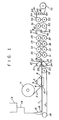
- Figure 1 depicts a Foudrinier machine wherein a wet-laid layer of polyethylene synthetic pulp 1 is advanced on a forming wire 17 to a position at which a lightly consolidated sheet 2 of flash-spun polyethylene plexifilamentary film-fibril strands supplied from roll 11 , is laid upon the wet-laid pulp layer.
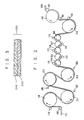
- FIG. 1 depicts a calender apparatus suitable for bonding layers of the composite nonwoven sheet 140 together.
- the calender comprises multiple, internally heated rolls 150-158 , internally cooled rolls 159 and 190 , idler rolls 180 and 182 , corona discharge wands 186-188 , and rubber-coated nip rolls 170-176 and 182 .
- Figure 3 depicts a cross-section of composite sheet 200 which comprises a layer 210 of polyethylene synthetic pulp and a layer 220 of plexifilamentary polyethylene film-fibril strands.
- a laminate is made of a sheet of plexifilamentary polyethylene film-fibril strands and a synthetic pulp of polyethylene.
- the sheet of flash-spun polyethylene plexifilamentary film-fibril strands is made by the general method of Steuber, United States Patent 3,169,899, the disclosure of which is hereby incorporated by reference.
- the sheets are prepared by flash-spinning from multiple position solutions of polyethylene in an organic solvent into plexifilamentary film-fibril strands which are deposited and combined on a moving surface to form a sheet, which is then lightly consolidated and wound into a roll.
- suitable lightly consolidated spunbonded polyethylene film-fibril sheets have thicknesses in the range of 0.13 to 0.33 mm and weights in the range of 25 to 100 g/m2, preferably 40 to 70 g/m2.
- Polyethylene synthetic pulps that are suitable for use in the present invention include PulPlusTM (made by E. I. du Pont de Nemours and Company), "SWP” (distributed by Mini-Fibers, Inc., of Johnson City, Tennessee), “Pulpex” (made by Lextar, a company of Hercules, Inc., of Wilmington, Delaware) and the like.
- PulPlusTM is made by the general methods disclosed by Gale et al, United States Patent 4,608,089, which disclosure is hereby incorporated by reference, and is preferred for use in the present invention because the melting temperatures of the pulp made by these methods most closely match those of the layer of flash-spun polyethylene plexifilamentary film-fibril strand sheet.
- the pulps when laminated to the sheet layer, add about 8.5 to 85 g/m2, preferably 15 to 60 g/m2 to the weight of the sheet.
- a conventional Foudrinier paper making machine can be employed, with certain minor modifications.
- the modifications involve the addition of (see Figure 1) an unwind stand (not shown) for roll 11 of flash-spun polyethylene film-fibril sheet 2 and an initial compression zone formed by forming wire 17 and top wire 5 .
- Roll 11 is accurately aligned with forming wire 17 to avoid the formation of wrinkles in the product being formed.
- the drives (not shown) of the paper-making machine provide sufficient force to unwind the sheet from the roll.
- the unwind stand has a small brake to provide tension to the sheet.
- Pulp 1 is floated onto the forming wire by conventional paper-making techniques.
- Sheet 2 is placed atop pulp 1 on forming wire 17 because of the low porosity and hydrophobic nature of sheet 2 .
- the pulp is usually laid atop the scrim. Because pulp 2 , with its very high moisture content preferably 94-98.5%), is very mobile, when compression is applied to the combined pulp and sheet, the pulp flows more into thinner areas of the sheet. This produces a laminate of improved thickness uniformity. Only a small amount of pulp is necessary; the sheet provides the necessary strength for carrying the wet laminated to the press section (rolls 20-25 and belts 27-28 ).
- the laminate is initially consolidated between top wire 5 and forming wire 17 . Additional consolidation is provided by the press section ( 30-37 ) and drying sections ( 30-37 and 50-53 ).
- pulp 1 and sheet 2 it is also sometimes desirable to combine pulp 1 and sheet 2 at the first rolls 20 and 23 of the dewatering press. However, when the moisture content of the pulp is less than 50%, the pulp layer does not adhere to the sheet.
- the bonding or finishing of the laminated sheet can be accomplished with conventional equipment, such as calender roll stacks.
- Particularly preferred equipment for carrying out the bonding is shown in Figure 2 as described above.
- the equipment is similar to that disclosed by Lee, United States Patent 4,554,207.
- All rolls were operated at substantially the same peripheral speeds.
- the temperature of the interface between the pulp and the plexifilamentary strand sheet was raised sufficiently to bond the two layers together.
- the bonding of the laminate can be augmented with latex binders or thermally fusible fibers.
- Latex binders of the kind disclosed by Weeks, United States Patent 4,647,497, are suited for this purpose.
- the latex binders can be applied to the polyethylene film-fibril sheet or can be included in the pulp furnish.
- the fusible fibers can be added directly to the pulp furnish.
- the melting point of the fusible fibers should be lower than that of the pulp fibers.
- a suitable fusible fibers for use with pulps of Pulplus R are Pulpex R EA (sold by Hercules, Incorporated) fibers which have a melting temperature that is about 4°C lower than that of the Pulplus R .
- Sheet weight is measured in accordance with ASTM D3776-79 and is reported in grams per square meter.
- Tensile strength which is reported in Newtons, is measured as follows. A 1.0-inch (2.54-cm) wide by 8.0-inch (20.3-cm) long strip of sheet is mounted in the clamps of a Constant Rate-of-Extension Instron Tensile Testing Machine. A continuously increasing load is applied longitudinally to the strip longitudinally. The load at rupture is the tensile strength (or breaking load).
- Elmendorf tear strength is measured in accordance with ASTM D1424-83, but with the specimen size set forth for film in ASTM D1922-67(1978), and is reported in Newtons.
- Sheet thickness and thickness uniformity is measured utilizing a beta-gauge, by the method described in detail in Lim, United States Patent 4,652,322, column 5, lines 21-32, which description is hereby incorporated by reference.
- This example illustrates the surprisingly large improvement in thickness uniformity obtained when composite sheets are made in accordance with the present invention.
- a composite sheet of the invention was made by combining a 17.0-g/m2 layer of polyethylene synthetic pulp (PulPlusTM) with a 42.4-g/m2 layer of lightly consolidated, flash-spun polyethylene plexifilamentary film-fibril strand sheet and then bonding the two layers together, substantially as shown in Example 2 below.
- the average thickness of the composite sheet was measured with a Beta-gauge (16,920 points, 5 readings per inch) to average 0.187 ⁇ 0.021 millimeter.
- the value quoted is the average value, X, plus or minus one standard deviation, ⁇ (i.e., X ⁇ ⁇ ).
- the composite sheet of this example was much more uniform than would have been expected from a simple combination of a plexifilamentary substrate sheet with a pulp of perfectly uniform thickness.
- the average thickness of a bonded 41.1-g/m2 flash-spun polyethylene plexifilamentary film-fibril strand sheet was measured to be 0.162 ⁇ 0.025, which corresponds to a coefficient of variation of 15.4%.
- the resulting composite sheet would have an average thickness of 0.187 ⁇ 0.025 mm, obtained by adding the total thickness of the pulp layer to the thickness of the plexifilamentary strand sheet, or a CV of 13.4%.
- the thickness uniformity of the composite sheet made in this example had a ⁇ of ⁇ 0.021, or a CV of 9.3%.
- the coefficient of variation of thickness was about 30% smaller than that theoretically obtainable with a pulp of perfectly uniform thickness.
- This example illustrates the production of a series of composite sheets of the invention and further demonstrates the advantageous improvements obtained by the invention in sheet thickness uniformity.
- PulPlusTM polyethylene synthetic pulp was screened through a Bird Model-100 Centrisorter (sold by Bird Machine Co., South Walpole, Massachusetts) equipped with a 0.045-inch plate. The plate was perforated with a multiplicity of 0.045-inch (0.114-cm) diameter holes. Screened pulp, weighing in the range of 17.0 to 64.4 g/m2, was combined on a Fourdrinier paper-making machine of the type shown in Figure 1, with lightly consolidated, flash-spun polyethylene plexifilamentary film-fibril strand sheet weighing in the range of 41.0 and 52 ⁇ 2 g/m2.
- the machine was operated with a speed of 100 feet per minute (30.5 m/min), with free dewatering (i.e., no vacuum under screen 17 ) and with nip loads of 280 pounds. per linear inch (50 kg/cm) between rolls 20 and 23 , 180-230 lb/in (32.2-41.2 kg/cm) between rolls 22 and 25 , and 125 lb/in (22.4 kg/cm) between rolls 42 and 43 .
- a lump-breaker roll was employed atop forming wire 17 immediately above couch roll 19 . Rolls 60 through 64 were by-passed.
- the moisture content of the pulp at a place on the Fourdrinier machine about 30 cm upstream of where the pulp and sheet were combined was in the range of 97.8 to 99.6%. Other tests showed that at moisture contents of 94.5% excellent formation (i.e., uniformity) of the wet is obtained. Even when moisture content is as low as 50%, adequate lamination can be obtained.
- Table 2 clearly demonstrate the significant improvement in thickness uniformity of the composite products of the invention over the commercial product.
- the thickness of the composites had coefficients of variation ranging from 6.6-to-9.8% versus 13.4% for the commercial product.
- Table 2 also shows that thickness uniformity also improves with increasing pulp weight.
- the printed bar code was read with a "Lasercheck” reader, (Model no. LC2811 manufactured by Symbol Technologies, Inc. of Bohemia, New York) to determine whether the printed matter could be read.
- Printed matter that can be read with the Lasercheck reader 85% of the time is considered satisfactory for commercial use.
- the measured percent of successful readings for each of several sheet samples was as follows: Sheet Sample % Successful Readings Example 4 96, 98, 91, 92 Comparison C 50, 29, 48, 52, 29 These results clearly demonstrated that the printed composite sheet of the invention was much more readable than the printed comparison sheet.
Landscapes
- Chemical & Material Sciences (AREA)
- Chemical Kinetics & Catalysis (AREA)
- Laminated Bodies (AREA)
- Paper (AREA)
- Artificial Filaments (AREA)
Applications Claiming Priority (2)
| Application Number | Priority Date | Filing Date | Title |
|---|---|---|---|
| US415831 | 1989-09-29 | ||
| US07/415,831 US4941947A (en) | 1989-09-29 | 1989-09-29 | Composite fibrous polyethylene sheet |
Publications (2)
| Publication Number | Publication Date |
|---|---|
| EP0420360A2 true EP0420360A2 (fr) | 1991-04-03 |
| EP0420360A3 EP0420360A3 (en) | 1992-05-13 |
Family
ID=23647382
Family Applications (1)
| Application Number | Title | Priority Date | Filing Date |
|---|---|---|---|
| EP19900202606 Ceased EP0420360A3 (en) | 1989-09-29 | 1990-10-01 | Composite fibrous polyethylene sheet |
Country Status (4)
| Country | Link |
|---|---|
| US (1) | US4941947A (fr) |
| EP (1) | EP0420360A3 (fr) |
| JP (1) | JPH03183537A (fr) |
| CA (1) | CA2026489A1 (fr) |
Families Citing this family (11)
| Publication number | Priority date | Publication date | Assignee | Title |
|---|---|---|---|---|
| US6171443B1 (en) | 1990-03-05 | 2001-01-09 | Polyweave International, Llc | Recyclable polymeric synthetic paper and method for its manufacture |
| US5616384A (en) * | 1990-03-05 | 1997-04-01 | International Paper Company | Recyclable polymeric label paper |
| US5449200A (en) * | 1993-06-08 | 1995-09-12 | Domtar, Inc. | Security paper with color mark |
| CA2177983A1 (fr) * | 1993-12-22 | 1995-06-29 | Donald F. Hagen | Matieres en feuille pour extractions en phase solide ou reactions en phase solide |
| NZ335492A (en) | 1996-10-15 | 2001-01-26 | William D Ewing | Use of printable polyethylene film as recyclable cash register receipt |
| US7494703B2 (en) * | 2003-12-04 | 2009-02-24 | Tom Hopkins | High modulus thermoplastic films |
| US7268098B2 (en) * | 2003-12-04 | 2007-09-11 | Hopkins Thomas E | High modulus thermoplastic films and their use as cash register tapes |
| CN1750872A (zh) * | 2004-01-15 | 2006-03-22 | 环境应用研究技术机构-地球(加拿大)有限公司 | 可重复使用的吸附聚结剂 |
| US20070102128A1 (en) * | 2005-11-10 | 2007-05-10 | Levit Mikhail R | Wood pulp paper with high antimicrobial barrier level |
| US20080006378A1 (en) * | 2006-07-06 | 2008-01-10 | Maciel Antonio N | Paper sheet with high/low density polyethylene |
| CN116334836B (zh) * | 2022-09-08 | 2025-03-04 | 江苏青昀新材料有限公司 | 一种厚度均匀的聚乙烯闪纺无纺布 |
Family Cites Families (4)
| Publication number | Priority date | Publication date | Assignee | Title |
|---|---|---|---|---|
| NL271149A (fr) * | 1960-11-08 | 1900-01-01 | ||
| US4647497A (en) * | 1985-06-07 | 1987-03-03 | E. I. Du Pont De Nemours And Company | Composite nonwoven sheet |
| US4608089A (en) * | 1985-07-19 | 1986-08-26 | E. I. Du Pont De Nemours And Company | Cement matrix composites and method of making same |
| US4652322A (en) * | 1986-02-28 | 1987-03-24 | E. I. Du Pont De Nemours And Company | Process for bonding and stretching nonwoven sheet |
-
1989
- 1989-09-29 US US07/415,831 patent/US4941947A/en not_active Expired - Fee Related
-
1990
- 1990-09-28 CA CA002026489A patent/CA2026489A1/fr not_active Abandoned
- 1990-09-29 JP JP2262923A patent/JPH03183537A/ja active Pending
- 1990-10-01 EP EP19900202606 patent/EP0420360A3/en not_active Ceased
Also Published As
| Publication number | Publication date |
|---|---|
| JPH03183537A (ja) | 1991-08-09 |
| US4941947A (en) | 1990-07-17 |
| CA2026489A1 (fr) | 1991-03-30 |
| EP0420360A3 (en) | 1992-05-13 |
Similar Documents
| Publication | Publication Date | Title |
|---|---|---|
| CA1251980A (fr) | Non tisse composite | |
| CA2342227C (fr) | Papier ou carton stratifie et son procede de fabrication | |
| CA1261109A (fr) | Papiers para-aramide extra-denses | |
| US4273825A (en) | Electric insulating sheet | |
| US6156680A (en) | Reverse osmosis support substrate and method for its manufacture | |
| US6042936A (en) | Microsphere containing circuit board paper | |
| EP1243697B1 (fr) | Papier multicouche pelable en au moins deux feuilles minces | |
| US5133835A (en) | Printable, high-strength, tear-resistant nonwoven material and related method of manufacture | |
| US5851355A (en) | Reverse osmosis support substrate and method for its manufacture | |
| US6544622B1 (en) | Aramid honeycombs and a method for producing the same | |
| US4247318A (en) | Process for making security paper from film-fibril sheets | |
| US4941947A (en) | Composite fibrous polyethylene sheet | |
| US4894280A (en) | Flexible, tear resistant composite sheet material and a method for producing the same | |
| US6174826B1 (en) | Wet-laid nonwoven polyolefin battery separator substrate | |
| US3256138A (en) | Application of resin particles to a wet fibrous ply in forming a multi-ply water-laid web | |
| PT1763602E (pt) | Formação de material de couro em folha utilizando hidroentrelaçamento | |
| US5403444A (en) | Printable, high-strength, tear-resistant nonwoven material and related method of manufacture | |
| US5013599A (en) | Composite fibrous polyethylene sheet | |
| US3264167A (en) | Carpet backing laminate | |
| DE69326443T2 (de) | Wiederverwertbares, polymeres synthetisches papier sowie dessen herstellungsverfahren | |
| DE1560899B2 (de) | Impraegnierter, unverfestigter schichtstoff in bahnen- oder bogenform | |
| US6517676B1 (en) | Recyclable thermoplastic moldable nonwoven liner for office partition and method for its manufacture | |
| US7754314B2 (en) | Security paper highly resistant to double folding and method for making same | |
| EP1274564B1 (fr) | Papier et carton modifie resistant a la rupture | |
| JPH06212549A (ja) | 印刷基材およびその製造方法 |
Legal Events
| Date | Code | Title | Description |
|---|---|---|---|
| PUAI | Public reference made under article 153(3) epc to a published international application that has entered the european phase |
Free format text: ORIGINAL CODE: 0009012 |
|
| AK | Designated contracting states |
Kind code of ref document: A2 Designated state(s): DE FR GB IT LU NL |
|
| PUAL | Search report despatched |
Free format text: ORIGINAL CODE: 0009013 |
|
| AK | Designated contracting states |
Kind code of ref document: A3 Designated state(s): DE FR GB IT LU NL |
|
| 17P | Request for examination filed |
Effective date: 19920704 |
|
| 17Q | First examination report despatched |
Effective date: 19950322 |
|
| GRAG | Despatch of communication of intention to grant |
Free format text: ORIGINAL CODE: EPIDOS AGRA |
|
| STAA | Information on the status of an ep patent application or granted ep patent |
Free format text: STATUS: THE APPLICATION HAS BEEN REFUSED |
|
| 18R | Application refused |
Effective date: 19960901 |