EP0420667A2 - Phasensynchrone Regeleinrichtung zur Herstellung eines Referenztaktsignals in einem optischen Plattenantriebssystem - Google Patents
Phasensynchrone Regeleinrichtung zur Herstellung eines Referenztaktsignals in einem optischen Plattenantriebssystem Download PDFInfo
- Publication number
- EP0420667A2 EP0420667A2 EP90310640A EP90310640A EP0420667A2 EP 0420667 A2 EP0420667 A2 EP 0420667A2 EP 90310640 A EP90310640 A EP 90310640A EP 90310640 A EP90310640 A EP 90310640A EP 0420667 A2 EP0420667 A2 EP 0420667A2
- Authority
- EP
- European Patent Office
- Prior art keywords
- pulse
- injection
- signal
- phase
- synchronized
- Prior art date
- Legal status (The legal status is an assumption and is not a legal conclusion. Google has not performed a legal analysis and makes no representation as to the accuracy of the status listed.)
- Granted
Links
- 230000003287 optical effect Effects 0.000 title claims abstract description 52
- 238000004519 manufacturing process Methods 0.000 title description 4
- 238000002347 injection Methods 0.000 claims abstract description 90
- 239000007924 injection Substances 0.000 claims abstract description 90
- 230000004044 response Effects 0.000 claims abstract description 19
- 229940090044 injection Drugs 0.000 claims description 89
- 230000010355 oscillation Effects 0.000 claims description 38
- 239000000306 component Substances 0.000 claims description 34
- 238000001914 filtration Methods 0.000 claims description 12
- 238000013500 data storage Methods 0.000 claims description 10
- 238000000605 extraction Methods 0.000 claims description 6
- 230000001360 synchronised effect Effects 0.000 claims 2
- 238000007792 addition Methods 0.000 abstract 1
- 238000012546 transfer Methods 0.000 description 19
- 238000010586 diagram Methods 0.000 description 16
- 230000033458 reproduction Effects 0.000 description 14
- 238000005070 sampling Methods 0.000 description 10
- 230000001629 suppression Effects 0.000 description 9
- 230000003111 delayed effect Effects 0.000 description 8
- 230000006870 function Effects 0.000 description 8
- 230000007274 generation of a signal involved in cell-cell signaling Effects 0.000 description 7
- 239000003990 capacitor Substances 0.000 description 6
- 238000013016 damping Methods 0.000 description 6
- 238000012545 processing Methods 0.000 description 6
- 238000000034 method Methods 0.000 description 5
- 238000012937 correction Methods 0.000 description 4
- 238000001514 detection method Methods 0.000 description 4
- 238000001228 spectrum Methods 0.000 description 4
- 238000006243 chemical reaction Methods 0.000 description 3
- 230000006872 improvement Effects 0.000 description 3
- 230000009466 transformation Effects 0.000 description 3
- 230000001052 transient effect Effects 0.000 description 3
- KTTCLOUATPWTNB-UHFFFAOYSA-N 2-[2-[4-(6,7-dimethoxy-3,4-dihydro-1h-isoquinolin-2-yl)butylcarbamoyl]-4-methylphenoxy]ethyl methanesulfonate Chemical compound C1C=2C=C(OC)C(OC)=CC=2CCN1CCCCNC(=O)C1=CC(C)=CC=C1OCCOS(C)(=O)=O KTTCLOUATPWTNB-UHFFFAOYSA-N 0.000 description 2
- 230000000593 degrading effect Effects 0.000 description 2
- CNQCVBJFEGMYDW-UHFFFAOYSA-N lawrencium atom Chemical compound [Lr] CNQCVBJFEGMYDW-UHFFFAOYSA-N 0.000 description 2
- 238000005259 measurement Methods 0.000 description 2
- 230000007246 mechanism Effects 0.000 description 2
- ORQBXQOJMQIAOY-UHFFFAOYSA-N nobelium Chemical compound [No] ORQBXQOJMQIAOY-UHFFFAOYSA-N 0.000 description 2
- 230000008569 process Effects 0.000 description 2
- 230000002441 reversible effect Effects 0.000 description 2
- 230000003321 amplification Effects 0.000 description 1
- 238000004458 analytical method Methods 0.000 description 1
- 230000015556 catabolic process Effects 0.000 description 1
- 229910052729 chemical element Inorganic materials 0.000 description 1
- 230000003247 decreasing effect Effects 0.000 description 1
- 230000002950 deficient Effects 0.000 description 1
- 238000006731 degradation reaction Methods 0.000 description 1
- 238000013461 design Methods 0.000 description 1
- 230000000694 effects Effects 0.000 description 1
- 238000002474 experimental method Methods 0.000 description 1
- 239000000284 extract Substances 0.000 description 1
- 230000004048 modification Effects 0.000 description 1
- 238000012986 modification Methods 0.000 description 1
- 239000013642 negative control Substances 0.000 description 1
- 238000003199 nucleic acid amplification method Methods 0.000 description 1
- 230000010363 phase shift Effects 0.000 description 1
- 239000000243 solution Substances 0.000 description 1
- 230000001131 transforming effect Effects 0.000 description 1
- 230000007704 transition Effects 0.000 description 1
- 239000002699 waste material Substances 0.000 description 1
Images



Classifications
-
- G—PHYSICS
- G11—INFORMATION STORAGE
- G11B—INFORMATION STORAGE BASED ON RELATIVE MOVEMENT BETWEEN RECORD CARRIER AND TRANSDUCER
- G11B27/00—Editing; Indexing; Addressing; Timing or synchronising; Monitoring; Measuring tape travel
- G11B27/10—Indexing; Addressing; Timing or synchronising; Measuring tape travel
- G11B27/19—Indexing; Addressing; Timing or synchronising; Measuring tape travel by using information detectable on the record carrier
- G11B27/28—Indexing; Addressing; Timing or synchronising; Measuring tape travel by using information detectable on the record carrier by using information signals recorded by the same method as the main recording
- G11B27/30—Indexing; Addressing; Timing or synchronising; Measuring tape travel by using information detectable on the record carrier by using information signals recorded by the same method as the main recording on the same track as the main recording
- G11B27/3027—Indexing; Addressing; Timing or synchronising; Measuring tape travel by using information detectable on the record carrier by using information signals recorded by the same method as the main recording on the same track as the main recording used signal is digitally coded
-
- G—PHYSICS
- G11—INFORMATION STORAGE
- G11B—INFORMATION STORAGE BASED ON RELATIVE MOVEMENT BETWEEN RECORD CARRIER AND TRANSDUCER
- G11B20/00—Signal processing not specific to the method of recording or reproducing; Circuits therefor
- G11B20/10—Digital recording or reproducing
-
- G—PHYSICS
- G11—INFORMATION STORAGE
- G11B—INFORMATION STORAGE BASED ON RELATIVE MOVEMENT BETWEEN RECORD CARRIER AND TRANSDUCER
- G11B7/00—Recording or reproducing by optical means, e.g. recording using a thermal beam of optical radiation by modifying optical properties or the physical structure, reproducing using an optical beam at lower power by sensing optical properties; Record carriers therefor
- G11B7/004—Recording, reproducing or erasing methods; Read, write or erase circuits therefor
Definitions
- the present invention relates to a technique for generating a high-precision reference clock signal suitably applied to a data storage system using a rotatable disk-like storage medium and, more particularly, to a phase control circuit for a digital apparatus capable of high-density, high-speed data access. More specifically, the present invention relates to an optical disk drive system capable of high-speed data access, which is suitably used as an external memory unit of a highly-advanced computer.
- sample-servo scheme optical disk drive system attract a great deal of attention from engineers. This is because such optical disk apparatuses are firmly believed by the engineers to be much superior to the remaining types in a data storage capacity, operation reliability, and application range.
- a technique of extracting a high-precision reference clock signal is one of them.
- a reference clock signal for data recording and reproduction is generated in the following manner. Clock pits included in servo byte areas of a rotating optical disk are read by scanning of a light beam spot.
- a reproduced clock pit pulse signal is supplied to a phase-lock loop control circuit to obtain an oscillation output from a voltage-controlled oscillator.
- a reference signal generation circuit arrangement for a sample-servo scheme optical disk apparatus is disclosed in, e.g., ISOM '87 Technical Digest "CLOCK JITTER IN SAMPLED SERVO FORMAT” Takashi Takeuchi et al., 1987, pp. 137 - 140.
- the sampling frequency of a phase-lock loop control circuit may be increased to jack up the reproduction clock rate of an optical disk. If a high sampling frequency is set, the operation range of the phase-lock loop control circuit which is free from high-frequency jitter can be expanded. With an increase in reproduction clock rate, therefore, reproduction of a high-precision reference clock signal can be expected. With such an arrangement, however, the area occupied by servo byte areas including clock pits is increased on the optical disk which is sample-servo formatted in a limited surface area. With this increase in area, effective data storage areas are relatively reduced. In other words, the format efficiency of the optical disk is decreased. This impairs one of the merits of an optical disk, i.e., a large recording capacity.
- the mechanical rigidness and process precision of an optical disk driving mechanism portion may be improved to suppress or eliminate the occurrence of mechanical resonance associated with high-speed rotation of an optical disk, which is a direct cause of high-frequency jitter components.
- Such an improvement in a mechanical system is not welcomed by the manufacturers of optical disk drive system for the following reasons.
- the above-described mechanical means for solving the problem complicates the mechanical design and the manufacturing process and increases the manufacturing cost.
- the present invention is addressed to a specific phase-lock control device which generates a reference clock signal having a predetermined frequency by using clock information reproduced from a data storage medium.
- a signal extracting section receives an electrical reproduction output signal from the data storage medium and generates an electrical pulse signal (Pin) reflecting the clock information.
- An electrical oscillator is variably oscillated to generate an electrical oscillation pulse signal serving as the reference clock signal.
- a comparator is connected to the signal extracting section and the oscillator so as to detect a phase difference between the pulse signal and the oscillation pulse signal and to generate an electrical comparison result signal in response to which the oscillator is variably oscillated.
- An injection-synchronized section receives the pulse signal and is responsive to the oscillation pulse signal.
- the injection-lock section intermittently injects at least one injection pulse component having a selected pulse width into the oscillator after phase comparison is performed by the comparator.
- the oscillator includes an injection-synchronized voltage-controlled oscillator which is responsive to the injection pulse component and adjusts the phase of the oscillation pulse signal by advancing/delaying it.
- a reference clock signal generation circuit for an optical disk apparatus is generally designated by reference numeral 20.
- this optical disk is sample-servo formatted, which has control information areas called "servo bytes" spirally arranged at predetermined intervals on one disk surface.
- Each servo byte area has two control pits arranged on both sides of a corresponding spiral track center line, and a clock pit in a known manner.
- the remaining divided areas of the spiral track are assigned to data storage. These areas are called “data areas”.
- a sample-servo format scheme of an optical disk itself is well known to a person skilled in the art, and is disclosed in, e.g., ISOM '87 Technical Digest "CLOCK JITTER IN SAMPLED SERVO FORMAT” Takashi Takeuchi et al., 1987, pp. 137 - 140.
- a peak detector 21 is arranged, to which a reproduction output signal Sr from a presently available sample-servo scheme optical disk (not shown) is supplied.
- the reproduction output signal Sr has peak waveform components in correspondence with control pits and a clock pit in each servo byte area of a track, of the optical disk, onto which a reproduction laser beam is being focused. These peak waveform components are generally called "pit signals".
- the peak detector 21 performs binary processing of the signal Sr to generate positive pulse signal components Ps which are generated in synchronism with the above-mentioned pit signals. The pulse signal components are required for accurate timing control.
- the binary output signal from the peak detector 21, which includes binary pulses, is supplied to a clock pit detector 22 and a gate 23.
- the clock pit detector 22 generates extraction pulses Pg and error correction pulses Pdc on the basis of a string of input binary pulses.
- the extraction pulses Pg are used to extract normal clock pulses.
- the extraction pulses Pg are supplied to the gate 23 connected between the peak detector 21 and a phase-comparator 24.
- the error correction pulses Pdc are supplied to the phase-comparator 24 and are used to remove detection error noise components generated therein.
- the gate 23 extracts the rise timing of a normal clock pit pulse.
- An output signal from the gate 23, which represents the extracted pulse rise timing, is supplied to one input of the phase-comparator 24.
- the phase-comparator 24 constitutes a feed-back closed loop circuit together with a switch 25, a low-pass filter 26, a voltage-controlled oscillator 27, a frequency-diving counter 28, and a decoder 29, as shown in Fig. 1.
- This closed loop circuit is a phase-lock loop abbreviated as a "PLL”.
- the decoder 29 generates a feed-back clock signal Pfb, which is supplied to the other input of the phase-comparator 24.
- the phase-comparator 24 compares the phases of input signals received by the first and second inputs so as to detect a phase difference therebetween.
- An output signal of the phase-comparator 24 is sent to the low-pass filter 26 through the switch 25 and is subjected to filter processing.
- a negative output signal of the low-pass filter 26 is supplied as a control voltage signal Vc to the voltage-controlled oscillator (to be simply referred to as a "VCO" hereinafter) 27.
- the VCO 27 generates a reference clock signal Pck in response to the control signal Vc.
- the reference clock signal Pck appears at the output terminal of the unit 20 and is simultaneously supplied to the frequency-dividing counter 28.
- the decoder 29 generates the feed-back clock signal Pfb in response to a state transition of the frequency-dividing counter 28.
- the feed-back clock signal Pfb is, therefore, a pulse signal having a frequency 1/N that of the reference clock signal Pck.
- the reference clock signal Pck generated by the VCO 27 is accurately phase-locked with clock pit pulses from the optical disk.
- the frequency of the signal Pck can be set to be N times the repeating frequency of clock pit pulses, i.e., a sampling frequency. Therefore, the reference clock signal Pck serves as a recording/reproduction reference clock signal of a rotating optical disk, or as a reference clock signal for detection of a control signal.
- the unit 20 comprises an injection-locked loop including a time-base filter 30 for performing time-domain filtering and an injection pulse generator 31.
- the VCO 27 is constituted by an injection-locked VCO, which constitutes a feed forward injection-synchronized loop together with the time-base filter (to be referred to as a time-domain filter hereinafter) 30 and the injection pulse generator 31.
- the first input of the time-domain filter 30 is supplied with a clock pit pulse signal Pin extracted by the gate 23.
- the output signal of the decoder 29, i.e., the feed-back clock signal Pfb, is sent to the phase-comparator 24 and is simultaneously supplied to the second input of the filter 30.
- the filter 30 generates a window pulse signal by referring to a timing between the clock signal Pck and the feed-back clock signal Pfb.
- the window signal will be described in more detail later.
- the filter 30 performs time-domain filtering effective for injection synchronization, i.e., extraction of only clock pit pulses phase-locked with the feed-back clock signal Pfb.
- the injection pulse generator 31 generates an injection pulse signal Pi on the basis of the clock pit pulse signal subjected to time-domain filtering.
- the phase of the reference clock signal Pck is properly controlled.
- the VCO oscillation output is phase-controlled not only by the control voltage signal Vc but also by the injection pulse signal Pi.
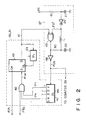
- Fig. 2 shows detailed internal arrangements of the components 27, 30, and 31 constituting the additional injection-synchronized loop.
- a circuit portion corresponding to the time-domain filter 30 and the injection pulse generator 31 is indicated by a dotted block denoted by reference numerals 30 and 31.
- the time-domain filter 30 and the injection pulse generator 31 include a tapped delay circuit 41, a 3-input AND gate 42, a D-type flip-flop 43, and a delay circuit 44.
- the injection-locked VCO 27 includes a 2-input NAND gate 45 and an inverter 46.
- Resistors R0 and R1 Resistors R0 and R1, capacitors CO and Cl, a varactor diode Dv, and an inductor (coil) L, which are connected as shown in Figure 2, are provided for the above-mentioned components.
- the resistor R0, the capacitor C0, the varactor diode Dv, and the inductor L constitute a load resonator to be connected to the NAND gate 45.
- the clock pit pulse signal Pin is supplied to a clock input CK of the D-type flip-flop 43.
- the flip-flop 43 sets its inverted output Q at "L” level in synchronism with the rise timing of the clock pit pulse signal Pin.
- the "L"-level inverted output Q is input to a clear terminal CL of the D-type flip-flop 43 through the delay circuit 44, the inverted output Q is restored to "H” level.
- the flip-flop 43 intermittently generates negative pulse components Pi each having a pulse width equal to a delay amount ⁇ w of the delay circuit 44.
- each intermittent pulse component Pi has a pulse width substantially equal to the non-response period of oscillation of the injection-synchronized VCO 27.
- the intermittent pulse signal Pi is supplied as an injection pulse signal to the first input of the 2-input NAND gate 45.
- the delay amount ⁇ w of the delay circuit 44 is typically set to be 1/2 the period of the reference clock signal Pck.
- An output signal from the NAND gate 45 is fed back to its second input through the above-mentioned load resonator associated with the gate 45.
- the circuit portion constituted by the NAND gate 45, the resistor R0, the capacitor C0, the inductor L, and the varactor diode Dv oscillates while the injection pulse signal is at "H" level.
- This circuit portion constitutes a gated oscillator known to a person skilled in the art, wherein its oscillation phase is controlled by changing the injection timing of the injection pulse signal Pi. This is directly associated with the gist of the present invention and hence is important. This will be described in detail later.
- the negative control voltage Vc generated by the low-pass filter 26 in Figure 1 is supplied to the anode of the varactor diode Dv through a high-frequency noise removing low-pass filter circuit constituted by the injection-synchronized VCO 27, the resistor R1, and the capacitor C1. Therefore, the injection-synchronized VCO operates as an injection-synchronized voltage-controlled oscillator.
- An oscillation output of the NAND gate 45 is processed as an output from the injection-synchronized VCO 27 through the inverter 46. This oscillation output is supplied to the tapped delay circuit 41.
- the total delay amount of the tapped delay circuit 41 is set to be equal to the delay amount ⁇ w.
- the delay amount ⁇ w between the respective taps is set to be, e.g., ⁇ w/5.
- a first tap output P1 and a fifth tap output P5 are supplied to the second input of the AND gate 42.
- Another input of the AND gate 42 is being supplied with the feed-back clock signal Pfb output from the decoder 29 of the PLL in Fig. 1.
- the AND gate 42 generates the window pulse signal Piw for extracting the rise timing of the clock pit pulse signal Pin.
- the window pulse signal Piw is supplied to the data input of the D-type flip-flop 43. If the phase of the feed-back clock signal Pfb coincides with that of the window pulse signal Piw, the injection pulse signal Pi is generated by the D-type flip-flop 43. Otherwise, the injection pulse signal Pi is not generated, thus performing time-domain filtering for preventing an undesired injection operation.
- the reference clock signal Pck and the oscillation feed-back input Pcf to the NAND gate 45 have the same phase in accordance with the oscillation conditions.
- the reference clock signal Pck and the feed-back clock signal Pfb also have the same rise timing.
- the average rise timing of the clock pit pulse signal Pin is delayed from that of the feed-back clock signal Pfb by the time rw upon adjustment of the PLL.
- the window pulse signal Piw output from the AND gate 42 under the above-described delay conditions becomes a positive pulse having a relatively small pulse width corresponding to a time range ⁇ rw/5 with the average rise timing point of the clock pit pulse signal Pin being set as the center.
- the injection pulse signal Pi is generated. By performing such time-domain filtering, an erroneous operation of the injection-synchronized PLL which is caused by a defective clock pulse can be reliably prevented. If the rise timings of the oscillation feed-back input signal Pcf (i.e., the reference clock signal Pck) and of the injection pulse signal Pi coincide with each other, oscillation phases are not influenced at all.
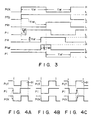
- Fig. 4A shows a case wherein the phase of the clock pit pulse Pin is advanced from that of the feed-back clock Pfb.
- the reference clock Pck falls at the fall timing of the injection pulse Pi.
- the oscillation feed-back input Pcf is not changed at this timing but its phase is advanced by ⁇ i at the next fall timing.
- Fig. 4B shows a case wherein the feed-back clock Pfb and the clock pit pulse Pin have the same phase. In this case, as described above, the phase of the reference clock Pck is not influenced.
- Fig 4C shows a case wherein the phase of the clock pit pulse Pin is delayed from that of the feed-back clock Pfb.
- the reference clock Pck is influenced immediately at the rise timing of the injection pulse Pi so as to be delayed by ⁇ i.
- the conditions, of the injection pulse Pi, for controlling the phase of the reference clock Pck by means of the injection-synchronized loop are to be set such that the average fall timing of the injection pulse Pi coincides with the fall timing of oscillation feed-back input Pcf, and its pulse width is equal to or slightly smaller than a pulse width, during an L-level interval, of the period of the oscillation feed-back input Pcf.
- phase control of the reference clock Pck can be stably performed on the basis of the above-described principle of injection synchronization.
- Fig. 5 showing an equivalent circuit of the injection-synchronized VCO 27 in Fig. 2.
- the constants of the load resonator are set such that the value of a resistor 71 is Ro as a value including the output resistance of the NAND gate; the value of a capacitor 72, Co; the value of an inductor 73, L; the value of a capacitor 74, C as a value obtained by adding the input capacitance of the NAND gate 70 to the capacitance of the varactor diode.
- Fig. 6 is an equivalent block diagram of the circuit in Figure 5.
- CMOS-IC is used for the NAND gate 70, it normally has a gain of 60 dB or more.
- a true loop gain must be obtained from the oscillation frequency conditions. This can be obtained by substituting equation (3) into equation (2) and is given by
- FIG. 6 The block diagram of Fig. 6 can be represented by a transfer element 90 shown in Fig. 7. This element is represented as a closed loop function as follows:
- ⁇ n the transient response of oscillation. If ⁇ n is the natural frequency and ⁇ is a damping coefficient, ⁇ n and ⁇ are respectively represented as follows:
- phase shift control is performed by an injection operation in a direction to reduce a phase difference, and the control amount is reduced to 1/2.
- the control amount is greatly changed due to the influences of the nonlinear characteristics of the NAND gate 70 and the transient term.
- phase after the clock pit pulse Pin are important.
- the natural angular frequency ⁇ n of the transient term must be set to be equal to ⁇ c, and the damping coefficient ⁇ must be set to be close to unity.
- FIG. 8 is an equivalent block diagram of a circuit to be realized when the injection-synchronized loop and the PLL are used together.
- An input ⁇ i is the phase of the clock pulse Pin; and an output ⁇ e from addition point 101, an observed phase difference, from which residual jitter is calculated.
- addition points 100 and 101 are located at the same point, they are assumed to be separated from each other for descriptive convenience.
- injection synchronization is to control the output phase of the injection-synchronized oscillator to be 1/2 the phase difference by an injection operation in a stepwise manner.
- This operation is equivalent to negative feed-back of the phase difference ⁇ e to the addition point 101 through a transfer element 102, as shown in Fig. 8.
- the circuit for this operation is called the injection-synchronized loop.
- the PLL is represented by a loop for negatively feeding back the phase difference ⁇ e to the addition point 100 through a transfer element 103 representing a phase-comparator and a loop filter, and a transfer element 104 representing a VCO.
- a transfer function F(s) of the transfer element 103 is given by the following equation, provided that a conversion gain at which the phase difference is converted into a voltage is represented by Kp, and the phase correction zero point of the loop is represented by ⁇ 1:
- Fig. 9 is a block diagram showing a circuit obtained by converting the above-mentioned injection-synchronized loop.
- the interval between the injection timing and the phase comparison timing must be increased.
- an injection operation must be performed upon completion of phase comparison, as described above.
- a curve 31a represents the characteristic of the PLL alone
- the curve 31c will be described in detail in the next embodiment.
- Fig. 12 shows a sample of measurement of residual jitter spectra obtained by an experiment conducted by the present inventors.
- the noise bandwidth of the loop is increased to 1.8 times that of the PLL alone, no increase in noise jitter is recognized, as shown in Fig. 12.
- the jitter amount is negligibly small.
- the amount of high-frequency jitter caused by vibrations and the like of a mechanical portion of the optical disk apparatus rather poses a problem. It is an object of the present invention to suppress this high-frequency jitter.
- the response characteristics are mostly determined by the response characteristics of the injection-synchronized loop and are greatly improved.
- the injection-synchronized loop in addition to the normal PLL for obtaining the reference clock signal Pck on the basis of the clock pit pulse signal Pin reproduced from a rotating optical disk, the injection-synchronized loop is employed, in which after phase comparison or phase detection by means of the PLL is completed, the injection pulse signal Pi is generated on the basis of a clock pit pulse signal processed by time-domain filtering, and the phase of the reference clock signal Pck is controlled by supplying the signal Pi to the injection-synchronized VCO 27.
- occurrence of high-frequency jitter of the reference clock signal Pck can be successfully prevented or inhibited without sacrificing the data storage capacity of an optical disk and without degrading the noise resistant characteristics of the optical disk apparatus. Therefore, in addition to an improvement in operation stability and performance achieved by the PLL, a high-precision reference clock signal especially required to increase the data transfer speed and retrieval speed of the optical disk apparatus can be generated.
- a reference clock generation circuit unit for an optical disk apparatus is generally designated by reference numeral 20′ in Fig. 13.
- the same reference numerals in the illustration of this embodiment denote the same parts as in the embodiment described above with reference to Fig. 1, and a detailed description thereof will be omitted to simply prevent redundancy of the description.
- the reference clock generation circuit unit 20′ is characterized in that the jitter suppression function is further improved.
- This embodiment is based on the assumption that a plurality of clock pulses are detected per sampling operation, i.e., within a certain servo byte. For this reason, two gates 32a and 23b are arranged.
- a clock pit detector 22 generates two types of gate pulse signals Pg1 and Pg2.
- the first gate pulse Pg1 is used to extract the start clock pit pulse of a string of clocks.
- This gate pulse signal Pg1 is supplied to a gate 23a.
- the second gate pulse signal Pg2 is supplied to the other gate 23b to extract all the clock pulses.
- the start clock pit pulse extracted by the first gate 23a is supplied to a PLL constituted by a phase-comparator 24, a switch 25, a low-pass filter 26, an injection-synchronized VCO 27, a frequency-dividing counter 28, and a decoder 29.
- Clock pulses Pin extracted by the gate 23b are subjected to time-domain filtering in a time-domain filter 30 in the same manner as described in the above embodiment. Thereafter, the clock pit pulses Pin are supplied to an injection pulse generator 31.
- the injection pulse generator 31 generates a single or a plurality of injection pulse signals Pi. When these injection pulse signals Pi are injected into the injection-synchronized VCO 27, an injection-synchronized loop is realized. It should be noted in this embodiment that the decoder 29 in the injection-synchronized loop generates a gate pulse signal Pm used for time-domain filtering, which is then supplied to the time-domain filter 30.
- the reference clock pck and the gate pulse Pm have the same rise timing.
- the average rise timing of the clock pit pulse Pin is adjusted by the PLL to be delayed from the rise timing of the gate pulse Pm by a time ⁇ w.
- the natural angular frequency ⁇ n of the injection-synchronized VCO 27 is set to be equal to ⁇ c, and the damping coefficient ⁇ is set to be 0.8.
- injection control of the reference clock Pck is performed in a direction to be delayed at the rise timing of the injection pulse Pi.
- injection control is performed in the same direction.
- the clock pit pulse Pin has a predetermined period.
- the clock pit pulse Pin need not have a predetermined period.
- the number of pulses may vary. This means that the injection efficiency can be improved by using control signals and the like other than servo bytes.
- a PLL requires a predetermined sampling period, and suppression of high-frequency jitter requires a high sampling frequency, i.e., sacrifice of the storage capacity of an optical disk.
- timing data of pits other than clock pits can be used for phase control by means of the injection-synchronized loop, and the high-frequency jitter suppression characteristics can be further improved.
- each sector area has a control information area called a "preformat area" arranged at its head portion, and a free area for data storage with a gap sandwiched therebetween.
- preformat area includes a sector mark signal SM, sector address data ID, and a PLL control signal (preamble pulse signal) VF for properly synchronizing a recording/reproduction reference clock signal with the generation timing of record data.
- PLL control signal preamble pulse signal
- a reference clock generation circuit unit for a sector format type optical disk apparatus is generally designated by reference numeral 200.
- a binary processing circuit 201 is arranged to receive an electrical reproduction signal Sr read by scanning a rotating optical disk with a laser beam.
- the binary processing circuit 201 generates a binary pulse signal Pin.
- the binary pulse signal Pin well reflects the storage information in the preformat area of each sector area. This pulse signal Pin is supplied to a phase-comparator 202.
- the phase-comparator 202 constitutes a PLL together with a low-pass filter 203 and a VCO 204.
- This PLL includes a feed-back pulse generator 205.
- the feed-back pulse generator 205 generates a feed-back pulse signal Pfb and an interpolation pulse signal Pc by frequency-dividing a reference clock signal Pck.
- the binary pulse signal Pin is supplied to the first input of the phase-comparator 202.
- the feed-back signal Pfb is supplied to the second input of the phase-comprator 202.
- the phase-comparator 202 compares these input signals and detects a phase difference therebetween.
- a comparison result signal from the phase-comparator 202 is sent as a control voltage Vc to the VCO 204 through the LPF 203.
- An oscillation output signal from the VCO 204 appears as the reference clock signal Pck at an output terminal 206 of the unit 200.
- an injection-synchronized loop including a time-base filter 207 and an injection pulse generator 208 is provided to the VCO 204.
- the VCO 204 is of an injection-synchronized type.
- the time-base filter 207 receives the binary pulse signal Pin and the feed-back pulse signal Pfb.
- the time-base filter 207 is applied with the reference clock Pck from the injection-synchronized VCO 204.
- the time-base filter 207 generates window pulses by referring to the binary pulse signal Pin and the feed-back pulse signal Pfb. These window pulses have different pulse widths during a preamble input period and a reproduction data pulse input period.
- the time-base filter 207 performs time-domain filtering for a PLL lock preamble pulse signal and subsequent reproduction data pulses by using these window pulses.
- the injection pulse generator 208 is responsive to the time-base filter 207 and intermittently or periodically generates a plurality of negative injection pulses every time phase comparison of sequential sector addresses selected for data access is completed by the phase-comparator 202.
- These injection pulse signals Pi are continuously injected into the injection-synchronized VCO 204 to realize a continuous injection-synchronized loop. With such an arrangement, even at the time of high-speed data access of the sector-formatted optical disk, a high-precision reference clock signal free from high-frequency jitter can be generated.
- the reference clock generation circuit 200 may be modified, as shown in Fig. 16, wherein a sector mark detector 210 is additionally arranged.
- the sector mark detector 210 receives the binary pulse signal Pin and detects a sector mark data component therefrom.
- a detection output signal from the sector mark detector 210 is called a preamble gate signal Pg.
- the preamble gate signal Pg is supplied to the time-base filter 207.
- the amplification factor and filtering time constant of the time-base filter 207 are variably controlled. With such an arrangement, a high-precision reference clock signal free from high-frequency jitter for the sector format type optical disk apparatus can be generated.
Landscapes
- Engineering & Computer Science (AREA)
- Signal Processing (AREA)
- Stabilization Of Oscillater, Synchronisation, Frequency Synthesizers (AREA)
- Signal Processing For Digital Recording And Reproducing (AREA)
Applications Claiming Priority (2)
| Application Number | Priority Date | Filing Date | Title |
|---|---|---|---|
| JP25489889 | 1989-09-29 | ||
| JP254898/89 | 1989-09-29 |
Publications (3)
| Publication Number | Publication Date |
|---|---|
| EP0420667A2 true EP0420667A2 (de) | 1991-04-03 |
| EP0420667A3 EP0420667A3 (en) | 1993-08-18 |
| EP0420667B1 EP0420667B1 (de) | 1997-08-06 |
Family
ID=17271378
Family Applications (1)
| Application Number | Title | Priority Date | Filing Date |
|---|---|---|---|
| EP90310640A Expired - Lifetime EP0420667B1 (de) | 1989-09-29 | 1990-09-28 | Phasensynchrone Regeleinrichtung zur Herstellung eines Referenztaktsignals in einem Plattenantriebssystem |
Country Status (3)
| Country | Link |
|---|---|
| US (1) | US5172357A (de) |
| EP (1) | EP0420667B1 (de) |
| DE (1) | DE69031201T2 (de) |
Cited By (5)
| Publication number | Priority date | Publication date | Assignee | Title |
|---|---|---|---|---|
| WO2002021758A3 (de) * | 2000-09-11 | 2003-03-13 | Infineon Technologies Ag | Taktregenerierungsschaltung zum regenerieren von eingangsdaten und verfahren zur nutzung |
| WO2003041905A1 (en) * | 2001-11-15 | 2003-05-22 | Renishaw Plc | Substrate treatment device and method and encoder scale treated by this method |
| EP1662267A4 (de) * | 2003-07-16 | 2006-06-14 | Advantest Corp | Schiebetakt-erzeugungseinrichtung, timing-generator und testeinrichtung |
| US8466943B2 (en) | 2002-01-18 | 2013-06-18 | Renishaw Plc | Laser marking |
| CN117674839A (zh) * | 2023-11-30 | 2024-03-08 | 重庆西南集成电路设计有限责任公司 | 自动频率校正电路及方法 |
Families Citing this family (28)
| Publication number | Priority date | Publication date | Assignee | Title |
|---|---|---|---|---|
| US5416809A (en) * | 1991-03-13 | 1995-05-16 | Sony Corporation | Digital phase locked loop apparatus |
| JP2902814B2 (ja) * | 1991-06-17 | 1999-06-07 | 株式会社東芝 | デジタルデータ処理装置 |
| JP3277517B2 (ja) * | 1991-06-17 | 2002-04-22 | ソニー株式会社 | ディスク状記録媒体の再生方法 |
| DE69231731T2 (de) * | 1991-06-17 | 2001-06-28 | Sony Corp., Tokio/Tokyo | Plattenaufzeichnungsverfahren |
| US5388090A (en) * | 1991-07-09 | 1995-02-07 | Hitachi, Ltd. | Method, apparatus, and medium for recording information in data sections having number of bytes which increases with increase in circumference of tracks on medium |
| JPH0562367A (ja) * | 1991-09-03 | 1993-03-12 | Hitachi Ltd | データ再生装置 |
| US5559775A (en) * | 1992-09-14 | 1996-09-24 | Olympus Optical Co., Ltd. | Clock detection device of information recording/reproducing apparatus and clock detection device of information recording apparatus |
| US5526332A (en) * | 1993-06-22 | 1996-06-11 | Matsushita Electric Industrial Co., Ltd. | Reference clock generator for sampled servo type disk unit and disk unit |
| JP2606090B2 (ja) * | 1993-07-14 | 1997-04-30 | 日本電気株式会社 | 光学的情報制御装置 |
| JP3240762B2 (ja) * | 1993-07-26 | 2001-12-25 | ソニー株式会社 | 光記録媒体の再生方法及び再生装置 |
| US5654948A (en) * | 1993-09-07 | 1997-08-05 | Sony Corporation | Disc apparatus for recording/reproducing with zone constant angular velocity |
| KR960012921B1 (ko) * | 1993-10-06 | 1996-09-25 | 현대전자산업 주식회사 | 위상 록 루프 회로 |
| WO1996006433A1 (en) | 1994-08-25 | 1996-02-29 | Sony Corporation | Optical disk and optical disk drive device |
| US5790332A (en) * | 1995-11-07 | 1998-08-04 | Pc Peripherals Inc. | Method and apparatus for generating clock signals having count closure and deterministically optimized phase closure |
| JPH09161411A (ja) * | 1995-12-11 | 1997-06-20 | Sony Corp | 再生クロック位相補正回路 |
| JP3784485B2 (ja) * | 1997-02-12 | 2006-06-14 | 富士通株式会社 | 出力パルス幅制御システム |
| DE69703204T2 (de) * | 1997-07-14 | 2001-02-01 | Stmicroelectronics S.R.L., Agrate Brianza | Integrierte Schaltung mit zwei Phasenregelkreisen und Mitteln zur Verhinderung von Injektionssynchronisierung |
| US6188286B1 (en) | 1999-03-30 | 2001-02-13 | Infineon Technologies North America Corp. | Method and system for synchronizing multiple subsystems using one voltage-controlled oscillator |
| DE10016853C2 (de) * | 1999-04-02 | 2003-04-30 | Advantest Corp | Verzögerungstakt-Erzeugungsvorrichtung |
| CN1167199C (zh) * | 2000-06-08 | 2004-09-15 | 华为技术有限公司 | 注入型同步窄带再生锁相环 |
| US6617936B2 (en) * | 2001-02-20 | 2003-09-09 | Velio Communications, Inc. | Phase controlled oscillator |
| DE60100114T2 (de) * | 2001-04-03 | 2003-10-02 | Agilent Technologies Inc., A Delaware Corp. | Filter zur Einspeisung von datenabhängigem Jitter und Pegelgeräusch |
| US7274862B2 (en) * | 2001-09-27 | 2007-09-25 | Sony Corporation | Information processing apparatus |
| US20030097392A1 (en) * | 2001-11-21 | 2003-05-22 | Masteller Steven R. | Four-rail NCL incrementor/decrementor |
| TWI235992B (en) * | 2002-03-08 | 2005-07-11 | Via Tech Inc | Method and device for generating a write clock of a constant angular velocity compact disk drive |
| TW200533077A (en) * | 2004-03-26 | 2005-10-01 | Realtek Semiconductor Corp | Method and apparatus for tuning an analog filter |
| EP1772794A1 (de) * | 2005-10-10 | 2007-04-11 | Axalto S.A. | Verfahren und Schaltung zur lokalen Takterzeugung und diese enthaltende Chipkarte |
| JP5174055B2 (ja) * | 2010-02-02 | 2013-04-03 | 株式会社半導体理工学研究センター | 広帯域発振回路 |
Family Cites Families (11)
| Publication number | Priority date | Publication date | Assignee | Title |
|---|---|---|---|---|
| NL6516878A (de) * | 1965-12-24 | 1967-06-26 | ||
| US3806822A (en) * | 1972-12-13 | 1974-04-23 | Motorola Inc | Phase locked loop employing gated alternating current injection for fast synchronization |
| US3878474A (en) * | 1974-06-17 | 1975-04-15 | Bell Telephone Labor Inc | Phase locked loop |
| US4347484A (en) * | 1980-06-02 | 1982-08-31 | General Electric Company | Synthesizer having an injection synchronized divider |
| GB2113929B (en) * | 1982-01-05 | 1986-09-03 | Emi Ltd | Oscillator circuits |
| US4651231A (en) * | 1984-09-13 | 1987-03-17 | Reference Technology, Inc. | Timing system for laser disc having digital information |
| JPS61219286A (ja) * | 1985-03-25 | 1986-09-29 | Sony Corp | 時間軸補正装置の書込クロツク発生回路 |
| KR900001593B1 (ko) * | 1985-03-30 | 1990-03-15 | 가부시끼가이샤 도오시바 | 디지탈신호 재생회로 |
| US4688003A (en) * | 1986-10-03 | 1987-08-18 | Sanders Associates, Inc. | Feed-forward error correction for sandaps and other phase-locked loops |
| US4949325A (en) * | 1987-03-18 | 1990-08-14 | Hitachi, Ltd. | Method and associated apparatus and medium for optical recording and reproducing information |
| US5003408A (en) * | 1988-08-04 | 1991-03-26 | Irwin Magnetic Systems, Inc. | Method and apparatus for removing data stream variations |
-
1990
- 1990-09-28 EP EP90310640A patent/EP0420667B1/de not_active Expired - Lifetime
- 1990-09-28 US US07/589,642 patent/US5172357A/en not_active Expired - Lifetime
- 1990-09-28 DE DE69031201T patent/DE69031201T2/de not_active Expired - Fee Related
Cited By (13)
| Publication number | Priority date | Publication date | Assignee | Title |
|---|---|---|---|---|
| WO2002021758A3 (de) * | 2000-09-11 | 2003-03-13 | Infineon Technologies Ag | Taktregenerierungsschaltung zum regenerieren von eingangsdaten und verfahren zur nutzung |
| US7723639B2 (en) | 2001-11-15 | 2010-05-25 | Renishaw Plc | Substrate treatment device and method and encoder scale treated by this method |
| WO2003041905A1 (en) * | 2001-11-15 | 2003-05-22 | Renishaw Plc | Substrate treatment device and method and encoder scale treated by this method |
| GB2397040A (en) * | 2001-11-15 | 2004-07-14 | Renishaw Plc | Substrate treatment device and method and encoder scale treated by this method |
| GB2397040B (en) * | 2001-11-15 | 2005-05-18 | Renishaw Plc | Substrate treatment device and method and encoder scale treated by this method |
| US10982334B2 (en) | 2001-11-15 | 2021-04-20 | Renishaw Plc | Substrate treatment device and method and encoder scale treated by this method |
| DE10297440B4 (de) * | 2001-11-15 | 2017-04-20 | Renishaw Plc | Verfahren zum Behandeln eines Substrates und entsprechende Vorrichtung |
| US8987633B2 (en) | 2002-01-18 | 2015-03-24 | Renishaw Plc | Laser marking |
| US8466943B2 (en) | 2002-01-18 | 2013-06-18 | Renishaw Plc | Laser marking |
| KR100882362B1 (ko) * | 2003-07-16 | 2009-02-05 | 주식회사 아도반테스토 | 쉬프트 클록 발생 장치, 타이밍 발생기 및 시험 장치 |
| US7183828B2 (en) | 2003-07-16 | 2007-02-27 | Advantest Corporation | Shift clock generator, timing generator and test apparatus |
| EP1662267A4 (de) * | 2003-07-16 | 2006-06-14 | Advantest Corp | Schiebetakt-erzeugungseinrichtung, timing-generator und testeinrichtung |
| CN117674839A (zh) * | 2023-11-30 | 2024-03-08 | 重庆西南集成电路设计有限责任公司 | 自动频率校正电路及方法 |
Also Published As
| Publication number | Publication date |
|---|---|
| DE69031201D1 (de) | 1997-09-11 |
| DE69031201T2 (de) | 1998-02-19 |
| EP0420667B1 (de) | 1997-08-06 |
| US5172357A (en) | 1992-12-15 |
| EP0420667A3 (en) | 1993-08-18 |
Similar Documents
| Publication | Publication Date | Title |
|---|---|---|
| EP0420667B1 (de) | Phasensynchrone Regeleinrichtung zur Herstellung eines Referenztaktsignals in einem Plattenantriebssystem | |
| US4495474A (en) | PLL Control circuit for recovery of data from audio disk | |
| US4949325A (en) | Method and associated apparatus and medium for optical recording and reproducing information | |
| US5666341A (en) | Data detection apparatus | |
| KR19990023908A (ko) | 위상 동기 루프 회로 | |
| CA2022192C (en) | Optical disk recording/reproducing device | |
| CN1096067C (zh) | 光盘再现设备 | |
| US6693862B1 (en) | Recording clock generating apparatus for a data recording system | |
| CN100452181C (zh) | Pll时钟发生器及其控制方法和光盘装置 | |
| EP0822664B1 (de) | System und Verfahren zum Synchronisieren von Daten | |
| JPH03212860A (ja) | クロック生成用pll回路を含む読取線速度可変型ディスク記録情報再生装置 | |
| CN1171386C (zh) | 检测数字锁相环频率的方法 | |
| JP3485088B2 (ja) | 信号処理回路及び信号処理方法 | |
| JP3607048B2 (ja) | ディスク再生装置及びデータスライス回路 | |
| JP3217350B2 (ja) | 光ディスク装置 | |
| US4580100A (en) | Phase locked loop clock recovery circuit for data reproducing apparatus | |
| US5260841A (en) | Clock extracting circuit | |
| JPH1116293A (ja) | 電圧制御発振回路及びディスク再生装置 | |
| JP2675096B2 (ja) | 再生信号補正方法 | |
| JPH10112141A (ja) | Pll回路とこれを具備する光ディスク装置 | |
| JPH10302277A (ja) | 光ディスク装置およびトラックエラー信号生成方法 | |
| JPH0757384A (ja) | ディスクプレーヤ | |
| JP2002025076A (ja) | データ再生装置 | |
| JP2004343724A (ja) | Pllクロック発生器、光ディスク装置およびpllクロック発生器の制御方法 | |
| JPH1097768A (ja) | Pll回路 |
Legal Events
| Date | Code | Title | Description |
|---|---|---|---|
| PUAI | Public reference made under article 153(3) epc to a published international application that has entered the european phase |
Free format text: ORIGINAL CODE: 0009012 |
|
| 17P | Request for examination filed |
Effective date: 19901011 |
|
| AK | Designated contracting states |
Kind code of ref document: A2 Designated state(s): DE FR GB |
|
| PUAL | Search report despatched |
Free format text: ORIGINAL CODE: 0009013 |
|
| AK | Designated contracting states |
Kind code of ref document: A3 Designated state(s): DE FR GB |
|
| 17Q | First examination report despatched |
Effective date: 19951201 |
|
| GRAG | Despatch of communication of intention to grant |
Free format text: ORIGINAL CODE: EPIDOS AGRA |
|
| GRAH | Despatch of communication of intention to grant a patent |
Free format text: ORIGINAL CODE: EPIDOS IGRA |
|
| GRAH | Despatch of communication of intention to grant a patent |
Free format text: ORIGINAL CODE: EPIDOS IGRA |
|
| GRAA | (expected) grant |
Free format text: ORIGINAL CODE: 0009210 |
|
| AK | Designated contracting states |
Kind code of ref document: B1 Designated state(s): DE FR GB |
|
| REF | Corresponds to: |
Ref document number: 69031201 Country of ref document: DE Date of ref document: 19970911 |
|
| ET | Fr: translation filed | ||
| PLBE | No opposition filed within time limit |
Free format text: ORIGINAL CODE: 0009261 |
|
| STAA | Information on the status of an ep patent application or granted ep patent |
Free format text: STATUS: NO OPPOSITION FILED WITHIN TIME LIMIT |
|
| 26N | No opposition filed | ||
| PGFP | Annual fee paid to national office [announced via postgrant information from national office to epo] |
Ref country code: FR Payment date: 19980909 Year of fee payment: 9 |
|
| PGFP | Annual fee paid to national office [announced via postgrant information from national office to epo] |
Ref country code: GB Payment date: 19981001 Year of fee payment: 9 |
|
| PGFP | Annual fee paid to national office [announced via postgrant information from national office to epo] |
Ref country code: DE Payment date: 19981005 Year of fee payment: 9 |
|
| REG | Reference to a national code |
Ref country code: GB Ref legal event code: 746 Effective date: 19980915 |
|
| REG | Reference to a national code |
Ref country code: FR Ref legal event code: D6 |
|
| PG25 | Lapsed in a contracting state [announced via postgrant information from national office to epo] |
Ref country code: GB Free format text: LAPSE BECAUSE OF NON-PAYMENT OF DUE FEES Effective date: 19990928 |
|
| GBPC | Gb: european patent ceased through non-payment of renewal fee |
Effective date: 19990928 |
|
| PG25 | Lapsed in a contracting state [announced via postgrant information from national office to epo] |
Ref country code: FR Free format text: LAPSE BECAUSE OF NON-PAYMENT OF DUE FEES Effective date: 20000531 |
|
| PG25 | Lapsed in a contracting state [announced via postgrant information from national office to epo] |
Ref country code: DE Free format text: LAPSE BECAUSE OF NON-PAYMENT OF DUE FEES Effective date: 20000701 |
|
| REG | Reference to a national code |
Ref country code: FR Ref legal event code: ST |