EP0420976B1 - Procede et composition de fabrication de semelles gaufrees de chaussures - Google Patents
Procede et composition de fabrication de semelles gaufrees de chaussures Download PDFInfo
- Publication number
- EP0420976B1 EP0420976B1 EP90908021A EP90908021A EP0420976B1 EP 0420976 B1 EP0420976 B1 EP 0420976B1 EP 90908021 A EP90908021 A EP 90908021A EP 90908021 A EP90908021 A EP 90908021A EP 0420976 B1 EP0420976 B1 EP 0420976B1
- Authority
- EP
- European Patent Office
- Prior art keywords
- sole
- mold
- insert
- plug
- exterior
- Prior art date
- Legal status (The legal status is an assumption and is not a legal conclusion. Google has not performed a legal analysis and makes no representation as to the accuracy of the status listed.)
- Expired - Lifetime
Links
- 238000000034 method Methods 0.000 title claims abstract description 15
- 239000000203 mixture Substances 0.000 title claims description 10
- 239000000463 material Substances 0.000 claims abstract description 26
- 229920003023 plastic Polymers 0.000 claims abstract description 19
- 239000004033 plastic Substances 0.000 claims abstract description 19
- 238000004049 embossing Methods 0.000 claims abstract description 15
- 238000003475 lamination Methods 0.000 claims abstract description 10
- 238000010438 heat treatment Methods 0.000 claims description 9
- 239000000853 adhesive Substances 0.000 claims description 8
- 230000001070 adhesive effect Effects 0.000 claims description 8
- DQXBYHZEEUGOBF-UHFFFAOYSA-N but-3-enoic acid;ethene Chemical compound C=C.OC(=O)CC=C DQXBYHZEEUGOBF-UHFFFAOYSA-N 0.000 claims description 8
- 239000005038 ethylene vinyl acetate Substances 0.000 claims description 8
- 229920001200 poly(ethylene-vinyl acetate) Polymers 0.000 claims description 8
- 238000009413 insulation Methods 0.000 claims description 5
- 238000002844 melting Methods 0.000 claims description 4
- 230000008018 melting Effects 0.000 claims description 4
- 239000011810 insulating material Substances 0.000 claims description 3
- 239000004635 Polyester fiberglass Substances 0.000 claims description 2
- ZFMQKOWCDKKBIF-UHFFFAOYSA-N bis(3,5-difluorophenyl)phosphane Chemical compound FC1=CC(F)=CC(PC=2C=C(F)C=C(F)C=2)=C1 ZFMQKOWCDKKBIF-UHFFFAOYSA-N 0.000 claims description 2
- 239000004645 polyester resin Substances 0.000 claims description 2
- 229920001225 polyester resin Polymers 0.000 claims description 2
- 238000003825 pressing Methods 0.000 claims description 2
- 239000005062 Polybutadiene Substances 0.000 claims 6
- 229920002857 polybutadiene Polymers 0.000 claims 6
- XLOMVQKBTHCTTD-UHFFFAOYSA-N Zinc monoxide Chemical compound [Zn]=O XLOMVQKBTHCTTD-UHFFFAOYSA-N 0.000 claims 2
- 238000001816 cooling Methods 0.000 claims 2
- 238000010030 laminating Methods 0.000 claims 1
- 150000003464 sulfur compounds Chemical class 0.000 claims 1
- 239000011787 zinc oxide Substances 0.000 claims 1
- 229920013754 low-melting plastic Polymers 0.000 abstract 1
- 239000002131 composite material Substances 0.000 description 12
- 238000000465 moulding Methods 0.000 description 3
- 238000006116 polymerization reaction Methods 0.000 description 3
- 230000002411 adverse Effects 0.000 description 2
- 239000007795 chemical reaction product Substances 0.000 description 2
- 230000006835 compression Effects 0.000 description 2
- 238000007906 compression Methods 0.000 description 2
- 229920001971 elastomer Polymers 0.000 description 2
- 239000002184 metal Substances 0.000 description 2
- 229910052751 metal Inorganic materials 0.000 description 2
- 230000002787 reinforcement Effects 0.000 description 2
- 229920004943 Delrin® Polymers 0.000 description 1
- 229910000831 Steel Inorganic materials 0.000 description 1
- NINIDFKCEFEMDL-UHFFFAOYSA-N Sulfur Chemical compound [S] NINIDFKCEFEMDL-UHFFFAOYSA-N 0.000 description 1
- DHKHKXVYLBGOIT-UHFFFAOYSA-N acetaldehyde Diethyl Acetal Natural products CCOC(C)OCC DHKHKXVYLBGOIT-UHFFFAOYSA-N 0.000 description 1
- 125000002777 acetyl group Chemical class [H]C([H])([H])C(*)=O 0.000 description 1
- 230000001464 adherent effect Effects 0.000 description 1
- 229910052782 aluminium Inorganic materials 0.000 description 1
- XAGFODPZIPBFFR-UHFFFAOYSA-N aluminium Chemical compound [Al] XAGFODPZIPBFFR-UHFFFAOYSA-N 0.000 description 1
- 230000000386 athletic effect Effects 0.000 description 1
- 230000015572 biosynthetic process Effects 0.000 description 1
- 239000003795 chemical substances by application Substances 0.000 description 1
- 239000000498 cooling water Substances 0.000 description 1
- 238000004132 cross linking Methods 0.000 description 1
- 238000009434 installation Methods 0.000 description 1
- 239000010410 layer Substances 0.000 description 1
- 239000006082 mold release agent Substances 0.000 description 1
- 239000005011 phenolic resin Substances 0.000 description 1
- 150000002989 phenols Chemical class 0.000 description 1
- 229920000642 polymer Polymers 0.000 description 1
- 229920002635 polyurethane Polymers 0.000 description 1
- 239000004814 polyurethane Substances 0.000 description 1
- 230000003014 reinforcing effect Effects 0.000 description 1
- 238000007711 solidification Methods 0.000 description 1
- 230000008023 solidification Effects 0.000 description 1
- 239000010959 steel Substances 0.000 description 1
- 239000011593 sulfur Substances 0.000 description 1
- 229910052717 sulfur Inorganic materials 0.000 description 1
- XLYOFNOQVPJJNP-UHFFFAOYSA-N water Substances O XLYOFNOQVPJJNP-UHFFFAOYSA-N 0.000 description 1
Images


Classifications
-
- B—PERFORMING OPERATIONS; TRANSPORTING
- B29—WORKING OF PLASTICS; WORKING OF SUBSTANCES IN A PLASTIC STATE IN GENERAL
- B29C—SHAPING OR JOINING OF PLASTICS; SHAPING OF MATERIAL IN A PLASTIC STATE, NOT OTHERWISE PROVIDED FOR; AFTER-TREATMENT OF THE SHAPED PRODUCTS, e.g. REPAIRING
- B29C43/00—Compression moulding, i.e. applying external pressure to flow the moulding material; Apparatus therefor
- B29C43/02—Compression moulding, i.e. applying external pressure to flow the moulding material; Apparatus therefor of articles of definite length, i.e. discrete articles
- B29C43/18—Compression moulding, i.e. applying external pressure to flow the moulding material; Apparatus therefor of articles of definite length, i.e. discrete articles incorporating preformed parts or layers, e.g. compression moulding around inserts or for coating articles
-
- A—HUMAN NECESSITIES
- A43—FOOTWEAR
- A43B—CHARACTERISTIC FEATURES OF FOOTWEAR; PARTS OF FOOTWEAR
- A43B13/00—Soles; Sole-and-heel integral units
- A43B13/02—Soles; Sole-and-heel integral units characterised by the material
- A43B13/12—Soles with several layers of different materials
-
- B—PERFORMING OPERATIONS; TRANSPORTING
- B29—WORKING OF PLASTICS; WORKING OF SUBSTANCES IN A PLASTIC STATE IN GENERAL
- B29C—SHAPING OR JOINING OF PLASTICS; SHAPING OF MATERIAL IN A PLASTIC STATE, NOT OTHERWISE PROVIDED FOR; AFTER-TREATMENT OF THE SHAPED PRODUCTS, e.g. REPAIRING
- B29C33/00—Moulds or cores; Details thereof or accessories therefor
- B29C33/12—Moulds or cores; Details thereof or accessories therefor with incorporated means for positioning inserts, e.g. labels
- B29C33/14—Moulds or cores; Details thereof or accessories therefor with incorporated means for positioning inserts, e.g. labels against the mould wall
-
- B—PERFORMING OPERATIONS; TRANSPORTING
- B29—WORKING OF PLASTICS; WORKING OF SUBSTANCES IN A PLASTIC STATE IN GENERAL
- B29C—SHAPING OR JOINING OF PLASTICS; SHAPING OF MATERIAL IN A PLASTIC STATE, NOT OTHERWISE PROVIDED FOR; AFTER-TREATMENT OF THE SHAPED PRODUCTS, e.g. REPAIRING
- B29C70/00—Shaping composites, i.e. plastics material comprising reinforcements, fillers or preformed parts, e.g. inserts
- B29C70/68—Shaping composites, i.e. plastics material comprising reinforcements, fillers or preformed parts, e.g. inserts by incorporating or moulding on preformed parts, e.g. inserts or layers, e.g. foam blocks
-
- B—PERFORMING OPERATIONS; TRANSPORTING
- B29—WORKING OF PLASTICS; WORKING OF SUBSTANCES IN A PLASTIC STATE IN GENERAL
- B29C—SHAPING OR JOINING OF PLASTICS; SHAPING OF MATERIAL IN A PLASTIC STATE, NOT OTHERWISE PROVIDED FOR; AFTER-TREATMENT OF THE SHAPED PRODUCTS, e.g. REPAIRING
- B29C33/00—Moulds or cores; Details thereof or accessories therefor
- B29C33/20—Opening, closing or clamping
-
- B—PERFORMING OPERATIONS; TRANSPORTING
- B29—WORKING OF PLASTICS; WORKING OF SUBSTANCES IN A PLASTIC STATE IN GENERAL
- B29L—INDEXING SCHEME ASSOCIATED WITH SUBCLASS B29C, RELATING TO PARTICULAR ARTICLES
- B29L2031/00—Other particular articles
- B29L2031/48—Wearing apparel
- B29L2031/50—Footwear, e.g. shoes or parts thereof
-
- B—PERFORMING OPERATIONS; TRANSPORTING
- B29—WORKING OF PLASTICS; WORKING OF SUBSTANCES IN A PLASTIC STATE IN GENERAL
- B29L—INDEXING SCHEME ASSOCIATED WITH SUBCLASS B29C, RELATING TO PARTICULAR ARTICLES
- B29L2031/00—Other particular articles
- B29L2031/48—Wearing apparel
- B29L2031/50—Footwear, e.g. shoes or parts thereof
- B29L2031/504—Soles
Definitions
- Prior shoe soles for walking and athletic shoes having insert plates for mounting removable spikes have included shoe sole portions composed of polyurethane polymers which materials could be embossed by molding to create surface designs at low temperatures in the range of 38 - 49°C (100-120°F). Soles made of such material are relatively heavy compared with soles made of lighter material such as ethylene-vinyl acetate; however, such lighter weight material has a moldable heat range above the softening point of the insert plate material such as Delrin (Registered Trade Mark) acetal material.
- lighter material such as ethylene-vinyl acetate
- Delrin Registered Trade Mark
- GB-A-2092881 discloses a lightweight shoe sole laminate comprising layers of ethylene-vinyl acetate plastics material (e.v.a.) A layer of reinforcing plastics material is positioned between the e.v.a. layers and plastics or metal inserts are pushed through holes in the reinforcement layer and in a lower one of the e.v.a. layers. These inserts have backing flanges to secure them to the reinforcement layer and are adapted to receive screw-in studs.
- the present invention comprises a shoe sole comprising a lamination having an exterior skin portion, said lamination comprising:
- the invention further provides a method of heat-embossing a shoe sole laminate comprising an upper sole portion and a lower sole portion, said lower sole portion having at least one aperture extending therethrough and an insert of plastics material positioned between said sole portions and comprising a planar member and a socket element extending generally perpendicular from the planar member, characterised in that said method comprises the steps of:
- the sole is lighter, requires no adherent release agent, and the plastics sole insert is not damaged during the embossing in the mold.
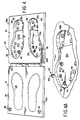
- shoe sole composite 10 includes upper sole portion 11, lower sole portion 12, sole plastic insert 13 including sole insert plate 14 with seven (7) sockets 16a-16g. Sockets 16 are functioned to receive removable spikes (not shown).
- Lower sole portion 12 carries holes 15 to accommodate sockets 16. Portions 11, 12 and insert 13 are assembled, compressed and held together with adhesive to create the full sole section 10a.
- Composite 10 also includes upper heel portion 17, lower heel portion 18 and heel insert 19 including heel plate 21 and four (4) heel sockets 22a-d. Lower heel portion has holes 20 to accommodate sockets 22. The heel portion 17, 18 and insert 19 are assembled compressed and held together with adhesive to form heel section 10b (Fig. 3).
- Fig. 2a depicts the assemblage of elements prior to compression.
- mold 30 includes mold base plate 31 with right and left cavities 32, 33 respectively. Also shown is mold lid 24 embossing pattern 25 for embossing the top side of the sole, the embossing Fig. 4a is a partial and enlarged view of Fig. 4; pattern 26 for embossing the bottom of sole and the logo embosser 27. Also shown is the mold hinge 28 and the alignment pins 29.
- exterior sides include mold edges 30a-d together with the larger exterior surfaces 31a, 24a of base plate 31 and lid 24, respectively (Fig. 5).
- Each cavity 32, 33 has a sole floor 32a, 33a and heel floors 32b, 33b.
- Each cavity 32, 33 has holes 34 in the heel-receiving portions 32b, 33b and holes 36 in the sole-receiving portion 32a, 33a corresponding in position to the socket locations in the lower sole portion 18.
- a threaded post 41 for receiving an insulated plug 42 (for illustration purposes only examples of such post 41 and plug 42 are shown).
- Plug 42 has threaded interior apertures 43 (see Fig. 5) so that each plug 42 can be threaded on its post 41.
- FIG. 5 this sectional view taken through the heel and particularly through the centers of two of the sockets 22c, 22d shows insulated plugs 42 positioned on threaded posts 41 upstanding in holes 34. Plugs 42 upper cylindrical heads 42a fit into sockets 22c, 22d (see Fig. 4a). Also shown is insert plate 19, heel layer portions 17 and 18, mold base plate 31 and mold lid 24. Fig. 6 shows the embossed sole composite 10 including lower sole portion 18 and embossing 18a.
- FIG. 7 an alternative mold lid 50 is shown with an insulating panel or plug 51 recessed in it.
- Plug 51 is held in place by bolts 52, 53.
- the following composition was mixed in a suitable container which provides temperatures, pressures and other conditions for admixing and polymerization:
- the rubber component serves to increase hardness and strengthen elasticity of the end product while adding hardness. Rubber may be added in the range of 0-40%.
- the composition after polymerization was placed in a suitable mold (not shown) and after solidification was cut into shoe sole components including lower sole portion 12, upper sole portion 11 and lower and upper heel portions 17, 18.
- the lower sole and heel portions had apertures formed in them to receive the sockets 16 and 22 of the inserts 13 and 19.
- a pair of lower and upper soles were stacked with a sole insert sandwiched between them and thereafter partially compressed and then secured together using a suitable adhesive. Simultaneously, the heel portion with a heel insert were assembled, compressed and glued to the sole to form a completed sole composite including heel (see Fig. 1).
- the mold was first equipped with insulating plugs 42 threaded on posts 41 in selected hole locations on the mold cavity floor which plugs are sized to extend upwardly through the sole and heel apertures 15, 20 and to reside in and against sockets 16, 22 when the mold is closed.
- Plugs 42 are composed of a mixture of polyester resin and fiberglass and sulfur to provide heat insulation and strength.
- the plugs may also be made of phenol resins or other phenolic compounds.
- the adhered composite was placed in mold 30, then at room temperature and with plugs 42 in the described positions.
- one or more of the sides of the mold was subjected to a temperature of about 132°C (270°F) for about six (6) minutes using electrically heated top and bottom mold press plates.
- the temperature of the inside of mold 30 reached in about one minute the heating temperature of 132°C (270°F) while the insulating mold insert plugs 42 remain at or near room temperature thereby establishing a temperature differential between the plastic inserts 13 and 19 in the composite and the outer surfaces of mold.
- the insulating plugs 42 retarded heat transfer to the plastic inserts 13 and 19 during the heating period.
- the outer layer of the shoe composite is positioned between plugs 42 and surface of the molds 30a-d which layer reaches a temperature adequate to permit embossing formation before the inserts reach their softening point. Inserts made of materials which soften and/or shrink at temperatures as low as 38-49°C (110-120°F) and melt at 79°C (175°F) were properly protected from mold heat by the insulating plugs.
- the mold was then cooled with water to reduce the outside temperature. Some of the cooling water entered the mold to function as a mold release agent.
- the mold 30 can be made of steel, aluminum, or other material.
- the mold material, size, temperature applied, time, plug material and size, heating and other variables should be controlled to (1) raise the embossable skin areas of the sole composition to proper temperature without (2) permitting the temperature of the plastic inserts to raise to a level that the inserts are softened or otherwise adversely effected. Sockets of the insert are adversely effected if their threads or walls are distorted thereby making threaded installation of spikes difficult.
- composition was mixed in a suitable container:
- the dioctyl adipate component serves to increase heat resistance and cold endurance of the end product while the ZnO2 were added to accelerate polymerization including cross-linking.
- composition was mixed in a suitable container:
- Example 1 The same steps of Example 1 were then followed with satisfactory results.
Landscapes
- Engineering & Computer Science (AREA)
- Mechanical Engineering (AREA)
- Chemical & Material Sciences (AREA)
- Materials Engineering (AREA)
- Composite Materials (AREA)
- Footwear And Its Accessory, Manufacturing Method And Apparatuses (AREA)
Abstract
Claims (11)
- Semelle de chaussure comprenant une stratification (10) comportant :i. une partie supérieure façonnée (11) de semelle ;ii. une partie inférieure façonnée (12) de semelle, comportant au moins une ouverture (15) traversant cette partie, etiii. une pièce insérée (13) en matière plastique, intercalée entre les parties (11, 12) de semelle et comprenant un élément plan (14) et un élément (16) d'appui s'étendant dans une direction de façon générale perpendiculaire depuis l'élément plan (14) et situé de manière à s'étendre dans ladite ouverture (15) de partie inférieure ;semelle caractérisée en ce que les parties supérieure (11) et inférieure (12) sont stratifiées en étant collées ensemble à l'aide d'un adhésif et sous pression et puis la partie formant peau extérieure du stratifié est gaufrée dans un moule (30) par application de la pression et de la chaleur à une température supérieure à celle du point de fusion de la matière plastique de la pièce insérée (13), en utilisant un bouchon ou ergot isolant (42), placé dans l'ouverture ou dans chaque ouverture (15) de la partie inférieure (12) de la semelle et s'étendant entre ladite pièce insérée (13) et le moule (30) pendant l'application de ladite pression et de ladite chaleur.
- Semelle de chaussure selon la revendication 1, dans laquelle la partie inférieure façonnée (12) de la semelle est composée de caoutchouc d'éthylène/acétate de vinyle et de caoutchouc de butadiène.
- Semelle de chaussure selon la revendication 1, dans laquelle l'une desdites parties (11, 12) comporte une proportion comprise entre environ soixante pour-cent (60 %) en poids et environ cent pour cent (100 %) de caoutchouc d'éthylène/acétate de vinyle et entre environ zéro pour cent (0 %) et environ quarante pourcent (40 %) de caoutchouc de butadiène.
- Semelle de chaussure selon la revendication 2, dans laquelle la semelle supérieure (11) et la semelle inférieure (12) ont la même composition et la même gamme de proportions de leurs constituants.
- Semelle de chaussure selon la revendication 3, dans laquelle l'une desdites parties (11, 12) de la semelle comprend du caoutchouc d'éthylène/acétate de vinyle, du caoutchouc de butadiène et environ quatre et demi pourcent (4,5 %) en poids d'adipate de dioctyle.
- Semelle de chaussure selon la revendication 3, dans laquelle l'une desdites parties (11, 12) de la semelle comprend de l'éthylène/acétate de vinyle, du caoutchouc de butadiène et quatre et demi pourcent (4,5 %) en poids d'oxyde de zinc.
- Procédé pour former et traiter une semelle de chaussure selon la revendication 1, ce procédé comprenant :a) la stratification ensemblei. d'une partie supérieure façonnée (11) de semelle en caoutchouc d'éthylène/acétate de vinyle et en caoutchouc de butadiène ;ii. d'une partie inférieure façonnée (12) de semelle en caoutchouc d'éthylène/acétate de vinyle et caoutchouc de butadiène, comportant ladite ouverture dans ladite partie inférieure ;iii. une pièce insérée (13) en matière plastique, intercalée entre les parties (11, 12) de semelle et comprenant ledit élément plan (14) et ledit élément (16) d'appui s'étendant, dans une direction de manière générale perpendiculaire depuis l'élément plan et étant située de façon à s'étendre dans ladite ouverture (15) de la partie inférieure de semelle ; les parties supérieure et inférieure (11, 12) de semelle étant stratifiées ensemble, à l'aide de la pression et d'un adhésif, pour former un stratifié ayant ladite surface extérieure ;b) le choix dudit moule (30) ayant des côtés extérieurs et une cavité intérieure (32, 33) pour y réaliser du chauffage et du refroidissement en chauffant les côtés extérieurs puis en refroidissant les côtés exterieurs ;c) le placement, dans la cavité (32, 33) de moule dudit bouchon prisonnier (42) en matière isolante pour retarder le transfert de la chaleur du côté extérieur du moule vers ladite pièce insérée (13), etd) l'introduction de la stratification (10) dans le moule (32, 33) avec le bouchon isolant (42) placé entre l'extérieur du moule et la pièce insérée (13), le chauffage du moule avec le bouchon isolant (42) ainsi placé étant réglé de manière à éviter d'élever la température de la pièce insérée (13) au-delà d'un point où ladite pièce insérée (13) devient endommagée tout en permettant le gaufrage de la surface extérieure de la stratification.
- Procédé selon la revendication 7, dans lequel la stratification (10) est légèrement plus grande que la cavité (32, 33) du moule.
- Procédé selon la revendication 7, dans lequel le bouchon (42) d'isolation est composé d'un mélange de résine de polyester et de fibres de verre.
- Procédé selon la revendication 7, dans lequel le bouchon (42) d'isolation comprend un composé du soufre.
- Procédé pour gaufrer à chaud une stratification (10) devant former une semelle de chaussure, et comprenant une partie supérieure (11) et une partie inférieure (12) de semelle, ladite partie inférieure (12) comportant au moins une ouverture (15) qui la traverse et comportant une pièce insérée (13), en matière plastique, intercalée entre lesdites parties (11, 12) de la semelle et comprenant un élément plan (14) et un élément d'appui (16) s'étendant dans une direction de manière générale perpendiculaire depuis l'élément plan (14), procédé caractérisé en ce que ce procédé comprend les étapes consistant à :a) choisir, pour la partie inférieure (12) de la semelle, une matière qui se gaufre à une température supérieure au point de fusion de la matière plastique de la pièce insérée (13), la couche inférieure (12) ayant une surface inférieure destinée à venir au contact du moule et une surface supérieure destinée à venir au contact de ladite pièce insérée (13), et ladite couche inférieure (12) comportant un trou (15) qui communique avec la surface inférieure (12) et également avec la pièce insérée (13) ;b) choisir un moule (30) pouvant être chauffé et comportant une cavité interne (32, 33), cette cavité ayant, un plancher ou fond (32a, 33a) et un ergot ou bouchon (42) en une matière isolante placée sélectivement sur le fond et présentant une partie en saillie au-dessus du fond ;c) placer le stratifié dans la cavité (32, 33) du moule avec le bouchon ou prisonnier (42) placé dans l'ouverture de la couche inférieure ; etd) gaufrer une surface extérieure de la partie inférieure (12) du stratifié, par application de la pression et de la chaleur à ladite température supérieure.
Priority Applications (1)
| Application Number | Priority Date | Filing Date | Title |
|---|---|---|---|
| AT90908021T ATE102449T1 (de) | 1989-04-17 | 1990-04-16 | Verfahren und zusammensetzung von gepraegten schuhsohlen. |
Applications Claiming Priority (2)
| Application Number | Priority Date | Filing Date | Title |
|---|---|---|---|
| US338915 | 1989-04-17 | ||
| US07/338,915 US4984320A (en) | 1989-04-17 | 1989-04-17 | Shoe sole embossed composition and method |
Publications (3)
| Publication Number | Publication Date |
|---|---|
| EP0420976A1 EP0420976A1 (fr) | 1991-04-10 |
| EP0420976A4 EP0420976A4 (en) | 1992-06-03 |
| EP0420976B1 true EP0420976B1 (fr) | 1994-03-09 |
Family
ID=23326675
Family Applications (1)
| Application Number | Title | Priority Date | Filing Date |
|---|---|---|---|
| EP90908021A Expired - Lifetime EP0420976B1 (fr) | 1989-04-17 | 1990-04-16 | Procede et composition de fabrication de semelles gaufrees de chaussures |
Country Status (8)
| Country | Link |
|---|---|
| US (1) | US4984320A (fr) |
| EP (1) | EP0420976B1 (fr) |
| JP (1) | JP2927945B2 (fr) |
| AU (1) | AU632568B2 (fr) |
| CA (1) | CA2031202A1 (fr) |
| DE (1) | DE69007223T2 (fr) |
| ES (1) | ES2051016T3 (fr) |
| WO (1) | WO1990012517A1 (fr) |
Families Citing this family (26)
| Publication number | Priority date | Publication date | Assignee | Title |
|---|---|---|---|---|
| US5572804A (en) * | 1991-09-26 | 1996-11-12 | Retama Technology Corp. | Shoe sole component and shoe sole component construction method |
| JP3471011B2 (ja) * | 1991-09-26 | 2003-11-25 | スカイデックス・テクノロジーズ・インコーポレーテッド | 靴のソール構成要素 |
| US5604006A (en) * | 1992-01-24 | 1997-02-18 | Cascade Engineering | Label inmolding process and article of manufacture produced therefrom |
| US5987783A (en) * | 1995-06-05 | 1999-11-23 | Acushnet Company | Golf shoe having spike socket spine system |
| US6029962A (en) | 1997-10-24 | 2000-02-29 | Retama Technology Corporation | Shock absorbing component and construction method |
| JP2001523592A (ja) * | 1997-11-15 | 2001-11-27 | トリスポート・リミテッド | 圧縮成形方法 |
| US7082698B2 (en) * | 2003-01-08 | 2006-08-01 | Nike, Inc. | Article of footwear having a sole structure with adjustable characteristics |
| US20040262819A1 (en) * | 2003-06-24 | 2004-12-30 | Lee Kuo Chan | Method for forming patterns on shoe sole |
| WO2010034411A1 (fr) * | 2008-09-24 | 2010-04-01 | Johnson Controls Interiors Gmbh & Co. Kg | Outil et procédé de production d'objets plats présentant des pièces accessoires |
| US8726424B2 (en) | 2010-06-03 | 2014-05-20 | Intellectual Property Holdings, Llc | Energy management structure |
| US8945449B2 (en) * | 2011-04-21 | 2015-02-03 | Nike, Inc. | Method for making a cleated plate |
| USD679058S1 (en) | 2011-07-01 | 2013-03-26 | Intellectual Property Holdings, Llc | Helmet liner |
| US9516910B2 (en) | 2011-07-01 | 2016-12-13 | Intellectual Property Holdings, Llc | Helmet impact liner system |
| USD683079S1 (en) | 2011-10-10 | 2013-05-21 | Intellectual Property Holdings, Llc | Helmet liner |
| US9320311B2 (en) | 2012-05-02 | 2016-04-26 | Intellectual Property Holdings, Llc | Helmet impact liner system |
| US9894953B2 (en) | 2012-10-04 | 2018-02-20 | Intellectual Property Holdings, Llc | Helmet retention system |
| JP6166794B2 (ja) | 2013-02-05 | 2017-07-19 | ナイキ イノベイト セー. フェー. | クリート、クリート付きソール構造、およびフットウェア製品 |
| USD733972S1 (en) | 2013-09-12 | 2015-07-07 | Intellectual Property Holdings, Llc | Helmet |
| US9743701B2 (en) | 2013-10-28 | 2017-08-29 | Intellectual Property Holdings, Llc | Helmet retention system |
| US10016919B2 (en) * | 2014-07-03 | 2018-07-10 | Nike, Inc. | Method of making an article of footwear with a segmented plate |
| US9648923B2 (en) * | 2014-10-09 | 2017-05-16 | Dah Lih Puh Co., Ltd. | Mold and method for making heterogeneous composite outer shoe sole |
| EP3332660B1 (fr) * | 2016-12-12 | 2019-04-17 | Louis Garneau Sports Inc. | Chaussure de cyclisme à zone d'expansion métatarsienne |
| KR101858548B1 (ko) | 2018-03-16 | 2018-05-17 | (주)덕윤 | 신발 어셈블리 |
| WO2020068822A1 (fr) * | 2018-09-24 | 2020-04-02 | Daniel Kim | Outil de coupe en trois dimensions |
| US11325289B2 (en) * | 2019-10-16 | 2022-05-10 | Ford Global Technologies, Llc | Method of forming a screw boss in an injection molded polymer part |
| US20220361631A1 (en) * | 2021-05-17 | 2022-11-17 | Ronald Lawrence Somers | Wear-resistant, fully embedded node for extending the life of polyurethane used in restoring shoes |
Family Cites Families (14)
| Publication number | Priority date | Publication date | Assignee | Title |
|---|---|---|---|---|
| NL34771C (fr) * | 1930-06-21 | |||
| US2071298A (en) * | 1934-11-23 | 1937-02-16 | Cambridge Rubber Co | Shoe |
| US2651118A (en) * | 1948-10-27 | 1953-09-08 | United Shoe Machinery Corp | Molding soles and heels to uppers |
| US3204347A (en) * | 1965-04-09 | 1965-09-07 | Robert B Snow | Sole plate for athletic shoe |
| US3529370A (en) * | 1968-11-08 | 1970-09-22 | Wright & Co Inc E T | Cleated anchor plate |
| US3738026A (en) * | 1972-01-10 | 1973-06-12 | Phillips F Inc | Shoe outsole unit |
| US3739499A (en) * | 1972-08-31 | 1973-06-19 | E Morin | Molded golf shoe heel and instep structure and method of making same |
| JPS5620401A (en) * | 1979-07-30 | 1981-02-26 | Daicel Ltd | Sports shoes sole |
| GB2092881A (en) * | 1981-02-12 | 1982-08-25 | Stylo Matchmakers Int | Footwear studded sole units |
| JPS5815077A (ja) * | 1981-07-18 | 1983-01-28 | 住友電気工業株式会社 | セラミツクスパイク |
| US4580359A (en) * | 1983-10-24 | 1986-04-08 | Pro-Shu Company | Golf shoes |
| US4794707A (en) * | 1986-06-30 | 1989-01-03 | Converse Inc. | Shoe with internal dynamic rocker element |
| DE8618748U1 (de) * | 1986-07-12 | 1986-10-09 | adidas Sportschuhfabriken Adi Dassler Stiftung & Co KG, 8522 Herzogenaurach | Golfschuhsohle |
| US4742646A (en) * | 1987-02-09 | 1988-05-10 | Schlegel Corporation | Panel and frame weatherseal combination |
-
1989
- 1989-04-17 US US07/338,915 patent/US4984320A/en not_active Expired - Fee Related
-
1990
- 1990-04-16 CA CA002031202A patent/CA2031202A1/fr not_active Abandoned
- 1990-04-16 AU AU55484/90A patent/AU632568B2/en not_active Ceased
- 1990-04-16 WO PCT/US1990/002061 patent/WO1990012517A1/fr not_active Ceased
- 1990-04-16 DE DE69007223T patent/DE69007223T2/de not_active Expired - Fee Related
- 1990-04-16 JP JP2506813A patent/JP2927945B2/ja not_active Expired - Lifetime
- 1990-04-16 EP EP90908021A patent/EP0420976B1/fr not_active Expired - Lifetime
- 1990-04-16 ES ES90908021T patent/ES2051016T3/es not_active Expired - Lifetime
Also Published As
| Publication number | Publication date |
|---|---|
| EP0420976A1 (fr) | 1991-04-10 |
| US4984320A (en) | 1991-01-15 |
| DE69007223T2 (de) | 1994-08-25 |
| JPH03505539A (ja) | 1991-12-05 |
| ES2051016T3 (es) | 1994-06-01 |
| AU5548490A (en) | 1990-11-16 |
| WO1990012517A1 (fr) | 1990-11-01 |
| AU632568B2 (en) | 1993-01-07 |
| DE69007223D1 (de) | 1994-04-14 |
| JP2927945B2 (ja) | 1999-07-28 |
| EP0420976A4 (en) | 1992-06-03 |
| CA2031202A1 (fr) | 1990-10-18 |
Similar Documents
| Publication | Publication Date | Title |
|---|---|---|
| EP0420976B1 (fr) | Procede et composition de fabrication de semelles gaufrees de chaussures | |
| US4420351A (en) | Method of making decorative laminated products such as tiles, panels or webs from cellulosic materials | |
| US5053179A (en) | Process for producing a multilayer molded article | |
| CA2013206A1 (fr) | Panneau multicouche | |
| US20050095375A1 (en) | Method of manufacturing multiple levels of automobile trim | |
| CA2254300A1 (fr) | Methode de fabrication d'une porte et porte | |
| CA2364589A1 (fr) | Methode de fabrication de chaussures | |
| US4247513A (en) | Method of making laminated sole | |
| US3536290A (en) | Mold for making mats | |
| EP2596950B1 (fr) | Procédé de fabrication de matériaux en film composite dotés de composants intégrés | |
| EP0042138A3 (fr) | Semelle intérieure simplifiée isolante contre le froid | |
| EP1468815A1 (fr) | Moule et procédé de fabrication des semelles et parties de semelle de chaussure, semelles et parties de semelle de chaussure | |
| EP0110708B1 (fr) | Procédé pour moulage par pression ou estampage | |
| US20040262819A1 (en) | Method for forming patterns on shoe sole | |
| EP0035168B1 (fr) | Procédé de fabrication d'une couverture en matière plastique laminée sur un panneau de bois | |
| JPS58105703A (ja) | 靴底の製造法 | |
| CA1307087C (fr) | Procede de fabrication d'articles moules multicouches | |
| JP2618782B2 (ja) | 鋲螺着可能な靴底の製造法 | |
| JPS6039552B2 (ja) | パツド材入り内装部品の端末処理方法 | |
| ES8705289A1 (es) | Procedimiento para formar un material que incluye varias capas superpuestas | |
| TW421604B (en) | Plate-shaped gym exerciser and method for manufacturing same | |
| JPS6019531A (ja) | 積層板の製造方法 | |
| JP2541971Y2 (ja) | 靴 底 | |
| JPS6366667B2 (fr) | ||
| JPS6477537A (en) | Laminate for automotive interior floor mat |
Legal Events
| Date | Code | Title | Description |
|---|---|---|---|
| PUAI | Public reference made under article 153(3) epc to a published international application that has entered the european phase |
Free format text: ORIGINAL CODE: 0009012 |
|
| 17P | Request for examination filed |
Effective date: 19901214 |
|
| AK | Designated contracting states |
Kind code of ref document: A1 Designated state(s): AT BE CH DE DK ES FR GB IT LI LU NL SE |
|
| RIN1 | Information on inventor provided before grant (corrected) |
Inventor name: YEH, TZU-HUNG Inventor name: YANG, JUI-CHIUNG Inventor name: CURLEY, JOHN, J., JR. |
|
| A4 | Supplementary search report drawn up and despatched |
Effective date: 19920413 |
|
| AK | Designated contracting states |
Kind code of ref document: A4 Designated state(s): AT BE CH DE DK ES FR GB IT LI LU NL SE |
|
| 17Q | First examination report despatched |
Effective date: 19920822 |
|
| GRAA | (expected) grant |
Free format text: ORIGINAL CODE: 0009210 |
|
| AK | Designated contracting states |
Kind code of ref document: B1 Designated state(s): AT BE CH DE DK ES FR GB IT LI LU NL SE |
|
| PG25 | Lapsed in a contracting state [announced via postgrant information from national office to epo] |
Ref country code: NL Effective date: 19940309 Ref country code: LI Effective date: 19940309 Ref country code: DK Effective date: 19940309 Ref country code: CH Effective date: 19940309 Ref country code: BE Effective date: 19940309 Ref country code: AT Effective date: 19940309 |
|
| REF | Corresponds to: |
Ref document number: 102449 Country of ref document: AT Date of ref document: 19940315 Kind code of ref document: T |
|
| REF | Corresponds to: |
Ref document number: 69007223 Country of ref document: DE Date of ref document: 19940414 |
|
| PG25 | Lapsed in a contracting state [announced via postgrant information from national office to epo] |
Ref country code: LU Free format text: LAPSE BECAUSE OF NON-PAYMENT OF DUE FEES Effective date: 19940430 |
|
| ET | Fr: translation filed | ||
| ITF | It: translation for a ep patent filed | ||
| REG | Reference to a national code |
Ref country code: ES Ref legal event code: FG2A Ref document number: 2051016 Country of ref document: ES Kind code of ref document: T3 |
|
| REG | Reference to a national code |
Ref country code: CH Ref legal event code: PL |
|
| NLV1 | Nl: lapsed or annulled due to failure to fulfill the requirements of art. 29p and 29m of the patents act | ||
| PLBE | No opposition filed within time limit |
Free format text: ORIGINAL CODE: 0009261 |
|
| STAA | Information on the status of an ep patent application or granted ep patent |
Free format text: STATUS: NO OPPOSITION FILED WITHIN TIME LIMIT |
|
| EAL | Se: european patent in force in sweden |
Ref document number: 90908021.0 |
|
| 26N | No opposition filed | ||
| PGFP | Annual fee paid to national office [announced via postgrant information from national office to epo] |
Ref country code: SE Payment date: 19970424 Year of fee payment: 8 |
|
| PGFP | Annual fee paid to national office [announced via postgrant information from national office to epo] |
Ref country code: ES Payment date: 19970429 Year of fee payment: 8 |
|
| PGFP | Annual fee paid to national office [announced via postgrant information from national office to epo] |
Ref country code: DE Payment date: 19970513 Year of fee payment: 8 |
|
| PGFP | Annual fee paid to national office [announced via postgrant information from national office to epo] |
Ref country code: FR Payment date: 19980416 Year of fee payment: 9 |
|
| PG25 | Lapsed in a contracting state [announced via postgrant information from national office to epo] |
Ref country code: SE Free format text: LAPSE BECAUSE OF NON-PAYMENT OF DUE FEES Effective date: 19980417 Ref country code: ES Free format text: LAPSE BECAUSE OF EXPIRATION OF PROTECTION Effective date: 19980417 |
|
| EUG | Se: european patent has lapsed |
Ref document number: 90908021.0 |
|
| PG25 | Lapsed in a contracting state [announced via postgrant information from national office to epo] |
Ref country code: DE Free format text: LAPSE BECAUSE OF NON-PAYMENT OF DUE FEES Effective date: 19990202 |
|
| PG25 | Lapsed in a contracting state [announced via postgrant information from national office to epo] |
Ref country code: FR Free format text: LAPSE BECAUSE OF NON-PAYMENT OF DUE FEES Effective date: 19991231 |
|
| REG | Reference to a national code |
Ref country code: FR Ref legal event code: ST |
|
| PGFP | Annual fee paid to national office [announced via postgrant information from national office to epo] |
Ref country code: GB Payment date: 20000407 Year of fee payment: 11 |
|
| REG | Reference to a national code |
Ref country code: ES Ref legal event code: FD2A Effective date: 20000301 |
|
| PG25 | Lapsed in a contracting state [announced via postgrant information from national office to epo] |
Ref country code: GB Free format text: LAPSE BECAUSE OF NON-PAYMENT OF DUE FEES Effective date: 20010416 |
|
| GBPC | Gb: european patent ceased through non-payment of renewal fee |
Effective date: 20010416 |
|
| PG25 | Lapsed in a contracting state [announced via postgrant information from national office to epo] |
Ref country code: IT Free format text: LAPSE BECAUSE OF NON-PAYMENT OF DUE FEES Effective date: 20050416 |