EP0421170A2 - Métiers à filer avec systèmes d'étirage à double-manchon - Google Patents
Métiers à filer avec systèmes d'étirage à double-manchon Download PDFInfo
- Publication number
- EP0421170A2 EP0421170A2 EP90117710A EP90117710A EP0421170A2 EP 0421170 A2 EP0421170 A2 EP 0421170A2 EP 90117710 A EP90117710 A EP 90117710A EP 90117710 A EP90117710 A EP 90117710A EP 0421170 A2 EP0421170 A2 EP 0421170A2
- Authority
- EP
- European Patent Office
- Prior art keywords
- pressure roller
- arm
- force
- spinning machine
- machine according
- Prior art date
- Legal status (The legal status is an assumption and is not a legal conclusion. Google has not performed a legal analysis and makes no representation as to the accuracy of the status listed.)
- Withdrawn
Links
Images




Classifications
-
- D—TEXTILES; PAPER
- D01—NATURAL OR MAN-MADE THREADS OR FIBRES; SPINNING
- D01H—SPINNING OR TWISTING
- D01H5/00—Drafting machines or arrangements ; Threading of roving into drafting machine
- D01H5/18—Drafting machines or arrangements without fallers or like pinned bars
- D01H5/46—Loading arrangements
- D01H5/52—Loading arrangements using fluid pressure
- D01H5/525—Loading arrangements using fluid pressure for top roller arms
Definitions
- the invention relates to a spinning machine according to the preamble of claim 1.
- the loading arms of the drafting systems of such spinning machines are normally locked at a pivot point above the drafting system.
- the load can be applied pneumatically using levers, whereby the individual pressure saddles can be individually loaded with springs.
- the known drafting systems have the disadvantage that the locking device has to apply very high torques, which is particularly problematic when the required loading pressures, i.e. the closing forces of the loading arms are particularly large.
- all the loading arms of a spinning machine section are generally pressurized by means of a pneumatic pressure hose which is guided along all the spinning positions and can optionally be subjected to or relieved of a more or less high pneumatic pressure.
- the common central pressurization of all drafting systems has the advantage that, depending on the yarn to be produced, the pressure with which the pressure roller pairs are pressed onto the drive cylinder can be changed. In this way, optimal pressurization can be controlled centrally on all drafting systems for each type of yarn to be produced.
- the pneumatic pressure can be removed from the common pressurization line of all drafting systems. whereupon all the load arms of the double apron drafting systems are relieved and unnecessary stresses or deformations within the drafting systems are avoided.
- a disadvantage of the known drafting systems of this type is that, due to the short lever arms in the area of the pneumatic hose, considerable pneumatic forces have to be applied in order to achieve sufficient driving forces.
- the aim of the invention is to provide a spinning machine of the type mentioned in the introduction, in which an individual relief of individual loading arms can nevertheless be carried out in a simple manner without dispensing with the common central application of force to all drafting systems, with particularly high closing forces in the region of the pivot axis of the loading arm should be avoided.
- each individual load arm is assigned an individual force-displacement generating device which can bring the relevant swivel arm and the pressure rollers arranged thereon into engagement with the drive cylinders with defined pressure, or lift the pressure rollers off the drive cylinders. Since all force-displacement generating devices are acted upon in parallel from the central power source, the force exerted by the load arms on the individual drafting systems can be set centrally to a predetermined value. All of the load arms can be relieved of the closing force simultaneously and jointly by the central control of the power source, if this is expedient, for example, in the event of operational interruptions.
- the stroke of the force-displacement generating device is preferably so small that the loading arm can only be brought out of the closed position into that open position where the fuse can be inserted laterally in a gap between the pressure rollers and drive cylinders. If the loading arm is to be opened further, the force-displacement generating device, preferably the traction means, is then uncoupled from the loading arm, whereupon the loading arm can then be pivoted further up by hand.
- the embodiment according to claim 2 has the advantage that, despite the limitation of the transmitted clamping forces, the intervention in the drafting system is prevented as little as possible from the operating side.
- the division of the loading arm into a pressure roller support arm and into a cover arm according to claim 5 has on the one hand the advantage that the realtivverschiebles between pressure roller arm and cover arm can be used to release the tension member from the loading arm.
- the cover arm can cover the pressure roller support arm like a hood from above, so that all fastening elements for the pressure rollers are only accessible if the cover arm is removed or pivoted upwards relative to the pressure roller support arm.
- the particularly advantageous development according to claim 8 ensures a constant power transmission ratio between the first and third pressure rollers when the loading arm 17 is pulled up by means of the force-displacement generating device 23 via the mechanical tension member 24.
- the power transmission ratio is of the order of 1: 1 and is preferred in a ring spinning machine changed so that the power transmission at the outlet pressure roller is slightly less than at the inlet pressure roller, while in a flyer the situation is just the other way round.
- the design according to claim 9 has the purpose that when the loading arm is pivoted slightly upwards, there is an approximately equally wide gap between all the printing rollers and the associated drive cylinders.
- the pressing force of the first and third pressure rollers is provided directly by the force-displacement generating device, it is particularly expedient if the pressing force of the second cage pressure roller is carried out independently by means of a spring, the reaction force of which, however, is also absorbed by the force-displacement generating device.
- the development according to claim 11 has the advantage that the pressure rollers with their individual suspension elements can be preassembled on the carrier before the actual assembly, which then only has to be preferably mounted on the pressure roller support arm from below. Due to the embodiment according to claim 12, the force-displacement generating device only has to act in the clamping direction, while when it is relieved, the opening spring ensures the opening of the loading arm at least to the extent that the loading arm reaches the sliver insertion position.
- the individual pressure rollers are advantageously adjustable in accordance with claim 13 for the exact adjustment of the drafting system.
- a particularly preferred embodiment of the force-displacement generating device is characterized by claim 14 or 15.
- the force-displacement generating device can be double-acting and can effect both the closing or clamping process and the opening process of the loading arm for the purpose of inserting the fuse.
- a pneumatic reversing valve would have to be provided to act on the piston-cylinder arrangement.
- the embodiment acting on one side in the clamping direction according to claim 16 is possible.
- the stroke of the force-displacement generating device is preferably limited to the extent evident from claim 17, while the further movement of the loading arm and the base frame should take place by hand after unhooking the tension member.
- Claim 18 defines a particularly advantageous circuit for the pressure or force application of the individual drafting systems from a central force or pressure source.
- a double apron drafting system 88 of a ring spinning machine is arranged on a base frame 11.
- a base frame 11 Within the base frame 11 are one behind the other and in the machine longitudinal direction, i.e.
- drive cylinders 12, 13, 14 are arranged, which extend in the longitudinal direction of the machine over a plurality of adjacent spinning stations and are driven from one end in a manner not shown to a rotary movement in the direction of the arrows.
- the rotational speed of the drive cylinders 12, 13, 14 increases in the running direction of the fuse 22, indicated by an arrow. This means that, for example, the drive cylinder 14 rotates much faster than the inlet drive cylinder 12.
- Deflection beads 52, 53 represent the one shown in FIG. 1 and the usual one in such drafting systems Guide the strappy 50 safely.
- a loading arm 17 is provided, which is mounted so as to be pivotable upward in the direction of arrow F about a pivot axis 16 directed in the machine longitudinal direction.
- the pivot axis 16 is located on the side of the drive cylinders 12, 13, 14 facing away from the yarn outlet side 54 and in a plane clearly above the upper surfaces of these drive cylinders 12, 13, 14.
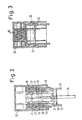
- the loading arm 17 consists of a pressure roller support arm 31 which can be pivoted about the pivot axis 16 and a cover arm 32 which covers it from above, like a hood, and which is open at the bottom and which by means of lateral longitudinal guides 33 (FIGS. 1, 3) in the longitudinal direction of the loading arm 17 on a across the pressure roller support arm 31 extending pivot and guide pin 34 is slidably and pivotally mounted relative to the pressure roller support arm 31.
- 1 and 3 is supported on the rotary and guide pin 34 from the front of one leg of a coil spring 35, which is wrapped around an upper cross pin 55 of the cover arm 32 and with its second leg extending at right angles to the first leg from below abuts the upper wall of the cover arm 32.
- the cover arm 32 has a handle 58, which has a clear play 57 relative to the front wall 59 of the pressure roller support arm 31, by which the Ab cover arm 32 can be moved by exerting a force in the direction of arrow T relative to the pressure roller support arm 31 while overcoming the force of the clock spring 35.
- the game 57 is sufficiently large so that after it has been overcome, the cover arm 32 can be pivoted up relative to the pressure roller support arm 31 and the rear wall 56 can pass the corner 60 present at the lower end of the first cam surface 36, in order to finally be aligned with an angle of the order of magnitude 45 ° arranged to come second flat cam surface 37 of the pressure roller support arm 31.
- This opened position of the cover arm 32 is illustrated in FIG. 6. After releasing the hand opening lever 58 in this position, the clock spring 35 presses the rear wall 56 into engagement with the cam surface 37.
- the pressure cylinders 18, 19, 20 arranged above them are assigned to the drive cylinders 12, 13, 14.
- the pressure roller pairs 18, 20 which cooperate with the drive cylinders 12, 14 are fastened via suitable saddle bearings 61 to the two ends of a rocker arm 39 which extends in the direction of the roving and about a tilting axis 38 which extends in the machine longitudinal direction and lies approximately between the pressure roller pairs 18, 20 , is pivotally attached to a support 43 which is attached by means of screws 62 to the pressure roller support arm 31 from below.
- the rocker arm 39 is pressurized counterclockwise in FIG. 1 by a helical compression spring 44 acting on it in its front region and supported on the pressure roller support arm 31, so that it is in the lifted state of the Pressure roller pairs 18, 20 (FIG. 4) can pivot counterclockwise until a stop region 63 at its rear upper end comes into engagement with a stop 45 on the carrier 43. 4, the gap between the drive cylinders 12, 13, 14 and the associated pairs of pressure rollers 18, 19, 20 is substantially the same width, whereby the insertion is in the partially open position of the loading arm 17 of FIG the fuse 22 is relieved.
- the pairs of pressure rollers 18, 19, 20 convey and stretch two runners 22, which run parallel to and at a distance from the pressure rollers of a pair, as is customary in double apron drafting systems.
- the inlet pressure roller 18 is adjustably arranged in the longitudinal direction of the loading arm 17 by means of a releasable adjustment mechanism 64 within a slot 65, while the front outlet pressure roller 20 is fixedly attached to the front end region of the rocker arm 39 by means of screws 66.
- the cage pressure roller 19 is provided above the drive cylinder 13, which is fixed by means of saddle bearings 61 on a pivot lever 40 by means of an adjusting device 67 and an adjustment slot 68 in the longitudinal direction of the loading arm 17.
- the pivot lever 40 is pivotally attached to the carrier 43 immediately behind the end of the rocker lever 39 and a pivot lever axis 41 extending in the machine longitudinal direction.
- the front end of the pivot lever 40 is acted upon by a helical compression spring 42 supported at the top on the carrier 43 by the spring force being provided with a flange-like spring abutment 82 supporting the lower end of the spring 42 and screwed from above into a lower bend 34 of the pivot lever 40 transfers to the pivot lever 40.
- a vorese over the screw 69 Hene bore 85 in the pressure roller support arm 31 allows the passage of a screwdriver with which the screw 69 is rotated and so the bias of the spring 42 can be changed. In this way, the pressure roller 19 is pressed resiliently against the drive cylinder 13 from above.
- a cutout 70 is provided within the pivot lever 40 in the region of the tilt axis 38, through which the tilt axis 38 arranged on the carrier 43 can pass with the required play.
- the pressure roller support arm 31 is attached in the rear area to a base 71 on the base frame 11 via a gimbal-adjustable fastening arrangement 72, which also carries a vertically extending opening spring 46, which presses the pressure roller support arm 31 at a clear distance in front of the pivot axis 16 in the vertical opening direction with a biasing force acted upon.
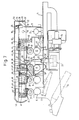
- the hook rod 24 is articulated on the piston rod 26 of a pneumatic piston-cylinder arrangement 23.
- the axis 25 of this joint extends in the longitudinal direction of the machine, i.e. transverse to the longitudinal direction of the loading arm 17.
- the loading arm 17 By moving the piston 23 'in the direction of arrow K, the loading arm 17 can be pivoted up from the position shown in FIG. 1 in the total of FIG. 4.
- the force K can be applied either by pressure in the lower cylinder space 23 ⁇ or, preferably, by the opening spring 46.
- a decoupling stop 30 extends from the cover arm 32 at the level of the transverse pin 28, but somewhat in front of it, which extends approximately to the height of the hooks 27 of the hook rod parts 24 and is in contact with them in the position shown in FIG. 2 evidently slightly overlapped.
- the arrangement and design of the decoupling stop 30 are such that when the manual operating lever 58 is moved rearward in the direction of the arrow T, the decoupling stop blow 30 comes into engagement with the hook 27 and - if at the same time a slight movement in the direction of arrow B is carried out from the partially open position according to FIG. 4 - thereby releases the hook 27 from the cross pin 28, which is dash-dotted in FIG. 1 is indicated.
- the cover arm 32 can then also be pivoted up relative to the pressure roller support arm 31 into the position shown in FIG. 6, so that now all parts of the drafting system are accessible in an optimal manner.
- the cage pressure roller 19 according to FIG. 1 is wrapped, similarly to the drive cylinder 13, by a strap 47 which has a flat strand 83 aligned parallel to the strand 51, the fuse 22 being securely guided between the two rubbers 51, 83.
- the strap 47 is brought into the form shown in FIG. 1 in the usual way by a guide bead 74.
- the pressure roller pairs 18, 30 are pressed against the drive cylinders 12, 14 with a defined force due to the pneumatic pressure maintained in the cylinder space 23 ′′′, the force ratio being able to be determined by a suitable choice of the lever arms of the rocker arm 39.
- the cage pressure roller pair 19 is pressed against the associated drive cylinder 13 by means of the force originating from the compression spring 48. If two new fuses 22 are to be drawn into the drafting system, the pressure is removed from the cylinder space 23 ′′′, whereupon the opening spring 46 pivots the loading arm 17 into the position shown in FIG. 4.
- the spring 44 presses the rocker arm 39 counterclockwise into the position shown in FIG. 4, so that the gap between all pairs of pressure rollers 18, 19 30 and all drive cylinders 12, 13, 14 is substantially the same size.
- the piston 23 'in FIG. 1 can be moved downward by renewed pressure generation in the cylinder space 23, the hook 27 transferring the loading arm 17 back into the clamping position shown in FIG. 1 via the transverse pin 28.
- the handle 58 is initially moved somewhat downwards in the direction of arrow B so that it hooks 27 and the cross pin 28 disengage. Then, in the direction of arrow D, the cover arm 32 is moved rearward, the decoupling stop 30 engaging with the hooks 27 and pivoting the hook rod 24 into the position shown in broken lines in FIG. 1.
- the loading arm 17 can now be pivoted further along the path 75 in FIG. 4 into the opening position according to FIG. 5, in which it is held by the opening spring 46, which preferably presses the loading arm 17 against a stop, not shown, which moves the position towards Fig. 5 defines. Due to the comparatively wide opening according to FIG. 5, the drafting system can be easily cleaned or serviced.
- the cover arm 32 can now be operated in parallel lel to the pressure roller support arm 31 are resiliently moved backwards against the wine spring 35, the first cam surface 36 and the rear wall 56 disengaging so that the cover arm 32 can be pivoted upwards relative to the pressure roller support arm 31, the rear wall 56 (FIG. 1 ) past the edge 60 and finally can come into engagement with the second cam surface 37 by the action of the coil spring 35 after the handle 58 has been released again.
- the position according to FIG. 6 is now reached, where practically all parts of the drafting system and the pressure roller support arm 31 are optimally accessible. Now all adjustment and assembly work on the pressure roller support arm 31 can also be carried out without any problems.
- Cleaning rollers 76, scraper 77 and the suction pipe 78 are only indicated in the drawing, since it is a common arrangement and training.
- the control valve 79 for the pneumatic piston-cylinder arrangement 23 is only indicated schematically.
- the actuation button 80 for loading the control valve 79 should not be arranged on the loading arm 17 itself, but rather - as indicated in FIG. 1 - on the base frame 11 in an easily accessible manner.
- This training is particularly advantageous for a flyer.
- the load arm 17 thus contains no lines in the form of electrical cables or pneumatic tubes. It can thus be removed and re-installed without removing or removing such lines.
- FIG. 7 differs from the embodiment described above only in that a further drafting stage is provided in the form of the drive cylinder 15 and the pair of pressure rollers 21, so that there is a total of a four-cylinder flyer drafting system.
- the pair of pressure rollers 21 is pivotally mounted on the pressure roller support arm 31 or the carrier 43 via a pivot lever 49 analogous to the cage pressure roller pair 19 about a pivot axis 81 extending in the machine longitudinal direction.
- a helical compression spring 48 acts on a preload adjusting screw 69 'the pivot lever 49 in the direction of the drive cylinder 15 such that in the working position shown in FIG. 7, the pressure roller 21 is pressed with the force generated by the spring 48 against the associated drive cylinder 15.
- the swivel path of the swivel lever 49 is limited downward analogously to the swivel lever 40 so that when the loading arm 17 is lifted, the pressure roller 21 can move downward just as far under the action of the spring force 48 that when the loading arm 17 is lifted into the match insertion position (FIG. 4 ) the gap between the pressure roller pair 21 and the drive cylinder 15 is essentially the same size as the gap between the other pressure roller pairs 18, 19, 20 and the associated drive cylinders 12, 13 and 14, respectively.
- a central pressure source in particular a pneumatic pressure source 86, is acted upon by a pneumatic pressure line 87 guided along the spinning machine via a pressure regulator and / or reducing or switching-off device 89, from which the double apron drafting system, which is only shown schematically in broken lines, acts 88 branches off a pneumatic branch line 90 which acts on the pneumatic piston-cylinder arrangement 23 via the control valve 79 designed as a reversing valve.
- the reversing valve 79 is a two-way two-position valve and, in the position shown in FIG. 8, connects the pneumatic pressure line 87 to the upper cylinder chamber 23 ′′′ of the piston-cylinder arrangement 23, while the lower cylinder chamber 23 ⁇ is in communication with the atmosphere. In this way, a downward closing force is exerted on the piston rod 26.
- valve 79 If the valve 79 is switched to the other position in the direction of the arrow f in FIG. 8, which can be done individually by pressing the actuation button 80 (FIGS. 1, 8), the lower cylinder space 23 ′ is applied to the pressure source 86 while the upper cylinder space 23 ′′′ is connected to atmosphere. The piston rod 26 is now moved upwards, as a result of which the hook 27 is raised and the load arm 17 thereby moves into the position according to FIG. 4.
- both cylinder spaces 23 bei and 23 ′′′ could also be connected to the atmosphere, because then the opening spring 46 would cause the loading arm 13 to move up to the position according to FIG. 4, with the force transmission pin 28 and the hook 27 of the piston 23 'would be raised with, which is possible in this case by connecting the cylinder chambers 23äume, 23 ′′′ to atmosphere.
Landscapes
- Engineering & Computer Science (AREA)
- Physics & Mathematics (AREA)
- Fluid Mechanics (AREA)
- Mechanical Engineering (AREA)
- Textile Engineering (AREA)
- Spinning Or Twisting Of Yarns (AREA)
Applications Claiming Priority (2)
| Application Number | Priority Date | Filing Date | Title |
|---|---|---|---|
| DE3933165 | 1989-10-04 | ||
| DE19893933165 DE3933165A1 (de) | 1989-10-04 | 1989-10-04 | Spinnmaschinen mit doppelriemchen-streckwerken |
Publications (2)
| Publication Number | Publication Date |
|---|---|
| EP0421170A2 true EP0421170A2 (fr) | 1991-04-10 |
| EP0421170A3 EP0421170A3 (en) | 1991-10-23 |
Family
ID=6390829
Family Applications (1)
| Application Number | Title | Priority Date | Filing Date |
|---|---|---|---|
| EP19900117710 Withdrawn EP0421170A3 (en) | 1989-10-04 | 1990-09-14 | Spinning machines with dual-apron drafting arrangement |
Country Status (4)
| Country | Link |
|---|---|
| EP (1) | EP0421170A3 (fr) |
| JP (1) | JPH03124821A (fr) |
| CZ (1) | CZ477390A3 (fr) |
| DE (1) | DE3933165A1 (fr) |
Cited By (2)
| Publication number | Priority date | Publication date | Assignee | Title |
|---|---|---|---|---|
| WO2015166323A1 (fr) * | 2014-04-28 | 2015-11-05 | Maschinenfabrik Rieter Ag | Ensemble de dévidage pour métier à filer |
| CN113493951A (zh) * | 2020-03-20 | 2021-10-12 | 张家港市广大纺机有限公司 | 一种纺纱机摇架及微调压力方法 |
Families Citing this family (1)
| Publication number | Priority date | Publication date | Assignee | Title |
|---|---|---|---|---|
| IT1244444B (it) * | 1990-09-13 | 1994-07-15 | Linimpianti Srl | Dispositivo pressore per una macchina di stiro di filati |
Family Cites Families (9)
| Publication number | Priority date | Publication date | Assignee | Title |
|---|---|---|---|---|
| DE1831952U (fr) * | 1900-01-01 | |||
| CH268500A (de) * | 1947-03-19 | 1950-05-31 | Rieter Joh Jacob & Cie Ag | Streckwerk mit Belastungsschiene. |
| BE672810A (fr) * | 1965-11-24 | 1966-03-16 | ||
| CH469830A (de) * | 1967-07-13 | 1969-03-15 | Rieter Ag Maschf | Oberwalzensattelanordnung für Spinnmaschinen-Streckwerke |
| DE7517056U (de) * | 1974-05-27 | 1975-10-02 | Schlumberger N & Cie | Vorrichtung zum Verziehen oder Verstrecken von Textilfasern |
| JPS5940928B2 (ja) * | 1980-04-30 | 1984-10-03 | 村田機械株式会社 | 紡績機に於けるドラフト装置の駆動伝達方法 |
| ATE18265T1 (de) * | 1981-04-06 | 1986-03-15 | Rieter Ag Maschf | Streckwerk fuer spinnmaschinen zur bearbeitung eines faserbandes. |
| JPS5915520A (ja) * | 1982-07-15 | 1984-01-26 | Toyoda Autom Loom Works Ltd | ドラフト機構のロ−ラ加圧装置 |
| NL8700932A (nl) * | 1987-05-19 | 1988-11-16 | Kostromskoe Sp K Bjuro Textiln | Machine voor het vervaardigen van twistloos garen uit vlasvezel. |
-
1989
- 1989-10-04 DE DE19893933165 patent/DE3933165A1/de not_active Withdrawn
-
1990
- 1990-09-14 EP EP19900117710 patent/EP0421170A3/de not_active Withdrawn
- 1990-10-01 CZ CS904773A patent/CZ477390A3/cs unknown
- 1990-10-02 JP JP26326290A patent/JPH03124821A/ja active Pending
Cited By (3)
| Publication number | Priority date | Publication date | Assignee | Title |
|---|---|---|---|---|
| WO2015166323A1 (fr) * | 2014-04-28 | 2015-11-05 | Maschinenfabrik Rieter Ag | Ensemble de dévidage pour métier à filer |
| CN106232885A (zh) * | 2014-04-28 | 2016-12-14 | 里特机械公司 | 用于纺纱机的牵拉装置 |
| CN113493951A (zh) * | 2020-03-20 | 2021-10-12 | 张家港市广大纺机有限公司 | 一种纺纱机摇架及微调压力方法 |
Also Published As
| Publication number | Publication date |
|---|---|
| CZ477390A3 (en) | 1993-03-17 |
| DE3933165A1 (de) | 1991-04-11 |
| EP0421170A3 (en) | 1991-10-23 |
| JPH03124821A (ja) | 1991-05-28 |
Similar Documents
| Publication | Publication Date | Title |
|---|---|---|
| DE2141276A1 (de) | Antriebs- und bremseinrichtung fuer ein offen-end-spinnaggregat | |
| EP1357298A2 (fr) | Distributeur d'actionnement pour un vérin pneumatique à double effet et utilisation d'un tel distributeur pour un cantre actionné par des vérins pneumatiques | |
| DE2061043A1 (de) | Gesenk-Schmiedepresse mit selbsttaetigem Werkstuecktransport | |
| EP0650832B1 (fr) | Dispositif pour tendre une pièce de tissu | |
| DE69810041T2 (de) | Vorrichtung zum Breithalten von schlauchförmigen Wirkwaren | |
| DE3881748T2 (de) | Bügelpresse für Kleider. | |
| DE4441142C2 (de) | Zweirichtungsschwenkrahmen einer Papierrollenwechseleinrichtung | |
| DE19704815A1 (de) | Vorrichtung an einer Strecke für Textilfaserbänder mit Belastung der Oberwalzen des Streckwerks | |
| DE3119661A1 (de) | Vorrichtung zum zufuehren von waeschestuecken zu einer mangel | |
| CH669799A5 (fr) | ||
| DE69613762T2 (de) | Verstellbare Klammer für die Schwenkverbindung der Schwingarme einer Schaftmaschine mit den Hebeln des Hebesystems | |
| DE3933165A1 (de) | Spinnmaschinen mit doppelriemchen-streckwerken | |
| EP0441178A1 (fr) | Banc à étirer à courroies et continu à filer avec une pluralité de telles bancs à étirer à courroies | |
| DE10253341A1 (de) | Spulengatter für Textilmaschinen sowie Betätigungsventil zum Verstellen eines solchen Spulengatters | |
| DE1090385B (de) | Einrichtung zur Bedienung von Kernschiessmaschinen | |
| DE3832060A1 (de) | Streckwerk fuer spinnereimaschinen | |
| EP0488007B1 (fr) | Système d'étirage pour métier à filer pour fil de titre fin | |
| EP0013368B1 (fr) | Dispositif pour régler la tension d'une bande de matériau | |
| EP0143291A1 (fr) | Dispositif d'étirage pour machine de filature | |
| DE2139307A1 (de) | Streckwerk mit starker verfeinerung zum verstrecken diskontinuierlicher textilfasern | |
| DE1577368C3 (de) | Druckbalken für eine automatische Bandschleifmaschine | |
| DD208634A5 (de) | Vorrichtung zur aufnahme eines streckrollenaggregates | |
| DE470636C (de) | Buegelpresse | |
| EP0287958B1 (fr) | Dispositif de serrage d'une lame de scie dans une machine de dressage de lames de scie | |
| DE4335236C1 (de) | Offenend-Spinnvorrichtung |
Legal Events
| Date | Code | Title | Description |
|---|---|---|---|
| PUAI | Public reference made under article 153(3) epc to a published international application that has entered the european phase |
Free format text: ORIGINAL CODE: 0009012 |
|
| AK | Designated contracting states |
Kind code of ref document: A2 Designated state(s): CH DE ES FR GB IT LI |
|
| PUAL | Search report despatched |
Free format text: ORIGINAL CODE: 0009013 |
|
| AK | Designated contracting states |
Kind code of ref document: A3 Designated state(s): CH DE ES FR GB IT LI |
|
| 17P | Request for examination filed |
Effective date: 19910916 |
|
| 17Q | First examination report despatched |
Effective date: 19930811 |
|
| STAA | Information on the status of an ep patent application or granted ep patent |
Free format text: STATUS: THE APPLICATION IS DEEMED TO BE WITHDRAWN |
|
| 18D | Application deemed to be withdrawn |
Effective date: 19931222 |