EP0421352A2 - Atténuateur optique - Google Patents
Atténuateur optique Download PDFInfo
- Publication number
- EP0421352A2 EP0421352A2 EP90118876A EP90118876A EP0421352A2 EP 0421352 A2 EP0421352 A2 EP 0421352A2 EP 90118876 A EP90118876 A EP 90118876A EP 90118876 A EP90118876 A EP 90118876A EP 0421352 A2 EP0421352 A2 EP 0421352A2
- Authority
- EP
- European Patent Office
- Prior art keywords
- light beam
- incidence
- light
- optical attenuator
- incident
- Prior art date
- Legal status (The legal status is an assumption and is not a legal conclusion. Google has not performed a legal analysis and makes no representation as to the accuracy of the status listed.)
- Withdrawn
Links
- 230000003287 optical effect Effects 0.000 title claims abstract description 49
- 230000000644 propagated effect Effects 0.000 claims abstract description 8
- 238000012544 monitoring process Methods 0.000 claims description 4
- 239000011358 absorbing material Substances 0.000 claims description 3
- 238000002834 transmittance Methods 0.000 description 12
- 230000005684 electric field Effects 0.000 description 11
- 239000013598 vector Substances 0.000 description 11
- 239000005331 crown glasses (windows) Substances 0.000 description 4
- 238000005259 measurement Methods 0.000 description 3
- 239000004065 semiconductor Substances 0.000 description 3
- 230000001419 dependent effect Effects 0.000 description 2
- 230000000694 effects Effects 0.000 description 2
- 230000014509 gene expression Effects 0.000 description 2
- 229910052751 metal Inorganic materials 0.000 description 2
- 239000002184 metal Substances 0.000 description 2
- 230000010287 polarization Effects 0.000 description 2
- 241001442234 Cosa Species 0.000 description 1
- 244000089409 Erythrina poeppigiana Species 0.000 description 1
- 235000009776 Rathbunia alamosensis Nutrition 0.000 description 1
- 229910052782 aluminium Inorganic materials 0.000 description 1
- XAGFODPZIPBFFR-UHFFFAOYSA-N aluminium Chemical compound [Al] XAGFODPZIPBFFR-UHFFFAOYSA-N 0.000 description 1
- 230000002238 attenuated effect Effects 0.000 description 1
- 238000010276 construction Methods 0.000 description 1
- 238000010586 diagram Methods 0.000 description 1
- 239000011521 glass Substances 0.000 description 1
- 239000000463 material Substances 0.000 description 1
- 230000007935 neutral effect Effects 0.000 description 1
- 239000013307 optical fiber Substances 0.000 description 1
- 238000001228 spectrum Methods 0.000 description 1
- 238000010183 spectrum analysis Methods 0.000 description 1
- 239000000758 substrate Substances 0.000 description 1
Images


Classifications
-
- G—PHYSICS
- G02—OPTICS
- G02B—OPTICAL ELEMENTS, SYSTEMS OR APPARATUS
- G02B26/00—Optical devices or arrangements for the control of light using movable or deformable optical elements
- G02B26/02—Optical devices or arrangements for the control of light using movable or deformable optical elements for controlling the intensity of light
-
- G—PHYSICS
- G02—OPTICS
- G02B—OPTICAL ELEMENTS, SYSTEMS OR APPARATUS
- G02B5/00—Optical elements other than lenses
- G02B5/001—Axicons, waxicons, reflaxicons
Definitions
- the present invention relates to an optical attenuator and in particular to an optical attenuator for producing a precisely attenuated light beam.
- An optical attenuator is generally utilized to attenuate the intensity of a light beam in a predetermined ratio.
- an optical attenuator may be used in a measurement or other application to attenuate the intensity of an output light beam from a light source such as a high power semiconductor laser diode.
- a conventional optical attenuator typically includes one or more ND (Neutral Density) filters. It is possible to provide such an optical attenuator with a desired transmittance (the reciprocal of the attenuation ratio) by selectively combining a plurality of ND filters each having a predetermined transmittance.
- the attenuation function of an ND filter in such an optical attenuator is obtained by reflecting an incident light beam from a light source with a predetermined reflectance.
- light returned from the optical attenuator to the light source causes unstable operation of the laser diode in the light source due to the optical feedback effect.
- the transmittance of the filters is changed in response to the polarized direction of the incident light beam as described hereinafter.
- T TP*cos2A + TS*sin2A (1)
- A is an azimuthal angle which is defined as the angle between the electric field vector of the incident light beam and the plane of incidence.
- the plane of incidence is defined as the plane including both the axis of the incident light beam and the normal to the surface of the medium at the point of incidence.
- TP is the transmittance of the component parallel to the plane of incidence and TS is the transmittance of the component perpendicular to the plane of incidence.
- the symbol * represents the multiplication operation.
- an optical attenuator includes a beam splitter for receiving an incident light beam from a light source at a predetermined angle of incidence to split it into a first reflected light beam and a first transmitted light beam, and a second beam splitter for receiving the first reflected light beam at the same predetermined angle of incidence to split it into a second reflected light beam and a second transmitted light beam.
- the first and second beam splitters have the same optical characteristics and are arranged so that their planes of incidence are perpendicular to each other.
- the optical attenuator further includes a first deflecting means for deflecting the first transmitted light beam from the first beam splitter to cause the deflected light to be propagated in other than the incident direction of the first transmitted light beam, and a second deflecting means to deflect the second transmitted light beam from the second beam splitter to cause the deflected light to be propagated in other than the incident direction of the second transmitted light beam.
- the incident light beam is partly reflected by the first and second beam splitters and the transmitted light beams through the beam splitters are deflected in other than the respective incident directions by the first and second deflecting means. Therefore, no light is returned to the light source and perturbation in the operation of the light source is eliminated.
- the distance between the light source and the optical attenuator can be further reduced in comparison with a conventional system in order to more miniaturize such an optical system. Since the two planes of incidence associated with the beam splitters, respectively, are perpendicular to each other, the azimuthal angle of the incident light from the light source does not affect the transmittance of the optical attenuator.
- incident light from a light source 10 such as a semiconductor laser diode is collimated by a collimator lens 12.
- the optical attenuation system in FIG. 1 basically includes first and second beam splitters 14 and 16.
- the first and second beam splitters 14 and 16 should have the same optical characteristics.
- the parallel light beam is incident on the first beam splitter 14 at a predetermined angle of incidence Th, for example 45 degrees.
- the reflected light beam from the first beam splitter 14 is incident on the second beam splitter 16 at the same angle of incidence Th.
- the light transmitted through the first beam splitter 14 is scattered by a first deflector 18 in other than the direction of the incident light beam to completely prevent any transmitted light from returning to the light source 10.
- the light transmitted through the second beam splitter 16 is also deflected or scattered by a second deflector 20 in other than the direction of the incident light beam from the first beam splitter 14 to prevent any light from returning to the light source 10.
- An ND filter 22 may be provided to further attenuate the reflected light from the second beam splitter 16 if necessary. It may be desired to employ a movable filter as the filter 22 to adjust the transmittance of the optical attenuator by removing the filter 22 from the light path or by replacing the filter 22 with another one.
- the light beam transmitted through the filter 22 is concentrated by a condenser lens 24 and applied to an optical detector 26.
- the optical detector 26 converts the light beam from the filter 22 to an electric signal.
- FIG. 2 illustrates in simplified fashion the reflected light path through the optical attenuator of FIG. 1.
- the operation of reflection by the first and second beam splitters 14 and 16 is described in detail hereinafter.
- the first and second beam splitters 14 and 16 are arranged such that the plane of incidence I associated with the beam splitter 14 is perpendicular to the plane of incidence II associated with the beam splitter 16.
- the first and second beam splitters 14 and 16 have the same angle of incidence Th.
- the common angle of incidence Th for both beam splitters 14 and 16 are set at 45 degrees, but it can be set at another value if desired.
- the incident light beam is reflected at the incident point 27 by the first beam splitter 14 and then reflected at the point 28 by the second beam splitter 16.
- the first and second beam splitters and the light beams transmitted therethrough are not shown for convenience of explanation.
- the incident light beam applied to the optical attenuator is a linearly polarized light beam such as the output light beam from a laser diode.
- the propagation energy of the incident light beam per unit time and per unit area is typically represented by its intensity L, which is a scalar quantity proportional to the square of the electric field vector E of the incident light beam.
- the electric field vectors of the first and second reflected light beams from the first and second beam splitters 14 and 16 of FIG. 1 are respectively represented by E1 and E2 in FIG. 2.
- EP1 and ES1 are the parallel and perpendicular electric field vector components, respectively, of E1 and, similarly, EP2 and ES2 are the parallel and perpendicular electric field vector components, respectively, of E2.
- the propagation energy values per unit time and per unit area i.e.
- FIG. 3 shows the behavior of reflectance components RP and RS associated with light components parallel and perpendicular to a plane of incidence as a function of the angle at which external light is incident on a crown glass surface.
- the value of RP is different from that of RS and, therefore, the reflectance R1 of the formula (2) varies in response to the change of the azimuthal angle A.
- the first and second beam splitters are disposed such that the planes of incidence I and II are perpendicular to each other and the two angles of incidence are equal.
- the total transmittance T of the optical attenuator is represented by the simple product of the reflectance components RP and RS and is completely independent of the azimuthal angle A of the incident light beam from the light source. It is, therefore, possible to provide an optical attenuator having accurate and stable attenuation performance which is not affected by the polarization of the incident light beam.
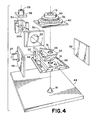
- FIG. 4 shows an exploded perspective view of another embodiment of the present invention.
- the corresponding components in FIG. 4 have the same reference numbers as those in FIG. 1.
- the collimator lens 12 is mounted in a lens holder 30 provided with a dial 32 for fine adjustment of the position of the collimator lens 12 along the optical axis to produce a completely collimated incident light beam.
- the incident light beam is split by the first beam splitter 14 into a first reflected light beam and a first transmitted light beam.
- the first reflected light beam from the first beam splitter 14 is split by the second beam splitter 16 into the second reflected light beam and the second transmitted light beam.
- the first and second beam splitters 14 and 16 are fixed by a supporting member 34 preferably made of metal, for example aluminum, so that the angles of incidence on the beam splitters are each set at 45 degrees and the planes of incidence associated with the two beam splitters are perpendicular to each other.
- the beam splitters may be made of crown glass that has been coated to achieve higher reflectances for an angle of incidence of 45 degrees than those shown in FIG. 3.
- the supporting member 34 is fixed to a bottom structure 36 preferably made of metal.
- the incident light beam from the collimator lens 12 is incident on the first beam splitter 14 by way of the entrance aperture 38 on the top of the supporting member 34.
- the second reflected light beam from the second beam splitter 16 is emitted by way of the exit aperture 40 provided on the side of the supporting member 34.
- the first transmitted light beam from the first beam splitter 14 is transmitted to the first deflector 18 by way of the aperture 42 provided on the bottom structure 36.
- the first deflector 18 is attached to the bottom external structure 44 and is a cone shaped reflector to reflect light from the first beam splitter 14 in directions other than the incidence direction thereof in order to prevent the reflected light from returning to the light source (not shown).
- the surface of the first deflector 18 is coated with light absorbing material.
- the ND filter 22 may be provided to further attenuate the second reflected light beam emitted through the exit aperture 40 from the second beam splitter 16.
- the sliding lens holder 46 for holding the filter 22 is disposed so that the filter 22 is slightly inclined to the optical axis so that the angle of incidence at the filter 22 is approximately 5 degrees and therefore the light reflected from the filter 22 is prevented from returning back to the light source. If the attenuation of the filter 22 is unnecessary, it is possible to slide the lens holder 46 to remove the filter 22 from the light path.
- the second reflected light beam from the second beam splitter 16 is concentrated by the condenser lens 24 provided on the side structure 48 and is applied to an optical detector such as a PIN photodiode (not shown).
- the second transmitted light beam which is transmitted through the second beam splitter 16 is propagated by way of the aperture 52 of the side structure 50 to the second deflector 20a, which is attached to the supporting structure 54.
- the second deflector 20a in FIG. 4 has a trigonal shape as opposed to the cone shape of the second deflector 20 in FIG. 1.
- the trigonal deflector 20a divides the second transmitted light beam from the second beam splitter 16 into two beams, which are deflected vertically upward and vertically downward, respectively.
- the light beam reflected upward by the second deflector 20a is supplied to the monitoring connector 58 provided on the supporting plate 56.
- the monitoring connector 58 may be used for connecting to an optical fiber cable (not shown) to transmit the light received from the second deflector 20a to an external measurement instrument such as a spectrum analyzer (not shown).
- an optical fiber cable not shown
- the optical deflector may be utilized not only for preventing reflected light from returning to the light source, but also for producing a monitoring light beam which is suitable for additional measurement such as spectrum analysis.
- the optical deflectors 18 and 20 are not limited to the reflecting types that have been described.
- the first and second beam splitters 14 and 16 and the ND filter 22 are entirely enclosed with the structures including the bottom structure 36, the upper structure 60 having the collimator lens 12 thereon, the side structures 48, 50 and 62, the front side structure (not shown for convenience), and the supporting structure 54 for supporting the second deflector 20a.
- the optical attenuator in FIG. 4 is further enclosed with the external structures including the bottom external structure 44 and other external structures (not shown for convenience) to form a compact box type apparatus. It is preferably to entirely coat the inner surfaces of all the parts forming the optical attenuator with light absorbing material in order to reduce random scattering of light.
- the ND filter 22 preferably has the transmittance T of 10 plus or minus 5 %, and in particular of 10 plus or minus 0.5 % (in the range of 750-850 nm). It is apparent that the above specification may be changed in accordance with some real applications.
Landscapes
- Physics & Mathematics (AREA)
- General Physics & Mathematics (AREA)
- Optics & Photonics (AREA)
- Optical Elements Other Than Lenses (AREA)
- Light Guides In General And Applications Therefor (AREA)
- Optical Couplings Of Light Guides (AREA)
- Mechanical Light Control Or Optical Switches (AREA)
Applications Claiming Priority (2)
| Application Number | Priority Date | Filing Date | Title |
|---|---|---|---|
| JP1261763A JP2614117B2 (ja) | 1989-10-06 | 1989-10-06 | 光減衰器 |
| JP261763/89 | 1989-10-06 |
Publications (2)
| Publication Number | Publication Date |
|---|---|
| EP0421352A2 true EP0421352A2 (fr) | 1991-04-10 |
| EP0421352A3 EP0421352A3 (en) | 1991-05-08 |
Family
ID=17366356
Family Applications (1)
| Application Number | Title | Priority Date | Filing Date |
|---|---|---|---|
| EP19900118876 Withdrawn EP0421352A3 (en) | 1989-10-06 | 1990-10-02 | Optical attenuator |
Country Status (4)
| Country | Link |
|---|---|
| US (1) | US5011265A (fr) |
| EP (1) | EP0421352A3 (fr) |
| JP (1) | JP2614117B2 (fr) |
| CA (1) | CA2020310A1 (fr) |
Cited By (2)
| Publication number | Priority date | Publication date | Assignee | Title |
|---|---|---|---|---|
| WO2007014773A1 (fr) * | 2005-08-02 | 2007-02-08 | Carl Zeiss Laser Optics Gmbh | Système optique pour atténuer et imager un faisceau optique en vue d'une mesure d’intensité subséquente |
| CN112987184A (zh) * | 2021-03-10 | 2021-06-18 | 南京英田光学工程股份有限公司 | 一种提高自由空间激光通信光路隔离度的方法 |
Families Citing this family (22)
| Publication number | Priority date | Publication date | Assignee | Title |
|---|---|---|---|---|
| SE9100916L (sv) * | 1991-03-27 | 1992-09-28 | Nobeltech Electronics Ab | Laservarnare |
| US5187611A (en) * | 1991-08-27 | 1993-02-16 | Northeast Robotics, Inc. | Diffuse on-axis light source |
| US5309542A (en) * | 1991-09-18 | 1994-05-03 | International Business Machines Corporation | Fiber optic transmitter modification for improved extinction ratio |
| JPH0596825U (ja) * | 1991-09-25 | 1993-12-27 | スタンレー電気株式会社 | 反射装置 |
| US5287365A (en) * | 1992-03-05 | 1994-02-15 | Laser Alignment, Inc. | Compact laser apparatus |
| US5631456A (en) * | 1994-03-01 | 1997-05-20 | Lynn Ltd. | Reflection control apparatus |
| US5604550A (en) * | 1994-10-31 | 1997-02-18 | Northeast Robotics, Inc. | Illumination device for indirectly illuminating an object with continuous diffuse light |
| US5761540A (en) * | 1994-10-31 | 1998-06-02 | Northeast Robotics, Inc. | Illumination device with microlouver for illuminating an object with continuous diffuse light |
| US5539485A (en) * | 1994-10-31 | 1996-07-23 | White; Timothy P. | Illumination device for providing continuous diffuse light on and off an observing axis |
| US5842060A (en) * | 1994-10-31 | 1998-11-24 | Northeast Robotics Llc | Illumination device with curved beam splitter for illumination an object with continuous diffuse light |
| US5764874A (en) * | 1994-10-31 | 1998-06-09 | Northeast Robotics, Inc. | Imaging system utilizing both diffuse and specular reflection characteristics |
| US5790306A (en) * | 1995-06-16 | 1998-08-04 | Global Surgical Corporation | Microscope beamsplitter |
| US5713661A (en) * | 1995-10-23 | 1998-02-03 | Northeast Robotics, Inc. | Hockey puck shaped continuous diffuse illumination apparatus and method |
| US5838852A (en) * | 1997-01-28 | 1998-11-17 | Ko; Chun-Ming | Adjustable optical power limiter |
| US20040114035A1 (en) * | 1998-03-24 | 2004-06-17 | Timothy White | Focusing panel illumination method and apparatus |
| US6273338B1 (en) | 1998-09-22 | 2001-08-14 | Timothy White | Low cost color-programmable focusing ring light |
| US6542304B2 (en) | 1999-05-17 | 2003-04-01 | Toolz, Ltd. | Laser beam device with apertured reflective element |
| US6674953B2 (en) * | 2001-01-03 | 2004-01-06 | Alliance Fiber Optic Products, Inc. | Controllably variable optical attenuator |
| US7123257B2 (en) | 2001-07-31 | 2006-10-17 | Canon Kabushiki Kaisha | Coloring information adding method and apparatus, and image processing method and apparatus |
| US8116342B2 (en) * | 2007-03-26 | 2012-02-14 | Nikon Corporation | Variable attenuator device and method |
| JP7427487B2 (ja) * | 2020-03-24 | 2024-02-05 | キヤノン株式会社 | 光学装置、車載システム、および移動装置 |
| JP2023137889A (ja) * | 2022-03-18 | 2023-09-29 | 株式会社トプコン | 穀物成分センサ及び穀物成分分析装置 |
Family Cites Families (8)
| Publication number | Priority date | Publication date | Assignee | Title |
|---|---|---|---|---|
| JPS5437459B2 (fr) * | 1972-01-13 | 1979-11-15 | ||
| US4111564A (en) * | 1973-02-08 | 1978-09-05 | Trice Jr James R | Reference plane production |
| JPS5638006A (en) * | 1979-09-06 | 1981-04-13 | Sony Corp | Television display unit of back projection type |
| JPS5889889A (ja) * | 1981-11-24 | 1983-05-28 | Olympus Optical Co Ltd | レ−ザ出力可変装置 |
| DE3223898C2 (de) * | 1982-06-26 | 1984-04-19 | Standard Elektrik Lorenz Ag, 7000 Stuttgart | Einstellbares optisches Dämpfungsglied |
| US4836649A (en) * | 1985-07-12 | 1989-06-06 | Hughes Aircraft Company | Optical layout for a three light valve full-color projector employing a dual relay lens system and a single projection lens |
| US4827334A (en) * | 1986-08-22 | 1989-05-02 | Electrohome Limited | Optical system and method for image sampling in a video projection system |
| US4778263A (en) * | 1987-05-29 | 1988-10-18 | The United States Of America As Respresented By The Department Of Energy | Variable laser attenuator |
-
1989
- 1989-10-06 JP JP1261763A patent/JP2614117B2/ja not_active Expired - Lifetime
-
1990
- 1990-02-07 US US07/476,833 patent/US5011265A/en not_active Expired - Fee Related
- 1990-07-03 CA CA002020310A patent/CA2020310A1/fr not_active Abandoned
- 1990-10-02 EP EP19900118876 patent/EP0421352A3/en not_active Withdrawn
Cited By (2)
| Publication number | Priority date | Publication date | Assignee | Title |
|---|---|---|---|---|
| WO2007014773A1 (fr) * | 2005-08-02 | 2007-02-08 | Carl Zeiss Laser Optics Gmbh | Système optique pour atténuer et imager un faisceau optique en vue d'une mesure d’intensité subséquente |
| CN112987184A (zh) * | 2021-03-10 | 2021-06-18 | 南京英田光学工程股份有限公司 | 一种提高自由空间激光通信光路隔离度的方法 |
Also Published As
| Publication number | Publication date |
|---|---|
| JP2614117B2 (ja) | 1997-05-28 |
| US5011265A (en) | 1991-04-30 |
| EP0421352A3 (en) | 1991-05-08 |
| CA2020310A1 (fr) | 1991-04-07 |
| JPH03123313A (ja) | 1991-05-27 |
Similar Documents
| Publication | Publication Date | Title |
|---|---|---|
| US5011265A (en) | Optical attenuator | |
| US7221823B2 (en) | Fiber coupler, system and associated methods for reducing back reflections | |
| US6252718B1 (en) | Optical reflector and laser with external cavity incorporating such a reflector | |
| JP2786322B2 (ja) | 反射軽減集成装置 | |
| US6600845B1 (en) | Integrated parallel transmitter | |
| US6668115B2 (en) | Method, apparatus, and system for compensation of amplifier gain slope and chromatic dispersion utilizing a virtually imaged phased array | |
| US6654518B1 (en) | Tap output collimator | |
| US5661737A (en) | Multi-wavelength laser beam detector with refractive element | |
| US7412132B1 (en) | Mini fiber optic isolator | |
| US6614958B1 (en) | Optical imaging system | |
| JP2739632B2 (ja) | 光学スイッチング装置 | |
| JP2000299521A (ja) | 波長のフィルタリング用の単一方向の自動整合した後方反射光学系 | |
| US4660983A (en) | Apparatus for measuring reflectivities of resonator facets of semiconductor laser | |
| CN115638884B (zh) | 一种非线性干涉仪 | |
| US4281905A (en) | Magneto-optic light deflector beam recombination apparatus | |
| US5013120A (en) | Monochromator to fiber-cable coupling system | |
| US6934086B2 (en) | Optical component and compact wavelength locking arrangement including such a component | |
| Best et al. | Shedding light on hybrid optics: A tutorial in coupling | |
| US5361159A (en) | Angular acousto-optical deflection device and spectrum analyzer using such a device | |
| CN218866152U (zh) | 一种滤波器 | |
| JP2548767B2 (ja) | 疑似波長分散発生装置 | |
| JP4421159B2 (ja) | 制限されたスペクトル間隔を仕切る矩形の応答型光学フィルタ | |
| EP0762168A1 (fr) | Dispositif de raccordement d'un guide d'ondes à un élément émettant à partir de la surface ou à un élément détecteur | |
| JPH03111804A (ja) | 低反射コリメート光学装置 | |
| JP2907037B2 (ja) | 双方向ラインモニタ |
Legal Events
| Date | Code | Title | Description |
|---|---|---|---|
| PUAI | Public reference made under article 153(3) epc to a published international application that has entered the european phase |
Free format text: ORIGINAL CODE: 0009012 |
|
| PUAL | Search report despatched |
Free format text: ORIGINAL CODE: 0009013 |
|
| AK | Designated contracting states |
Kind code of ref document: A2 Designated state(s): DE FR GB |
|
| AK | Designated contracting states |
Kind code of ref document: A3 Designated state(s): DE FR GB |
|
| 17P | Request for examination filed |
Effective date: 19910503 |
|
| 17Q | First examination report despatched |
Effective date: 19930512 |
|
| STAA | Information on the status of an ep patent application or granted ep patent |
Free format text: STATUS: THE APPLICATION IS DEEMED TO BE WITHDRAWN |
|
| 18D | Application deemed to be withdrawn |
Effective date: 19930923 |