EP0422298A1 - Système d'affichage - Google Patents
Système d'affichage Download PDFInfo
- Publication number
- EP0422298A1 EP0422298A1 EP89310458A EP89310458A EP0422298A1 EP 0422298 A1 EP0422298 A1 EP 0422298A1 EP 89310458 A EP89310458 A EP 89310458A EP 89310458 A EP89310458 A EP 89310458A EP 0422298 A1 EP0422298 A1 EP 0422298A1
- Authority
- EP
- European Patent Office
- Prior art keywords
- display
- memory
- character
- information
- font
- Prior art date
- Legal status (The legal status is an assumption and is not a legal conclusion. Google has not performed a legal analysis and makes no representation as to the accuracy of the status listed.)
- Granted
Links
- 230000015654 memory Effects 0.000 claims abstract description 83
- 230000003068 static effect Effects 0.000 claims description 5
- 238000005516 engineering process Methods 0.000 abstract description 6
- 238000010586 diagram Methods 0.000 description 4
- 239000000872 buffer Substances 0.000 description 3
- 238000007792 addition Methods 0.000 description 1
- 239000003086 colorant Substances 0.000 description 1
- 230000006835 compression Effects 0.000 description 1
- 238000007906 compression Methods 0.000 description 1
- 238000010276 construction Methods 0.000 description 1
- 238000011161 development Methods 0.000 description 1
- 238000000034 method Methods 0.000 description 1
- 238000012986 modification Methods 0.000 description 1
- 230000004048 modification Effects 0.000 description 1
- 230000002093 peripheral effect Effects 0.000 description 1
- 238000012545 processing Methods 0.000 description 1
- 230000000007 visual effect Effects 0.000 description 1
Images

Classifications
-
- G—PHYSICS
- G09—EDUCATION; CRYPTOGRAPHY; DISPLAY; ADVERTISING; SEALS
- G09G—ARRANGEMENTS OR CIRCUITS FOR CONTROL OF INDICATING DEVICES USING STATIC MEANS TO PRESENT VARIABLE INFORMATION
- G09G5/00—Control arrangements or circuits for visual indicators common to cathode-ray tube indicators and other visual indicators
- G09G5/22—Control arrangements or circuits for visual indicators common to cathode-ray tube indicators and other visual indicators characterised by the display of characters or indicia using display control signals derived from coded signals representing the characters or indicia, e.g. with a character-code memory
- G09G5/222—Control of the character-code memory
Definitions
- the invention relates to a display system comprising a display memory for the storage of information for display on a display device.
- APA all points addressable
- character display modes ie. using fixed-size character boxes
- advantages over APA modes in certain circumstances (eg. for operating system messages) because they intrinsically have less demand for storage.
- character display modes remain necessary for reasons of compatibility with the large number of alpha-numeric applications already existing.
- dual-ported display memory in particular dual-ported video memory which is otherwise known as VRAM
- VRAM dual-ported video memory
- DRAM dynamic RAM
- DRAM dynamic RAM
- serial access mode in which data can be output sequentially at high speed in, for example, an eight bit wide data stream.
- European patent application EP-A-284,904 relates to a display system with a symbol font memory in which a selection of symbol fonts are stored in the system memory of a workstation and only those portions of a symbol font which are currently needed for display are transferred to the display memory of a display system.
- part of the APA display memory is configured as a cache.
- This prior display system addresses the system overhead incurred in updating the display memory from the system memory of the workstation, but does not address the problem the instant invention seeks to solve, namely the efficient support of character modes in a display system comprising a dual-ported display memory.
- EP-A-284,904 relates to two examples, both of which are based on prior display adapter standards which use DRAM technology; namely the Colour Graphics Adapter (CGA) and the Extended Graphics Array (EGA).
- CGA Colour Graphics Adapter
- EGA Extended Graphics Array
- character font as used herein is intended to be synonymous with the term “symbol font” used in EP-A-284,904.
- An object of the invention is to provide a display system having a dual-ported display memory for the storage of information to be displayed, which display system can efficiently support a character display mode.
- a display system comprises a display memory for the storage of information for display on a display device, said information including character font definitions, a font cache for the temporary storage of the definitions of one or more character fonts currently required for display and control logic for updating the font cache from the display memory.
- the invention provides, in addition to a display memory, a separate font cache for the temporary storage of currently displayable character (or symbol) fonts.
- the information for display comprises character codes, character attributes and font definitions for a plurality of different fonts.
- the font definitions will define a large number of different fonts.
- this information for display is stored in the display memory.
- the display system also supports an APA mode, there will be a relatively large amount of storage which is needed for on-screen storage in the APA mode, but which is available for off-screen storage in the character mode.
- the on-screen storage requirements are much higher in an APA mode.
- the primary object of the invention is to enable a character mode to be efficiently supported on a display system having a dual-ported display memory for the storage of information to be displayed, the invention would also be applicable to display systems with display memories implemented in other memory technologies.
- the font cache is preferably in the form of high-speed static storage. As only selected font information is held in the font cache at any one time, it may be relatively small. Preferably, in order to achieve compatibility with existing display standards (eg. EGA, VGA) two fonts are displayable at any one time.
- existing display standards eg. EGA, VGA
- the character codes and attributes are accessed sequentially from the VRAM and are passed to a serialiser which uses the character codes to access the appropriate font information from the cache.
- the serialiser then uses the font information from the font cache with the attribute information for creating appropriate video signals to drive the monitor.
- the information defining the currently displayable fonts can be accessed sequentially from the VRAM and written into the cache.
- the contents of the cache can thus be updated during successive vertical refresh times from the fonts stored in the VRAM. Any individual change caused by the system writing to the font area in VRAM or changing the fonts currently selected for display is reflected in the font cache within a few vertical scan periods.
- FIG. 1 is a schematic block diagram of a typical configuration of a workstation in the form of personal computer such as one of the members of the range of IBM PS/2 personal computers.
- the heart of the workstation is a conventional microprocessor 10. This is connected to a number of other units including a display adapter 12 via a system bus 14. Also connected to the system bus are a random access memory RAM 16 and a read only store 18.
- An I/O adapter 20 is provided for connecting the system bus to the peripheral devices 22 such as disk units.
- a communications adapter 24 is provided for connecting the workstation to a remote processor (eg. a mainframe computer).
- a keyboard 26 is connected to the system bus via a keyboard adapter 28.
- the display adapter 12 is used for controlling the display of data on a display device 30. In operation the CPU will issue commands to the display adapter over the system bus for causing it to perform display processing tasks.
- the display adapter 12 illustrated in Figure 1 includes a display memory 36 for containing information for display and logic for controlling display operations. It should be noted however, that in come prior systems, the display memory is formed by configuring part of the system RAM 16. Either way, in prior computer systems, the display memory is typically implemented using dynamic random access memory (DRAM).
- DRAM dynamic random access memory
- Existing display adapter standards such as the IBM Extended Graphics Array (EGA), or the IBM Video Graphics Array (VGA) were designed to make use of such a memory.
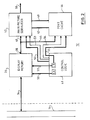
- FIG 2 is a schematic diagram of elements of a display system in accordance with the invention which is configured as a display adapter 12 to be connected to the system bus 14 of the personal computer in Figure 1 in addition to, or as a replacement for the display adapter 12 shown in the Figure.
- a display adapter 12 to be connected to the system bus 14 of the personal computer in Figure 1 in addition to, or as a replacement for the display adapter 12 shown in the Figure.
- FIG 2 is a schematic diagram of elements of a display system in accordance with the invention which is configured as a display adapter 12 to be connected to the system bus 14 of the personal computer in Figure 1 in addition to, or as a replacement for the display adapter 12 shown in the Figure.
- buffers and/or memory control logic in the path 34 between the system bus 14 and the display memory 36 and a digital-to-analogue converter stage and possibly a colour palette between the main picture serialiser and the display device(s) being driven by the adapter.
- a display system in accordance with the invention is described herein in terms of the display adapter 12 for use in a workstation, the term “display system” as used herein is not to be limited thereto.
- the term “display system” is to be interpreted to cover any system which is capable of displaying information.
- the workstation of Figure 1 when modified to incorporate the display adapter of Figure 2, also forms a display system in accordance with the invention.
- the invention is not limited to the display of information by means of a visual display monitor, but also includes the display of information by means of, for example, a printer.
- the display adapter illustrated in Figure 2 comprises a display memory (sometimes otherwise known as a refresh buffer or frame buffer) 36 composed of dual-ported memory (here dual-ported video memory, otherwise known as VRAM).
- the serial access port 38 of the VRAM is connected via a video path 40 to a main picture serialiser 42. Data for updating the display device are read out of the display memory via this serial port and are passed via the video path 40 to the serialiser 42.
- the serial output port of the display memory is also connected via an additional path 44 to a font cache 46. During periods when data is not required for updating the display, data can be passed via the additional path 44 for updating the font memory.
- the serialiser is able to address the font cache via address bus 47 for causing font data to be passed from the font cache to the serialiser via data path 49.
- Control logic 48 is provided for controlling the operation of the display adapter by means of address and control signals passed via lines 50 - 55.
- the control logic is implemented as part of the Cathode Ray Tube Controller (CRTC).
- the CRTC causes data to be read from the display memory in synchronism with the scanning of the CRT display in accordance with the current mode of operation (APA or character mode).
- APA current mode of operation
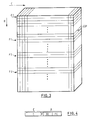
- Figure 3 is a schematic illustration of the content of the display memory in a character mode.
- Figure 3 represents the conceptual three dimensional structure of a VRAM, with a number (here 8) bits of data per row and column address.
- the VRAM memory itself is conventional in construction and operation, so this will not be described in detail. Briefly, however, the memory can be operated using the normal (DRAM type) random access port of the memory, and also using the fast serial port of the VRAM memory. In the former case, specifying a row and column address results in eight bits being output from that location via the random access port.
- DRAM type normal random access port
- the fast serial port of the VRAM specifies eight bits being output from that location via the random access port.
- multiple sets of eight bits for consecutive memory locations are output via the serial port starting from a selected location in memory.
- the character definition information is stored in the on-screen portion of the display memory, starting at a selected location CD in the memory (here location 0,0).
- the "on-screen portion" of the display memory is scanned sequentially during active display times for displaying the data characters specified by the character definition information stored therein.
- the definitions for a number of fonts (typically eight) are also stored in the display memory, although in an off-screen portion thereof. This portion of the display memory is not scanned during active display times.
- the definitions for the fonts each start at a different memory location (F1, F2, F3).
- the font definitions represent bit maps of each of the characters of the font.
- each font is stored with the data defining the bit maps for respective characters of the font at successive locations in the display memory.
- the character definition information for successive characters to be displayed is stored sequentially in the VRAM in which they are to appear on the display screen. In this way, during the active display scan time, the character definition information for successive characters to be displayed on each display scan line can be sequentially accessed in the VRAM.
- a typical format for the character information for a character is illustrated in Figure 4. It comprises a character code, C, and attribute information, A.
- the character code is used for specifying a particular character within a font and the attribute information selects between two fonts (bit F) and specifies the foreground (bits FC) and background (bits BC) colours.
- the accessing of information from the display memory is controlled by the CRTC.
- the character codes and attributes are accessed sequentially from the VRAM and are passed to a serialiser.
- the serialiser then assembles the video information for controlling the display monitor from the character information and font information.
- the serialiser does not, however, take the font information directly from the display memory, rather it obtains this from the font cache.
- the character definition information can be stored such that it may accessed from successive display memory locations during active display times, the character font information cannot be so stored. This is partly because the order in which characters are to be displayed on any particular line cannot be predicted in advance, and partly because only one line of bit map data for a character is needed for any one display line.
- pixel data for half the scan lines need to be accessed from the font during a first scan of the display screen and pixel data for the other half of the scan lines, which are interleaved between those of the first half, need to be accessed during a second scan of the display screen.
- the serialiser addresses the font cache via path 47 for accessing appropriate pixel information for successive characters to be displayed.
- the font cache addresses are generated by serialiser from the font bit F and the character code C for each character on that line as received from the display memory via path 40 (this identifies the font and character) and conventional display line count information from the CRTC via path 52 identifying the current scan line (this identifies the scan line within the character).
- the pixel information is passed to the serialiser via path 49 from the font cache. This pixel information effectively specifies for each pixel position on the display screen whether the background or foreground colour specified in the corresponding character attribute information is to be displayed.
- the serialiser uses this pixel information to gate the appropriate colour information to the output line 58 for driving the display monitor.
- the cache has the capacity to store two complete fonts. For reasons of compatibility with other existing display standards, eight fonts should be held in the display memory. For meeting these requirements, the font cache can be updated from the display memory. This takes account of the fact that, during vertical retrace neither the VRAM nor the font RAM are accessed for the display purposes.
- the CRTC is arranged, therefore to access the information defining the currently displayable fonts sequentially from the VRAM using the serial access port and to write this information into the cache. The contents of the cache can thus be updated during successive vertical refresh times from the fonts stored in the VRAM.
- any individual change caused by the system writing to the font area in VRAM or changing the fonts currently selected for display is reflected in the font cache within a few vertical scan periods. It is possible to update the font cache within this time thanks to the speed of the VRAM serial port.
- the mechanism for determining the destination of the data from the display memory could take any suitable form.
- the destination is determined by the control logic enabling the data inputs to the data serialiser and the font memory at appropriate times via control signals on control lines 53 and 54.
- the data input to the serialiser is enabled via control line 53 and the data input to the font cache disabled.
- the data input to the serialiser is disabled, the data input to the font cache is enabled via line 54 and address information is supplied to the font cache by the CRTC.
- the CRTC needs a separate counting mechanism for addressing the display information during active display times and a second counting mechanism for addressing the font information for updating the font cache.
- the CRTC includes a first counter CA for counting from the base address CD to the final address CDF at which the character definition information is stored each time the display is refreshed.
- Figure 2 represents schematically these addresses being passed via address lines 50 to the display memory.
- the CRTC includes a second counter CB.
- FIG. 1 represents schematically these addresses being passed via address lines 51 to the display memory.
- the content of the counter CB is used by control logic in the CRTC as an index for generating not only the display memory addresses from which font data is to be read, but also the font cache addresses to which data is to be written.
- Figure 2 represents schematically these addresses being passed via address lines 55 to the font cache.
- the display system described above having a combination of VRAM storage for the main storage of the display information for a character mode and cache storage for the temporary storage of currently displayable font information provides the following advantages: - all access by the host system to the character, attribute or font data can be to the VRAM which means that they can have a high performance; - all accesses to the character or attribute data by the display system can be to the VRAM which means that they can be sequential and that high video rates may be supported.
- -all accesses to the font data by the display system can be to the cache; -only a small cache is needed which means that it may be made from high speed (static) memory and that high video rates may be supported; - fonts and other data can be stored exactly as they were in previous adapters which means that register level compatibility can be obtained; and -the updating of the font cache can be achieved during otherwise unused VRAM bandwidth so that system performance need not be affected.
- the primary object of the invention is to enable a character mode to be efficiently supported on a display system having a dual-ported display memory for the storage of information to be displayed
- the invention would also be applicable to display systems with display memories implemented in other memory technologies.
- the font is only updated during vertical display retrace in the above example, it could be updated at any other time when display data is not required from the display memory for display purposes.
- the font cache were also updated during horizontal retrace and/or display blanking times.
Landscapes
- Engineering & Computer Science (AREA)
- Physics & Mathematics (AREA)
- Computer Hardware Design (AREA)
- General Physics & Mathematics (AREA)
- Theoretical Computer Science (AREA)
- Controls And Circuits For Display Device (AREA)
- Accessory Devices And Overall Control Thereof (AREA)
- Dot-Matrix Printers And Others (AREA)
Priority Applications (5)
| Application Number | Priority Date | Filing Date | Title |
|---|---|---|---|
| EP89310458A EP0422298B1 (fr) | 1989-10-12 | 1989-10-12 | Système d'affichage |
| DE68920147T DE68920147T2 (de) | 1989-10-12 | 1989-10-12 | Anzeigesystem. |
| US07/485,347 US5208908A (en) | 1989-10-12 | 1990-02-26 | Display system having a font cache for the temporary storage of font data |
| CA002021831A CA2021831C (fr) | 1989-10-12 | 1990-07-24 | Systeme d'affichage |
| JP2226817A JPH03134700A (ja) | 1989-10-12 | 1990-08-30 | 表示装置 |
Applications Claiming Priority (1)
| Application Number | Priority Date | Filing Date | Title |
|---|---|---|---|
| EP89310458A EP0422298B1 (fr) | 1989-10-12 | 1989-10-12 | Système d'affichage |
Publications (2)
| Publication Number | Publication Date |
|---|---|
| EP0422298A1 true EP0422298A1 (fr) | 1991-04-17 |
| EP0422298B1 EP0422298B1 (fr) | 1994-12-21 |
Family
ID=8202814
Family Applications (1)
| Application Number | Title | Priority Date | Filing Date |
|---|---|---|---|
| EP89310458A Expired - Lifetime EP0422298B1 (fr) | 1989-10-12 | 1989-10-12 | Système d'affichage |
Country Status (5)
| Country | Link |
|---|---|
| US (1) | US5208908A (fr) |
| EP (1) | EP0422298B1 (fr) |
| JP (1) | JPH03134700A (fr) |
| CA (1) | CA2021831C (fr) |
| DE (1) | DE68920147T2 (fr) |
Cited By (2)
| Publication number | Priority date | Publication date | Assignee | Title |
|---|---|---|---|---|
| EP0626637A1 (fr) * | 1993-05-18 | 1994-11-30 | Nokia Mobile Phones Ltd. | Circuit et méthode pour commander un affichage orienté vers les mots dans un équipement portable |
| AU754557B2 (en) * | 1998-08-26 | 2002-11-21 | Aventis Pharma Limited | Aza-bicycles which modulate the inhibition of cell adhesion |
Families Citing this family (34)
| Publication number | Priority date | Publication date | Assignee | Title |
|---|---|---|---|---|
| JPH0426890A (ja) * | 1990-05-22 | 1992-01-30 | Sharp Corp | 文字表示装置 |
| JP2659614B2 (ja) * | 1990-11-13 | 1997-09-30 | 株式会社日立製作所 | 表示制御装置 |
| JP2892176B2 (ja) * | 1991-05-15 | 1999-05-17 | 株式会社東芝 | フォントメモリアクセス方式 |
| US5592678A (en) * | 1991-07-23 | 1997-01-07 | International Business Machines Corporation | Display adapter supporting priority based functions |
| US5581731A (en) * | 1991-08-30 | 1996-12-03 | King; Edward C. | Method and apparatus for managing video data for faster access by selectively caching video data |
| US6101576A (en) * | 1992-07-31 | 2000-08-08 | Fujitsu Limited | Method for saving generated character image in a cache system including a backup cache |
| JP3049158B2 (ja) * | 1992-09-24 | 2000-06-05 | キヤノン株式会社 | 文字処理装置および文字処理装置の文字処理方法 |
| US5446840A (en) * | 1993-02-19 | 1995-08-29 | Borland International, Inc. | System and methods for optimized screen writing |
| US5530799A (en) * | 1993-12-17 | 1996-06-25 | Taligent Inc. | Rendering cache in an object oriented system |
| US5689724A (en) * | 1993-12-23 | 1997-11-18 | International Business Machines Corporation | Generic font specification leading to specific font selection |
| US5590260A (en) * | 1993-12-30 | 1996-12-31 | International Business Machines Corporation | Method and apparatus for optimizing the display of fonts in a data processing system |
| US5539428A (en) * | 1993-12-30 | 1996-07-23 | Cirrus Logic, Inc. | Video font cache |
| EP0663659A3 (fr) * | 1993-12-30 | 1995-11-22 | Ibm | Affichage de caractères dans un système de traitement de données. |
| DE4405329A1 (de) * | 1994-02-21 | 1995-08-24 | Vobis Microcomputer Ag | Verfahren zur Textdarstellung im CGA-Graphikmodus auf einem Bildschirm eines Personalcomputers |
| US5687376A (en) * | 1994-12-15 | 1997-11-11 | International Business Machines Corporation | System for monitoring performance of advanced graphics driver including filter modules for passing supported commands associated with function calls and recording task execution time for graphic operation |
| US5745762A (en) * | 1994-12-15 | 1998-04-28 | International Business Machines Corporation | Advanced graphics driver architecture supporting multiple system emulations |
| US5745761A (en) * | 1994-12-15 | 1998-04-28 | International Business Machines Corporation | Advanced graphics driver architecture with extension capability |
| US5715459A (en) * | 1994-12-15 | 1998-02-03 | International Business Machines Corporation | Advanced graphics driver architecture |
| US5742298A (en) * | 1994-12-30 | 1998-04-21 | Cirrus Logic, Inc. | 64 bit wide video front cache |
| US5745110A (en) * | 1995-03-10 | 1998-04-28 | Microsoft Corporation | Method and apparatus for arranging and displaying task schedule information in a calendar view format |
| US6124867A (en) * | 1995-07-18 | 2000-09-26 | Kabushiki Kaisha Toshiba | Picture output apparatus, picture preparation apparatus, and picture output method for outputting picture in the state developed into bitmap data |
| GB9603582D0 (en) | 1996-02-20 | 1996-04-17 | Hewlett Packard Co | Method of accessing service resource items that are for use in a telecommunications system |
| US6859783B2 (en) | 1995-12-29 | 2005-02-22 | Worldcom, Inc. | Integrated interface for web based customer care and trouble management |
| KR100207316B1 (ko) * | 1996-08-06 | 1999-07-15 | 윤종용 | 화면상의 정보표시 장치 |
| US9197599B1 (en) * | 1997-09-26 | 2015-11-24 | Verizon Patent And Licensing Inc. | Integrated business system for web based telecommunications management |
| US6763376B1 (en) * | 1997-09-26 | 2004-07-13 | Mci Communications Corporation | Integrated customer interface system for communications network management |
| US7058600B1 (en) * | 1997-09-26 | 2006-06-06 | Mci, Inc. | Integrated proxy interface for web based data management reports |
| US6745229B1 (en) | 1997-09-26 | 2004-06-01 | Worldcom, Inc. | Web based integrated customer interface for invoice reporting |
| US6209063B1 (en) * | 1998-05-07 | 2001-03-27 | Microware Systems Corporation | Management of the information flow within a computer system |
| US6920633B1 (en) * | 2000-01-14 | 2005-07-19 | Microsoft Corporation | Cross-process common system resource data sharing |
| US6754772B2 (en) * | 2001-11-15 | 2004-06-22 | Micron Technology, Inc. | Distributed cache |
| JP2005114960A (ja) * | 2003-10-07 | 2005-04-28 | Canon Inc | 表示ユニットおよび表示機能付き装置 |
| US8238538B2 (en) | 2009-05-28 | 2012-08-07 | Comcast Cable Communications, Llc | Stateful home phone service |
| WO2018067155A1 (fr) | 2016-10-06 | 2018-04-12 | Hewlett-Packard Development Company, L.P. | Signaux de commande d'entrée propagés sur des trajets de signal |
Citations (4)
| Publication number | Priority date | Publication date | Assignee | Title |
|---|---|---|---|---|
| EP0123896A2 (fr) * | 1983-04-04 | 1984-11-07 | Tektronix, Inc. | Circuit pour contrôler en mode caractères et en mode vidéo |
| US4486856A (en) * | 1982-05-10 | 1984-12-04 | Teletype Corporation | Cache memory and control circuit |
| EP0284260A2 (fr) * | 1987-03-14 | 1988-09-28 | Brother Kogyo Kabushiki Kaisha | Imprimante de type balayage de trame |
| EP0284904A2 (fr) * | 1987-04-02 | 1988-10-05 | International Business Machines Corporation | Système de visualisation pour une mémoire de police de symboles |
Family Cites Families (4)
| Publication number | Priority date | Publication date | Assignee | Title |
|---|---|---|---|---|
| JPS55121372A (en) * | 1979-03-14 | 1980-09-18 | Tokyo Shibaura Electric Co | Grain drier |
| GB2202720B (en) * | 1987-03-27 | 1991-04-17 | Ibm | Raster scan display system with random access memory character generator |
| JP2907826B2 (ja) * | 1987-05-29 | 1999-06-21 | 株式会社日立製作所 | 文字フォント管理装置 |
| JP2901607B2 (ja) * | 1987-10-30 | 1999-06-07 | 株式会社日立製作所 | 文字出力装置 |
-
1989
- 1989-10-12 DE DE68920147T patent/DE68920147T2/de not_active Expired - Fee Related
- 1989-10-12 EP EP89310458A patent/EP0422298B1/fr not_active Expired - Lifetime
-
1990
- 1990-02-26 US US07/485,347 patent/US5208908A/en not_active Expired - Fee Related
- 1990-07-24 CA CA002021831A patent/CA2021831C/fr not_active Expired - Fee Related
- 1990-08-30 JP JP2226817A patent/JPH03134700A/ja active Pending
Patent Citations (4)
| Publication number | Priority date | Publication date | Assignee | Title |
|---|---|---|---|---|
| US4486856A (en) * | 1982-05-10 | 1984-12-04 | Teletype Corporation | Cache memory and control circuit |
| EP0123896A2 (fr) * | 1983-04-04 | 1984-11-07 | Tektronix, Inc. | Circuit pour contrôler en mode caractères et en mode vidéo |
| EP0284260A2 (fr) * | 1987-03-14 | 1988-09-28 | Brother Kogyo Kabushiki Kaisha | Imprimante de type balayage de trame |
| EP0284904A2 (fr) * | 1987-04-02 | 1988-10-05 | International Business Machines Corporation | Système de visualisation pour une mémoire de police de symboles |
Cited By (2)
| Publication number | Priority date | Publication date | Assignee | Title |
|---|---|---|---|---|
| EP0626637A1 (fr) * | 1993-05-18 | 1994-11-30 | Nokia Mobile Phones Ltd. | Circuit et méthode pour commander un affichage orienté vers les mots dans un équipement portable |
| AU754557B2 (en) * | 1998-08-26 | 2002-11-21 | Aventis Pharma Limited | Aza-bicycles which modulate the inhibition of cell adhesion |
Also Published As
| Publication number | Publication date |
|---|---|
| US5208908A (en) | 1993-05-04 |
| DE68920147T2 (de) | 1995-06-29 |
| CA2021831A1 (fr) | 1991-04-13 |
| DE68920147D1 (de) | 1995-02-02 |
| EP0422298B1 (fr) | 1994-12-21 |
| JPH03134700A (ja) | 1991-06-07 |
| CA2021831C (fr) | 1995-12-05 |
Similar Documents
| Publication | Publication Date | Title |
|---|---|---|
| EP0422298B1 (fr) | Système d'affichage | |
| US5515494A (en) | Graphics control planes for windowing and other display operations | |
| EP0329892B1 (fr) | Système d'affichage comportant un mécanisme pour fenêtres | |
| US4686521A (en) | Display apparatus with mixed alphanumeric and graphic image | |
| US5500654A (en) | VGA hardware window control system | |
| US5539428A (en) | Video font cache | |
| EP0279225B1 (fr) | Compteurs à configuration variable pour l'adressage dans les systèmes de visualisation graphiques | |
| US4918429A (en) | Display system with symbol font memory | |
| US4910505A (en) | Graphic display apparatus with combined bit buffer and character graphics store | |
| EP0661681A1 (fr) | Adaptateur d'affichage | |
| EP0525986B1 (fr) | Appareil à copie rapide entre des tampons de trame dans un système d'affichage à double mémoire-tampon | |
| US5629723A (en) | Graphics display subsystem that allows per pixel double buffer display rejection | |
| US6606094B1 (en) | Method and apparatus for text image stretching | |
| JPS5912176B2 (ja) | デイジタル・テレビジヨン・デイスプレイのためのカ−ソル回路 | |
| US5376949A (en) | Display system with graphics cursor | |
| JPH037957B2 (fr) | ||
| JPH07234773A (ja) | 表示制御装置 | |
| US5847700A (en) | Integrated apparatus for displaying a plurality of modes of color information on a computer output display | |
| KR100288662B1 (ko) | Vga영상데이터를윈도우화하는방법및그래픽디스플레이어댑터 | |
| EP0422297B1 (fr) | Système d'affichage | |
| US5900866A (en) | Method and system for providing video graphics adapter functionality on a simple frame buffer | |
| US7348983B1 (en) | Method and apparatus for text image stretching | |
| HK1005387B (en) | Apparatus and method of windowing a vga image | |
| EP0279231A2 (fr) | Processeur d'affichage vidéo en mode graphique pour un système d'affichage vidéo à haute performance | |
| GB2270450A (en) | Intergrated apparatus for displaying a plurality of modes of color information on a computer output display |
Legal Events
| Date | Code | Title | Description |
|---|---|---|---|
| PUAI | Public reference made under article 153(3) epc to a published international application that has entered the european phase |
Free format text: ORIGINAL CODE: 0009012 |
|
| 17P | Request for examination filed |
Effective date: 19901213 |
|
| AK | Designated contracting states |
Kind code of ref document: A1 Designated state(s): DE FR GB IT |
|
| 17Q | First examination report despatched |
Effective date: 19930506 |
|
| GRAA | (expected) grant |
Free format text: ORIGINAL CODE: 0009210 |
|
| AK | Designated contracting states |
Kind code of ref document: B1 Designated state(s): DE FR GB IT |
|
| PG25 | Lapsed in a contracting state [announced via postgrant information from national office to epo] |
Ref country code: IT Free format text: LAPSE BECAUSE OF FAILURE TO SUBMIT A TRANSLATION OF THE DESCRIPTION OR TO PAY THE FEE WITHIN THE PRESCRIBED TIME-LIMIT;WARNING: LAPSES OF ITALIAN PATENTS WITH EFFECTIVE DATE BEFORE 2007 MAY HAVE OCCURRED AT ANY TIME BEFORE 2007. THE CORRECT EFFECTIVE DATE MAY BE DIFFERENT FROM THE ONE RECORDED. Effective date: 19941221 |
|
| REF | Corresponds to: |
Ref document number: 68920147 Country of ref document: DE Date of ref document: 19950202 |
|
| ET | Fr: translation filed | ||
| PGFP | Annual fee paid to national office [announced via postgrant information from national office to epo] |
Ref country code: GB Payment date: 19950926 Year of fee payment: 7 |
|
| PGFP | Annual fee paid to national office [announced via postgrant information from national office to epo] |
Ref country code: FR Payment date: 19951009 Year of fee payment: 7 |
|
| PLBE | No opposition filed within time limit |
Free format text: ORIGINAL CODE: 0009261 |
|
| STAA | Information on the status of an ep patent application or granted ep patent |
Free format text: STATUS: NO OPPOSITION FILED WITHIN TIME LIMIT |
|
| PGFP | Annual fee paid to national office [announced via postgrant information from national office to epo] |
Ref country code: DE Payment date: 19951030 Year of fee payment: 7 |
|
| 26N | No opposition filed | ||
| PG25 | Lapsed in a contracting state [announced via postgrant information from national office to epo] |
Ref country code: GB Effective date: 19961012 |
|
| GBPC | Gb: european patent ceased through non-payment of renewal fee |
Effective date: 19961012 |
|
| PG25 | Lapsed in a contracting state [announced via postgrant information from national office to epo] |
Ref country code: FR Effective date: 19970630 |
|
| PG25 | Lapsed in a contracting state [announced via postgrant information from national office to epo] |
Ref country code: DE Effective date: 19970701 |
|
| REG | Reference to a national code |
Ref country code: FR Ref legal event code: ST |