EP0422469B1 - Sulfonylaminocarbonyltriazolinones - Google Patents
Sulfonylaminocarbonyltriazolinones Download PDFInfo
- Publication number
- EP0422469B1 EP0422469B1 EP90118750A EP90118750A EP0422469B1 EP 0422469 B1 EP0422469 B1 EP 0422469B1 EP 90118750 A EP90118750 A EP 90118750A EP 90118750 A EP90118750 A EP 90118750A EP 0422469 B1 EP0422469 B1 EP 0422469B1
- Authority
- EP
- European Patent Office
- Prior art keywords
- formula
- general formula
- methoxy
- alkyl
- methyl
- Prior art date
- Legal status (The legal status is an assumption and is not a legal conclusion. Google has not performed a legal analysis and makes no representation as to the accuracy of the status listed.)
- Expired - Lifetime
Links
- 0 CCC(*C1C(CC)=CCCC1)=C[C@@](C)(C1C(C)C(C*)CC1)C=*C#C Chemical compound CCC(*C1C(CC)=CCCC1)=C[C@@](C)(C1C(C)C(C*)CC1)C=*C#C 0.000 description 8
- DVUBVLMCLDAHLF-UHFFFAOYSA-N O=S(c(c(F)ccc1)c1F)=O Chemical compound O=S(c(c(F)ccc1)c1F)=O DVUBVLMCLDAHLF-UHFFFAOYSA-N 0.000 description 1
Classifications
-
- C—CHEMISTRY; METALLURGY
- C07—ORGANIC CHEMISTRY
- C07D—HETEROCYCLIC COMPOUNDS
- C07D401/00—Heterocyclic compounds containing two or more hetero rings, having nitrogen atoms as the only ring hetero atoms, at least one ring being a six-membered ring with only one nitrogen atom
- C07D401/02—Heterocyclic compounds containing two or more hetero rings, having nitrogen atoms as the only ring hetero atoms, at least one ring being a six-membered ring with only one nitrogen atom containing two hetero rings
- C07D401/12—Heterocyclic compounds containing two or more hetero rings, having nitrogen atoms as the only ring hetero atoms, at least one ring being a six-membered ring with only one nitrogen atom containing two hetero rings linked by a chain containing hetero atoms as chain links
-
- A—HUMAN NECESSITIES
- A01—AGRICULTURE; FORESTRY; ANIMAL HUSBANDRY; HUNTING; TRAPPING; FISHING
- A01N—PRESERVATION OF BODIES OF HUMANS OR ANIMALS OR PLANTS OR PARTS THEREOF; BIOCIDES, e.g. AS DISINFECTANTS, AS PESTICIDES OR AS HERBICIDES; PEST REPELLANTS OR ATTRACTANTS; PLANT GROWTH REGULATORS
- A01N43/00—Biocides, pest repellants or attractants, or plant growth regulators containing heterocyclic compounds
- A01N43/64—Biocides, pest repellants or attractants, or plant growth regulators containing heterocyclic compounds having rings with three nitrogen atoms as the only ring hetero atoms
- A01N43/647—Triazoles; Hydrogenated triazoles
- A01N43/653—1,2,4-Triazoles; Hydrogenated 1,2,4-triazoles
-
- A—HUMAN NECESSITIES
- A01—AGRICULTURE; FORESTRY; ANIMAL HUSBANDRY; HUNTING; TRAPPING; FISHING
- A01N—PRESERVATION OF BODIES OF HUMANS OR ANIMALS OR PLANTS OR PARTS THEREOF; BIOCIDES, e.g. AS DISINFECTANTS, AS PESTICIDES OR AS HERBICIDES; PEST REPELLANTS OR ATTRACTANTS; PLANT GROWTH REGULATORS
- A01N47/00—Biocides, pest repellants or attractants, or plant growth regulators containing organic compounds containing a carbon atom not being member of a ring and having no bond to a carbon or hydrogen atom, e.g. derivatives of carbonic acid
- A01N47/08—Biocides, pest repellants or attractants, or plant growth regulators containing organic compounds containing a carbon atom not being member of a ring and having no bond to a carbon or hydrogen atom, e.g. derivatives of carbonic acid the carbon atom having one or more single bonds to nitrogen atoms
- A01N47/28—Ureas or thioureas containing the groups >N—CO—N< or >N—CS—N<
- A01N47/38—Ureas or thioureas containing the groups >N—CO—N< or >N—CS—N< containing the group >N—CO—N< where at least one nitrogen atom is part of a heterocyclic ring; Thio analogues thereof
-
- A—HUMAN NECESSITIES
- A01—AGRICULTURE; FORESTRY; ANIMAL HUSBANDRY; HUNTING; TRAPPING; FISHING
- A01N—PRESERVATION OF BODIES OF HUMANS OR ANIMALS OR PLANTS OR PARTS THEREOF; BIOCIDES, e.g. AS DISINFECTANTS, AS PESTICIDES OR AS HERBICIDES; PEST REPELLANTS OR ATTRACTANTS; PLANT GROWTH REGULATORS
- A01N51/00—Biocides, pest repellants or attractants, or plant growth regulators containing organic compounds having the sequences of atoms O—N—S, X—O—S, N—N—S, O—N—N or O-halogen, regardless of the number of bonds each atom has and with no atom of these sequences forming part of a heterocyclic ring
-
- C—CHEMISTRY; METALLURGY
- C07—ORGANIC CHEMISTRY
- C07D—HETEROCYCLIC COMPOUNDS
- C07D249/00—Heterocyclic compounds containing five-membered rings having three nitrogen atoms as the only ring hetero atoms
- C07D249/02—Heterocyclic compounds containing five-membered rings having three nitrogen atoms as the only ring hetero atoms not condensed with other rings
- C07D249/08—1,2,4-Triazoles; Hydrogenated 1,2,4-triazoles
- C07D249/10—1,2,4-Triazoles; Hydrogenated 1,2,4-triazoles with hetero atoms or with carbon atoms having three bonds to hetero atoms with at the most one bond to halogen, e.g. ester or nitrile radicals, directly attached to ring carbon atoms
- C07D249/12—Oxygen or sulfur atoms
-
- C—CHEMISTRY; METALLURGY
- C07—ORGANIC CHEMISTRY
- C07D—HETEROCYCLIC COMPOUNDS
- C07D249/00—Heterocyclic compounds containing five-membered rings having three nitrogen atoms as the only ring hetero atoms
- C07D249/02—Heterocyclic compounds containing five-membered rings having three nitrogen atoms as the only ring hetero atoms not condensed with other rings
- C07D249/08—1,2,4-Triazoles; Hydrogenated 1,2,4-triazoles
- C07D249/10—1,2,4-Triazoles; Hydrogenated 1,2,4-triazoles with hetero atoms or with carbon atoms having three bonds to hetero atoms with at the most one bond to halogen, e.g. ester or nitrile radicals, directly attached to ring carbon atoms
- C07D249/14—Nitrogen atoms
-
- C—CHEMISTRY; METALLURGY
- C07—ORGANIC CHEMISTRY
- C07D—HETEROCYCLIC COMPOUNDS
- C07D403/00—Heterocyclic compounds containing two or more hetero rings, having nitrogen atoms as the only ring hetero atoms, not provided for by group C07D401/00
- C07D403/02—Heterocyclic compounds containing two or more hetero rings, having nitrogen atoms as the only ring hetero atoms, not provided for by group C07D401/00 containing two hetero rings
- C07D403/12—Heterocyclic compounds containing two or more hetero rings, having nitrogen atoms as the only ring hetero atoms, not provided for by group C07D401/00 containing two hetero rings linked by a chain containing hetero atoms as chain links
-
- C—CHEMISTRY; METALLURGY
- C07—ORGANIC CHEMISTRY
- C07D—HETEROCYCLIC COMPOUNDS
- C07D405/00—Heterocyclic compounds containing both one or more hetero rings having oxygen atoms as the only ring hetero atoms, and one or more rings having nitrogen as the only ring hetero atom
- C07D405/02—Heterocyclic compounds containing both one or more hetero rings having oxygen atoms as the only ring hetero atoms, and one or more rings having nitrogen as the only ring hetero atom containing two hetero rings
- C07D405/12—Heterocyclic compounds containing both one or more hetero rings having oxygen atoms as the only ring hetero atoms, and one or more rings having nitrogen as the only ring hetero atom containing two hetero rings linked by a chain containing hetero atoms as chain links
-
- C—CHEMISTRY; METALLURGY
- C07—ORGANIC CHEMISTRY
- C07D—HETEROCYCLIC COMPOUNDS
- C07D409/00—Heterocyclic compounds containing two or more hetero rings, at least one ring having sulfur atoms as the only ring hetero atoms
- C07D409/02—Heterocyclic compounds containing two or more hetero rings, at least one ring having sulfur atoms as the only ring hetero atoms containing two hetero rings
- C07D409/12—Heterocyclic compounds containing two or more hetero rings, at least one ring having sulfur atoms as the only ring hetero atoms containing two hetero rings linked by a chain containing hetero atoms as chain links
-
- C—CHEMISTRY; METALLURGY
- C07—ORGANIC CHEMISTRY
- C07D—HETEROCYCLIC COMPOUNDS
- C07D471/00—Heterocyclic compounds containing nitrogen atoms as the only ring hetero atoms in the condensed system, at least one ring being a six-membered ring with one nitrogen atom, not provided for by groups C07D451/00 - C07D463/00
- C07D471/02—Heterocyclic compounds containing nitrogen atoms as the only ring hetero atoms in the condensed system, at least one ring being a six-membered ring with one nitrogen atom, not provided for by groups C07D451/00 - C07D463/00 in which the condensed system contains two hetero rings
- C07D471/04—Ortho-condensed systems
-
- C—CHEMISTRY; METALLURGY
- C07—ORGANIC CHEMISTRY
- C07D—HETEROCYCLIC COMPOUNDS
- C07D487/00—Heterocyclic compounds containing nitrogen atoms as the only ring hetero atoms in the condensed system, not provided for by groups C07D451/00 - C07D477/00
- C07D487/02—Heterocyclic compounds containing nitrogen atoms as the only ring hetero atoms in the condensed system, not provided for by groups C07D451/00 - C07D477/00 in which the condensed system contains two hetero rings
- C07D487/04—Ortho-condensed systems
Definitions
- the invention relates to new sulfonylaminocarbonyltriazolinones, several processes for their preparation and their use as herbicides.
- the new sulfonylaminocarbonyltriazolinones of the general formula (I) and their salts are notable for strong herbicidal activity.
- the new compounds of formula (I) show considerably better herbicidal activity than the structurally similar known herbicide 1-isobutylaminocarbonyl-2-imidazolidinone (isocarbamide).
- the invention further preferably sodium, potassium, magnesium, calcium, ammonium, C1-C4-alkyl-ammonium, di- (C1-C4-alkyl) -ammonium-, tri- (C1-C4- alkyl) -ammonium-, C5- or C--cycloalkyl-ammonium and di- (C1-C2-alkyl) -benzyl-ammonium salts of compounds of formula (I) in which R1, R2 and R3 are those preferably given above Have meanings.
- R 1 and R 2 preferably or in particular have those meanings which have already been mentioned above in connection with the description of the compounds of the formula (I) according to the invention preferably or as particularly preferred for R 1 and R 2.
- the starting materials of the formula (II) are known and / or can be prepared by processes known per se (cf. Chem. Ber. 90 (1957), 909-921; ibid. 98 (1965), 3025-3099; J. Heterocycl Chem. 15 (1978), 237-240; Tetrahedron 32 (1976), 2347-2352; Helv. Chim. Acta 63 (1980), 841-859; J. Chem. Soc.
- Formula (III) provides a general definition of the sulfonyl isocyanates to be used as starting materials in process (a) according to the invention for the preparation of compounds of the formula (I).
- R3 preferably or in particular has the meaning which has already been mentioned above in connection with the description of the compounds of the formula (I) according to the invention preferably or as particularly preferred for R3.
- Examples of the starting materials of the formula (III) are: 2-fluoro, 2-chloro, 2-bromo, 2-methyl, 2-methoxy, 2-trifluoromethyl, 2-difluoromethoxy, 2-trifluoromethoxy, 2-methylthio, 2-ethylthio -, 2-propylthio, 2-methylsulfinyl, 2-methylsulfonyl, 2-dimethylaminosulfonyl, 2-diethylaminosulfonyl, 2- (N-methoxy-N-methyl) aminosulfonyl, 2-phenyl, 2-phenoxy -, 2-methoxycarbonyl, 2-ethoxycarbonyl, 2-propoxycarbonyl and 2-isopropoxycarbonylphenylsulfonyl isocyanate, 2-fluoro, 2-chloro, 2-difluoromethoxy, 2-trifluoromethoxy, 2-methoxycarbonyl and 2- Ethoxycarbonyl-benzylsulfonyl is
- the sulfonyl isocyanates of the formula (III) are known and / or can be prepared by processes known per se (cf. US Pat. Nos. 4,127,405, 4,169,719, 4,371,391; EP-A 7,687, 13,480, 21,641). 23 141, 23 422, 30 139, 35 893, 44 808, 44 809, 48 143, 51 466, 64 322, 70 041, 173 312).
- Process (a) according to the invention for the preparation of the new compounds of the formula (I) is preferably carried out using diluents.
- diluents Practically all inert organic solvents can be used as diluents. These preferably include aliphatic and aromatic, optionally halogenated hydrocarbons such as pentane, hexane, heptane, cyclohexane, petroleum ether, gasoline, ligroin, benzene, toluene, xylene, methylene chloride, ethylene chloride, chloroform, carbon tetrachloride, chlorobenzene and o-dichlorobenzene, ethers such as diethyl and Dibutyl ether, glycol dimethyl ether and diglycol dimethyl ether, tetrahydrofuran and dioxane, ketones such as acetone, methyl ethyl, methyl isopropyl and methyl isobut
- reaction temperatures can be varied within a substantial range in process (a) according to the invention. In general, temperatures between 0 ° C and 150 ° C, preferably at temperatures between 10 ° C and 80 ° C.
- Process (a) according to the invention is generally carried out at atmospheric pressure.
- reaction components can be combined in any order.
- the reaction mixture is stirred until the end of the reaction, concentrated and the crude product remaining in the residue with a suitable solvent, such as. B. diethyl ether, brought to crystallization.
- a suitable solvent such as. B. diethyl ether
- Formula (IV) provides a general definition of the triazolinone derivatives to be used as starting materials in process (b) according to the invention for the preparation of compounds of the formula (I).
- Possible examples of the starting materials of the formula (IV) are those of the compounds of the formula (II) listed in Table 2 and phosgene, methyl chloroformate, benzyl chloroformate, phenyl chloroformate or diphenyl carbonate compounds of the formula (IV) to be prepared.
- the starting materials of the formula (IV) are known and / or can be prepared by processes known per se (cf. EP-A 283876; EP-A 294666; EP-A 298371).
- Formula (V) provides a general definition of the sulfonamides to be used as starting materials in process (b) according to the invention for the preparation of compounds of the formula (I).
- R3 preferably or in particular has the meaning which has already been mentioned above in connection with the description of the compounds of the formula (I) according to the invention preferably or as particularly preferred for R3.
- the sulfonic acid amides of the formula (V) are known and / or can be prepared by processes known per se (cf. US Pat. No. 4,127,405, 4,169,719, 4,371,391; EP-A 7,687, 13,480, 21,641). 23 141, 23 422, 30 139, 35 893, 44 808, 44 809, 48 143, 51 466, 64 322, 70 041, 173 312).
- Process (b) according to the invention for the preparation of the new compounds of the formula (I) is preferably carried out using diluents.
- diluents Practically all inert organic solvents, such as those specified above for process (a) according to the invention, are suitable as diluents.
- Acid acceptors which can be used in process (b) according to the invention are all acid binders which can customarily be used for such reactions.
- Alkali metal hydroxides such as, for. B. sodium and potassium hydroxide, alkaline earth metal hydroxides such. B.
- alkali carbonates and alcoholates such as sodium and potassium carbonate, sodium and potassium tert-butoxide, also aliphatic, aromatic or heterocyclic amines, for example triethylamine, trimethylamine, dimethylaniline, dimethylbenzylamine, pyridine, 1,5-diazabicyclo- [4 , 3,0] -non-5-ene (DBN), 1,8-diazabicyclo- [5,4,0] -undec-7-ene (DBU) and 1,4-diazabicyclo- [2,2,2 ] octane (DABCO).
- DBN 1,5-diazabicyclo- [4 , 3,0] -non-5-ene
- DBU 1,8-diazabicyclo- [5,4,0] -undec-7-ene
- DABCO 1,4-diazabicyclo- [2,2,2 ] octane
- reaction temperatures can be varied within a substantial range in process (b) according to the invention. Generally one works at temperatures between 0 ° C and 100 ° C, preferably at temperatures between 10 ° C and 60 ° C.
- Process (b) according to the invention is generally carried out under normal pressure. However, it is also possible to work under increased or reduced pressure.
- process (b) the starting materials required in each case are generally used in approximately equimolar amounts. However, it is also possible to use one of the two components used in each case in a larger excess.
- the reactions are generally carried out in a suitable diluent in the presence of an acid acceptor, and the reaction mixture is stirred for several hours at the temperature required in each case.
- Working up in process (b) according to the invention is carried out in each case by customary methods.
- Formula (VI) provides a general definition of the sulfonamide derivatives to be used as starting materials in process (c) according to the invention for the preparation of compounds of the formula (I).
- R3 and Z preferably or in particular have those meanings which have already been mentioned above in connection with the description of the compounds of the formula (I) or (IV) according to the invention preferably or as particularly preferred for R3 and Z.
- Process (c) according to the invention is preferably carried out using diluents.
- diluents The same organic solvents that are mentioned above in connection with the description of process (a) according to the invention can be used here.
- Process (c) is optionally carried out in the presence of an acid acceptor.
- an acid acceptor The same acid binders that are mentioned above in connection with the description of process (b) according to the invention can be used here.
- reaction temperatures in process (c) according to the invention can be varied within a substantial range. In general, temperatures between 0 ° C and 100 ° C, preferably at temperatures between 10 ° C and 60 ° C.
- Process (c) according to the invention is generally carried out under normal pressure. However, it is also possible to work under increased or reduced pressure.
- process (c) the starting materials required in each case are generally used in approximately equimolar amounts. However, it is also possible to use one of the two components used in each case in a larger excess.
- the reactions are generally carried out in a suitable diluent in the presence of an acid acceptor, and the reaction mixture is stirred for several hours at the temperature required in each case.
- Working up in process (c) according to the invention is carried out in each case by customary methods.
- the compounds of formula (I) are mixed with suitable salt formers, e.g. Sodium or potassium hydroxide, methylate or ethylate, ammonia, isopropylamine, dibutylamine or triethylamine, in suitable diluents, e.g. Water, methanol or ethanol, stirred.
- suitable salt formers e.g. Sodium or potassium hydroxide, methylate or ethylate, ammonia, isopropylamine, dibutylamine or triethylamine
- suitable diluents e.g. Water, methanol or ethanol
- the active compounds according to the invention can be used as defoliants, desiccants, haulm killers and in particular as weed killers. Weeds in the broadest sense are all plants that grow in places where they are undesirable. Whether the substances according to the invention act as total or selective herbicides depends essentially on the amount used.
- the active compounds according to the invention can be used, for example, in the following plants: Dicotyledon weeds of the genera: Sinapis, Lepidium, Galium, Stellaria, Matricaria, Anthemis, Galinsoga, Chenopodium, Urtica, Senecio, Amaranthus, Portulaca, Xanthium, Convolvulus, Ipomoea, Polygonum, Sesbania, Ambrosia, Cirsium, Carduippum, Sonuanum , Rotala, Lindernia, Lamium, Veronica, Abutilon, Emex, Datura, Viola, Galeopsis, Papaver, Centaurea, Trifolium, Ranunculus, Taraxacum.
- the compounds are suitable for total weed control, e.g. on industrial and track systems and on paths and squares with and without tree cover.
- the compounds for weed control in permanent crops e.g. Forest, ornamental wood, fruit, wine, citrus, nut, banana, coffee, tea, rubber, oil palm, cocoa, berry fruit and hop plants, on ornamental and sports turf and pasture land and for selective purposes Weed control can be used in annual crops.
- the compounds of the formula (I) according to the invention are suitable for controlling monocotyledon and dicotyledon weeds both in the pre-emergence and in the post-emergence process. They are significantly more effective than e.g. Isocarbamide.
- the compounds of the invention also show fungicidal activity, e.g. against powdery mildew and against apple scab as well as against Pyricularia oryzae on rice.
- the active compounds can be converted into the customary formulations, such as solutions, emulsions, wettable powders, suspensions, powders, dusts, pastes, soluble powders, granules, suspension emulsion concentrates, active substance-impregnated natural and synthetic substances and very fine encapsulations in polymeric substances.
- formulations are prepared in a known manner, e.g. B. by mixing the active ingredients with Extenders, that is to say liquid solvents and / or solid carriers, optionally using surface-active agents, that is to say emulsifiers and / or dispersants and / or foam-generating agents.
- Extenders that is to say liquid solvents and / or solid carriers
- surface-active agents that is to say emulsifiers and / or dispersants and / or foam-generating agents.
- organic solvents can, for example, also be used as auxiliary solvents.
- auxiliary solvents include aromatics, such as xylene, toluene, or alkylnaphthalenes, chlorinated aromatics and chlorinated aliphatic hydrocarbons, such as chlorobenzenes, chlorethylenes or methylene chloride, aliphatic hydrocarbons, such as cyclohexane or paraffins, for example petroleum fractions, mineral and vegetable oils, alcohols , such as butanol or glycol and their ethers and esters, ketones such as acetone, methyl ethyl ketone, methyl isobutyl ketone or cyclohexanone, strongly polar solvents such as dimethylformamide and dimethyl sulfoxide, and water.
- aromatics such as xylene, toluene, or alkylnaphthalenes
- chlorinated aromatics and chlorinated aliphatic hydrocarbons such as chlorobenzen
- solid carriers e.g. ammonium salts and natural rock powders, such as kaolins, clays, talc, chalk, quartz, attapulgite, montmorillonite or diatomaceous earth and synthetic rock powders, such as highly disperse silica, aluminum oxide and silicates, as solid carriers for granules are possible: e.g.
- suitable emulsifiers and / or foam-generating agents are: for example nonionic and anionic emulsifiers, such as polyoxyethylene fatty acid esters, polyoxyethylene fatty alcohol ethers, for example alkylaryl polyglycol ethers, alkyl sulfonates, alkyl sulfates, aryl sulfonates and protein hydrolyzates;
- Possible dispersing agents are, for example, lignin sulfite waste liquor and methyl cellulose.
- Adhesives such as carboxymethyl cellulose, natural and synthetic powdery, granular or latex-shaped polymers, such as gum arabic, polyvinyl alcohol, polyvinyl acetate, and natural phospholipids such as cephalins and lecithins and synthetic phospholipids can be used in the formulations.
- Other additives can be mineral and vegetable oils.
- Dyes such as inorganic pigments, e.g. Iron oxide, titanium oxide, ferrocyan blue and organic dyes such as alizarin, azo and metal phthalocyanine dyes and trace nutrients such as salts of iron, manganese, boron, copper, cobalt, molybdenum and zinc can be used.
- the formulations generally contain between 0.1 and 95 percent by weight of active compound, preferably between 0.5 and 90%.
- the active compounds according to the invention can also be used in a mixture with known herbicides for weed control, finished formulations or tank mixtures being possible.
- Known herbicides such as 1-amino-6-ethylthio-3- (2,2-dimethylpropyl) -1,3,5-triazine-2,4 (1H, 3H) -dione (AMETHYDIONE) or N- (2-benzothiazolyl) -N, N'-dimethyl-urea (METABENZTHIAZURON) for weed control in cereals; 4-amino-3-methyl-6-phenyl-1,2,4-triazin-5 (4H) -one (METAMITRON) for weed control in sugar beets and 4-amino-6- (1,1-dimethylethyl) -3- methylthio-1,2,4-triazin-5 (4H) -one (METRIBUZIN) for weed control in soybeans, in question; also 2,4-dichlorophenoxyacetic acid (2,4-D); 4- (2,4-dichlorophenoxy) butyric acid (2,4-DB); 2,4-d
- a mixture with other known active compounds such as fungicides, insecticides, acaricides, nematicides, bird repellants, plant nutrients and agents which improve soil structure, is also possible.
- the active compounds can be used as such, in the form of their formulations or in the use forms prepared therefrom by further dilution, such as ready-to-use solutions, suspensions, emulsions, powders, pastes and granules. They are used in the usual way, e.g. by pouring, spraying, spraying, sprinkling.
- the active compounds according to the invention can be applied both before and after emergence of the plants.
- the amount of active ingredient used can vary over a wide range. It essentially depends on the type of effect desired. In general, the application rates are between 0.01 and 15 kg of active ingredient per hectare of soil, preferably between 0.05 and 10 kg per ha.
- a mixture of 75.5 g (0.43 mol) of 1-ethoxyaminocarbonyl-2-propionylhydrazine, 17.5 g (0.44 mol) of sodium hydroxide and 300 ml of water is heated under reflux for 12 hours. After cooling, a pH between 3 and 4 is adjusted and concentrated by adding concentrated hydrochloric acid. The residue is stirred with ethyl acetate and the undissolved sodium chloride is removed by suction. The filtrate is concentrated, the residue is stirred with diethyl ether and the crystalline product is isolated by suction.
- Example (II-1) Analogously to Example (II-1), for example, the compounds of the formulas (II) and (IIa) listed in Table 4 below can also be prepared.
- Seeds of the test plants are sown in normal soil and watered with the active compound preparation after 24 hours.
- the amount of water per unit area is expediently kept constant.
- the concentration of active substance in the preparation is irrelevant, the only decisive factor is the amount of active substance applied per unit area.
- O% no effect (like untreated control)
- 100% total annihilation
- the compounds according to the preparation examples show a clear superiority in effectiveness compared to the prior art 3, 6, 7, 8, 9, 10, 11, 14, 15, 16, 17 and 22.
- Test plants with a height of 5-15 cm are sprayed with the active substance preparation in such a way that the desired amounts of active substance are applied per unit area.
- the concentration of the spray liquor is chosen so that the desired amounts of active compound are applied in 1000 l of water / ha.
- O% no effect (like untreated control)
- 100% total annihilation
- the compounds according to the preparation examples show a clear superiority in effectiveness compared to the prior art 6, 7, 8, 9, 10, 11, 14, 15, 16, 17, 18, 20 and 22.
- the disease infestation is evaluated 4 days after the inoculation.
- the disease infestation is evaluated 4 days after the inoculation.
Landscapes
- Organic Chemistry (AREA)
- Chemical & Material Sciences (AREA)
- Life Sciences & Earth Sciences (AREA)
- Environmental Sciences (AREA)
- Agronomy & Crop Science (AREA)
- Engineering & Computer Science (AREA)
- Dentistry (AREA)
- General Health & Medical Sciences (AREA)
- Wood Science & Technology (AREA)
- Zoology (AREA)
- Plant Pathology (AREA)
- Pest Control & Pesticides (AREA)
- Health & Medical Sciences (AREA)
- Agricultural Chemicals And Associated Chemicals (AREA)
- Plural Heterocyclic Compounds (AREA)
- Heterocyclic Carbon Compounds Containing A Hetero Ring Having Nitrogen And Oxygen As The Only Ring Hetero Atoms (AREA)
- Pharmaceuticals Containing Other Organic And Inorganic Compounds (AREA)
- Organic Low-Molecular-Weight Compounds And Preparation Thereof (AREA)
- Thiazole And Isothizaole Compounds (AREA)
- Nitrogen Condensed Heterocyclic Rings (AREA)
Claims (8)
- Procédé pour la préparation de sulfonylaminocarbonyltriazolinones répondant à la formule générale (I)
 R¹ représente un groupe allyle, un groupe cycloalkyle en C₃-C₆, un groupe phényle, un groupe benzyle, un groupe alcoxy en C₁-C₃, un groupe alkyl(en C₁-C₃)amino ou un groupe di(alkyl en C₁-C₂)amino;R² représente un groupe alkyle en C₁-C₄ portant éventuellement un ou plusieurs substituants fluoro et/ou chloro, méthoxy ou éthoxy; un groupe cycloalkyle en C₃-C₆; un groupe phényle; un groupe alcoxy en C₁-C₃; un groupe alkyl(en C₁-C₃)amino; ou encore un groupe di(alkyl en C₁-C₂)amino; etR³ représente le groupement
 R⁴ représente un atome de fluor, un atome de chlore, un atome de brome, un groupe méthyle, un groupe trifluorométhyle, un groupe méthoxy, un groupe difluorométhoxy, un groupe trifluorométhoxy, un groupe 2-chloréthoxy, un groupe 2-méthoxyéthoxy, un groupe alkyl(en C₁-C₃)thio, un groupe alkyl(en C₁-C₃)sulfinyle, un groupe alkyl(en C₁-C₃)-sulfonyle, un groupe diméthylaminosulfonyle, un groupe diéthylaminosulfonyle, un groupe N-méthoxy-N-méthylaminosulfonyle, un groupe phényle, un groupe phénoxy ou un groupe alcoxy(en C₁-C₃)-carbonyle; etR⁵ représente un atome d'hydrogène, un atome de fluor, un atome de chlore ou un atome de brome;en outre,R³ représente le radical
 R¹⁰ représente un atome d'hydrogène;R¹¹ représente un atome de fluor, un atome de chlore, un atome de brome, un groupe méthyle, un groupe méthoxy, un groupe difluorométhoxy, un groupe trifluorométhoxy, un groupe éthoxy, un groupe méthoxycarbonyle, un groupe éthoxycarbonyle, un groupe méthylsulfonyle ou un groupe diméthylaminosulfonyle; etR¹² représente un atome d'hydrogène;en outre,R³ représente le radicalainsi que des sels des composés de formule (I), caractérisé en ce qu'on fait réagir
représente le radical a) des triazolinones répondant à la formule générale (II)
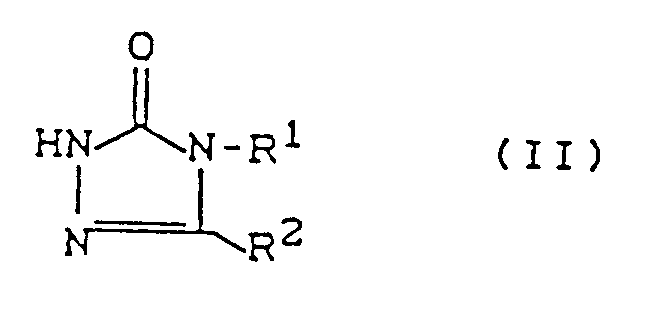 R¹ et R² ont les significations indiquées ci-dessus (dans la formule I),avec des sulfonylisocyanates répondant à la formule générale (III)
R³-SO₂-N=C=O (III)
dans laquelleR³ a la signification indiquée ci-dessus,éventuellement en présence d'un diluant, ou bien en ce qu'on fait réagirb) des dérivés de triazolinones, répondant à la formule générale (IV) R¹ et R² ont les significations indiquées ci-dessus, etZ représente un atome de chlore, un groupe alcoxy en C₁-C₄, un groupe benzyloxy ou un groupe phénoxy,avec des amides d'acides sulfoniques répondant à la formule générale (V)
R³-SO₂-NH₂ (V)
dans laquelleR³ a la signification indiquée ci-dessus,éventuellement en présence d'un agent neutralisateur d'acides et éventuellement en présence d'un diluant, ou bien en ce qu'on fait réagirc) des triazolinones répondant à la formule générale (II) R¹ et R² ont les significations indiquées ci-dessus,avec des dérivés d'amides d'acides sulfoniques répondant à la formule générale (VI)
R³-SO₂-NH-CO-Z (VI)
dans laquelleR³ a la signification indiquée ci-dessus, etZ représente un atome de chlore, un groupe alcoxy en C₁-C₄, un groupe benzyloxy ou un groupe phénoxy,éventuellement en présence d'un agent neutralisateur d'acides et éventuellement en présence d'un diluant, et, le cas échéant, on forme des sels à partir des composés de formule (I) préparés conformément aux procédés (a), (b) ou (c), conformément à des procédés habituels. - Agents herbicides caractérisés par une teneur en au moins une sulfonylaminocarbonyltriazolinone de formule (I) selon la revendication 1.
- Utilisation de sulfonylaminocarbonyltriazolinones répondant à la formule générale (I) selon la revendication 1, pour lutter contre la croissance non désirée de plantes.
- Procédé pour lutter contre les mauvaises herbes, caractérisé en ce qu'on laisse agir des sulfonylaminocarbonyltriazolinones répondant à la formule générale (I) selon la revendication 1, sur les mauvaises herbes ou sur leur biotope.
- Procédé pour la préparation d'agents herbicides, caractérisé en ce qu'on mélange des sulfonylaminocarbonyltriazolinones répondant à la formule générale (I) selon la revendication 1, avec des diluants et/ou des agents tensioactifs.
Priority Applications (2)
| Application Number | Priority Date | Filing Date | Title |
|---|---|---|---|
| DK95111736T DK0683157T3 (da) | 1989-10-12 | 1990-09-29 | Sulfonylaminocarbonyltriazolinoner som herbicider |
| EP95111736A EP0683157B1 (fr) | 1989-10-12 | 1990-09-29 | Sulfonylaminocarbonyltriazolinones comme herbicides |
Applications Claiming Priority (2)
| Application Number | Priority Date | Filing Date | Title |
|---|---|---|---|
| DE3934081 | 1989-10-12 | ||
| DE3934081A DE3934081A1 (de) | 1989-10-12 | 1989-10-12 | Sulfonylaminocarbonyltriazolinone |
Related Child Applications (2)
| Application Number | Title | Priority Date | Filing Date |
|---|---|---|---|
| EP95111736.5 Division-Into | 1990-09-29 | ||
| EP95111736A Division EP0683157B1 (fr) | 1989-10-12 | 1990-09-29 | Sulfonylaminocarbonyltriazolinones comme herbicides |
Publications (3)
| Publication Number | Publication Date |
|---|---|
| EP0422469A2 EP0422469A2 (fr) | 1991-04-17 |
| EP0422469A3 EP0422469A3 (en) | 1992-01-08 |
| EP0422469B1 true EP0422469B1 (fr) | 1996-05-08 |
Family
ID=6391328
Family Applications (2)
| Application Number | Title | Priority Date | Filing Date |
|---|---|---|---|
| EP90118750A Expired - Lifetime EP0422469B1 (fr) | 1989-10-12 | 1990-09-29 | Sulfonylaminocarbonyltriazolinones |
| EP95111736A Expired - Lifetime EP0683157B1 (fr) | 1989-10-12 | 1990-09-29 | Sulfonylaminocarbonyltriazolinones comme herbicides |
Family Applications After (1)
| Application Number | Title | Priority Date | Filing Date |
|---|---|---|---|
| EP95111736A Expired - Lifetime EP0683157B1 (fr) | 1989-10-12 | 1990-09-29 | Sulfonylaminocarbonyltriazolinones comme herbicides |
Country Status (13)
| Country | Link |
|---|---|
| EP (2) | EP0422469B1 (fr) |
| JP (1) | JPH03133966A (fr) |
| KR (1) | KR0171400B1 (fr) |
| AU (1) | AU627080B2 (fr) |
| BR (1) | BR9005095A (fr) |
| CA (4) | CA2189698C (fr) |
| CZ (1) | CZ281525B6 (fr) |
| DE (3) | DE3934081A1 (fr) |
| DK (2) | DK0683157T3 (fr) |
| ES (2) | ES2087107T3 (fr) |
| HU (1) | HU218976B (fr) |
| PL (1) | PL165494B1 (fr) |
| SK (1) | SK495090A3 (fr) |
Families Citing this family (32)
| Publication number | Priority date | Publication date | Assignee | Title |
|---|---|---|---|---|
| DE3936622A1 (de) * | 1989-11-03 | 1991-05-08 | Bayer Ag | Halogenierte sulfonylaminocarbonyltriazolinone |
| DE4030063A1 (de) * | 1990-09-22 | 1992-03-26 | Bayer Ag | Substituierte 5-alkoxy-1,2,4,-triazol-3-(thi)one |
| DE4131842A1 (de) * | 1991-09-25 | 1993-04-01 | Bayer Ag | Sulfonylaminocarbonyltriazolinone mit zwei ueber sauerstoff gebundenen substituenten |
| DE4110795A1 (de) * | 1991-04-04 | 1992-10-08 | Bayer Ag | Sulfonylaminocarbonyltriazolinone mit ueber sauerstoff gebundenen substituenten |
| DE4238125A1 (de) * | 1992-11-12 | 1994-05-19 | Bayer Ag | Substituierte Triazolinone |
| US6906006B1 (en) | 1988-11-23 | 2005-06-14 | Bayer Aktiengesellschaft | N-arly-substituted nitrogen-containing heterocycles, processes and novel intermediates for their preparation, and their use as herbicides and plant growth regulators |
| DE3928662A1 (de) * | 1989-08-30 | 1991-03-07 | Bayer Ag | Substituierte 4,5-diamino-1,2,4-triazol-3-(thi)one |
| US5534486A (en) * | 1991-04-04 | 1996-07-09 | Bayer Aktiengesellschaft | Herbicidal sulphonylaminocarbonyl triazolinones having substituents bonded via oxygen |
| DE4316430A1 (de) * | 1993-05-17 | 1994-11-24 | Bayer Ag | Substituierte Triazolinone |
| DE4343595A1 (de) * | 1993-12-21 | 1995-06-22 | Bayer Ag | Verfahren zur Herstellung von Sulfonylaminocarbonyltriazolinonen |
| DE4411913A1 (de) * | 1994-04-07 | 1995-10-12 | Bayer Ag | Substituierte Sulfonylaminocarbonyltriazolinone |
| DE4435547A1 (de) * | 1994-10-05 | 1996-04-11 | Bayer Ag | Sulfonylaminocarbonyltriazolinone mit über Sauerstoff und Schwefel gebundenen Substituenten |
| DE19502579A1 (de) * | 1995-01-27 | 1996-08-01 | Bayer Ag | Sulfonylamino(thio)carbonyl-triazolin(thi)one |
| DE19525974A1 (de) * | 1995-07-17 | 1997-01-23 | Bayer Ag | Substituierte Arylsulfonylamino(thio)carbonyltriazolin(thi)one |
| DE19530450A1 (de) * | 1995-08-18 | 1997-02-20 | Bayer Ag | Verfahren zur Herstellung von substituierten Aminotriazolinonen |
| ZA974703B (en) * | 1996-05-30 | 1997-12-30 | Bayer Ag | Substituted sulfonylamino(thio)carbonyl compounds. |
| DE19632945A1 (de) * | 1996-08-16 | 1998-02-19 | Bayer Ag | Substituierte Sulfonylamino(thio)carbonylverbindungen |
| DE19802697A1 (de) | 1998-01-24 | 1999-07-29 | Bayer Ag | Selektive Herbizide auf Basis von N-Aryl-triazolin(thi)onen und N-Arylsulfonylamino(thio)carbonyltriazolin(thi)onen |
| DE19823131A1 (de) * | 1998-05-23 | 1999-11-25 | Bayer Ag | Sulfonylamino(thio)carbonyltriazolin(thi)one mit Alkenyl-Substituenten |
| DE19843766A1 (de) | 1998-09-24 | 2000-03-30 | Bayer Ag | Substituierte Thiazol(in)ylidenaminosulfonylamino(thio)carbonyl-triazolinone |
| DE19845408A1 (de) * | 1998-10-02 | 2000-04-27 | Bayer Ag | Selektive Herbizide auf Basis eines substituierten Phenylsulfonylaminocarbonyl-triazolinons |
| DE19845407B4 (de) | 1998-10-02 | 2012-06-28 | Arysta LifeScience North America Corp.(n.d.Ges.d.Staates Californien) | Selektive Herbizide auf Basis eines substituierten Phenylsulfonylaminocarbonyl-triazolinons |
| US5912354A (en) * | 1998-12-11 | 1999-06-15 | Bayer Corporation | Process for preparing 4-amino-1,2,4-triazolin-5-ones |
| KR100704718B1 (ko) * | 1999-12-27 | 2007-04-09 | 바이엘 코포레이션 | 설포닐아미노카보닐 트리아졸리논 염의 제조방법 |
| KR100431154B1 (ko) * | 2002-04-12 | 2004-05-12 | (주)하나실업 | 데님제품의 무늬 성형방법 |
| EP1717228A1 (fr) | 2005-04-28 | 2006-11-02 | Bayer CropScience GmbH | Dérivés de sulfonylamino(thio)carbonyl comme herbicides et regulateurs de la croissance végétale |
| DE102008060967A1 (de) | 2008-12-06 | 2010-06-10 | Bayer Schering Pharma Aktiengesellschaft | Substituierte Phenylsulfonyltriazolone und ihre Verwendung |
| EP2822931B1 (fr) | 2012-03-09 | 2017-05-03 | Inception 2, Inc. | Composés de triazolone et leurs utilisations |
| ES2660249T3 (es) | 2012-12-20 | 2018-03-21 | Inception 2, Inc. | Compuestos de tipo triazolona y sus usos |
| BR112015031291A2 (pt) | 2013-06-20 | 2017-07-25 | Bayer Cropscience Ag | derivados de sulfureto de arila e derivados de arilalquil sulfóxido como acaricidas e inseticidas |
| JP2016529311A (ja) | 2013-09-06 | 2016-09-23 | インセプション 2、 インコーポレイテッド | トリアゾロン化合物類及びそれらの使用 |
| JOP20190094A1 (ar) | 2016-10-27 | 2019-04-25 | Broad Inst Inc | مركبات 1، 2، 4-تريازولون تحمل ثلاثة بدائل عند المواقع 2، 4، 5 مفيدة كمثبطات لديهيدروجيناز ثنائي هيدرو أوروتات (dhodh) |
Family Cites Families (7)
| Publication number | Priority date | Publication date | Assignee | Title |
|---|---|---|---|---|
| DE1126882B (de) * | 1960-05-03 | 1962-04-05 | Boehringer Sohn Ingelheim | Verfahren zur Herstellung von 1,2,4-Triazolonen-(5) |
| US4487773A (en) * | 1981-03-16 | 1984-12-11 | Mead Johnson & Company | 1,2,4-Triazol-3-one antidepressants |
| BE894856A (fr) * | 1982-10-28 | 1983-02-14 | Fahlberg List Veb | Compositions herbicides a base d'un derive de la 1,2,4-triazolinone-(5) |
| US4575555A (en) * | 1983-06-29 | 1986-03-11 | Mead Johnson & Company | 4-(3-Chlorophenyl)-1,2,3,6-tetrahydropyridine derivative |
| DE3709574A1 (de) * | 1987-03-24 | 1988-10-06 | Bayer Ag | Substituierte triazolinone |
| DE3815765A1 (de) * | 1988-05-09 | 1989-11-23 | Bayer Ag | 2-sulfonylaminocarbonyl-2,4-dihydro-3h-1,2,4- triazol-3-one einschliesslich 4,5-kondensierter, bicyclischer derivate, verfahren und neue zwischenprodukte zu ihrer herstellung und ihre verwendung als pflanzenbehandlungsmittel |
| KR960014792B1 (en) * | 1988-03-07 | 1996-10-19 | Chugai Pharm Kk | Novel triazole compounds, process for producing the same and herbicidal composition containing the same |
-
1989
- 1989-10-12 DE DE3934081A patent/DE3934081A1/de not_active Withdrawn
-
1990
- 1990-09-29 DK DK95111736T patent/DK0683157T3/da active
- 1990-09-29 ES ES90118750T patent/ES2087107T3/es not_active Expired - Lifetime
- 1990-09-29 DK DK90118750.0T patent/DK0422469T3/da active
- 1990-09-29 EP EP90118750A patent/EP0422469B1/fr not_active Expired - Lifetime
- 1990-09-29 DE DE59010314T patent/DE59010314D1/de not_active Expired - Lifetime
- 1990-09-29 DE DE59010938T patent/DE59010938D1/de not_active Expired - Lifetime
- 1990-09-29 ES ES95111736T patent/ES2222457T3/es not_active Expired - Lifetime
- 1990-09-29 EP EP95111736A patent/EP0683157B1/fr not_active Expired - Lifetime
- 1990-10-09 JP JP2269742A patent/JPH03133966A/ja active Pending
- 1990-10-10 CA CA002189698A patent/CA2189698C/fr not_active Expired - Lifetime
- 1990-10-10 CA CA002420329A patent/CA2420329C/fr not_active Expired - Lifetime
- 1990-10-10 PL PL90287259A patent/PL165494B1/pl unknown
- 1990-10-10 CA CA002027206A patent/CA2027206C/fr not_active Expired - Lifetime
- 1990-10-10 CA CA002302058A patent/CA2302058C/fr not_active Expired - Lifetime
- 1990-10-11 AU AU64591/90A patent/AU627080B2/en not_active Expired
- 1990-10-11 SK SK4950-90A patent/SK495090A3/sk not_active IP Right Cessation
- 1990-10-11 KR KR1019900016081A patent/KR0171400B1/ko not_active Expired - Lifetime
- 1990-10-11 HU HU419/90A patent/HU218976B/hu unknown
- 1990-10-11 CZ CS904950A patent/CZ281525B6/cs not_active IP Right Cessation
- 1990-10-11 BR BR909005095A patent/BR9005095A/pt not_active IP Right Cessation
Also Published As
| Publication number | Publication date |
|---|---|
| CA2420329A1 (fr) | 1991-04-13 |
| CA2189698C (fr) | 2003-05-06 |
| CA2027206C (fr) | 1997-12-23 |
| CZ495090A3 (en) | 1996-07-17 |
| EP0683157A1 (fr) | 1995-11-22 |
| CA2027206A1 (fr) | 1991-04-13 |
| HU906419D0 (en) | 1991-04-29 |
| DE59010938D1 (de) | 2004-07-01 |
| AU627080B2 (en) | 1992-08-13 |
| AU6459190A (en) | 1991-04-18 |
| EP0422469A2 (fr) | 1991-04-17 |
| KR910007893A (ko) | 1991-05-30 |
| SK280209B6 (sk) | 1999-09-10 |
| KR0171400B1 (ko) | 1999-02-01 |
| PL165494B1 (pl) | 1994-12-30 |
| EP0422469A3 (en) | 1992-01-08 |
| CA2302058A1 (fr) | 1991-04-13 |
| DE59010314D1 (de) | 1996-06-13 |
| DK0683157T3 (da) | 2004-09-27 |
| SK495090A3 (en) | 1999-09-10 |
| DK0422469T3 (da) | 1996-08-26 |
| ES2222457T3 (es) | 2005-02-01 |
| HUT55369A (en) | 1991-05-28 |
| CA2420329C (fr) | 2005-11-29 |
| PL287259A1 (en) | 1992-01-27 |
| CZ281525B6 (cs) | 1996-10-16 |
| CA2302058C (fr) | 2004-05-25 |
| BR9005095A (pt) | 1991-09-17 |
| JPH03133966A (ja) | 1991-06-07 |
| DE3934081A1 (de) | 1991-04-18 |
| EP0683157B1 (fr) | 2004-05-26 |
| ES2087107T3 (es) | 1996-07-16 |
| HU218976B (hu) | 2001-01-29 |
| CA2189698A1 (fr) | 1991-04-13 |
Similar Documents
| Publication | Publication Date | Title |
|---|---|---|
| EP0683157B1 (fr) | Sulfonylaminocarbonyltriazolinones comme herbicides | |
| EP0425948B1 (fr) | Sulfonylaminocarbonyl-triazolinones halogénées | |
| EP0507171B1 (fr) | Sulfonylaminocarbonyltriazolinones avec des substituants liés par l'oxygène | |
| EP0341489B1 (fr) | Sulfonylaminocarbonyltriazolinones | |
| EP0305844B1 (fr) | Triazolinones substituées | |
| EP0431291B1 (fr) | Sulfonylaminocarbonyl-triazolinones comportant des substituants attachés par du soufre | |
| EP0412358A1 (fr) | Dérivés d'amino-3 aminocarbonil-5 triazole-1,2,4 | |
| DE4021439A1 (de) | 2-iminopyridin-derivate | |
| EP0332991B1 (fr) | Triazoles substitués | |
| EP0391187B1 (fr) | 4-Amino-5-alkylthio-1,2,4-triazol-3-ones substituées | |
| DE4131842A1 (de) | Sulfonylaminocarbonyltriazolinone mit zwei ueber sauerstoff gebundenen substituenten | |
| EP0298371B1 (fr) | Triazolinones substituées | |
| EP0484750A1 (fr) | Sulfonylaminotriazolylpyrimidines substituées | |
| EP0355385B1 (fr) | 4-Sulphonylamino-2-azinyl-1,2,4-triazol-3-ones substituées, procédé et intermédiaires pour leur préparation et leur utilisation comme herbicides | |
| EP0477646B1 (fr) | Alkoxy-5 triazole-1,2,4 (thi)ones-2 substituées | |
| EP0370293A2 (fr) | Triazolinones substituées | |
| EP0343462B1 (fr) | Aminoguanidinoazines | |
| EP0490220A1 (fr) | 2,2-Difluoro-1,3-benzodioxyl-4-cétones substituées | |
| EP0507172A1 (fr) | Sulfonylguanidinoazines | |
| EP0372326A2 (fr) | Sulfonylaminoazines, procédés pour leur préparation et leur utilisation comme herbicides | |
| EP0414067A2 (fr) | Arylsulfonyl-aminoguanidinoazine substitué | |
| DE4112329A1 (de) | Cyanothiazolderivate | |
| EP0457140A2 (fr) | Composés phénoxyphénylsulfoniques | |
| EP0332029A2 (fr) | 2-Sulfonamidetriazolopyrimidines | |
| EP0484776A1 (fr) | Heterocycles azotés substitués par un aryle et contenant un groupe alkylidène |
Legal Events
| Date | Code | Title | Description |
|---|---|---|---|
| PUAI | Public reference made under article 153(3) epc to a published international application that has entered the european phase |
Free format text: ORIGINAL CODE: 0009012 |
|
| 17P | Request for examination filed |
Effective date: 19900929 |
|
| AK | Designated contracting states |
Kind code of ref document: A2 Designated state(s): BE CH DE DK ES FR GB IT LI NL |
|
| PUAL | Search report despatched |
Free format text: ORIGINAL CODE: 0009013 |
|
| AK | Designated contracting states |
Kind code of ref document: A3 Designated state(s): BE CH DE DK ES FR GB IT LI NL |
|
| 17Q | First examination report despatched |
Effective date: 19930219 |
|
| GRAH | Despatch of communication of intention to grant a patent |
Free format text: ORIGINAL CODE: EPIDOS IGRA |
|
| GRAA | (expected) grant |
Free format text: ORIGINAL CODE: 0009210 |
|
| AK | Designated contracting states |
Kind code of ref document: B1 Designated state(s): BE CH DE DK ES FR GB IT LI NL |
|
| XX | Miscellaneous (additional remarks) |
Free format text: TEILANMELDUNG 95111736.5 EINGEREICHT AM 26/07/95. |
|
| REG | Reference to a national code |
Ref country code: CH Ref legal event code: NV Representative=s name: E. BLUM & CO. PATENTANWAELTE |
|
| REG | Reference to a national code |
Ref country code: ES Ref legal event code: BA2A Ref document number: 2087107 Country of ref document: ES Kind code of ref document: T3 |
|
| REF | Corresponds to: |
Ref document number: 59010314 Country of ref document: DE Date of ref document: 19960613 |
|
| ITF | It: translation for a ep patent filed | ||
| GBT | Gb: translation of ep patent filed (gb section 77(6)(a)/1977) |
Effective date: 19960611 |
|
| ET | Fr: translation filed | ||
| REG | Reference to a national code |
Ref country code: ES Ref legal event code: FG2A Ref document number: 2087107 Country of ref document: ES Kind code of ref document: T3 |
|
| REG | Reference to a national code |
Ref country code: DK Ref legal event code: T3 |
|
| PLBE | No opposition filed within time limit |
Free format text: ORIGINAL CODE: 0009261 |
|
| STAA | Information on the status of an ep patent application or granted ep patent |
Free format text: STATUS: NO OPPOSITION FILED WITHIN TIME LIMIT |
|
| 26N | No opposition filed | ||
| REG | Reference to a national code |
Ref country code: GB Ref legal event code: IF02 |
|
| REG | Reference to a national code |
Ref country code: CH Ref legal event code: PFA Owner name: BAYER AG Free format text: BAYER AG# #D-51368 LEVERKUSEN (DE) -TRANSFER TO- BAYER AG# #D-51368 LEVERKUSEN (DE) |
|
| PGFP | Annual fee paid to national office [announced via postgrant information from national office to epo] |
Ref country code: DK Payment date: 20090914 Year of fee payment: 20 |
|
| PGFP | Annual fee paid to national office [announced via postgrant information from national office to epo] |
Ref country code: NL Payment date: 20090903 Year of fee payment: 20 Ref country code: GB Payment date: 20090923 Year of fee payment: 20 |
|
| PGFP | Annual fee paid to national office [announced via postgrant information from national office to epo] |
Ref country code: ES Payment date: 20091006 Year of fee payment: 20 Ref country code: CH Payment date: 20091006 Year of fee payment: 20 Ref country code: DE Payment date: 20090820 Year of fee payment: 20 |
|
| PGFP | Annual fee paid to national office [announced via postgrant information from national office to epo] |
Ref country code: BE Payment date: 20090917 Year of fee payment: 20 |
|
| PGFP | Annual fee paid to national office [announced via postgrant information from national office to epo] |
Ref country code: IT Payment date: 20090917 Year of fee payment: 20 Ref country code: FR Payment date: 20091012 Year of fee payment: 20 |
|
| BE20 | Be: patent expired |
Owner name: *BAYER A.G. Effective date: 20100929 |
|
| REG | Reference to a national code |
Ref country code: NL Ref legal event code: V4 Effective date: 20100929 |
|
| REG | Reference to a national code |
Ref country code: CH Ref legal event code: PL |
|
| REG | Reference to a national code |
Ref country code: DK Ref legal event code: EUP |
|
| REG | Reference to a national code |
Ref country code: GB Ref legal event code: PE20 Expiry date: 20100928 |
|
| PG25 | Lapsed in a contracting state [announced via postgrant information from national office to epo] |
Ref country code: GB Free format text: LAPSE BECAUSE OF EXPIRATION OF PROTECTION Effective date: 20100928 |
|
| PG25 | Lapsed in a contracting state [announced via postgrant information from national office to epo] |
Ref country code: NL Free format text: LAPSE BECAUSE OF EXPIRATION OF PROTECTION Effective date: 20100929 |
|
| PG25 | Lapsed in a contracting state [announced via postgrant information from national office to epo] |
Ref country code: DE Free format text: LAPSE BECAUSE OF EXPIRATION OF PROTECTION Effective date: 20100929 |
|
| REG | Reference to a national code |
Ref country code: ES Ref legal event code: FD2A Effective date: 20130801 |
|
| PG25 | Lapsed in a contracting state [announced via postgrant information from national office to epo] |
Ref country code: ES Free format text: LAPSE BECAUSE OF EXPIRATION OF PROTECTION Effective date: 20100930 |