EP0422474A2 - Fluoreszenzpigmente - Google Patents
Fluoreszenzpigmente Download PDFInfo
- Publication number
- EP0422474A2 EP0422474A2 EP90118762A EP90118762A EP0422474A2 EP 0422474 A2 EP0422474 A2 EP 0422474A2 EP 90118762 A EP90118762 A EP 90118762A EP 90118762 A EP90118762 A EP 90118762A EP 0422474 A2 EP0422474 A2 EP 0422474A2
- Authority
- EP
- European Patent Office
- Prior art keywords
- fluorescent pigments
- alkyl
- contain
- fluorescent
- dye
- Prior art date
- Legal status (The legal status is an assumption and is not a legal conclusion. Google has not performed a legal analysis and makes no representation as to the accuracy of the status listed.)
- Granted
Links
Classifications
-
- C—CHEMISTRY; METALLURGY
- C08—ORGANIC MACROMOLECULAR COMPOUNDS; THEIR PREPARATION OR CHEMICAL WORKING-UP; COMPOSITIONS BASED THEREON
- C08J—WORKING-UP; GENERAL PROCESSES OF COMPOUNDING; AFTER-TREATMENT NOT COVERED BY SUBCLASSES C08B, C08C, C08F, C08G or C08H
- C08J3/00—Processes of treating or compounding macromolecular substances
- C08J3/20—Compounding polymers with additives, e.g. colouring
- C08J3/22—Compounding polymers with additives, e.g. colouring using masterbatch techniques
- C08J3/226—Compounding polymers with additives, e.g. colouring using masterbatch techniques using a polymer as a carrier
-
- C—CHEMISTRY; METALLURGY
- C08—ORGANIC MACROMOLECULAR COMPOUNDS; THEIR PREPARATION OR CHEMICAL WORKING-UP; COMPOSITIONS BASED THEREON
- C08K—Use of inorganic or non-macromolecular organic substances as compounding ingredients
- C08K5/00—Use of organic ingredients
- C08K5/0008—Organic ingredients according to more than one of the "one dot" groups of C08K5/01 - C08K5/59
- C08K5/0041—Optical brightening agents, organic pigments
-
- C—CHEMISTRY; METALLURGY
- C09—DYES; PAINTS; POLISHES; NATURAL RESINS; ADHESIVES; COMPOSITIONS NOT OTHERWISE PROVIDED FOR; APPLICATIONS OF MATERIALS NOT OTHERWISE PROVIDED FOR
- C09B—ORGANIC DYES OR CLOSELY-RELATED COMPOUNDS FOR PRODUCING DYES, e.g. PIGMENTS; MORDANTS; LAKES
- C09B5/00—Dyes with an anthracene nucleus condensed with one or more heterocyclic rings with or without carbocyclic rings
- C09B5/62—Cyclic imides or amidines of peri-dicarboxylic acids of the anthracene, benzanthrene, or perylene series
-
- C—CHEMISTRY; METALLURGY
- C09—DYES; PAINTS; POLISHES; NATURAL RESINS; ADHESIVES; COMPOSITIONS NOT OTHERWISE PROVIDED FOR; APPLICATIONS OF MATERIALS NOT OTHERWISE PROVIDED FOR
- C09B—ORGANIC DYES OR CLOSELY-RELATED COMPOUNDS FOR PRODUCING DYES, e.g. PIGMENTS; MORDANTS; LAKES
- C09B67/00—Influencing the physical, e.g. the dyeing or printing properties of dyestuffs without chemical reactions, e.g. by treating with solvents grinding or grinding assistants, coating of pigments or dyes; Process features in the making of dyestuff preparations; Dyestuff preparations of a special physical nature, e.g. tablets, films
- C09B67/006—Preparation of organic pigments
- C09B67/0061—Preparation of organic pigments by grinding a dyed resin
Definitions
- the present invention relates to new fluorescent pigments whose average particle size is 8 to 16 ⁇ m and which comprise nonpolar polymer matrices selected from the group consisting of polymethyl methacrylate, polystyrene, polystyrene modified with polybutadiene, polycarbonate, polyvinyl chloride and polyamide and one or more nonpolar fluorescent dyes contain the coumarin or perylene series.
- fluorescent pigments which have dyes from the naphthalimide series and whose polymer matrices are polycondensates based on urea and formaldehyde or on polyamide.
- US Pat. No. 2,938,873 describes fluorescent pigments whose dyes come from the naphthalimide or coumarin series and which contain resins based on p-toluenesulfonamide and formaldehyde as the polymer matrix.
- the object of the present invention was therefore to provide new fluorescent pigments which no longer have the disadvantages mentioned.
- the new fluorescent pigments contain one or more non-polar fluorescent dyes from the coumarin or perylene series.
- Suitable non-polar coumarin dyes are, for example, those as described in US Pat. No. 3,880,869.
- coumarin dyes of formula III in which R5 and R6 are the same or different and each independently represent C1-C4-alkyl, especially ethyl.
- the coumarin dyes of the formula IV included in what R5 and R6 are the same or different and are each independently C1-C4-alkyl, especially ethyl, and R7 is C1-C11 alkyl.
- Suitable non-polar perylene dyes are, for example, those as described in US Pat. No. 4,618,694, DE-A-2,451,782, US-A-4,379,934, US-A-4,446,324 or EP-A-227,980 are.
- nonpolar perylene dyes are, for example, those as described in EP-A-73 007.
- Fluorescent pigments containing perylene series dyes are preferred.
- the perylene dyes of the formula V contain, wherein R8 is C1-C13-alkyl.
- Fluorescent pigments, the perylene dyes of the formula I, are particularly preferred included in what R1 is hydrogen or cyano and R2 is C1-C11 alkyl.
- fluorescent pigments the perylene dyes of the formula II included in what R3 C5-C20-alkyl, which is optionally interrupted by an oxygen atom, or phenyl, which is mono- or polysubstituted by C1-C13-alkyl or C1-C13-alkoxy, and R4 is hydrogen, chlorine, phenoxy or phenoxy substituted by halogen, C1-C4-alkyl or C1-C4-alkoxy.
- fluorescent pigments which contain dyes of the formula II in which R3 is phenyl which is mono- or polysubstituted by C1-C4-alkyl or C1-C4-alkoxy and R4 is hydrogen, phenoxy or chlorine.
- fluorescent pigments which contain a dye of the formula I in which R1 is cyano and R2 is butyl.
- fluorescent pigments which contain a dye of the formula II in which R3 is 2,6-diisopropylphenyl and R4 is phenoxy.
- Suitable radicals R2, R5, R6, R7 and R8 are e.g. Methyl, ethyl, propyl, isopropyl, butyl, isobutyl or sec-butyl.
- Residues R2, R7 and R8 are also, like residues R3, e.g. Pentyl, isopentyl, neopentyl, tert-pentyl, hexyl, 2-methylpentyl, heptyl, 1-ethylpentyl, octyl, 2-ethylhexyl, isooctyl, nonyl, isononyl, decyl, isodecyl or undecyl.
- R3 and R8 are still e.g. e.g. Dodecyl, tridecyl or isotridecyl.
- R3 radicals are furthermore, for example, tetradecyl, pentadecyl, hexadecyl, heptadecyl, octadecyl, nonadecyl, eicosyl (the above designations isooctyl, isononyl, isodecyl and isotridecyl are trivial designations and come from the alcohols obtained after oxosynthesis - see also Ullmanns Chemie der Encyklie der Chemie Ency 4th edition, volume 7, pages 215 to 217, and volume 11, pages 435 and 436.), 2-propoxyethyl, 2-isopropoxyethyl, 2-butoxyethyl, 2- or 3-methoxypropyl, 2- or 3-ethoxypropyl, 2 - or 3-propoxypropyl, 2- or 3-isopropoxypropyl, 2- or 3-butoxypropyl, 2- or 3- (2-ethylhexyloxy)
- R4 are e.g. 2-, 3- or 4-fluorophenoxy, 2-, 3- or 4-chlorophenoxy, 2-, 3- or 4-bromophenoxy, 2-, 3- or 4-tert-butylphenoxy, 2-isopropyl-4-methylphenoxy, 2,3-, 2,4-, 2,5- or 2,6-dichlorophenoxy, 2,4,5- or 2,4,6-trichlorophenoxy, 2-, 3- or 4-methylphenoxy, 2,3- , 2,4-, 2,5-, 2,6- or 3,5-dimethylphenoxy, 2,5,6-trimethylphenoxy, 2-methyl-4-chlorophenoxy, 2-methyl-5-chlorophenoxy, 2-methyl- 6-chlorophenoxy, 2-ethylphenoxy, 2,6-diethylphenoxy, 2,6-diethyl-4-methylphenoxy, 2-isopropylphenoxy, 3-methyl-4-chlorophenyl, 4-propylphenoxy, 4-butylphenoxy, 2-, 3- or 4-methoxyphenoxy, 2-
- the fluorescent pigments according to the invention have non-polar polymer matrices selected from the group consisting of polymethyl methacrylate, polystyrene, polystyrene modified with polybutadiene, polycarbonate, polyvinyl chloride and polyamide.
- Preferred fluorescent pigments are those which have polymer matrices made of polymethyl methacrylate or polystyrene.
- polystyrene resin polystyrene resin
- the content of fluorescent dye in the fluorescent pigments according to the invention is generally 1 to 3% by weight, based on the polymer matrix.
- the fluorescent dyes mentioned can be contained in the new fluorescent pigments either individually or as mixtures with one another.
- the fluorescent pigments according to the invention can have only one of the polymer matrices mentioned or else mixtures thereof.
- the new fluorescent pigments are expediently prepared by first incorporating the fluorescent dye into the polymer matrix, which is usually in the form of granules, in a manner known per se, for example by extrusion or injection molding.
- the use of a twin-screw extruder has proven particularly favorable for extrusion.
- the incorporation generally takes place at a temperature of 150 to 250 ° C., when polymethyl methacrylate is used as the polymer matrix, preferably at 200 to 240 ° C.
- the colored plastic material formed during incorporation is then strand-granulated, producing particles whose size is usually 2 to 6 mm.
- This granulate is then further comminuted, this step advantageously being carried out in a pin mill known per se. After this pre-comminution, the granules have a particle size which is usually 0.8 to 1.2 mm.
- the fluorescent pigments according to the invention should have an average particle size which is 8 to 16 ⁇ m, preferably 10 to 12 ⁇ m, a further comminution step is necessary, which is advantageously carried out in a jet mill.
- a fluidized bed counter jet mill for example a counter jet mill of the GK-W 481 type from Alpine, has proven to be particularly advantageous here.
- the new fluorescent pigments are advantageously suitable for pigmenting water-based paints, for pigmenting films and objects made of polyolefins, e.g. Polyethylene or polypropylene, or for printing fiber materials, e.g. of fabrics made of polyester, cotton or polyester-cotton blend.
- polyolefins e.g. Polyethylene or polypropylene
- printing fiber materials e.g. of fabrics made of polyester, cotton or polyester-cotton blend.
- the new fluorescent pigments have a high luminosity and show advantageous application properties, e.g. high lightfastness and low migration tendency.
- PMMA polymethyl methacrylate
- the granules had an average particle size of 1 mm after the preliminary comminution.
- the pre-comminuted granulate was placed in a fluidized bed counter jet mill (counter jet mill of the type GK-W 481 from Alpine) with a horizontally arranged classifier wheel.
- the operating conditions of the gaseous nitrogen plant were: Classifier wheel: 6700 rpm Gas pressure at the nozzles: 4 bar Purge air shaft: 0.45 bar Purge air motor: 0.5 bar
- Cila's granulometric particle size determination gave an average particle size of 11.7 ⁇ m (volume distribution).
- the fluorescent dyes listed in the following table are processed analogously to Example 1 to fluorescent pigments.
- the film is suitable for promoting the growth of green plants. It is characterized by good lightfastness and low dye migration.
Landscapes
- Chemical & Material Sciences (AREA)
- Organic Chemistry (AREA)
- Chemical Kinetics & Catalysis (AREA)
- Health & Medical Sciences (AREA)
- Medicinal Chemistry (AREA)
- Polymers & Plastics (AREA)
- Compositions Of Macromolecular Compounds (AREA)
- Processes Of Treating Macromolecular Substances (AREA)
- Developing Agents For Electrophotography (AREA)
Abstract
Description
- Die vorliegende Erfindung betrifft neue Fluoreszenzpigmente, deren mittlere Teilchengröße 8 bis 16 µm beträgt und die unpolare Polymermatrices, ausgewählt aus der Gruppe, bestehend aus Polymethylmethacrylat, Polystyrol, mit Polybutadien modifiziertem Polystyrol, Polycarbonat, Polyvinylchlorid und Polyamid, aufweisen und einen oder mehrere unpolare Fluoreszenzfarbstoffe aus der Cumarin- oder Perylenreihe enthalten.
- Aus der US-A-2 498 592 sowie der US-A-3 915 884 sind Fluoreszenzpigmente bekannt, die Farbstoffe aus der Naphthalimidreihe aufweisen und deren Polymermatrices Polykondensate auf Basis von Harnstoff und Formaldehyd oder von Polyamid darstellen.
- Weiterhin beschreibt die US-A-2 938 873 Fluoreszenzpigmente, deren Farbstoffe aus der Naphthalimid- oder Cumarinreihe stammen und die als Polymermatrix Harze auf Basis von p-Toluolsulfonamid und Formaldehyd enthalten.
- Es hat sich jedoch gezeigt, daß solche Fluoreszenzpigmente über ungenügende anwendungstechnische Eigenschaften, insbesondere über eine nicht ausreichende Lichtechtheit verfügen.
- Aufgabe der vorliegenden Erfindung war es deshalb, neue Fluoreszenzpigmente bereitzustellen, die die genannten Nachteile nicht mehr aufweisen.
- Demgemäß wurden die eingangs näher bezeichneten Fluoreszenzpigmente gefunden.
- Die neuen Fluoreszenzpigmente enthalten einen oder mehrere unpolare Fluoreszenzfarbstoffe aus der Cumarin- oder Perylenreihe.
- Geeignete unpolare Cumarinfarbstoffe sind beispielsweise solche, wie sie in der US-A-3 880 869 beschrieben sind. Hervorzuheben sind dabei Cumarinfarbstoffe der Formel III

- Weiterhin hervorzuheben sind Fluoreszenzpigmente, die Cumarinfarbstoffe der Formel IV

R⁵ und R⁶ gleich oder verschieden sind und unabhängig voneinander jeweils C₁-C₄-Alkyl, insbesondere Ethyl, und
R⁷ C₁-C₁₁-Alkyl bedeuten. - Geeignete unpolare Perylenfarbstoffe sind beispielsweise solche, wie sie in der US-A-4 618 694, DE-A-2 451 782, US-A-4 379 934, US-A-4 446 324 oder EP-A-227 980 beschrieben sind.
- Weiterhin geeignete unpolare Perylenfarbstoffe sind beispielsweise solche, wie sie in der EP-A-73 007 beschrieben sind.
- Bevorzugt sind Fluoreszenzpigmente, die Farbstoffe der Perylenreihe enthalten.
- Hervorzuheben sind Fluoreszenzpigmente, die Perylenfarbstoffe der Formel V

- Besonders bevorzugt sind Fluoreszenzpigmente, die Perylenfarbstoffe der Formel I

R¹ Wasserstoff oder Cyano und
R² C₁-C₁₁-Alkyl bedeuten. - Weiterhin besonders bevorzugt sind Fluoreszenzpigmente, die Perylenfarbstoffe der Formel II

R³ C₅-C₂₀-Alkyl, das gegebenenfalls durch ein Sauerstoffatom unterbrochen ist, oder Phenyl, das durch C₁-C₁₃-Alkyl oder C₁-C₁₃-Alkoxy ein- oder mehrfach substituiert ist, und
R⁴ Wasserstoff, Chlor, Phenoxy oder durch Halogen, C₁-C₄-Alkyl oder C₁-C₄-Alkoxy substituiertes Phenoxy bedeuten. - Insbesondere bevorzugt sind Fluoreszenzpigmente, die Farbstoffe der Formel II enthalten, worin R³ durch C₁-C₄-Alkyl oder C₁-C₄-Alkoxy ein- oder mehrfach substituiertes Phenyl und R⁴ Wasserstoff, Phenoxy oder Chlor bedeuten.
- Ganz besonders hervorzuheben sind Fluoreszenzpigmente, die einen Farbstoff der Formel I enthalten, worin R¹ jeweils Cyano und R² jeweils Butyl bedeuten.
- Weiterhin ganz besonders hervorzuheben sind Fluoreszenzpigmente, die einen Farbstoff der Formel II enthalten, worin R³ 2,6-Diisopropylphenyl und R⁴ Phenoxy bedeuten.
- Geeignete Reste R², R⁵, R⁶, R⁷ und R⁸ sind z.B. Methyl, Ethyl, Propyl, Isopropyl, Butyl, Isobutyl oder sec-Butyl.
- Reste R², R⁷ und R⁸ sind weiterhin, wie auch Reste R³, z.B. Pentyl, Isopentyl, Neopentyl, tert-Pentyl, Hexyl, 2-Methylpentyl, Heptyl, 1-Ethylpentyl, Octyl, 2-Ethylhexyl, Isooctyl, Nonyl, Isononyl, Decyl, Isodecyl oder Undecyl.
- Reste R³ und R⁸ sind weiterhin z.B. z.B. Dodecyl, Tridecyl oder Isotridecyl.
- Reste R³ sind weiterhin z.B. Tetradecyl, Pentadecyl, Hexadecyl, Heptadecyl, Octadecyl, Nonadecyl, Eicosyl (Die obigen Bezeichnungen Isooctyl, Isononyl, Isodecyl und Isotridecyl sind Trivialbezeichnungen und stammen von den nach der Oxosynthese erhaltenen Alkoholen - vgl. dazu Ullmanns Encyklopädie der technischen Chemie, 4. Auflage, Band 7, Seiten 215 bis 217, sowie Band 11, Seiten 435 und 436.), 2-Propoxyethyl, 2-Isopropoxyethyl, 2-Butoxyethyl, 2- oder 3-Methoxypropyl, 2- oder 3-Ethoxypropyl, 2- oder 3-Propoxypropyl, 2- oder 3-Isopropoxypropyl, 2- oder 3-Butoxypropyl, 2- oder 3-(2-Ethylhexyloxy)propyl, 2- oder 4-Methoxybutyl, 2- oder 4-Ethoxybutyl, 2- oder 4-Propoxybutyl, 2- oder 4-Isopropoxybutyl, 2- oder 4-Butoxybutyl, 2- oder 4-(2-Ethylhexyloxy)butyl, 2-Methyl-6-isopropyl phenyl, 2-Methyl-6-sec-butylphenyl, 2-Methyl-6-tert-butylphenyl, 2-Ethyl-6-isopropylphenyl, 2-Ethyl-6-sec-butylphenyl, 2-Ethyl-6-tert-butylphenyl, 2-Methylphenyl, 2,3-, 2,4-, 2,5- oder 2,6-Dimethylphenyl, 2,4,6-Trimethylphenyl, 2-Methyl-4-methoxyphenyl, 2,5-Dimethyl-4-methoxyphenyl, 2-Ethylphenyl, 2,6-Diethylphenyl, 2,6-Diethyl-4-methylphenyl, 2-Isopropylphenyl, 2,4-, 2,5- oder 2,6-Diisopropylphenyl, 2-n-Butylphenyl, 2-sec-Butylphenyl, 2-n-Pentylphenyl, 2-n-Hexylphenyl, 2-(2-Methylpentyl)phenyl, 2-n-Octylphenyl, 2-Methoxyphenyl, 2-Ethoxyphenyl, 2,5-Dimethoxyphenyl, 2,5-Diethoxyphenyl, 2,4-Dimethoxyphenyl, 2,4-Diethoxyphenyl, 2,3-Dimethoxyphenyl oder 2,3-Diethoxyphenyl.
- Reste R⁴ sind z.B. 2-, 3- oder 4-Fluorphenoxy, 2-, 3- oder 4-Chlorphenoxy, 2-, 3- oder 4-Bromphenoxy, 2-, 3- oder 4-tert-Butylphenoxy, 2-Isopropyl-4-methylphenoxy, 2,3-, 2,4-, 2,5- oder 2,6-Dichlorphenoxy, 2,4,5- oder 2,4,6-Trichlorphenoxy, 2-, 3- oder 4-Methylphenoxy, 2,3-, 2,4-, 2,5-, 2,6- oder 3,5-Dimethylphenoxy, 2,5,6-Trimethylphenoxy, 2-Methyl-4-chlorphenoxy, 2-Methyl-5-chlorphenoxy, 2-Methyl-6-chlorphenoxy, 2-Ethylphenoxy, 2,6-Diethylphenoxy, 2,6-Diethyl-4-methylphenoxy, 2-Isopropylphenoxy, 3-Methyl-4-chlorphenyl, 4-Propylphenoxy, 4-Butylphenoxy, 2-, 3- oder 4-Methoxyphenoxy, 2-, 3- oder 4-Ethoxyphenoxy, 2-, 3- oder 4-Propoxyphenoxy, 2-, 3- oder 4-Isopropoxyphenoxy, 2-, 3- oder 4-Butoxyphenoxy oder 2,4-Dimethoxyphenoxy.
- Die erfindungsgemäßen Fluoreszenzpigmente weisen unpolare Polymermatrices, ausgewählt aus der Gruppe, bestehend aus Polymethylmethacrylat, Polystyrol, mit Polybutadien modifiziertem Polystyrol, Polycarbonat, Polyvinylchlorid und Polyamid, auf.
- Bevorzugt sind dabei solche Fluoreszenzpigmente, die Polymermatrices aus Polymethylmethacrylat oder Polystyrol aufweisen.
- Die genannten Polymermatrices sind an sich bekannt und handelsüblich.
- Der Gehalt an Fluoreszenzfarbstoff in den erfindungsgemäßen Fluoreszenzpigmenten liegt im allgemeinen bei 1 bis 3 Gew.%, bezogen auf die Polymermatrix.
- Die genannten Fluoreszenzfarbstoffe können dabei jeweils für sich oder auch als Mischungen untereinander in den neuen Fluoreszenzpigmenten enthalten sein. Ebenso können die erfindungsgemäßen Fluoreszenzpigmente nur eine der genannten Polymermatrices oder auch deren Mischungen untereinander aufweisen.
- Die neuen Fluoreszenzpigmente werden zweckmäßig so hergestellt, daß man zunächst den Fluoreszenzfarbstoff in die Polymermatrix, die üblicherweise als Granulat vorliegt, auf an sich bekanntem Weg, beispielsweise durch Extrusion oder Spritzgießen, einarbeitet. Bei der Extrusion hat sich die Verwendung eines Doppelschneckenextruders als besonders günstig erwiesen. Die Einarbeitung findet im allgemeinen bei einer Temperatur von 150 bis 250°C, bei Verwendung von Polymethylmethacrylat als Polymermatrix, vorzugsweise bei 200 bis 240°C statt.
- Das bei der Einarbeitung entstehende gefärbte Kunststoffmaterial wird anschließend stranggranuliert, wobei Partikel entstehen, deren Größe in der Regel 2 bis 6 mm beträgt. Dieses Granulat wird dann weiter zerkleinert, wobei dieser Schritt vorteilhaft in einer an sich bekannten Stiftmühle durchgeführt wird. Das Granulat weist nach dieser Vorzerkleinerung eine Partikelgröße auf, die üblicherweise 0,8 bis 1,2 mm beträgt.
- Da die erfindungsgemäßen Fluoreszenzpigmente eine mittlere Teilchengröße aufweisen sollen, die 8 bis 16 µm, vorzugsweise 10 bis 12 µm beträgt, ist ein weiterer Zerkleinerungsschritt notwendig, der vorteilhaft in einer Strahlmühle vorgenommen wird. Als besonders vorteilhaft hierbei erweist sich die Verwendung einer Fließbettgegenstrahlmühle, beispielsweise eine Gegenstrahlmühle vom Typ GK-W 481 der Firma Alpine.
- Die neuen Fluoreszenzpigmente eignen sich in vorteilhafter Weise zum Pigmentieren von Anstrichmitteln auf wäßriger Basis, zum Pigmentieren von Folien und Gegenständen aus Polyolefinen, z.B. Polyethylen oder Polypropylen, oder zum Bedrucken von Fasermaterialien, z.B. von Geweben aus Polyester, Baumwolle oder Polyester-Baumwolle-Mischgewebe.
- Die neuen Fluoreszenzpigmente weisen eine hohe Leuchtstärke auf und zeigen vorteilhafte anwendungstechnische Eigenschaften, z.B. eine hohe Lichtechtheit und geringe Migrationstendenz.
- Die folgenden Beispiele sollen die Erfindung näher erläutern. Dabei steht die Abkürzung PMMA für Polymethylmethacrylat.
- 10 g 3,9-Bis(isobutoxycarbonyl)-4,10-dicyanoperylen wurden in 1 kg PMMA-Granulat nach bekannter Technologie durch Extrusion in einem Doppelschneckenextruder bei 210°C eingearbeitet und das entstehende Material stranggranuliert. Dieses Produkt, das eine Partikelgröße von 4 mm in der längsten Dimension aufweist, wurde in einer Stiftmühle vorzerkleinert.
- Das Granulat wies nach der Vorzerkleinerung eine mittlere Partikelgröße von 1 mm auf.
- Das vorzerkleinerte Granulat wurde in eine Fließbettgegenstrahlmühle (Gegenstrahlmühle vom Typ GK-W 481 der Firma Alpine) mit horizontal angeordnetem Sichterrad gegeben. Die Betriebsbedingungen der mit gasförmigem Stickstoff betriebenen Anlage waren:
Sichterrad: 6700 U/min
Gasdruck an den Düsen: 4 bar
Spülluft Welle: 0,45 bar
Spülluft Motor: 0,5 bar - Das erhaltene Produkt zeigte einen leuchtend hellgelben Farbton. Cilas granulometrische Partikelgrößenbestimmung ergab eine mittlere Partikelgröße von 11,7 µm (Volumenverteilung).
- 20 g des Fluoreszenzfarbstoffs der Formel

- Die in der folgenden Tabelle aufgeführten Fluoreszenzfarbstoffe werden analog Beispiel 1 zu Fluoreszenzpigmenten verarbeitet.


- 40 g des nach Beispiel 2 hergestellten Fluoreszenzpigmentes wurden in eine Dispersion, die 760 ml Wasser, 30 g Polyacrylsäure, 30 g eines Emulgators auf Basis eines Formaldehydkondensationsproduktes und 180 g eines Bindemittels auf Basis von Polybutadien enthielt, durch intensives Rühren eingearbeitet. Die entstehende homogene Suspension wurde auf Polyester-Baumwolle-Mischgewebe aufgedruckt und 4 Minuten bei 115°C fixiert. Man erhielt auf diese Weise einen leuchtend roten Druck, der sich durch besonders gute Waschechtheiten und hervorragende Lichtechtheit (4-5 nach der Blauskala) auszeichnet.
- 5 g Fluoreszenzpigment, hergestellt nach Beispiel 2, wurden zusammen mit 95 g Polyethylengranulat intensiv gemischt, extrudiert und stranggranuliert.
- Mit diesem Stranggranulat wurde auf einer Folienblasmaschine eine 50 µm dicke Polyethylenfolie hergestellt, die eine Fluoreszenz bei 613 nm aufweist.
- Die Folie ist geeignet zur Wachstumsförderung grüner Pflanzen. Sie zeichnet sich durch gute Lichtbeständigkeit und niedrige Farbstoffmigration aus.
Claims (4)

R¹ Wasserstoff oder Cyano und
R² C₁-C₁₁-Alkyl bedeuten.
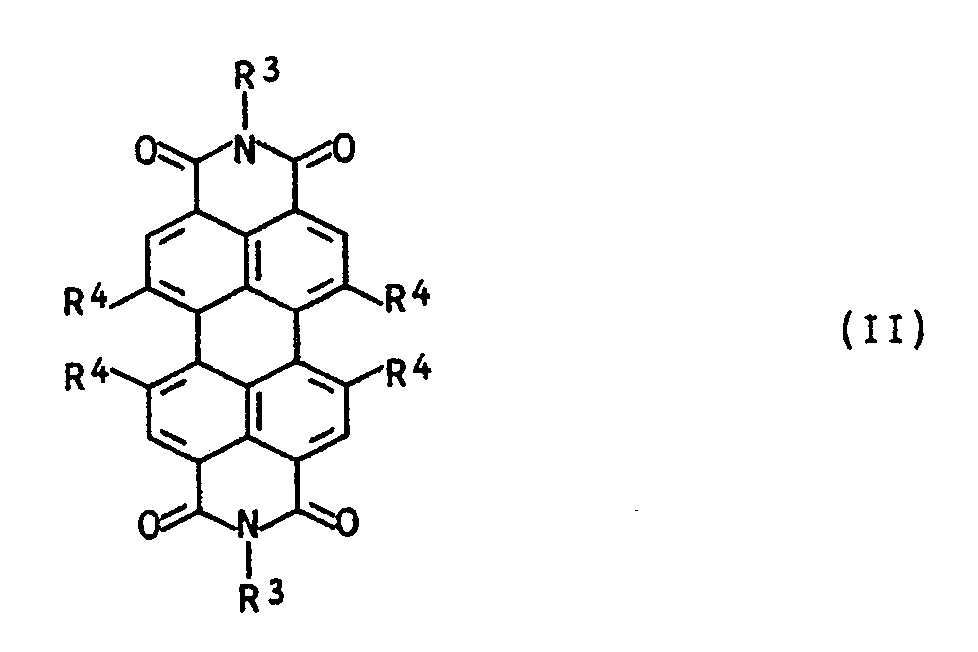
R³ C₅-C₂₀-Alkyl, das gegebenenfalls durch ein Sauerstoffatom unterbrochen ist, oder Phenyl, das durch C₁-C₁₃-Alkyl oder C₁-C₁₃-Alkoxy ein- oder mehrfach substituiert ist, und
R⁴ Wasserstoff, Chlor, Phenoxy oder durch Halogen, C₁-C₄-Alkyl oder C₁-C₄-Alkoxy substituiertes Phenoxy bedeuten.
Applications Claiming Priority (2)
| Application Number | Priority Date | Filing Date | Title |
|---|---|---|---|
| DE3933903 | 1989-10-11 | ||
| DE3933903A DE3933903A1 (de) | 1989-10-11 | 1989-10-11 | Fluoreszenzpigmente |
Publications (3)
| Publication Number | Publication Date |
|---|---|
| EP0422474A2 true EP0422474A2 (de) | 1991-04-17 |
| EP0422474A3 EP0422474A3 (en) | 1991-11-13 |
| EP0422474B1 EP0422474B1 (de) | 1995-11-29 |
Family
ID=6391246
Family Applications (1)
| Application Number | Title | Priority Date | Filing Date |
|---|---|---|---|
| EP90118762A Expired - Lifetime EP0422474B1 (de) | 1989-10-11 | 1990-09-29 | Fluoreszenzpigmente |
Country Status (4)
| Country | Link |
|---|---|
| US (1) | US5470502A (de) |
| EP (1) | EP0422474B1 (de) |
| JP (1) | JPH03134064A (de) |
| DE (2) | DE3933903A1 (de) |
Cited By (14)
| Publication number | Priority date | Publication date | Assignee | Title |
|---|---|---|---|---|
| EP0432445A3 (en) * | 1989-11-16 | 1992-05-27 | Basf Lacke + Farben Aktiengesellschaft | Fluorescent printing ink |
| EP0542669A1 (de) * | 1991-11-04 | 1993-05-19 | Societe Nouvelle De Chimie Industrielle S.A. | Verfahren zur Herstellung von Pigmenten, insbesondere fluoreszierenden Pigmenten |
| WO1993010191A1 (en) * | 1991-11-13 | 1993-05-27 | Eastman Kodak Company | Fluorescent pigment concentrates |
| EP0692517A1 (de) * | 1994-07-14 | 1996-01-17 | Basf Aktiengesellschaft | Vernetzte Polymerteilchen mit Fluoreszenzfarbstoff |
| EP0792907A3 (de) * | 1996-02-29 | 1998-07-15 | Sumitomo Chemical Company Limited | Polyolefinharzzusammensetzung und selbige enthaltender laminierter Film |
| US5989453A (en) * | 1990-05-11 | 1999-11-23 | Societe Nouvelle De Chimie Industrielle S.A. | Process for the manufacture of pigments, especially fluorescent pigments |
| WO2001007527A1 (en) * | 1999-07-28 | 2001-02-01 | Hwa Sung Gye Jeon Co., Ltd. | Coated chain and method for coating chain |
| WO2001062867A3 (en) * | 2000-02-22 | 2002-03-07 | 3M Innovative Properties Co | Durable fluorescent organic pigments and methods of making |
| WO2002022727A1 (en) * | 2000-09-12 | 2002-03-21 | 3M Innovative Properties Company | Fluorescent red article and retroreflective article made therefrom |
| US6893147B2 (en) | 2002-04-05 | 2005-05-17 | General Electric Company | Lamp lens or bezel with visual effect |
| US7288107B2 (en) | 2002-07-11 | 2007-10-30 | Koninklijke Philips Electronics, N.V. | Tanning device |
| US7718238B2 (en) | 2002-05-13 | 2010-05-18 | Sabic Innovative Plastics Ip B.V. | Plastics articles such as bottles with visual effect |
| WO2012160521A1 (en) | 2011-05-24 | 2012-11-29 | Ecole Polytechnique Federale De Lausanne (Epfl) | Color conversion films comprising polymer-substituted organic fluorescent dyes |
| CN112625510A (zh) * | 2021-01-04 | 2021-04-09 | 浙江纳美新材料股份有限公司 | 一种高稳定性的荧光色浆及其制备方法 |
Families Citing this family (42)
| Publication number | Priority date | Publication date | Assignee | Title |
|---|---|---|---|---|
| EP0698649A1 (de) * | 1994-08-26 | 1996-02-28 | Basf Aktiengesellschaft | Verwendung von thermoplastisch verarbeitbaren, langzeitstabilen elektrolumineszenten Materialien |
| DE19547209A1 (de) * | 1995-12-18 | 1997-06-19 | Basf Ag | 1,7-Diaroxy-oder -arylthiosubstituierte Perylen-3,4,9,10-tetracarbonsäuren, deren Dianhydride und Diimide |
| US5969150A (en) * | 1996-06-25 | 1999-10-19 | The Rockefeller University | Imidazolium cations and processes for their preparation |
| US5874587A (en) | 1996-06-25 | 1999-02-23 | The Rockefeller University | Imidazolium cations, processes for their preparation, and uses therefor |
| US6160037A (en) * | 1997-07-10 | 2000-12-12 | Ciba Specialty Chemicals Corporation | Reactive extrusion of latent pigments |
| US6165384A (en) * | 1997-08-27 | 2000-12-26 | Spectronics Corporation | Full spectrum fluorescent dye composition for the optimization of leak detection processes |
| US6110566A (en) * | 1997-10-23 | 2000-08-29 | 3M Innovative Properties Company | Stabilization of fluorescent dyes in vinyl articles using hindered amine light stabilizers |
| DE69904292T2 (de) | 1998-01-21 | 2003-08-14 | Reflexite Corp., Avon | Langzeitbeständige fluoreszendierende polyvinylchloridfolie |
| US6221279B1 (en) | 1999-06-24 | 2001-04-24 | Isotag Technology, Inc. | Pigment particles for invisible marking applications |
| US6472050B1 (en) | 1999-12-30 | 2002-10-29 | Avery Dennison Corporation | Light stable fluorescent vinyl suitable for use as a highway retroreflective roll-up sign |
| AT409490B (de) * | 2000-07-12 | 2002-08-26 | Sunpor Kunststoff Gmbh | Expandierbare polystyrolpartikel, mischung daraus, verfahren zu ihrer herstellung und daraus hergestellter polystyrolschaumstoff-formteil |
| US6572977B1 (en) | 2000-09-12 | 2003-06-03 | 3M Innovative Properties Company | Fluorescent red composition and articles made therefrom |
| US6447553B1 (en) | 2000-10-24 | 2002-09-10 | Sigma Technologies International, Inc. | Vacuum-deposited colorants |
| US6972147B1 (en) | 2000-11-09 | 2005-12-06 | Avery Dennison Corporation | Fluorescent polymeric articles fabricated from U.V. light absorbing polymer |
| US6514594B1 (en) | 2000-11-09 | 2003-02-04 | Avery Dennison Corporation | Fluorescent polymeric articles having screening layer formed from U.V. light absorbing polymer |
| US6903505B2 (en) | 2001-12-17 | 2005-06-07 | General Electric Company | Light-emitting device with organic electroluminescent material and photoluminescent materials |
| KR100482414B1 (ko) * | 2002-09-17 | 2005-04-14 | 주식회사 디자인서울모형 | 유색 야광체 조성물 및 그 제조방법 |
| JP2005002172A (ja) * | 2003-06-10 | 2005-01-06 | Shinroihi Kk | 有機蛍光顔料及び水性蛍光組成物 |
| US20050154098A1 (en) * | 2004-01-09 | 2005-07-14 | Reflexite Corporation | Fade-resistant fluorescent retroreflective articles |
| US8048837B2 (en) | 2005-01-13 | 2011-11-01 | The Clorox Company | Stable bleaches with coloring agents |
| US7875359B2 (en) | 2005-01-13 | 2011-01-25 | Akzo Nobel N.V. | Opacifying polymers |
| US20060275231A1 (en) * | 2005-05-10 | 2006-12-07 | L'oreal | Cosmetic composition, a packaging device and a method of application |
| US7270772B2 (en) * | 2005-11-28 | 2007-09-18 | General Electric Company | Benzopyran colorants, method of manufacture, and method of use |
| US7351461B2 (en) * | 2005-11-11 | 2008-04-01 | General Electric Company | Articles comprising benzopyran colorants, method of manufacture, and method of use |
| EP2094497B1 (de) * | 2006-11-07 | 2010-12-15 | Basf Se | Lasermarkierung von pigmentierten substraten |
| JP5448853B2 (ja) | 2007-03-15 | 2014-03-19 | データレース リミテッド | レゾルシニルトリアジン誘導体を主成分とする感熱性コーティング組成物 |
| US8642527B2 (en) | 2007-06-18 | 2014-02-04 | The Clorox Company | Oxidizing bleach composition |
| CA2696032A1 (en) * | 2007-08-22 | 2009-02-26 | Basf Se | Laser-sensitive coating composition |
| WO2009059888A1 (en) * | 2007-11-07 | 2009-05-14 | Basf Se | New fiber products |
| JP5645832B2 (ja) | 2008-10-27 | 2014-12-24 | データレース リミテッドDatalase Ltd. | 基材にマーキングするためのレーザー感受性水性組成物 |
| DE102011014886B3 (de) * | 2011-03-23 | 2011-12-15 | Alfelder Kunststoffwerke Herm. Meyer Gmbh | Behälter mit Mündung und Verschluss mit Dichtscheibe |
| US8939576B2 (en) | 2011-08-05 | 2015-01-27 | Nitto Denko Corporation | Optical element for correcting color blindness |
| US8931930B2 (en) | 2013-01-29 | 2015-01-13 | Nitto Denko Corporation | Optical element for correcting color blindness |
| US9631066B2 (en) | 2013-12-30 | 2017-04-25 | Council Of Scientific And Industrial Research | Highly fluorescent monodisperse, cross-linked polymer microbeads |
| CN110177789A (zh) | 2017-01-18 | 2019-08-27 | 巴斯夫欧洲公司 | 作为色彩转化器的经1,6,7,12-四(2-异丙基苯氧基)取代的苝四甲酸二酰亚胺 |
| RU2765627C2 (ru) | 2017-03-20 | 2022-02-01 | Сикпа Холдинг Са | Фотолюминесцентный материал на основе легированного железом станната бария, композиция защитной краски и ее защитный признак |
| JP2020515890A (ja) | 2017-03-24 | 2020-05-28 | ビーエーエスエフ ソシエタス・ヨーロピアBasf Se | 色変換体のマトリックス材料としてのポリ(エチレンフラン−2,5−ジカルボキシレート) |
| CN111052634B (zh) * | 2017-08-24 | 2023-06-06 | 巴斯夫欧洲公司 | 用于传送数据和用于发射可见光谱范围内的电磁辐射的发送器和数据传输系统 |
| CN112739794B (zh) * | 2018-09-11 | 2024-08-13 | 巴斯夫欧洲公司 | 用于光学数据通信的包括发光收集器的接收器 |
| EP3941200A1 (de) | 2019-03-22 | 2022-01-26 | Basf Se | Pflanzenzuchtverfahren |
| US11981964B2 (en) * | 2020-07-28 | 2024-05-14 | Illumina Cambridge Limited | Substituted coumarin dyes and uses as fluorescent labels |
| EP4444700A1 (de) | 2021-12-09 | 2024-10-16 | Basf Se | Terrylendiimid- und quaterrylendiimidfarbstoffe |
Family Cites Families (23)
| Publication number | Priority date | Publication date | Assignee | Title |
|---|---|---|---|---|
| US2498592A (en) * | 1945-01-30 | 1950-02-21 | Joseph L Switzer | Daylight fluorescent pigment compositions |
| US2938873A (en) * | 1958-06-11 | 1960-05-31 | Switzer Brothers Inc | Pigment materials |
| DE2009749A1 (de) * | 1970-03-03 | 1971-09-23 | Basf Ag | Tageshchtleuchtpigmente |
| US3915884A (en) * | 1972-05-17 | 1975-10-28 | Day Glo Color Corp | Modified amides for pigments and method for producing the same |
| DD107943A5 (de) * | 1972-11-02 | 1974-08-20 | ||
| GB1523475A (en) * | 1974-10-31 | 1978-08-31 | Basf Ag | Dyes of the perylene-3,4,9,10-tetracarboxylic acid diimide series |
| US4186020A (en) * | 1974-11-04 | 1980-01-29 | A. B. Dick Company | Fluorescent ink for automatic identification |
| DE2546118C3 (de) * | 1975-10-15 | 1978-07-13 | Basf Farben + Fasern Ag, 2000 Hamburg | Verfahren zur Herstellung von Konzentraten, die Tagesleuchtpigmente enthalten |
| US4379934A (en) * | 1980-01-19 | 1983-04-12 | Basf Aktiengesellschaft | Process for two-dimensionally concentrating light, and novel perylene-3,4,9,10-tetracarboxylic acid diimides |
| NL193146C (nl) * | 1980-01-24 | 1998-12-04 | Holland Colours Apeldoorn Bv | Werkwijze voor het bereiden van een deeltjesvormige kleurstofsamenstelling. |
| DE3172025D1 (en) * | 1980-07-15 | 1985-10-03 | Ciba Geigy Ag | Printing ink and its use in the manufacture of textured, foamed resinous materials |
| US4446324A (en) * | 1980-12-27 | 1984-05-01 | Basf Aktiengesellschaft | Perylenetetracarboxylic acid diimides and their use |
| EP0055363B1 (de) * | 1980-12-27 | 1983-12-14 | BASF Aktiengesellschaft | Perylentetracarbonsäurediimide und deren Verwendung |
| DE3133390A1 (de) * | 1981-08-24 | 1983-03-10 | Basf Ag, 6700 Ludwigshafen | Verfahren zur flaechenmaessigen konzentrierung von licht und neue fluoreszierende verbindungen |
| ES506765A0 (es) * | 1981-10-13 | 1982-08-16 | Lacomba Cots Jose | Procedimiento para la manufactura textil con luminosidad propia. |
| DE3140897A1 (de) * | 1981-10-15 | 1983-04-28 | Basf Ag, 6700 Ludwigshafen | Verfahren zur nutzbarmachung von licht der wellenlaengen 470 bis 600 nm fuer die fotosynthese |
| DE3149620A1 (de) * | 1981-12-15 | 1983-07-21 | Bayer Ag, 5090 Leverkusen | Lichtsammelsysteme unter verwendung von halogenierten perylenderivaten als lichtwandler |
| DE3301357C1 (de) * | 1983-01-18 | 1984-08-16 | Plast-Labor S.A., 1630 Bulle | Markierungsmittel,Verfahren zu ihrer Herstellung und ihre Verwendung zur Markierung von feindispersen Systemen |
| DE3400991A1 (de) * | 1984-01-13 | 1985-07-18 | Basf Ag, 6700 Ludwigshafen | Verfahren zum flaechenmaessigen konzentrieren von licht und neue farbstoffe |
| US4845223A (en) * | 1985-12-19 | 1989-07-04 | Basf Aktiengesellschaft | Fluorescent aryloxy-substituted perylene-3,4,9,10-tetracarboxylic acid diimides |
| DE3545004A1 (de) * | 1985-12-19 | 1987-06-25 | Basf Ag | Fluoreszierende aroxysubstituierte perylen-3,4,9,10-tetracarbonsaeurediimide und ihre verwendung zur flaechenmaessigen konzentriertung von licht |
| US4865937A (en) * | 1988-09-26 | 1989-09-12 | Eastman Kodak Company | Method of making fluorescent toner |
| US5236621A (en) * | 1989-09-19 | 1993-08-17 | Day-Glo Color Corp. | Fluorescent pigments |
-
1989
- 1989-10-11 DE DE3933903A patent/DE3933903A1/de not_active Withdrawn
-
1990
- 1990-09-29 EP EP90118762A patent/EP0422474B1/de not_active Expired - Lifetime
- 1990-09-29 DE DE59009921T patent/DE59009921D1/de not_active Expired - Fee Related
- 1990-10-11 JP JP2270677A patent/JPH03134064A/ja active Pending
-
1994
- 1994-02-08 US US08/193,874 patent/US5470502A/en not_active Expired - Fee Related
Cited By (17)
| Publication number | Priority date | Publication date | Assignee | Title |
|---|---|---|---|---|
| EP0432445A3 (en) * | 1989-11-16 | 1992-05-27 | Basf Lacke + Farben Aktiengesellschaft | Fluorescent printing ink |
| US5989453A (en) * | 1990-05-11 | 1999-11-23 | Societe Nouvelle De Chimie Industrielle S.A. | Process for the manufacture of pigments, especially fluorescent pigments |
| EP0542669A1 (de) * | 1991-11-04 | 1993-05-19 | Societe Nouvelle De Chimie Industrielle S.A. | Verfahren zur Herstellung von Pigmenten, insbesondere fluoreszierenden Pigmenten |
| WO1993010191A1 (en) * | 1991-11-13 | 1993-05-27 | Eastman Kodak Company | Fluorescent pigment concentrates |
| US5439968A (en) * | 1991-11-13 | 1995-08-08 | Eastman Chemical Company | Fluorescent pigment concentrates |
| EP0692517A1 (de) * | 1994-07-14 | 1996-01-17 | Basf Aktiengesellschaft | Vernetzte Polymerteilchen mit Fluoreszenzfarbstoff |
| US5710197A (en) * | 1994-07-14 | 1998-01-20 | Basf Aktiengesellschaft | Crosslinked polymer particles containing a fluorescent dye |
| EP1132426A3 (de) * | 1996-02-29 | 2001-10-31 | Sumitomo Chemical Company, Limited | Mehrschichtfilm, der eine Polyolefinharzzusammensetzung enthält |
| EP0792907A3 (de) * | 1996-02-29 | 1998-07-15 | Sumitomo Chemical Company Limited | Polyolefinharzzusammensetzung und selbige enthaltender laminierter Film |
| WO2001007527A1 (en) * | 1999-07-28 | 2001-02-01 | Hwa Sung Gye Jeon Co., Ltd. | Coated chain and method for coating chain |
| WO2001062867A3 (en) * | 2000-02-22 | 2002-03-07 | 3M Innovative Properties Co | Durable fluorescent organic pigments and methods of making |
| WO2002022727A1 (en) * | 2000-09-12 | 2002-03-21 | 3M Innovative Properties Company | Fluorescent red article and retroreflective article made therefrom |
| US6893147B2 (en) | 2002-04-05 | 2005-05-17 | General Electric Company | Lamp lens or bezel with visual effect |
| US7718238B2 (en) | 2002-05-13 | 2010-05-18 | Sabic Innovative Plastics Ip B.V. | Plastics articles such as bottles with visual effect |
| US7288107B2 (en) | 2002-07-11 | 2007-10-30 | Koninklijke Philips Electronics, N.V. | Tanning device |
| WO2012160521A1 (en) | 2011-05-24 | 2012-11-29 | Ecole Polytechnique Federale De Lausanne (Epfl) | Color conversion films comprising polymer-substituted organic fluorescent dyes |
| CN112625510A (zh) * | 2021-01-04 | 2021-04-09 | 浙江纳美新材料股份有限公司 | 一种高稳定性的荧光色浆及其制备方法 |
Also Published As
| Publication number | Publication date |
|---|---|
| EP0422474A3 (en) | 1991-11-13 |
| JPH03134064A (ja) | 1991-06-07 |
| DE3933903A1 (de) | 1991-04-18 |
| EP0422474B1 (de) | 1995-11-29 |
| US5470502A (en) | 1995-11-28 |
| DE59009921D1 (de) | 1996-01-11 |
Similar Documents
| Publication | Publication Date | Title |
|---|---|---|
| EP0422474B1 (de) | Fluoreszenzpigmente | |
| EP0282855B2 (de) | Pigmentpräparationen | |
| DE69219074T2 (de) | Verfahren zur Herstellung von Pigmenten, insbesondere fluoreszierenden Pigmenten | |
| DE69007385T2 (de) | Anthrachinon-Copolyester Farbstoffkonzentrate. | |
| EP0362690B1 (de) | Chinacridon-Pigmente, Verfahren zu ihrer Herstellung und ihre Verwendung | |
| DE3446177C2 (de) | ||
| EP0254681B1 (de) | Neue Stoffzusammensetzungen auf der Basis von Indanthronblau-Pigmenten | |
| DE19950043A1 (de) | Pigmentpräparationen, Verfahren zu ihrer Herstellung und Verwendung | |
| US3458804A (en) | Process for the production of pigment composition | |
| EP0424896A1 (de) | Staubarmes Pigment- bzw. Farbstoff-Feingranulat | |
| DE2826268C3 (de) | Verfahren zum Färben von thermoplastischen Harzen | |
| EP0001267B1 (de) | Verfahren zum Färben linearer Polyester in der Masse | |
| DE10140107A1 (de) | Verfahren zur Herstellung von 1-Amino-4-hydroxyanthrachinonen | |
| EP0632108A1 (de) | Pigmentzubereitungen mit Anthrachinonderivaten als Dispergiermittel | |
| CH636896A5 (de) | Verfahren zur herstellung von praktisch staubfreien, dosierbaren und leicht dispergierbaren perlen einer pigmentzusammensetzung und verwendung der so hergestellten perlen. | |
| US4015998A (en) | 2,9-Dichloroquinacridone pigment compositions | |
| DE68922292T2 (de) | Verfahren zur Herstellung von pulverförmigen Zusammensetzungen, die Farbstoffe und/oder Pigmente enthalten und die unter Verwendung dieser Zusammensetzungen erthaltenen Produkte. | |
| US4436852A (en) | Process for the coloration of linear polyesters in the melt with perylenetetracarboxylic acid bis-methylimide | |
| EP0432445B1 (de) | Fluoreszierende Druckfarben | |
| DE3522742A1 (de) | Isoindolinfarbstoffe enthaltende druckfarben | |
| DE2757815A1 (de) | Leicht dispergierbares alkaliblaupulver und verfahren zu seiner herstellung | |
| DE2746164C2 (de) | Verfahren zur Überführung von schwerlöslichen Chinolinderivaten in eine Pigmentform | |
| DE945114C (de) | Verfahren zur Herstellung von bei Tageslicht fluoreszierenden Farbstoff- massen bzw. von zur Leuchtfarbenherstellung geeigneten Lackgrundstoffen | |
| DE933475C (de) | Verfahren zur Herstellung von gefaerbten Pigmenten | |
| DE2133070A1 (de) | Azomethinpigmente und Verfahren zu ihrer Herstellung |
Legal Events
| Date | Code | Title | Description |
|---|---|---|---|
| PUAI | Public reference made under article 153(3) epc to a published international application that has entered the european phase |
Free format text: ORIGINAL CODE: 0009012 |
|
| 17P | Request for examination filed |
Effective date: 19901227 |
|
| AK | Designated contracting states |
Kind code of ref document: A2 Designated state(s): CH DE FR GB IT LI |
|
| PUAL | Search report despatched |
Free format text: ORIGINAL CODE: 0009013 |
|
| AK | Designated contracting states |
Kind code of ref document: A3 Designated state(s): CH DE FR GB IT LI |
|
| 17Q | First examination report despatched |
Effective date: 19940504 |
|
| GRAA | (expected) grant |
Free format text: ORIGINAL CODE: 0009210 |
|
| AK | Designated contracting states |
Kind code of ref document: B1 Designated state(s): CH DE FR GB IT LI |
|
| REF | Corresponds to: |
Ref document number: 59009921 Country of ref document: DE Date of ref document: 19960111 |
|
| ITF | It: translation for a ep patent filed | ||
| GBT | Gb: translation of ep patent filed (gb section 77(6)(a)/1977) |
Effective date: 19960115 |
|
| ET | Fr: translation filed | ||
| PG25 | Lapsed in a contracting state [announced via postgrant information from national office to epo] |
Ref country code: GB Effective date: 19960929 |
|
| PG25 | Lapsed in a contracting state [announced via postgrant information from national office to epo] |
Ref country code: LI Effective date: 19960930 Ref country code: CH Effective date: 19960930 |
|
| PLBE | No opposition filed within time limit |
Free format text: ORIGINAL CODE: 0009261 |
|
| STAA | Information on the status of an ep patent application or granted ep patent |
Free format text: STATUS: NO OPPOSITION FILED WITHIN TIME LIMIT |
|
| 26N | No opposition filed | ||
| REG | Reference to a national code |
Ref country code: CH Ref legal event code: PL |
|
| GBPC | Gb: european patent ceased through non-payment of renewal fee |
Effective date: 19960929 |
|
| PG25 | Lapsed in a contracting state [announced via postgrant information from national office to epo] |
Ref country code: DE Effective date: 19970603 |
|
| PG25 | Lapsed in a contracting state [announced via postgrant information from national office to epo] |
Ref country code: FR Effective date: 19970630 |
|
| REG | Reference to a national code |
Ref country code: FR Ref legal event code: ST |
|
| REG | Reference to a national code |
Ref country code: FR Ref legal event code: ST |
|
| PG25 | Lapsed in a contracting state [announced via postgrant information from national office to epo] |
Ref country code: IT Free format text: LAPSE BECAUSE OF NON-PAYMENT OF DUE FEES;WARNING: LAPSES OF ITALIAN PATENTS WITH EFFECTIVE DATE BEFORE 2007 MAY HAVE OCCURRED AT ANY TIME BEFORE 2007. THE CORRECT EFFECTIVE DATE MAY BE DIFFERENT FROM THE ONE RECORDED. Effective date: 20050929 |