EP0424302B1 - Methode zur Regelung von Mehrrahmen-Übertragung über Tokenring-Netzwerke - Google Patents
Methode zur Regelung von Mehrrahmen-Übertragung über Tokenring-Netzwerke Download PDFInfo
- Publication number
- EP0424302B1 EP0424302B1 EP90480153A EP90480153A EP0424302B1 EP 0424302 B1 EP0424302 B1 EP 0424302B1 EP 90480153 A EP90480153 A EP 90480153A EP 90480153 A EP90480153 A EP 90480153A EP 0424302 B1 EP0424302 B1 EP 0424302B1
- Authority
- EP
- European Patent Office
- Prior art keywords
- frame
- transmitted
- counter
- transmit
- contents
- Prior art date
- Legal status (The legal status is an assumption and is not a legal conclusion. Google has not performed a legal analysis and makes no representation as to the accuracy of the status listed.)
- Expired - Lifetime
Links
- 230000005540 biological transmission Effects 0.000 title claims description 23
- 238000000034 method Methods 0.000 title claims description 14
- 238000010586 diagram Methods 0.000 description 2
- 206010000210 abortion Diseases 0.000 description 1
- 239000000835 fiber Substances 0.000 description 1
- 238000010079 rubber tapping Methods 0.000 description 1
- 239000002699 waste material Substances 0.000 description 1
Images



Classifications
-
- H—ELECTRICITY
- H04—ELECTRIC COMMUNICATION TECHNIQUE
- H04L—TRANSMISSION OF DIGITAL INFORMATION, e.g. TELEGRAPHIC COMMUNICATION
- H04L12/00—Data switching networks
- H04L12/28—Data switching networks characterised by path configuration, e.g. LAN [Local Area Networks] or WAN [Wide Area Networks]
- H04L12/42—Loop networks
- H04L12/427—Loop networks with decentralised control
- H04L12/433—Loop networks with decentralised control with asynchronous transmission, e.g. token ring, register insertion
Definitions
- This invention relates to communication networks in general and more particularly to a method and apparatus for controlling the multi-frame transmission and providing optimal utilization of the transmission bandwidth when a station is capable of transmitting multiple frames onto the ring before releasing the token.
- a transmit station can send frames using either a single frame or a multi-frame mode.
- single frame mode a station sends only one frame for each usable token that it acquires.
- multi-frame mode a station sends multiple frames per usable token.
- the maximum number of frames a station can transmit per usable token is limited by the token holding timer which is specified in the applicable standard, i.e., either the IEEE 802.5 standard for token rings or the ANSI standard X3T9.5 for fiber distributed data interface (FDDI).
- One way of managing the transmission of a multi-frame transmit sequence is for the transmit station to transmit its frame queue until it gets to the last frame in the queue. If, at that time, the THT has not expired, the transmitter terminates the transmit sequence by marking the intermediate frame bit (I-bit) in the ending delimiter of the current frame as the last frame. If the transmit frame sequence is not completed at the end of the THT window, the transmit station aborts the partially transmitted last frame and releases a token.
- I-bit intermediate frame bit
- IBM Technical Diclosure Bulletin, Vol. 26, Noll, 4/84 discloses a technique which enable a station on a token ring communication system to transmit a plurality of frames without releasing a free token.
- Each station is fitted with a Token Holding Timer which is used to indicate to the transmitting station when to terminate its transmission. It shows the maximum number of bytes that a station is allowed to transmit. If there is a pending message, and its size is less than or equal to the THT, then that message may be sent. If ther is a pending message whose size is greater than the THT, than the message is inhibited.
- the transmit station always looks ahead at the length of the next frame to be transmitted.
- the transmitter sets a counter identified as the total transmit length counter (TTLEN) which is used to manage the maximum amount of data bytes that the transmitter can send within the THT time window.
- TTLEN total transmit length counter
- the transmitter then decrements the TTLEN on each data byte that it transmits.
- the transmitter compares the length of the next frame (NFLEN) with the residual count value in the TTLEN counter.
- the transmitter terminates the transmit sequence by marking the current frame as the last frame in the I-bit of the ending delimiter in the frame trailer, and then releasing the token if in early token release mode. If the TTLEN counter value is greater than the next frame length, the transmitter marks the current frame as an intermediate frame and continues to transmit the next frame.
- the last frame decision algorithm is performed before transmitting the frame check sequence (FCS) of each frame transmitted. The last frame decision algorithm does not waste any ring bandwidth if the total transmit queue exceeds the THT time window.
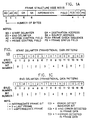
- FIGS 1A-1E illustrate the frame structure and delimiters used in conjunction with the IEEE 802.5 protocol standard.
- Figure 2 illustrates a block diagram implementation of this invention.
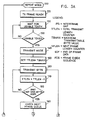
- Figures 3A-3B illustrate a flow chart for the last frame decision algorithm of this invention.
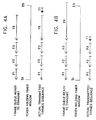
- Figures 4A-4B illustrate scenarios demonstrating the two different last frame ending conditions handled by the last frame decision algorithm.
- the invention will be particularly described with respect to the frame structure used in the IEEE 802.5 protocol.
- a person skilled in the art will readily be able to apply the last frame decision algorithm described herein to the ANSI X3T9.5 protocol for FDDI or any other protocol using a ring topology.
- the frame structure and delimiter patterns of the IEEE 802.5 token ring protocol are shown in Figures 1A-1E.
- the token ring frame structure is used here to illustrate the operation and timing of the last frame decision algorithm relative to the different fields of the frame.
- Figure 1A shows the overall frame structure which contains a starting delimiter (SD), access control field (AC), frame control field (FC), destination address (DA), source address (SA), information field, frame check sequence (FCS), ending delimiter (ED), and frame status field (FS).
- SD delimiter
- AC access control field
- FC frame control field
- DA destination address
- SA source address
- FCS frame check sequence
- ED ending delimiter
- FS frame status field
- the frame header consists of the SD, AC, FC, DA and SA fields.
- the frame trailer consists of the FCS, ED and FS fields.
- Figures 1B and 1C show the starting delimiter and ending delimiter data patterns respectively. In IEEE 802.5 token ring application, only the first six bits of the ending delimiter are considered in decoding the pattern; the last two are ignored.
- the I-bit which is used to indicate whether a frame is an intermediate frame or the last frame, follows in the first half of bit number 6.
- the I-bit is set by the transmitter to indicate whether the transmit frame is the last frame or an intermediate frame. A zero in the I-bit indicates the last frame. A one in the I-bit indicates an intermediate frame.
- Figure 1D shows the bit pattern of the access control byte.
- Figure 1E shows the bit pattern for a token which consists of a starting delimiter, access control byte and ending delimiter.
- FIG. 2 A block diagram of the apparatus implementing the last frame decision algorithm is shown in Figure 2.
- Incoming ring data is first converted from Differential Manchester code to Transitional code via the Manchester-to-Transitional decoder (M/T) 10.
- M/T Manchester-to-Transitional decoder
- the decoded serial ring data is shifted into a 16-bit data deserializer 12 which deserializes a serial data stream into a parallel data stream.
- Tapping at the parallel output of data deserializer 12 are the starting delimiter (SD) detector 14, the ending delimiter (ED) 16, and the token detector 18 which are connected through an internal control bus 20 to the multi-frame transmit finite state machine (TXFSM) 30.
- the logic flow sequence employed in the last decision frame algorithm is controlled by TXFSM 30.
- the adapter processor 40 through its microcode stored in read-only memory (ROM) 42 initiates the assigned transmit frame queues and stores them in transmit buffer 44 implemented in random access memory (RAM).
- the transmit data is transferred through the direct memory access (DMA) bus control block 46 into the transmit data first in-first out (FIFO) buffer 48.
- DMA direct memory access
- the frame data and the delimiters generated by generator 52 are multiplexed into transmitter data serializer 54 according to the protocol frame structure.
- the parallel data stream is converted into a serial data stream and fed into the transmitter data multiplexer control block 60.
- the transmit output is selected from the repeat data path 58 or from the transmit data path 56, respectively.
- TXFSM 30 Individual bits can be modified by the TXFSM 30 through line 62 as they pass through the transmitter data multiplexer control block 60.
- serial transmit data which is in transitional code is converted back into Differential Manchester code by the Transitional-to-Manchester encoder (T/M) 70.
- T/M Transitional-to-Manchester encoder
- the TXSFM 30 loads the maximum transmittable byte value (TBMAX) from a holding register 22 into the total transmit length counter (TTLEN) 24. TBMAX is loaded into holding register 22 during system initialization.
- TXFSM 30 loads the length of the next frame into the next frame length counter (NFLEN) 26, and initiates a comparison of the TTLEN and NFLEN counters 24, 26 in frame length comparator 28. The comparison results in TXFSM 30 setting the I-bit in the ending delimiter to the appropriate value depending on whether that frame is an intermediate frame or a final frame.
- FIGS 3A-3B illustrate a flow chart for the last frame decision algorithm.
- the algorithm starts with the transmitter in repeat mode as indicated in block 100.
- the transmitter starts looking for a usable token (block 120).
- the transmitter goes into transmit mode at the TI bit time in the access control field of the frame as indicated in block 140.
- the location of the TI bit was previously shown in Figure 1D.
- the transmitter loads the maximum transmittable byte value (TBMAX) from holding register 22 into the total transmit length counter 24.
- the TBMAX value is calculated by microcode during adapter initialization and stored in the TBMAX holding register 22.
- the TTLEN counter 24 is loaded with the TBMAX value, it is decremented in block 170 at the end of every transmitted byte (block 160). After the transmitter sends the last data byte in the information field of the frame being transmitted which is tested in decision block 180, it checks to see if there are any more frames waiting in the transmit queue in block 190.
- the transmitter treats the current frame as the last frame. It transmits the four bytes of frame check sequence (block 210 and decision block 220), sets the I-bit to 0 in the transmitted ending delimiter (block 230), transmits the 1 byte frame status field (block 240) and the interframe gap or IFG (block 250). After transmitting the last IFG byte (decision block 260), the token is released in block 270 if early token release is being employed. If in normal token release mode, idle characters are transmitted until the source address (SA) of the return frame is recognized, at which time the token is released. Releasing a token causes a transmitter to go into repeat mode (block 100).
- SA source address
- the transmitter compares the current value in the TTLEN counter with the byte length of the next frame contained in the NFLEN counter in block 300. If the TTLEN value is less than the NFLEN value (block 310), the remaining THT window is insufficient to send the next frame. The transmitter, therefore, treats the current frame as the last frame and repeats the process just described when there is no frame in the transmit queue, i.e., transmit the FCS, set the I-bit to 0 and transmit the ED, transmit the FS byte and IFG, and release the token.
- the transmitter treats the current frame as an intermediate frame, transmits the FCS, sets the I-bit in the transmitted ending delimiter to one, transmits the FS byte, the IFG and the next frame.
- the TTLEN counter is decremented after each byte of the FCS (block 330 and decision block 340). Similarly, the TTLEN counter is decremented after each transmitted byte in blocks 350, 360 and 370 after transmitting the ending delimiter, the frame status byte and the interframe gap, respectively.
- the starting delimiter of the next frame is transmitted and the TTLEN counter is decremented again in block 390. At this point, control is transferred back to block 160 for transmission of the next frame.
- the process embodied in this sequence of steps continues until the last frame in the transmit queue is transmitted or until the remaining THT window is not long enough to send the next frame in the transmit queue.
- the first point is that the frame length of the first frame in the transmit queue is not checked. The reason the length is not checked is that the applicable standard restricts the maximum frame length of any transmit frame to be less than the byte capacity of the token holding timer (THT). Thus, the first frame in a multi-frame transmit queue should always be accommodated for transmission.
- the second point is that the last frame decision algorithm can be forced into a single frame transmit mode by setting the maximum transmittable byte value (TBMAX) to zero. Two examples are provided below on how TBMAX is calculated for a 16 Megabits per second (Mbps) and a Mbps token ring.
- the IFG on a 16 Mbps token ring is 5 bytes while on a 4 Mbps token ring, it is 1 byte.
- FIGS 4A-4B Scenarios demonstrating the two different last frame ending conditions handled by the last frame decision algorithm are shown in Figures 4A-4B.
- the length of the assigned transmit frame queue ready to be transmitted containing frames F1, F2, F3 and F4 is shorter than a THT time window.
- the transmitter has enough time to send all the frames in the queue. Therefore, the actual transmitted frame queue is the same as the assigned frame queue ready to be transmitted.
- the token T1 is released after frame F4 is transmitted.
- the length of the assigned transmit frame queue ready to be transmitted is larger than the THT time window. In this case, the transmitter does not have enough time to send the last frame F4.
- the actual transmitted frame queue terminates at the end of the third frame F3 with the token released at the end. Frame F4 will be held for the next transmitting queue.
Landscapes
- Engineering & Computer Science (AREA)
- Computer Networks & Wireless Communication (AREA)
- Signal Processing (AREA)
- Small-Scale Networks (AREA)
Claims (7)
- Verfahren zur Steuerung der Übertragung von Rahmen über einen Token-Ring in einem Computernetz an einer Ursprungsstation, wobei jede Station in dem Netz zur Übertragung mehrfacher Rahmen über den Ring während eines Übertragungszeitfensters nach dem Anfordern eines Übertragungstokens fähig ist, wobei jeder Rahmen, der über den Ring übertragen wird, einen Rahmenvorsatz, ein Informationsfeld und einen Rahmennachsatz hat, wobei das Verfahren durch die folgenden Schritte gekennzeichnet ist:
Bestimmen der maximalen Rahmenbytelänge, die während des Übertragungszeitfensters übertragen werden kann,
Übertragen von Rahmen, die in einem Übertragungspuffer an der Ursprungsstation warten, und Überwachen der Gesamtzahl übertragener Bytes,
Beenden der Übertragung von Rahmen, falls die Übertragung des nächsten Rahmens, der auf die Übertragung wartet, dazu führt, daß die Gesamtzahl übertragener Bytes die maximale Rahmenbytelänge übersteigt, oder falls alle Rahmen, die in dem Übertragungspuffer warten, übertragen werden, ehe die Gesamtzahl übertragener Bytes die maximale Rahmenbytelänge übersteigt, und
Freigeben des Übertragungstokens unmittelbar nach dem Beenden der Übertragung von Rahmen, falls ein Modus zur frühen Token-Freigabe vorliegt. - Verfahren nach Anspruch 1, wobei der Schritt des Bestimmens der maximalen Rahmenbytelänge die folgenden Schritte umfaßt:
Auswählen der Betriebsgeschwindigkeit des Token-Rings Bestimmen der Gesamtzahl von Bytes, die während des Übertragungszeitfensters übertragen werden kann, und
Subtrahieren des Rahmen-Systemaufwandes, welcher der Übertragung des Rahmenvorsatzes und des Rahmennachsatzes zugeordnet ist, von der Gesamtzahl von Bytes, die übertragen werden können. - Verfahren irgendeines der Ansprüche 1 oder 2, wobei der Schritt des Übertragens von Rahmen, die in dem Übertragungspuffer warten, folgendes umfaßt:
Setzen eines ersten Rahmenzählers an der Ursprungsstation auf die maximale Rahmenbytelänge,
Übertragen des ersten Rahmens im Übertragungspuffer, der auf die Übertragung wartet,
Dekrementieren des ersten Rahmenzählers nach jedem Byte in dem ersten Rahmen, das auf den Ring übertragen wird,
Setzen eines zweiten Rahmenzählers auf die Länge des nächsten Rahmens in dem Übertragungspuffer, der auf die Übertragung wartet,
Vergleichen des Inhalts des ersten Rahmenzählers mit dem Inhalt des zweiten Rahmenzählers,
Übertragen des nächsten Rahmens, falls der Inhalt des ersten Rahmenzählers den Inhalt des zweiten Rahmenzählers übersteigt,
Vermindern des ersten Rahmenzählers, nachdem jedes Byte in dem nächsten Rahmen übertragen ist, und
Wiederholen der Schritte des Setzens des zweiten Rahmenzählers, des Vergleichens und des Übertragens des nächsten Rahmens, und Vermindern des ersten Rahmenzählers, bis der Inhalt des zweiten Rahmenzählers den Inhalt des ersten Rahmenzählers übersteigt. - Verfahren nach Anspruch 3, wobei der Schritt des Vergleichens ausgeführt wird, ehe der Rahmennachsatz des aktuellen Rahmens übertragen ist, und das weiterhin ein Markieren des aktuellen Rahmens als einen Zwischenrahmen umfaßt, falls der Inhalt des ersten Rahmenzählers den Inhalt des zweiten Rahmenzählers übersteigt, und ein Markieren des aktuellen Rahmens als den letzten Rahmen, falls der Inhalt des zweiten Rahmenzählers den Inhalt des ersten Rahmenzählers übersteigt.
- Verfahren nach Anspruch 3 oder 4 einschließlich des Schrittes des Zurücksetzens des ersten Rahmenzählers auf Null, um die Ursprungsstation in einen Übertragungsmodus für Einzelrahmen zu setzen, indem erzwungen wird, daß der Inhalt des zweiten Rahmenzählers den Inhalt des ersten Rahmenzählers übersteigt.
- Vorrichtung zur Steuerung der Übertragung von Rahmen über einen Token-Ring in einem Computernetz an einer Ursprungsstation, wobei jede Station in dem Ring zur Übertragung mehrfacher Rahmen über den Ring während eines Übertragungszeitfensters nach dem Anfordern eines Übertragungstoken fähig ist, wobei jeder Rahmen, der über den Ring übertragen wird, einen Rahmenvorsatz, ein Informationsfeld und einen Rahmennachsatz hat, wobei die Vorrichtung folgendes umfaßt:
Mittel (22) zur Bestimmung der maximalen Rahmenbytelänge, die während des Übertragungszeitfensters übertragen werden kann, wobei das Mittel logische Mittel zur Umrechnung des Übertragungszeitfensters in die Bytezahl umfaßt, die in dem Fenster auf Basis der Betriebsgeschwindigkeit übertragen werden kann,
Puffermittel (44) zur Speicherung von Rahmen, die von der Ursprungsstation zu übertragen sind,
Mittel (60) zur Übertragung von Rahmen, die in dem Übertragungspuffer an der Ursprungsstation warten,
Mittel (24, 26, 28) zur Überwachung der Gesamtzahl von Bytes, die während des Übertragungszeitfensters übertragen werden, und
Mittel (30) zur Beendigung der Übertragung von Rahmen, wenn die Übertragung des nächsten Rahmens, der auf die Übertragung wartet, zu einem Gesamtbetrag übertragener Bytes führen würde, der die maximal übertragbare Bytelänge übersteigt, oder falls alle in dem Übertragungspuffer (44) wartenden Rahmen übertragen werden, ehe die Gesamtzahl übertragener Bytes die maximale Rahmenbytelänge überschreitet. - Vorrichtung nach Anspruch 6, wobei das Mittel zur Überwachung der Gesamtzahl übertragener Bytes folgendes umfaßt:
ein erstes Zählermittel (24) zum Zählen der Anzahl übertragener Bytes in absteigender Folge während des Übertragungszeitfensters, angefangen von der maximalen Rahmenbytelänge,
ein zweites Zählermittel (26) zum Halten der Länge des nächsten Rahmens in dem Übertragungspuffer, der auf die Übertragung wartet, und
Vergleichsmittel (28) zum Vergleichen der Inhalte des ersten Zählermittels und des zweiten Zählermittels.
Applications Claiming Priority (2)
| Application Number | Priority Date | Filing Date | Title |
|---|---|---|---|
| US424850 | 1989-10-20 | ||
| US07/424,850 US4964113A (en) | 1989-10-20 | 1989-10-20 | Multi-frame transmission control for token ring networks |
Publications (3)
| Publication Number | Publication Date |
|---|---|
| EP0424302A2 EP0424302A2 (de) | 1991-04-24 |
| EP0424302A3 EP0424302A3 (en) | 1991-07-24 |
| EP0424302B1 true EP0424302B1 (de) | 1995-02-22 |
Family
ID=23684133
Family Applications (1)
| Application Number | Title | Priority Date | Filing Date |
|---|---|---|---|
| EP90480153A Expired - Lifetime EP0424302B1 (de) | 1989-10-20 | 1990-10-09 | Methode zur Regelung von Mehrrahmen-Übertragung über Tokenring-Netzwerke |
Country Status (4)
| Country | Link |
|---|---|
| US (1) | US4964113A (de) |
| EP (1) | EP0424302B1 (de) |
| JP (1) | JPH07105805B2 (de) |
| DE (1) | DE69017142T2 (de) |
Families Citing this family (22)
| Publication number | Priority date | Publication date | Assignee | Title |
|---|---|---|---|---|
| JP2535615B2 (ja) * | 1989-08-14 | 1996-09-18 | 株式会社東芝 | デ―タ同期伝送方式 |
| US5142530A (en) * | 1989-10-16 | 1992-08-25 | International Business Machines Corporation | Multi-frame stripping protocol for token ring networks |
| US5106910A (en) * | 1989-11-09 | 1992-04-21 | Applied Polymer Systems | High concentration acid resistant coatings |
| US5235593A (en) * | 1989-12-01 | 1993-08-10 | National Semiconductor Corporation | Ring latency timer |
| EP0453863A2 (de) * | 1990-04-27 | 1991-10-30 | National Semiconductor Corporation | Verfahren und Gerät zur Ausführung einer Mediumzugriffssteuerung/Wirtsystemschnittstelle |
| GB9011700D0 (en) * | 1990-05-25 | 1990-07-18 | Inmos Ltd | Communication interface |
| US5210749A (en) * | 1990-05-29 | 1993-05-11 | Advanced Micro Devices, Inc. | Configuration of srams as logical fifos for transmit and receive of packet data |
| US5351242A (en) * | 1992-04-14 | 1994-09-27 | Marian Kramarczyk | Method and apparatus for configuring and maintaining token ring networks |
| US5539727A (en) * | 1992-04-14 | 1996-07-23 | Kramarczyk; Marian | Method and apparatus for configuring and maintaining token ring networks |
| US5586266A (en) * | 1993-10-15 | 1996-12-17 | International Business Machines Corporation | System and method for adaptive, active monitoring of a serial data stream having a characteristic pattern |
| US5475685A (en) * | 1993-10-27 | 1995-12-12 | International Business Machines Corporation | Multi-media flow control over FDDI synchronous networks |
| GB9517619D0 (en) * | 1995-08-29 | 1995-11-01 | Madge Networks Ltd | End station port |
| US6067591A (en) * | 1998-10-08 | 2000-05-23 | Intel Corporation | Method and apparatus for avoidance of invalid transactions in a bus host controller |
| US7349842B2 (en) * | 2003-09-29 | 2008-03-25 | Sony Corporation | Rate-distortion control scheme in audio encoding |
| US7426462B2 (en) * | 2003-09-29 | 2008-09-16 | Sony Corporation | Fast codebook selection method in audio encoding |
| US7325023B2 (en) * | 2003-09-29 | 2008-01-29 | Sony Corporation | Method of making a window type decision based on MDCT data in audio encoding |
| US7283968B2 (en) | 2003-09-29 | 2007-10-16 | Sony Corporation | Method for grouping short windows in audio encoding |
| US20050104873A1 (en) * | 2003-11-14 | 2005-05-19 | Mallinath Hatti | Last frame repeat |
| US7697529B2 (en) * | 2006-02-28 | 2010-04-13 | Cisco Technology, Inc. | Fabric channel control apparatus and method |
| DE112010003309B4 (de) * | 2009-08-18 | 2016-03-31 | Mitsubishi Electric Corporation | Kommunikationssystem und Kommunikationsvorrichtungs-Zustandsbestimmungsverfahren |
| US10608943B2 (en) | 2017-10-27 | 2020-03-31 | Advanced Micro Devices, Inc. | Dynamic buffer management in multi-client token flow control routers |
| CN107809436B (zh) * | 2017-11-10 | 2020-04-21 | 北京世纪鼎点软件有限公司 | 网络视频访问的权限鉴别方法、加密方法、装置及系统 |
Family Cites Families (6)
| Publication number | Priority date | Publication date | Assignee | Title |
|---|---|---|---|---|
| US4404557A (en) * | 1982-03-05 | 1983-09-13 | Burroughs Corporation | Timed token ring with multiple priorities |
| US4536874A (en) * | 1983-07-21 | 1985-08-20 | Stoffel James C | Bandwidth efficient multipoint data communication system |
| JPS60250742A (ja) * | 1984-05-28 | 1985-12-11 | Nec Corp | 伝送路システムのアクセス制御方式 |
| US4667323A (en) * | 1985-09-03 | 1987-05-19 | Allen-Bradley Company, Inc. | Industrialized token passing network |
| JPS62233951A (ja) * | 1986-04-02 | 1987-10-14 | Nec Corp | 多重パケツト伝送方式 |
| US4926418A (en) * | 1989-04-11 | 1990-05-15 | International Business Machines Corporation | Fairness algorithm for full-duplex buffer insertion ring |
-
1989
- 1989-10-20 US US07/424,850 patent/US4964113A/en not_active Expired - Fee Related
-
1990
- 1990-10-05 JP JP2266605A patent/JPH07105805B2/ja not_active Expired - Lifetime
- 1990-10-09 EP EP90480153A patent/EP0424302B1/de not_active Expired - Lifetime
- 1990-10-09 DE DE69017142T patent/DE69017142T2/de not_active Expired - Fee Related
Also Published As
| Publication number | Publication date |
|---|---|
| JPH07105805B2 (ja) | 1995-11-13 |
| US4964113A (en) | 1990-10-16 |
| EP0424302A2 (de) | 1991-04-24 |
| EP0424302A3 (en) | 1991-07-24 |
| DE69017142D1 (de) | 1995-03-30 |
| DE69017142T2 (de) | 1995-08-10 |
| JPH03145353A (ja) | 1991-06-20 |
Similar Documents
| Publication | Publication Date | Title |
|---|---|---|
| US4964113A (en) | Multi-frame transmission control for token ring networks | |
| US4566097A (en) | Token ring with secondary transmit opportunities | |
| EP0462349B1 (de) | Breitbandringkommunikationssystem und Zugriffssteuerungsverfahren | |
| US4726018A (en) | Method of providing priority access to a transmission communication ring | |
| US4404557A (en) | Timed token ring with multiple priorities | |
| US5436902A (en) | Ethernet extender | |
| US4567590A (en) | Message stripping protocol for a ring communication network | |
| US4454508A (en) | Timed token ring | |
| EP0684719A1 (de) | Verfahren und Vorrichtung zum Übertragen von Hochprioritätsverkehr auf Niedrigergeschwindigkeits-Kommunikationsverbindungen | |
| US5173898A (en) | Multiple-access control for a communication system with order pad passing | |
| EP0054077A1 (de) | Verfahren zur Übertragung von Information zwischen Stationen, die an eine unidirektionale Ringleitung angeschlossen sind | |
| EP1128612A2 (de) | Verfahren zur Übertragung von hochprioritäts Echtzeitdatenverkehr über niedriggeschwindigkeits Kommunikationsverbindungen | |
| EP0404078A2 (de) | Kommunikationsgerät zur Wiederzusammensetzung von aus einen Netz empfangenen Paketen in eine Nachricht | |
| EP0122765A2 (de) | Netzwerk-Protokoll zur Integration von synchronem und asynchronem Verkehr auf einem gemeinsamen seriellen Datenbus | |
| US5210750A (en) | Method and apparatus for distributed queue multiple access in a communication system | |
| JP3934915B2 (ja) | フロー制御装置及び方法 | |
| CA1278873C (en) | Runt packet filter | |
| US5235593A (en) | Ring latency timer | |
| US5051986A (en) | Asynchronous priority select logic | |
| US5812554A (en) | Efficiency of a network having a minimum data transmission time | |
| JPH07110010B2 (ja) | 情報伝送方式 | |
| EP0505656B1 (de) | Einfüge- und Entfernungssignalisierung in LAN Systemen | |
| EP0459756A2 (de) | Lichtwellenleiternetz mit verteilter Datenschnittstelle | |
| JP3034405B2 (ja) | ローカルエリアネットワーク装置 | |
| JPH03267844A (ja) | リング待ち時間タイマ |
Legal Events
| Date | Code | Title | Description |
|---|---|---|---|
| PUAI | Public reference made under article 153(3) epc to a published international application that has entered the european phase |
Free format text: ORIGINAL CODE: 0009012 |
|
| 17P | Request for examination filed |
Effective date: 19901213 |
|
| AK | Designated contracting states |
Kind code of ref document: A2 Designated state(s): DE FR GB |
|
| PUAL | Search report despatched |
Free format text: ORIGINAL CODE: 0009013 |
|
| AK | Designated contracting states |
Kind code of ref document: A3 Designated state(s): DE FR GB |
|
| 17Q | First examination report despatched |
Effective date: 19930624 |
|
| GRAA | (expected) grant |
Free format text: ORIGINAL CODE: 0009210 |
|
| AK | Designated contracting states |
Kind code of ref document: B1 Designated state(s): DE FR GB |
|
| REF | Corresponds to: |
Ref document number: 69017142 Country of ref document: DE Date of ref document: 19950330 |
|
| ET | Fr: translation filed | ||
| PGFP | Annual fee paid to national office [announced via postgrant information from national office to epo] |
Ref country code: FR Payment date: 19951009 Year of fee payment: 6 |
|
| PLBE | No opposition filed within time limit |
Free format text: ORIGINAL CODE: 0009261 |
|
| STAA | Information on the status of an ep patent application or granted ep patent |
Free format text: STATUS: NO OPPOSITION FILED WITHIN TIME LIMIT |
|
| 26N | No opposition filed | ||
| PG25 | Lapsed in a contracting state [announced via postgrant information from national office to epo] |
Ref country code: FR Effective date: 19970630 |
|
| REG | Reference to a national code |
Ref country code: FR Ref legal event code: ST |
|
| PGFP | Annual fee paid to national office [announced via postgrant information from national office to epo] |
Ref country code: GB Payment date: 19990930 Year of fee payment: 10 |
|
| PG25 | Lapsed in a contracting state [announced via postgrant information from national office to epo] |
Ref country code: GB Free format text: LAPSE BECAUSE OF NON-PAYMENT OF DUE FEES Effective date: 20001009 |
|
| PGFP | Annual fee paid to national office [announced via postgrant information from national office to epo] |
Ref country code: DE Payment date: 20001101 Year of fee payment: 11 |
|
| GBPC | Gb: european patent ceased through non-payment of renewal fee |
Effective date: 20001009 |
|
| PG25 | Lapsed in a contracting state [announced via postgrant information from national office to epo] |
Ref country code: DE Free format text: LAPSE BECAUSE OF NON-PAYMENT OF DUE FEES Effective date: 20020702 |