EP0424759A2 - Verfahren zur Herstellung von Pigmenten auf Isoindolbasis - Google Patents
Verfahren zur Herstellung von Pigmenten auf Isoindolbasis Download PDFInfo
- Publication number
- EP0424759A2 EP0424759A2 EP90119656A EP90119656A EP0424759A2 EP 0424759 A2 EP0424759 A2 EP 0424759A2 EP 90119656 A EP90119656 A EP 90119656A EP 90119656 A EP90119656 A EP 90119656A EP 0424759 A2 EP0424759 A2 EP 0424759A2
- Authority
- EP
- European Patent Office
- Prior art keywords
- reaction
- formula
- iii
- base
- water
- Prior art date
- Legal status (The legal status is an assumption and is not a legal conclusion. Google has not performed a legal analysis and makes no representation as to the accuracy of the status listed.)
- Granted
Links
Classifications
-
- C—CHEMISTRY; METALLURGY
- C09—DYES; PAINTS; POLISHES; NATURAL RESINS; ADHESIVES; COMPOSITIONS NOT OTHERWISE PROVIDED FOR; APPLICATIONS OF MATERIALS NOT OTHERWISE PROVIDED FOR
- C09B—ORGANIC DYES OR CLOSELY-RELATED COMPOUNDS FOR PRODUCING DYES, e.g. PIGMENTS; MORDANTS; LAKES
- C09B57/00—Other synthetic dyes of known constitution
- C09B57/04—Isoindoline dyes
Definitions
- Preferred radicals R are independently hydrogen, alkyl, cycloalkyl, aryl or hetaryl.
- radicals R are hydrogen, C1-C6-alkyl and optionally substituted phenyl.
- R very particularly preferably represents hydrogen, methyl, ethyl and phenyl.
- reaction of the reaction product from (II) and (III) with (IV) is preferably carried out at temperatures between 0 ° C and 150 ° C in a molar ratio of 2: 1 to 6: 1, based on (II), in the pH range between 1 and 6 performed.
- Suitable alcohols (III) are preferably C1-C6-alkanols, C2-C6-alkanediols and their mono-C1-C4-alkyl ethers, for example methanol, ethanol, propanol, i-propanol, butanol, i-butanol, glycols and glycol derivatives such as ethylene glycol, glycol monomethyl ether, glycol monoethyl ether, diethylene glycol monomethyl and monoethyl ether.
- the organic medium for the reaction of (II) with (III) are preferably water-miscible organic solvents such as cyclic or open-chain ethers, for example tetrahydrofuran, dioxane, ethylene glycol dimethyl ether, ethylene glycol diethyl ether, oligo- and polyglycols and their ethers, and dipolar-aprotic solvents such as formamide, dimethylformamide, dimethylacetamide, N-methylpyrrolidone and dimethyl sulfoxide and mixtures thereof, also with other solvents.
- water-miscible organic solvents such as cyclic or open-chain ethers, for example tetrahydrofuran, dioxane, ethylene glycol dimethyl ether, ethylene glycol diethyl ether, oligo- and polyglycols and their ethers
- dipolar-aprotic solvents such as formamide, dimethylformamide, dimethylacetamide, N-methylpyrrolidon
- Particularly preferred organic media are the alcohols (III) themselves.
- the bases are the alkali or alkaline earth alcoholates of the alcohols (III), e.g. Sodium methylate, sodium ethylate or potassium tert-butoxide, the alkali and alkaline earth metal hydroxides such as e.g. Sodium, potassium or lithium hydroxide as well as the alkali or alkaline earth carbonates such as Sodium carbonate and potassium carbonate in question.
- the alcohols (III) e.g. Sodium methylate, sodium ethylate or potassium tert-butoxide
- the alkali and alkaline earth metal hydroxides such as e.g. Sodium, potassium or lithium hydroxide
- the alkali or alkaline earth carbonates such as Sodium carbonate and potassium carbonate in question.
- the reaction is carried out in such a way that the components of the first substep are mixed in any order, it being possible, depending on the circumstances, such as the type and concentration of the compounds used, to remove the heat of reaction by cooling or to accelerate the reaction by heating.
- a temperature range in which excessive cooling or heating is avoided.
- Such a favorable temperature range is, for example, between 0 ° C. and approx. 100 ° C., but the reaction can also be carried out at lower or higher temperatures.
- the added base serves as a catalyst and therefore does not have to be used in a stoichiometric ratio. If the amount of base is too low, the reaction is uneconomically slow. Therefore, 0.1 to 1 mol of base, based on 1 mol (II), are preferred.
- the reaction product in the presence of water and optionally an anionic, cationic or neutral surface-active compound with the barbituric acid derivatives of the formula (IV) in a molar ratio of about 1: 2 to 1: 6, preferably in a molar ratio of about 1: 2 up to approx. 1: 3.
- the pH in this reaction is kept between 1 and 6, preferably between 1 and 5, very particularly preferably between 1.5 and 3.5. This can either be done by adding acid during the reaction, or the acid can be mixed with the water before the reaction.
- Suitable acids are mineral acids, aliphatic or aromatic carboxylic acids, aliphatic or aromatic sulfonic acids and mixtures of the acids mentioned.
- Example 2 The procedure of Example 1 is followed, but 4.1 g of potassium carbonate are used instead of the sodium methylate solution. Yield: 32.0 g of yellow pigment.
- Example 2 The procedure of Example 1 is followed, but 100 ml of ethylene glycol are used instead of the methanol. Yield: 33.9 g of yellow pigment.
- Example 2 The procedure of Example 1 is followed, but 39 g of N, N-dimethylbarbituric acid are used instead of the barbituric acid. Yield: 34.5 g of yellow pigment.
- the product is suctioned off hot and washed neutral with hot water. 31.2 g of yellow pigment are obtained.
Landscapes
- Chemical & Material Sciences (AREA)
- Organic Chemistry (AREA)
- Nitrogen Condensed Heterocyclic Rings (AREA)
- Pigments, Carbon Blacks, Or Wood Stains (AREA)
Abstract
Description
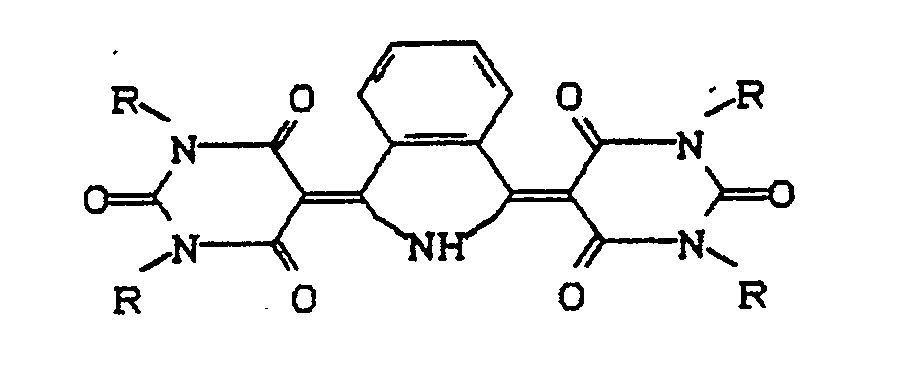
- Die Erfindung betrifft ein neues Verfahren zur Herstellung von Pigmentfarbstoffen der Formel

R = Wasserstoff oder Substituent,
dadurch gekennzeichnet, daß man Phthalodinitril (II) in einem organischen Medium mit einem Alkohol (III) in Gegenwart einer Base, vorzugsweise bei Temperaturen von 0°C bis 100°C, umsetzt und anschließend, vorzugsweise ohne Zwischenisolierung, das Reaktionsprodukt in Gegenwart von Wasser mit Verbindungen der Formel
- Bevorzugte Reste R sind unabhängig voneinander Wasserstoff, Alkyl, Cycloalkyl, Aryl oder Hetaryl.
- Besonders bevorzugte Reste R sind Wasserstoff, C₁-C₆-Alkyl und gegebenenfalls substituiertes Phenyl.
- Ganz besonders bevorzugt steht R für Wasserstoff, Methyl, Ethyl und Phenyl.
- Die Umsetzung des Reaktionsprodukts aus (II) und (III) mit (IV) wird vorzugsweise bei Temperaturen zwischen 0°C und 150°C im Molverhältnis von 2:1 bis 6:1, bezogen auf (II), im pH-Bereich zwischen 1 und 6 durchgeführt.
- Als Alkohole (III) kommen vorzugsweise C₁-C₆-Alkanole, C₂-C₆-Alkandiole und deren Mono-C₁-C₄-alkylether in Frage, beispielsweise Methanol, Ethanol, Propanol, i-Propanol, Butanol, i-Butanol, Glykole und Glykolderivate wie Ethylenglykol, Glykolmonomethylether, Glykolmonoethylether, Diethylenglykolmonomethyl- und -monoethylether.
- Als organisches Medium für die Umsetzung von (II) mit (III) kommen bevorzugt mit Wasser mischbare organische Lösungsmittel wie cyclische oder offenkettige Ether, zum Beispiel Tetrahydrofuran, Dioxan, Ethylenglykoldimethylether, Ethylenglykoldiethylether, Oligo- und Polyglykole und deren Ether, und dipolar-aprotische Lösungsmittel wie Formamid, Dimethylformamid, Dimethylacetamid, N-Methylpyrrolidon und Dimethylsulfoxid sowie deren Mischungen, auch mit anderen Lösungsmitteln, in Frage.
- Besonders bevorzugte organische Medien sind die Alkohole (III) selbst.
- Als Basen kommen die Alkali- oder Erdalkalialkoholate der Alkohole (III) wie z.B. Natriummethylat, Natriumethylat oder auch Kalium-tert.-butylat, die Alkali- und Erdalkalihydroxide wie z.B. Natrium-, Kalium- oder Lithiumhydroxid sowie die Alkali- oder Erdalkalicarbonate wie z.B. Natriumcarbonat und Kaliumcarbonat in Frage.
- Im einzelnen wird die Reaktion so durchgeführt, daß man die Komponenten des ersten Teilschritts in beliebiger Reihenfolge mischt, wobei es je nach den Umständen wie Art und Konzentration der eingesetzten Verbindungen angezeigt sein kann, die Reaktionswärme durch Kühlen abzuführen oder die Reaktion durch Erwärmen zu beschleunigen. Im allgemeinen wird man in einem Temperaturbereich arbeiten, in dem man übermäßiges Kühlen oder Erwärmen vermeidet. Ein derart günstiger Temperaturbereich liegt z.B. zwischon 0°C und ca. 100°C, jedoch kann die Reaktion auch bei tieferen oder höheren Temperaturen durchgeführt werden.
- Die zugesetzte Base dient als Katalysator und muß daher nicht im stöchiometrischen Verhältnis eingesetzt werden. Bei zu geringen Basenmengen läuft die Reaktion jedoch unwirtschaftlich langsam ab. Bevorzugt sind daher 0,1 bis 1 Mol Base, bezogen auf 1 Mol (II).
- Nach erfolgter Umsetzung wird das Reaktionsprodukt in Gegenwart von Wasser und gegebenenfalls einer anionischen, kationischen oder neutralen oberflächenaktiven Verbindung mit den Barbitursäurederivaten der Formel (IV) im Molverhältnis von ca. 1:2 bis 1:6, bevorzugt im Molverhältnis von ca. 1:2 bis ca. 1:3, umgesetzt. Der pH-Wert bei dieser Umsetzung wird zwischen 1 und 6, bevorzugt zwischen 1 und 5, ganz besonders bevorzugt zwischen 1,5 und 3,5, gehalten. Dies kann entweder durch Zugabe von Säure während der Reaktion geschehen, oder die Säure kann vor der Reaktion mit dem Wasser gemischt werden.
- Als Säuren kommen Mineralsäuren, aliphatische oder aromatische Carbonsäuren, aliphatische oder aromatische Sulfonsäuren und Gemische der genannten Säuren in Frage.
- Bevorzugt sind aliphatische wasserlösliche Carbonsäuren wie Ameisensäure, Essigsäure oder Propionsäure.
- Die Umsetzung wird bei Temperaturen zwischen 0°C und 150°C durchgeführt, bevorzugt zwischen 20°C und 130°C.
- Nach dem erfindungsgemäßen Verfahren erhält man die Pigmentfarbstoffe der Formel (I) in guten Ausbeuten und Reinheiten. Die nach dem erfindungsgemäßen Verfahren erhaltenen Produkte weisen eine hohe Brillanz, gute Licht- und Wetterechtheiten auf, sie sind zudem sehr gut dispergierbar.
- 12,8 g Phthalodinitril werden in 100 ml Methanol suspendiert. Man setzt 5 ml einer 30 %igen Natriummethylatlösung zu und rührt bei Raumtemperatur 2 Stunden bis zur vollständigen Umsetzung. Die entstehende Lösung wird innerhalb von 30 Min. bei Raumtemperatur zu einer Suspension von 32 g Barbitursäure, 250 ml Wasser und 22 ml Ameisensäure gegeben. Es wird 1 Stunde bei Raumtemperatur nachgerührt, anschließend wird 3 Stunden am Rückfluß erhitzt. Das Produkt wird heiß abgesaugt und mit heißem Wasser neutral-gewaschen. Es werden 28,3 Teile Gelbpigment erhalten.
- Man verfährt nach Beispiel 1, verwendet jedoch anstelle der Natriummethylatlösung 1,2 g pulverisiertes Natriumhydroxid. Ausbeute: 31,2 g Gelbpigment.
- Man verfährt nach Beispiel 1, verwendet jedoch anstelle der Natriummethylatlösung 0,9 g pulverisiertes Kaliumhydroxid. Ausbeute: 31,1 g Gelbpigment.
- Man verfährt nach Beispiel 1, verwendet jedoch anstelle der Natriummethylatlösung 4,1 g Kaliumcarbonat. Ausbeute: 32,0 g Gelbpigment.
- Man verfährt nach Beispiel 1, verwendet jedoch anstelle des Methanols 100 ml Ethylenglykol. Ausbeute: 33,9 g Gelbpigment.
- Man verfährt nach Beispiel 1, verwendet jedoch anstelle der Ameisensäure 20 ml Essigsäure. Ausbeute: 29,7 g Gelbpigment.
- Man verfährt nach Beispiel 1, verwendet jedoch anstelle der Barbitursäure 39 g N,N-Dimethylbarbitursäure. Ausbeute: 34,5 g Gelbpigment.
- 12,8 g Phthalodinitril werden in 100 ml Methanol suspendiert. Man setzt 5 ml einer 30 %igen Natriummethylatlösung zu und rührt bei Raumtemperatur 3 Stunden bis zur vollständigen Umsetzung. Zu der entstehenden Lösung werden nacheinander 32 g Barbitursäure, 12 ml Essigsäure und 150 ml Wasser gegeben. Es wird 1 Stunde bei Raumtemperatur nachgerührt, anschließend wird 3 Stunden zum Rückfluß erhitzt.
- Das Produkt wird heiß abgesaugt und mit heißem Wasser neutral-gewaschen. Es werden 31,2 g Gelbpigment erhalten.
Claims (6)

R unabhängig voneinander = Wasserstoff oder Substituent,
dadurch gekennzeichnet, daß man Phthalodinitril (II) in einem organischen Medium mit einem Alkohol (III) In Gegenwart einer Base umsetzt und anschließend vorzugsweise ohne Zwischenisolierung, das Reaktionsprodukt in Gegenwart von Wasser mit Verbindungen der Formel

Applications Claiming Priority (2)
| Application Number | Priority Date | Filing Date | Title |
|---|---|---|---|
| DE3935858 | 1989-10-27 | ||
| DE3935858A DE3935858A1 (de) | 1989-10-27 | 1989-10-27 | Verfahren zur herstellung von pigmenten auf isoindolbasis |
Publications (3)
| Publication Number | Publication Date |
|---|---|
| EP0424759A2 true EP0424759A2 (de) | 1991-05-02 |
| EP0424759A3 EP0424759A3 (en) | 1992-01-02 |
| EP0424759B1 EP0424759B1 (de) | 1994-01-05 |
Family
ID=6392386
Family Applications (1)
| Application Number | Title | Priority Date | Filing Date |
|---|---|---|---|
| EP90119656A Revoked EP0424759B1 (de) | 1989-10-27 | 1990-10-13 | Verfahren zur Herstellung von Pigmenten auf Isoindolbasis |
Country Status (4)
| Country | Link |
|---|---|
| US (1) | US5091532A (de) |
| EP (1) | EP0424759B1 (de) |
| JP (1) | JP2773972B2 (de) |
| DE (2) | DE3935858A1 (de) |
Cited By (1)
| Publication number | Priority date | Publication date | Assignee | Title |
|---|---|---|---|---|
| EP0839879A3 (de) * | 1996-10-31 | 1999-03-24 | Bayer Ag | Verwendung von Pigmentpreparationen für den Ink-Jet Druck |
Families Citing this family (13)
| Publication number | Priority date | Publication date | Assignee | Title |
|---|---|---|---|---|
| US6245138B1 (en) | 1997-10-20 | 2001-06-12 | Bayer Aktiengesellschaft | Pigment preparations useful for ink-jet printing |
| DE19923072A1 (de) | 1999-05-20 | 2000-11-23 | Bayer Ag | Pigmentpräparationen für den Ink-Jet-Druck |
| JP3835624B1 (ja) | 2005-03-31 | 2006-10-18 | 株式会社コナミデジタルエンタテインメント | ゲームシステム、ゲームシステムの制御方法及びプログラム |
| TWI401245B (zh) * | 2006-08-18 | 2013-07-11 | Toyo Ink Mfg Co | 苯并異吲哚衍生物、含此之顏料組成物及著色組成物 |
| WO2009074533A2 (en) * | 2007-12-10 | 2009-06-18 | Basf Se | Isometric isoindoline yellow pigment |
| CN102585542A (zh) * | 2011-12-27 | 2012-07-18 | 百合花集团有限公司 | 一种制备c.i.颜料黄139的方法 |
| CN103289434A (zh) * | 2012-02-24 | 2013-09-11 | 先尼科化工(上海)有限公司 | 异吲哚啉黄颜料的生产方法 |
| CN103013158A (zh) * | 2012-12-13 | 2013-04-03 | 先尼科化工(上海)有限公司 | 异吲哚啉黄色颜料的合成方法 |
| CN103013159A (zh) * | 2012-12-13 | 2013-04-03 | 先尼科化工(上海)有限公司 | 无水制备异吲哚啉颜料的方法 |
| EP3197955B1 (de) | 2014-09-23 | 2018-05-16 | Basf Se | Stabilisierung von c.i. pigmentgelb 139 |
| JP7124313B2 (ja) * | 2017-12-25 | 2022-08-24 | 東洋インキScホールディングス株式会社 | カラーフィルタ用着色剤、着色組成物およびカラーフィルタ |
| JP7017006B1 (ja) * | 2020-07-15 | 2022-02-08 | 東洋インキScホールディングス株式会社 | 顔料組成物、着色組成物、塗料、インキ、インキセット、印刷物、及び包装材料 |
| JP7105024B1 (ja) | 2021-08-03 | 2022-07-22 | 東洋インキScホールディングス株式会社 | 顔料組成物、着色組成物、塗料、インキ、インキセット、印刷物、及び包装材料 |
Family Cites Families (14)
| Publication number | Priority date | Publication date | Assignee | Title |
|---|---|---|---|---|
| CA539915A (en) * | 1957-04-23 | Vollmann Heinrich | Process for the production of isoindolenine derivatives | |
| GB698070A (en) * | 1949-08-25 | 1953-10-07 | Bayer Ag | New intermediate products for the phthalocyanine synthesis |
| DE879102C (de) * | 1949-08-25 | 1953-06-09 | Bayer Ag | Verfahren zur Herstellung und Isolierung von monomeren Alkoxy-imino-isoindoleninen oder deren Kernsubstitutionsprodukten |
| DE1012406B (de) * | 1952-12-06 | 1957-07-18 | Basf Ag | Verfahren zur Herstellung von Farbstoffen |
| DE1025080B (de) * | 1954-12-18 | 1958-02-27 | Basf Ag | Verfahren zur Herstellung von Farbstoffen |
| FR1537299A (fr) * | 1966-09-09 | 1968-08-23 | Bayer Ag | Procédé de préparation de nouveaux dérivés de l'isoindoline |
| DE2041999C3 (de) * | 1970-08-25 | 1978-03-02 | Basf Ag, 6700 Ludwigshafen | Pigmentfarbstoffe |
| DE2628409C3 (de) * | 1976-06-24 | 1986-10-02 | Basf Ag, 6700 Ludwigshafen | Verfahren zur Herstellung von Pigmentfarbstoffen |
| DE3007300A1 (de) * | 1980-02-27 | 1981-09-10 | Basf Ag, 6700 Ludwigshafen | Neue isoindolinfarbstoffe |
| DE3022839A1 (de) * | 1980-06-19 | 1982-01-07 | Bayer Ag, 5090 Leverkusen | Isoindoleninderivate, verfahren zu ihrer herstellung sowie ihre verwendung als zwischenprodukte zur herstellung von farbstoffen |
| CH668980A5 (de) * | 1985-07-05 | 1989-02-15 | Basf Ag | Verfahren zur formierung von isoindolinpigmenten. |
| DE3535276A1 (de) * | 1985-10-03 | 1987-04-09 | Basf Ag | Verfahren zur herstellung von tetrachlor-3-imino-isoindolin-1-on |
| DE3840488A1 (de) * | 1988-12-01 | 1990-06-07 | Bayer Ag | Elektrophotographische toner |
| JP2790399B2 (ja) * | 1992-10-27 | 1998-08-27 | 千代田化工建設株式会社 | 向流式造粒設備 |
-
1989
- 1989-10-27 DE DE3935858A patent/DE3935858A1/de not_active Withdrawn
-
1990
- 1990-10-13 EP EP90119656A patent/EP0424759B1/de not_active Revoked
- 1990-10-13 DE DE90119656T patent/DE59004119D1/de not_active Revoked
- 1990-10-16 US US07/600,036 patent/US5091532A/en not_active Expired - Lifetime
- 1990-10-23 JP JP2283606A patent/JP2773972B2/ja not_active Expired - Lifetime
Cited By (1)
| Publication number | Priority date | Publication date | Assignee | Title |
|---|---|---|---|---|
| EP0839879A3 (de) * | 1996-10-31 | 1999-03-24 | Bayer Ag | Verwendung von Pigmentpreparationen für den Ink-Jet Druck |
Also Published As
| Publication number | Publication date |
|---|---|
| DE3935858A1 (de) | 1991-05-02 |
| EP0424759B1 (de) | 1994-01-05 |
| DE59004119D1 (de) | 1994-02-17 |
| JP2773972B2 (ja) | 1998-07-09 |
| EP0424759A3 (en) | 1992-01-02 |
| US5091532A (en) | 1992-02-25 |
| JPH03153761A (ja) | 1991-07-01 |
Similar Documents
| Publication | Publication Date | Title |
|---|---|---|
| EP0424759B1 (de) | Verfahren zur Herstellung von Pigmenten auf Isoindolbasis | |
| DE2460491A1 (de) | Verfahren zur herstellung von xanthenfarbstoffen | |
| DE69605746T2 (de) | Naphtholderivate und ein verfahren zu ihrer herstellung | |
| DE2412227A1 (de) | Verfahren zur herstellung von dispersions-methinfarbstoffen | |
| DE3022839A1 (de) | Isoindoleninderivate, verfahren zu ihrer herstellung sowie ihre verwendung als zwischenprodukte zur herstellung von farbstoffen | |
| DE3217224C2 (de) | Verfahren zur Herstellung von Arylazoaminonaphtholsulfonsäuren und deren Verwendung | |
| DE69917443T2 (de) | Methoden zur hochselektiven o-alkylierung von amiden mit hilfe von kupfersalzen | |
| EP0375617B1 (de) | Verfahren zur Herstellung von Pyrimidinderivaten | |
| CH636332A5 (en) | Process for preparing monoalkylated dihydroxybenzenes | |
| EP0115295B1 (de) | Verbessertes Verfahren zur Herstellung von Riboflavin | |
| EP0306866B1 (de) | Verfahren zur Herstellung von Pyrazolo [5,1-b] chinazolonen | |
| EP0574799B1 (de) | Verfahren zur Herstellung von faserreaktiven Formazanfarbstoffen sowie Aminophenole | |
| EP0863884B1 (de) | Verfahren zur herstellung von bis-alkoxy-triazinyl-aminohaltigen stilben-disulfonsäuren oder deren derivate | |
| EP0056578A2 (de) | Verfahren zur Herstellung von Lösungen kationischer Azofarbstoffe | |
| DE2521649C2 (de) | 3-Amino-4-carbalkoxybenzoesäure- 4'-phenoxyanilide, Verfahren zu ihrer Herstellung und ihre Verwendung | |
| DE2505237A1 (de) | Verfahren zur herstellung von benzoylpyridinen und ihren derivaten | |
| EP0847381B1 (de) | Verfahren zur herstellung von n-carboxymethylen-4-chlor-anthranilsäure, sowie deren dialkylestern | |
| EP0196272B1 (de) | Neue Sulfonverbindungen | |
| DE3128159A1 (de) | Verfahren zur herstellung von styrylfarbstoffen | |
| DE2118493C3 (de) | Verfahren zur Herstellung von Aminostilbenen | |
| DE2118492C3 (de) | Verfahren zur Herstellung von 8H- 8-Oxo-dibenz [c,mn] -acridinderivaten | |
| EP0057665B1 (de) | Verfahren zur Herstellung von 1-Acylamino-3,4-phthaloyl-acridonen | |
| DE3842062A1 (de) | Explosionssichere 1-dimethylamino-3-dimethylimino-2-arylpropen-1-salze, verfahren zu ihrer herstellung und ihre verwendung | |
| DE2711272A1 (de) | Verfahren zur herstellung von chinazolonderivaten | |
| DE2510528A1 (de) | Benzimidazo-/1,2-a/-chinoline und verfahren zu ihrer herstellung |
Legal Events
| Date | Code | Title | Description |
|---|---|---|---|
| PUAI | Public reference made under article 153(3) epc to a published international application that has entered the european phase |
Free format text: ORIGINAL CODE: 0009012 |
|
| 17P | Request for examination filed |
Effective date: 19901013 |
|
| AK | Designated contracting states |
Kind code of ref document: A2 Designated state(s): CH DE FR GB LI |
|
| PUAL | Search report despatched |
Free format text: ORIGINAL CODE: 0009013 |
|
| AK | Designated contracting states |
Kind code of ref document: A3 Designated state(s): CH DE FR GB LI |
|
| 17Q | First examination report despatched |
Effective date: 19930603 |
|
| GRAA | (expected) grant |
Free format text: ORIGINAL CODE: 0009210 |
|
| AK | Designated contracting states |
Kind code of ref document: B1 Designated state(s): CH DE FR GB LI |
|
| GBT | Gb: translation of ep patent filed (gb section 77(6)(a)/1977) |
Effective date: 19940117 |
|
| REF | Corresponds to: |
Ref document number: 59004119 Country of ref document: DE Date of ref document: 19940217 |
|
| ET | Fr: translation filed | ||
| PLBI | Opposition filed |
Free format text: ORIGINAL CODE: 0009260 |
|
| 26 | Opposition filed |
Opponent name: CIBA-GEIGY AG PATENTABTEILUNG Effective date: 19941004 |
|
| PLBO | Opposition rejected |
Free format text: ORIGINAL CODE: EPIDOS REJO |
|
| APAC | Appeal dossier modified |
Free format text: ORIGINAL CODE: EPIDOS NOAPO |
|
| APAA | Appeal reference recorded |
Free format text: ORIGINAL CODE: EPIDOS REFN |
|
| PLBQ | Unpublished change to opponent data |
Free format text: ORIGINAL CODE: EPIDOS OPPO |
|
| PLAB | Opposition data, opponent's data or that of the opponent's representative modified |
Free format text: ORIGINAL CODE: 0009299OPPO |
|
| R26 | Opposition filed (corrected) |
Opponent name: CIBA SPECIALTY CHEMICALS HOLDING INC. Effective date: 19941004 |
|
| PGFP | Annual fee paid to national office [announced via postgrant information from national office to epo] |
Ref country code: DE Payment date: 19980911 Year of fee payment: 9 |
|
| PGFP | Annual fee paid to national office [announced via postgrant information from national office to epo] |
Ref country code: FR Payment date: 19980923 Year of fee payment: 9 |
|
| PGFP | Annual fee paid to national office [announced via postgrant information from national office to epo] |
Ref country code: CH Payment date: 19980929 Year of fee payment: 9 |
|
| PGFP | Annual fee paid to national office [announced via postgrant information from national office to epo] |
Ref country code: GB Payment date: 19981016 Year of fee payment: 9 |
|
| APAC | Appeal dossier modified |
Free format text: ORIGINAL CODE: EPIDOS NOAPO |
|
| RDAH | Patent revoked |
Free format text: ORIGINAL CODE: EPIDOS REVO |
|
| RDAG | Patent revoked |
Free format text: ORIGINAL CODE: 0009271 |
|
| STAA | Information on the status of an ep patent application or granted ep patent |
Free format text: STATUS: PATENT REVOKED |
|
| 27W | Patent revoked |
Effective date: 19990720 |
|
| GBPR | Gb: patent revoked under art. 102 of the ep convention designating the uk as contracting state |
Free format text: 990720 |
|
| REG | Reference to a national code |
Ref country code: CH Ref legal event code: PL |
|
| APAH | Appeal reference modified |
Free format text: ORIGINAL CODE: EPIDOSCREFNO |