EP0425810A1 - Véhicules avec des programmes différents pour l'actuation des freins - Google Patents
Véhicules avec des programmes différents pour l'actuation des freins Download PDFInfo
- Publication number
- EP0425810A1 EP0425810A1 EP90118238A EP90118238A EP0425810A1 EP 0425810 A1 EP0425810 A1 EP 0425810A1 EP 90118238 A EP90118238 A EP 90118238A EP 90118238 A EP90118238 A EP 90118238A EP 0425810 A1 EP0425810 A1 EP 0425810A1
- Authority
- EP
- European Patent Office
- Prior art keywords
- road
- motor vehicle
- service brake
- program
- brake pedal
- Prior art date
- Legal status (The legal status is an assumption and is not a legal conclusion. Google has not performed a legal analysis and makes no representation as to the accuracy of the status listed.)
- Granted
Links
Images
Classifications
-
- B—PERFORMING OPERATIONS; TRANSPORTING
- B60—VEHICLES IN GENERAL
- B60T—VEHICLE BRAKE CONTROL SYSTEMS OR PARTS THEREOF; BRAKE CONTROL SYSTEMS OR PARTS THEREOF, IN GENERAL; ARRANGEMENT OF BRAKING ELEMENTS ON VEHICLES IN GENERAL; PORTABLE DEVICES FOR PREVENTING UNWANTED MOVEMENT OF VEHICLES; VEHICLE MODIFICATIONS TO FACILITATE COOLING OF BRAKES
- B60T8/00—Arrangements for adjusting wheel-braking force to meet varying vehicular or ground-surface conditions, e.g. limiting or varying distribution of braking force
- B60T8/32—Arrangements for adjusting wheel-braking force to meet varying vehicular or ground-surface conditions, e.g. limiting or varying distribution of braking force responsive to a speed condition, e.g. acceleration or deceleration
- B60T8/34—Arrangements for adjusting wheel-braking force to meet varying vehicular or ground-surface conditions, e.g. limiting or varying distribution of braking force responsive to a speed condition, e.g. acceleration or deceleration having a fluid pressure regulator responsive to a speed condition
- B60T8/48—Arrangements for adjusting wheel-braking force to meet varying vehicular or ground-surface conditions, e.g. limiting or varying distribution of braking force responsive to a speed condition, e.g. acceleration or deceleration having a fluid pressure regulator responsive to a speed condition connecting the brake actuator to an alternative or additional source of fluid pressure, e.g. traction control systems
-
- B—PERFORMING OPERATIONS; TRANSPORTING
- B60—VEHICLES IN GENERAL
- B60T—VEHICLE BRAKE CONTROL SYSTEMS OR PARTS THEREOF; BRAKE CONTROL SYSTEMS OR PARTS THEREOF, IN GENERAL; ARRANGEMENT OF BRAKING ELEMENTS ON VEHICLES IN GENERAL; PORTABLE DEVICES FOR PREVENTING UNWANTED MOVEMENT OF VEHICLES; VEHICLE MODIFICATIONS TO FACILITATE COOLING OF BRAKES
- B60T8/00—Arrangements for adjusting wheel-braking force to meet varying vehicular or ground-surface conditions, e.g. limiting or varying distribution of braking force
- B60T8/17—Using electrical or electronic regulation means to control braking
- B60T8/1701—Braking or traction control means specially adapted for particular types of vehicles
- B60T8/1708—Braking or traction control means specially adapted for particular types of vehicles for lorries or tractor-trailer combinations
-
- B—PERFORMING OPERATIONS; TRANSPORTING
- B60—VEHICLES IN GENERAL
- B60T—VEHICLE BRAKE CONTROL SYSTEMS OR PARTS THEREOF; BRAKE CONTROL SYSTEMS OR PARTS THEREOF, IN GENERAL; ARRANGEMENT OF BRAKING ELEMENTS ON VEHICLES IN GENERAL; PORTABLE DEVICES FOR PREVENTING UNWANTED MOVEMENT OF VEHICLES; VEHICLE MODIFICATIONS TO FACILITATE COOLING OF BRAKES
- B60T2210/00—Detection or estimation of road or environment conditions; Detection or estimation of road shapes
- B60T2210/10—Detection or estimation of road conditions
- B60T2210/16—Off-road driving conditions
Definitions
- the invention relates to a motor vehicle with a service brake device acting on the brakes of its wheels, which comprises a regulating and control device with an electronic, computer-controlled anti-lock braking system, and possibly also a traction control system.
- Known anti-lock braking systems allow a certain yaw moment limitation for road surfaces with different friction coefficients from side to side.
- the aim is to limit yaw around the vertical axis of the motor vehicle and the effective steering forces to a reasonable extent without having to accept excessive losses in the braking distance.
- This is achieved in that the brake pressure which becomes effective on the brakes of the wheels is controlled in such a way that blocking of a wheel cannot occur even with different coefficients of friction between wheels on the left and right side of the vehicle.
- the braking distance is relatively short in the "modified individual control” and therefore cheaper than in the "select-low control".
- One of these two philosophies has previously been stored in the electronics part of the regulating and control device as a brake actuation program. The following comparison shows the following weaknesses regardless of the brake actuation program used: When braking, the driver has no option to choose between the stability of the vehicle or the shortest possible braking distance. He always has to have a very bad one Live compromise. In practice, stability requirements tend to occur more frequently than requirements for the shortest possible braking distance.
- At least two brake actuation programs which are geared to different brake actuation modes and are selectively activated by the driver by actuating the service brake pedal with different strengths - path-dependent - are stored in the electronic part of the regulating and control device to be able to influence the course of a braking process. He can take into account the currently prevailing nature of the road or the area being traveled in with foresight in view of the fact that with the respective braking process either the stability, keeping the vehicle in lane or the shortest possible braking distance can be achieved. To a certain extent, the driver has the possibility of setting priorities in the respective braking situation, which is optimally adapted to the vehicle, its loading and its current mode of operation.
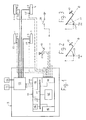
- the wheels of a steerable front axle are designated as 1, 3 and the wheels of a rear axle as 2, 4 as parts of the motor vehicle.
- two front axles, each with steerable wheels can also be provided, for example in heavy goods vehicles. In this respect, there is always talk of front axle wheels below.
- the brakes respectively associated with the wheels of the vehicle are designated in their entirety per wheel with 5 or 6 or 7 or 8.
- a service brake device is assigned to these brakes, which comprises a regulating and control device 9 and can be activated by a service brake pedal 10. Compressed air and / or hydraulic fluid is used as the pressure medium in the service brake device.
- the corresponding pressure medium supply devices are designated and marked 11 and 12 in their entirety a pressure regulating and control device 13 is connected, which in turn is connected to the actuators of the brakes 5, 6, 7, 8 via corresponding pressure lines.
- the regulating and control device 9 comprises in an electronic part 14 an electronic, computer-controlled anti-blocking system, which can optionally be expanded by a computer-controlled anti-slip control.
- the electronic part 14 of the regulating and control device 9 essentially consists of a microprocessor 15, at least one data memory 16, at least one program memory 17, an input periphery 18, an output periphery 19 with signal amplification units and a signal input and processing unit 20, the latter being a series of Signals that signal vehicle operating data, driving status data and the like are fed, which are implemented accordingly in it.
- These signals include those that come from sensors 22, 23, 24, 25 that detect the wheel rotation, furthermore possibly speed signals, also speed signals and signals about other operating data and signals that indicate the position of the service brake pedal 10 specify or are representative of its actuation position.
- Said parts 15, 16, 17, 18, 19, 20 are connected to a data bus system 21 via data channels within the electronic part 14 of the regulating and control device 9 and are in mutual or mutual communication with the microprocessor 15.
- the electronic part 14 of the regulating and control device 9 there are at least two brake actuation programs which are oriented to different types of actuation of the brakes 5, 6, 7, 8 stored, specifically in the program memory (s) 17 and data memory 16. These different brake actuation programs can be activated by the driver either by actuating the service brake pedal 10 with different strengths - path-dependent.
- adapted brake actuation programs are provided for vehicles that are usually only operated on the usual road network or in light terrain, which differ from the brake actuation philosophy that is used in connection with motor vehicles, which in principle also applies for operation in difficult to very difficult terrain.
- a first brake actuation program - called “select-low control” - and a second brake actuation program - are in the electronic part 14 of the regulating and control device 9 for blocking protection.
- Modified individual regulation "called - stored.
- Both brake actuation programs are known per se with regard to their regulating and control characteristics, ie with regard to their influence on a braking operation - as mentioned at the beginning - but have so far only been used in vehicles as an alternative, but never together. By programming both brake actuation programs, the driver now has the option of taking advantage of the respective brake actuation program, but of the above-mentioned after to eliminate parts.
- the wheels 2, 4 of the rear axle (s) are braked individually in a conventional manner.
- This brake actuation program is then effective in such a way that, when the sensors 22, 23, 24, 25 detect, differently occurring on the wheels 1, 2, 3, 4 on both sides of the motor vehicle, friction values ( ⁇ - Split) first initiates a brake pressure based on the lower or lowest coefficient of friction, with which the brakes 5, 6 of all front axle wheels 1, 3 of the motor vehicle are applied at the same height, and then the brake pressure on the brakes of that front axle wheel or those front axle wheels on which there is a higher coefficient of friction are continuously or stepwise increased in a program-controlled manner up to a limit value specified for such a case.
- the wheels 2, 4 of the rear axle (s) are also known conventional type individually braked This ensures that as long as the service brake pedal 10 is not in its maximum position, di e Stability, tracking and maneuverability of the vehicle are optimally guaranteed, but when the maximum braking force is really necessary, priority is given to shortening the braking distance.
- the braking effect increases noticeably, especially on loose ground such as gravel or deep snow, because material wedges can build up in front of the wheels, which contribute significantly to braking .
- the previous off-road brake actuation program and thus also the anti-lock braking system is completely switched off below the second speed threshold, the existing coefficient of friction of a loose surface is fully utilized, especially when driving downhill or downhill in steep terrain.
- the driver has the possibility, e.g. to create conditions in pure terrain with dry hard ground and with few inclines or downhill gradients when braking as in pure road operation.
- the positive results described above in connection with the second embodiment of the invention are then achieved again.
- the switching thresholds S (FIG. 2) or S1, S2 (FIG. 3), when a program change or another braking mode of operation is initiated or exceeded, can be implemented in various ways, for example either by mechanical switches or electrical potentiometers which are actuated as a function of the movement of the service brake pedal 10 or by pressure switches, which are connected to the control pressure circuit of the service brake pedal 10.
- these organs generally designated 27 deliver "high” or “low” signals, or coded digital signals, which are supplied to the electronic part 14 of the regulating and control device 9.
- These organs 27 can also be designed in an advantageous manner so that the switching thresholds are marked by pressure points that the driver can feel when the service brake pedal 10 is actuated, which must first be overcome in order to trigger the relevant switching threshold signal.
Landscapes
- Engineering & Computer Science (AREA)
- Transportation (AREA)
- Mechanical Engineering (AREA)
- Physics & Mathematics (AREA)
- Fluid Mechanics (AREA)
- Regulating Braking Force (AREA)
Applications Claiming Priority (2)
| Application Number | Priority Date | Filing Date | Title |
|---|---|---|---|
| DE3936160A DE3936160A1 (de) | 1989-10-31 | 1989-10-31 | Kraftfahrzeug mit verschiedenen bremsenbetaetigungsprogrammen |
| DE3936160 | 1989-10-31 |
Publications (2)
| Publication Number | Publication Date |
|---|---|
| EP0425810A1 true EP0425810A1 (fr) | 1991-05-08 |
| EP0425810B1 EP0425810B1 (fr) | 1993-09-29 |
Family
ID=6392542
Family Applications (1)
| Application Number | Title | Priority Date | Filing Date |
|---|---|---|---|
| EP90118238A Expired - Lifetime EP0425810B1 (fr) | 1989-10-31 | 1990-09-22 | Véhicules avec des programmes différents pour l'actuation des freins |
Country Status (2)
| Country | Link |
|---|---|
| EP (1) | EP0425810B1 (fr) |
| DE (2) | DE3936160A1 (fr) |
Cited By (6)
| Publication number | Priority date | Publication date | Assignee | Title |
|---|---|---|---|---|
| WO1997026164A1 (fr) * | 1996-01-17 | 1997-07-24 | Itt Automotive Europe Gmbh | Procede permettant d'ameliorer le comportement de regulation d'un systeme antiblocage dans des situations de conduite hors-route |
| EP1419946A1 (fr) * | 2002-11-16 | 2004-05-19 | WABCO GmbH & CO. OHG | Logique de réglage ABS comportant un module tous terrains |
| WO2005054024A1 (fr) * | 2003-12-03 | 2005-06-16 | Continental Aktiengesellschaft | Procede de commande du fonctionnement d'un programme de stabilite electronique d'un vehicule |
| GB2412750A (en) * | 2004-03-30 | 2005-10-05 | Bosch Gmbh Robert | Adapting a vehicle stabilising system to the nature of the road surface |
| EP2108554A1 (fr) * | 2008-04-11 | 2009-10-14 | KNORR-BREMSE Systeme für Nutzfahrzeuge GmbH | Procédé de fonctionnement d'une installation de frein et installation de frein pour un véhicule utilitaire |
| EP2853452A1 (fr) * | 2013-09-27 | 2015-04-01 | WABCO GmbH | Procédé et système de commande d'un système de freinage électronique |
Citations (3)
| Publication number | Priority date | Publication date | Assignee | Title |
|---|---|---|---|---|
| DE3417423A1 (de) * | 1984-05-11 | 1985-11-14 | Robert Bosch Gmbh, 7000 Stuttgart | Vortriebsregeleinrichtung |
| DE3505268A1 (de) * | 1984-08-03 | 1986-02-13 | Wabco Westinghouse Fahrzeugbremsen GmbH, 3000 Hannover | Strassenfahrzeug mit blockierschutz |
| DE3636537A1 (de) * | 1985-10-28 | 1987-05-07 | Akebono Brake Ind | Bremskraftverstaerker |
Family Cites Families (4)
| Publication number | Priority date | Publication date | Assignee | Title |
|---|---|---|---|---|
| DE2610585A1 (de) * | 1976-03-13 | 1977-09-15 | Bosch Gmbh Robert | Blockierschutz-regeleinrichtung fuer kraftfahrzeuge |
| DE3026254A1 (de) * | 1980-07-11 | 1982-02-11 | Wabco Fahrzeugbremsen Gmbh, 3000 Hannover | Antiblockiersystem |
| DE3127302C2 (de) * | 1981-07-10 | 1983-09-15 | Daimler-Benz Ag, 7000 Stuttgart | "Einrichtung zur Vortriebsregelung an Kraftfahrzeugen" |
| DE3421700A1 (de) * | 1983-06-14 | 1984-12-20 | Robert Bosch Gmbh, 7000 Stuttgart | Antiblockierregelsystem |
-
1989
- 1989-10-31 DE DE3936160A patent/DE3936160A1/de not_active Withdrawn
-
1990
- 1990-09-22 DE DE90118238T patent/DE59002920D1/de not_active Expired - Fee Related
- 1990-09-22 EP EP90118238A patent/EP0425810B1/fr not_active Expired - Lifetime
Patent Citations (3)
| Publication number | Priority date | Publication date | Assignee | Title |
|---|---|---|---|---|
| DE3417423A1 (de) * | 1984-05-11 | 1985-11-14 | Robert Bosch Gmbh, 7000 Stuttgart | Vortriebsregeleinrichtung |
| DE3505268A1 (de) * | 1984-08-03 | 1986-02-13 | Wabco Westinghouse Fahrzeugbremsen GmbH, 3000 Hannover | Strassenfahrzeug mit blockierschutz |
| DE3636537A1 (de) * | 1985-10-28 | 1987-05-07 | Akebono Brake Ind | Bremskraftverstaerker |
Cited By (9)
| Publication number | Priority date | Publication date | Assignee | Title |
|---|---|---|---|---|
| WO1997026164A1 (fr) * | 1996-01-17 | 1997-07-24 | Itt Automotive Europe Gmbh | Procede permettant d'ameliorer le comportement de regulation d'un systeme antiblocage dans des situations de conduite hors-route |
| EP1419946A1 (fr) * | 2002-11-16 | 2004-05-19 | WABCO GmbH & CO. OHG | Logique de réglage ABS comportant un module tous terrains |
| WO2005054024A1 (fr) * | 2003-12-03 | 2005-06-16 | Continental Aktiengesellschaft | Procede de commande du fonctionnement d'un programme de stabilite electronique d'un vehicule |
| US7937205B2 (en) | 2003-12-03 | 2011-05-03 | Continental Aktiengesellschaft | Method for controlling the functions of an electronic driving stability program for a motor vehicle |
| GB2412750A (en) * | 2004-03-30 | 2005-10-05 | Bosch Gmbh Robert | Adapting a vehicle stabilising system to the nature of the road surface |
| GB2412750B (en) * | 2004-03-30 | 2006-06-28 | Bosch Gmbh Robert | Adapting a vehicle stabilising system to the terrain |
| US7248956B2 (en) | 2004-03-30 | 2007-07-24 | Robert Bosch Gmbh | Adaptation of a vehicle stabilizing system to the surface |
| EP2108554A1 (fr) * | 2008-04-11 | 2009-10-14 | KNORR-BREMSE Systeme für Nutzfahrzeuge GmbH | Procédé de fonctionnement d'une installation de frein et installation de frein pour un véhicule utilitaire |
| EP2853452A1 (fr) * | 2013-09-27 | 2015-04-01 | WABCO GmbH | Procédé et système de commande d'un système de freinage électronique |
Also Published As
| Publication number | Publication date |
|---|---|
| DE59002920D1 (de) | 1993-11-04 |
| EP0425810B1 (fr) | 1993-09-29 |
| DE3936160A1 (de) | 1991-05-02 |
Similar Documents
| Publication | Publication Date | Title |
|---|---|---|
| DE102016123691B4 (de) | Steuersystem für eine Antriebseinheit | |
| DE3413738C2 (de) | Schlupfgeregelte bremsanlage fuer strassenfahrzeuge | |
| EP2144794B1 (fr) | Procédé de fonctionnement d'un système de freinage de véhicule et système de freinage de véhicule | |
| DE69600247T2 (de) | Einrichtung zur Regelung des Fahrzeugverhaltens mit Möglichkeit zur Änderung ihres oberen Ausgangsgrenzwertes in Abhängigkeit von der Verfügbarkeit einer anderen Einrichtung zur Regelung des Fahrzeugverhaltens | |
| DE4041404C2 (de) | Steuersystem für die Hinterradlenkung eines Kraftfahrzeuges | |
| EP0051801B1 (fr) | Installation d'antiblocage | |
| DE19817326A1 (de) | Verfahren zum Verkürzen des Bremsgeweges | |
| EP0295396B1 (fr) | Système de freinage pour un véhicule dirigeable, à 2 ou plusieurs essieux, avec entraînement au moins sur les roues arrière | |
| EP0307588B1 (fr) | Système anti-blockage pour véhicules | |
| DE19637297B4 (de) | Fahrzeug mit Bremskraftregelung im Gefälle | |
| WO2007147526A1 (fr) | Direction d'essieu arrière pour grue automotrice | |
| DE19643168B4 (de) | Steuergerät für eine Fahrzeugstabilitätsregelung mit Unterscheidung einer Straße mit unterschiedlichen Reibungskoeffizienten µ | |
| EP0792224B1 (fr) | Circuit de commande pour systeme de freinage a regulation antiblocage | |
| EP1050444A2 (fr) | Dispositif pour contrôler les feux de freinage | |
| EP0874746B1 (fr) | Procede permettant d'ameliorer le comportement de regulation d'un systeme antiblocage dans des situations de conduite hors-route | |
| DE3627550A1 (de) | Kraftfahrzeug mit einem antiblockiersystem | |
| WO2020259878A1 (fr) | Procédé et dispositif pour stabiliser un attelage et appareil de commande | |
| DE10120529B4 (de) | Bremskraftregelsystem für ein Fahrzeug | |
| EP0254113B1 (fr) | Installation hydraulique de frein de direction pour véhicule | |
| EP0425810B1 (fr) | Véhicules avec des programmes différents pour l'actuation des freins | |
| EP1088724B1 (fr) | Procédé d'actionnement de la régulation de freinage et installation de commande | |
| DE3439067C2 (de) | Anordnung zum Feststellen einer druckmittelbetätigten Radbremse | |
| DE4014295A1 (de) | Hydraulische zweikreisbremsanlage | |
| EP1156952A1 (fr) | Dispositif et procede de regulation du glissement de roues apres detection d'un derapage | |
| DE3342555A1 (de) | Hydraulisches bremssystem fuer kraftfahrzeuge |
Legal Events
| Date | Code | Title | Description |
|---|---|---|---|
| PUAI | Public reference made under article 153(3) epc to a published international application that has entered the european phase |
Free format text: ORIGINAL CODE: 0009012 |
|
| 17P | Request for examination filed |
Effective date: 19910313 |
|
| AK | Designated contracting states |
Kind code of ref document: A1 Designated state(s): CH DE FR IT LI NL SE |
|
| 17Q | First examination report despatched |
Effective date: 19920414 |
|
| ITF | It: translation for a ep patent filed | ||
| GRAA | (expected) grant |
Free format text: ORIGINAL CODE: 0009210 |
|
| AK | Designated contracting states |
Kind code of ref document: B1 Designated state(s): CH DE FR IT LI NL SE |
|
| ET | Fr: translation filed | ||
| REF | Corresponds to: |
Ref document number: 59002920 Country of ref document: DE Date of ref document: 19931104 |
|
| PGFP | Annual fee paid to national office [announced via postgrant information from national office to epo] |
Ref country code: CH Payment date: 19940727 Year of fee payment: 5 |
|
| PLBE | No opposition filed within time limit |
Free format text: ORIGINAL CODE: 0009261 |
|
| STAA | Information on the status of an ep patent application or granted ep patent |
Free format text: STATUS: NO OPPOSITION FILED WITHIN TIME LIMIT |
|
| 26N | No opposition filed | ||
| EAL | Se: european patent in force in sweden |
Ref document number: 90118238.6 |
|
| PG25 | Lapsed in a contracting state [announced via postgrant information from national office to epo] |
Ref country code: LI Effective date: 19950930 Ref country code: CH Effective date: 19950930 |
|
| REG | Reference to a national code |
Ref country code: CH Ref legal event code: PL |
|
| PGFP | Annual fee paid to national office [announced via postgrant information from national office to epo] |
Ref country code: SE Payment date: 20010827 Year of fee payment: 12 Ref country code: NL Payment date: 20010827 Year of fee payment: 12 |
|
| PGFP | Annual fee paid to national office [announced via postgrant information from national office to epo] |
Ref country code: DE Payment date: 20010903 Year of fee payment: 12 |
|
| PGFP | Annual fee paid to national office [announced via postgrant information from national office to epo] |
Ref country code: FR Payment date: 20010904 Year of fee payment: 12 |
|
| PG25 | Lapsed in a contracting state [announced via postgrant information from national office to epo] |
Ref country code: SE Free format text: LAPSE BECAUSE OF NON-PAYMENT OF DUE FEES Effective date: 20020923 |
|
| PG25 | Lapsed in a contracting state [announced via postgrant information from national office to epo] |
Ref country code: NL Free format text: LAPSE BECAUSE OF NON-PAYMENT OF DUE FEES Effective date: 20030401 Ref country code: DE Free format text: LAPSE BECAUSE OF NON-PAYMENT OF DUE FEES Effective date: 20030401 |
|
| EUG | Se: european patent has lapsed | ||
| PG25 | Lapsed in a contracting state [announced via postgrant information from national office to epo] |
Ref country code: FR Free format text: LAPSE BECAUSE OF NON-PAYMENT OF DUE FEES Effective date: 20030603 |
|
| REG | Reference to a national code |
Ref country code: FR Ref legal event code: ST |
|
| PG25 | Lapsed in a contracting state [announced via postgrant information from national office to epo] |
Ref country code: IT Free format text: LAPSE BECAUSE OF NON-PAYMENT OF DUE FEES;WARNING: LAPSES OF ITALIAN PATENTS WITH EFFECTIVE DATE BEFORE 2007 MAY HAVE OCCURRED AT ANY TIME BEFORE 2007. THE CORRECT EFFECTIVE DATE MAY BE DIFFERENT FROM THE ONE RECORDED. Effective date: 20050922 |