EP0425965A2 - Verfahren zur Herstellung von Halbleiterstrukturen - Google Patents
Verfahren zur Herstellung von Halbleiterstrukturen Download PDFInfo
- Publication number
- EP0425965A2 EP0425965A2 EP90120230A EP90120230A EP0425965A2 EP 0425965 A2 EP0425965 A2 EP 0425965A2 EP 90120230 A EP90120230 A EP 90120230A EP 90120230 A EP90120230 A EP 90120230A EP 0425965 A2 EP0425965 A2 EP 0425965A2
- Authority
- EP
- European Patent Office
- Prior art keywords
- forming
- layer
- dielectric
- trench
- trenches
- Prior art date
- Legal status (The legal status is an assumption and is not a legal conclusion. Google has not performed a legal analysis and makes no representation as to the accuracy of the status listed.)
- Ceased
Links
Images



Classifications
-
- H—ELECTRICITY
- H10—SEMICONDUCTOR DEVICES; ELECTRIC SOLID-STATE DEVICES NOT OTHERWISE PROVIDED FOR
- H10P—GENERIC PROCESSES OR APPARATUS FOR THE MANUFACTURE OR TREATMENT OF DEVICES COVERED BY CLASS H10
- H10P90/00—Preparation of wafers not covered by a single main group of this subclass, e.g. wafer reinforcement
- H10P90/19—Preparing inhomogeneous wafers
- H10P90/1904—Preparing vertically inhomogeneous wafers
- H10P90/1906—Preparing SOI wafers
-
- H—ELECTRICITY
- H10—SEMICONDUCTOR DEVICES; ELECTRIC SOLID-STATE DEVICES NOT OTHERWISE PROVIDED FOR
- H10W—GENERIC PACKAGES, INTERCONNECTIONS, CONNECTORS OR OTHER CONSTRUCTIONAL DETAILS OF DEVICES COVERED BY CLASS H10
- H10W10/00—Isolation regions in semiconductor bodies between components of integrated devices
- H10W10/01—Manufacture or treatment
- H10W10/011—Manufacture or treatment of isolation regions comprising dielectric materials
- H10W10/012—Manufacture or treatment of isolation regions comprising dielectric materials using local oxidation of silicon [LOCOS]
-
- H—ELECTRICITY
- H10—SEMICONDUCTOR DEVICES; ELECTRIC SOLID-STATE DEVICES NOT OTHERWISE PROVIDED FOR
- H10W—GENERIC PACKAGES, INTERCONNECTIONS, CONNECTORS OR OTHER CONSTRUCTIONAL DETAILS OF DEVICES COVERED BY CLASS H10
- H10W10/00—Isolation regions in semiconductor bodies between components of integrated devices
- H10W10/01—Manufacture or treatment
- H10W10/041—Manufacture or treatment of isolation regions comprising polycrystalline semiconductor materials
-
- H—ELECTRICITY
- H10—SEMICONDUCTOR DEVICES; ELECTRIC SOLID-STATE DEVICES NOT OTHERWISE PROVIDED FOR
- H10W—GENERIC PACKAGES, INTERCONNECTIONS, CONNECTORS OR OTHER CONSTRUCTIONAL DETAILS OF DEVICES COVERED BY CLASS H10
- H10W10/00—Isolation regions in semiconductor bodies between components of integrated devices
- H10W10/01—Manufacture or treatment
- H10W10/061—Manufacture or treatment using SOI processes together with lateral isolation, e.g. combinations of SOI and shallow trench isolations
-
- H—ELECTRICITY
- H10—SEMICONDUCTOR DEVICES; ELECTRIC SOLID-STATE DEVICES NOT OTHERWISE PROVIDED FOR
- H10W—GENERIC PACKAGES, INTERCONNECTIONS, CONNECTORS OR OTHER CONSTRUCTIONAL DETAILS OF DEVICES COVERED BY CLASS H10
- H10W10/00—Isolation regions in semiconductor bodies between components of integrated devices
- H10W10/10—Isolation regions comprising dielectric materials
- H10W10/13—Isolation regions comprising dielectric materials formed using local oxidation of silicon [LOCOS], e.g. sealed interface localised oxidation [SILO] or side-wall mask isolation [SWAMI]
-
- H—ELECTRICITY
- H10—SEMICONDUCTOR DEVICES; ELECTRIC SOLID-STATE DEVICES NOT OTHERWISE PROVIDED FOR
- H10W—GENERIC PACKAGES, INTERCONNECTIONS, CONNECTORS OR OTHER CONSTRUCTIONAL DETAILS OF DEVICES COVERED BY CLASS H10
- H10W10/00—Isolation regions in semiconductor bodies between components of integrated devices
- H10W10/10—Isolation regions comprising dielectric materials
- H10W10/181—Semiconductor-on-insulator [SOI] isolation regions, e.g. buried oxide regions of SOI wafers
-
- H—ELECTRICITY
- H10—SEMICONDUCTOR DEVICES; ELECTRIC SOLID-STATE DEVICES NOT OTHERWISE PROVIDED FOR
- H10W—GENERIC PACKAGES, INTERCONNECTIONS, CONNECTORS OR OTHER CONSTRUCTIONAL DETAILS OF DEVICES COVERED BY CLASS H10
- H10W10/00—Isolation regions in semiconductor bodies between components of integrated devices
- H10W10/40—Isolation regions comprising polycrystalline semiconductor materials
-
- H—ELECTRICITY
- H10—SEMICONDUCTOR DEVICES; ELECTRIC SOLID-STATE DEVICES NOT OTHERWISE PROVIDED FOR
- H10P—GENERIC PROCESSES OR APPARATUS FOR THE MANUFACTURE OR TREATMENT OF DEVICES COVERED BY CLASS H10
- H10P90/00—Preparation of wafers not covered by a single main group of this subclass, e.g. wafer reinforcement
- H10P90/19—Preparing inhomogeneous wafers
- H10P90/1904—Preparing vertically inhomogeneous wafers
- H10P90/1906—Preparing SOI wafers
- H10P90/1912—Preparing SOI wafers using selective deposition, e.g. epitaxial lateral overgrowth [ELO] or selective deposition of single crystal silicon
Definitions
- This invention relates, in general, to semiconductor devices, and more particularly to a method of fabricating a semiconductor structure that is compatible with multiple technologies.
- Prior art methods of fabricating semiconductor structures having variable width shallow isolation elements, especially those disposed over deep trench isolation elements generally require multiple masking steps. Specifically, masks are used to define the encroachment of the isolation elements into the active regions. Inherent with multiple masking steps are misalignment tolerances that must be provided for. These misalignment tolerances prohibit aggressive scaling of structures and require additional real estate.
- the present invention seeks to provide a method of fabricating a semiconductor structure that is compatible with several technologies.
- a method of fabricating a semiconductor structure comprising the steps of: providing a semiconductor substrate; forming a thermal oxide layer on said substrate; forming a polycrystalline semiconductor layer on said thermal oxide layer; forming a first dielectric layer on said polycrystalline semiconductor layer; the invention being characterized by: forming a first mask on said first dielectric layer and using said first mask to form at least one opening in said first dielectric layer, said at least one opening extending to said polycrystalline semiconductor layer; forming dielectric spacers in said at least one opening; forming a trench in said substrate beneath said at least one opening, said dielectric spacers creating a self-aligned reduction in the width of said trench; forming a dielectric trench liner in said trench and in said at least one opening; filling said trench with polycrystalline semiconductor material; and forming a shallow dielectric isolation element on said filled trench.
- Embodiments of the present invention advantageously provide a method of fabricating a semiconductor structure having increased integration flexibility, enhanced scalability characteristics and wherein both deep trench isolation elements and shallow dielectric isolation elements may be fabricated at variable widths.
- Such a semiconductor structure that may be employed in conjunction with high performance integrated circuits.
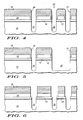
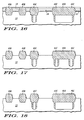
- FIGS. 1-16 are highly enlarged cross-sectional views of a portion of a semiconductor structure during processing. It should be understood that the figures herein may not be precisely to scale.
- substrate 10 is provided.
- substrate 10 is comprised of monocrystalline silicon however it should be understood that substrates comprising other materials may be used.
- substrate 10 may comprise semiconductor material wherein pre-isolation processing has been completed to establish required doping profiles and epitaxial layers.
- a thin thermal oxide layer 12 is formed on substrate 10 followed by the formation of a thin polysilicon layer 14 thereon, preferably by deposition. As one skilled in the art will understand, polysilicon layer 14 will serve as a buffer for the local oxidation which will be explained presently.
- a nitride layer 16 is formed on polysilicon layer 14. Nitride layer 16 is formed by CVD in this embodiment although other well known methods may be employed.
- An oxide layer 18 is then formed, preferably by CVD, on nitride layer 16.
- photoresist mask 20 is formed thereon.
- the formation of photoresist mask 20 includes patterning a photoresist layer by methods well known in the art.
- Mask 20 is employed to form openings 22 that extend through oxide layer 18 and nitride layer 16 and stop on polysilicon layer 14 as shown in FIG. 2. Openings 22 are formed by reactive ion etching. Once openings 22 have been formed, photoresist mask 20 is removed by a standard photoresist clean.
- dielectric spacers 24 are formed in openings 22.
- Spacers 24 are comprised of oxide in this embodiment although nitride or oxynitride may be employed.
- Oxide spacers 24 are formed by depositing, either by CVD or PECVD, an oxide layer (not shown) and then reactive ion etching the oxide layer to form oxide spacers 24. It should be understood that this oxide spacer etch stops on polysilicon layer 14.
- Spacers 24 allow for a self-aligned reduction in the widths of openings 22. It should be understood that the use of spacers 24 allows openings 22 to be reduced to widths smaller than those obtainable using conventional photolithography techniques. Further, the width of spacers 24 may be varied according to the application. This enhances scalability characteristics of the structure.
- FIG. 4 illustrates the formation of trenches 26 beneath openings 22. Reactive ion etching is employed to form trenches 26. As shown, trenches 26 extend into substrate 10. The width of trenches 26 is determined by the width of the corresponding opening 22 and spacers 24 disposed therein. Although FIGS. 1-4 show a series of trenches 26 of approximately the same width, it should be understood that the present invention may be employed in structures having trenches 26 of varying widths as shown in FIG. 5.
- a trench clean is performed following the formation of trenches 26.
- a dilute solution of hydrofluoric acid is employed to remove sidewall passivation material left in trenches 26 by the reactive ion etch.
- the trench clean can also be employed to remove oxide spacers 24.
- spacers 24 are shown to be completely removed in this embodiment, partial removal thereof is also possible. The width of spacers 24 to be removed is dependent upon the clean and application for which the structure will be employed.
- spacers 24 exposes the portions of polysilicon layer 14 disposed beneath. This creates a self-aligned offset between the sidewall of trench 26 and the edge of nitride layer 16 which will serve as a mask for the formation of shallow dielectric isolation elements. If spacers 24 comprise nitride or oxynitride, they are not removed at this point and will later serve to minimize the lateral encroachment during shallow isolation element formation as will be explained presently.
- FIG. 7 illustrates the formation of a trench liner 28.
- trench liner 28 is formed by thermally oxidizing the walls of trench 26.
- dielectric material 30 is formed to add thickness to trench liner 28 as shown in FIG. 8.
- trench liner 28 may be removed from the bottom of trench 26.
- trench liner 28 and material 30 are removed from the bottom of trench 26 by anisotropic reactive ion etching.
- the optional implant of a channel stop (not shown) may be performed. Again, this is specific to the application for which the structure is being used.
- FIGS. 9 and 10 depict two different embodiments of the present invention wherein trenches 26 are filled with trench fill material 32.
- trench fill material 32 comprises polysilicon which may be formed by LPCVD or selective polysilicon growth (SPG). If LPCVD is employed to form polysilicon trench fill 32, it might be necessary to employ a sacrificial material layer and an RIE planarization etchback so that trench fill material 32 is planarized. If SPG is employed, a planarization etchback will not be required. Preferably, the top of trench fill material 32 will be coplanar with the top surface of substrate 10.
- oxide layer 18 is removed to expose nitride layer 16 as shown in FIG. 11.
- Oxide layer 18 is removed by a wet etch employing dilute hydrofluoric acid in this embodiment although reactive ion etching or various combinations of etches may be employed. In addition to removing oxide layer 18, this etch also removes the spacers resulting from the formation of material 30 that project above polysilicon layer 14 as well as a portion of trench liner 28. Again, it should be understood that if spacers 24 were comprised of oxide and not earlier removed, their removal may occur at this point.
- a dielectric cap 34 comprised of oxide in this embodiment is formed on polysilicon trench fill 32 as shown in FIG. 12.
- Oxide cap 34 combines with trench liner 28 to essentially seal polysilicon trench fill material 32.
- Oxide cap 34 is formed by thermally oxidizing polysilicon trench fill 32 and must be thick enough to withstand unmasked reactive ion etching of nitride layer 16 as will be explained presently. Additionally, the exposed edges of polysilicon layer 14 will also be thermally oxidized. It should be understood that the formation of oxide cap 34 is not mandatory.
- FIG. 13 illustrates the formation of a mask 36. This occurs by forming a photoresist layer on the structure and then patterning it by methods well known in the art. As shown in FIG. 14 openings 38 are formed in nitride layer 16 using mask 36. Once openings 38 have been formed by methods such as reactive ion etching, mask 36 is removed. One of skill in the art will understand that optional channel stops (not shown) may now be formed in substrate 10 beneath openings 38 by methods well known in the art. Openings 38 allow for the formation of shallow isolation elements that will be explained presently.
- FIG. 16 illustrates the formation of shallow isolation elements in the embodiment of the present invention having trenches of varying widths.
- the encroachment into active areas by shallow isolation elements 40C formed over trench isolation elements is self-aligned to the edges of nitride layer 16 in openings 22 (see FIG. 2) defined by photoresist mask 20. This results in the encroachment requiring less proportional area and increases the scalability characteristics of the structure.
- FIGS. 17-18 are highly enlarged cross-sectional views of two embodiments of a portion of a semiconductor structure prior to active device formation.
- an active area strip is performed. This strip includes using a wet etch to remove nitride layer 16, polysilicon layer 14 and thermal oxide layer 12 as well as other unwanted materials disposed on the active area.
- the present invention may be compatible with multiple technologies and may be employed in high performance integrated circuits.
- the composite shallow isolation element 40 comprising 40A and 40C disposed over and between multiple trenches is ideally suited for bipolar inter-tub isolation while shallow isolation elements 40B are ideally suited for MOS intra-well and bipolar intra-tub isolation.
- Shallow isolation element 40C disposed over a single trench is ideally suited for densely packed bipolar active areas such as those employed in memory applications and CMOS inter-well isolation.
- shallow isolation elements 40C disposed over variable width trenches may be tailored depending upon the specific application for which they are intended. These variable width trenches allow for increased design flexibility.
- mask 36 may be employed to form shallow isolation elements disposed over and extending beyond the edges of single, variable width trenches. In a BIMOS application, this would create a misregistration between shallow isolation elements in the bipolar regions and those in the MOS regions.
Landscapes
- Element Separation (AREA)
- Metal-Oxide And Bipolar Metal-Oxide Semiconductor Integrated Circuits (AREA)
- Bipolar Integrated Circuits (AREA)
Applications Claiming Priority (2)
| Application Number | Priority Date | Filing Date | Title |
|---|---|---|---|
| US431420 | 1989-11-03 | ||
| US07/431,420 US4994406A (en) | 1989-11-03 | 1989-11-03 | Method of fabricating semiconductor devices having deep and shallow isolation structures |
Publications (2)
| Publication Number | Publication Date |
|---|---|
| EP0425965A2 true EP0425965A2 (de) | 1991-05-08 |
| EP0425965A3 EP0425965A3 (en) | 1993-12-08 |
Family
ID=23711873
Family Applications (1)
| Application Number | Title | Priority Date | Filing Date |
|---|---|---|---|
| EP19900120230 Ceased EP0425965A3 (en) | 1989-11-03 | 1990-10-22 | Method of fabricating semiconductor structures |
Country Status (4)
| Country | Link |
|---|---|
| US (1) | US4994406A (de) |
| EP (1) | EP0425965A3 (de) |
| JP (1) | JPH03155151A (de) |
| SG (1) | SG46368A1 (de) |
Cited By (2)
| Publication number | Priority date | Publication date | Assignee | Title |
|---|---|---|---|---|
| EP0534746A3 (en) * | 1991-09-27 | 1994-08-17 | Motorola Inc | Method of fabricating a trench structure in a semiconductor substrate |
| WO2004068575A1 (en) * | 2003-01-31 | 2004-08-12 | Koninklijke Philips Electronics N.V. | Trench isolation structure, semiconductor assembly comprising such a trench isolation, and method for forming such a trench isolation |
Families Citing this family (53)
| Publication number | Priority date | Publication date | Assignee | Title |
|---|---|---|---|---|
| GB2239561B (en) * | 1989-12-28 | 1993-10-20 | Nissan Motor | Method of manufacturing a field effect transistor |
| US5070031A (en) * | 1990-12-14 | 1991-12-03 | Motorola, Inc. | Complementary semiconductor region fabrication |
| JPH05152429A (ja) * | 1991-11-28 | 1993-06-18 | Nec Corp | 半導体装置の製造方法 |
| US5397912A (en) * | 1991-12-02 | 1995-03-14 | Motorola, Inc. | Lateral bipolar transistor |
| KR0148602B1 (ko) * | 1994-11-23 | 1998-12-01 | 양승택 | 반도체 장치의 소자 격리방법 |
| KR0147630B1 (ko) * | 1995-04-21 | 1998-11-02 | 김광호 | 반도체 장치의 소자분리방법 |
| US5679599A (en) * | 1995-06-22 | 1997-10-21 | Advanced Micro Devices, Inc. | Isolation using self-aligned trench formation and conventional LOCOS |
| KR0186083B1 (ko) * | 1995-08-12 | 1999-04-15 | 문정환 | 반도체 소자의 소자격리방법 |
| US5904539A (en) * | 1996-03-21 | 1999-05-18 | Advanced Micro Devices, Inc. | Semiconductor trench isolation process resulting in a silicon mesa having enhanced mechanical and electrical properties |
| WO1997038442A1 (en) * | 1996-04-10 | 1997-10-16 | Advanced Micro Devices, Inc. | Semiconductor trench isolation with improved planarization methodology |
| US5926713A (en) * | 1996-04-17 | 1999-07-20 | Advanced Micro Devices, Inc. | Method for achieving global planarization by forming minimum mesas in large field areas |
| JP4027447B2 (ja) * | 1996-04-24 | 2007-12-26 | 株式会社ルネサステクノロジ | 半導体装置の製造方法 |
| US5899727A (en) | 1996-05-02 | 1999-05-04 | Advanced Micro Devices, Inc. | Method of making a semiconductor isolation region bounded by a trench and covered with an oxide to improve planarization |
| KR100236097B1 (ko) * | 1996-10-30 | 1999-12-15 | 김영환 | 반도체 장치의 격리막 형성방법 |
| US5960297A (en) * | 1997-07-02 | 1999-09-28 | Kabushiki Kaisha Toshiba | Shallow trench isolation structure and method of forming the same |
| US6074931A (en) * | 1998-11-05 | 2000-06-13 | Vanguard International Semiconductor Corporation | Process for recess-free planarization of shallow trench isolation |
| US6071794A (en) * | 1999-06-01 | 2000-06-06 | Mosel Vitelic, Inc. | Method to prevent the formation of a thinner portion of insulating layer at the junction between the side walls and the bottom insulator |
| EP1212792B1 (de) | 1999-09-17 | 2015-08-05 | Infineon Technologies AG | Selbstausrichtende methode für die herstellung von tiefen gräben in seichten gräben für die isolation von halbleiterbauteilen |
| US6284666B1 (en) * | 2000-05-31 | 2001-09-04 | International Business Machines Corporation | Method of reducing RIE lag for deep trench silicon etching |
| US6406976B1 (en) | 2000-09-18 | 2002-06-18 | Motorola, Inc. | Semiconductor device and process for forming the same |
| US6864151B2 (en) * | 2003-07-09 | 2005-03-08 | Infineon Technologies Ag | Method of forming shallow trench isolation using deep trench isolation |
| US7071075B2 (en) * | 2003-12-08 | 2006-07-04 | Nanya Technology Corporation | STI forming method for improving STI step uniformity |
| US7023069B2 (en) * | 2003-12-19 | 2006-04-04 | Third Dimension (3D) Semiconductor, Inc. | Method for forming thick dielectric regions using etched trenches |
| JP4377676B2 (ja) * | 2003-12-24 | 2009-12-02 | 株式会社東芝 | 半導体装置およびその製造方法 |
| US6974741B2 (en) * | 2004-01-06 | 2005-12-13 | Nanya Technology Corporatiion | Method for forming shallow trench in semiconductor device |
| US7439583B2 (en) * | 2004-12-27 | 2008-10-21 | Third Dimension (3D) Semiconductor, Inc. | Tungsten plug drain extension |
| TWI401749B (zh) * | 2004-12-27 | 2013-07-11 | 3D半導體股份有限公司 | 用於高電壓超接面終止之方法 |
| TW200727367A (en) * | 2005-04-22 | 2007-07-16 | Icemos Technology Corp | Superjunction device having oxide lined trenches and method for manufacturing a superjunction device having oxide lined trenches |
| US7679130B2 (en) * | 2005-05-10 | 2010-03-16 | Infineon Technologies Ag | Deep trench isolation structures and methods of formation thereof |
| US7446018B2 (en) * | 2005-08-22 | 2008-11-04 | Icemos Technology Corporation | Bonded-wafer superjunction semiconductor device |
| US7429772B2 (en) * | 2006-04-27 | 2008-09-30 | Icemos Technology Corporation | Technique for stable processing of thin/fragile substrates |
| US7550361B2 (en) * | 2007-01-02 | 2009-06-23 | International Business Machines Corporation | Trench structure and method for co-alignment of mixed optical and electron beam lithographic fabrication levels |
| US8021563B2 (en) * | 2007-03-23 | 2011-09-20 | Alpha & Omega Semiconductor, Ltd | Etch depth determination for SGT technology |
| US8580651B2 (en) * | 2007-04-23 | 2013-11-12 | Icemos Technology Ltd. | Methods for manufacturing a trench type semiconductor device having a thermally sensitive refill material |
| US7723172B2 (en) * | 2007-04-23 | 2010-05-25 | Icemos Technology Ltd. | Methods for manufacturing a trench type semiconductor device having a thermally sensitive refill material |
| US20080272429A1 (en) * | 2007-05-04 | 2008-11-06 | Icemos Technology Corporation | Superjunction devices having narrow surface layout of terminal structures and methods of manufacturing the devices |
| US20090085148A1 (en) | 2007-09-28 | 2009-04-02 | Icemos Technology Corporation | Multi-directional trenching of a plurality of dies in manufacturing superjunction devices |
| CN101510557B (zh) | 2008-01-11 | 2013-08-14 | 艾斯莫斯技术有限公司 | 具有电介质终止的超结半导体器件及制造该器件的方法 |
| US7795045B2 (en) * | 2008-02-13 | 2010-09-14 | Icemos Technology Ltd. | Trench depth monitor for semiconductor manufacturing |
| US7846821B2 (en) * | 2008-02-13 | 2010-12-07 | Icemos Technology Ltd. | Multi-angle rotation for ion implantation of trenches in superjunction devices |
| US8030133B2 (en) * | 2008-03-28 | 2011-10-04 | Icemos Technology Ltd. | Method of fabricating a bonded wafer substrate for use in MEMS structures |
| US20090269897A1 (en) * | 2008-04-29 | 2009-10-29 | International Business Machines Corporation | Methods of fabricating dual-depth trench isolation regions for a memory cell |
| US20090267156A1 (en) * | 2008-04-29 | 2009-10-29 | International Business Machines Corporation | Device structures including dual-depth trench isolation regions and design structures for a static random access memory |
| US7723178B2 (en) * | 2008-07-18 | 2010-05-25 | International Business Machines Corporation | Shallow and deep trench isolation structures in semiconductor integrated circuits |
| US8497529B2 (en) * | 2009-03-13 | 2013-07-30 | International Business Machines Corporation | Trench generated device structures and design structures for radiofrequency and BiCMOS integrated circuits |
| US7902608B2 (en) * | 2009-05-28 | 2011-03-08 | International Business Machines Corporation | Integrated circuit device with deep trench isolation regions for all inter-well and intra-well isolation and with a shared contact to a junction between adjacent device diffusion regions and an underlying floating well section |
| US8159008B2 (en) * | 2009-09-18 | 2012-04-17 | International Business Machines Corporation | Method of fabricating a trench-generated transistor structure |
| US8946814B2 (en) | 2012-04-05 | 2015-02-03 | Icemos Technology Ltd. | Superjunction devices having narrow surface layout of terminal structures, buried contact regions and trench gates |
| US9040929B2 (en) | 2012-07-30 | 2015-05-26 | International Business Machines Corporation | Charge sensors using inverted lateral bipolar junction transistors |
| US9576842B2 (en) | 2012-12-10 | 2017-02-21 | Icemos Technology, Ltd. | Grass removal in patterned cavity etching |
| US8941211B2 (en) * | 2013-03-01 | 2015-01-27 | Taiwan Semiconductor Manufacturing Company, Ltd. | Integrated circuit using deep trench through silicon (DTS) |
| US10607881B2 (en) * | 2017-10-06 | 2020-03-31 | Globalfoundries Singapore Pte. Ltd. | Device isolation structure and methods of manufacturing thereof |
| CN114899101B (zh) * | 2022-04-19 | 2026-03-31 | 矽力杰半导体技术(杭州)有限公司 | 半导体器件及其制造方法 |
Family Cites Families (14)
| Publication number | Priority date | Publication date | Assignee | Title |
|---|---|---|---|---|
| JPS58190040A (ja) * | 1982-04-30 | 1983-11-05 | Nec Corp | 半導体装置の製造方法 |
| JPS60136327A (ja) * | 1983-12-26 | 1985-07-19 | Hitachi Ltd | 半導体装置の製造方法 |
| JPS60211958A (ja) * | 1984-04-06 | 1985-10-24 | Hitachi Ltd | 半導体装置 |
| FR2566179B1 (fr) * | 1984-06-14 | 1986-08-22 | Commissariat Energie Atomique | Procede d'autopositionnement d'un oxyde de champ localise par rapport a une tranchee d'isolement |
| JPS61154144A (ja) * | 1984-12-27 | 1986-07-12 | Nec Corp | 半導体装置及びその製造方法 |
| US4593459A (en) * | 1984-12-28 | 1986-06-10 | Gte Laboratories Incorporated | Monolithic integrated circuit structure and method of fabrication |
| JPS6258656A (ja) * | 1985-09-06 | 1987-03-14 | Matsushita Electric Ind Co Ltd | 半導体装置の製造方法 |
| US4630356A (en) * | 1985-09-19 | 1986-12-23 | International Business Machines Corporation | Method of forming recessed oxide isolation with reduced steepness of the birds' neck |
| JPS62249448A (ja) * | 1986-04-23 | 1987-10-30 | Hitachi Ltd | 半導体装置の製造方法 |
| EP0250722A3 (de) * | 1986-07-04 | 1988-08-03 | Siemens Aktiengesellschaft | Verfahren zur Herstellung benachbarter, mit Dotierstoffionen unterschiedlichen Leitungstyps implantierter Wannen für hochintegrierte CMOS-Bauelemente |
| JPS63144540A (ja) * | 1986-12-09 | 1988-06-16 | Toshiba Corp | 半導体装置の製造方法 |
| JPH0194635A (ja) * | 1987-10-06 | 1989-04-13 | Nec Corp | 半導体装置の製造方法 |
| JPH01232739A (ja) * | 1988-03-12 | 1989-09-18 | Ricoh Co Ltd | 半導体装置の製造方法 |
| US4853344A (en) * | 1988-08-12 | 1989-08-01 | Advanced Micro Devices, Inc. | Method of integrated circuit isolation oxidizing walls of isolation slot, growing expitaxial layer over isolation slot, and oxidizing epitaxial layer over isolation slot |
-
1989
- 1989-11-03 US US07/431,420 patent/US4994406A/en not_active Expired - Lifetime
-
1990
- 1990-10-22 EP EP19900120230 patent/EP0425965A3/en not_active Ceased
- 1990-10-22 SG SG1996003697A patent/SG46368A1/en unknown
- 1990-10-30 JP JP2290954A patent/JPH03155151A/ja active Pending
Cited By (3)
| Publication number | Priority date | Publication date | Assignee | Title |
|---|---|---|---|---|
| EP0534746A3 (en) * | 1991-09-27 | 1994-08-17 | Motorola Inc | Method of fabricating a trench structure in a semiconductor substrate |
| WO2004068575A1 (en) * | 2003-01-31 | 2004-08-12 | Koninklijke Philips Electronics N.V. | Trench isolation structure, semiconductor assembly comprising such a trench isolation, and method for forming such a trench isolation |
| US7791162B2 (en) | 2003-01-31 | 2010-09-07 | Nxp B.V. | Trench isolation structure, semiconductor assembly comprising such a trench isolation, and method for forming such a trench isolation |
Also Published As
| Publication number | Publication date |
|---|---|
| EP0425965A3 (en) | 1993-12-08 |
| US4994406A (en) | 1991-02-19 |
| SG46368A1 (en) | 1998-02-20 |
| JPH03155151A (ja) | 1991-07-03 |
Similar Documents
| Publication | Publication Date | Title |
|---|---|---|
| US4994406A (en) | Method of fabricating semiconductor devices having deep and shallow isolation structures | |
| US6251734B1 (en) | Method for fabricating trench isolation and trench substrate contact | |
| US6121110A (en) | Trench isolation method for semiconductor device | |
| EP0375632B1 (de) | Verfahren zur Herstellung von Gräben mit abgerundeter Unterseite in einem Siliziumsubstrat zur Herstellung von Isolationen für Grabenstrukturen | |
| US6461934B2 (en) | Method of manufacturing semiconductor device having trench type element isolation regions | |
| US5112772A (en) | Method of fabricating a trench structure | |
| US6306723B1 (en) | Method to form shallow trench isolations without a chemical mechanical polish | |
| JPS6352468B2 (de) | ||
| US5004703A (en) | Multiple trench semiconductor structure method | |
| US6020622A (en) | Trench isolation for semiconductor device with lateral projections above substrate | |
| US5834359A (en) | Method of forming an isolation region in a semiconductor substrate | |
| EP1459374A2 (de) | Verfahren zur bildung einer flachen grabenisolationsstruktur mit verbesserter rundung der grabenecken | |
| US4876214A (en) | Method for fabricating an isolation region in a semiconductor substrate | |
| US5677232A (en) | Methods of fabricating combined field oxide/trench isolation regions | |
| US7067387B2 (en) | Method of manufacturing dielectric isolated silicon structure | |
| US6069056A (en) | Method of forming isolation structure | |
| CN113937056A (zh) | 半导体器件及其制造方法 | |
| US5795814A (en) | Method for manufacturing semiconductor device having groove-type isolation area | |
| KR100209714B1 (ko) | 반도체소자의 격리막 및 이의 형성방법 | |
| JP2812013B2 (ja) | 半導体装置の製造方法 | |
| JPS61228650A (ja) | 半導体装置の製造方法 | |
| JPH04280451A (ja) | 半導体素子分離領域の製造方法 | |
| KR100199007B1 (ko) | 필드산화막 형성과 트랜치 형성이 혼합된 소자 격리방법 | |
| KR100215698B1 (ko) | 반도체 소자의 소자 분리막 형성 방법 | |
| KR0135068B1 (ko) | 반도체 소자간의 다중 활성영역 형성방법 |
Legal Events
| Date | Code | Title | Description |
|---|---|---|---|
| PUAI | Public reference made under article 153(3) epc to a published international application that has entered the european phase |
Free format text: ORIGINAL CODE: 0009012 |
|
| AK | Designated contracting states |
Kind code of ref document: A2 Designated state(s): DE FR GB IT |
|
| PUAL | Search report despatched |
Free format text: ORIGINAL CODE: 0009013 |
|
| AK | Designated contracting states |
Kind code of ref document: A3 Designated state(s): DE FR GB IT |
|
| 17P | Request for examination filed |
Effective date: 19940608 |
|
| 17Q | First examination report despatched |
Effective date: 19941108 |
|
| 18D | Application deemed to be withdrawn |
Effective date: 19950519 |
|
| 18RA | Request filed for re-establishment of rights before grant |
Effective date: 19960611 |
|
| D18D | Application deemed to be withdrawn (deleted) | ||
| GRAG | Despatch of communication of intention to grant |
Free format text: ORIGINAL CODE: EPIDOS AGRA |
|
| STAA | Information on the status of an ep patent application or granted ep patent |
Free format text: STATUS: THE APPLICATION HAS BEEN REFUSED |
|
| 18R | Application refused |
Effective date: 19990607 |