EP0426326A2 - Magnetischer Lese-/Schreibkopf und Herstellungsverfahren eines solchen Kopfes - Google Patents
Magnetischer Lese-/Schreibkopf und Herstellungsverfahren eines solchen Kopfes Download PDFInfo
- Publication number
- EP0426326A2 EP0426326A2 EP19900311353 EP90311353A EP0426326A2 EP 0426326 A2 EP0426326 A2 EP 0426326A2 EP 19900311353 EP19900311353 EP 19900311353 EP 90311353 A EP90311353 A EP 90311353A EP 0426326 A2 EP0426326 A2 EP 0426326A2
- Authority
- EP
- European Patent Office
- Prior art keywords
- magnetic
- core
- depositing
- thin film
- head
- Prior art date
- Legal status (The legal status is an assumption and is not a legal conclusion. Google has not performed a legal analysis and makes no representation as to the accuracy of the status listed.)
- Granted
Links
- 238000004519 manufacturing process Methods 0.000 title description 7
- 239000010409 thin film Substances 0.000 claims abstract description 52
- 239000000758 substrate Substances 0.000 claims abstract description 22
- ZOXJGFHDIHLPTG-UHFFFAOYSA-N Boron Chemical compound [B] ZOXJGFHDIHLPTG-UHFFFAOYSA-N 0.000 claims abstract description 18
- 229910052796 boron Inorganic materials 0.000 claims abstract description 18
- 238000000034 method Methods 0.000 claims abstract description 18
- 238000000151 deposition Methods 0.000 claims abstract description 16
- 238000004070 electrodeposition Methods 0.000 claims abstract description 9
- 229910001092 metal group alloy Inorganic materials 0.000 claims abstract description 9
- 239000000463 material Substances 0.000 claims description 33
- XEEYBQQBJWHFJM-UHFFFAOYSA-N Iron Chemical compound [Fe] XEEYBQQBJWHFJM-UHFFFAOYSA-N 0.000 claims description 17
- 238000009713 electroplating Methods 0.000 claims description 16
- 229910017052 cobalt Inorganic materials 0.000 claims description 10
- 239000010941 cobalt Substances 0.000 claims description 10
- GUTLYIVDDKVIGB-UHFFFAOYSA-N cobalt atom Chemical compound [Co] GUTLYIVDDKVIGB-UHFFFAOYSA-N 0.000 claims description 10
- 229910052742 iron Inorganic materials 0.000 claims description 9
- 239000011810 insulating material Substances 0.000 claims description 7
- 238000000137 annealing Methods 0.000 claims description 5
- 230000008021 deposition Effects 0.000 abstract description 4
- 239000011162 core material Substances 0.000 description 37
- 239000004020 conductor Substances 0.000 description 22
- 238000003860 storage Methods 0.000 description 18
- 230000035699 permeability Effects 0.000 description 16
- 239000000696 magnetic material Substances 0.000 description 13
- 239000013598 vector Substances 0.000 description 12
- PNEYBMLMFCGWSK-UHFFFAOYSA-N aluminium oxide Inorganic materials [O-2].[O-2].[O-2].[Al+3].[Al+3] PNEYBMLMFCGWSK-UHFFFAOYSA-N 0.000 description 9
- 229920006395 saturated elastomer Polymers 0.000 description 7
- ZDZZPLGHBXACDA-UHFFFAOYSA-N [B].[Fe].[Co] Chemical group [B].[Fe].[Co] ZDZZPLGHBXACDA-UHFFFAOYSA-N 0.000 description 6
- 229910019236 CoFeB Inorganic materials 0.000 description 4
- 229910045601 alloy Inorganic materials 0.000 description 4
- 239000000956 alloy Substances 0.000 description 4
- RJTANRZEWTUVMA-UHFFFAOYSA-N boron;n-methylmethanamine Chemical compound [B].CNC RJTANRZEWTUVMA-UHFFFAOYSA-N 0.000 description 4
- 229910052593 corundum Inorganic materials 0.000 description 4
- 230000005381 magnetic domain Effects 0.000 description 4
- 230000008569 process Effects 0.000 description 4
- 229910001845 yogo sapphire Inorganic materials 0.000 description 4
- 230000008859 change Effects 0.000 description 3
- 230000003247 decreasing effect Effects 0.000 description 3
- 230000000694 effects Effects 0.000 description 3
- 239000010408 film Substances 0.000 description 3
- 230000035945 sensitivity Effects 0.000 description 3
- 230000005330 Barkhausen effect Effects 0.000 description 2
- PXHVJJICTQNCMI-UHFFFAOYSA-N Nickel Chemical compound [Ni] PXHVJJICTQNCMI-UHFFFAOYSA-N 0.000 description 2
- QVYYOKWPCQYKEY-UHFFFAOYSA-N [Fe].[Co] Chemical group [Fe].[Co] QVYYOKWPCQYKEY-UHFFFAOYSA-N 0.000 description 2
- FQMNUIZEFUVPNU-UHFFFAOYSA-N cobalt iron Chemical compound [Fe].[Co].[Co] FQMNUIZEFUVPNU-UHFFFAOYSA-N 0.000 description 2
- 230000000875 corresponding effect Effects 0.000 description 2
- 230000007423 decrease Effects 0.000 description 2
- 239000000203 mixture Substances 0.000 description 2
- 239000007787 solid Substances 0.000 description 2
- RCEAADKTGXTDOA-UHFFFAOYSA-N OS(O)(=O)=O.CCCCCCCCCCCC[Na] Chemical compound OS(O)(=O)=O.CCCCCCCCCCCC[Na] RCEAADKTGXTDOA-UHFFFAOYSA-N 0.000 description 1
- KGWWEXORQXHJJQ-UHFFFAOYSA-N [Fe].[Co].[Ni] Chemical compound [Fe].[Co].[Ni] KGWWEXORQXHJJQ-UHFFFAOYSA-N 0.000 description 1
- KGBXLFKZBHKPEV-UHFFFAOYSA-N boric acid Chemical compound OB(O)O KGBXLFKZBHKPEV-UHFFFAOYSA-N 0.000 description 1
- 239000003638 chemical reducing agent Substances 0.000 description 1
- 229910001429 cobalt ion Inorganic materials 0.000 description 1
- XLJKHNWPARRRJB-UHFFFAOYSA-N cobalt(2+) Chemical compound [Co+2] XLJKHNWPARRRJB-UHFFFAOYSA-N 0.000 description 1
- 238000013500 data storage Methods 0.000 description 1
- 229910003460 diamond Inorganic materials 0.000 description 1
- 239000010432 diamond Substances 0.000 description 1
- 238000005530 etching Methods 0.000 description 1
- 230000004907 flux Effects 0.000 description 1
- 238000000227 grinding Methods 0.000 description 1
- 239000012212 insulator Substances 0.000 description 1
- -1 iron ion Chemical class 0.000 description 1
- UGKDIUIOSMUOAW-UHFFFAOYSA-N iron nickel Chemical group [Fe].[Ni] UGKDIUIOSMUOAW-UHFFFAOYSA-N 0.000 description 1
- 230000009191 jumping Effects 0.000 description 1
- 230000005389 magnetism Effects 0.000 description 1
- 230000005415 magnetization Effects 0.000 description 1
- 230000000873 masking effect Effects 0.000 description 1
- 229910052759 nickel Inorganic materials 0.000 description 1
- 239000012811 non-conductive material Substances 0.000 description 1
- 230000009467 reduction Effects 0.000 description 1
- 239000002002 slurry Substances 0.000 description 1
- 239000001509 sodium citrate Substances 0.000 description 1
- NLJMYIDDQXHKNR-UHFFFAOYSA-K sodium citrate Chemical compound O.O.[Na+].[Na+].[Na+].[O-]C(=O)CC(O)(CC([O-])=O)C([O-])=O NLJMYIDDQXHKNR-UHFFFAOYSA-K 0.000 description 1
- AYGJDUHQRFKLBG-UHFFFAOYSA-M sodium;1,1-dioxo-1,2-benzothiazol-3-olate;dihydrate Chemical compound O.O.[Na+].C1=CC=C2C(=O)[N-]S(=O)(=O)C2=C1 AYGJDUHQRFKLBG-UHFFFAOYSA-M 0.000 description 1
- 238000004544 sputter deposition Methods 0.000 description 1
- 238000004804 winding Methods 0.000 description 1
Images







Classifications
-
- G—PHYSICS
- G11—INFORMATION STORAGE
- G11B—INFORMATION STORAGE BASED ON RELATIVE MOVEMENT BETWEEN RECORD CARRIER AND TRANSDUCER
- G11B5/00—Recording by magnetisation or demagnetisation of a record carrier; Reproducing by magnetic means; Record carriers therefor
- G11B5/127—Structure or manufacture of heads, e.g. inductive
- G11B5/31—Structure or manufacture of heads, e.g. inductive using thin films
- G11B5/3163—Fabrication methods or processes specially adapted for a particular head structure, e.g. using base layers for electroplating, using functional layers for masking, using energy or particle beams for shaping the structure or modifying the properties of the basic layers
-
- G—PHYSICS
- G11—INFORMATION STORAGE
- G11B—INFORMATION STORAGE BASED ON RELATIVE MOVEMENT BETWEEN RECORD CARRIER AND TRANSDUCER
- G11B5/00—Recording by magnetisation or demagnetisation of a record carrier; Reproducing by magnetic means; Record carriers therefor
- G11B5/127—Structure or manufacture of heads, e.g. inductive
- G11B5/31—Structure or manufacture of heads, e.g. inductive using thin films
- G11B5/3109—Details
-
- Y—GENERAL TAGGING OF NEW TECHNOLOGICAL DEVELOPMENTS; GENERAL TAGGING OF CROSS-SECTIONAL TECHNOLOGIES SPANNING OVER SEVERAL SECTIONS OF THE IPC; TECHNICAL SUBJECTS COVERED BY FORMER USPC CROSS-REFERENCE ART COLLECTIONS [XRACs] AND DIGESTS
- Y10—TECHNICAL SUBJECTS COVERED BY FORMER USPC
- Y10T—TECHNICAL SUBJECTS COVERED BY FORMER US CLASSIFICATION
- Y10T29/00—Metal working
- Y10T29/49—Method of mechanical manufacture
- Y10T29/49002—Electrical device making
- Y10T29/4902—Electromagnet, transformer or inductor
- Y10T29/49021—Magnetic recording reproducing transducer [e.g., tape head, core, etc.]
- Y10T29/49032—Fabricating head structure or component thereof
- Y10T29/49034—Treating to affect magnetic properties
Definitions
- the present invention relates to a magnetic read/write head and to a method of making such a head.
- Thin film magnetic read/write heads are used for magnetically reading and writing information on a magnetic storage medium, such as a magnetic disk or magnetic tape.
- a magnetic storage medium such as a magnetic disk or magnetic tape.
- Increased storage densities require magnetic read/write heads which provide a strong writing field in relation to the applied writing current. This may be achieved by making the anisotropy field (H k ) as small as possible thereby increasing the permeability ( ⁇ ). Increased permeability ( ⁇ ) also results in increased sensitivity when information is read from the magnetic storage medium.
- Smaller coercivity (H c ) in a read/write magnetic head is also desirable. Small coercivity (H c ) causes the domain pattern in the poles and yoke of the thin film head to become more stable thereby minimising the effects of Barkhausen noise.
- U. S. Patent No. 4,661,216 relates to a cobalt-nickel-iron electro-plating composition bath used to produce a thin film head having a saturation magnetisation (4 ⁇ M s ) of about 19 K gauss, a coercivity (H c ) of about 2 Oersteds, an anisotropy field (H k ) of about 13 Oersteds and a permeability ( ⁇ ) of about 1500.
- a magnetic read/write head comprising a substrate, a thin film magnetic core of a metal alloy supported by the substrate, the magnetic core including a read/write gap for reading and writing information, and a coil within the magnetic core, characterised in that the metal alloy includes boron.
- a method of forming a magnetic read/write head characterised by depositing layers of a magnetic metal alloy, which includes boron, on a substrate to form a thin film magnetic core.
- the invention features a magnetic read/write head having a core comprising cobalt-iron with the boron in the alloy.
- This core may be deposited by means of electro-deposition techniques.
- the anisotropy field (H k ) may be reduced if an alternating magnetic field is applied to the core during the electro-plating process.
- the core may be subjected to a rotating magnetic field during annealing to lower the anisotropy field (H k ).
- the thin film magnetic head described below has a reduced coercivity H c and an anisotropy field H k while maintaining a large saturation magnetisation M s or 4 ⁇ M s It also has an increased permeability ⁇ . More especially, the cobalt-iron-boron core of the thin film magnetic head described below has a saturation magnetisation 4 ⁇ M s of about 19 K gauss, a coercivity H c of about 1.0 Oersteds, an anisotropy field H k of about 7 Oersteds and a permeability ⁇ of about 2500.
- the present invention provides a thin film magnetic head having magnetic characteristics offering improved performance.
- the magnetic head of the present invention is formed with a metal alloy comprising cobalt, iron and boron to improve head performance.
- a bar magnet 6 is shown in Figure 1 and has an easy axis indicated by an arrow 8 and a hard axis indicated by an arrow 10.
- the expression easy axis refers to the preferred direction of the magnetisation vector (M) within a magnetic material in a relaxed state. In a magnet, the easy axis is parallel with the axis of the poles.
- the hard axis refers to a direction perpendicular to the easy axis, as shown in Figure 1 by the arrow 10. When a magnetising field H is applied to a magnetic material, the magnetisation vector M of the material tends to deflect in the direction of the applied field H.
- the material's magnetisation vector M is deflected away from its preferred direction in the relaxed state, parallel to the easy axis.
- the deflected magnetisation vector M is shown as M (Resultant) in Figure 1.
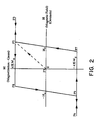
- a graph of magnetisation M versus applied magnetic field H forms a hysteresis loop as shown in Figure 2.
- the magnetisation M is shown as 4 ⁇ M in units of gauss.
- H the applied magnetic field, is shown in units of Oersteds.
- the hysteresis graph for the material follows the path from the point P3 through P2 and to the point labelled P4 in Figure 2.
- the material's magnetisation does not change from its saturated value of 4 ⁇ M s .
- a further increase of the applied magnetic field H in the reverse direction causes the magnetisation M within the magnetic field to begin to decrease following the path from the point P4 to the point labelled P5 passing through the point labelled -H c on the hysteresis loop shown in Figure 2.
- the hysteresis graph follows the path through the point P5 to the point labelled P7 in Figure 2 and the magnetisation of the material does not change from its saturated value of -4 ⁇ M s . Additional increase of the magnetic field H causes the material's magnetisation to follow the path from the point P7 to the point P2 through H c on the hysteresis loop. By continuing to vary the applied magnetic field H, the material may be made to repeatedly follow the hysteresis path of Figure 2.
- the points labelled H c and -H c represent the coercive force, or coercivity of the magnetic material.
- the area of the hysteresis loop corresponds to the energy loss during one hysteresis cycle.
- Hysteresis loss is the energy lost in the form of heat in overcoming the friction encountered during domain wall motion and domain rotation.
- Figure 3 shows a further graph of magnetisation M of a material measured in gauss versus applied magnetic field H.
- the vector H has been applied in a direction parallel to the hard axis and perpendicular to the easy axis of the magnetic material.
- H is the applied magnetic field
- 4 ⁇ M is the resultant magnetisation vector within the magnetic material. With no applied magnetic field H, the magnetisation along the hard axis direction is zero.
- the plot of magnetisation follows the line from the point labelled P8 to the point labelled P9 in Figure 3.
- a maximum magnetisation value 4 ⁇ M s has been reached for the material and the material is saturated having a magnetisation equal to 4 ⁇ M s .
- Further increase in the applied magnetic field H results in no further increase in the magnetisation of the material beyond the value 4 ⁇ M s , and the plot continues to the point labelled P10.
- the magnetisation M of the material decreases from its value at the points P9 and P10 of 4 ⁇ M s through zero at the point P8 and ultimately reaches saturation again with a value of -4 ⁇ M s at the point labelled P11 in Figure 3.
- Further increase in the applied magnetic field (in the reverse direction) beyond the level necessary to reach the point P11 results in no corresponding increase in the material's magnetisation M and the plot moves to the point labelled P12 in Figure 3.
- the value of applied magnetic field H along the hard axis necessary to place the magnetic material in saturation is known as the anisotropic field and is labelled H k .
- the permeability of the material, ⁇ may be expressed as: where M s is the saturated magnetisation value for the material and H k is the anisotropy of the material.
- M s is the saturated magnetisation value for the material
- H k is the anisotropy of the material.
- Equation (1) may be made because the factor 4 ⁇ M / H is much greater than one.
- the slope of the graph of Figure 3 is approximately equal to the permeability ⁇ of the magnetic material.
- Figure 3 graphically shows that as H k is decreased the permeability ⁇ for the material will increase as the slope of the curve in Figure 3 increases.
- Figure 4 shows a thin film head 12 comprising a core 13 including an upper pole piece 14 and a lower pole piece 16. Conductors 18 extend through the thin film head 12 and are sandwiched between the upper pole piece 14 and the lower pole piece 16.
- the upper pole piece 14 includes an upper pole tip 20 while the lower pole piece 16 includes a lower pole tip 22.
- a gap 24 is shown as formed between the upper pole tip 20 and the lower pole tip 22. Typically, alumina fills the gap.
- a magnetic storage medium (not shown) may be placed near the gap 24 such that information may be written on or read from the medium.
- FIG. 4 Also shown in Figure 4 is an arrow labelled H (Applied) indicating the direction of the applied magnetic field H and an arrow labelled M (Relaxed) indicating the magnetisation M of the thin film head 12 in its relaxed state.
- a magnetic storage medium such as a magnetic disk or a magnetic tape moves in the region near the gap 24 formed between the upper pole tip 20 and the lower pole tip 22.
- a magnetic field H will be applied to the thin film head 12 in the direction shown by the arrow labelled H (Applied) in Figure 4.
- This applied magnetic field causes the magnetisation M of the material to change direction from the direction indicated by the arrow labelled M (Relaxed) to the direction indicated by the arrow formed by the dashed line labelled M (Resultant).
- M (Resultant) is deflected away from the easy axis in a direction towards the gap 24 formed between the upper pole tip 20 and the lower pole tip 22 due to the applied magnetic field H from the electrical current passing through the conductors 18, the upper pole tip 20 will become an increasingly strong north pole while the lower pole tip 22 becomes a south pole. This causes a fringe field to form around the gap 24 with a magnetic field vector having a direction from the upper pole tip 20 to the lower pole tip 22.
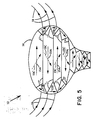
- Figure 5 shows the thin film head 12 of Figure 4 including arrows 15A, 15B and 15C indicating the direction of the magnetisation vectors M in the magnetic domains across the upper pole piece 14.
- Solid arrows 15A in Figure 5 indicate the direction of a magnetic domain's easy axis.
- Lines 17 in Figure 5 separating two adjacent magnetic domains indicate the domain walls.
- the solid arrows 15A indicate the direction of the magnetisation vector M in the relaxed state of the thin film head 12 along its easy axis.
- Small vertical arrows 15B along the edge of the upper pole piece 14 shown in Figure 5 indicate the magnetisation vector in the closure domains. Closure domains complete the magnetic circuit between adjacent opposing domains.
- the direction of the magnetisation vector M of the domains in the upper pole piece 14 are deflected away from the easy axis as indicated by the arrows 15C formed by the dashed lines. It is this deflection that causes north and south poles to form at the upper pole tip 20 and the lower pole tip 22, respectively. If the anisotropic field H k is made small, thereby increasing the permeability ⁇ for the thin film head 12, the required strength of the applied magnetic field H will be lower to achieve the same amount of deflection of the material's magnetisation M and a smaller electrical current applied through the conductors 18 is required.
- a thin film head having a large permeability ⁇ (which is proportional to M s , see Equation (1) above) will also have increased sensitivity when information is read back from the magnetic storage medium. Increased sensitivity causes even weak changes in the magnetisation of the magnetic storage medium passing through the fringe field region of the thin film head 12 to produce relatively large changes in the electrical current flowing through the conductors 18.
- thin film read/write heads are produced having large saturation magnetisation M s , low coercivity H c , low anisotropy H k and large permeability ⁇ .
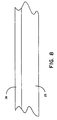
- FIG 6 shows a cross sectional view of the thin film magnetic head 12 of Figures 4 and 5.
- the thin film head 12 includes a base or "flyer” substrate 25 and the pole pieces or core 13.
- the flyer substrate 25 may comprise, for example, ALSIMAG material.
- the core 13 comprises the upper pole piece 14 and the lower pole piece 16.
- the upper pole piece and lower pole piece 14 and 16 form the upper pole tip 20 and the lower pole tip 22 between which the gap 24 is formed.
- the core 13 also includes a rear upper portion 26 and a rear lower portion 28.
- the upper pole piece and lower pole piece 14 and 16 and rear upper and lower portions 26 and 28 of the core 13 meet at a centre area or "via" 30 (not shown in Figures 4 and 5).
- the thin film head 12 of Figure 6 uses two core windings formed by conductors 18 and 34. Although only the conductors 18 are shown in Figures 4 and 5, the conductors 18 and 34 are formed in a coil around the via 30 of the core 13 with a portion of the wrapping being sandwiched between the upper pole piece and lower pole piece 14 and 16 of the core 13 and a portion of the wrapping sandwiched between the rear upper and lower portions 26 and 28 of the core 13.
- the core 13 is separated from the substrate 25 by a base coat 36.
- the base coat 36 is an insulator such as alumina, Al2O3.
- the area between the upper pole piece and lower pole piece 14 and 16 is filled with an insulating material 38.
- the insulating material 38 is photo-resist.
- the gap 24 between the upper pole tip 20 and the lower pole tip 22 is filled with alumina, Al2O3.
- the insulating material 38 is also sandwiched between the rear upper and lower portions 26 and 28 of the core 13.
- multiple heads similar to the thin film head 12 may be deposited across the entire surface of the base substrate 25.
- the base substrate 25 (upon which the head 12 is formed) is "diced” or sliced into many individual thin film heads, each carried by a portion of the base substrate 25, such that the upper and lower pole tips 20 and 22 and the gap 24 are exposed.
- the gap 24 and pole tips 20 and 22 may then be lapped in a direction generally inward, towards the centre of the thin film head 12, to the desired throat dimensions.
- the lapping process is a grinding process in which the exposed portion of the gap 24 is applied to a diamond slurry.
- Electrical contacts (not shown) are applied to the conductors 18 and 24 of the thin film head 12.
- the completed head may then be attached to some type of carrying fixture (not shown) for use in reading and writing data on a magnetic storage medium such as a computer disk.
- the magnetic storage medium is placed near the upper and lower pole tips 20 and 22 which form the gap 24.
- the changing magnetic field due to the moving storage medium impresses a magnetic field upon the upper and lower pole tips 20 and 22 formed by the upper pole pieces and lower pole pieces 14 and 16 of the core 13.
- This impressed field is carried around the conductors 18 and 34 through the upper pole piece 14, the via 30 and the lower pole piece 16 of the core 13.
- This electrical current is representative of the magnetic field produced by the moving magnetic storage medium.
- an electrical current is caused to flow in the conductor 18 or the conductor 34. This results in a magnetic field in the core 13 which is applied to the storage medium (not shown) due to the fringing effect at the gap 24 formed between the upper and lower pole tips 20 and 22 of the core 13.
- the base substrate 25 is shown.
- the base substrate 25 is typically large relative to the dimensions of the thin film magnetic heads and is referred to as a "wafer".
- many thin film heads such as the thin film head 12 typically are fabricated upon the base substrate 25.
- the base substrate 25 is made of an electrically conductive material, such as ALSIMAG.
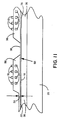
- a layer providing the base coat 36 is deposited across the entire base substrate 25 as shown in Figure 8.
- the base coat 36 is a non-conductive material, typically comprising alumina, Al2O3.
- the base coat 36 may be applied using sputtering techniques.
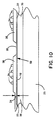
- a thin film layer 50 of magnetic material is applied across the surface using electro-deposition techniques. This process is described below in more detail.
- the layer 50 forms the lower pole piece 16 and the lower rear portion 28 of the core 13, as well as the lower pole tip 22 and part of the via 30.
- the layer 50 comprises a portion of the CoFeB core of the present invention.
- the insulating layer 38 is deposited upon the layer 50 of the core 13 in the shape shown in Figure 10.
- Alumina, Al2O3 is deposited in the gap 24.
- the conductors 34 are deposited upon the insulating layer 38 and formed in a coiled shape.
- the insulating layer 38 has been built up slightly using photo-lithographic masking and etching techniques.
- the conductors 18 are deposited similarly to the conductors 34, and formed in a coiled shape.
- the insulating layer 38 has been built up again and covers the conductors 18 and 34.
- another layer of magnetic material is deposited over the structure shown in Figure 12 to form the upper pole piece 14, the rear upper portion 26 and a portion of the via 30 as shown in Figure 6.
- This layer is deposited using electro-deposition techniques and comprises CoFeB.
- the upper pole piece 14 and the lower pole piece 16 are deposited upon the substrate 25 through electroplating.
- the anisotropic field H k may be reduced.
- the core may be annealed in a rotating field to lower the anisotropic field H k .
- the electro-plating bath used in the present invention to deposit the pole pieces 14 and 16 comprises a solution of cobalt, iron and boron. The addition of the boron reduces the coercivity H c of the pole pieces. For thicker films forming the upper pole piece 14 and the lower pole piece 16, this reduction of coercivity H is even greater.
- the concentration of boron in the electro-plating bath varies from about 0.1% to about 2.0% by weight. Iron concentration may vary from about 7.0% to about 12.0% by weight with the balance of the electro-plating bath being cobalt.
- One suitable electrolyplating bath for forming the thin film magnetic read/write head of the present invention is: Table 1 Composition Amount CoSo47H2O 50 to 300 grammes/litre FeSo46H2O 3 to 15 grammes/litre H3BO3 5 to 50 grammes/litre Sodium saccharin dihydrate 0.5 to 4 grammes/litre Dodecyl sodium sulphate 0.1 to 3 grammes/litre DMAB 1 to 10 drops/litre of 2 grammes/50 ml dissolved DMAB Sodium citrate 0.5 to 10 grammes/litre DMAB (dimethyl amine borane) acts as a reducing agent and provides the dis-associated boron used for deposition of the CoFeB thin film core.
- the disassociated cobalt ion may range from 5 to 100 grammes/litre in the electro-plating bath.
- the iron ion may range from 0.2 to 5.0 grammes/litre in the electroplating bath.
- a suitable temperature during electroplating is about 30.C.
- a suitable pH for the electroplating bath is about 3.5. The ratio between cobalt, iron and boron in the electro-plating bath will remain approximately the same in the electro-plated film.
- Pulse electro-plating may be used during the deposition of the cobalt-iron-boron core using 6 ampere pulses with a 10 mS on time and a 90 mS off time. Pulse electro-plating helps maintain the magnetic characteristics of the cobalt-iron-boron core as the core's thickness grows beyond about 0.5 microns, preventing the core from becoming isotropic and losing its hysteresis loop.
- the thin film exhibits useful magnetic characteristics for thickness between about 500 ⁇ and about 10 microns, preferably ranging between about 2000 ⁇ and about 3 microns.
- the anisotropy field H k of the core may be lowered by two alternative methods.
- a rotating magnetic field may be applied. This field should alternate between the normal axis of the core and 90° off the normal axis. Applying the normal field for 40 seconds of a one minute cycle and the 90° field for the remaining 20 seconds of the one minute cycle provides a suitable ratio between the two field positions.
- this rotating field may be applied during an annealing step in which the core material is subjected to heat.
- Table 2 shows a comparison between a nickel-iron core (using 82% nickel in the alloy), a cobalt-iron core (using 90% cobalt in the alloy), and the cobalt-iron-boron core of the present invention (also using 90% cobalt in the alloy).
- Table 2 Core Saturation Material Magnetization 4 ⁇ Ms Hc Hk ⁇ 82NiFe 10 KGauss ⁇ 0.2 Oe ⁇ 2.5 Oe ⁇ 4000 90CoFe 19 KGauss ⁇ 3.0 Oe ⁇ 13 Oe ⁇ 1500 90CoFeB 19 KGauss ⁇ 1.0 Oe ⁇ 7 Oe ⁇ 2500
- Table 2 shows that H c and H k are reduced for the CoFeB core of the present invention while the value of the permeability ⁇ is greatly increased over the cobaltiron core.
- the thin film magnetic head coercivity H c is reduced over that of a cobalt-iron thin film head as the thickness of the film is increased.
- the head will have a high saturation magnetisation 4 ⁇ M s , low coercivity H c , low anisotropy H k and an increased permeability ⁇ .
- the thin film magnetic read/write head of the present invention offers improved reading and writing characteristics whereby magnetic storage density may be increased.
Landscapes
- Engineering & Computer Science (AREA)
- Manufacturing & Machinery (AREA)
- Magnetic Heads (AREA)
Applications Claiming Priority (2)
| Application Number | Priority Date | Filing Date | Title |
|---|---|---|---|
| US42573589A | 1989-10-20 | 1989-10-20 | |
| US425735 | 1989-10-20 |
Publications (3)
| Publication Number | Publication Date |
|---|---|
| EP0426326A2 true EP0426326A2 (de) | 1991-05-08 |
| EP0426326A3 EP0426326A3 (en) | 1993-09-29 |
| EP0426326B1 EP0426326B1 (de) | 1997-09-17 |
Family
ID=23687810
Family Applications (1)
| Application Number | Title | Priority Date | Filing Date |
|---|---|---|---|
| EP90311353A Expired - Lifetime EP0426326B1 (de) | 1989-10-20 | 1990-10-17 | Magnetischer Lese-/Schreibkopf und Herstellungsverfahren eines solchen Kopfes |
Country Status (5)
| Country | Link |
|---|---|
| US (2) | US5168410A (de) |
| EP (1) | EP0426326B1 (de) |
| JP (1) | JPH04129009A (de) |
| DE (1) | DE69031453T2 (de) |
| SG (1) | SG48895A1 (de) |
Families Citing this family (20)
| Publication number | Priority date | Publication date | Assignee | Title |
|---|---|---|---|---|
| JPH04310608A (ja) * | 1991-04-09 | 1992-11-02 | Matsushita Electric Ind Co Ltd | 薄膜磁気ヘッドの製造方法 |
| US5404635A (en) * | 1992-05-21 | 1995-04-11 | Das Devices, Inc. | Method of making a narrow track thin film head |
| JPH07254116A (ja) * | 1994-03-16 | 1995-10-03 | Fuji Electric Co Ltd | 薄膜磁気ヘッドの熱処理方法 |
| US5600519A (en) * | 1995-03-06 | 1997-02-04 | International Business Machines Corporation | Controlled saturation thin film magnetic write head |
| US5889403A (en) * | 1995-03-31 | 1999-03-30 | Canon Denshi Kabushiki Kaisha | Magnetic detecting element utilizing magnetic impedance effect |
| US5883762A (en) * | 1997-03-13 | 1999-03-16 | Calhoun; Robert B. | Electroplating apparatus and process for reducing oxidation of oxidizable plating anions and cations |
| JP3049315B1 (ja) * | 1999-02-19 | 2000-06-05 | 名古屋大学長 | 磁場による電析または無電解析出膜の結晶方位制御方法 |
| US6898053B1 (en) | 1999-10-26 | 2005-05-24 | Seagate Technology Llc | Perpendicular recording head with trackwidth defined by plating thickness |
| US6560069B1 (en) | 1999-11-29 | 2003-05-06 | Seagate Technology, Llc | Perpendicular recording head defining the trackwidth by material deposition thickness |
| US6693768B1 (en) * | 2000-03-15 | 2004-02-17 | Seagate Technology Llc | Perpendicular magnetic recording head having a flux focusing main pole |
| US6855240B2 (en) * | 2000-08-09 | 2005-02-15 | Hitachi Global Storage Technologies Netherlands B.V. | CoFe alloy film and process of making same |
| US6687085B2 (en) | 2001-07-17 | 2004-02-03 | Seagate Technology Llc | Perpendicular write head with high magnetization pole material and method of fabricating the write head |
| US6876507B2 (en) * | 2002-01-18 | 2005-04-05 | International Business Machines Corporation | High-saturation thin-film write head for high-coercivity magnetic data storage media |
| WO2004077413A1 (ja) * | 2003-02-19 | 2004-09-10 | Neomax Co., Ltd. | 磁場中熱処理装置 |
| US7102854B2 (en) * | 2003-10-03 | 2006-09-05 | Seagate Technology Llc | Transducing head with reduced side writing |
| US7135103B2 (en) * | 2003-10-20 | 2006-11-14 | Waseda University | Preparation of soft magnetic thin film |
| US8177955B2 (en) * | 2004-06-03 | 2012-05-15 | Headway Technologies, Inc. | Electrodeposition of FeCoNiV films with high resistivity and high saturation magnetization for magnetic head fabrication |
| JP2007123473A (ja) * | 2005-10-27 | 2007-05-17 | Alps Electric Co Ltd | 軟磁性膜及びその製造方法、ならびに前記軟磁性膜を用いた薄膜磁気ヘッド及びその製造方法 |
| US8497538B2 (en) * | 2006-05-31 | 2013-07-30 | Everspin Technologies, Inc. | MRAM synthetic antiferromagnet structure |
| US20090046397A1 (en) * | 2007-08-15 | 2009-02-19 | Freescale Semiconductor, Inc. | Methods and apparatus for a synthetic anti-ferromagnet structure with improved thermal stability |
Family Cites Families (18)
| Publication number | Priority date | Publication date | Assignee | Title |
|---|---|---|---|---|
| JPS519570B1 (de) * | 1970-10-05 | 1976-03-27 | ||
| JPS5194211A (de) * | 1975-02-15 | 1976-08-18 | ||
| US4165525A (en) * | 1978-02-15 | 1979-08-21 | U.S. Philips Corporation | Magnetic head having a core provided on a substrate by means of thin-film technology |
| US4201837A (en) * | 1978-11-16 | 1980-05-06 | General Electric Company | Bonded amorphous metal electromagnetic components |
| US4242710A (en) * | 1979-01-29 | 1980-12-30 | International Business Machines Corporation | Thin film head having negative magnetostriction |
| JPS5719361A (en) * | 1980-07-11 | 1982-02-01 | Hitachi Ltd | Amorphous alloy for core of magnetic head and magnetic head for video using it |
| US4440609A (en) * | 1980-12-31 | 1984-04-03 | International Business Machines Corporation | Method of electrodepositing a low coercine force, corrosion-resistant alloy of nickel, iron and boron |
| JPS57155707A (en) * | 1981-03-20 | 1982-09-25 | Matsushita Electric Ind Co Ltd | Amorphous alloy thin film magnetic core and its manufacture |
| JPS57155339A (en) * | 1981-03-20 | 1982-09-25 | Matsushita Electric Ind Co Ltd | Magnetic head and production thereof |
| JPH061729B2 (ja) * | 1983-01-17 | 1994-01-05 | 株式会社日立製作所 | 磁性体膜およびそれを用いた磁気ヘッド |
| JPS59231722A (ja) * | 1983-06-13 | 1984-12-26 | Matsushita Electric Ind Co Ltd | 薄膜磁気ヘッドの製造方法 |
| JPS6074104A (ja) * | 1983-09-29 | 1985-04-26 | Alps Electric Co Ltd | デジタル用磁気ヘツド |
| JPS6176642A (ja) * | 1984-09-25 | 1986-04-19 | Hitachi Ltd | Co―Ni―Fe合金の電気めっき浴及び電気めっき方法 |
| NL8403595A (nl) * | 1984-11-27 | 1986-06-16 | Philips Nv | Magneetkop met kerndelen van amorf ferromagnetisch metaal. |
| US4661216A (en) * | 1986-04-21 | 1987-04-28 | International Business Machines Corporation | Electrodepositing CoNiFe alloys for thin film heads |
| KR960004065B1 (ko) * | 1986-05-30 | 1996-03-26 | 가부시기가이샤 히다찌세이사꾸쇼 | 자성체막 및 이것을 사용한 자기 헤드 |
| EP0303324A1 (de) * | 1987-08-10 | 1989-02-15 | Koninklijke Philips Electronics N.V. | Magnetisches Material, Verfahren zum Herstellen dieses Materials und mit diesem Material versehener Magnetkopf |
| US5011581A (en) * | 1988-09-28 | 1991-04-30 | Matsushita Electric Industrial Co., Ltd. | Process for producing a thin alloy film having high saturation magnetic flux density |
-
1990
- 1990-04-25 JP JP2107736A patent/JPH04129009A/ja active Pending
- 1990-10-17 SG SG1996003562A patent/SG48895A1/en unknown
- 1990-10-17 EP EP90311353A patent/EP0426326B1/de not_active Expired - Lifetime
- 1990-10-17 DE DE69031453T patent/DE69031453T2/de not_active Expired - Fee Related
-
1991
- 1991-08-12 US US07/744,827 patent/US5168410A/en not_active Expired - Fee Related
-
1992
- 1992-09-14 US US07/944,393 patent/US5372698A/en not_active Expired - Fee Related
Also Published As
| Publication number | Publication date |
|---|---|
| DE69031453T2 (de) | 1998-01-29 |
| SG48895A1 (en) | 1998-05-18 |
| EP0426326A3 (en) | 1993-09-29 |
| EP0426326B1 (de) | 1997-09-17 |
| DE69031453D1 (de) | 1997-10-23 |
| US5372698A (en) | 1994-12-13 |
| JPH04129009A (ja) | 1992-04-30 |
| HK1003039A1 (en) | 1998-09-30 |
| US5168410A (en) | 1992-12-01 |
Similar Documents
| Publication | Publication Date | Title |
|---|---|---|
| EP0426326B1 (de) | Magnetischer Lese-/Schreibkopf und Herstellungsverfahren eines solchen Kopfes | |
| US5379172A (en) | Laminated leg for thin film magnetic transducer | |
| US5763108A (en) | High saturtion magnetization material and magnetic head fabricated therefrom | |
| EP0013883B1 (de) | Köpfe mit dünnen magnetischen Schichten | |
| US6296955B1 (en) | High moment and high permeability transducer structures and formation | |
| US6259583B1 (en) | Laminated yoke head with a domain control element | |
| US4780781A (en) | Thin film magnetic head having magnetic film of Co-Ni-Fe alloy | |
| EP0243627B1 (de) | Galvanisch abgeschiedene CoNiFe-Legierung für mit einem dünnen Film versehene Schreib-Lese-Köpfe | |
| US6120918A (en) | Co-Fe-Ni thin magnetic film, process for producing the same, composite thin film magnetic head, and magnetic recording device | |
| EP0881627A2 (de) | Dünnfilmmagnetkopf | |
| JPH10199726A (ja) | Co−Ni−Feを主成分とする軟磁性薄膜,その製造方法,それを用いた磁気ヘッド及び磁気記憶装置 | |
| Andricacos et al. | Magnetically soft materials in data storage: Their properties and electrochemistry | |
| US6507464B1 (en) | Co-Fe-Ni magnetic film having a high saturation magnetic flux density, composite thin film magnetic head using the film and magnetic memory device using the head | |
| US6793961B2 (en) | Enhancement of magnetization switching speed in soft ferromagnetic films through control of edge stress anisotropy | |
| US7101633B2 (en) | Electroplated magnetic thin film, method of manufacturing the same, electroplating bath and thin film magnetic head | |
| JPH0271413A (ja) | 改良した磁気ドメイン構造を有する極片の製造方法 | |
| US6507457B2 (en) | Magnetic head | |
| US5666250A (en) | Thin film magnetic heads with thin nickel underlayers | |
| US6125010A (en) | Mo-Au gold seedlayer in thin film heads | |
| HK1010069B (en) | Thin film magnetic heads with thin nickel underlayers | |
| HK1003039B (en) | Magnetic read/write head and method of making such a head | |
| KR100331188B1 (ko) | 박막자기헤드,기록/재생분리형헤드및이를이용한자기기록및재생장치 | |
| JPH06195637A (ja) | 薄膜磁気ヘッド | |
| Lier et al. | Combined thin film magnetoresistive read, inductive write heads | |
| US20070047140A1 (en) | Electroplated multiple layer soft magnetic materials with high magnetic moment |
Legal Events
| Date | Code | Title | Description |
|---|---|---|---|
| PUAI | Public reference made under article 153(3) epc to a published international application that has entered the european phase |
Free format text: ORIGINAL CODE: 0009012 |
|
| AK | Designated contracting states |
Kind code of ref document: A2 Designated state(s): DE FR GB IT NL |
|
| RIN1 | Information on inventor provided before grant (corrected) |
Inventor name: LIAO, SIMON HUANGCHUNG |
|
| PUAL | Search report despatched |
Free format text: ORIGINAL CODE: 0009013 |
|
| AK | Designated contracting states |
Kind code of ref document: A3 Designated state(s): DE FR GB IT NL |
|
| 17P | Request for examination filed |
Effective date: 19940210 |
|
| 17Q | First examination report despatched |
Effective date: 19950629 |
|
| GRAG | Despatch of communication of intention to grant |
Free format text: ORIGINAL CODE: EPIDOS AGRA |
|
| GRAH | Despatch of communication of intention to grant a patent |
Free format text: ORIGINAL CODE: EPIDOS IGRA |
|
| GRAH | Despatch of communication of intention to grant a patent |
Free format text: ORIGINAL CODE: EPIDOS IGRA |
|
| GRAA | (expected) grant |
Free format text: ORIGINAL CODE: 0009210 |
|
| AK | Designated contracting states |
Kind code of ref document: B1 Designated state(s): DE FR GB IT NL |
|
| PG25 | Lapsed in a contracting state [announced via postgrant information from national office to epo] |
Ref country code: IT Free format text: LAPSE BECAUSE OF FAILURE TO SUBMIT A TRANSLATION OF THE DESCRIPTION OR TO PAY THE FEE WITHIN THE PRE;WARNING: LAPSES OF ITALIAN PATENTS WITH EFFECTIVE DATE BEFORE 2007 MAY HAVE OCCURRED AT ANY TIME BEFORE 2007. THE CORRECT EFFECTIVE DATE MAY BE DIFFERENT FROM THE ONE RECORDED.SCRIBED TIME-LIMIT Effective date: 19970917 Ref country code: FR Free format text: LAPSE BECAUSE OF FAILURE TO SUBMIT A TRANSLATION OF THE DESCRIPTION OR TO PAY THE FEE WITHIN THE PRESCRIBED TIME-LIMIT Effective date: 19970917 Ref country code: NL Free format text: LAPSE BECAUSE OF FAILURE TO SUBMIT A TRANSLATION OF THE DESCRIPTION OR TO PAY THE FEE WITHIN THE PRESCRIBED TIME-LIMIT Effective date: 19970917 |
|
| REF | Corresponds to: |
Ref document number: 69031453 Country of ref document: DE Date of ref document: 19971023 |
|
| EN | Fr: translation not filed | ||
| NLV1 | Nl: lapsed or annulled due to failure to fulfill the requirements of art. 29p and 29m of the patents act | ||
| PLBE | No opposition filed within time limit |
Free format text: ORIGINAL CODE: 0009261 |
|
| STAA | Information on the status of an ep patent application or granted ep patent |
Free format text: STATUS: NO OPPOSITION FILED WITHIN TIME LIMIT |
|
| 26N | No opposition filed | ||
| REG | Reference to a national code |
Ref country code: GB Ref legal event code: 732E |
|
| REG | Reference to a national code |
Ref country code: GB Ref legal event code: IF02 |
|
| PGFP | Annual fee paid to national office [announced via postgrant information from national office to epo] |
Ref country code: GB Payment date: 20031001 Year of fee payment: 14 |
|
| PGFP | Annual fee paid to national office [announced via postgrant information from national office to epo] |
Ref country code: DE Payment date: 20031029 Year of fee payment: 14 |
|
| PG25 | Lapsed in a contracting state [announced via postgrant information from national office to epo] |
Ref country code: GB Free format text: LAPSE BECAUSE OF NON-PAYMENT OF DUE FEES Effective date: 20041017 |
|
| PG25 | Lapsed in a contracting state [announced via postgrant information from national office to epo] |
Ref country code: DE Free format text: LAPSE BECAUSE OF NON-PAYMENT OF DUE FEES Effective date: 20050503 |
|
| GBPC | Gb: european patent ceased through non-payment of renewal fee |
Effective date: 20041017 |