EP0426548A1 - Feuille complexe de papier absorbant - Google Patents
Feuille complexe de papier absorbant Download PDFInfo
- Publication number
- EP0426548A1 EP0426548A1 EP90403043A EP90403043A EP0426548A1 EP 0426548 A1 EP0426548 A1 EP 0426548A1 EP 90403043 A EP90403043 A EP 90403043A EP 90403043 A EP90403043 A EP 90403043A EP 0426548 A1 EP0426548 A1 EP 0426548A1
- Authority
- EP
- European Patent Office
- Prior art keywords
- sheets
- sheet
- complex sheet
- complex
- absorbent paper
- Prior art date
- Legal status (The legal status is an assumption and is not a legal conclusion. Google has not performed a legal analysis and makes no representation as to the accuracy of the status listed.)
- Granted
Links
- 230000002745 absorbent Effects 0.000 title claims abstract description 14
- 239000002250 absorbent Substances 0.000 title claims abstract description 14
- 238000004049 embossing Methods 0.000 claims abstract description 14
- 229920002678 cellulose Polymers 0.000 claims abstract description 9
- 239000001913 cellulose Substances 0.000 claims abstract description 9
- 238000004026 adhesive bonding Methods 0.000 claims abstract description 8
- 238000000034 method Methods 0.000 claims abstract description 6
- 238000003490 calendering Methods 0.000 claims abstract description 4
- 238000005259 measurement Methods 0.000 claims abstract description 3
- 239000002184 metal Substances 0.000 description 8
- 239000003292 glue Substances 0.000 description 6
- 238000009434 installation Methods 0.000 description 5
- 239000000853 adhesive Substances 0.000 description 4
- 230000001070 adhesive effect Effects 0.000 description 4
- 238000004519 manufacturing process Methods 0.000 description 3
- 230000009466 transformation Effects 0.000 description 2
- 230000001186 cumulative effect Effects 0.000 description 1
- 230000007547 defect Effects 0.000 description 1
- 238000000151 deposition Methods 0.000 description 1
- 238000002513 implantation Methods 0.000 description 1
- 238000003754 machining Methods 0.000 description 1
- 239000000463 material Substances 0.000 description 1
- 230000010355 oscillation Effects 0.000 description 1
- 230000000737 periodic effect Effects 0.000 description 1
- 238000004513 sizing Methods 0.000 description 1
- 239000007787 solid Substances 0.000 description 1
- 230000001360 synchronised effect Effects 0.000 description 1
- 238000011144 upstream manufacturing Methods 0.000 description 1
- 238000004804 winding Methods 0.000 description 1
Images


Classifications
-
- D—TEXTILES; PAPER
- D21—PAPER-MAKING; PRODUCTION OF CELLULOSE
- D21H—PULP COMPOSITIONS; PREPARATION THEREOF NOT COVERED BY SUBCLASSES D21C OR D21D; IMPREGNATING OR COATING OF PAPER; TREATMENT OF FINISHED PAPER NOT COVERED BY CLASS B31 OR SUBCLASS D21G; PAPER NOT OTHERWISE PROVIDED FOR
- D21H27/00—Special paper not otherwise provided for, e.g. made by multi-step processes
- D21H27/30—Multi-ply
- D21H27/40—Multi-ply at least one of the sheets being non-planar, e.g. crêped
-
- B—PERFORMING OPERATIONS; TRANSPORTING
- B31—MAKING ARTICLES OF PAPER, CARDBOARD OR MATERIAL WORKED IN A MANNER ANALOGOUS TO PAPER; WORKING PAPER, CARDBOARD OR MATERIAL WORKED IN A MANNER ANALOGOUS TO PAPER
- B31F—MECHANICAL WORKING OR DEFORMATION OF PAPER, CARDBOARD OR MATERIAL WORKED IN A MANNER ANALOGOUS TO PAPER
- B31F1/00—Mechanical deformation without removing material, e.g. in combination with laminating
- B31F1/07—Embossing, i.e. producing impressions formed by locally deep-drawing, e.g. using rolls provided with complementary profiles
-
- B—PERFORMING OPERATIONS; TRANSPORTING
- B31—MAKING ARTICLES OF PAPER, CARDBOARD OR MATERIAL WORKED IN A MANNER ANALOGOUS TO PAPER; WORKING PAPER, CARDBOARD OR MATERIAL WORKED IN A MANNER ANALOGOUS TO PAPER
- B31F—MECHANICAL WORKING OR DEFORMATION OF PAPER, CARDBOARD OR MATERIAL WORKED IN A MANNER ANALOGOUS TO PAPER
- B31F2201/00—Mechanical deformation of paper or cardboard without removing material
- B31F2201/07—Embossing
- B31F2201/0707—Embossing by tools working continuously
- B31F2201/0715—The tools being rollers
- B31F2201/0723—Characteristics of the rollers
- B31F2201/0733—Pattern
-
- B—PERFORMING OPERATIONS; TRANSPORTING
- B31—MAKING ARTICLES OF PAPER, CARDBOARD OR MATERIAL WORKED IN A MANNER ANALOGOUS TO PAPER; WORKING PAPER, CARDBOARD OR MATERIAL WORKED IN A MANNER ANALOGOUS TO PAPER
- B31F—MECHANICAL WORKING OR DEFORMATION OF PAPER, CARDBOARD OR MATERIAL WORKED IN A MANNER ANALOGOUS TO PAPER
- B31F2201/00—Mechanical deformation of paper or cardboard without removing material
- B31F2201/07—Embossing
- B31F2201/0707—Embossing by tools working continuously
- B31F2201/0715—The tools being rollers
- B31F2201/0723—Characteristics of the rollers
- B31F2201/0738—Cross sectional profile of the embossments
-
- B—PERFORMING OPERATIONS; TRANSPORTING
- B31—MAKING ARTICLES OF PAPER, CARDBOARD OR MATERIAL WORKED IN A MANNER ANALOGOUS TO PAPER; WORKING PAPER, CARDBOARD OR MATERIAL WORKED IN A MANNER ANALOGOUS TO PAPER
- B31F—MECHANICAL WORKING OR DEFORMATION OF PAPER, CARDBOARD OR MATERIAL WORKED IN A MANNER ANALOGOUS TO PAPER
- B31F2201/00—Mechanical deformation of paper or cardboard without removing material
- B31F2201/07—Embossing
- B31F2201/0756—Characteristics of the incoming material, e.g. creped, embossed, corrugated
-
- B—PERFORMING OPERATIONS; TRANSPORTING
- B31—MAKING ARTICLES OF PAPER, CARDBOARD OR MATERIAL WORKED IN A MANNER ANALOGOUS TO PAPER; WORKING PAPER, CARDBOARD OR MATERIAL WORKED IN A MANNER ANALOGOUS TO PAPER
- B31F—MECHANICAL WORKING OR DEFORMATION OF PAPER, CARDBOARD OR MATERIAL WORKED IN A MANNER ANALOGOUS TO PAPER
- B31F2201/00—Mechanical deformation of paper or cardboard without removing material
- B31F2201/07—Embossing
- B31F2201/0758—Characteristics of the embossed product
- B31F2201/0761—Multi-layered
- B31F2201/0766—Multi-layered the layers being superposed tip to tip
-
- B—PERFORMING OPERATIONS; TRANSPORTING
- B31—MAKING ARTICLES OF PAPER, CARDBOARD OR MATERIAL WORKED IN A MANNER ANALOGOUS TO PAPER; WORKING PAPER, CARDBOARD OR MATERIAL WORKED IN A MANNER ANALOGOUS TO PAPER
- B31F—MECHANICAL WORKING OR DEFORMATION OF PAPER, CARDBOARD OR MATERIAL WORKED IN A MANNER ANALOGOUS TO PAPER
- B31F2201/00—Mechanical deformation of paper or cardboard without removing material
- B31F2201/07—Embossing
- B31F2201/0758—Characteristics of the embossed product
- B31F2201/0761—Multi-layered
- B31F2201/0769—Multi-layered the layers being shifted
-
- B—PERFORMING OPERATIONS; TRANSPORTING
- B31—MAKING ARTICLES OF PAPER, CARDBOARD OR MATERIAL WORKED IN A MANNER ANALOGOUS TO PAPER; WORKING PAPER, CARDBOARD OR MATERIAL WORKED IN A MANNER ANALOGOUS TO PAPER
- B31F—MECHANICAL WORKING OR DEFORMATION OF PAPER, CARDBOARD OR MATERIAL WORKED IN A MANNER ANALOGOUS TO PAPER
- B31F2201/00—Mechanical deformation of paper or cardboard without removing material
- B31F2201/07—Embossing
- B31F2201/0784—Auxiliary operations
- B31F2201/0787—Applying adhesive
-
- Y—GENERAL TAGGING OF NEW TECHNOLOGICAL DEVELOPMENTS; GENERAL TAGGING OF CROSS-SECTIONAL TECHNOLOGIES SPANNING OVER SEVERAL SECTIONS OF THE IPC; TECHNICAL SUBJECTS COVERED BY FORMER USPC CROSS-REFERENCE ART COLLECTIONS [XRACs] AND DIGESTS
- Y10—TECHNICAL SUBJECTS COVERED BY FORMER USPC
- Y10T—TECHNICAL SUBJECTS COVERED BY FORMER US CLASSIFICATION
- Y10T428/00—Stock material or miscellaneous articles
- Y10T428/24—Structurally defined web or sheet [e.g., overall dimension, etc.]
- Y10T428/24355—Continuous and nonuniform or irregular surface on layer or component [e.g., roofing, etc.]
- Y10T428/24446—Wrinkled, creased, crinkled or creped
- Y10T428/24455—Paper
- Y10T428/24463—Plural paper components
-
- Y—GENERAL TAGGING OF NEW TECHNOLOGICAL DEVELOPMENTS; GENERAL TAGGING OF CROSS-SECTIONAL TECHNOLOGIES SPANNING OVER SEVERAL SECTIONS OF THE IPC; TECHNICAL SUBJECTS COVERED BY FORMER USPC CROSS-REFERENCE ART COLLECTIONS [XRACs] AND DIGESTS
- Y10—TECHNICAL SUBJECTS COVERED BY FORMER USPC
- Y10T—TECHNICAL SUBJECTS COVERED BY FORMER US CLASSIFICATION
- Y10T428/00—Stock material or miscellaneous articles
- Y10T428/24—Structurally defined web or sheet [e.g., overall dimension, etc.]
- Y10T428/24479—Structurally defined web or sheet [e.g., overall dimension, etc.] including variation in thickness
-
- Y—GENERAL TAGGING OF NEW TECHNOLOGICAL DEVELOPMENTS; GENERAL TAGGING OF CROSS-SECTIONAL TECHNOLOGIES SPANNING OVER SEVERAL SECTIONS OF THE IPC; TECHNICAL SUBJECTS COVERED BY FORMER USPC CROSS-REFERENCE ART COLLECTIONS [XRACs] AND DIGESTS
- Y10—TECHNICAL SUBJECTS COVERED BY FORMER USPC
- Y10T—TECHNICAL SUBJECTS COVERED BY FORMER US CLASSIFICATION
- Y10T428/00—Stock material or miscellaneous articles
- Y10T428/24—Structurally defined web or sheet [e.g., overall dimension, etc.]
- Y10T428/24479—Structurally defined web or sheet [e.g., overall dimension, etc.] including variation in thickness
- Y10T428/24562—Interlaminar spaces
-
- Y—GENERAL TAGGING OF NEW TECHNOLOGICAL DEVELOPMENTS; GENERAL TAGGING OF CROSS-SECTIONAL TECHNOLOGIES SPANNING OVER SEVERAL SECTIONS OF THE IPC; TECHNICAL SUBJECTS COVERED BY FORMER USPC CROSS-REFERENCE ART COLLECTIONS [XRACs] AND DIGESTS
- Y10—TECHNICAL SUBJECTS COVERED BY FORMER USPC
- Y10T—TECHNICAL SUBJECTS COVERED BY FORMER US CLASSIFICATION
- Y10T428/00—Stock material or miscellaneous articles
- Y10T428/24—Structurally defined web or sheet [e.g., overall dimension, etc.]
- Y10T428/24479—Structurally defined web or sheet [e.g., overall dimension, etc.] including variation in thickness
- Y10T428/24612—Composite web or sheet
-
- Y—GENERAL TAGGING OF NEW TECHNOLOGICAL DEVELOPMENTS; GENERAL TAGGING OF CROSS-SECTIONAL TECHNOLOGIES SPANNING OVER SEVERAL SECTIONS OF THE IPC; TECHNICAL SUBJECTS COVERED BY FORMER USPC CROSS-REFERENCE ART COLLECTIONS [XRACs] AND DIGESTS
- Y10—TECHNICAL SUBJECTS COVERED BY FORMER USPC
- Y10T—TECHNICAL SUBJECTS COVERED BY FORMER US CLASSIFICATION
- Y10T428/00—Stock material or miscellaneous articles
- Y10T428/24—Structurally defined web or sheet [e.g., overall dimension, etc.]
- Y10T428/24628—Nonplanar uniform thickness material
-
- Y—GENERAL TAGGING OF NEW TECHNOLOGICAL DEVELOPMENTS; GENERAL TAGGING OF CROSS-SECTIONAL TECHNOLOGIES SPANNING OVER SEVERAL SECTIONS OF THE IPC; TECHNICAL SUBJECTS COVERED BY FORMER USPC CROSS-REFERENCE ART COLLECTIONS [XRACs] AND DIGESTS
- Y10—TECHNICAL SUBJECTS COVERED BY FORMER USPC
- Y10T—TECHNICAL SUBJECTS COVERED BY FORMER US CLASSIFICATION
- Y10T428/00—Stock material or miscellaneous articles
- Y10T428/24—Structurally defined web or sheet [e.g., overall dimension, etc.]
- Y10T428/24628—Nonplanar uniform thickness material
- Y10T428/24661—Forming, or cooperating to form cells
-
- Y—GENERAL TAGGING OF NEW TECHNOLOGICAL DEVELOPMENTS; GENERAL TAGGING OF CROSS-SECTIONAL TECHNOLOGIES SPANNING OVER SEVERAL SECTIONS OF THE IPC; TECHNICAL SUBJECTS COVERED BY FORMER USPC CROSS-REFERENCE ART COLLECTIONS [XRACs] AND DIGESTS
- Y10—TECHNICAL SUBJECTS COVERED BY FORMER USPC
- Y10T—TECHNICAL SUBJECTS COVERED BY FORMER US CLASSIFICATION
- Y10T428/00—Stock material or miscellaneous articles
- Y10T428/24—Structurally defined web or sheet [e.g., overall dimension, etc.]
- Y10T428/24628—Nonplanar uniform thickness material
- Y10T428/24669—Aligned or parallel nonplanarities
-
- Y—GENERAL TAGGING OF NEW TECHNOLOGICAL DEVELOPMENTS; GENERAL TAGGING OF CROSS-SECTIONAL TECHNOLOGIES SPANNING OVER SEVERAL SECTIONS OF THE IPC; TECHNICAL SUBJECTS COVERED BY FORMER USPC CROSS-REFERENCE ART COLLECTIONS [XRACs] AND DIGESTS
- Y10—TECHNICAL SUBJECTS COVERED BY FORMER USPC
- Y10T—TECHNICAL SUBJECTS COVERED BY FORMER US CLASSIFICATION
- Y10T428/00—Stock material or miscellaneous articles
- Y10T428/24—Structurally defined web or sheet [e.g., overall dimension, etc.]
- Y10T428/24628—Nonplanar uniform thickness material
- Y10T428/24669—Aligned or parallel nonplanarities
- Y10T428/24694—Parallel corrugations
Definitions
- the present invention relates to the field of absorbent paper, in particular cellulose wadding, for sanitary use as toilet paper for example or else for domestic use as household paper.
- US Pat. No. 3,414,459 describes a sheet of absorbent paper obtained by combining, called tips against tips, at least two embossed sheets of cellulose wadding paper.
- the embossing pattern consists of protuberances arranged in a regular network, the density of which is between 3 and 30 protuberances per cm2.
- the protrusions on each sheet are obtained by mechanical deformation between a metal cylinder engraved in relief according to the desired pattern and a smooth rubber cylinder.
- the protrusions are arranged on the same side of the plane of the sheet, have a height of between 0.2 and 1 mm, and occupy between 10 and 60% of the total surface.
- a mechanical calendering treatment is applied to the double sheet from the connecting rolls, by which its thickness is reduced by at least 50%.
- This treatment aims to reduce the modulus of compressibility of the double sheet, that is to say the resistance to deformation when it is subjected to a compressive force exerted perpendicular to its main plane. It follows that a person handling the leaf thus treated will feel an impression of greater softness and will attribute a spongy character to it.
- the two sheets are bonded by passing them through the clamping gap formed between the two identical metallic embossing cylinders.
- the latter are arranged in parallel, and driven by means of belts or other equivalent members so that their rotational speeds are equal and in opposite directions.
- the drive members are adjusted so that the bosses coincide as exactly as possible in the tightening interval.
- the invention proposes to solve this problem and aims to provide a complex sheet which we control the extent of areas where the two sheets are not linked due to the misalignment of the protrusions.
- the invention therefore relates to a complex sheet composed of at least two sheets of absorbent paper of cellulose wadding, the grammage of which is between 10 and 40 g / m2, obtained in particular according to a process consisting of embossing separately by calendering each said sheets in a pattern consisting of protrusions, distributed in a first step (P1sm, P2sm) in a first direction and a second step (P1st, P2st) in a second direction forming a non-zero angle with the first, and the end of which remote from the non-embossed plane comprises a connecting flat, link the two sheets together by said flat surfaces placed in coincidence at least partially.
- This complex sheet is characterized in that the steps (P1sm, P2sm) in said first direction are different and are linked by the relation L1 being a predetermined value, corresponds to the measurement of any segment, parallel to the first direction, along which it is desired to guarantee the existence of at least one point capable of constituting a connection between the two sheets whatever the relative position of the two motifs.
- the pitch of each pattern according to the chosen direction which can be, the manufacturing machine direction - corresponding to the direction of travel of the sheets - or else the transverse direction which is perpendicular thereto.
- This misalignment is due to the inevitable manufacturing tolerances. A tiny initial difference at the level of two adjacent reliefs becomes observable by the cumulative effect and the high number of reliefs.
- This distance PL which can be designated by "no connection”, therefore corresponds to the distance separating two zones of the complex sheet likely to include a connection between the two sheets (for each of these two zones the contact surface between the two reliefs is sufficient to constitute a connection).
- the invention is therefore based on the consideration that the unbound zones being included within a segment of length equal to the pitch of connection of the two patterns, the extent of this undesirable zone can be reduced at will by reducing the value of the connection step.
- connection points do not only exist at the places where the protuberances have a minimum or zero deviation. Connection points will no doubt be formed on either side of these protrusions, as long as the contact surface is sufficient. But the invention provides the guarantee of the existence of at least one link over this distance, which is sufficient to keep the two sheets integral.
- the invention is of general application regardless of the pattern, but it is of certain interest when the sheets are embossed with a fine pattern, that is to say a pattern whose density is greater than 20 protuberances per cm2 and less than 300. It will be noted that beyond 300 the distance separating the protuberances is too small to allow the deformation of the sheet of absorbent paper.
- the leaf is smooth in appearance.
- the surface of the flats is between 5 and 30% of the surface of the sheet before embossing.
- the complex sheet is produced in a strip of width of 2.60 m, then cut lengthwise into strips of width of 100 mm, to be transformed into rolls of toilet paper whose rolled strip is pre-cut, at regular intervals, so as to obtain sheets of format 100 x 125 mm2.
- the steps of the two patterns are chosen so that at least one of the connecting steps in a direction SM or ST is less than 100 mm. This guarantees that each 100 x 125 format sheet will include at least one connection point. This is of course the minimum requirement. In practice, we prefer to choose a sufficiently small connection pitch so that the sheets are linked at several points.
- the steps can be chosen very different from each other. However, there then follows a difference in appearance on the faces of the complex sheet. According to a particular embodiment, an additional condition is imposed which makes it possible to avoid the sheet having a place and a backing: for the same direction, the ratio between the pitch of the patterns of the two sheets is between 1 and 2, preferably between 1 and 1.5.
- the number of points effectively linked by bonding is less than the number of points on the sheet capable of constituting a connection between the two sheets.
- this partial gluing is ensured by means of an applicator cylinder, the effective application surface of which represents only a fraction of the surface of the sheet to be glued. This is achieved by engraving the surface of the cylinder in an appropriate pattern.
- At least one of the sheets to be bound is embossed with protuberances of different heights, two for example, so that the connection with the other sheet is only ensured by the protuberances whose height is the highest.
- FIGS. 1 and 2 show an example of an embossing pattern for the two sheets of absorbent paper made of cellulose wadding.
- the protrusions or bosses (A) are distributed uniformly in two directions: a first direction Psm and a second direction Pst forming a non-zero angle with it. It can conveniently be the machine direction and the cross direction. In the embodiment shown, the pattern is staggered, but other arrangements are possible.
- the protuberances on each of the two sheets are distributed uniformly with a first step, P1sm and P2sm respectively, while cross direction the steps are P1st and P2st.
- P1sm different from P2sm
- P1st different from P2st.
- the protuberances have at their top a flat (B) in a plane parallel to the plane of the sheet.
- a complex sheet in accordance with the invention was produced from two sheets of creped cellulose wadding absorbent paper, of the same grammage: 15 g / m2, which were embossed on cylinders whose patterns consist of protuberances ovals distributed in staggered rows at different machine direction Psm and cross direction Pst, and with a density ratio close to unity.
- Machine direction the distance L1 over which we require the presence of at least one link, is 100 mm.
- Direction across the distance L2 is 125 mm.
- the density ratio between the cylinders (5) and (1) is 1.08.
- the calculated machine direction link pitch pLsm is 9.16 mm, and the cross direction link direction PLst: 13.38 mm.
- the glue bringing a certain rigidity to the sheet we try to reduce as much as possible the quantity brought.
- the softness of the complex sheet is improved by gluing only some of the binding zones defined in the pattern of FIG. 5 for example. This objective is very simply achieved by choosing a sizing cylinder depositing the glue, on a sheet, in a pattern compatible with the binding pattern.
- FIG. 5 there is shown a first pair of cylinders (1, 3) comprising an engraved metal cylinder (1) on the surface of which are embossed in the desired pattern.
- the metal cylinder is rotated about a horizontal axis and is associated with a rubber cylinder (3) which is parallel to it, and with which it provides a tightening interval (1-3). While passing in this interval, a sheet of absorbent paper in cellulose wadding undergoes permanent mechanical deformations by the pressure exerted by the reliefs of the metal cylinder.
- the installation comprises a second pair of embossing cylinders with a metal cylinder (5) of the same diameter and rotating in the same horizontal plane as the cylinder (1), it cooperates with a rubber cylinder (7) for embossing.
- the cylinders (1) and (5) provide a tightening interval between them (1-5) and are driven at opposite, synchronous speeds of rotation, so as to roll over one another without sliding.
- the installation also includes a gluing system (10) with applicator cylinder (11) (made of rubber or other equivalent material) bearing on the cylinder (1) upstream of the tightening interval (1-5).
- a transfer cylinder (13) transfers the adhesive from a plunger cylinder (15) to the applicator cylinder (11).
- the plunger cylinder (15) collects the glue in a container.
- the sheets (20, 30) of absorbent paper to be associated are fed from rollers (21, 31).
- the sheet (20) is guided around the rubber cylinder (3) and passes through the tightening interval (1-3) from which it emerges embossed, following the raised surface of the metal cylinder (1).
- the applicator cylinder (11) then deposits adhesive, in metered quantity, on the surface of the protuberances of the sheet, forming flats.
- the second sheet (30) also undergoes a mechanical embossing treatment, by passing through the tightening interval (5-7), then is associated with the sheet (20) in the tightening interval (1-5).
- the resulting complex sheet is rolled pending further processing.
- One way to reduce the amount of glue deposited is to glue the sheet (20) not on all the vertices of the reliefs, but only on a fraction.
- an applicator cylinder can be used, the surface of which has been etched in an appropriate pattern. The reliefs covering only a fraction of the total surface of the applicator cylinder, the adhesive carried by it is reduced by the same amount.
- Another way is to engrave one of the cylinders, for example (1) so that the reliefs are not all at the same height. Only the highest reliefs receive the glue.
Landscapes
- Engineering & Computer Science (AREA)
- Mechanical Engineering (AREA)
- Absorbent Articles And Supports Therefor (AREA)
- Paper (AREA)
- Machines For Manufacturing Corrugated Board In Mechanical Paper-Making Processes (AREA)
- Laminated Bodies (AREA)
- Solid-Sorbent Or Filter-Aiding Compositions (AREA)
- Materials For Medical Uses (AREA)
- Sanitary Thin Papers (AREA)
- Orthopedics, Nursing, And Contraception (AREA)
Abstract

Description
- La présente invention se rapporte au domaine des papiers absorbants, en ouate de cellulose notamment, à usage sanitaire comme papier toilette par exemple ou bien à usage domestique comme papier de ménage.
- Le brevet US 3,414,459 décrit une feuille de papier absorbant obtenue par l'association, dite pointes contre pointes, d'au moins deux feuilles gaufrées de papier en ouate de cellulose. Le motif de gaufrage consiste en des protubérances disposées en réseau régulier dont la densité est comprise entre 3 et 30 protubérances par cm². Les protubérances, sur chaque feuille, sont obtenues par déformation mécanique entre un cylindre métallique gravé en relief selon le motif souhaité et un cylindre lisse en caoutchouc. Les protubérances sont disposées d'un même côté du plan de la feuille, ont une hauteur comprise entre 0,2 et 1 mm, et occupent entre 10 et 60 % de la surface totale.
- Afin de lui donner la souplesse, la compressibilité et la douceur requises par l'application comme papier sanitaire et domestique, on applique un traitement mécanique de calandrage à la feuille double issue des cylindres de liaison, par lequel son épaisseur est réduite d'au moins 50 %. Ce traitement vise à réduire le module de compressibilité de la feuille double, c'est-à-dire la résistance à la déformation quand elle est soumise à une force de compression exercée perpendiculairement à son plan principal. Il s'ensuit qu'une personne manipulant la feuille ainsi traitée ressentira une impression de plus grande douceur et lui attribuera un caractère spongieux.
- Comme cela est rapporté dans le brevet susmentionné, on lie les deux feuilles en les faisant passer par l'intervalle de serrage ménagé entre les deux cylindres métalliques de gaufrage identiques. Ces derniers sont disposés en parallèle, et entrainés au moyen de courroies ou autres organes équivalents de manière que leurs vitesses de rotation soient égales et de sens opposé. On règle les organes d'entrainement de manière que les bossages viennent coïncider aussi exactement que possible dans l'intervalle de serrage.
- Le brevet admet implicitement que les cylindres métalliques sont gravés parfaitement et qu'il n'y a pas de variation dans la disposition des picots les uns par rapport aux autres. En réalité les techniques usuelles de gravure conduisent à deux types de décalage :
- Un décalage circonférentiel entre les picots disposés sur une même génératrice théorique du cylindre. Ainsi, pour un cylindre de 2,60 m de longueur on a mesuré un décalage circonférentiel de 5/10 mm entre les bossages extrêmes d'une même génératrice. Ce décalage est indépendant de la densité du motif.
- Un décalage axial le long de cette génératrice, dont, pour un certain mode d'usinage, l'amplitude varie selon une fonction périodique sinusoïdale avec une fréquence dépendant de la finesse du motif. Plus la finesse est grande plus la fréquence des oscillations le long de la génératrice est élevée. On a mesuré une amplitude maximale de 1/10 mm. - Ces tolérances de fabrication n'ont pas d'incidence sur la qualité de la liaison entre les deux feuilles lorsque les picots ont une surface de contact relativement importante. En effet la probabilité est faible de voir deux picots, de même indice sur les deux cylindres, tellement décalés l'un par rapport à l'autre qu'ils n'assurent plus de liaison.
- Lorsqu'on transforme la double feuille obtenue selon ce procédé, en rouleaux de petite laize, 10, 20 ou 30 cm par exemple, on ne remarque pas de feuilles non liées.
- On a voulu étendre cette technique d'association à des feuilles de papier en ouate de cellulose, préalablement gaufrées selon un motif fin où les surfaces de contact sont très faibles. On a alors constaté que des zones entières, formant de larges bandes orientées dans le sens machine, n'étaient pas liées. Après transformation en rouleaux, de papier hygiénique par exemple, dont la laize est inférieure à la largeur de ces bandes, on obtient des produits découpés à l'intérieur de ces mêmes bandes, qui sont composés d'un enroulement de deux feuilles non liées. Il s'ensuit un pourcentage de rebut important.
- L'invention se propose de résoudre ce problème et a pour objet de fournir une feuille complexe dont on maitrise l'étendue des zones où les deux feuilles ne sont pas liées du fait du désalignement des protubérances.
- L'invention se rapporte donc à une feuille complexe composée d'au moins deux feuilles de papier absorbant en ouate de cellulose, dont le grammage est compris entre 10 et 40 g/m², obtenue notamment suivant un procédé consistant à gaufrer séparément par calandrage chacune desdites feuilles selon un motif constitué de protubérances, réparties selon un premier pas (P₁sm, P₂sm) dans une première direction et un deuxième pas (P₁st, P₂st) dans une deuxième direction formant un angle non nul avec la première, et dont l'extrémité éloignée du plan non gaufré comporte un méplat de liaison, lier les deux feuilles entre elles par lesdits méplats mis en coïncidence au moins partielle. Cette feuille complexe est caractérisée en ce que les pas (P₁sm, P₂sm) selon ladite première direction sont différents et sont liés par la relation

- Ainsi, selon l'invention, avant de définir le pas de chaque motif selon la direction choisie, qui peut être, le sens machine de fabrication - correspondant à la direction de défilement des feuilles - ou bien le sens travers qui lui est perpendiculaire, on se fixe tout d'abord l'étendue maximale des poches que l'on tolère sur la feuille complexe dans cette direction. Ensuite, cette valeur L1 étant déterminée, on choisit les motifs dont les pas satisfont à la condition requise.
- Cette condition résulte de l'observation effectuée : quand on se déplace le long de la direction choisie, depuis un point de liaison où deux protubérances se chevauchent. On constate, dans le cas d'une implantation apparemment identique sur les deux feuilles, que les protubérances, se faisant face le long de cette direction, s'écartent progressivement les unes des autres jusqu'à ne plus coïncider, puis se rapprochent à nouveau. Lorsque la surface de contact entre deux protubérances est inférieure à un certain seuil, il n'a pas de liaison possible en cet endroit. En fait l'écart varie entre une valeur maximale d'un demi-pas et une valeur nulle.
- Ce défaut d'alignement est dû aux inévitables tolérances de fabrication. Un écart infime initial au niveau de deux reliefs adjacents devient observable par l'effet cumulatif et le nombre élevé de reliefs. En outre, lorsqu'on parvient dans une zone où les protubérances ne sont pas alignées, il faut compter un nombre de pas non négligeable avant de retrouver deux protubérances susceptibles de former une liaison. Cela explique la présence de larges poches non liées. Ce phénomène peut être comparé dans une certaine mesure aux phénomènes de battements observés lorsqu'on procède à la composition de deux vibrations sinusoïdales de même direction et de périodes légèrement différentes.
- L'analyse de ce phénomène montre que, toujours en se déplaçant dans la direction choisie (sm), lorsque le désalignement entre les reliefs redevient minimum, le nombre de pas, séparant les protubérances, depuis le dernier désalignement minimum est égal à n pour le motif (de pas P₁sm) de l'une des feuilles et à (n + 1) pour celui (de pas P₂sm) de l'autre feuille. On peut alors définir une distance PL satisfaisant aux deux relations : PL = nP₁sm et PL = (n + 1) P₂sm, avec (P₁ > P₂).
- En éliminant n entre elles, on obtient la relation équivalente
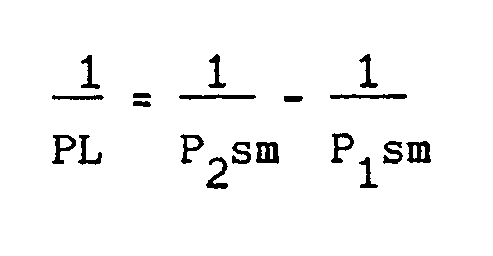
- L'invention repose donc sur la considération que les zones non liées étant comprises à l'intérieur d'un segment de longueur égale au pas de liaison des deux motifs, on peut réduire à volonté l'étendue de cette zone indésirable en réduisant la valeur du pas de liaison.
- Il suffit donc de choisir les pas de chaque motif de façon que le pas de liaison soit plus petit que l'étendue L maximale non liée, tolérée, compatible avec l'application à laquelle est destinée la feuille complexe et les contraintes liées à sa transformation. Il est certain que, sur cette distance, les points de liaison n'existent pas uniquement aux endroits où les protubérances présentent un écart minimum ou nul. Des points de liaison seront sans doute formés de part et d'autre de ces protubérances, dans la mesure où la surface de contact est suffisante. Mais l'invention apporte la garantie de l'existence d'au moins une liaison sur cette distance, ce qui suffit pour maintenir les deux feuilles solidaires.
- L'invention est d'application générale quel que soit le motif, mais elle présente un intérêt certain quand les feuilles sont gaufrées avec un motif fin, c'est-à-dire un motif dont la densité est supérieure à 20 protubérances par cm² et inférieure à 300. On notera qu'au-del à de 300 la distance séparant les protubérances est trop faible pour permettre la déformation de la feuille de papier absorbant. La feuille est d'apparence lisse.
- Selon une caractéristique supplémentaire la surface des méplats est comprise entre 5 et 30 % de la surface de la feuille avant gaufrage.
- Selon une application particulière, la feuille complexe est produite en une bande de laize de 2,60 m, puis découpée dans le sens de la longueur en bandes de laize de 100 mm, pour être transformée en rouleaux de papier toilette dont la bande enroulée est prédécoupée, à intervalles réguliers, de manière à obtenir des feuillets de format 100 x 125 mm². On choisit les pas des deux motifs de façon qu'au moins l'un des pas de liaison dans une direction SM ou ST soit inférieur à 100 mm. On garantit ainsi que chaque feuillet de format 100 x 125 comportera au moins un point de liaison. Il s'agit bien sùr de la condition minimale. Dans la pratique on préfèrera choisir un pas de liaison suffisamment petit pour que les feuillets soient liés en plusieurs points.
- Les pas peuvent être choisis très différents l'un de l'autre. Toutefois il s'ensuit alors une différence d'aspect sur les faces de la feuille complexe. Selon un mode particulier de réalisation, on impose une condition supplémentaire permettant d'éviter que la feuille présente un endroit et un envers : pour une même direction, le rapport entre les pas des motifs des deux feuilles est compris entre 1 et 2, de préférence entre 1 et 1,5.
- Conformément à une caractéristique supplémentaire de l'invention, le nombre de points effectivement liés par collage est inférieur au nombre de points de la feuille susceptibles de constituer une liaison entre les deux feuilles.
- En effet pour réduire autant que possible la rigidité conférée à la feuille par la colle, il est possible de n'assurer qu'un encollage partiel compatible avec la contrainte d'obtenir un liage à l'intérieur de surfaces de format déterminé.
- Selon un premier mode de réalisation, on assure cet encollage partiel au moyen d'un cylindre applicateur dont la surface effective d'application ne représente qu'une fraction de la surface de la feuille à encoller. On obtient ce résultat en gravant la surface du cylindre selon un motif approprié.
- Selon un deuxième mode de réalisation, on gaufre au moins l'une des feuilles à lier avec des protubérances de hauteurs, différentes, deux par exemple, de telle sorte que la liaison avec l'autre feuille ne soit assurée que par les protubérances dont la hauteur est la plus élevée.
- D'autres caractéristiques et avantages seront développées dans la description qui suit :
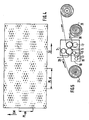
- - la figure 1 représente en plan un motif de protubérances gravées sur un cylindre,
- - la figure 2 est une coupe selon II-II de l'arrangement de protubérances de la figure 1,
- - la figure 3 est une représentation schématique, en coupe transversale, d'une feuille complexe obtenue par l'association de feuilles gaufrées avec des motifs à pas différents conformément A l'invention,
- - la figure 4 est une vue en plan, à plus grande échelle, de la feuille complexe de la figure 3 sur laquelle on a visualisé les zones susceptibles de comporter des liaisons,
- - la figure 5 est une représentation schématique d'une installation de gaufrage et de liage.
- - la figure 6 est une représentation d'un mode de réalisation particulier des bossages sur les cylindres gaufreurs.
- On a représenté sur les figures 1 et 2 un exemple de motif de gaufrage pour les deux feuilles de papier absorbant en ouate de cellulose.
- Les protubérances ou bossages (A) sont répartis uniformément selon deux directions : une première direction Psm et une deuxième direction Pst formant un angle non nul avec elle. Il peut s'agir commodément du sens machine et du sens travers. Dans le mode de réalisation représenté le motif est en quinconce, mais d'autres arrangements sont possibles.
- Sens machine, les protubérances sur chacune des deux feuilles sont réparties uniformément avec un premier pas, P₁sm et P₂sm respectivement, tandis que sens travers les pas sont P₁st et P₂st. On choisit P₁sm différent de P₂sm et P₁st différent de P₂st. Les protubérances présentent à leur sommet un méplat (B) dans un plan parallèle au plan de la feuille.
- Sur la figure 3, on a représenté, en coupe selon la direction ST, la feuille complexe obtenue après association des deux feuilles, pointes contre pointes. Quand on se déplace le long de la direction de la coupe à partir d'un point de liaison où les bossages se chevauchent, les points de liaison successifs sont plus ou moins solides selon le degré de chevauchement des bossages. Toutefois à une distance égale au pas de liaison P₁st correspondant à n pas P₁st et (n + 1) pas P₂st, les bossages sont à nouveau superposés avec une surface maximale de contact. En choisissant une valeur PL suffisamment petite, on réduit ainsi la largeur des zones où les bossages ne sont pas en chevauchement suffisant pour assurer la liaison.
- On a réalisé une feuille complexe conforme à l'invention à partir de deux feuilles de papier absorbant en ouate de cellulose crépées, de même grammage : 15 g/m², que l'on a gaufrées sur des cylindres dont les motifs sont constitués de protubérances ovales réparties en quinconce selon des pas, sens machine Psm et sens travers Pst, différents, et avec un rapport de densités proche de l'unité. Sens machine, la distance L1 sur laquelle on requiert la présence d'au moins une liaison, est 100 mm. Sens travers la distance L2 est 125 mm. Le rapport des densités entre les cylindres (5) et (1) est égal à 1,08.
Cylindre 1 Cylindre 5 Pst (mm) 3,15 2,55 Psm (mm) 1,1 1,25 Densité du motif (par cm²) 58 62,7 Surface gaufrée 7 % 7 % Hauteur de protubérances (mm) 0,6 0,6 - Le pas de liaison pLsm sens machine calculé est 9,16 mm, et le pas de liaison PLst sens travers : 13,38 mm.
- Après association, on a pu constater que la feuille complexe obtenue ne présentait aucun défaut de liaison. Les feuillets de format L1 x L2 = 100 x 125 mm² que l'on a découpés à divers endroits étaient tous constitués de deux feuilles liées.
- On a représenté sur la figure 4 le résultat obtenu sur la feuille complexe, en ne faisant apparaître que les protubérances susceptibles de former une liaison au moins partielle. On constate que ces zones de liaison forment elles-mêmes un motif de pas PLst = 13,38 mm dans un sens et PLsm = 9,16 mm dans l'autre.
- La colle apportant une certaine rigidité à la feuille, on cherche à réduire autant possible la quantité apportée. Ainsi, on améliore la douceur de la feuille complexe en n'encollant que certaines des zones de liage définies dans le motif de la figure 5 par exemple. On réalise très simplement cet objectif en choisissant un cylindre d'encollage déposant la colle, sur une feuille, selon un motif compatible avec le motif de liage.
- On décrit ci-après une installation connue en soi, permettant de réaliser la feuille de l'invention.
- Sur la figure 5, on a représenté une première paire de cylindres (1, 3) comportant un cylindre métallique gravé (1) à la surface duquel sont implantés des reliefs selon le motif souhaité. Le cylindre métallique est entraîné en rotation autour d'un axe horizontal et est associé à un cylindre en caoutchouc (3) qui lui est parallèle, et avec lequel il ménage un intervalle de serrage (1-3). En passant dans cet intervalle, une feuille de papier absorbant en ouate de cellulose subit des déformations mécaniques permanentes par la pression exercée par les reliefs du cylindre métallique.
- L'installation comporte une deuxième paire de cylindres de gaufrage avec un cylindre métallique (5) de même diamètre et tournant dans le même plan horizontal que le cylindre (1), il coopére avec un cylindre en caoutchouc (7) pour le gaufrage.
- Les cylindres (1) et (5) ménagent entre eux un intervalle de serrage (1-5) et sont entraînés à des vitesses de rotation opposées, synchrones, de manière à rouler l'un sur l'autre sans glissement.
- L'installation comprend également un système d'encollage (10) avec cylindre applicateur (11) (en caoutchouc ou autre matière équivalent) venant en appui sur le cylindre (1) en amont de l'intervalle de serrage (1-5). Un cylindre de transfert (13), transfère l'adhésif depuis un cylindre plongeur (15) sur le cylindre applicateur (11). Le cylindre plongeur (15) prélève la colle dans un bac.
- Les feuilles (20, 30) de papier absorbant à associer sont alimentées depuis des rouleaux (21, 31). La feuille (20) est guidée autour du cylindre en caoutchouc (3) et passe dans l'intervalle de serrage (1-3) dont elle ressort gaufrée, en épousant la surface en relief du cylindre métallique (1). Le cylindre applicateur (11) dépose ensuite de la colle, en quantité dosée, sur la surface des protubérances de la feuille, formant méplats.
- La deuxième feuille (30) subit également un traitement mécanique de gaufrage, par passage dans l'intervalle de serrage (5-7), puis est associée à la feuille (20) dans l'intervalle de serrage (1-5). La feuille complexe qui en résulte est mise en rouleau en attendant d'être transformée ultérieurement.
- Un moyen pour réduire la quantité de colle déposée est d'encoller la feuille (20) non pas sur l'ensemble des sommets des reliefs, mais sur une fraction seulement. A cet effet, on peut utiliser un cylindre applicateur dont la surface a été gravée selon un motif approprié. Les reliefs ne couvrant qu'une fraction de la surface totale du cylindre applicateur, la colle emportée par celui-ci est réduite d'autant.
- Un autre moyen est de graver l'un des cylindres, par exemple (1) de telle sorte que les reliefs ne soient pas tous à la même hauteur. Seuls les reliefs les plus hauts reçoivent la colle.
- Un tel exemple est représenté sur la figure 6 où l'on voit les cylindres métalliques (1′) et(5′) avec leurs bossages(A₁) et (A₅). Les deux feuilles (20) et (30) mises en forme sur ces bossages sont collées ensemble dans l'intervalle de serrage (1′-5′) par les sommets des reliefs qui viennent en contact à ce niveau. Conformément au mode de réalisation de la figure 6, les bossages du cylindre 1′ sont à deux niveaux. Seuls les bossages(A₁₁), dont la hauteur est supérieure d'une valeur "d" à celle des bossages (A₁₂) viennent au contact du cylindre encolleur lisse (11) puis au contact des bossages du cylindre(5′). Il s'ensuit que les feuilles (20) et (30) ne sont liées que par ces bossages. On peut ainsi réduire à volonté le nombre de points susceptibles de former une liaison par rapport à ceux reproduits sur la figure 4. Ces points de liaison seront formés aux intersections entre le motif de la figure 4 et le motif reproduit par les bossages (A₁₁).
Claims (9)

Applications Claiming Priority (2)
| Application Number | Priority Date | Filing Date | Title |
|---|---|---|---|
| FR8914202A FR2653793B1 (fr) | 1989-10-30 | 1989-10-30 | |
| FR8914202 | 1989-10-30 |
Publications (2)
| Publication Number | Publication Date |
|---|---|
| EP0426548A1 true EP0426548A1 (fr) | 1991-05-08 |
| EP0426548B1 EP0426548B1 (fr) | 1994-11-30 |
Family
ID=9386909
Family Applications (1)
| Application Number | Title | Priority Date | Filing Date |
|---|---|---|---|
| EP90403043A Expired - Lifetime EP0426548B1 (fr) | 1989-10-30 | 1990-10-29 | Feuille complexe de papier absorbant |
Country Status (10)
| Country | Link |
|---|---|
| US (1) | US5173351A (fr) |
| EP (1) | EP0426548B1 (fr) |
| AT (1) | ATE114756T1 (fr) |
| DE (1) | DE69014558T2 (fr) |
| DK (1) | DK0426548T3 (fr) |
| ES (1) | ES2064693T3 (fr) |
| FI (1) | FI96343C (fr) |
| FR (1) | FR2653793B1 (fr) |
| GR (1) | GR3015025T3 (fr) |
| NO (1) | NO178381C (fr) |
Cited By (14)
| Publication number | Priority date | Publication date | Assignee | Title |
|---|---|---|---|---|
| FR2721251A1 (fr) * | 1994-06-17 | 1995-12-22 | Kaysersberg Sa | Feuille multicouche de papier absorbant, son procédé de fabrication. |
| WO1997020688A1 (fr) * | 1995-12-05 | 1997-06-12 | Fabio Perini S.P.A. | Machine de gaufrage et de stratification pour le collage de couches gaufrees |
| WO1997020689A1 (fr) * | 1995-12-05 | 1997-06-12 | Fabio Perini S.P.A. | Procede et machine de gaufrage et de stratification a cylindres presentant des zones de contact distribuees |
| WO1997020687A1 (fr) * | 1995-12-05 | 1997-06-12 | Fabio Perini S.P.A. | Machine de gaufrage et de stratification a cylindres de gaufrage tournant a des vitesses differentes |
| FR2775698A1 (fr) * | 1998-03-06 | 1999-09-10 | Fort James France | Nouveau produit en papier absorbant comprenant trois plis et son procede de fabrication |
| FR2777919A1 (fr) * | 1998-04-24 | 1999-10-29 | Fort James France | Feuille de papier absorbant gaufre |
| FR2788066A1 (fr) * | 1999-01-05 | 2000-07-07 | Fort James France | Nouveau produit en papier absorbant comprenant deux plis |
| EP1236830A1 (fr) * | 2001-02-23 | 2002-09-04 | Georgia-Pacific France | Feuille de papier absorbant crêpée et gaufrée, cylindre de gaufrage d'une telle feuille et procédé de gaufrage |
| FR2834240A1 (fr) * | 2001-12-27 | 2003-07-04 | Georgia Pacific France | Feuille de papier gaufree |
| EP1520930A1 (fr) * | 2003-10-02 | 2005-04-06 | Georgia-Pacific France | Feuille de papier absorbant à relief amélioré |
| WO2005085526A3 (fr) * | 2004-03-04 | 2005-11-17 | Perini Fabio Spa | Produit en papier multicouches, ou produit similaire, procede de production et systeme correspondants |
| US7494564B2 (en) * | 2003-03-07 | 2009-02-24 | Georgia-Pacific France | Absorbent paper product having improved embossing |
| US7645222B2 (en) | 2003-05-15 | 2010-01-12 | Fabio Perini S.P.A. | Variable crown roller for devices for processing continuous web material and device comprising said roller |
| EP3009385A2 (fr) | 2014-10-13 | 2016-04-20 | FABIO PERINI S.p.A. | Rouleau pour traiter une matière en bande continue et dispositif comprenant ledit cylindre |
Families Citing this family (98)
| Publication number | Priority date | Publication date | Assignee | Title |
|---|---|---|---|---|
| FR2773564B1 (fr) * | 1998-01-13 | 2000-02-11 | Fort James France | Feuille de papier absorbant gaufre, son procede de fabrication et dispositif permettant de la fabriquer |
| USD436738S1 (en) | 1993-03-29 | 2001-01-30 | Fort James Corporation | Embossed paper product |
| US5368909A (en) * | 1993-04-02 | 1994-11-29 | The Procter & Gamble Company | Fluid-pervious plastic web having improved fluid drainage |
| US5368910A (en) * | 1993-04-02 | 1994-11-29 | The Procter & Gamble Company | Macroscopically expanded plastic web having improved fluid drainage |
| WO1995013773A1 (fr) * | 1993-11-18 | 1995-05-26 | The Procter & Gamble Company | Nappe de plastique expanse de façon macroscopique, tridimensionnelle, fibreuse et ajouree |
| DE69422999T2 (de) * | 1993-11-18 | 2000-08-17 | The Procter & Gamble Company, Cincinnati | Bahn für absorbierende artikel mit texturierter trägerberührungsoberfläche |
| US5665452A (en) * | 1994-03-03 | 1997-09-09 | The Procter & Gamble Company | Three-dimensional, macroscopically expanded, apertured laminate webs |
| JP3503984B2 (ja) | 1994-03-29 | 2004-03-08 | 大王製紙株式会社 | エンボス付与ウェブおよびその製造用ロール |
| US5643238A (en) * | 1995-09-29 | 1997-07-01 | Paragon Trade Brands, Inc. | Absorbent core structure comprised of storage and acquisition cells |
| USD382354S (en) * | 1995-12-12 | 1997-08-12 | Minnesota Mining And Manufacturing Company | Sheet member with a plurality of protective bumpers |
| USD382352S (en) * | 1995-12-12 | 1997-08-12 | Minnesota Mining And Manufacturing Company | Sheet member with a plurality of protective bumpers |
| USD382353S (en) * | 1995-12-12 | 1997-08-12 | Minnesota Mining And Manufacturing Company | Sheet member with a plurality of protective bumpers |
| USD378054S (en) * | 1995-12-12 | 1997-02-18 | Minnesota Mining And Manufacturing Company | Protective bumper |
| USD383311S (en) * | 1995-12-12 | 1997-09-09 | Minnesota Mining And Manufacturing Company | Sheet member with a plurality of protective bumpers |
| USD407303S (en) | 1996-01-19 | 1999-03-30 | Minnesota Mining And Manufacturing Company | Hex-shaped protective bumpers |
| USD416476S (en) | 1996-04-10 | 1999-11-16 | 3M Innovative Properties Company | Sheet comprising a plurality of hex-shaped protective bumpers |
| EP0843042A1 (fr) * | 1996-11-19 | 1998-05-20 | The Procter & Gamble Company | Structures fibreuses gauffrées obtenues par voie humide |
| US6030690A (en) * | 1997-04-23 | 2000-02-29 | The Procter & Gamble Company | High pressure embossing and paper produced thereby |
| USD390363S (en) | 1997-05-02 | 1998-02-10 | Kimberly-Clark Worldwide, Inc. | Embossed tissue |
| EP1547513A3 (fr) * | 1997-05-23 | 2005-10-19 | The Procter & Gamble Company | Structures tridimensionnelles pour chiffons de nettoyage |
| USD426709S (en) * | 1998-01-14 | 2000-06-20 | Scott Paper Limited | Surface pattern for a paper product |
| FR2774707B1 (fr) * | 1998-02-06 | 2000-04-07 | Fort James France | Papier absorbant a usage domestique |
| WO1999044814A1 (fr) * | 1998-03-02 | 1999-09-10 | Fabio Perini S.P.A. | Procede et dispositif de production d'un materiau en bande continue gaufre et produit ainsi obtenu |
| US6174412B1 (en) | 1998-03-02 | 2001-01-16 | Purely Cotton, Inc. | Cotton linter tissue products and method for preparing same |
| USD430734S (en) * | 1998-08-07 | 2000-09-12 | Fort James Corporation | Pattern for an embossed paper product |
| US6261666B1 (en) | 1998-08-14 | 2001-07-17 | Paper Converting Machine Co. | Two-ply paper products with either nested or foot-to-foot embossments and method of making |
| USD418745S (en) * | 1998-08-20 | 2000-01-11 | 3M Innovative Properties Company | Protective bumper and sheet member with a plurality of protective bumpers |
| US6109326A (en) * | 1998-08-20 | 2000-08-29 | Paper Converting Machine Company | Embosser for producing two-ply paper products with either nested or foot-to-foot embossments |
| USD423232S (en) * | 1998-10-13 | 2000-04-25 | Irving Tissue, Inc. | Paper towel |
| USD438017S1 (en) | 1998-10-13 | 2001-02-27 | Irving Tissue, Inc. | Paper toweling |
| US6251207B1 (en) * | 1998-12-31 | 2001-06-26 | Kimberly-Clark Worldwide, Inc. | Embossing and laminating irregular bonding patterns |
| DE19912225C2 (de) * | 1999-03-18 | 2003-04-24 | Sca Hygiene Prod Gmbh | Verfahren und Vorrichtung zum Herstellen eines zumindest 2-lagigen Tissue-Produktes |
| US7195810B1 (en) * | 1999-04-27 | 2007-03-27 | Fort James Corporation | Air-laid absorbent sheet with sinuate emboss |
| US6893525B1 (en) * | 1999-05-05 | 2005-05-17 | Fort James Corporation | Method for embossing air-laid webs using laser engraved heated embossing rolls |
| IT1307887B1 (it) | 1999-06-18 | 2001-11-19 | Perini Fabio Spa | Metodo e dispositivo di goffratura per la produzione di materialenastriforme multivelo, e prodotto cosi' ottenuto. |
| US6551691B1 (en) * | 1999-08-31 | 2003-04-22 | Gerogia-Pacific France | Absorbent paper product of at least three plies and method of manufacture |
| US7118796B2 (en) * | 1999-11-01 | 2006-10-10 | Fort James Corporation | Multi-ply absorbent paper product having impressed pattern |
| CA2324786C (fr) | 1999-11-01 | 2014-02-25 | Fort James Corporation | Produit en papier absorbant multicouches a motifs imprimes |
| USD430406S (en) * | 1999-12-13 | 2000-09-05 | Irving Tissue, Inc. | Pattern for absorbent sheet material |
| USD430407S (en) * | 1999-12-13 | 2000-09-05 | Irving Tissue Inc. | Pattern for absorbent sheet material |
| USD431372S (en) * | 1999-12-15 | 2000-10-03 | Irving Tissue, Inc. | Pattern for absorbent sheet material |
| USD431371S (en) * | 1999-12-15 | 2000-10-03 | Irving Tissue, Inc. | Pattern for absorbent sheet material |
| DE10022464A1 (de) | 2000-05-09 | 2001-11-22 | Sca Hygiene Prod Gmbh | Flächiges Erzeugnis mit mehreren adhäsiv verbundenen faserhaltigen Lagen |
| FR2808816B1 (fr) * | 2000-05-12 | 2003-05-30 | Fort James France | Produit en papier absorbant a structure dissymetrique |
| USD459897S1 (en) | 2000-07-25 | 2002-07-09 | Fort James Corporation | Paper towel |
| US6700036B2 (en) * | 2000-09-22 | 2004-03-02 | Tredegar Film Products Corporation | Acquisition distribution layer having void volumes for an absorbent article |
| USD449453S1 (en) | 2000-10-03 | 2001-10-23 | The Procter & Gamble Company | Surface pattern for paper product |
| USD450934S1 (en) | 2000-10-03 | 2001-11-27 | The Procter & Gamble Company | Paper product |
| US6602577B1 (en) | 2000-10-03 | 2003-08-05 | The Procter & Gamble Company | Embossed cellulosic fibrous structure |
| US7083845B2 (en) | 2001-02-23 | 2006-08-01 | Georgia-Pacific France | Sheet of absorbent creped paper, cylinder for embossing such a sheet and an embossing process |
| ATE364751T1 (de) * | 2001-03-09 | 2007-07-15 | Georgia Pacific France | Papierbahn mit kleinen kissen |
| US6591560B2 (en) * | 2001-03-09 | 2003-07-15 | Milliken & Company | Electrostatic dissipating flooring article |
| US6924042B2 (en) * | 2001-11-20 | 2005-08-02 | Sca Hygiene Products Gmbh | Multi-ply planar product including adhesively bonded fibrous plies |
| ITFI20020053A1 (it) * | 2002-03-29 | 2003-09-29 | Perini Fabio Spa | Metodo e dispositivo per la produzione di un materiale nastriforme goffrato e manufatto ottenuto con detto metodo |
| ITFI20020113A1 (it) * | 2002-06-26 | 2003-12-29 | Perini Fabio Spa | Dispositivo goffratore e laminatore con gruppo di cilindri goffratoriintercambiabile |
| US20040191486A1 (en) * | 2003-03-25 | 2004-09-30 | Underhill Richard Louis | Cloth-like tissue sheets having camouflaged texture |
| US7314663B2 (en) * | 2003-09-29 | 2008-01-01 | The Procter + Gamble Company | Embossed multi-ply fibrous structure product and process for making same |
| US7374638B2 (en) * | 2003-09-29 | 2008-05-20 | The Procter & Gamble Company | High bulk strong absorbent single-ply tissue-towel paper product |
| US20050247397A1 (en) * | 2003-09-29 | 2005-11-10 | The Procter & Gamble Company | Process for producing embossed products |
| USD688878S1 (en) | 2003-10-16 | 2013-09-03 | The Procter & Gamble Company | Paper product with surface pattern |
| USD688466S1 (en) | 2003-10-16 | 2013-08-27 | The Procter & Gamble Company | Paper product with surface pattern |
| EP1735498A2 (fr) * | 2004-02-17 | 2006-12-27 | The Procter and Gamble Company | Produits en papier a gaufrures nichees de maniere profonde |
| US20050247416A1 (en) * | 2004-05-06 | 2005-11-10 | Forry Mark E | Patterned fibrous structures |
| US7435313B2 (en) * | 2004-05-21 | 2008-10-14 | The Procter & Gamble Company | Process for producing deep-nested embossed paper products |
| US7413629B2 (en) * | 2004-05-21 | 2008-08-19 | The Procter & Gamble Company | Process for producing deep-nested embossed paper products |
| US7799169B2 (en) | 2004-09-01 | 2010-09-21 | Georgia-Pacific Consumer Products Lp | Multi-ply paper product with moisture strike through resistance and method of making the same |
| ES2339668T3 (es) * | 2004-12-29 | 2010-05-24 | Sca Hygiene Products Ab | Metodo para laminar capas de papel tisu unido por capas. |
| EP1712667B1 (fr) * | 2005-04-11 | 2011-01-05 | Pantex International S.p.A. | Méthode de fabrication d'un tissu non-tissé et produit ainsi obtenu |
| US7597777B2 (en) | 2005-09-09 | 2009-10-06 | The Procter & Gamble Company | Process for high engagement embossing on substrate having non-uniform stretch characteristics |
| EP1845193A1 (fr) | 2006-04-14 | 2007-10-17 | Georgia-Pacific France | Feuille absorbante délitable multiplis, rouleau et procédé de fabrication associés |
| ITFI20060245A1 (it) | 2006-10-11 | 2008-04-12 | Delicarta Spa | Un materiale in carta con elevate caratteristiche detergenti e metodo per la sua produzione |
| USD574721S1 (en) | 2006-10-23 | 2008-08-12 | The Procter & Gamble Company | Package for rolls of paper towels |
| US8998871B2 (en) * | 2006-11-22 | 2015-04-07 | Uni-Charm Corporation | Absorbent article with compressed channel portions |
| ITFI20070048A1 (it) * | 2007-02-27 | 2008-08-28 | Perini Fabio Spa | Gruppo goffratore multi-funzione |
| FR2914170B1 (fr) | 2007-03-28 | 2012-08-31 | Georgia Pacific France | Rouleau de produit cellulosique fibreux |
| FR2914838B1 (fr) | 2007-04-13 | 2009-06-05 | Georgia Pacific France Soc En | Rouleau de feuilles de produit absorbant de type papier toilette |
| US8102275B2 (en) * | 2007-07-02 | 2012-01-24 | Procter & Gamble | Package and merchandising system |
| US20090008275A1 (en) * | 2007-07-02 | 2009-01-08 | Ferrari Michael G | Package and merchandising system |
| ITFI20070163A1 (it) | 2007-07-18 | 2009-01-19 | Perini Fabio Spa | "materiale cartaceo goffrato, metodo e dispositivo per la sua produzione" |
| ITFI20080038A1 (it) | 2008-02-27 | 2009-08-28 | Delicarta Spa | "materiale plurivelo in carta goffrata e macchina per la sua produzione" |
| FR2928383B1 (fr) | 2008-03-06 | 2010-12-31 | Georgia Pacific France | Feuille gaufree comportant un pli en materiau hydrosoluble et procede de realisation d'une telle feuille. |
| US20100030174A1 (en) * | 2008-08-04 | 2010-02-04 | Buschur Patrick J | Multi-ply fibrous structures and processes for making same |
| US20100028621A1 (en) * | 2008-08-04 | 2010-02-04 | Thomas Timothy Byrne | Embossed fibrous structures and methods for making same |
| USD640473S1 (en) | 2009-03-10 | 2011-06-28 | The Procter & Gamble Company | Paper product |
| USD632896S1 (en) | 2009-03-10 | 2011-02-22 | The Procter & Gamble Company | Paper product |
| US8753737B2 (en) * | 2009-05-19 | 2014-06-17 | The Procter & Gamble Company | Multi-ply fibrous structures and methods for making same |
| US20100297395A1 (en) * | 2009-05-19 | 2010-11-25 | Andre Mellin | Fibrous structures comprising design elements and methods for making same |
| US20100297378A1 (en) * | 2009-05-19 | 2010-11-25 | Andre Mellin | Patterned fibrous structures and methods for making same |
| US9243368B2 (en) * | 2009-05-19 | 2016-01-26 | The Procter & Gamble Company | Embossed fibrous structures and methods for making same |
| USD641556S1 (en) | 2009-11-19 | 2011-07-19 | The Procter & Gamble Company | Paper product |
| US8791321B2 (en) | 2010-08-26 | 2014-07-29 | Medline Industries, Inc. | Disposable absorbent lift device |
| USD704453S1 (en) | 2013-06-12 | 2014-05-13 | Georgia-Pacific Consumer Products Lp | Paper product |
| USD769629S1 (en) * | 2014-08-13 | 2016-10-25 | JJM Manufacturing Ltd. | Fabric with pattern simulating hockey skate laces |
| PT3194154T (pt) | 2014-08-29 | 2018-11-07 | Sofidel Spa | Produto de celulose em relevo em várias camadas e meios para a sua produção |
| EP3231939A1 (fr) | 2016-04-11 | 2017-10-18 | Fuhrmann, Uwe | Mouchoir en papier multicouche destine a reduire la transmission d'agents infectieux |
| USD853132S1 (en) * | 2016-09-15 | 2019-07-09 | Kimberly-Clark Worldwide, Inc. | Wiper sheet |
| USD837535S1 (en) * | 2016-10-04 | 2019-01-08 | Kimberly-Clark Worldwide, Inc. | Wiper sheet |
| BR112020022071A2 (pt) * | 2018-05-29 | 2021-02-02 | José Antonio Logiodice | aperfeiçoamento em conjunto gofrador para processamento de papel |
Citations (4)
| Publication number | Priority date | Publication date | Assignee | Title |
|---|---|---|---|---|
| US3414459A (en) * | 1965-02-01 | 1968-12-03 | Procter & Gamble | Compressible laminated paper structure |
| GB1382714A (en) * | 1970-04-29 | 1975-02-05 | Kimberly Clark Co | Production of multi-ply products |
| US4469735A (en) * | 1982-03-15 | 1984-09-04 | The Procter & Gamble Company | Extensible multi-ply tissue paper product |
| EP0265298A1 (fr) * | 1986-10-02 | 1988-04-27 | Kaysersberg Sa | Feuille stratifiée absorbante et procédé pour fabriquer une telle feuille |
Family Cites Families (5)
| Publication number | Priority date | Publication date | Assignee | Title |
|---|---|---|---|---|
| US3017317A (en) * | 1957-02-12 | 1962-01-16 | Kimberly Clark Co | Method of creping tissue and product thereof |
| US3672950A (en) * | 1970-01-12 | 1972-06-27 | Int Paper Co | Adhesively laminated cellulosic product |
| CA1052157A (fr) * | 1975-05-05 | 1979-04-10 | Thomas J. Flautt (Jr.) | Papier tissu a deux pli |
| US4320162A (en) * | 1980-05-15 | 1982-03-16 | American Can Company | Multi-ply fibrous sheet structure and its manufacture |
| US4671983A (en) * | 1985-06-12 | 1987-06-09 | Marcal Paper Mills, Inc. | Embossments for minimizing nesting in roll material |
-
1989
- 1989-10-30 FR FR8914202A patent/FR2653793B1/fr not_active Expired - Lifetime
-
1990
- 1990-10-29 AT AT90403043T patent/ATE114756T1/de not_active IP Right Cessation
- 1990-10-29 FI FI905328A patent/FI96343C/fi not_active IP Right Cessation
- 1990-10-29 ES ES90403043T patent/ES2064693T3/es not_active Expired - Lifetime
- 1990-10-29 NO NO904672A patent/NO178381C/no not_active IP Right Cessation
- 1990-10-29 DK DK90403043.4T patent/DK0426548T3/da active
- 1990-10-29 EP EP90403043A patent/EP0426548B1/fr not_active Expired - Lifetime
- 1990-10-29 DE DE69014558T patent/DE69014558T2/de not_active Expired - Fee Related
- 1990-10-30 US US07/605,346 patent/US5173351A/en not_active Expired - Lifetime
-
1995
- 1995-02-09 GR GR940403741T patent/GR3015025T3/el unknown
Patent Citations (4)
| Publication number | Priority date | Publication date | Assignee | Title |
|---|---|---|---|---|
| US3414459A (en) * | 1965-02-01 | 1968-12-03 | Procter & Gamble | Compressible laminated paper structure |
| GB1382714A (en) * | 1970-04-29 | 1975-02-05 | Kimberly Clark Co | Production of multi-ply products |
| US4469735A (en) * | 1982-03-15 | 1984-09-04 | The Procter & Gamble Company | Extensible multi-ply tissue paper product |
| EP0265298A1 (fr) * | 1986-10-02 | 1988-04-27 | Kaysersberg Sa | Feuille stratifiée absorbante et procédé pour fabriquer une telle feuille |
Cited By (26)
| Publication number | Priority date | Publication date | Assignee | Title |
|---|---|---|---|---|
| WO1995035205A1 (fr) * | 1994-06-17 | 1995-12-28 | Kaysersberg | Feuille multicouche de papier absorbant, son procede de fabrication |
| FR2721251A1 (fr) * | 1994-06-17 | 1995-12-22 | Kaysersberg Sa | Feuille multicouche de papier absorbant, son procédé de fabrication. |
| RU2162414C2 (ru) * | 1995-12-05 | 2001-01-27 | Фабио Перини С.П.А. | Машина для тиснения и ламинирования, тисненое листовое изделие и способ тиснения полосового материала |
| WO1997020688A1 (fr) * | 1995-12-05 | 1997-06-12 | Fabio Perini S.P.A. | Machine de gaufrage et de stratification pour le collage de couches gaufrees |
| WO1997020689A1 (fr) * | 1995-12-05 | 1997-06-12 | Fabio Perini S.P.A. | Procede et machine de gaufrage et de stratification a cylindres presentant des zones de contact distribuees |
| WO1997020687A1 (fr) * | 1995-12-05 | 1997-06-12 | Fabio Perini S.P.A. | Machine de gaufrage et de stratification a cylindres de gaufrage tournant a des vitesses differentes |
| RU2162415C2 (ru) * | 1995-12-05 | 2001-01-27 | Фабио Перини С.П.А. | Машина для тиснения и ламинирования с тиснильными цилиндрами, обладающими различной скоростью вращения и способ тиснения и ламинирования |
| RU2162416C2 (ru) * | 1995-12-05 | 2001-01-27 | Фабио Перини С.П.А. | Машина для тиснения и ламинирования с цилиндрами с рассредоточенными участками контакта и способ тиснения и ламинирования |
| WO1999045205A1 (fr) * | 1998-03-06 | 1999-09-10 | Fort James France | Produit en papier absorbant comprenant trois plis et son procede de fabrication |
| FR2775698A1 (fr) * | 1998-03-06 | 1999-09-10 | Fort James France | Nouveau produit en papier absorbant comprenant trois plis et son procede de fabrication |
| WO1999055967A1 (fr) * | 1998-04-24 | 1999-11-04 | Fort James France | Feuille de papier absorbant gaufre |
| FR2777919A1 (fr) * | 1998-04-24 | 1999-10-29 | Fort James France | Feuille de papier absorbant gaufre |
| FR2788066A1 (fr) * | 1999-01-05 | 2000-07-07 | Fort James France | Nouveau produit en papier absorbant comprenant deux plis |
| WO2000040800A1 (fr) * | 1999-01-05 | 2000-07-13 | Georgia-Pacific France | Produit en papier absorbant comprenant deux plis |
| EP1236830A1 (fr) * | 2001-02-23 | 2002-09-04 | Georgia-Pacific France | Feuille de papier absorbant crêpée et gaufrée, cylindre de gaufrage d'une telle feuille et procédé de gaufrage |
| WO2002068758A1 (fr) * | 2001-02-23 | 2002-09-06 | Georgia-Pacific France | Feuille de papier absorbant crepee et gaufree, cylindre de gaufrage d'une telle feuille et procede de gaufrage |
| EP1325982A1 (fr) * | 2001-12-27 | 2003-07-09 | Georgia-Pacific France | Feuille de papier gaufrée |
| FR2834240A1 (fr) * | 2001-12-27 | 2003-07-04 | Georgia Pacific France | Feuille de papier gaufree |
| US6916403B2 (en) | 2001-12-27 | 2005-07-12 | Georgia-Pacific France | Embossed sheet material and method |
| US7494564B2 (en) * | 2003-03-07 | 2009-02-24 | Georgia-Pacific France | Absorbent paper product having improved embossing |
| US7645222B2 (en) | 2003-05-15 | 2010-01-12 | Fabio Perini S.P.A. | Variable crown roller for devices for processing continuous web material and device comprising said roller |
| EP1520930A1 (fr) * | 2003-10-02 | 2005-04-06 | Georgia-Pacific France | Feuille de papier absorbant à relief amélioré |
| FR2860527A1 (fr) * | 2003-10-02 | 2005-04-08 | Georgia Pacific France | Feuille de papier absorbant |
| WO2005033408A3 (fr) * | 2003-10-02 | 2005-07-21 | Georgia Pacific France | Feuille de papier absorbant |
| WO2005085526A3 (fr) * | 2004-03-04 | 2005-11-17 | Perini Fabio Spa | Produit en papier multicouches, ou produit similaire, procede de production et systeme correspondants |
| EP3009385A2 (fr) | 2014-10-13 | 2016-04-20 | FABIO PERINI S.p.A. | Rouleau pour traiter une matière en bande continue et dispositif comprenant ledit cylindre |
Also Published As
| Publication number | Publication date |
|---|---|
| NO178381B (no) | 1995-12-04 |
| ATE114756T1 (de) | 1994-12-15 |
| FR2653793A1 (fr) | 1991-05-03 |
| US5173351A (en) | 1992-12-22 |
| DE69014558D1 (de) | 1995-01-12 |
| GR3015025T3 (en) | 1995-05-31 |
| NO904672L (no) | 1991-05-02 |
| FI905328A0 (fi) | 1990-10-29 |
| EP0426548B1 (fr) | 1994-11-30 |
| FI96343C (fi) | 1996-06-10 |
| DE69014558T2 (de) | 1995-04-13 |
| FR2653793B1 (fr) | 1992-01-03 |
| NO904672D0 (no) | 1990-10-29 |
| FI96343B (fi) | 1996-02-29 |
| ES2064693T3 (es) | 1995-02-01 |
| DK0426548T3 (da) | 1995-01-23 |
| NO178381C (no) | 1996-03-13 |
Similar Documents
| Publication | Publication Date | Title |
|---|---|---|
| EP0426548B1 (fr) | Feuille complexe de papier absorbant | |
| CA2201633C (fr) | Feuille multicouche absorbante et son procede de fabrication | |
| CA2193088C (fr) | Feuille multicouche de papier absorbant, son procede de fabrication | |
| EP0265298B1 (fr) | Feuille stratifiée absorbante et procédé pour fabriquer une telle feuille | |
| EP0572503B1 (fr) | Feuilles de papier multicouches presentant des marquages et procede pour leur elaboration | |
| EP1239079B1 (fr) | Feuille de papier avec coussinets | |
| EP1047546B1 (fr) | Feuille de papier absorbant gaufre, son procede de fabrication et dispositif permettant de la fabriquer | |
| EP0679122A1 (fr) | Procede de gaufrage d'une feuille a un ou plusieurs plis | |
| FR2728152A1 (fr) | Papier absorbant gaufre a motifs combines | |
| EP0570578B1 (fr) | Procede de fabrication de feuilles gaufrees stratifiees, machine pour sa mise en oeuvre | |
| EP1670991B1 (fr) | Feuille de papier absorbant | |
| EP1073797A1 (fr) | Feuille de papier absorbant gaufre | |
| EP0570579B1 (fr) | Feuilles complexes de papier absorbant | |
| CA2344261C (fr) | Dispositif, cylindre et installation pour le serrage d'au moins une feuille de papier ou nontisse, procedes mettant en oeuvre un tel dispositif et article fabrique selon ces procedes | |
| EP0828602B1 (fr) | Procede de fabrication d'une structure absorbante | |
| EP0893242B2 (fr) | Procédé de fabrication de produits cellulosiques fibreux, tels que notamment des mouchoirs ou des serviettes | |
| CA2202166C (fr) | Papier absorbant gaufre a motifs combines |
Legal Events
| Date | Code | Title | Description |
|---|---|---|---|
| PUAI | Public reference made under article 153(3) epc to a published international application that has entered the european phase |
Free format text: ORIGINAL CODE: 0009012 |
|
| 17P | Request for examination filed |
Effective date: 19901103 |
|
| AK | Designated contracting states |
Kind code of ref document: A1 Designated state(s): AT BE CH DE DK ES FR GB GR IT LI LU NL SE |
|
| 17Q | First examination report despatched |
Effective date: 19930302 |
|
| ITCL | It: translation for ep claims filed |
Representative=s name: JACOBACCI CASETTA & PERANI S.P.A. |
|
| GRAA | (expected) grant |
Free format text: ORIGINAL CODE: 0009210 |
|
| RIN1 | Information on inventor provided before grant (corrected) |
Inventor name: LAURENT, PIERRE Inventor name: HUNGLER, JOEL Inventor name: RUPPEL, REMY |
|
| AK | Designated contracting states |
Kind code of ref document: B1 Designated state(s): AT BE CH DE DK ES FR GB GR IT LI LU NL SE |
|
| REF | Corresponds to: |
Ref document number: 114756 Country of ref document: AT Date of ref document: 19941215 Kind code of ref document: T |
|
| ITF | It: translation for a ep patent filed | ||
| REF | Corresponds to: |
Ref document number: 69014558 Country of ref document: DE Date of ref document: 19950112 |
|
| REG | Reference to a national code |
Ref country code: DK Ref legal event code: T3 |
|
| GBT | Gb: translation of ep patent filed (gb section 77(6)(a)/1977) |
Effective date: 19941228 |
|
| REG | Reference to a national code |
Ref country code: ES Ref legal event code: FG2A Ref document number: 2064693 Country of ref document: ES Kind code of ref document: T3 |
|
| REG | Reference to a national code |
Ref country code: GR Ref legal event code: FG4A Free format text: 3015025 |
|
| PLBE | No opposition filed within time limit |
Free format text: ORIGINAL CODE: 0009261 |
|
| STAA | Information on the status of an ep patent application or granted ep patent |
Free format text: STATUS: NO OPPOSITION FILED WITHIN TIME LIMIT |
|
| PG25 | Lapsed in a contracting state [announced via postgrant information from national office to epo] |
Ref country code: LU Free format text: LAPSE BECAUSE OF NON-PAYMENT OF DUE FEES Effective date: 19951031 |
|
| 26N | No opposition filed | ||
| REG | Reference to a national code |
Ref country code: FR Ref legal event code: CD Ref country code: FR Ref legal event code: CJ |
|
| REG | Reference to a national code |
Ref country code: FR Ref legal event code: CD |
|
| REG | Reference to a national code |
Ref country code: GB Ref legal event code: IF02 |
|
| PGFP | Annual fee paid to national office [announced via postgrant information from national office to epo] |
Ref country code: AT Payment date: 20030922 Year of fee payment: 14 |
|
| PGFP | Annual fee paid to national office [announced via postgrant information from national office to epo] |
Ref country code: DK Payment date: 20030924 Year of fee payment: 14 |
|
| PGFP | Annual fee paid to national office [announced via postgrant information from national office to epo] |
Ref country code: SE Payment date: 20030925 Year of fee payment: 14 |
|
| PGFP | Annual fee paid to national office [announced via postgrant information from national office to epo] |
Ref country code: CH Payment date: 20030926 Year of fee payment: 14 |
|
| PGFP | Annual fee paid to national office [announced via postgrant information from national office to epo] |
Ref country code: GR Payment date: 20030929 Year of fee payment: 14 |
|
| PGFP | Annual fee paid to national office [announced via postgrant information from national office to epo] |
Ref country code: DE Payment date: 20030930 Year of fee payment: 14 |
|
| PG25 | Lapsed in a contracting state [announced via postgrant information from national office to epo] |
Ref country code: AT Free format text: LAPSE BECAUSE OF NON-PAYMENT OF DUE FEES Effective date: 20041029 |
|
| PG25 | Lapsed in a contracting state [announced via postgrant information from national office to epo] |
Ref country code: SE Free format text: LAPSE BECAUSE OF NON-PAYMENT OF DUE FEES Effective date: 20041030 |
|
| PG25 | Lapsed in a contracting state [announced via postgrant information from national office to epo] |
Ref country code: LI Free format text: LAPSE BECAUSE OF NON-PAYMENT OF DUE FEES Effective date: 20041031 Ref country code: CH Free format text: LAPSE BECAUSE OF NON-PAYMENT OF DUE FEES Effective date: 20041031 |
|
| PG25 | Lapsed in a contracting state [announced via postgrant information from national office to epo] |
Ref country code: DK Free format text: LAPSE BECAUSE OF NON-PAYMENT OF DUE FEES Effective date: 20041101 |
|
| PG25 | Lapsed in a contracting state [announced via postgrant information from national office to epo] |
Ref country code: DE Free format text: LAPSE BECAUSE OF NON-PAYMENT OF DUE FEES Effective date: 20050503 |
|
| PG25 | Lapsed in a contracting state [announced via postgrant information from national office to epo] |
Ref country code: GR Free format text: LAPSE BECAUSE OF NON-PAYMENT OF DUE FEES Effective date: 20050504 |
|
| EUG | Se: european patent has lapsed | ||
| REG | Reference to a national code |
Ref country code: DK Ref legal event code: EBP |
|
| REG | Reference to a national code |
Ref country code: CH Ref legal event code: PL |
|
| PGFP | Annual fee paid to national office [announced via postgrant information from national office to epo] |
Ref country code: GB Payment date: 20090928 Year of fee payment: 20 |
|
| PGFP | Annual fee paid to national office [announced via postgrant information from national office to epo] |
Ref country code: ES Payment date: 20091006 Year of fee payment: 20 |
|
| PGFP | Annual fee paid to national office [announced via postgrant information from national office to epo] |
Ref country code: NL Payment date: 20091002 Year of fee payment: 20 |
|
| PGFP | Annual fee paid to national office [announced via postgrant information from national office to epo] |
Ref country code: FR Payment date: 20091201 Year of fee payment: 20 Ref country code: IT Payment date: 20091007 Year of fee payment: 20 |
|
| PGFP | Annual fee paid to national office [announced via postgrant information from national office to epo] |
Ref country code: BE Payment date: 20091001 Year of fee payment: 20 |
|
| BE20 | Be: patent expired |
Owner name: S.A. *KAYSERSBERG Effective date: 20101029 |
|
| REG | Reference to a national code |
Ref country code: NL Ref legal event code: V4 Effective date: 20101029 |
|
| REG | Reference to a national code |
Ref country code: GB Ref legal event code: PE20 Expiry date: 20101028 |
|
| PG25 | Lapsed in a contracting state [announced via postgrant information from national office to epo] |
Ref country code: NL Free format text: LAPSE BECAUSE OF EXPIRATION OF PROTECTION Effective date: 20101029 |
|
| PG25 | Lapsed in a contracting state [announced via postgrant information from national office to epo] |
Ref country code: GB Free format text: LAPSE BECAUSE OF EXPIRATION OF PROTECTION Effective date: 20101028 |
|
| REG | Reference to a national code |
Ref country code: ES Ref legal event code: FD2A Effective date: 20110614 |
|
| PG25 | Lapsed in a contracting state [announced via postgrant information from national office to epo] |
Ref country code: ES Free format text: LAPSE BECAUSE OF EXPIRATION OF PROTECTION Effective date: 20101030 |