EP0893242B2 - Procédé de fabrication de produits cellulosiques fibreux, tels que notamment des mouchoirs ou des serviettes - Google Patents
Procédé de fabrication de produits cellulosiques fibreux, tels que notamment des mouchoirs ou des serviettes Download PDFInfo
- Publication number
- EP0893242B2 EP0893242B2 EP98401813A EP98401813A EP0893242B2 EP 0893242 B2 EP0893242 B2 EP 0893242B2 EP 98401813 A EP98401813 A EP 98401813A EP 98401813 A EP98401813 A EP 98401813A EP 0893242 B2 EP0893242 B2 EP 0893242B2
- Authority
- EP
- European Patent Office
- Prior art keywords
- products
- cut
- strips
- alternating
- format
- Prior art date
- Legal status (The legal status is an assumption and is not a legal conclusion. Google has not performed a legal analysis and makes no representation as to the accuracy of the status listed.)
- Expired - Lifetime
Links
- 238000004519 manufacturing process Methods 0.000 title claims abstract description 17
- 238000000034 method Methods 0.000 title claims abstract description 15
- 238000004049 embossing Methods 0.000 claims description 16
- 229920002678 cellulose Polymers 0.000 claims description 7
- 239000001913 cellulose Substances 0.000 claims description 7
- 229920003043 Cellulose fiber Polymers 0.000 abstract 1
- 238000012856 packing Methods 0.000 abstract 1
- 238000009434 installation Methods 0.000 description 13
- 238000005520 cutting process Methods 0.000 description 5
- 238000004026 adhesive bonding Methods 0.000 description 3
- 238000003490 calendering Methods 0.000 description 3
- 239000003292 glue Substances 0.000 description 3
- 230000000295 complement effect Effects 0.000 description 2
- 238000005034 decoration Methods 0.000 description 2
- 230000001815 facial effect Effects 0.000 description 2
- 239000000463 material Substances 0.000 description 2
- 238000004806 packaging method and process Methods 0.000 description 2
- 238000004513 sizing Methods 0.000 description 2
- 229910000831 Steel Inorganic materials 0.000 description 1
- 239000000853 adhesive Substances 0.000 description 1
- 230000001070 adhesive effect Effects 0.000 description 1
- 230000015572 biosynthetic process Effects 0.000 description 1
- 230000003750 conditioning effect Effects 0.000 description 1
- 238000010586 diagram Methods 0.000 description 1
- 229920002457 flexible plastic Polymers 0.000 description 1
- 230000002093 peripheral effect Effects 0.000 description 1
- 239000004033 plastic Substances 0.000 description 1
- 229920003023 plastic Polymers 0.000 description 1
- 239000002985 plastic film Substances 0.000 description 1
- 238000000926 separation method Methods 0.000 description 1
- 239000010959 steel Substances 0.000 description 1
Images




Classifications
-
- B—PERFORMING OPERATIONS; TRANSPORTING
- B65—CONVEYING; PACKING; STORING; HANDLING THIN OR FILAMENTARY MATERIAL
- B65H—HANDLING THIN OR FILAMENTARY MATERIAL, e.g. SHEETS, WEBS, CABLES
- B65H35/00—Delivering articles from cutting or line-perforating machines; Article or web delivery apparatus incorporating cutting or line-perforating devices, e.g. adhesive tape dispensers
-
- B—PERFORMING OPERATIONS; TRANSPORTING
- B31—MAKING ARTICLES OF PAPER, CARDBOARD OR MATERIAL WORKED IN A MANNER ANALOGOUS TO PAPER; WORKING PAPER, CARDBOARD OR MATERIAL WORKED IN A MANNER ANALOGOUS TO PAPER
- B31D—MAKING ARTICLES OF PAPER, CARDBOARD OR MATERIAL WORKED IN A MANNER ANALOGOUS TO PAPER, NOT PROVIDED FOR IN SUBCLASSES B31B OR B31C
- B31D1/00—Multiple-step processes for making flat articles ; Making flat articles
- B31D1/04—Multiple-step processes for making flat articles ; Making flat articles the articles being napkins, handkerchiefs, towels, doilies, or the like
-
- B—PERFORMING OPERATIONS; TRANSPORTING
- B65—CONVEYING; PACKING; STORING; HANDLING THIN OR FILAMENTARY MATERIAL
- B65H—HANDLING THIN OR FILAMENTARY MATERIAL, e.g. SHEETS, WEBS, CABLES
- B65H39/00—Associating, collating, or gathering articles or webs
- B65H39/16—Associating two or more webs
-
- B—PERFORMING OPERATIONS; TRANSPORTING
- B65—CONVEYING; PACKING; STORING; HANDLING THIN OR FILAMENTARY MATERIAL
- B65H—HANDLING THIN OR FILAMENTARY MATERIAL, e.g. SHEETS, WEBS, CABLES
- B65H45/00—Folding thin material
- B65H45/02—Folding limp material without application of pressure to define or form crease lines
- B65H45/06—Folding webs
- B65H45/08—Folding webs longitudinally
-
- B—PERFORMING OPERATIONS; TRANSPORTING
- B65—CONVEYING; PACKING; STORING; HANDLING THIN OR FILAMENTARY MATERIAL
- B65H—HANDLING THIN OR FILAMENTARY MATERIAL, e.g. SHEETS, WEBS, CABLES
- B65H45/00—Folding thin material
- B65H45/12—Folding articles or webs with application of pressure to define or form crease lines
- B65H45/28—Folding in combination with cutting
-
- B—PERFORMING OPERATIONS; TRANSPORTING
- B65—CONVEYING; PACKING; STORING; HANDLING THIN OR FILAMENTARY MATERIAL
- B65H—HANDLING THIN OR FILAMENTARY MATERIAL, e.g. SHEETS, WEBS, CABLES
- B65H2701/00—Handled material; Storage means
- B65H2701/10—Handled articles or webs
- B65H2701/19—Specific article or web
- B65H2701/1924—Napkins or tissues, e.g. dressings, toweling, serviettes, kitchen paper and compresses
Definitions
- the present invention relates to a process for the manufacture of fibrous cellulosic products, such as, in particular, facial tissues or rectangular or square towels.
- It may be a colored pattern that is printed on the product and / or embossed pattern embossed in the thickness of the product.
- each stack of products comprises products with at least two different patterns, each stack having alternately products having a first pattern and products having a second pattern distinct from the first pattern.
- each series of products is carried out independently of the other then the products are stacked, by automated means, alternately taking a product in one or the other series of cut products.
- This manufacturing process is particularly complex, slow and expensive in its final phase because it requires, in addition to conventional facilities for the independent manufacture of both series of products, to have a complementary facility for alternating stacking.
- Another known technique is that used for entangled facial type products.
- a handkerchief with embossing A followed by a handkerchief with embossing B it would be necessary to install an embossing group on each of the rolls of cellulose wadding, hence an increase of not insignificant material.
- the object of the invention is to propose a new manufacturing method that makes it possible to eliminate the complementary alternating stacking installation, and thus to reduce the time and the cost of manufacturing alternating product packages.
- the invention proposes a manufacturing method of the type mentioned above, according to claim 1.
- the cutting of the strip allows to obtain the continuous flow of alternating products which can be immediately automatically stacked one after the other to constitute the desired pile.
- the products are folded, in a longitudinal orientation before being cut to size, and they can also be folded in a transverse orientation after having been cut into the format and before to be stacked.
- two continuous and adjacent strips are simultaneously produced for the simultaneous constitution of two stacks each comprising at least two alternating products of different patterns, and the two adjacent strips are made of a single width that is longitudinally separated into two bands before cutting the strips.
- the alternating products of each of the two adjacent strips may be of the same length and aligned longitudinally or they may be offset longitudinally.
- Each of the two strips can comprise alternately first and second products, a first product of one of the strips being for example adjacent to a second product of the other band.
- Each band may comprise an association of at least two individual plies, or sheets, of cellulose wadding, superimposed.
- the two bands may be of the same color or not, and be composed of cellulose wadding different in nature.
- a continuous band comprises successively and alternately in its length first and second fibrous cellulosic products respectively comprising a first and a second decorative pattern.
- tissues of paper in particular cellulose wadding, which are generally square in shape and packaged in stacks of tissues each of which has tissues of different patterns folded and wrapped in a plastic case.
- FIG. 1 shows an installation comprising a coil 10 from which a width 12 of cellulose wadding is unwound.
- the width 12 which may be a single-ply or multiple-ply sheet, first passes into a calendering station 14 whose function is to smooth the paper and give it softness by passing it through. between two calendering rollers 16.
- the sheet 12 then passes to an embossing station 18 comprising for example a rubber cylinder 20 and an engraved steel cylinder 22, the station 18 having the function of embossing different patterns on the width 12, these patterns can also be colored .
- an embossing station 18 comprising for example a rubber cylinder 20 and an engraved steel cylinder 22, the station 18 having the function of embossing different patterns on the width 12, these patterns can also be colored .
- the embossing of patterns on the web 12 is such that it results in producing two adjacent longitudinal strips, each of which, according to the teachings of the invention, comprises successively and alternately in its length of tissues M1 and M2 having distinct decorative patterns.
- each etched strip b1, b2, and therefore each strip of embossed paper B1, B2, thus comprises the two patterns alternately.
- the design of the engraved cylinder 22 is also such that the patterns have the same circumferential length in the running direction M, and a first pattern m1 is aligned in the running direction with a pattern m2 of the other band.
- a width 12 is thus obtained comprising the two adjacent strips B1 and B2, each of which alternately includes the tissues M1 and M2.
- the installation illustrated in Figure 1 comprises a station 24, said slitting by which is separated by cutting strips B1 and B2. These then continue to run parallel and at the same speed on guide rollers 26 and 28 and then to a station 30, not shown in detail in the figures, where the operations of longitudinal folding of the tissues are performed.
- the two strips then arrive at a common cutting station 32 where the simultaneous cross section of the handkerchiefs of the two bands is carried out.
- Each file then passes to a station 34 where is made a transverse folding to result in the formation of two rows of tissues cut and folded. They finally come out of the installation in an arrangement that makes it possible to automatically produce series of P batteries of tissues each of which has an alternating stack of tissues M1 and M2.
- each cell P by packaging means (not shown in the figures) for making tissue packs each having a case in which is housed a stack of tissues.
- the patterns of the bands may be longitudinally offset from one band adjacent to the other.
- the invention is of course not limited to the case where each of the cells comprises tissues belonging to two different series.
- each band comprises successively and alternately tissues with different decorations, for example three or four different and successive decorations.
- the installation uses a sheet or web 12 consisting of three superimposed folds which, beyond the calendering station 14, are divided into a single lower fold S and a double upper fold D.
- the double upper fold D is driven between the rubber cylinder 20 and the engraved cylinder 22 of the embossing station.
- a gluing station 36 which is here shown schematically in the form of a gluing group with two cylinders and with doctor chamber, d other more conventional sizing groups that can be envisaged, for example of the known three-roll type.
- the single lower ply is married to the double upper fold embossed and glued by means of a marrying cylinder 38.
- FIG. 6 The rest of the installation shown in FIG. 6 is similar to that described and shown with reference to FIG. 1, and thus makes it possible to produce stacks of tissues with two alternating patterns with embossed and glued edges.
- an applicator roll 40 having application areas corresponding to the peripheral areas of the handkerchiefs which will then be etched.
- the third single lower fold S is assembled to the double top fold D at the same time as the embossing of the patterns is performed by means of the rolls 20 and 22.
- the remainder of the installation, downstream of the embossing station 18, is identical to that described and shown with reference to FIG. 1 and it makes it possible to produce stacks of tissues with two alternating patterns with glued and embossed edges.
Landscapes
- Artificial Filaments (AREA)
- Polysaccharides And Polysaccharide Derivatives (AREA)
- Treatments For Attaching Organic Compounds To Fibrous Goods (AREA)
- Absorbent Articles And Supports Therefor (AREA)
- Packages (AREA)
- Machines For Manufacturing Corrugated Board In Mechanical Paper-Making Processes (AREA)
- Folding Of Thin Sheet-Like Materials, Special Discharging Devices, And Others (AREA)
- Undergarments, Swaddling Clothes, Handkerchiefs Or Underwear Materials (AREA)
- Packaging Of Annular Or Rod-Shaped Articles, Wearing Apparel, Cassettes, Or The Like (AREA)
- Auxiliary Devices For And Details Of Packaging Control (AREA)
- Paper (AREA)
Description
- La présente invention concerne un procédé de fabrication de produits cellulosiques fibreux, tels que notamment des mouchoirs ou des serviettes rectangulaires ou carrés.
- Un mode de commercialisation de ce type de produits consiste à les distribuer sous forme de piles de produits qui sont généralement tous découpés au même format, chaque pile comportant un certain nombre de produits et étant emballée dans un film ou un étui en matière plastique souple transparente qui peut comporter des informations et des décors publicitaires. D'autres matériaux sont également utilisés.
- Afin de rendre ce type de produit encore plus attractif, il a déjà été proposé qu'il comporte, sur chaque produit, un motif décoratif.
- Il peut s'agir d'un motif coloré qui est imprimé sur le produit et/ou d'un motif gaufré en relief dans l'épaisseur du produit.
- Toujours dans le but d'augmenter l'agrément d'utilisation de ce type de produit commercialisé par paquets de produits empilés, il a aussi été proposé que chaque pile de produits comporte des produits avec au moins deux motifs différents, chaque pile comportant alternativement des produits comportant un premier motif et des produits comportant un deuxième motif distinct du premier.
- Dans ce but, il s'est donc avéré nécessaire de réaliser des piles de produits alternés avant le conditionnement final de ces piles en paquets dans des étuis.
- A cet effet, il a déjà été proposé un procédé de fabrication consistant à réaliser une première série de produits comportant chacun un premier motif décoratif et qui sont découpés au format désiré, à réaliser au moins une deuxième série de produits comportant chacun un deuxième motif décoratif et qui sont découpés au format désiré, puis à constituer une pile comportant alternativement des premiers et deuxièmes produits découpés en vue de leur conditionnement ultérieur par piles comportant appartenant aux deux séries.
- Selon une technique connue, chaque série de produits est réalisée indépendamment de l'autre puis les produits sont mis en piles, par des moyens automatisés, en venant alternativement prendre un produit dans l'une ou l'autre série de produits découpés.
- Ce procédé de fabrication est particulièrement complexe, lent et coûteux dans sa phase finale car il nécessite, outre les installations classiques permettant la fabrication indépendante des deux séries de produits, de disposer d'une installation complémentaire pour l'empilage alterné.
- Une autre technique connue est celle utilisée pour les produits de type facial enchevêtré. Cependant pour obtenir le résultat voulu, c'est-à-dire un mouchoir avec gaufrage A suivi d'un mouchoir avec gaufrage B, il faudrait installer un groupe de gaufrage sur chacune des bobines d'ouate de cellulose, d'où un surcroît de matériel non négligeable.
- L'invention a pour objet de proposer un nouveau procédé de fabrication permettant de supprimer l'installation complémentaire d'empilage alterné, et donc de réduire le temps et le coût de la fabrication de paquets de produits alternés.
- Dans ce but, l'invention propose un procédé de fabrication du type mentionné précédemment, selon la revendication 1.
- Le tronçonnage de la bande permet d'obtenir le débit en continu de produits alternés qui peuvent être immédiatement automatiquement empilés les uns après les autres pour constituer la pile souhaitée.
- Pour certains produits, et notamment dans le cas des mouchoirs en papier, les produits sont pliés, selon une orientation longitudinale avant d'être découpés au format, et ils peuvent être aussi pliés selon une orientation transversale après avoir été découpés au format et avant d'être empilés.
- Grâce à de telles caractéristiques, on obtient directement l'empilage de mouchoirs pliés et à motifs alternés.
- Pour augmenter la capacité de production d'une unité de fabrication de tels produits, on réalise simultanément deux bandes continues et adjacentes pour la constitution simultanée de deux piles comportant chacune au moins deux produits alternés de motifs différents, et les deux bandes adjacentes sont réalisées en une laize unique qui est séparée longitudinalement en deux bandes avant le tronçonnage des bandes.
- Les produits alternés de chacune des deux bandes adjacentes peuvent être de même longueur et alignés longitudinalement ou ils peuvent être décalés longitudinalement.
- Chacune des deux bandes peut comporter alternativement des premiers et deuxièmes produits, un premier produit de l'une des bandes étant par exemple adjacent à un deuxième produit de l'autre bande.
- Chaque bande peut comporter une association d'au moins deux plis individuels, ou feuilles, d'ouate de cellulose, superposés. Les deux bandes peuvent être de même couleur ou pas, et être composées d'ouate de cellulose différentes en nature.
- Une bande continue comporte successivement et alternativement dans sa longueur des premiers et des deuxièmes produits cellulosiques fibreux comportant respectivement un premier et un deuxième motif décoratif.
- D'autres caractéristiques et avantages de l'invention apparaîtront à la lecture de la description détaillée qui suit pour la compréhension de laquelle on se reportera aux dessins annexés dans lesquels :
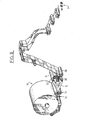
- la figure 1 est une vue schématique en perspective des principaux éléments d'une installation pour la mise en oeuvre d'un procédé de fabrication conforme aux enseignements de l'invention ;
- la figure 2 est une vue schématique en élévation illustrant la position des différents motifs sur un cylindre gravé de gaufrage appartenant à l'installation de la figure 1 ;
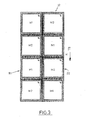
- la figure 3 est une vue de détail illustrant une partie d'une laize gravée à l'aide du cylindre de la figure 2 et comportant deux bandes adjacentes de mouchoirs à motifs alternés et alignés longitudinalement ;
- les figures 4 et 5 sont deux schémas permettant d'illustrer différents agencements de motifs et de bandes dans une laize ; et
- les figures 6 et 7 sont des vues similaires à celle de la figure 1 qui illustrent deux variantes de réalisation de l'installation.
- Le procédé selon l'invention sera maintenant décrit dans le cadre de la fabrication de mouchoirs en papier, notamment en ouate de cellulose, qui sont de forme générale carrée et conditionnés en piles de mouchoirs dont chacune comporte des mouchoirs de motifs différents pliés et emballés dans un étui en plastique.
- On a représenté sur la figure 1 une installation comportant une bobine 10 à partir de laquelle se dévide une laize 12 d'ouate de cellulose.
- A partir de la bobine 10, la laize 12, qui peut être une feuille à pli unique ou multiple, passe d'abord dans un poste de calandrage 14 ayant pour fonction de lisser le papier et de lui conférer de la douceur en le faisant passer entre deux rouleaux de calandrage 16.
- La feuille 12 passe ensuite à un poste de gaufrage 18 comportant par exemple un cylindre en caoutchouc 20 et un cylindre gravé en acier 22, le poste 18 ayant pour fonction de marquer en relief différents motifs sur la laize 12, ces motifs pouvant aussi être colorés.
- Le gaufrage de motifs sur la laize 12 est tel qu'il aboutit à réaliser deux bandes longitudinales adjacentes dont chacune, conformément aux enseignements de l'invention, comporte successivement et alternativement dans sa longueur des mouchoirs M1 et M2 comportant des motifs décoratifs distincts.
- En vue d'obtenir les deux bandes adjacentes B1 et B2, on utilise par exemple un cylindre gravé du type illustré à la figure 2 dont la surface cylindrique continue comporte deux bandes gravées b1 et b2 adjacentes selon le sens travers T. Chacune de ces bandes comporte un nombre pair de motifs gravés m1 et m2 successifs et alternés selon le sens marche M.
- Dans le mode de réalisation illustré aux figures 1 et 2, chaque bande gravée b1, b2, et donc chaque bande de papier gaufrée B1, B2, comporte ainsi les deux motifs en alternance.
- La conception du cylindre gravé 22 est aussi telle que les motifs présentent la même longueur circonférentielle selon le sens marche M, et un premier motif m1 est aligné selon le sens marche avec un motif m2 de l'autre bande.
- Après gaufrage et avant séparation, comme on peut le voir à la figure 3, on obtient ainsi une laize 12 comportant les deux bandes adjacentes B1 et B2 dont chacune comporte en alternance les mouchoirs M1 et M2.
- L'installation illustrée à la figure 1 comporte un poste 24, dit de refendage par lequel on sépare par découpe les bandes B1 et B2. Celles-ci continuent ensuite à défiler parallèlement et à la même vitesse sur des rouleaux de guidage 26 et 28 puis vers un poste 30, non représenté en détails sur les figures, où l'on effectue les opérations de pliage longitudinal des mouchoirs.
- Les deux bandes arrivent ensuite à un poste commun 32 de tronçonnage où l'on effectue la coupe transversale simultanée des mouchoirs des deux bandes.
- Après le poste de tronçonnage 32, on obtient deux successions, selon le sens de marche, de mouchoirs pliés M1 et M2 longitudinalement et découpés à longueur qui se présentent en défilement successivement et alternativement dans chaque file.
- Chaque file passe ensuite à un poste 34 où est réalisé un pliage transversal pour aboutir à la formation de deux files de mouchoirs découpés et pliés. Ils sortent finalement de l'installation selon un agencement qui permet de réaliser automatiquement des séries de piles P de mouchoirs dont chacune comporte un empilage alterné de mouchoirs M1 et M2.
- Il ne reste plus ensuite qu'à conditionner chaque pile P par des moyens d'emballage (non représentés sur les figures) permettant de réaliser des paquets de mouchoirs comportant chacun un étui dans lequel est logée une pile de mouchoirs.
- A titre de variante et comme on peut le voir sur la figure 4, il est bien entendu possible de partir d'une laize 12 de plus grande largeur, c'est-à-dire que l'on réalise simultanément des bandes adjacentes supplémentaires de façon à disposer par exemple de quatre bandes adjacentes comportant chacune des motifs alternés.
- A titre de variante, et comme cela est schématisé à la figure 5, les motifs des bandes peuvent être décalés longitudinalement d'une bande adjacente à l'autre.
- Le choix de motifs alignés ou décalés d'une bande à l'autre résulte d'un compromis, en fonction de la nature de chacun des motifs, en vue notamment de répartir de façon équilibrée les gravures sur le cylindre gravé afin d'éviter notamment des phénomènes vibratoires intempestifs au poste de gaufrage.
- L'invention n'est bien entendu pas limitée au cas où chacune des piles comporte des mouchoirs appartenant à deux séries différentes.
- Il est bien entendu possible de multiplier le nombre de mouchoirs différents de chaque pile dans la mesure où il suffit de prévoir que chaque bande comporte successivement et alternativement des mouchoirs comportant des décors différents, par exemple trois ou quatre décors différents et successifs.
- Les produits ainsi fabriqués, et notamment dans le cas des mouchoirs, ne sont bien entendu pas limités au cas où ils comportent un seul pli par feuille.
- Bien au contraire, ils comportent de préférence plusieurs plis superposés.
- C'est par exemple le cas dans les variantes de réalisation illustrées aux figures 6 et 7.
- Sur ces figures, l'installation fait appel à une feuille ou laize 12 constituée par trois plis superposés qui, au delà du poste de calandrage 14, sont divisés en un pli inférieur simple S et en un pli supérieur double D.
- Le pli supérieur double D est entraîné entre le cylindre en caoutchouc 20 et le cylindre gravé 22 du poste de gaufrage.
- Les parties formées en relief sur le pli double à la sortie du poste de gaufrage sont ensuite enduites de colle par un poste d'encollage 36 qui est ici schématisé sous la forme d'un groupe encolleur à deux cylindres et à chambre à racle, d'autres groupes d'encollage plus classiques pouvant être envisagés, par exemple du type connu à trois cylindres.
- Après application de la colle, le pli inférieur simple est marié au pli supérieur double gaufré et encollé au moyen d'un cylindre marieur 38.
- La suite de l'installation représentée à la figure 6 est similaire à celle décrite et représentée en référence à la figure 1 et elle permet ainsi de réaliser des piles de mouchoirs à deux motifs alternés à bords gaufrés et collés.
- Dans la variante illustrée à la figure 7, les opérations de gaufrage et de collage sont inversées.
- On voit ainsi que l'on applique la colle avant gaufrage sur le pli supérieur double D au moyen d'un poste d'encollage 36.
- Pour éviter que la colle ne recouvre toute la surface de la face correspondant du pli double D, on prévoit un cylindre applicateur 40 présentant des zones d'application correspondant aux zones périphériques des mouchoirs qui seront ensuite gravés.
- Le troisième pli inférieur simple S est assemblé au pli supérieur double D en même temps que l'on procède au gaufrage des motifs par l'intermédiaire des cylindres 20 et 22.
- Le reste de l'installation, en aval du poste de gaufrage 18, est identique à celle décrite et représentée en référence à la figure 1 et elle permet de réaliser des piles de mouchoirs à deux motifs alternés à bords collés et gaufrés.
Claims (9)
- Procédé de fabrication de produits cellulosiques fibreux, tels que notamment des mouchoirs ou des serviettes rectangulaires ou carrés, comportant :- la réalisation d'une première série de produits (MI) gaufrés comportant chacun un premier motif décoratif et qui sont découpés au format désiré ;- la réalisation d'au moins une deuxième série de produits (M2) comportant chacun un deuxième motif décoratif gaufré distinct du premier et qui sont découpés au format désiré ; puis- la constitution d'une pile (P) comportant alternativement des premiers (M1) et deuxièmes (M2) produits découpés en vue de leur conditionnement ultérieur par piles comportant des produits appartenant aux deux séries ;
caractérisé en ce que :- les premiers (M1) et deuxièmes (M2) produits sont réalisés en une bande continue (B1, B2) comportant successivement et alternativement dans sa longueur des premiers (M1) et des deuxièmes (M2) produits sur un poste de gaufrage comportant un cylindre gravé (22) ayant pour fonction de marquer en relief différents motifs;- la bande est ensuite tronçonnée (32) pour obtenir une succession de premiers (M1) et deuxièmes (M2) produits alternés découpés au format ; et- les produits successifs et alternés (M1, M2) sont ensuite empilés consécutivement pour constituer ladite pile (P). - Procédé selon la revendication précédente, caractérisé en ce que les produits (M1, M2) sont pliés (30) , selon une orientation longitudinale avant d'être découpés au format.
- Procédé selon l'une quelconque des revendications précédentes, caractérisé en ce que les produits (M1, M2) sont pliés (34) selon une orientation transversale après avoir été découpés au format et avant d'être empilés.
- Procédé selon l'une quelconque des revendications précédentes, caractérisé en ce que l'on réalise simultanément deux bandes continues et adjacentes (B1, B2) pour la constitution simultanée de deux piles comportant chacune au moins deux produits alternés de motifs différents, et en ce que les deux bandes adjacentes sont réalisées en une laize unique (12) qui est séparée longitudinalement (24) en deux bandes avant le tronçonnage (32) des bandes.
- Procédé selon la revendication précédente, caractérisé en ce que les produits alternés de chacune des deux bandes adjacentes sont de même longueur et sont alignés longitudinalement.
- Procédé selon l'une quelconque des revendications 1 à 4, caractérisé en ce que les produits alternés de chacune des deux bandes adjacentes sont décalés longitudinalement.
- Procédé selon la revendication 5 ou 6, caractérisé en ce que chacune des deux bandes comporte alternativement des premiers et deuxièmes produits.
- Procédé selon la revendication 7 prise en combinaison avec la revendication 5, caractérisé en ce qu'un premier produit de l'une des bandes est adjacent à un deuxième produit de l'autre bande.
- Procédé selon l'une quelconque des revendications précédentes, caractérisé en ce que la bande comporte une association d'au moins deux plis individuels, ou feuilles, d'ouate de cellulose, superposés.
Applications Claiming Priority (2)
| Application Number | Priority Date | Filing Date | Title |
|---|---|---|---|
| FR9709171 | 1997-07-18 | ||
| FR9709171A FR2766125B1 (fr) | 1997-07-18 | 1997-07-18 | Procede de fabrication de produits cellulosiques fibreux, tels que notamment des mouchoirs ou des serviettes |
Publications (3)
| Publication Number | Publication Date |
|---|---|
| EP0893242A1 EP0893242A1 (fr) | 1999-01-27 |
| EP0893242B1 EP0893242B1 (fr) | 2002-02-06 |
| EP0893242B2 true EP0893242B2 (fr) | 2007-12-26 |
Family
ID=9509383
Family Applications (1)
| Application Number | Title | Priority Date | Filing Date |
|---|---|---|---|
| EP98401813A Expired - Lifetime EP0893242B2 (fr) | 1997-07-18 | 1998-07-17 | Procédé de fabrication de produits cellulosiques fibreux, tels que notamment des mouchoirs ou des serviettes |
Country Status (7)
| Country | Link |
|---|---|
| EP (1) | EP0893242B2 (fr) |
| AT (1) | ATE212905T1 (fr) |
| DE (1) | DE69803725T3 (fr) |
| DK (1) | DK0893242T4 (fr) |
| ES (1) | ES2172866T5 (fr) |
| FR (1) | FR2766125B1 (fr) |
| PT (1) | PT893242E (fr) |
Families Citing this family (5)
| Publication number | Priority date | Publication date | Assignee | Title |
|---|---|---|---|---|
| RU2123431C1 (ru) * | 1998-03-18 | 1998-12-20 | Ставрулов Игорь Анатольевич | Материал на бумажной основе |
| ITFI20050033A1 (it) † | 2005-03-01 | 2006-09-02 | Perini Fabio Spa | Rullo goffratore, dispositivo goffratore comprendente detto rullo ed articolo di materiale cartaceo realizzato con detto dispositivo goffratore |
| GB0525964D0 (en) * | 2005-12-21 | 2006-02-01 | Euro Packaging Ltd | Interjecting bag |
| CN103342007B (zh) * | 2013-07-02 | 2015-04-22 | 中顺洁柔纸业股份有限公司 | 一种迷你型纸手帕的制造工艺 |
| CN103979347A (zh) * | 2014-06-03 | 2014-08-13 | 福建培新机械制造实业有限公司 | 一种餐巾纸机 |
Family Cites Families (4)
| Publication number | Priority date | Publication date | Assignee | Title |
|---|---|---|---|---|
| US2004032A (en) * | 1930-11-12 | 1935-06-04 | John Waldron Corp | Paper napkin embossing, printing, and folding machine |
| US4360194A (en) * | 1979-10-18 | 1982-11-23 | Paper Converting Machine Company | Web unit handling method and apparatus |
| DE4202254A1 (de) * | 1992-01-28 | 1993-07-29 | Hobema Maschf Hermann | Verfahren zur zufuehrung von bahnen aus papier, tissue, nonwoven oder dergleichen zu einer falzmaschine zur herstellung ein oder mehrmals in querrichtung gefalteter bahnabschnitte und zur abgabe der bahnabschnitte in aus abgezaehlten einzelstuecken bestehenden paeckchen sowie vorrichtung zur durchfuehrung des verfahrens |
| DE4323732C2 (de) * | 1993-07-15 | 1995-08-10 | Heil Gmbh & Co Kg Geb | Einrichtung zur gleichzeitigen Herstellung einer Anzahl von gefalteten Tüchern |
-
1997
- 1997-07-18 FR FR9709171A patent/FR2766125B1/fr not_active Expired - Lifetime
-
1998
- 1998-07-17 AT AT98401813T patent/ATE212905T1/de active
- 1998-07-17 PT PT98401813T patent/PT893242E/pt unknown
- 1998-07-17 DK DK98401813T patent/DK0893242T4/da active
- 1998-07-17 ES ES98401813T patent/ES2172866T5/es not_active Expired - Lifetime
- 1998-07-17 EP EP98401813A patent/EP0893242B2/fr not_active Expired - Lifetime
- 1998-07-17 DE DE69803725T patent/DE69803725T3/de not_active Expired - Lifetime
Also Published As
| Publication number | Publication date |
|---|---|
| DE69803725D1 (de) | 2002-03-21 |
| ATE212905T1 (de) | 2002-02-15 |
| EP0893242A1 (fr) | 1999-01-27 |
| DK0893242T4 (da) | 2008-04-28 |
| PT893242E (pt) | 2002-07-31 |
| DE69803725T3 (de) | 2008-07-10 |
| DE69803725T2 (de) | 2002-08-29 |
| ES2172866T5 (es) | 2008-05-16 |
| FR2766125B1 (fr) | 1999-09-24 |
| ES2172866T3 (es) | 2002-10-01 |
| DK0893242T3 (da) | 2002-04-02 |
| EP0893242B1 (fr) | 2002-02-06 |
| FR2766125A1 (fr) | 1999-01-22 |
Similar Documents
| Publication | Publication Date | Title |
|---|---|---|
| EP0426548B1 (fr) | Feuille complexe de papier absorbant | |
| EP0265298B1 (fr) | Feuille stratifiée absorbante et procédé pour fabriquer une telle feuille | |
| EP0793751B1 (fr) | Feuille multicouche absorbante et son procede de fabrication | |
| EP0797705B1 (fr) | Papier absorbant gaufre a motifs combines | |
| EP1855876B1 (fr) | Rouleau de gaufrage, dispositif de gaufrage comprenant ledit rouleau et article en papier produit avec ledit dispositif | |
| FR2537920A1 (fr) | Procede de gaufrage de feuilles de papier et article ainsi produit, notamment serviette en papier | |
| EP2173946B2 (fr) | Procédé de fabrication d'un matériau en feuille | |
| EP0773320B1 (fr) | Feuille de sécurité d'épaisseur sensiblement constante | |
| EP3218179B1 (fr) | Procedes de realisation d'un outil de gaufrage femelle, outils de gaufrage , module et procede de gaufrage et machine de gaufrage equipee dedits outils | |
| EP1330352B1 (fr) | Procede de fabrication d'une feuille de papier absorbant multipli | |
| FR2861642A1 (fr) | Procede de conditionnement de produits en rouleaux et cylindre associe | |
| EP0893242B1 (fr) | Procédé de fabrication de produits cellulosiques fibreux, tels que notamment des mouchoirs ou des serviettes | |
| WO1998002299A1 (fr) | Materiau d'approvisionnement de machine de fabrication de produit de rembourrage | |
| EP2069136B1 (fr) | Procédé et installation d'association de plis formant une feuille absorbante | |
| CH694183A5 (fr) | Installation pour la fabrication d'un mat'riau multicouche et mat'riau ainsi obtenu. | |
| FR2605303A1 (fr) | Installation de fabrication de produits plats en forme | |
| CA2363215A1 (fr) | Boite recouverte d'un materiau non tisse | |
| EP1356950B1 (fr) | Document imprimé et façonné formant insert et procédé de fabrication de documents de ce type | |
| FR2809380A1 (fr) | Materiau d'emballage pour la maturation controlee de produits alimentaires | |
| CA2202166C (fr) | Papier absorbant gaufre a motifs combines | |
| EP1042119A1 (fr) | Film en materiau multicouches comprenant une couche interne ludique et procede de fabrication | |
| EP1075431A1 (fr) | Enveloppe en papier transparent ou translucide |
Legal Events
| Date | Code | Title | Description |
|---|---|---|---|
| PUAI | Public reference made under article 153(3) epc to a published international application that has entered the european phase |
Free format text: ORIGINAL CODE: 0009012 |
|
| AK | Designated contracting states |
Kind code of ref document: A1 Designated state(s): AT BE CH DE DK ES FI FR GB GR IE IT LI NL PT SE |
|
| AX | Request for extension of the european patent |
Free format text: AL;LT;LV;MK;RO;SI |
|
| 17P | Request for examination filed |
Effective date: 19990727 |
|
| AKX | Designation fees paid |
Free format text: AT BE CH DE DK ES FI FR GB GR IE IT LI NL PT SE |
|
| GRAG | Despatch of communication of intention to grant |
Free format text: ORIGINAL CODE: EPIDOS AGRA |
|
| 17Q | First examination report despatched |
Effective date: 20010425 |
|
| GRAG | Despatch of communication of intention to grant |
Free format text: ORIGINAL CODE: EPIDOS AGRA |
|
| GRAH | Despatch of communication of intention to grant a patent |
Free format text: ORIGINAL CODE: EPIDOS IGRA |
|
| RAP1 | Party data changed (applicant data changed or rights of an application transferred) |
Owner name: GEORGIA-PACIFIC FRANCE |
|
| GRAH | Despatch of communication of intention to grant a patent |
Free format text: ORIGINAL CODE: EPIDOS IGRA |
|
| GRAA | (expected) grant |
Free format text: ORIGINAL CODE: 0009210 |
|
| REG | Reference to a national code |
Ref country code: GB Ref legal event code: IF02 |
|
| AK | Designated contracting states |
Kind code of ref document: B1 Designated state(s): AT BE CH DE DK ES FI FR GB GR IE IT LI NL PT SE |
|
| REF | Corresponds to: |
Ref document number: 212905 Country of ref document: AT Date of ref document: 20020215 Kind code of ref document: T |
|
| REG | Reference to a national code |
Ref country code: CH Ref legal event code: EP |
|
| REF | Corresponds to: |
Ref document number: 69803725 Country of ref document: DE Date of ref document: 20020321 |
|
| REG | Reference to a national code |
Ref country code: DK Ref legal event code: T3 |
|
| GBT | Gb: translation of ep patent filed (gb section 77(6)(a)/1977) |
Effective date: 20020422 |
|
| REG | Reference to a national code |
Ref country code: CH Ref legal event code: NV Representative=s name: MICHELI & CIE INGENIEURS-CONSEILS |
|
| REG | Reference to a national code |
Ref country code: PT Ref legal event code: SC4A Free format text: AVAILABILITY OF NATIONAL TRANSLATION Effective date: 20020422 |
|
| REG | Reference to a national code |
Ref country code: GR Ref legal event code: EP Ref document number: 20020401549 Country of ref document: GR |
|
| REG | Reference to a national code |
Ref country code: ES Ref legal event code: FG2A Ref document number: 2172866 Country of ref document: ES Kind code of ref document: T3 |
|
| PLBI | Opposition filed |
Free format text: ORIGINAL CODE: 0009260 |
|
| PLBQ | Unpublished change to opponent data |
Free format text: ORIGINAL CODE: EPIDOS OPPO |
|
| PLBF | Reply of patent proprietor to notice(s) of opposition |
Free format text: ORIGINAL CODE: EPIDOS OBSO |
|
| 26 | Opposition filed |
Opponent name: SCA HYGIENE PRODUCTS AB Effective date: 20021105 |
|
| NLR1 | Nl: opposition has been filed with the epo |
Opponent name: SCA HYGIENE PRODUCTS AB |
|
| PLBF | Reply of patent proprietor to notice(s) of opposition |
Free format text: ORIGINAL CODE: EPIDOS OBSO |
|
| PLAY | Examination report in opposition despatched + time limit |
Free format text: ORIGINAL CODE: EPIDOSNORE2 |
|
| PLBC | Reply to examination report in opposition received |
Free format text: ORIGINAL CODE: EPIDOSNORE3 |
|
| PGFP | Annual fee paid to national office [announced via postgrant information from national office to epo] |
Ref country code: SE Payment date: 20040624 Year of fee payment: 7 |
|
| PGFP | Annual fee paid to national office [announced via postgrant information from national office to epo] |
Ref country code: CH Payment date: 20040628 Year of fee payment: 7 |
|
| PLAY | Examination report in opposition despatched + time limit |
Free format text: ORIGINAL CODE: EPIDOSNORE2 |
|
| PG25 | Lapsed in a contracting state [announced via postgrant information from national office to epo] |
Ref country code: SE Free format text: LAPSE BECAUSE OF NON-PAYMENT OF DUE FEES Effective date: 20050718 |
|
| PG25 | Lapsed in a contracting state [announced via postgrant information from national office to epo] |
Ref country code: LI Free format text: LAPSE BECAUSE OF NON-PAYMENT OF DUE FEES Effective date: 20050731 Ref country code: CH Free format text: LAPSE BECAUSE OF NON-PAYMENT OF DUE FEES Effective date: 20050731 |
|
| PLBC | Reply to examination report in opposition received |
Free format text: ORIGINAL CODE: EPIDOSNORE3 |
|
| REG | Reference to a national code |
Ref country code: CH Ref legal event code: PL |
|
| EUG | Se: european patent has lapsed | ||
| PUAH | Patent maintained in amended form |
Free format text: ORIGINAL CODE: 0009272 |
|
| STAA | Information on the status of an ep patent application or granted ep patent |
Free format text: STATUS: PATENT MAINTAINED AS AMENDED |
|
| 27A | Patent maintained in amended form |
Effective date: 20071226 |
|
| AK | Designated contracting states |
Kind code of ref document: B2 Designated state(s): AT BE CH DE DK ES FI FR GB GR IE IT LI NL PT SE |
|
| NLR2 | Nl: decision of opposition |
Effective date: 20071226 |
|
| GBTA | Gb: translation of amended ep patent filed (gb section 77(6)(b)/1977) |
Effective date: 20080312 |
|
| REG | Reference to a national code |
Ref country code: GR Ref legal event code: EP Ref document number: 20080400796 Country of ref document: GR |
|
| REG | Reference to a national code |
Ref country code: DK Ref legal event code: T4 |
|
| NLR3 | Nl: receipt of modified translations in the netherlands language after an opposition procedure | ||
| REG | Reference to a national code |
Ref country code: ES Ref legal event code: DC2A Date of ref document: 20080312 Kind code of ref document: T5 |
|
| PLAB | Opposition data, opponent's data or that of the opponent's representative modified |
Free format text: ORIGINAL CODE: 0009299OPPO |
|
| PGFP | Annual fee paid to national office [announced via postgrant information from national office to epo] |
Ref country code: DK Payment date: 20150624 Year of fee payment: 18 |
|
| PGFP | Annual fee paid to national office [announced via postgrant information from national office to epo] |
Ref country code: IE Payment date: 20150623 Year of fee payment: 18 Ref country code: GR Payment date: 20150624 Year of fee payment: 18 |
|
| PGFP | Annual fee paid to national office [announced via postgrant information from national office to epo] |
Ref country code: PT Payment date: 20150703 Year of fee payment: 18 Ref country code: ES Payment date: 20150708 Year of fee payment: 18 |
|
| REG | Reference to a national code |
Ref country code: FR Ref legal event code: PLFP Year of fee payment: 19 |
|
| PGFP | Annual fee paid to national office [announced via postgrant information from national office to epo] |
Ref country code: FI Payment date: 20160622 Year of fee payment: 19 Ref country code: GB Payment date: 20160627 Year of fee payment: 19 |
|
| PGFP | Annual fee paid to national office [announced via postgrant information from national office to epo] |
Ref country code: IT Payment date: 20160627 Year of fee payment: 19 Ref country code: DE Payment date: 20160622 Year of fee payment: 19 |
|
| PGFP | Annual fee paid to national office [announced via postgrant information from national office to epo] |
Ref country code: AT Payment date: 20160622 Year of fee payment: 19 |
|
| REG | Reference to a national code |
Ref country code: DK Ref legal event code: EBP Effective date: 20170131 |
|
| REG | Reference to a national code |
Ref country code: GR Ref legal event code: ML Ref document number: 20080400796 Country of ref document: GR Effective date: 20170207 |
|
| PG25 | Lapsed in a contracting state [announced via postgrant information from national office to epo] |
Ref country code: GR Free format text: LAPSE BECAUSE OF NON-PAYMENT OF DUE FEES Effective date: 20170207 |
|
| REG | Reference to a national code |
Ref country code: IE Ref legal event code: MM4A |
|
| PG25 | Lapsed in a contracting state [announced via postgrant information from national office to epo] |
Ref country code: PT Free format text: LAPSE BECAUSE OF NON-PAYMENT OF DUE FEES Effective date: 20170117 |
|
| REG | Reference to a national code |
Ref country code: FR Ref legal event code: PLFP Year of fee payment: 20 |
|
| PG25 | Lapsed in a contracting state [announced via postgrant information from national office to epo] |
Ref country code: IE Free format text: LAPSE BECAUSE OF NON-PAYMENT OF DUE FEES Effective date: 20160717 |
|
| PGFP | Annual fee paid to national office [announced via postgrant information from national office to epo] |
Ref country code: FR Payment date: 20170621 Year of fee payment: 20 |
|
| PGFP | Annual fee paid to national office [announced via postgrant information from national office to epo] |
Ref country code: NL Payment date: 20170622 Year of fee payment: 20 Ref country code: BE Payment date: 20170622 Year of fee payment: 20 |
|
| PG25 | Lapsed in a contracting state [announced via postgrant information from national office to epo] |
Ref country code: DK Free format text: LAPSE BECAUSE OF NON-PAYMENT OF DUE FEES Effective date: 20160731 |
|
| REG | Reference to a national code |
Ref country code: DE Ref legal event code: R119 Ref document number: 69803725 Country of ref document: DE |
|
| REG | Reference to a national code |
Ref country code: AT Ref legal event code: MM01 Ref document number: 212905 Country of ref document: AT Kind code of ref document: T Effective date: 20170717 |
|
| GBPC | Gb: european patent ceased through non-payment of renewal fee |
Effective date: 20170717 |
|
| PG25 | Lapsed in a contracting state [announced via postgrant information from national office to epo] |
Ref country code: DE Free format text: LAPSE BECAUSE OF NON-PAYMENT OF DUE FEES Effective date: 20180201 Ref country code: FI Free format text: LAPSE BECAUSE OF NON-PAYMENT OF DUE FEES Effective date: 20170717 Ref country code: GB Free format text: LAPSE BECAUSE OF NON-PAYMENT OF DUE FEES Effective date: 20170717 |
|
| REG | Reference to a national code |
Ref country code: ES Ref legal event code: FD2A Effective date: 20180507 |
|
| PG25 | Lapsed in a contracting state [announced via postgrant information from national office to epo] |
Ref country code: AT Free format text: LAPSE BECAUSE OF NON-PAYMENT OF DUE FEES Effective date: 20170717 Ref country code: ES Free format text: LAPSE BECAUSE OF NON-PAYMENT OF DUE FEES Effective date: 20160718 |
|
| REG | Reference to a national code |
Ref country code: NL Ref legal event code: MK Effective date: 20180716 |
|
| PG25 | Lapsed in a contracting state [announced via postgrant information from national office to epo] |
Ref country code: IT Free format text: LAPSE BECAUSE OF NON-PAYMENT OF DUE FEES Effective date: 20170717 |
|
| REG | Reference to a national code |
Ref country code: BE Ref legal event code: MK Effective date: 20180717 |