EP0427041A2 - Kabelaufwickelvorrichtung - Google Patents
Kabelaufwickelvorrichtung Download PDFInfo
- Publication number
- EP0427041A2 EP0427041A2 EP90120280A EP90120280A EP0427041A2 EP 0427041 A2 EP0427041 A2 EP 0427041A2 EP 90120280 A EP90120280 A EP 90120280A EP 90120280 A EP90120280 A EP 90120280A EP 0427041 A2 EP0427041 A2 EP 0427041A2
- Authority
- EP
- European Patent Office
- Prior art keywords
- cable
- winding device
- cable winding
- guide element
- supply
- Prior art date
- Legal status (The legal status is an assumption and is not a legal conclusion. Google has not performed a legal analysis and makes no representation as to the accuracy of the status listed.)
- Granted
Links
Images


Classifications
-
- H—ELECTRICITY
- H02—GENERATION; CONVERSION OR DISTRIBUTION OF ELECTRIC POWER
- H02G—INSTALLATION OF ELECTRIC CABLES OR LINES, OR OF COMBINED OPTICAL AND ELECTRIC CABLES OR LINES
- H02G11/00—Arrangements of electric cables or lines between relatively-movable parts
- H02G11/02—Arrangements of electric cables or lines between relatively-movable parts using take-up reel or drum
-
- B—PERFORMING OPERATIONS; TRANSPORTING
- B65—CONVEYING; PACKING; STORING; HANDLING THIN OR FILAMENTARY MATERIAL
- B65H—HANDLING THIN OR FILAMENTARY MATERIAL, e.g. SHEETS, WEBS, CABLES
- B65H75/00—Storing webs, tapes, or filamentary material, e.g. on reels
- B65H75/02—Cores, formers, supports, or holders for coiled, wound, or folded material, e.g. reels, spindles, bobbins, cop tubes, cans, mandrels or chucks
- B65H75/34—Cores, formers, supports, or holders for coiled, wound, or folded material, e.g. reels, spindles, bobbins, cop tubes, cans, mandrels or chucks specially adapted or mounted for storing and repeatedly paying-out and re-storing lengths of material provided for particular purposes, e.g. anchored hoses, power cables
- B65H75/38—Cores, formers, supports, or holders for coiled, wound, or folded material, e.g. reels, spindles, bobbins, cop tubes, cans, mandrels or chucks specially adapted or mounted for storing and repeatedly paying-out and re-storing lengths of material provided for particular purposes, e.g. anchored hoses, power cables involving the use of a core or former internal to, and supporting, a stored package of material
- B65H75/44—Constructional details
- B65H75/4402—Guiding arrangements to control paying-out and re-storing of the material
Definitions
- the invention relates to a cable winder for stowing e.g. a central on-board power supply system of an airport with a supply cable connection of an aircraft connectable supply cable, which can be unrolled from or rolled up via a peripheral opening of the preferably drum-shaped cable winding device, the free end of the supply cable having a plug unit with preferably a control function (panel).
- a cable winder for stowing e.g. a central on-board power supply system of an airport with a supply cable connection of an aircraft connectable supply cable, which can be unrolled from or rolled up via a peripheral opening of the preferably drum-shaped cable winding device, the free end of the supply cable having a plug unit with preferably a control function (panel).
- a corresponding cable winder is e.g. can be found in DE-U-83 03 469 or EP-A-0 163 025.
- the corresponding cable winding devices can be suspended with a vertical axis under the bridgehead of a gate or a telescopic passenger boarding bridge and can be moved in the desired direction of rotation by means of a motor for rolling up or unrolling.
- the cable winding device of the first-mentioned type has a winding drum and one arranged coaxially with it Compensating drum, which is above the take-up drum.
- Compensating drum which is above the take-up drum.
- the cable winder of EP-A-0 163 025 has completely eliminated these disadvantages.
- wires are exposed in a section extending in the axial direction of the suspension device or drum, which can be twisted and twisted more spirally when the supply cable is unwound from the winding drum while reducing the radial bulge, and weakly during winding while increasing the radial bulge.
- compensation sections and their arrangement in the compensation drum are no longer required.
- the cable winding device known from EP-A-0 163 025, which can be arranged not only under a gate, but also under the floor, has therefore received unrestricted recognition and has therefore been used extensively.
- the object of the present invention is therefore to develop a cable winding device of the type described above in such a way that it is ensured that the supply cable or its wires in the region of the plug unit, such as panels, are not damaged, in particular cannot break.
- the object is essentially achieved in that the cable winding device emanates from a guide element surrounding the supply cable, at least in sections, or is part of the cable winding device, the one section of the supply cable starting from the plug unit is associated with a centering element at least in sections.
- the guide element which is preferably designed as a tubular element, so that uncontrolled forces which occur in the prior art due to a pendulous hanging down are excluded.
- the plug unit with the adjoining supply cable consequently forms a rigid unit which is guided by the guide element.
- the latter can itself be tubular, the outer diameter of course being larger than that of the centering element.
- the guide element can start from a holder which surrounds the opening of the cable winding device and is adjustable to this .
- This holder can be designed like a housing and e.g. be connected to the cable winding device via elongated holes. This results in an adjustability, so that consequently the angle at which the cable is inserted into the cable winding device can be adjusted.
- the guide element is formed at least in two parts, the parts being connected via an elastic element such as a tension spring.
- an elastic element such as a tension spring.
- the centering element on the plug side has a flange on which the free outer edge of the guide element bears when the centering element is arranged in the guide element.
- At least the inner geometry of the free outer edge of the guide element can be expanded like a trumpet and, if necessary, the free outer end of the centering element can taper.
- Both the guide element and the centering element flanged to the plug unit can consist of impact-resistant plastic or other suitable material, as a result of which damage due to impact, impacts or the like is largely excluded.
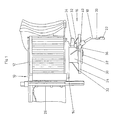
- a telescopic aircraft bridge (10), of which only the front part is shown in Fig. 1, comprises a head (12), on the underside (14) of which a device (16) for stowing a supply cable (18) of a central electrical system for aircraft is attached.
- the cable winding device (16) is moved horizontally or vertically together with the passenger boarding bridge (10) and fixed in the desired position.
- the supply cable is connected via a connection box (not shown) to a connecting cable piece (26) which extends along the telescopic passenger boarding bridge (10).
- the construction of the cable winding device (16) can correspond to that of the European patent application EP-A-01630250.
- the cable has a section (28) which is deflected into the axis of rotation of the drum (24) and which, in turn, extends into a section in the housing (24) of exposed spirals and when unwinding the connecting cable (18) while reducing radial Expansion is greater and when winding is carried out, the radial expansion is increased by weakening spirally twistable wires.
- the drum (24) receiving the connecting cable (18) is connected to the housing (30) or the underside (14) of the head (12) via struts (32).
- the cable winding device (16) can be rotated clockwise or counterclockwise via a geared motor (34), depending on whether the supply cable (18) wound on the drum (24) or to be removed from it.
- Support rollers (36) are provided to ensure that the supply cable (18), that is to say the section (20), is inserted gently into the drum (24) via the opening (40).
- rollers for reducing the friction can be arranged peripherally on the peripheral surface of the drum (24), as can be seen, for example, from PCT / EP 86/00142.
- the plug connector (22) hangs freely in the known cable winding devices, so it can exert an uncontrolled oscillating movement, with the risk that the wires of the supply cable break, which means that the supply cable must be replaced or at least shortened is.
- a holder (42) is now provided for a tubular element (44) through which the supply cable (18) can be pulled out of the cable winding device (16) or inserted into it.
- a tube-shaped centering element (46) is also assigned to the tube (44), which can also be referred to as a guide element, which emanates from the plug unit (22), which can be designed as a panel.
- This centering element (46) clearly surrounds the supply cable (18) inserted into the plug unit (22), ie the section (20).
- the diameter of the centering element (46) is smaller than the inside diameter of the guide element (44), so as - as shown in FIG. 3 - the centering element (46) up to a stop (48) in the guide element (44) when the supply cable is rolled up ( 18) to be able to bring.
- the supply cable (18) when it is not used, that is when it is largely wound on the cable winding device (16), it can no longer oscillate freely, so that the wires of the supply cable (18) are consequently also protected.
- the graphic representations further clarify that the holder (42) can be adjusted relative to the cable winding device (16) in order to be able to adjust the insertion angle of the centering element (46) into the guide element (44). This ensures that during the transition from the supply cable (18) to the centering element (46) there are no impact forces on the supply cable (18) in the region of the free end of the centering element (46).
- the insertion of the centering element (46) into the guide element (44) is further facilitated in that the opening (50) of the guide element (44) is expanded like a trumpet, at least on the inside.
- the front free end (52) of the centering element (46) can be chamfered.
- Both the centering element (46) and the guide element (44) can be detachably connected to the plug unit (42) or the holder (42) with screw connections.
- the holder (42) which can be in the form of a tubular or cuboid housing, is connected to the cable winding device (16) via flat irons extending from it, the connection itself being effected via elongated holes in order to adjust the angle of inclination of the holder (42) can.
- the guide element is thus divided into two sections, an inner section (54) and an outer section (56), which are spaced apart from one another and are connected to one another by a flexible element such as a tension spring (58) or the like.
- a flexible element such as a tension spring (58) or the like.
Landscapes
- Storing, Repeated Paying-Out, And Re-Storing Of Elongated Articles (AREA)
- Manufacturing Of Electric Cables (AREA)
- Electric Cable Arrangement Between Relatively Moving Parts (AREA)
- Organic Insulating Materials (AREA)
Abstract
Description
- Die Erfindung bezieht sich auf eine Kabelaufwickelvorrichtung zum Verstauen eines z.B. eine zentrale Bordnetzversorgungsanlage eines Flughafens mit einem Versorgungssteckeranschluß eines Flugzeugs verbindbaren Versorgungskabels, das über eine periphere Öffnung der vorzugsweise trommelartig ausgebildeten Kabelaufwickelvorrichtung von dieser abrollbar oder auf diese aufrollbar ist, wobei das freie Ende des Versorgungskabels eine Steckereinheit mit vorzugsweise Steuerfunktion (Panel) aufweist.
- Eine entsprechende Kabelaufwickelvorrichtung ist z.B. dem DE-U-83 03 469 oder der EP-A-0 163 025 zu entnehmen. Die entsprechenden Kabelaufwickelvorrichtungen können dabei mit vertikaler Achse unter dem Brückenkopf eines Gates bzw. einer teleskopartig aufgebauten Fluggastbrücke aufgehängt und mittels Motor zum Auf- bzw. Abrollen in die gewünschte Drehrichtung versetzt werden.
- Die Kabelaufwickelvorrichtung der zuerst genannten Art weist eine Aufwickeltrommel und eine zu dieser koaxial angeordnete Ausgleichstrommel auf, die oberhalb der Aufwickeltrommel liegt. Eine solche Konstruktion ist aufwendig und birgt den gravierenden Nachteil in sich, daß von dem in der Kabelaufwickelvorrichtung vorhandenem Kabel nur die Hälfte genutzt, also abgerollt werden kann. Daher hat sich eine entsprechende Vorrichtung in der Praxis auch nicht bewährt.
- Die Kabelaufwickelvorrichtung der EP-A-0 163 025 hat diese Nachteile vollständig ausgeräumt. Hierzu sind in einem sich in Achsrichtung der Aufhängevorrichtung bzw. -trommel erstreckenden Abschnitt Adern freiliegend angeordnet, die beim Abwickeln des Versorgungskabels von der Aufwickeltrommel unter Reduzierung der radialen Ausbauchung stärker und beim Aufwickeln unter Vergrößerung der radialen Ausbauchung schwächer spiralförmig verdreh- und verdrillbar sind. Hierdurch sind Ausgleichabschnitte und deren Anordnung in der Ausgleichstrommel nicht mehr erforderlich. Die aus der EP-A-0 163 025 bekannte Kabelaufwickelvorrichtung, die nicht nur unterhalb eines Gates, sondern auch unterflur anordbar ist, hat daher uneingeschränkte Anerkennung gefunden und ist somit umfassend zum Einsatz gelangt.
- Trotz der entscheidenden Vorteile, die mit Kabelaufwickelvorrichtungen der eingangs genannten Art erzielbar sind, zeigt sich von Fall zu Fall der Nachteil, daß das mit der Steckereinheit versehene Kabelende im Bereich des Austritts aus der Kabelaufwickelvorrichtung bricht, da es dort pendelnd herabhängt.
- Aufgabe der vorliegenden Erfindung ist es daher, eine Kabelaufwickelvorrichtung der zuvor beschriebenen Art so weiterzubilden, daß sichergestellt ist, daß das Versorgungskabel bzw. dessen Adern im Bereich der Steckereinheit wie Panels nicht beschädigt werden, insbesondere nicht brechen kann.
- Die Aufgabe wird erfindungsgemäß im wesentlichen dadurch gelöst, daß von der Kabelaufwickelvorrichtung ein das Versorgungskabel zumindest abschnittsweise umgebendes Führungselement ausgeht oder Teil der Kabelaufwickelvorrichtung ist, dem ein von der Steckereinheit ausgehender Abschnitt des Versorgungskabels zumindest abschnittsweise umgebendes Zentrierelement zugeordnet ist.
- Durch die erfindungsgemäße Konstruktion wird bei aufgerolltem Versorgungskabel der von der Steckereinheit ausgehende Abschnitt geführt von dem vorzugsweise als Rohrelement ausgebildeten Führungselement aufgenommen, so daß unkontrollierte Krafteinwirkungen, die nach dem Stand der Technik durch ein pendelndes Herabhängen auftreten, ausgeschlossen sind. Die Steckereinheit mit dem sich anschließenden Versorgungskabel bildet folglich eine starre Einheit, die geführt von dem Führungselement aufgenommen ist. Letzteres kann dabei selbst rohrförmig ausgebildet sein, wobei selbstverständlich der Außendurchmesser größer als der des Zentrierelementes ist.
- Um beim Aufwickeln des Kabels zu gewährleisten, daß das Zentrierelement ohne Schwierigkeit in das Führungselement einbringbar ist, um also unkontrollierte Stöße oder ähnliches im Übergangsbereich von dem Versorgungskabel zum Zentrierelement auszuschließen, kann das Führungselement von einer die Öffnung der Kabelaufwickelvorrichtung umgebenden und zu dieser verstellbaren Halterung ausgehen. Diese Halterung kann gehäuseartig ausgebildet sein und z.B. über Langlöcher mit der Kabelaufwikkelvorrichtung verbunden sein. Hierdurch ergibt sich eine Verstellbarkeit, so daß folglich der Winkel, unter dem das Kabel in die Kabelaufwickelvorrichtung eingeführt wird, verstellt werden kann.
- In hervorzuhebender und eigenerfinderischer Ausgestaltung ist vorgesehen, daß das Führungselement zumindest zweiteilig ausgebildet ist, wobei die Teile über ein elastisches Element wie Zugfeder verbunden sind. Hierdurch ist der Vorteil gegeben, daß sich der vordere Abschnitt noch weiter auf die Einzugsrichtung des Kabels ausrichten kann, wobei eine Voreinstellung über die das Führungselement aufnehmende Halterung erfolgen kann. Anstelle einer Zugfeder kann auch ein gleichwirkendes Element zum Einsatz gelangen.
- Des weiteren ist vorgesehen, daß das Zentrierelement steckerseitig einen Flansch aufweist, an dem bei in dem Führungselement angeordnetem Zentrierelement der freie äußere Rand des Führungselementes anliegt.
- Um das Einführen des Zentrierelementes in das Führungselement zu erleichtern, kann zumindest die Innengeometrie des freien äußeren Randes des Führungselementes trompetenartig erweitert sein und gegebenenfalls das freie äußere Ende des Zentrierelementes sich verjüngen.
- Sowohl das Führungselement als auch das an der Steckereinheit angeflanschte Zentrierelement kann aus schlagfestem Kunststoff oder anderem geeigneten Material bestehen, wodurch Beschädigungen durch Schlageinwirkungen, Stöße oder ähnliches weitgehend ausgeschlossen sind.
- Weitere Einzelheiten, Vorteile und Merkmale der Erfindung ergeben sich nicht nur aus den Ansprüchen, den diesen zu entnehmenden Merkmalen -für sich und/oder in Kombination-, sondern auch aus der nachfolgenden Beschreibung eines der Zeichnung zu entnehmenden bevorzugten Ausführungsbeispiels.
- Es zeigen:
- Fig. 1 eine Seitenansicht des Kopfes einer teleskopierbaren Fluggastbrücke mit einer Kabelaufwickelvorrichtung,
- Fig. 2 eine Detaildarstellung einer Kabelaufwickelvorrichtung mit teilweise abgerolltem Versorgungskabel,
- Fig. 3 die Detaildarstellung nach Fig. 3, jedoch mit aufgerolltem Versorgungskabel und
- Fig. 4 eine der Fig. 3 entsprechende Darstellung mit weiter ausgestaltetem Führungselement.
- Eine teleskopierbare Flugzeugbrücke (10), von der in Fig. 1 nur der vordere Teil dargestellt ist, umfaßt einen Kopf (12), an dessen Unterseite (14) eine Vorrichtung (16) zum Verstauen eines Versorgungskabels (18) einer zentralen Bordnetzversorgungsanlage für Flugzeuge befestigt ist. Die Kabelaufwickelvorrichtung (16) wird dabei zusammen mit der Fluggastbrücke (10) horizontal bzw. vertikal verschoben und in gewünschter Position festgelegt.
- Das Versorgungskabel (18), von dem ein abgerollter Abschnitt mit dem Bezugszeichen (20) versehen ist und an dessen äußerem Ende eine rein prinzipiell dargestellte Steckereinheit (22) wie Steckverbinder angeordnet ist, wird von der als Trommel (24) ausgebildeten Kabelaufwickelrolle (14) aufgenommen, wobei die Länge des Abschnittes (20) von dem Abstand zwischen dem Kopf (12) und dem zu versorgenden Flugzeug abhängt. Das Versorgungskabel wird über einen nicht dargestellten Anschlußkasten mit einem Verbindungskabelstück (26) verbunden, welches sich entlang der teleskopierbaren Fluggastbrücke (10) erstreckt.
- Der Aufbau der Kabelaufwickelvorrichtung (16) kann dem der Europäischen Patentanmeldung EP-A-01630250 entsprechen. Dies bedeutet, daß das Kabel einen in die Drehachse der Trommel (24) umgelenkten Abschnitt (28) aufweist, der seinerseits in einen in dem Gehäuse (24) verlaufenden Abschnitt von freiliegend spiralförmig angeordneten und beim Abwickeln des Verbindungskabels (18) unter Reduzierung einer radialen Ausdehnung stärker und beim Aufwickeln unter Vergrößerung der radial Ausdehnung schwächer spiralförmig verdrehbaren Adern übergeht.
- Eine andere verdrillungsfreie Verbindungsart zwischen dem Versorgungskabel (18) und dem Abschnitt (26) über z.B. Schleifringe oder ähnliches ist selbstverständlich möglich.
- Die das Verbindungskabel (18) aufnehmende Trommel (24) ist über Streben (32) mit dem Gehäuse (30) bzw. der Unterseite (14) des Kopfes (12) verbunden. Über einen Getriebemotor (34) ist die Kabelaufwickelvorrichtung (16) im oder entgegengesetzt dem Uhrzeigersinn drehbar, je nachdem, ob das Versorgungskabel (18) auf der Trommel (24) aufgewickelt oder von dieser abgezogen werden soll.
- Um ein schonendes Einführen des Versorgungskabels (18), also des Abschnitts (20) über die Öffnung (40) in die Trommel (24) sicherzustellen, sind Abstützrollen (36) vorgesehen. Schließlich können peripher auf der Umfangsfläche der Trommel (24) Rollen zur Reduzierung der Reibung angeordnet sein, wie es beispielhaft der PCT/EP 86/00142 zu entnehme ist.
- Bei aufgerolltem Versorgungskabel (18) hängt bei den bekannten Kabelaufwickelvorrichtungen der Steckverbinder (22) frei herab, kann also eine unkontrollierte pendelnde Bewegung ausüben, wobei die Gefahr besteht, daß die Adern des Versorgungskabels brechen, wodurch ein Austausch des Versorgungskabels oder zumindest eine Verkürzung dieses erforderlich ist.
- Im Bereich der Austrittsöffnung (40) der Kabelaufwickelvorrichtung (16), also dort, wo die Führungsrollen (36) zur Abstützung des Versorgungskabels (18) verlaufen, ist nun eine Halterung (42) für ein Rohrelement (44) vorgesehen, durch das das Versorgungskabel (18) aus der Kabelaufwickelvorrichtung (16) herausgezogen bzw. in diese eingebracht werden kann.
- Dem auch als Führungselement zu bezeichnenden Rohr (44) ist ein ebenfalls rohrförmig ausgebildetes Zentrierelement (46) zugeordnet, das von der Steckereinheit (22), das als Panel ausgebildet sein kann, ausgeht. Dieses Zentrierelement (46) umgibt erkennbar das in die Steckereinheit (22) eingeführte Versorgungskabel (18), also den Abschnitt (20). Der Durchmesser des Zentrierelementes (46) ist kleiner als der Innendurchmesser des Führungselementes (44), um so -wie die Fig. 3 verdeutlicht- das Zentrierelement (46) bis zu einem Anschlag (48) in das Führungselement (44) bei aufgerolltem Versorgungskabel (18) einbringen zu können. Hierdurch wird eine starre Einheit aus Steckereinheit (22), Zentrierelement (46), Führungselement (44), Halterung (42) und der Trommel (24) gebildet, wodurch das Kabel (18), das innerhalb dieser starren Einheit verläuft, unkontrollierten Krafteinwirkungen nicht mehr ausgsetzt ist. Insbesondere kann bei nicht genutztem Versorgungskabel (18), also wenn es weitgehend auf der Kabelaufwickelvorrichtung (16) aufgewickelt ist, nicht mehr frei pendeln, so daß folglich auch die Adern des Versorgungskabels (18) geschützt sind.
- Die zeichnerischen Darstellungen verdeutlichen des weiteren, daß die Halterung (42) gegenüber der Kabelaufwickelvorrichtung (16) verstellbar ist, um so den Einführungswinkel des Zentrierelementes (46) in das Führungselement (44) einstellen zu können. Hierdurch ist sichergestellt, daß beim Übergang von dem Versorgungskabel (18) zu dem Zentrierelement (46) keine stoßartigen Krafteinwirkungen auf das Versorgungskabel (18) im Bereich des freien Endes des Zentrierelementes (46) erfolgen.
- Das Einführen des Zentrierelementes (46) in das Führungselement (44) wird des weiteren dadurch erleichtert, daß die Öffnung (50) des Führungselementes (44) zumindest innenwandig trompetenartig erweitert ist. Zusätzlich kann das vordere freie Ende (52) des Zentrierelementes (46) angefast sein.
- Sowohl das Zentrierelement (46) als auch das Führungselement (44) kann mit der Steckereinheit (42) bzw. der Halterung (42) mit Schraubverbindungen lösbar verbunden sein. Die Halterung (42), die als rohrförmiges bzw. quaderförmiges Gehäuse ausgebildet sein kann, wird mit der Kabelaufwickelvorrichtung (16) über von dieser ausgehende Flacheisen verbunden, wobei die Verbindung selbst über Langlöcher erfolgt, um so den Neigungswinkel der Halterung (42) einstellen zu können.
- Der Fig. 4 ist eine besonders hervorzuhebende Weiterbildung des Führungselementes (44) zu entnehmen.
- So ist das Führungselement in zwei Abschnitte, einen inneren Abschnitt (54) und einen äußeren Abschnitt (56) unterteilt, die zueinander beabstandet und durch ein flexibles Element wie Zugfeder (58) oder ähnliches miteinander verbunden sind. Hierdurch wird der Vorteil erzielt, daß der äußere Abschnitt (56) zu dem inneren Abschnitt (54) verschwenkbar ist, so daß der Kabeleinführungswinkel auf ein schonendes Einziehen des Kabels (18) ausrichtbar ist.
Claims (9)
dadurch gekennzeichnet,
daß von der Kabelaufwickelvorrichtung (16, 24) ein das Versorgungskabel (18) zumindest abschnittsweise umgebendes Führungselement (44) ausgeht, dem ein von der Steckereinheit (42) ausgehendes, den von der Steckereinheit ausgehenden Abschnitt (20) des Versorgungskabels (18) zumindest abschnittsweise umgebendes Zentrierelement (46) zugeordnet ist.
dadurch gekennzeichnet,
daß das Führungselement (44) ein Rohrelement ist.
dadurch gekennzeichnet,
daß das Zentrierelement (46) ein zumindest bereichsweise von dem Führungselement (44) aufnehmbares Rohrelement ist.
dadurch gekennzeichnet,
daß das Führungselement (44) von einer die Öffnung (40) der Kabelaufwickelvorrichtung (16, 24) umgebenden und zu dieser verstellbaren Halterung (42) ausgeht.
dadurch gekennzeichnet,
daß das Zentrierelement (46) steckerseitig einen Flansch (48) aufweist, an dem bei im Führungselement (44) angeordnetem Zentrierelement (46) der freie äußere Rand des Führungselementes anliegt.
dadurch gekennzeichnet,
daß die Öffnung (50) des Führungselementes zumindest innenseitig trompetenartig erweitert ist.
dadurch gekennzeichnet,
daß sich das freie äußere Ende (52) des Zentrierelementes (46) verjüngt.
dadurch gekennzeichnet,
daß das Führungselement (44) in zumindest einen inneren und einen äußeren Abschnitt (54, 56) unterteilt ist, die flexibel untereinander verbunden sind.
dadurch gekennzeichnet,
daß der innere und der äußere Abschnitt über ein Federelement wie Zugfeder (58) verbunden sind.
Applications Claiming Priority (4)
| Application Number | Priority Date | Filing Date | Title |
|---|---|---|---|
| DE8913225U | 1989-11-08 | ||
| DE8913225U DE8913225U1 (de) | 1989-11-08 | 1989-11-08 | Kabelaufwickelvorrichtung |
| DE8914558U | 1989-12-11 | ||
| DE8914558U DE8914558U1 (de) | 1989-11-08 | 1989-12-11 | Kabelaufwickelvorrichtung |
Publications (3)
| Publication Number | Publication Date |
|---|---|
| EP0427041A2 true EP0427041A2 (de) | 1991-05-15 |
| EP0427041A3 EP0427041A3 (en) | 1991-11-21 |
| EP0427041B1 EP0427041B1 (de) | 1995-03-15 |
Family
ID=25955487
Family Applications (1)
| Application Number | Title | Priority Date | Filing Date |
|---|---|---|---|
| EP90120280A Expired - Lifetime EP0427041B1 (de) | 1989-11-08 | 1990-10-23 | Kabelaufwickelvorrichtung |
Country Status (6)
| Country | Link |
|---|---|
| US (1) | US5145040A (de) |
| EP (1) | EP0427041B1 (de) |
| AT (1) | ATE120051T1 (de) |
| DE (1) | DE59008709D1 (de) |
| DK (1) | DK0427041T3 (de) |
| ES (1) | ES2071722T3 (de) |
Cited By (1)
| Publication number | Priority date | Publication date | Assignee | Title |
|---|---|---|---|---|
| CN103249599A (zh) * | 2010-11-24 | 2013-08-14 | 戴姆勒股份公司 | 用于运行设置在可运动的透明面元件中和/或上的电负载的装置 |
Families Citing this family (4)
| Publication number | Priority date | Publication date | Assignee | Title |
|---|---|---|---|---|
| JP3347433B2 (ja) * | 1993-10-19 | 2002-11-20 | 本田技研工業株式会社 | 電動車両の充電コード収納構造 |
| US5810135A (en) * | 1996-09-25 | 1998-09-22 | General Cable Industries, Inc. | Plug and switch assembly |
| JP5293187B2 (ja) * | 2006-11-14 | 2013-09-18 | パナソニック株式会社 | センサ |
| FI11095U1 (fi) * | 2015-08-12 | 2016-01-12 | Mattoasennus Karjalainen Oy | Automaattisesti kelautuva lämmitysjohtojärjestely ajoneuvoon |
Family Cites Families (16)
| Publication number | Priority date | Publication date | Assignee | Title |
|---|---|---|---|---|
| US1725308A (en) * | 1924-09-03 | 1929-08-20 | Shoenberg | Combined cord reel |
| US2013733A (en) * | 1934-11-06 | 1935-09-10 | Claude M Murphy | Winding reel for cables |
| US2543176A (en) * | 1948-03-20 | 1951-02-27 | Aero Motive Mfg Company | Reel |
| CH419273A (de) * | 1963-09-12 | 1966-08-31 | Bommeli Paul | Elektrische Stecker-Anordnung in Mauerwänden |
| US3840713A (en) * | 1972-05-08 | 1974-10-08 | Mc Graw Edison Co | Portable reel for flexible conductors |
| US4138177A (en) * | 1976-04-16 | 1979-02-06 | Valer Andrew F Van | Safety vehicle power distribution system |
| US4258834A (en) * | 1978-07-12 | 1981-03-31 | Western Gear Corporation | Winding system for flexible conduits and cables |
| DE3209294A1 (de) * | 1982-03-13 | 1983-09-22 | M.A.N. Maschinenfabrik Augsburg-Nürnberg AG, 4200 Oberhausen | Gleisloses untertagefahrzeug |
| DE3304276C1 (de) * | 1983-02-08 | 1984-08-02 | Schabmüller, Heinz, 8132 Tutzing | Verstauvorrichtung fuer das Anschlusskabel einer zentralen Bordnetzversorgungsanlage auf Flughaefen |
| US4825986A (en) * | 1983-09-02 | 1989-05-02 | Wyle Laboratories | Remotely controllable cable assembly |
| DE8416520U1 (de) * | 1984-05-30 | 1984-10-04 | Manfred Fladung GmbH, 8752 Mömbris | Vorrichtung zum Verstauen des Anschlußkabels einer zentralen Bordnetzversorgungsanlage |
| EP0252914B1 (de) * | 1985-03-15 | 1989-06-28 | Manfred Fladung GmbH | Vorrichtung zum verstauen eines versorgungskabels von vorzugsweise einer bordnetzversorgungsanlage auf flughäfen |
| US4842108A (en) * | 1985-05-28 | 1989-06-27 | Circle A Product, Inc. | Power retract electric cord reel |
| US4653833A (en) * | 1985-06-27 | 1987-03-31 | Czubernat Donald A | Retractable booster cable device |
| DE8913225U1 (de) * | 1989-11-08 | 1990-01-04 | Manfred Fladung GmbH, 63776 Mömbris | Kabelaufwickelvorrichtung |
| US5034571A (en) * | 1989-11-13 | 1991-07-23 | Galloway Albert D | Power cord retractor for recreational vehicle |
-
1990
- 1990-10-23 DE DE59008709T patent/DE59008709D1/de not_active Expired - Fee Related
- 1990-10-23 DK DK90120280.4T patent/DK0427041T3/da active
- 1990-10-23 ES ES90120280T patent/ES2071722T3/es not_active Expired - Lifetime
- 1990-10-23 EP EP90120280A patent/EP0427041B1/de not_active Expired - Lifetime
- 1990-10-23 AT AT90120280T patent/ATE120051T1/de not_active IP Right Cessation
- 1990-10-31 US US07/606,115 patent/US5145040A/en not_active Expired - Lifetime
Cited By (1)
| Publication number | Priority date | Publication date | Assignee | Title |
|---|---|---|---|---|
| CN103249599A (zh) * | 2010-11-24 | 2013-08-14 | 戴姆勒股份公司 | 用于运行设置在可运动的透明面元件中和/或上的电负载的装置 |
Also Published As
| Publication number | Publication date |
|---|---|
| ATE120051T1 (de) | 1995-04-15 |
| ES2071722T3 (es) | 1995-07-01 |
| DK0427041T3 (da) | 1995-07-10 |
| US5145040A (en) | 1992-09-08 |
| EP0427041A3 (en) | 1991-11-21 |
| DE59008709D1 (de) | 1995-04-20 |
| EP0427041B1 (de) | 1995-03-15 |
Similar Documents
| Publication | Publication Date | Title |
|---|---|---|
| DE69318291T2 (de) | Verfahren und einrichtung zur herstellung eines verbindungskabels | |
| DE4205574C2 (de) | Kanalkörper und Verfahren zum Verlegen eines Kabels in diesem | |
| DE1051770B (de) | Kontinuierlich arbeitende Abwickeleinrichtung fuer Draht | |
| EP0445312B1 (de) | Vorrichtung zum Verlegen von Kabeln oder flexiblen Rohren über eine Verlegungsstrecke | |
| EP0427041B1 (de) | Kabelaufwickelvorrichtung | |
| DE69009377T2 (de) | Verfahren zur Doppelaufwicklung eines Kabels oder dergleichen auf der Aussenfläche einer Trommel. | |
| EP0163025B1 (de) | Vorrichtung zum Verstauen des Anschlusskabels einer zentralen Bordnetzversorgungsanlage | |
| DE2504649C3 (de) | Haltevorrichtung für elektrische Kabel | |
| EP0049734B1 (de) | Vorrichtung zum kontrollierten Ausfahren einer an einem mit Drall versehenen Satellitenkörper befestigten flexiblen Auslegerverbindung | |
| DE3610635A1 (de) | Verbesserte markise in form eines dachs | |
| DE3317920A1 (de) | Vorrichtung zum anbringen einer versetzbaren halterung an einer rohrwand eines dampferzeugers | |
| DE8913225U1 (de) | Kabelaufwickelvorrichtung | |
| DE3427788C1 (de) | Vorrichtung zum nachträglichen Einziehen von Kabeln in Kabelschutzrohre | |
| DE3017195C2 (de) | ||
| DE8419599U1 (de) | Kabelaufrollvorrichtung für Anschlußkabel von Bordnetzversorgungsanlagen für Flugzeuge | |
| DE10008613A1 (de) | Übergangsstück | |
| DE9208985U1 (de) | Kabelführungseinrichtung mit zumindest einem Kabelführungsrohr | |
| EP0437709B1 (de) | Langgestrecktes Element zum Einziehen in ein Rohr und Verfahren zur Anwendung hierfür | |
| DE3038704C2 (de) | ||
| DE3031941C2 (de) | Vorrichtung zum Zusammenziehen von Kanalröhren | |
| DE3901063A1 (de) | Verfahren zum einziehen eines kabels in ein kabelkanalsystem und vorrichtung zum aufwickeln eines kabels | |
| DE2618465C2 (de) | Führungs- und Spanneinrichtung für Leitungen im Fahrzeugrahmen | |
| DE102005034556B4 (de) | Vorrichtung zur Datenübertragung und Verfahren zum Einbringen einer solchen Vorrichtung in ein Rohr | |
| EP0238436B1 (de) | Schlingenwagenantrieb | |
| WO1991000537A1 (de) | Verfahren und einrichtung zum einziehen von insbesondere lichtwellenleiterkabeln in schutzrohre |
Legal Events
| Date | Code | Title | Description |
|---|---|---|---|
| PUAI | Public reference made under article 153(3) epc to a published international application that has entered the european phase |
Free format text: ORIGINAL CODE: 0009012 |
|
| AK | Designated contracting states |
Kind code of ref document: A2 Designated state(s): AT BE CH DE DK ES FR GB GR IT LI LU NL SE |
|
| PUAL | Search report despatched |
Free format text: ORIGINAL CODE: 0009013 |
|
| AK | Designated contracting states |
Kind code of ref document: A3 Designated state(s): AT BE CH DE DK ES FR GB GR IT LI LU NL SE |
|
| 17P | Request for examination filed |
Effective date: 19911108 |
|
| 17Q | First examination report despatched |
Effective date: 19931210 |
|
| GRAA | (expected) grant |
Free format text: ORIGINAL CODE: 0009210 |
|
| AK | Designated contracting states |
Kind code of ref document: B1 Designated state(s): AT BE CH DE DK ES FR GB GR IT LI LU NL SE |
|
| PG25 | Lapsed in a contracting state [announced via postgrant information from national office to epo] |
Ref country code: GR Free format text: LAPSE BECAUSE OF FAILURE TO SUBMIT A TRANSLATION OF THE DESCRIPTION OR TO PAY THE FEE WITHIN THE PRESCRIBED TIME-LIMIT Effective date: 19950315 Ref country code: BE Effective date: 19950315 |
|
| REF | Corresponds to: |
Ref document number: 120051 Country of ref document: AT Date of ref document: 19950415 Kind code of ref document: T |
|
| REF | Corresponds to: |
Ref document number: 59008709 Country of ref document: DE Date of ref document: 19950420 |
|
| ITF | It: translation for a ep patent filed | ||
| ET | Fr: translation filed | ||
| REG | Reference to a national code |
Ref country code: ES Ref legal event code: FG2A Ref document number: 2071722 Country of ref document: ES Kind code of ref document: T3 |
|
| REG | Reference to a national code |
Ref country code: DK Ref legal event code: T3 |
|
| GBT | Gb: translation of ep patent filed (gb section 77(6)(a)/1977) |
Effective date: 19950612 |
|
| PG25 | Lapsed in a contracting state [announced via postgrant information from national office to epo] |
Ref country code: LU Free format text: LAPSE BECAUSE OF NON-PAYMENT OF DUE FEES Effective date: 19951031 |
|
| PLBE | No opposition filed within time limit |
Free format text: ORIGINAL CODE: 0009261 |
|
| STAA | Information on the status of an ep patent application or granted ep patent |
Free format text: STATUS: NO OPPOSITION FILED WITHIN TIME LIMIT |
|
| 26N | No opposition filed | ||
| PGFP | Annual fee paid to national office [announced via postgrant information from national office to epo] |
Ref country code: DK Payment date: 19980916 Year of fee payment: 9 |
|
| PGFP | Annual fee paid to national office [announced via postgrant information from national office to epo] |
Ref country code: SE Payment date: 19980928 Year of fee payment: 9 |
|
| PGFP | Annual fee paid to national office [announced via postgrant information from national office to epo] |
Ref country code: ES Payment date: 19981013 Year of fee payment: 9 |
|
| PGFP | Annual fee paid to national office [announced via postgrant information from national office to epo] |
Ref country code: GB Payment date: 19981023 Year of fee payment: 9 |
|
| PGFP | Annual fee paid to national office [announced via postgrant information from national office to epo] |
Ref country code: DE Payment date: 19981028 Year of fee payment: 9 Ref country code: AT Payment date: 19981028 Year of fee payment: 9 |
|
| PGFP | Annual fee paid to national office [announced via postgrant information from national office to epo] |
Ref country code: FR Payment date: 19981030 Year of fee payment: 9 |
|
| PGFP | Annual fee paid to national office [announced via postgrant information from national office to epo] |
Ref country code: NL Payment date: 19981031 Year of fee payment: 9 |
|
| PGFP | Annual fee paid to national office [announced via postgrant information from national office to epo] |
Ref country code: CH Payment date: 19981105 Year of fee payment: 9 |
|
| PG25 | Lapsed in a contracting state [announced via postgrant information from national office to epo] |
Ref country code: GB Free format text: LAPSE BECAUSE OF NON-PAYMENT OF DUE FEES Effective date: 19991023 Ref country code: DK Free format text: LAPSE BECAUSE OF NON-PAYMENT OF DUE FEES Effective date: 19991023 Ref country code: AT Free format text: LAPSE BECAUSE OF NON-PAYMENT OF DUE FEES Effective date: 19991023 |
|
| PG25 | Lapsed in a contracting state [announced via postgrant information from national office to epo] |
Ref country code: ES Free format text: LAPSE BECAUSE OF NON-PAYMENT OF DUE FEES Effective date: 19991024 |
|
| PG25 | Lapsed in a contracting state [announced via postgrant information from national office to epo] |
Ref country code: SE Free format text: THE PATENT HAS BEEN ANNULLED BY A DECISION OF A NATIONAL AUTHORITY Effective date: 19991030 |
|
| PG25 | Lapsed in a contracting state [announced via postgrant information from national office to epo] |
Ref country code: LI Free format text: LAPSE BECAUSE OF NON-PAYMENT OF DUE FEES Effective date: 19991031 Ref country code: CH Free format text: LAPSE BECAUSE OF NON-PAYMENT OF DUE FEES Effective date: 19991031 |
|
| PG25 | Lapsed in a contracting state [announced via postgrant information from national office to epo] |
Ref country code: NL Free format text: LAPSE BECAUSE OF NON-PAYMENT OF DUE FEES Effective date: 20000501 |
|
| GBPC | Gb: european patent ceased through non-payment of renewal fee |
Effective date: 19991023 |
|
| REG | Reference to a national code |
Ref country code: CH Ref legal event code: PL |
|
| EUG | Se: european patent has lapsed |
Ref document number: 90120280.4 |
|
| PG25 | Lapsed in a contracting state [announced via postgrant information from national office to epo] |
Ref country code: FR Free format text: LAPSE BECAUSE OF NON-PAYMENT OF DUE FEES Effective date: 20000630 |
|
| NLV4 | Nl: lapsed or anulled due to non-payment of the annual fee |
Effective date: 20000501 |
|
| REG | Reference to a national code |
Ref country code: DK Ref legal event code: EBP |
|
| PG25 | Lapsed in a contracting state [announced via postgrant information from national office to epo] |
Ref country code: DE Free format text: LAPSE BECAUSE OF NON-PAYMENT OF DUE FEES Effective date: 20000801 |
|
| REG | Reference to a national code |
Ref country code: FR Ref legal event code: ST |
|
| REG | Reference to a national code |
Ref country code: ES Ref legal event code: FD2A Effective date: 20001113 |
|
| PG25 | Lapsed in a contracting state [announced via postgrant information from national office to epo] |
Ref country code: IT Free format text: LAPSE BECAUSE OF NON-PAYMENT OF DUE FEES;WARNING: LAPSES OF ITALIAN PATENTS WITH EFFECTIVE DATE BEFORE 2007 MAY HAVE OCCURRED AT ANY TIME BEFORE 2007. THE CORRECT EFFECTIVE DATE MAY BE DIFFERENT FROM THE ONE RECORDED. Effective date: 20051023 |