EP0427060A2 - Katalysatorsysteme vom Typ der Ziegler-Natta-Katalysatoren - Google Patents
Katalysatorsysteme vom Typ der Ziegler-Natta-Katalysatoren Download PDFInfo
- Publication number
- EP0427060A2 EP0427060A2 EP90120547A EP90120547A EP0427060A2 EP 0427060 A2 EP0427060 A2 EP 0427060A2 EP 90120547 A EP90120547 A EP 90120547A EP 90120547 A EP90120547 A EP 90120547A EP 0427060 A2 EP0427060 A2 EP 0427060A2
- Authority
- EP
- European Patent Office
- Prior art keywords
- titanium
- magnesium
- solid component
- compound
- alkyl group
- Prior art date
- Legal status (The legal status is an assumption and is not a legal conclusion. Google has not performed a legal analysis and makes no representation as to the accuracy of the status listed.)
- Granted
Links
Classifications
-
- C—CHEMISTRY; METALLURGY
- C08—ORGANIC MACROMOLECULAR COMPOUNDS; THEIR PREPARATION OR CHEMICAL WORKING-UP; COMPOSITIONS BASED THEREON
- C08F—MACROMOLECULAR COMPOUNDS OBTAINED BY REACTIONS ONLY INVOLVING CARBON-TO-CARBON UNSATURATED BONDS
- C08F4/00—Polymerisation catalysts
-
- C—CHEMISTRY; METALLURGY
- C08—ORGANIC MACROMOLECULAR COMPOUNDS; THEIR PREPARATION OR CHEMICAL WORKING-UP; COMPOSITIONS BASED THEREON
- C08F—MACROMOLECULAR COMPOUNDS OBTAINED BY REACTIONS ONLY INVOLVING CARBON-TO-CARBON UNSATURATED BONDS
- C08F10/00—Homopolymers and copolymers of unsaturated aliphatic hydrocarbons having only one carbon-to-carbon double bond
Definitions
- the invention relates to the production of such catalyst systems, the production of polymers of propylene with the aid of these catalyst systems, the polymers obtainable hereafter, and films and moldings made from these polymers.
- Catalyst systems of the Ziegler-Natta type include known from EP-B 14523, EP-A-23425, EP-A 45975 and EP-A 195 497. These systems are used in particular for the polymerization of ⁇ -olefins and contain i.a. Compounds of polyvalent titanium, aluminum halides and / or alkyls, and electron donor compounds, in particular silicon compounds, ethers, carboxylic esters, ketones and lactones, which are used on the one hand in conjunction with the titanium compound and on the other hand as a cocatalyst.
- a catalyst system is known from EP-A 86473 in which carbonic acid esters are used as electron donor compounds as constituents of the titanium-containing solid component and Cocatalyst inter alia silicon compounds are used, which has a satisfactorily high productivity, but leaves something to be desired in terms of the stereospecificity of the resulting polymers.
- EP-A 171 200 also describes a Ziegler-Natta catalyst system which contains, among other things, carboxylic acid esters as well as silicon and aluminum compounds as cocatalysts as part of the titanium-containing solid component. This catalyst system enables the production of polypropylenes with high stereospecificity, but in addition to productivity which is no longer satisfactory, has the further disadvantage that the particle size distribution of the polymer obtainable here is too wide.
- a low halogen content in the polyolefin is also important in order to enable the use of such materials in combination with substances at risk of corrosion. For this, it is especially necessary to significantly reduce the halogen content in the polymer.
- GB-A-2 111 066 describes a catalyst system for the polymerization of polyolefins, which also i.a. Contains carboxylic acid esters as components of the titanium-containing solid component and silicon compounds as cocatalysts.
- This catalyst system is characterized by high productivity and good product properties of the homopolymers formed, in particular with regard to the stereospecificity, the particle size distribution and the fine particle fraction.
- these properties deteriorate considerably if the polymerization is carried out in the gas phase instead of in the solution phase.
- the object of the present invention was to develop a new catalyst system with which the disadvantages described can largely be remedied and with which it is in particular possible to produce polypropylene with high productivity even in the gas phase, which is distinguished by a high stereospecificity and by good morphological Characteristics, particularly characterized by the lowest possible fine grain fraction.
- Halides or alcoholates of tri- or tetravalent titanium are generally used as titanium compounds to produce the titanium-containing solid component, with the chlorides of titanium, in particular titanium tetrachloride, being preferred.
- the titanium-containing solid component advantageously contains a finely divided carrier, silicon and aluminum oxides and aluminum silicates having proven successful.
- SiO2 ⁇ aAl2O3 is used as the preferred carrier, where a stands for a value in the range from 0 to 2, in particular in the range from 0 to 0.5.
- the production of the titanium-containing solid component includes Compounds of magnesium used.
- magnesium halides magnesium alkyls and magnesium aryls, magnesium alkoxy and magnesium aryloxy compounds also come into consideration, magnesium dichloride, magnesium dibromide and magnesium di (C1-C10-alkyl) compounds in particular being used.
- the titanium-containing solid component contains halogen, preferably chlorine or bromine.
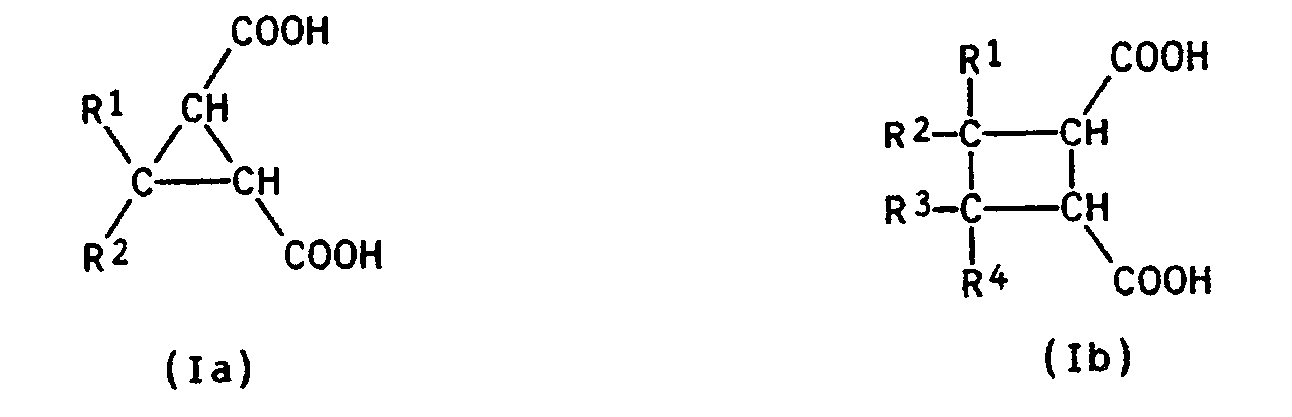
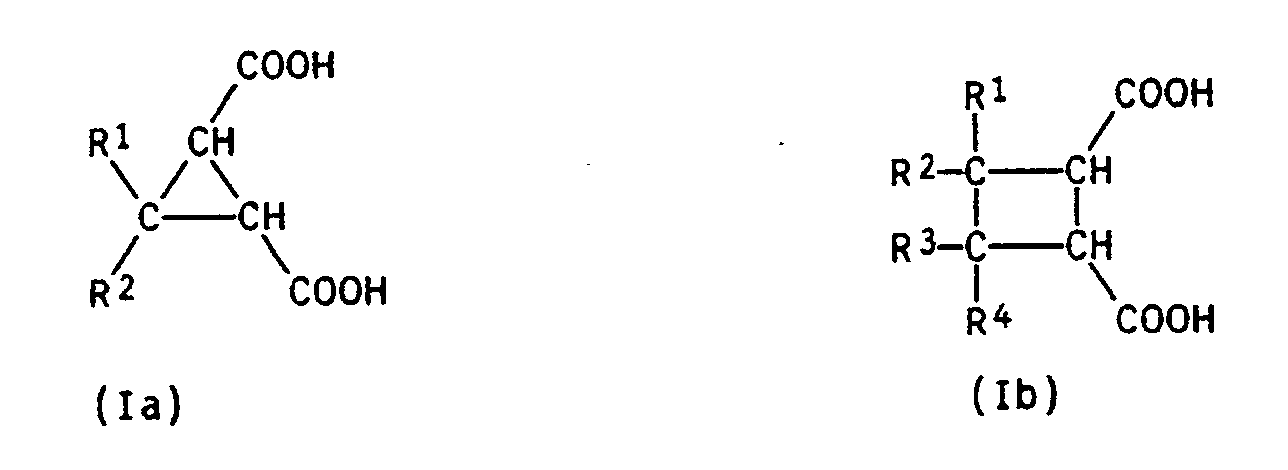
- the titanium-containing solid component also contains a diester of a 3- or 4-membered cycloalkyl-1,2-dicarboxylic acid of the formula Ia or Ib, wherein R1, R2, R3 and R4 are the same or different and an H atom, a C1 to C15 alkyl group, a C7 to C15 alkylaryl group, or a 5 to 7-membered cycloalkyl group, which in turn is C1 to C10 -Alkyl groups can mean.
- Preferred carboxylic acids are those in which R1, R2, R3 and R4 represent an H atom or a C1-C8 alkyl group.
- the hydroxy compounds used in the esterification reactions are alcohols, including C1 to C15 alkanols, C5 to C7 cycloalkanols, which in turn can carry C1 to C10 alkyl groups, and also C6 to C10 phenols.
- Preferred esters contain as alcohol residues C1 to C8 alkanols.
- esters examples include the esters of cyclopropane-1,2-dicarboxylic acid, pentanol, hexanol, heptanol and octanol in particular being used as the hydroxy compounds.
- the titanium-containing solid component can be prepared in a manner known per se, such as that e.g. in EP-A 45 975, EP-A 45 977, EP-A 86 473, EP-A 171 200 and GB-A 2 111 066.
- the following three-stage process is preferably used to produce the titanium-containing solid component.
- a finely divided carrier is first added, preferably SiO2 ⁇ aAl2O3 - where a stands for a number in the range from 0 to 2, in particular in the range from 0 to 0.5 - which generally has a particle diameter of 0.1 to 1000 ⁇ m, in particular from 10 to 300 ⁇ m, a pore volume of 0.1 to 10 cm3 / g, in particular from 1.0 to 4.0 cm3 / g, and a specific surface area of 10 to 1000 m2 / g, in particular from 100 to 500 m2 / g, with a solution of a magnesium-containing compound in a liquid alkane, after which this mixture is stirred for 0.5 to 5 hours at a temperature between 10 and 120 ° C.
- a halogen or a hydrogen halide in particular chlorine or hydrogen chloride, is added in at least a two-fold, preferably in at least a five-fold, molar excess, based on the magnesium-containing compound. After about 30 to 120 minutes, the solid is separated from the liquid phase.
- the product obtained in this way is introduced into a liquid alkane and then a C1 to C8 alkanol, in particular ethanol, a halide or an alcoholate of tri- or tetravalent titanium, in particular titanium tetrachloride, and the one to be used according to the invention are added Cycloalkyl-1,2-dicarboxylic acid ester added.
- the solid obtained from the second stage is extracted for a few hours at temperatures between 100 and 150 ° C. with excess titanium tetrachloride or one present in excess Solution of titanium tetrachloride in an inert solvent, preferably an alkylbenzene, the solvent containing at least 5% by weight titanium tetrachloride.
- an inert solvent preferably an alkylbenzene, the solvent containing at least 5% by weight titanium tetrachloride.
- the product is then washed with a liquid alkane until the titanium tetrachloride content in the washing liquid is less than 2% by weight.
- the titanium-containing solid component obtainable in this way is used together with cocatalysts as the Ziegler-Natta catalyst system.
- Aluminum compounds are particularly suitable as cocatalysts.
- electron donor compounds are preferably used as further cocatalysts.
- suitable aluminum components are also those compounds in which an alkyl group is replaced by an alkoxy group or by a halogen atom, for example by chlorine or bromine.
- Trialkylaluminum compounds are preferably used, the alkyl groups of which each have 1 to 8 carbon atoms, for example trimethyl, triethyl or methyldiethylaluminum.
- the catalyst systems according to the invention preferably also contain further electron donor compounds such as mono- or polyfunctional carboxylic acids, carboxylic acid anhydrides and carboxylic acid esters, furthermore ketones, ethers, alcohols, lactones and organophosphorus and organosilicon compounds.
- further electron donor compounds such as mono- or polyfunctional carboxylic acids, carboxylic acid anhydrides and carboxylic acid esters, furthermore ketones, ethers, alcohols, lactones and organophosphorus and organosilicon compounds.
- Preferred electron donors are organosilicon compounds of the formula II R5 n Si (OR6) 4-n (II) in which R5 is a C1 to C20 alkyl group, a 5- to 7-membered cycloalkyl group, which in turn can carry a C1 to C10 alkyl group, or a C6 to C20 aryl or arylalkyl group, R6 is a C1 to C20 alkyl group means and n stands for the numbers 1, 2 or 3.
- Compounds in which R5 is a C1 to C8 alkyl group or a 5- to 7-membered cycloalkyl group, and R6 is a C1 to C4 alkyl group and n is the number 1 or 2, are particularly preferred.
- dimethoxydiisopropylsilane, dimethoxyisobutylisopropylsilane, dimethoxydiisobutylsilane, dimethoxydicyclopentylsilane and diethoxyisobutylisopropylsilane are particularly suitable.
- Catalyst systems are preferably used in which the atomic ratio between aluminum from the aluminum compound and titanium from the titanium-containing solid component is 10: 1 to 800: 1, in particular 20: 1 to 200: 1, and the molar ratio between the aluminum compound and the electron donor compound c) 1 : 1 to 100: 1, in particular 2: 1 to 80: 1.
- the catalyst system according to the invention is particularly suitable for the production of polymers of propylene.
- polyolefins in particular polymers of propylene
- polymers of propylene can be carried out either batchwise or preferably continuously, among other things, in the conventional reactors used for the polymerization of propylene. as a suspension polymerization or preferably as a gas phase polymerization.
- Suitable reactors include continuously operated stirred reactors which contain a fixed bed of finely divided polymer which is usually kept in motion by suitable stirring devices.
- the reaction can also be carried out in a series of several reactors connected in series.
- the reaction time depends crucially on the chosen polymerization conditions. It is usually between 0.2 and 20 hours, usually between 0.5 and 10 hours.
- propylene polymers are also understood to mean copolymers of propylene with minor amounts of other ⁇ , ⁇ -unsaturated olefinic compounds having 2 to 12 carbon atoms, e.g. of ⁇ -monoolefins or of bifunctional ⁇ -olefins such as, for example, hexadi-1,5-ene.
- Particularly suitable comonomers are ethylene, but-1-ene, pent-1-ene, 4-methylpent-1-ene, hex-1-ene, hept-1-ene and oct-1-ene.
- the copolymers obtained in this way can have a block-like structure as well as a statistical or alternating structure.
- the catalyst system according to the invention is also particularly suitable for the production of propylene-ethylene copolymers with up to 10% by weight of copolymerized ethylene, of terpolymers of propylene with minor amounts of copolymerized ethylene and but-1-ene and of propylene-ethylene block copolymers which, in addition to polypropylene blocks, also contain blocks of copolymerized propylene-ethylene copolymers.
- the polymerization reaction is advantageously carried out at temperatures from 20 to 160 ° C and pressures from 1 to 100 bar. Temperatures between 40 and 120 ° C. and pressures between 10 and 80 bar.
- the molar mass of the polyolefins formed in this way can be controlled by adding regulators customary in polymerization technology, for example hydrogen, and adjusted to a narrower distribution. It is also possible to use inert solvents such as toluene or hexane, inert gases such as nitrogen or argon and smaller amounts of polypropylene powder.
- propylene homo- and copolymers obtainable according to the invention are available in the molar masses customary for polyolefins, polymers with molar masses between 20,000 and 500,000 being preferred.
- the catalyst system according to the invention both the productivity and the stereospecificity in the polymerization of propylene are improved.
- the polymers accessible in this way have a very low fines content ( ⁇ 0.25 mm) and a low chlorine content.
- the propylene polymers produced using the catalyst system according to the invention are particularly suitable for the production of films and moldings.
- the product obtained in the first stage was again mixed with n-heptane and, with constant stirring, 3 mol of ethanol per mol of magnesium. This mixture was stirred at 80 ° C. for 1 hour and then 6.7 mol of titanium tetrachloride and 0.3 mol of cyclopropane-1,2-dicarboxylic acid n-hexyl ester, in each case based on 1 mol of magnesium, were added. The mixture was then stirred at 100 ° C. for 2 hours, the solid substance thus obtained was filtered off and washed 3 times with 100 ml of n-heptane in each case.
- the solid product obtained was extracted for 3 hours at 125 ° C. with a 10% by volume solution of titanium tetrachloride in ethylbenzene. The solid product was then separated from the extractant by filtration and washed with n-heptane until the extractant had only 0.3% by weight of titanium tetrachloride.
- the titanium-containing solid component contained 3.8% by weight of Ti 5.9% by weight of Mg 24.0% by weight of Cl.
- a titanium-containing solid component was prepared as in Example 1a), but the same molar amount of cyclopropane-1,2-dicarboxylic acid n-pentyl ester was used instead of the cyclopropane-1,2-dicarboxylic acid n-hexyl ester.
- the titanium-containing solid component contained 3.6% by weight of Ti 5.9% by weight of Mg 24.3% by weight of Cl.
- Propylene was polymerized under the conditions of Example 1 of the present patent application, but deviating from this with the catalyst according to Example 1 of GB-A-2 111 066.
- this catalyst in addition to titanium tetrachloride and magnesium chloride, this catalyst had diisobutyl phthalate and phthalic anhydride as electron donor .
- triethyl aluminum was used as the aluminum cocatalyst and phenyltriethoxysilane as the further electron donor compound.
- the titanium-containing solid component a) used 3.1% by weight of Ti 17.0% by weight of Mg 56.0% by weight of Cl
Landscapes
- Chemical & Material Sciences (AREA)
- Health & Medical Sciences (AREA)
- Chemical Kinetics & Catalysis (AREA)
- Medicinal Chemistry (AREA)
- Polymers & Plastics (AREA)
- Organic Chemistry (AREA)
- Engineering & Computer Science (AREA)
- Materials Engineering (AREA)
- Transition And Organic Metals Composition Catalysts For Addition Polymerization (AREA)
- Addition Polymer Or Copolymer, Post-Treatments, Or Chemical Modifications (AREA)
Abstract
a) eine titanhaltige Feststoffkomponente, die Titan, Magnesium, Halogen und einen Carbonsäureester enthält, sowie als Cokatalysator
b) eine Aluminiumverbindung und
c) gegebenenfalls weitere Elektronendonorverbindungen,
dadurch gekennzeichnet, daß sie in der Feststoffkomponente als Carbonsäureester einen Diester einer Carbonsäure der Formel Ia oder Ib
Description
- Die vorliegende Erfindung betrifft neue Katalysatorsysteme vom Typ der Ziegler-Natta-Katalysatoren, enthaltend als aktive Bestandteile
- a) eine titanhaltige Feststoffkomponente, die Titan, Magnesium, Halogen und einen Carbonsäureester enthält,
sowie als Cokatalysator - b) eine Aluminiumverbindung und
- c) gegebenenfalls weitere Elektronendonorverbindungen, die durch die Verwendung von Estern spezieller Carbonsäuren gekennzeichnet sind.
- Außerdem betrifft die Erfindung die Herstellung solcher Katalysatorsysteme, die Herstellung von Polymerisaten des Propylens mit Hilfe dieser Katalysatorsysteme, die hiernach erhältlichen Polymerisate sowie Folien und Formkörper aus diesen Polymerisaten.
- Katalysatorsysteme vom Typ der Ziegler-Natta-Katalysatoren sind u.a. aus der EP-B 14523, der EP-A-23425, der EP-A 45975 und der EP-A 195 497 bekannt. Diese Systeme werden insbesondere zur Polymerisation von α-Olefinen verwendet und enthalten u.a. Verbindungen des mehrwertigen Titans, Aluminiumhalogenide und/oder -alkyle, sowie Elektronendonorverbindungen, insbesondere Siliciumverbindungen, Ether, Carbonsäureester, Ketone und Lactone, die einerseits in Verbindung mit der Titanverbindung und andererseits als Cokatalysator verwendet werden.
- Um eine wirtschaftliche Polyolefinproduktion zu gewährleisten, müssen solche Katalysatorsysteme u.a. eine hohe Produktivität aufweisen. Darunter versteht man das Verhältnis der gebildeten Menge Polymerisat zur Menge des eingesetzten Katalysators. Weiterhin ist es erforderlich, daß die dabei erhältlichen Polymerisate möglichst stereospezifisch ausgerichtet sind, d.h. der Anteil nichtisotaktischer Molekülstrukturen in Homopolymerisaten sollte 2 % bis 2,5 % nicht übersteigen.
- Diese beiden Zielvorgaben lassen sich nach dem Stand der Technik zusammen nur bedingt verwirklichen. So ist beispielsweise aus der EP-A 86473 ein Katalysatorsystem bekannt, bei dem als Elektronendonorverbindungen als Bestandteile der titanhaltigen Feststoffkomponente Carbonsäureester und als Cokatalysator u.a. Siliciumverbindungen verwendet werden, das zwar eine befriedigend hohe Produktivität aufweist, im Hinblick auf die Stereospezifität der entstehenden Polymerisate aber zu wünschen übrig läßt. In der EP-A 171 200 wird ferner ein Ziegler-Natta-Katalysatorsystem beschrieben, das als Bestandteil der titanhaltigen Feststoffkomponente u.a. Carbonsäureester, sowie Silicium- und Aluminiumverbindungen als Cokatalysatoren enthält. Dieses Katalysatorsystem ermöglicht die Herstellung von Polypropylenen mit hoher Stereospezifität, weist aber neben einer nicht mehr befriedigenden Produktivität den weiteren Nachteil auf, daß die Kornverteilung des hierbei erhältlichen Polymerisats zu breit ist.
- Neben diesen, insbesondere für die Verarbeitung der Polymerisate wichtigen Eigenschaften ist auch ein niedriger Halogengehalt im Polyolefin von Bedeutung, um die Verwendung derartiger Materialien in Kombination mit korrosionsgefährdeten Stoffen zu ermöglichen. Dazu ist es vorallem notwendig, den Halogengehalt im Polymerisat deutlich zu reduzieren.
- Polymerisationsverfahren zur Herstellung von Polyolefinen werden vorteilhaft in Lösung, in einer Aufschlämmung oder in der Gasphase durchgeführt. Gegenüber den anderen Polymerisationsverfahren unterscheidet sich die Gasphasenpolymerisation durch eine besonders einfache Verfahrensführung. Dabei muß jedoch eine Verringerung der Katalysatorproduktivität sowie eine Verschlechterung der Stereospezifität und der morphologischen Eigenschaften der entstehenden Polymerisate in Kauf genommen werden. So wird beispielsweise in der GB-A 2 111 066 ein Katalysatorsystem zur Polymerisation von Polyolefinen beschrieben, das ebenfalls u.a. Carbonsäureester als Bestandteile der titanhaltigen Feststoffkomponente und Siliciumverbindungen als Cokatalysatoren enthält. Dieses Katalysatorsystem zeichnet sich durch eine hohe Produktivität und durch gute Produkteigenschaften der dabei gebildeten Homopolymerisate, insbesondere hinsichtlich der Stereospezifität, der Kornverteilung und des Feinstkornanteils aus. Wie der nachstehende Vergleichsversuch A der vorliegenden Anmeldung zeigt, verschlechtern sich diese Eigenschaften jedoch erheblich, wenn die Polymerisation statt in der Lösungsphase in der Gasphase durchgeführt wird.
- Der vorliegenden Erfindung lag als Aufgabe die Entwicklung eines neuen Katalysatorsystems zugrunde, mit dem den geschilderten Nachteilen weitgehend abgeholfen werden kann und mit welchem es insbesondere möglich ist, auch in der Gasphase Polypropylen mit hoher Produktivität herzustellen, das sich durch eine hohe Stereospezifität und durch gute morphologische Eigenschaften, insbesondere durch einen möglichst geringen Feinstkornanteil auszeichnet.
- Demgemäß wurden die in den Patentansprüchen angeführten neuen Katalysatorsysteme gefunden.
- Zur Herstellung der titanhaltigen Feststoffkomponente werden als Titanverbindungen im allgemeinen Halogenide oder Alkoholate des drei- oder vierwertigen Titans verwendet, wobei die Chloride des Titans, insbesondere Titantetrachlorid, bevorzugt sind. Vorteilhaft enthält die titanhaltige Feststoffkomponente einen feinteiligen Träger, wobei sich Silicium- und Aluminiumoxide, sowie Aluminiumsilicate gut bewährt haben. Als bevorzugter Träger wird SiO₂·aAl₂O₃ verwendet, wobei a für einen Wert im Bereich von 0 bis 2, insbesondere im Bereich von 0 bis 0,5 steht.
- Weiter werden bei der Herstellung der titanhaltigen Feststoffkomponente sind u.a. Verbindungen des Magnesiums eingesetzt. Als solche kommen neben Magnesiumhalogeniden, Magnesiumalkylen und Magnesiumarylen auch Magnesiumalkoxy- und Magnesiumaryloxyverbindungen in Betracht, wobei insbesondere Magnesiumdichlorid, Magnesiumdibromid und Magnesiumdi-(C₁-C₁₀-alkyl)-Verbindungen verwendet werden. Daneben enthält die titanhaltige Feststoffkomponente Halogen, bevorzugt Chlor oder Brom.
- Erfindungsgemäß enthält die titanhaltige Feststoffkomponente noch einen Diester einer 3- oder 4-gliedrigen Cycloalkyl-1,2-dicarbonsäure der Formel Ia oder Ib,
- Als Hydroxyverbindungen werden die, bei Veresterungsreaktionen üblichen Alkohole verwendet, u.a. C₁- bis C₁₅-Alkanole, C₅- bis C₇-Cycloalkanole, die ihrerseits C₁- bis C₁₀-Alkylgruppen tragen können, ferner C₆- bis C₁₀-Phenole. Bevorzugt eingesetzte Ester enthalten als Alkoholreste C₁- bis C₈-Alkanole.
- Beispiele für besonders gut geeignete Ester sind u.a. die Ester der Cyclopropan-1,2-dicarbonsäure, wobei als Hydroxyverbindungen insbesondere Pentanol, Hexanol, Heptanol und Octanol verwendet werden.
- Die titanhaltige Feststoffkomponente kann in sonst an sich bekannter Weise hergestellt werden, wie sie z.B. in der EP-A 45 975, der EP-A 45 977, der EP-A 86 473, der EP-A 171 200 und der GB-A 2 111 066 beschrieben ist.
- Vorzugsweise wird zur Herstellung der titanhaltigen Feststoffkomponente folgendes dreistufige Verfahren angewandt.
- In der ersten Stufe versetzt man zunächst einen feinteiligen Träger, bevorzugt SiO₂·aAl₂O₃ - wobei a für eine Zahl im Bereich von 0 bis 2, insbesondere im Bereich von 0 bis 0,5 steht - der in der Regel einen Teilchendurchmesser von 0,1 bis 1000 µm, insbesondere von 10 bis 300 µm, ein Porenvolumen von 0,1 bis 10 cm³/g, insbesondere von 1,0 bis 4,0 cm³/g, und eine spezifische Oberfläche von 10 bis 1000 m²/g, insbesondere von 100 bis 500 m²/g, aufweist, mit einer Lösung einer magnesiumhaltigen Verbindung in einem flüssigen Alkan, wonach man dieses Gemisch 0,5 bis 5 Stunden lang bei einer Temperatur zwischen 10 und 120°C rührt. Vorzugsweise setzt man pro Mol des Trägers 0,1 bis 1 mol der Magnesiumverbindung ein. Anschließend fügt man unter ständigem Rühren ein Halogen oder einen Halogenwasserstoff, insbesondere Chlor oder Chlorwasserstoff im wenigstens zweifachen, bevorzugt im wenigstens fünffachen molaren Überschuß, bezogen auf die magnesiumhaltigen Verbindung, ein. Nach etwa 30 bis 120 Minuten trennt man den Feststoff von der flüssigen Phase ab.
- In der zweiten Stufe bringt man das auf diese Weise erhaltene Produkt in ein flüssiges Alkan ein und fügt danach ein C₁- bis C₈-Alkanol, insbesondere Ethanol, ein Halogenid oder ein Alkoholat des drei- oder vierwertigen Titans, insbesondere Titantetrachlorid, sowie den erfindungsgemäß einzusetzenden Cycloalkyl-1,2-dicarbonsäureester hinzu. Dabei setzt man pro Mol Magnesium des aus der ersten Stufe erhaltenen Feststoffs 1 bis 5 Mol, insbesondere 2 bis 4 Mol, Alkanol, 2 bis 20 Mol, insbesondere 4 bis 10 Mol, des drei- oder vierwertigen Titans und 0,01 bis 1 Mol, insbesondere 0,1 bis 1,0 Mol, des Cycloalkyl-1,2-dicarbonsäureesters ein. Das Gemisch wird wenigstens eine Stunde lang bei einer Temperatur zwischen 10 und 150°C gerührt, der so erhaltene feste Stoff anschließend abfiltriert und mit einem flüssigen Alkan, bevorzugt mit Hexan oder Heptan, gewaschen.
- In der dritten Stufe extrahiert man den aus der zweiten Stufe erhaltenen Feststoff einige Stunden lang bei Temperaturen zwischen 100 und 150°C mit überschüssigem Titantetrachlorid oder einer im Überschuß vorliegenden Lösung von Titantetrachlorid in einem inerten Lösungsmittel, vorzugsweise einem Alkylbenzol, wobei das Lösungsmittel wenigstens 5 Gew.-% Titantetrachlorid enthält. Danach wäscht man das Produkt solange mit einem flüssigen Alkan, bis der Gehalt der Waschflüssigkeit an Titantetrachlorid weniger als 2 Gew.-% beträgt.
- Die auf diese Weise erhältliche titanhaltige Feststoffkomponente wird zusammen mit Cokatalysatoren als Ziegler-Natta-Katalysatorsystem verwendet. Als Cokatalysatoren kommen dabei insbesondere Aluminiumverbindungen in Frage. Vorzugsweise werden neben einer Aluminiumverbindung noch Elektronendonorverbindungen als weitere Cokatalysatoren eingesetzt.
- Als Aluminiumkomponente kommen neben Trialkylaluminium auch solche Verbindungen in Betracht, bei denen eine Alkylgruppe durch eine Alkoxygruppe oder durch ein Halogenatom, beispielsweise durch Chlor oder Brom, ersetzt ist. Bevorzugt werden Trialkylaluminiumverbindungen verwendet, deren Alkylgruppen jeweils 1 bis 8 C-Atome aufweisen, beispielsweise Trimethyl-, Triethyl- oder Methyldiethylaluminium.
- Neben der titanhaltigen Feststoffkomponente und der Aluminiumverbindung enthalten die erfindungsgemäßen Katalysatorsysteme bevorzugt ferner noch weitere Elektronendonorverbindungen wie mono- oder polyfunktionelle Carbonsäuren, Carbonsäureanhydride und Carbonsäureester, ferner Ketone, Ether, Alkohole, Lactone, sowie phosphor- und siliciumorganische Verbindungen. Bevorzugte Elektronendonore sind siliciumorganische Verbindungen der Formel II
R⁵nSi(OR⁶)4-n (II)
wobei
R⁵ eine C₁- bis C₂₀-Alkylgruppe, eine 5- bis 7-gliedrige Cycloalkylgruppe, die ihrerseits eine C₁- bis C₁₀-Alkylgruppe tragen kann, oder eine C₆- bis C₂₀-Aryl- oder Arylalkylgruppe, R⁶ eine C₁- bis C₂₀-Alkylgruppe bedeutet und n für die Zahlen 1, 2 oder 3 steht. Besonders bevorzugt werden dabei solche Verbindungen, in denen R⁵ eine C₁- bis C₈-Alkylgruppe oder eine 5- bis 7-gliedrige Cycloalkylgruppe, sowie R⁶ eine C₁- bis C₄-Alkylgruppe bedeutet und n für die Zahlen 1 oder 2 steht. - Unter diesen Verbindungen sind Dimethoxydiisopropylsilan, Dimethoxyisobutylisopropylsilan, Dimethoxydiisobutylsilan, Dimethoxydicyclopentylsilan und Diethoxyisobutylisopropylsilan besonders geeignet.
- Bevorzugt werden solche Katalysatorsysteme verwendet, bei denen das Atomverhältnis zwischen Aluminium aus der Aluminiumverbindung und Titan aus der titanhaltigen Feststoffkomponente 10:1 bis 800:1, insbesondere 20:1 bis 200:1, und das Molverhältnis zwischen der Aluminiumverbindung und der Elektronendonorverbindung c) 1:1 bis 100:1, insbesondere 2:1 bis 80:1 beträgt.
- Das erfindungsgemäße Katalysatorsystem ist für die Herstellung von Polymerisaten des Propylens besonders geeignet.
- Die Herstellung von Polyolefinen, insbesondere von Polymerisaten des Propylens kann in den üblichen, für die Polymerisation von Propylen verwendeten Reaktoren entweder absatzweise oder bevorzugt kontinuierlich u.a. als Suspensionspolymerisation oder bevorzugt als Gasphasenpolymerisation, durchgeführt werden. Geeignete Reaktoren sind u.a. kontinuierlich betriebene Rührreaktoren, die ein Festbett aus feinteiligem Polymerisat enthalten, welches üblicherweise durch geeignete Rührvorrichtungen in Bewegung gehalten wird. Selbstverständlich kann die Reaktion auch in einer Reihe von mehreren, hintereinander geschalteten Reaktoren durchgeführt werden. Die Reaktiondauer hängt entscheidend von den jeweils gewählten Polymerisationsbedingungen ab. Sie liegt üblicherweise zwischen 0,2 und 20 Stunden, meistens zwischen 0,5 und 10 Stunden.
- Unter Polymerisaten des Propylens werden neben Homopolymerisaten des Propylens auch Copolymerisate des Propylens mit untergeordneten Mengen anderer α,β-ungesättigter olefinischer Verbindungen mit 2 bis 12 C-Atomen verstanden, z.B. von α-Monoolefinen oder von bifunktionellen α-Olefinen wie beispielsweise Hexa-di-1,5-en. Besonders geeignete Comonomere sind Ethylen, But-1-en, Pent-1-en, 4-Methylpent-1-en, Hex-1-en, Hept-1-en und Oct-1-en.
- Die dabei erhaltenen Copolymerisate können sowohl blockartig, als auch statistisch oder alternierend aufgebaut sein. Das erfindungsgemäße Katalysatorsystem eignet sich insbesondere auch zur Herstellung von Propylen-Ethylen-Copolymerisaten mit bis zu 10 Gew.-% von einpolymerisiertem Ethylen, von Terpolymerisaten des Propylens mit untergeordneten Mengen von einpolymerisiertem Ethylen und But-1-en und von Propylen-Ethylen-Blockcopolymerisaten, die neben Polypropylenblöcken noch Blöcke von einpolymerisierten Propylen-Ethylen-Copolymerisaten enthalten.
- Die Polymerisationsreaktion wird zweckmäßigerweise bei Temperaturen von 20 bis 160°C und Drücken von 1 bis 100 bar durchgeführt. Bevorzugt sind dabei Temperaturen zwischen 40 und 120°C und Drücke zwischen 10 und 80 bar. Die Molmasse der dabei gebildeten Polyolefine kann durch Zugabe von in der Polymerisationstechnik gebräuchlichen Reglern, beispielsweise von Wasserstoff kontrolliert und auf eine engere Verteilung eingestellt werden. Weiterhin ist es möglich, inerte Lösungsmittel wie beispielsweise Toluol oder Hexan, Inertgase wie Stickstoff oder Argon und kleinere Mengen Polypropylenpulver mitzuverwenden.
- Die erfindungsgemäß erhältlichen Propylenhomo- und -copolymerisate sind in den für Polyolefine üblichen Molmassen erhältlich, wobei Polymerisate mit Molmassen zwischen 20 000 und 500 000 bevorzugt werden.
- Mit dem erfindungsgemäßen Katalysatorsystem wird sowohl die Produktivität als auch die Stereospezifität bei der Polymerisation von Propylen verbessert. Die auf diese Weise zugänglichen Polymerisate weisen einen sehr geringen Feinstkornanteil (<0,25 mm) und einen niedrigen Chlorgehalt auf.
- Aufgrund ihrer guten mechanischen Eigenschaften eignen sich die mit dem erfindungsgemäßen Katalysatorsystem hergestellten Propylenpolymerisate vor allem für die Herstellung von Folien und Formkörpern.
- In einer ersten Stufe wurde SiO₂, das einen Teilchendurchmesser von 20 bis 45 µm, ein Porenvolumen von 1,6 cm³/g und eine spezifische Oberfläche von 335 m²/g aufwies, mit einer 20 %igen Lösung von n-Butyloctylmagnesium in n-Heptan versetzt, wobei pro Mol SiO₂ 0,25 Mol der Magnesiumverbindung eingesetzt wurden. Die Lösung wurde 60 Minuten bei 40°C unter Rückfluß gerührt, danach auf 20°C abgekühlt, wonach die 10fache molare Menge, bezogen auf die Magnesiumverbindung, an Chlorwasserstoff eingeleitet wurde. Nach 60 Minuten wurde das feste Produkt von dem Lösungsmittel abgetrennt.
- Das in der ersten Stufe erhaltene Produkt wurde erneut mit n-Heptan versetzt und unter ständigem Rühren mit 3 Mol Ethanol pro Mol Magnesium versetzt. Dieses Gemisch wurde 1 Stunde bei 80°C gerührt und anschließend mit 6,7 Mol Titantetrachlorid und 0,3 Mol Cyclopropan-1,2-dicarbonsäure-n-hexylester, jeweils bezogen auf 1 Mol Magnesium, versetzt. Anschließend wurde 2 Stunden bei 100°C gerührt, der so erhaltene feste Stoff abfiltriert und 3mal mit jeweils 100 ml n-Heptan gewaschen.
- Das erhaltene Festprodukt extrahierte man 3 Stunden lang bei 125°C mit einer 10 vol.-%igen Lösung von Titantetrachlorid in Ethylbenzol. Danach wurde das Festprodukt durch Filtration vom Extraktionsmittel getrennt und solange mit n-Heptan gewaschen, bis das Extraktionsmittel nur noch 0,3 Gew.-% Titantetrachlorid aufwies.
- Die titanhaltige Feststoffkomponente enthielt
3,8 Gew.-% Ti
5,9 Gew.-% Mg
24,0 Gew.-% Cl. - In einem mit einem Rührer versehenen 10 l-Stahlautoklaven wurden bei 30°C 50 g Polypropylenpulver (Schmelzflußindex: 8 g/10 min), 10 mmol Triethylaluminium (in Form einer 1-molaren Lösung in n-Heptan), 1,0 mmol Dimethoxyisobutylisopropylsilan (in Form einer 1-molaren Lösung in n-Heptan), 10 l Wasserstoff und 100 mg der gemäß Beispiel 1a) hergestellten titanhaltigen Feststoffkomponente vorgelegt. Anschließend wurde die Reaktortemperatur innerhalb von 15 Minuten auf 70°C erhöht, der Reaktordruck durch Aufpressen von gasförmigem Propylen auf 28 bar gebracht, wonach 2 Stunden lang polymerisiert wurde. Hierbei wurde das verbrauchte Monomere kontinuierlich durch neues ersetzt.
- Dabei erhielt man 996 g eines Propylenhomopolymerisats mit einer mittleren Molmasse von 245.000. Die Produktivität des Katalysatorsystems, die als das Verhältnis der Menge an gebildetem Polymerisat zur Menge der titanhaltigen Feststoffkomponente definiert wird, der heptanlösliche Anteil, der eine Maßzahl für den Anteil an nichtisotaktischen Struktureinheiten darstellt, der Feinstkornanteil (< 0,25 mm) und der Chlorgehalt des Polymerisats sind in der nachstehenden Tabelle zusammengestellt.
- Entsprechend Beispiel 1a) wurde eine titanhaltige Feststoffkomponente hergestellt, jedoch anstelle des Cyclopropan-1,2-dicarbonsäure-n-hexylesters die gleiche molare Menge von Cyclopropan-1,2-dicarbonsäure-n-pentylester verwendet.
- Die titanhaltige Feststoffkomponente enthielt
3,6 Gew.-% Ti
5,9 Gew.-% Mg
24,3 Gew.-% Cl. - Mit diesem Katalysator-Feststoff a) wurde Propylen analog Beispiel 1b polymerisiert. Dabei erhielt man 1500 kg eines Propylenhomopolymerisats mit einer mittleren Molmasse von 255.000. Die weiteren Ergebnisse sind in nachstehender Tabelle wiedergegeben.
- Unter den Bedingungen des Beispiels 1 der vorliegenden Patentanmeldung wurde Propylen polymerisiert, abweichend hierzu jedoch mit dem Katalysator gemäß Beispiel 1 der GB-A-2 111 066. Dieser Katalysator wies in der titanhaltigen Feststoffkomponente a) neben Titantetrachlorid und Magnesiumchlorid als Elektronendonor Diisobutylphthalat und Phthalsäureanhydrid auf. Neben der titanhaltigen Feststoffkomponente wurde als Aluminium-Cokatalysator Triethylaluminium und als weitere Elektronendonorverbindung Phenyltriethoxysilan verwendet.
- Die verwendete titanhaltige Feststoffkomponente a) enthielt
3,1 Gew.-% Ti
17,0 Gew.-% Mg
56,0 Gew.-% Cl - In der nachstehenden Tabelle sind die Ergebnisse dieses Vergleichsversuchs A mit dem Katalysator gemäß Beispiel 1 der GB-A-2 111 066 und die der vorliegenden Erfindung (Beispiele 1 und 2) wiedergegeben.
- Wie die Tabelle zeigt, erhält man mit dem erfindungsgemäßen Katalysatorsystem unter den Bedingungen der Gasphasenpolymerisation höhere Produktivitäten und Stereospezifitäten und insbesondere einen verringerten Feinstkornanteil im Polymerisat als mit dem Katalysatorsystem gemäß Beispiel 1 der GB-A-2 111 066.
Tabelle Beispiel 1 Beispiel 2 Vergleichsversuch A Produktivität (g Polypropylen/g titanhaltige Feststoffkomponente) 9960 15000 9345 heptanlösliche Anteile (Gew.-%) 1,7 2,4 2,4 Feinstkornanteil <0,25 mm (in %) 1,0 1,2 82,4 Chlorgehalt im Polymerisat (ppm) 28 16 60
Claims (9)
a) eine titanhaltige Feststoffkomponente, die Titan, Magnesium, Halogen und einen Carbonsäureester enthält,
sowie als Cokatalysator
b) eine Aluminiumverbindung und
c) gegebenenfalls weitere Elektronendonorverbindungen,
dadurch gekennzeichnet, daß man hierzu in der Feststoffkomponente als Carbonsäureester einen Diester einer Carbonsäure der Formel Ia oder Ib

R⁵nSi(OR⁶)4-n (II)
verwendet, in der R⁵ eine C₁- bis C₂₀-Alkylgruppe, eine 5- bis 7-gliedrige Cycloalkylgruppe, die ihrerseits eine C₁- bis C₁₀-Alkylgruppe tragen kann, oder eine C₆- bis C₂₀-Aryl- oder Arylalkylgruppe, R⁶ eine C₁- bis C₂₀-Alkylgruppe bedeutet und n für die Zahlen 1, 2 oder 3 steht.
Priority Applications (1)
| Application Number | Priority Date | Filing Date | Title |
|---|---|---|---|
| AT90120547T ATE99334T1 (de) | 1989-11-06 | 1990-10-26 | Katalysatorsysteme vom typ der ziegler-nattakatalysatoren. |
Applications Claiming Priority (2)
| Application Number | Priority Date | Filing Date | Title |
|---|---|---|---|
| DE3936856A DE3936856A1 (de) | 1989-11-06 | 1989-11-06 | Katalysatorsysteme vom typ der ziegler-natta-katalysatoren |
| DE3936856 | 1989-11-06 |
Publications (3)
| Publication Number | Publication Date |
|---|---|
| EP0427060A2 true EP0427060A2 (de) | 1991-05-15 |
| EP0427060A3 EP0427060A3 (en) | 1991-10-02 |
| EP0427060B1 EP0427060B1 (de) | 1993-12-29 |
Family
ID=6392938
Family Applications (1)
| Application Number | Title | Priority Date | Filing Date |
|---|---|---|---|
| EP90120547A Expired - Lifetime EP0427060B1 (de) | 1989-11-06 | 1990-10-26 | Katalysatorsysteme vom Typ der Ziegler-Natta-Katalysatoren |
Country Status (10)
| Country | Link |
|---|---|
| EP (1) | EP0427060B1 (de) |
| JP (1) | JPH03168207A (de) |
| KR (1) | KR910009734A (de) |
| AR (1) | AR244714A1 (de) |
| AT (1) | ATE99334T1 (de) |
| AU (1) | AU6576890A (de) |
| BR (1) | BR9005591A (de) |
| DE (2) | DE3936856A1 (de) |
| ES (1) | ES2047229T3 (de) |
| ZA (1) | ZA908839B (de) |
Cited By (2)
| Publication number | Priority date | Publication date | Assignee | Title |
|---|---|---|---|---|
| WO2004087771A1 (en) * | 2003-03-26 | 2004-10-14 | Bp Corporation North America Inc. | Olefin polymerisation catalyst containing a cycloakane dicarboxylate as electron donor |
| EP2225288B1 (de) | 2007-12-21 | 2018-08-29 | W.R. Grace & CO. - CONN. | Selbstlimitierende katalysatorzusammensetzung mit zweizähnigem internem donator |
Families Citing this family (2)
| Publication number | Priority date | Publication date | Assignee | Title |
|---|---|---|---|---|
| US5432244A (en) * | 1990-12-12 | 1995-07-11 | Union Carbide Chemicals & Plastics Technology Corporation | Process for the production of polypropylene |
| KR101207628B1 (ko) * | 2010-01-13 | 2012-12-03 | 삼성토탈 주식회사 | 프로필렌 중합용 고체촉매 및 그 제조 방법 |
Family Cites Families (3)
| Publication number | Priority date | Publication date | Assignee | Title |
|---|---|---|---|---|
| JPS5883006A (ja) * | 1981-11-13 | 1983-05-18 | Mitsui Petrochem Ind Ltd | オレフインの重合方法 |
| JPH0655780B2 (ja) * | 1984-07-09 | 1994-07-27 | 東燃株式会社 | オレフイン重合用触媒成分 |
| EP0341723B1 (de) * | 1988-05-12 | 1994-03-30 | Union Carbide Corporation | Verfahren zur Herstellung statistischer Copolymere |
-
1989
- 1989-11-06 DE DE3936856A patent/DE3936856A1/de not_active Withdrawn
-
1990
- 1990-10-26 DE DE90120547T patent/DE59004030D1/de not_active Expired - Lifetime
- 1990-10-26 ES ES90120547T patent/ES2047229T3/es not_active Expired - Lifetime
- 1990-10-26 EP EP90120547A patent/EP0427060B1/de not_active Expired - Lifetime
- 1990-10-26 AT AT90120547T patent/ATE99334T1/de not_active IP Right Cessation
- 1990-11-02 JP JP2295570A patent/JPH03168207A/ja active Pending
- 1990-11-05 AU AU65768/90A patent/AU6576890A/en not_active Abandoned
- 1990-11-05 ZA ZA908839A patent/ZA908839B/xx unknown
- 1990-11-05 BR BR909005591A patent/BR9005591A/pt unknown
- 1990-11-06 KR KR1019900017882A patent/KR910009734A/ko not_active Withdrawn
- 1990-11-06 AR AR90318308A patent/AR244714A1/es active
Cited By (3)
| Publication number | Priority date | Publication date | Assignee | Title |
|---|---|---|---|---|
| WO2004087771A1 (en) * | 2003-03-26 | 2004-10-14 | Bp Corporation North America Inc. | Olefin polymerisation catalyst containing a cycloakane dicarboxylate as electron donor |
| EP2261267A3 (de) * | 2003-03-26 | 2012-01-25 | Ineos Usa Llc | Katalysatorbestandteil, der ein substituertes Cycloalkandikarboxylat als Elektrodonor enthält |
| EP2225288B1 (de) | 2007-12-21 | 2018-08-29 | W.R. Grace & CO. - CONN. | Selbstlimitierende katalysatorzusammensetzung mit zweizähnigem internem donator |
Also Published As
| Publication number | Publication date |
|---|---|
| JPH03168207A (ja) | 1991-07-22 |
| DE3936856A1 (de) | 1991-05-08 |
| ES2047229T3 (es) | 1994-02-16 |
| DE59004030D1 (de) | 1994-02-10 |
| ATE99334T1 (de) | 1994-01-15 |
| AR244714A1 (es) | 1993-11-30 |
| AU6576890A (en) | 1991-05-09 |
| BR9005591A (pt) | 1991-09-17 |
| KR910009734A (ko) | 1991-06-28 |
| ZA908839B (en) | 1992-07-29 |
| EP0427060B1 (de) | 1993-12-29 |
| EP0427060A3 (en) | 1991-10-02 |
Similar Documents
| Publication | Publication Date | Title |
|---|---|---|
| EP0463406B1 (de) | Verfahren zur Herstellung von Homopolymerisaten des Propylens mit breitem Molmassenverhältnis | |
| EP0450456B1 (de) | Copolymerisate des Propylens mit anderen Alk-1-enen | |
| EP0761696B1 (de) | Katalysatorsysteme vom Typ der Ziegler-Natta-Katalysatoren | |
| EP0778295B1 (de) | Verbesserte statistische Propylenpolymerisate | |
| EP0812861B1 (de) | Katalysatorsysteme vom Typ der Ziegler-Natta-Katalysatoren | |
| EP0442316A2 (de) | Copolymerisate des Propylens | |
| EP0642537B1 (de) | Ziegler-natta-katalysatorsysteme mit speziellen siliciumorganischen verbindungen | |
| EP0795566B1 (de) | Ziegler-Natta-Katalysatorsysteme mit speziellen siliciumorganischen Verbindungen | |
| EP0531838B1 (de) | Verfahren zur Herstellung von Ziegler-Natta-Katalysatorsystemen | |
| EP0421197B1 (de) | Katalysatorsysteme vom Typ der Ziegler-Natta-Katalysatoren | |
| DE4114833A1 (de) | Ziegler-natta-katalysatorsysteme mit siliciumorganischen verbindungen | |
| EP0427060B1 (de) | Katalysatorsysteme vom Typ der Ziegler-Natta-Katalysatoren | |
| EP0427080B1 (de) | Katalysatorsysteme vom Typ der Ziegler-Natta-Katalysatoren | |
| EP0829489A1 (de) | Bei ihrer Herstellung modifizierte Ziegler-Natta-Katalysatorsysteme | |
| EP0829490B1 (de) | Bei ihrer Herstellung modifizierte Ziegler-Natta-Katalysatorsysteme | |
| EP0473924B1 (de) | Ziegler-Natta-Katalysatorsysteme mit metallorganischen Verbindungen | |
| EP0655466B1 (de) | Katalysatorsysteme vom Typ der Ziegler-Natta-Katalysatoren | |
| EP0531834B1 (de) | Verfahren zur Herstellung von Ziegler-Natta-Katalysatorsystemen | |
| EP0518093A1 (de) | Propylen-Ethylen-Copolymerisate mit hohem Kautschukgehalt | |
| EP0558987A2 (de) | Verfahren zur Herstellung von Propylen-Ethylen-Copolymerisaten | |
| EP0515879B1 (de) | Propylen-Ethylen-Copolymerisate aus drei verschiedenen Bestandteilen | |
| EP0529377A1 (de) | Mit Aluminiumphosphat geträgerte Ziegler-Natta-Katalysatorsysteme | |
| DE4027809A1 (de) | Katalysatorsysteme vom typ der ziegler-natta-katalysatoren | |
| DE19543292A1 (de) | Copolymerisate des Propylens mit anderen C¶2¶-C¶1¶¶0¶-Alk-1-enen | |
| DE3020827A1 (de) | Verfahren zum herstellen von homo- und copolymerisaten von (alpha) -monoolefinen mittels eines ziegler-natta-katalysatorsystems |
Legal Events
| Date | Code | Title | Description |
|---|---|---|---|
| PUAI | Public reference made under article 153(3) epc to a published international application that has entered the european phase |
Free format text: ORIGINAL CODE: 0009012 |
|
| 17P | Request for examination filed |
Effective date: 19901227 |
|
| AK | Designated contracting states |
Kind code of ref document: A2 Designated state(s): AT BE DE ES FR GB IT NL |
|
| PUAL | Search report despatched |
Free format text: ORIGINAL CODE: 0009013 |
|
| AK | Designated contracting states |
Kind code of ref document: A3 Designated state(s): AT BE DE ES FR GB IT NL |
|
| 17Q | First examination report despatched |
Effective date: 19920717 |
|
| GRAA | (expected) grant |
Free format text: ORIGINAL CODE: 0009210 |
|
| AK | Designated contracting states |
Kind code of ref document: B1 Designated state(s): AT BE DE ES FR GB IT NL |
|
| REF | Corresponds to: |
Ref document number: 99334 Country of ref document: AT Date of ref document: 19940115 Kind code of ref document: T |
|
| ITF | It: translation for a ep patent filed | ||
| GBT | Gb: translation of ep patent filed (gb section 77(6)(a)/1977) |
Effective date: 19940111 |
|
| REF | Corresponds to: |
Ref document number: 59004030 Country of ref document: DE Date of ref document: 19940210 |
|
| REG | Reference to a national code |
Ref country code: ES Ref legal event code: FG2A Ref document number: 2047229 Country of ref document: ES Kind code of ref document: T3 |
|
| ET | Fr: translation filed | ||
| PGFP | Annual fee paid to national office [announced via postgrant information from national office to epo] |
Ref country code: FR Payment date: 19940916 Year of fee payment: 5 |
|
| PGFP | Annual fee paid to national office [announced via postgrant information from national office to epo] |
Ref country code: ES Payment date: 19941010 Year of fee payment: 5 |
|
| PGFP | Annual fee paid to national office [announced via postgrant information from national office to epo] |
Ref country code: GB Payment date: 19941017 Year of fee payment: 5 |
|
| PGFP | Annual fee paid to national office [announced via postgrant information from national office to epo] |
Ref country code: BE Payment date: 19941020 Year of fee payment: 5 |
|
| PGFP | Annual fee paid to national office [announced via postgrant information from national office to epo] |
Ref country code: DE Payment date: 19941024 Year of fee payment: 5 |
|
| PG25 | Lapsed in a contracting state [announced via postgrant information from national office to epo] |
Ref country code: AT Effective date: 19941026 |
|
| PGFP | Annual fee paid to national office [announced via postgrant information from national office to epo] |
Ref country code: NL Payment date: 19941031 Year of fee payment: 5 |
|
| PLBE | No opposition filed within time limit |
Free format text: ORIGINAL CODE: 0009261 |
|
| STAA | Information on the status of an ep patent application or granted ep patent |
Free format text: STATUS: NO OPPOSITION FILED WITHIN TIME LIMIT |
|
| 26N | No opposition filed | ||
| PG25 | Lapsed in a contracting state [announced via postgrant information from national office to epo] |
Ref country code: DE Effective date: 19951024 |
|
| PG25 | Lapsed in a contracting state [announced via postgrant information from national office to epo] |
Ref country code: GB Effective date: 19951026 |
|
| PG25 | Lapsed in a contracting state [announced via postgrant information from national office to epo] |
Ref country code: ES Free format text: LAPSE BECAUSE OF THE APPLICANT RENOUNCES Effective date: 19951027 |
|
| PG25 | Lapsed in a contracting state [announced via postgrant information from national office to epo] |
Ref country code: BE Effective date: 19951031 |
|
| BERE | Be: lapsed |
Owner name: BASF A.G. Effective date: 19951031 |
|
| PG25 | Lapsed in a contracting state [announced via postgrant information from national office to epo] |
Ref country code: NL Effective date: 19960501 |
|
| GBPC | Gb: european patent ceased through non-payment of renewal fee |
Effective date: 19951026 |
|
| PG25 | Lapsed in a contracting state [announced via postgrant information from national office to epo] |
Ref country code: FR Effective date: 19960628 |
|
| NLV4 | Nl: lapsed or anulled due to non-payment of the annual fee |
Effective date: 19960501 |
|
| REG | Reference to a national code |
Ref country code: FR Ref legal event code: ST |
|
| REG | Reference to a national code |
Ref country code: ES Ref legal event code: FD2A Effective date: 19991007 |
|
| PG25 | Lapsed in a contracting state [announced via postgrant information from national office to epo] |
Ref country code: IT Free format text: LAPSE BECAUSE OF NON-PAYMENT OF DUE FEES;WARNING: LAPSES OF ITALIAN PATENTS WITH EFFECTIVE DATE BEFORE 2007 MAY HAVE OCCURRED AT ANY TIME BEFORE 2007. THE CORRECT EFFECTIVE DATE MAY BE DIFFERENT FROM THE ONE RECORDED. Effective date: 20051026 |