EP0778295B1 - Verbesserte statistische Propylenpolymerisate - Google Patents
Verbesserte statistische Propylenpolymerisate Download PDFInfo
- Publication number
- EP0778295B1 EP0778295B1 EP96119036A EP96119036A EP0778295B1 EP 0778295 B1 EP0778295 B1 EP 0778295B1 EP 96119036 A EP96119036 A EP 96119036A EP 96119036 A EP96119036 A EP 96119036A EP 0778295 B1 EP0778295 B1 EP 0778295B1
- Authority
- EP
- European Patent Office
- Prior art keywords
- propylene
- alk
- titanium
- solid component
- ene
- Prior art date
- Legal status (The legal status is an assumption and is not a legal conclusion. Google has not performed a legal analysis and makes no representation as to the accuracy of the status listed.)
- Expired - Lifetime
Links
- QQONPFPTGQHPMA-UHFFFAOYSA-N propylene Natural products CC=C QQONPFPTGQHPMA-UHFFFAOYSA-N 0.000 title claims description 45
- 229920001577 copolymer Polymers 0.000 title claims description 17
- 239000010936 titanium Substances 0.000 claims description 37
- 229910052719 titanium Inorganic materials 0.000 claims description 36
- RTAQQCXQSZGOHL-UHFFFAOYSA-N Titanium Chemical compound [Ti] RTAQQCXQSZGOHL-UHFFFAOYSA-N 0.000 claims description 35
- 239000007787 solid Substances 0.000 claims description 32
- 150000001875 compounds Chemical class 0.000 claims description 29
- 125000004805 propylene group Chemical group [H]C([H])([H])C([H])([*:1])C([H])([H])[*:2] 0.000 claims description 28
- VYPSYNLAJGMNEJ-UHFFFAOYSA-N Silicium dioxide Chemical compound O=[Si]=O VYPSYNLAJGMNEJ-UHFFFAOYSA-N 0.000 claims description 24
- 239000002245 particle Substances 0.000 claims description 23
- 229910002027 silica gel Inorganic materials 0.000 claims description 22
- 239000000741 silica gel Substances 0.000 claims description 22
- VGGSQFUCUMXWEO-UHFFFAOYSA-N Ethene Chemical compound C=C VGGSQFUCUMXWEO-UHFFFAOYSA-N 0.000 claims description 20
- 239000005977 Ethylene Substances 0.000 claims description 20
- VXNZUUAINFGPBY-UHFFFAOYSA-N 1-Butene Chemical compound CCC=C VXNZUUAINFGPBY-UHFFFAOYSA-N 0.000 claims description 18
- 239000011777 magnesium Substances 0.000 claims description 18
- 229910052749 magnesium Inorganic materials 0.000 claims description 18
- -1 aluminum compound Chemical class 0.000 claims description 16
- 238000000034 method Methods 0.000 claims description 14
- FYYHWMGAXLPEAU-UHFFFAOYSA-N Magnesium Chemical compound [Mg] FYYHWMGAXLPEAU-UHFFFAOYSA-N 0.000 claims description 11
- 238000006116 polymerization reaction Methods 0.000 claims description 11
- 229910052782 aluminium Inorganic materials 0.000 claims description 10
- 239000000203 mixture Substances 0.000 claims description 10
- 239000011164 primary particle Substances 0.000 claims description 6
- 239000011954 Ziegler–Natta catalyst Substances 0.000 claims description 5
- 229910052736 halogen Inorganic materials 0.000 claims description 5
- 150000002367 halogens Chemical class 0.000 claims description 5
- 238000004519 manufacturing process Methods 0.000 claims description 4
- 125000003262 carboxylic acid ester group Chemical class [H]C([H])([*:2])OC(=O)C([H])([H])[*:1] 0.000 claims 1
- 239000003054 catalyst Substances 0.000 description 10
- 229920000642 polymer Polymers 0.000 description 10
- 238000002360 preparation method Methods 0.000 description 9
- XJDNKRIXUMDJCW-UHFFFAOYSA-J titanium tetrachloride Chemical compound Cl[Ti](Cl)(Cl)Cl XJDNKRIXUMDJCW-UHFFFAOYSA-J 0.000 description 9
- 238000012685 gas phase polymerization Methods 0.000 description 7
- 239000011148 porous material Substances 0.000 description 7
- YNQLUTRBYVCPMQ-UHFFFAOYSA-N Ethylbenzene Chemical compound CCC1=CC=CC=C1 YNQLUTRBYVCPMQ-UHFFFAOYSA-N 0.000 description 6
- IMNFDUFMRHMDMM-UHFFFAOYSA-N N-Heptane Chemical compound CCCCCCC IMNFDUFMRHMDMM-UHFFFAOYSA-N 0.000 description 6
- 229910052801 chlorine Inorganic materials 0.000 description 6
- 239000000460 chlorine Substances 0.000 description 6
- 230000000052 comparative effect Effects 0.000 description 6
- 239000000155 melt Substances 0.000 description 6
- 229910004298 SiO 2 Inorganic materials 0.000 description 5
- 150000001733 carboxylic acid esters Chemical class 0.000 description 5
- 229920005604 random copolymer Polymers 0.000 description 5
- IJGRMHOSHXDMSA-UHFFFAOYSA-N Atomic nitrogen Chemical compound N#N IJGRMHOSHXDMSA-UHFFFAOYSA-N 0.000 description 4
- ZAMOUSCENKQFHK-UHFFFAOYSA-N Chlorine atom Chemical compound [Cl] ZAMOUSCENKQFHK-UHFFFAOYSA-N 0.000 description 4
- LFQSCWFLJHTTHZ-UHFFFAOYSA-N Ethanol Chemical compound CCO LFQSCWFLJHTTHZ-UHFFFAOYSA-N 0.000 description 4
- 125000000217 alkyl group Chemical group 0.000 description 4
- 238000003756 stirring Methods 0.000 description 4
- YXFVVABEGXRONW-UHFFFAOYSA-N Toluene Chemical compound CC1=CC=CC=C1 YXFVVABEGXRONW-UHFFFAOYSA-N 0.000 description 3
- 150000001298 alcohols Chemical class 0.000 description 3
- 150000002170 ethers Chemical class 0.000 description 3
- 239000007789 gas Substances 0.000 description 3
- 150000002576 ketones Chemical class 0.000 description 3
- 150000002596 lactones Chemical class 0.000 description 3
- 239000007788 liquid Substances 0.000 description 3
- VLKZOEOYAKHREP-UHFFFAOYSA-N n-Hexane Chemical compound CCCCCC VLKZOEOYAKHREP-UHFFFAOYSA-N 0.000 description 3
- 150000003961 organosilicon compounds Chemical class 0.000 description 3
- 230000003068 static effect Effects 0.000 description 3
- 125000000008 (C1-C10) alkyl group Chemical group 0.000 description 2
- ZGEGCLOFRBLKSE-UHFFFAOYSA-N 1-Heptene Chemical compound CCCCCC=C ZGEGCLOFRBLKSE-UHFFFAOYSA-N 0.000 description 2
- LIKMAJRDDDTEIG-UHFFFAOYSA-N 1-hexene Chemical compound CCCCC=C LIKMAJRDDDTEIG-UHFFFAOYSA-N 0.000 description 2
- KWKAKUADMBZCLK-UHFFFAOYSA-N 1-octene Chemical compound CCCCCCC=C KWKAKUADMBZCLK-UHFFFAOYSA-N 0.000 description 2
- XKRFYHLGVUSROY-UHFFFAOYSA-N Argon Chemical compound [Ar] XKRFYHLGVUSROY-UHFFFAOYSA-N 0.000 description 2
- WKBOTKDWSSQWDR-UHFFFAOYSA-N Bromine atom Chemical compound [Br] WKBOTKDWSSQWDR-UHFFFAOYSA-N 0.000 description 2
- VEXZGXHMUGYJMC-UHFFFAOYSA-N Hydrochloric acid Chemical compound Cl VEXZGXHMUGYJMC-UHFFFAOYSA-N 0.000 description 2
- TWRXJAOTZQYOKJ-UHFFFAOYSA-L Magnesium chloride Chemical compound [Mg+2].[Cl-].[Cl-] TWRXJAOTZQYOKJ-UHFFFAOYSA-L 0.000 description 2
- CTQNGGLPUBDAKN-UHFFFAOYSA-N O-Xylene Chemical compound CC1=CC=CC=C1C CTQNGGLPUBDAKN-UHFFFAOYSA-N 0.000 description 2
- 150000001335 aliphatic alkanes Chemical class 0.000 description 2
- 125000003545 alkoxy group Chemical group 0.000 description 2
- 238000004458 analytical method Methods 0.000 description 2
- GDTBXPJZTBHREO-UHFFFAOYSA-N bromine Substances BrBr GDTBXPJZTBHREO-UHFFFAOYSA-N 0.000 description 2
- 229910052794 bromium Inorganic materials 0.000 description 2
- YXMVRBZGTJFMLH-UHFFFAOYSA-N butylsilane Chemical compound CCCC[SiH3] YXMVRBZGTJFMLH-UHFFFAOYSA-N 0.000 description 2
- 229910052799 carbon Inorganic materials 0.000 description 2
- 150000001244 carboxylic acid anhydrides Chemical class 0.000 description 2
- 150000001735 carboxylic acids Chemical class 0.000 description 2
- 239000007795 chemical reaction product Substances 0.000 description 2
- 125000000753 cycloalkyl group Chemical group 0.000 description 2
- DOIRQSBPFJWKBE-UHFFFAOYSA-N dibutyl phthalate Chemical compound CCCCOC(=O)C1=CC=CC=C1C(=O)OCCCC DOIRQSBPFJWKBE-UHFFFAOYSA-N 0.000 description 2
- XFAOZKNGVLIXLC-UHFFFAOYSA-N dimethoxy-(2-methylpropyl)-propan-2-ylsilane Chemical compound CO[Si](C(C)C)(OC)CC(C)C XFAOZKNGVLIXLC-UHFFFAOYSA-N 0.000 description 2
- 238000009826 distribution Methods 0.000 description 2
- 239000008246 gaseous mixture Substances 0.000 description 2
- 150000004820 halides Chemical class 0.000 description 2
- 239000000017 hydrogel Substances 0.000 description 2
- 239000001257 hydrogen Substances 0.000 description 2
- 229910052739 hydrogen Inorganic materials 0.000 description 2
- 229910000041 hydrogen chloride Inorganic materials 0.000 description 2
- IXCSERBJSXMMFS-UHFFFAOYSA-N hydrogen chloride Substances Cl.Cl IXCSERBJSXMMFS-UHFFFAOYSA-N 0.000 description 2
- 239000012442 inert solvent Substances 0.000 description 2
- 150000002681 magnesium compounds Chemical class 0.000 description 2
- 229910052757 nitrogen Inorganic materials 0.000 description 2
- 150000002903 organophosphorus compounds Chemical class 0.000 description 2
- YWAKXRMUMFPDSH-UHFFFAOYSA-N pentene Chemical compound CCCC=C YWAKXRMUMFPDSH-UHFFFAOYSA-N 0.000 description 2
- 150000003021 phthalic acid derivatives Chemical class 0.000 description 2
- 238000004626 scanning electron microscopy Methods 0.000 description 2
- 239000012265 solid product Substances 0.000 description 2
- 239000008096 xylene Substances 0.000 description 2
- 125000004209 (C1-C8) alkyl group Chemical group 0.000 description 1
- DNIAPMSPPWPWGF-GSVOUGTGSA-N (R)-(-)-Propylene glycol Chemical compound C[C@@H](O)CO DNIAPMSPPWPWGF-GSVOUGTGSA-N 0.000 description 1
- AZUYLZMQTIKGSC-UHFFFAOYSA-N 1-[6-[4-(5-chloro-6-methyl-1H-indazol-4-yl)-5-methyl-3-(1-methylindazol-5-yl)pyrazol-1-yl]-2-azaspiro[3.3]heptan-2-yl]prop-2-en-1-one Chemical compound ClC=1C(=C2C=NNC2=CC=1C)C=1C(=NN(C=1C)C1CC2(CN(C2)C(C=C)=O)C1)C=1C=C2C=NN(C2=CC=1)C AZUYLZMQTIKGSC-UHFFFAOYSA-N 0.000 description 1
- RGPSRYWDFHAWOT-UHFFFAOYSA-N CCCCCCCC[Mg]CCCC Chemical compound CCCCCCCC[Mg]CCCC RGPSRYWDFHAWOT-UHFFFAOYSA-N 0.000 description 1
- UFHFLCQGNIYNRP-UHFFFAOYSA-N Hydrogen Chemical compound [H][H] UFHFLCQGNIYNRP-UHFFFAOYSA-N 0.000 description 1
- 239000004743 Polypropylene Substances 0.000 description 1
- 150000004996 alkyl benzenes Chemical class 0.000 description 1
- AZDRQVAHHNSJOQ-UHFFFAOYSA-N alumane Chemical class [AlH3] AZDRQVAHHNSJOQ-UHFFFAOYSA-N 0.000 description 1
- XAGFODPZIPBFFR-UHFFFAOYSA-N aluminium Chemical compound [Al] XAGFODPZIPBFFR-UHFFFAOYSA-N 0.000 description 1
- 229910052786 argon Inorganic materials 0.000 description 1
- 125000003710 aryl alkyl group Chemical group 0.000 description 1
- QVGXLLKOCUKJST-UHFFFAOYSA-N atomic oxygen Chemical compound [O] QVGXLLKOCUKJST-UHFFFAOYSA-N 0.000 description 1
- 125000004432 carbon atom Chemical group C* 0.000 description 1
- 239000012876 carrier material Substances 0.000 description 1
- 238000006243 chemical reaction Methods 0.000 description 1
- 239000003795 chemical substances by application Substances 0.000 description 1
- 150000001805 chlorine compounds Chemical class 0.000 description 1
- 125000001309 chloro group Chemical group Cl* 0.000 description 1
- 239000003426 co-catalyst Substances 0.000 description 1
- FVAXOELGJXMINU-UHFFFAOYSA-N dicyclopentyl(diethoxy)silane Chemical compound C1CCCC1[Si](OCC)(OCC)C1CCCC1 FVAXOELGJXMINU-UHFFFAOYSA-N 0.000 description 1
- JWCYDYZLEAQGJJ-UHFFFAOYSA-N dicyclopentyl(dimethoxy)silane Chemical compound C1CCCC1[Si](OC)(OC)C1CCCC1 JWCYDYZLEAQGJJ-UHFFFAOYSA-N 0.000 description 1
- 150000005690 diesters Chemical class 0.000 description 1
- RIAWHSGONJRETM-UHFFFAOYSA-N diethoxy-(2-methylpropyl)-propan-2-ylsilane Chemical compound CCO[Si](CC(C)C)(OCC)C(C)C RIAWHSGONJRETM-UHFFFAOYSA-N 0.000 description 1
- MYBJXSAXGLILJD-UHFFFAOYSA-N diethyl(methyl)alumane Chemical compound CC[Al](C)CC MYBJXSAXGLILJD-UHFFFAOYSA-N 0.000 description 1
- 238000009792 diffusion process Methods 0.000 description 1
- NHYFIJRXGOQNFS-UHFFFAOYSA-N dimethoxy-bis(2-methylpropyl)silane Chemical compound CC(C)C[Si](OC)(CC(C)C)OC NHYFIJRXGOQNFS-UHFFFAOYSA-N 0.000 description 1
- VHPUZTHRFWIGAW-UHFFFAOYSA-N dimethoxy-di(propan-2-yl)silane Chemical compound CO[Si](OC)(C(C)C)C(C)C VHPUZTHRFWIGAW-UHFFFAOYSA-N 0.000 description 1
- 238000010894 electron beam technology Methods 0.000 description 1
- 238000004453 electron probe microanalysis Methods 0.000 description 1
- 238000005516 engineering process Methods 0.000 description 1
- 238000005886 esterification reaction Methods 0.000 description 1
- 150000002148 esters Chemical class 0.000 description 1
- 239000000284 extract Substances 0.000 description 1
- 239000000835 fiber Substances 0.000 description 1
- 238000001914 filtration Methods 0.000 description 1
- 238000000227 grinding Methods 0.000 description 1
- 125000005843 halogen group Chemical group 0.000 description 1
- 150000002431 hydrogen Chemical class 0.000 description 1
- 229910000039 hydrogen halide Inorganic materials 0.000 description 1
- 239000012433 hydrogen halide Substances 0.000 description 1
- 150000002440 hydroxy compounds Chemical class 0.000 description 1
- 239000011261 inert gas Substances 0.000 description 1
- OTCKOJUMXQWKQG-UHFFFAOYSA-L magnesium bromide Chemical compound [Mg+2].[Br-].[Br-] OTCKOJUMXQWKQG-UHFFFAOYSA-L 0.000 description 1
- 235000011147 magnesium chloride Nutrition 0.000 description 1
- 239000000463 material Substances 0.000 description 1
- QSHDDOUJBYECFT-UHFFFAOYSA-N mercury Chemical compound [Hg] QSHDDOUJBYECFT-UHFFFAOYSA-N 0.000 description 1
- 229910052753 mercury Inorganic materials 0.000 description 1
- 239000000178 monomer Substances 0.000 description 1
- 238000000465 moulding Methods 0.000 description 1
- 150000002901 organomagnesium compounds Chemical class 0.000 description 1
- 239000001301 oxygen Substances 0.000 description 1
- 229910052760 oxygen Inorganic materials 0.000 description 1
- 150000002989 phenols Chemical class 0.000 description 1
- 229920001155 polypropylene Polymers 0.000 description 1
- 238000002459 porosimetry Methods 0.000 description 1
- 230000008092 positive effect Effects 0.000 description 1
- 239000000843 powder Substances 0.000 description 1
- 239000000047 product Substances 0.000 description 1
- 239000011541 reaction mixture Substances 0.000 description 1
- 238000012216 screening Methods 0.000 description 1
- 150000004756 silanes Chemical class 0.000 description 1
- 150000003377 silicon compounds Chemical class 0.000 description 1
- 239000000377 silicon dioxide Substances 0.000 description 1
- 239000002904 solvent Substances 0.000 description 1
- 238000001179 sorption measurement Methods 0.000 description 1
- 238000001694 spray drying Methods 0.000 description 1
- 238000010557 suspension polymerization reaction Methods 0.000 description 1
- 150000003609 titanium compounds Chemical class 0.000 description 1
- VOITXYVAKOUIBA-UHFFFAOYSA-N triethylaluminium Chemical compound CC[Al](CC)CC VOITXYVAKOUIBA-UHFFFAOYSA-N 0.000 description 1
- 238000005406 washing Methods 0.000 description 1
- XLYOFNOQVPJJNP-UHFFFAOYSA-N water Substances O XLYOFNOQVPJJNP-UHFFFAOYSA-N 0.000 description 1
Classifications
-
- C—CHEMISTRY; METALLURGY
- C08—ORGANIC MACROMOLECULAR COMPOUNDS; THEIR PREPARATION OR CHEMICAL WORKING-UP; COMPOSITIONS BASED THEREON
- C08F—MACROMOLECULAR COMPOUNDS OBTAINED BY REACTIONS ONLY INVOLVING CARBON-TO-CARBON UNSATURATED BONDS
- C08F210/00—Copolymers of unsaturated aliphatic hydrocarbons having only one carbon-to-carbon double bond
- C08F210/16—Copolymers of ethene with alpha-alkenes, e.g. EP rubbers
-
- C—CHEMISTRY; METALLURGY
- C08—ORGANIC MACROMOLECULAR COMPOUNDS; THEIR PREPARATION OR CHEMICAL WORKING-UP; COMPOSITIONS BASED THEREON
- C08F—MACROMOLECULAR COMPOUNDS OBTAINED BY REACTIONS ONLY INVOLVING CARBON-TO-CARBON UNSATURATED BONDS
- C08F210/00—Copolymers of unsaturated aliphatic hydrocarbons having only one carbon-to-carbon double bond
- C08F210/04—Monomers containing three or four carbon atoms
- C08F210/06—Propene
-
- C—CHEMISTRY; METALLURGY
- C08—ORGANIC MACROMOLECULAR COMPOUNDS; THEIR PREPARATION OR CHEMICAL WORKING-UP; COMPOSITIONS BASED THEREON
- C08F—MACROMOLECULAR COMPOUNDS OBTAINED BY REACTIONS ONLY INVOLVING CARBON-TO-CARBON UNSATURATED BONDS
- C08F2410/00—Features related to the catalyst preparation, the catalyst use or to the deactivation of the catalyst
- C08F2410/06—Catalyst characterized by its size
Definitions
- the present invention relates to a process for the preparation of random propylene copolymers with polymerized C 2 -C 10 -alk-1-enes, obtainable by polymerization of propylene and C 2 -C 10 -alk-1-enes in the presence of a Ziegler-Natta catalyst system from a) a titanium-containing solid component which comprises a compound of magnesium, a halogen, silica gel as carrier and a carboxylic acid ester as electron donor compound, and as cocatalysts b) an aluminum compound and c) a further electron donor compound, wherein at temperatures in the range of 50 to 100 ° C, pressures in the range of 15 to 40 bar and average residence times of 0.5 to 5 hours of propylene and the C 2 -C 10 -alk-1-ene polymerized together, a partial pressure ratio between propylene and the or the C 2 - C 10 -Alk-1-enes of 2: 1 to 100: 1 sets and uses a
- Catalyst systems of the Ziegler-Natta type are known, inter alia, from EP-B 014523, EP-A 023425, EP-A 045975 and EP-A 195497. These systems are used in particular for the polymerization of C 2 -C 10 -alk-1-enes and contain inter alia compounds of polybasic titanium, aluminum halides and / or alkyls, and electron donor compounds, in particular silicon compounds, ethers, carboxylic acid esters, ketones and lactones, on the one hand used in conjunction with the titanium component and on the other hand as cocatalyst.
- the preparation of Ziegler-Natta catalysts is usually done in two steps. First, the titanium-containing solid component produced. Then this with the Cocatalyst reacted. With the help of the catalysts thus obtained then the polymerization is carried out.
- polymers of propylene For some applications of polymers of propylene is it is necessary that these are u.a. by a high rigidity and only small amounts of xylene-soluble polymer particles distinguished. This applies, for example, to food films that be prepared from such polymers of propylene.
- the present invention was therefore based on the object, starting from the US-A 48 57 613 and US-A 52 88 824 described Polymers of propylene again an improved Process for the preparation of polymers of propylene develop, which do not have the above-mentioned disadvantages.
- the inventive method for the production of statistical Propylene copolymers are carried out by polymerization in Presence of a Ziegler-Natta catalyst system from a titanium-containing Solid component a) which is a compound of magnesium, a halogen, silica gel as a carrier and a carboxylic acid ester has as electron donor compound, as well as cocatalysts via an aluminum compound b) and another electron donor compound c).
- a which is a compound of magnesium, a halogen, silica gel as a carrier and a carboxylic acid ester has as electron donor compound, as well as cocatalysts via an aluminum compound b) and another electron donor compound c).
- the chlorides of titanium in particular titanium tetrachloride, are preferred.
- the titanium-containing solid component further contains silica gel Carrier.
- the titanium-containing solid component inter alia, compounds of magnesium are used.
- magnesium halides magnesium alkyls and magnesium aryls, as well as magnesium alkoxy and magnesium aryloxy compounds into consideration, preferably magnesium dichloride, magnesium dibromide and magnesium di (C 1 -C 10 alkyl) compounds are used.
- the titanium-containing solid component may still contain halogen, preferably chlorine or bromine.
- the titanium-containing solid component a) also contains electron donor compounds, for example monofunctional or polyfunctional carboxylic acids, carboxylic anhydrides and carboxylic acid esters, furthermore ketones, ethers, alcohols, lactones and organophosphorus and organosilicon compounds.
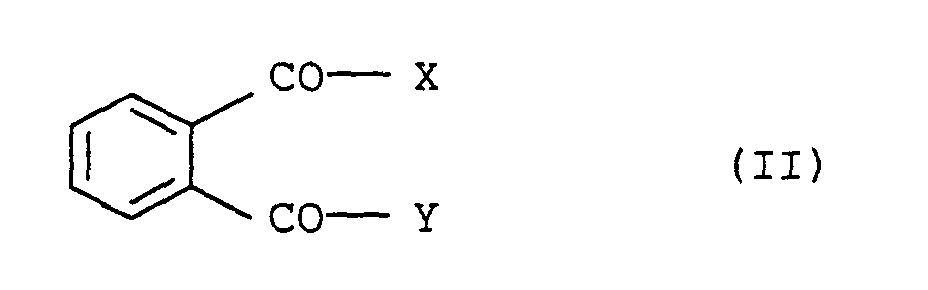
- Preferred electron donor compounds within the titanium-containing solid component are phthalic acid derivatives of the general formula (II) used, wherein X and Y are each a chlorine atom or a C 1 - to C 10 alkoxy or together are oxygen.
- Particularly preferred electron donor compounds are phthalic acid esters, where X and Y denote a C 1 -C 8 alkoxy radical, for example a methoxy, ethoxy, propyloxy or butyloxy radical.
- Further preferred electron donor compounds within the titanium-containing solid component include diesters of 3- or 4-membered, optionally substituted cycloalkyl-1,2-dicarboxylic acids, as well as monoesters of optionally substituted benzophenone-2-carboxylic acids.
- the hydroxy compounds used in these esters are the alcohols customary in esterification reactions, inter alia C 1 -to-C 15 -alkanols, C 5 -to-C 7 -cycloalkanols, which in turn may carry C 1 to C 10 -alkyl groups, furthermore C 6 to C 10 phenols.
- the titanium-containing solid component can be known per se Methods are produced. Examples of this are u.a. in the EP-A 45 975, EP-A 45 977, EP-A 86 473, EP-A 171 200, GB-A 2 111 066, US-A 48 57 613 and US-A 52 88 824.
- a finely divided carrier of silica gel SiO 2 having an average particle diameter of 5 microns usually to 200, especially from 20 to 70 microns, a pore volume of 0.1 to 10 cm 3 / g, in particular from 1.0 to 4.0 cm 3 / g, and a specific surface area of from 10 to 1000 m 2 / g, especially from 100 to 500 m 2 / g, with a solution of the magnesium-containing compound in a liquid alkane, followed by stirring this mixture for 0.5 to 5 hours at a temperature between 10 and 120 ° C.
- 0.1 to 1 mol of the magnesium compound is preferably used per mole of the carrier.
- a halogen or a hydrogen halide in particular chlorine or hydrogen chloride in at least twice, preferably in at least five times the molar excess, based on the magnesium-containing compound added.
- a C 1 - to C 8 alkanol especially ethanol, a halide or an alcoholate of trivalent or tetravalent titanium, in particular titanium tetrachloride, and an electron donor added.
- an inert solvent preferably an alkylbenzene, wherein the solvent contains at least 5% by weight of titanium tetrachloride.
- the product is washed with a liquid Alkane until the content of the washing liquid to titanium tetrachloride less than 2 wt .-% is.
- the titanium-containing solid component obtainable in this way is used with a cocatalyst as Ziegler-Natta catalyst system used.
- cocatalyst u.a. an aluminum compound b) in question.
- Trialkylaluminum also includes those compounds in which an alkyl group by an alkoxy group or by a halogen atom, for example is replaced by chlorine or bromine.
- an alkyl group by an alkoxy group or by a halogen atom for example is replaced by chlorine or bromine.
- Trialkylaluminium used whose alkyl groups each Have 1 to 8 C atoms, for example trimethyl, Triethyl or methyldiethylaluminum.
- electron donor compounds c) such as, for example, monofunctional or polyfunctional carboxylic acids, carboxylic anhydrides and carboxylic acid esters, ketones, ethers, alcohols, lactones, and also organophosphorus and organosilicon compounds are preferably used as further co-catalyst.
- Preferred electron donor compounds are organosilicon compounds of the general formula (I) R 1 n Si (OR 2 ) 4-n in which R 1 is the same or different and is a C 1 - to C 20 -alkyl group, a 5- to 7-membered cycloalkyl group, which in turn can carry a C 1 - to C 10 -alkyl group, or a C 6 - to C 20 -aryl or arylalkyl group, R 2 is identical or different and corresponds to a C 1 - to C 20 -alkyl group and n is the numbers 1, 2 or 3.
- R 1 is the same or different and is a C 1 - to C 20 -alkyl group, a 5- to 7-membered cycloalkyl group, which in turn can carry a C 1 - to C 10 -alkyl group, or a C 6 - to C 20 -aryl or arylalkyl group
- R 2 is identical or different and corresponds to a
- R 1 is a C 1 - to C 8 -alkyl group or a 5- to 7-membered cycloalkyl group
- R 2 is a C 1 - to C 4 -alkyl group and n is the numbers 1 or 2 stands.
- dimethoxydiisopropylsilane Dimethoxyisobutylisopropylsilane, dimethoxydiisobutylsilane, Dimethoxydicyclopentylsilane, dimethoxyisobutylsec.butylsilane, dimethoxyisopropylsec. butylsilane, diethoxydicyclopentylsilane and Emphasize diethoxyisobutylisopropylsilane.
- the individual compounds b) and optionally c) can be used in in any order individually or as a mixture of two components be used as cocatalyst.
- such finely divided silica gel is used in the titanium-containing solid component a), which has an average particle diameter of from 5 to 200 .mu.m, in particular from 20 to 70 .mu.m, and an average particle diameter of the primary particles of from 1 to 10 .mu.m, in particular from 1 to 5 .mu.m.
- the so-called primary particles are porous, granular silica gel particles which are obtained by grinding, optionally after appropriate screening, from an SiO 2 hydrogel.
- the finely divided silica gel to be used according to the invention is also characterized in that it has cavities or channels with an average diameter of 1 to 10 ⁇ m, in particular of 1 to 5 ⁇ m, whose macroscopic volume fraction of the total particle ranges from 5 to 20%. , in particular in the range of 5 to 15%.
- the finely divided silica gel furthermore has, in particular, a pore volume of from 0.1 to 10 cm 3 / g, preferably from 1.0 to 4.0 cm 3 / g and a specific surface area of from 10 to 1000 m 2 / g, preferably from 100 to 500 m 2 / g.
- a finely divided silica gel Due to the voids or channels present in the finely divided silica gel, a significantly improved distribution of the catalyst active components is present in the carrier material. In addition, a material so permeated with cavities and channels has a positive effect on the diffusion-controlled supply of monomers and cocatalysts and thus also on the polymerization kinetics.
- a finely divided silica gel is obtainable, inter alia, by spray-drying ground, correspondingly sieved SiO 2 hydrogel, which is premixed with water or an aliphatic alcohol. However, such a finely divided silica gel is also commercially available.
- the silica gel is within the titanium-containing solid component a) preferably in such amounts before that to 1 mole of the Silica gel 0.1 to 1.0 mole, especially 0.2 to 0.5 mole of the compound of magnesium.
- the compounds c) acting as cocatalysts b) and c) can be both sequentially and together on the titanium-containing solid component a) leave to act. Usually, this happens at temperatures from 0 to 150 ° C, in particular from 20 to 90 ° C and Press from 1 to 100 bar, in particular from 1 to 40 bar.
- the preparation of the propylene random copolymers can be carried out in the customary reactors used for the polymerization of C 2 -C 10 -alk-1-enes, either batchwise or preferably continuously, inter alia, as suspension polymerization or, preferably, as gas-phase polymerization.
- Suitable reactors include continuously operated stirred reactors containing a fixed bed of finely divided polymer, which is usually kept in motion by means of suitable stirring devices.
- the reaction can also be carried out in a series of several reactors connected in series.
- the inventive method is carried out in such a way that propylene together with the C 2 -C 10 -alk-1-enes at temperatures in the range of 50 to 100 ° C, pressures in the range of 15 to 40 bar and average residence times of 0 , Polymerized for 5 to 5 hours. Preference is given to temperatures of 60 to 90 ° C, pressures of 20 to 35 bar and average residence times of 0.5 to 3 hours.
- the comonomers propylene and the one or more C 2 -C 10 are thereby used -alk-1-enes in such amounts usually means that the partial pressure ratio between propylene and the one or more C 2 -C 10 -alk-1-enes 2: 1 to 100: 1, in particular 5: 1 to 80: 1.
- the term C 2 -C 10 -alk-1-enes is intended to mean in particular ethylene, but-1-ene, pent-1-ene, hex-1-ene, hept-1-ene or oct-1-ene or mixtures from these comonomers, preferably ethylene, but-1-ene or mixtures of ethylene and but-1-ene are used.
- the molecular weight of the propylene random copolymers can by Addition of regulators commonly used in polymerization technology, for example, of hydrogen, controlled and over a wide Range can be adjusted. Furthermore, it is possible to inert Solvent such as toluene or hexane, inert gas such as To use nitrogen or argon and smaller amounts of polypropylene powder.
- the random propylene copolymers of the invention preferably have molecular weights (weight average) between 20 000 and 500 000 on. Their melt flow indices, at 230 ° C and under a weight of 2.16 kg, according to DIN 53735 are in the range from 0.1 to 100 g / 10 min, in particular in the range of 0.5 to 50 g / 10 min.
- Propylene copolymers are distinguished from the previously known propylene random copolymers in particular by lowered xylene soluble fractions, i. an improved stereospecificity and a higher rigidity.
- the productivity of the used for the preparation of these random propylene copolymers Procedure is compared to the methods known from the prior art clearly elevated.
- finely divided silica gel (SiO 2) having a particle diameter of 20 to 45 ⁇ m, a pore volume of 1.5 cm 3 / g and a specific surface area of 260 m 2 / g was treated with a solution of n-butyloctylmagnesium in n-heptane, wherein per mole of SiO 2 0.3 mol of the magnesium compound were used.
- the finely divided silica gel was additionally characterized by an average particle size of the primary particles of 3-5 .mu.m and by cavities and channels with a diameter of 3-5 .mu.m, wherein the macroscopic volume fraction of the cavities and channels in the total particle was about 15%.
- the solution was stirred for 45 minutes at 95 ° C, then cooled to 20 ° C, after which the 10-fold molar amount, based on the organomagnesium compound, of hydrogen chloride was introduced. After 60 minutes, the reaction product was added with constant stirring with 3 moles of ethanol per mole of magnesium. This mixture was stirred for 0.5 hours at 80 ° C and then treated with 7.2 moles of titanium tetrachloride and 0.5 mole of di-n-butyl phthalate, each based on 1 mole of magnesium. The mixture was then stirred for 1 hour at 100 ° C, the resulting solid filtered off and washed several times with ethylbenzene.
- the resulting solid product was extracted 3 hours long at 125 ° C with a 10 vol .-% solution of titanium tetrachloride in ethylbenzene. After that, the solid product became separated by filtration from the extractant and as long washed with n-heptane until the extractive agent only 0.3 wt .-% titanium tetrachloride had.
- the particle diameter was determined by Coulter Counter analysis (Grain size distribution of silica gel particles), the pore volume and specific surface area by nitrogen adsorption according to DIN 66131 or by mercury porosimetry according to DIN 66133.
- the determination of the mean particle size the primary particles, the diameter of the cavities and channels as well their macroscopic volume fraction happened with the help of Scanning Electron Microscopy (Scanning Electron Microscopy) or Electron Probe Micro Analysis (Electron Beam Microscope Analysis) each on grain surfaces and grain cross sections of Silica.
- the polymerization was carried out in a vertically stirred gas phase reactor with a useful volume of 800 l in presence of hydrogen as molecular weight regulator at a temperature of 80 ° C and carried out under a pressure of 23 bar.
- the reactor contained a moving fixed bed of finely divided polymer.
- Example 1a Solid component a) continuously polymerized, wherein per hour 7.5 g of the titanium-containing solid component a), 450 m mol of triethylaluminum and 45 mmol Dimethoxyisobutylisopropylsilan were used as cocatalysts.
- Propylene and ethylene were polymerized with the same catalyst system and under the same conditions analogously to Example 1 according to the invention, but using such a titanium-containing solid component a) which had a granular silica gel with the following properties: particle 20 to 45 ⁇ m pore volume 1.8 cm 3 / g specific surface 325 m 2 / g Proportion of cavities and channels in the total particle ⁇ 1.0%
- Example 1 according to the invention was repeated analogously, wherein at a mean residence time of 1.5 hours a gaseous Mixture of propylene and ethylene with a ratio between the partial pressure of propylene and that of ethylene of 35: 1 was polymerized.
- Propylene and ethylene were polymerized analogously to Example 2 according to the invention using the same catalyst system and under the same conditions, but using such a titanium-containing solid component a) which had a granular silica gel having the following properties: particle 20 to 45 ⁇ m pore volume 1.8 cm 3 / g specific surface 325 m 2 / g Proportion of cavities and channels in the total particle ⁇ 1.0%
- Example 1 Analogously to Example 1 according to the invention was in the gas phase reactor at a temperature of 70 ° C and at a pressure of 20 bar Mixture of propylene, ethylene and but-1-en polymerized.
- the Partial pressure ratio of propylene to ethylene and but-1-ene was while 20: 1.0: 0.9, the average residence time of the reaction mixture was 1.5 hours.
- Propylene and ethylene were polymerized analogously to Example 2 according to the invention using the same catalyst system and under the same conditions, but using such a titanium-containing solid component a) which had a granular silica gel having the following properties: particle 20 to 45 ⁇ m pore volume 1.8 cm 3 / g specific surface 325 m 2 / g Proportion of cavities and channels in the total particle ⁇ 1.0%
- inventive examples 1 to 3 A comparison between the inventive examples 1 to 3 and Comparative Examples A to C makes it clear that the inventive method has a higher productivity and to propylene random copolymers having an increased Stereospecificity (low xylene solubles) and increased Stiffness (higher G-modulus) leads.
Landscapes
- Chemical & Material Sciences (AREA)
- Health & Medical Sciences (AREA)
- Chemical Kinetics & Catalysis (AREA)
- Medicinal Chemistry (AREA)
- Polymers & Plastics (AREA)
- Organic Chemistry (AREA)
- Transition And Organic Metals Composition Catalysts For Addition Polymerization (AREA)
- Addition Polymer Or Copolymer, Post-Treatments, Or Chemical Modifications (AREA)
- Artificial Filaments (AREA)
Description
R1 gleich oder verschieden ist und eine C1- bis C20-Alkylgruppe, eine 5- bis 7-gliedrige Cycloalkylgruppe, die ihrerseits eine C1- bis C10-Alkylgruppe tragen kann, oder eine C6- bis C20-Aryl- oder Arylalkylgruppe bedeutet, R2 gleich oder verschieden ist und einer C1- bis C20-Alkylgruppe entspricht und n für die Zahlen 1, 2 oder 3 steht. Besonders bevorzugt werden dabei solche Verbindungen, in denen R1 eine C1- bis C8-Alkylgruppe oder eine 5- bis 7-gliedrige Cycloalkylgruppe, sowie R2 eine C1- bis C4-Alkylgruppe bedeutet und n für die Zahlen 1 oder 2 steht.
| Teilchendurchmesser | 20 bis 45 µm |
| Porenvolumen | 1,8 cm3/g |
| spezifische Oberfläche | 325 m2/g |
| Anteil der Hohlräume und Kanäle am Gesamtpartikel | < 1,0 % |
| Teilchendurchmesser | 20 bis 45 µm |
| Porenvolumen | 1,8 cm3/g |
| spezifische Oberfläche | 325 m2/g |
| Anteil der Hohlräume und Kanäle am Gesamtpartikel | < 1,0 % |
| Teilchendurchmesser | 20 bis 45 µm |
| Porenvolumen | 1,8 cm3/g |
| spezifische Oberfläche | 325 m2/g |
| Anteil der Hohlräume und Kanäle am Gesamtpartikel | < 1,0 % |

Claims (4)
- Verfahren zur Herstellung von statistischen Propylencopolymerisaten mit einpolymerisierten C2-C10-Alk-1-enen, erhältlich durch Polymerisation von Propylen und C2-C10-Alk-1-enen in Gegenwart eines Ziegler-Natta-Katalysatorsystems aus einer titanhaltigen Feststoffkomponente a), die eine Verbindung des Magnesiums, ein Halogen, Kieselgel als Träger und einen Carbonsäureester als Elektronendonorverbindung aufweist, sowie als Cokatalysatoren eine Aluminiumverbindung b) und eine weitere Elektronendonorverbindung c) enthält, wobei man bis Temperaturen im Bereich von 50 bis 100°C, Drücken im Bereich von 15 bis 40 bar und mittleren Verweilzeiten von 0,5 bis 5 Stunden Propylen und die C2-C10-Alk-1-ene miteinander polymerisiert, dadurch gekennzeichnet, daß man ein Partialdruckverhältnis zwischen Propylen und den oder den C2-C10-Alk-1-enen von 2:1 bis 100:1 einstellt und ein Kieselgel als Träger der titanhaltigen Feststoffkomponente verwendet, welches einen mittleren Teilchendurchmesser von 5 bis 200 µm, einen mittleren Teilchendurchmesser der Primärpartikel von 1 bis 10 µm und Hohlräume bzw. Kanäle mit einem mittleren Durchmesser von 1 bis 10 µm aufweist, deren makroskopischer Volumenanteil am Gesamtpartikel im Bereich von 5 bis 20 % liegt.
- Verfahren nach Anspruch 1, dadurch gekennzeichnet, daß man die Polymerisation bei mittleren Verweilzeiten von 0,5 bis 3 Stunden durchführt.
- Verfahren nach Anspruch 1, dadurch gekennzeichnet, daß man als C2-C10-Alk-1-en Ethylen verwendet.
- Verfahren nach Anspruch 1, dadurch gekennzeichnet, daß man als C2-C10-Alk-1-en ein Gemisch aus Ethylen und But-1-en verwendet.
Applications Claiming Priority (2)
| Application Number | Priority Date | Filing Date | Title |
|---|---|---|---|
| DE19545499 | 1995-12-06 | ||
| DE19545499A DE19545499A1 (de) | 1995-12-06 | 1995-12-06 | Verbesserte statistische Propylencopolymerisate |
Publications (2)
| Publication Number | Publication Date |
|---|---|
| EP0778295A1 EP0778295A1 (de) | 1997-06-11 |
| EP0778295B1 true EP0778295B1 (de) | 2005-02-23 |
Family
ID=7779342
Family Applications (1)
| Application Number | Title | Priority Date | Filing Date |
|---|---|---|---|
| EP96119036A Expired - Lifetime EP0778295B1 (de) | 1995-12-06 | 1996-11-28 | Verbesserte statistische Propylenpolymerisate |
Country Status (11)
| Country | Link |
|---|---|
| US (2) | US5744567A (de) |
| EP (1) | EP0778295B1 (de) |
| JP (1) | JPH09286819A (de) |
| CN (1) | CN1089769C (de) |
| AR (1) | AR004890A1 (de) |
| AT (1) | ATE289613T1 (de) |
| AU (1) | AU710890B2 (de) |
| DE (2) | DE19545499A1 (de) |
| ES (1) | ES2237759T3 (de) |
| TW (1) | TW494107B (de) |
| ZA (1) | ZA9610223B (de) |
Families Citing this family (16)
| Publication number | Priority date | Publication date | Assignee | Title |
|---|---|---|---|---|
| DE19637367A1 (de) * | 1996-09-13 | 1998-03-19 | Basf Ag | Bei ihrer Herstellung modifizierte Ziegler-Natta-Katalysatorsysteme |
| DE19637370A1 (de) * | 1996-09-13 | 1998-03-19 | Basf Ag | Bei ihrer Herstellung modifizierte Ziegler-Natta-Katalysatorsysteme |
| DE19722569A1 (de) | 1997-05-28 | 1998-12-03 | Basf Ag | Statistische Propylencopolymerisate |
| JPH11255980A (ja) * | 1998-03-09 | 1999-09-21 | Sumitomo Chem Co Ltd | 包装用フィルム |
| DE19813399A1 (de) * | 1998-03-26 | 1999-09-30 | Basf Ag | Statistische Propylencopolymerisate |
| DE10002653A1 (de) * | 2000-01-21 | 2001-07-26 | Targor Gmbh | Neuartige Katalysatorsysteme vom Typ der Ziegler-Natta-Katalysatoren |
| CN1181105C (zh) * | 2000-08-22 | 2004-12-22 | 中国石油化工股份有限公司 | 用于乙烯聚合或共聚合的高活性硅胶载体催化剂组分及其催化剂和该催化剂的应用 |
| RU2005128272A (ru) * | 2003-02-24 | 2006-08-10 | Чайна Петролеум Энд Кемикал Корпорейшн (Cn) | Комплексный носитель катализаторов полимеризации пропилена, каталитический компонент и катализатор, включающий указанный компонент |
| CN1825057B (zh) * | 2005-02-22 | 2010-09-29 | 亚洲光学股份有限公司 | 一种激光水平装置及其操作方法 |
| EP1803743B1 (de) * | 2005-12-30 | 2016-08-10 | Borealis Technology Oy | Katalysatorpartikel |
| US10696765B2 (en) | 2014-02-07 | 2020-06-30 | Eastman Chemical Company | Adhesive composition comprising amorphous propylene-ethylene copolymer and propylene polymer |
| US10308740B2 (en) | 2014-02-07 | 2019-06-04 | Eastman Chemical Company | Amorphous propylene-ethylene copolymers |
| US10723824B2 (en) | 2014-02-07 | 2020-07-28 | Eastman Chemical Company | Adhesives comprising amorphous propylene-ethylene copolymers |
| US9593179B2 (en) | 2014-02-07 | 2017-03-14 | Eastman Chemical Company | Amorphous propylene-ethylene copolymers |
| US10647795B2 (en) | 2014-02-07 | 2020-05-12 | Eastman Chemical Company | Adhesive composition comprising amorphous propylene-ethylene copolymer and polyolefins |
| US11267916B2 (en) | 2014-02-07 | 2022-03-08 | Eastman Chemical Company | Adhesive composition comprising amorphous propylene-ethylene copolymer and polyolefins |
Family Cites Families (22)
| Publication number | Priority date | Publication date | Assignee | Title |
|---|---|---|---|---|
| JPS607645B2 (ja) * | 1976-04-19 | 1985-02-26 | チッソ株式会社 | 共重合体ポリプロピレン用触媒の重合前活性化による該共重合体の製造法 |
| NZ192572A (en) | 1979-01-10 | 1981-11-19 | Ici Ltd | Catalyst component and olefine polymerisation catalyst containing this component |
| GB2054616B (en) * | 1979-07-09 | 1983-03-02 | El Paso Polyolefins | Propylene polymerization process and product |
| JPS595203B2 (ja) | 1979-07-25 | 1984-02-03 | 東亜燃料工業株式会社 | α−オレフイン重合用触媒成分の製造方法 |
| IT1209255B (it) | 1980-08-13 | 1989-07-16 | Montedison Spa | Catalizzatori per la polimerizzazione di olefine. |
| JPS5883006A (ja) * | 1981-11-13 | 1983-05-18 | Mitsui Petrochem Ind Ltd | オレフインの重合方法 |
| IT1190683B (it) | 1982-02-12 | 1988-02-24 | Montedison Spa | Componenti e catalizzatori per la polimerizzazione di olefine |
| US4761462A (en) * | 1983-09-20 | 1988-08-02 | Sumitomo Chemical Company, Limited | Packaging propylene copolymer film |
| JPH0655780B2 (ja) | 1984-07-09 | 1994-07-27 | 東燃株式会社 | オレフイン重合用触媒成分 |
| JPH072775B2 (ja) | 1985-01-28 | 1995-01-18 | 東燃株式会社 | オレフイン重合用触媒成分の製造法 |
| DE3730022A1 (de) | 1987-09-08 | 1989-03-16 | Basf Ag | Verfahren zum herstellen von homo- und copolymerisaten des propens mittels eines ziegler-natta-katalysatorsystems |
| IT1221653B (it) * | 1987-11-27 | 1990-07-12 | Ausimonti Spa | Copolimeri cristallini del propilene |
| CA2018829C (en) * | 1989-06-19 | 1996-06-11 | Jun Saito | Process for producing a high-stiffness polypropylene and a highly stereoregular polypropylene |
| US5618895A (en) * | 1990-04-06 | 1997-04-08 | Basf Aktiengesellschaft | Process for preparing copolymers of propylene with other 1-alkenes |
| DE4011160A1 (de) * | 1990-04-06 | 1991-10-17 | Basf Ag | Copolymerisate des propylens mit anderen alk-1-enen |
| DE4024421A1 (de) * | 1990-08-01 | 1992-02-06 | Basf Ag | Ziegler-natta-katalysatorsysteme mit metallorganischen verbindungen |
| DE4128829A1 (de) | 1991-08-30 | 1993-03-04 | Basf Ag | Verfahren zum herstellen von homo- und copolymerisaten des propens mittels eines ziegler-nata-katalysatorsystems |
| DE4242056A1 (de) * | 1992-12-14 | 1994-06-16 | Basf Ag | Copolymerisate des Propylens mit verringerter Weißbruchneigung |
| DE4317654A1 (de) * | 1993-05-27 | 1994-12-01 | Basf Ag | Statistische Copolymerisate des Propylens |
| TW354792B (en) * | 1993-08-13 | 1999-03-21 | Mitsui Petrochemical Ind | Olefin polymerization catalyst and process for preparing polypropylene and propylene block copolymer |
| US5661097A (en) * | 1994-08-12 | 1997-08-26 | The Dow Chemical Company | Supported olefin polymerization catalyst |
| ATE164598T1 (de) * | 1995-08-09 | 1998-04-15 | Basf Ag | Katalysatorsysteme vom typ der ziegler-natta- katalysatoren |
-
1995
- 1995-12-06 DE DE19545499A patent/DE19545499A1/de not_active Withdrawn
-
1996
- 1996-11-28 DE DE59611200T patent/DE59611200D1/de not_active Expired - Lifetime
- 1996-11-28 ES ES96119036T patent/ES2237759T3/es not_active Expired - Lifetime
- 1996-11-28 EP EP96119036A patent/EP0778295B1/de not_active Expired - Lifetime
- 1996-11-28 AT AT96119036T patent/ATE289613T1/de active
- 1996-12-04 AU AU74144/96A patent/AU710890B2/en not_active Ceased
- 1996-12-04 TW TW085114929A patent/TW494107B/zh not_active IP Right Cessation
- 1996-12-04 US US08/763,839 patent/US5744567A/en not_active Expired - Lifetime
- 1996-12-05 ZA ZA9610223A patent/ZA9610223B/xx unknown
- 1996-12-06 CN CN96117277A patent/CN1089769C/zh not_active Expired - Lifetime
- 1996-12-06 JP JP8327117A patent/JPH09286819A/ja active Pending
- 1996-12-06 AR ARP960105538A patent/AR004890A1/es active IP Right Grant
-
1997
- 1997-11-13 US US08/969,278 patent/US6013742A/en not_active Expired - Lifetime
Also Published As
| Publication number | Publication date |
|---|---|
| DE59611200D1 (de) | 2005-03-31 |
| AU7414496A (en) | 1997-06-12 |
| AR004890A1 (es) | 1999-03-10 |
| EP0778295A1 (de) | 1997-06-11 |
| ZA9610223B (en) | 1998-06-05 |
| AU710890B2 (en) | 1999-09-30 |
| ATE289613T1 (de) | 2005-03-15 |
| US6013742A (en) | 2000-01-11 |
| ES2237759T3 (es) | 2005-08-01 |
| CN1158860A (zh) | 1997-09-10 |
| TW494107B (en) | 2002-07-11 |
| JPH09286819A (ja) | 1997-11-04 |
| CN1089769C (zh) | 2002-08-28 |
| US5744567A (en) | 1998-04-28 |
| DE19545499A1 (de) | 1997-06-12 |
Similar Documents
| Publication | Publication Date | Title |
|---|---|---|
| EP0463406B1 (de) | Verfahren zur Herstellung von Homopolymerisaten des Propylens mit breitem Molmassenverhältnis | |
| EP0515855B2 (de) | Hochfliessfähige Propylen-Ethylen-Copolymerisate | |
| EP0761696B1 (de) | Katalysatorsysteme vom Typ der Ziegler-Natta-Katalysatoren | |
| EP0881239A1 (de) | Statistische Propylencopolymerisate | |
| EP0778295A1 (de) | Verbesserte statistische Propylenpolymerisate | |
| EP0450456B1 (de) | Copolymerisate des Propylens mit anderen Alk-1-enen | |
| EP0812861B1 (de) | Katalysatorsysteme vom Typ der Ziegler-Natta-Katalysatoren | |
| DE19529240A1 (de) | Katalysatorsysteme vom Typ der Ziegler-Natta-Katalysatoren | |
| EP0642537B1 (de) | Ziegler-natta-katalysatorsysteme mit speziellen siliciumorganischen verbindungen | |
| EP0531838B1 (de) | Verfahren zur Herstellung von Ziegler-Natta-Katalysatorsystemen | |
| EP0829489B1 (de) | Bei ihrer Herstellung modifizierte Ziegler-Natta-Katalysatorsysteme | |
| EP0778294B1 (de) | Verbesserte Propylenpolymerisate | |
| EP0829490B1 (de) | Bei ihrer Herstellung modifizierte Ziegler-Natta-Katalysatorsysteme | |
| EP0518093B1 (de) | Propylen-Ethylen-Copolymerisate mit hohem Kautschukgehalt | |
| EP0655466B1 (de) | Katalysatorsysteme vom Typ der Ziegler-Natta-Katalysatoren | |
| EP0700406B1 (de) | Statistische copolymerisate des propylens | |
| EP0473924B1 (de) | Ziegler-Natta-Katalysatorsysteme mit metallorganischen Verbindungen | |
| EP0531834B1 (de) | Verfahren zur Herstellung von Ziegler-Natta-Katalysatorsystemen | |
| EP0558981B2 (de) | Verfahren zur Herstellung von Propylen-Ethylen-Copolymerisaten | |
| EP0427060A2 (de) | Katalysatorsysteme vom Typ der Ziegler-Natta-Katalysatoren | |
| EP0558987A2 (de) | Verfahren zur Herstellung von Propylen-Ethylen-Copolymerisaten | |
| EP0427080A2 (de) | Katalysatorsysteme vom Typ der Ziegler-Natta-Katalysatoren | |
| EP0775714A2 (de) | Copolymerisate des Propylens | |
| EP0628058B1 (de) | Verfahren zur polymerisation von c3-c10-alk-1-enen ohne mitverwendung einer weiteren elektronendonorverbindung | |
| EP0775713A2 (de) | Copolymerisate des Propylens mit C2-C10-Alk-1-enen |
Legal Events
| Date | Code | Title | Description |
|---|---|---|---|
| PUAI | Public reference made under article 153(3) epc to a published international application that has entered the european phase |
Free format text: ORIGINAL CODE: 0009012 |
|
| AK | Designated contracting states |
Kind code of ref document: A1 Designated state(s): AT BE DE ES FI FR GB IT NL SE |
|
| 17P | Request for examination filed |
Effective date: 19970507 |
|
| 17Q | First examination report despatched |
Effective date: 19971003 |
|
| RAP1 | Party data changed (applicant data changed or rights of an application transferred) |
Owner name: NOVOLEN TECHNOLOGY HOLDINGS C.V. |
|
| GRAP | Despatch of communication of intention to grant a patent |
Free format text: ORIGINAL CODE: EPIDOSNIGR1 |
|
| GRAS | Grant fee paid |
Free format text: ORIGINAL CODE: EPIDOSNIGR3 |
|
| GRAA | (expected) grant |
Free format text: ORIGINAL CODE: 0009210 |
|
| AK | Designated contracting states |
Kind code of ref document: B1 Designated state(s): AT BE DE ES FI FR GB IT NL SE |
|
| PG25 | Lapsed in a contracting state [announced via postgrant information from national office to epo] |
Ref country code: GB Free format text: LAPSE BECAUSE OF FAILURE TO SUBMIT A TRANSLATION OF THE DESCRIPTION OR TO PAY THE FEE WITHIN THE PRESCRIBED TIME-LIMIT Effective date: 20050223 |
|
| REG | Reference to a national code |
Ref country code: GB Ref legal event code: FG4D Free format text: NOT ENGLISH |
|
| REF | Corresponds to: |
Ref document number: 59611200 Country of ref document: DE Date of ref document: 20050331 Kind code of ref document: P |
|
| PG25 | Lapsed in a contracting state [announced via postgrant information from national office to epo] |
Ref country code: SE Free format text: LAPSE BECAUSE OF FAILURE TO SUBMIT A TRANSLATION OF THE DESCRIPTION OR TO PAY THE FEE WITHIN THE PRESCRIBED TIME-LIMIT Effective date: 20050523 |
|
| REG | Reference to a national code |
Ref country code: ES Ref legal event code: FG2A Ref document number: 2237759 Country of ref document: ES Kind code of ref document: T3 |
|
| GBV | Gb: ep patent (uk) treated as always having been void in accordance with gb section 77(7)/1977 [no translation filed] |
Effective date: 20050223 |
|
| PLBE | No opposition filed within time limit |
Free format text: ORIGINAL CODE: 0009261 |
|
| STAA | Information on the status of an ep patent application or granted ep patent |
Free format text: STATUS: NO OPPOSITION FILED WITHIN TIME LIMIT |
|
| 26N | No opposition filed |
Effective date: 20051124 |
|
| ET | Fr: translation filed | ||
| PGFP | Annual fee paid to national office [announced via postgrant information from national office to epo] |
Ref country code: AT Payment date: 20101110 Year of fee payment: 15 |
|
| PGFP | Annual fee paid to national office [announced via postgrant information from national office to epo] |
Ref country code: DE Payment date: 20101124 Year of fee payment: 15 |
|
| PGFP | Annual fee paid to national office [announced via postgrant information from national office to epo] |
Ref country code: IT Payment date: 20101117 Year of fee payment: 15 |
|
| PGFP | Annual fee paid to national office [announced via postgrant information from national office to epo] |
Ref country code: FI Payment date: 20111125 Year of fee payment: 16 Ref country code: ES Payment date: 20111124 Year of fee payment: 16 Ref country code: FR Payment date: 20111128 Year of fee payment: 16 |
|
| PGFP | Annual fee paid to national office [announced via postgrant information from national office to epo] |
Ref country code: BE Payment date: 20111124 Year of fee payment: 16 |
|
| BERE | Be: lapsed |
Owner name: *NOVOLEN TECHNOLOGY HOLDINGS C.V. Effective date: 20121130 |
|
| REG | Reference to a national code |
Ref country code: AT Ref legal event code: MM01 Ref document number: 289613 Country of ref document: AT Kind code of ref document: T Effective date: 20121128 |
|
| PG25 | Lapsed in a contracting state [announced via postgrant information from national office to epo] |
Ref country code: AT Free format text: LAPSE BECAUSE OF NON-PAYMENT OF DUE FEES Effective date: 20121128 |
|
| REG | Reference to a national code |
Ref country code: FR Ref legal event code: ST Effective date: 20130731 |
|
| PG25 | Lapsed in a contracting state [announced via postgrant information from national office to epo] |
Ref country code: BE Free format text: LAPSE BECAUSE OF NON-PAYMENT OF DUE FEES Effective date: 20121130 Ref country code: IT Free format text: LAPSE BECAUSE OF NON-PAYMENT OF DUE FEES Effective date: 20121128 Ref country code: FI Free format text: LAPSE BECAUSE OF NON-PAYMENT OF DUE FEES Effective date: 20121128 |
|
| REG | Reference to a national code |
Ref country code: DE Ref legal event code: R119 Ref document number: 59611200 Country of ref document: DE Effective date: 20130601 |
|
| PG25 | Lapsed in a contracting state [announced via postgrant information from national office to epo] |
Ref country code: DE Free format text: LAPSE BECAUSE OF NON-PAYMENT OF DUE FEES Effective date: 20130601 |
|
| PG25 | Lapsed in a contracting state [announced via postgrant information from national office to epo] |
Ref country code: FR Free format text: LAPSE BECAUSE OF NON-PAYMENT OF DUE FEES Effective date: 20121130 |
|
| REG | Reference to a national code |
Ref country code: ES Ref legal event code: FD2A Effective date: 20140305 |
|
| PG25 | Lapsed in a contracting state [announced via postgrant information from national office to epo] |
Ref country code: ES Free format text: LAPSE BECAUSE OF NON-PAYMENT OF DUE FEES Effective date: 20121129 |
|
| PGFP | Annual fee paid to national office [announced via postgrant information from national office to epo] |
Ref country code: NL Payment date: 20151126 Year of fee payment: 20 |
|
| REG | Reference to a national code |
Ref country code: NL Ref legal event code: MK Effective date: 20161127 |