EP0427067A2 - Procédé d'exploitation alternative d'un ordinateur avec plusieurs systèmes d'exploitation - Google Patents
Procédé d'exploitation alternative d'un ordinateur avec plusieurs systèmes d'exploitation Download PDFInfo
- Publication number
- EP0427067A2 EP0427067A2 EP90120603A EP90120603A EP0427067A2 EP 0427067 A2 EP0427067 A2 EP 0427067A2 EP 90120603 A EP90120603 A EP 90120603A EP 90120603 A EP90120603 A EP 90120603A EP 0427067 A2 EP0427067 A2 EP 0427067A2
- Authority
- EP
- European Patent Office
- Prior art keywords
- operating system
- computer
- switching
- operating systems
- processor
- Prior art date
- Legal status (The legal status is an assumption and is not a legal conclusion. Google has not performed a legal analysis and makes no representation as to the accuracy of the status listed.)
- Withdrawn
Links
Images

Classifications
-
- G—PHYSICS
- G06—COMPUTING OR CALCULATING; COUNTING
- G06F—ELECTRIC DIGITAL DATA PROCESSING
- G06F9/00—Arrangements for program control, e.g. control units
- G06F9/06—Arrangements for program control, e.g. control units using stored programs, i.e. using an internal store of processing equipment to receive or retain programs
- G06F9/46—Multiprogramming arrangements
- G06F9/48—Program initiating; Program switching, e.g. by interrupt
- G06F9/4806—Task transfer initiation or dispatching
- G06F9/4843—Task transfer initiation or dispatching by program, e.g. task dispatcher, supervisor, operating system
Definitions
- So-called multi-tasking operating systems e.g. iRMX 2 from Intel
- iRMX 2 Integrated Multi-tasking operating systems
- MS-DOS is a trademark of Microsoft
- the object of the present invention is to provide a method in which, during multi-tasking operation, a user can also be provided with a single-tasking operating system at the same time in such a way that hardly noticeable slowdowns in both types of operating system with regard to tasks to be solved surrender.
- Switching is advantageously carried out by a control program, which is kept permanently in the working memory. This makes it possible to make adjustments without major changes to the operating systems, e.g. in the event of hardware changes.
- control program Since the control program must be able to be called up from both operating systems, the control program should be distributed over the memory areas assigned to the operating systems.
- the computer status is queried before the switchover and if certain computer states exist, e.g. for peripheral access, switching is prevented.
- At least one processor of the computer changes its operating mode, in particular its addressing mode, when switching, it is avoided that the computer in one operating system accidentally accesses memory areas which are assigned to the other operating system.
- the information necessary for the proper further work in this operating system e.g. the processor status
- the information necessary for the proper further work in this operating system are stored in a predefined memory area and, before the other operating system is continued, the information required for proper further work in this operating system is retrieved from a predefined memory area.
- switching should be able to be triggered and / or blocked by keyboard entries.
- peripheral devices e.g. Machine tools, monitored and their reporting processes logged and printed out.
- a printer 3 and a display 4 are assigned to the computer.
- a terminal 5 is used to communicate the user with the computer 1.
- the terminal 5 comprises a monitor (not shown) and a keyboard (also not shown).
- Such a monitoring system is sold, for example, by Siemens under the name COROS.
- the computer 1 internally has i.a. a working memory 6 and a main processor 7, e.g. an Intel 80286/80386, which is preceded by a control processor 10.
- the computer 1 is also connected to mass storage devices 11, e.g. Hard drives or floppy disks.
- FIG. 2 shows the distribution of the memory 6 in the computer 1 in terms of hardware.
- the computer When the computer 1 is switched on, the computer is first booted up, the single-tasking operating system ST, for example MS-DOS, being loaded into the memory area 13.
- the communication program KP is entered into the memory area 16 by a command to be entered by the user load.
- the multi-tasking operating system MT for example the operating system iRMX, is loaded into the memory area 15 by a further command, likewise to be entered by the user.
- the operating systems ST, MT and the control program KP are kept permanently in the memory 6.
- the ST operating system can only execute programs that are stored in the memory area between zero and one megabyte (1 MB).
- the MT operating system may execute programs that are stored in the memory area of one to 16 megabytes (16 MB). Consequently, the memory areas 14 and 12 remain for user programs for the operating system ST and MT. Access to data is not restricted in both operating systems ST, MT.
- the dashed line in FIG. 2 indicates the boundary between the memory areas assigned to the operating systems ST and MT.
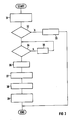
- FIG. 3 shows how the system is switched from the single-tasking operating system ST to the multi-tasking operating system MT.
- the entire process sequence shown in FIG. 3 is part of the control program KP.
- Interrupts can e.g. Time lapse, that is, cyclic switching, keyboard inputs or requests of processor 10 by one of peripheral devices 2.
- Function block 32 then checks whether the operating system needs to be switched over to handle the interrupts. If not, the function block 33 forwards the interrupt in the operating system ST to the processor 7 and exits the control program KP. The processor 7 then processes the interrupt without leaving the operating system ST.
- the function block 34 asks whether a switching of the operating systems is permitted. For example, if the computer 1 is currently switching to external memory, for example accessing the hard disk 11, is not permitted. In this case, the waiting loop 35 is run through and then again the function block 34. If the switching of the operating systems is permitted, the current status of the processor 7 and further data required for the proper continuation in the operating system ST, for example the memory configuration of the memory 6 and which ones Parts of it are occupied, stored in the memory area 8. The function module 37 then switches the addressing mode of the processor 7, namely from real addressing RM to virtual addressing VM. After switching the addressing mode, the processor 7 is able to access programs in the memory area from one to 16 megabytes. The function block 38 reads the data required for the continuation in the operating system MT from the memory area 9 and partially loads it into the processor 10. The function block 39 then transfers control to the multi-tasking operating system MT.
- the function block 41 carries out the interrupt handling already described in FIG. 3 as well as all other tasks that occur in the operating system MT.
- Function block 42 repeatedly asks whether further tasks are pending in the MT operating system. If so, block 41 is run through again. Only if there are currently no tasks to be done in the MT operating system, ie the MT operating system would work in idle (zero process), is the system switched to the ST operating system.
- the function module 43 In order to switch over, the function module 43, like the function module 36 previously, stores the information required to continue the operating system MT in the memory area 9. Then function block 44, more precisely from its part 44a, a command to processor 10, on the basis of which processor 10 transmits a reset signal to processor 7. The reset switches processor 7 back into addressing mode RM and reinitializes it.
- the data stored in the memory area 8 are called up by the function block 44b, which is part of the initialization routing of the processor 7, so that the processor 7 can continue to work properly in the operating system ST after the control has been passed on from the function block 45 to the operating system ST.
- the initialization of the processor 7 is necessary because the processor 7 does not allow switching from virtual addressing VM to real addressing RM. Because of the different types of addressing, the processor 10 can access programs in the memory area up to 16 megabytes with virtual addressing VM, in the RM mode only up to 1 megabyte.
- the switchover between the operating systems ST, MT which is concealed by the user, can be triggered and / or blocked to carry out important and / or time-critical tasks. For example, it is possible to force the computer 1 to remain in the ST operating system by pressing a button on the terminal 6.
Landscapes
- Engineering & Computer Science (AREA)
- Software Systems (AREA)
- Theoretical Computer Science (AREA)
- Physics & Mathematics (AREA)
- General Engineering & Computer Science (AREA)
- General Physics & Mathematics (AREA)
- Stored Programmes (AREA)
Applications Claiming Priority (2)
| Application Number | Priority Date | Filing Date | Title |
|---|---|---|---|
| DE3937202 | 1989-11-08 | ||
| DE3937202 | 1989-11-08 |
Publications (2)
| Publication Number | Publication Date |
|---|---|
| EP0427067A2 true EP0427067A2 (fr) | 1991-05-15 |
| EP0427067A3 EP0427067A3 (en) | 1991-08-14 |
Family
ID=6393123
Family Applications (1)
| Application Number | Title | Priority Date | Filing Date |
|---|---|---|---|
| EP19900120603 Withdrawn EP0427067A3 (en) | 1989-11-08 | 1990-10-26 | Method for the alternating operation of a computer with several operating systems |
Country Status (1)
| Country | Link |
|---|---|
| EP (1) | EP0427067A3 (fr) |
Cited By (2)
| Publication number | Priority date | Publication date | Assignee | Title |
|---|---|---|---|---|
| EP0625749A1 (fr) * | 1993-05-17 | 1994-11-23 | Siemens Aktiengesellschaft | Méthode d'opération pour un ordinateur |
| EP1031924A3 (fr) * | 1999-02-19 | 2003-10-15 | Hitachi, Ltd. | Ordinateur exécutant une pluralité de systèmes d'exploitation |
Family Cites Families (2)
| Publication number | Priority date | Publication date | Assignee | Title |
|---|---|---|---|---|
| US4530052A (en) * | 1982-10-14 | 1985-07-16 | Honeywell Information Systems Inc. | Apparatus and method for a data processing unit sharing a plurality of operating systems |
| US4779187A (en) * | 1985-04-10 | 1988-10-18 | Microsoft Corporation | Method and operating system for executing programs in a multi-mode microprocessor |
-
1990
- 1990-10-26 EP EP19900120603 patent/EP0427067A3/de not_active Withdrawn
Cited By (3)
| Publication number | Priority date | Publication date | Assignee | Title |
|---|---|---|---|---|
| EP0625749A1 (fr) * | 1993-05-17 | 1994-11-23 | Siemens Aktiengesellschaft | Méthode d'opération pour un ordinateur |
| EP1031924A3 (fr) * | 1999-02-19 | 2003-10-15 | Hitachi, Ltd. | Ordinateur exécutant une pluralité de systèmes d'exploitation |
| US7810096B2 (en) | 1999-02-19 | 2010-10-05 | Hitachi, Ltd. | Computer executing multiple operating systems |
Also Published As
| Publication number | Publication date |
|---|---|
| EP0427067A3 (en) | 1991-08-14 |
Similar Documents
| Publication | Publication Date | Title |
|---|---|---|
| EP0333123B1 (fr) | Système de communication RNIS à structure modulaire | |
| DE69031233T2 (de) | Adaptive Arbeitsfolgeplanung für Mehrfachverarbeitungssysteme | |
| DE4135749B4 (de) | Prozessormodul für eine programmierbare Steuerung mit einer intelligenten Funktionsmodulschnittstelle | |
| DE4228755C2 (de) | Unterbrechungseinrichtung für ein Mikroprozessorsystem und zugehöriges Verfahren | |
| DE60036465T2 (de) | Rechneradapterkarte für die kombinierung von eingang-/ausgangfertigstellungsberichten und verwendung derselben | |
| DE3689961T2 (de) | Verfahren zur Verarbeitung von Unterbrechungen in einem digitalen Rechnersystem. | |
| DE3686873T2 (de) | Untersystem fuer virtuelle terminals. | |
| DE60220287T2 (de) | System und verfahren zur überwachung von software-warteschlangenanwendungen | |
| DE4011745C2 (fr) | ||
| EP0011685B1 (fr) | Dispositif programmable de protection de mémoire pour des systèmes de microprocesseurs et circuit avec un tel dispositif | |
| DE3855289T2 (de) | Maus-Zeiger mit umschaltbarem Emulations-Betriebsmodus | |
| DE69908682T2 (de) | Prozessor mit Echtzeit-Ablaufsteuerung zur Fehlerbeseitigung ohne Fehlerbeseitigungsmonitor | |
| DE2243956A1 (de) | Speicherprogrammierte datenverarbeitungsanlage | |
| DE2054068A1 (de) | Mit Programmverschachtelung arbei tendes Datenverarbeitungssystem zur gleichzeitigen Verarbeitung mehrerer Programme | |
| DE60122085T2 (de) | Datenverarbeitungsgerät für serielles Kommunikationssystem | |
| DE3500804A1 (de) | Unterbrechungssteuerkreis | |
| DE4408544C2 (de) | Automatische Installation | |
| DE2911773A1 (de) | Mikroprogrammsteuerung | |
| DE69120362T2 (de) | Speicherverwaltung in einem Datenverarbeitungsnetzwerk | |
| DE102004003102A1 (de) | System und Verfahren zum Bestimmen einer Transaktionszeitüberschreitung | |
| DE68926777T2 (de) | Schwebendes Konsolesteuerungssystem | |
| EP0360135A1 (fr) | Méthode de traitement de signaux d'interruption dans un ordinateur | |
| DE3040429A1 (de) | Ueberwachungseinrichtung fuer ein computersystem | |
| DE4228754C2 (de) | Unterbrechungseinrichtung für ein Mikroprozessorsystem und Verfahren zum zuverlässigen Unterbrechen einer CPU | |
| EP0010135A1 (fr) | Unité d'entrée-sortie microprogrammable et méthode pour réaliser des opérations d'entrée-sortie |
Legal Events
| Date | Code | Title | Description |
|---|---|---|---|
| PUAI | Public reference made under article 153(3) epc to a published international application that has entered the european phase |
Free format text: ORIGINAL CODE: 0009012 |
|
| 17P | Request for examination filed |
Effective date: 19901205 |
|
| AK | Designated contracting states |
Kind code of ref document: A2 Designated state(s): AT BE CH DE ES FR GB GR IT LI LU NL SE |
|
| PUAL | Search report despatched |
Free format text: ORIGINAL CODE: 0009013 |
|
| AK | Designated contracting states |
Kind code of ref document: A3 Designated state(s): AT BE CH DE ES FR GB GR IT LI LU NL SE |
|
| 17Q | First examination report despatched |
Effective date: 19960319 |
|
| STAA | Information on the status of an ep patent application or granted ep patent |
Free format text: STATUS: THE APPLICATION IS DEEMED TO BE WITHDRAWN |
|
| 18D | Application deemed to be withdrawn |
Effective date: 19961001 |