EP0427394A2 - Mikropipettenadapter für Spektrofluormeter - Google Patents
Mikropipettenadapter für Spektrofluormeter Download PDFInfo
- Publication number
- EP0427394A2 EP0427394A2 EP90310988A EP90310988A EP0427394A2 EP 0427394 A2 EP0427394 A2 EP 0427394A2 EP 90310988 A EP90310988 A EP 90310988A EP 90310988 A EP90310988 A EP 90310988A EP 0427394 A2 EP0427394 A2 EP 0427394A2
- Authority
- EP
- European Patent Office
- Prior art keywords
- light
- micropipette
- adaptor
- lens
- adaptor according
- Prior art date
- Legal status (The legal status is an assumption and is not a legal conclusion. Google has not performed a legal analysis and makes no representation as to the accuracy of the status listed.)
- Withdrawn
Links
Images

Classifications
-
- G—PHYSICS
- G01—MEASURING; TESTING
- G01N—INVESTIGATING OR ANALYSING MATERIALS BY DETERMINING THEIR CHEMICAL OR PHYSICAL PROPERTIES
- G01N21/00—Investigating or analysing materials by the use of optical means, i.e. using sub-millimetre waves, infrared, visible or ultraviolet light
- G01N21/01—Arrangements or apparatus for facilitating the optical investigation
- G01N21/03—Cuvette constructions
-
- G—PHYSICS
- G01—MEASURING; TESTING
- G01N—INVESTIGATING OR ANALYSING MATERIALS BY DETERMINING THEIR CHEMICAL OR PHYSICAL PROPERTIES
- G01N21/00—Investigating or analysing materials by the use of optical means, i.e. using sub-millimetre waves, infrared, visible or ultraviolet light
- G01N21/01—Arrangements or apparatus for facilitating the optical investigation
- G01N21/03—Cuvette constructions
- G01N2021/0346—Capillary cells; Microcells
-
- G—PHYSICS
- G01—MEASURING; TESTING
- G01N—INVESTIGATING OR ANALYSING MATERIALS BY DETERMINING THEIR CHEMICAL OR PHYSICAL PROPERTIES
- G01N21/00—Investigating or analysing materials by the use of optical means, i.e. using sub-millimetre waves, infrared, visible or ultraviolet light
- G01N21/17—Systems in which incident light is modified in accordance with the properties of the material investigated
- G01N2021/1738—Optionally different kinds of measurements; Method being valid for different kinds of measurement
- G01N2021/174—Optionally different kinds of measurements; Method being valid for different kinds of measurement either absorption-reflection or emission-fluorescence
-
- G—PHYSICS
- G01—MEASURING; TESTING
- G01N—INVESTIGATING OR ANALYSING MATERIALS BY DETERMINING THEIR CHEMICAL OR PHYSICAL PROPERTIES
- G01N21/00—Investigating or analysing materials by the use of optical means, i.e. using sub-millimetre waves, infrared, visible or ultraviolet light
- G01N21/62—Systems in which the material investigated is excited whereby it emits light or causes a change in wavelength of the incident light
- G01N21/63—Systems in which the material investigated is excited whereby it emits light or causes a change in wavelength of the incident light optically excited
- G01N21/64—Fluorescence; Phosphorescence
- G01N21/645—Specially adapted constructive features of fluorimeters
- G01N2021/6463—Optics
-
- G—PHYSICS
- G01—MEASURING; TESTING
- G01N—INVESTIGATING OR ANALYSING MATERIALS BY DETERMINING THEIR CHEMICAL OR PHYSICAL PROPERTIES
- G01N35/00—Automatic analysis not limited to methods or materials provided for in any single one of groups G01N1/00 - G01N33/00; Handling materials therefor
- G01N35/10—Devices for transferring samples or any liquids to, in, or from, the analysis apparatus, e.g. suction devices, injection devices
- G01N2035/1027—General features of the devices
- G01N2035/1048—General features of the devices using the transfer device for another function
- G01N2035/1062—General features of the devices using the transfer device for another function for testing the liquid while it is in the transfer device
Definitions
- the present invention pertains to devices which hold solutions of sample materials while the composition of the material is being measured and analyzed. Specifically, the present invention pertains to sample holders which may be used with spectrofluorimeters and spectrophotometers. More particularly the present invention relates to adaptors for holding elongated micropipettes. The present invention is particularly, but not exclusively, useful for obtaining spectroscopic measurements of very small samples of material.
- spectrophotometers and spectrofluorimeters to measure the light absorption and emission characteristics of sample materials. Indeed, the basic principles involved are relatively simple. A beam of light, whose characteristics are known, is directed through the sample material and the light that emerges is analyzed to determine which wavelengths of the original beams were absorbed or absorbed and emitted at another wavelength, or otherwise affected, by the sample material. Based on differences between the incident light and the transmitted or emitted light, certain characteristics of the sample material can be determined. The processes of spectrophotometry and spectrofluorimetry, however, while related, proceed from fundamentally different physical principles.
- spectrophotometry measures the effect the sample material has on the incident beam
- spectrofluorimetry measures the effect the incident beam has on the sample material.
- both processes recognise the well-known quantum physics principle that molecules or atoms which are in one quantum energy state may absorb incident photons having particular wavelengths, and thereby be excited into a higher quantum energy state.
- the now-excited molecule or atom will tend to revert to its ground quantum energy state, either by thermally losing its excitation energy to its surrounding environs or, alternatively, by emitting one or more photons. In the latter case, when emission of the photon is from a singlet quantum state, the process is known as fluorescence.
- spectrophotometry determines certain sample characteristics by measuring the total amount of incident light which is absorbed, without considering how the absorbing molecules revert back to their ground quantum states.
- spectrofluorimetry determines certain sample characteristics by measuring the fluorescent or phosphorescent properties of a a specimen through which light has been directed, to determine certain specimen characteristics. Additionally the principles underlying spectrofluorimetry may be applied to determine certain characteristics of chemiluminescent and bioluminescent samples.
- Samples in this genre of material spontaneously emit photons, and hence do not require irradiation with excitation photons in order to induce emission of photons.
- the principles of sample analysis and evaluation remain unchanged. It will therefore be appreciated that a single spectrofluorimetry device may potentially provide for sample analysis by either exciting sample molecules with external radiation, or by observing the spontoneous photon emission of chemiluminescent or bioluminescent samples.
- test cuvettes for holding the sample material must be completely filled. This typically requires a substantial amount of sample material or a dilution of the sample material.. Consequently, when only a small amount of the sample material is effectively available for testing or if it is desired not to dilute the sample thus ruining it for follow on use, presently available test cuvettes (e.g. 12.5 mm x 12.5 mm cuvette) are inadequate because of their relatively large size. Merely reducing the size of the cuvette is not the answer. This is so because, with a size reduction of the cuvette, there is also a reduction in the amount of sample material through which light can pass. Consequently, the intensity of the light passing through the sample material is reduced and the sensitivity and accuracy of the measurement is compromised.
- test cuvettes e.g. 12.5 mm x 12.5 mm cuvette
- an adaptor for holding in a spectrofluorimeter and elongated micropipette which contains chemiluminescent or bioluminescent matter and which comprises: a base adapted to hold said micropipette; and an elongated, substantially cylindrical focussing lens disposed on said base with said lens elongation substantially aligned with said micropipette elongation for collimating light emitted from said micropipette for measurement by said spectrofluorimeter.
- an adaptor for holding an elongated micropipette in a spectrofluorimeter having a source of collimated light which comprises: a base for holding said micropipette; a directing lens for linearly focusing the collimated light from said light source substantially along the longitudinal axis of said micropipette, said light having a first direction; and a receiving lens for recollimating light which is emitted from said micropipette in a direction substantially perpendicular to said first direction for measurements of said omitted light by said spectrofluorimeter.
- an adaptor for holding a micropipette in a spectrophotometer or spectrofluorimeter having a source of collimated light which comprises: a base for holding said micropipette; directing means for linearly focusing the collimated light from said light source along the longitudinal axis of said micropipette, said light having a first direction; spectrophotometric receiving means for recollimating light which emerges from said micropipette in a direction substantially parallel to said first direction, for measurement of said parallel emergent light by said spectrophotometer; and spectrofluorescent receiving means for recollimating light which emerges from said micropipette in a direction substantially perpendicular to said first direction, for measurement of said perpendicular emergent light by said spectrofluorimeter.
- a method for determining the light emission characteristics of a substantially minute sample solution held in a micropipette which comprises the steps of: producing a beam of collimated light; positioning said micropipette in the path of said beam; linearly focussing said beam into axial alignment with said micropipette; recollimating light which emerges from said micropipette substantially perpendicular to said path of said beam; and measuring the recollimated light to determine the light emission characteristic of said sample.
- a method for simultaneously determining the light emission and light absorption characteristics of a sample solution held in a container which comprises the steps of: producing a beam of light; positioning said container in the path of said beam; directing said beam into axial alignment with said container; measuring the light to determine the light emission characteristics of said sample; and measuring the light which emerges from said container substantially parallel to said path of said beam to determine the light absorption characteristics of said sample.
- the micropipette adaptor for spectrofluorimeters comprises a base member that is adapted to hold a capillary tube, such as a micropipette, preferably an elongated micropipette, which is filled with a solution of the sample material to be analyzed.
- the base member may be formed with an opening, and may be formed with a hole which is-distanced across the opening from a conical well. As formed on the base member, both the hole and the conical well may be aligned with each other to respectively receive a portion of the micropipette and hold it on the base member. When so held the micropipette may extend across the opening of the base member.
- An optical system may be provided for the adaptor and may be attached to the base member to focus a beam of collimated light through the opening and onto the micropipette, and to then collimate the light that fluoresces from the micropipette.
- a cylindrical quartz lens i.e. a directing lens
- this directing lens may be used to focus collimated light from the light source into a line.
- This linearly focused light may be aligned along the longitudinal axis of the micropipette to provide a very high intensity light input for the sample material which fills the lumen of the micropipette.
- Another cylindrical quartz lens i.e. a receiving lens
- the receiving lens and the directing lens may be made of quartz, glass, sapphire, fused silica or any other appropriate light transmitting material.
- the adaptor may be intended for use with very small micropipettes.
- a micropipette having a capillary tube with a lumen which is approximately half a millimeter (0.5 mm) in diameter can be effectively used with the adaptor disclosed herein.
- pipettes of various sizes may be used.
- the light wavelengths which are useful with the adaptor of the present invention need not necessarily be limited to the visual and ultraviolet ranges.
- the adaptor is preferably made to absorb light (i.e. is coloured black) in order to minimize the amount of direct light from the light source that is received by the detector. Further, in an alternative embodiment for the present invention, when chemiluminescent or bioluminescent materials are to be analyzed, the light source and the directing lens may be eliminated.
- the present invention recognises that it is possible to take spectrofluorescent and spectrophotometric measurements of very small quantities of a sample material, even where there is a relatively high concentration of the material in solution.
- the present invention recognises that this can be done by properly focusing collimated light onto the sample material to obtain sufficiently high input light intensities for the desired measurements. Further, the present invention recognises that this focusing can be accomplished by a device which is engageable, and operatively compatible, with presently available spectrofluorimeters such as the LS-50 Luminescence Spectrometer by Perkin Elmin, or spectrophotometers such as UVIKON Model 820 spectrophotometer by Kontron.
- micropipette adaptor for spectrographic analysis which allows for specrofluorescent or spectrophotometric measurements of very small quantities of sample material in solution.
- Another advantage of the present invention is that it provides a micropipette adaptor for spectrographic analysis which permits recovery of the sample material after spectrographic measurements have been made.
- Yet another advantage of the present invention is that it provides a micropipette adaptor for spectrographic analysis which allows spectroscopic measurements of samples to be made while the sample is in the process of being transferred in a micropipette.
- Still another advantage of the present invention is that it provides a micropipette adaptor for spectrographic analysis which provides for a high light collection efficiency to increase the sensitivity of the measurements which are made.
- Another advantage of the present invention is that it provides a micropipette adaptor for spectrographic analysis which allows a micropipette or other capillary sample holder to be easily installed and removed from the adaptor.
- a micropipette adaptor is shown in operative engagement with a spectofluorimeter 12, shown in phantom, the adaptor 10 being positioned between a light source 14 and a detector 16.
- Light source 14 is any suitable source of visible infrared or ultraviolet light which has sufficient energy to excite sample molecules contained in adaptor 10 to higher energy states.
- variable monochrometer 18 is shown positioned in the path of light beam 22 to pass light from light source 14 of a selected wavelength. As so positioned, a beam of collimated or approximately collimated light 22 from light source 14 is filtered by monochrometer 18, whereupon monochromatic beam 26 is directed to impinge upon micropipette 28 with a known intensity and wavelength.
- lens 60 of micropipette adaptor 10 focuses the collimated, monochromatic beam 26 onto the micropipette 28 which is held by the adaptor 10.
- the molecules of the substance contained in micropipette 28 are excited to higher quantum energy states.
- molecules so excited may de-excite by reverting to their ground energy state, thereby emitting one or more photons of known wavelengths by the processes known as fluorescence or phosphorescence.
- Fluorescent or phosphorescent radiation so emitted is recollimated by lens 62 of adaptor 10 into output light beam 24, which has a given intensity and wavelength (or wavelengths).
- Variable monochrometer 20 may be positioned in the beam 24, as shown, to pass only photons which have a preselected wavelength.
- concentration of the substance held by micropipette 28 may be determined by evaluating the difference in intensity between light beams 24 and 26, while the nature and composition of the substance may be analyzed by observing the wavelength(s) of fluorescent light beam 24.
- micropipette adaptor 10 is best seen in Figure 2, which shows a base generally designated 30.
- base 30 may comprise a single structure, in accordance with the embodiment shown base 30 comprises lens housing 32 and micropipette housing 34.
- the housings 32 and 34 may be attached by any suitable means, such as by the screws 48a and b.
- base 30 is made of a rigid, light absorbing material, such as black delrin plastic.
- base 30 may alternatively be made of a thermal conductor, such as copper or brass, to heat micropipette 28 in cooperation with a heating/cooling source.
- lens housing 32 is formed with an opening 36 to allow the passage of light through housing 32 and to micropipette 28.
- a second opening 38 is formed in lens housing 32 to permit the passage of flourescent light emitted by the substance contained in micropipette 28 through housing 32.
- micropipette housing 34 is formed with an opening 40 which, for purposes stated above, is positioned in alignment with opening 36 of lens housing 32.
- micropipette housing 34 is formed with a passage 42 and a conical-shaped well 44 which are positioned across the opening 40 from each other. More particularly, passage 42 and well 44 receive micropipette 28 to hold micropipette 28 in place within and across opening 40.
- a bushing 46 which is appropriately sized to receive micropipette 28, may be positioned in passage 42 to securely hold micropipette 28 on adaptor 10. Bushing 46 may not be needed if precision hole is made in micropipette housing 34 to exactly fit the micropipette in use.
- micropipette housing 34 is also formed with an opening (not shown) which is aligned with the opening 38 of lens housing 32.
- portion 50 of micropipette 28 which is that portion of the micropipette that extends across opening 40, is the portion of micropipette 28 that is irradiated by light from source 14. It will therefore be appreciated that the housings 32 and 34 are positioned relative to each other such that incident light beam 26 may pass directly through the openings 36, 40, and emitted light beam 24 may pass across opening 40 and through opening 38.
- a lens 60 is shown positioned in opening 36.
- lens 60 is attached or mounted on housing 32 by any means well known in the pertinent art, such as by gluing, press fitting, or solvent bonding. Further, lens 60 may be mounted on housing 32 by a frictional snap-in configuration or held thereon by set screws (not shown).
- a lens 62 is attached or mounted on housing 32 and is positioned in the opening 38 substantially as shown.
- the lenses 60, 62 be cylindrical. This is so in order for the lens 60 (the directing lens) to linearly focus input light beam 26 onto a line which can be positioned along the longitudinal axis of micropipette 28.
- lens 60 should be positioned to focus beam 26 in a line that is substantially as wide as the lumen of micropipette 28, which for the embodiment shown, is approximately one half millimeter (0.5mm).
- a cylindrical shape for lens 62 (the receiving lens) is also preferable in order for fluorescent light emitted by the substance contained in micropipette 28 to be collimated as output light beam 24.
- both cylindrical lens 60 and cylindrical lens 62 are made of a quartz material which permits use of either visible or ultraviolet light, although other materials, such as sapphire, may be suitable depending on the wavelength of beam 26.
- lenses 60, 62 are positioned in housing 32 such that their respective lens axes 66, 68 are substantially perpendicular to each other. Moreover, the lenses 60, 62 are positioned to be substantially co-planer with irradiated portion 50 of micropipette 28. This is so because, as is well known in the art, fluorescent or phosphorescent radiation from the substance contained within micropipette 28 will be emitted substantially isotopically relative to micropipette 28. It is the case, however, that by collimating for processing only emitted flourescent or phosphorescent light which is perpendicular relative to the direction of the irradiating light, the amount of non-fluorescent light reaching the detector is minimized.
- walls 56 of opening 40 may be composed of a black, light absorbing material such as black delrin plastic or anodized copper.
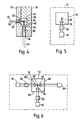
- Figures 5 and 6 show alternative embodiments of micropipette adaptor 10 which recognize the fact that other applications of adaptor 10, in addition to the ones above, may be provided for in a single embodiment.
- Figure 5 shows a micropipette adaptor 70 in which an external light source and a directing lens have been eliminated.
- micropipette adaptor 70 is useful for analyzing radiation spontaneously emitted by chemiluminescent or bioluminescent substances which may be contained in micropipette 28.
- the micropipette adaptor 72 shown in Figure 6 provides for analysis by spectrophotometry, in addition to providing for chemiluminescence, bioluminescence, and spectrofluorescence analysis capabilities.
- the micropipette adaptor 72 of Figure 6 contemplates the incorporation of a directing lens 74, a spectrofluorescent receiving lens 76, and a spectrophotometric receiving lens 78.
- the lenses 74, 76 are positioned within adaptor 72 in substantially the same manner as the lenses 60, 62 are disposed in adaptor 10 in Figure 1, as disclosed above.
- the lenses 74, 76 in combination provide for analysis by spectrofluorimetry.
- spectrophotometric receiving lens 78 is substantially diametrically opposed to directing lens 74 within adaptor 72 and, in combination with lens 74, provides for analysis by spectrophotometry in a manner disclosed in co-pending application no.
- micropipette adaptor 72 may include shields 80, 82, and 84 for lenses 74, 76 and 78, respectively.
- Shields 80, 82, and 84 are any suitable light shields which are removeably disposed on adaptor 72 to prevent visible or ultraviolet light from passing freely through the affected lens between micropipette 28 and other components of adaptor 72.
- shield 84 is positioned adjacent lens 78 to prevent unwanted radiation from entering adaptor 72 through lens 78.
- shield 82 is positioned adjacent lens 76.
- lenses 74 and 78 are functionally removed from adaptor 72 by positioning shields 80, 84 to block light from passing through their respective lenses.
Landscapes
- Physics & Mathematics (AREA)
- Health & Medical Sciences (AREA)
- Life Sciences & Earth Sciences (AREA)
- Chemical & Material Sciences (AREA)
- Analytical Chemistry (AREA)
- Biochemistry (AREA)
- General Health & Medical Sciences (AREA)
- General Physics & Mathematics (AREA)
- Immunology (AREA)
- Pathology (AREA)
- Investigating, Analyzing Materials By Fluorescence Or Luminescence (AREA)
- Spectrometry And Color Measurement (AREA)
- Investigating Or Analysing Materials By The Use Of Chemical Reactions (AREA)
- Optical Measuring Cells (AREA)
- Investigating Or Analysing Materials By Optical Means (AREA)
Applications Claiming Priority (2)
| Application Number | Priority Date | Filing Date | Title |
|---|---|---|---|
| US433752 | 1982-10-08 | ||
| US07/433,752 US5104218A (en) | 1989-11-09 | 1989-11-09 | Micropipette adaptor for spectrofluorimeters |
Publications (2)
| Publication Number | Publication Date |
|---|---|
| EP0427394A2 true EP0427394A2 (de) | 1991-05-15 |
| EP0427394A3 EP0427394A3 (en) | 1992-02-26 |
Family
ID=23721406
Family Applications (1)
| Application Number | Title | Priority Date | Filing Date |
|---|---|---|---|
| EP19900310988 Withdrawn EP0427394A3 (en) | 1989-11-09 | 1990-10-08 | Micropipette adaptor for spectrofluorometers |
Country Status (3)
| Country | Link |
|---|---|
| US (1) | US5104218A (de) |
| EP (1) | EP0427394A3 (de) |
| JP (1) | JPH03170846A (de) |
Cited By (2)
| Publication number | Priority date | Publication date | Assignee | Title |
|---|---|---|---|---|
| CN109406402A (zh) * | 2018-09-05 | 2019-03-01 | 浙江省海洋水产研究所 | 一种吸收荧光通用比色皿装置及测量方法 |
| EP2107408B1 (de) * | 2002-12-09 | 2020-08-05 | Europäisches Laboratorium für Molekularbiologie (EMBL) | Mikroskop mit der Beobachtungsrichtung senkrecht zur Beleuchtungsrichtung |
Families Citing this family (14)
| Publication number | Priority date | Publication date | Assignee | Title |
|---|---|---|---|---|
| JPH05240774A (ja) * | 1992-03-02 | 1993-09-17 | Hitachi Ltd | 光学セル及び光学検出装置とこれを用いる試料分離検出装置 |
| GB9314926D0 (en) * | 1993-07-19 | 1993-09-01 | Optiglass Ltd | Spectrophotometer cell |
| US5710625A (en) * | 1996-04-30 | 1998-01-20 | Hughes Electronics | Spectral oil immersion cell |
| US5846492A (en) * | 1997-03-11 | 1998-12-08 | Johnson & Johnson Clinical Diagnostics, Inc. | Sample quality measurement and/or analyte measurement in the dispensing tip of an analyzer |
| US6013528A (en) * | 1997-03-11 | 2000-01-11 | Ortho-Clinical Diagnostis, Inc. | Analyzer throughput featuring through-the-tip analysis |
| DE19948587A1 (de) * | 1999-10-08 | 2001-04-12 | Dade Behring Marburg Gmbh | Spektralphotometrische und nephelometrische Detektionseinheit |
| US20050161623A1 (en) * | 2004-01-27 | 2005-07-28 | Carver David R. | Apparatus for measuring photoluminescing species such as those found in liquid chromatography and capillary electrophoresis and process for making same |
| DE102004024350A1 (de) * | 2004-05-17 | 2005-12-15 | H+P Labortechnik Ag | Reaktionsgefäß sowie dessen Herstellung und Verwendung |
| US20080241843A1 (en) * | 2006-12-21 | 2008-10-02 | Stanford University | Single-cell analysis systems, methods of counting molecules in a single-cell, cylindrical fluorescence detection systems |
| DE102011102430A1 (de) * | 2011-05-24 | 2012-11-29 | Schott Ag | Optischer Durchflusssensor |
| US9055762B2 (en) | 2013-08-14 | 2015-06-16 | Angele Innovations, Llc | UV adapter for preparation of neonate nutritional fluid |
| US9516972B2 (en) | 2013-12-13 | 2016-12-13 | Angele Innovations, Llc | Electronically controlled nutritional fluid warmer |
| WO2016077741A1 (en) * | 2014-11-13 | 2016-05-19 | Marquette University | Adapter for a cell holder of a spectrofluorometer |
| JP6437390B2 (ja) * | 2015-06-30 | 2018-12-12 | 株式会社日立ハイテクノロジーズ | 自動分析装置 |
Family Cites Families (13)
| Publication number | Priority date | Publication date | Assignee | Title |
|---|---|---|---|---|
| US3531211A (en) * | 1965-04-05 | 1970-09-29 | Perkin Elmer Corp | Optical system and method for cylindrical cuvettes |
| US3573470A (en) * | 1968-03-28 | 1971-04-06 | California Inst Of Techn | Plural output optimetric sample cell and analysis system |
| US3920334A (en) * | 1973-11-13 | 1975-11-18 | Du Pont | Dual purpose detector for a liquid chromatograph |
| US4006990A (en) * | 1974-07-22 | 1977-02-08 | Varian Associates | Convergent light illuminated flow cell for liquid chromatography |
| US4008397A (en) * | 1975-04-24 | 1977-02-15 | Hoffmann-La Roche Inc. | Fluorometer flow cell |
| US3975098A (en) * | 1975-08-05 | 1976-08-17 | Applied Photophysics Limited | Spectrofluorimeter |
| JPS5941646Y2 (ja) * | 1979-08-15 | 1984-12-01 | 松下電工株式会社 | 多チヤンネル信号発生回路 |
| US4475813A (en) * | 1982-08-30 | 1984-10-09 | Milton Roy Company | Divergent light optical systems for liquid chromatography |
| JPS6151569A (ja) * | 1984-08-22 | 1986-03-14 | Canon Inc | 細胞識別装置 |
| AT384488B (de) * | 1985-03-18 | 1987-11-25 | Avl Verbrennungskraft Messtech | Kuevette zur messung von dampf- bzw. gasspektren |
| US4826660A (en) * | 1987-05-07 | 1989-05-02 | Becton, Dickinson And Company | Detector assembly for analyzer instrument |
| JPH01109245A (ja) * | 1987-10-21 | 1989-04-26 | Hitachi Ltd | 蛍光光度計 |
| US4991958A (en) * | 1989-07-10 | 1991-02-12 | General Atomics | Micropipette adaptor for spectrophotometers |
-
1989
- 1989-11-09 US US07/433,752 patent/US5104218A/en not_active Expired - Lifetime
-
1990
- 1990-10-08 EP EP19900310988 patent/EP0427394A3/en not_active Withdrawn
- 1990-11-07 JP JP2302286A patent/JPH03170846A/ja active Pending
Cited By (2)
| Publication number | Priority date | Publication date | Assignee | Title |
|---|---|---|---|---|
| EP2107408B1 (de) * | 2002-12-09 | 2020-08-05 | Europäisches Laboratorium für Molekularbiologie (EMBL) | Mikroskop mit der Beobachtungsrichtung senkrecht zur Beleuchtungsrichtung |
| CN109406402A (zh) * | 2018-09-05 | 2019-03-01 | 浙江省海洋水产研究所 | 一种吸收荧光通用比色皿装置及测量方法 |
Also Published As
| Publication number | Publication date |
|---|---|
| US5104218A (en) | 1992-04-14 |
| EP0427394A3 (en) | 1992-02-26 |
| JPH03170846A (ja) | 1991-07-24 |
Similar Documents
| Publication | Publication Date | Title |
|---|---|---|
| US5104218A (en) | Micropipette adaptor for spectrofluorimeters | |
| US7411673B2 (en) | Scanning spectrophotometer for high throughput fluorescence detection | |
| CA1319743C (en) | Area-modulated luminescence (aml) | |
| US7352459B2 (en) | Scanning Spectrophotometer for high throughput fluorescence detection and fluorescence polarization | |
| FI103434B (fi) | Monileimamittauslaite | |
| US4826660A (en) | Detector assembly for analyzer instrument | |
| US6348965B1 (en) | Solid state fluorescence and absorption spectroscopy | |
| US20040057870A1 (en) | Instrumentation for optical measurement of samples | |
| US5190857A (en) | Optical method for measuring an analyte using area-modulated luminescence | |
| US7199879B2 (en) | Versatile instrumentation for optical measurement of samples | |
| US7843568B2 (en) | Enhanced instrumentation and method for optical measurement of samples | |
| ES2719588T3 (es) | Sistema de medición de fluorescencia | |
| GB2215838A (en) | Fluorimeters | |
| CN106990059B (zh) | 一种液体样品测量装置和测量方法 | |
| JPH03503314A (ja) | 蛍光測定器 | |
| JPH0372245A (ja) | 蛍光試薬で処理した試料を分析するための測定法および測光装置 | |
| US20040126275A1 (en) | Method and device for measuring the lifetime of the fluorescence of fluorophores in samples | |
| JPH01316619A (ja) | 分光蛍光装置 | |
| JPH02227638A (ja) | 蛍光光度計 |
Legal Events
| Date | Code | Title | Description |
|---|---|---|---|
| PUAI | Public reference made under article 153(3) epc to a published international application that has entered the european phase |
Free format text: ORIGINAL CODE: 0009012 |
|
| AK | Designated contracting states |
Kind code of ref document: A2 Designated state(s): CH DE FR GB LI |
|
| PUAL | Search report despatched |
Free format text: ORIGINAL CODE: 0009013 |
|
| AK | Designated contracting states |
Kind code of ref document: A3 Designated state(s): CH DE FR GB LI |
|
| 17P | Request for examination filed |
Effective date: 19920525 |
|
| STAA | Information on the status of an ep patent application or granted ep patent |
Free format text: STATUS: THE APPLICATION IS DEEMED TO BE WITHDRAWN |
|
| 18D | Application deemed to be withdrawn |
Effective date: 19940503 |