EP0428082A2 - System zur Erkennung einer dreidimensionalen Konfiguration - Google Patents
System zur Erkennung einer dreidimensionalen Konfiguration Download PDFInfo
- Publication number
- EP0428082A2 EP0428082A2 EP19900121493 EP90121493A EP0428082A2 EP 0428082 A2 EP0428082 A2 EP 0428082A2 EP 19900121493 EP19900121493 EP 19900121493 EP 90121493 A EP90121493 A EP 90121493A EP 0428082 A2 EP0428082 A2 EP 0428082A2
- Authority
- EP
- European Patent Office
- Prior art keywords
- checker pattern
- dimensional
- point
- recognition system
- cross points
- Prior art date
- Legal status (The legal status is an assumption and is not a legal conclusion. Google has not performed a legal analysis and makes no representation as to the accuracy of the status listed.)
- Withdrawn
Links
Images

Classifications
-
- G—PHYSICS
- G06—COMPUTING OR CALCULATING; COUNTING
- G06T—IMAGE DATA PROCESSING OR GENERATION, IN GENERAL
- G06T7/00—Image analysis
- G06T7/50—Depth or shape recovery
- G06T7/521—Depth or shape recovery from laser ranging, e.g. using interferometry; from the projection of structured light
-
- G—PHYSICS
- G01—MEASURING; TESTING
- G01B—MEASURING LENGTH, THICKNESS OR SIMILAR LINEAR DIMENSIONS; MEASURING ANGLES; MEASURING AREAS; MEASURING IRREGULARITIES OF SURFACES OR CONTOURS
- G01B11/00—Measuring arrangements characterised by the use of optical techniques
- G01B11/24—Measuring arrangements characterised by the use of optical techniques for measuring contours or curvatures
- G01B11/25—Measuring arrangements characterised by the use of optical techniques for measuring contours or curvatures by projecting a pattern, e.g. one or more lines, moiré fringes on the object
-
- G—PHYSICS
- G06—COMPUTING OR CALCULATING; COUNTING
- G06V—IMAGE OR VIDEO RECOGNITION OR UNDERSTANDING
- G06V10/00—Arrangements for image or video recognition or understanding
- G06V10/10—Image acquisition
- G06V10/12—Details of acquisition arrangements; Constructional details thereof
- G06V10/14—Optical characteristics of the device performing the acquisition or on the illumination arrangements
- G06V10/145—Illumination specially adapted for pattern recognition, e.g. using gratings
Definitions
- the present invention relates to a 3-dimensional configuration recognition system for the recognition of a 3-dimensional surface.
- a system which obtains 3-dimensional coordinates of a surface of a solid from a light projected onto the surface is known as a recognition system of a 3-dimensional configuration.
- the light is emitted through slits and is moved over the surface.
- the location of the above light is detected by two cameras during this movement.
- the location of the light, i.e., 3-dimensional coordinates of the surface is calculated geometrically from the distance between 2 cameras and an angle formed with a line connecting the above cameras and a ray of light.
- the present invention is invented in view of the above points of the prior art and has an object to provide a system recognizable of 3-dimensional configuration at a high speed.
- a 3-dimensional configuration recognition system comprises: a means for projecting a checker pattern onto a surface of a solid object; a means for thinning said checker pattern and for generating a thinned checker pattern; a means for extracting cross points of said thinned checker pattern; a coupled of means for detecting 2-dimensional coordinate of said cross points; and a means for calculating 3-dimensional coordinate of said cross points from said 2-dimensional coordinate and positions of said couple of means.
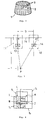
- Fig.2 shows a truncated cone 1 as an example of a 3-dimensional configuration to be recognized.
- checker pattern 2 is projected onto the surface of the above truncated cone 1, according to the present embodiment.
- the surface shape of the above truncated cone 1 is recognized by calculating 3-dimensional coordinates of cross points of the above checker pattern 2.
- Fig. 3 shows two typical cameras 11 and 12 for detecting 2-dimensional coordinate of cross points 3 on the surface.
- the above cameras form an image of a point P to be detected onto the screen 15 by the lenses 13 and 14.
- Fig.1 shows the procedure for the recognition of the configuration of the surface.
- a black spot is projected as a reference point onto the surface to be recognized. This reference point is used for obtaining 3-dimensional coordinates of each point on the surface at step 61.
- shaping correction is performed for the image obtained by cameras 11 and 12. Shading correction is performed so as to unify the luminance distribution of the whole image, as is generally known. Input image is segmented into a plurality of areas and optimized theresholds are calculated for each area so that the imae has equivalent luminance as a whole.
- step 52 smoothing processing, i.e., median filter, etc., is performed so as to perform noise processing with preserving edges. As the result, noises of an image is deleted without dulling edge.
- image is binarized at step 53 so that numerical value of "1" of "0” is given to all pixels as their luminance.
- the coordinate of a centroid of a spot projected onto the reference point is calculated for detecting the position of the reference point obtained at step 50.
- This position of the centroid is calculated, as is generally known, by dividing the moment around the predetermined point of a spot by the area of the spot.
- checker pattern is projected onto the surface of the solid.
- This checker pattern is formed, for example, by a meshed material in front of an iluminant and projecting the mesh pattern onto the surface. That is, this checker pattern is drawn with black lines onto the surface.
- Shading correction is performed for the above obtained checker pattern at step 56, and noise reduction and binarizing are performed at step 57 and 58, respectively.
- processings performed at steps 56, 57 and 58 are the same as that of steps 51, 52 and 53.
- thinning is performed for the checker pattern obtained from the processings up to steps 58.
- a configuration is converted into a line configuration with one pixel width by the above thinning.
- branch points are extracted from the thinned checker pattern. These branch points are extracted through, for example, evaluating eight pixels surrounding a center pixel with pixel value of "1" in the convolution of a size of 3x3.
- step 61 relationship between each point to the reference point is obtained. This is fully described with referring Fig.4.
- a convolution T1 is taken into a consideration with its center on the reference point B, arranging 5 pixels in vertical direction and 5 pixels in horizontal direction.
- Two cameras 11 and 12 (refer to Fig. 3) detect branch points on the above convolution T1, as examining each pixel successively in a spiral order, staring from the reference point B, as shown by an arrow in Fig.4.
- the locations of branch points detected by each camera 11, 12 are stored in a memory, which is not shown in the figure, as the relative location to the reference point B. That is, two cameras 11 and 12 define the relationship between equivalent points to each other.
- a 5x5 convolution T2 is taken into a consideration as described above, with its center of a branch point I which has already been detected.
- branch points are detected by examining pixels successively in a spiral order.
- branch points I, J, K and L fro which branch point J is detected first.
- the same branch point detection with respect to the next convolution T3 centering the branch point J is repeatedly performed.
- branch point detection with respect to the convolution T4 centering a branch point K in the convolution T2 is performed.
- no branch point is detecté ed with respect to a 5x5 convolution, a 10x10 convolution is taken and same branch point detection is performed.
- branch point detection for all pixels is performed so that the locations of all branch points are to be stored in a memory.
- step 62 3-dimensional coordinate for each branch point is calculated.
- the locations of each branch point detected by each camera 11, 12 are stored as the angles ⁇ and ⁇ as shown in Fig.3.
- distance L Z coordinate
- x and y coordinates are simply calculated by detecting the locations of each pixel, since a plane (x-y plane) perpendicular to the direction of distance L is parallel to a screen 15, and is on the same plane as that of the above convolution.
- x, y and z coordinates of each branch point i.e., cross points of the checker pattern, are calculated so as to recognize the surface shape of a 3-dimensional configuration.
Landscapes
- Engineering & Computer Science (AREA)
- Physics & Mathematics (AREA)
- Computer Vision & Pattern Recognition (AREA)
- General Physics & Mathematics (AREA)
- Theoretical Computer Science (AREA)
- Optics & Photonics (AREA)
- Artificial Intelligence (AREA)
- Multimedia (AREA)
- Image Analysis (AREA)
- Length Measuring Devices By Optical Means (AREA)
- Image Processing (AREA)
Applications Claiming Priority (2)
| Application Number | Priority Date | Filing Date | Title |
|---|---|---|---|
| JP1296677A JP2787149B2 (ja) | 1989-11-15 | 1989-11-15 | 立体形状認識装置 |
| JP296677/89 | 1989-11-15 |
Publications (2)
| Publication Number | Publication Date |
|---|---|
| EP0428082A2 true EP0428082A2 (de) | 1991-05-22 |
| EP0428082A3 EP0428082A3 (en) | 1993-05-26 |
Family
ID=17836648
Family Applications (1)
| Application Number | Title | Priority Date | Filing Date |
|---|---|---|---|
| EP19900121493 Withdrawn EP0428082A3 (en) | 1989-11-15 | 1990-11-09 | A 3-dimensional configuration recognition system |
Country Status (3)
| Country | Link |
|---|---|
| EP (1) | EP0428082A3 (de) |
| JP (1) | JP2787149B2 (de) |
| KR (1) | KR910010355A (de) |
Families Citing this family (2)
| Publication number | Priority date | Publication date | Assignee | Title |
|---|---|---|---|---|
| JP2980493B2 (ja) * | 1993-08-19 | 1999-11-22 | インターナショナル・ビジネス・マシーンズ・コーポレイション | 磁気ヘッドの浮上量測定方法 |
| KR100972640B1 (ko) * | 2008-05-07 | 2010-07-30 | 선문대학교 산학협력단 | 모아레를 이용한 3차원 측정장치의 기준격자 획득방법 및장치 |
Family Cites Families (4)
| Publication number | Priority date | Publication date | Assignee | Title |
|---|---|---|---|---|
| JPS5278467A (en) * | 1975-12-25 | 1977-07-01 | Agency Of Ind Science & Technol | Method of determining reference points for measurement of configuratio n |
| JPH061164B2 (ja) * | 1985-01-31 | 1994-01-05 | 伍良 松本 | 立体形状測定装置 |
| US4842411A (en) * | 1986-02-06 | 1989-06-27 | Vectron, Inc. | Method of automatically measuring the shape of a continuous surface |
| JP2739319B2 (ja) * | 1988-03-01 | 1998-04-15 | 株式会社エイ・ティ・アール通信システム研究所 | 立体形状再生装置 |
-
1989
- 1989-11-15 JP JP1296677A patent/JP2787149B2/ja not_active Expired - Fee Related
-
1990
- 1990-11-06 KR KR1019900017904A patent/KR910010355A/ko not_active Ceased
- 1990-11-09 EP EP19900121493 patent/EP0428082A3/en not_active Withdrawn
Also Published As
| Publication number | Publication date |
|---|---|
| EP0428082A3 (en) | 1993-05-26 |
| JPH03158709A (ja) | 1991-07-08 |
| JP2787149B2 (ja) | 1998-08-13 |
| KR910010355A (ko) | 1991-06-29 |
Similar Documents
| Publication | Publication Date | Title |
|---|---|---|
| US5231678A (en) | Configuration recognition system calculating a three-dimensional distance to an object by detecting cross points projected on the object | |
| US5081689A (en) | Apparatus and method for extracting edges and lines | |
| US7333132B2 (en) | Corrected image generating apparatus and corrected image generating program storage medium | |
| EP0523152B1 (de) | Dreidimensionales echtzeit-sensorsystem | |
| US7650015B2 (en) | Image processing method | |
| JPH07113966B2 (ja) | 二次元画像処理方法および装置 | |
| EP0157299B1 (de) | Bildauswertungsgerät | |
| US6396960B1 (en) | Method and apparatus of image composite processing | |
| JP2530955B2 (ja) | リ―ド付き部品の検査装置及び検査方法 | |
| CN114549975A (zh) | 一种基于多摄像头的移动机器人的覆盖率检测方法及系统 | |
| JP3516118B2 (ja) | 物体認識方法および物体認識装置 | |
| GB2272285A (en) | Determining the position of edges and corners in images. | |
| JP3627249B2 (ja) | 画像処理装置 | |
| JP2787149B2 (ja) | 立体形状認識装置 | |
| JPH0417472B2 (de) | ||
| JPH10283478A (ja) | 特徴抽出方法およびその方法を用いた物体認識装置 | |
| JPH05122602A (ja) | 距離動画像入力処理方法 | |
| JP2004030453A (ja) | ステレオマッチング方法、ステレオマッチングプログラム及びステレオマッチングプログラムを記録したコンピュータ読み取り可能な記録媒体 | |
| JPH05272922A (ja) | 視覚センサ装置 | |
| US20020159654A1 (en) | Method for processing an image of a concrete construction | |
| JPS59188509A (ja) | 物体の位置および形状認識方法 | |
| JPH0534117A (ja) | 画像処理方法 | |
| JP2959017B2 (ja) | 円形画像判別方法 | |
| JP3080097B2 (ja) | 平行線図形抽出方法 | |
| JPH0624028B2 (ja) | パターン認識のための特徴点コーナーの位置計測方法 |
Legal Events
| Date | Code | Title | Description |
|---|---|---|---|
| PUAI | Public reference made under article 153(3) epc to a published international application that has entered the european phase |
Free format text: ORIGINAL CODE: 0009012 |
|
| AK | Designated contracting states |
Kind code of ref document: A2 Designated state(s): BE DE FR GB IT NL SE |
|
| PUAL | Search report despatched |
Free format text: ORIGINAL CODE: 0009013 |
|
| AK | Designated contracting states |
Kind code of ref document: A3 Designated state(s): BE DE FR GB IT NL SE |
|
| 17P | Request for examination filed |
Effective date: 19930505 |
|
| RAP1 | Party data changed (applicant data changed or rights of an application transferred) |
Owner name: EZEL INC. Owner name: SHARP KABUSHIKI KAISHA |
|
| RAP1 | Party data changed (applicant data changed or rights of an application transferred) |
Owner name: SHARP KABUSHIKI KAISHA Owner name: EZEL INC. |
|
| RAP3 | Party data changed (applicant data changed or rights of an application transferred) |
Owner name: EZEL INC. Owner name: SHARP KABUSHIKI KAISHA |
|
| 17Q | First examination report despatched |
Effective date: 19940120 |
|
| STAA | Information on the status of an ep patent application or granted ep patent |
Free format text: STATUS: THE APPLICATION IS DEEMED TO BE WITHDRAWN |
|
| 18D | Application deemed to be withdrawn |
Effective date: 19950329 |