EP0428780B1 - Presse à poinçonner avec entrée de valeur de correction pour la profondeur de pénétration et la longueur d'alimentation - Google Patents
Presse à poinçonner avec entrée de valeur de correction pour la profondeur de pénétration et la longueur d'alimentation Download PDFInfo
- Publication number
- EP0428780B1 EP0428780B1 EP89121629A EP89121629A EP0428780B1 EP 0428780 B1 EP0428780 B1 EP 0428780B1 EP 89121629 A EP89121629 A EP 89121629A EP 89121629 A EP89121629 A EP 89121629A EP 0428780 B1 EP0428780 B1 EP 0428780B1
- Authority
- EP
- European Patent Office
- Prior art keywords
- control
- characteristic curve
- punch press
- regulating
- strokes
- Prior art date
- Legal status (The legal status is an assumption and is not a legal conclusion. Google has not performed a legal analysis and makes no representation as to the accuracy of the status listed.)
- Expired - Lifetime
Links
- 230000035515 penetration Effects 0.000 title claims 3
- 238000012937 correction Methods 0.000 title description 9
- 230000001105 regulatory effect Effects 0.000 claims description 24
- 238000013461 design Methods 0.000 claims description 14
- 238000004080 punching Methods 0.000 claims description 7
- 230000001419 dependent effect Effects 0.000 claims description 5
- 238000004519 manufacturing process Methods 0.000 claims description 5
- 239000000463 material Substances 0.000 claims description 5
- 238000007654 immersion Methods 0.000 description 28
- 230000006870 function Effects 0.000 description 7
- 238000010586 diagram Methods 0.000 description 4
- 239000000725 suspension Substances 0.000 description 4
- 230000000694 effects Effects 0.000 description 3
- 230000005489 elastic deformation Effects 0.000 description 1
- 238000004049 embossing Methods 0.000 description 1
- 238000005259 measurement Methods 0.000 description 1
- 238000004886 process control Methods 0.000 description 1
- 238000012545 processing Methods 0.000 description 1
Images

Classifications
-
- B—PERFORMING OPERATIONS; TRANSPORTING
- B21—MECHANICAL METAL-WORKING WITHOUT ESSENTIALLY REMOVING MATERIAL; PUNCHING METAL
- B21D—WORKING OR PROCESSING OF SHEET METAL OR METAL TUBES, RODS OR PROFILES WITHOUT ESSENTIALLY REMOVING MATERIAL; PUNCHING METAL
- B21D43/00—Feeding, positioning or storing devices combined with, or arranged in, or specially adapted for use in connection with, apparatus for working or processing sheet metal, metal tubes or metal profiles; Associations therewith of cutting devices
- B21D43/02—Advancing work in relation to the stroke of the die or tool
- B21D43/021—Control or correction devices in association with moving strips
-
- B—PERFORMING OPERATIONS; TRANSPORTING
- B30—PRESSES
- B30B—PRESSES IN GENERAL
- B30B15/00—Details of, or accessories for, presses; Auxiliary measures in connection with pressing
- B30B15/0029—Details of, or accessories for, presses; Auxiliary measures in connection with pressing means for adjusting the space between the press slide and the press table, i.e. the shut height
- B30B15/0041—Control arrangements therefor
-
- Y—GENERAL TAGGING OF NEW TECHNOLOGICAL DEVELOPMENTS; GENERAL TAGGING OF CROSS-SECTIONAL TECHNOLOGIES SPANNING OVER SEVERAL SECTIONS OF THE IPC; TECHNICAL SUBJECTS COVERED BY FORMER USPC CROSS-REFERENCE ART COLLECTIONS [XRACs] AND DIGESTS
- Y10—TECHNICAL SUBJECTS COVERED BY FORMER USPC
- Y10T—TECHNICAL SUBJECTS COVERED BY FORMER US CLASSIFICATION
- Y10T83/00—Cutting
- Y10T83/141—With means to monitor and control operation [e.g., self-regulating means]
-
- Y—GENERAL TAGGING OF NEW TECHNOLOGICAL DEVELOPMENTS; GENERAL TAGGING OF CROSS-SECTIONAL TECHNOLOGIES SPANNING OVER SEVERAL SECTIONS OF THE IPC; TECHNICAL SUBJECTS COVERED BY FORMER USPC CROSS-REFERENCE ART COLLECTIONS [XRACs] AND DIGESTS
- Y10—TECHNICAL SUBJECTS COVERED BY FORMER USPC
- Y10T—TECHNICAL SUBJECTS COVERED BY FORMER US CLASSIFICATION
- Y10T83/00—Cutting
- Y10T83/141—With means to monitor and control operation [e.g., self-regulating means]
- Y10T83/148—Including means to correct the sensed operation
-
- Y—GENERAL TAGGING OF NEW TECHNOLOGICAL DEVELOPMENTS; GENERAL TAGGING OF CROSS-SECTIONAL TECHNOLOGIES SPANNING OVER SEVERAL SECTIONS OF THE IPC; TECHNICAL SUBJECTS COVERED BY FORMER USPC CROSS-REFERENCE ART COLLECTIONS [XRACs] AND DIGESTS
- Y10—TECHNICAL SUBJECTS COVERED BY FORMER USPC
- Y10T—TECHNICAL SUBJECTS COVERED BY FORMER US CLASSIFICATION
- Y10T83/00—Cutting
- Y10T83/141—With means to monitor and control operation [e.g., self-regulating means]
- Y10T83/148—Including means to correct the sensed operation
- Y10T83/152—And modify another operation
Definitions
- the present invention relates to a punch press with stroke rate adjustment and a control device containing a target characteristic, by means of which signals for an adjusting device according to the target characteristic can be generated, and by which setting device an immersion depth adjustment of the punch of the punch press while the punch press is running as a function of the signals the control or regulating device takes place.
- the invention relates to a punch press with stroke rate adjustment and a control device containing a target characteristic, by means of which signals for an adjusting device according to the target characteristic can be generated and by which adjusting device a feed length setting for the material to be punched while the punch press is running as a function of the signals the control or regulating device takes place.
- Setpoint deviations also occur in the feed device, in which the dimension of the feed length deviates from a respectively predetermined setpoint, with increasing number of strokes and accelerated belt mass forming further sources of error.
- the invention seeks to remedy this.
- the invention as characterized in the claims solves the task of creating a punch press in which these disadvantages do not occur and in which parts can be produced with the desired precision over the entire range of strokes with each tool, in that the control device has an input means by means of which a value deviating from the target characteristic curve can be entered for the immersion depth at any number of strokes, and that the control or regulating device for generating the signals is designed in such a way that the entered value can be changed as a function of the stroke number and can be linked to the desired characteristic curve.
- control or regulating device has an input means by means of which a value for the feed length deviating from the nominal characteristic curve can be entered at any number of strokes, and that the control or regulating device for generating the signals is designed in such a way that the entered value can be changed depending on the stroke rate and can be linked to the target characteristic curve.
- the control or regulating device proceeds analogously when changing the target feed length value.
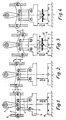
- FIGS. 1-4 show in simplified form the parts of a punch press that are essential for understanding the invention.
- the crank arm 1, the levers 2, the adjusting spindles 3, the drive connecting rods 4, the plunger 5 and the table 6 are drawn from the punch press.
- WHS means the tool closing height.
- the deflection amount F and the play S are shown schematically in accordance with the respective operating states.
- Figure 3 shows the same machine that with a stroke rate of 100 H / min. punches. The speed is therefore again the same as that of FIG. 1.
- the upper tool part 8, the lower tool part 9 and the workpiece, i.e. the tape 10 from which the product is punched and embossed is shown.
- the reference number 13 denotes a punched-out piece of material.
- Figure 4 shows the machine with a high number of strokes, ie analogous to the number of strokes in FIG. 2. Because of the large dynamic forces (at approx. 300-400 h / min.) the game is run through and at the same time the dynamic suspension analogous to FIG. In order to keep the tool closing height WSH constant again, the plunger adjustment would have to be corrected by the amount F + S.
- FIG. 5 schematically shows a block diagram of a known regulation, which is basically based on FIG. 1 of DE-PS 27 31 084.
- the number of strokes is fed from a corresponding sensor 26 to a first element 20, in which a target characteristic curve is stored.
- a target characteristic curve is provided for each tool used.
- the target characteristic is programmable via an input 21 of the control device.
- the target characteristic curve e.g. represents the immersion depth as a function of the number of strokes.
- a comparator the target immersion depth emitted by the element 20 is compared with the actual immersion depth, which is measured by a sensor 25 on the motor 24 of the immersion depth adjustment.
- the element 22 activates one of the switches 23 in order to actuate the motor for the immersion depth adjustment for raising or lowering the ram or tool. The actuation continues until the actual value is again adjusted to the setpoint within the control accuracy.
- FIG. 6 shows roughly schematically how the control device of a punch press according to the invention can be designed. Only one element 30 of the control device is shown, which is basically the element 20 of Figure 5 corresponds. The further elements of FIG. 5 have been omitted from FIG. 6 for the sake of simplicity. These elements 22, 23, 24, 25 are basically of the same design in the control device according to FIG. 6 as in the known control device according to FIG. 5.
- Element 30 also has a tool-specific target characteristic curve of a known type that has been programmed via input 21. It also has an input for a stroke-dependent signal from a sensor 26.
- An input or input means 31 is now provided, by means of which a value can be entered by which the immersion depth is corrected at the number of strokes present at the moment.
- FIG. 7 shows a target characteristic curve 40 in an immersion depth / stroke rate diagram.
- this nominal characteristic curve is shown as a straight line. While this is correct for a feed device, the target characteristic curve for the immersion depth will usually be parabolic.
- the schematic nominal characteristic curve shows the value to which the immersion depth is adjusted at the respective number of strokes.
- the setpoint characteristic curve can inevitably only be an imperfect image of the complex real function.
- the parts punched according to the nominal characteristic curve can show large deviations from the desired manufacturing tolerance, even - and especially - if the control device according to FIG. 5 follows the nominal value characteristic curve 40.
- the control device of the punch press according to the invention therefore has input 31, into which a value can be entered by which the control device detaches itself from the setpoint characteristic.
- FIG. 7 shows how this manifests itself in the immersion depth / stroke diagram.
- the operator of the stamping press was able to determine that the operation on the associated target characteristic point 42 does not give the desired precision of the stamped parts.
- the control device can receive a correction value via input 31 W can be entered.
- the punch press then works at the operating point 41, which results from the nominal characteristic curve 40 and the entered correction value W.
- the value W can be entered using a wide variety of means, for example using a numerical keyboard as a digital value, using a variable resistor as an analog value or using ⁇ keys in predetermined small steps. The type of input will depend on the design of the control device.
- W can of course be larger or smaller or can also be effective on the other side of the target characteristic curve, so that an operating point 43 would result. If the precision of the parts achieved at the new operating point 41 is not satisfactory, a different value for W can of course be entered.
- the value W is automatically changed by the control device. This can be done continuously, so that there is again a continuous curve (shown as curve 44 in dashed lines) between the stroke numbers H1 to H4 or H max to H min . This can be done in such a way that an additional characteristic curve is calculated from the known nominal value characteristic curve parameters, which in the example shown passes through the new operating point 41 and touches or intersects the nominal value characteristic curve at the minimum number of strokes.
- corrected correction values W2 to W4 only for individual stroke numbers H2 to H4, the new "operating setpoint curve" which arises, for example, being step-like or being formed between the points by a straight line.
- the nominal characteristic curve 40 is parabolic for the immersion depth, and when it is changed, all parabolic parameters are recalculated starting from the value W set at any number of strokes, and a new nominal nominal characteristic curve is thus formed.
- the control device is of course preferably formed by a digital process control, which carries out the necessary calculations and the corresponding regulation.
- FIG. 6 indicates, for example, how a configuration of the control device according to the invention can be achieved with little effort.
- the signal at the output 33 to the comparator 22 is formed in such a way that an adder / subtractor 35 links the basic value from the setpoint characteristic curve with the entered value W in order to obtain the new operating point.
- a second adder / subtractor 36 is activated, which from the previous new operating point 41 e.g. counts a constant K when the number of strokes drops or adds the constant K when the number of strokes increases.
- the control device is preferably provided with a memory in which at least one value W, at most the entire new target operating characteristic and a number associated with the tool, can be stored are. This makes it possible to call up a tool that has already been used and has been driven with a changed setpoint characteristic curve and to start operation on the changed curve.
- the above statements regarding the immersion depth also apply to the feed length.
- the corresponding setpoint characteristic curve can be a straight line.
- the principle of correction and the means used remain the same.
- only one of the corrections that is, either the feed length or the immersion depth, can be carried out on a punch press.
- both options are provided in the same punch press.
Landscapes
- Engineering & Computer Science (AREA)
- Mechanical Engineering (AREA)
- Control Of Presses (AREA)
- Punching Or Piercing (AREA)
Claims (8)
- Presse d'emboutissage avec réglage du nombre d'oscillations et une unité de commande et de régulation (30) comportant une courbe de consigne (40) et agencée pour engendrer en fonction de celle-ci des signaux destinés à un dispositif de réglage, le dispositif de réglage réglant la profondeur de pénétration du poinçon (5) de la presse au cours de la marche de celle-ci et en fonction des signaux émanant de l'unité de commande et de régulation, caractérisée en ce que l'unité de commande et de régulation (30) possède un organe récepteur (31) agencé pour recevoir une valeur différente de celle indiquée par la courbe de consigne (40) pour la profondeur de pénétration à un nombre arbitraire (H) d'oscillations, et en ce que l'unité de commande et de régulation est agencée de manière à ce que la valeur introduite (W) puisse être modifiée en fonction du nombre d'oscillations et combinée avec la courbe de consigne (40).
- Presse d'emboutissage selon la revendication 1, caractérisée en ce que l'unité de commande et de régulation (30) comporte une mémoire capable de mémoriser au moins une valeur qui y a été introduite.
- Presse d'emboutissage selon la revendication 1, caractérisée en ce que l'unité de commande et de régulation (30) est agencée pour combiner une valeur qui y a été introduite avec une valeur caractéristique de l'outil d'emboutissage utilisé.
- Presse d'emboutissage selon une des revendications 1 à 3, caractérisée en ce que l'unité de commande et de régulation (30) est agencée pour mémoriser une courbe de consigne en forme de parabole et pour modifier tous les paramètres de la parabole en fonction du nombre d'oscillations.
- Presse d'emboutissage selon une des revendications 1 à 4, caractérisée en ce que l'unité de commande et de régulation (30) est agencée pour produire en fonction d'une seconde courbe de consigne des signaux pour un dispositif d'avancement de la presse, que l'organe récepteur est prévu pour recevoir une valeur différente de celle déterminée par la seconde courbe de consigne pour la longueur de l'avance du matériau à emboutir et que l'unité de commande et de régulation est agencée pour engendrer les signaux régulateurs de l'avance de manière à ce que la valeur introduite puisse être modifiée en fonction du nombre d'oscillations et combinée avec la courbe de consigne.
- Presse d'emboutissage avec réglage du nombre d'oscillations et une unité de commande et de régulation (30) comportant une courbe de consigne (40) et agencée pour engendrer en fonction de celle-ci des signaux destinés à un organe de réglage de la longueur de l'avance du matériau à emboutir lorsque la presse est en marche et en fonction des signaux émis par l'unité de commande et de régulation (30), caractérisée en ce que l'unité de commande et de régulation (30) possède un organe récepteur (31) agencé pour recevoir une valeur (W) différente de celle indiquée par la courbe de consigne (40) pour la longueur d'avance à un nombre arbitraire d'oscillations (H), et en ce que l'unité de commande et de régulation (30) pour engendrer les signaux est agencée de manière à ce que la valeur introduite (W) puisse être modifiée en fonction du nombre d'oscillations et combinée avec la courbe de consigne (40).
- Presse d'emboutissage selon la revendication 6, caractérisée en ce que l'unité de commande et de régulation (30) comporte une mémoire pouvant mémoriser au moins une valeur qui y a été introduite.
- Presse d'emboutissage selon la revendication 7, caractérisée en ce que l'unité de commande et de régulation (30) est agencée pour combiner une valeur qui y a été introduite avec une valeur caractéristique de l'outil d'emboutissage utilisé.
Applications Claiming Priority (1)
| Application Number | Priority Date | Filing Date | Title |
|---|---|---|---|
| CH4039/88A CH676445A5 (fr) | 1988-10-28 | 1988-10-28 |
Publications (2)
| Publication Number | Publication Date |
|---|---|
| EP0428780A1 EP0428780A1 (fr) | 1991-05-29 |
| EP0428780B1 true EP0428780B1 (fr) | 1993-12-22 |
Family
ID=4268678
Family Applications (1)
| Application Number | Title | Priority Date | Filing Date |
|---|---|---|---|
| EP89121629A Expired - Lifetime EP0428780B1 (fr) | 1988-10-28 | 1989-11-23 | Presse à poinçonner avec entrée de valeur de correction pour la profondeur de pénétration et la longueur d'alimentation |
Country Status (4)
| Country | Link |
|---|---|
| US (1) | US5099731A (fr) |
| EP (1) | EP0428780B1 (fr) |
| CH (1) | CH676445A5 (fr) |
| DE (1) | DE58906506D1 (fr) |
Families Citing this family (6)
| Publication number | Priority date | Publication date | Assignee | Title |
|---|---|---|---|---|
| DE4101603A1 (de) * | 1991-01-21 | 1992-07-23 | Kaiser Kg Otto | Verfahren zum konstanthalten der vorschublaengen |
| US6868351B1 (en) * | 1999-10-19 | 2005-03-15 | The Minster Machine Company | Displacement based dynamic load monitor |
| US6582166B1 (en) | 1999-10-22 | 2003-06-24 | Gerber Scientific Products, Inc. | Method of compensating for cutter deflection |
| ATE418444T1 (de) * | 2000-08-01 | 2009-01-15 | Haulick & Roos Gmbh | Press- oder stanzautomat |
| KR200353163Y1 (ko) * | 2004-03-26 | 2004-06-14 | 디앤크래프트 주식회사 | 펀칭과 엠보싱을 동시에 할 수 있는 펀치 |
| PL1879266T3 (pl) * | 2006-07-13 | 2013-08-30 | Schaefer Werkzeug & Sonderma | Sposób i urządzenie do ustawiania ruchu skokowego urządzenia zagniatającego |
Family Cites Families (6)
| Publication number | Priority date | Publication date | Assignee | Title |
|---|---|---|---|---|
| GB1099192A (en) * | 1964-01-15 | 1968-01-17 | Hordern Mason & Edwards Ltd | Improvements relating to feeding devices for power presses or like machine tools |
| DE2731084C3 (de) * | 1977-07-09 | 1980-07-03 | L. Schuler Gmbh, 7320 Goeppingen | Stößelverstellung für schnellaufende Schnittpressen |
| GB2099750B (en) * | 1981-06-06 | 1985-06-26 | Samco Strong Ltd | Stroke control for press |
| DE3274074D1 (en) * | 1982-01-08 | 1986-12-11 | Fanuc Ltd | A spindle head unit |
| DE3432235A1 (de) * | 1984-09-01 | 1986-03-13 | Unidor GmbH, 7534 Birkenfeld | Verfahren zum konstanthalten einer vorgewaehlten vorschublaenge einer bandvorschubeinrichtung an einer werkzeugmaschine |
| US4823658A (en) * | 1985-10-18 | 1989-04-25 | Spicer Andrew I | Punch presses |
-
1988
- 1988-10-28 CH CH4039/88A patent/CH676445A5/de not_active IP Right Cessation
-
1989
- 1989-11-23 EP EP89121629A patent/EP0428780B1/fr not_active Expired - Lifetime
- 1989-11-23 DE DE89121629T patent/DE58906506D1/de not_active Expired - Lifetime
- 1989-12-11 US US07/450,285 patent/US5099731A/en not_active Expired - Lifetime
Also Published As
| Publication number | Publication date |
|---|---|
| CH676445A5 (fr) | 1991-01-31 |
| DE58906506D1 (de) | 1994-02-03 |
| EP0428780A1 (fr) | 1991-05-29 |
| US5099731A (en) | 1992-03-31 |
Similar Documents
| Publication | Publication Date | Title |
|---|---|---|
| EP0873855B1 (fr) | Procédé et dispositif pour la fabrication pièces moulées en métal dur, céramique, métal fritté ou similaire | |
| DE2742572B1 (de) | Verfahren zum Herstellen von Tabletten und Tablettenpresse | |
| EP2008736B1 (fr) | Machine-outil et procédé destinés à l'évacuation d'une partie d'une pièce à usiner | |
| DE3153332C2 (de) | Verfahren zur Steuerung einer hydraulischen Presse zum Pressen von Platten auf Holzbasis und Vorrichtung zur Durchführung des Verfahrens | |
| EP0353479B1 (fr) | Procédé et dispositif pour réduire la charge de presse dans une presse à découper comportant des butées fixes | |
| DE3718961C2 (fr) | ||
| DE2731084A1 (de) | Stellantrieb fuer eine stoesselverstellung einer schnittpresse | |
| DE112018001401T5 (de) | Pressensystem | |
| DE3131402A1 (de) | Verfahren und tablettenpresse zum aufeinanderfolgenden herstellen einer vielzahl von tabletten mit gleichem gewicht | |
| DE69011077T2 (de) | Regelanordnung für abkantpresse. | |
| DE3744177C2 (fr) | ||
| EP0428780B1 (fr) | Presse à poinçonner avec entrée de valeur de correction pour la profondeur de pénétration et la longueur d'alimentation | |
| DE1752005B2 (de) | Steuerung der Tischbewegungen hydraulischer Pressen | |
| EP0921876A1 (fr) | Procede pour produire des couches d'elements constitutifs | |
| EP0242824B1 (fr) | Procédé et dispositif pour le réglage d'au moins deux propriétés physiques déterminantes pour la qualité du produit fini d'un boudin à fumer | |
| DE4315680C2 (de) | Regelung von Tablettenparametern bei der Herstellung auf Rundlauf-Pressen | |
| EP0367035B1 (fr) | Presse ou poinçonneuse | |
| DE2249793A1 (de) | Verfahren und vorrichtung zum verformen eines zylindrischen werkstueckes durch walzen | |
| EP1287975B1 (fr) | Procédé pour la production d'éléments moulés dans une presse à poudre | |
| DE3230930C2 (fr) | ||
| DE2805187C2 (de) | Gesenkschmiedepresse | |
| DE1940912C3 (de) | Vorrichtung zum Ausrichten von schrittweise einer Schere mit Scrollschnitt zugeführtem Bandmaterial | |
| DE102004012858B4 (de) | Verfahren und Einrichtung zur Wälzkörperherstellung | |
| DE2842365C2 (fr) | ||
| DE2147002C3 (de) | Presse zum Herstellen von Steinrohlingen |
Legal Events
| Date | Code | Title | Description |
|---|---|---|---|
| PUAI | Public reference made under article 153(3) epc to a published international application that has entered the european phase |
Free format text: ORIGINAL CODE: 0009012 |
|
| 17P | Request for examination filed |
Effective date: 19910204 |
|
| AK | Designated contracting states |
Kind code of ref document: A1 Designated state(s): DE FR GB IT NL |
|
| TCNL | Nl: translation of patent claims filed | ||
| EL | Fr: translation of claims filed | ||
| ITCL | It: translation for ep claims filed |
Representative=s name: BARZANO' E ZANARDO ROMA S.P.A. |
|
| GBC | Gb: translation of claims filed (gb section 78(7)/1977) | ||
| 17Q | First examination report despatched |
Effective date: 19930122 |
|
| RAP1 | Party data changed (applicant data changed or rights of an application transferred) |
Owner name: BRUDERER AG |
|
| ITF | It: translation for a ep patent filed | ||
| GRAA | (expected) grant |
Free format text: ORIGINAL CODE: 0009210 |
|
| AK | Designated contracting states |
Kind code of ref document: B1 Designated state(s): DE FR GB IT NL |
|
| REF | Corresponds to: |
Ref document number: 58906506 Country of ref document: DE Date of ref document: 19940203 |
|
| ET | Fr: translation filed | ||
| GBT | Gb: translation of ep patent filed (gb section 77(6)(a)/1977) |
Effective date: 19940203 |
|
| PLBE | No opposition filed within time limit |
Free format text: ORIGINAL CODE: 0009261 |
|
| STAA | Information on the status of an ep patent application or granted ep patent |
Free format text: STATUS: NO OPPOSITION FILED WITHIN TIME LIMIT |
|
| 26N | No opposition filed | ||
| REG | Reference to a national code |
Ref country code: GB Ref legal event code: IF02 |
|
| PGFP | Annual fee paid to national office [announced via postgrant information from national office to epo] |
Ref country code: NL Payment date: 20081113 Year of fee payment: 20 Ref country code: DE Payment date: 20081121 Year of fee payment: 20 |
|
| PGFP | Annual fee paid to national office [announced via postgrant information from national office to epo] |
Ref country code: IT Payment date: 20081125 Year of fee payment: 20 |
|
| PGFP | Annual fee paid to national office [announced via postgrant information from national office to epo] |
Ref country code: FR Payment date: 20081113 Year of fee payment: 20 |
|
| PGFP | Annual fee paid to national office [announced via postgrant information from national office to epo] |
Ref country code: GB Payment date: 20081117 Year of fee payment: 20 |
|
| REG | Reference to a national code |
Ref country code: GB Ref legal event code: PE20 Expiry date: 20091122 |
|
| NLV7 | Nl: ceased due to reaching the maximum lifetime of a patent |
Effective date: 20091123 |
|
| PG25 | Lapsed in a contracting state [announced via postgrant information from national office to epo] |
Ref country code: NL Free format text: LAPSE BECAUSE OF EXPIRATION OF PROTECTION Effective date: 20091123 |
|
| PG25 | Lapsed in a contracting state [announced via postgrant information from national office to epo] |
Ref country code: GB Free format text: LAPSE BECAUSE OF EXPIRATION OF PROTECTION Effective date: 20091122 |