EP0429148A1 - Procédé et dispositif destinés à l'imagerie anatomique - Google Patents
Procédé et dispositif destinés à l'imagerie anatomique Download PDFInfo
- Publication number
- EP0429148A1 EP0429148A1 EP90250268A EP90250268A EP0429148A1 EP 0429148 A1 EP0429148 A1 EP 0429148A1 EP 90250268 A EP90250268 A EP 90250268A EP 90250268 A EP90250268 A EP 90250268A EP 0429148 A1 EP0429148 A1 EP 0429148A1
- Authority
- EP
- European Patent Office
- Prior art keywords
- images
- image
- data
- anatomy
- transformation
- Prior art date
- Legal status (The legal status is an assumption and is not a legal conclusion. Google has not performed a legal analysis and makes no representation as to the accuracy of the status listed.)
- Withdrawn
Links
- 210000003484 anatomy Anatomy 0.000 title claims abstract description 44
- 238000000034 method Methods 0.000 title claims description 42
- 238000003384 imaging method Methods 0.000 title abstract description 62
- 239000007943 implant Substances 0.000 claims abstract description 79
- 230000009466 transformation Effects 0.000 claims description 42
- 238000012360 testing method Methods 0.000 claims description 6
- 238000002513 implantation Methods 0.000 claims description 4
- 238000002372 labelling Methods 0.000 claims 8
- 230000001131 transforming effect Effects 0.000 claims 1
- 210000000988 bone and bone Anatomy 0.000 abstract description 10
- 239000000463 material Substances 0.000 abstract description 4
- 238000001514 detection method Methods 0.000 abstract description 2
- 230000000149 penetrating effect Effects 0.000 abstract 1
- 206010028980 Neoplasm Diseases 0.000 description 55
- 238000001356 surgical procedure Methods 0.000 description 20
- 210000003625 skull Anatomy 0.000 description 16
- 238000001959 radiotherapy Methods 0.000 description 13
- 230000005855 radiation Effects 0.000 description 12
- 210000001519 tissue Anatomy 0.000 description 10
- 238000011282 treatment Methods 0.000 description 10
- 210000004556 brain Anatomy 0.000 description 9
- 230000008569 process Effects 0.000 description 9
- 238000013519 translation Methods 0.000 description 9
- 230000008901 benefit Effects 0.000 description 8
- 238000005481 NMR spectroscopy Methods 0.000 description 7
- 230000006870 function Effects 0.000 description 7
- 238000002512 chemotherapy Methods 0.000 description 6
- 238000013500 data storage Methods 0.000 description 6
- 230000008859 change Effects 0.000 description 5
- 238000002591 computed tomography Methods 0.000 description 5
- 230000000875 corresponding effect Effects 0.000 description 5
- 238000012545 processing Methods 0.000 description 5
- 230000004807 localization Effects 0.000 description 4
- 230000033001 locomotion Effects 0.000 description 4
- 238000005259 measurement Methods 0.000 description 4
- 230000002411 adverse Effects 0.000 description 3
- 230000000694 effects Effects 0.000 description 3
- 230000005856 abnormality Effects 0.000 description 2
- 230000007812 deficiency Effects 0.000 description 2
- 238000012631 diagnostic technique Methods 0.000 description 2
- 210000005069 ears Anatomy 0.000 description 2
- 238000011156 evaluation Methods 0.000 description 2
- 239000011159 matrix material Substances 0.000 description 2
- 230000000737 periodic effect Effects 0.000 description 2
- 238000000844 transformation Methods 0.000 description 2
- 238000004458 analytical method Methods 0.000 description 1
- 238000004364 calculation method Methods 0.000 description 1
- 201000011510 cancer Diseases 0.000 description 1
- 238000006243 chemical reaction Methods 0.000 description 1
- 238000010835 comparative analysis Methods 0.000 description 1
- 239000012141 concentrate Substances 0.000 description 1
- 230000001276 controlling effect Effects 0.000 description 1
- 230000002596 correlated effect Effects 0.000 description 1
- 238000005336 cracking Methods 0.000 description 1
- 230000007423 decrease Effects 0.000 description 1
- 238000003745 diagnosis Methods 0.000 description 1
- 239000003814 drug Substances 0.000 description 1
- 229940079593 drug Drugs 0.000 description 1
- 238000005516 engineering process Methods 0.000 description 1
- 230000006872 improvement Effects 0.000 description 1
- 238000003780 insertion Methods 0.000 description 1
- 230000037431 insertion Effects 0.000 description 1
- 230000003993 interaction Effects 0.000 description 1
- 230000002452 interceptive effect Effects 0.000 description 1
- 230000001678 irradiating effect Effects 0.000 description 1
- 239000003550 marker Substances 0.000 description 1
- 239000002184 metal Substances 0.000 description 1
- 238000012986 modification Methods 0.000 description 1
- 230000004048 modification Effects 0.000 description 1
- 230000002093 peripheral effect Effects 0.000 description 1
- 235000020030 perry Nutrition 0.000 description 1
- 238000003825 pressing Methods 0.000 description 1
- 230000002285 radioactive effect Effects 0.000 description 1
- 210000001562 sternum Anatomy 0.000 description 1
- 230000001225 therapeutic effect Effects 0.000 description 1
- 238000002560 therapeutic procedure Methods 0.000 description 1
- 238000012795 verification Methods 0.000 description 1
- 238000012800 visualization Methods 0.000 description 1
- 238000004804 winding Methods 0.000 description 1
Images




Classifications
-
- A—HUMAN NECESSITIES
- A61—MEDICAL OR VETERINARY SCIENCE; HYGIENE
- A61B—DIAGNOSIS; SURGERY; IDENTIFICATION
- A61B6/00—Apparatus or devices for radiation diagnosis; Apparatus or devices for radiation diagnosis combined with radiation therapy equipment
- A61B6/12—Arrangements for detecting or locating foreign bodies
-
- A—HUMAN NECESSITIES
- A61—MEDICAL OR VETERINARY SCIENCE; HYGIENE
- A61B—DIAGNOSIS; SURGERY; IDENTIFICATION
- A61B90/00—Instruments, implements or accessories specially adapted for surgery or diagnosis and not covered by any of the groups A61B1/00 - A61B50/00, e.g. for luxation treatment or for protecting wound edges
- A61B90/39—Markers, e.g. radio-opaque or breast lesions markers
-
- A—HUMAN NECESSITIES
- A61—MEDICAL OR VETERINARY SCIENCE; HYGIENE
- A61B—DIAGNOSIS; SURGERY; IDENTIFICATION
- A61B90/00—Instruments, implements or accessories specially adapted for surgery or diagnosis and not covered by any of the groups A61B1/00 - A61B50/00, e.g. for luxation treatment or for protecting wound edges
- A61B90/36—Image-producing devices or illumination devices not otherwise provided for
- A61B2090/363—Use of fiducial points
-
- A—HUMAN NECESSITIES
- A61—MEDICAL OR VETERINARY SCIENCE; HYGIENE
- A61B—DIAGNOSIS; SURGERY; IDENTIFICATION
- A61B90/00—Instruments, implements or accessories specially adapted for surgery or diagnosis and not covered by any of the groups A61B1/00 - A61B50/00, e.g. for luxation treatment or for protecting wound edges
- A61B90/39—Markers, e.g. radio-opaque or breast lesions markers
- A61B2090/3904—Markers, e.g. radio-opaque or breast lesions markers specially adapted for marking specified tissue
- A61B2090/3916—Bone tissue
-
- A—HUMAN NECESSITIES
- A61—MEDICAL OR VETERINARY SCIENCE; HYGIENE
- A61B—DIAGNOSIS; SURGERY; IDENTIFICATION
- A61B90/00—Instruments, implements or accessories specially adapted for surgery or diagnosis and not covered by any of the groups A61B1/00 - A61B50/00, e.g. for luxation treatment or for protecting wound edges
- A61B90/10—Instruments, implements or accessories specially adapted for surgery or diagnosis and not covered by any of the groups A61B1/00 - A61B50/00, e.g. for luxation treatment or for protecting wound edges for stereotaxic surgery, e.g. frame-based stereotaxis
Definitions
- Imaging systems providing cross-sectional views such as computed tomographic (CT) x-ray imagers or nuclear magnetic resonance (NMR) machines have provided the ability to improve visualization of the anatomical structure of the human body without surgery or other invasive techniques.
- CT computed tomographic
- NMR nuclear magnetic resonance
- the patient can be subjected to scanning techniques of such imaging systems, and the patient's anatomical structure can be reproduced in a form for evaluation by a trained doctor.
- the doctor sufficiently experienced in these techniques can evaluate the images of the patient's anatomy and determine if there are any abnormalities present.
- An abnormal ity in the form of a tumor appears on the image as a shape that has a discernible contrast with the surrounding area.
- the difference in contrast is due to the tumor having different imaging properties than the surrounding body tissue. Moreover, the contrasting shape that represents the tumor appears at a location on the image where such a shape would not normally appear with regard to a similar image of a healthy person.
- a tumor Once a tumor has been identified, several methods of treatment are utilized to remove or destroy the tumor including chemotherapy, radiation therapy and surgery.
- chemotherapy drugs are introduced into the patient's body to destroy the tumor.
- imagers are commonly used to follow the progress of treatment by subjecting the patient to periodic scans and comparing the images taken over the course of the treatment to ascertain any changes in the tumor configurations
- the images of the tumor generated by the imager are used by a radiologist to adjust the irradiating device and to direct radiation solely at the tumor while minimizing or eliminating adverse effects to surrounding healthy tissue.
- the imaging system is also used to follow the progress of the patient in the same manner described above with respect to chemotherapy.
- the images of the tumor in the patient can guide the surgeon during the operation. By reviewing the images prior to surgery, the surgeon can decide the best strategy for reaching and excising the tumor. After surgery has been performed, further scanning is utilized to evaluate the success of the surgery and the subsequent progress of the patient.
- a problem associated with the scanning techniques mentioned above is the inability to select and compare accurately the cross section of the same anatomical area in images that have been obtained by imagers at different times or by images obtained essentially at the same time using different image modalities, e.g., CT and MRI.
- image modalities e.g., CT and MRI.
- the inaccuracy in image comparison can be better appreciated from an explanation of the scanning techniques and how the imaging systems generate the images within a cross-sectional "slice" of the patient's anatomy.
- a slice depicts elemental volumes within the cross-section of the patient's anatomy that is exposed or excited by a radiation beam or a magnetic field and the information is recorded on a film or other tangible medium.
- a patient has a tumor, its size density and location can be determined with the help of images generated by a scanning device.
- two scanning examinations are required.
- the patient is subjected to an initial scan that generates a number of slices through the portion of the anatomy, for instance the brain, to be diagnosed.
- the patient is held in a substantially fixed position with respect to the imager.
- Each slice of a particular scan is taken at a predetermined distance from the previous slice and parallel thereto.
- the doctor can evaluate the tumor. If, however, the doctor wants to assess changes in the configuration of the tumor over a given period of time, a second or "follow-up" scan has to be taken.
- U.S. Patent 4,583,538 to Onik, et al. discloses a localization device that is placed on a patient's skin which can be identified in a slice of a CT scan. A reference point is chosen from a position on the device which exactly correlates to a point on the CT scan. Measurements of the localization device on the CT scan is then correlated to the device on the patient.
- U.S. Patent 4,572,198 to Codington discloses a catheter with a coil winding in its tip to excite or weaken the magnetic field.
- the weak magnetic field is detectable by an NMR device thus pinpointing the location of the catheter tip with respect to the NMR device.
- the invention relates to a method and apparatus for insuring that scans taken at different times produce images substantially identical to those of previous scans even if they are from different image modalities at different times. This insures that a more accurate assessment of any changes in anatomy is obtained. As a result, the doctor can be more certain as to the size, location and density of the tumor, or a section thereof, that is located in the cranial cavity.
- This ability will enhance the use of surgical techniques in removing or otherwise eliminating the tumor in particular by those noninvasive techniques such as laser technology.
- laser beams can be focused directly on the tumor.
- scans can be made to determine if the tumor has moved or substantially changed in size as a result of the surgery.
- the laser or other surgical instrument can be adjusted accordingly. Because of the accuracy of the imaging techniques produced by the invention, the doctor can be confident that the amount of healthy tissue destroyed during surgery is minimized.
- a method adopted by the invention disclosed herein utilizes fiducial implants or implants to define a plane which cooperates with the imager, or other computer, and particularly the data processing capabilities of the imager to insure that subsequent scanning results in slices substantially parallel to those taken during the initial scan.
- the fiducial implants are implanted beneath the skin into the calvania and are spaced sufficiently from one another to define a plane.
- the patient with these implants implanted is placed in the scanning device in the conventional manner and scanned to provide the images of consecutive parallel slices of a given thickness along a predetermined path through the cranial cavity.
- one or more slices will be needed to accommodate part or all of each fiducial implant.
- the computational features of the imager or other computer will take into account the spatial relationship between any selected plane of a slice and that plane defined by the fiducial implants. Because of this capability, images taken in subsequent scans at different points in time, at different angles can be reconstructed to be substantially identical with the slices taken originally.
- Fiducial implants for this purpose are specially configured and made of material that enables their implantation into the skull and the ability to be detected by scanning devices.
- the fiducial implant as disclosed herein is configured to insure that during implantation it does not have adverse effects on the skull such as cracking or extending through to the cranial cavity. Nor is it sufficiently exposed between the skull and the skin to distort any external features of the anatomy.
- the fiducial implant is positioned at least on a portion of the skull at the interface of the skin and the bone of the skull to facilitate its imaging by the imager. At least a portion of the implant is symmetrical in cross-section such that slices taken of the cranial cavity, for example, can be used to locate the center of mass of the implant. This insures accuracy in using the implant image as a reference point to transform the subsequent slices of the follow-up examination into the proper position and orientation.
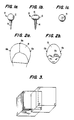
- FIG. 1 there is shown a fiducial implant 10 for the human body that is detectable by an imaging system.
- the fiducial implant comprises a first portion 12 and a second portion 14.
- the first portion 12 is configured to be detected by an imaging system (when place beneath the skin.)
- the second portion 14 is configured for fixed attachment to the bone beneath the skin without fracturing the bone.
- the first portion 12 is sufficiently large and comprised of a material for detection by an imaging system and sufficiently small to provide minimal distortion of the skin when placed at an interface between the skin and the bone.
- First portion 12 also has at least a portion which is spherical and defines a surface for cooperating with a tool for securing the second portion 14 to the bone.
- the placement of three fiducial implants 10 into a portion of anatomy of the human body allows of the recreation of a particular image slice of the portion of the anatomy taken by an imaging system in order to duplicate images taken at the first time period, that is, at the initial examination. This provides a doctor with the ability to accurately follow the progress of treatment on selected slices representing the anatomy of interest.
- three fiducial implants 10 allows a target (a tumor for instance) to be identified relative to an external coordinate system.
- the portion of anatomy with the target may then be operated on, for instance, robotically, or precisely irradiated.
- the three fiducial implants 10 are first implanted into a body of a patient at a desired region of interest.
- the patient is then placed in an imaging system and images of a series of cross-sectional slices are obtained that include, for example, the volume of the tumor which is the primary target of interest.
- the three fiducial implants are located and an internal coordinate system is defined with respect to them.
- the image data may be further reformatted to show image slices whose direction is different from that obtained originally during the imaging period.
- appropriate decisions with regard to surgery, chemotherapy or radiation therapy on a patient may be made.
- the imaging data can also be used from several different types of images, such as CT, PET or NMR to obtain the same view of the anatomy but with different qualities stressed.
- the fiducial implants 10 are located with respect to the second imaging session and the same internal coordinate system is defined relative to the implants 10. Once the same internal coordinate system is defined with respect to the second imaging session, the translation and rotation of the internal coordinate system and the images with it is determined with respect to the coordinate system established at the first imaging session. An image slice identified from the first imaging session that is to be used for diagnosis, is recovered from the second imaging session. The two image slices, one from the first image session and one from the second image session, are then compared to determine what changes, if any, have occurred in the anatomy of the patient.
- a 3-dimensional noncollinear coordinate system requires three distinct noncollinear points to be fully defined. If there are more than three identifiable points, the system is over-determined and three points have to be chosen to define the coordinate system. If there are less than three identifiable distinct points, the system is undetermined and a position relative to the one or two identifiable points will not be defined.
- the known location of three distinct points identifies a plane upon which an orthogonal coordinate system can be established. If the three points are fixed in place relative to each other over time in the body, a coordinate system to each other over time in the body, a coordinate system can be established that is also fixed in time.
- the ability to define a fixed internal coordinate system to the human body over time has important ramifications.
- a fully defined internal coordinate system that is fixed in place over time with respect to some location in the body permits comparison of subsequent images of the body taken into imaging systems such as CT scans, NMR scans or PET scans, to name a few. More precisely, these comparisons will allow a diagnostician to see what change, if any, has occurred within the body at a predetermined location.
- the same coordinates can be compared over time.
- the tissue or body material is not necessarily fixed in place relative to a predetermined set of coordinates over time. After the passage of time, the tissue may have shifted, a change not uncommon following surgery. Nevertheless, the ability to compare various properties (depending on the type of images) of the tissue at the same coordinates and at different times is a great advantage for diagnostic purposes.
- the three points (that are necessary) to define a coordinate system can be chosen in a variety of ways.
- the two ears and a tooth, or the two ears and the nose may comprise the three points.
- an image slice of the skull could provide a set of points from which the three points would be chosen to create the coordinate system for the body.
- three fiducial points that are implanted into the body, and create high contrast images during scanning provide the most reliable way to define a coordinate system.
- the three points should be in the same approximate area of the body that is under analysis, and also should be identifiable and measurable by different imagery systems, such as CT imagers and NMR imagers. The use of such a system is described at length in copending application U.S. Serial No. 119,353 which is included herein by reference.
- the placement of the three fiducial implants 10 depends on the portion of the anatomy to be evaluated. Essentially, three fiducial implants 10 are placed in three locations such that they are readily identifiable and the locations are fixed with respect to each other over time. If, for example, a study of the skull and brain is to be undertaken, preferably an implant 10A is placed on the midline of skull 18 just above the hairline, with the other two implants 10B, 10C being placed on the right and left side, respectively, of the midline in posterior position to the midline implant 10A. See Figures 2a and 2b which are a frontal and overhead view of skull 19, respectively.
- Another example of an area of interest could be the torso, with one fiducial implant 10 placed on the midline of the sternum and the other two fiducial implants 10 placed laterally thereto on the right and left side, respectively, and in ribs.
- one fiducial implant 10 can be placed in the spinous process of a vertebra in the midline and the other two fiducial implants placed in right and left iliac crest, respectively.
- Imaging apparatus provides a fixed axis relative to which any other position in space can be located. As a result, the position of the fiducial marker and the coordinate system these markers define can be located relative to the imaging apparatus.
- the features of the invention permit the location of the markers relative to the imaging apparatus to be recorded for future reference. In subsequent scans, the patient's orientation may change relative to the imaging apparatus. This new orientation can be measured by locating the fiducial markers in relation to the image apparatus and comparing it to the previously recorded location.
- the comparison technique permits re-orienting images of subsequent scans to a position corresponding to the earlier recorded scale so that image slices are always at generally the same cross-section of the earlier recorded slices.
- these positions are defined by a coordinate system and it is the positioning of these systems that is accomplished by translation or rotation as discussed below.
- any point can be obtained with respect to translation and rotation of a given cartesian coordinate system. Since any point can be obtained, any plane can also be obtained, because a plane is comprised of a set of points. For example, if a given point is desired to be looked at over time, then the coordinate of the point is identified with respect to a first time. The translation and rotation information corresponding to the coordinate system at the first time with respect to the second time is then applied to the point at the first time to indicate the coordinates of the identical point in the coordinate system at the second time. The imaging data pertaining to the second time is then searched to find the desired point. This is but one way of many possible ways to obtain the same point in the coordinate system as a function of time.
- the same procedure is applied to each point of the set of points that make up the slice image.
- the desired points are then searched for in the image information corresponding to the coordinate system at the second time. Once all the points, with their associated image information are identified, they are reformatted to produce an image slice as close as possible to the desired image slice pertaining to the coordinate system at the first time.
- the position of the slice selected by the physician from the initial image slices has to be determined with respect to the fiducial implants.
- the z coordinates or the elevation coordinates of the system have to be introduced. This can be done with respect to any slice in the image set. For instance, the slice containing the first fiducial implant can be chosen.
- the reformatting step takes image points from image slices of the second time and aligns them together and produces an image slice as similar as possible to the desired image slice of the first time.
- a point that is necessary for the creation of a reformatted image does not exist because image slices were taken, for instance, above and below the point.
- interpolation must be used to estimate the attributes of the missing point so a desired image slice can be prepared.
- one simple method of interpolation utilizes the two closest known points to the nonexistent desired point. These two known points are also as nearly opposite each other as possible with the desired point therebetween, and their average thus approximates the desired point's image value.
- the desired point is assigned an image intensity value of 5 units. See Figure 6, which shows the flow chart describing the above overall process.
- Interpolation could be avoided if the internal coordinate system is positioned identically at the different times the imaging data is obtained. This could be accomplished by causing the three fiducial implants 10 to be exactly the same position whenever imaging data is obtained.
- the body By having, for instance, an X-ray machine, or following the method discussed below that reveals the location of the fiducial implants in the body with respect to an external coordinate system, and knowing where the implants were positioned at the first time that imaging occurred, the body could be moved to be in the same exact location.
- One way of moving the body in position is with a table or platform that has 3 dimensional movement. Then, knowing where the coordinate system is in the body with respect to the platform, the platform could be moved up, down, forward, backward and/or rotated so the internal coordinate system is positioned exactly the same way it was the first time imaging data was obtained.
- One embodiment utilizes the existing computer and its peripherals to generate the reformatted images.
- Another embodiment utilizes a stand-alone system, in which the images are fed from the respective imager, and then perform the comparative analysis in the stand-alone system.
- the whole computer part of the imager must be duplicate essentially, plus various options for data input supplied, in order to accommodate images of all types.
- Hardcopy capability is also desirable therein, such as a matrix camera, because permanent records are invaluable to the diagnostician.
- the images are preferably stored as files having two parts: (1) the header that contains the patient's demographic data and information on the examination itself, that is, technical parameters of the exposure or image procedure; and (2) the image matrix.
- These two parts are preferably stored temporarily (for a couple of days, usually) on magnetic disk drives, and then moved to permanent storage medium, such as magnetic tape or floppy disk.
- a subfile may be added containing the results of the computation (the Euler angles may be added, for instance).
- An apparatus 100 carries out the imaging, signal processing and display necessary to provide images of essentially the same coordinates in the human body which can be compared over time, or to provide the location of targets, such as tumors is shown in Figure 7.
- Such an apparatus 100 is comprised of an imager 102 that supplies imaging data and is controlled by a programmable computer 104.
- the imaging data is obtained from a source 106 in the imager 102 that is approximately placed about a patient 107 as is well known in the art.
- the imaging data experiences signal processing, as described above, and the desired images are displayed on display 108. Additionally, operator interaction can be achieved through an operator control panel 110 and the coordinates of a target can be displayed in the coordinates of the target display 112 for radiation therapy applications.
- the apparatus 100 operates in the following manner.
- a number of fiducial implants 10 are implanted in the region of interest in a patient 107, in the skull 18 for example. Once the fiducial implants 10 have been secured, the patient 107 is then placed within scanning range of the imager 102.
- a series of image slices is then created by performing a scan in a conventional manner. These image slices (the "image scan") are then stored in a data base library of the programmable computer 104.
- the apparatus 100 allows the image scans (or slices of these scans) to be transformed into new images for display or comparison against a more recently obtained image scan of the patient 107.
- the following describes the operation of the programmable computer 104, once image scans have been acquired into some type of data storage device, such as magnetic tape.
- the programmable computer's operation is window-based. It reads archival tapes and writes into the data base library, reads images for viewing from the data base, and calculates and performs transformations and other related functions.
- the operation has been implemented in the 'C' programming language and can be run, for example, on a SUN workstation, manufactured by SUN Microsystems, Inc., using the SunOS Release 4.0 operating system.
- the data base library is in a hierarchical format that provides easy access and preserves the integrity of the data.
- the data base library contains one patient directory for each patient. Under each patient directory, there exists one scan directory for each image scan that has been taken of the patient.
- the scan directory contains several data files, which in turn contain all the data necessary to recreate an image scan, or a slice of an image scan, on the terminal screen.
- Access to the data library is accomplished via a read/write capability of the computer 104.
- the user causes the computer 104 to read patient data out of storage (such as magnetic tape) and write it into the data base library.
- the user can also display the images contained in the data base library, and modify or transform those images into new images which may then be displayed on the display 108.
- a data storage device such as standard magnetic tape
- the computer 104 is programmable to read virtually any given data format from the data storage device or from the imager 102 itself. Referring to input step 303, the user then indicates which data format is being used and which image scan or slices of image scans from the data storage device are to be transferred to the data base library.
- the computer 104 then converts the data format from the data storage device into a format usable by the computer 14 in step 305. This conversion of formats does not alter the data but merely rearranges it into the proper form for the computer 104.
- the re-formatted data is then written into the data base library, Step 305, where is it Stored for future use.
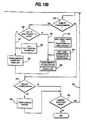
- the operation of computer 104 to view and transform slices is illustrated by the flow chart in Figures 10a and 10b.
- the user first selects a view option in input step 310 whereupon the data base library is accessed to retrieve a patient menu which is displayed on the screen in display step 314.
- the user selects a patient and an image scan of that patient in input step 316, and assigns the image scan (input step 318) to either of two display screens of display 108.
- the patient's name, I.D., and the name of the scan are displayed beneath the selected display screen in display step 320.
- the user now has the option to display a slice of the image scan in decision step 322. Assuming the user chooses to do so, the user then inputs which slice is to be viewed in input step 324. This is done by either selecting the proper slice number, or by selecting a group of slices which are displayed in miniature and picking the individual slice from the group. Slices are then displayed on the appropriate image screen in display step 326.
- the user then has the option in decision step 328 of implanting pseudo-fiducials into the displayed slice.
- Pseudo-fiducials are computer generated reference points that are additional to the actual fiducial markers. These additional reference points can be used later to compute and execute transformations.
- the pseudo-fiducial shape, size, and the position are inputted in input Step 334.
- the computer 104 will superimpose the pseudo-fiducial onto the slice on the display screen 108 in display step 330.
- the user may repeat the implanting process, and implant up to nine pseudo-fiducials in any given slice.
- the user may then choose to "localize" any fiducials in the slice, including both the pseudo-fiducials and the actual fiducials, in decision step 336.
- the purpose of the localization process is to identify the exact center of a fiducial so that the computer may use these coordinates when it calculates and performs a transformation.
- the center of the fiducial is determined manually by the user in input step 338.
- the user indicates this fiducial center by moving the cursor to the center of the fiducial and pressing the appropriate button. Since fiducials are three-dimensional objects which may occupy space in more than one slice, it is important that the user not only select the center of the fiducial on any particular slice but also that the user selects the particular slice which cuts through the center of this particular fiducial.
- the computer 104 then numbers the fiducial and records its coordinates for future reference in step 340. The user may localize as many other fiducials in the slice as desired.
- the user may then display any other slices in this image scan and repeat the same process (following path 341 back to decision step 322). After viewing the slices of the selected image scan, the user may then proceed to decision step 342, where the user has the option of selecting another image scan for simultaneous viewing. If simultaneous viewing is selected, operation of the computer 104 follows path 343 back to display step 314 and another image scan is selected.
- the second image scan can be assigned to the second display screen of the display 108 to thereby allow the user to view both the first and the second image scans at the same time, and compare the two image scans.
- path 345 is followed to decision step 344, where the user is presented the option of computing a transformation.
- Decision step 346 allows the user to choose: 1) to calculate the transformation of one displayed image scan onto the second displayed image scan; or 2) to calculate the transformation of one displayed image scan according to test parameters which the user will input. If the user to chooses to input his own parameters (path 347), the three Eulerian angles which are associated with the transformation are input in input step 348. These parameters are then stored with the image scan data (step 330) in the data base library where they will remain until the transformation is executed.
- path 351 is followed.
- the user selects which image scan is to be transformed, and labels three of the fiducials in that image as primary fiducials. These three primary fiducials must have been previously localized.
- the computer 104 uses the coordinates of these fiducials to determine the coordinate system for the entire volume of the image scan.
- the user then proceeds to the second image scan (to which the first image scan is being transformed) and labels the corresponding three fiducials in the second image scan. It is the user's responsibility to insure that the proper fiducials in each of the scans has been labeled so that the computer 104 may properly calculate the transformation.
- the computer 104 calculates the exact transformation in step 356. This calculation is performed by method of trial and error in an algorithm that repeatedly refines the Eulerian angles until the transformation results in a coordinate match-up between the three primary fiducials and the image being transformed and the three primary fiducials in the image which is being transformed to.
- the computer transformation is then stored with each image scan's data in the data base library.
- step 360 involves the mathematical process outlined above. Briefly, all the slices in an image scan are assembled and normalized into one volume. Individually the slices are not of uniform thickness, and thus have ragged edges. Therefore, the slices may not fit together exactly, which leaves holes between them where the ragged edges will not properly join. The computer 104 fills these holes in the image scan volume by interpolating between the closest available points, and thus approximates the proper data for the holes.
- the transformation may then proceed.
- the entire image scan volume is indexed from the three primary fiducials, and a new slice angle is selected pursuant to the Eulerian angles which have been previously calculated or input.
- the image scan volume is then uniformly sliced at this angle, and the new slice data of the transformation replaces the old data of the original image scan.
- the computer 104 preferably, eliminates the old data which may be reread out of the data storage device if it is needed.
- the transformed image scan is assigned to the same screen where the original image scan was assigned. The user may now compare slices of the transformed image scan with slices of the image scan to which it was transformed in decision step 362 and path 343. The entire viewing and transformation process may be repeated as desired.
- a distance measurement function provides the user with a measurement of any distance within the image scan volume. The user merely selects a point A on any given slice and a point B on that or any other slice in the image scan volume. The computer 104 will calculate the distance between the two points and display the result.
- the computer 104 also contains a trace function which allows the user to trace a line around any feature of a displayed slice. The user may also use the trace function to trace simultaneously on a pair of slices displayed on the two image screens.
- the trace and distance functions allow accurate measurement and comparison of the relative sizes of tumors or other features found within the patient 107. This leads to more effective evaluation of improvement or decline in the patient's condition.
- An application that takes advantage of a fully-defined internal coordinate system of the body relates to radiation therapy.
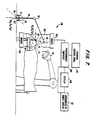
- the location of a radioactive beam of an external coordinate system must be related to the internal coordinate system. See Figure 5, where the external coordinate system can be considered the unprimed system and the internal system the primed system.
- the point P can represent the location of a point of a tumor. In this situation the actual distances and locations of the point P in the primed coordinate system, and the location of the origin S of the primed coordinate system are important. If the point P is known with respect to the internal or primed coordinate system, and the primed coordinate system is known with respect to the external or unprimed coordinate system, and the Euler angles of rotation are known, then the location of point P is known with respect to the external coordinate system.
- One way to accomplish the irradiation of a specific location the body 32, where, for instance, a tumor is located involves the use of a robot arm 34 whose base 36 can be chosen as the origin (0,0,0) of the external coordinate system B.
- a sensor 40 At the tip 38 of the robot arm 34 is located a sensor 40.
- the sensor 40 can be a metal detector or an ultrasonic detector or any instrument that can sense the position of a fiducial implant 10 in a body 32. If the fiducial implants 10 are placed in a skull 18 and there is a tumor therein, the sensor 40 in the tip 38 of the robot arm 34 is moved by the arm 34 until it contacts a fiducial implant 10 in the skull 18.
- the movement of the robot arm 34 is tracked by a computer (not shown) so the position of the sensor 40 relative to the arm's 34 base 36, the origin 0 of the external coordinate B, is known.
- the means to track the arm is well known and is accomplished by sensors (not shown) in critical locations of the arm 34, detecting rotation or movement of the joints 42 of the arm 74.
- the tip 38 location of the arm 34 is always known.
- the tip 38 of the arm 34 rests on the fiducial implant 10 in the skull 18, the location of the internal coordinate system A defined by the fiducial implants 10 is known with respect to the external coordinate system B.
- the location of the tumor is known relative to the internal coordinate system through for instance the image data already stored, and the fact that the fiducial implants 10 are also fixed relative to each other once they are in place.
- the radiation source 30 and where it is aimed is known by the computer relative to the external coordinate system B.
- the computer having the information where the tumor is located in the external coordinate system B, can aim the radiation source 30 to precisely irradiate the tumor site in the brain.
- the location of a point P in the internal coordinate system relative to the external coordinate system is determined when the distance between the origins of the two coordinate systems is known and the Euler angles are known, as described above.
- the internal coordinate system defined by the three fiducial points can allow, for example, a laser to be followed as it cuts through tissue to a tumor.
- An imaging system present in the operating theater would be positioned to continually take imaging data that is provided to a computer system which also guides the laser based on the inputted data. As the laser cuts through the tissue, the change in the tissue is apparent through the imaging system and can be followed with respect to the fixed internal coordinate system.
- the computer controlling the laser and processing the imaging data would discontinue the operation of the laser.
- imaging data is taken at a first time and stored. At distinct intervals in time, for instance about every year thereafter, the patient returns to the location of the imaging system, or one similar to it, and undergoes follow-up imaging. The most recently received imaging data is then reformatted, as described above, to obtain high fidelity images of the same cross-sections on the body as attained in the earlier session.
- the purpose of the comparisons, as stated earlier can be multifold: (a) either a simple follow-up of the growth of the tumor, without therapy; or (b) verification of therapeutic treatment, such as radiation or chemotherapy or (c) follow-up of surgical treatment.
- the tumor is first identified in the patient's body.
- the patient is then positioned in the imaging system such that at least the tumor area can be imaged.
- the imaging system is used to locate the position of the tumor in the internal coordinate system.
- the image data can, for instance, then be stored for later use so the tumor position is identified without new images having to be obtained every time radiation therapy is performed.
- the patient can then be placed before a radiation source, and each time radiation therapy occurs, the information from the imaging session that is stored is supplied to the computer operating the radiation source.
- the internal coordinate is located with respect to the external coordinate system, for instance by locating one fiducial implant, as described above, with respect to a known position in the external coordinate system.
- the tumor position is known with respect to the external coordinate system from the stored imaging information.
- a radiation source is then aimed, for example by a computer receiving the imaging and position data, at the tumor in the body.
- the procedure that is followed to take advantage of the fiducial implants is similar to the procedure described above for radiation therapy.
- n fiducial implants 10 While three fiducial implants 10 are the minimum necessary to define an internal coordinate system, there can be n fiducial implants 10, where n is greater than or equal to four and is an integer, that may be used.
- n fiducial implants 10 is that additional internal coordinate systems can be defined that result in increased clarity of images obtained from an imager by the proper choice of the coordinate system to maximize the same. This is essentially true with respect to the comparison of, for instance, an image from a magnetic resonance imager and an image of a CT imager concerning the same portion of a patient's anatomy.
- three fiducial implants 10 can be picked from the n fiducial implants 10 that are present in a patient to provide the greatest clarity and image with respect to the patient.
- the internal coordinate system can be determined by choosing which three fiducial implants 10 of the n fiducial implants 10 provide an internal coordinate system which yields the clearest images or the best view of the portion of anatomy of interest. Additionally, once the three fiducial implants 10 are chosen of the n fiducial implants 10, it does not necessarily means that each image must be produced with respect to the coordinate system defined by these three fiducial implants 10.
Landscapes
- Health & Medical Sciences (AREA)
- Life Sciences & Earth Sciences (AREA)
- Medical Informatics (AREA)
- Engineering & Computer Science (AREA)
- Surgery (AREA)
- Veterinary Medicine (AREA)
- Nuclear Medicine, Radiotherapy & Molecular Imaging (AREA)
- Biomedical Technology (AREA)
- Heart & Thoracic Surgery (AREA)
- Pathology (AREA)
- Molecular Biology (AREA)
- Animal Behavior & Ethology (AREA)
- General Health & Medical Sciences (AREA)
- Public Health (AREA)
- Biophysics (AREA)
- Oral & Maxillofacial Surgery (AREA)
- High Energy & Nuclear Physics (AREA)
- Optics & Photonics (AREA)
- Radiology & Medical Imaging (AREA)
- Physics & Mathematics (AREA)
- Apparatus For Radiation Diagnosis (AREA)
- Image Processing (AREA)
- Radiation-Therapy Devices (AREA)
- Magnetic Resonance Imaging Apparatus (AREA)
- Surgical Instruments (AREA)
- Laser Surgery Devices (AREA)
- Image Analysis (AREA)
- Medical Treatment And Welfare Office Work (AREA)
Applications Claiming Priority (2)
| Application Number | Priority Date | Filing Date | Title |
|---|---|---|---|
| US43676389A | 1989-11-15 | 1989-11-15 | |
| US436763 | 1989-11-15 |
Publications (1)
| Publication Number | Publication Date |
|---|---|
| EP0429148A1 true EP0429148A1 (fr) | 1991-05-29 |
Family
ID=23733738
Family Applications (1)
| Application Number | Title | Priority Date | Filing Date |
|---|---|---|---|
| EP90250268A Withdrawn EP0429148A1 (fr) | 1989-11-15 | 1990-10-22 | Procédé et dispositif destinés à l'imagerie anatomique |
Country Status (5)
| Country | Link |
|---|---|
| EP (1) | EP0429148A1 (fr) |
| JP (1) | JP3016396B2 (fr) |
| AU (2) | AU6575690A (fr) |
| BR (1) | BR9005747A (fr) |
| CA (1) | CA2028065C (fr) |
Cited By (11)
| Publication number | Priority date | Publication date | Assignee | Title |
|---|---|---|---|---|
| FR2686499A1 (fr) * | 1992-01-28 | 1993-07-30 | Technomed Int Sa | Appareil de traitement d'une cible, telle qu'une lesion a l'interieur du corps d'un mammifere, en particulier d'un etre humain, utilisant un element marqueur implante dans ou au voisinage de la cible pour piloter la therapie de ladite cible. |
| FR2694880A1 (fr) * | 1992-07-31 | 1994-02-25 | Univ Joseph Fourier | Procédé de détermination de la position d'un organe. |
| WO1996025893A1 (fr) * | 1995-02-23 | 1996-08-29 | Aesculap Ag | Procede et dispositif de determination de la position d'une partie du corps |
| EP0672389A3 (fr) * | 1994-03-17 | 1996-12-27 | Roke Manor Research | Sytème à base vidéo pour chirurgie et localisation assistées par ordinateur. |
| EP0650075A3 (fr) * | 1993-10-21 | 1999-01-07 | Allen, George S. | Localisation automatique à ultrasons de cibles implantées dans le corps humain |
| DE102005029242A1 (de) * | 2005-06-23 | 2006-12-28 | Siemens Ag | Verfahren zur Aufnahme und Auswertung von Bilddaten eines Untersuchungsobjekts |
| DE102005029243A1 (de) * | 2005-06-23 | 2007-01-04 | Siemens Ag | Verfahren zur Darstellung und Aufbereitung wenigstens eines Untersuchungsbildes eines Untersuchungsobjekts |
| US8830233B2 (en) | 2011-04-28 | 2014-09-09 | Howmedica Osteonics Corp. | Surgical case planning platform |
| WO2014166415A1 (fr) * | 2013-04-12 | 2014-10-16 | 重庆伟渡医疗设备股份有限公司 | Procédé de guidage par image utilisant l'imagerie bidimensionnelle |
| DE102015000444A1 (de) | 2014-01-20 | 2015-07-23 | Dieter Edinger | Verfahren zur kontrollierten Korrektur einer Bohrschablone |
| CN109350062A (zh) * | 2018-12-12 | 2019-02-19 | 上海联影医疗科技有限公司 | 医学信息获取方法、设备及非易失性计算机存储介质 |
Families Citing this family (3)
| Publication number | Priority date | Publication date | Assignee | Title |
|---|---|---|---|---|
| US7623250B2 (en) | 2005-02-04 | 2009-11-24 | Stryker Leibinger Gmbh & Co. Kg. | Enhanced shape characterization device and method |
| JP5358144B2 (ja) | 2008-08-29 | 2013-12-04 | 京セラドキュメントソリューションズ株式会社 | 静電荷像現像用トナー |
| CN111445561B (zh) * | 2020-03-25 | 2023-11-17 | 北京百度网讯科技有限公司 | 虚拟对象的处理方法、装置、设备及存储介质 |
Citations (4)
| Publication number | Priority date | Publication date | Assignee | Title |
|---|---|---|---|---|
| EP0160238A2 (fr) * | 1984-05-04 | 1985-11-06 | Gary Mark Onik | Appareil pour la disposition de sondes dans le corps par stéréotropisme en utilisant la localisation par tomographe computérisé |
| GB2159943A (en) * | 1984-06-06 | 1985-12-11 | Oreal | Monitoring variations in time of characteristics of a zone of or the whole of a person |
| US4791934A (en) * | 1986-08-07 | 1988-12-20 | Picker International, Inc. | Computer tomography assisted stereotactic surgery system and method |
| GB2212371A (en) * | 1987-11-10 | 1989-07-19 | Allen George S | Fiducial implant and method of using same |
-
1990
- 1990-10-19 CA CA002028065A patent/CA2028065C/fr not_active Expired - Fee Related
- 1990-10-22 EP EP90250268A patent/EP0429148A1/fr not_active Withdrawn
- 1990-11-02 AU AU65756/90A patent/AU6575690A/en not_active Abandoned
- 1990-11-13 BR BR909005747A patent/BR9005747A/pt unknown
- 1990-11-15 JP JP2310112A patent/JP3016396B2/ja not_active Expired - Lifetime
-
1992
- 1992-10-30 AU AU27450/92A patent/AU664208B2/en not_active Ceased
Patent Citations (4)
| Publication number | Priority date | Publication date | Assignee | Title |
|---|---|---|---|---|
| EP0160238A2 (fr) * | 1984-05-04 | 1985-11-06 | Gary Mark Onik | Appareil pour la disposition de sondes dans le corps par stéréotropisme en utilisant la localisation par tomographe computérisé |
| GB2159943A (en) * | 1984-06-06 | 1985-12-11 | Oreal | Monitoring variations in time of characteristics of a zone of or the whole of a person |
| US4791934A (en) * | 1986-08-07 | 1988-12-20 | Picker International, Inc. | Computer tomography assisted stereotactic surgery system and method |
| GB2212371A (en) * | 1987-11-10 | 1989-07-19 | Allen George S | Fiducial implant and method of using same |
Cited By (18)
| Publication number | Priority date | Publication date | Assignee | Title |
|---|---|---|---|---|
| FR2686499A1 (fr) * | 1992-01-28 | 1993-07-30 | Technomed Int Sa | Appareil de traitement d'une cible, telle qu'une lesion a l'interieur du corps d'un mammifere, en particulier d'un etre humain, utilisant un element marqueur implante dans ou au voisinage de la cible pour piloter la therapie de ladite cible. |
| WO1993014712A1 (fr) * | 1992-01-28 | 1993-08-05 | Technomed International | Appareil de traitement d'une cible, telle qu'une lesion utilisant un element marqueur |
| FR2694880A1 (fr) * | 1992-07-31 | 1994-02-25 | Univ Joseph Fourier | Procédé de détermination de la position d'un organe. |
| EP0650075A3 (fr) * | 1993-10-21 | 1999-01-07 | Allen, George S. | Localisation automatique à ultrasons de cibles implantées dans le corps humain |
| EP0672389A3 (fr) * | 1994-03-17 | 1996-12-27 | Roke Manor Research | Sytème à base vidéo pour chirurgie et localisation assistées par ordinateur. |
| US5792147A (en) * | 1994-03-17 | 1998-08-11 | Roke Manor Research Ltd. | Video-based systems for computer assisted surgery and localisation |
| WO1996025893A1 (fr) * | 1995-02-23 | 1996-08-29 | Aesculap Ag | Procede et dispositif de determination de la position d'une partie du corps |
| US5807252A (en) * | 1995-02-23 | 1998-09-15 | Aesculap Ag | Method and apparatus for determining the position of a body part |
| DE102005029242A1 (de) * | 2005-06-23 | 2006-12-28 | Siemens Ag | Verfahren zur Aufnahme und Auswertung von Bilddaten eines Untersuchungsobjekts |
| DE102005029243A1 (de) * | 2005-06-23 | 2007-01-04 | Siemens Ag | Verfahren zur Darstellung und Aufbereitung wenigstens eines Untersuchungsbildes eines Untersuchungsobjekts |
| US7466849B2 (en) | 2005-06-23 | 2008-12-16 | Siemens Aktiengesellschaft | Method and apparatus for acquisition and evaluation of image data of an examination subject |
| US7804987B2 (en) | 2005-06-23 | 2010-09-28 | Siemens Aktiengesellschaft | Method and apparatus for representation and preparation of at least one examination image of an examination subject |
| DE102005029242B4 (de) * | 2005-06-23 | 2012-10-25 | Siemens Ag | Verfahren zur Aufnahme und Auswertung von Bilddaten eines Untersuchungsobjekts und dazugehörige Einrichtung |
| US8830233B2 (en) | 2011-04-28 | 2014-09-09 | Howmedica Osteonics Corp. | Surgical case planning platform |
| WO2014166415A1 (fr) * | 2013-04-12 | 2014-10-16 | 重庆伟渡医疗设备股份有限公司 | Procédé de guidage par image utilisant l'imagerie bidimensionnelle |
| DE102015000444A1 (de) | 2014-01-20 | 2015-07-23 | Dieter Edinger | Verfahren zur kontrollierten Korrektur einer Bohrschablone |
| CN109350062A (zh) * | 2018-12-12 | 2019-02-19 | 上海联影医疗科技有限公司 | 医学信息获取方法、设备及非易失性计算机存储介质 |
| CN109350062B (zh) * | 2018-12-12 | 2023-02-24 | 上海联影医疗科技股份有限公司 | 医学信息获取方法、设备及非易失性计算机存储介质 |
Also Published As
| Publication number | Publication date |
|---|---|
| AU664208B2 (en) | 1995-11-09 |
| AU2745092A (en) | 1992-12-17 |
| CA2028065A1 (fr) | 1991-05-16 |
| BR9005747A (pt) | 1991-09-24 |
| CA2028065C (fr) | 1996-06-11 |
| JP3016396B2 (ja) | 2000-03-06 |
| AU6575690A (en) | 1991-05-23 |
| JPH03210245A (ja) | 1991-09-13 |
Similar Documents
| Publication | Publication Date | Title |
|---|---|---|
| US5222499A (en) | Method and apparatus for imaging the anatomy | |
| AU658333B2 (en) | Method for imaging the anatomy | |
| US6359959B1 (en) | System for determining target positions in the body observed in CT image data | |
| EP0501993B1 (fr) | Visualisation de donnees d'images anatomiques obtenues en correlation avec une sonde | |
| US5787886A (en) | Magnetic field digitizer for stereotatic surgery | |
| US5483961A (en) | Magnetic field digitizer for stereotactic surgery | |
| JP4822634B2 (ja) | 対象物の案内のための座標変換を求める方法 | |
| US8682413B2 (en) | Systems and methods for automated tracker-driven image selection | |
| US4791934A (en) | Computer tomography assisted stereotactic surgery system and method | |
| AU664863B2 (en) | Interactive image guided surgical system | |
| US8131031B2 (en) | Systems and methods for inferred patient annotation | |
| CA2028065C (fr) | Methode et appareil d'imagerie anatomique | |
| KR20190005177A (ko) | 영상을 기반으로 하는 탐색을 위한 방법 및 장치 | |
| US20080114267A1 (en) | Systems and methods for implant distance measurement | |
| DE102007057094A1 (de) | Systeme und Verfahren zur visuellen Verifizierung einer CT Registrierung und Rückkopplung | |
| JPH11178837A (ja) | 基準構造構成システムおよび基準構造アセンブリ | |
| US20080119712A1 (en) | Systems and Methods for Automated Image Registration | |
| US9477686B2 (en) | Systems and methods for annotation and sorting of surgical images | |
| US20080119724A1 (en) | Systems and methods for intraoperative implant placement analysis | |
| Liu et al. | Surgical instrument guidance using synthesized anatomical structures | |
| CN121400969A (zh) | 一种图像实时引导定位方法、系统、装置和存储介质 |
Legal Events
| Date | Code | Title | Description |
|---|---|---|---|
| PUAI | Public reference made under article 153(3) epc to a published international application that has entered the european phase |
Free format text: ORIGINAL CODE: 0009012 |
|
| AK | Designated contracting states |
Kind code of ref document: A1 Designated state(s): DE ES FR GB IT SE |
|
| 17P | Request for examination filed |
Effective date: 19911024 |
|
| 17Q | First examination report despatched |
Effective date: 19931111 |
|
| GRAG | Despatch of communication of intention to grant |
Free format text: ORIGINAL CODE: EPIDOS AGRA |
|
| RAP1 | Party data changed (applicant data changed or rights of an application transferred) |
Owner name: ALLEN, GEORGE S. |
|
| GRAG | Despatch of communication of intention to grant |
Free format text: ORIGINAL CODE: EPIDOS AGRA |
|
| GRAG | Despatch of communication of intention to grant |
Free format text: ORIGINAL CODE: EPIDOS AGRA |
|
| GRAH | Despatch of communication of intention to grant a patent |
Free format text: ORIGINAL CODE: EPIDOS IGRA |
|
| STAA | Information on the status of an ep patent application or granted ep patent |
Free format text: STATUS: THE APPLICATION IS DEEMED TO BE WITHDRAWN |
|
| 18D | Application deemed to be withdrawn |
Effective date: 19990330 |