EP0429157A2 - Supplémentation diététique pour citrate de magnésium - Google Patents
Supplémentation diététique pour citrate de magnésium Download PDFInfo
- Publication number
- EP0429157A2 EP0429157A2 EP90300697A EP90300697A EP0429157A2 EP 0429157 A2 EP0429157 A2 EP 0429157A2 EP 90300697 A EP90300697 A EP 90300697A EP 90300697 A EP90300697 A EP 90300697A EP 0429157 A2 EP0429157 A2 EP 0429157A2
- Authority
- EP
- European Patent Office
- Prior art keywords
- potassium
- citrate
- magnesium
- magnesium citrate
- meq
- Prior art date
- Legal status (The legal status is an assumption and is not a legal conclusion. Google has not performed a legal analysis and makes no representation as to the accuracy of the status listed.)
- Granted
Links
Images

Classifications
-
- A—HUMAN NECESSITIES
- A61—MEDICAL OR VETERINARY SCIENCE; HYGIENE
- A61K—PREPARATIONS FOR MEDICAL, DENTAL OR TOILETRY PURPOSES
- A61K31/00—Medicinal preparations containing organic active ingredients
- A61K31/185—Acids; Anhydrides, halides or salts thereof, e.g. sulfur acids, imidic, hydrazonic or hydroximic acids
- A61K31/19—Carboxylic acids, e.g. valproic acid
-
- C—CHEMISTRY; METALLURGY
- C07—ORGANIC CHEMISTRY
- C07C—ACYCLIC OR CARBOCYCLIC COMPOUNDS
- C07C59/00—Compounds having carboxyl groups bound to acyclic carbon atoms and containing any of the groups OH, O—metal, —CHO, keto, ether, groups, groups, or groups
- C07C59/235—Saturated compounds containing more than one carboxyl group
- C07C59/245—Saturated compounds containing more than one carboxyl group containing hydroxy or O-metal groups
- C07C59/265—Citric acid
Definitions
- This invention relates to dietary supplementation, and more particularly, to a method for supplementing dietary potassium and magnesium through the oral administration of potassium magnesium citrate. Another aspect of the invention relates to a method for increasing urinary pH, potassium, magnesium and citrate through the oral administration of potassium magnesium citrate. Another aspect of the invention relates to a method for decreasing urinary calcium and oxalate through the oral administration of potassium citrate.
- magnesium salts for dietary supplementation are well known. Unfortunately, the beneficial effects derived from dietary magnesium supplementation have too often been achieved at the expense of other undesirable side effects such as acute diarrhea. Another disadvantage of the commercially available dietary magnesium supplements has been the relatively large tablet size required to obtain the desired magnesium dosage.
- potassium supplements such as potassium chloride for the treatment of patients with hypokalemia is also well known.
- problems have been encountered with associated side effects such as arrhythmia and diarrhea.
- a method is disclosed that is believed to significantly and unexpectedly improve the supplementation of dietary potassium and magnesium through the administration of a single composition comprising both potassium and magnesium together with citrate in a single salt.
- a method for supplementing dietary potassium and magnesium comprises orally administering tetrapotassium monomagnesium dicitrate to a patient in need of such supplementation.
- a method for supplementing dietary potassium comprises orally administering tetrapotassium monomagnesium dicitrate to a patent in need of such supplementation.
- a method for increasing the urinary citrate excretion of a patient comprises orally administering effective amounts of tetrapotassium monomagnesium dicitrate.
- a method for increasing the urinary magnesium excretion of a patient comprises orally administering effective amounts of tetrapotassium monomagnesium dicitrate.
- a method for decreasing the urinary calcium of a patient comprises orally administering effective amounts of tetrapotassium monomagnesium dicitrate.
- a method for decreasing the urinary oxalate of a patient comprises orally administering effective amounts of tetrapotassium monomagnesium dicitrate.
- the present invention is believed to provide dietary potassium, magnesium and citrate in a form that is more efficiently absorbed than prior art compositions, and with fewer or less severe side effects.
- the methods of the invention preferably involve K4Mg(CGH507)2 but the use of any potassium citrate salt is included in the invention.
- the supplements of the invention can be readily compacted into an easily ingestible tablet form. When the subject composition is produced as a pharmaceutical grade, directly compressible material as disclosed herein, only one or two excipients are required, with no preprocessing.
- the invention includes a method for producing a magnesium potassium citrate composition comprising the steps of:
- Potassium magnesium citrate may be used to ameliorate the hypokalemia and/or calcium deficiency induced when patients are treated with thiazide.
- the invention therefore provides a product containing potassium magnesium citrate and a thiazide for their concomitant, separate or sequential use in therapy.
- a new compound, a dual mineral salt, has now been synthesized by reacting stoichiometric quantities of citric acid, a maanesium compound and a ootassium compound, preferably as follows: Although the structure of the resultant product is not known with certainty, a likely structural formula for the preferred product is shown in Figure 1.
- the monopotassium form of the composition of the invention can also be produced in a competing reaction as follows:
- the reaction is preferably initiated by the slow addition of the magnesium compound to a mixture of water and citric acid, followed by the slow introduction of the potassium compound to the reaction mixture.
- the magnesium compound is preferably selected from the group consisting of magnesium carbonate, magnesium oxide and magnesium hydroxide.
- Magnesium oxide is the preferred magnesium compound from a cost standpoint, although the use of magnesium carbonate will provide better control over the temperature of the reaction mixture.
- the potassium compound is preferably selected from the group consisting of potassium carbonate and potassium bicarbonate, with potassium carbonate being generally preferred because of its lower cost.
- the citric acid is mixed with water with uninterrupted agitation, and the magnesium compound and potassium compound are thereafter sequentially mixed with the citric acid to produce a dense, hydrated mixture.
- This dense hydrated mixture may be characterized as being a thick "slush" comprising potassium ions, magnesium ions and citrate ions in a proportion of about 4:1:2.
- the temperature of the mixture is desirably controlled below about 10° C. by controlling the rate of addition. If the temperature of the reaction mixture is permitted to rise above about 120 C., product degradation may occur.
- a preferred temperature for the reaction mixture during and following addition of the magnesium compound is about 80° C.
- the hydrated mixture preferably has a water content between about 10 weight percent and about 20 weight percent. If the water content falls below about 10 weight percent, it is likely that the reaction will be incomplete. Above about 20 weight percent, the mixture retains a paste-like consistency for a longer period of time, which is economically disadvantageous.
- This hydrated mixture is thereafter preferably blended in a ribbon mixer to a granular mass consisting of granules and lumps.
- the mass is then milled and dried to produce a potassium magnesium citrate composition having a maximum particle size of about 1/8 inch (0.3 cm) in diameter and a moisture content ranging between about 0 weight percent and about 5 weight percent.
- the potassium magnesium citrate composition thus produced has a bulk density (weight per gross volume) preferably ranging from about 1.0 g/cc to about 1.3 g/cc, and most preferably, greater than about 1.1 g/cc. Milling and sizing this bulk material produces a granular pharmaceutical material suitable for tableting.
- This bulk potassium magnesium citrate composition is a preferred precursor for the production of potassium magnesium citrate tablets as it represents a densified source of potassium, magnesium and citrate, and is directly compressible.
- a tableting composition is formed by subjoining and blending it with a lubricant, such as magnesium stearate.
- a retarded release tableting composition is formed by subjoining and blending potassium magnesium citrate, a lubricant such as magnesium stearate and a wax material such as carnauba wax. Each of these tableting compositions is then fed through a multiple-station tablet press to form potassium magnesium citrate tablets.
- the preferred magnesium potassium citrate tablets thus formed preferably comprise about 27 weight percent potassium, 4 weight percent magnesium, 68 weight percent citrate, and have a potassium:magnesium:citrate molar composition of 4:1:2.
- Non-wax matrix tablets characteristically have a density of about 1.7 g/cc and wax matrix tablets have a density of about 1.5 g/cc.
- these tablets may be coated by conventional means with mixtures comprising substances such as sugar, polyvinylpyrrolidone, calcium carbonate and titanium oxide, or the like.
- the tetrapotassium monomagnesium dicitrate composition of the invention is a potent delivery system yielding 7.0 meq of potassium (274 mg), 3.5 meq of magnesium (42 mg) and 10.5 meq of citrate (662 mg) in each 10.5 meq tablet of potassium magnesium citrate (978 mg).
- Citric acid powder (120 g) and water (30 g) were thoroughly mixed in a large beaker. Pure magnesium oxide (12.6 g) was added with rapid stirring. Potassium carbonate powder (86.4 g) was introduced in four approximately equal portions, each portion added after the CO 2 evolution had slowed or ceased. Water (10 g) was added to complete the reaction. After drying, the material was sized and found to have a bulk density greater than 1.1 g/cc. Tablet density was determined by an Archimedean method.
- This dense granular potassium magnesium citrate was subjected to compression tableting and tablets containing 3.5 meq (42 mg) of magnesium, 7.0 meq (274 mg) of potassium and 10.5 meq (662 mg) of citrate, with a size of 0.28 (7.11 mm) inch by 0.62 inches (1.6 cm) were produced, even without the addition of binders.
- the ultradense potassium magnesium citrate tablets of the invention were also produced on a large scale.
- Citric acid powder (48.03 kg, 250 moles) and water (12 kg) were placed in a Colton 7 cu. ft. ribbon mixer and blended for 2 minutes.
- the magnesium oxide (5.04 kg, 125 moles) was added in approximately three equal portions, 3 minutes apart with continuous mixing.
- Potassium carbonate (69.1 kg, 500 moles) was added in approximately three equal portions 5 minutes apart with continuous mixing.
- Water (4 kg) was added in order to complete the reaction. Mixing continued for 2-5 minutes.
- the resultant granular and lumpy material was passed through a Fitzmill, knives forward, with no screen, trayed and dried at 1500 F (66 C) for three hours.
- the dried product was sized and its bulk density was determined to be greater than 1.1 g/cc.
- the sizing was done using a Fitzmill Model No. 6 with a 3162AA screen.
- the dried potassium magnesium citrate composition was subjoined with 1.0 weight percent magnesium stearate.
- the tableting composition was then tableted in a multiple station tablet press to form potassium magnesium citrate tablets comprising at least about 42 mg of magnesium, 274 mg of potassium and 662 mg of citrate.
- Multiple station tablet presses such as a cotton #216-16 station press; a Vector #247-41 station press; or a Manesty Rotopress-37 station press, for example, may be used.
- the tablets thus obtained may be final products or may be further processed.
- Further processing to physically and aesthetically improve these tablets may be accomplished by tablet coating procedures well known to those skilled in relevant pharmaceutical arts.
- a coating comprising polyvinylpyrrolidone (PVP), sugar, water, calcium carbonate and titanium dioxide was placed on these tablets.
- PVP polyvinylpyrrolidone
- This coating procedure was by conventional pharmaceutical pan-coating technology.
- Example 2 The procedure from Example 2 was followed with the magnesium oxide being replaced by magnesium carbonate. A potassium magnesium citrate having a bulk density of greater than 1.1 g/cc was produced.
- Example 2 The procedure from Example 2 was followed with the magnesium oxide being replace by magnesium hydroxide. A potassium magnesium citrate having a bulk density of greater than 1.1 g/cc was produced.
- Magnesium potassium citrate produced by the methods in Examples 2-5 can be used in the preparation of slow release or retarded release tablets by subjoining it with a wax material such as carnauba wax.
- the dried, sized potassium magnesium citrate made in accordance with the invention was subjoined with 1.0 weight percent magnesium stearate and 13.2 weight percent carnauba wax.
- tableting in the Manesty rotopress yielded tablets having a density of 1.6 g/cc or one tablet per 0.7cc.
- Each such tablet contained 978 mg of magnesium potassium citrate and the USP (Method II) dissolution pattern indicated the following: This dissolution profile should prevent known side effects encountered with other potassium preparations, despite the fact that the wax level is minimal.
- tableted pharmaceutical compositions as disclosed herein, or in such other dosages as may be deemed effective by persons trained in medicine and licensed to prescribe such supplements one can easily supplement dietary potassium, magnesium and citrate in a patent needing such supplementation.
- thiazides probably represent the most popular treatment regimen for hypercalciuric nephrolithiasis. They have even been advocated for the management of calcium nephrolithiasis associated with normocalciuria.
- thiazide therapy may limit its utility in nephrolithiasis.
- thiazides may cause hypokalemia and magnesium depletion by provoking renal loss of potassium and magnesium.
- this complication may cause muscle weakness, cramping and serious cardiac arrhythmias.
- the induced potassium and magnesium loss may impair renal excretion of citrate, a recognised inhibitor of the crystallisation of calcium salts.
- the resulting reduction in inhibitor activity may cause a relapse in stone formation during thiazide therapy, by opposing the hypocalciuric action of thiazide.
- experience with the use of thiazide alone has not been entirely satisfactory, with a relapse rate of 37.5 - 57.1%.
- potassium citrate averts the development of hypokalemia in hypercalciuric patients with nephrolithiasis treated with thiazide, augments citrate excretion and prevents recurrent stone formation in patients who have relapsed on thiazide therapy.
- magnesium citrate does not avert thiazide-induced magnesium depletion. This need theoretically may be met by magnesium citrate. Magnesium citrate has been shown to be more soluble and absorbable than magnesium oxide. Unfortunately, magnesium citrate was also shown to have an equivalent magnesiuric and citraturic effect as magnesium oxide, when magnesium salts were provided in small divided doses.
- Another problem with potassium citrate is poor patient compliance due to the small amount of potassium citrate (5 meq) contained in each tablet. Thus a patient maintained on an average dose of Urocit-K (50 meq/day) needs to take 10 tablets of this medication per day.
- the value of the tetrapotassium monomagnesium dicitrate composition disclosed herein as a dietary supplement is also enhanced by its excellent solubility.
- Four tablets of potassium magnesium citrate (containing 28 meq K, 14 meq Mg and 42 meq citrate, representing a high single dose) were found to be completely soluble in 300 ml water (without HCI) at 37 degrees C. after 15 min. incubation.
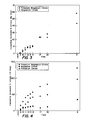
- Potassium bioavailability from potassium magnesium citrate was compared with that of potassium citrate. At each time period, the difference in urinary potassium following ingestion of potassium magnesium citrate (containing 49 meq potassium) or potassium citrate (containing 50 meq potassium) from that obtained at a corresponding time period following taking magnesium citrate (no potassium; therefore serving as control). The cumulative increment in urinary potassium (indicative of potassium bioavailability) is shown in Figure 2. As shown, potassium bioavailability was equivalent between the two preparations (potassium magnesium citrate and potassium citrate).
- Magnesium bioavailability from potassium magnesium citrate was compared with that of magnesium citrate. At each time period (following oral administration), the difference in urinary magnesium following ingestion of potassium magnesium citrate (containing 24.5 meq magnesium) or magnesium citrate (containing 25 meq magnesium) from that obtained at a corresponding time period following taking potassium citrate (no magnesium, thus serving as control) was calculated. The cumulative increment in urinary magnesium (indicative of magnesium bioavailability or absorption) is shown in Figure 3. Note equivalent magnesium bioavailability between the two preparations.
- Citrate bioavailability from potassium magnesium citrate was compared with that of potassium citrate and magnesium citrate. At each time period, the difference in urinary citrate following administration of potassium magnesium citrate (73.5 meq citrate), potassium citrate (50 meq citrate) or magnesium citrate (25 meq citrate) from that obtained following ingestion of potassium chloride (containing no citrate, thus serving as control) was calculated. The cumulative increment in citrate was much higher for potassium magnesium citrate than for the other two preparations, as shown in Figure 4.
- potassium magnesium citrate should be equally effective as potassium chloride in preventing thiazide-induced hypokalemia, except in rare patients with severe chloride deficiency.
- Potassium magnesium citrate might be more effective than potassium citrate in augmenting citrate excretion, due to the "citraturic action" of magnesium, and the higher content of citrate.
- the provision of magnesium as potassium magnesium citrate should augment urinary magnesium (from absorbed magnesium) and reduce urinary oxalate (from binding of oxalate by magnesium in the intestinal tract). Potassium magnesium citrate should also cause a greater enhancement of citrate excretion than magnesium citrate, because of its greater citrate content.
- potassium magnesium citrate should therefore be more effective than potassium citrate or magnesium citrate in lowering urinary saturation of calcium oxalate and in increasing its inhibitor activity.
- the method of the present invention provides advantages and benefits not previously available in the production and use of dietary supplements comprising magnesium and potassium. Furthermore, it will be apparent to those skilled in the pharmaceutical arts upon reading this disclosure that other trace elements and minerals can also be compounded with the composition of the invention to produce other useful preparations. For this reason, it is intended that the invention disclosed herein be limited only by the broadest interpretation of the appended claims to which the inventors may be legally entitled.
Landscapes
- Chemical & Material Sciences (AREA)
- Health & Medical Sciences (AREA)
- Organic Chemistry (AREA)
- Animal Behavior & Ethology (AREA)
- Epidemiology (AREA)
- Life Sciences & Earth Sciences (AREA)
- Pharmacology & Pharmacy (AREA)
- General Health & Medical Sciences (AREA)
- Public Health (AREA)
- Veterinary Medicine (AREA)
- Medicinal Chemistry (AREA)
- Acyclic And Carbocyclic Compounds In Medicinal Compositions (AREA)
- Pharmaceuticals Containing Other Organic And Inorganic Compounds (AREA)
- Medicinal Preparation (AREA)
Applications Claiming Priority (2)
| Application Number | Priority Date | Filing Date | Title |
|---|---|---|---|
| US43793889A | 1989-11-16 | 1989-11-16 | |
| US437938 | 1989-11-16 |
Publications (3)
| Publication Number | Publication Date |
|---|---|
| EP0429157A2 true EP0429157A2 (fr) | 1991-05-29 |
| EP0429157A3 EP0429157A3 (en) | 1992-01-29 |
| EP0429157B1 EP0429157B1 (fr) | 1995-03-22 |
Family
ID=23738544
Family Applications (1)
| Application Number | Title | Priority Date | Filing Date |
|---|---|---|---|
| EP19900300697 Expired - Lifetime EP0429157B1 (fr) | 1989-11-16 | 1990-01-23 | Supplémentation diététique pour citrate de magnésium |
Country Status (4)
| Country | Link |
|---|---|
| EP (1) | EP0429157B1 (fr) |
| AU (1) | AU628544B2 (fr) |
| CA (1) | CA1326040C (fr) |
| DE (1) | DE69018022T2 (fr) |
Cited By (4)
| Publication number | Priority date | Publication date | Assignee | Title |
|---|---|---|---|---|
| EP1722772A4 (fr) * | 2004-03-08 | 2008-03-19 | Mission Pharma Co | Supplement dietetique a base de citrate de magnesium et de potassium stoechiometriquement specifique |
| WO2012066254A1 (fr) * | 2010-11-18 | 2012-05-24 | Advicenne | Composition pharmaceutique comprenant du sel precurseur du cycle de krebs, en particulier du sel de citrate, et son utilisation comme medicament |
| US9636304B2 (en) | 2010-11-18 | 2017-05-02 | Advicenne | Pharmaceutical composition comprising citrate and bicarbonate salts, and use thereof for treating cystinuria |
| CN109529107A (zh) * | 2018-12-07 | 2019-03-29 | 中鼎凯瑞科技成都有限公司 | 多微量元素有机化合物与无机化合物通过水合桥化形成的有机-无机自凝固复合骨移植物 |
Families Citing this family (1)
| Publication number | Priority date | Publication date | Assignee | Title |
|---|---|---|---|---|
| US10285961B2 (en) | 2014-02-06 | 2019-05-14 | University Of Houston System | Organic acids as agents to dissolve calcium minerals in pathological calcification and uses thereof |
Family Cites Families (3)
| Publication number | Priority date | Publication date | Assignee | Title |
|---|---|---|---|---|
| DE968843C (de) * | 1953-11-29 | 1958-04-03 | Cassella Farbwerke Mainkur Ag | Verfahren zur Herstellung von pharmakologisch wirksamen Magnesiumsalzen der Citronensaeure |
| HU165181B (fr) * | 1971-11-08 | 1974-07-27 | ||
| US4895980A (en) * | 1988-01-05 | 1990-01-23 | Mission Pharmacal Company, Inc. | Method of manufacturing magnesium potassium citrate |
-
1989
- 1989-02-14 CA CA 591007 patent/CA1326040C/fr not_active Expired - Lifetime
-
1990
- 1990-01-23 EP EP19900300697 patent/EP0429157B1/fr not_active Expired - Lifetime
- 1990-01-23 DE DE1990618022 patent/DE69018022T2/de not_active Expired - Lifetime
- 1990-05-08 AU AU54812/90A patent/AU628544B2/en not_active Expired
Cited By (5)
| Publication number | Priority date | Publication date | Assignee | Title |
|---|---|---|---|---|
| EP1722772A4 (fr) * | 2004-03-08 | 2008-03-19 | Mission Pharma Co | Supplement dietetique a base de citrate de magnesium et de potassium stoechiometriquement specifique |
| WO2012066254A1 (fr) * | 2010-11-18 | 2012-05-24 | Advicenne | Composition pharmaceutique comprenant du sel precurseur du cycle de krebs, en particulier du sel de citrate, et son utilisation comme medicament |
| US9636304B2 (en) | 2010-11-18 | 2017-05-02 | Advicenne | Pharmaceutical composition comprising citrate and bicarbonate salts, and use thereof for treating cystinuria |
| US9782352B2 (en) | 2010-11-18 | 2017-10-10 | Advicenne | Pharmaceutical composition comprising Krebs cycle precursor salt, in particular citrate salt, and use thereof as a medicament |
| CN109529107A (zh) * | 2018-12-07 | 2019-03-29 | 中鼎凯瑞科技成都有限公司 | 多微量元素有机化合物与无机化合物通过水合桥化形成的有机-无机自凝固复合骨移植物 |
Also Published As
| Publication number | Publication date |
|---|---|
| AU628544B2 (en) | 1992-09-17 |
| DE69018022D1 (de) | 1995-04-27 |
| EP0429157B1 (fr) | 1995-03-22 |
| AU5481290A (en) | 1991-05-23 |
| CA1326040C (fr) | 1994-01-11 |
| DE69018022T2 (de) | 1995-07-20 |
| EP0429157A3 (en) | 1992-01-29 |
Similar Documents
| Publication | Publication Date | Title |
|---|---|---|
| US5432200A (en) | Method for increasing urinary excretion of electrolytes | |
| CA1281289C (fr) | Preparation ultradense, plus soluble et plus biodisponible, de citrate de calcium | |
| AU2004260652C1 (en) | Calcium carbonate granulation | |
| US5075499A (en) | Calcium supplementation by dicalcium citrate-lactate | |
| US4985593A (en) | Magnesium potassium citrate | |
| CA2376017C (fr) | Compositions de citrate de potassium et de calcium et methodes de production | |
| CA2421410C (fr) | Compositions a base de fer | |
| CA1314233C (fr) | Supplements de calcium | |
| US4895980A (en) | Method of manufacturing magnesium potassium citrate | |
| US5650168A (en) | Tablet with improved bioavailability containing dichloromethylenediphosphonic acid as the active substance | |
| CA1326040C (fr) | Citrate de magnesium-potassium | |
| EP0444000B1 (fr) | Formes de doses orales du sulfate de la glucosamine stables au stockage et leurs procédés de préparation | |
| US5720977A (en) | Oral water soluble pharmaceutical compositions containing estrone compound and calcium salt | |
| US5985335A (en) | Agent for acting upon bone formation disturbances containing alkaline citrates, lactates and/or malates | |
| US20040048925A1 (en) | Composition and method for enhancing the bioavailability of calcium and magnesium in dietary supplements and food additives | |
| JP2545479B2 (ja) | 医薬組成物 | |
| JP3279695B2 (ja) | 分岐ガラクトオリゴ糖を有効成分とするミネラル吸収促進剤 | |
| JPH0390030A (ja) | カルシウム製剤 | |
| DE68916409T2 (de) | Magnesiumkaliumcitrat. | |
| JPS6348210A (ja) | 易溶性顆粒 | |
| HU206219B (en) | Process for producing mixtures with increased magnesium content and compositions comprising same | |
| JP2001131076A (ja) | カルシウム塩含有チュアブル錠 | |
| PL196058B1 (pl) | Tabletka musująca z mleczanem wapnia i sposób wytwarzania tabletek musujących z mleczanem wapnia | |
| HK1084338A1 (en) | Pharmaceutical formulation comprising lanthanum compounds | |
| HK1084338B (en) | Pharmaceutical formulation comprising lanthanum compounds |
Legal Events
| Date | Code | Title | Description |
|---|---|---|---|
| PUAI | Public reference made under article 153(3) epc to a published international application that has entered the european phase |
Free format text: ORIGINAL CODE: 0009012 |
|
| AK | Designated contracting states |
Kind code of ref document: A2 Designated state(s): CH DE FR GB IT LI SE |
|
| PUAL | Search report despatched |
Free format text: ORIGINAL CODE: 0009013 |
|
| AK | Designated contracting states |
Kind code of ref document: A3 Designated state(s): CH DE FR GB IT LI SE |
|
| 17P | Request for examination filed |
Effective date: 19920317 |
|
| 17Q | First examination report despatched |
Effective date: 19931130 |
|
| GRAA | (expected) grant |
Free format text: ORIGINAL CODE: 0009210 |
|
| AK | Designated contracting states |
Kind code of ref document: B1 Designated state(s): CH DE FR GB IT LI SE |
|
| REF | Corresponds to: |
Ref document number: 69018022 Country of ref document: DE Date of ref document: 19950427 |
|
| ET | Fr: translation filed | ||
| ITF | It: translation for a ep patent filed | ||
| PLBE | No opposition filed within time limit |
Free format text: ORIGINAL CODE: 0009261 |
|
| STAA | Information on the status of an ep patent application or granted ep patent |
Free format text: STATUS: NO OPPOSITION FILED WITHIN TIME LIMIT |
|
| 26N | No opposition filed | ||
| REG | Reference to a national code |
Ref country code: GB Ref legal event code: IF02 |
|
| PGFP | Annual fee paid to national office [announced via postgrant information from national office to epo] |
Ref country code: DE Payment date: 20090115 Year of fee payment: 20 |
|
| PGFP | Annual fee paid to national office [announced via postgrant information from national office to epo] |
Ref country code: CH Payment date: 20090126 Year of fee payment: 20 Ref country code: GB Payment date: 20090121 Year of fee payment: 20 |
|
| PGFP | Annual fee paid to national office [announced via postgrant information from national office to epo] |
Ref country code: SE Payment date: 20090108 Year of fee payment: 20 Ref country code: IT Payment date: 20090127 Year of fee payment: 20 |
|
| PGFP | Annual fee paid to national office [announced via postgrant information from national office to epo] |
Ref country code: FR Payment date: 20090113 Year of fee payment: 20 |
|
| REG | Reference to a national code |
Ref country code: CH Ref legal event code: PL |
|
| REG | Reference to a national code |
Ref country code: GB Ref legal event code: PE20 Expiry date: 20100122 |
|
| EUG | Se: european patent has lapsed | ||
| PG25 | Lapsed in a contracting state [announced via postgrant information from national office to epo] |
Ref country code: GB Free format text: LAPSE BECAUSE OF EXPIRATION OF PROTECTION Effective date: 20100122 |
|
| PG25 | Lapsed in a contracting state [announced via postgrant information from national office to epo] |
Ref country code: DE Free format text: LAPSE BECAUSE OF EXPIRATION OF PROTECTION Effective date: 20100123 |