EP0429744A2 - Procédé de préparation de substrats pasteurisés et dispositif de mise en oeuvre - Google Patents
Procédé de préparation de substrats pasteurisés et dispositif de mise en oeuvre Download PDFInfo
- Publication number
- EP0429744A2 EP0429744A2 EP90105953A EP90105953A EP0429744A2 EP 0429744 A2 EP0429744 A2 EP 0429744A2 EP 90105953 A EP90105953 A EP 90105953A EP 90105953 A EP90105953 A EP 90105953A EP 0429744 A2 EP0429744 A2 EP 0429744A2
- Authority
- EP
- European Patent Office
- Prior art keywords
- receptacle
- waste mixture
- waste
- screw
- stirring
- Prior art date
- Legal status (The legal status is an assumption and is not a legal conclusion. Google has not performed a legal analysis and makes no representation as to the accuracy of the status listed.)
- Ceased
Links
Images
Classifications
-
- C—CHEMISTRY; METALLURGY
- C05—FERTILISERS; MANUFACTURE THEREOF
- C05F—ORGANIC FERTILISERS NOT COVERED BY SUBCLASSES C05B, C05C, e.g. FERTILISERS FROM WASTE OR REFUSE
- C05F17/00—Preparation of fertilisers characterised by biological or biochemical treatment steps, e.g. composting or fermentation
-
- B—PERFORMING OPERATIONS; TRANSPORTING
- B01—PHYSICAL OR CHEMICAL PROCESSES OR APPARATUS IN GENERAL
- B01F—MIXING, e.g. DISSOLVING, EMULSIFYING OR DISPERSING
- B01F27/00—Mixers with rotary stirring devices in fixed receptacles; Kneaders
- B01F27/23—Mixers with rotary stirring devices in fixed receptacles; Kneaders characterised by the orientation or disposition of the rotor axis
-
- C—CHEMISTRY; METALLURGY
- C05—FERTILISERS; MANUFACTURE THEREOF
- C05F—ORGANIC FERTILISERS NOT COVERED BY SUBCLASSES C05B, C05C, e.g. FERTILISERS FROM WASTE OR REFUSE
- C05F17/00—Preparation of fertilisers characterised by biological or biochemical treatment steps, e.g. composting or fermentation
- C05F17/90—Apparatus therefor
-
- B—PERFORMING OPERATIONS; TRANSPORTING
- B01—PHYSICAL OR CHEMICAL PROCESSES OR APPARATUS IN GENERAL
- B01F—MIXING, e.g. DISSOLVING, EMULSIFYING OR DISPERSING
- B01F27/00—Mixers with rotary stirring devices in fixed receptacles; Kneaders
- B01F27/23—Mixers with rotary stirring devices in fixed receptacles; Kneaders characterised by the orientation or disposition of the rotor axis
- B01F27/232—Mixers with rotary stirring devices in fixed receptacles; Kneaders characterised by the orientation or disposition of the rotor axis with two or more rotation axes
- B01F27/2321—Mixers with rotary stirring devices in fixed receptacles; Kneaders characterised by the orientation or disposition of the rotor axis with two or more rotation axes having different inclinations, e.g. non parallel
-
- Y—GENERAL TAGGING OF NEW TECHNOLOGICAL DEVELOPMENTS; GENERAL TAGGING OF CROSS-SECTIONAL TECHNOLOGIES SPANNING OVER SEVERAL SECTIONS OF THE IPC; TECHNICAL SUBJECTS COVERED BY FORMER USPC CROSS-REFERENCE ART COLLECTIONS [XRACs] AND DIGESTS
- Y02—TECHNOLOGIES OR APPLICATIONS FOR MITIGATION OR ADAPTATION AGAINST CLIMATE CHANGE
- Y02P—CLIMATE CHANGE MITIGATION TECHNOLOGIES IN THE PRODUCTION OR PROCESSING OF GOODS
- Y02P20/00—Technologies relating to chemical industry
- Y02P20/141—Feedstock
- Y02P20/145—Feedstock the feedstock being materials of biological origin
-
- Y—GENERAL TAGGING OF NEW TECHNOLOGICAL DEVELOPMENTS; GENERAL TAGGING OF CROSS-SECTIONAL TECHNOLOGIES SPANNING OVER SEVERAL SECTIONS OF THE IPC; TECHNICAL SUBJECTS COVERED BY FORMER USPC CROSS-REFERENCE ART COLLECTIONS [XRACs] AND DIGESTS
- Y02—TECHNOLOGIES OR APPLICATIONS FOR MITIGATION OR ADAPTATION AGAINST CLIMATE CHANGE
- Y02W—CLIMATE CHANGE MITIGATION TECHNOLOGIES RELATED TO WASTEWATER TREATMENT OR WASTE MANAGEMENT
- Y02W30/00—Technologies for solid waste management
- Y02W30/40—Bio-organic fraction processing; Production of fertilisers from the organic fraction of waste or refuse
Definitions
- the invention relates to a method for producing pasteurized substrate.
- waste material is fed to a circular fermentation tank with a circular distribution movement around its circumference after its preparation, which is usually carried out by sieving, separating and comminuting processes, and is gradually counteracted for the purpose of initiating and maintaining an aerobic biological decomposition process with constant stirring central outlet opening of the fermentation tank shifted.
- the stirring takes place in the form of a number of interlinked, screw-like partial movements in a predetermined direction of rotation.
- This procedure is intended to prevent so-called short-circuit currents in the waste material, with which parts of the waste to be treated can reach the outlet opening within a time which is shorter than the residence time required for the complete biological decomposition or conversion of the waste material.
- the aim is to avoid mixing the finished fermented end product with non-rotting waste.
- the proposal under consideration does not convey any teaching regarding the composition of the waste material to be decomposed: whether and to what extent the agricultural waste, sewage sludge, liquid manure, etc. can be processed using this method. Only urban waste is mentioned as the raw material to be treated. The question of disinfection of the end product also remains open.
- the method in question only consists in intensive aeration of the waste material by constant stirring, while it is transported from the entry of the fermentation container to its outlet in a not specified residence time.
- the object of the present invention is to provide a method of the type described in the introduction which, while avoiding the disadvantages of the known fermentation method, allows the biological conversion of organic waste material into a pasteurized substrate within the shortest possible residence time.
- the object is achieved in the method which comprises the treatment steps characterized in patent claim 1.
- Such a procedure enables rapidly, mechanized and controllable rotting of all types of organic waste materials, including sewage sludge. Animal carcasses, liquid manure, etc. with disinfection, i.e. to a pasteurized substrate, without the use of external heat.
- the invention also relates to a system according to claim 11, with a receptacle for the waste mixture to be rotten, including devices for feeding the latter and for removing the finished fermented product, as well as screw conveyors for stirring the waste mixture.
- the system is particularly suitable for carrying out the method according to the invention.
- a decomposition device has also become known for realizing the previously known method described above.
- This has a swivel bridge which, spanning the associated circular fermentation tank along a diameter of the same, is movably supported at its two ends by means of rollers provided there on a circular rail track which is circumferentially fastened to the upper edge of the tank.
- the swing bridge can be driven by means of an electric drive via a reduction gear acting on one of the rollers. It is also supported by a central warehouse, which is attached to the frustoconical inner wall in the center of the fermentation tank interior.
- the swing bridge is composed of two bridge halves, each extending radially from the central warehouse to the container circumference.
- One of the latter carries a screw conveyor which is arranged to feed the waste material to be rotten to the periphery of the fermentation tank, extending from a receiving funnel arranged above the central warehouse to an outlet chute located in the peripheral region.
- a receiving funnel arranged above the central warehouse to an outlet chute located in the peripheral region.
- On the other Half of the bridge is attached to a plurality of motor-driven ventilation screws in two parallel rows, the latter running radially between the frustoconical inner wall and the cylindrical outer wall of the fermentation tank.
- the tips of the ventilation screws are directed downwards from the bridge and are inclined so that each screw tip points forward in the direction of rotation of the bridge and at the same time towards the outer wall of the container.
- the ventilation screws in one row are displaced in the radial direction with respect to those in the other row.
- the screw surface of the ventilation screws lifts the waste material from the bottom of the container and conveys it upwards with constant stirring.
- the filling level of the fermentation tank is provided at a height which is approximately 80 to 85% of that of the tank wall.
- the rotating movement of the bridge is supported by the ventilation screws rotating in the same direction, which thoroughly mix the waste material across the entire width of the fermentation tank.
- the air required for the above-mentioned process is supplied by means of a blower via a number of openings provided in the outer wall near the bottom and the distribution pipes connecting these to the blower.
- the peripheral speed of the individual ventilation screws can be adjusted to achieve a suitable decomposition of the waste material. Measures are also provided to stop the operation of the system in the event that a ventilation screw should encounter an unexpected obstacle.
- a number of sensors that can be moved into the fermentation tank from below are used to record the respective condition of the waste material being treated, such as temperature and oxygen content, and to control the air supply.
- the object is achieved according to the invention by a system with the training features according to the characterizing part of the independent claim 11.
- the system according to the invention has a significantly simpler nature than the known one. You can therefore expect increased operational reliability and a noticeably lower energy consumption.
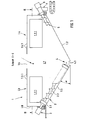
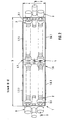
- the system comprises a receptacle 1 for the waste mixture to be rotten, two pairs of screw conveyors 2 mounted therein for simultaneous stirring and aeration of the waste mixture and two discharge screws 5 each assigned to one of the two screw pairs.
- the receptacle While the receptacle has the shape of a square in the top view, it appears in the front view in the form of a pentagonal profile with its roof fist lowered into the ground. As can be seen in particular in FIG. 2, it has a large width b compared to its overall length I.
- the container bottom consists of two identical bottom halves 1.1, 1.2 with a surface designed according to the contours of the conveying and discharge screws 2 and 5, which are inclined at an obtuse angle to one another.
- the arrangement of the four screw conveyors 2 is such that a pair of each is arranged in the vicinity of one of the two inclined bottom halves 1.1, 1.2 of the receptacle 1, running parallel to the same.
- the pitch angle of the two floor halves 1.1, 1.2 against the horizontal is advantageously chosen to be 30 degrees.
- a container lid of square shape is provided, which is also formed from two identical lid halves 1.3, 1.4.
- the two cover halves 1.3, 1.4 are in turn composed of pivotally hinged, flat and rectangular cover elements 1.3.1, 1.4.1.
- the container lid is in place, the two innermost, adjacent lid elements 1.3.1, 1.4.1 are to rot to expose an inlet opening 1.5
- Ending waste mixture A can be opened in the middle of the lid.
- the waste mixture A or its components can be fed to the inlet opening 1.5 in a manner known per se, for example by means of a conveyor belt.
- At least one door 1.6.1, 1.7.1 in its pentagonal two walls, namely in the end wall 1.6 and the rear wall 1.7.
- the storage 2.1 of the screw conveyor 2 each on the associated bottom halves 1.1, 1.2 of the receptacle 1 is provided at the two screw ends.
- One reversible electric drive 3 each coupled to the upper screw end is arranged on the outer surface of the narrow side 1.8 or 1.9 of the receiving container 1 through which the screw end in question is guided.
- a length of 4.5 meters proved to be particularly useful for screw conveyors 2.
- a diameter of 60 to 80 mm is suitable for the worm core 2.2 designed as a hollow shaft.
- all screw conveyors 2 are particularly expediently designed in such a way that their direction of conveyance on the 85% of their overall length measured by the respective lower screw end from the lower to the upper screw end and the remaining 15% their length is reversed.
- a partition 4 of triangular cross section is provided between the lower ends of the two pairs of screw conveyors 2 in the corner formed by the inclined two bottom halves 1.1, 1.2 of the receptacle 1.
- Their height should be smaller than the screw diameter projected on them.
- the partition 4 has a number of inlet openings 4.1, through which the air L required for an aerobic bacterial conversion of the waste mixture is drawn into it by the negative pressure present in the interior of the receptacle 1.
- a discharge screw 5 is provided on each of the two inclined bottom halves 1.1, 1.2 of the receptacle 1, symmetrically between the two conveyor screws 2 arranged there.
- the upper end of the two discharge screws 5 also penetrates the respective narrow side 1.8 or 1.9 of the receptacle 1 located there and is coupled to an electric drive 6.
- an outlet 7 is arranged in each case in the area of its upper end in such a way that the finished product can be conveyed further, for example by means of a conveyor belt.
- the overall length of the discharge screws 5 extends from the outlet 7 to the height of the abutment of the opposing screw flights of the screw conveyors 2.
- the control unit which with a speed n equal to 6 to 8 U / min. ongoing stirring movement of the screw conveyors 2 with a first cycle time t 1 equal to 10 minutes for the forward conveyance of the waste mixture, with a second cycle time t 2 equal to 0.5 minutes for the return conveyance of the latter and with a time interval ts equal to 5 minutes for the standstill between the two Regulating conveyor movements is not shown in the drawing.
- the reverse movement of the screw conveyors 2 is required to prevent the treated material from sticking to the inner surfaces of the receptacle 1. As a result, the formation of dead zones can be counteracted and the entire waste mixture can thus be completely fed into the rotting process.
- the invention enables the removal of all types of waste such as city and agricultural waste, sewage sludge, liquid manure, animal carcasses etc. and their recycling in the form of pasteurized substrate with the help of a controllable and mechanically feasible biological rotting process with a total duration of approximately 72 hours, whereby due to the process temperature of over 80 degrees Celsius, the end product is sterilized without external heat.
- the so-called carcass soup which is added to the waste mixture, is a meat soup made from animal carcasses, the fat content of which is removed. This is necessary because the grease closes the capillary paths in the waste mixture and thus inhibits the air supply to the rotting process.
- a rotting process that tends to come to a standstill, which is manifested by rapid cooling of the treated waste mixture due to acid waste material, lowering of the pH value, can be achieved by small amounts of white lime or by adding an additional amount of wood shavings and / or untreated grass and / or get it going again from straw manure.
Landscapes
- Chemical & Material Sciences (AREA)
- Chemical Kinetics & Catalysis (AREA)
- Engineering & Computer Science (AREA)
- Health & Medical Sciences (AREA)
- Biochemistry (AREA)
- Biotechnology (AREA)
- Life Sciences & Earth Sciences (AREA)
- General Chemical & Material Sciences (AREA)
- Microbiology (AREA)
- Molecular Biology (AREA)
- Organic Chemistry (AREA)
- Processing Of Solid Wastes (AREA)
- Treatment Of Sludge (AREA)
- Fertilizers (AREA)
Applications Claiming Priority (2)
| Application Number | Priority Date | Filing Date | Title |
|---|---|---|---|
| CH4186/89 | 1989-11-22 | ||
| CH4186/89A CH679999A5 (fr) | 1989-11-22 | 1989-11-22 |
Publications (2)
| Publication Number | Publication Date |
|---|---|
| EP0429744A2 true EP0429744A2 (fr) | 1991-06-05 |
| EP0429744A3 EP0429744A3 (en) | 1991-06-26 |
Family
ID=4271395
Family Applications (1)
| Application Number | Title | Priority Date | Filing Date |
|---|---|---|---|
| EP19900105953 Ceased EP0429744A3 (en) | 1989-11-22 | 1990-03-28 | Process for producing pasteurized substrates and apparatus therefor |
Country Status (8)
| Country | Link |
|---|---|
| EP (1) | EP0429744A3 (fr) |
| JP (1) | JPH04505001A (fr) |
| AU (1) | AU653503B2 (fr) |
| CA (1) | CA2045633A1 (fr) |
| CH (1) | CH679999A5 (fr) |
| CZ (1) | CZ580290A3 (fr) |
| HU (1) | HUT60985A (fr) |
| WO (1) | WO1991007365A1 (fr) |
Cited By (2)
| Publication number | Priority date | Publication date | Assignee | Title |
|---|---|---|---|---|
| EP0482407A3 (en) * | 1990-10-23 | 1992-11-25 | Erwin Sen. Hunziker | Process for the production of an animal and/or vegetable nutritive substance from organic waste |
| US6573691B2 (en) | 2001-10-17 | 2003-06-03 | Hatch Associates Ltd. | Control system and method for voltage stabilization in electric power system |
Families Citing this family (2)
| Publication number | Priority date | Publication date | Assignee | Title |
|---|---|---|---|---|
| AU668939B2 (en) * | 1992-06-10 | 1996-05-23 | Psm Construction Close Corporation | Treatment of sewage sludge |
| CN120554168B (zh) * | 2025-06-25 | 2026-03-20 | 河南三宁科技有限公司 | 一种复合微生物有机肥料、制备装置及制备方法 |
Family Cites Families (11)
| Publication number | Priority date | Publication date | Assignee | Title |
|---|---|---|---|---|
| CH387671A (fr) * | 1960-09-09 | 1965-02-15 | Prat Felix | Procédé de fermentation rapide des ordures ménagères, installation pour la mise en oeuvre de ce procédé et utilisation du produit résultant dudit procédé |
| US3364007A (en) * | 1962-11-30 | 1968-01-16 | Garbage Service Company Inc | Method of composting waste materials |
| US3129828A (en) * | 1963-01-14 | 1964-04-21 | Clayton & Lambert Mfg Co | Top leveler for grain storage bins and the like |
| DE2335538B1 (de) * | 1973-07-12 | 1974-08-01 | Joachim Dr Thomsen | Verfahren zur Beschleunigung und Intensivierung biologischer Abbauvorgaenge |
| DE2545078A1 (de) * | 1975-10-08 | 1977-04-21 | Motan Gmbh | Vorrichtung zum mischen von granulat- und/oder pulverfoermigen stoffen |
| US4203376A (en) * | 1976-12-21 | 1980-05-20 | Refuse Derived Fuels (London) Limited | Treatment of waste |
| DE2709715A1 (de) * | 1977-03-05 | 1978-09-07 | Rolf Flach | Vorrichtung zur kompostierung von eine mischung aus klaerschlamm und muell enthaltendem abfallgut |
| US4411682A (en) * | 1981-09-14 | 1983-10-25 | Brill J H | Process and apparatus for producing compost |
| FR2519972B1 (fr) * | 1982-01-20 | 1985-06-14 | Adapt | Procede de compostage d'elements d'origines diverses par fermentation aerobie et installation de compostage |
| FR2527504B1 (fr) * | 1982-05-27 | 1987-04-24 | Burton Steel Sarl | Centrale a beton mobile comportant un dispositif perfectionne d'extraction du ciment |
| DE3879491D1 (de) * | 1988-09-30 | 1993-04-22 | Ecolise | Verfahren zur wertsteigerung von schweinemist und vorrichtung zu seiner durchfuehrung. |
-
1989
- 1989-11-22 CH CH4186/89A patent/CH679999A5/de not_active IP Right Cessation
-
1990
- 1990-03-28 EP EP19900105953 patent/EP0429744A3/de not_active Ceased
- 1990-11-21 WO PCT/CH1990/000265 patent/WO1991007365A1/fr not_active Ceased
- 1990-11-21 HU HU908183A patent/HUT60985A/hu active IP Right Revival
- 1990-11-21 AU AU67115/90A patent/AU653503B2/en not_active Ceased
- 1990-11-21 JP JP2515280A patent/JPH04505001A/ja active Pending
- 1990-11-21 CA CA002045633A patent/CA2045633A1/fr not_active Abandoned
- 1990-11-22 CZ CS905802A patent/CZ580290A3/cs unknown
Cited By (2)
| Publication number | Priority date | Publication date | Assignee | Title |
|---|---|---|---|---|
| EP0482407A3 (en) * | 1990-10-23 | 1992-11-25 | Erwin Sen. Hunziker | Process for the production of an animal and/or vegetable nutritive substance from organic waste |
| US6573691B2 (en) | 2001-10-17 | 2003-06-03 | Hatch Associates Ltd. | Control system and method for voltage stabilization in electric power system |
Also Published As
| Publication number | Publication date |
|---|---|
| AU6711590A (en) | 1991-06-13 |
| CH679999A5 (fr) | 1992-05-29 |
| CA2045633A1 (fr) | 1991-05-23 |
| EP0429744A3 (en) | 1991-06-26 |
| AU653503B2 (en) | 1994-10-06 |
| WO1991007365A1 (fr) | 1991-05-30 |
| HUT60985A (en) | 1992-11-30 |
| JPH04505001A (ja) | 1992-09-03 |
| CZ580290A3 (en) | 1994-01-19 |
Similar Documents
| Publication | Publication Date | Title |
|---|---|---|
| DE69029268T2 (de) | Verfahren und anlage zur herstellung eines organischen düngemittels | |
| DE2636535C3 (de) | Fermentationsbehälter zur aeroben Kompostherstellung | |
| DE19602489A1 (de) | Verfahren zur biologischen Behandlung von organischen Materialien und Vorrichtung zur Durchführung des Verfahrens | |
| DE69510533T2 (de) | Einrichtung zum fördern der aerobischen fermentierung von exkrementen, anlage mit verwendung derselben und daraus gewonnener kompost | |
| CH645331A5 (de) | Verfahren zur aeroben verrottung und/oder trocknung von organischen abfallstoffen in einem verrottungsbunker sowie eine vorrichtung zu dessen ausuebung. | |
| DE2519618A1 (de) | Verfahren und vorrichtung zur maschinellen schnell-kompostierung von gegebenenfalls vorentwaessertem klaerschlamm und anderen fluessigen, halbfesten oder festen abfallstoffen sowie gemischen aus diesen | |
| EP0588160B1 (fr) | Procédé et dispositif de traitement des déchets en particulier des déchets alimentaires | |
| DE19619966C2 (de) | Abfallbehandlungsvorrichtung | |
| DE2252188B2 (de) | Verfahren zum Kompostieren von organischen Abfällen | |
| DE2415695A1 (de) | Kompostierungsanlage fuer abfallmaterial | |
| CH679999A5 (fr) | ||
| DE3605258A1 (de) | Verfahren und vorrichtung zum kompostieren fester und fluessiger organischer abfaelle | |
| DE2709715A1 (de) | Vorrichtung zur kompostierung von eine mischung aus klaerschlamm und muell enthaltendem abfallgut | |
| EP0029095A1 (fr) | Procédé et dispositif pour mélanger, en particulier des mélanges susceptibles de s'agglomérer | |
| WO1996004220A1 (fr) | Procede et dispositif de traitement de residus organiques biologiques | |
| DE2944519A1 (de) | Verfahren und vorrichtung zum kompostieren | |
| EP1094048B1 (fr) | Procédé et appareil pour le traitement de matières à composter | |
| CH633243A5 (de) | Zersetzungseinrichtung zur aeroben biologischen behandlung von organischem abfall. | |
| DE1917268A1 (de) | Verfahren und Vorrichtung zum Kompostieren von Siedlungsabfaellen | |
| DE3727451C2 (de) | Gärungsanordnung | |
| DE2547134A1 (de) | Verfahren und vorrichtung zur aufbereitung und hygienisierung von muell bzw. muell-klaerschlammgemischen mittels kompostierung | |
| DE69416435T2 (de) | Verfahren und Vorrichtung zum Kompostieren von organischen Abfällen | |
| DE3210655A1 (de) | Vorrichtung fuer eine materialzufuehrung von unten her zu einem haufen sowie zum vermischen des materiales | |
| DE2544960A1 (de) | Verfahren und vorrichtung zur herstellung eines humusduengers aus tierkot o.dgl. | |
| DE102010042734A1 (de) | Vorrichtung zum Transportieren von Futter zu Futterplätzen in einem Stall, Stall und Verfahren zur Versorgung von Futterplätzen mit Futter in einem solchen Stall |
Legal Events
| Date | Code | Title | Description |
|---|---|---|---|
| PUAI | Public reference made under article 153(3) epc to a published international application that has entered the european phase |
Free format text: ORIGINAL CODE: 0009012 |
|
| PUAL | Search report despatched |
Free format text: ORIGINAL CODE: 0009013 |
|
| AK | Designated contracting states |
Kind code of ref document: A2 Designated state(s): AT BE CH DE DK ES FR GB GR IT LI LU NL SE |
|
| AK | Designated contracting states |
Kind code of ref document: A3 Designated state(s): AT BE CH DE DK ES FR GB GR IT LI LU NL SE |
|
| RAP1 | Party data changed (applicant data changed or rights of an application transferred) |
Owner name: SPESCHA, ADELRICH |
|
| 17P | Request for examination filed |
Effective date: 19911212 |
|
| 17Q | First examination report despatched |
Effective date: 19921209 |
|
| RAP1 | Party data changed (applicant data changed or rights of an application transferred) |
Owner name: ADYMAT AG |
|
| STAA | Information on the status of an ep patent application or granted ep patent |
Free format text: STATUS: THE APPLICATION HAS BEEN REFUSED |
|
| 18R | Application refused |
Effective date: 19951204 |