EP0429802B1 - Textiles Erzeugnis aus einander gegenüberliegenden absorbierenden und nicht-absorbierenden Schichten und Verfahren zu dessen Herstellung - Google Patents
Textiles Erzeugnis aus einander gegenüberliegenden absorbierenden und nicht-absorbierenden Schichten und Verfahren zu dessen Herstellung Download PDFInfo
- Publication number
- EP0429802B1 EP0429802B1 EP90119126A EP90119126A EP0429802B1 EP 0429802 B1 EP0429802 B1 EP 0429802B1 EP 90119126 A EP90119126 A EP 90119126A EP 90119126 A EP90119126 A EP 90119126A EP 0429802 B1 EP0429802 B1 EP 0429802B1
- Authority
- EP
- European Patent Office
- Prior art keywords
- yarns
- yarn
- hydrophilic
- textile fabric
- characterized further
- Prior art date
- Legal status (The legal status is an assumption and is not a legal conclusion. Google has not performed a legal analysis and makes no representation as to the accuracy of the status listed.)
- Expired - Lifetime
Links
Images
Classifications
-
- D—TEXTILES; PAPER
- D04—BRAIDING; LACE-MAKING; KNITTING; TRIMMINGS; NON-WOVEN FABRICS
- D04B—KNITTING
- D04B21/00—Warp knitting processes for the production of fabrics or articles not dependent on the use of particular machines; Fabrics or articles defined by such processes
- D04B21/02—Pile fabrics or articles having similar surface features
- D04B21/04—Pile fabrics or articles having similar surface features characterised by thread material
-
- A—HUMAN NECESSITIES
- A61—MEDICAL OR VETERINARY SCIENCE; HYGIENE
- A61F—FILTERS IMPLANTABLE INTO BLOOD VESSELS; PROSTHESES; DEVICES PROVIDING PATENCY TO, OR PREVENTING COLLAPSING OF, TUBULAR STRUCTURES OF THE BODY, e.g. STENTS; ORTHOPAEDIC, NURSING OR CONTRACEPTIVE DEVICES; FOMENTATION; TREATMENT OR PROTECTION OF EYES OR EARS; BANDAGES, DRESSINGS OR ABSORBENT PADS; FIRST-AID KITS
- A61F13/00—Bandages or dressings; Absorbent pads
- A61F13/15—Absorbent pads, e.g. sanitary towels, swabs or tampons for external or internal application to the body; Supporting or fastening means therefor; Tampon applicators
- A61F13/15577—Apparatus or processes for manufacturing
-
- A—HUMAN NECESSITIES
- A61—MEDICAL OR VETERINARY SCIENCE; HYGIENE
- A61F—FILTERS IMPLANTABLE INTO BLOOD VESSELS; PROSTHESES; DEVICES PROVIDING PATENCY TO, OR PREVENTING COLLAPSING OF, TUBULAR STRUCTURES OF THE BODY, e.g. STENTS; ORTHOPAEDIC, NURSING OR CONTRACEPTIVE DEVICES; FOMENTATION; TREATMENT OR PROTECTION OF EYES OR EARS; BANDAGES, DRESSINGS OR ABSORBENT PADS; FIRST-AID KITS
- A61F13/00—Bandages or dressings; Absorbent pads
- A61F13/15—Absorbent pads, e.g. sanitary towels, swabs or tampons for external or internal application to the body; Supporting or fastening means therefor; Tampon applicators
- A61F13/51—Absorbent pads, e.g. sanitary towels, swabs or tampons for external or internal application to the body; Supporting or fastening means therefor; Tampon applicators characterised by the outer layers of the pads
- A61F13/511—Topsheet, i.e. the permeable cover or layer facing the skin
- A61F13/51121—Topsheet, i.e. the permeable cover or layer facing the skin characterised by the material
-
- A—HUMAN NECESSITIES
- A61—MEDICAL OR VETERINARY SCIENCE; HYGIENE
- A61F—FILTERS IMPLANTABLE INTO BLOOD VESSELS; PROSTHESES; DEVICES PROVIDING PATENCY TO, OR PREVENTING COLLAPSING OF, TUBULAR STRUCTURES OF THE BODY, e.g. STENTS; ORTHOPAEDIC, NURSING OR CONTRACEPTIVE DEVICES; FOMENTATION; TREATMENT OR PROTECTION OF EYES OR EARS; BANDAGES, DRESSINGS OR ABSORBENT PADS; FIRST-AID KITS
- A61F13/00—Bandages or dressings; Absorbent pads
- A61F13/15—Absorbent pads, e.g. sanitary towels, swabs or tampons for external or internal application to the body; Supporting or fastening means therefor; Tampon applicators
- A61F13/51—Absorbent pads, e.g. sanitary towels, swabs or tampons for external or internal application to the body; Supporting or fastening means therefor; Tampon applicators characterised by the outer layers of the pads
- A61F13/511—Topsheet, i.e. the permeable cover or layer facing the skin
- A61F13/513—Topsheet, i.e. the permeable cover or layer facing the skin characterised by its function or properties, e.g. stretchability, breathability, rewet, visual effect; having areas of different permeability
- A61F13/51305—Topsheet, i.e. the permeable cover or layer facing the skin characterised by its function or properties, e.g. stretchability, breathability, rewet, visual effect; having areas of different permeability having areas of different permeability
-
- A—HUMAN NECESSITIES
- A61—MEDICAL OR VETERINARY SCIENCE; HYGIENE
- A61F—FILTERS IMPLANTABLE INTO BLOOD VESSELS; PROSTHESES; DEVICES PROVIDING PATENCY TO, OR PREVENTING COLLAPSING OF, TUBULAR STRUCTURES OF THE BODY, e.g. STENTS; ORTHOPAEDIC, NURSING OR CONTRACEPTIVE DEVICES; FOMENTATION; TREATMENT OR PROTECTION OF EYES OR EARS; BANDAGES, DRESSINGS OR ABSORBENT PADS; FIRST-AID KITS
- A61F13/00—Bandages or dressings; Absorbent pads
- A61F13/15—Absorbent pads, e.g. sanitary towels, swabs or tampons for external or internal application to the body; Supporting or fastening means therefor; Tampon applicators
- A61F13/53—Absorbent pads, e.g. sanitary towels, swabs or tampons for external or internal application to the body; Supporting or fastening means therefor; Tampon applicators characterised by the absorbing medium
- A61F13/534—Absorbent pads, e.g. sanitary towels, swabs or tampons for external or internal application to the body; Supporting or fastening means therefor; Tampon applicators characterised by the absorbing medium having an inhomogeneous composition through the thickness of the pad
- A61F13/537—Absorbent pads, e.g. sanitary towels, swabs or tampons for external or internal application to the body; Supporting or fastening means therefor; Tampon applicators characterised by the absorbing medium having an inhomogeneous composition through the thickness of the pad characterised by a layer facilitating or inhibiting flow in one direction or plane, e.g. a wicking layer
- A61F13/53708—Absorbent pads, e.g. sanitary towels, swabs or tampons for external or internal application to the body; Supporting or fastening means therefor; Tampon applicators characterised by the absorbing medium having an inhomogeneous composition through the thickness of the pad characterised by a layer facilitating or inhibiting flow in one direction or plane, e.g. a wicking layer the layer having a promotional function on liquid propagation in at least one direction
- A61F13/53713—Absorbent pads, e.g. sanitary towels, swabs or tampons for external or internal application to the body; Supporting or fastening means therefor; Tampon applicators characterised by the absorbing medium having an inhomogeneous composition through the thickness of the pad characterised by a layer facilitating or inhibiting flow in one direction or plane, e.g. a wicking layer the layer having a promotional function on liquid propagation in at least one direction the layer having a promotional function on liquid propagation in the vertical direction
-
- A—HUMAN NECESSITIES
- A61—MEDICAL OR VETERINARY SCIENCE; HYGIENE
- A61F—FILTERS IMPLANTABLE INTO BLOOD VESSELS; PROSTHESES; DEVICES PROVIDING PATENCY TO, OR PREVENTING COLLAPSING OF, TUBULAR STRUCTURES OF THE BODY, e.g. STENTS; ORTHOPAEDIC, NURSING OR CONTRACEPTIVE DEVICES; FOMENTATION; TREATMENT OR PROTECTION OF EYES OR EARS; BANDAGES, DRESSINGS OR ABSORBENT PADS; FIRST-AID KITS
- A61F13/00—Bandages or dressings; Absorbent pads
- A61F13/15—Absorbent pads, e.g. sanitary towels, swabs or tampons for external or internal application to the body; Supporting or fastening means therefor; Tampon applicators
- A61F13/53—Absorbent pads, e.g. sanitary towels, swabs or tampons for external or internal application to the body; Supporting or fastening means therefor; Tampon applicators characterised by the absorbing medium
- A61F13/534—Absorbent pads, e.g. sanitary towels, swabs or tampons for external or internal application to the body; Supporting or fastening means therefor; Tampon applicators characterised by the absorbing medium having an inhomogeneous composition through the thickness of the pad
- A61F13/537—Absorbent pads, e.g. sanitary towels, swabs or tampons for external or internal application to the body; Supporting or fastening means therefor; Tampon applicators characterised by the absorbing medium having an inhomogeneous composition through the thickness of the pad characterised by a layer facilitating or inhibiting flow in one direction or plane, e.g. a wicking layer
- A61F13/53743—Absorbent pads, e.g. sanitary towels, swabs or tampons for external or internal application to the body; Supporting or fastening means therefor; Tampon applicators characterised by the absorbing medium having an inhomogeneous composition through the thickness of the pad characterised by a layer facilitating or inhibiting flow in one direction or plane, e.g. a wicking layer characterised by the position of the layer relative to the other layers
- A61F13/53747—Absorbent pads, e.g. sanitary towels, swabs or tampons for external or internal application to the body; Supporting or fastening means therefor; Tampon applicators characterised by the absorbing medium having an inhomogeneous composition through the thickness of the pad characterised by a layer facilitating or inhibiting flow in one direction or plane, e.g. a wicking layer characterised by the position of the layer relative to the other layers the layer is facing the topsheet
-
- A—HUMAN NECESSITIES
- A61—MEDICAL OR VETERINARY SCIENCE; HYGIENE
- A61F—FILTERS IMPLANTABLE INTO BLOOD VESSELS; PROSTHESES; DEVICES PROVIDING PATENCY TO, OR PREVENTING COLLAPSING OF, TUBULAR STRUCTURES OF THE BODY, e.g. STENTS; ORTHOPAEDIC, NURSING OR CONTRACEPTIVE DEVICES; FOMENTATION; TREATMENT OR PROTECTION OF EYES OR EARS; BANDAGES, DRESSINGS OR ABSORBENT PADS; FIRST-AID KITS
- A61F13/00—Bandages or dressings; Absorbent pads
- A61F13/15—Absorbent pads, e.g. sanitary towels, swabs or tampons for external or internal application to the body; Supporting or fastening means therefor; Tampon applicators
- A61F13/51—Absorbent pads, e.g. sanitary towels, swabs or tampons for external or internal application to the body; Supporting or fastening means therefor; Tampon applicators characterised by the outer layers of the pads
- A61F13/511—Topsheet, i.e. the permeable cover or layer facing the skin
- A61F13/51121—Topsheet, i.e. the permeable cover or layer facing the skin characterised by the material
- A61F2013/51139—Topsheet, i.e. the permeable cover or layer facing the skin characterised by the material being woven or knitted fabrics
-
- A—HUMAN NECESSITIES
- A61—MEDICAL OR VETERINARY SCIENCE; HYGIENE
- A61F—FILTERS IMPLANTABLE INTO BLOOD VESSELS; PROSTHESES; DEVICES PROVIDING PATENCY TO, OR PREVENTING COLLAPSING OF, TUBULAR STRUCTURES OF THE BODY, e.g. STENTS; ORTHOPAEDIC, NURSING OR CONTRACEPTIVE DEVICES; FOMENTATION; TREATMENT OR PROTECTION OF EYES OR EARS; BANDAGES, DRESSINGS OR ABSORBENT PADS; FIRST-AID KITS
- A61F13/00—Bandages or dressings; Absorbent pads
- A61F13/15—Absorbent pads, e.g. sanitary towels, swabs or tampons for external or internal application to the body; Supporting or fastening means therefor; Tampon applicators
- A61F13/51—Absorbent pads, e.g. sanitary towels, swabs or tampons for external or internal application to the body; Supporting or fastening means therefor; Tampon applicators characterised by the outer layers of the pads
- A61F13/514—Backsheet, i.e. the impermeable cover or layer furthest from the skin
- A61F13/51401—Backsheet, i.e. the impermeable cover or layer furthest from the skin characterised by the material
- A61F2013/51441—Backsheet, i.e. the impermeable cover or layer furthest from the skin characterised by the material being a fibrous material
- A61F2013/51449—Backsheet, i.e. the impermeable cover or layer furthest from the skin characterised by the material being a fibrous material being knitted or woven fabrics
-
- A—HUMAN NECESSITIES
- A61—MEDICAL OR VETERINARY SCIENCE; HYGIENE
- A61F—FILTERS IMPLANTABLE INTO BLOOD VESSELS; PROSTHESES; DEVICES PROVIDING PATENCY TO, OR PREVENTING COLLAPSING OF, TUBULAR STRUCTURES OF THE BODY, e.g. STENTS; ORTHOPAEDIC, NURSING OR CONTRACEPTIVE DEVICES; FOMENTATION; TREATMENT OR PROTECTION OF EYES OR EARS; BANDAGES, DRESSINGS OR ABSORBENT PADS; FIRST-AID KITS
- A61F13/00—Bandages or dressings; Absorbent pads
- A61F13/15—Absorbent pads, e.g. sanitary towels, swabs or tampons for external or internal application to the body; Supporting or fastening means therefor; Tampon applicators
- A61F13/53—Absorbent pads, e.g. sanitary towels, swabs or tampons for external or internal application to the body; Supporting or fastening means therefor; Tampon applicators characterised by the absorbing medium
- A61F2013/530131—Absorbent pads, e.g. sanitary towels, swabs or tampons for external or internal application to the body; Supporting or fastening means therefor; Tampon applicators characterised by the absorbing medium being made in fibre but being not pulp
- A61F2013/530343—Absorbent pads, e.g. sanitary towels, swabs or tampons for external or internal application to the body; Supporting or fastening means therefor; Tampon applicators characterised by the absorbing medium being made in fibre but being not pulp being natural fibres
- A61F2013/53035—Absorbent pads, e.g. sanitary towels, swabs or tampons for external or internal application to the body; Supporting or fastening means therefor; Tampon applicators characterised by the absorbing medium being made in fibre but being not pulp being natural fibres of cotton
-
- A—HUMAN NECESSITIES
- A61—MEDICAL OR VETERINARY SCIENCE; HYGIENE
- A61F—FILTERS IMPLANTABLE INTO BLOOD VESSELS; PROSTHESES; DEVICES PROVIDING PATENCY TO, OR PREVENTING COLLAPSING OF, TUBULAR STRUCTURES OF THE BODY, e.g. STENTS; ORTHOPAEDIC, NURSING OR CONTRACEPTIVE DEVICES; FOMENTATION; TREATMENT OR PROTECTION OF EYES OR EARS; BANDAGES, DRESSINGS OR ABSORBENT PADS; FIRST-AID KITS
- A61F13/00—Bandages or dressings; Absorbent pads
- A61F13/15—Absorbent pads, e.g. sanitary towels, swabs or tampons for external or internal application to the body; Supporting or fastening means therefor; Tampon applicators
- A61F13/53—Absorbent pads, e.g. sanitary towels, swabs or tampons for external or internal application to the body; Supporting or fastening means therefor; Tampon applicators characterised by the absorbing medium
- A61F2013/530131—Absorbent pads, e.g. sanitary towels, swabs or tampons for external or internal application to the body; Supporting or fastening means therefor; Tampon applicators characterised by the absorbing medium being made in fibre but being not pulp
- A61F2013/530379—Absorbent pads, e.g. sanitary towels, swabs or tampons for external or internal application to the body; Supporting or fastening means therefor; Tampon applicators characterised by the absorbing medium being made in fibre but being not pulp comprising mixtures of fibres
- A61F2013/53043—Absorbent pads, e.g. sanitary towels, swabs or tampons for external or internal application to the body; Supporting or fastening means therefor; Tampon applicators characterised by the absorbing medium being made in fibre but being not pulp comprising mixtures of fibres with different ratio of components
-
- A—HUMAN NECESSITIES
- A61—MEDICAL OR VETERINARY SCIENCE; HYGIENE
- A61F—FILTERS IMPLANTABLE INTO BLOOD VESSELS; PROSTHESES; DEVICES PROVIDING PATENCY TO, OR PREVENTING COLLAPSING OF, TUBULAR STRUCTURES OF THE BODY, e.g. STENTS; ORTHOPAEDIC, NURSING OR CONTRACEPTIVE DEVICES; FOMENTATION; TREATMENT OR PROTECTION OF EYES OR EARS; BANDAGES, DRESSINGS OR ABSORBENT PADS; FIRST-AID KITS
- A61F13/00—Bandages or dressings; Absorbent pads
- A61F13/15—Absorbent pads, e.g. sanitary towels, swabs or tampons for external or internal application to the body; Supporting or fastening means therefor; Tampon applicators
- A61F13/53—Absorbent pads, e.g. sanitary towels, swabs or tampons for external or internal application to the body; Supporting or fastening means therefor; Tampon applicators characterised by the absorbing medium
- A61F13/534—Absorbent pads, e.g. sanitary towels, swabs or tampons for external or internal application to the body; Supporting or fastening means therefor; Tampon applicators characterised by the absorbing medium having an inhomogeneous composition through the thickness of the pad
- A61F13/537—Absorbent pads, e.g. sanitary towels, swabs or tampons for external or internal application to the body; Supporting or fastening means therefor; Tampon applicators characterised by the absorbing medium having an inhomogeneous composition through the thickness of the pad characterised by a layer facilitating or inhibiting flow in one direction or plane, e.g. a wicking layer
- A61F13/53708—Absorbent pads, e.g. sanitary towels, swabs or tampons for external or internal application to the body; Supporting or fastening means therefor; Tampon applicators characterised by the absorbing medium having an inhomogeneous composition through the thickness of the pad characterised by a layer facilitating or inhibiting flow in one direction or plane, e.g. a wicking layer the layer having a promotional function on liquid propagation in at least one direction
- A61F2013/53721—Absorbent pads, e.g. sanitary towels, swabs or tampons for external or internal application to the body; Supporting or fastening means therefor; Tampon applicators characterised by the absorbing medium having an inhomogeneous composition through the thickness of the pad characterised by a layer facilitating or inhibiting flow in one direction or plane, e.g. a wicking layer the layer having a promotional function on liquid propagation in at least one direction with capillary means
-
- A—HUMAN NECESSITIES
- A61—MEDICAL OR VETERINARY SCIENCE; HYGIENE
- A61F—FILTERS IMPLANTABLE INTO BLOOD VESSELS; PROSTHESES; DEVICES PROVIDING PATENCY TO, OR PREVENTING COLLAPSING OF, TUBULAR STRUCTURES OF THE BODY, e.g. STENTS; ORTHOPAEDIC, NURSING OR CONTRACEPTIVE DEVICES; FOMENTATION; TREATMENT OR PROTECTION OF EYES OR EARS; BANDAGES, DRESSINGS OR ABSORBENT PADS; FIRST-AID KITS
- A61F13/00—Bandages or dressings; Absorbent pads
- A61F13/15—Absorbent pads, e.g. sanitary towels, swabs or tampons for external or internal application to the body; Supporting or fastening means therefor; Tampon applicators
- A61F13/53—Absorbent pads, e.g. sanitary towels, swabs or tampons for external or internal application to the body; Supporting or fastening means therefor; Tampon applicators characterised by the absorbing medium
- A61F13/534—Absorbent pads, e.g. sanitary towels, swabs or tampons for external or internal application to the body; Supporting or fastening means therefor; Tampon applicators characterised by the absorbing medium having an inhomogeneous composition through the thickness of the pad
- A61F13/537—Absorbent pads, e.g. sanitary towels, swabs or tampons for external or internal application to the body; Supporting or fastening means therefor; Tampon applicators characterised by the absorbing medium having an inhomogeneous composition through the thickness of the pad characterised by a layer facilitating or inhibiting flow in one direction or plane, e.g. a wicking layer
- A61F2013/53765—Absorbent pads, e.g. sanitary towels, swabs or tampons for external or internal application to the body; Supporting or fastening means therefor; Tampon applicators characterised by the absorbing medium having an inhomogeneous composition through the thickness of the pad characterised by a layer facilitating or inhibiting flow in one direction or plane, e.g. a wicking layer characterized by its geometry
-
- D—TEXTILES; PAPER
- D10—INDEXING SCHEME ASSOCIATED WITH SUBLASSES OF SECTION D, RELATING TO TEXTILES
- D10B—INDEXING SCHEME ASSOCIATED WITH SUBLASSES OF SECTION D, RELATING TO TEXTILES
- D10B2331/00—Fibres made from polymers obtained otherwise than by reactions only involving carbon-to-carbon unsaturated bonds, e.g. polycondensation products
- D10B2331/04—Fibres made from polymers obtained otherwise than by reactions only involving carbon-to-carbon unsaturated bonds, e.g. polycondensation products polyesters, e.g. polyethylene terephthalate [PET]
-
- D—TEXTILES; PAPER
- D10—INDEXING SCHEME ASSOCIATED WITH SUBLASSES OF SECTION D, RELATING TO TEXTILES
- D10B—INDEXING SCHEME ASSOCIATED WITH SUBLASSES OF SECTION D, RELATING TO TEXTILES
- D10B2401/00—Physical properties
- D10B2401/02—Moisture-responsive characteristics
- D10B2401/021—Moisture-responsive characteristics hydrophobic
-
- D—TEXTILES; PAPER
- D10—INDEXING SCHEME ASSOCIATED WITH SUBLASSES OF SECTION D, RELATING TO TEXTILES
- D10B—INDEXING SCHEME ASSOCIATED WITH SUBLASSES OF SECTION D, RELATING TO TEXTILES
- D10B2401/00—Physical properties
- D10B2401/02—Moisture-responsive characteristics
- D10B2401/022—Moisture-responsive characteristics hydrophylic
-
- D—TEXTILES; PAPER
- D10—INDEXING SCHEME ASSOCIATED WITH SUBLASSES OF SECTION D, RELATING TO TEXTILES
- D10B—INDEXING SCHEME ASSOCIATED WITH SUBLASSES OF SECTION D, RELATING TO TEXTILES
- D10B2401/00—Physical properties
- D10B2401/10—Physical properties porous
-
- D—TEXTILES; PAPER
- D10—INDEXING SCHEME ASSOCIATED WITH SUBLASSES OF SECTION D, RELATING TO TEXTILES
- D10B—INDEXING SCHEME ASSOCIATED WITH SUBLASSES OF SECTION D, RELATING TO TEXTILES
- D10B2403/00—Details of fabric structure established in the fabric forming process
- D10B2403/01—Surface features
- D10B2403/011—Dissimilar front and back faces
- D10B2403/0111—One hairy surface, e.g. napped or raised
-
- D—TEXTILES; PAPER
- D10—INDEXING SCHEME ASSOCIATED WITH SUBLASSES OF SECTION D, RELATING TO TEXTILES
- D10B—INDEXING SCHEME ASSOCIATED WITH SUBLASSES OF SECTION D, RELATING TO TEXTILES
- D10B2403/00—Details of fabric structure established in the fabric forming process
- D10B2403/01—Surface features
- D10B2403/011—Dissimilar front and back faces
- D10B2403/0114—Dissimilar front and back faces with one or more yarns appearing predominantly on one face, e.g. plated or paralleled yarns
-
- D—TEXTILES; PAPER
- D10—INDEXING SCHEME ASSOCIATED WITH SUBLASSES OF SECTION D, RELATING TO TEXTILES
- D10B—INDEXING SCHEME ASSOCIATED WITH SUBLASSES OF SECTION D, RELATING TO TEXTILES
- D10B2509/00—Medical; Hygiene
Definitions
- the present invention relates to an integrally fabricated textile fabric having a layer of hydrophobic yarn, a layer of ground yarns and a layer of hydrophilic yarn being intermeshed with at least one of the other for integrating said layers and to a method of warp knitting such a fabric.
- the article In the fabrication of various products ranging from athletic wear and other similar apparel items such as active wear and sportswear to such diverse items as diapers, incontinence garments, bed pads, chair pads and various other articles, it is desirable that the article have a high affinity for liquid absorption without producing an uncomfortably wet feel at the exposed liquid-receiving surface of the article.
- Traditional athletic garments and other active wear may be provided with a fleece or pile surface facing the wearer's body and be fabricated of cotton for this purpose.
- Conventional diapers, incontinence garments and pads, and like articles provide one or more relatively thick layers of a highly absorbent material, e.g., non-woven cotton batting, with a non-absorbent yet liquid-permeable barrier covering the liquid-receiving surface of the absorbent material.
- a highly absorbent material e.g., non-woven cotton batting
- a non-absorbent yet liquid-permeable barrier covering the liquid-receiving surface of the absorbent material.
- barrier is a surface-brushed polyester textile fabric.
- the layer or layers of batting or other absorbent material and the barrier are separately fabricated and subsequently attached together in a separate stitching or similar procedure.
- a liquid impervious backing is typically attached to cover the surface of the absorbent material opposite the barrier to prevent leakage of absorbed liquid.
- Liquid absorbing articles of the aforementioned type generally perform acceptably for their intended purpose, but nevertheless suffer certain disadvantages.
- Athletic garments and active wear generally have relatively good absorbent qualities but nevertheless produce a wet feel when any significant amount of liquid is absorbed.
- JP-A 60 155 760 a fabrik having generally separate hydrophilic and hydrophobic yarn layers.
- the hydrophilic layer is intended for initial liquid contact (e.g., in body contact to absorb sweat).
- the hydrophilic layer serves to transmit absorbed moisture to the hydrophobic layer for evaporation.
- the hydrophobic layer is of a relatively open work construction providing open spaces which occupy 10 to 80 percent of the surface area of the hydrophobic layer.
- the fabric's ground yarns should be elastic and formed in a construction rendering the fabric stretchable in both lengthwise and widthwise directions.
- a spun yarn of staple natural fibers e.g., cotton
- Optimal absorbency is achieved by utilizing a spun yarn consisting entirely of cotton fibers.
- the hydrophobic yarn is preferably a multifilament synthetic yarn, e.g., polyester.
- the ground yarn may be a multifilament synthetic yarn, a spun yarn of synthetic fibers, a spun yarn of a blend of synthetic and natural fibers, or a spun yarn of entirely natural fibers.
- the hydrophilic yarn is of a relatively low yarn count as measured according to the cotton count system, i.e., of a relatively high denier, which should be substantially higher than the denier of the hydrophobic and ground yarns, preferably more than twice the denier of the hydrophobic yarn.
- the yarn count of the hydrophilic yarn is less than approximately ten.
- the hydrophilic yarn should constitute in excess of at least approximately forty percent by weight of the fabric.
- the hydrophilic yarn constitutes greater than forty-five percent by weight of the fabric and in other embodiments exceeds fifty percent by weight of the fabric.
- the hydrophobic yarn on the other hand, should constitute no greater than approximately forty percent of the fabric weight.
- the ground yarn should constitute no greater than approximately thirty percent of the fabric weight and, in certain embodiments, constitutes less than ten percent of the fabric weight.
- One preferred construction of the present fabric is by warp knitting the hydrophilic, hydrophobic and ground yarns in an at least three-bar, but preferably four-bar, construction.
- a set of hydrophilic yarns are warp knitted in overfed needle loops at the technical face of the fabric for forming the absorbent layer.
- a set of hydrophobic yarns are warp knitted in extended nappable underlaps at the technical back of the fabric for forming the non-absorbent layer.
- a first set of ground yarns are warp knitted in a chain stitch pattern and a second set of ground yarns are warp knitted in a lay-in pattern intermediate the technical face and back of the fabric for restricting its walewise and weftwise stretching.
- the needle loops of the hydrophilic yarns are preferably formed in alternate wales and alternate courses of the fabric, with the hydrophilic yarns being anchored intermediate successive needle loops at a weftwise spacing therefrom for increasing the quantity of the hydrophilic yarns in the absorbent fabric layer.
- Each hydrophobic yarn is warp knitted intermediate each underlap in needle loops formed alternately in the alternate wales and in intermediate wales therebetween.
- the chain stitches of the first ground yarns are formed in the intermediate wales while the second ground yarns are laid in weftwise between spaced ones of the intermediate wales.
- the hydrophilic yarns are knitted in a 5-4, 7-7, 4-5, 2-2 stitch pattern
- the hydrophobic yarns are knitted in a 1-0, 3-4 stitch pattern
- the first ground yarns are knitted in a 0-1, 1-0 stitch pattern
- the second ground yarns are knitted in a 5-5, 0-0 lay-in pattern.
- the warp knitting machine includes a second middle guide bar by which a second set of ground yarns may be laid in non-stitch loops extending about spaced ones of the intermediate needles to form the fabric in a four-bar construction, the two sets of ground yarns providing dimensional stability to the fabric.
- the preferred embodiment of the fabric of the present invention is produced, and the method of the present invention is carried out, on a warp knitting machine which may be of any conventional type of an at least three-bar construction having three or more yarn guide bars and a needle bar, e.g., a conventional tricot warp knitting machine.
- a four-bar warp knitting machine adapted for producing dual-faced terry toweling is preferred.
- One such machine is manufactured and sold by Karl Mayer Textilmaschinenfabrik GmbH, of Obertshausen, West Germany, as its Model KS4-FBZ.
- Another suitable warp knitting machine is manufactured by Textima of Karl-Marx-Stadt, East Germany, under the model designation Lirapol.
- the yarn guide bars of the warp knitting machine are identified as “top,” “middle” and “bottom” guide bars for reference purposes only and not by way of limitation. As those persons skilled in the art will understand, such terms equally identify knitting machines whose guide bars may be referred to as “front,” “middle” and “back” guide bars, which machines, of course, are not to be excluded from the scope and substance of the present invention.
- the "bar construction” of a warp knitting machine refers to the number of yarn guide bars of the machine, while the “bar construction” of a warp knitted fabric refers to the number of different sets of warp yarns included in the fabric, all as is conventional terminology in the art.
- the bottom guide bar of the machine is threaded on alternate guide members with a set of hydrophilic yarns 10 delivered from a warp beam (not shown)
- the top guide bar is similarly threaded on alternate guide members with a set of hydrophobic yarns 12 delivered from another warp beam (also not shown)
- the upper middle guide bar is threaded on alternate guide members with a first set of ground yarns 14 supplied from a third warp beam (also not shown)
- the lower middle guide bar is threaded on alternate guide members with a second set of ground yarns 16 supplied from a fourth warp beam (also not shown).
- substantially any yarn having an affinity to retain water or another liquid by absorption or otherwise may be utilized as the hydrophilic yarn.
- cotton-containing spun yarns particularly those consisting entirely of cotton fibers, are considered preferable, although those persons skilled in the art will recognize that other natural fiber yarns may function equally well.
- substantially all man-made synthetic yarns are lacking in any significant affinity for water or liquid retention and therefore are contemplated to be suitable for use as the hydrophobic yarn. It is of course preferred that the synthetic yarn selected for use as the hydrophobic yarn not be subjected to any finishing operation designed to enhance its liquid retention capability. Further, the synthetic hydrophobic yarn should have the ability to be napped by a conventional textile napping operation without destroying the structural integrity of the yarn. To provide these properties, it is preferred that a multifilament polyester yarn be utilized as the hydrophobic yarn.
- ground yarns any suitable conventional yarn of sufficient strength to provide structural integrity to the warp knitted fabric may be utilized as the ground yarns.
- a spun cotton yarn or a spun yarn of cotton and synthetic fibers or a multifilament synthetic yarn may be utilized as the ground yarns.
- the same or different yarns may be utilized for the two sets of ground yarns.
- the hydrophilic yarns constitute at least approximately forty percent of the weight of the fabric.
- the hydrophilic yarn may constitute in excess of forty-five percent of the fabric weight in certain embodiments and in excess of fifty percent of the fabric weight in other embodiments.
- the hydrophobic yarns should constitute no greater than approximately forty percent of the fabric weight, with the ground yarns supplying the balance of the fabric weight but preferably no greater than approximately thirty percent thereof.
- the hydrophilic yarn should be of a relatively low yarn count as measured according to the cotton count system (i.e., of a relatively high denier), which in each embodiment should be of a substantially higher denier than the hydrophobic and ground yarns, preferably at least twice the denier of the hydrophobic yarns.
- Spun cotton yarns of a yarn count of less than approximately ten are preferred.
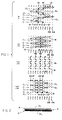
- FIG. 1 the stitch constructions of the hydrophilic, ground and hydrophobic yarns 10,12,14,16, as carried out by the respective lateral traversing movements of the guide bars of the knitting machine according to one possible embodiment of the present fabric and method, are illustrated individually in a traditional dot or point diagram format, wherein the individual points 15 represent the needles of the needle bar of the knitting machine in the formation of several successive fabric courses C across several successive fabric wales W.
- the Model KS4-FBZ warp knitting machine manufactured by Karl Mayer Textilmaschinenfabrik GmbH is preferred for use in producing the present fabric and performing the present method.
- This warp knitting machine is equipped with a longitudinal needle bar to which is mounted a longitudinally extending series of hook-type knitting needles, the hooks of alternating ones of the needles being of a substantially conventional construction defining an open yarn-receiving area within the hook while the hooks of the intervening needles define substantially smaller yarn-receiving areas so that the yarn engaging surface in each such hook is spaced farther from the outer free end of the hook than in the alternating conventional needles.
- This needle construction enables larger pile-type loops to be formed by the intervening needles.
- This needle format is described and illustrated in U.S. patent No. 4,397,160. In the illustrations of Fig. 1, the columns of points 15 representing the alternating conventional needles are indicated at 15A, while the columns of the points 15 representing the intervening needles with filled-in hooks are indicated at 15B.
- the bottom guide bar of the machine manipulates the hydrophilic yarns 10 to traverse laterally back and forth relative to the needle bar of the machine to stitch the hydrophilic yarns 10 on the intervening needles 15B in a repeating 5-4, 7-7, 4-5, 2-2 stitch pattern, as indicated at I of Fig. 1, while the hydrophilic yarns 10 are being fed from their respective warp beam in a conventional overfeeding fashion.
- the top guide bar of the machine manipulates the hydrophobic yarns 12 as they are fed from their respective warp beam to traverse relative to the needle bar to stitch the hydrophobic yarns 12 in a repeating 1-0, 3-4 stitch pattern alternatingly on the needles 15A and 15B, as indicated at IV of Fig. 1.
- the upper middle guide bar of the machine manipulates the first set of ground yarns 14 as they are fed from their respective warp beam to traverse relative to the needle bar to stitch the ground yarns 14 on the alternating needles 15A in a repeating 0-1, 1-0 chain stitch pattern, as indicated at III in Fig. 1.
- the lower middle guide bar simultaneously manipulates the second set of ground yarns 16 as they are fed from their respective warp beam to traverse relative to the needle bar to lay in the ground yarns 16 about spaced ones of the alternating needles 15A in a repeating 5-5, 0-0, non-stitch lay-in pattern, as indicated at II of Fig. 1.
- the hydrophilic yarns 10 are interknitted with the hydrophobic yarns 12 which, in turn, are interknitted with the ground yarns 14, the ground yarns 16 being captured between the hydrophilic and ground yarns 10,14, thereby integrating the yarns in the fabric.
- the overfed stitch construction of the hydrophilic yarns forms the hydrophilic yarns 10 in needle loops 10n formed in alternating courses C1 and in alternating wales W1, each hydrophilic yarn 10 having its needle loops 10n formed in the alternating courses C1 and in a common wale W1 with an underlap extent 10u extending and being anchored between the successive needles loops 10n in the intervening courses C2 at a weftwise spacing from the common wale W1, thereby increasing the quantity of the hydrophilic yarn 10 in the fabric.
- the ground yarns 14 are formed only in the intervening wales W2, each ground yarn 14 being formed in one respective wale W2 in needle loops 14n aligned walewise with one another in every course C.
- the hydrophobic yarns 12 are formed in needle loops 12n formed in every alternate wale W1 in every alternate course C1 and in every intervening wale W2 in every intervening course C2, each hydrophobic yarn 12 having its needle loops 12n alternating every course between wales W1,W2 spaced apart by two intervening wales W1,W2 and in elongated underlaps 12u extending diagonally between the successive needle loops 12n in a substantially coursewise direction.
- the needle loops 12n in the alternating wales W1 are interknitted in plated relationship with the overfed needle loops 10n of the hydrophilic yarn 10 in such wales and the needle loops 12n in the intervening wales W2 are interknitted with the needle loops 14n of the ground yarn 14 in such wales.
- the ground yarns 16 are not directly interknitted with the other yarns 10,12,14, but instead are captured and retained between the hydrophilic yarns 10 and the ground yarns 14 with each ground yarn 16 extending substantially weftwise in every course across five wales including three successive ones of the intervening wales W2 and the two successive alternate wales W1 therebetween.
- the hydrophilic yarns 10 are structured in a terry pile construction predominantly at the technical face of the fabric whereat the needle loops 10n of the hydrophilic yarns 10 extend generally outwardly of the fabric surface, thereby forming a relatively thick and relatively dense absorbent outer layer A at the technical face of the fabric, as indicated in Fig. 2.
- the hydrophobic yarns 12 are formed predominantly at the technical back of the fabric whereat the extended underlaps 12u of the hydrophobic yarns 12 provide a nappable surface, thereby forming an outer non-absorbent layer N of the fabric at its opposite face from the absorbent layer A of hydrophobic yarns 10.
- the ground yarns 14,16 form a base or substrate G to the fabric predominantly between the absorbent hydrophilic yarn layer A and the non-absorbent hydrophobic yarn layer N for integrating the absorbent and non-absorbent layers and providing dimensional stability to the fabric, the walewise chain stitch construction of the ground yarns 14 restricting the walewise stretchability of the fabric while the coursewise laid-in construction of the ground yarns 16 similarly restricting the coursewise stretchability of the fabric.
- the underlaps 12u at the outer surface of the hydrophobic yarn layer are subjected to a brushing, sanding, napping or similar operation, herein broadly referred to as "napping," to produce a raised velvet-like plush surface effect at the technical back of the fabric, thereby increasing the thickness of the hydrophobic yarn layer and substantially closing or at least reducing in size the interstices formed by the stitch construction of the hydrophobic yarns 12.
- Fig. 2 schematically illustrates in cross-section the layered construction of the fabric as described.
- the fabric of the present invention as described provides a unique and advantageous combination of properties in that the layer of the hydrophilic yarns 10 offers a relatively high capacity for liquid absorption while the non-absorbent layer of the hydrophobic yarns 12 maintains its outer surface substantially dry to the touch.
- the raised nap of the underlaps 12u of the hydrophobic yarns 12 serve to direct liquid coming in contact with the non-absorbent hydrophobic fabric layer N by a wicking action through such layer and through the ground layer G to the absorbent hydrophilic yarn layer A for absorption while, at the same time, the relatively small interstices between the napped filaments of the hydrophobic yarns 12 serve to resist leakage or other return flow of any absorbed liquid from the absorbent hydrophilic yarn layer A through the non-absorbent hydrophobic yarn layer N.
- the plush napped hydrophobic yarn layer N remains essentially dry to the touch and comfortable even after the absorbent hydrophilic yarn layer A has absorbed and retains a relatively high liquid content.
- the fabric is of a relatively small thickness in relation to its capacity for liquid absorbency, particularly as compared to conventional multi-layer absorbent battings of the like aforedescribed.
- the fabric of the present invention is particularly adapted for use in such textile products as diapers, incontinence garments, bed and chair pads, and the like wherein a relatively high capacity for liquid absorbency is desired without the liquid-receiving surface acquiring a correspondingly wetted feel.
- other embodiments of the present fabric would be highly suited for various apparel items, such as athletic garments, active wear and sportswear.
- the desirable properties of the fabric of the present invention such as the overall weight of the fabric per unit area (square yard), the percentage content by weight of the hydrophilic, hydrophobic and ground yarns, and the attendant capacity of the fabric for moisture absorbency, may be selectively modified and varied, as desired, by selection of the particular types and sizes of the constituent yarns, thereby to achieve differing embodiments of the fabric suited to differing end uses.
- the following are representative examples of fabrics according to the present invention.
- the respective stitch patterns of the hydrophilic, hydrophobic and ground yarns are as above-described.
- the particular stitch patterns in which the hydrophilic, hydrophobic and ground yarns are knitted may also be varied provided that the ground yarns are knitted or formed about needles other than the needles which form the overfed pile needle loops of the hydrophilic yarns and provided that the stitch construction of the hydrophobic yarn provides for knitting of needle loops on both sets of needles to achieve proper integration of the respective yarns in the fabric.
- embodiments of the present fabric may be of a three-bar rather than four-bar construction requiring only three sets of yarns, namely a set of hydrophilic yarns, a set of hydrophobic yarns, and only one set of ground yarns.
- the fabric of Fig. 1 could be constructed without the ground yarns 16 and with the ground yarns 14 knitted in a non-chain stitch construction, such as 1-0, 2-3.
Landscapes
- Health & Medical Sciences (AREA)
- Engineering & Computer Science (AREA)
- Vascular Medicine (AREA)
- Epidemiology (AREA)
- Biomedical Technology (AREA)
- Heart & Thoracic Surgery (AREA)
- Life Sciences & Earth Sciences (AREA)
- Animal Behavior & Ethology (AREA)
- General Health & Medical Sciences (AREA)
- Public Health (AREA)
- Veterinary Medicine (AREA)
- Textile Engineering (AREA)
- Manufacturing & Machinery (AREA)
- Knitting Of Fabric (AREA)
- Absorbent Articles And Supports Therefor (AREA)
Claims (42)
- Integral hergestelltes textiles Erzeugnis mit einer Schicht (N) aus hydrophobem Garn (12), einer Schicht (G) aus Grundgarnen (14, 16) und einer Schicht (A) aus hydrophilem Garn (10), das zur Integration der Schichten mit wenigstens einem der anderen vermascht ist, gekennzeichnet durch
eine flüssigkeitsdurchlässige, nicht, aufsaugende Schicht (N) aus hydrophobem Garn (12), die in einem Aufbau mit erhabener Oberfläche vorwiegend auf einer Seite des Erzeugnisses ausgebildet und für einen ersten Kontakt mit Flüssigkeit bei einer Verwendung des Erzeugnisses ausgelegt ist,
eine flüssigkeitsrückhaltende, aufsaugende Schicht (A) aus hydrophilem Garn (10), die in einem Aufbau mit relativ dichtem, langgestrecktem Flor vorwiegend auf der entgegengesetzten Seite des Erzeugnisses ausgebildet ist, um eine Dochtwirkung für Flüssigkeit von der nicht aufsaugenden Schicht (N) zu der aufsaugenden Schicht (A) auszuüben und durch Dochtwirkung aufgesaugte Flüssigkeit dort zurückzuhalten,
und eine Schicht (G) aus im allgemeinen inelastischem Garn (14, 16), die in einem formbeständigen, im allgemeinen nicht dehnbaren Aufbau vorwiegend zwischen den Seiten des Erzeugnisses ausgebildet ist,
wobei der Aufbau mit erhabener Oberfläche aus hydrophobem Garn (12) durch Aufrauhen erzeugt wird, um die Abmessung von Lücken in der nicht aufsaugenden Schicht (N) wesentlich zu reduzieren und so zu erlauben, daß Flüssigkeit durch dieselbe hindurch zu der aufsaugenden Schicht (A) gelangt, während sie dazu dient, einem Entweichen von aufgesaugter Flüssigkeit aus der aufsaugenden Schicht (A) durch die nicht aufsaugende Schicht (N) hindurch Widerstand entgegenzusetzen. - Textiles Erzeugnis nach Anspruch 1 und weiter dadurch gekennzeichnet, daß das hydrophile Garn (10) ein Gespinst aus Stapelnaturfasern ist.
- Textiles Erzeugnis nach Anspruch 2 und weiter dadurch gekennzeichnet, daß die Naturfasern aus Baumwolle bestehen.
- Textiles Erzeugnis nach Anspruch 3 und weiter dadurch gekennzeichnet, daß das Gespinst (10) vollständig aus Baumwollfasern besteht.
- Textiles Erzeugnis nach Anspruch 1 und weiter dadurch gekennzeichnet, daß das hydrophobe Garn (12) ein synthetisches Multifilamentgarn beinhaltet.
- Textiles Erzeugnis nach Anspruch 5 und weiter dadurch gekennzeichnet, daß die Filamente des synthetischen Garns (12) aus Polyester bestehen.
- Textiles Erzeugnis nach Anspruch 1 und weiter dadurch gekennzeichnet, daß das Grundgarn (14, 16) wenigstens eines von synthetischen Fasern und Filamenten und Naturfasern beinhaltet.
- Textiles Erzeugnis nach Anspruch 1 und weiter dadurch gekennzeichnet, daß das hydrophile Garn (10) eine relativ niedrige Garnnummer gemäß dem Baumwollgarnnummernsystem aufweist.
- Textiles Erzeugnis nach Anspruch 8 und weiter dadurch gekennzeichnet, daß das hydrophile Garn (10) eine Garnnummer von weniger als ungefähr 10 aufweist.
- Textiles Erzeugnis nach Anspruch 8 und weiter dadurch gekennzeichnet, daß das hydrophile Garn (10) ein wesentlich höheres Denier als die hydrophoben und die Grundgarne (12; 14, 16) aufweist.
- Textiles Erzeugnis nach Anspruch 10 und weiter dadurch gekennzeichnet, daß das hydrophile Garn (10) ein Denier von mehr als wenigstens ungefähr dem Doppelten des Deniers des hydrophoben Garns (12) aufweist.
- Textiles Erzeugnis nach Anspruch 8 und weiter dadurch gekennzeichnet, daß das hydrophile Garn (10) mehr als wenigstens ungefähr 40 Gewichtsprozent des Erzeugnisses ausmacht.
- Textiles Erzeugnis nach Anspruch 12 und weiter dadurch gekennzeichnet, daß das hydrophile Garn (10) mehr als ungefähr 45 Gewichtsprozent des Erzeugnisses ausmacht.
- Textiles Erzeugnis nach Anspruch 13 und weiter dadurch gekennzeichnet, daß das hydrophile Garn (10) mehr als ungefähr 50 Gewichtsprozent des Erzeugnisses ausmacht.
- Textiles Erzeugnis nach Anspruch 12 und weiter dadurch gekennzeichnet, daß das hydrophobe Garn (12) nicht mehr als ungefähr 40 Gewichtsprozent des Erzeugnisses ausmacht.
- Textiles Erzeugnis nach Anspruch 15 und weiter dadurch gekennzeichnet, daß das Grundgarn (14, 16) nicht mehr als ungefähr 30 Gewichtsprozent des Erzeugnisses ausmacht.
- Textiles Erzeugnis nach Anspruch 1 und weiter dadurch gekennzeichnet, daß das Erzeugnis mit einem Aufbau von wenigstens drei Leisten kettengewirkt ist.
- Textiles Erzeugnis nach Anspruch 17 und weiter dadurch gekennzeichnet, daß das hydrophile Garn (10) einen Satz von in Voreilfadenschlingen kettengewirkten Garnen an der technischen Vorderseite des Erzeugnisses beinhaltet, um die aufsaugende Schicht (A) zu bilden.
- Textiles Erzeugnis nach Anspruch 18 und weiter dadurch gekennzeichnet, daß die hydrophilen Garne (10) zwischen aufeinanderfolgenden Fadenschlingen (10n) in einem Schußrichtungsabstand von denselben zwecks erhöhter Quantität an hydrophilen Garnen in der aufsaugenden Schicht (A) des Erzeugnisses verankert sind.
- Textiles Erzeugnis nach Anspruch 18 und weiter dadurch gekennzeichnet, daß das hydrophobe Garn (12) einen Satz von in ausgedehnten, aufrauhbaren Unterpelzlagen kettengewirkten Garnen an der technischen Rückseite des Erzeugnisses beinhaltet, um die nicht aufsaugende Schicht (N) zu bilden.
- Textiles Erzeugnis nach Anspruch 20 und weiter dadurch gekennzeichnet, daß das Erzeugnis einen Vierleisten-Aufbau aufweist, wobei das Grundgarn einen ersten Satz von in einem Kettenmaschenmuster kettengewirkten Garnen (14) und einen zweiten Satz von in einem Einlagemuster kettengewirkten Garnen (16) beinhaltet, um ein Dehnen in Rippenrichtung und in Schußrichtung des Erzeugnisses einzuschränken.
- Textiles Erzeugnis nach Anspruch 21 und weiter dadurch gekennzeichnet, daß Fadenschlingen (10n) der hydrophilen Garne (10) in alternierenden Rippen (W1) und alternierenden Maschenreihen (C1) des Erzeugnisses gebildet sind, wobei jedes hydrophobe Garn (12) zwischen jeder Unterpelzlage in Fadenschlingen (12n) kettengewirkt ist, die alternierend in den alternierenden Rippen (W1) und in dazwischenliegenden Rippen (W2) gebildet sind, und daß die ersten Grundgarne (14) in den zwischenliegenden Rippen (W2) gebildet sind.
- Textiles Erzeugnis nach Anspruch 21 und weiter dadurch gekennzeichnet, daß die hydrophilen Garne (10) in einem 5-4-, 7-7-, 4-5-, 2-2-Maschenmuster kettengewirkt sind, die hydrophoben Garne (12) in einem 1-0-, 3-4-Maschenmuster kettengewirkt sind, die ersten Grundgarne (14) in einem 0-1-, 1-0-Maschenmuster kettengewirkt sind und die zweiten Grundgarne (16) in einem 5-5-, 0-0-Einlagemuster kettengewirkt sind.
- Verfahren zur Herstellung eines kettengewirkten textilen Erzeugnisses mit einem Aufbau mit wenigstens drei Leisten, das eine flüssigkeitsdurchlässige, nicht aufsaugende Schicht (N) an der technischen Rückseite des Erzeugnisses und eine flüssigkeitsrückhaltende, aufsaugende Schicht (A) an der technischen Vorderseite des Erzeugnisses aufweist, wobei das Verfahren folgendes umfaßt:
Bereitstellen einer Kettenwirkmaschine mit wenigstens einer oberen, einer mittleren und einer unteren Garnführungsleiste und einer Nadelleiste, die eine Nadelreihe trägt;
Kettenwirken eines Satzes von hydrophilen Garnen (10) auf der unteren Führungsleiste in Voreilfadenschlingen (10n) auf ausgewählten Nadeln der Nadelleiste, wobei eine aufsaugende Schicht (A) aus den Fadenschlingen aus hydrophilem Garn in einem Aufbau mit relativ dichtem Flor an der technischen Vorderseite des Erzeugnisses gebildet wird;
gleichzeitiges Kettenwirken eines Satzes von hydrophoben Garnen (12) auf der oberen Führungsleiste in Nadelschlingen abwechselnd auf ausgewählten Nadeln und auf dazwischenliegenden Nadeln und in langgestreckten, aufrauhbaren Unterpelzlagen, die sich zwischen den Nadelschlingen (12n) aus hydrophobem Garn (12) erstrecken, wobei eine nicht aufsaugende Schicht (N) aus wassserabweisenden Garnen (12) an der technischen Rückseite des Erzeugnisses gebildet wird;
gleichzeitiges Kettenwirken eines Satzes von Grundgarnen (14,16) auf der mittleren Führungsleiste in Nadelschlingen auf den dazwischenliegenden Nadeln, wobei eine Schicht aus dem Grundgarn im wesentlichen zwischen der aufsaugenden Florschicht (A) aus dem hydrophilen Garn (10) und der nicht aufsaugenden Schicht (N) aus dem hydrophoben Garn (12) gebildet wird; und
Aufrauhen der aufrauhbaren Unterpelzlagen aus dem hydrophoben Garn (12) in ausreichender Weise, um die Abmessung von Lücken in der nicht aufsaugenden Schicht (N) aus den hydrophoben Garnen (12) wesentlich zu reduzieren, um einem Entweichen von aufgesaugter Flüssigkeit aus der aufsaugenden Schicht (A) aus den hydrophilen Garnen (10) durch die nicht aufsaugende Schicht (N) aus den hydrophoben Garnen (12) hindurch Widerstand entgegenzusetzen. - Verfahren zur Herstellung eines kettengewirkten textilen Erzeugnisses nach Anspruch 24 und weiter gekennzeichnet durch ein Bereitstellen von Gespinsten aus Stapelnaturfasern als den hydrophilen Garnen (10).
- Verfahren zur Herstellung eines kettengewirkten textilen Erzeugnisses nach Anspruch 25 und weiter gekennzeichnet durch ein Bereitstellen von Gespinsten aus Baumwolle als den hydrophilen Garnen (10).
- Verfahren zur Herstellung eines kettengewirkten textilen Erzeugnisses nach Anspruch 26 und weiter gekennzeichnet durch ein Bereitstellen von Gespinsten, die gänzlich aus Baumwollfasern als den hydrophilen Garnen (10) bestehen.
- Verfahren zur Herstellung eines kettengewirkten textilen Erzeugnisses nach Anspruch 24 und weiter gekennzeichnet durch ein Bereitstellen von synthetischen Multifilamentgarnen als den hydrophoben Garnen (12).
- Verfahren zur Herstellung eines kettengewirkten textilen Erzeugnisses nach Anspruch 28 und weiter gekennzeichnet durch ein Bereitstellen von Multifilamentgarnen aus Polyester-Filamenten als den hydrophoben Garnen (12).
- Verfahren zur Herstellung eines kettengewirkten textilen Erzeugnisses nach Anspruch 1 und weiter gekennzeichnet durch ein Bereitstellen von Garnen, die wenigstens eine von synthetischen Fasern und Filamenten und Naturfasern als das Grundgarn (14, 16) beinhalten.
- Verfahren zur Herstellung eines kettengewirkten textilen Erzeugnisses nach Anspruch 1 und weiter gekennzeichnet durch ein Bereitstellen von Garnen mit einer relativ niedrigen Garnnummer gemäß dem Baumwollgarnnummernsystem als den hydrophilen Garnen (10).
- Verfahren zur Herstellung eines kettengewirkten textilen Erzeugnisses nach Anspruch 31 und weiter gekennzeichnet durch ein Bereitstellen von Garnen mit einer Garnnummer von weniger als ungefähr 10 als den hydrophilen Garnen (10).
- Verfahren zur Herstellung eines kettengewirkten textilen Erzeugnisses nach Anspruch 31 und weiter gekennzeichnet durch ein Bereitstellen von Garnen als den hydrophilen Garnen (10), die ein wesentlich höheres Denier als die hydrophoben und die Grundgarne (12; 14, 16) aufweisen.
- Verfahren zur Herstellung eines kettengewirkten textilen Erzeugnisses nach Anspruch 33 und weiter gekennzeichnet durch ein Bereitstellen von Garnen als den hydrophilen Garnen (10) mit einem Denier von mehr als wenigstens ungefähr dem Doppelten des Deniers der hydrophoben Garne (12).
- Verfahren zur Herstellung eines kettengewirkten textilen Erzeugnisses nach Anspruch 31 und weiter gekennzeichnet durch ein Bereitstellen der hydrophilen Garne (10) in ausreichender Menge, um mehr als ungefähr 40 Gewichtsprozent des Erzeugnisses auszumachen.
- Verfahren zur Herstellung eines kettengewirkten textilen Erzeugnisses nach Anspruch 31 und weiter gekennzeichnet durch ein Bereitstellen der hydrophilen Garne (10) in ausreichender Menge, um mehr als ungefähr 45 Gewichtsprozent des Erzeugnisses auszumachen.
- Verfahren zur Herstellung eines kettengewirkten textilen Erzeugnisses nach Anspruch 31 und weiter gekennzeichnet durch ein Bereitstellen der hydrophilen Garne (10) in ausreichender Menge, um mehr als ungefähr 50 Gewichtsprozent des Erzeugnisses auszumachen.
- Verfahren zur Herstellung eines kettengewirkten textilen Erzeugnisses nach Anspruch 35 und weiter gekennzeichnet durch ein Bereitstellen der hydrophoben Garne (12) in geeigneter Menge, um nicht mehr als ungefähr 40 Gewichtsprozent des Erzeugnisses auszumachen.
- Verfahren zur Herstellung eines kettengewirkten textilen- Erzeugnisses nach Anspruch 38 und weiter gekennzeichnet durch ein Bereitstellen der Grundgarne (14, 16) in geeigneter Menge, um nicht mehr als ungefähr 30 Gewichtsprozent des Erzeugnisses auszumachen.
- Verfahren zur Herstellung eines kettengewirkten textilen Erzeugnisses nach Anspruch 24 und weiter dadurch gekennzeichnet, daß das Kettenwirken der hydrophilen Garne (10) das Verankern der hydrophilen Garne zwischen aufeinanderfolgenden Fadenschlingen (10n) in einem Schußrichtungsabstand von denselben zwecks erhöhter Quantität der hydrophilen Garne (10) in der aufsaugenden Schicht (A) des Erzeugnisses beinhaltet.
- Verfahren zur Herstellung eines kettengewirkten textilen Erzeugnisses nach Anspruch 24 und weiter dadurch gekennzeichnet, daß das Erzeugnis einen Vierleisten-Aufbau aufweist und das Bereitstellen der Kettenwirkmaschine das Bereitstellen einer zweiten mittleren Führungsleiste beinhaltet, und weiter gekennzeichnet durch das Einlegen eines zweiten Satzes von Grundgarnen (16) in Nichtmaschen-Schlingen, die sich um die dazwischenliegenden Nadeln herum erstrecken, auf die zweite Führungsleiste.
- Verfahren zur Herstellung eines kettengewirkten textilen Erzeugnisses nach Anspruch 41 und weiter gekennzeichnet durch ein Kettenwirken der hydrophilen Garne (10) in einem 5-4-, 7-7-, 4-5-, 2-2-Maschenmuster, ein Kettenwirken der hydrophoben Garne (12) in einem 1-0-, 3-4-Maschenmuster, ein Kettenwirken der ersterwähnten Grundgarne (14) in einem 0-1-, 1-0-Maschenmuster und ein Kettenwirken der zweiten Grundgarne (16) in Kettstuhlgewebe in einem 5-5-, 0-0-Einlagemuster.
Applications Claiming Priority (2)
| Application Number | Priority Date | Filing Date | Title |
|---|---|---|---|
| US07/444,546 US5065600A (en) | 1989-11-30 | 1989-11-30 | Textile fabric with opposed absorbent and non-absorbent layers and method of fabricating same |
| US444546 | 1989-11-30 |
Publications (3)
| Publication Number | Publication Date |
|---|---|
| EP0429802A2 EP0429802A2 (de) | 1991-06-05 |
| EP0429802A3 EP0429802A3 (en) | 1992-07-01 |
| EP0429802B1 true EP0429802B1 (de) | 1995-12-27 |
Family
ID=23765364
Family Applications (1)
| Application Number | Title | Priority Date | Filing Date |
|---|---|---|---|
| EP90119126A Expired - Lifetime EP0429802B1 (de) | 1989-11-30 | 1990-10-05 | Textiles Erzeugnis aus einander gegenüberliegenden absorbierenden und nicht-absorbierenden Schichten und Verfahren zu dessen Herstellung |
Country Status (4)
| Country | Link |
|---|---|
| US (1) | US5065600A (de) |
| EP (1) | EP0429802B1 (de) |
| AT (1) | ATE132213T1 (de) |
| DE (1) | DE69024466T2 (de) |
Cited By (2)
| Publication number | Priority date | Publication date | Assignee | Title |
|---|---|---|---|---|
| CN103255570A (zh) * | 2013-05-24 | 2013-08-21 | 江苏聚杰微纤纺织科技集团有限公司 | 一种经编弹力麂皮绒织物 |
| IT202300010227A1 (it) * | 2023-05-19 | 2024-11-19 | Agripool S R L | Coperta per ungulati e relativo processo di produzione |
Families Citing this family (81)
| Publication number | Priority date | Publication date | Assignee | Title |
|---|---|---|---|---|
| US5312667A (en) * | 1991-05-23 | 1994-05-17 | Malden Mills Industries, Inc. | Composite sweatshirt fabric |
| US5267453A (en) * | 1991-06-06 | 1993-12-07 | Guilford Mills, Inc. | Loop-type textile fastener fabric and method of producing same |
| US5249320A (en) * | 1991-11-12 | 1993-10-05 | Moretz Herbert L | Moisture-managing bed pad and bed sheet |
| DE4336303A1 (de) * | 1993-10-25 | 1995-04-27 | Wirkelastic Gmbh | Zweiflächiges feuchtetransportierendes Abstandsgewirke |
| GB9323029D0 (en) * | 1993-11-09 | 1994-01-05 | Brown Nicholas | Textile fabric |
| FR2713083B1 (fr) * | 1993-12-03 | 1996-01-19 | Kaysersberg Sa | Article d'hygiène féminine muni de capteurs du flux menstruel. |
| DE4400239A1 (de) * | 1994-01-07 | 1995-07-13 | Mayer Textilmaschf | Abstandsgewirk, Verfahren zu seiner Herstellung und Kettenwirkmaschine zur Durchführung des Verfahrens |
| US5461884A (en) * | 1994-01-19 | 1995-10-31 | Guilford Mills, Inc. | Warp-knitted textile fabric shoe liner and method of producing same |
| IT1270619B (it) * | 1994-07-14 | 1997-05-07 | M I T I Manifattura Italiana T | Metodo per la preparazione di un tessuto a maglia in catena ad armatura alveolare e tessuto cosi' ottenuto |
| US5557950A (en) * | 1995-06-02 | 1996-09-24 | Guilford Mills, Inc. | Warp knitted plush fabric resistant to pile pull-through |
| US5778457A (en) * | 1995-12-20 | 1998-07-14 | Intellitecs International Ltd. | Hygienic panty and quick-attach pad |
| US5819317A (en) * | 1995-12-20 | 1998-10-13 | Intellitecs International Ltd. | Infant t-shirt |
| FR2746818A1 (fr) * | 1996-04-02 | 1997-10-03 | Adidas Ag | Tricot chaine double face a base de fils capillaires formant bouclette et procede de fabrication |
| US5735145A (en) * | 1996-05-20 | 1998-04-07 | Monarch Knitting Machinery Corporation | Weft knit wicking fabric and method of making same |
| US5906876A (en) * | 1996-07-17 | 1999-05-25 | Intellitecs International, Inc. | Absorbent fabric and undergarments incorporating the fabric |
| DE29613983U1 (de) * | 1996-08-13 | 1997-12-11 | Melitta Haushaltsprodukte GmbH & Co. KG, 32427 Minden | Reinigungstextilie |
| DE19635170C1 (de) * | 1996-08-30 | 1997-09-18 | Titv Greiz | Feuchteleitendes und absorbierendes Abstandsgewirke |
| US5759662A (en) * | 1996-12-19 | 1998-06-02 | Standard Textile Co., Inc. | Facing fabric for reusable incontinent products |
| CA2223120C (en) * | 1997-12-02 | 2002-02-12 | Vintex Inc. | Textile fabric |
| US6610381B1 (en) | 1997-05-09 | 2003-08-26 | Standard Textile Co., Inc. | Absorbent barrier sheet and method of making same |
| US5902757A (en) * | 1997-05-10 | 1999-05-11 | Standard Textile Co., Inc. | Stitch bonded fabric and fluid-retaining fabric made therewith |
| US6099932A (en) * | 1997-12-31 | 2000-08-08 | Gehring Textiles, Inc. | Loop fabric for hook and-loop type fastener and method of making the same |
| US7560399B2 (en) * | 1998-08-28 | 2009-07-14 | Mmi-Ipco, Llc | Multi-layer composite fabric garment |
| US6216496B1 (en) * | 1998-09-04 | 2001-04-17 | Gehring Textiles, Inc. | High performance hook and loop closure system |
| US6131419A (en) * | 1998-09-14 | 2000-10-17 | Malden Mills Industries, Inc. | Two face cut loop fabric |
| EP0994207B1 (de) * | 1998-10-14 | 2004-01-02 | Malden Mills Industries, Inc. | Dreidimensional gewirkter Abstandsstoff für Schuheinlagen und Rücksäcke |
| US6105400A (en) * | 1998-11-17 | 2000-08-22 | Yoon; Su-Gun | Warp knitted cut pile fabric having opening pattern and superior elasticity |
| DE10003008A1 (de) * | 2000-01-26 | 2001-08-09 | Vaude Sport Gmbh & Co Kg | Textiles Flächengebilde |
| EP1127969B1 (de) * | 2000-02-25 | 2004-04-21 | Rohner Textil Ag | Textilsubstrat |
| US6770581B1 (en) | 2000-03-17 | 2004-08-03 | Milliken & Company | Absorbent fabrics, products, and methods |
| GB2396841B (en) * | 2000-03-17 | 2004-09-08 | Walk Off Mats Ltd | Mat,and method of manufacturing a mat |
| US6593256B1 (en) | 2000-03-29 | 2003-07-15 | Tietex International, Ltd | Fluid containment textile and incontinence pad formed therefrom |
| US6276178B1 (en) * | 2000-05-05 | 2001-08-21 | Liberty Fabrics | Open mesh fabric structure with stand-off design |
| US20030114062A1 (en) * | 2000-06-19 | 2003-06-19 | Graham Scott | Floor covering with woven face |
| JP3875007B2 (ja) | 2000-09-01 | 2007-01-31 | ユニ・チャーム株式会社 | 連続フィラメントを有する表面層を用いた吸収性物品およびその製造方法 |
| AU2001294888A1 (en) * | 2000-09-29 | 2002-04-08 | Cotton Incorporated | Cellulosic substrates with reduced absorbent capacity having the capability to wick liquids |
| FR2829682A1 (fr) * | 2001-09-19 | 2003-03-21 | Alain Potencier | Article textile de nettoyage, notamment chiffon, et procede de fabrication d'un tel article |
| US6767849B2 (en) * | 2001-09-24 | 2004-07-27 | Malden Mills Industries, Inc. | Fabric with disparate surface properties |
| KR20020028051A (ko) * | 2002-03-19 | 2002-04-15 | 고경찬 | 일방향 초고속 흡습속건성 소재의 제조방법 |
| AU2003251382A1 (en) * | 2002-05-24 | 2003-12-12 | Michel Joyce | Article of clothing with moisture absorbent portion |
| US7465683B2 (en) * | 2003-11-24 | 2008-12-16 | Mcmurray Brian L | Functional double-faced performance warp knit fabric, method of manufacturing, and products made there from |
| GB2416781A (en) * | 2004-08-04 | 2006-02-08 | Lightex Ltd | Breathable fabric |
| JP4629489B2 (ja) * | 2005-04-28 | 2011-02-09 | スリーエム イノベイティブ プロパティズ カンパニー | 払拭部材及び洗浄具 |
| JP2009506878A (ja) | 2005-09-07 | 2009-02-19 | タイコ ヘルスケア グループ リミテッド パートナーシップ | マイクロポンプを有する自蔵創傷手当て |
| GB2430443A (en) * | 2005-09-23 | 2007-03-28 | Lenzing Fibers Ltd | Wicking fabric |
| US8016894B2 (en) * | 2005-12-22 | 2011-09-13 | Apjet, Inc. | Side-specific treatment of textiles using plasmas |
| ES1061935Y (es) * | 2006-01-19 | 2006-07-16 | Font Juan Manuel Aloy | Tejido para limpieza. |
| AT503271B1 (de) * | 2006-02-23 | 2008-05-15 | Chemiefaser Lenzing Ag | Frottierware |
| GB0611748D0 (en) * | 2006-06-14 | 2006-07-26 | Barraclough Wendy P | Water absorbing sheet-like material |
| US9157191B2 (en) * | 2006-11-02 | 2015-10-13 | Apjet, Inc. | Treatment of fibrous materials using atmospheric pressure plasma polymerization |
| US8440119B2 (en) * | 2007-12-19 | 2013-05-14 | Tempnology Llc | Process of making a fabric |
| US9885129B2 (en) | 2007-12-19 | 2018-02-06 | Coolcore, Llc | Fabric and method of making the same |
| US8361276B2 (en) | 2008-02-11 | 2013-01-29 | Apjet, Inc. | Large area, atmospheric pressure plasma for downstream processing |
| US20110059288A1 (en) * | 2009-09-04 | 2011-03-10 | Shavel Jonathan G | Flannel sheeting fabric for use in home textiles |
| CN102695430B (zh) * | 2009-12-29 | 2014-11-05 | 苏特兰公司 | 绝缘服 |
| US8956302B2 (en) | 2010-07-19 | 2015-02-17 | Susan L. Pollyea | Triple layer protective liner for use with blood pressure cuff |
| ITBI20110003U1 (it) * | 2011-06-29 | 2012-12-30 | Tessitore Filippo Vaglio | Nuovo tessuto a doppio strato, in particolare per l'abbigliamento intimo e sportivo, con migliorate proprieta' traspiranti e termoisolanti. |
| US9877872B2 (en) | 2011-07-14 | 2018-01-30 | Smith & Nephew Plc | Wound dressing and method of treatment |
| BR112014029100A2 (pt) | 2012-05-23 | 2017-06-27 | Smith & Nephew | aparelhos e métodos para terapia de ferida por pressão negativa |
| BR112015002154A2 (pt) | 2012-08-01 | 2017-07-04 | Smith & Nephew | curativo de ferimento |
| AU2013298198B2 (en) | 2012-08-01 | 2017-05-11 | Smith & Nephew Plc | Wound dressing |
| US9808382B2 (en) | 2012-12-28 | 2017-11-07 | Sca Hygiene Products Ab | Absorbent article having fluid flow control member |
| BR112015015386A2 (pt) | 2012-12-28 | 2018-05-15 | Sca Hygiene Prod Ab | artigo absorvente descartável com um elemento de controle de fluxo de fluido |
| DE102013006612B4 (de) * | 2013-04-09 | 2016-05-25 | Gebrüder Aurich GmbH | Textiles Gewirk |
| ES2424565B1 (es) * | 2013-07-16 | 2014-05-06 | Sutran I Mas D, S.L. | Funda protectora textil |
| CN106659590B (zh) | 2014-06-18 | 2020-08-21 | 史密夫及内修公开有限公司 | 伤口敷料 |
| JP6560892B2 (ja) * | 2015-04-16 | 2019-08-14 | 東洋染工株式会社 | 衣類用布帛 |
| US11297888B2 (en) | 2016-01-15 | 2022-04-12 | Nike, Inc. | Garment with integral wipe zones |
| US9788661B1 (en) | 2016-04-28 | 2017-10-17 | Bedgear, Llc | Performance bed sheets |
| JP6833160B2 (ja) * | 2016-06-03 | 2021-02-24 | エムピーユーエスエー,エルエルシー | 湿潤活性化冷却布地 |
| US11639567B2 (en) | 2016-06-03 | 2023-05-02 | Mpusa, Llc | Wet-activated cooling fabric |
| WO2017214142A1 (en) * | 2016-06-08 | 2017-12-14 | Bedgear, Llc | Bed sheets |
| US11304536B2 (en) * | 2016-07-28 | 2022-04-19 | Airweave Inc. | Bedding and bedding cover sheet |
| AT518970B1 (de) * | 2016-07-28 | 2019-10-15 | Beck Gerald | Textiles Erzeugnis zur Herstellung von Bekleidung, insbesondere Sportbekleidung, oder dgl. und Bekleidung aus einem derartigen textilen Erzeugnis |
| GB2555584B (en) | 2016-10-28 | 2020-05-27 | Smith & Nephew | Multi-layered wound dressing and method of manufacture |
| US11412796B2 (en) | 2016-11-16 | 2022-08-16 | Nike, Inc. | Garment with wipe zones |
| TR201720766A2 (tr) * | 2017-12-19 | 2018-01-22 | Veritas Tekstil Konfeksiyon Pazarlama San Ve Tic A S | Çözgülü örme makinelerinde pamuk ipliklerden çözgülü örme kumaş elde edilmesi |
| JP6588075B2 (ja) * | 2017-12-27 | 2019-10-09 | ウラベ株式会社 | 経編地 |
| CN109498282A (zh) * | 2018-12-21 | 2019-03-22 | 浙江珍琦护理用品有限公司 | 一种能够吸附汗液的纸尿裤及其制造方法 |
| WO2024128982A1 (en) * | 2022-12-16 | 2024-06-20 | Noyon Lanka (Pvt) Ltd | Absorbent fabric |
| WO2024128983A1 (en) * | 2022-12-16 | 2024-06-20 | Mas Innovation (Private) Limited | Absorbent pad and garment comprising the absorbent pad |
Family Cites Families (9)
| Publication number | Priority date | Publication date | Assignee | Title |
|---|---|---|---|---|
| SE315971B (de) * | 1964-12-11 | 1969-10-13 | Tricol Oy | |
| US3791178A (en) * | 1971-06-28 | 1974-02-12 | R Meyer | Knit fabric |
| DE3036309C2 (de) * | 1980-09-26 | 1983-02-10 | Karl Mayer Textil-Maschinen-Fabrik Gmbh, 6053 Obertshausen | Wirknadelsatz für eine Kettenwirkmaschine |
| JPS599252A (ja) * | 1982-07-02 | 1984-01-18 | 旭化成株式会社 | ハイパイル経編地の編成方法 |
| DE3306743A1 (de) * | 1983-02-25 | 1984-08-30 | Chr. Eisele Maschinenfabrik GmbH & Co KG, 7316 Köngen | Kreissaegemaschine |
| JPS60155760A (ja) * | 1984-01-25 | 1985-08-15 | 東洋紡績株式会社 | 伸縮性経編地およびその製造方法 |
| US4638648A (en) * | 1986-05-01 | 1987-01-27 | E. I. Du Pont De Nemours And Company | Layered warp knits |
| US4712281A (en) * | 1986-10-30 | 1987-12-15 | Guilford Mills, Inc. | Napped warp-knitted fabric and method of producing same |
| US4881383A (en) * | 1988-07-05 | 1989-11-21 | Guilford Mills, Inc. | Warp knitted fabric with satin-like back and brushable face and method of knitting same |
-
1989
- 1989-11-30 US US07/444,546 patent/US5065600A/en not_active Expired - Lifetime
-
1990
- 1990-10-05 AT AT90119126T patent/ATE132213T1/de not_active IP Right Cessation
- 1990-10-05 DE DE69024466T patent/DE69024466T2/de not_active Expired - Fee Related
- 1990-10-05 EP EP90119126A patent/EP0429802B1/de not_active Expired - Lifetime
Cited By (3)
| Publication number | Priority date | Publication date | Assignee | Title |
|---|---|---|---|---|
| CN103255570A (zh) * | 2013-05-24 | 2013-08-21 | 江苏聚杰微纤纺织科技集团有限公司 | 一种经编弹力麂皮绒织物 |
| IT202300010227A1 (it) * | 2023-05-19 | 2024-11-19 | Agripool S R L | Coperta per ungulati e relativo processo di produzione |
| EP4464152A1 (de) * | 2023-05-19 | 2024-11-20 | Agripool S.r.l. | Decke für huftiere und zugehöriges herstellungsverfahren |
Also Published As
| Publication number | Publication date |
|---|---|
| US5065600A (en) | 1991-11-19 |
| DE69024466D1 (de) | 1996-02-08 |
| EP0429802A2 (de) | 1991-06-05 |
| DE69024466T2 (de) | 1996-05-15 |
| ATE132213T1 (de) | 1996-01-15 |
| EP0429802A3 (en) | 1992-07-01 |
Similar Documents
| Publication | Publication Date | Title |
|---|---|---|
| US5065600A (en) | Textile fabric with opposed absorbent and non-absorbent layers and method of fabricating same | |
| US5735145A (en) | Weft knit wicking fabric and method of making same | |
| US5192600A (en) | Stitchbonded comfort fabric | |
| US6151928A (en) | Textile fabric | |
| US10584432B2 (en) | Multilayer-structure circular knit fabric | |
| US6770581B1 (en) | Absorbent fabrics, products, and methods | |
| US4733546A (en) | Knitted fabric for clothing | |
| CS246166B1 (en) | Integrated textile showing a higher perspiration transportation | |
| EP2542197A1 (de) | Integriertes, waschbares und wiederverwendbares dreidimensionales (3d) multifunktionsstrickgewebegefüge und herstellungsverfahren dafür | |
| JP2009525779A (ja) | 粘弾性発泡体マットレス用の被覆 | |
| JP3724190B2 (ja) | 合成繊維編織物 | |
| EP0756030B1 (de) | Verfahren zur Herstellung von einem doppelseitigen Stoff | |
| US20050159721A1 (en) | Body fluid absorbing product and diaper | |
| US5759662A (en) | Facing fabric for reusable incontinent products | |
| JP2000170016A (ja) | 汗取りバンド | |
| US6281150B1 (en) | Textile support for reinforcing an item of clothing or pieces of clothing | |
| JP2506532B2 (ja) | 三層構造弾性編地とその編成方法 | |
| CN112513355B (zh) | 二层结构编织物和服装 | |
| JP4113394B2 (ja) | 吸水性布帛 | |
| JP2022156969A (ja) | シングル緯編地 | |
| GB2604021A (en) | An absorbent composite | |
| CN217197234U (zh) | 一种高吸湿纺织品 | |
| JPS6236878Y2 (de) | ||
| JP2007044386A (ja) | クッション材 | |
| JPH0970339A (ja) | 床ずれ防止マット |
Legal Events
| Date | Code | Title | Description |
|---|---|---|---|
| PUAI | Public reference made under article 153(3) epc to a published international application that has entered the european phase |
Free format text: ORIGINAL CODE: 0009012 |
|
| AK | Designated contracting states |
Kind code of ref document: A2 Designated state(s): AT BE CH DE DK ES FR GB GR IT LI LU NL SE |
|
| PUAL | Search report despatched |
Free format text: ORIGINAL CODE: 0009013 |
|
| AK | Designated contracting states |
Kind code of ref document: A3 Designated state(s): AT BE CH DE DK ES FR GB GR IT LI LU NL SE |
|
| 17P | Request for examination filed |
Effective date: 19920815 |
|
| 17Q | First examination report despatched |
Effective date: 19940513 |
|
| GRAA | (expected) grant |
Free format text: ORIGINAL CODE: 0009210 |
|
| AK | Designated contracting states |
Kind code of ref document: B1 Designated state(s): AT BE CH DE DK ES FR GB GR IT LI LU NL SE |
|
| PG25 | Lapsed in a contracting state [announced via postgrant information from national office to epo] |
Ref country code: NL Free format text: LAPSE BECAUSE OF FAILURE TO SUBMIT A TRANSLATION OF THE DESCRIPTION OR TO PAY THE FEE WITHIN THE PRESCRIBED TIME-LIMIT Effective date: 19951227 Ref country code: GR Free format text: LAPSE BECAUSE OF FAILURE TO SUBMIT A TRANSLATION OF THE DESCRIPTION OR TO PAY THE FEE WITHIN THE PRESCRIBED TIME-LIMIT Effective date: 19951227 Ref country code: ES Free format text: THE PATENT HAS BEEN ANNULLED BY A DECISION OF A NATIONAL AUTHORITY Effective date: 19951227 Ref country code: DK Effective date: 19951227 Ref country code: BE Effective date: 19951227 Ref country code: AT Effective date: 19951227 |
|
| REF | Corresponds to: |
Ref document number: 132213 Country of ref document: AT Date of ref document: 19960115 Kind code of ref document: T |
|
| REF | Corresponds to: |
Ref document number: 69024466 Country of ref document: DE Date of ref document: 19960208 |
|
| ET | Fr: translation filed | ||
| ITF | It: translation for a ep patent filed | ||
| PG25 | Lapsed in a contracting state [announced via postgrant information from national office to epo] |
Ref country code: SE Effective date: 19960327 |
|
| REG | Reference to a national code |
Ref country code: CH Ref legal event code: NV Representative=s name: PATENTANWALTSBUERO G. PETSCHNER |
|
| NLV1 | Nl: lapsed or annulled due to failure to fulfill the requirements of art. 29p and 29m of the patents act | ||
| PG25 | Lapsed in a contracting state [announced via postgrant information from national office to epo] |
Ref country code: LU Free format text: LAPSE BECAUSE OF NON-PAYMENT OF DUE FEES Effective date: 19961031 |
|
| PLBE | No opposition filed within time limit |
Free format text: ORIGINAL CODE: 0009261 |
|
| STAA | Information on the status of an ep patent application or granted ep patent |
Free format text: STATUS: NO OPPOSITION FILED WITHIN TIME LIMIT |
|
| 26N | No opposition filed | ||
| PGFP | Annual fee paid to national office [announced via postgrant information from national office to epo] |
Ref country code: DE Payment date: 20010926 Year of fee payment: 12 |
|
| PGFP | Annual fee paid to national office [announced via postgrant information from national office to epo] |
Ref country code: GB Payment date: 20011011 Year of fee payment: 12 |
|
| PGFP | Annual fee paid to national office [announced via postgrant information from national office to epo] |
Ref country code: FR Payment date: 20011029 Year of fee payment: 12 |
|
| PGFP | Annual fee paid to national office [announced via postgrant information from national office to epo] |
Ref country code: CH Payment date: 20011217 Year of fee payment: 12 |
|
| REG | Reference to a national code |
Ref country code: GB Ref legal event code: IF02 |
|
| PG25 | Lapsed in a contracting state [announced via postgrant information from national office to epo] |
Ref country code: GB Free format text: LAPSE BECAUSE OF NON-PAYMENT OF DUE FEES Effective date: 20021005 |
|
| PG25 | Lapsed in a contracting state [announced via postgrant information from national office to epo] |
Ref country code: LI Free format text: LAPSE BECAUSE OF THE APPLICANT RENOUNCES Effective date: 20021031 Ref country code: CH Free format text: LAPSE BECAUSE OF THE APPLICANT RENOUNCES Effective date: 20021031 |
|
| REG | Reference to a national code |
Ref country code: CH Ref legal event code: PL |
|
| REG | Reference to a national code |
Ref country code: FR Ref legal event code: TP |
|
| PG25 | Lapsed in a contracting state [announced via postgrant information from national office to epo] |
Ref country code: DE Free format text: LAPSE BECAUSE OF NON-PAYMENT OF DUE FEES Effective date: 20030501 |
|
| GBPC | Gb: european patent ceased through non-payment of renewal fee |
Effective date: 20021005 |
|
| PG25 | Lapsed in a contracting state [announced via postgrant information from national office to epo] |
Ref country code: FR Free format text: LAPSE BECAUSE OF NON-PAYMENT OF DUE FEES Effective date: 20030630 |
|
| REG | Reference to a national code |
Ref country code: FR Ref legal event code: ST |
|
| PG25 | Lapsed in a contracting state [announced via postgrant information from national office to epo] |
Ref country code: IT Free format text: LAPSE BECAUSE OF NON-PAYMENT OF DUE FEES;WARNING: LAPSES OF ITALIAN PATENTS WITH EFFECTIVE DATE BEFORE 2007 MAY HAVE OCCURRED AT ANY TIME BEFORE 2007. THE CORRECT EFFECTIVE DATE MAY BE DIFFERENT FROM THE ONE RECORDED. Effective date: 20051005 |