EP0429963B1 - Méthode de récupération d'un complexe solide d'un métal de groupe VIII et méthode d'hydroformylation - Google Patents
Méthode de récupération d'un complexe solide d'un métal de groupe VIII et méthode d'hydroformylation Download PDFInfo
- Publication number
- EP0429963B1 EP0429963B1 EP90121825A EP90121825A EP0429963B1 EP 0429963 B1 EP0429963 B1 EP 0429963B1 EP 90121825 A EP90121825 A EP 90121825A EP 90121825 A EP90121825 A EP 90121825A EP 0429963 B1 EP0429963 B1 EP 0429963B1
- Authority
- EP
- European Patent Office
- Prior art keywords
- viii metal
- group viii
- trialkylphosphine
- tri
- group
- Prior art date
- Legal status (The legal status is an assumption and is not a legal conclusion. Google has not performed a legal analysis and makes no representation as to the accuracy of the status listed.)
- Expired - Lifetime
Links
Classifications
-
- B—PERFORMING OPERATIONS; TRANSPORTING
- B01—PHYSICAL OR CHEMICAL PROCESSES OR APPARATUS IN GENERAL
- B01J—CHEMICAL OR PHYSICAL PROCESSES, e.g. CATALYSIS OR COLLOID CHEMISTRY; THEIR RELEVANT APPARATUS
- B01J31/00—Catalysts comprising hydrides, coordination complexes or organic compounds
- B01J31/40—Regeneration or reactivation
- B01J31/4015—Regeneration or reactivation of catalysts containing metals
- B01J31/4023—Regeneration or reactivation of catalysts containing metals containing iron group metals, noble metals or copper
-
- C—CHEMISTRY; METALLURGY
- C22—METALLURGY; FERROUS OR NON-FERROUS ALLOYS; TREATMENT OF ALLOYS OR NON-FERROUS METALS
- C22B—PRODUCTION AND REFINING OF METALS; PRETREATMENT OF RAW MATERIALS
- C22B3/00—Extraction of metal compounds from ores or concentrates by wet processes
-
- B—PERFORMING OPERATIONS; TRANSPORTING
- B01—PHYSICAL OR CHEMICAL PROCESSES OR APPARATUS IN GENERAL
- B01J—CHEMICAL OR PHYSICAL PROCESSES, e.g. CATALYSIS OR COLLOID CHEMISTRY; THEIR RELEVANT APPARATUS
- B01J31/00—Catalysts comprising hydrides, coordination complexes or organic compounds
- B01J31/16—Catalysts comprising hydrides, coordination complexes or organic compounds containing coordination complexes
- B01J31/20—Carbonyls
-
- B—PERFORMING OPERATIONS; TRANSPORTING
- B01—PHYSICAL OR CHEMICAL PROCESSES OR APPARATUS IN GENERAL
- B01J—CHEMICAL OR PHYSICAL PROCESSES, e.g. CATALYSIS OR COLLOID CHEMISTRY; THEIR RELEVANT APPARATUS
- B01J31/00—Catalysts comprising hydrides, coordination complexes or organic compounds
- B01J31/16—Catalysts comprising hydrides, coordination complexes or organic compounds containing coordination complexes
- B01J31/22—Organic complexes
- B01J31/2204—Organic complexes the ligands containing oxygen or sulfur as complexing atoms
- B01J31/2208—Oxygen, e.g. acetylacetonates
- B01J31/2226—Anionic ligands, i.e. the overall ligand carries at least one formal negative charge
- B01J31/223—At least two oxygen atoms present in one at least bidentate or bridging ligand
- B01J31/2234—Beta-dicarbonyl ligands, e.g. acetylacetonates
-
- B—PERFORMING OPERATIONS; TRANSPORTING
- B01—PHYSICAL OR CHEMICAL PROCESSES OR APPARATUS IN GENERAL
- B01J—CHEMICAL OR PHYSICAL PROCESSES, e.g. CATALYSIS OR COLLOID CHEMISTRY; THEIR RELEVANT APPARATUS
- B01J31/00—Catalysts comprising hydrides, coordination complexes or organic compounds
- B01J31/16—Catalysts comprising hydrides, coordination complexes or organic compounds containing coordination complexes
- B01J31/24—Phosphines, i.e. phosphorus bonded to only carbon atoms, or to both carbon and hydrogen atoms, including e.g. sp2-hybridised phosphorus compounds such as phosphabenzene, phosphole or anionic phospholide ligands
-
- B—PERFORMING OPERATIONS; TRANSPORTING
- B01—PHYSICAL OR CHEMICAL PROCESSES OR APPARATUS IN GENERAL
- B01J—CHEMICAL OR PHYSICAL PROCESSES, e.g. CATALYSIS OR COLLOID CHEMISTRY; THEIR RELEVANT APPARATUS
- B01J31/00—Catalysts comprising hydrides, coordination complexes or organic compounds
- B01J31/40—Regeneration or reactivation
- B01J31/4015—Regeneration or reactivation of catalysts containing metals
- B01J31/4023—Regeneration or reactivation of catalysts containing metals containing iron group metals, noble metals or copper
- B01J31/4038—Regeneration or reactivation of catalysts containing metals containing iron group metals, noble metals or copper containing noble metals
- B01J31/4046—Regeneration or reactivation of catalysts containing metals containing iron group metals, noble metals or copper containing noble metals containing rhodium
-
- B—PERFORMING OPERATIONS; TRANSPORTING
- B01—PHYSICAL OR CHEMICAL PROCESSES OR APPARATUS IN GENERAL
- B01J—CHEMICAL OR PHYSICAL PROCESSES, e.g. CATALYSIS OR COLLOID CHEMISTRY; THEIR RELEVANT APPARATUS
- B01J31/00—Catalysts comprising hydrides, coordination complexes or organic compounds
- B01J31/40—Regeneration or reactivation
- B01J31/4015—Regeneration or reactivation of catalysts containing metals
- B01J31/4053—Regeneration or reactivation of catalysts containing metals with recovery of phosphorous catalyst system constituents
-
- B—PERFORMING OPERATIONS; TRANSPORTING
- B01—PHYSICAL OR CHEMICAL PROCESSES OR APPARATUS IN GENERAL
- B01J—CHEMICAL OR PHYSICAL PROCESSES, e.g. CATALYSIS OR COLLOID CHEMISTRY; THEIR RELEVANT APPARATUS
- B01J31/00—Catalysts comprising hydrides, coordination complexes or organic compounds
- B01J31/40—Regeneration or reactivation
- B01J31/4015—Regeneration or reactivation of catalysts containing metals
- B01J31/4061—Regeneration or reactivation of catalysts containing metals involving membrane separation
-
- C—CHEMISTRY; METALLURGY
- C07—ORGANIC CHEMISTRY
- C07C—ACYCLIC OR CARBOCYCLIC COMPOUNDS
- C07C45/00—Preparation of compounds having >C = O groups bound only to carbon or hydrogen atoms; Preparation of chelates of such compounds
- C07C45/49—Preparation of compounds having >C = O groups bound only to carbon or hydrogen atoms; Preparation of chelates of such compounds by reaction with carbon monoxide
-
- C—CHEMISTRY; METALLURGY
- C07—ORGANIC CHEMISTRY
- C07C—ACYCLIC OR CARBOCYCLIC COMPOUNDS
- C07C45/00—Preparation of compounds having >C = O groups bound only to carbon or hydrogen atoms; Preparation of chelates of such compounds
- C07C45/49—Preparation of compounds having >C = O groups bound only to carbon or hydrogen atoms; Preparation of chelates of such compounds by reaction with carbon monoxide
- C07C45/50—Preparation of compounds having >C = O groups bound only to carbon or hydrogen atoms; Preparation of chelates of such compounds by reaction with carbon monoxide by oxo-reactions
-
- C—CHEMISTRY; METALLURGY
- C07—ORGANIC CHEMISTRY
- C07C—ACYCLIC OR CARBOCYCLIC COMPOUNDS
- C07C45/00—Preparation of compounds having >C = O groups bound only to carbon or hydrogen atoms; Preparation of chelates of such compounds
- C07C45/78—Separation; Purification; Stabilisation; Use of additives
- C07C45/81—Separation; Purification; Stabilisation; Use of additives by change in the physical state, e.g. crystallisation
-
- B—PERFORMING OPERATIONS; TRANSPORTING
- B01—PHYSICAL OR CHEMICAL PROCESSES OR APPARATUS IN GENERAL
- B01J—CHEMICAL OR PHYSICAL PROCESSES, e.g. CATALYSIS OR COLLOID CHEMISTRY; THEIR RELEVANT APPARATUS
- B01J2231/00—Catalytic reactions performed with catalysts classified in B01J31/00
- B01J2231/30—Addition reactions at carbon centres, i.e. to either C-C or C-X multiple bonds
- B01J2231/32—Addition reactions to C=C or C-C triple bonds
- B01J2231/321—Hydroformylation, metalformylation, carbonylation or hydroaminomethylation
-
- B—PERFORMING OPERATIONS; TRANSPORTING
- B01—PHYSICAL OR CHEMICAL PROCESSES OR APPARATUS IN GENERAL
- B01J—CHEMICAL OR PHYSICAL PROCESSES, e.g. CATALYSIS OR COLLOID CHEMISTRY; THEIR RELEVANT APPARATUS
- B01J2531/00—Additional information regarding catalytic systems classified in B01J31/00
- B01J2531/80—Complexes comprising metals of Group VIII as the central metal
-
- B—PERFORMING OPERATIONS; TRANSPORTING
- B01—PHYSICAL OR CHEMICAL PROCESSES OR APPARATUS IN GENERAL
- B01J—CHEMICAL OR PHYSICAL PROCESSES, e.g. CATALYSIS OR COLLOID CHEMISTRY; THEIR RELEVANT APPARATUS
- B01J2531/00—Additional information regarding catalytic systems classified in B01J31/00
- B01J2531/80—Complexes comprising metals of Group VIII as the central metal
- B01J2531/82—Metals of the platinum group
- B01J2531/822—Rhodium
-
- B—PERFORMING OPERATIONS; TRANSPORTING
- B01—PHYSICAL OR CHEMICAL PROCESSES OR APPARATUS IN GENERAL
- B01J—CHEMICAL OR PHYSICAL PROCESSES, e.g. CATALYSIS OR COLLOID CHEMISTRY; THEIR RELEVANT APPARATUS
- B01J31/00—Catalysts comprising hydrides, coordination complexes or organic compounds
- B01J31/16—Catalysts comprising hydrides, coordination complexes or organic compounds containing coordination complexes
- B01J31/18—Catalysts comprising hydrides, coordination complexes or organic compounds containing coordination complexes containing nitrogen, phosphorus, arsenic or antimony as complexing atoms, e.g. in pyridine ligands, or in resonance therewith, e.g. in isocyanide ligands C=N-R or as complexed central atoms
- B01J31/1805—Catalysts comprising hydrides, coordination complexes or organic compounds containing coordination complexes containing nitrogen, phosphorus, arsenic or antimony as complexing atoms, e.g. in pyridine ligands, or in resonance therewith, e.g. in isocyanide ligands C=N-R or as complexed central atoms the ligands containing nitrogen
-
- B—PERFORMING OPERATIONS; TRANSPORTING
- B01—PHYSICAL OR CHEMICAL PROCESSES OR APPARATUS IN GENERAL
- B01J—CHEMICAL OR PHYSICAL PROCESSES, e.g. CATALYSIS OR COLLOID CHEMISTRY; THEIR RELEVANT APPARATUS
- B01J31/00—Catalysts comprising hydrides, coordination complexes or organic compounds
- B01J31/16—Catalysts comprising hydrides, coordination complexes or organic compounds containing coordination complexes
- B01J31/22—Organic complexes
- B01J31/2282—Unsaturated compounds used as ligands
- B01J31/2295—Cyclic compounds, e.g. cyclopentadienyls
-
- Y—GENERAL TAGGING OF NEW TECHNOLOGICAL DEVELOPMENTS; GENERAL TAGGING OF CROSS-SECTIONAL TECHNOLOGIES SPANNING OVER SEVERAL SECTIONS OF THE IPC; TECHNICAL SUBJECTS COVERED BY FORMER USPC CROSS-REFERENCE ART COLLECTIONS [XRACs] AND DIGESTS
- Y02—TECHNOLOGIES OR APPLICATIONS FOR MITIGATION OR ADAPTATION AGAINST CLIMATE CHANGE
- Y02P—CLIMATE CHANGE MITIGATION TECHNOLOGIES IN THE PRODUCTION OR PROCESSING OF GOODS
- Y02P20/00—Technologies relating to chemical industry
- Y02P20/50—Improvements relating to the production of bulk chemicals
- Y02P20/584—Recycling of catalysts
Definitions
- the present invention relates to a method for economically and efficiently recover a Group VIII metal solid complex from an organic compound-containing solution containing a Group VIII metal complex.
- the present invention also relates to an industrially advantageous hydroformylation method wherein the above recovery of the Group VIII metal solid complex is employed.
- a soluble complex of a compound of a metal of Group VIII of the Periodic Table and an organic phosphorus compound has been used as a catalyst for various reactions such as a hydrogenation reaction, a carbonyl-modification reaction and oligomerization.
- a soluble complex of a Group VIII metal compound and an organic phosphorus compound in a hydroformylation method for producing an aldehyde or an alcohol as its hydrogenated product, by reacting an olefinic compound with water gas in the presence of a catalyst.
- the catalyst is in a state uniformly dissolved in the reaction solution. Therefore, it is important economically and from the viewpoint of preventing environmental pollution to separate and recover the catalyst efficiently from the solution withdrawn after the reaction.
- distillation separation is a method for separating and recovering a Group VIII metal complex from the reaction solutions obtained by the above-mentioned respective reactions.
- the distillation is effective particularly when the reaction product has a low boiling point, and after separating the reaction product and the catalyst solution, the catalyst can be recycled for reuse to the next reaction in an active form.
- the distillation for separation can not be employed.
- the above-mentioned complex is usually not stable against high temperature heating. Accordingly, when the catalyst is distilled and separated from the high boiling point reaction product, it undergoes thermal degradation, whereby the catalytic activities tend to deteriorate. Therefore, an additional step including a special apparatus or a treatment is required for its regeneration.
- the reaction product obtained by the hydroformylation reaction is of a relatively low boiling point
- various high boiling point substances are produced as byproducts. Accordingly, by the recycling of the catalyst solution, such high boiling point byproducts tend to accumulate in the reaction system, whereby it becomes difficult to continue the operation under a stabilized condition. Therefore, it is necessary to remove the high boiling point byproducts from the catalyst solution by e.g. distillation.
- the distillation. is conducted at a high temperature, the above complex undergoes thermal degradation, and the activities of the recycled catalyst tend to deteriorate.
- the extraction method by means of a strong acid as described in above item (1) has a problem of corrosion of the apparatus, since the acid (e.g. sulfuric acid of at least 60% by weight) is used.
- the recovered rhodium complex contains sulfuric acid ions (SO42 ⁇ ), chlorine ions (Cl ⁇ ). This sulfur (S) or chlorine (Cl) acts as a catalyst poison to the rhodium complex catalyst and is required to be removed by alkali treatment.
- the method of adsorbing on active carbon as disclosed in above item (2) requires a calcination step as a post treating step, whereby a loss of the Group VIII metal to some extent is unavoidable, thus leading to an increase of the production cost.
- the extraction method as disclosed in above item (3) is disadvantages in that the extraction rate of the complex is not high and that a toxic extracting agent is used, thus leading to a problem for safety.
- the method of above item (4) is hardly applicable on an industrial scale, since the organic phosphorus compound added as a ligand can not be recovered, the recovery operation is cumbersome and with respect to the hydroformylation reaction itself, in order to conduct the hydroformylation reaction at a proper reaction rate and yield, a large amount of rhodium is required, such being industrially disadvantageous.
- the freed organic phosphorus compound is required to be recovered by distillation, whereby the operation is cumbersome and uneconomical.
- Japanese Unexamined Patent Publications No. 121793/1974, No. 63388/1976, No. 3995/1978 and No. 26218/1979 propose methods for recovery of a Group VIII metal complex. However, they are hardly applicable on an industrial scale in view of the inadequate recovery rate or the cumbersomeness of the process.
- the present inventors have conducted extensive researches for a method of a recovering a Group VIII metal complex in an organic compound-containing solution efficiently by a simple operation as a complex active for the above-mentioned reaction, and as a result, have arrived at the present invention. They have further found that the above recovery of the Group VIII metal solid complex can be applied to a hydroformylation reaction solution, whereby the hydroformylation reaction can be conducted industrially advantageously.
- the present invention provides a method for recovering a Group VIII metal solid complex from an organic compound-containing solution containing a Group VIII metal complex, wherein the Group VIII metal complex is precipitated in the presence of a trialkyl phosphine of the following formula (I): wherein each of R1, R2 and R3 is an alkyl group and they may be the same or different from one another, and the sum of the carbon numbers of R1, R2 and R3 is at least 42.
- the Group VIII metal complex to be recovered by the method of the present invention is a complex containing at least one metal selected from the group consisting of iron, cobalt, nickel, ruthenium, rhodium, palladium, osmium, iridium and platinum and being soluble in an organic compound-containing solution.
- this complex can be precipitated and separated from the organic compound-containing solution by forming a complex with a specific trialkylphosphine used in the present invention.
- at least one exchangeable ligand is coordinated on the complex, so that it can readily form a complex with the specific trialkylphosphine, whereby the present invention can effectively be conducted.
- Such ligands include, for example, phosphines such as triphenylphosphine, tri-p-tolylphosphine, tris-(m-methoxyphenyl)phosphine, tris(m-chlorophenyl)phosphine, tris(4-dimethylaminophenyl)phosphine, diphenylisopropylphosphine, triethylphosphine, tributylphosphine, tricyclohexylphosphine, tribenzylphosphine and trialkylphosphines of the formula (I), phosphites such as triphenylphosphite, tricyclohexylphosphite, triethylphosphite, trioctylphosphite and tris(2-dimethylaminoethyl)phosphite, olefins such as 1,5-cyclooctadiene
- Group VIII metal complex examples include, for example, Fe(CO)5, Ni(CO)4, Co(CO)8, RuCl2(PPh3)3, Rh4(CO)12, Rh(acac)(CO)2, RhH(CO)(PPh3)3, PdCl2(COD), Pd(OAc)2, PtCl2(PhCN)2, PtCl2(PPh3)2, Ir4(CO)12 and OsCl3(PEt3)3 where Ph represents a phenyl group, acac represents an acetyl acetonate group, Ac represents an acetyl group and COD represents 1,5-cyclooctadiene.
- the Group VIII metal complex is not limited to such specific examples.
- the present invention is directed also to a treatment of a soluble complex formed by the reaction using a Group VIII metal complex as a catalyst, and it is advantageously applicable to the recovery of the Group VIII metal complex from the solution withdrawn from the reaction system or from a catalyst solution obtained by further concentrating such withdrawn solution by e.g. distillation.
- the concentration of the Group VIII metal complex dissolved in the organic compound-containing solution is usually selected within a range of from 1 mg to 100 g, preferably from 10 mg to 10 g, per litre of the solution, as calculated by weight of the metal atoms.
- the present invention comprises precipitating the solid complex of the Group VIII metal in the presence of a specific trialkylphosphine in the organic compound-containing solution containing the Group VIII metal complex.
- a trialkylphosphine wherein each of the three alkyl groups for R1, R2 and R3 has at least 10 carbon atoms is preferred. More preferred is a trialkylphosphine wherein each of the three alkyl groups has the same carbon number. Further, it is particularly preferred that each of the three alkyl groups has at least 16 carbon atoms. If the total carbon number of the alkyl groups is less 42, the recovery rate of the solid complex of the Group VIII metal tends to be poor.
- the upper limit of the sum of the carbon numbers of the three alkyl groups for R1, R2 and R3 is not particularly limited. However, it is unnecessary to increase the carbon numbers beyond the levels where the present invention can be conducted efficiently. Usually, the sum of the carbon numbers is at most 90, preferably at most 70.
- trialkylphosphine compound to be used in the present invention includes tri-n-tetradecylphosphine, tri-n-pentadecylphosphine, tri-n-hexadecylphosphine, tri-n-octadecylphosphine, tri-n-eicosylphosphine, tri-n-docosylphosphine, di-n-dodecyl-n-octadecylphosphine, di-n-tetradecyl-n-octadecylphosphine and di-n-hexadecyl-n-decylphosphine.
- tri-n-hexadecylphosphine, tri-n-octadecylphosphine or tri-n-eicosylphosphine is used.
- the amount of the trialkylphosphine to be used is not particular restriction as to the amount of the trialkylphosphine to be used, and the amount may optionally be determined so that the Group VIII metal complex can be recovered at a high recovery rate. Usually, the amount is at least about 1 mol, preferably at least 3 mols, per gram atom of the Group VIII metal.
- a poor solvent for the precipitation operation, it is not essential to use a poor solvent.
- a solvent inert for the precipitation operation, it is preferred to use a solvent inert to the complex.
- Preferred examples of such poor solvent include methanol, ethanol, propanol, n-butyl alcohol, acetonitrile and dimethylformamide.
- the precipitation treatment can be conducted properly by using a known precipitation apparatus and employing one step precipitation or multi-step precipitation.
- the precipitation temperature is not particularly limited so long as the Group VIII metal complex and the organic compound-containing solution can be separated, but the precipitation is operated usually within a range of from -78° to 80°C, preferably from -20°C to 50°C.
- the precipitated Group VIII metal solid complex is usually subjected to solid-liquid separation by a usual solid-liquid separation method such as filtration, centrifugal filtration or centrifugal separation to obtain the Group VIII metal solid complex.
- the recovered Group VIII metal solid complex may be by itself or after subjecting it to proper regeneration treatment, reused as an active soluble complex catalyst for the above-mentioned various reactions.
- reaction zone is the one wherein the specific trialkylphosphine of the formula (I) is employed
- the solution withdrawn from the reaction system is subjected to the above-mentioned precipitation treatment, and the Group VIII metal solid complex thereby separated and recovered is recycled for reuse for the subsequent reaction.
- reaction zone is the one wherein a triarylphosphine such as triphenylphosphine is employed
- a specific trialkylphosphine of the formula (I) is added to the solution withdrawn from the reaction system, to form a Group VIII metal-trialkylphosphine complex by the ligand exchange, and the Group VIII metal solid complex is recovered by precipitation treatment and then subjected to an oxidation treatment as described above.
- the triarylphosphine recovered separately by a known method is added thereto, and the mixture is recycled for use for the subsequent reaction.
- the above described recovery of the Group VIII metal solid complex is applied to a hydroformylation reaction solution, so that the hydroformylation reaction of an olefinic compound can advantageously be conducted on an industrial scale.
- the present invention provides a hydroformylation method for producing a hydroformylated product by reacting an olefinic compound with carbon monoxide and hydrogen in the presence of a Group VIII metal complex catalyst, wherein at least a part of the hydroformylation reaction solution is withdrawn and subjected to precipitation treatment in the presence of a trialkylphosphine with the sum of the carbon numbers of the alkyl groups being at least 42, to precipitate, separate and recover the Group VIII metal complex catalyst, which is recycled to the hydroformylation reaction zone.
- the olefinic compound is not particularly limited so long as it is an organic compound having at least one olefinic double bond in its molecule.
- olefinic hydrocarbons such as ethylene, propylene, butene, butadiene, pentene, hexene, hexadiene, octene, octadiene, decene, hexadecene, octadecene, eicosene, docosene, styrene, ⁇ -methylstyrene, cyclohexene as well as olefin oligomer isomer mixtures of dimers to tetramers of lower olefins such as propylene, n-butene and isobutylene, and substituted olefins such as acrylonitrile, allyl alcohol, 1-hydroxy-2,7-octadiene, 3-hydroxy-1,7-octad
- the present invention is applicable even when the hydroformylation reaction product obtained by using the above olefin will have a high boiling point as high as at least 160°C or even when the olefin starting material is poor in the heat stability.
- At least a part of the hydroformylation reaction solution is withdrawn and subjected to precipitation treatment in the presence of a trialkylphosphine.
- the trialkylphosphine of the above formula (I) is employed.
- the upper limit of the carbon number is not particularly limited. However, it is unnecessary to increase the carbon number beyond a level where the present invention can efficiently be conducted. If the carbon number is too large, the solubility under the hydroformylation reaction condition tends to be low, and it is properly selected so that the reaction solution will be a uniform solution under the hydroformylation reaction condition.
- the upper limit is usually at most 90, more preferably at most 70.
- organic phosphorus compound examples include, for example, tri-n-tetradecylphosphine, tri-n-pentadecylphosphine, tri-n-hexadecylphosphine, tri-n-octadecylphosphine, tri-n-eicosylphosphine, tri-n-docosylphosphine, di-n-dodecyl-n-octadecylphosphine, di-n-tetradecyl-n-octadecylphosphine and di-n-hexadecyl-n-decylphosphine.
- tri-n-hexadecylphosphine, tri-n-octadecylphosphine or tri-n-eicosylphosphine is used.
- the amount of the trialkylphosphine to be used is optionally determined in consideration of the activities of the catalyst so that a desired result can be obtained for the recovery of the Group VIII metal complex.
- the amount is selected usually within a range of from about 0.5 to 500 mols, preferably from 1 to 100 mols, more preferably from 3 to 30 mols per gram atom of the Group VIII metal.
- the Group VIII metal complex used as a catalyst may be any complex containing a Group VIII metal and being soluble in the hydroformylation reaction medium, and specific examples may be the same as mentioned above.
- Such a complex can be prepared by a known method for forming a complex, or it may be formed in the hydroformylation reaction zone.
- the Group VIII metal complex catalyst for the hydroformylation reaction does not have an organic phosphorus compound of the formula (I) as a ligand, it is possible that a trialkylphosphine of the formula (I) is reacted to the solution withdrawn from the hydroformylation reaction to precipitate, separate and recover the Group VIII metal solid complex, which can be recycled to the hydroformylation reaction zone again, if necessary, after subjecting it to a suitable regeneration treatment.
- a Group VIII metal complex having the above specific trialkylphosphine as a ligand can readily be prepared by a known method for forming a complex from a compound of a Group VIII metal, such as a hydride, a halide, an organic salt, an inorganic salt, an oxide, a carbonyl compound or an amine compound and the trialkylphosphine.
- a Group VIII metal such as a hydride, a halide, an organic salt, an inorganic salt, an oxide, a carbonyl compound or an amine compound and the trialkylphosphine.
- the Group VIII metal compound and the above trialkylphosphine may be supplied to the hydroformylation reaction zone, so that the complex can be formed in the reaction zone.
- the Group VIII metal compound includes, for example, ruthenium compounds such as ruthenium trichloride, tetraamine hydroxochlororuthenium chloride and dichlorotris(triphenylphosphine)ruthenium, palladium compounds such as palladium acetate and palladium chloride, osmium compounds such as osmium tetrachloride, iridium compounds such as iridium trichloride and iridium carbonyl, platinum compounds such as platinic acid, sodium hexachloroplatinate and potassium platinate, cobalt compounds such as dicobalt octacarbonyl and cobalt stearate and rhodium compounds such as rhodium tetrachloride, rhodium nitrate, rhodium acetate, Rh(acac)(CO)2, [Rh(OAc)(COD)]2, Rh4(CO)12, HRh(CO)(
- the amount of the Group VIII metal compound to be used is not particularly limited. From the viewpoint of the catalytic activities and economical feasibility, however, there is a limit.
- the concentration in the hydroformylation reaction zone is selected within a range of from 0.05 mg to 5 g, preferably from 0.5 mg to 1 g, per litre of the olefinic compound, as calculated by the metal atoms.
- a solvent for the reaction is not essential. If necessary, however, the hydroformylation reaction may be conducted in the presence of an inert solvent.
- a preferred solvent include aromatic hydrocarbon compounds such as toluene, xylene and dodecylbenzene, ketones such as acetone, diethyl ketone and methyl ethyl ketone, ethers such as tetrahydrofuran and dioxane, and esters such as ethyl acetate and di-n-octylphthalate.
- the reaction conditions for the hydroformylation method may be the same as those commonly used in the conventional hydroformylation method. Namely, the reaction temperature is selected usually within a range of from room temperature to 200°C, preferably from 50 to 150°C.
- the reaction pressure is selected usually within a range of from atmospheric pressure to 20,26 MPa (200 atm), preferably from 0,5065 to 20,13 MPa (5 to 100 atm), more preferably from 0,5065 to 5.065 MPa (5 to 50 atm).
- the molar ratio of hydrogen to carbon monoxide (H2/CO) is selected usually within a range of from 10/1 to 1/10, preferably from 1/1 to 6/1.
- the reaction system for the hydroformylation reaction may be a continuous system or a batch system in a stirring type reactor or an air bubble tower type reactor.
- reaction solution from the hydroformylation reaction is withdrawn and subjected to precipitation treatment to precipitate, separate and recover the Group VIII metal complex catalyst, which is then recycled to the hydroformylation reaction zone.
- the Group VIII metal complex catalyst is separated and recovered by the precipitation treatment utilizing the solubility of the complex of the trialkylphosphine having the above-mentioned specific carbon numbers and the Group VIII metal in the hydroformylation reaction solution.
- the free trialkylphosphine can be precipitated along with the precipitation of the Group VIII metal complex, and it can simultaneously be separated and recovered.
- a poor solvent inert to the catalyst, since it is thereby possible to increase the precipitation rate.
- Suitable examples of such a poor solvent include methanol, ethanol, propanol, n-butyl alcohol, acetonitrile and dimethylformamide.
- the precipitation treatment can be properly conducted using a known precipitation apparatus by means of either one step precipitation method or a multi step precipitation method.
- the precipitation temperature is not particularly limited so long as the separation of the catalyst from the reaction solution is possible.
- the precipitation is conducted usually within a range of from -78°C to 80°C, preferably from -20 to 50°C.
- the precipitated Group VIII metal complex catalyst can be separated and recovered from the reaction solution by a usual solid-liquid separation method such as filtration, centrifugal filtration or centrifugal separation.
- the above precipitation treatment and the separation and recovery of the precipitated solid complex are conducted in an inert gas atmosphere such as nitrogen or argon to prevent the oxidation of the trialkylphosphine, since the trialkylphosphine is susceptible to oxidation in the presence of oxygen to a trialkylphosphine oxide.
- the recovered Group VIII metal complex catalyst is recycled to the hydroformylation reaction zone and reused as a catalyst, after subjecting it to purification treatment such as recrystallization, or after subjecting it to a treatment such as ligand exchange, or without subjecting it to any such special treatment.
- the useful and valuable Group VIII metal complex catalyst can be separated and recovered selectively and in good yield by simple treatments such as precipitation treatment and solid-liquid separation treatment from the hydroformylation reaction solution.
- the free trialkylphosphine can simultaneously be separated and recovered.
- the recovered catalyst can be reused for the hydroformylation reaction.
- rhodium analysis was conducted by means of a Zeeman type atomic absorption measuring device, whereby the amount of dissolved rhodium was found to be 1.0% relative to the amount of charged rhodium. Namely, 99% of rhodium was found to be recovered as the solid complex.
- Example 2 The operation was conducted in the same manner as in Example 1 except that instead of Rh(acac)(CO)2 complex, the Group VIII metal complex as identified in Table 1 was used in the amount as identified in Table 1, and instead of (n-C18H37)3P, an equimolar amount of (n-C12H25)3P was used.
- methyl oleate crude raw material 85.34 wt% of methyl oleate, 11.29 wt% of methyl stearate, 0.17 wt% of methyl hexadecanoate, 2.66 wt% of methyl palmitate, and not more than 0.2 wt% of methyl linolate
- 3 ml of n-tetradecane, 14.7 mg of Rh(acac)(CO)2 and 6 mols, per mol of rhodium, of (n-C18H37)3P were charged under an argon atmosphere, and then the autoclave was closed.
- reaction solution was withdrawn to a Schlenk tube under an. argon atmosphere, and a part thereof was subjected to gas chromatography (column: Thermon-3000 capillary: 0.25 ⁇ x 50 m) to measure the concentrations of the products.
- the conversion of the methyl oleate (hereinafter referred to simply as "MO”) and methyl linolate (hereinafter referred to simply as “ML”) were 88.2 mol%
- MFS methylformyl stearate
- MS yield of methyl stearate
- the reaction solution was subjected to solid-liquid separation in the same manner as the above-mentioned precipitation treatment, and then the rhodium analysis was conducted with respect to the filtrate, whereby dissolved rhodium was found to be 0.59% relative to the charged rhodium. This means that 99.4% of rhodium was recovered as the solid complex.
- the first hydroformylation reaction was conducted in the same manner as in Example 7 except that instead of (n-C18H37)3P, (n-C12H25)3P was used.
- the results of the gas chromatography analysis of the solution withdrawn after the reaction were as follows: (MO + ML) conversion: 90.3 mol%, MFS yield: 88.5 mol%, and MS yield: 1.3 mol%.
- precipitation and separation of the rhodium complex were attempted by the same precipitation treatment as in Example 1, but the complex did not precipitate at all.
- the hydroformylation reaction and the precipitation treatment were conducted in the same manner as in Example 7 except that the hydroformylation reaction was conducted for three hours by using, instead of methyl oleate, the same amount by volume of 1-octene (purity: at least 99%) and acetonitrile was used as the solvent added for the precipitation operation.
- the results of the first hydroformylation reaction were as follows: octene conversion: 94.7 mol%, and nonylaldehyde yield: 94.1 mol%.
- the recovery rate of rhodium after the precipitation treatment was 99.6% relative to the amount of charged rhodium.
- the result of the second hydroformylation reaction using the above recovered rhodium complex were as follows: octene conversion: 94.0 mol%, and nonylaldehyde yield: 93.5 mol%. Further, the recovery rate of rhodium by the precipitation treatment was 99.8% relative to the charged rhodium.
- the first hydroformylation reaction was conducted in the same manner as in Example 8 except that instead of (n-C18H37)3P, (n-C12H25)3P was used.
- the results of the reaction were as follows: octene conversion: 92.9 mol%, and nonylaldehyde yield: 92.0 mol%.
- Precipitation and separation of the rhodium complex was attempted by the same precipitation treatment as in Example 8, but the complex did not precipitate at all.
- the concentration of the product was measured by gas chromatography (column: CBP1 capillary: 0.25 ⁇ x 50 m, manufactured by Shimazu corporation), whereby the conversion of 1-HOD was 89.2 mol%, and the yield of the total formed aldehyde was 81.0 mol%.
- the precipitation treatment was conducted in the same manner as in Example 1 except that 200 ml of acetonitrile was added as a poor solvent, and the mixture was cooled to 0°C and left to stand for one day, whereby 99.3% of rhodium relative to the charged rhodium was recovered as the solid complex.
- reaction solution was withdrawn under an argon atmosphere, and 5 mols, per mol of rhodium atom, of (n-C18H37)3P was added thereto to form a complex. Further, a part of the reaction solution was analyzed by gas chromatography (column: Thermon-3000 capillary: 0.25 ⁇ x 50m) to measure the concentration of the product.
- Group VIII metal solid complex can efficiently be recovered from an organic compound-containing solution containing a Group VIII metal complex. Its value for industrial application is particularly high in that it is thereby possible to efficiently recover a valuable Group VIII noble metal complex as a solid complex. Further, the catalyst for a hydroformylation reaction can be recovered efficiently and in an active state by a simple operation and can be recycled to the reaction system, whereby the hydroformylation reaction can advantageously be conducted on an industrial scale. The industrial value of the present invention is very high particularly when a valuable Group VIII noble metal complex catalyst is employed.
Landscapes
- Chemical & Material Sciences (AREA)
- Organic Chemistry (AREA)
- Chemical Kinetics & Catalysis (AREA)
- Engineering & Computer Science (AREA)
- Materials Engineering (AREA)
- Inorganic Chemistry (AREA)
- Crystallography & Structural Chemistry (AREA)
- Environmental & Geological Engineering (AREA)
- Geology (AREA)
- Manufacturing & Machinery (AREA)
- Geochemistry & Mineralogy (AREA)
- Mechanical Engineering (AREA)
- Metallurgy (AREA)
- General Life Sciences & Earth Sciences (AREA)
- Life Sciences & Earth Sciences (AREA)
- Low-Molecular Organic Synthesis Reactions Using Catalysts (AREA)
- Organic Low-Molecular-Weight Compounds And Preparation Thereof (AREA)
- Catalysts (AREA)
Claims (27)
- Procédé pour récupérer un complexe solide d'un métal du Groupe VIII à partir d'une solution contenant un composé organique, laquelle contient un complexe d'un métal du Groupe VIII, procédé suivant lequel le complexe du métal du Groupe VIII est précipité en présence d'une trialkyl phosphine de la formule suivante (I) :

- Procédé selon la revendication 1, dans lequel le complexe de métal du Groupe VIII est un complexe contenant un métal choisi dans le groupe constitué par Fe, Co, Ni, Ru, Rh, Pd, Os, Ir et Pt, ayant au moins un ligand échangeable coordonné au métal et étant soluble dans la solution contenant le composé organique.
- Procédé selon la revendication 2, dans lequel le ligand est choisi dans le groupe constitué par les phosphines, les phosphites, les oléfines, les nitriles, les isonitriles, les composés contenant de l'azote, les β-dicétones, les β-cétoesters et le monoxyde de carbone.
- Procédé selon la revendication 1, dans lequel la concentration du complexe de métal du Groupe VIII dans la solution contenant le composé organique est de 1 mg à 100 g par litre de la solution, calculée en poids des atomes de métal.
- Procédé selon la revendication 1, dans lequel chacun des trois groupes alkyle pour R₁, R₂ et R₃ de la trialkyl phosphine de la formule (I) a au moins 10 atomes de carbone.
- Procédé selon la revendication 1, dans lequel chacun des trois groupes alkyle pour R₁, R₂ et R₃ de la trialkyl phosphine de la formule (I) a au moins 16 atomes de carbone.
- Procédé selon la revendication 1, dans lequel la trialkyl phosphine de la formule (I) est choisie dans le groupe constitué par la tri-n-tétradécyl phosphine, la tri-n-pentadécyl phosphine, la tri-n-hexadécyl phosphine, la tri-n-octadécyl phosphine, la tri-n-eicosyl phosphine, la tri-n-docosyl phosphine, la di-n-dodécyl-n-octadécyl phosphine, la di-n-tétradécyl-n-octadécyl phosphine et la di-n-hexadécyl-n-décyl phosphine.
- Procédé selon la revendication 1, dans lequel le complexe de métal du Groupe VIII est précipité en présence d'au moins 1 mole de la trialkyl phosphine de la formule (I) par atome-gramme du métal du Groupe VIII dissous dans la solution contenant le composé organique.
- Procédé selon la revendication 1, dans lequel la précipitation est conduite en présence d'un solvant inerte vis-à-vis du complexe de métal du Groupe VIII.
- Procédé selon la revendication 9, dans lequel le solvant est choisi dans le groupe constitué par le méthanol, l'éthanol, le propanol, l'alcool n-butylique, l'acétonitrile et le diméthylformamide.
- Procédé selon la revendication 1, dans lequel le traitement de précipitation est conduit à une température de -78 à 80°C.
- Procédé selon la revendication 1, dans lequel le complexe solide de métal du Groupe VIII ayant précipité est séparé et récupéré par une séparation solide-liquide.
- Procédé d'hydroformylation en vue de la préparation d'un produit hydroformylé par réaction d'un composé oléfinique avec du monoxyde de carbone et de l'hydrogène en présence d'un catalyseur formé par un complexe de métal du Groupe VIII, procédé dans lequel au moins une partie de la solution de réaction d'hydroformylation est retirée et soumise à un traitement de précipitation en présence d'une trialkyl phosphine de la formule suivante (I) :

afin de faire précipiter, de séparer et de récupérer le catalyseur formé par le complexe de métal du Groupe VIII, lequel est recyclé dans la zone de réaction d'hydroformylation. - Procédé selon la revendication 13, dans lequel la réaction d'hydroformylation est conduite en présence d'un solvant inerte viv-à-vis de la réaction d'hydroformylation.
- Procédé selon la revendication 14, dans lequel le solvant est choisi dans le groupe constitué par les composés hydrocarbonés aromatiques, les cétones, les éthers et les esters.
- Procédé selon la revendication 13, dans lequel chacun des trois groupes alkyle pour R₁, R₂ et R₃ de la trialkyl phosphine de la formule (I) a au moins 10 atomes de carbone.
- Procédé selon la revendication 13, dans lequel chacun des trois groupes alkyle pour R₁, R₂ et R₃ de la trialkyl phosphine de la formule (I) a au moins 16 atomes de carbone.
- Procédé selon la revendication 13, dans lequel la trialkyl phosphine de la formule (I) est choisie dans le groupe constitué par la tri-n-tétradécyl phosphine, la tri-n-pentadécyl phosphine, la tri-n-hexadécyl phosphine, la tri-n-octadécyl phosphine, la tri-n-eicosyl phosphine, la tri-n-docosyl phosphine, la di-n-dodécyl-n-octadécyl phosphine, la di-n-tétradécyl-n-octadécyl phosphine et la di-n-hexadécyl-n-décyl phosphine.
- Procédé selon la revendication 13, dans lequel le catalyseur formé par le complexe de métal du Groupe VIII est précipité en présence de 0,5 à 500 moles de la trialkyl phosphine de la formule (I) par atome-gramme du métal du Groupe VIII dissous dans la solution.
- Procédé selon la revendication 13, dans lequel le catalyseur formé par le complexe de métal du Groupe VIII est précipité en présence de 1 à 100 moles de la trialkyl phosphine de la formule (I) par atome-gramme du métal du Groupe VIII dissous dans la solution.
- Procédé selon la revendication 13, dans lequel le traitement de précipitation est conduit en présence d'un solvant inerte vis-à-vis du catalyseur formé par le complexe de métal du Groupe VIII.
- Procédé selon la revendication 21, dans lequel le solvant est choisi dans le groupe constitué par le méthanol, l'éthanol, le propanol, l'alcool n-butylique, l'acétonitrile et le diméthylformamide.
- Procédé selon la revendication 13, dans lequel le traitement de précipitation est conduit à une température de -78 à 80°C.
- Procédé selon la revendication 13, dans lequel le traitement de précipitation est conduit à une température de -20 à 50°C.
- Procédé selon la revendication 13, dans lequel la température de réaction pour la réaction d'hydroformylation se situe dans une plage allant de la température ambiante à 200°C.
- Procédé selon la revendication 13, dans lequel la pression de réaction pour la réaction d'hydroformylation se situe dans une plage allant de la pression atmosphérique à 20,26 MPa (200 atm).
- Procédé d'hydroformylation en vue de préparer un produit hydroformylé par réaction d'un composé oléfinique avec du monoxyde de carbone et de l'hydrogène, en présence d'un catalyseur formé par un complexe de métal du Groupe VIII ayant un composé organique en tant que ligand, procédé dans lequel, en tant que composé organique phosphoré, une trialkyl phosphine de la formule suivante (I) :
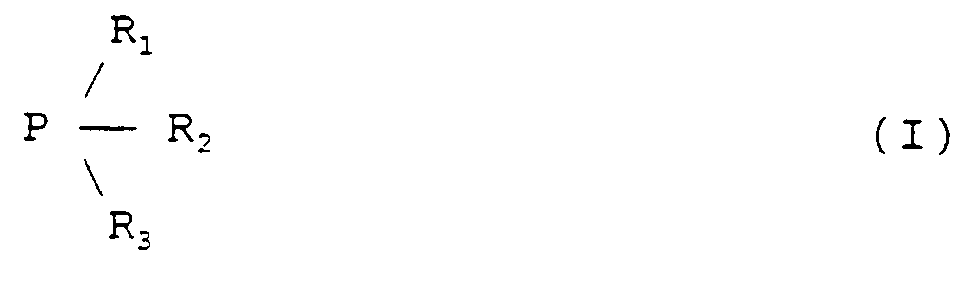
est utilisée, et au moins une partie de la solution de réaction d'hydroformylation est retirée et soumise à un traitement de précipitation, afin de faire précipiter, de séparer et de récupérer le catalyseur formé du complexe de métal du Groupe VIII, lequel est recyclé dans la zone de réaction d'hydroformylation.
Applications Claiming Priority (4)
| Application Number | Priority Date | Filing Date | Title |
|---|---|---|---|
| JP299429/89 | 1989-11-17 | ||
| JP29942989A JP2969697B2 (ja) | 1989-11-17 | 1989-11-17 | 第8族金属固体錯体の取得方法 |
| JP30152489 | 1989-11-20 | ||
| JP301524/89 | 1989-11-20 |
Publications (2)
| Publication Number | Publication Date |
|---|---|
| EP0429963A1 EP0429963A1 (fr) | 1991-06-05 |
| EP0429963B1 true EP0429963B1 (fr) | 1993-03-17 |
Family
ID=26561928
Family Applications (1)
| Application Number | Title | Priority Date | Filing Date |
|---|---|---|---|
| EP90121825A Expired - Lifetime EP0429963B1 (fr) | 1989-11-17 | 1990-11-14 | Méthode de récupération d'un complexe solide d'un métal de groupe VIII et méthode d'hydroformylation |
Country Status (5)
| Country | Link |
|---|---|
| US (1) | US5099047A (fr) |
| EP (1) | EP0429963B1 (fr) |
| KR (1) | KR910009940A (fr) |
| BR (1) | BR9005817A (fr) |
| DE (1) | DE69001119T2 (fr) |
Cited By (2)
| Publication number | Priority date | Publication date | Assignee | Title |
|---|---|---|---|---|
| US5840898A (en) * | 1994-05-03 | 1998-11-24 | Glaxo Wellcome, Inc. | Method of removing heavy metal contaminants from organic compounds |
| US6346629B1 (en) | 1998-06-03 | 2002-02-12 | Basf Aktiengesellschaft | Method for producing butyrolactones |
Families Citing this family (34)
| Publication number | Priority date | Publication date | Assignee | Title |
|---|---|---|---|---|
| DE4025074A1 (de) * | 1990-08-08 | 1992-02-13 | Hoechst Ag | Verfahren zur wiedergewinnung von rhodium aus den rueckstaenden der destillation von produkten der oxosynthese |
| US5324851A (en) * | 1993-10-14 | 1994-06-28 | E. I. Du Pont De Nemours And Company | Recovery of palladium catalyst |
| US6559309B2 (en) | 1996-11-01 | 2003-05-06 | Osi Pharmaceuticals, Inc. | Preparation of a camptothecin derivative by intramolecular cyclisation |
| KR100732894B1 (ko) * | 2001-03-08 | 2007-06-27 | 미쓰비시 가가꾸 가부시키가이샤 | 알데히드의 제조 방법 |
| US6959903B1 (en) * | 2002-06-04 | 2005-11-01 | West Albert C | Cast in place chimney form |
| WO2004065007A1 (fr) * | 2003-01-17 | 2004-08-05 | Sasol Technology (Proprietary) Limited | Recuperation d'un composant actif de catalyse dans un flux de processus |
| CN100339158C (zh) * | 2003-11-20 | 2007-09-26 | 三菱化学株式会社 | 铑络合物催化剂的回收方法 |
| US20060058174A1 (en) * | 2004-09-10 | 2006-03-16 | Chevron U.S.A. Inc. | Highly active slurry catalyst composition |
| US7485267B2 (en) * | 2005-07-29 | 2009-02-03 | Chevron U.S.A. Inc. | Process for metals recovery from spent catalyst |
| KR101035146B1 (ko) | 2006-11-06 | 2011-05-17 | 주식회사 엘지화학 | 옥소 공정에서 재결정화 과정에 의한 촉매 리간드 산화물의 분리 방법 |
| US7674369B2 (en) | 2006-12-29 | 2010-03-09 | Chevron U.S.A. Inc. | Process for recovering ultrafine solids from a hydrocarbon liquid |
| EA016893B1 (ru) * | 2007-10-31 | 2012-08-30 | Шеврон Ю.Эс.Эй. Инк. | Объемный катализатор гидрогенизации и его применение |
| US7837960B2 (en) * | 2007-11-28 | 2010-11-23 | Chevron U.S.A. Inc. | Process for separating and recovering base metals from used hydroprocessing catalyst |
| US7658895B2 (en) * | 2007-11-28 | 2010-02-09 | Chevron U.S.A. Inc | Process for recovering base metals from spent hydroprocessing catalyst |
| US8221710B2 (en) * | 2007-11-28 | 2012-07-17 | Sherritt International Corporation | Recovering metals from complex metal sulfides |
| US7846404B2 (en) * | 2007-11-28 | 2010-12-07 | Chevron U.S.A. Inc. | Process for separating and recovering base metals from used hydroprocessing catalyst |
| US8628735B2 (en) * | 2009-03-25 | 2014-01-14 | Chevron U.S.A. Inc. | Process for recovering metals from coal liquefaction residue containing spent catalysts |
| US8372776B2 (en) * | 2009-11-24 | 2013-02-12 | Chevron U.S.A. Inc. | Hydroprocessing bulk catalyst and methods of making thereof |
| US8389433B2 (en) * | 2009-11-24 | 2013-03-05 | Chevron U.S.A. | Hydroprocessing bulk catalyst and methods of making thereof |
| US8815184B2 (en) | 2010-08-16 | 2014-08-26 | Chevron U.S.A. Inc. | Process for separating and recovering metals |
| US8703641B2 (en) | 2010-11-11 | 2014-04-22 | Chevron U.S.A. Inc. | Hydroconversion multi-metallic catalyst and method for making thereof |
| US8575061B2 (en) | 2010-11-11 | 2013-11-05 | Chevron U.S.A. Inc. | Hydroconversion multi-metallic catalyst and method for making thereof |
| US8658558B2 (en) | 2010-11-11 | 2014-02-25 | Chevron U.S.A. Inc. | Hydroconversion multi-metallic catalyst and method for making thereof |
| US8586500B2 (en) | 2010-11-11 | 2013-11-19 | Chevron U.S.A. Inc. | Hydroconversion multi-metallic catalyst and method for making thereof |
| US9168519B2 (en) | 2010-11-11 | 2015-10-27 | Chevron U.S.A. Inc. | Hydroconversion multi-metallic catalyst and method for making thereof |
| US8575062B2 (en) | 2010-11-11 | 2013-11-05 | Chevron U.S.A. Inc. | Hydroconversion multi-metallic catalyst and method for making thereof |
| CN102617311B (zh) * | 2012-02-27 | 2014-01-08 | 中国科学院新疆理化技术研究所 | 一种合成三环癸烷不饱和单醛的方法 |
| CN102603502B (zh) * | 2012-02-27 | 2014-01-08 | 中国科学院新疆理化技术研究所 | 一种合成三环癸烷二甲醛的方法 |
| EP2841440B1 (fr) | 2012-04-25 | 2016-07-20 | Umicore AG & Co. KG | Procédé de production de complexes dicétonate-rhodium(1)-carbonyle |
| JP6254165B2 (ja) | 2012-09-05 | 2017-12-27 | シェブロン ユー.エス.エー. インコーポレイテッド | 水素化変換多金属触媒及びそれを調製する方法 |
| US9687823B2 (en) | 2012-12-14 | 2017-06-27 | Chevron U.S.A. Inc. | Hydroprocessing co-catalyst compositions and methods of introduction thereof into hydroprocessing units |
| US9321037B2 (en) | 2012-12-14 | 2016-04-26 | Chevron U.S.A., Inc. | Hydroprocessing co-catalyst compositions and methods of introduction thereof into hydroprocessing units |
| RU2628609C2 (ru) * | 2015-12-30 | 2017-08-21 | Федеральное государственное бюджетное образовательное учреждение высшего образования "Московский государственный университет имени М.В. Ломоносова" (МГУ) | Способ получения альдегидов гидроформилированием с модификацией лигандов ацетализацией |
| WO2017127654A1 (fr) * | 2016-01-21 | 2017-07-27 | Archer Daniels Midland Company | Procédés de séparation et de récupération de catalyseur |
Family Cites Families (7)
| Publication number | Priority date | Publication date | Assignee | Title |
|---|---|---|---|---|
| DE2505180A1 (de) * | 1975-02-07 | 1976-08-19 | Huels Chemische Werke Ag | Regenerierung von palladiumhaltigen katalysatoren |
| IT1074824B (it) * | 1977-02-01 | 1985-04-20 | Snam Progetti | Metodo di preparazione di "clusters" metallo-carbonilici immobilizzati in zeoliti e loro impiego come catalizzatori eterogenei |
| US4605780A (en) * | 1980-09-24 | 1986-08-12 | Union Carbide Corporation | Reactivation of rhodium complex hydroformylation catalysts |
| JPS5850234B2 (ja) * | 1980-10-23 | 1983-11-09 | 三菱化学株式会社 | 第8族貴金属固体錯体の取得方法 |
| US4782188A (en) * | 1983-11-14 | 1988-11-01 | The Dow Chemical Company | Process for hydroformylation of unsaturated compounds using iron carbonyl catalysts |
| DE3411034A1 (de) * | 1984-03-26 | 1985-09-26 | Ruhrchemie Ag, 4200 Oberhausen | Verfahren zur rueckgewinnung von rhodium aus reaktionsprodukten der oxosynthese |
| US4935550A (en) * | 1988-08-12 | 1990-06-19 | Union Carbide Chemicals And Plastics Company Inc. | Catalytic metal recovery from non-polar organic solutions |
-
1990
- 1990-11-13 US US07/611,515 patent/US5099047A/en not_active Expired - Fee Related
- 1990-11-14 DE DE90121825T patent/DE69001119T2/de not_active Expired - Fee Related
- 1990-11-14 EP EP90121825A patent/EP0429963B1/fr not_active Expired - Lifetime
- 1990-11-16 BR BR909005817A patent/BR9005817A/pt unknown
- 1990-11-17 KR KR1019900018665A patent/KR910009940A/ko not_active Withdrawn
Cited By (2)
| Publication number | Priority date | Publication date | Assignee | Title |
|---|---|---|---|---|
| US5840898A (en) * | 1994-05-03 | 1998-11-24 | Glaxo Wellcome, Inc. | Method of removing heavy metal contaminants from organic compounds |
| US6346629B1 (en) | 1998-06-03 | 2002-02-12 | Basf Aktiengesellschaft | Method for producing butyrolactones |
Also Published As
| Publication number | Publication date |
|---|---|
| DE69001119T2 (de) | 1993-10-07 |
| EP0429963A1 (fr) | 1991-06-05 |
| KR910009940A (ko) | 1991-06-28 |
| DE69001119D1 (de) | 1993-04-22 |
| BR9005817A (pt) | 1991-09-24 |
| US5099047A (en) | 1992-03-24 |
Similar Documents
| Publication | Publication Date | Title |
|---|---|---|
| EP0429963B1 (fr) | Méthode de récupération d'un complexe solide d'un métal de groupe VIII et méthode d'hydroformylation | |
| JP2859955B2 (ja) | オレフィンの低圧ロジウム接触ヒドロホルミル化 | |
| KR102756407B1 (ko) | 하이드로포밀화 공정의 제어 방법 | |
| US6831035B2 (en) | Stabilization of fluorophosphite-containing catalysts | |
| US4322564A (en) | Process for hydroformylation of olefins | |
| KR20250057144A (ko) | 하이드로포밀화 공정에서 촉매의 탈활성화를 느리게 하고/하거나 테트라포스핀 리간드 사용을 느리게 하는 방법 | |
| EP1311344B1 (fr) | Catalyseur d'hydroformylation contenant des phosphines bicycliques et son utilisation dans la preparation de produits oxygenes | |
| JPH0328406B2 (fr) | ||
| KR20250057145A (ko) | 모노포스핀, 테트라포스핀 리간드의 조합을 포함하는 촉매 조성물 및 이를 이용하는 하이드로포밀화 공정 | |
| US4354036A (en) | Preparation of carboxylic acid esters | |
| JP2946790B2 (ja) | アルデヒド類の製造法 | |
| JP2913820B2 (ja) | ヒドロホルミル化方法 | |
| JP3903575B2 (ja) | アルデヒド類の製造方法 | |
| TWI914295B (zh) | 催化劑組合物及加氫甲醯化過程 | |
| EP0125055B1 (fr) | Procédé d'hydroformylation à l'aide d'un catalyseur de platine (o) | |
| JPH0566933B2 (fr) | ||
| CN120282943A (zh) | 通过利用降解产物使多膦使用最小化的方法 | |
| KR100969474B1 (ko) | 하이드로포밀화 반응생성물로부터의 로듐촉매 회수방법 | |
| JPH11246464A (ja) | アルデヒド類の製造方法 | |
| JPH0520435B2 (fr) |
Legal Events
| Date | Code | Title | Description |
|---|---|---|---|
| PUAI | Public reference made under article 153(3) epc to a published international application that has entered the european phase |
Free format text: ORIGINAL CODE: 0009012 |
|
| AK | Designated contracting states |
Kind code of ref document: A1 Designated state(s): DE FR GB NL |
|
| 17P | Request for examination filed |
Effective date: 19910805 |
|
| 17Q | First examination report despatched |
Effective date: 19920603 |
|
| GRAA | (expected) grant |
Free format text: ORIGINAL CODE: 0009210 |
|
| AK | Designated contracting states |
Kind code of ref document: B1 Designated state(s): DE FR GB NL |
|
| REF | Corresponds to: |
Ref document number: 69001119 Country of ref document: DE Date of ref document: 19930422 |
|
| ET | Fr: translation filed | ||
| PGFP | Annual fee paid to national office [announced via postgrant information from national office to epo] |
Ref country code: FR Payment date: 19931110 Year of fee payment: 4 |
|
| PLBE | No opposition filed within time limit |
Free format text: ORIGINAL CODE: 0009261 |
|
| STAA | Information on the status of an ep patent application or granted ep patent |
Free format text: STATUS: NO OPPOSITION FILED WITHIN TIME LIMIT |
|
| 26N | No opposition filed | ||
| PG25 | Lapsed in a contracting state [announced via postgrant information from national office to epo] |
Ref country code: FR Effective date: 19950731 |
|
| REG | Reference to a national code |
Ref country code: FR Ref legal event code: ST |
|
| PGFP | Annual fee paid to national office [announced via postgrant information from national office to epo] |
Ref country code: NL Payment date: 19960926 Year of fee payment: 7 |
|
| PG25 | Lapsed in a contracting state [announced via postgrant information from national office to epo] |
Ref country code: NL Free format text: LAPSE BECAUSE OF NON-PAYMENT OF DUE FEES Effective date: 19980601 |
|
| NLV4 | Nl: lapsed or anulled due to non-payment of the annual fee |
Effective date: 19980601 |
|
| PGFP | Annual fee paid to national office [announced via postgrant information from national office to epo] |
Ref country code: GB Payment date: 19981120 Year of fee payment: 9 |
|
| PG25 | Lapsed in a contracting state [announced via postgrant information from national office to epo] |
Ref country code: GB Free format text: LAPSE BECAUSE OF NON-PAYMENT OF DUE FEES Effective date: 19991114 |
|
| PGFP | Annual fee paid to national office [announced via postgrant information from national office to epo] |
Ref country code: DE Payment date: 19991231 Year of fee payment: 10 |
|
| GBPC | Gb: european patent ceased through non-payment of renewal fee |
Effective date: 19991114 |
|
| PG25 | Lapsed in a contracting state [announced via postgrant information from national office to epo] |
Ref country code: DE Free format text: LAPSE BECAUSE OF NON-PAYMENT OF DUE FEES Effective date: 20010801 |