EP0430507A2 - Méthode de fixage d'une image de toner - Google Patents
Méthode de fixage d'une image de toner Download PDFInfo
- Publication number
- EP0430507A2 EP0430507A2 EP90312491A EP90312491A EP0430507A2 EP 0430507 A2 EP0430507 A2 EP 0430507A2 EP 90312491 A EP90312491 A EP 90312491A EP 90312491 A EP90312491 A EP 90312491A EP 0430507 A2 EP0430507 A2 EP 0430507A2
- Authority
- EP
- European Patent Office
- Prior art keywords
- toner
- image
- fixing
- toner image
- roller
- Prior art date
- Legal status (The legal status is an assumption and is not a legal conclusion. Google has not performed a legal analysis and makes no representation as to the accuracy of the status listed.)
- Ceased
Links
Images



Classifications
-
- G—PHYSICS
- G03—PHOTOGRAPHY; CINEMATOGRAPHY; ANALOGOUS TECHNIQUES USING WAVES OTHER THAN OPTICAL WAVES; ELECTROGRAPHY; HOLOGRAPHY
- G03G—ELECTROGRAPHY; ELECTROPHOTOGRAPHY; MAGNETOGRAPHY
- G03G13/00—Electrographic processes using a charge pattern
- G03G13/20—Fixing, e.g. by using heat
-
- G—PHYSICS
- G03—PHOTOGRAPHY; CINEMATOGRAPHY; ANALOGOUS TECHNIQUES USING WAVES OTHER THAN OPTICAL WAVES; ELECTROGRAPHY; HOLOGRAPHY
- G03G—ELECTROGRAPHY; ELECTROPHOTOGRAPHY; MAGNETOGRAPHY
- G03G15/00—Apparatus for electrographic processes using a charge pattern
- G03G15/20—Apparatus for electrographic processes using a charge pattern for fixing, e.g. by using heat
- G03G15/2003—Apparatus for electrographic processes using a charge pattern for fixing, e.g. by using heat using heat
- G03G15/2014—Apparatus for electrographic processes using a charge pattern for fixing, e.g. by using heat using heat using contact heat
- G03G15/206—Structural details or chemical composition of the pressure elements and layers thereof
-
- G—PHYSICS
- G03—PHOTOGRAPHY; CINEMATOGRAPHY; ANALOGOUS TECHNIQUES USING WAVES OTHER THAN OPTICAL WAVES; ELECTROGRAPHY; HOLOGRAPHY
- G03G—ELECTROGRAPHY; ELECTROPHOTOGRAPHY; MAGNETOGRAPHY
- G03G9/00—Developers
- G03G9/08—Developers with toner particles
- G03G9/0821—Developers with toner particles characterised by physical parameters
Definitions
- the present invention relates to a method for fixing a toner image on a transfer material by means of a fixing roller unit, and more particularly to a method for fixing a toner image on a transfer material with the reproduction of the original density of a solid image and the original intricacy of fine, delicate lines and patterns.
- a toner image transferred onto a transfer material is fixed thereto by means of a fixing roller unit that comprises a roller and a press roller.
- the toner image fixed on the transfer material must be reproduced without losing the original density of a solid toner image and the original intricacy of fine, delicate line and pattern image.
- the density of a toner image to be transferred to a copy paper can be adjusted by controlling the amount of toner to be transferred thereto, but since the amount of toner to be transferred depends on the amount of toner developer to be carried on an image bearer, it is difficult to reproduce a solid toner image and a fine toner image with the original density and delicacy.
- the toner deposit equally increases on fine, delicate lines and patterns owing to edge effect.
- the excessive deposit of toner blurs fine, delicate lines and patterns.
- the original density of a solid toner image may be satisfactorily attained but the fine, delicate lines and patterns will be blackened or spoiled.
- the amount of a toner developer is reduced so as to reproduce the original intricacy of fine, delicate lines and patterns, the scarcity of toner will unfavourably affect the density of a solid image.
- the recent common practice to attain a full-colour image is to use cyan toner, yellow toner, magenta toner, and if necessary, black toner, which are consecutively applied so as to develop respective colour images which are then superimposed one after another on a transfer material so as to form a full-color image.
- the full-colour image formation unavoidably increases the deposit of toner on the transfer material.
- some portion of the toner is likely to remain unfused in the fixing process, which causes unevenness on the surface of the toner image transferred to the transfer material.
- the uneven surface of the toner image on the transfer material spoils the transparency, spectral characteristics, colouring characteristics, and other desirable characteristics, thereby falling to produce a dense, definitive and clear image.
- a method for fixing a toner image formed on a transfer member by applying heat and pressure to a toner image using a fixing roller unit wherein the toner has melt viscosities of 1 x 10⁵ to 3 x 10⁶ poises at 90 o C and 1 x 10⁴ to 1 x 10⁵ poises at 100 o C
- the fixing roller unit comprises a heater and a press roller having a mirror-like elastic surface
- the elastic surface is provided by an elastic rubber layer coated with tetrafluoroethylene-perfluoroalkyl vinyl ether copolymer resin (PFA).
- PFA tetrafluoroethylene-perfluoroalkyl vinyl ether copolymer resin
- the toner contains a colouring agent dispersed in a resinous binder and the resinous binder has a weight-average molecular weight (Mw) of 10,000 to 80,000 and a ratio of the weight-average molecular weight (Mw) to the number-average molecular weight (Mn) of 2 to 15.
- Mw weight-average molecular weight
- Mn number-average molecular weight
- the invention described herein makes possible singly or in combination the objectives of (1) providing a method for fixing a toner image on a transfer material with the original density of a solid image and the original intricacy of fine line image, (2) providing a method for fixing a dense, definitive colour image on a transfer material thereby ensuring that the color image has an even surface, and (3) providing a method of fixing a toner image on a transfer material with an economical amount of toner.
- Main features of the present invention reside in (1) the use of toners whose melt viscosities are in a relatively small range and which melt quickly, and (2) the use of a fixing roller which has a mirror-like elastic surface capable of fixing a toner image to a transfer material with the original density and intricacy of the image.
- a toner image 11 is transferred to a transfer material 15 and then passed between a press roller 14 and a fixing roller, more specifically, a mirror-like surface 12 on an elastic layer 13 of the fixing roller.
- the mirror-like surface 12 keeps contact with the toner portion of the toner image 11 .
- Owing to the elastic layer 13 the toner image 11 is protected from becoming deformed when it is passed through the fixing roller unit. While the toner image 11 keeps its shape, the toner is heated. The toner quickly melts and is bonded to the transfer material 15 . Then, the transfer material 15 is separated from the mirror-like surface 12 of the fixing roller. This prevents offset and secures an even surface of the toner image 11 so that the toner image 11 is fixed to the transfer material 15 .
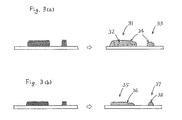
- FIG. 3(a) shows an example in which an excessive amount of toner is supplied so as to form a dense solid image area 31 .
- the problem in this case is that surplus toner 32 tends to remain unmelted in the solid image area on the transfer material after the toner image is fixed thereto.
- the same problem occurs in a fine line image area 33 , that is, surplus toner also remains unmelted. In this way, the surplus toner causes a resulting image to extend more widely than the toner image initially transferred onto the transfer material.
- the respective surface 34 of the dense solid image area 31 and the fine line image area 33 are uneven.
- Figure 3(b) shows a case in which a controlled amount of toner is supplied so as to prevent the resulting toner image from extending to a larger image than the original one.
- the problem is that the toner on the dense solid image area 35 is lacking, and the apparent image density decreases because of irregular reflection due to the uneven surface 36 of the toner image.
- the fine line image area 37 no problem of thickened lines occurs but the surface 38 is still uneven.
- Figure 2 shows a case in which an adequate amount of toner is supplied so as not to thicken the fine line image.
- the toner in the dense solid image area 21 is safe from disturbance and keeps its initial even surface 22 , thereby preventing a reflecting light on the dense solid image area 21 from scattering.
- its apparent density is enhanced.
- the fine line image area 23 the initial smooth surface is maintained and the toner is melted in this state, thereby preventing the fine line image from becoming thick or squashed.
- FIG 4 shows an example of a fixing unit used for fixing method of the present invention.
- the fixing unit 5 comprises a fixing roller 51 and a press roller 52 .
- the fixing roller 51 comprises a core 42 of a cylindrical metal (e.g., aluminum) including a heat source 41 therein, an elastic rubber layer 43 such as silicone rubber laminated on the outer surface of the core 42 , and a mirror finish fluorocarbon resin (PFA) tube 44 covering the elastic rubber layer 43 , so that the fixing roller 51 has a mirror-like outer surface.
- a discharger roller 45 of metal is disposed in such a manner as to contact the PFA tube 44 that covers the outer surface of the elastic rubber layer 43 provided along the circumference of the fixing roller 51 .
- the discharger roller 45 rotates together with the rotation of the fixing roller 51 .
- the discharger roller 45 is made of aluminum, for example, and is grounded through an image forming apparatus (not shown).
- An oil-impregnated felt roller 46 and a blade 47 are disposed in such a manner as to contact the outer surface of the discharger roller 45 , the oil-impregnated felt roller 46 rotating together with the rotation of the discharger roller 45 .
- the blade 47 is disposed downstream of the oil-impregnated felt roller 46 in the rotating direction of the discharger roller 45 .
- the discharger roller 45 and the oil-impregnated felt roller 46 are provided to prevent offset, coiling of a transfer material, and so on.
- the press roller 52 includes a cylindrical metal body 53 covered with a PFA tube 54 so that the press roller 52 has a hard surface.
- the press roller 52 includes a heat source 55 .
- An oil-impregnated felt 56 is disposed in contact with the surface of the PFA tube 54 .
- a blade 57 is disposed downstream of the oil-impregnated felt 56 in the rotating direction of the press roller 52 .
- the elastic rubber layer 43 can be made of fluorine-contained rubber, urethane, etc.
- the elastic rubber layer 43 may be covered with a mirror finish silicone rubber or a sintered layer of polytetrafluoroethylene (PTFE) so as to make the surface of the fixing roller 51 glossy.
- PTFE polytetrafluoroethylene
- the toner used in the fixing method of the present invention has such a melting viscosity as to soften immediately upon the start of the melting process.
- it consists of plastic particles having an average diameter of 5 to 20 ⁇ m having a coloring agent dispersed in a binder.
- the melt viscosity of the toner at 90°C ( ⁇ 90) is within the range of 1 x 10⁵ to 3 x 10⁶ poises, and the melt viscosity thereof at 100°C ( ⁇ 100) is higher than 1 x 10⁴ poises and lower than 1 x 10⁵ poises.
- the above-described toner has a low melt viscosity but at a relatively early stage the toner stops becoming fluid.
- the advantage of the above-described toner softens immedi strictlyately upon the start of the melting process and become adequately fluid. If the toner becomes excessively fluid, it causes an offset and stains the roller. If a toner image is formed with such an excessively fluid toner, and is fixed by means of a known fixing unit, a fatal offset or a poor fixing may occur.
- Such problems can be overcome by using a fixing unit equipped with a fixing roller having an elastic and mirror-like surface that is kept in contact with the toner, no problems of offset and poor fixing will occur, and a fixed image has a smooth surface, being free from any troubles, such as thickened line images and squashed image, due to the overdose of toner.
- melt viscosity at 90°C ( ⁇ 90) is lower than 1 x 10⁵ poises, an offset is likely to occur at the start of melting. Conversely, if it is higher than 3 x 10⁶ poises, the fixed toner image may not have a surface smoothness, thereby spoiling the transparency thereof, and preventing the dense reproduction of dense solid toner image. If the melt viscosity at 100°C ( ⁇ 100) is lower than 1 x 10⁴ poises, a fatal offset is more likely to occur, and its durability decreases. If it is higher than 1 x 10⁵ poises, the fixed image will have an uneven surface, thus spoiling the transparency, the coloring characteristics, and the density preservation characteristics of the image.
- the toner whose melt viscosity is to be measured may be passed through a sieve of 60 mesh, and about 1.5 g of the sieved particles are charged in a mold.
- the flow rate of this sample is measured using a flow meter, for example, Model FT-500 manufactured by Shimadzu Corporation, under the following conditions. Rise in temperature: 6.0 D/M (°C/minute) Initial temperature: 70.0 DEG (°C) Maximum temperature: 200.0 DEG (°C) Interval: 3.0 DEG Preheating time: 300.0 SEC Load: 20.0 KG Capillary diameter: 1.0 MM Plunger bottom area: 1.0 CM2
- a binder contained in the toner a known resin can be used, such as polystyrene, polyacrylic, polyamide, or polyether resins which are most preferable.
- these binders are referred to as "resinous binders”.
- Polyester resins are formed by condensation of polyols and polycarboxylic acids, the polyols including aliphatic polyols, aromatic polyols, heterocyclic polyols, etc., aromatic polyols being most desirable.
- Polycarboxylic acids include aliphatic carboxylic acids, aromatic polycarboxylic acids, etc. More specifically, the acids include terephthalic acid, isophthalic acid, naphthalenedicarboxylic acid, maleic acid, fumaric acid, succinic acid, adipic acid, sebacic acid, cyclohexane dicarboxylic acid, etc., among which terephthalic acid is preferably used.
- the polyols include ethylene glycol, propylene glycol, diethylene glycol, butane-diol, cyclohexanedimethanol, hexylene glycol, triethylene glycol or glycerol, mannitol, pentaerythritol, bisphenol A, 2,2′-bis(4-oxypropoxyphenyl) propane, 2,2′-bis(oxyethoxyphenyl) propane, etc. Any combination of these substances which can be used is determined by taking into consideration the compatibility with the used electric charge prohibitor, and the desired transparency.
- the above-mentioned resins should have a weight-average molecular weight (Mw) within the range of 10,000 to 80,000, and preferably within the range of 30,000 to 70,000.
- the degree of dispersion (Mw/Mn) expressed by the ratio of the weight-average molecular weight (Mw) to the number-average molecular weight (Mn) should be within the range of 2 to 15, and preferably within the range of 3 to 10.
- the resinous binder having a molecular weight within the above range has dispersed therein a coloring agent and other constituents described below.
- the degree of dispersion within the above range facilitates the softening of the toner so as to soften immediately without causing an offset.
- a degree of dispersion greater than the above range tends to retard the progress of melting, and a degree of dispersion smaller than the above range is likely to cause a blocking problem and reduces heat resistance.
- the coloring agent to be dispersed in the resinous binder includes: carbon black; aniline black; lamp black; magenta dyes and pigments such as C.I. pigment red 81, C.I. pigment red 122, C.I. pigment red 57, C.I. solvent red 49, C.I. solvent red 19, C.I. solvent red 52, C.I. basic red 10, C.I. disperse red 15, etc.; cyan dyes and pigments such as C.I. pigment blue 16, C.I. pigment blue 25, C.I. pigment blue 55, C.I. pigment blue 70, C.I. direct blue 25, C.I. pigment blue 86, etc.; and yellow dyes and pigments such as C.I. pigment yellow 17, C.I. pigment yellow 12, C.I. pigment yellow 1, C.I. pigment yellow 97, C.I. pigment yellow 138, C.I. solvent yellow 29, C.I. solvent yellow 162, C.I. pigment yellow 93, etc.
- magenta dyes and pigments such as C.I. pigment
- coloring agents are blended within the range of 0.3 to 15 weight parts, and preferably within the range of 1 to 7 parts, for every 100 weight parts of the above resinous binder.
- known magnetic substances such as ferrite, magnetites can be added. These magnetic substance are added within the range of 5 to 200 weight parts for every 100 weight parts of the resinous binder.
- electric charge prohibiting substances may be added. They include known substances such as metal complex monoazo dyes, metallic salts or metallic complex salts such as salicylic acid, alkyl salicylic acid, naphthoic acid, etc., and nigrosine dyes. Sulphonic acids, phosphonic acids, carboxylic acids, and polymers having these metallic salts as side chains may also be used. These charge control substances are added within the range of 0.1 to 10 weight parts, and preferably within the range of 0.5 to 5 weight parts, for every 100 weight parts of the resinous binder.
- the toner can be produced by known methods.
- a common method consists of the steps of melting the above-mentioned substances, kneading them, cooling the dough and crushing the mass and classifying the particles.
- Another is a method in which various orientation agents are added to the polymerized monomers forming the resinous binder and the toner is produced in a single step during the polymerization process of the resinous binder.
- the toner produced in this way is treated on its surface with powder, e.g. hydrophobic silica or alumina, or with fine powder of acrylic, styrene, silicone or other polymers.
- powder e.g. hydrophobic silica or alumina, or with fine powder of acrylic, styrene, silicone or other polymers.
- the previously noted conditions should be satisfied, and it is desirable that the surface temperature of the fixing roller be controlled within the range of 120 to 190°C so that the deposit of toner on the transfer material is maintained within the range of 30 to 200 mg, preferably within the range of 60 to 120 mg for an image which occupies 40% of an A4 size paper.
- the fixing roller is preferably operated at a surface speed of 30 to 300 mm/sec.
- the fixing method of the present invention prevents undulations occurring in the fixed toner image surface and unevenness in melting of the toner so as to provide the fixed toner image with a smooth, uniform surface, thus enabling all-toned areas to be produced in high density while faithfully repro ducing fine line areas. Therefore, a monochromatic image can be produced in high density, while in the case of a color image, a high-density, clear and definitive image having good transparency and spectral characteristics can be produced.
- Example 1 The procedure of Example 1 was repeated but using different resinous binders and coloring agents, as shown in Table 1, to prepare toners of Examples 2 to 4 and Comparative Examples 1 to 4.
- resinous binders and coloring agents as shown in Table 1, to prepare toners of Examples 2 to 4 and Comparative Examples 1 to 4.
- carbon black 5 weight parts were used for every 100 weight parts of the resin, while in the case of copper phthalocyanine or benzidine pigments, 3.5 weight parts were used for every 100 weight parts of the resin.
- a fixed toner image was produced using the fixing conditions shown in Table 1, and the fixed toner image was evaluated. The results are shown in Table 1. Also, the melting viscosity characteristics of these toners are shown in Figure 5.
Landscapes
- Physics & Mathematics (AREA)
- General Physics & Mathematics (AREA)
- Developing Agents For Electrophotography (AREA)
- Fixing For Electrophotography (AREA)
Applications Claiming Priority (2)
| Application Number | Priority Date | Filing Date | Title |
|---|---|---|---|
| JP305663/89 | 1989-11-24 | ||
| JP1305663A JPH03164753A (ja) | 1989-11-24 | 1989-11-24 | 定着方法 |
Publications (2)
| Publication Number | Publication Date |
|---|---|
| EP0430507A2 true EP0430507A2 (fr) | 1991-06-05 |
| EP0430507A3 EP0430507A3 (en) | 1991-12-04 |
Family
ID=17947852
Family Applications (1)
| Application Number | Title | Priority Date | Filing Date |
|---|---|---|---|
| EP19900312491 Ceased EP0430507A3 (en) | 1989-11-24 | 1990-11-16 | Method for fixing a toner image |
Country Status (2)
| Country | Link |
|---|---|
| EP (1) | EP0430507A3 (fr) |
| JP (1) | JPH03164753A (fr) |
Cited By (1)
| Publication number | Priority date | Publication date | Assignee | Title |
|---|---|---|---|---|
| EP0806709A3 (fr) * | 1996-05-10 | 1998-11-11 | Fuji Xerox Co., Ltd. | Appareil de formation d'images |
Families Citing this family (4)
| Publication number | Priority date | Publication date | Assignee | Title |
|---|---|---|---|---|
| JP3365134B2 (ja) * | 1995-03-03 | 2003-01-08 | ミノルタ株式会社 | フルカラー用非磁性一成分トナー及び画像形成方法 |
| JP3385785B2 (ja) * | 1995-03-03 | 2003-03-10 | ミノルタ株式会社 | フルカラー用非磁性一成分トナー |
| JP3385786B2 (ja) * | 1995-03-03 | 2003-03-10 | ミノルタ株式会社 | フルカラー用非磁性一成分トナー |
| JP5470858B2 (ja) * | 2009-01-08 | 2014-04-16 | 富士ゼロックス株式会社 | 静電荷像現像用トナー、静電荷像現像剤、トナーカートリッジ、プロセスカートリッジ及び画像形成装置 |
Family Cites Families (2)
| Publication number | Priority date | Publication date | Assignee | Title |
|---|---|---|---|---|
| JPS6270860A (ja) * | 1985-09-25 | 1987-04-01 | Konishiroku Photo Ind Co Ltd | 静電像現像用トナ− |
| JPH0820747B2 (ja) * | 1987-10-14 | 1996-03-04 | キヤノン株式会社 | 画像形成方法 |
-
1989
- 1989-11-24 JP JP1305663A patent/JPH03164753A/ja active Pending
-
1990
- 1990-11-16 EP EP19900312491 patent/EP0430507A3/en not_active Ceased
Cited By (1)
| Publication number | Priority date | Publication date | Assignee | Title |
|---|---|---|---|---|
| EP0806709A3 (fr) * | 1996-05-10 | 1998-11-11 | Fuji Xerox Co., Ltd. | Appareil de formation d'images |
Also Published As
| Publication number | Publication date |
|---|---|
| EP0430507A3 (en) | 1991-12-04 |
| JPH03164753A (ja) | 1991-07-16 |
Similar Documents
| Publication | Publication Date | Title |
|---|---|---|
| US5849448A (en) | Carrier for developer of electrostatic latent image, method for making said carrier | |
| EP0349227B1 (fr) | Film transparent et procédé de production d'images en couleurs | |
| EP0373652B1 (fr) | Procédé de fixation d'images d'agent de contraste par la chaleur | |
| EP2286303B1 (fr) | Composition de toner permettant d'empêcher le blocage d images | |
| EP0501360B1 (fr) | Utilisation d'un film laminé pour la réception d'un image coloré de toner et procédé de fixation d'un image coloré de toner | |
| JPH0544031B2 (fr) | ||
| EP0217337B1 (fr) | Toner encapsulé | |
| US3060051A (en) | Method of fusing powder images | |
| EP0831378B1 (fr) | Méthode de formation d'images, appareil de formation d'images et combinaison de support de reproduction et toner associé | |
| US5903802A (en) | Method for forming an image by absorbing a release agent using a release agent absorbing layer coated on feed passage member | |
| US5482760A (en) | Light-transmitting film and method for forming images using the same | |
| JP2633023B2 (ja) | 透明ラミネートフイルム及びカラー画像形成方法 | |
| US6033821A (en) | Electrophotographic transfer sheet and method for forming color image | |
| JPH04212168A (ja) | 電子写真用複写シート及び電子写真法 | |
| EP0807858A1 (fr) | Agent de développement et son procédé de fabrication | |
| US5837416A (en) | Toner particles comprising specified polymeric beads in the bulk of the toner particles | |
| JPH0980804A (ja) | 静電荷像現像用現像剤 | |
| JP3342272B2 (ja) | カラートナー、二成分系現像剤、画像形成装置及び画像形成方法 | |
| JP7790266B2 (ja) | キャリアセット及び現像剤セット | |
| JPH03164753A (ja) | 定着方法 | |
| JP3186362B2 (ja) | 静電荷像現像剤の製造方法 | |
| US5620821A (en) | Method of forming transparent color image | |
| JPS6348570A (ja) | カラ−トナ−画像用定着ロ−ラ− | |
| JP2853783B2 (ja) | 画像透光性透明フィルムおよびそれを用いた画像形成方法 | |
| EP0811887B1 (fr) | Particules de révélateur comprenant des billes polymériques, spécifiées dans la masse des particules du révélateur |
Legal Events
| Date | Code | Title | Description |
|---|---|---|---|
| PUAI | Public reference made under article 153(3) epc to a published international application that has entered the european phase |
Free format text: ORIGINAL CODE: 0009012 |
|
| 17P | Request for examination filed |
Effective date: 19901218 |
|
| AK | Designated contracting states |
Kind code of ref document: A2 Designated state(s): DE FR GB IT NL |
|
| PUAL | Search report despatched |
Free format text: ORIGINAL CODE: 0009013 |
|
| AK | Designated contracting states |
Kind code of ref document: A3 Designated state(s): DE FR GB IT NL |
|
| 17Q | First examination report despatched |
Effective date: 19930517 |
|
| STAA | Information on the status of an ep patent application or granted ep patent |
Free format text: STATUS: THE APPLICATION HAS BEEN REFUSED |
|
| 18R | Application refused |
Effective date: 19931107 |