EP0430542A2 - Verfahren zur Herstellung von flexiblen Röhrchen - Google Patents
Verfahren zur Herstellung von flexiblen Röhrchen Download PDFInfo
- Publication number
- EP0430542A2 EP0430542A2 EP90312622A EP90312622A EP0430542A2 EP 0430542 A2 EP0430542 A2 EP 0430542A2 EP 90312622 A EP90312622 A EP 90312622A EP 90312622 A EP90312622 A EP 90312622A EP 0430542 A2 EP0430542 A2 EP 0430542A2
- Authority
- EP
- European Patent Office
- Prior art keywords
- core member
- braid
- flex
- sheath
- resin layer
- Prior art date
- Legal status (The legal status is an assumption and is not a legal conclusion. Google has not performed a legal analysis and makes no representation as to the accuracy of the status listed.)
- Withdrawn
Links
- 238000000034 method Methods 0.000 title claims abstract description 34
- 229920005989 resin Polymers 0.000 claims abstract description 65
- 239000011347 resin Substances 0.000 claims abstract description 65
- 238000007598 dipping method Methods 0.000 claims abstract description 8
- 229910052751 metal Inorganic materials 0.000 claims abstract description 8
- 239000002184 metal Substances 0.000 claims abstract description 8
- 239000000463 material Substances 0.000 claims description 11
- 239000011521 glass Substances 0.000 claims description 6
- 238000004804 winding Methods 0.000 claims description 3
- 230000015572 biosynthetic process Effects 0.000 claims description 2
- 239000010410 layer Substances 0.000 description 53
- 239000000853 adhesive Substances 0.000 description 33
- 230000001070 adhesive effect Effects 0.000 description 33
- 230000002093 peripheral effect Effects 0.000 description 26
- 239000012790 adhesive layer Substances 0.000 description 19
- 238000005452 bending Methods 0.000 description 10
- 230000001050 lubricating effect Effects 0.000 description 8
- 238000003780 insertion Methods 0.000 description 6
- 230000037431 insertion Effects 0.000 description 6
- 238000001125 extrusion Methods 0.000 description 3
- 239000013307 optical fiber Substances 0.000 description 3
- ATJFFYVFTNAWJD-UHFFFAOYSA-N Tin Chemical compound [Sn] ATJFFYVFTNAWJD-UHFFFAOYSA-N 0.000 description 2
- 239000002253 acid Substances 0.000 description 2
- 239000004840 adhesive resin Substances 0.000 description 2
- 229920006223 adhesive resin Polymers 0.000 description 2
- 238000010276 construction Methods 0.000 description 2
- 230000003247 decreasing effect Effects 0.000 description 2
- 239000000835 fiber Substances 0.000 description 2
- 239000012943 hotmelt Substances 0.000 description 2
- 238000005286 illumination Methods 0.000 description 2
- 238000005470 impregnation Methods 0.000 description 2
- 239000007788 liquid Substances 0.000 description 2
- 229920001343 polytetrafluoroethylene Polymers 0.000 description 2
- 239000004810 polytetrafluoroethylene Substances 0.000 description 2
- 229920005749 polyurethane resin Polymers 0.000 description 2
- 239000000126 substance Substances 0.000 description 2
- 229920005992 thermoplastic resin Polymers 0.000 description 2
- 229910001369 Brass Inorganic materials 0.000 description 1
- RYGMFSIKBFXOCR-UHFFFAOYSA-N Copper Chemical compound [Cu] RYGMFSIKBFXOCR-UHFFFAOYSA-N 0.000 description 1
- 229910000881 Cu alloy Inorganic materials 0.000 description 1
- GRYLNZFGIOXLOG-UHFFFAOYSA-N Nitric acid Chemical compound O[N+]([O-])=O GRYLNZFGIOXLOG-UHFFFAOYSA-N 0.000 description 1
- 229910000831 Steel Inorganic materials 0.000 description 1
- 239000003513 alkali Substances 0.000 description 1
- 229910052782 aluminium Inorganic materials 0.000 description 1
- XAGFODPZIPBFFR-UHFFFAOYSA-N aluminium Chemical compound [Al] XAGFODPZIPBFFR-UHFFFAOYSA-N 0.000 description 1
- 239000010951 brass Substances 0.000 description 1
- 239000000919 ceramic Substances 0.000 description 1
- 239000003795 chemical substances by application Substances 0.000 description 1
- 239000011248 coating agent Substances 0.000 description 1
- 238000000576 coating method Methods 0.000 description 1
- 230000008602 contraction Effects 0.000 description 1
- 238000007796 conventional method Methods 0.000 description 1
- 229920001577 copolymer Polymers 0.000 description 1
- 229910052802 copper Inorganic materials 0.000 description 1
- 239000010949 copper Substances 0.000 description 1
- 238000007689 inspection Methods 0.000 description 1
- 238000012986 modification Methods 0.000 description 1
- 230000004048 modification Effects 0.000 description 1
- CWQXQMHSOZUFJS-UHFFFAOYSA-N molybdenum disulfide Chemical compound S=[Mo]=S CWQXQMHSOZUFJS-UHFFFAOYSA-N 0.000 description 1
- 229910052982 molybdenum disulfide Inorganic materials 0.000 description 1
- 229910017604 nitric acid Inorganic materials 0.000 description 1
- -1 polytetrafluoroethylene Polymers 0.000 description 1
- 230000002028 premature Effects 0.000 description 1
- 238000007789 sealing Methods 0.000 description 1
- 238000000926 separation method Methods 0.000 description 1
- 238000005507 spraying Methods 0.000 description 1
- 239000010935 stainless steel Substances 0.000 description 1
- 229910001220 stainless steel Inorganic materials 0.000 description 1
- 239000010959 steel Substances 0.000 description 1
- 229920003051 synthetic elastomer Polymers 0.000 description 1
- 239000005061 synthetic rubber Substances 0.000 description 1
- 230000037303 wrinkles Effects 0.000 description 1
Images

Classifications
-
- A—HUMAN NECESSITIES
- A61—MEDICAL OR VETERINARY SCIENCE; HYGIENE
- A61M—DEVICES FOR INTRODUCING MEDIA INTO, OR ONTO, THE BODY; DEVICES FOR TRANSDUCING BODY MEDIA OR FOR TAKING MEDIA FROM THE BODY; DEVICES FOR PRODUCING OR ENDING SLEEP OR STUPOR
- A61M25/00—Catheters; Hollow probes
- A61M25/0009—Making of catheters or other medical or surgical tubes
- A61M25/0012—Making of catheters or other medical or surgical tubes with embedded structures, e.g. coils, braids, meshes, strands or radiopaque coils
-
- A—HUMAN NECESSITIES
- A61—MEDICAL OR VETERINARY SCIENCE; HYGIENE
- A61B—DIAGNOSIS; SURGERY; IDENTIFICATION
- A61B1/00—Instruments for performing medical examinations of the interior of cavities or tubes of the body by visual or photographical inspection, e.g. endoscopes; Illuminating arrangements therefor
- A61B1/005—Flexible endoscopes
- A61B1/0051—Flexible endoscopes with controlled bending of insertion part
- A61B1/0055—Constructional details of insertion parts, e.g. vertebral elements
-
- B—PERFORMING OPERATIONS; TRANSPORTING
- B29—WORKING OF PLASTICS; WORKING OF SUBSTANCES IN A PLASTIC STATE IN GENERAL
- B29D—PRODUCING PARTICULAR ARTICLES FROM PLASTICS OR FROM SUBSTANCES IN A PLASTIC STATE
- B29D23/00—Producing tubular articles
- B29D23/001—Pipes; Pipe joints
-
- F—MECHANICAL ENGINEERING; LIGHTING; HEATING; WEAPONS; BLASTING
- F16—ENGINEERING ELEMENTS AND UNITS; GENERAL MEASURES FOR PRODUCING AND MAINTAINING EFFECTIVE FUNCTIONING OF MACHINES OR INSTALLATIONS; THERMAL INSULATION IN GENERAL
- F16L—PIPES; JOINTS OR FITTINGS FOR PIPES; SUPPORTS FOR PIPES, CABLES OR PROTECTIVE TUBING; MEANS FOR THERMAL INSULATION IN GENERAL
- F16L11/00—Hoses, i.e. flexible pipes
- F16L11/04—Hoses, i.e. flexible pipes made of rubber or flexible plastics
- F16L11/10—Hoses, i.e. flexible pipes made of rubber or flexible plastics with reinforcements not embedded in the wall
-
- A—HUMAN NECESSITIES
- A61—MEDICAL OR VETERINARY SCIENCE; HYGIENE
- A61M—DEVICES FOR INTRODUCING MEDIA INTO, OR ONTO, THE BODY; DEVICES FOR TRANSDUCING BODY MEDIA OR FOR TAKING MEDIA FROM THE BODY; DEVICES FOR PRODUCING OR ENDING SLEEP OR STUPOR
- A61M25/00—Catheters; Hollow probes
- A61M25/0043—Catheters; Hollow probes characterised by structural features
- A61M25/0045—Catheters; Hollow probes characterised by structural features multi-layered, e.g. coated
-
- A—HUMAN NECESSITIES
- A61—MEDICAL OR VETERINARY SCIENCE; HYGIENE
- A61M—DEVICES FOR INTRODUCING MEDIA INTO, OR ONTO, THE BODY; DEVICES FOR TRANSDUCING BODY MEDIA OR FOR TAKING MEDIA FROM THE BODY; DEVICES FOR PRODUCING OR ENDING SLEEP OR STUPOR
- A61M25/00—Catheters; Hollow probes
- A61M25/0043—Catheters; Hollow probes characterised by structural features
- A61M25/005—Catheters; Hollow probes characterised by structural features with embedded materials for reinforcement, e.g. wires, coils, braids
-
- B—PERFORMING OPERATIONS; TRANSPORTING
- B29—WORKING OF PLASTICS; WORKING OF SUBSTANCES IN A PLASTIC STATE IN GENERAL
- B29K—INDEXING SCHEME ASSOCIATED WITH SUBCLASSES B29B, B29C OR B29D, RELATING TO MOULDING MATERIALS OR TO MATERIALS FOR MOULDS, REINFORCEMENTS, FILLERS OR PREFORMED PARTS, e.g. INSERTS
- B29K2705/00—Use of metals, their alloys or their compounds, for preformed parts, e.g. for inserts
-
- B—PERFORMING OPERATIONS; TRANSPORTING
- B29—WORKING OF PLASTICS; WORKING OF SUBSTANCES IN A PLASTIC STATE IN GENERAL
- B29K—INDEXING SCHEME ASSOCIATED WITH SUBCLASSES B29B, B29C OR B29D, RELATING TO MOULDING MATERIALS OR TO MATERIALS FOR MOULDS, REINFORCEMENTS, FILLERS OR PREFORMED PARTS, e.g. INSERTS
- B29K2705/00—Use of metals, their alloys or their compounds, for preformed parts, e.g. for inserts
- B29K2705/08—Transition metals
-
- B—PERFORMING OPERATIONS; TRANSPORTING
- B29—WORKING OF PLASTICS; WORKING OF SUBSTANCES IN A PLASTIC STATE IN GENERAL
- B29L—INDEXING SCHEME ASSOCIATED WITH SUBCLASS B29C, RELATING TO PARTICULAR ARTICLES
- B29L2023/00—Tubular articles
- B29L2023/005—Hoses, i.e. flexible
- B29L2023/007—Medical tubes other than catheters
-
- B—PERFORMING OPERATIONS; TRANSPORTING
- B29—WORKING OF PLASTICS; WORKING OF SUBSTANCES IN A PLASTIC STATE IN GENERAL
- B29L—INDEXING SCHEME ASSOCIATED WITH SUBCLASS B29C, RELATING TO PARTICULAR ARTICLES
- B29L2031/00—Other particular articles
- B29L2031/753—Medical equipment; Accessories therefor
- B29L2031/7542—Catheters
Definitions
- This invention relates to a method of producing a flexible tube for use, for example, in an insertion portion of an endoscope or a catheter.
- a flexible tube used in an endoscope comprises a flex formed by winding a metal strip into a spiral shape, a braid provided around the outer periphery of the flex, and a resin layer formed on the outer periphery of the braid.
- the braid and the resin layer are joined together to form a sheath.
- the flex and the sheath are connected together only at their opposite ends.
- the above flexible tube is so flexible as to be bent.
- the flex resists a compressive force acting on the flexible tube in a radial direction of the flexible tube, thus preventing the flexible tube from being crushed flat.
- the braid resists a tensile force acting on the flexible tube in an axial direction of the flexible tube, and also resists a torsional force acting on the flexible tube. Thus, the braid prevents the elongation and torsion of the flexible tube.
- the resin layer resists a compressive force acting on the flexible tube in an axial direction of the flexible tube, thus preventing an axial contraction of the flexible tube.
- the resin layer also imparts liquid-sealing properties to the flexible tube.
- the braid and the resin layer reinforce each other. If the resin layer and the braid are separated from each other, wrinkles develop on the resin layer at an inner side of a bent portion of the flexible tube when the flexible tube is bent. Therefore, repeated bending of the flexible tube may cause the resin layer to be torn because of fatigue. Also, the braid may be cut because of fatigue. Therefore, the braid and the resin layer must be joined together firmly.
- the braid is fitted on the flex.
- an adhesive is coated on and impregnated in the braid.
- the resin layer is formed on the outer periphery of the braid either by fitting a heat-shrinkable tube on the braid or by extrusion of a resin.
- the adhesive layer is recognized as an inner resin layer.
- Another method without the use of an adhesive may be used in which the braid, fitted on the flex, is impregnated with a resin by dipping, and then the resin is dried to form the resin layer.
- the braid is embedded in the inside portion of the resin layer.
- the adhesive in order to meet the above first requirement (that is, the firm connection between the braid and the resin layer), the adhesive must be adequately penetrated into the braid. In this case, the adhesive reaches to the outer peripheral surface of the flex. As a result, each turn of the flex is adhesively bonded to the sheath, and therefore can not move relative to the sheath, thus failing to meet the above second requirement. In contrast, if the amount of impregnation of the adhesive in the braid is reduced in order to meet the second requirement, then the strength of bonding between the resin layer and the braid is decreased, thus failing to meet the first requirement.
- Japanese Laid-Open (Kokai) Patent Application No. 195538/83 discloses a technique in which a non-adhesive layer is formed on an outer peripheral surface of a flex, thereby preventing the flex from being adhesively bonded to a sheath even if an adhesive reaches the outer peripheral surface of the flex.
- this method however, part of the adhesive intrudes into the spaces between the adjacent turns of the flex, and then is solidified to form convex portions projecting radially inwardly. These convex portions prevent the turns of the flex from moving relative to the sheath.
- Japanese Laid-Open Patent Application No. 163330/83 discloses a method in which a resin layer is formed by extrusion.
- a molten resin intrudes into the spaces between turns of a flex, and then is solidified to form convex portions projecting radially inwardly. These convex portions prevent the turns of the flex from moving relative to a sheath.
- Japanese Laid-Open Patent Application No. 149124/84 discloses means for preventing an adhesive, penetrated into a braid, from reaching a flex. More specifically, a thin strip or band of a resin is wound on the outer periphery of the flex.
- Japanese Laid-Open Patent Application No. 137031/84 discloses a technique in which a thin tube is interposed between a flex and a braid. This tube prevents an adhesive from reaching the flex. In these cases, however, there is encountered a problem that upon repeated bending of the flexible tube, the strip or the tin tube may be ruptured or damaged by the frictional contact of the strip or the tin tube with the turns of the flex.
- Japanese Laid-Open Patent Application No. 230614/85 discloses a method in which an elongated core member of synthetic rubber is used.
- a flex is fitted on the outer periphery of the core member, and a braid is fitted on the outer periphery of the flex.
- the braid is impregnated with an adhesive, and a resin layer is formed on the outer periphery of the braid.
- part of the adhesive intrudes into the spaces between the turns of the flex, and then is solidified to form convex portions projecting radially inwardly.
- the height of these convex portions is generally equal to the thickness of the flex, and the convex portions prevent the turns of the flex from moving relative to a sheath.
- This prior patent application does not describe how the core member is removed from the sheath.
- Japanese Patent Publication No. 11011/88 discloses the prior art using an elongated core member.
- a braid is fitted on the core member.
- the braid is impregnated with an adhesive of a resin.
- a tube is fitted on the braid, and is heat-shrunk to be brought into intimate contact with the braid.
- the adhesive resin is compressed by the heat-shrunk tube, so that the adhesive resin is sufficiently introduced into the meshes of the braid and is cured to form an elastic resin layer.
- This method is to produce a flexible tube having no flex.
- This prior patent publication does not described how the core member is removed from the sheath.
- a method of producing a flexible tube comprising the steps of:
- a method of producing a flexible tube comprising the steps of:
- the endoscope comprises a body 1, an insertion portion 2 extending from one end of the body 1, a bending portion 3 extending from a distal end of the insertion portion 2, and a rigid portion 4 provided at a distal end of the bending portion 3.
- An ocular portion 5 is formed on the other end of the body 1, and is optically connected to an inspection window, formed on the rigid portion 4, via an optical fiber bundle and so on.
- a manipulation dial 6 for remote control of the bending portion 3 via wires is mounted on the peripheral wall of the body 1.
- a cable 7 is connected at one end to the body 1, and is connected at the other end to a light source. Light from the light source is fed to an illumination window, formed on the rigid portion 4, via an optical fiber bundle passing through the cable 7, the body 1, the insertion portion 2 and the bending portion 3, and the light is further emitted from the illumination window.
- the insertion portion 2 has a flexible tube 10 shown in Figs. 2 and 3.
- the above-mentioned optical fiber bundles, the wires and etc., are passed through the flexible tube 10.
- the flexible tube 10 comprises a flex 11 formed by winding a metal strip into a spiral shape, a braid 12 mounted around the outer periphery of the flex 11, a soft resin layer 13 mounted around the outer periphery of the braid 12.
- the braid 12 is embedded in an adhesive layer 14, and the braid 12 and the resin layer 13 are joined together through the adhesive layer 14.
- the braid 12, the resin layer 13 and the adhesive layer 14 jointly constitute a sheath 15 which is so flexible as to be bent.
- the adhesive layer 14 is made of an elastic resin, and can be recognized as an inner resin layer.
- the braid 12 is made of narrow wires of steel, copper, a copper alloy or the like.
- a lubricating layer 16 is formed on the outer peripheral surface of the flex 11.
- the outer diameter of the flex 11 in its natural condition is slightly greater than the inner diameter of the sheath 15, and therefore the flex 11 is held in contact with the inner peripheral surface of the sheath 15 with a slight resilient force.
- the sheath 15 has an inner diameter of 8 mm and an outer diameter of 9.4 mm.
- the thickness of the braid 12 is 0.2 mm, and the thickness of the adhesive layer 14 is almost the same as the thickness of the braid 12.
- the thickness of the resin layer 13 is 0.5 mm, and the thickness of the flex 11 is 0.2 mm, and the thickness of the lubricating layer 16 is 30 ⁇ m.
- a pair of rings 17 and 18 of metal are attached to the opposite ends of the flexible tube 10.
- Each of the rings 17 and 18 has an inner diameter slightly greater than that of the sheath 15, and has an outer diameter slightly smaller than that of the sheath 15.
- the opposite ends of the braid 12, as well as the opposite ends of the flex 11, project respectively from the opposite ends of the adhesive layer 14 and also project respectively from the opposite ends of the resin layer 13.
- the opposite ends of the braid 12 as well as the opposite ends of the flex 11 are soldered respectively to the inner peripheral surfaces of the rings 17 and 18.
- the ring 17 is received in the body 1 and fixed thereto, and the ring 18 is connected to the proximal end of the bending portion 3.
- Fig. 4 shows a modified flexible tube 10A.
- a resin layer 13A and a braid 12, which jointly constitute a sheath 15A of the flexible tube 10A, are directly joined together, with no adhesive layer interposed therebetween.
- the braid 12 is embedded in the inside portion of the resin layer 13.
- the other parts are the same as those of the flexible tube 10 of Fig. 3, and are designated by identical reference numerals, respectively, and therefore explanation of those corresponding parts is omitted.
- each of the flexible tubes 10 and 10A shown respectively in Figs. 3 and 4 is similar to a conventional construction.
- a method of producing the flexible tube 10 of Fig. 3 will now be described.
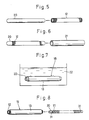
- a core member 20 in the form of a straight hollow cylindrical pipe.
- the core member 20 is made, for example, of a glass material which is dissolvable in an acid.
- the outer diameter of the core member 20 is slightly smaller than the outer diameter of the flex 11 in its natural condition.
- the opposite ends of the core member 20 are closed.
- the braid 12 is fitted on the core member 20, and then the braid 12 is wiped or rubbed by rollers to be brought into intimate contact with the outer peripheral surface of the core member 20. Then, the braid 12 is fastened at its opposite ends to the core member 20 by tapes or the like. Instead of using the rollers, the braid 20 may be pulled axially of the core member 20 to be brought into intimate contact with the core member 20.
- a hot-melt type adhesive in a liquid state is applied to the outer peripheral surface of the braid 12 by coating, spraying or the like, so that the adhesive is impregnated into the braid 12.
- the thus impregnated adhesive is solidified or set to form an adhesive layer, and the braid 12 is embedded in this adhesive layer.
- the adhesive layer is not formed on the opposite end portions of the braid 12.
- a heat-shrinkable tube 21 made, for example, of a polyurethane resin is fitted on the braid 12. Then, the tube 21 is heated to be shrunk radially, so that the tube 21 is intimately fitted on the braid 12. At this time, the adhesive layer is again melted by the heat applied to the tube 21, and bonds the tube 21 and the braid 12 together.
- the above adhesive is a polyester-type hot melt agent which can be relatively satisfactorily bonded adhesively to both the tube 21 of a polyurethane resin and the braid 12 of metal.
- the adhesive when cured or set, forms the adhesive layer 14 shown in Fig. 3, and the cured tube 21 serves as the resin layer 13. Thus, the sheath 15 is formed.
- the opposite end portions of the braid 12 do not have the adhesive layer, and therefore are not bonded to the tube 21.
- the closed opposite ends of the core member 20 is cut to be opened, and then the above sheath assembly is dipped in a dissolving solution 22 of an acid, so that the core member 20 is dissolved.
- the core member 20 has a pipe-shape, the core member 20 begins to be dissolved from its inner peripheral surface. This enhances the dissolving efficiency.
- the dissolving solution 22 is circulated in order to promote the dissolving of the core member 20.
- the dissolving solution 22 is of the type which dissolves only the core member 20 and does not dissolve the braid 12, the adhesive layer 14 and the resin layer 13.
- nitric acid is used as the dissolving solution.
- the core member 20 is in the form of a pipe so that the dissolving of the core member 20 can begin from its inner peripheral surface, it is particularly necessary that before the dissolving, foreign matters of a non-dissolving nature should not adhere to the inner peripheral surface of the core member 20. For this reason, in this embodiment, the opposite ends of the core member 20 are closed beforehand.
- the opposite end portions of the resin layer 13 which are not bonded to the braid 12 are cut so as to expose the opposite end portions of the braid 12.
- the flex 11 having the lubricating layer 16 preformed thereon is inserted into the sheath 15.
- the length of the flex 11 in its natural condition is substantially equal to the length of the braid 12.
- the insertion of the flex 11 into the sheath 15 will now be described in detail.
- a core member 30 having an outer diameter smaller than the inner diameter of the flex 11.
- the outer diameter of the core member 30 is smaller than the inner diameter of the sheath 15, and the difference between this outer diameter and this inner diameter is greater than the double of the thickness of the flex 11.
- the flex 11 is fitted on the core member 30, and is twisted into a smaller diameter, so that the flex 11 is brought into contact with the outer peripheral surface of the core member 30.
- This reduced-diameter flex 11 has a length generally equal to its length in its natural condition, and the pitch of the turns of the reduced-diameter flex 11 becomes smaller.
- the opposite ends of the flex 10 are fixed to the outer peripheral surface of the core member 30 by screws 31.
- the core member 30 with the flex 11 is inserted into the sheath 15.
- the fixing of the opposite ends of the flex 11 to the core member 30 is released by removing the screws 31, so that the flex 11 is increased in diameter to be brought into contact with the sheath 15 under a small pressure. In this manner, the flex 11 can be easily inserted into the sheath 15.
- the core member 30 is moved axially and is withdrawn from the flex 11 and the sheath 15.
- the opposite end portions of the braid 12 are soldered respectively to the outer peripheral surfaces of the opposite end portions of the flex 11, and the opposite end portions of the flex 11 as well as the opposite end portions of the braid 12 are soldered respectively to the rings 17 and 18 shown in Fig. 2.
- the flex 11 is inserted thereinto, and therefore the flex 11 is positively prevented from being bonded to the sheath 15 by the adhesive. Further, since the adhesive reaches the outer peripheral surface of the core member 20 and is cured there, the inner peripheral surface of the adhesive layer 14 is smooth. Therefore, the turns of the flex 11 can be smoothly moved relative to the sheath 15.
- the core member 20 Since the core member 20 is to be dissolved later, there is no need to form a layer of a non-adhesive nature on the outer peripheral surface of the core member 20. Therefore, the adhesive is allowed to be satisfactorily bonded to the core member 20, thereby forming a smoother surface.
- the lubricating layer 16 is formed on the outer peripheral surface of the flex 11. The lubricating layer 16 does not need to have the function of preventing the adhering of the adhesive thereto, and therefore the material for the lubricating layer 16 can be selected, only taking its frictional resistance into consideration. Therefore, the lubricating layer 16 can be made of a material having a very low frictional resistance.
- the lubricating layer 16 can be made of molybdenum disulfide or ceramics.
- the frictional resistance between the inner peripheral surface of the adhesive layer 14 (i.e., the inner peripheral surface of the sheath 15) and the flex 11 is very low, and therefore the turns of the flex 11 can be more smoothly moved relative to the sheath 15.
- the bending resistance of the flexible tube 10 can be reduced to a very small level.
- the adhesive When the adhesive is to be impregnated into the braid 12, it is not necessary at all to consider the adhering of the adhesive to the outer peripheral surface of the flex 11. Therefore, the adhesive can be sufficiently impregnated into the braid 12, and the strength of bonding between the braid 12 and the resin layer 13 can be increased. This prevents a premature rupture of the resin layer 13 which would otherwise be caused by the separation of the braid 12 from the resin layer 13 due to repeated bending of the flexible tube 10.
- the braid may be made solely of chemical fibers, or may be made of a combination of chemical fibers and metal wires.
- the core member to be inserted into the braid for assembling the sheath may be made of a glass material dissolvable in an alkali solution. Also, this core member may be made of any other suitable dissolvable material than a glass material.
- the core member to be inserted in the braid may be removed from the sheath by moving the core member axially relative to the sheath.
- the core member is in the form of a bar or a pipe made of stainless steel, brass, aluminum or the like.
- a layer of a non-adhesive nature is preferably preformed on the outer periphery of the core member. Examples of such non-adhesive material include PTFE (polytetrafluoroethylene) and FEP (tetrafluoroethylene-hexafluoropropylene copolymer).
- the following modified methods may be used for forming the resin layer. These method are similar to the above embodiment in that the braid is fitted on the core member, and the adhesive is impregnated in the braid and is cured to form the adhesive layer.
- a tube of a thermoplastic resin is heated and softened, and is increased in diameter by an air pressure.
- This tube is used instead of the heat-shrinkable tube of the above embodiment.
- the thus enlarged-diameter tube is fitted on the braid 2, and then the tube is heated at a temperature higher than the temperature of the heat used for the above diameter-increasing step, and then the tube is returned to its initial diameter to be brought into intimate contact with the braid. At this time, the braid and the tube are bonded together by the adhesive.
- a tube of a thermoplastic resin is fitted on the braid, and this tube is heated and softened, and in this condition pressure is applied to the outer peripheral surface of the tube by rollers or the like, thereby bringing the tube into intimate contact with the braid.
- a molten resin is applied to the outer peripheral surface of the braid by extrusion, and then the molten resin is cured to form the resin layer.
- a resin in a liquid state is applied to the braid by dipping, and then the resin is dried and cured to form the resin layer.
- the braid is embedded in the inside portion of the cured resin layer, thereby providing the flexible tube 10A shown in Fig.4.
- the braid 12 and the resin layer 13A can, of course, be firmly joined together.
- the inner peripheral surface of the resin layer 13A is smooth, and part of the resin layer 13A will not intrude into the spaces between the turns of the flex 11, thereby ensuring a smooth movement of the turns of the flex 11 relative to the sheath 15A.
- the dipping method it is necessary that at least one end of the glass pipe used as the core member should be closed so as to prevent the molten resin from intruding into the glass pipe.
- the methods in which the dissolvable core member is removed from the sheath by dissolving this core member can be used for producing the type of flexible tube having no flex.
Landscapes
- Health & Medical Sciences (AREA)
- Engineering & Computer Science (AREA)
- Life Sciences & Earth Sciences (AREA)
- Mechanical Engineering (AREA)
- General Engineering & Computer Science (AREA)
- Biophysics (AREA)
- Public Health (AREA)
- Surgery (AREA)
- Biomedical Technology (AREA)
- Heart & Thoracic Surgery (AREA)
- Veterinary Medicine (AREA)
- Animal Behavior & Ethology (AREA)
- General Health & Medical Sciences (AREA)
- Pulmonology (AREA)
- Anesthesiology (AREA)
- Physics & Mathematics (AREA)
- Nuclear Medicine, Radiotherapy & Molecular Imaging (AREA)
- Optics & Photonics (AREA)
- Pathology (AREA)
- Radiology & Medical Imaging (AREA)
- Hematology (AREA)
- Medical Informatics (AREA)
- Molecular Biology (AREA)
- Endoscopes (AREA)
- Rigid Pipes And Flexible Pipes (AREA)
- Laminated Bodies (AREA)
- Instruments For Viewing The Inside Of Hollow Bodies (AREA)
Applications Claiming Priority (2)
| Application Number | Priority Date | Filing Date | Title |
|---|---|---|---|
| JP307616/89 | 1989-11-29 | ||
| JP1307616A JP2911927B2 (ja) | 1989-11-29 | 1989-11-29 | 可撓管の製造方法 |
Publications (2)
| Publication Number | Publication Date |
|---|---|
| EP0430542A2 true EP0430542A2 (de) | 1991-06-05 |
| EP0430542A3 EP0430542A3 (en) | 1991-07-17 |
Family
ID=17971177
Family Applications (1)
| Application Number | Title | Priority Date | Filing Date |
|---|---|---|---|
| EP19900312622 Withdrawn EP0430542A3 (en) | 1989-11-29 | 1990-11-20 | Method of producing flexible tube |
Country Status (2)
| Country | Link |
|---|---|
| EP (1) | EP0430542A3 (de) |
| JP (1) | JP2911927B2 (de) |
Cited By (14)
| Publication number | Priority date | Publication date | Assignee | Title |
|---|---|---|---|---|
| EP0621015A1 (de) * | 1993-04-23 | 1994-10-26 | Schneider (Europe) Ag | Stent mit einer Beschichtung aus elastischem Material und Verfahren zum Anbringen der Beschichtung auf dem Stent |
| WO1995018935A1 (en) * | 1994-01-06 | 1995-07-13 | Powerplus International Corporation Limited | Fuel hose and apparatus for improving the efficiency of hydrocarbon and synthetic fuel combustion |
| NL1000081C2 (en) * | 1995-04-06 | 1996-10-08 | Cordis Europ | Small diameter and wall thickness catheter |
| EP0839548A1 (de) * | 1996-10-29 | 1998-05-06 | Medtronic, Inc. | Dünnwandiger Führungskatheter |
| GB2319183A (en) * | 1996-11-08 | 1998-05-20 | Smiths Industries Plc | Flexible Inner Tube for Cannula Assemblies |
| EP0879585A1 (de) * | 1997-05-20 | 1998-11-25 | Medicorp R&D Benelux S.A. | Anbringvorrichtung für luminale Endoprothese |
| US6451875B1 (en) | 1999-10-12 | 2002-09-17 | Sony Chemicals Corporation | Connecting material for anisotropically electroconductive connection |
| WO2006098322A1 (ja) | 2005-03-14 | 2006-09-21 | Olympus Corporation | 内視鏡および内視鏡の修理方法 |
| WO2010059542A1 (en) * | 2008-11-24 | 2010-05-27 | Sabin Corporation | Method of forming reinforced tubing |
| EP1961368A3 (de) * | 2007-02-26 | 2010-07-28 | Machida Endoscope Co., Ltd | Drahtelement zur Steuerung eines flexiblen Endoskopes und Verfahren zu seiner Herstellung |
| WO2010096476A1 (en) * | 2009-02-20 | 2010-08-26 | Boston Scientific Scimed, Inc. | Balloon catheter |
| EP2116170A4 (de) * | 2007-02-26 | 2011-06-15 | Machida Endoscope Co Ltd | Weicher endoskopspiegel für mrt |
| EP2664267A4 (de) * | 2011-04-28 | 2014-11-19 | Olympus Corp | Schlauchteil für ein endoskop und endoskop mit dem schlauchteil |
| US10765307B2 (en) | 2003-04-01 | 2020-09-08 | Boston Scientific Scimed, Inc. | Endoscopic imaging system |
Families Citing this family (6)
| Publication number | Priority date | Publication date | Assignee | Title |
|---|---|---|---|---|
| US6515009B1 (en) | 1991-09-27 | 2003-02-04 | Neorx Corporation | Therapeutic inhibitor of vascular smooth muscle cells |
| JP2007151812A (ja) * | 2005-12-05 | 2007-06-21 | Pentax Corp | 内視鏡用可撓管の製造方法 |
| JP5638425B2 (ja) * | 2011-03-07 | 2014-12-10 | 富士フイルム株式会社 | 内視鏡用可撓管及びその製造方法 |
| JP6113089B2 (ja) * | 2014-01-21 | 2017-04-12 | オリンパス株式会社 | 内視鏡可撓管部 |
| WO2019244521A1 (ja) * | 2018-06-20 | 2019-12-26 | Hoya株式会社 | 内視鏡用可撓管の製造方法、内視鏡用可撓管および内視鏡 |
| JP7801866B2 (ja) * | 2021-09-13 | 2026-01-19 | オリンパスメディカルシステムズ株式会社 | 内視鏡用可撓管の製造方法、この内視鏡用可撓管の製造方法を用いて製造された内視鏡用可撓管を具備する内視鏡、内視鏡用可撓管の製造時に用いられる芯材 |
Family Cites Families (6)
| Publication number | Priority date | Publication date | Assignee | Title |
|---|---|---|---|---|
| US2329286A (en) * | 1940-02-24 | 1943-09-14 | Charles A F Meyer | Hose reinforcement inserting apparatus |
| GB694655A (en) * | 1950-11-15 | 1953-07-22 | Superflexit | Improvements in or relating to flexible pipes or hose |
| FR1196284A (fr) * | 1958-05-22 | 1959-11-23 | Perfectionnements aux tubes en matière plastique | |
| FR1593155A (de) * | 1968-11-12 | 1970-05-25 | ||
| FR2071500A5 (de) * | 1969-12-31 | 1971-09-17 | Bvs | |
| GB2214598A (en) * | 1988-01-09 | 1989-09-06 | Frank * Zamuner | Flexible vacuum hose |
-
1989
- 1989-11-29 JP JP1307616A patent/JP2911927B2/ja not_active Expired - Lifetime
-
1990
- 1990-11-20 EP EP19900312622 patent/EP0430542A3/en not_active Withdrawn
Cited By (22)
| Publication number | Priority date | Publication date | Assignee | Title |
|---|---|---|---|---|
| EP0621015A1 (de) * | 1993-04-23 | 1994-10-26 | Schneider (Europe) Ag | Stent mit einer Beschichtung aus elastischem Material und Verfahren zum Anbringen der Beschichtung auf dem Stent |
| US6375787B1 (en) | 1993-04-23 | 2002-04-23 | Schneider (Europe) Ag | Methods for applying a covering layer to a stent |
| WO1995018935A1 (en) * | 1994-01-06 | 1995-07-13 | Powerplus International Corporation Limited | Fuel hose and apparatus for improving the efficiency of hydrocarbon and synthetic fuel combustion |
| NL1000081C2 (en) * | 1995-04-06 | 1996-10-08 | Cordis Europ | Small diameter and wall thickness catheter |
| EP0839548A1 (de) * | 1996-10-29 | 1998-05-06 | Medtronic, Inc. | Dünnwandiger Führungskatheter |
| GB2319183A (en) * | 1996-11-08 | 1998-05-20 | Smiths Industries Plc | Flexible Inner Tube for Cannula Assemblies |
| US6024730A (en) * | 1996-11-08 | 2000-02-15 | Smiths Industries Plc | Catheter assemblies and inner cannulae |
| GB2319183B (en) * | 1996-11-08 | 2000-05-03 | Smiths Industries Plc | Catheter assemblies and inner cannulae |
| EP0879585A1 (de) * | 1997-05-20 | 1998-11-25 | Medicorp R&D Benelux S.A. | Anbringvorrichtung für luminale Endoprothese |
| BE1011161A5 (fr) * | 1997-05-20 | 1999-05-04 | Medicorp R & D Benelux Sa | Applicateur pour endoprotheses luminales. |
| US6451875B1 (en) | 1999-10-12 | 2002-09-17 | Sony Chemicals Corporation | Connecting material for anisotropically electroconductive connection |
| US10765307B2 (en) | 2003-04-01 | 2020-09-08 | Boston Scientific Scimed, Inc. | Endoscopic imaging system |
| US11324395B2 (en) | 2003-04-01 | 2022-05-10 | Boston Scientific Scimed, Inc. | Endoscopic imaging system |
| WO2006098322A1 (ja) | 2005-03-14 | 2006-09-21 | Olympus Corporation | 内視鏡および内視鏡の修理方法 |
| EP1859725A4 (de) * | 2005-03-14 | 2010-01-06 | Olympus Corp | Endoskop und verfahren zur reparatur eines endoskops |
| EP1961368A3 (de) * | 2007-02-26 | 2010-07-28 | Machida Endoscope Co., Ltd | Drahtelement zur Steuerung eines flexiblen Endoskopes und Verfahren zu seiner Herstellung |
| EP2116170A4 (de) * | 2007-02-26 | 2011-06-15 | Machida Endoscope Co Ltd | Weicher endoskopspiegel für mrt |
| US8696551B2 (en) | 2007-02-26 | 2014-04-15 | Machida Endoscope Co., Ltd. | Flexible endoscope suitable for MRI |
| WO2010059542A1 (en) * | 2008-11-24 | 2010-05-27 | Sabin Corporation | Method of forming reinforced tubing |
| US9365018B2 (en) | 2008-11-24 | 2016-06-14 | Cook Medical Technologies Llc | Method of forming reinforced tubing |
| WO2010096476A1 (en) * | 2009-02-20 | 2010-08-26 | Boston Scientific Scimed, Inc. | Balloon catheter |
| EP2664267A4 (de) * | 2011-04-28 | 2014-11-19 | Olympus Corp | Schlauchteil für ein endoskop und endoskop mit dem schlauchteil |
Also Published As
| Publication number | Publication date |
|---|---|
| JPH03169535A (ja) | 1991-07-23 |
| JP2911927B2 (ja) | 1999-06-28 |
| EP0430542A3 (en) | 1991-07-17 |
Similar Documents
| Publication | Publication Date | Title |
|---|---|---|
| EP0430542A2 (de) | Verfahren zur Herstellung von flexiblen Röhrchen | |
| CA1198269A (en) | Joining method to obtain elongated coated optical fiber | |
| CN102116911B (zh) | 光纤连接器以及其组装方法 | |
| US9069140B2 (en) | Optical connector | |
| US4699462A (en) | Fiber optic cable termination and method for forming same | |
| GB2105060A (en) | Methods of joining together optical fibres | |
| CN1320381C (zh) | 高紧凑的光纤通讯光缆 | |
| US11163117B2 (en) | Optical fiber cable and method for manufacturing the same | |
| US6860645B2 (en) | Optical fiber cable connector assembly with strain relief | |
| US5592579A (en) | Fiber optic cable splice and method for producing same | |
| JP2004038019A (ja) | 光ファイバ融着接続部の補強部材およびその製造方法 | |
| JPH07209542A (ja) | 耐熱光ファイバ接続部の補強構造 | |
| EP3977187B1 (de) | Spleissanordnung für faseroptisches kabel | |
| JPS60149015A (ja) | 光コネクタ | |
| EP0131742A2 (de) | Verfahren zum Aufbringen eines Steckers am Ende eines optischen Kabels | |
| CN102866467A (zh) | 光纤连接器 | |
| JP3439635B2 (ja) | 光ファイバ接続部の補強方法及び補強部材 | |
| US20250228435A1 (en) | Flexible pipe of insertion instrument, insertion instrument, and manufacturing method of flexible pipe of insertion instrument | |
| JP2000137154A (ja) | 光ケーブルの製造方法 | |
| JPH02193108A (ja) | 光コネクタ端末構造 | |
| JPH11174293A (ja) | 可とう管入り光ファイバケーブル | |
| US20240368020A1 (en) | Method for making optical fiber bundle structure, and method for connecting optical fiber bundle structure with multicore fiber | |
| JPS6035043Y2 (ja) | 光フアイバコネクタの端末構造 | |
| JPH1068838A (ja) | 光ファイバ | |
| JP2871914B2 (ja) | 光部品のコード化パッケージ構造 |
Legal Events
| Date | Code | Title | Description |
|---|---|---|---|
| PUAI | Public reference made under article 153(3) epc to a published international application that has entered the european phase |
Free format text: ORIGINAL CODE: 0009012 |
|
| PUAL | Search report despatched |
Free format text: ORIGINAL CODE: 0009013 |
|
| AK | Designated contracting states |
Kind code of ref document: A2 Designated state(s): DE FR GB |
|
| AK | Designated contracting states |
Kind code of ref document: A3 Designated state(s): DE FR GB |
|
| 17P | Request for examination filed |
Effective date: 19910829 |
|
| 17Q | First examination report despatched |
Effective date: 19930420 |
|
| STAA | Information on the status of an ep patent application or granted ep patent |
Free format text: STATUS: THE APPLICATION IS DEEMED TO BE WITHDRAWN |
|
| 18D | Application deemed to be withdrawn |
Effective date: 19930831 |