EP0430863B2 - Kaskadenpolymer-gebundene Komplexbildner, deren Komplexe und Konjugate, Verfahren zu ihrer Herstellung und diese enthaltende pharmazeutische Mittel - Google Patents
Kaskadenpolymer-gebundene Komplexbildner, deren Komplexe und Konjugate, Verfahren zu ihrer Herstellung und diese enthaltende pharmazeutische Mittel Download PDFInfo
- Publication number
- EP0430863B2 EP0430863B2 EP90730017A EP90730017A EP0430863B2 EP 0430863 B2 EP0430863 B2 EP 0430863B2 EP 90730017 A EP90730017 A EP 90730017A EP 90730017 A EP90730017 A EP 90730017A EP 0430863 B2 EP0430863 B2 EP 0430863B2
- Authority
- EP
- European Patent Office
- Prior art keywords
- mmol
- complex
- numbers
- cascade
- oder
- Prior art date
- Legal status (The legal status is an assumption and is not a legal conclusion. Google has not performed a legal analysis and makes no representation as to the accuracy of the status listed.)
- Expired - Lifetime
Links
- 229920000642 polymer Polymers 0.000 title claims abstract description 64
- 238000000034 method Methods 0.000 title claims description 25
- 230000008569 process Effects 0.000 title claims description 3
- 239000008177 pharmaceutical agent Substances 0.000 title claims 3
- 238000002360 preparation method Methods 0.000 title description 3
- 150000002500 ions Chemical class 0.000 claims abstract description 20
- 150000001413 amino acids Chemical class 0.000 claims abstract description 17
- 150000001768 cations Chemical class 0.000 claims abstract description 11
- 150000007530 organic bases Chemical class 0.000 claims abstract description 9
- 150000007529 inorganic bases Chemical class 0.000 claims abstract description 8
- 239000003446 ligand Substances 0.000 claims abstract description 8
- -1 phenylene, phenyleneoxy, phenyleneimino, amide Chemical class 0.000 claims description 73
- XLYOFNOQVPJJNP-UHFFFAOYSA-N water Substances O XLYOFNOQVPJJNP-UHFFFAOYSA-N 0.000 claims description 62
- 229910001868 water Inorganic materials 0.000 claims description 49
- 125000004433 nitrogen atom Chemical group N* 0.000 claims description 27
- 239000002872 contrast media Substances 0.000 claims description 24
- 229910052757 nitrogen Inorganic materials 0.000 claims description 23
- 125000004435 hydrogen atom Chemical group [H]* 0.000 claims description 20
- 150000002148 esters Chemical class 0.000 claims description 15
- 150000001408 amides Chemical class 0.000 claims description 14
- 125000003178 carboxy group Chemical group [H]OC(*)=O 0.000 claims description 11
- 125000003277 amino group Chemical group 0.000 claims description 9
- 229940039231 contrast media Drugs 0.000 claims description 8
- 239000004593 Epoxy Chemical group 0.000 claims description 7
- 125000002887 hydroxy group Chemical group [H]O* 0.000 claims description 7
- 229910052740 iodine Inorganic materials 0.000 claims description 7
- 229910052717 sulfur Inorganic materials 0.000 claims description 7
- 238000004519 manufacturing process Methods 0.000 claims description 6
- UFHFLCQGNIYNRP-UHFFFAOYSA-N Hydrogen Chemical compound [H][H] UFHFLCQGNIYNRP-UHFFFAOYSA-N 0.000 claims description 5
- 239000000654 additive Substances 0.000 claims description 4
- 125000004185 ester group Chemical group 0.000 claims description 4
- 239000001257 hydrogen Substances 0.000 claims description 4
- 229910052739 hydrogen Inorganic materials 0.000 claims description 4
- QJGQUHMNIGDVPM-UHFFFAOYSA-N nitrogen group Chemical group [N] QJGQUHMNIGDVPM-UHFFFAOYSA-N 0.000 claims description 4
- 229910052760 oxygen Inorganic materials 0.000 claims description 4
- 229920006395 saturated elastomer Polymers 0.000 claims description 4
- NINIDFKCEFEMDL-UHFFFAOYSA-N Sulfur Chemical compound [S] NINIDFKCEFEMDL-UHFFFAOYSA-N 0.000 claims description 3
- 239000001301 oxygen Substances 0.000 claims description 3
- 125000004430 oxygen atom Chemical group O* 0.000 claims description 3
- 125000000464 thioxo group Chemical group S=* 0.000 claims description 3
- 125000000008 (C1-C10) alkyl group Chemical group 0.000 claims description 2
- QVGXLLKOCUKJST-UHFFFAOYSA-N atomic oxygen Chemical compound [O] QVGXLLKOCUKJST-UHFFFAOYSA-N 0.000 claims description 2
- 238000007911 parenteral administration Methods 0.000 claims description 2
- 239000005864 Sulphur Substances 0.000 claims 1
- 125000001841 imino group Chemical group [H]N=* 0.000 claims 1
- 239000002504 physiological saline solution Substances 0.000 claims 1
- BDHFUVZGWQCTTF-UHFFFAOYSA-N sulfonic acid Chemical group OS(=O)=O BDHFUVZGWQCTTF-UHFFFAOYSA-N 0.000 claims 1
- 239000008139 complexing agent Substances 0.000 abstract description 16
- 230000000536 complexating effect Effects 0.000 abstract description 3
- 238000002560 therapeutic procedure Methods 0.000 abstract 1
- OKKJLVBELUTLKV-UHFFFAOYSA-N Methanol Chemical compound OC OKKJLVBELUTLKV-UHFFFAOYSA-N 0.000 description 144
- HEMHJVSKTPXQMS-UHFFFAOYSA-M Sodium hydroxide Chemical compound [OH-].[Na+] HEMHJVSKTPXQMS-UHFFFAOYSA-M 0.000 description 51
- 239000000243 solution Substances 0.000 description 51
- 238000004458 analytical method Methods 0.000 description 50
- 150000001875 compounds Chemical class 0.000 description 46
- 239000000203 mixture Substances 0.000 description 45
- YMWUJEATGCHHMB-UHFFFAOYSA-N Dichloromethane Chemical compound ClCCl YMWUJEATGCHHMB-UHFFFAOYSA-N 0.000 description 39
- 238000004364 calculation method Methods 0.000 description 34
- 238000006243 chemical reaction Methods 0.000 description 26
- RTZKZFJDLAIYFH-UHFFFAOYSA-N Diethyl ether Chemical compound CCOCC RTZKZFJDLAIYFH-UHFFFAOYSA-N 0.000 description 25
- 239000003921 oil Substances 0.000 description 25
- VLKZOEOYAKHREP-UHFFFAOYSA-N n-Hexane Chemical compound CCCCCC VLKZOEOYAKHREP-UHFFFAOYSA-N 0.000 description 23
- CSCPPACGZOOCGX-UHFFFAOYSA-N Acetone Chemical compound CC(C)=O CSCPPACGZOOCGX-UHFFFAOYSA-N 0.000 description 18
- LFQSCWFLJHTTHZ-UHFFFAOYSA-N Ethanol Chemical compound CCO LFQSCWFLJHTTHZ-UHFFFAOYSA-N 0.000 description 18
- VEXZGXHMUGYJMC-UHFFFAOYSA-N Hydrochloric acid Chemical compound Cl VEXZGXHMUGYJMC-UHFFFAOYSA-N 0.000 description 16
- BAPJBEWLBFYGME-UHFFFAOYSA-N Methyl acrylate Chemical compound COC(=O)C=C BAPJBEWLBFYGME-UHFFFAOYSA-N 0.000 description 16
- 239000002253 acid Substances 0.000 description 15
- 150000003839 salts Chemical class 0.000 description 15
- OKTJSMMVPCPJKN-UHFFFAOYSA-N Carbon Chemical compound [C] OKTJSMMVPCPJKN-UHFFFAOYSA-N 0.000 description 14
- HEDRZPFGACZZDS-UHFFFAOYSA-N Chloroform Chemical compound ClC(Cl)Cl HEDRZPFGACZZDS-UHFFFAOYSA-N 0.000 description 12
- 229910052688 Gadolinium Inorganic materials 0.000 description 12
- 239000003795 chemical substances by application Substances 0.000 description 12
- UIWYJDYFSGRHKR-UHFFFAOYSA-N gadolinium atom Chemical compound [Gd] UIWYJDYFSGRHKR-UHFFFAOYSA-N 0.000 description 12
- 238000002595 magnetic resonance imaging Methods 0.000 description 12
- 239000012071 phase Substances 0.000 description 12
- 239000007787 solid Substances 0.000 description 12
- HHLZCENAOIROSL-UHFFFAOYSA-N 2-[4,7-bis(carboxymethyl)-1,4,7,10-tetrazacyclododec-1-yl]acetic acid Chemical compound OC(=O)CN1CCNCCN(CC(O)=O)CCN(CC(O)=O)CC1 HHLZCENAOIROSL-UHFFFAOYSA-N 0.000 description 11
- RPNUMPOLZDHAAY-UHFFFAOYSA-N Diethylenetriamine Chemical compound NCCNCCN RPNUMPOLZDHAAY-UHFFFAOYSA-N 0.000 description 11
- 238000005481 NMR spectroscopy Methods 0.000 description 11
- 239000008367 deionised water Substances 0.000 description 11
- 229910021641 deionized water Inorganic materials 0.000 description 11
- 239000000706 filtrate Substances 0.000 description 11
- PIICEJLVQHRZGT-UHFFFAOYSA-N Ethylenediamine Chemical compound NCCN PIICEJLVQHRZGT-UHFFFAOYSA-N 0.000 description 10
- WYURNTSHIVDZCO-UHFFFAOYSA-N Tetrahydrofuran Chemical compound C1CCOC1 WYURNTSHIVDZCO-UHFFFAOYSA-N 0.000 description 10
- 239000000126 substance Substances 0.000 description 10
- 125000001424 substituent group Chemical group 0.000 description 10
- WEVYAHXRMPXWCK-UHFFFAOYSA-N Acetonitrile Chemical compound CC#N WEVYAHXRMPXWCK-UHFFFAOYSA-N 0.000 description 9
- KDLHZDBZIXYQEI-UHFFFAOYSA-N Palladium Chemical compound [Pd] KDLHZDBZIXYQEI-UHFFFAOYSA-N 0.000 description 9
- ZMANZCXQSJIPKH-UHFFFAOYSA-N Triethylamine Chemical compound CCN(CC)CC ZMANZCXQSJIPKH-UHFFFAOYSA-N 0.000 description 9
- 230000002378 acidificating effect Effects 0.000 description 9
- LGMLJQFQKXPRGA-VPVMAENOSA-K gadopentetate dimeglumine Chemical compound [Gd+3].CNC[C@H](O)[C@@H](O)[C@H](O)[C@H](O)CO.CNC[C@H](O)[C@@H](O)[C@H](O)[C@H](O)CO.OC(=O)CN(CC([O-])=O)CCN(CC([O-])=O)CCN(CC(O)=O)CC([O-])=O LGMLJQFQKXPRGA-VPVMAENOSA-K 0.000 description 9
- 229920002521 macromolecule Polymers 0.000 description 9
- 239000007858 starting material Substances 0.000 description 9
- MBYLVOKEDDQJDY-UHFFFAOYSA-N tris(2-aminoethyl)amine Chemical compound NCCN(CCN)CCN MBYLVOKEDDQJDY-UHFFFAOYSA-N 0.000 description 9
- RYHBNJHYFVUHQT-UHFFFAOYSA-N 1,4-Dioxane Chemical compound C1COCCO1 RYHBNJHYFVUHQT-UHFFFAOYSA-N 0.000 description 8
- IJGRMHOSHXDMSA-UHFFFAOYSA-N Atomic nitrogen Chemical compound N#N IJGRMHOSHXDMSA-UHFFFAOYSA-N 0.000 description 8
- 239000000538 analytical sample Substances 0.000 description 8
- 239000002585 base Substances 0.000 description 8
- 125000000524 functional group Chemical group 0.000 description 8
- 239000012528 membrane Substances 0.000 description 8
- 125000002924 primary amino group Chemical group [H]N([H])* 0.000 description 8
- 238000000108 ultra-filtration Methods 0.000 description 8
- IAZDPXIOMUYVGZ-UHFFFAOYSA-N Dimethylsulphoxide Chemical compound CS(C)=O IAZDPXIOMUYVGZ-UHFFFAOYSA-N 0.000 description 7
- KWYUFKZDYYNOTN-UHFFFAOYSA-M Potassium hydroxide Chemical compound [OH-].[K+] KWYUFKZDYYNOTN-UHFFFAOYSA-M 0.000 description 7
- 150000001412 amines Chemical class 0.000 description 7
- 238000012937 correction Methods 0.000 description 7
- 230000007935 neutral effect Effects 0.000 description 7
- 239000000843 powder Substances 0.000 description 7
- 210000001519 tissue Anatomy 0.000 description 7
- QGZKDVFQNNGYKY-UHFFFAOYSA-N Ammonia Chemical compound N QGZKDVFQNNGYKY-UHFFFAOYSA-N 0.000 description 6
- CSNNHWWHGAXBCP-UHFFFAOYSA-L Magnesium sulfate Chemical compound [Mg+2].[O-][S+2]([O-])([O-])[O-] CSNNHWWHGAXBCP-UHFFFAOYSA-L 0.000 description 6
- 150000008064 anhydrides Chemical class 0.000 description 6
- 125000002915 carbonyl group Chemical group [*:2]C([*:1])=O 0.000 description 6
- 239000003054 catalyst Substances 0.000 description 6
- 238000002143 fast-atom bombardment mass spectrum Methods 0.000 description 6
- 238000004817 gas chromatography Methods 0.000 description 6
- 229910052751 metal Chemical class 0.000 description 6
- 239000002184 metal Chemical class 0.000 description 6
- 239000012074 organic phase Substances 0.000 description 6
- 229910052763 palladium Inorganic materials 0.000 description 6
- 125000006239 protecting group Chemical group 0.000 description 6
- 239000002904 solvent Substances 0.000 description 6
- 238000003786 synthesis reaction Methods 0.000 description 6
- UOTMYNBWXDUBNX-UHFFFAOYSA-N 1-[(3,4-dimethoxyphenyl)methyl]-6,7-dimethoxyisoquinolin-2-ium;chloride Chemical compound Cl.C1=C(OC)C(OC)=CC=C1CC1=NC=CC2=CC(OC)=C(OC)C=C12 UOTMYNBWXDUBNX-UHFFFAOYSA-N 0.000 description 5
- ZMXDDKWLCZADIW-UHFFFAOYSA-N N,N-Dimethylformamide Chemical compound CN(C)C=O ZMXDDKWLCZADIW-UHFFFAOYSA-N 0.000 description 5
- 238000005804 alkylation reaction Methods 0.000 description 5
- 125000004432 carbon atom Chemical group C* 0.000 description 5
- 229940075613 gadolinium oxide Drugs 0.000 description 5
- 229910001938 gadolinium oxide Inorganic materials 0.000 description 5
- CMIHHWBVHJVIGI-UHFFFAOYSA-N gadolinium(iii) oxide Chemical compound [O-2].[O-2].[O-2].[Gd+3].[Gd+3] CMIHHWBVHJVIGI-UHFFFAOYSA-N 0.000 description 5
- 150000002540 isothiocyanates Chemical class 0.000 description 5
- 150000002678 macrocyclic compounds Chemical class 0.000 description 5
- 229910021645 metal ion Inorganic materials 0.000 description 5
- 239000000725 suspension Substances 0.000 description 5
- HZAXFHJVJLSVMW-UHFFFAOYSA-N 2-Aminoethan-1-ol Chemical compound NCCO HZAXFHJVJLSVMW-UHFFFAOYSA-N 0.000 description 4
- 229920001450 Alpha-Cyclodextrin Polymers 0.000 description 4
- DGAQECJNVWCQMB-PUAWFVPOSA-M Ilexoside XXIX Chemical compound C[C@@H]1CC[C@@]2(CC[C@@]3(C(=CC[C@H]4[C@]3(CC[C@@H]5[C@@]4(CC[C@@H](C5(C)C)OS(=O)(=O)[O-])C)C)[C@@H]2[C@]1(C)O)C)C(=O)O[C@H]6[C@@H]([C@H]([C@@H]([C@H](O6)CO)O)O)O.[Na+] DGAQECJNVWCQMB-PUAWFVPOSA-M 0.000 description 4
- KFZMGEQAYNKOFK-UHFFFAOYSA-N Isopropanol Chemical compound CC(C)O KFZMGEQAYNKOFK-UHFFFAOYSA-N 0.000 description 4
- YNAVUWVOSKDBBP-UHFFFAOYSA-N Morpholine Chemical compound C1COCCN1 YNAVUWVOSKDBBP-UHFFFAOYSA-N 0.000 description 4
- 206010028980 Neoplasm Diseases 0.000 description 4
- VYPSYNLAJGMNEJ-UHFFFAOYSA-N Silicium dioxide Chemical compound O=[Si]=O VYPSYNLAJGMNEJ-UHFFFAOYSA-N 0.000 description 4
- DTQVDTLACAAQTR-UHFFFAOYSA-N Trifluoroacetic acid Chemical compound OC(=O)C(F)(F)F DTQVDTLACAAQTR-UHFFFAOYSA-N 0.000 description 4
- 125000000217 alkyl group Chemical group 0.000 description 4
- 230000029936 alkylation Effects 0.000 description 4
- 125000002947 alkylene group Chemical group 0.000 description 4
- 229940043377 alpha-cyclodextrin Drugs 0.000 description 4
- 239000007864 aqueous solution Substances 0.000 description 4
- 125000003118 aryl group Chemical group 0.000 description 4
- 230000015572 biosynthetic process Effects 0.000 description 4
- 239000008280 blood Substances 0.000 description 4
- 210000004369 blood Anatomy 0.000 description 4
- 238000009903 catalytic hydrogenation reaction Methods 0.000 description 4
- 239000012230 colorless oil Substances 0.000 description 4
- 150000004985 diamines Chemical class 0.000 description 4
- 238000001704 evaporation Methods 0.000 description 4
- 230000008020 evaporation Effects 0.000 description 4
- 238000003384 imaging method Methods 0.000 description 4
- 210000003734 kidney Anatomy 0.000 description 4
- 150000004702 methyl esters Chemical class 0.000 description 4
- ZGEGCLOFRBLKSE-UHFFFAOYSA-N methylene hexane Natural products CCCCCC=C ZGEGCLOFRBLKSE-UHFFFAOYSA-N 0.000 description 4
- 230000005298 paramagnetic effect Effects 0.000 description 4
- 229920003228 poly(4-vinyl pyridine) Polymers 0.000 description 4
- 238000007363 ring formation reaction Methods 0.000 description 4
- 239000000741 silica gel Substances 0.000 description 4
- 229910002027 silica gel Inorganic materials 0.000 description 4
- 239000011734 sodium Substances 0.000 description 4
- 229910052708 sodium Inorganic materials 0.000 description 4
- YLQBMQCUIZJEEH-UHFFFAOYSA-N tetrahydrofuran Natural products C=1C=COC=1 YLQBMQCUIZJEEH-UHFFFAOYSA-N 0.000 description 4
- 125000005490 tosylate group Chemical group 0.000 description 4
- ZCYVEMRRCGMTRW-UHFFFAOYSA-N 7553-56-2 Chemical compound [I] ZCYVEMRRCGMTRW-UHFFFAOYSA-N 0.000 description 3
- BVKZGUZCCUSVTD-UHFFFAOYSA-M Bicarbonate Chemical compound OC([O-])=O BVKZGUZCCUSVTD-UHFFFAOYSA-M 0.000 description 3
- XTHFKEDIFFGKHM-UHFFFAOYSA-N Dimethoxyethane Chemical compound COCCOC XTHFKEDIFFGKHM-UHFFFAOYSA-N 0.000 description 3
- BRLQWZUYTZBJKN-UHFFFAOYSA-N Epichlorohydrin Chemical compound ClCC1CO1 BRLQWZUYTZBJKN-UHFFFAOYSA-N 0.000 description 3
- 206010061218 Inflammation Diseases 0.000 description 3
- FYYHWMGAXLPEAU-UHFFFAOYSA-N Magnesium Chemical compound [Mg] FYYHWMGAXLPEAU-UHFFFAOYSA-N 0.000 description 3
- ISWSIDIOOBJBQZ-UHFFFAOYSA-N Phenol Chemical compound OC1=CC=CC=C1 ISWSIDIOOBJBQZ-UHFFFAOYSA-N 0.000 description 3
- ZLMJMSJWJFRBEC-UHFFFAOYSA-N Potassium Chemical compound [K] ZLMJMSJWJFRBEC-UHFFFAOYSA-N 0.000 description 3
- 239000003513 alkali Substances 0.000 description 3
- 230000003321 amplification Effects 0.000 description 3
- 229910021538 borax Inorganic materials 0.000 description 3
- 239000000872 buffer Substances 0.000 description 3
- 150000001720 carbohydrates Chemical class 0.000 description 3
- 235000014633 carbohydrates Nutrition 0.000 description 3
- 229910052799 carbon Inorganic materials 0.000 description 3
- 230000008878 coupling Effects 0.000 description 3
- 238000010168 coupling process Methods 0.000 description 3
- 238000005859 coupling reaction Methods 0.000 description 3
- 230000006378 damage Effects 0.000 description 3
- 239000003480 eluent Substances 0.000 description 3
- 125000001495 ethyl group Chemical group [H]C([H])([H])C([H])([H])* 0.000 description 3
- 238000003818 flash chromatography Methods 0.000 description 3
- 150000004820 halides Chemical class 0.000 description 3
- 238000004128 high performance liquid chromatography Methods 0.000 description 3
- 230000004054 inflammatory process Effects 0.000 description 3
- 239000011630 iodine Substances 0.000 description 3
- 239000011777 magnesium Substances 0.000 description 3
- 229910052749 magnesium Inorganic materials 0.000 description 3
- 229910052943 magnesium sulfate Inorganic materials 0.000 description 3
- 235000019341 magnesium sulphate Nutrition 0.000 description 3
- 125000002496 methyl group Chemical group [H]C([H])([H])* 0.000 description 3
- 238000006386 neutralization reaction Methods 0.000 description 3
- 238000003199 nucleic acid amplification method Methods 0.000 description 3
- 239000008194 pharmaceutical composition Substances 0.000 description 3
- 229920000075 poly(4-vinylpyridine) Polymers 0.000 description 3
- 229920002717 polyvinylpyridine Polymers 0.000 description 3
- 239000011591 potassium Substances 0.000 description 3
- 229910052700 potassium Inorganic materials 0.000 description 3
- 239000000376 reactant Substances 0.000 description 3
- 230000009467 reduction Effects 0.000 description 3
- 238000010992 reflux Methods 0.000 description 3
- 150000003335 secondary amines Chemical class 0.000 description 3
- SUKJFIGYRHOWBL-UHFFFAOYSA-N sodium hypochlorite Chemical compound [Na+].Cl[O-] SUKJFIGYRHOWBL-UHFFFAOYSA-N 0.000 description 3
- 239000004328 sodium tetraborate Substances 0.000 description 3
- 235000010339 sodium tetraborate Nutrition 0.000 description 3
- 238000003756 stirring Methods 0.000 description 3
- 239000000758 substrate Substances 0.000 description 3
- 150000003512 tertiary amines Chemical class 0.000 description 3
- ZWZVWGITAAIFPS-UHFFFAOYSA-N thiophosgene Chemical compound ClC(Cl)=S ZWZVWGITAAIFPS-UHFFFAOYSA-N 0.000 description 3
- 238000004448 titration Methods 0.000 description 3
- CUGDYSSBTWBKII-LXGUWJNJSA-N (2r,3r,4r,5s)-6-(dimethylamino)hexane-1,2,3,4,5-pentol Chemical compound CN(C)C[C@H](O)[C@@H](O)[C@H](O)[C@H](O)CO CUGDYSSBTWBKII-LXGUWJNJSA-N 0.000 description 2
- ULYDPFYLCOXMBQ-UHFFFAOYSA-N 2-[4,7-bis(carboxymethyl)-10-(2,3,4-trihydroxybutyl)-1,4,7,10-tetrazacyclododec-1-yl]acetic acid Chemical compound OCC(O)C(O)CN1CCN(CC(O)=O)CCN(CC(O)=O)CCN(CC(O)=O)CC1 ULYDPFYLCOXMBQ-UHFFFAOYSA-N 0.000 description 2
- ZTRWDFBYZAMSTB-UHFFFAOYSA-N 2-[4,7-bis(carboxymethyl)-10-[2-hydroxy-3-(2-isothiocyanatoethoxy)propyl]-1,4,7,10-tetrazacyclododec-1-yl]acetic acid Chemical compound S=C=NCCOCC(O)CN1CCN(CC(O)=O)CCN(CC(O)=O)CCN(CC(O)=O)CC1 ZTRWDFBYZAMSTB-UHFFFAOYSA-N 0.000 description 2
- DKKSKDLGUXKSSF-UHFFFAOYSA-N 2-[4,7-bis(carboxymethyl)-10-[3-(dibenzylamino)-2-hydroxypropyl]-1,4,7,10-tetrazacyclododec-1-yl]acetic acid Chemical compound C1CN(CC(O)=O)CCN(CC(O)=O)CCN(CC(O)=O)CCN1CC(O)CN(CC=1C=CC=CC=1)CC1=CC=CC=C1 DKKSKDLGUXKSSF-UHFFFAOYSA-N 0.000 description 2
- BEYRQRIJHJZNMD-UHFFFAOYSA-N 2-[4,7-bis(carboxymethyl)-10-[3-[2-(dibenzylamino)ethoxy]-2-hydroxypropyl]-1,4,7,10-tetrazacyclododec-1-yl]acetic acid Chemical compound C1CN(CC(O)=O)CCN(CC(O)=O)CCN(CC(O)=O)CCN1CC(O)COCCN(CC=1C=CC=CC=1)CC1=CC=CC=C1 BEYRQRIJHJZNMD-UHFFFAOYSA-N 0.000 description 2
- DNKRGNZUQLCLKQ-UHFFFAOYSA-N 2-[4,7-bis(carboxymethyl)-10-[3-[2-[2-(dibenzylamino)ethoxy]ethoxy]-2-hydroxypropyl]-1,4,7,10-tetrazacyclododec-1-yl]acetic acid Chemical compound C1CN(CC(O)=O)CCN(CC(O)=O)CCN(CC(O)=O)CCN1CC(O)COCCOCCN(CC=1C=CC=CC=1)CC1=CC=CC=C1 DNKRGNZUQLCLKQ-UHFFFAOYSA-N 0.000 description 2
- SSSFAZIIDGOWOE-UHFFFAOYSA-N 2-[4-[3-[2-[(2-bromoacetyl)amino]ethoxy]-2-hydroxypropyl]-7,10-bis(carboxymethyl)-1,4,7,10-tetrazacyclododec-1-yl]acetic acid Chemical compound BrCC(=O)NCCOCC(O)CN1CCN(CC(O)=O)CCN(CC(O)=O)CCN(CC(O)=O)CC1 SSSFAZIIDGOWOE-UHFFFAOYSA-N 0.000 description 2
- 239000004475 Arginine Substances 0.000 description 2
- CIWBSHSKHKDKBQ-JLAZNSOCSA-N Ascorbic acid Chemical compound OC[C@H](O)[C@H]1OC(=O)C(O)=C1O CIWBSHSKHKDKBQ-JLAZNSOCSA-N 0.000 description 2
- LSNNMFCWUKXFEE-UHFFFAOYSA-M Bisulfite Chemical compound OS([O-])=O LSNNMFCWUKXFEE-UHFFFAOYSA-M 0.000 description 2
- OYPRJOBELJOOCE-UHFFFAOYSA-N Calcium Chemical compound [Ca] OYPRJOBELJOOCE-UHFFFAOYSA-N 0.000 description 2
- VTYYLEPIZMXCLO-UHFFFAOYSA-L Calcium carbonate Chemical compound [Ca+2].[O-]C([O-])=O VTYYLEPIZMXCLO-UHFFFAOYSA-L 0.000 description 2
- BVKZGUZCCUSVTD-UHFFFAOYSA-L Carbonate Chemical compound [O-]C([O-])=O BVKZGUZCCUSVTD-UHFFFAOYSA-L 0.000 description 2
- 208000024172 Cardiovascular disease Diseases 0.000 description 2
- 229920002307 Dextran Polymers 0.000 description 2
- QEVGZEDELICMKH-UHFFFAOYSA-N Diglycolic acid Chemical compound OC(=O)COCC(O)=O QEVGZEDELICMKH-UHFFFAOYSA-N 0.000 description 2
- AHLPHDHHMVZTML-BYPYZUCNSA-N L-Ornithine Chemical compound NCCC[C@H](N)C(O)=O AHLPHDHHMVZTML-BYPYZUCNSA-N 0.000 description 2
- ODKSFYDXXFIFQN-BYPYZUCNSA-P L-argininium(2+) Chemical compound NC(=[NH2+])NCCC[C@H]([NH3+])C(O)=O ODKSFYDXXFIFQN-BYPYZUCNSA-P 0.000 description 2
- KDXKERNSBIXSRK-YFKPBYRVSA-N L-lysine Chemical compound NCCCC[C@H](N)C(O)=O KDXKERNSBIXSRK-YFKPBYRVSA-N 0.000 description 2
- KDXKERNSBIXSRK-UHFFFAOYSA-N Lysine Natural products NCCCCC(N)C(O)=O KDXKERNSBIXSRK-UHFFFAOYSA-N 0.000 description 2
- 239000004472 Lysine Substances 0.000 description 2
- BZLVMXJERCGZMT-UHFFFAOYSA-N Methyl tert-butyl ether Chemical compound COC(C)(C)C BZLVMXJERCGZMT-UHFFFAOYSA-N 0.000 description 2
- 238000006845 Michael addition reaction Methods 0.000 description 2
- MBBZMMPHUWSWHV-BDVNFPICSA-N N-methylglucamine Chemical compound CNC[C@H](O)[C@@H](O)[C@H](O)[C@H](O)CO MBBZMMPHUWSWHV-BDVNFPICSA-N 0.000 description 2
- AHLPHDHHMVZTML-UHFFFAOYSA-N Orn-delta-NH2 Natural products NCCCC(N)C(O)=O AHLPHDHHMVZTML-UHFFFAOYSA-N 0.000 description 2
- UTJLXEIPEHZYQJ-UHFFFAOYSA-N Ornithine Natural products OC(=O)C(C)CCCN UTJLXEIPEHZYQJ-UHFFFAOYSA-N 0.000 description 2
- WCUXLLCKKVVCTQ-UHFFFAOYSA-M Potassium chloride Chemical compound [Cl-].[K+] WCUXLLCKKVVCTQ-UHFFFAOYSA-M 0.000 description 2
- 239000002262 Schiff base Substances 0.000 description 2
- 150000004753 Schiff bases Chemical class 0.000 description 2
- FAPWRFPIFSIZLT-UHFFFAOYSA-M Sodium chloride Chemical compound [Na+].[Cl-] FAPWRFPIFSIZLT-UHFFFAOYSA-M 0.000 description 2
- FZNCGRZWXLXZSZ-CIQUZCHMSA-N Voglibose Chemical compound OCC(CO)N[C@H]1C[C@](O)(CO)[C@@H](O)[C@H](O)[C@H]1O FZNCGRZWXLXZSZ-CIQUZCHMSA-N 0.000 description 2
- 238000010521 absorption reaction Methods 0.000 description 2
- 150000007513 acids Chemical class 0.000 description 2
- 125000002252 acyl group Chemical group 0.000 description 2
- 230000010933 acylation Effects 0.000 description 2
- 238000005917 acylation reaction Methods 0.000 description 2
- 150000001299 aldehydes Chemical class 0.000 description 2
- 125000001931 aliphatic group Chemical group 0.000 description 2
- 229910052783 alkali metal Inorganic materials 0.000 description 2
- 150000001340 alkali metals Chemical group 0.000 description 2
- 238000007098 aminolysis reaction Methods 0.000 description 2
- 229910021529 ammonia Inorganic materials 0.000 description 2
- 238000002583 angiography Methods 0.000 description 2
- 239000012736 aqueous medium Substances 0.000 description 2
- 239000007900 aqueous suspension Substances 0.000 description 2
- ODKSFYDXXFIFQN-UHFFFAOYSA-N arginine Natural products OC(=O)C(N)CCCNC(N)=N ODKSFYDXXFIFQN-UHFFFAOYSA-N 0.000 description 2
- 125000001797 benzyl group Chemical group [H]C1=C([H])C([H])=C(C([H])=C1[H])C([H])([H])* 0.000 description 2
- 230000008499 blood brain barrier function Effects 0.000 description 2
- 210000001218 blood-brain barrier Anatomy 0.000 description 2
- 210000004556 brain Anatomy 0.000 description 2
- 229910052794 bromium Inorganic materials 0.000 description 2
- 125000000484 butyl group Chemical group [H]C([*])([H])C([H])([H])C([H])([H])C([H])([H])[H] 0.000 description 2
- 239000011575 calcium Substances 0.000 description 2
- 229910052791 calcium Inorganic materials 0.000 description 2
- 125000001951 carbamoylamino group Chemical group C(N)(=O)N* 0.000 description 2
- 150000001718 carbodiimides Chemical class 0.000 description 2
- 150000004649 carbonic acid derivatives Chemical class 0.000 description 2
- 150000001767 cationic compounds Chemical class 0.000 description 2
- 229920001429 chelating resin Polymers 0.000 description 2
- 239000003153 chemical reaction reagent Substances 0.000 description 2
- 239000000460 chlorine Substances 0.000 description 2
- 229910052801 chlorine Inorganic materials 0.000 description 2
- 125000004122 cyclic group Chemical group 0.000 description 2
- 238000011161 development Methods 0.000 description 2
- 239000000032 diagnostic agent Substances 0.000 description 2
- 229940039227 diagnostic agent Drugs 0.000 description 2
- 150000002009 diols Chemical group 0.000 description 2
- 239000003814 drug Substances 0.000 description 2
- 150000002118 epoxides Chemical class 0.000 description 2
- 125000003700 epoxy group Chemical group 0.000 description 2
- 230000007717 exclusion Effects 0.000 description 2
- 230000002349 favourable effect Effects 0.000 description 2
- 238000004108 freeze drying Methods 0.000 description 2
- 230000024924 glomerular filtration Effects 0.000 description 2
- 238000005984 hydrogenation reaction Methods 0.000 description 2
- SHFJWMWCIHQNCP-UHFFFAOYSA-M hydron;tetrabutylazanium;sulfate Chemical compound OS([O-])(=O)=O.CCCC[N+](CCCC)(CCCC)CCCC SHFJWMWCIHQNCP-UHFFFAOYSA-M 0.000 description 2
- XLYOFNOQVPJJNP-UHFFFAOYSA-M hydroxide Chemical compound [OH-] XLYOFNOQVPJJNP-UHFFFAOYSA-M 0.000 description 2
- 238000001727 in vivo Methods 0.000 description 2
- 229910052500 inorganic mineral Inorganic materials 0.000 description 2
- 238000010253 intravenous injection Methods 0.000 description 2
- 208000028867 ischemia Diseases 0.000 description 2
- 230000000302 ischemic effect Effects 0.000 description 2
- 150000002576 ketones Chemical class 0.000 description 2
- 239000000463 material Substances 0.000 description 2
- 229910044991 metal oxide Inorganic materials 0.000 description 2
- 150000004706 metal oxides Chemical class 0.000 description 2
- BDAGIHXWWSANSR-UHFFFAOYSA-N methanoic acid Natural products OC=O BDAGIHXWWSANSR-UHFFFAOYSA-N 0.000 description 2
- 235000010755 mineral Nutrition 0.000 description 2
- 239000011707 mineral Substances 0.000 description 2
- 208000010125 myocardial infarction Diseases 0.000 description 2
- 229960003104 ornithine Drugs 0.000 description 2
- 230000003647 oxidation Effects 0.000 description 2
- 238000007254 oxidation reaction Methods 0.000 description 2
- 125000004043 oxo group Chemical group O=* 0.000 description 2
- 229920000768 polyamine Polymers 0.000 description 2
- 238000002600 positron emission tomography Methods 0.000 description 2
- BWHMMNNQKKPAPP-UHFFFAOYSA-L potassium carbonate Chemical compound [K+].[K+].[O-]C([O-])=O BWHMMNNQKKPAPP-UHFFFAOYSA-L 0.000 description 2
- 150000003141 primary amines Chemical class 0.000 description 2
- 239000000047 product Substances 0.000 description 2
- 125000001436 propyl group Chemical group [H]C([*])([H])C([H])([H])C([H])([H])[H] 0.000 description 2
- 239000002516 radical scavenger Substances 0.000 description 2
- 150000003254 radicals Chemical class 0.000 description 2
- 238000001959 radiotherapy Methods 0.000 description 2
- 239000012266 salt solution Substances 0.000 description 2
- BEOOHQFXGBMRKU-UHFFFAOYSA-N sodium cyanoborohydride Chemical compound [Na+].[B-]C#N BEOOHQFXGBMRKU-UHFFFAOYSA-N 0.000 description 2
- JQWHASGSAFIOCM-UHFFFAOYSA-M sodium periodate Chemical compound [Na+].[O-]I(=O)(=O)=O JQWHASGSAFIOCM-UHFFFAOYSA-M 0.000 description 2
- 238000006467 substitution reaction Methods 0.000 description 2
- 239000011593 sulfur Substances 0.000 description 2
- 238000004809 thin layer chromatography Methods 0.000 description 2
- 231100000331 toxic Toxicity 0.000 description 2
- 230000002588 toxic effect Effects 0.000 description 2
- GETQZCLCWQTVFV-UHFFFAOYSA-N trimethylamine Chemical compound CN(C)C GETQZCLCWQTVFV-UHFFFAOYSA-N 0.000 description 2
- LENZDBCJOHFCAS-UHFFFAOYSA-N tris Chemical compound OCC(N)(CO)CO LENZDBCJOHFCAS-UHFFFAOYSA-N 0.000 description 2
- 230000002792 vascular Effects 0.000 description 2
- LNAZSHAWQACDHT-XIYTZBAFSA-N (2r,3r,4s,5r,6s)-4,5-dimethoxy-2-(methoxymethyl)-3-[(2s,3r,4s,5r,6r)-3,4,5-trimethoxy-6-(methoxymethyl)oxan-2-yl]oxy-6-[(2r,3r,4s,5r,6r)-4,5,6-trimethoxy-2-(methoxymethyl)oxan-3-yl]oxyoxane Chemical compound CO[C@@H]1[C@@H](OC)[C@H](OC)[C@@H](COC)O[C@H]1O[C@H]1[C@H](OC)[C@@H](OC)[C@H](O[C@H]2[C@@H]([C@@H](OC)[C@H](OC)O[C@@H]2COC)OC)O[C@@H]1COC LNAZSHAWQACDHT-XIYTZBAFSA-N 0.000 description 1
- FURCSAWNLSNMIE-UHFFFAOYSA-N (4-methylphenyl)sulfonyl 2,3-dibromo-4-(dichloromethyl)-5,6-bis(methylsulfonyloxy)benzenesulfonate Chemical group ClC(C1=C(C(=C(S(=O)(=O)OS(=O)(=O)C2=CC=C(C)C=C2)C(=C1Br)Br)OS(=O)(=O)C)OS(=O)(=O)C)Cl FURCSAWNLSNMIE-UHFFFAOYSA-N 0.000 description 1
- 125000001272 (C1-C4)-alkylene-phenyl group Chemical group 0.000 description 1
- IFPMZBBHBZQTOV-UHFFFAOYSA-N 1,3,5-trinitro-2-(2,4,6-trinitrophenyl)-4-[2,4,6-trinitro-3-(2,4,6-trinitrophenyl)phenyl]benzene Chemical compound [O-][N+](=O)C1=CC([N+](=O)[O-])=CC([N+]([O-])=O)=C1C1=C([N+]([O-])=O)C=C([N+]([O-])=O)C(C=2C(=C(C=3C(=CC(=CC=3[N+]([O-])=O)[N+]([O-])=O)[N+]([O-])=O)C(=CC=2[N+]([O-])=O)[N+]([O-])=O)[N+]([O-])=O)=C1[N+]([O-])=O IFPMZBBHBZQTOV-UHFFFAOYSA-N 0.000 description 1
- UUEQNWFHJLYOPW-UHFFFAOYSA-N 1,4,7,10,13,16,19,22,25,28-decazacyclotriacontane Chemical compound C1CNCCNCCNCCNCCNCCNCCNCCNCCNCCN1 UUEQNWFHJLYOPW-UHFFFAOYSA-N 0.000 description 1
- QBPPRVHXOZRESW-UHFFFAOYSA-N 1,4,7,10-tetraazacyclododecane Chemical compound C1CNCCNCCNCCN1 QBPPRVHXOZRESW-UHFFFAOYSA-N 0.000 description 1
- HVSVGAVECUJPNC-UHFFFAOYSA-N 1,4,7,10-tetrazacyclododec-1-ylmethanetricarboxylic acid Chemical compound OC(=O)C(C(O)=O)(C(O)=O)N1CCNCCNCCNCC1 HVSVGAVECUJPNC-UHFFFAOYSA-N 0.000 description 1
- ITWBWJFEJCHKSN-UHFFFAOYSA-N 1,4,7-triazonane Chemical compound C1CNCCNCCN1 ITWBWJFEJCHKSN-UHFFFAOYSA-N 0.000 description 1
- MDAXKAUIABOHTD-UHFFFAOYSA-N 1,4,8,11-tetraazacyclotetradecane Chemical compound C1CNCCNCCCNCCNC1 MDAXKAUIABOHTD-UHFFFAOYSA-N 0.000 description 1
- AZUYLZMQTIKGSC-UHFFFAOYSA-N 1-[6-[4-(5-chloro-6-methyl-1H-indazol-4-yl)-5-methyl-3-(1-methylindazol-5-yl)pyrazol-1-yl]-2-azaspiro[3.3]heptan-2-yl]prop-2-en-1-one Chemical compound ClC=1C(=C2C=NNC2=CC=1C)C=1C(=NN(C=1C)C1CC2(CN(C2)C(C=C)=O)C1)C=1C=C2C=NN(C2=CC=1)C AZUYLZMQTIKGSC-UHFFFAOYSA-N 0.000 description 1
- WPWHSFAFEBZWBB-UHFFFAOYSA-N 1-butyl radical Chemical group [CH2]CCC WPWHSFAFEBZWBB-UHFFFAOYSA-N 0.000 description 1
- VILCJCGEZXAXTO-UHFFFAOYSA-N 2,2,2-tetramine Chemical compound NCCNCCNCCN VILCJCGEZXAXTO-UHFFFAOYSA-N 0.000 description 1
- VFFXYLYACPOCSJ-UHFFFAOYSA-N 2,2-dimethyl-4-(oxiran-2-yl)-1,3-dioxolane Chemical compound O1C(C)(C)OCC1C1OC1 VFFXYLYACPOCSJ-UHFFFAOYSA-N 0.000 description 1
- GIAFURWZWWWBQT-UHFFFAOYSA-N 2-(2-aminoethoxy)ethanol Chemical compound NCCOCCO GIAFURWZWWWBQT-UHFFFAOYSA-N 0.000 description 1
- YHOSPHYCYJAHBH-UHFFFAOYSA-N 2-(oxiran-2-ylmethoxy)propane-1,1-diamine Chemical compound NC(C(C)OCC1OC1)N YHOSPHYCYJAHBH-UHFFFAOYSA-N 0.000 description 1
- VKRHVGNFMOMXJK-UHFFFAOYSA-N 2-[1,10-bis(carboxymethyl)-1,2,3,4-tetrazacyclododec-7-yl]acetic acid Chemical compound OC(=O)CC1CCNNNN(CC(O)=O)CCC(CC(O)=O)CC1 VKRHVGNFMOMXJK-UHFFFAOYSA-N 0.000 description 1
- NGNBDVOYPDDBFK-UHFFFAOYSA-N 2-[2,4-di(pentan-2-yl)phenoxy]acetyl chloride Chemical compound CCCC(C)C1=CC=C(OCC(Cl)=O)C(C(C)CCC)=C1 NGNBDVOYPDDBFK-UHFFFAOYSA-N 0.000 description 1
- QLMUDNFDCHOWRU-UHFFFAOYSA-N 2-[2-(dibenzylamino)ethoxy]ethanol Chemical compound C=1C=CC=CC=1CN(CCOCCO)CC1=CC=CC=C1 QLMUDNFDCHOWRU-UHFFFAOYSA-N 0.000 description 1
- RQFNYUNDFYFHBI-UHFFFAOYSA-N 2-[2-[carboxymethyl-(2-ethoxy-2-oxoethyl)amino]ethyl-[2-(2,6-dioxomorpholin-4-yl)ethyl]amino]acetic acid Chemical compound CCOC(=O)CN(CC(O)=O)CCN(CC(O)=O)CCN1CC(=O)OC(=O)C1 RQFNYUNDFYFHBI-UHFFFAOYSA-N 0.000 description 1
- WTKSNEQCEDBJAB-UHFFFAOYSA-N 2-[4,7-bis(carboxymethyl)-10-(2-hydroxy-3-isothiocyanatopropyl)-1,4,7,10-tetrazacyclododec-1-yl]acetic acid Chemical compound S=C=NCC(O)CN1CCN(CC(O)=O)CCN(CC(O)=O)CCN(CC(O)=O)CC1 WTKSNEQCEDBJAB-UHFFFAOYSA-N 0.000 description 1
- USODUCXKCMFFCF-UHFFFAOYSA-N 2-[4,7-bis(carboxymethyl)-10-[2-hydroxy-3-[2-(2-isothiocyanatoethoxy)ethoxy]propyl]-1,4,7,10-tetrazacyclododec-1-yl]acetic acid Chemical compound S=C=NCCOCCOCC(O)CN1CCN(CC(O)=O)CCN(CC(O)=O)CCN(CC(O)=O)CC1 USODUCXKCMFFCF-UHFFFAOYSA-N 0.000 description 1
- UCOOUEAPFRTZTO-UHFFFAOYSA-N 2-[4,7-bis(carboxymethyl)-10-[3-(2,3-dihydroxypropoxy)-2-hydroxypropyl]-1,4,7,10-tetrazacyclododec-1-yl]acetic acid Chemical compound OCC(O)COCC(O)CN1CCN(CC(O)=O)CCN(CC(O)=O)CCN(CC(O)=O)CC1 UCOOUEAPFRTZTO-UHFFFAOYSA-N 0.000 description 1
- BCFSXOVYBUXNCH-UHFFFAOYSA-N 2-[4-(3-amino-2-hydroxypropyl)-7,10-bis(carboxymethyl)-1,4,7,10-tetrazacyclododec-1-yl]acetic acid Chemical compound NCC(O)CN1CCN(CC(O)=O)CCN(CC(O)=O)CCN(CC(O)=O)CC1 BCFSXOVYBUXNCH-UHFFFAOYSA-N 0.000 description 1
- JGSYZPMSPCEYJJ-UHFFFAOYSA-N 2-[4-[3-(2-aminoethoxy)-2-hydroxypropyl]-7,10-bis(carboxymethyl)-1,4,7,10-tetrazacyclododec-1-yl]acetic acid Chemical compound NCCOCC(O)CN1CCN(CC(O)=O)CCN(CC(O)=O)CCN(CC(O)=O)CC1 JGSYZPMSPCEYJJ-UHFFFAOYSA-N 0.000 description 1
- LNCOKXHETQWFLA-UHFFFAOYSA-N 2-[4-[3-[2-(2-aminoethoxy)ethoxy]-2-hydroxypropyl]-7,10-bis(carboxymethyl)-1,4,7,10-tetrazacyclododec-1-yl]acetic acid Chemical compound NCCOCCOCC(O)CN1CCN(CC(O)=O)CCN(CC(O)=O)CCN(CC(O)=O)CC1 LNCOKXHETQWFLA-UHFFFAOYSA-N 0.000 description 1
- LSTRKXWIZZZYAS-UHFFFAOYSA-N 2-bromoacetyl bromide Chemical compound BrCC(Br)=O LSTRKXWIZZZYAS-UHFFFAOYSA-N 0.000 description 1
- 125000000143 2-carboxyethyl group Chemical group [H]OC(=O)C([H])([H])C([H])([H])* 0.000 description 1
- 125000000954 2-hydroxyethyl group Chemical group [H]C([*])([H])C([H])([H])O[H] 0.000 description 1
- RFVNOJDQRGSOEL-UHFFFAOYSA-N 2-hydroxyethyl octadecanoate Chemical compound CCCCCCCCCCCCCCCCCC(=O)OCCO RFVNOJDQRGSOEL-UHFFFAOYSA-N 0.000 description 1
- 125000004200 2-methoxyethyl group Chemical group [H]C([H])([H])OC([H])([H])C([H])([H])* 0.000 description 1
- NTUGHESVYANSKJ-UHFFFAOYSA-N 2-methyl-2-propoxy-1,3-dioxolane Chemical compound C(CC)OC1(OCCO1)C NTUGHESVYANSKJ-UHFFFAOYSA-N 0.000 description 1
- BMYNFMYTOJXKLE-UHFFFAOYSA-N 3-azaniumyl-2-hydroxypropanoate Chemical compound NCC(O)C(O)=O BMYNFMYTOJXKLE-UHFFFAOYSA-N 0.000 description 1
- QOXOZONBQWIKDA-UHFFFAOYSA-N 3-hydroxypropyl Chemical group [CH2]CCO QOXOZONBQWIKDA-UHFFFAOYSA-N 0.000 description 1
- OSWFIVFLDKOXQC-UHFFFAOYSA-N 4-(3-methoxyphenyl)aniline Chemical compound COC1=CC=CC(C=2C=CC(N)=CC=2)=C1 OSWFIVFLDKOXQC-UHFFFAOYSA-N 0.000 description 1
- SXIFAEWFOJETOA-UHFFFAOYSA-N 4-hydroxy-butyl Chemical group [CH2]CCCO SXIFAEWFOJETOA-UHFFFAOYSA-N 0.000 description 1
- QTBSBXVTEAMEQO-UHFFFAOYSA-M Acetate Chemical compound CC([O-])=O QTBSBXVTEAMEQO-UHFFFAOYSA-M 0.000 description 1
- GUBGYTABKSRVRQ-XLOQQCSPSA-N Alpha-Lactose Chemical compound O[C@@H]1[C@@H](O)[C@@H](O)[C@@H](CO)O[C@H]1O[C@@H]1[C@@H](CO)O[C@H](O)[C@H](O)[C@H]1O GUBGYTABKSRVRQ-XLOQQCSPSA-N 0.000 description 1
- NLXLAEXVIDQMFP-UHFFFAOYSA-N Ammonium chloride Substances [NH4+].[Cl-] NLXLAEXVIDQMFP-UHFFFAOYSA-N 0.000 description 1
- VHUUQVKOLVNVRT-UHFFFAOYSA-N Ammonium hydroxide Chemical compound [NH4+].[OH-] VHUUQVKOLVNVRT-UHFFFAOYSA-N 0.000 description 1
- 206010002198 Anaphylactic reaction Diseases 0.000 description 1
- 241000212977 Andira Species 0.000 description 1
- WKBOTKDWSSQWDR-UHFFFAOYSA-N Bromine atom Chemical compound [Br] WKBOTKDWSSQWDR-UHFFFAOYSA-N 0.000 description 1
- LYURMLKFEKBWSG-UHFFFAOYSA-N CC(CC(C=O)O1)CC1=O Chemical compound CC(CC(C=O)O1)CC1=O LYURMLKFEKBWSG-UHFFFAOYSA-N 0.000 description 1
- BHPQYMZQTOCNFJ-UHFFFAOYSA-N Calcium cation Chemical compound [Ca+2] BHPQYMZQTOCNFJ-UHFFFAOYSA-N 0.000 description 1
- VEXZGXHMUGYJMC-UHFFFAOYSA-M Chloride anion Chemical compound [Cl-] VEXZGXHMUGYJMC-UHFFFAOYSA-M 0.000 description 1
- ZAMOUSCENKQFHK-UHFFFAOYSA-N Chlorine atom Chemical compound [Cl] ZAMOUSCENKQFHK-UHFFFAOYSA-N 0.000 description 1
- JPVYNHNXODAKFH-UHFFFAOYSA-N Cu2+ Chemical compound [Cu+2] JPVYNHNXODAKFH-UHFFFAOYSA-N 0.000 description 1
- 229920000858 Cyclodextrin Polymers 0.000 description 1
- FBPFZTCFMRRESA-KVTDHHQDSA-N D-Mannitol Chemical compound OC[C@@H](O)[C@@H](O)[C@H](O)[C@H](O)CO FBPFZTCFMRRESA-KVTDHHQDSA-N 0.000 description 1
- GSNUFIFRDBKVIE-UHFFFAOYSA-N DMF Natural products CC1=CC=C(C)O1 GSNUFIFRDBKVIE-UHFFFAOYSA-N 0.000 description 1
- BWLUMTFWVZZZND-UHFFFAOYSA-N Dibenzylamine Chemical compound C=1C=CC=CC=1CNCC1=CC=CC=C1 BWLUMTFWVZZZND-UHFFFAOYSA-N 0.000 description 1
- MYMOFIZGZYHOMD-UHFFFAOYSA-N Dioxygen Chemical compound O=O MYMOFIZGZYHOMD-UHFFFAOYSA-N 0.000 description 1
- 229910052692 Dysprosium Inorganic materials 0.000 description 1
- 229910052693 Europium Inorganic materials 0.000 description 1
- 206010073306 Exposure to radiation Diseases 0.000 description 1
- 239000001116 FEMA 4028 Substances 0.000 description 1
- CWYNVVGOOAEACU-UHFFFAOYSA-N Fe2+ Chemical compound [Fe+2] CWYNVVGOOAEACU-UHFFFAOYSA-N 0.000 description 1
- VTLYFUHAOXGGBS-UHFFFAOYSA-N Fe3+ Chemical compound [Fe+3] VTLYFUHAOXGGBS-UHFFFAOYSA-N 0.000 description 1
- 238000005642 Gabriel synthesis reaction Methods 0.000 description 1
- 229910052689 Holmium Inorganic materials 0.000 description 1
- GUBGYTABKSRVRQ-QKKXKWKRSA-N Lactose Natural products OC[C@H]1O[C@@H](O[C@H]2[C@H](O)[C@@H](O)C(O)O[C@@H]2CO)[C@H](O)[C@@H](O)[C@H]1O GUBGYTABKSRVRQ-QKKXKWKRSA-N 0.000 description 1
- 238000005684 Liebig rearrangement reaction Methods 0.000 description 1
- WHXSMMKQMYFTQS-UHFFFAOYSA-N Lithium Chemical compound [Li] WHXSMMKQMYFTQS-UHFFFAOYSA-N 0.000 description 1
- HBBGRARXTFLTSG-UHFFFAOYSA-N Lithium ion Chemical compound [Li+] HBBGRARXTFLTSG-UHFFFAOYSA-N 0.000 description 1
- JLVVSXFLKOJNIY-UHFFFAOYSA-N Magnesium ion Chemical compound [Mg+2] JLVVSXFLKOJNIY-UHFFFAOYSA-N 0.000 description 1
- WAEMQWOKJMHJLA-UHFFFAOYSA-N Manganese(2+) Chemical compound [Mn+2] WAEMQWOKJMHJLA-UHFFFAOYSA-N 0.000 description 1
- 229930195725 Mannitol Natural products 0.000 description 1
- AFVFQIVMOAPDHO-UHFFFAOYSA-N Methanesulfonic acid Chemical class CS(O)(=O)=O AFVFQIVMOAPDHO-UHFFFAOYSA-N 0.000 description 1
- QPCDCPDFJACHGM-UHFFFAOYSA-N N,N-bis{2-[bis(carboxymethyl)amino]ethyl}glycine Chemical compound OC(=O)CN(CC(O)=O)CCN(CC(=O)O)CCN(CC(O)=O)CC(O)=O QPCDCPDFJACHGM-UHFFFAOYSA-N 0.000 description 1
- 229910002651 NO3 Inorganic materials 0.000 description 1
- VEQPNABPJHWNSG-UHFFFAOYSA-N Nickel(2+) Chemical compound [Ni+2] VEQPNABPJHWNSG-UHFFFAOYSA-N 0.000 description 1
- NHNBFGGVMKEFGY-UHFFFAOYSA-N Nitrate Chemical compound [O-][N+]([O-])=O NHNBFGGVMKEFGY-UHFFFAOYSA-N 0.000 description 1
- 239000004721 Polyphenylene oxide Substances 0.000 description 1
- NPYPAHLBTDXSSS-UHFFFAOYSA-N Potassium ion Chemical compound [K+] NPYPAHLBTDXSSS-UHFFFAOYSA-N 0.000 description 1
- 229920005654 Sephadex Polymers 0.000 description 1
- 239000012507 Sephadex™ Substances 0.000 description 1
- KEAYESYHFKHZAL-UHFFFAOYSA-N Sodium Chemical compound [Na] KEAYESYHFKHZAL-UHFFFAOYSA-N 0.000 description 1
- FKNQFGJONOIPTF-UHFFFAOYSA-N Sodium cation Chemical compound [Na+] FKNQFGJONOIPTF-UHFFFAOYSA-N 0.000 description 1
- QAOWNCQODCNURD-UHFFFAOYSA-L Sulfate Chemical compound [O-]S([O-])(=O)=O QAOWNCQODCNURD-UHFFFAOYSA-L 0.000 description 1
- 229910052771 Terbium Inorganic materials 0.000 description 1
- 239000007983 Tris buffer Substances 0.000 description 1
- FCBXOFPQOPYISV-UHFFFAOYSA-N [2,6-bis(aminomethyl)pyridin-4-yl]methanamine Chemical compound NCC1=CC(CN)=NC(CN)=C1 FCBXOFPQOPYISV-UHFFFAOYSA-N 0.000 description 1
- IDWDEHYPSCTKFU-UHFFFAOYSA-N [3,5-bis(aminomethyl)phenyl]methanamine Chemical compound NCC1=CC(CN)=CC(CN)=C1 IDWDEHYPSCTKFU-UHFFFAOYSA-N 0.000 description 1
- 238000009825 accumulation Methods 0.000 description 1
- HSANJBZMPJBTRT-UHFFFAOYSA-N acetic acid;1,4,7,10-tetrazacyclododecane Chemical compound CC(O)=O.CC(O)=O.CC(O)=O.CC(O)=O.C1CNCCNCCNCCN1 HSANJBZMPJBTRT-UHFFFAOYSA-N 0.000 description 1
- CYJYKTMBMMYRHR-UHFFFAOYSA-N acetic acid;1,4,7-triazonane Chemical compound CC(O)=O.CC(O)=O.CC(O)=O.C1CNCCNCCN1 CYJYKTMBMMYRHR-UHFFFAOYSA-N 0.000 description 1
- RRCRATDBVQQNLL-UHFFFAOYSA-N acetic acid;1,5,9-triazacyclododecane Chemical compound CC(O)=O.CC(O)=O.CC(O)=O.C1CNCCCNCCCNC1 RRCRATDBVQQNLL-UHFFFAOYSA-N 0.000 description 1
- 125000005396 acrylic acid ester group Chemical group 0.000 description 1
- 239000002671 adjuvant Substances 0.000 description 1
- 230000001476 alcoholic effect Effects 0.000 description 1
- 150000001298 alcohols Chemical class 0.000 description 1
- 125000003172 aldehyde group Chemical group 0.000 description 1
- 150000001350 alkyl halides Chemical class 0.000 description 1
- 125000004390 alkyl sulfonyl group Chemical group 0.000 description 1
- 125000000539 amino acid group Chemical group 0.000 description 1
- 235000011114 ammonium hydroxide Nutrition 0.000 description 1
- 150000003863 ammonium salts Chemical class 0.000 description 1
- 208000003455 anaphylaxis Diseases 0.000 description 1
- 208000007502 anemia Diseases 0.000 description 1
- 238000005349 anion exchange Methods 0.000 description 1
- 239000003963 antioxidant agent Substances 0.000 description 1
- 235000006708 antioxidants Nutrition 0.000 description 1
- 238000013459 approach Methods 0.000 description 1
- 239000008346 aqueous phase Substances 0.000 description 1
- 125000003710 aryl alkyl group Chemical group 0.000 description 1
- 235000010323 ascorbic acid Nutrition 0.000 description 1
- 229960005070 ascorbic acid Drugs 0.000 description 1
- 239000011668 ascorbic acid Substances 0.000 description 1
- 125000004429 atom Chemical group 0.000 description 1
- 229910052788 barium Inorganic materials 0.000 description 1
- DSAJWYNOEDNPEQ-UHFFFAOYSA-N barium atom Chemical compound [Ba] DSAJWYNOEDNPEQ-UHFFFAOYSA-N 0.000 description 1
- 230000004888 barrier function Effects 0.000 description 1
- 230000008901 benefit Effects 0.000 description 1
- AGEZXYOZHKGVCM-UHFFFAOYSA-N benzyl bromide Chemical compound BrCC1=CC=CC=C1 AGEZXYOZHKGVCM-UHFFFAOYSA-N 0.000 description 1
- 229960004853 betadex Drugs 0.000 description 1
- 210000004204 blood vessel Anatomy 0.000 description 1
- 210000001124 body fluid Anatomy 0.000 description 1
- 239000010839 body fluid Substances 0.000 description 1
- 230000037396 body weight Effects 0.000 description 1
- 238000009835 boiling Methods 0.000 description 1
- GDTBXPJZTBHREO-UHFFFAOYSA-N bromine Substances BrBr GDTBXPJZTBHREO-UHFFFAOYSA-N 0.000 description 1
- 244000309464 bull Species 0.000 description 1
- 229910000019 calcium carbonate Inorganic materials 0.000 description 1
- 229910001424 calcium ion Inorganic materials 0.000 description 1
- 150000001721 carbon Chemical group 0.000 description 1
- 125000006297 carbonyl amino group Chemical group [H]N([*:2])C([*:1])=O 0.000 description 1
- 150000001728 carbonyl compounds Chemical class 0.000 description 1
- 125000004181 carboxyalkyl group Chemical group 0.000 description 1
- 125000002843 carboxylic acid group Chemical group 0.000 description 1
- 150000001735 carboxylic acids Chemical class 0.000 description 1
- 125000002057 carboxymethyl group Chemical group [H]OC(=O)C([H])([H])[*] 0.000 description 1
- 238000005341 cation exchange Methods 0.000 description 1
- 230000009920 chelation Effects 0.000 description 1
- BFGKITSFLPAWGI-UHFFFAOYSA-N chromium(3+) Chemical compound [Cr+3] BFGKITSFLPAWGI-UHFFFAOYSA-N 0.000 description 1
- 238000004140 cleaning Methods 0.000 description 1
- XLJKHNWPARRRJB-UHFFFAOYSA-N cobalt(2+) Chemical compound [Co+2] XLJKHNWPARRRJB-UHFFFAOYSA-N 0.000 description 1
- 230000009918 complex formation Effects 0.000 description 1
- 238000001816 cooling Methods 0.000 description 1
- 239000007819 coupling partner Substances 0.000 description 1
- 239000013078 crystal Substances 0.000 description 1
- 125000000753 cycloalkyl group Chemical group 0.000 description 1
- 125000001511 cyclopentyl group Chemical group [H]C1([H])C([H])([H])C([H])([H])C([H])(*)C1([H])[H] 0.000 description 1
- 238000007257 deesterification reaction Methods 0.000 description 1
- 230000006735 deficit Effects 0.000 description 1
- 238000010511 deprotection reaction Methods 0.000 description 1
- 238000001514 detection method Methods 0.000 description 1
- 238000002405 diagnostic procedure Methods 0.000 description 1
- 150000005690 diesters Chemical class 0.000 description 1
- ZBCBWPMODOFKDW-UHFFFAOYSA-N diethanolamine Chemical compound OCCNCCO ZBCBWPMODOFKDW-UHFFFAOYSA-N 0.000 description 1
- 230000004069 differentiation Effects 0.000 description 1
- 238000010790 dilution Methods 0.000 description 1
- 239000012895 dilution Substances 0.000 description 1
- VAYGXNSJCAHWJZ-UHFFFAOYSA-N dimethyl sulfate Chemical compound COS(=O)(=O)OC VAYGXNSJCAHWJZ-UHFFFAOYSA-N 0.000 description 1
- 125000005982 diphenylmethyl group Chemical group [H]C1=C([H])C([H])=C(C([H])=C1[H])C([H])(*)C1=C([H])C([H])=C([H])C([H])=C1[H] 0.000 description 1
- 201000010099 disease Diseases 0.000 description 1
- 208000037265 diseases, disorders, signs and symptoms Diseases 0.000 description 1
- KBQHZAAAGSGFKK-UHFFFAOYSA-N dysprosium atom Chemical compound [Dy] KBQHZAAAGSGFKK-UHFFFAOYSA-N 0.000 description 1
- 230000003670 easy-to-clean Effects 0.000 description 1
- 230000000694 effects Effects 0.000 description 1
- 239000003792 electrolyte Substances 0.000 description 1
- JHFPQYFEJICGKC-UHFFFAOYSA-N erbium(3+) Chemical compound [Er+3] JHFPQYFEJICGKC-UHFFFAOYSA-N 0.000 description 1
- 230000032050 esterification Effects 0.000 description 1
- 238000005886 esterification reaction Methods 0.000 description 1
- 238000006266 etherification reaction Methods 0.000 description 1
- 150000002170 ethers Chemical class 0.000 description 1
- OGPBJKLSAFTDLK-UHFFFAOYSA-N europium atom Chemical compound [Eu] OGPBJKLSAFTDLK-UHFFFAOYSA-N 0.000 description 1
- 230000029142 excretion Effects 0.000 description 1
- 238000001914 filtration Methods 0.000 description 1
- 239000000796 flavoring agent Substances 0.000 description 1
- 235000019634 flavors Nutrition 0.000 description 1
- 235000019253 formic acid Nutrition 0.000 description 1
- NKHAVTQWNUWKEO-UHFFFAOYSA-N fumaric acid monomethyl ester Natural products COC(=O)C=CC(O)=O NKHAVTQWNUWKEO-UHFFFAOYSA-N 0.000 description 1
- 229940083124 ganglion-blocking antiadrenergic secondary and tertiary amines Drugs 0.000 description 1
- 239000000499 gel Substances 0.000 description 1
- 238000002523 gelfiltration Methods 0.000 description 1
- 125000004997 halocarbonyl group Chemical group 0.000 description 1
- 125000005843 halogen group Chemical group 0.000 description 1
- 125000000623 heterocyclic group Chemical group 0.000 description 1
- GNOIPBMMFNIUFM-UHFFFAOYSA-N hexamethylphosphoric triamide Chemical compound CN(C)P(=O)(N(C)C)N(C)C GNOIPBMMFNIUFM-UHFFFAOYSA-N 0.000 description 1
- 239000012477 high molecular weight ligand Substances 0.000 description 1
- KJZYNXUDTRRSPN-UHFFFAOYSA-N holmium atom Chemical compound [Ho] KJZYNXUDTRRSPN-UHFFFAOYSA-N 0.000 description 1
- 238000007327 hydrogenolysis reaction Methods 0.000 description 1
- 230000007062 hydrolysis Effects 0.000 description 1
- 238000006460 hydrolysis reaction Methods 0.000 description 1
- 150000004679 hydroxides Chemical class 0.000 description 1
- 125000002632 imidazolidinyl group Chemical group 0.000 description 1
- 238000000338 in vitro Methods 0.000 description 1
- 229910001411 inorganic cation Inorganic materials 0.000 description 1
- 238000001990 intravenous administration Methods 0.000 description 1
- XEEYBQQBJWHFJM-UHFFFAOYSA-N iron Substances [Fe] XEEYBQQBJWHFJM-UHFFFAOYSA-N 0.000 description 1
- 125000000959 isobutyl group Chemical group [H]C([H])([H])C([H])(C([H])([H])[H])C([H])([H])* 0.000 description 1
- 239000012948 isocyanate Substances 0.000 description 1
- 150000002513 isocyanates Chemical class 0.000 description 1
- 238000002955 isolation Methods 0.000 description 1
- 125000000555 isopropenyl group Chemical group [H]\C([H])=C(\*)C([H])([H])[H] 0.000 description 1
- 239000008101 lactose Substances 0.000 description 1
- 229910052747 lanthanoid Inorganic materials 0.000 description 1
- 150000002602 lanthanoids Chemical class 0.000 description 1
- CZMAIROVPAYCMU-UHFFFAOYSA-N lanthanum(3+) Chemical compound [La+3] CZMAIROVPAYCMU-UHFFFAOYSA-N 0.000 description 1
- 239000000787 lecithin Substances 0.000 description 1
- 235000010445 lecithin Nutrition 0.000 description 1
- 229910052744 lithium Inorganic materials 0.000 description 1
- 239000012280 lithium aluminium hydride Substances 0.000 description 1
- 229910001416 lithium ion Inorganic materials 0.000 description 1
- 210000005228 liver tissue Anatomy 0.000 description 1
- 230000004807 localization Effects 0.000 description 1
- 229910001425 magnesium ion Inorganic materials 0.000 description 1
- 230000005291 magnetic effect Effects 0.000 description 1
- 239000000594 mannitol Substances 0.000 description 1
- 235000010355 mannitol Nutrition 0.000 description 1
- 239000002609 medium Substances 0.000 description 1
- MIKKOBKEXMRYFQ-WZTVWXICSA-N meglumine amidotrizoate Chemical compound C[NH2+]C[C@H](O)[C@@H](O)[C@H](O)[C@H](O)CO.CC(=O)NC1=C(I)C(NC(C)=O)=C(I)C(C([O-])=O)=C1I MIKKOBKEXMRYFQ-WZTVWXICSA-N 0.000 description 1
- MJGFBOZCAJSGQW-UHFFFAOYSA-N mercury sodium Chemical compound [Na].[Hg] MJGFBOZCAJSGQW-UHFFFAOYSA-N 0.000 description 1
- 229920000609 methyl cellulose Polymers 0.000 description 1
- NKHAVTQWNUWKEO-IHWYPQMZSA-N methyl hydrogen fumarate Chemical compound COC(=O)\C=C/C(O)=O NKHAVTQWNUWKEO-IHWYPQMZSA-N 0.000 description 1
- 239000001923 methylcellulose Substances 0.000 description 1
- 235000010981 methylcellulose Nutrition 0.000 description 1
- 230000005012 migration Effects 0.000 description 1
- 238000013508 migration Methods 0.000 description 1
- 230000004048 modification Effects 0.000 description 1
- 238000012986 modification Methods 0.000 description 1
- 125000002757 morpholinyl group Chemical group 0.000 description 1
- NJVDPMFWASDKDP-UHFFFAOYSA-N n,n-dibenzyl-1-(oxiran-2-yl)methanamine Chemical compound C=1C=CC=CC=1CN(CC=1C=CC=CC=1)CC1CO1 NJVDPMFWASDKDP-UHFFFAOYSA-N 0.000 description 1
- YTPHPLPECVRZAI-UHFFFAOYSA-N n,n-dibenzyl-2-(oxiran-2-ylmethoxy)ethanamine Chemical compound C1OC1COCCN(CC=1C=CC=CC=1)CC1=CC=CC=C1 YTPHPLPECVRZAI-UHFFFAOYSA-N 0.000 description 1
- XOTPDGWWXQUEML-UHFFFAOYSA-N n,n-dibenzyl-2-[2-(oxiran-2-ylmethoxy)ethoxy]ethanamine Chemical compound C=1C=CC=CC=1CN(CC=1C=CC=CC=1)CCOCCOCC1CO1 XOTPDGWWXQUEML-UHFFFAOYSA-N 0.000 description 1
- PSHKMPUSSFXUIA-UHFFFAOYSA-N n,n-dimethylpyridin-2-amine Chemical compound CN(C)C1=CC=CC=N1 PSHKMPUSSFXUIA-UHFFFAOYSA-N 0.000 description 1
- JUTXUCROFBCUPE-UHFFFAOYSA-N n-(sulfanylidenemethylidene)thiohydroxylamine Chemical group SN=C=S JUTXUCROFBCUPE-UHFFFAOYSA-N 0.000 description 1
- UYIXUPGBIXNDHN-UHFFFAOYSA-N neodymium(3+) Chemical compound [Nd+3] UYIXUPGBIXNDHN-UHFFFAOYSA-N 0.000 description 1
- 125000006502 nitrobenzyl group Chemical group 0.000 description 1
- 230000000269 nucleophilic effect Effects 0.000 description 1
- 210000000056 organ Anatomy 0.000 description 1
- 150000002892 organic cations Chemical class 0.000 description 1
- 125000000160 oxazolidinyl group Chemical group 0.000 description 1
- 150000002924 oxiranes Chemical class 0.000 description 1
- 230000005414 paramagnetic center Effects 0.000 description 1
- 230000001575 pathological effect Effects 0.000 description 1
- 229960003330 pentetic acid Drugs 0.000 description 1
- 125000001147 pentyl group Chemical group C(CCCC)* 0.000 description 1
- 125000001997 phenyl group Chemical group [H]C1=C([H])C([H])=C(*)C([H])=C1[H] 0.000 description 1
- NMHMNPHRMNGLLB-UHFFFAOYSA-N phloretic acid Chemical compound OC(=O)CCC1=CC=C(O)C=C1 NMHMNPHRMNGLLB-UHFFFAOYSA-N 0.000 description 1
- 125000005936 piperidyl group Chemical group 0.000 description 1
- 229910052697 platinum Inorganic materials 0.000 description 1
- BASFCYQUMIYNBI-UHFFFAOYSA-N platinum Substances [Pt] BASFCYQUMIYNBI-UHFFFAOYSA-N 0.000 description 1
- 239000003880 polar aprotic solvent Substances 0.000 description 1
- 229920000570 polyether Polymers 0.000 description 1
- 229920000136 polysorbate Polymers 0.000 description 1
- 239000011148 porous material Substances 0.000 description 1
- 229910000027 potassium carbonate Inorganic materials 0.000 description 1
- 239000001103 potassium chloride Substances 0.000 description 1
- 235000011164 potassium chloride Nutrition 0.000 description 1
- 229910001414 potassium ion Inorganic materials 0.000 description 1
- WCWKKSOQLQEJTE-UHFFFAOYSA-N praseodymium(3+) Chemical compound [Pr+3] WCWKKSOQLQEJTE-UHFFFAOYSA-N 0.000 description 1
- 239000002243 precursor Substances 0.000 description 1
- 238000012545 processing Methods 0.000 description 1
- 125000003072 pyrazolidinyl group Chemical group 0.000 description 1
- 125000002755 pyrazolinyl group Chemical group 0.000 description 1
- 125000000719 pyrrolidinyl group Chemical group 0.000 description 1
- 125000001422 pyrrolinyl group Chemical group 0.000 description 1
- 230000005855 radiation Effects 0.000 description 1
- 230000002285 radioactive effect Effects 0.000 description 1
- 238000011363 radioimmunotherapy Methods 0.000 description 1
- 230000003439 radiotherapeutic effect Effects 0.000 description 1
- 239000011541 reaction mixture Substances 0.000 description 1
- 238000001226 reprecipitation Methods 0.000 description 1
- 230000001850 reproductive effect Effects 0.000 description 1
- DOSGOCSVHPUUIA-UHFFFAOYSA-N samarium(3+) Chemical compound [Sm+3] DOSGOCSVHPUUIA-UHFFFAOYSA-N 0.000 description 1
- 238000007127 saponification reaction Methods 0.000 description 1
- 239000003579 shift reagent Substances 0.000 description 1
- 229910001023 sodium amalgam Inorganic materials 0.000 description 1
- 239000011780 sodium chloride Substances 0.000 description 1
- FDRCDNZGSXJAFP-UHFFFAOYSA-M sodium chloroacetate Chemical compound [Na+].[O-]C(=O)CCl FDRCDNZGSXJAFP-UHFFFAOYSA-M 0.000 description 1
- 239000012312 sodium hydride Substances 0.000 description 1
- 229910000104 sodium hydride Inorganic materials 0.000 description 1
- 229910001415 sodium ion Inorganic materials 0.000 description 1
- 239000012258 stirred mixture Substances 0.000 description 1
- 239000004094 surface-active agent Substances 0.000 description 1
- GZCRRIHWUXGPOV-UHFFFAOYSA-N terbium atom Chemical compound [Tb] GZCRRIHWUXGPOV-UHFFFAOYSA-N 0.000 description 1
- BNWCETAHAJSBFG-UHFFFAOYSA-N tert-butyl 2-bromoacetate Chemical compound CC(C)(C)OC(=O)CBr BNWCETAHAJSBFG-UHFFFAOYSA-N 0.000 description 1
- 125000000999 tert-butyl group Chemical group [H]C([H])([H])C(*)(C([H])([H])[H])C([H])([H])[H] 0.000 description 1
- 150000003511 tertiary amides Chemical class 0.000 description 1
- FAGUFWYHJQFNRV-UHFFFAOYSA-N tetraethylenepentamine Chemical compound NCCNCCNCCNCCN FAGUFWYHJQFNRV-UHFFFAOYSA-N 0.000 description 1
- AGGKEGLBGGJEBZ-UHFFFAOYSA-N tetramethylenedisulfotetramine Chemical compound C1N(S2(=O)=O)CN3S(=O)(=O)N1CN2C3 AGGKEGLBGGJEBZ-UHFFFAOYSA-N 0.000 description 1
- 229940124597 therapeutic agent Drugs 0.000 description 1
- 230000001225 therapeutic effect Effects 0.000 description 1
- 125000001984 thiazolidinyl group Chemical group 0.000 description 1
- 150000003553 thiiranes Chemical class 0.000 description 1
- 150000003556 thioamides Chemical class 0.000 description 1
- JOXIMZWYDAKGHI-UHFFFAOYSA-N toluene-4-sulfonic acid Chemical compound CC1=CC=C(S(O)(=O)=O)C=C1 JOXIMZWYDAKGHI-UHFFFAOYSA-N 0.000 description 1
- 125000004665 trialkylsilyl group Chemical group 0.000 description 1
- 125000002221 trityl group Chemical group [H]C1=C([H])C([H])=C([H])C([H])=C1C([*])(C1=C(C(=C(C(=C1[H])[H])[H])[H])[H])C1=C([H])C([H])=C([H])C([H])=C1[H] 0.000 description 1
- 229960000281 trometamol Drugs 0.000 description 1
- 210000004881 tumor cell Anatomy 0.000 description 1
- 208000019553 vascular disease Diseases 0.000 description 1
- 125000000391 vinyl group Chemical group [H]C([*])=C([H])[H] 0.000 description 1
- 229920002554 vinyl polymer Polymers 0.000 description 1
- 239000000341 volatile oil Substances 0.000 description 1
- 238000010626 work up procedure Methods 0.000 description 1
- ORZHVTYKPFFVMG-UHFFFAOYSA-N xylenol orange Chemical compound OC(=O)CN(CC(O)=O)CC1=C(O)C(C)=CC(C2(C3=CC=CC=C3S(=O)(=O)O2)C=2C=C(CN(CC(O)=O)CC(O)=O)C(O)=C(C)C=2)=C1 ORZHVTYKPFFVMG-UHFFFAOYSA-N 0.000 description 1
- AWSFICBXMUKWSK-UHFFFAOYSA-N ytterbium(3+) Chemical compound [Yb+3] AWSFICBXMUKWSK-UHFFFAOYSA-N 0.000 description 1
Classifications
-
- C—CHEMISTRY; METALLURGY
- C08—ORGANIC MACROMOLECULAR COMPOUNDS; THEIR PREPARATION OR CHEMICAL WORKING-UP; COMPOSITIONS BASED THEREON
- C08G—MACROMOLECULAR COMPOUNDS OBTAINED OTHERWISE THAN BY REACTIONS ONLY INVOLVING UNSATURATED CARBON-TO-CARBON BONDS
- C08G85/00—General processes for preparing compounds provided for in this subclass
-
- C—CHEMISTRY; METALLURGY
- C08—ORGANIC MACROMOLECULAR COMPOUNDS; THEIR PREPARATION OR CHEMICAL WORKING-UP; COMPOSITIONS BASED THEREON
- C08G—MACROMOLECULAR COMPOUNDS OBTAINED OTHERWISE THAN BY REACTIONS ONLY INVOLVING UNSATURATED CARBON-TO-CARBON BONDS
- C08G83/00—Macromolecular compounds not provided for in groups C08G2/00 - C08G81/00
-
- A—HUMAN NECESSITIES
- A61—MEDICAL OR VETERINARY SCIENCE; HYGIENE
- A61K—PREPARATIONS FOR MEDICAL, DENTAL OR TOILETRY PURPOSES
- A61K49/00—Preparations for testing in vivo
- A61K49/0002—General or multifunctional contrast agents, e.g. chelated agents
-
- A—HUMAN NECESSITIES
- A61—MEDICAL OR VETERINARY SCIENCE; HYGIENE
- A61K—PREPARATIONS FOR MEDICAL, DENTAL OR TOILETRY PURPOSES
- A61K49/00—Preparations for testing in vivo
- A61K49/04—X-ray contrast preparations
-
- A—HUMAN NECESSITIES
- A61—MEDICAL OR VETERINARY SCIENCE; HYGIENE
- A61K—PREPARATIONS FOR MEDICAL, DENTAL OR TOILETRY PURPOSES
- A61K49/00—Preparations for testing in vivo
- A61K49/06—Nuclear magnetic resonance [NMR] contrast preparations; Magnetic resonance imaging [MRI] contrast preparations
-
- A—HUMAN NECESSITIES
- A61—MEDICAL OR VETERINARY SCIENCE; HYGIENE
- A61K—PREPARATIONS FOR MEDICAL, DENTAL OR TOILETRY PURPOSES
- A61K49/00—Preparations for testing in vivo
- A61K49/06—Nuclear magnetic resonance [NMR] contrast preparations; Magnetic resonance imaging [MRI] contrast preparations
- A61K49/08—Nuclear magnetic resonance [NMR] contrast preparations; Magnetic resonance imaging [MRI] contrast preparations characterised by the carrier
- A61K49/085—Nuclear magnetic resonance [NMR] contrast preparations; Magnetic resonance imaging [MRI] contrast preparations characterised by the carrier conjugated systems
-
- A—HUMAN NECESSITIES
- A61—MEDICAL OR VETERINARY SCIENCE; HYGIENE
- A61K—PREPARATIONS FOR MEDICAL, DENTAL OR TOILETRY PURPOSES
- A61K49/00—Preparations for testing in vivo
- A61K49/06—Nuclear magnetic resonance [NMR] contrast preparations; Magnetic resonance imaging [MRI] contrast preparations
- A61K49/08—Nuclear magnetic resonance [NMR] contrast preparations; Magnetic resonance imaging [MRI] contrast preparations characterised by the carrier
- A61K49/10—Organic compounds
- A61K49/12—Macromolecular compounds
- A61K49/124—Macromolecular compounds dendrimers, dendrons, hyperbranched compounds
-
- A—HUMAN NECESSITIES
- A61—MEDICAL OR VETERINARY SCIENCE; HYGIENE
- A61K—PREPARATIONS FOR MEDICAL, DENTAL OR TOILETRY PURPOSES
- A61K51/00—Preparations containing radioactive substances for use in therapy or testing in vivo
- A61K51/02—Preparations containing radioactive substances for use in therapy or testing in vivo characterised by the carrier, i.e. characterised by the agent or material covalently linked or complexing the radioactive nucleus
- A61K51/04—Organic compounds
-
- A—HUMAN NECESSITIES
- A61—MEDICAL OR VETERINARY SCIENCE; HYGIENE
- A61K—PREPARATIONS FOR MEDICAL, DENTAL OR TOILETRY PURPOSES
- A61K51/00—Preparations containing radioactive substances for use in therapy or testing in vivo
- A61K51/02—Preparations containing radioactive substances for use in therapy or testing in vivo characterised by the carrier, i.e. characterised by the agent or material covalently linked or complexing the radioactive nucleus
- A61K51/04—Organic compounds
- A61K51/06—Macromolecular compounds, carriers being organic macromolecular compounds, i.e. organic oligomeric, polymeric, dendrimeric molecules
- A61K51/065—Macromolecular compounds, carriers being organic macromolecular compounds, i.e. organic oligomeric, polymeric, dendrimeric molecules conjugates with carriers being macromolecules
-
- C—CHEMISTRY; METALLURGY
- C08—ORGANIC MACROMOLECULAR COMPOUNDS; THEIR PREPARATION OR CHEMICAL WORKING-UP; COMPOSITIONS BASED THEREON
- C08G—MACROMOLECULAR COMPOUNDS OBTAINED OTHERWISE THAN BY REACTIONS ONLY INVOLVING UNSATURATED CARBON-TO-CARBON BONDS
- C08G83/00—Macromolecular compounds not provided for in groups C08G2/00 - C08G81/00
- C08G83/002—Dendritic macromolecules
- C08G83/003—Dendrimers
-
- Y—GENERAL TAGGING OF NEW TECHNOLOGICAL DEVELOPMENTS; GENERAL TAGGING OF CROSS-SECTIONAL TECHNOLOGIES SPANNING OVER SEVERAL SECTIONS OF THE IPC; TECHNICAL SUBJECTS COVERED BY FORMER USPC CROSS-REFERENCE ART COLLECTIONS [XRACs] AND DIGESTS
- Y10—TECHNICAL SUBJECTS COVERED BY FORMER USPC
- Y10T—TECHNICAL SUBJECTS COVERED BY FORMER US CLASSIFICATION
- Y10T436/00—Chemistry: analytical and immunological testing
- Y10T436/24—Nuclear magnetic resonance, electron spin resonance or other spin effects or mass spectrometry
Definitions
- the invention relates to the objects characterized in the claims, that is, new Cascade polymer complexes, compositions containing these compounds, the use the complexes in diagnostics and methods for producing them Medium.
- MRI Magnetic Resonance Imaging
- Magnevist A disadvantage of Magnevist is that after intravenous administration there is an even gap between the vasal and interstitial space. This is a differentiation between the vessels and the surrounding interstitial space is not possible when using Magnevist.
- a contrast medium that is exclusive would be desirable especially for the display of vessels distributed in the vascular space.
- Such a blood pool agent should make it possible with Using magnetic resonance imaging to differentiate between well-perfused and poorly perfused tissue to diagnose ischemia. Because of its anemia, infected tissue can also be removed from the delineate surrounding healthy or ischemic tissues when a vascular contrast agent is applied becomes. This is of particular importance if e.g. B. is about a heart attack from an ischemia to distinguish.
- NMR contrast media that can mark the vasal space (blood pool agent). These compounds are said to be well tolerated and highly effective (high increase in signal intensity with MRI).
- the number of paramagnetic centers in the complexes is that in the European Patent applications No. 88 695 and No. 150 884 are described for satisfactory imaging unsatisfactory.
- Macromolecules are generally suitable as contrast media for angiography, but albumin-GdDTPA (Radiology 1987; 162: 205), for example, shows an accumulation in liver tissue in the rat 24 hours after intravenous injection, which accounts for almost 30% of the dose. In addition, only 20% of the dose is eliminated in 24 hours.
- albumin-GdDTPA Radiology 1987; 162: 205
- the macromolecule polylysine-GdDTPA (European patent application, publication no. 0 233 619) also proved suitable as a blood pool agent. This connection exists due to the manufacturing process from a mixture of molecules of different sizes. When trying to excrete the rat could be shown that this macromolecule unchanged by glomerular filtration through the kidney is eliminated. Due to the synthesis, polylysine-GdDTPA can also contain macromolecules that do so are large that they cannot pass through the capillaries of the kidney during glomerular filtration and thus remain in the body.
- Macromolecular contrast agents based on carbohydrates e.g. Dextran are described (European patent application, publication no. 0 326 226).
- the disadvantage of these connections lies in that they generally only carry 4.6% of the signal-enhancing paramagnetic cation.
- the task was therefore to find new diagnostic tools, especially for detection and localization of vascular diseases that do not have the disadvantages mentioned. This task is solved by the present invention.
- the complex (former) residues which may represent Z 1 and Z 2 need not be identical.
- alkyl, acyl and alkylsulfonyl radicals mentioned for Z 1 are listed: -CH 2 COOH; - (CH 2 ) 2 COOH; -CH (COOH) CH 2 COOH; -CH 2 -CH (COOH) CH 2 OH; -CH 2 SO 3 H; - (CH 2 ) 2 SO 3 H; -COCH 3 ; -COCH 2 OH; -COCHOHCH 2 OH; -COCH 2 O-CH 2 COOH; -CO (CHOH) 4 CH 2 OH; -COCH 2 COOH; -CO- (CH 2 ) 2 COOH; -CO (CH 2 ) 3 COOH; -CO (CH 2 ) 4 COOH; -COCHOHCOOH; -CO (CHOH) 2 COOH; -COCH 2 CHOHCH 2 COOH; -SO 2 CH 2 COOH; -SO 2 (CH 2 ) 2 COOH; -SO 2 CH 3 .
- Preferred reproduction units S are - (CH 2 ) 2 -CONH- (CH 2 ) 2 -; -CH 2 -CH (OH) -CH 2 -; -CH 2 -CH (OH) -CH 2 -O- (CH 2 ) 2 -;
- Examples of the complexing agent residues K are those of 1,4,7,10-tetraazacyclododecanetetraacetic acid, 1,4,7-triazacyclononane-triacetic acid, 1,4,8,11-tetraazatetradecanetetraacetic acid, 1,5,9-triazacyclododecane triacetic acid, 1 , 4,7,10-tetraazacyclododecanetriacetic acid, which has a carbonyl group (each containing K) if R 1 is also a hydrogen atom) or a carbon atom (contained in V, see the definition for U and R 1 ), (when U is CH 2 X at the same time) are each bound to a terminal -NH 2 group of the last generation of the cascade polymer. If desired, some of the carboxylic acids can be present as esters and / or amides.
- Suitable ions are, for example chromium (III) -, manganese (II) -, iron (II) -, cobalt (II) -, nickel (II) -, copper (II) -, praseodymium (III) -, neodymium (III) -, Samarium (III) and ytterbium (III) ion. Because of their very strong magnetic moment are special preferably the gadolinium (III), terbium (III), dysprosium (III), holmium (III), erbium (III) and iron (III) ion.
- the agent according to the invention is intended for use in X-ray diagnostics, it must be Derive central ion from a higher atomic number element in order to ensure adequate absorption of the To obtain x-rays. It has been found that for this purpose diagnostic agents that a physiologically compatible complex salt with central ions of elements with atomic numbers between 21 - 29, 39, 42, 44, 57 - 83 contain, are suitable; these are, for example, the lanthanum (III) ion and the above called ions of the lanthanide series.
- the cascade polymer complexes according to the invention contain at least five ions of one element the above ordinal number.
- the alkylene group representing V and the alkyl group representing R and R '(see below) can be straight-chain, branched, cyclic, aliphatic, aromatic or arylaliphatic and have up to 20 carbon atoms.
- Straight-chain mono- to decamethylene groups and C 1 -C 4 -alkylenephenyl groups are preferred.
- alkylene groups may be mentioned by way of example: -CH 2 -CH (OH) -CH 2 -O-CH 2 CH 2 -; -CH 2 -CH (OH) -CH 2 -; -CH 2 -CH (OH) -CH 2 -OCH 2 -C 6 H 4 -NH-CO-CH 2 -; -CH 2 -CH (OH) -CH 2 -OCH 2 -C 6 H 4 -NH-CO-CH 2 -S- (CH 2 ) 4 -S-; wherein R + and R y stand for natural amino acid residues; -CH 2 -OH (OH) -CH 2 -O- (CH 2 ) 2 -NHCS-; -CH 2 -CH (OH) -CH 2 -NHCS-; -CH 2 -CH (OH) -CH 2 -O- (CH 2 ) 2 -O- (CH 2 ) 2 NHCS-; -CH 2 -CH (OH)
- the remaining acidic hydrogen atoms that is, those that are not substituted by the central ion have been, if appropriate, in whole or in part by cations of inorganic and / or organic Bases or amino acids to be replaced.
- the corresponding acid groups can also be whole or partially converted into esters or amides.
- Suitable inorganic cations are, for example, lithium ion, potassium ion, calcium ion, the magnesium ion and especially the sodium ion.
- Suitable cations of organic bases are below other those of primary, secondary or tertiary amines, such as ethanolamine, diethanolamine, Morpholine, glucamine, N, N-dimethylglucamine and especially N-methylglucamine.
- Suitable cations Examples of amino acids are that of lysine, arginine and ornithine, and the amides otherwise acidic or neutral amino acids.
- Suitable esters are preferably those with a C 1 -C 6 alkyl radical; Examples include the methyl, ethyl and tertiary butyl radical.
- carboxylic acid groups are at least partially present as amides, tertiary amides are preferred.
- Saturated, unsaturated, straight-chain or branched-chain or cyclic hydrocarbons with up to 5 carbon atoms, which are optionally substituted by 1 to 3 hydroxy or C 1 -C 4 alkoxy groups, are suitable as radicals.
- Examples include methyl, ethyl, 2-hydroxyethyl, 2-hydroxy-1- (hydroxymethyl) ethyl, 1- (hydroxymethyl) ethyl, propyl, isopropenyl, 2-hydroxypropyl, 3- Hydroxypropyl, 2,3-dihydroxypropyl, butyl, isobutyl, isobutenyl, 2-hydroxybutyl, 3-hydroxybutyl, 4-hydroxybutyl, 2-, 3- and 4-hydroxy-2-methylbutyl, 2 - And 3-hydroxyisobutyl, 2,3,4-trihydroxybutyl, 1,2,4-trihydroxybutyl, pentyl, cyclopentyl and 2-methoxyethyl group.
- the amide residue can also be a heterocyclic 5- or 6-ring formed with the inclusion of the amide nitrogen.
- Examples include: the pyrrolidinyl, piperidyl, pyrazolidinyl, pyrrolinyl, pyrazolinyl, piperizinyl, morpholinyl, imidazolidinyl, oxazolidinyl, thiazolidinyl ring.
- the compounds according to the invention have the desired properties described at the outset on. They contain the large number of metal ions in the complex required for their use in a stable manner bound. They are distributed only in the vasal space and can therefore mark it with the help of magnetic resonance imaging.
- the tolerance of the compounds according to the invention is better than Magnevist by at least a factor of 3 (LD 50 iv mouse from Example 8: 30 mmol / kg: Magnevist: ⁇ 10).
- the one for side effects like pain, blood vessel damage and cardiovascular disorders The responsible value of the osmolality is significantly reduced compared to Magnevist (Example 8: 0.46 [osmol / kg] compared to Magnevist 1.96 [osmol / kg], 0.5 mol / l at 37 ° C).
- the value for the size representing a measure of imaging in MRI is surprisingly large Relaxivity; the signal amplification could e.g. in the case of the connection of example 8 opposite Increase Magnevist fourfold.
- the complexes according to the invention serve as a contrast medium for representing the vessels by means of the Magnetic resonance imaging. It is possible to distinguish ischemic tissue from normal tissue. But other damage to the blood-tissue barrier is also associated with these compounds detect. With inflammation and tumors in the brain, the blood-brain barrier is so damaged that the Contrast agent can infiltrate the diseased tissue and thus the diseased tissue in magnetic resonance imaging becomes recognizable. Due to the impermeability of the intact blood-brain barrier even for small, however Inflammation and tumors could already be hydrophilic with the low molecular weight Recognize the Magnevist connection. However, if the complexes according to the invention are used in these cases, the dose can be reduced 16 times for two reasons: 1. they are 4 times higher Signal amplification and 2. they are distributed in a 4 times smaller room, namely only in the vasal room, i.e. a quarter of the dose is sufficient to achieve equal concentrations in the blood.
- Another advantage of the present invention is that now complexes with hydrophilic or Lipophilic, macrocyclic or open chain, low molecular weight or high molecular weight ligands accessible became. This gives you the opportunity. Tolerability and pharmacokinetics of this Control polymer complexes through chemical substitution.
- Substrates carried out the desired substituent K contain, or from which the desired substituent, optionally after modification by Follow-up reaction (s) that generate the reaction.
- the former are halides, Mesylates, tosylates and anhydrides called.
- the second group includes, for example, oxiranes, thiiranes, Aziranes, ⁇ , ⁇ -unsaturated carbonyl compounds or their vinyls, aldehydes, ketones, isothiocyanates and Isocyanates.
- a further possibility is the reaction of substituents K 'having terminal aldehyde groups with the desired cascade polymers containing terminal amino groups with subsequent reduction of the resulting Schiff bases analogously to methods known from the literature [Synthesis 1975, 135).
- the secondary amines generated here can be obtained by subsequent acylation or alkylation with optionally 1 to 3 carboxyl, 1 to 3 sulfonic acid, 1 to 5 hydroxyl radicals and / or 1 to 3 oxygen atoms containing ⁇ , ⁇ -unsaturated esters, alkyl halides, anhydrides, acid halides or Complexes or complexing agents K 'are converted into tertiary amines, amides or thioamides.
- the aldehydes required as starting materials can be prepared from the corresponding vicinal diols by oxidation with, for example, sodium metaperiodate in aqueous or alcoholic solution using methods known from the literature (for example Makromol Chem. 182, 1641 [1981]).
- the cascade polymers obtained in this way are preferably purified by ultrafiltration with membranes of suitable pore size (for example Amicon (R) ) or gel filtration on, for example, suitable Sephadex (R) gels.
- suitable pore size for example Amicon (R)
- suitable Sephadex (R) gels for example, suitable Sephadex (R) gels.
- the compounds I 'required as starting materials are known (for example European patent applications, publication numbers 0 154 788 and 0 331 616, German patent application P 38 25 040.3) or can be obtained from the corresponding polyamines (the functional groups which may be protected) by alkylation with an ester of the general formula II HalCH 2 COOY ' wherein Hal represents chlorine, bromine or iodine and Y 'represents a hydrogen atom, an alkali metal or an acid protecting group Y.
- polar aprotic solvents such as dimethylformamide, Dimethyl sulfoxide, acetonitrile, aqueous tetrahydrofuran or hexamethylphosphoric triamide
- an acid scavenger such as, for example, tertiary amine (for example triethylamine, trimethylamine, N, N-dimethylaminopyridine, 1,5-diazabicyclo [4.3.0] non-5 (DBN), 1,5-diazabicyclo [5.4.0] undecene-5 (DBU), alkali, Alkaline earth carbonate, hydrogen carbonate or hydroxide (for example sodium, magnesium, calcium, Barium, potassium, carbonate, hydroxide and hydrogen carbonate) at temperatures between -10 ° C and 120 ° C, preferably between 0 ° C and 50 ° C.
- tertiary amine for example triethylamine, trimethylamine, N, N-dimethylaminopyridine, 1,5-diazabicy
- Lower alkyl, aryl and aralkyl groups come as acid protecting groups Y. Methyl, ethyl, propyl, butyl, phenyl, benzyl, diphenylmethyl, triphenylmethyl, bis (p-nitrophenyl) methyl group, as well as trialkylsilyl groups.
- the splitting off of the protective groups Y is carried out according to those skilled in the art known processes, for example by hydrolysis, hydrogenolysis, alkaline saponification of the esters Alkali in aqueous-alcoholic solution at temperatures from 0 ° C to 50 ° C or in the case of tert-butyl esters with the help of trifluoroacetic acid.
- the cyclization is carried out according to methods known from the literature [for example Org. Synth. 58 , 86 (1978). Makrocyclic Polyether Syntheses, Springer Verlag Berlin, Heidelberg, New York (1982), Coord. Chem. Rev. 3 , 3 (1968), Ann. Chem. 1976. 916, J. Org. Chem. 49 , 110 (1984)]; one of the two reactants carries two leaving groups at the chain end, the other two nitrogen atoms, which nucleophilically displace these leaving groups.
- Examples include the reaction of terminal, if desired, the substituents V "'and optionally one to five nitrogen atoms containing dichloro, dibromo, dimesyloxy, ditosyloxy or dialkoxycarbonylalkylene compounds with terminal, optionally one to five additional nitrogen atom (s) in the alkylene chain-containing polyazaalkylene compounds.
- the substituent V "' can instead also be present in the second reactant, ie the one with the terminal nucleophilic nitrogen atoms.
- the nitrogen atoms are optionally protected, for example as tosylates or trifluoroacetates, and are released before the subsequent alkylation reaction by methods known from the literature (for example, the tosylates with mineral acids, alkali metals in liquid ammonia, hydrobromic acid and phenol, RedAl (R) , lithium aluminum hydride, sodium amalgam, see, for example, Liebigs Ann. Chem. 1977. 1344, Tetrahedron Letters 1976, 3477; the trifluoroacetates, for example with mineral acids or ammonia in methanol, see for example Tetrahedron Letters 1967, 289).
- the tosylates with mineral acids, alkali metals in liquid ammonia, hydrobromic acid and phenol, RedAl (R) , lithium aluminum hydride, sodium amalgam see, for example, Liebigs Ann. Chem. 1977. 1344, Tetrahedron Letters 1976, 3477
- the trifluoroacetates for example with mineral acids or ammoni
- these atoms in the starting materials can be provided with different protective groups, for example with tosylate and benzyl groups. The latter are then also removed by methods known from the literature (preferably by hydrogenation, for example EP patent application 232 751).
- the diketo compounds obtained in this way must be used can be reduced by methods known to those skilled in the art, for example using diborane.
- Correspondingly substituted terminal bisaldehydes can also be cyclized with the terminal bisamines desired in each case; the reduction of the Schiff bases thus obtained is carried out according to methods known from the literature, for example by catalytic hydrogenation [Helv. Chim. Acta 61 , 1376 (1978)].
- the desired diamines can also be prepared from the corresponding tosylates or halides by a Gabriel reaction [cf. e.g. Inorg. Chem. 25 , 4781 (1986)].
- the number of carbon atoms between the N atoms is determined by the type of as Coupling partner used diamines or amino acids determinable.
- the substituents V "' which can be converted into V or into the substituents V" which at the end have a functional group which is suitable for binding to a cascade polymer include hydroxyl and nitrobenzyl, hydroxyl and carboxyalkyl and thioalkyl radicals suitable with up to 20 carbon atoms. They are according to the literature method known to the skilled worker [Chem. Pharm. Bull. 33, 674 (1985), Compendium of Org. Synthesis Vol. 1-5, Wiley and Sons, Inc., Houben-Weyl, Methods of Organic Chemistry, Volume VIII, Georg Thieme Verlag, Stuttgart, J. Biochem .
- Examples of the conversion of hydroxyl or amino groups bound to aromatic or aliphatic radicals are those in suitable solvents such as tetrahydrofuran, dimethoxyethane or dimethyl sulfoxide, two-phase aqueous systems, such as water / dichloromethane, in the presence of an acid scavenger such as sodium hydroxide, sodium hydride or alkali or Alkaline earth carbonates such as sodium, magnesium, potassium, calcium carbonate or poly (4-vinylpyridine) Reillex (R) at temperatures between 0 ° C and the boiling point of the respective solvent, but preferably between 20 ° C and 60 ° C, carried out reactions with a substrate of the general formula III Nf-L-Fu wherein Nf for a nucleofuge such as Cl, Br, J.
- suitable solvents such as tetrahydrofuran, dimethoxyethane or dimethyl sulfoxide
- two-phase aqueous systems such as water / dichloromethane
- Conversions of carboxy groups can, for example, according to the carbodiimide method (Fieser, Reagents for Organic Syntheses 10, 142), on a mixed anhydride [Org. Prep. Proc. Int. 7, 215 [1975 /] or via an activated ester [Adv. Org. Chem. Part B, 472).
- a V "'-containing macrocycle precursor that is generated by conversion of a polyaza macrocycle containing only one free NH group is obtained.
- a V "'-containing macrocycle precursor that is generated by conversion of a polyaza macrocycle containing only one free NH group.
- the implementation of e.g. 1,4,7-triscarboxymethyl-1,4,7,10-tetraazacyclododecane with a primary epoxide having a protected amino group subsequent release of the amino function of the V "'- substituted macrocycle thus obtained and subsequent conversion to a V" -substituted Macrocycle (e.g. conversion of the amino group into one of the cascade polymer amine Couplable functional group such as the isothiocyanate or 2-haloacetamide group).
- the preparation of the for coupling to the complexing agent K (or the corresponding metal-containing complexes) required terminal amino-carrying cascade polymers is carried out after methods known to the person skilled in the art by cascading, generation-wise introduction of nitrogen atoms into a nitrogenous base molecule.
- a generation consists of at least two reaction steps.
- from each amino hydrogen atom of the cascade starter e.g. a Michael addition or addition of a primary epoxide containing a suitable functional group and Subsequent conversion of the functional groups thus introduced up to three amino groups.
- An example is the substitution of the six amino hydrogen atoms of the cascade starter tris- (aminoethyl) amine by six -CH 2 CH 2 -CONH-CH 2 CH 2 NH 2 units, which is achieved by Michael addition with acrylic acid ester and subsequent aminolysis with ethylenediamine .
- the aminolysis which is preferably carried out without a solvent, is carried out with up to 500-fold excess of amine per ester group at temperatures from 0 to about 130.degree.
- An example of an epoxy addition is the reaction of 6,6 ', 6 “, 6"', 6 “”, 6 “” '- hexaamino-6,6', 6 “, 6” ', 6 “", 6 “" '-hexadeoxy- ⁇ -cyclodextrin with 1,3- [N, N'-tetrabenzyl] diamino-2- [oxiranylmethoxy] propane and subsequent release of the amino functions by catalytic hydrogenation according to the Methods known to those skilled in the art (see also above).
- polymer compounds can be further functionalized by methods known to those skilled in the art be, for example by conversion into ester or amide, groups.
- the metal complexes according to the invention are prepared in the manner described in German Patent Application Laid-Open 34 01 052 has been disclosed by using the metal oxide or a metal salt (for example the nitrate, acetate, carbonate, chloride or sulfate) of the element of atomic numbers 21-29, 42, 44, 57 - 83 in water and / or a lower alcohol (such as methanol, ethanol or isopropanol) or suspended and with the solution or suspension of the equivalent amount of the complexing Reacts ligands and then, if desired, acidic hydrogen atoms of the acid or. Phenol groups substituted by cations of inorganic and / or organic bases or amino acids.
- a metal salt for example the nitrate, acetate, carbonate, chloride or sulfate
- a lower alcohol such as methanol, ethanol or isopropanol
- the introduction of the desired metal ions can take place both at the complexing agent stage, I'B, i.e. before coupling to the cascade polymers, as well as after coupling the unmetallated Ligands, I'B done.
- the neutralization takes place with the help of inorganic bases (for example hydroxides, carbonates or bicarbonates) of, for example, sodium, potassium, lithium, magnesium or calcium and / or more organic Bases such as primary, secondary and tertiary amines, such as ethanolamine, Morpholine, glucamine, N-methyl and N, N-dimethylglucamine, as well as basic amino acids, such as Lysine, arginine and ornithine or amides of originally neutral or acidic amino acids.
- inorganic bases for example hydroxides, carbonates or bicarbonates
- organic Bases such as primary, secondary and tertiary amines, such as ethanolamine, Morpholine, glucamine, N-methyl and N, N-dimethylglucamine, as well as basic amino acids, such as Lysine, arginine and ornithine or amides of originally neutral or acidic amino acids.
- the acid complex salts add as much of the desired bases in aqueous solution or suspension that the neutral point is achieved.
- the solution obtained can then be evaporated to dryness in vacuo.
- water-miscible solvents such as lower alcohols (methanol, ethanol, isopropanol and others), lower ketones (Acetone and others), polar ethers (tetrahydrofuran, dioxane, 1,2-dimethoxyethane and others) and to obtain crystals that are easy to isolate and easy to clean. It has been particularly advantageous have proven to add the desired base already during the complex formation of the reaction mixture and thereby save one procedural step.
- acidic complex compounds contain several free acidic groups, it is often advisable to produce neutral mixed salts that contain both inorganic and organic cations as counterions contain.
- Another way to get neutral complex compounds is to use the remaining ones To convert all or part of acid groups in the complex into, for example, esters or amides. This can be done by subsequent reaction on the finished polymer complex (e.g. by exhaustive Reaction of the free carboxy groups with dimethyl sulfate) as well as using a suitable derivatized substrate for the introduction of the complexing agent units of the general formulas I'B.
- compositions according to the invention are also produced in a manner known per se Way, by the complex compounds of the invention - optionally with the addition of in Galenik usual additives - suspended or dissolved in an aqueous medium and then the suspension or solution sterilized if necessary.
- Suitable additives are, for example, physiologically harmless Buffers (such as tromethamine), addition of complexing agents (such as diethylenetriaminepentaacetic acid) or - if necessary - electrolytes such as sodium chloride or - if required - antioxidants such as ascorbic acid.
- suspensions or solutions of the agents according to the invention in water or physiological salt solution are desired for enteral administration or other purposes, they are mixed with one or more adjuvant (s) common in galenics (for example methyl cellulose, lactose, mannitol) and / or surfactant (s ) (for example lecithins, Tween (R) , Myrj (R) and / or flavoring (s) for flavor correction (for example essential oils) mixed.
- adjuvant common in galenics
- s for example methyl cellulose, lactose, mannitol
- surfactant for example lecithins, Tween (R) , Myrj (R) and / or flavoring (s) for flavor correction (for example essential oils) mixed.
- the invention therefore also relates to methods for Preparation of the complex compounds and their salts.
- the final security is cleaning the isolated complex salt.
- the agents according to the invention meet the diverse requirements for suitability as contrast agents for magnetic resonance imaging. So they are ideally suited to oral or parenteral Application by increasing the signal intensity in the image obtained with the aid of an MRI scanner to improve its informative value. Furthermore, they show the high effectiveness that is necessary in order to Burden the body with the smallest possible amount of foreign substances, and the good tolerance, the is necessary to maintain the non-invasive nature of the examinations.
- the good water solubility and low osmolality of the agents according to the invention allow highly concentrated Manufacture solutions to increase the volume load of the circuit within reasonable limits hold and compensate for the dilution with the body fluid, that means NMR diagnostics Be 100 to 1000 times more soluble in water than for NMR spectroscopy. Furthermore, the inventive Not only a high stability in vitro, but also a surprisingly high level Stability in vivo so that release or exchange of those not covalently bound in the complexes - in itself toxic - ions within the time in which the new contrast agent is fully restored are eliminated very slowly.
- the agents according to the invention for use as NMR diagnostics in amounts of 0.0001-5 mmol / kg, preferably 0.005-0.5 mmol / kg. dosed. Details of the application are, for example, in HJ Weinmann et al., Am. J. of Roentgenology 142 , 619 (1984).
- organ-specific NMR diagnostics can be used, for example, to detect tumors and heart attacks.
- the complex compounds according to the invention can advantageously be used as susceptibility reagents and can be used as shift reagents for in vivo NMR spectroscopy.
- the agents according to the invention are due to their favorable radioactive properties and good Stability of the complex compounds contained in them also suitable as radio diagnostic agents. Details of their Application and dosage are e.g. in "Radiotracers for Medical Applications", CRC-Press, Boca Raton, Florida.
- positron emission tomography which uses positron emitting isotopes such as 43 Sc, 44 Sc, 52 Fe, 55 Co and 58 Ga [Heiss, WD; Phelps, ME; Positron Emission Tomography of Brain, Springer Verlag Berlin, Heidelberg, New York 1983).
- the compounds according to the invention can also be used in radioimmunotherapy or radiation therapy. This differs from the corresponding diagnostics only in the amount and type of isotope used.
- the goal is the destruction of tumor cells by high-energy short-wave radiation with the shortest possible range.
- Suitable ⁇ -emitting ions are, for example, 46 Sc, 47 Sc, 48 Sc, 72 Ga, 73 Ga and 90 Y.
- Suitable ⁇ -emitting ions with short half-lives are, for example, 211 Bi, 212 Bi, 213 Bi and 214 Bi, whereby 212 Bi is preferred.
- a suitable photon and electron emitting ion is 158 Gd, which can be obtained from 157 Gd by neutron capture.
- the therapeutic agents according to the invention are administered parenterally, preferably i.v. applied.
- radiotherapeutics are e.g. in R.W. Kozak et al. TIBTEC, October 1986, 262, discussed.
- the agents according to the invention are outstandingly suitable as X-ray contrast agents, especially It should be emphasized that they show no signs of those known from the iodine-containing contrast media anaphylaxis-like reactions in biochemical-pharmacological studies. Especially They are valuable because of the favorable absorption properties in areas with higher pipe tensions for digital subtraction techniques.
- Example 7c 2.20 g of the polymer described in Example 7c are dissolved in 25 ml of H 2 O. 3.09 g (4.7 mmol) of the isothiocyanate-Gd complex described in Example 2e are added in portions in solid form under nitrogen and the mixture is stirred overnight at room temperature. After ultrafiltration (Amicon YM-10 membrane) the conductivity of the solution is set to a minimum using an ion exchanger (Amberlite IR 120, H + form and IRA-410, OH - form). It is filtered off from the exchanger and freeze-dried.
- ion exchanger Amberlite IR 120, H + form and IRA-410, OH - form
- Example 13c 1.7 g of the polymer described in Example 13c are dissolved in 20 ml of H 2 O and adjusted to pH 9.5 by adding 2N NaOH.
- 4.43 g (6 mmol) of the Gd complex described in Example 3 are added at 40 ° C. with stirring, the pH being kept at pH 9.5 by adding 2N NaOH. After 24 hours at 40 ° C it is neutralized with dilute hydrochloric acid, ultrafiltered (AMICON YM5) and finally freeze-dried.
Landscapes
- Health & Medical Sciences (AREA)
- Life Sciences & Earth Sciences (AREA)
- Chemical & Material Sciences (AREA)
- Epidemiology (AREA)
- Veterinary Medicine (AREA)
- Public Health (AREA)
- General Health & Medical Sciences (AREA)
- Animal Behavior & Ethology (AREA)
- Medicinal Chemistry (AREA)
- Radiology & Medical Imaging (AREA)
- Nuclear Medicine, Radiotherapy & Molecular Imaging (AREA)
- Organic Chemistry (AREA)
- Polymers & Plastics (AREA)
- Chemical Kinetics & Catalysis (AREA)
- Proteomics, Peptides & Aminoacids (AREA)
- Physics & Mathematics (AREA)
- Optics & Photonics (AREA)
- Pharmacology & Pharmacy (AREA)
- Medicines Containing Antibodies Or Antigens For Use As Internal Diagnostic Agents (AREA)
- Pharmaceuticals Containing Other Organic And Inorganic Compounds (AREA)
- Medicines That Contain Protein Lipid Enzymes And Other Medicines (AREA)
- Medicinal Preparation (AREA)
- Processes Of Treating Macromolecular Substances (AREA)
- Compounds Of Unknown Constitution (AREA)
- Polymers With Sulfur, Phosphorus Or Metals In The Main Chain (AREA)
- Macromolecular Compounds Obtained By Forming Nitrogen-Containing Linkages In General (AREA)
- Magnetic Resonance Imaging Apparatus (AREA)
- Addition Polymer Or Copolymer, Post-Treatments, Or Chemical Modifications (AREA)
- Steroid Compounds (AREA)
Description
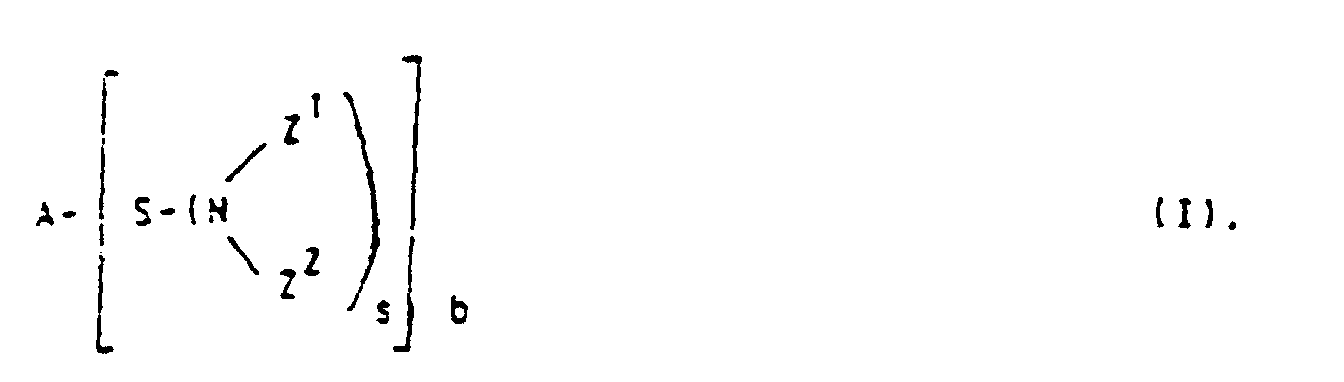
- A
- für einen Stickstoff-haltigen Kaskadenkern der Basismultiplizität b,
- S
- für eine Reproduktionseinheit,
- N
- für ein Stickstoffatom,
- Z1 und Z2
- für die erste bis vorletzte Generation jeweils für
für die letzte Generation dagegen
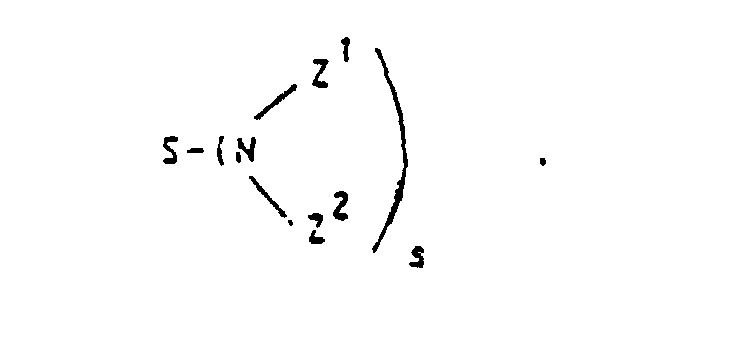
- Z1
- für ein Wasserstoffatom, einen gegebenenfalls 1 bis 3 Carboxyl-, 1 bis 3 Sulfonsäure-, 1 bis 5 Hydroxygruppen und/oder 1 bis 3 Sauerstoffatome enthaltenden C1-C10-Alkyl-, C2-C10-Acyl- oder C1-C10-Alkylsulfonylrest oder für den Rest eines Komplexes K und
- Z2
- für den Rest eines Komplexes K
- b
- für die Ziffern 1 bis 50 und
- s
- für die Ziffern 1 bis 3 stehen,
- K
- einen an die terminalen Stickstoffatome der letzten
Generation über V gebundenen Komplex-Rest der
allgemeinen Formel (IB) bedeutet
worin
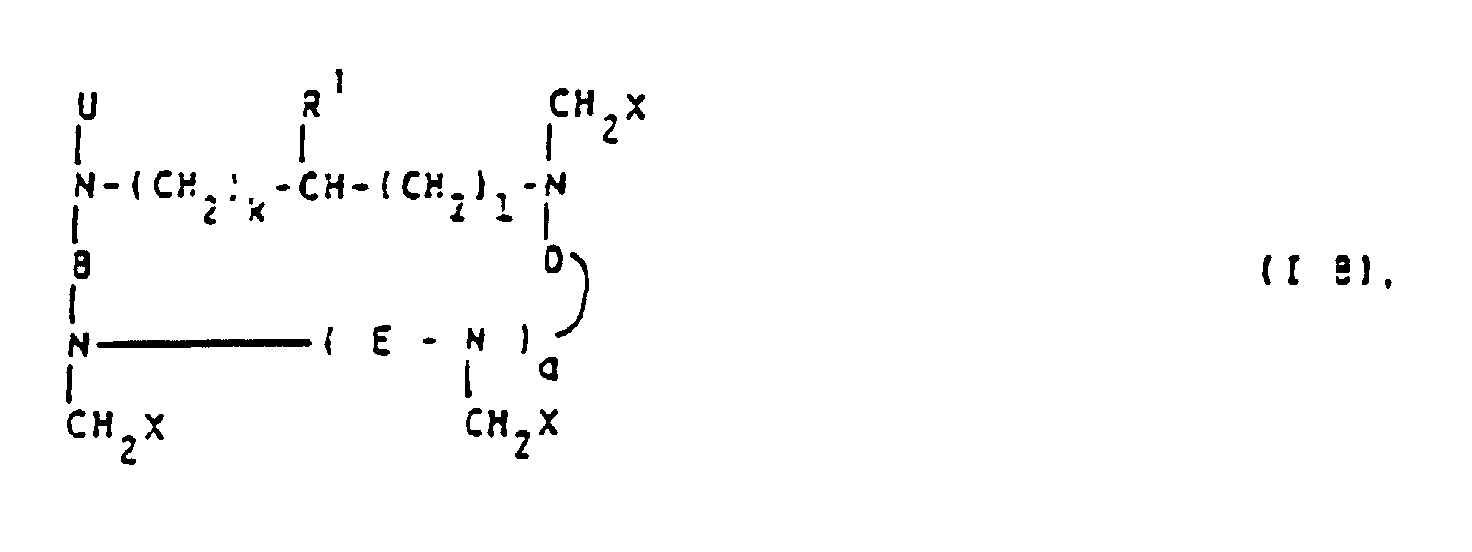
- k
- für die Ziffern 1,2,3,4 oder 5,
- l
- für die Ziffern 0,1,2,3,4 oder 5,
- q
- für die Ziffern 0,1 oder 2,
- U
- für CH2X oder V
- X
- für den Rest -COOH stehen,
- B,D und E
- die gleich oder verschieden sind, jeweils für die Gruppe -(CH2)a- mit a in der Bedeutung der Ziffern 2,3,4 oder 5,
- R1
- für V oder ein Wasserstoffatom
mit der Maßgabe, daß R1 nur dann für V steht, wenn U gleichzeitig CH2X bedeutet, und daß U nur dann für V steht, wenn gleichzeitig R1 ein Wasserstoffatom bedeutet, sowie der Maßgabe, daß gewünschtenfalls ein Teil der COOH-Gruppen als Ester und/oder Amid vorliegt,- V
- eine gegebenenfalls Imino-, Phenylen-, PhenylenoxyPhenylenimino-, Amid-, Hydrazid-, Ureido-, Thioureido-, Carbonyl-, Estergruppe(n), Sauerstoff-, Schwefel- und/oder Stickstoff-Atom(e) enthaltende gegebenenfalls durch Hydroxy-, Mercapto-, Imino-, Epoxy-, Oxo-, Thioxo- und/oder Aminogruppen (n) substituierte geradkettige, verzweigte, gesättigte oder ungesättigte C1-C20-Alkylengruppe bedeutet,
zur Verwendung als Kontrastmittel für die NMR- oder Röntgen-Diagnostik.
Stickstoffatom
NR2R3R4,



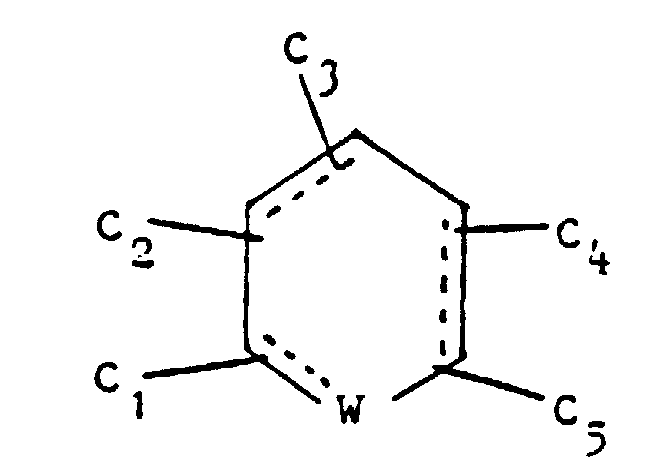

- R2, R3 und R4
- jeweils unabhängig voneinander für eine kovalente Bindung oder (CH2)k-(C6H4)r-(CH2)l-N ,
- g
- für die Ziffern 2, 3, 4 oder 5,
- t
- für die Ziffern 1, 2, 3, 4, 5, 6, 7 oder 8,
- W
- für CH, CH2, NH oder ein Stickstoffatom,
- C1
- für (CH2)k-N ,
- C2, C3, C4 und C5
- jeweils unabhängig für ein Wasserstoffatom oder (CH2)f-N ,
- j
- für die Ziffern 6, 7 oder 8,
- Y1 und Y2
- jeweils unabhängig voneinander für ein Wasserstoffatom, CH2-CH(OH)-CH2N oder (CH2)a-N und
- Y3
- für ein Stickstoffatom, O-CH2-CH(OH)-CH2N oder O-(CH2)g-N
- ---
- für eine Einfach- oder Doppelbindung
Tris(aminoethyl)amin (b = 6);
Tris(aminopropyl)amin (b = 6);
Diethylentriamin (b = 5);
Triethylentetramin (b = 6);
Tetraethylenpentamin (b = 7);
H2N-CH2-C6H4-CH2-NH-CH2-C6H4-CH2-NH2 (b = 5);
1,3,5-Tris(aminomethyl)benzol (b = 6);
2,4,6-Tris(aminomethyl)-pyridin (b = 6);
1,4,7-Triazacyclononan (b = 3);
1,4,7,10-Tetraazacyclododecan (b = 4);
1,4,7,10,13-Pentaazocyclopentadecan (b = 5);
1,4,8,11-Tetraazacyclotetradecan (b = 4);
1,4,7,10,13,16,19,22,25,28-Decaazacyclotriacontan (b = 10);
6,6',6",6"',6"",6""'-Hexaamino-6,6',6",6"',6"",6'""-Hexadeoxy-α-cyclodextrin (b = 12);
6,6',6'',6"',6"",6""'-Heptaamino-6,6',6",6"',6"",6""'-Heptadeoxy-β-cyclodextrin (b = 14);
6,6',6",6"',6"",6""'-Hexa-(1-Amino-2-hydroxypropyl)-α-cyclodextrinhexaether (b = 12);
2,2',2",2"',2"",2""',6,6',6",6"',6"",6""'-Dodeca-(1-Amino-2-hydroxypropyl)-α-cyclodextrin-dodeca-ether (b = 24).
-(CH2)2-CONH-(CH2)a-
oder
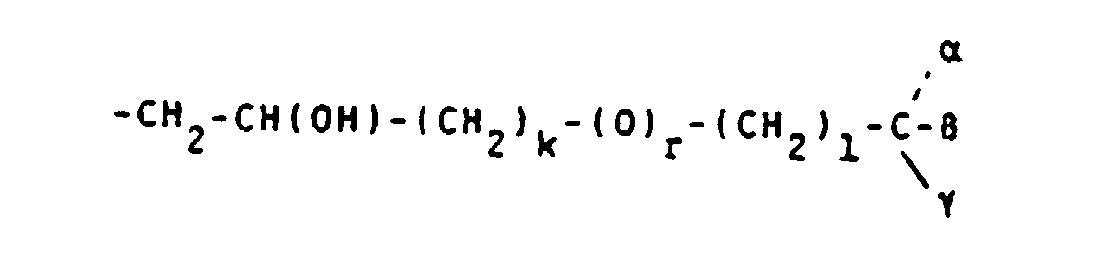
- α und β
- jeweils für ein Wasserstoffatom oder (CH2)o,
- γ
- für (CH2)f,
- f
- für die Ziffern 1, 2, 3, 4 oder 5,
- o
- für die Ziffern 0, 1, 2, 3, 4 oder 5, wobei l und o nicht gleichzeitig für die Ziffer 0 stehen sollen, und
- r
- für die Ziffern 0 oder 1
-(CH2)2-CONH-(CH2)2-;
-CH2-CH(OH)-CH2-;
-CH2-CH(OH)-CH2-O-(CH2)2-;
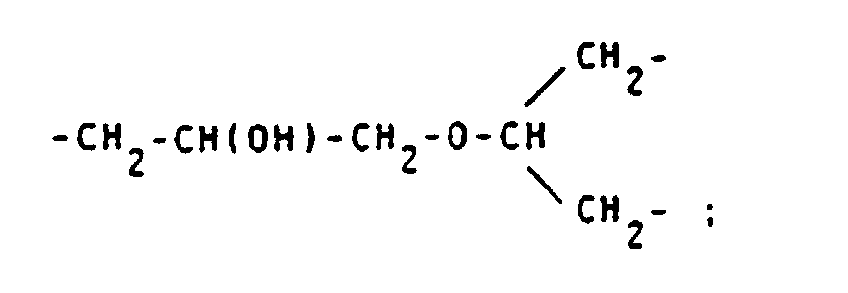
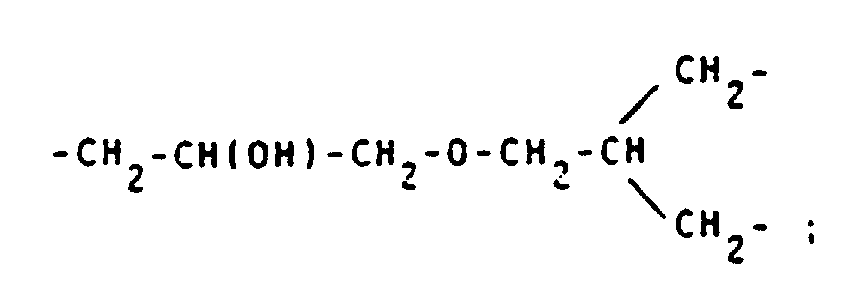

-CH2-CH(OH)-CH2-O-CH2CH2-;
-CH2-CH(OH)-CH2-;





-CH2-CH(OH)-CH2-OCH2-C6H4-NH-CO-CH2-S-(CH2)4-S-;

-CH2-OH(OH)-CH2-O-(CH2)2-NHCS-;
-CH2-CH(OH)-CH2-NHCS-;
-CH2-CH(OH)-CH2-O-(CH2)2-O-(CH2)2NHCS-;
-CH2-CH(OH)-CH2-O-(CH2)2-NH-CO-CH2-;
-CH2-CH(OH)-CH2-O-C6H4-NHCS-
-CH2-CH(OH)-CH2-O-C6H4-NHCO-;
-CH2-CH(OH)-CH2-O-CH2-C6H4-NHCS-;
-CH2-O-C6H4-CH2-; -CH2-CH(OH)-CH2-O-C6H4-CH2-; -C(= NH)-O-C6H4-CH2-;
-(CH2)4-NH-CO-CH2-O-C6H4-CH2-; -(CH2)4-NH-CH2-CH(OH)-CH2-O-C6H4-CH2-;
-(CH2)3-O-C6H4-CH2-; -CH2-CO-NH-(CH2)3-O-CH2-; -CH2-CO-NH-NH-;
-CH2-CONH-(CH2)2-; -CH2-CO-NH-(CH2)10-; -CH2-CONH-(CH2)2-S-;
-(CH2)4-NH-CO-(CH2)8-; -CH2-CO-NH-(CH2)3-NH-; -(CH2)3-NH-Gruppe steht.

- A
- für einen Stickstoff-haltigen Kaskadenkern der Basismultiplizität b,
- S
- für eine Reprodukfionseinheit,
- N
- für ein Stickstoffatom,
- Z1' und Z2'
- für die erste bis vorletzte Generation jeweils für
für die letzte Generation dagegen jeweils für ein Wasserstoffatom,

- b
- für die Ziffern 1 bis 50 und
- s
- für die Ziffern 1 bis 3

- k
- für die Ziffern 1, 2, 3, 4 oder 5,
- l
- für die Ziffern 0, 1, 2, 3, 4 oder 5,
- q
- für die Ziffern 0, 1 oder 2,
- U'
- für -CH2C*O-, CH2X' oder V", wobei V" für eine gegebenenfalls Imino-, Phenylen-. Phenylenoxy-, Phenylenimino-, Amid-, Hydrazid-, Ureido-. Thioureido-, Carbonyl-, Estergruppe(n), Sauerstoff-, Schwefel- und oder Stickstoff-Atom(e) enthaltende gegebenenfalls durch Hydroxy-, Mercapto-, Imino-, Epoxy-, Oxo-, Thioxo- und/oder Aminogruppe(n) substituierte geradkettige, verzweigte, gesättigte oder ungesättigte C1-C20-Alkylengruppe
- X'
- unabhängig voneinander jeweils für die Reste -COOH, COOY oder V"' steht,
- Y
- eine Säureschutzgruppe oder ein Metallonenäquivalent eines Elements der Ordnungszahlen 21-29, 39, 42, 44 oder 57-83 und
- V"'
- einen in V' umzuwandelnden Substituenten bedeutet,
- C*O
- für eine aktivierte Carbonylgruppe
- B, D und E,
- die gleich oder verschieden sind, jeweils für die Gruppe (CH2)a mit a in der Bedeutung der Ziffern 2, 3, 4 oder 5,
- R1 für V"
- oder ein Wasserstoffatom
mit der Maßgabe, daß R1' nur dann für V" steht, wenn U' gleichzeitig CH2X' bedeutet, und daß U' nur dann für -CH2C*O- oder V" steht, wenn gleichzeitig R1 ein Wasserstoffatom bedeutet,
umsetzt, gegebenenfalls vorhandene Schutzgruppen gewünschtenfalls abspaltet, die so erhaltenen Kaskaden-Polymere gewünschtenfalls - sofern K' für einen Komplexbildner steht - in an sich bekannter Weise mit mindestens einem Metalloxid oder Metallsalz eines Elements der Ordnungszahlen 21 - 29, 39, 42, 44 oder 57 - 83 umsetzt und in beliebiger Reihenfolge gegebenenfalls anschließend in den so erhaltenen Polymer-Komplexen noch vorhandene acide Wasserstoffatome ganz oder teilweise durch Kationen anorganischer und/oder organischer Basen, Aminosäuren oder Aminosäureamide substituiert bzw. die entsprechenden Säuregruppen ganz oder teilweise in Ester oder Amide überführt.
-CH2-CHOH-CH2-NCS;
-CH2-CHOH-CH2-O-(CH2)2-NCS;
-CH2-CHOH-CH2-O-(CH2)2-NH-CO-CH2-Br;
-CH2-CHOH-CH2-O-(CH2)2-O-(CH2)2-NCS;
-NCS;
-CH2-CHOH-CH2-O-CH2-CHO;
-CH2-CHOH-CHO;
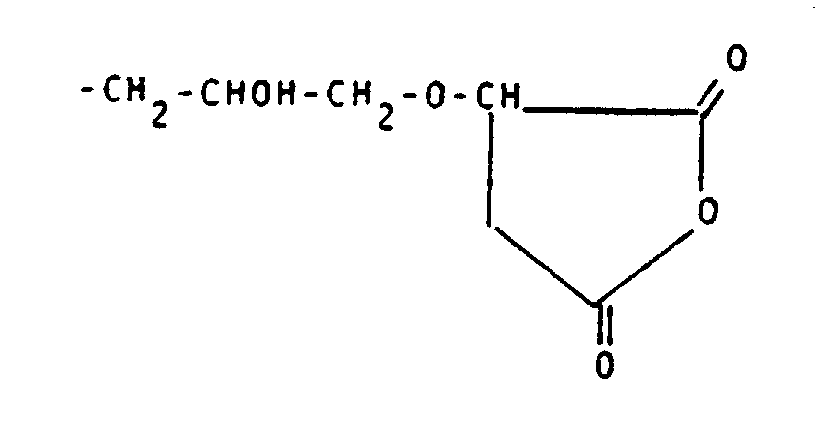
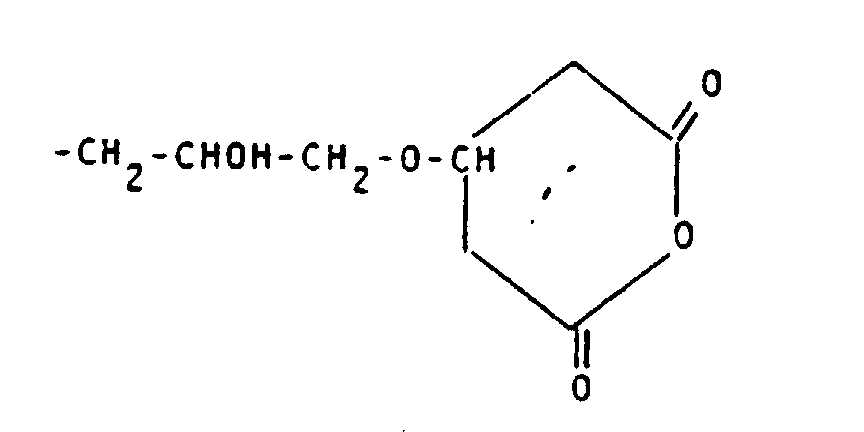
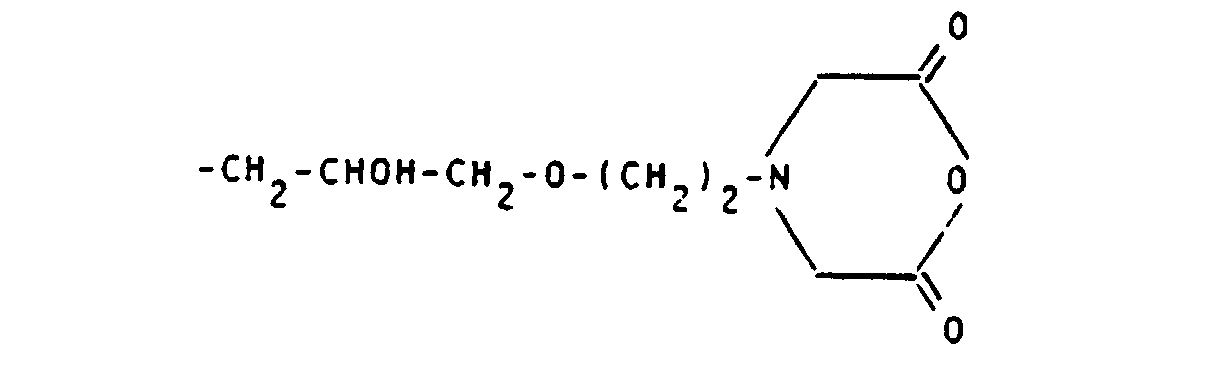
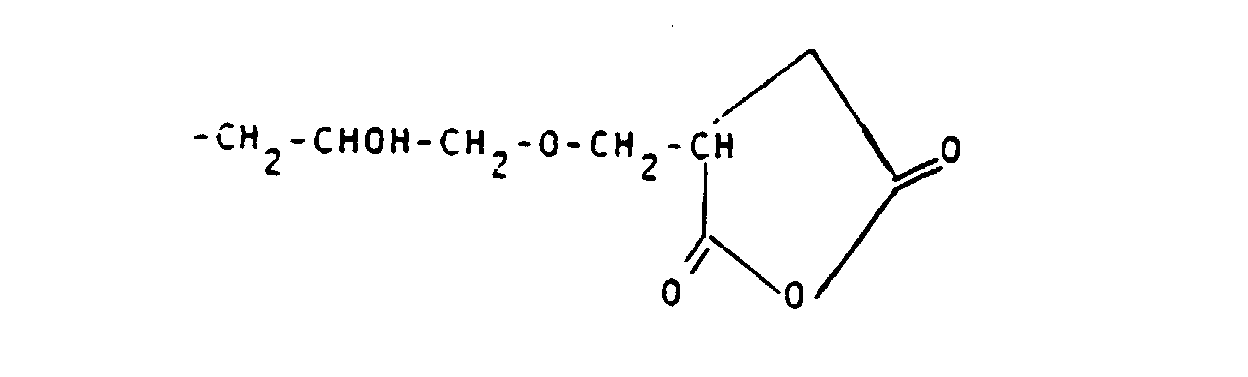


Br-CH2COOH; Cl-CH2-CH2-COOH; H2C=CH-COOCH3; HOOC-CH = CH-COOCH3; CH2 = C(OOOEt)-CH2OH; Br-CH2-So3H; Cl-CH2-CH2-SO3H; CH3-CO-Cl; Cl-CO-CH2OH; Cl-CO-CHOH-CH2OH; ClSO2CH3; ClSO2CH2COOC2H5; Br-CO-(CHOH)4-CH2OH; Cl-CO-CH2-COOC2H5;

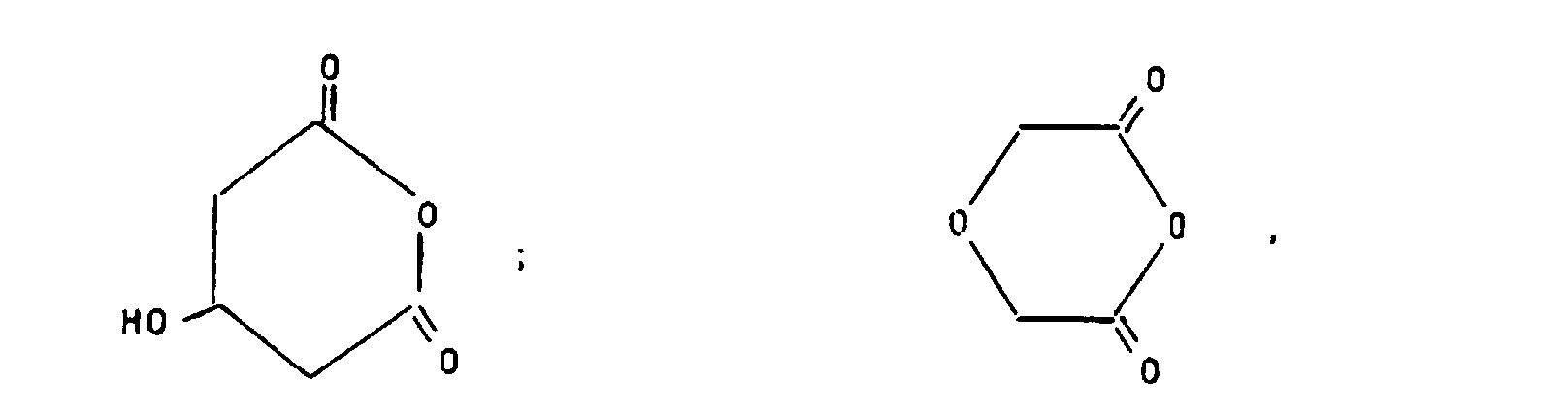

Zu einer gut gerührten Suspension aus 234.51 g (2,53 mol) Epichlorhydrin und 200 ml 32 % Natronlauge tropft man bei 0°C 100 g (506.9 mmol) Dibenzylamin (gelöst in 300 ml Methylenchlorid). Man rührt 2 Stunden bei 0°C dann 3 Stunden bei Raumtemperatur. Es wird mit 3 l Wasser verdünnt und 3 mal mit 500 ml Methylenchlorid extrahiert. Die organischen Phasen werden vereinigt, über Magnesiumsulfat getrocknet und im Vakuum eingedampft. Das zurückbleibende Öl wird an Kieselgel "Flash"-chromatographiert (Laufmittel: Methylenchlorid/Hexan/Aceton: 20/10/3). Ausbeute: 111,72 g eines farblosen Öls (87 % der Theorie)
| Analyse: | |||
| C 80,60 | H 7,56 | N 5,53 | (Ber.) |
| C 80,62 | H 7,50 | N 5,48 | (Gef.) |
20 g (78,95 mmol) der Titelverbindung aus Beispiel 1a) und 20,51 g (59,21 mmol) 1,4,7-Triscarboxymethyl-1,4,7,10-tetraazacyclododecan (≙ DO3A) werden in einer Mischung aus 50 ml Dioxan 200 ml Wasser gelöst, und der pH-Wert mit 6N Kalilauge auf pH 10 gebracht. Man rührt 24 Stunden bei 40°C. Man dampft zur Trockene ein, nimmt den Rückstand mit 500 ml Wasser/500 ml Methanol auf und extrahiert 2 mal mit 200 ml tert-Buthyl-methylether Die wässrige Lösung wird mit 5N Salzsäure auf pH 3 gestellt und zu Trockene eingedampft. Der Rückstand wird im Vakuum eingeengt und anschließend auf eine Säule aus Poly-(4-vinylpyridin) geben. Das Produkt wird mit einer Lösung aus Ethanol/Wasser 1:1 eluiert. Nach Eindampfen im Vakuum erhält man 22,37 g (63 % der Theorie, bezogen auf DO3A) der Titelverbindung als stark hygroskopischen, glasigen Feststoff (6,9 % Wasser laut Analyse).
| Analyse: | |||
| C 62,08 | H 7,56 | N 11,68 | (Ber.) |
| C 62,15 | H7,61 | N 11,61 | (Gef.) |
21 g (35,02 mmol) der Titelverbindung aus Beispiel 1b) werden in einer Lösung aus 150 ml entionisiertem Wasser/50 ml Methanol gelöst und 6,35 g (17,51 mmol) Gadoliniumoxid zugesetzt. Man kocht 2 Stunden unter Rückfluß. Es werden 3 g Aktivkohle zugesetzt. Die Lösung wird heiß filtriert und das Filtrat im Vakuum zur Trockene eingedampft. Ausbeute 25,08 g (95 % der Theorie) eines glasigen Feststoffes (5,2 % Wasser laut Analyse).
| Analyse: | ||||
| C 49,39 | H 5,61 | N 9,29 | Gd 20,86 | (Ber.) |
| C 49,41 | H 5,70 | N 9,25 | Gd 20,88 | (Gef.) |
24 g (31,83 mmol) der Titelverbindung aus Beispiel 1c) werden in einer Mischung aus 250 ml entionisiertem Wasser/150 ml Methanol gelöst und 10 g Palladiumkatalysator (10 % Pd auf Aktivkohle) zugesetzt. Anschließend wird 24 Stunden bei 50°C hydriert. Man filtriert vom Katalysator ab und dampft das Filtrat im Vakuum ein. Ausbeute: 17,89 g (98 % der Theorie) der Titelverbindung als glasigen Feststoff (6,4 % Wasser laut Analyse).
| Analyse: | ||||
| C 35,59 | H 5,27 | N 12,21 | Gd 27,41 | (Ber.) |
| C 35,51 | H 5,34 | N 12,16 | Gd 27,36 | (Gef.) |
Zu einer Lösung aus 12 g (20.92 mmol) der Titelverbindung aus Beispiel 1d) in 500 ml entionisiertem Wasser und 20 ml Polyvinylpyridin (Reillex) gibt man eine Lösung aus 4,81 g (41,83 mmol) Thiophosgen in 100 ml Chloroform. Die zweiphasige Lösung wird 10 Minuten bei 40°C, dann eine Stunde bei Raumtemperatur gerührt und filtriert. Die organische Phase wird abgetrennt und die Wasserphase 2 mal mit 200 ml Chloroform nachextrahiert. Anschließend wird die Wasserphase gefriergetrocknet. Ausbeute: 12,62 g (98 % der Theorie) eines farblosen Pulvers (5,7 % Wasser laut Analyse).
| Analyse: | |||||
| C 35,11 | H 4,58 | N 11,37 | S 5,21 | Gd 25,54 | (Ber.) |
| C 35,04 | H 4,64 | N 11,31 | S 5,15 | Gd 25,48 | (Gef.) |
100 g (414 mmol) N-Dibenzylaminoethanol werden in 200 ml Methylenchlorid gelöst und bei 0°C zu einer stark gerührten Mischung aus 250 ml 50 % Natronlauge, 7,03 g (20,7 mmol) Tetra-n-butylammoniumhydrogensülfat 153,4 g (1,657 mol) Epichlorhydrin getropft. Man rührt 8 Stunden bei 0° C, über Nacht bei Raumtemperatur. Man verdünnt mit 2 l Wasser und extrahiert 3 mal mit 500 ml Methylenchlorid Die vereinigten organischen Phasen werden über Magnesiumsulfat getrocknet und im Vakuum eingedampft. Das zurückbleibende Öl wird einer Flash-Chromatographie unterworfen. (Kieselgel/Laufmittel: Methylenchlorid/Hexan/Aceton 20/10/3) Ausbeute: 96.12 g (78 % der Theorie) eines farblosen Öls.
| Analyse: | |||
| C 76,74 | H 7,79 | N 4,71 | (Ber.) |
| C 76,68 | H 7,85 | N 4,66 | (Gef.) |
34,34 g (115,47 mmol) der Titelverbindung aus Beispiel 2a) und 20 g (57,74 mmol) 1,4,7-Triscarboxymethyl-1,4,7,10-tetraazacyclododecan (≙ DO3A) werden in einer Mischung aus 60 ml Dioxan/350 ml Wasser gelöst und der pH-Wert mit 6N Kalilauge auf pH 10 gestellt. Man rührt 24 Stunden bei 40°C. Es wird wie unter Beispiel 1b) beschrieben aufgearbeitet. Ausbeute: 26,39 g (71 % der Theorie bezogen auf DO3A) eines glasigen Fettstoffes (7,1 % Wasser laut Analyse).
| Analyse: | |||
| C 61,57 | H 7,67 | N 10,88 | (Ber.) |
| C 61,49 | H 7,80 | N 10,79 | (Gef.) |
23 g (35,73 mmol) der Titelverbindung aus Beispiel 2b) werden in einer Lösung aus 150 ml entionisiertem Wasser/50 ml Methanol gelöst und 6,48 g (17,86 mmol) Gadoliniumoxid zugesetzt. Man kocht 2 Stunden unter Rückfluß. Es werden 3 g Aktivkohle zugesetzt und eine zweite Stunde refluxiert. Die Lösung wird heiß filtriert und das Filtrat im Vakuum zur Trockene eingedampft. Man erhält 27,65 g (97 % der Theorie) der Titelverbindung als glasigen Feststoff (7,8 % Wasser laut Analyse).
| Analyse: | ||||
| C 49,67 | H 5,81 | N 8,78 | Gd 19,71 | (Ber.) |
| C 49,61 | H 5,89 | N 8,71 | Gd 19,61 | (Gef.) |
25 g (31,33 mmol) der Titelverbindung aus Beispiel 2c) werden in einer Mischung aus 250 ml entionisiertem Wasser/150 ml Methanol gelöst und 10 g Palladiumkatalysator (10 % Pd auf Aktivkohle) zugesetzt. Anschließend wird 24 Stunden bei 50°C hydriert. Man filtriert vom Katalysator ab und dampft das Filtrat im Vakuum ein. Ausbeute: 19,16 g (99 % der Theorie) der Titelverbindung als glasigen Feststoff (5,7 % Wasser laut Analyse).
| Analyse: | ||||
| C 36,94 | H 5,55 | N 11,34 | Gd 25,45 | (Ber.) |
| C 36,88 | H 5,59 | N 11,27 | Gd 25,38 | (Gef.) |
Zu einer Lösung aus 15 g (24,28 mmol) der Titelverbindung aus Beispiel 2d) in 500 ml entionisiertem Wasser und 20 ml Polyvinylpyridin (Reillex)) gibt man eine Lösung aus 5,58 g (48,56 mmol) Thiophosgen in 100 ml Chloroform. Die zweiphasige Lösung wird 10 Minuten bei 40°C, dann eine Stunde bei Raumtemperatur gerührt und filtriert. Die organische Phase wird abgetrennt und die Wasserphase 2 mal mit 200 ml Chloroform extrahiert. Anschließend wird die Wasserphase gefriergetrocknet. Ausbeute: 15,7 g (98 % der Theorie) eines farblosen Pulvers (6,1 % Wasser laut Analyse).
| Analyse: | |||||
| C 36,41 | H 4,89 | N 10,61 | Gd 23,83 | S 4,86 | (Ber.) |
| C 36,35 | H 4,95 | N 10,51 | Gd 23,71 | S 4,78 | (Gef.) |
| Analyse: | |||||
| C 34,15 | H 4,78 | N 9,48 | Gd 21,29 | Br 10,82 | (Ber.) |
| C 34,11 | H 4,85 | N 9,41 | Gd 21,19 | Br 10,75 | (Gef.) |
Eine Mischung aus 50 g (475,56 mmol) 2-(2-Amino-aethoxy) aethanol und 144,6 g (1,046 mol) Kaliumcarbonat in 600 ml EtOH/60 ml Wasser wird auf 60°C erhitzt. Zu dieser Mischung tropft man innerhalb 1 Stunde 178,95 g (1,046 mol) Benzylbromid zu und kocht anschließend 2 Stunden unter Rückfluß. Man dampft im Vakuum ein, nimmt den Rückstand mit 1 Methylenchlorid auf und filtriert von den Salzen ab. Das Filtrat wird im Vakuum eingeengt und durch Flash-Chromatographie gereinigt. (Kieselgel/Lautmittel: Methylenchlorid/Hexan/Aceton: 10/5/1) Ausbeute: 127,58 g (94 % der Theorie) eines farblosen Öls.
| Analyse: | |||
| C 75,76 | H 8,12 | N 4,91 | (Ber.) |
| C 75,71 | H 8,18 | N 4,85 | (Gef.) |
Zu einer gut gerührten Suspension aus 162,11 g (1,752 mol) Epichlorhydrin, 8,2 g (24,15 mmol) Tetranbutylammoniumhydrogensulfat und 250 ml 50 % Natronlauge tropft man bei 0°C eine Lösung aus 125 g (438 mmol) der Titelverbindung aus Beispiel 4a) in 200 ml Methylenchlorid. Man rührt 8 Stunden bei 0°C, über Nacht bei Raumtemperatur. Es wird mit 2 l Wasser verdünnt und 2 mal mit 500 ml Methylenchlorid extrahiert. Die vereinigten organischen Phasen werden über Magnesiumsulfat getrocknet und im Vakuum eingedampft. Das zurückbleibende Öl wird durch Flash-Chromatographie gereinigt (Kieselgel/Laufmittel: Methylenchlorid/Hexan/ Aceton: 20/10/3) Ausbeute: 116,5 g (78 % der Theorie) eines farblosen Öls.
| Analyse: | |||
| C 73,87 | H 7,79 | N 4,10 | (Ber.) |
| C 73,78 | H 7,95 | N 4,03 | (Gef.) |
39,43 g (115,47 mmol) der Titelverbindung aus Beispiel 4b) und 20 g (57,74 mmol) 1,4,7-Triscarboxymethyl-1,4,7,10-tetraazacyclododecan (≙ DO3A) werden in einer Mischung aus 60 ml Dioxan/250 ml Wasser gelöst und der pH-Wert mit 6N Kalilauge auf pH 10 gestellt. Man rührt 24 Stunden bei 40°C. Anschließend wird, wie unter Beispiel 1b) beschrieben, aufgearbeitet. Ausbeute: 28,59 g (72 % der Theorie bzg. auf D03A) eines glasigen Feststoffes (6,3 % Wasser laut Analyse).
| Analyse | |||
| C 61,12 | H 7,77 | N 10,18 | (Ber.) |
| C 61,07 | H 7,84 | N 10,05 | (Gef.) |
25 g (36,35 mmol) der Titelverbindung aus Beispiel 4c) werden in einer Lösung aus 150 ml entionisiertem Wasser/50 ml Methanol gelöst und 6,59 g (18,17 mmol) Gadoliniumoxid zugesetzt. Man kocht 2 Stunden unter Rückfluß. Es werden 3 g Aktivkohle zugesetzt und eine zweite Stunde refluxiert. Die Lösung wird heiß filtriert und das Filtrat im Vakuum zur Trockene eingedampft. Ausbeute: 30,0 g (98 % der Theorie) der Titelverbindung als glasiger Feststoff (5,4 % Wasser laut Analyse).
| Analyse: | ||||
| C 49,92 | H 5,98 | N 8,32 | Gd 18,67 | (Ber.) |
| C 49,83 | H 5,90 | N 8,34 | Gd 18,58 | (Gef.) |
| Analyse: | ||||
| C 50,24 | H 6,02 | N 8,37 | Eu 18,16 | (Ber.) |
| C 50,17 | H 5,96 | N 8,29 | Eu 18,09 | (Gef.) |
29 g (34,44 mmol) der Titelverbindung aus Beispiel 4d) werden in einer Mischung aus 250 ml entionisiertem Wasser/150 ml Methanol gelöst und 10 g Palladiumkatalysator (10 % Pd auf Aktivkohle) zugesetzt. Anschließend wird 24 Stunden bei 50°C hydriert. Man filtriert vom Katalysator ab und dampft das Filtrat im Vakuum ein. Ausbeute: 22,56 g (99 % der Theorie) der Titelverbindung als glasigen Feststoff (6,5 % Wasser laut Analyse)
| Analyse: | ||||
| C 38,11 | H 5,79 | N 10,58 | Gd 23,76 | (Ber.) |
| C 38,05 | H 5,86 | N 10,47 | Gd 23,65 | (Gef.) |
Zu einer Lösung aus 15 g (22,66 mmol) der Titelverbindung aus Beispiel 4e) in 500 ml entionisiertem Wasser und 20 ml Polyvinylpyridin (Reillex) gibt man eine Lösung aus 5,21 g (45,33 mmol) Thiophosgen in 100 ml Chloroform. Die zweiphasige Lösung wird 10 Minuten bei 40°C, dann eine Stunde bei Raumtemperatur gerührt und filtriert. Die organische Phase wird abgetrennt und die Wasserphase 2 mal mit 200 ml Chloroform extrahiert. Anschließend wird die Wasserphase gefriergetrocknet. Ausbeute: 15,64 g (98 % der Theorie) eines farblosen Pulvers (5,9 % Wasser laut Analyse)
| Analyse: | |||||
| C 37,54 | H 5,15 | N 9,95 | Gd 22,34 | S 4,55 | (Ber.) |
| C 37,49 | H 5,11 | N 9,91 | Gd 22,27 | S 4,61 | (Gef.) |
7,6 ml Tris(aminoethyl)amin (50 mmol) werden in 10 ml Methanol gelöst und tropfenweise zu 54,5 ml (600 mmol) Methylacrylat gegeben. Die Mischung wird 3 Tage bei Raumtemperatur gerührt und anschließend im Vakuum eingedampft. Das verbleibende Öl wird aus Methanol/Ether/Hexan umgefällt. Ausbeute: 30,59 g (92,3 % der Theorie) leicht gelbliches Öl.
| Analyse: | |||
| C 54,37 | H 8,21 | N 8,45 | (Ber.) |
| C 54,32 | H 8,29 | N 8,43 | (Gef.) |
26,5 g des in Beispiel 5a) beschriebenen Hexa-methylesters (40 mmol) werden in 20 ml Methanol gelöst und langsam zu 242 ml Ethylendiamin (3,6 mol) getropft und anschließend 3 Tage bei Raumtemperatur gerührt. Die Lösung wird im Vakuum eingedampft und das verbleibende Öl aus Methanol/Ether umgefällt. Ausbeute: 31,25 g (94 % der Theorie) leicht gelb gefärbtes Öl.
| Analyse: | |||
| C 52,03 | H 9,46 | N 26,96 | (Ber.) |
| C 51,97 | H 9,49 | N 26,89 | (Gef.) |
Zu 103 ml (1,14 mol) Methylacrylat werden 30,1 g 36,2 mmol) des in Beispiel 5b) beschriebenen Hexa-Amins in 50 ml Methanol so langsam zugetropft, daß die Lösung klar bleibt und 5 Tage bei Raumtemperatur gerührt. Nach Einengen im Vakuum wird mehrmals aus Methanol/Ether/Hexan umgefällt. Ausbeute: 64,2 g (95,1 %) gelbliches Öl.
Im FAB-Massenspektrum ist der M+H+-Peak deutlich erkennbar. Eine analytische Probe zeigte nach Korrektur des gaschromatographisch bestimmten Methanols folgende Elementaranalyse:
| C 54,12 | H 8,11 | N 12,02 | (Ber.) |
| C 54,01 | H 8,19 | N 11,98 | (Gef.) |
64,0 g (34,3 mmol) des in Beispiel 5c) beschriebenen Dodeka-Methylesters werden in 50 ml Methanol gelöst und langsam zu 870 ml Ethylendiamin (13 mol) getropft und 5 Tage bei Raumtemperatur gerührt. Nach Einengen im Vakuum wird mehrmals aus Methanol/Ether umgefällt, bis dünnschichtchromatographisch kein Ethylendiamin mehr nachweisbar ist. Ausbeute: 73,7 g (97 %) zähes, gelbliches Öl. Im FAB-Massenspektrum ist der Quasimolekülpeak bei 2201 deutlich erkennbar. Eine analytische Probe zeigte nach Korrektur des gaschromatographisch bestimmten Methanols folgende Elementaranalyse:
| C 52,39 | H 9,07 | N 25,46 | (Ber.) |
| C 52,29 | H 9,21 | N 25,71 | (Gef.) |
68,0 g (30 mmol) des 12-Amins (Beispiel 5d) werden in 120 ml Methanol gelöst und so langsam zu 270 ml (3 mol) Methylacrylat zugetropft, daß die Lösung homogen bleibt (Zugabe innerhalb 3 Stunden). Nach 5 Tagen wird analog Beispiel 5c) aufgearbeitet. Ausbeute: 119,7 g (93,5 %) gelbliches Öl. Das FAB-Massenspektrum zeigt das Quasimolekülion bei m/e=4268.
Eine analytische Probe zeigte nach Korrektur des gaschromatographisch bestimmten Methanols folgende Elementaranalyse:
| C 54,04 | H 8,08 | N 13,13 | (Ber.) |
| C 54,28 | H 8,01 | N 12,99 | (Gef.) |
39,87 g (9,3 mmol) des 24-Methylesters werden in 100 ml Methanol gelöst und tropfenweise zu 1,5 l Ethylendiamin (23 mol) gegeben und nach 7 Tagen analog Beispiel 5d) aufgearbeitet. Man erhält 44,0 g (95,9 %) eines zähen, gelbfarbenen Öls. Die Substanz ist im HPLC-Chromatogramm in 1M NaClO4 an Lichrospher DIOL 100, 500, 1000 (Merck) einheitlich.
| Analyse: | |||
| C 52,51 | H 8,94 | N 24,95 | (Ber.) |
| C 52,17 | H 8,72 | N 25,27 | (Gef.) |
5,54 ml Diethylentriamin (50 mmol) werden in 20 ml Methanol gelöst und tropfenweise zu 45,4 ml Methylacrylat (500 mmol) gegeben. Die Mischung wird 5 Tage bei Raumtemperatur gerührt und anschließend im Vakuum eingedampft. Das verbleibende Öl wird aus Methanol/Ether/Hexan umgefällt. Ausbeute: 24,8 g (92,9 %) leicht gelbliches Öl
| Analyse: | |||
| C 54,02 | H 8,12 | N 7,87 | (Ber.) |
| C 53,92 | H 8,06 | N 7,92 | (Gef.) |
21,3 g des in Beispiel 6a) beschriebenen Penta-methylesters (40 mmol) werden in 20 ml Methanol gelöst und langsam zu 202 ml Ethylendiamin (3,0 mol) getropft und anschließend 3 Tage bei Raumtemperatur gerührt. Die Lösung wird im Vakuum eingedampft und das verbleibende Öl aus Methanol/Ether umgefällt. Ausbeute: 24,8 g (92 %) leicht gelb gefärbtes Öl.
| Analyse: | |||
| C 51,69 | H 9,42 | N 27,02 | (Ber.) |
| C 51,48 | H 9,36 | N 27,15 | (Gef.) |
Zu 68 ml (0,75 mol) Methylacrylat werden 20,7 g des in Beispiel 6b) beschriebenen Penta-Amins in 35 ml Methanol so langsam zugetropft, daß die Lösung klar bleibt und 5 Tage bei Raumtemperatur gerührt. Nach Einengen im Vakuum wird mehrmals aus Methanol Ether/Hexan umgefällt. Ausbeute: 39,8 g (84 %) gelbliches Öl. Im FAB-Massenspektrum ist der M+H+-Peak deutlich erkennbar. Nach Korrektur des gaschromatographisch bestimmten Methanol-Gehalts zeigte eine analytische Probe folgende Elementaranalyse:
| C 54,00 | H 8,08 | N 11,86 |
| C 54,27 | H 8,16 | N 11,63 |
39,5 g (25,7 mmol) des in Beispiel 6c) beschriebenen Deka-Methylesters werden in 30 ml Methanol gelöst und langsam zu 520 ml (7,8 mol) Ethylendiamin gegeben und 5 Tage bei Raumperatur gerührt. Nach Einengen im Vakuum wird mehrmals aus Methanol Ether umgefällt, bis dünnschichtchromatographisch kein Ethylendiamin mehr nachweisbar ist. Ausbeute: 44,9 g (96,2 %) gelbliches Öl. Im FAB-Massenspektrum ist der Quasimolekülpeak bei m e = 1815 gut zu erkennen. Nach Korrektur des gas-chromatographisch bestimmten Methanol-Gehalts zeigte eine analytische Probe folgende Elementaranalyse:
| C 52,27 | H 9,05 | N 25,46 | (Ber.) |
| C 52,11 | H 9,09 | N 25,67 | (Gef.) |
41,8 g (23 mmol) des Deka-Amins (Beispiel 6d) werden in 100 ml Methanol gelöst und so langsam zu 200 ml (2,2 mol) Methylacrylat zugetropft, daß die Lösung homogen bleibt (2 Stunden). Nach 5 Tagen wird analog Beispiel 6c) aufgearbeitet. Ausbeute: 72,0 g (88,5 %) gelbliches Öl.
Das FAB-Massenspektrum zeigt das Quasimolekülion bei m/e = 3536. Nach Korrektur des gas-chromatographisch bestimmten Methanol-Gehalts zeigte eine analytische Probe folgende Elementaranalyse:
| C 53,99 | H 8,06 | N 13,07 | (Ber.) |
| C 53,71 | H 8,14 | N 13,10 | (Gef.) |
68,7 g (19,4 mmol) des 20-Methylesters werden in 100 ml Methanol gelöst und tropfenweise zu 1,5 l (23 mol) Ethylendiamin gegeben und nach 7 Tagen analog Beispiel 6d) aufgearbeitet. Man erhält 74,3 g (93,5 %) eines zähen Öls. Das Öl ist HPLC-einheitlich in 1M NaClO4 an Lichrospher DIOL-100, 500, 1000 (Merck). Die Titration einer analytichen Probe mit 1N HCl ergibt 97,8 % der Theorie.
| Analyse: | |||
| C 52,46 | H 8,93 | N 24,95 | (Ber.) |
| C 51,98 | H 8,99 | N 24,49 | (Gef.) |
20,5 g (5 mmol) des in Beispiel 9f) beschriebenen 20-Amins werden in 100 ml Methanol gelöst und innerhalb 5 Stunden zu 200 ml (2,2 mol) Methylacrylat bei 50°C zugetropft und 3 Tage bei dieser Temperatur gerührt. Nach mehrmaligem Umfällen aus Methanol/Ether/Hexan erhält man 34,3 g (91 %) zähes Öl.
| Analyse: | |||
| C 53,99 | H 8,06 | N 13,56 | (Ber.) |
| C 53,69 | H 8,12 | N 13.21 | (Gef.) |
26,4 g (3,5 mmol) des im vorstehenden Beispiel 6g) erhaltenen 40-Esters werden in 100 ml Methanol gelöst und zu 1170 ml (17,5 mol) Ethylendiamin zugetropft und nach 7 Tagen analog Beispiel 6d) aufgearbeitet. Ausbeute: 28,7 g (94,6 %) zähes, gelbliches Öl.
Das Öl ist HPLC-einheitlich in 1M NaClO4 an Lichrospher DIOL-100, 500, 1000 (Merck). Die Titration einer analytischen Probe mit 1N HCl ergibt 95,3 % der Theorie.
| Analyse: | |||
| C 52,54 | H 8,88 | N 24,73 | (Ber.) |
| C 52,73 | H 8,57 | N 24,35 | (Gef.) |
2,17 g (0,25 mmol) des in Beispiel 6h) beschriebenen 40-Amins werden in 250 ml H2O gelöst. Dazu werden unter Stickstoff portionsweise in fester Form 8,43 g (12 mmol; 1,2facher Überschuß) des in Beispiel 2e) beschriebenen Isothiocyanat-Gd-Komplexes gegeben und über Nacht bei Raumtemperatur gerührt. Nach Ultrafiltration (AMICONR YM-10-Membran) wird die Leitfähigkeit der Lösung mittels Ionenaustauscher (Amberlite IR 120. H+-Form, und IRA 410, OH--Form) auf ein Minimum eingestellt. Es wird vom Austauscher abfiltriert und gefriergetrocknet.
Ausbeute: 7,6 g (87 %)
H2O-Gehalt: 6,3 %
Gd-Bestimmung (AAS): 15,6 %
T1-Relaxivität (H2O): 12,43 ± 0,51[l/mmol.sec]
(Plasma): 13,19 ± 0,42[l/mmol·sec]
| Analyse (wasserfrei): | |||||
| C 40,39 | H 5,87 | N 14,10 | Gd 17,94 | S 3,66 | (Ber.) |
| C 40,67 | H 6,15 | N 13,88 | Gd 16,88 | S 3,47 | (Gef.) |
aus dem in Beispiel 1e) beschriebenen Isothiocyanat:
| C 39,65 | H 5,70 | N 14,85 | S 3,85 | Gd 18,89 | (Ber.) |
| C 40,12 | H 5,55 | N 14,31 | S 3,39 | Gd 18,71 | (Gef.) |
| C 41,07 | H 6,03 | N 13,43 | S 3,48 | Gd 17,08 | (Ber.) |
| C 40,69 | H 5,97 | N 13,57 | S 3,61 | Gd 16,88 | (Gef.) |
19,56 g (103,92 mmol) 2,2-Dimethyl-4-(2',3'-epoxy)-propoxy-methyl-1,3-dioxolan und 10 g (28,86 mmol) 1,4,7-Triscarboxymethyl-1,4,7,10-tetraazacyclododecan (=DO3A) werden in einer Mischung aus 50 ml Dioxan/80 ml Wasser gelöst, und der pH-Wert mit 6N Kalilauge auf pH 10 gebracht. Man rührt 24 Stunden bei 70°C. Man dampft zur Trockene ein, nimmt den Rückstand mit 200 ml Wasser/50 ml Methanol auf und extrahiert 2 mal mit 100 ml tert.-Butyl-methylether. Die wäßrige Lösung wird mit 5N-Salzsäure auf pH 3 gestellt und zur Trockene eingedampft. Der Rückstand wird mit 200 ml Methanol/80 ml Dichlormethan ausgekocht (extrahiert). Man kühlt im Eisbad ab und filtriert vom ausgefallenen Kaliumchlorid ab. Das Fittrat wird im Vakuum eingedampft, der Rückstand in 45 ml Wasser/20 ml Ethanol gelöst und anschließend auf eine Säule aus Poly-(4-vinylpyridin) gegeben. Das Produkt wird mit einer Lösung aus Ethanol/Wasser 1:3 eluiert. Nach Eindampfen im Vakuum wird der Rückstand an einer Reversed Phase-Säule (RP 18/Laufmittel= Gradient aus Wasser/Tetrahydrofuran) chromatographiert. Nach Eindampfen der Hauptfraktion erhält man 10,13 g (71 % d. Th.) eines stark hygroskopischen, glasigen Feststoffes.
| Analyse (bezogen auf wasserfreie Substanz): | |||
| C 48,57 | H 7,74 | N 11,33 | ber. |
| C 48,46 | H 7,81 | N 11,24 |
8,56 g (17,3 mmol) der Titelverbindung aus Beispiel 7a werden in 50 ml entionisiertem Wasser gelöst und 3,13 g (8,65 mmol) Gadoliniumoxid zugesetzt. Es wird 3 Stunden auf 90°C erhitzt. Die abgekühlte Lösung wird eine Stunde mit 3 ml saurem lonenaustauscher (AMB 252c) und 3 ml schwach basischem Austauscher (IRA 67) gerührt. Es wird vom Austauscher abfiltriert und das Filtrat gefriergetrocknet. Ausbeute: 11,0 g (98 % d. Th.) eines farblosen amorphen Pulvers
| Analyse (bezogen auf wasserfreie Substanz): | ||||
| C 37,03 | H 5,44 | N 8,64 | Gd 24,24 | ber. |
| C 37,00 | H 5,51 | N 8,57 | Gd 24,18 |
38,93 g (60 mmol) des Gd-Komplexes aus Beispiel 7b werden in 400 ml Methanol gelöst, mit 25,67 g (120 mmol) NalO4 versetzt und 4 Stunden unter Lichtausschluß verrührt. Dann wird vom Ungelösten abfiltriert und das Filtrat gefriergetrocknet. Das Lyophilisat wird mit 6,52 g (0,625 mmol = 30 mmol-NH2) eines 48-Kaskadenamins in 750 ml Puffer pH 9,0 (Riedel de Haën, Borax/HCl) gelöst und nach Zugabe von 11,32 g (180 mmol) Natriumcyanoborhydrid 6 Tage bei Raumtemperatur gerührt. Die Lösung wird anschließend über eine Amicon-Ultrafiltrationsmembran YM5 entsalzt und schließlich gefriergetrocknet.
Ausbeute: 16,45 g (61 % d. Th.)
H2O-Gehalt (Karl-Fischer): 9,8 %
Gd-Bestimmung (AAS): 15,75 %
T1-Relaxivität (H2O): 12,35 ± 0,14 l/mmol·sec
(Plasma): 14,74 ± 0,33 l/mmol·sec
Ausbeute: 2,20 g
H2O-Gehalt (Karl Fischer): 7,7 %
Gd-Bestimmung (AAS): 14,93 %
T1-Relaxivität (H2O): 11,47 ± 0,14 l/mmol·sec
(Plasma): 13,38 ± 0,07 l/mmol·sec
Die Papier-Elektropnorese des Polymers bei pH 9,0 (0,05 M Borax) und 10 V/cm zeigt eine Wanderung zur Anode, während die Ausgangsverbindung (Beispiel 7c) unter den gleichen Bedingungen zur Kathode wandert.
Ausbeute: 2,13 g
H2O-Gehalt (Karl-Fischer): 7,9 %
Gd-Bestimmung (AAS): 14,53 %
T1 -Relaxivität (H2O): 11,93 ± 0,27 l/mmol·sec
(Plasma): 13,27 ± 0,09 l/mmol·sec
H2O-Gehalt (Karl-Fischer): 10,5 %
Gd-Bestimmung (AAS): 15,12 %
T1-Relaxivität (H2O): 12,25 ± 0,37 l/mmol·sec
(Plasma): 12,93 ± 0,14 l/mmol·sec
Ausbeute: 2,43 g
H2O-Gehalt (Karl-Fischer): 8,3 %
Gd-Bestimmung (AAS): 14,82 %
T1-Relaxivität (H2O): 11,45 ± 0,23 l/mmol·sec
(Plasma): 13,74 ± 0,20 l/mmol·sec
Ausbeute: 3,31 g
H2O-Gehalt (Karl-Fischer): 7,3 %
Gd-Bestimmung (AAS): 15,32 %
T1-Relaxivität (H2O): 12,79 ± 0,30 l/mmol·sec
(Plasma): 14,21 ± 0,05 l/mmol·sec
10,0 g (28,87 mmol) 1,4,7-Triscarboxymethyl-1,4,7-10-tetraazacyclododecan (DO3A) werden in 40 ml Wasser gelöst und der pH mit 5 normaler Natronlauge auf 13 eingestellt. Man fügt eine Lösung aus 6,24 g (43,30 mmol) 2-(2,2-Dimethyl-1,3-dioxolan-4-yl)-ethylenoxid (DE 3 150 917) in 10 ml Dioxan zu und rührt 24 Stunden bei Raumtemperatur. Es wird mit 60 ml Wasser verdünnt und dreimal mit 50 ml Ether extrahiert. Die wäßrige Phase wird mit 10 %iger Salzsäure auf pH 2 gebracht und eingedampft. Der Rückstand wird in etwas Wasser gelöst und auf eine Kationenaustauschersäule (IR 120) gegeben. Nach Spülung mit Wasser wird der Ligand mit 0,5 normaler wäßriger Ammoniak-Lösung eluiert. Die Fraktionen werden eingedampft, das Ammoniumsalz mit wenig Wasser aufgenommen und über eine Anionenaustauschersäule (IRA 67) gegeben. Man wäscht zuerst mit Wasser und eluiert dann mit 0,5 normaler wäßriger Ameisensäure. Man dampft im Vakuum ein, löst den Rückstand in wenig heißem Methanol und gibt Aceton hinzu, wobei die Titelverbindung auskristallisiert. Ausbeute: 11,31 g (87 % d. Th.) eines weißen hygroskopischen Pulvers
H2O-Gehalt (Karl-Fischer): 11,1 %
| Analyse (bezogen auf wasserfreie Substanz): | |||
| C 47,99 | H 7,61 | N 12,44 | ber. |
| C 47,93 | H 7,67 | N 12,40 |
10,0 g (22,2 mmol) der nach Beispiel 13a erhaltenen Verbindung werden in 60 ml entionisiertem Wasser gelöst und 4,02 g (11,1 mmol) Gadoliniumoxid zugesetzt. Man erwärmt 3 Stunden auf 90°C. Die abgekühlte Lösung wird mit je 2 ml saurem lonenaustauscher (IR 120) und 2 ml basischem Austauscher (IRA 410) 1 Stunde bei Raumtemperatur gerührt. Man filtriert vom Austauscher ab und kocht das Filtrat mit Aktivkohle kurz auf.
Nach Filtrieren und Gefriertrocknung erhält man ein weißes, amorphes Pulver.
Ausbeute: 12,76 g (95 % d. Th.)
H2O-Gehalt (Karl-Fischer): 12,3 %
| Analyse (bezogen auf wasserfreie Substanz): | ||||
| C 35,73 | H 5,17 | Gd 25,99 | N 9,26 | ber. |
| C 35,68 | H 5,24 | Gd 25,93 | N 9,21 |
13,8 g (20 mmol) des Gd-Komplexes aus Beispiel 13b werden in 120 ml Methanol gelöst, mit 8,56 g (40 mmol) NalO4 versetzt und 4 Stunden unter Lichtausschluß verrührt. Dann wird vom Ungelösten abfiltriert und das Filtrat gefriergetrocknet. Das Lyophilisat wird mit 2,17 g (0,208 mmol = 10 mmol -NH2) des in Beispiel 7c verwendeten 48-Kaskadenamins in 250 ml Puffer pH 9,0 (Riedel de Haën, Borax/HCl) gelöst und nach Zugabe von 3,77 g (60 mmol) Natriumcyanoborhydrid 6 Tage bei Raumtemperatur gerührt. Die Lösung wird anschließend über eine Amicon-Ultrafiltrationsmembran YM5 entsalzt und schließlich gefriergetrocknet.
Ausbeute: 5,87 g
H2O-Gehalt (Karl-Fischer): 8,9 %
Gd-Bestimmung (AAS): 15,93 %
T1-Relaxivität (H2O): 13,22 ± 0,23 l/mmol·sec
(Plasma): 14,39 ± 0,12 l/mmol·sec
Ausbeute: 1,90 g
H2O-Gehalt (Karl-Fischer): 10,7 %
Gd-Bestimmung (AAS): 14,93 %
T1-Relaxivitat (H2O): 13,52 ± 0,22 l/mmol·sec
(Plasma): 15,01 ± 0,37 l/mmol·sec
Ausbeute: 2,45 g
H2O-Gehalt (Karl-Fischer): 9,7 %
Gd-Bestimmung (AAS): 15,72 %
T1-Relaxivität (H2O): 13,07 ± 0,23 l/mmol·sec
(Plasma): 14,39 ± 0,15 l/mmol·sec
Claims (7)
- Kaskaden-Polymer-Komplexe der allgemeinen Formel I, die komplexbildende Liganden enthalten,worin

- A
- für einen Stickstoff-haltigen Kaskadenkern der Basismultiplizität b,
- S
- für eine Reproduktionseinheit,
- N
- für ein Stickstoffatom,
- Z1 und Z2
- für die erste bis vorletzte Generation jeweils für
für die letzte Generation dagegen
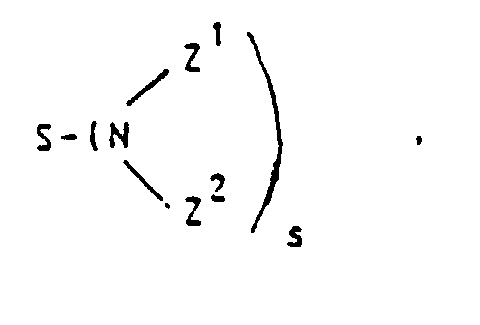
- Z1
- für ein Wasserstoffatom, einen gegebenenfalls 1 bis 3 Carboxyl-, 1 bis 3 Sulfonsäure-, 1 bis 5 Hydroxygruppen und/oder 1 bis 3 Sauerstoffatome enthaltenden C1-C10-Alkyl-, C2-C10-Acyl- oder C1-C10-Alkylsulfonylrest oder für den Rest eines Komplexes K und
- Z2
- für den Rest eines Komplexes K
- b
- für die Ziffern 1 bis 50 und
- s
- für die Ziffern 1 bis 3 stehen,
- K
- einen an die terminalen Stickstoffatome der letzten
Generation über V gebundenen Komplex-Rest der
allgemeinen Formel (IB) bedeutet
worin
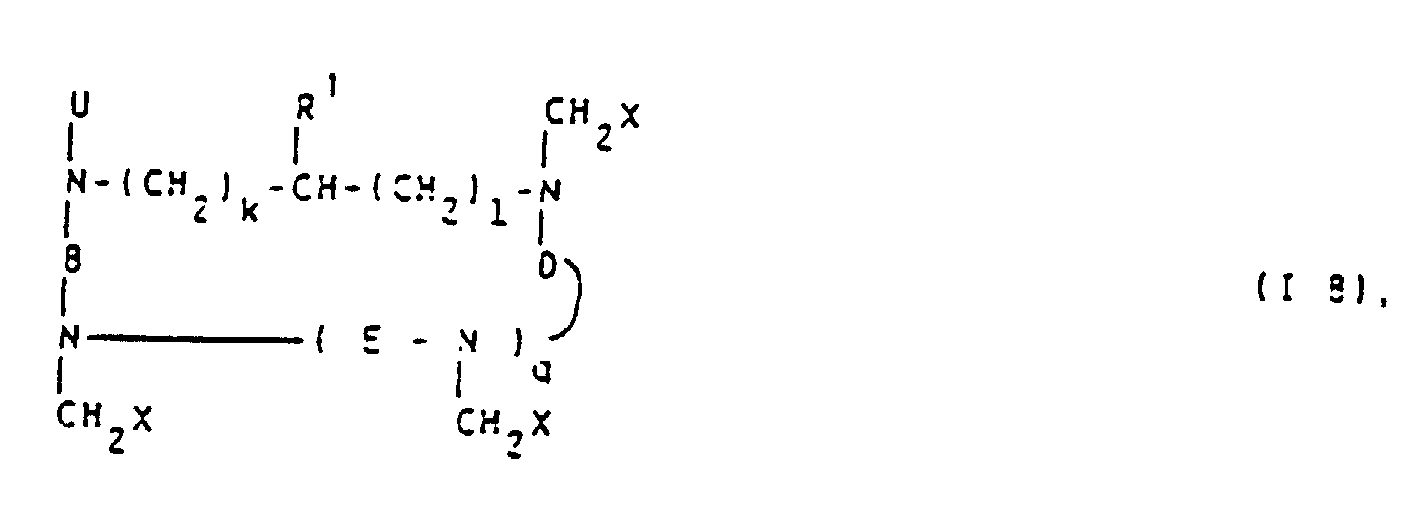
- k
- für die Ziffern 1,2,3,4 oder 5,
- l
- für die Ziffern 0,1,2,3,4 oder 5,
- q
- für die Ziffern 0,1 oder 2,
- U
- für CH2X oder V
- X
- für den Rest -COOH stehen,
- B,D und E
- die gleich oder verschieden sind, jeweils für die Gruppe -(CH2)a- mit a in der Bedeutung der Ziffern 2,3,4 oder 5,
- R1
- für V oder ein Wasserstoffatom
mit der Maßgabe, daß R1 nur dann für V steht, wenn U gleichzeitig CH2X bedeutet, und daß U nur dann für V steht, wenn gleichzeitig R1 ein Wasserstoffatom bedeutet, sowie der Maßgabe, daß gewünschtenfalls ein Teil der COOH-Gruppen als Ester und/oder Amid vorliegt,- V
- eine gegebenenfalls Imino-, Phenylen-, Phenylenoxy-Phenylenimino-, Amid-, Hydrazid-, Ureido-, Thioureido-, Carbonyl-, Estergruppe(n), Sauerstoff-, Schwefel- und/oder Stickstoff-Atom(e) enthaltende gegebenenfalls durch Hydroxy-, Mercapto-, Imino-, Epoxy-, Oxo-, Thioxo- und/oder Aminogruppen (n) substituierte geradkettige, verzweigte, gesättigte oder ungesättigte C1-C20-Alkylengruppe bedeutet,
- Kaskaden-Polymer-Komplexe gemäß Anspruch 1, dadurch gekennzeichnet, daß S
-(CH2)2-CONH-(CH2)a-
oderbedeutet,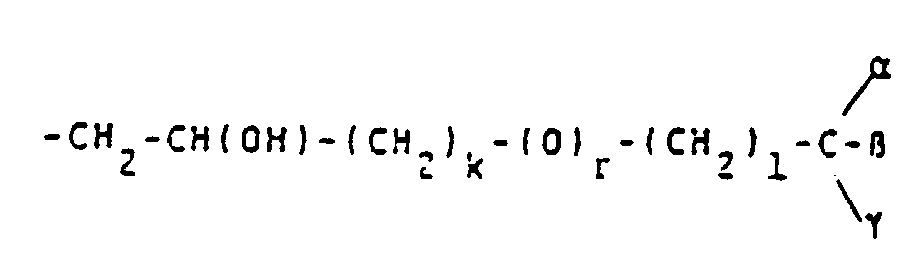
worin- α und β
- jeweils für ein Wasserstoffatom oder (CH2)o,
- γ
- für (CH2)f,
- f
- für die Ziffern 1, 2, 3, 4 oder 5,
- o
- für die Ziffern 0, 1, 2, 3, 4 oder 5, wobei l und o nicht gleichzeitig für die Ziffer 0 stehen sollen, und
- r
- für die Ziffern 0 oder 1
- a, k und l
- die oben angegebene Bedeutung haben.
- Kaskaden-Polymer-Komplex gemäß Anspruch 1, dadurch gekennzeichnet, daß A ein Stickstoffatom,
NR2R3R4,

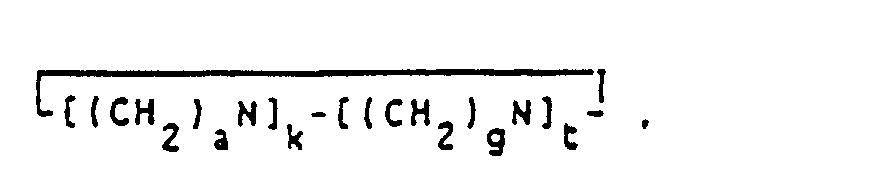 oder
oder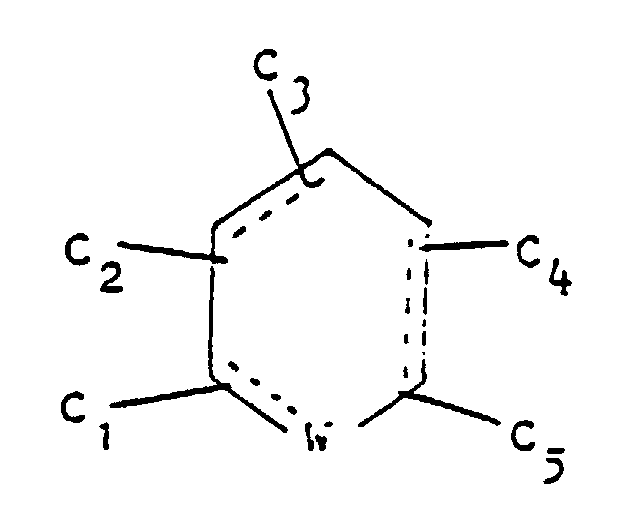 bedeutet, worin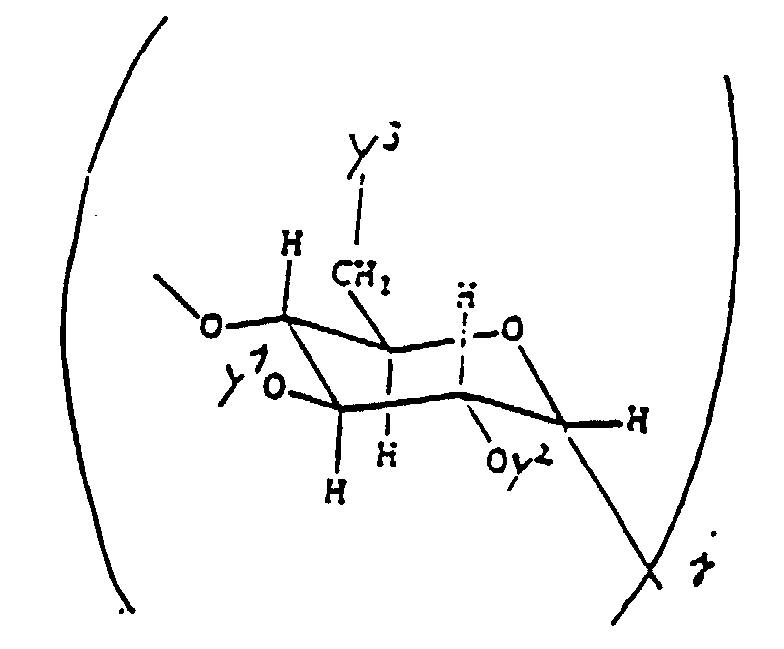
- R2, R3 und R4
- jeweils unabhängig voneinander für eine kovalente Bindung oder (CH2)k-(C6H4)r-(CH2)-N ,
- g
- für die Ziffern 2. 3, 4 oder 5,
- t
- für die Ziffern 1, 2, 3, 4, 5, 6, 7 oder 8,
- W
- für CH, CH2, NH oder ein Stickstoffatom,
- C1
- für (CH2)k-N ,
- C2, C3, C4 und C5
- jeweils unabhängig für ein Wasserstoffatom oder (CH2)f-N ,
- j
- für die Ziffern 6, 7 oder 8,
- Y1 und Y2
- jeweils unabhängig voneinander für ein Wasserstoffatom, CH2-CH(OH)-CH2N oder (CH2)a-N und
- Y3
- für ein Stickstoffatom, O-CH2-CH(OH)-CH2N oder O-(CH2)g-N
- ---
- für eine Einfach- oder Doppelbindung
- Kaskaden-Polymer-Komplex gemäß Anspruch 1, dadurch gekennzeichnet, daß V für eine
-CH2-CH(OH)-CH2-O-CH2CH2-;
-CH2-CH(OH)-CH2-;



 -CH2-CH(OH)-CH2-OCH2-C6H4-NH-CO-CH2-;
-CH2-CH(OH)-CH2-OCH2-C6H4-NH-CO-CH2-S-(CH2)4-S-;worin R+ und Ry für natürliche Aminosäurereste stehen;
-CH2-CH(OH)-CH2-O-(CH2)2-NHCS-;
-CH2-CH(OH)-CH2-NHCS-;
-CH2-CH(OH)-CH2-O-(CH2)2-O-(CH2)2NHCS-;
-CH2-CH(OH)-CH2-O-(CH2)2-NH-CO-CH2-;
-CH2-CH(OH)-CH2-O-C6H4-NHCS-;
-CH2-CH(OH)-CH2-O-C6H4-NHCO-;
-CH2-CH(OH)-CH2-O-CH2-C6H4-NHCS-;
-CH2-O-C6H4-CH2-; -CH2-CH(OH)-CH2-O-C6H4-CH2-; -C(= NH)-O-C6H4-CH2-;
-(CH2)4-NH-CO-CH2-O-C6H4-CH2-; -(CH2)4-NH-CH2-CH(OH)-CH2-O-C6H4-CH2-;
-(CH2)3-O-C6H4-CH2-; -CH2-CO-NH-(CH2)3-O-CH2-; -CH2-CO-NH-NH-;
-CH2-CONH-(CH2)2-; -CH2-CO-NH-(CH2)10-; -CH2-CONH-(CH2)2-S-;
-(CH2)4-NH-CO-(CH2)8-; -CH2-CO-NH-(CH2)3-NH-; -(CH2)3-NH-Gruppe steht. - Pharmazeutische Mittel enthaltend mindestens einen Kaskaden-Polymer Komplex nach Anspruch 1, gegebenenfalls mit den in der Galenik üblichen Zusätzen.
- Verwendung von mindestens einem Kaskaden-Polymer-Komplex gemäß Anspruch 1 für die Herstellung von Mitteln für die NMR- oder Röntgen-Diagnostik.
- Verfahren zur Herstellung der pharmazeutischen Mittel gemäß Anspruch 5, dadurch gekennzeichnet, daß man den in Wasser oder physiologischer Salzlösung gelösten oder suspendierten Polymer-Komplex, gegebenenfalls mit den in der Galenik üblichen Zusätzen, in eine für die enterale oder parenterale Applikation geeignete Form bringt.
Applications Claiming Priority (2)
| Application Number | Priority Date | Filing Date | Title |
|---|---|---|---|
| DE3938992A DE3938992A1 (de) | 1989-11-21 | 1989-11-21 | Kaskadenpolymer-gebundene komplexbildner, deren komplexe und konjugate, verfahren zu ihrer herstellung und diese enthaltende pharmazeutische mittel |
| DE3938992 | 1989-11-21 |
Publications (4)
| Publication Number | Publication Date |
|---|---|
| EP0430863A2 EP0430863A2 (de) | 1991-06-05 |
| EP0430863A3 EP0430863A3 (en) | 1992-03-04 |
| EP0430863B1 EP0430863B1 (de) | 1995-05-17 |
| EP0430863B2 true EP0430863B2 (de) | 1999-08-25 |
Family
ID=6394147
Family Applications (1)
| Application Number | Title | Priority Date | Filing Date |
|---|---|---|---|
| EP90730017A Expired - Lifetime EP0430863B2 (de) | 1989-11-21 | 1990-11-19 | Kaskadenpolymer-gebundene Komplexbildner, deren Komplexe und Konjugate, Verfahren zu ihrer Herstellung und diese enthaltende pharmazeutische Mittel |
Country Status (19)
| Country | Link |
|---|---|
| US (10) | US5364614A (de) |
| EP (1) | EP0430863B2 (de) |
| JP (2) | JP3179092B2 (de) |
| KR (1) | KR100202796B1 (de) |
| AT (1) | ATE122698T1 (de) |
| AU (1) | AU684453C (de) |
| CA (1) | CA2030472C (de) |
| DE (2) | DE3938992A1 (de) |
| DK (1) | DK0430863T4 (de) |
| ES (1) | ES2073006T5 (de) |
| FI (1) | FI107931B (de) |
| GR (1) | GR3031629T3 (de) |
| HU (1) | HUT56121A (de) |
| IE (1) | IE69317B1 (de) |
| IL (1) | IL96434A (de) |
| NO (1) | NO178032C (de) |
| NZ (1) | NZ236162A (de) |
| PT (1) | PT95944B (de) |
| ZA (1) | ZA909352B (de) |
Families Citing this family (79)
| Publication number | Priority date | Publication date | Assignee | Title |
|---|---|---|---|---|
| US5560929A (en) * | 1986-08-18 | 1996-10-01 | The Dow Chemical Company | Structured copolymers and their use as absorbents, gels and carriers of metal ions |
| US5527524A (en) * | 1986-08-18 | 1996-06-18 | The Dow Chemical Company | Dense star polymer conjugates |
| US5334371A (en) * | 1988-07-20 | 1994-08-02 | Schering Aktiengesellschaft | Marcocyclic polyaza bicyclo compounds containing 5 or 6 membered rings, and method for MRI |
| DE4001655A1 (de) * | 1990-01-18 | 1991-07-25 | Schering Ag | 6-ring enthaltende makrocyclische tetraaza-verbindungen, verfahren zu ihrer herstellung und diese enthaltende pharmazeutische mittel |
| US5914095A (en) * | 1989-04-07 | 1999-06-22 | Salutar, Inc. | Polychelants containg amide bonds |
| DE3938992A1 (de) | 1989-11-21 | 1991-05-23 | Schering Ag | Kaskadenpolymer-gebundene komplexbildner, deren komplexe und konjugate, verfahren zu ihrer herstellung und diese enthaltende pharmazeutische mittel |
| DE4115789A1 (de) * | 1991-05-10 | 1992-11-12 | Schering Ag | Makrocyclische polymer-komplexbildner, deren komplexe, verfahren zu ihrer herstellung und diese enthaltende pharmazeutische mittel |
| US5428139A (en) * | 1991-12-10 | 1995-06-27 | The Dow Chemical Company | Bicyclopolyazamacrocyclophosphonic acid complexes for use as radiopharmaceuticals |
| US5739294A (en) * | 1991-12-10 | 1998-04-14 | The Dow Chemical Company | Bicyclopol yazamacrocyclophosphonic acid complexes for use as contrast agents |
| DK0570575T3 (da) * | 1991-12-10 | 1998-08-24 | Dow Chemical Co | Bicykloazamakrocyklophosphonsyre, komplekser, konjugater, kontrastmidler og fremstilling heraf |
| WO1994026313A1 (en) * | 1993-05-06 | 1994-11-24 | The Dow Chemical Company | Bicyclopolyazamacrocyclocarboxylic acid complexes, their conjugates, processes for their preparation, and use as contrast agents |
| DE69327659T2 (de) * | 1992-10-14 | 2000-09-21 | Nycomed Imaging As, Oslo | Therapeutische und diagnostische bilderzeugungzusammensetzung und verfahren zur herstellung |
| ES2105332T3 (es) * | 1992-10-14 | 1997-10-16 | Nycomed Imaging As | Polimeros quelantes. |
| US5817292A (en) * | 1992-10-14 | 1998-10-06 | Nycomed Imaging As | MR imaging compositions and methods |
| US6203775B1 (en) * | 1993-03-19 | 2001-03-20 | The General Hospital Corporation | Chelating polymers for labeling of proteins |
| US5428156A (en) * | 1993-04-02 | 1995-06-27 | Associated Universities, Inc. | Synthesis of macrocyclic polyaminocarboxylates and their use for preparing stable radiometal antibody immunoconjugates for therapy, spect and pet imaging |
| US5482698A (en) * | 1993-04-22 | 1996-01-09 | Immunomedics, Inc. | Detection and therapy of lesions with biotin/avidin polymer conjugates |
| WO1994026315A1 (en) * | 1993-05-06 | 1994-11-24 | The Dow Chemical Company | Bicyclopolyazamacrocyclocarboxylic acid complexes, their conjugates, processes for their preparation, and use as radiopharmaceuticals |
| FI955575A7 (fi) * | 1993-05-20 | 1996-01-15 | Univ California | Makromolekyylivarjoaine magneettiresonanssikuvaukseen |
| US5534241A (en) * | 1993-07-23 | 1996-07-09 | Torchilin; Vladimir P. | Amphipathic polychelating compounds and methods of use |
| DE4344460A1 (de) * | 1993-12-22 | 1995-06-29 | Schering Ag | Metallkomplexe von dendrimeren Makromolekülen, diese enthaltende diagnostische Mittel sowie Verfahren zur Herstellung der Komplexe und Mittel |
| DE4344464A1 (de) * | 1993-12-22 | 1995-06-29 | Schering Ag | Kaskadenpolymere mit Iodaromaten |
| US5831087A (en) * | 1994-03-02 | 1998-11-03 | Hoechst Celanese Corp. | Macrocyclic imide compounds |
| GB9404208D0 (en) * | 1994-03-04 | 1994-04-20 | Nycomed Salutar Inc | Chelants |
| ATE277640T1 (de) * | 1994-03-07 | 2004-10-15 | Dow Chemical Co | Bioaktive und/oder gezielte dendrimere-konjugate enthaltend genetisches material |
| GB9407812D0 (en) * | 1994-04-20 | 1994-06-15 | Nycomed Salutar Inc | Compounds |
| US5958372A (en) * | 1994-06-28 | 1999-09-28 | Nycomed Imaging As | Low viscosity chelating polymers for diagnostic imaging |
| DE4425857A1 (de) * | 1994-07-07 | 1996-01-11 | Schering Ag | Kaskaden-Polymer-Komplexe, Verfahren zur ihrer Herstellung und diese enthaltende pharmazeutische Mittel |
| DE4426438A1 (de) * | 1994-07-26 | 1996-02-01 | Schering Ag | Verwendung von Chelaten als Röntgenkontrastmittel |
| US6207826B1 (en) | 1995-03-27 | 2001-03-27 | Isis Pharmaceuticals, Inc. | Macrocyclic compounds having nitrogen-containing linkages |
| GB9504910D0 (en) * | 1995-03-10 | 1995-04-26 | Nycomed Imaging As | Compounds |
| US6107482A (en) | 1995-03-27 | 2000-08-22 | Isis Pharmaceuticals, Inc. | Nitrogenous macrocyclic compounds |
| DE19518222A1 (de) * | 1995-05-11 | 1996-11-14 | Schering Ag | Verwendung von polymeren Kontrastmittel mittleren Molekulargewichts zur Differenzierung von benignen und malignen Tumoren mittels moderner bildgebender Verfahren |
| DE19521945A1 (de) * | 1995-06-12 | 1996-12-19 | Schering Ag | Kaskadenpolymere mit Iodaromaten |
| US6166200A (en) * | 1995-07-04 | 2000-12-26 | Schering Aktiengesellschaft | Cascade polymer complexes, process for their production and pharmaceutical agents containing said complexes |
| DE19525924A1 (de) | 1995-07-04 | 1997-01-09 | Schering Ag | Kaskaden-Polymer-Komplexe, Verfahren zu ihrer Herstellung und diese enthaltende pharmazeutische Mittel |
| DE19549286A1 (de) * | 1995-12-22 | 1997-06-26 | Schering Ag | Kaskaden-Polymer-Komplexe, Verfahren zu ihrer Herstellung und diese enthaltende pharmazeutische Mittel |
| AU726034B2 (en) * | 1995-12-22 | 2000-10-26 | Schering Aktiengesellschaft | Cascade polymer complexes, process for their production and pharmaceutical agents that contain the latter |
| US5874061A (en) * | 1995-12-22 | 1999-02-23 | Schering Aktiengesellschaft | Cascade polymer complexes, process for their production and pharmaceutical agents containing said complexes |
| DE19652387A1 (de) * | 1996-12-04 | 1998-06-10 | Schering Ag | Macrocyclische Metallkomplexcarbonsäuren, ihre Verwendung sowie Verfahren zu ihrer Herstellung |
| CA2274458A1 (en) * | 1997-01-13 | 1998-07-16 | Dendritech, Inc. | Nanocomposites of dendritic polymers |
| WO1998056427A1 (en) * | 1997-06-12 | 1998-12-17 | Mitsubishi Chemical Corporation | Novel contrast media |
| EP0885616A1 (de) * | 1997-06-20 | 1998-12-23 | Schering Aktiengesellschaft | Verwendung von intravenösen Kontrastmitteln sowie Vorrichtungen für die Projektionsmammographie |
| US5849337A (en) * | 1997-06-27 | 1998-12-15 | Gusty Winds Corporation | Method of enhancing magnesium absorption and prevention of atherosclerosis |
| DE19744003B4 (de) * | 1997-09-26 | 2004-07-08 | Schering Ag | Kontrastmittel für das Infarkt- und Nekroseimaging |
| DE19758118A1 (de) * | 1997-12-17 | 1999-07-01 | Schering Ag | Polyrotaxane |
| US6113880A (en) * | 1997-12-17 | 2000-09-05 | Schering Aktiengesellschaft | Polyrotaxane derivatives for x-ray and nuclear magnetic resonance imaging |
| US6549798B2 (en) * | 2001-02-07 | 2003-04-15 | Epix Medical, Inc. | Magnetic resonance angiography data |
| US6906050B2 (en) * | 2001-05-31 | 2005-06-14 | Miravant Pharmaceuticals, Inc. | Substituted porphyrin and azaporphyrin derivatives and their use in photodynamic therapy, radioimaging and MRI diagnosis |
| ITMI20011518A1 (it) * | 2001-07-17 | 2003-01-17 | Bracco Imaging Spa | Leganti azotati multidentati capaci di complessare ioni metallici e loro uso in diagnostica e in terapia |
| US7893223B2 (en) * | 2001-07-17 | 2011-02-22 | Bracco Imaging S.P.A. | Multidentate AZA ligands able to complex metal ions and the use thereof in diagnostics and therapy |
| TWI221406B (en) * | 2001-07-30 | 2004-10-01 | Epix Medical Inc | Systems and methods for targeted magnetic resonance imaging of the vascular system |
| US20040034223A1 (en) * | 2002-02-07 | 2004-02-19 | Covalent Partners, Llc. | Amphiphilic molecular modules and constructs based thereon |
| US7432371B2 (en) * | 2002-02-07 | 2008-10-07 | Covalent Partners, Llc | Nanofilm and membrane compositions |
| US20040106741A1 (en) * | 2002-09-17 | 2004-06-03 | Kriesel Joshua W. | Nanofilm compositions with polymeric components |
| WO2004054623A1 (en) * | 2002-12-16 | 2004-07-01 | Amersham Health As | Magnetic resonance imaging method and compounds for use in the method |
| US7648678B2 (en) | 2002-12-20 | 2010-01-19 | Dako Denmark A/S | Method and system for pretreatment of tissue slides |
| US20040137551A1 (en) * | 2003-01-13 | 2004-07-15 | Markovic Nenad S. | Cervical acid phosphatase - papanicolaou (CAP-PAP) test kit, method and accesories, processes for producing and using the same |
| AR047692A1 (es) * | 2003-07-10 | 2006-02-08 | Epix Medical Inc | Imagenes de blancos estacionarios |
| US20070073004A1 (en) * | 2003-09-12 | 2007-03-29 | Dendritic Nanotechnologies Inc. | Hyperbranched (pamam) polymers via a one pot process |
| US6960418B2 (en) * | 2003-10-23 | 2005-11-01 | Samsung Electronics Co., Ltd. | Organophotoreceptor with charge transport material with two N,N,N-trisubstituted-amino groups |
| EP1541568A1 (de) * | 2003-12-09 | 2005-06-15 | Deutsches Wollforschungsinstitut an der Rheinisch-Westfälischen Technischen Hochschule Aachen e.V. | Reaktive cyclische Carbonate und Harnstoffe zur Modifizierung von Biomolekülen, Polymeren und Oberflächen |
| US7199268B2 (en) | 2003-12-16 | 2007-04-03 | Schering Aktiengesellschaft | Process for the production of dendritic trimesic acid triamides |
| WO2006094259A2 (en) * | 2005-03-01 | 2006-09-08 | Haworth, Inc. | Tilt control mechanism for a chair |
| US9603941B2 (en) * | 2006-01-24 | 2017-03-28 | Minghui Chai | Method of preparing dendritic drugs |
| CN101400661A (zh) * | 2006-03-14 | 2009-04-01 | 马林克罗特公司 | 四氮杂大环衍生物的金属络合物 |
| EP2960263B1 (de) * | 2006-05-27 | 2017-07-12 | Fluidigm Canada Inc. | Polymerrückgratelementetiketten |
| FR2906253A1 (fr) * | 2006-09-22 | 2008-03-28 | Biosphere Medical Sa | Nouveaux materiaux polymeres bio-compatibles, leur procede d'obtention et leurs utilisations, notamment en imagerie medicale par resonnance magnetique |
| DE102007002726A1 (de) | 2007-01-18 | 2008-07-31 | Bayer Schering Pharma Aktiengesellschaft | Neue Kaskaden-Polymer-Komplexe, Verfahren zu ihrer Herstellung und diese enthaltende pharmazeutische Mittel |
| JP5242672B2 (ja) * | 2007-04-11 | 2013-07-24 | オレゴン ヘルス アンド サイエンス ユニバーシティ | 心臓における線維症の非侵襲性の定量的検出のためのシステム |
| EP2279190A1 (de) * | 2008-04-18 | 2011-02-02 | Ge Healthcare As | Paramagnetische, um einen zentralen kern angeordnete chelate enthaltende verbindungen und ihre verwendung in der magnetresonanzbilddarstellung und spektroskopie |
| KR101334780B1 (ko) | 2010-08-13 | 2013-12-02 | 한국생명공학연구원 | 요오드를 함유한 방사형상의 고분자 화합물, 이의 제조방법 및 이를 포함하는 ct용 조영제 조성물 |
| WO2015038784A1 (en) | 2013-09-13 | 2015-03-19 | The Board Of Trustees Of The Leland Stanford Junior University | Multiplexed imaging of tissues using mass tags and secondary ion mass spectrometry |
| EP3274719B1 (de) | 2015-03-25 | 2021-02-24 | The Board of Trustees of the Leland Stanford Junior University | Einzelzellanalyse mittels sekundärionenmassenspektrometrie |
| JP7131742B2 (ja) | 2016-09-29 | 2022-09-06 | メリット・メディカル・システムズ・インコーポレイテッド | 血管プロテーゼを受容し、その展開を補助するための柔軟部材 |
| WO2018107173A1 (en) * | 2016-12-09 | 2018-06-14 | Vanderbilt University | Glutamine transport inhibitors and methods for treating cancer |
| EP4467111A3 (de) | 2017-03-15 | 2025-03-05 | Merit Medical Systems, Inc. | Transluminale stents |
| WO2022093710A1 (en) | 2020-10-26 | 2022-05-05 | Merit Medical Systems, Inc. | Esophageal stents with helical thread |
| EP4243935A1 (de) * | 2020-11-10 | 2023-09-20 | Janssen Biotech, Inc. | Makrocyclische verbindungen und verfahren zur verwendung davon |
Family Cites Families (39)
| Publication number | Priority date | Publication date | Assignee | Title |
|---|---|---|---|---|
| US4036945A (en) | 1976-05-03 | 1977-07-19 | The Massachusetts General Hospital | Composition and method for determining the size and location of myocardial infarcts |
| US4071478A (en) * | 1976-06-07 | 1978-01-31 | Merck & Co., Inc. | Controlled partially cross-linked 3,3-ionenes |
| DE2803528C2 (de) * | 1977-03-09 | 1984-10-18 | Tabushi, Iwao, Kyoto | Schwermetallionen-Adsorbens und dessen Verwendung zum Adsorbieren von Schwermetallionen |
| US4331647A (en) | 1980-03-03 | 1982-05-25 | Goldenberg Milton David | Tumor localization and therapy with labeled antibody fragments specific to tumor-associated markers |
| JPS5779551A (en) | 1980-11-06 | 1982-05-18 | Nec Corp | Information transfer device |
| DE3129906C3 (de) | 1981-07-24 | 1996-12-19 | Schering Ag | Paramagnetische Komplexsalze, deren Herstellung und Mittel zur Verwendung bei der NMR-Diagnostik |
| US4957939A (en) * | 1981-07-24 | 1990-09-18 | Schering Aktiengesellschaft | Sterile pharmaceutical compositions of gadolinium chelates useful enhancing NMR imaging |
| US4647447A (en) * | 1981-07-24 | 1987-03-03 | Schering Aktiengesellschaft | Diagnostic media |
| US4507466A (en) | 1983-01-07 | 1985-03-26 | The Dow Chemical Corporation | Dense star polymers having core, core branches, terminal groups |
| NL194579C (nl) * | 1983-01-21 | 2002-08-05 | Schering Ag | Diagnostisch middel. |
| US4587329A (en) * | 1984-08-17 | 1986-05-06 | The Dow Chemical Company | Dense star polymers having two dimensional molecular diameter |
| US4639365A (en) * | 1984-10-18 | 1987-01-27 | The Board Of Regents, The University Of Texas System | Gadolinium chelates as NMR contrast agents |
| CA1317937C (en) * | 1984-10-18 | 1993-05-18 | A. Dean Sherry | Gadolinium chelates with carboxymethyl derivatives of polyazamacrocycles as nmr contrast agents |
| US5188816A (en) * | 1984-10-18 | 1993-02-23 | Board Of Regents, The University Of Texas System | Using polyazamacrocyclic compounds for intracellular measurement of metal ions using MRS |
| US4678667A (en) | 1985-07-02 | 1987-07-07 | 501 Regents of the University of California | Macrocyclic bifunctional chelating agents |
| US4871779A (en) | 1985-12-23 | 1989-10-03 | The Dow Chemical Company | Ion exchange/chelation resins containing dense star polymers having ion exchange or chelate capabilities |
| US4885363A (en) * | 1987-04-24 | 1989-12-05 | E. R. Squibb & Sons, Inc. | 1-substituted-1,4,7-triscarboxymethyl-1,4,7,10-tetraazacyclododecane and analogs |
| EP0232751B1 (de) | 1986-01-23 | 1991-09-11 | E.R. Squibb & Sons, Inc. | 1-Substituiertes-4,7,10-triscarboxymethyl-1,4,7,10-tetraazacyclododecan und Analoga |
| GB8603537D0 (en) * | 1986-02-13 | 1986-03-19 | Parker D | Conjugate compound |
| US4694064A (en) | 1986-02-28 | 1987-09-15 | The Dow Chemical Company | Rod-shaped dendrimer |
| US5338532A (en) * | 1986-08-18 | 1994-08-16 | The Dow Chemical Company | Starburst conjugates |
| US5527524A (en) * | 1986-08-18 | 1996-06-18 | The Dow Chemical Company | Dense star polymer conjugates |
| US5560929A (en) * | 1986-08-18 | 1996-10-01 | The Dow Chemical Company | Structured copolymers and their use as absorbents, gels and carriers of metal ions |
| DE3786000T3 (de) * | 1986-08-18 | 1997-08-21 | Dow Chemical Co | Conjugate dichter Sterne. |
| DE3701665A1 (de) | 1987-01-19 | 1988-07-28 | Schering Ag | Polymer-komplexe, verfahren zu deren herstellung und diese enthaltende pharmazeutische mittel |
| US5057302A (en) | 1987-02-13 | 1991-10-15 | Abbott Laboratories | Bifunctional chelating agents |
| DE3855239T2 (de) * | 1987-07-16 | 1996-10-31 | Nycomed Imaging As | Aminocarbonsäure und Derivate |
| DE3728525A1 (de) * | 1987-08-24 | 1989-03-16 | Schering Ag | Mehrkernige substituierte komplexbildner, komplexe und komplexsalze, verfahren zu deren herstellung und diese enthaltende pharmazeutische mittel |
| DE3806795A1 (de) * | 1988-02-29 | 1989-09-07 | Schering Ag | Polymer-gebundene komplexbildner, deren komplexe und konjugate, verfahren zu ihrer herstellung und diese enthaltende pharmazeutische mittel |
| JP2831073B2 (ja) * | 1988-06-24 | 1998-12-02 | ザ ダウ ケミカル カンパニー | 大環状二官能キレート剤、その錯体及びそれらの抗体接合体 |
| US5554748A (en) | 1989-04-07 | 1996-09-10 | Nycomed Salutar, Inc. | Adducts of macrocyclic chelants |
| US5364613A (en) | 1989-04-07 | 1994-11-15 | Sieving Paul F | Polychelants containing macrocyclic chelant moieties |
| US5136096A (en) * | 1989-08-31 | 1992-08-04 | University Of South Florida | Multifunctional synthons as used in the preparation of cascade polymers or unimolecular micelles |
| DE3938992A1 (de) * | 1989-11-21 | 1991-05-23 | Schering Ag | Kaskadenpolymer-gebundene komplexbildner, deren komplexe und konjugate, verfahren zu ihrer herstellung und diese enthaltende pharmazeutische mittel |
| US5188806A (en) * | 1991-01-04 | 1993-02-23 | Degussa Ag | Method and apparatus for producing carbon black |
| US5057696A (en) * | 1991-01-25 | 1991-10-15 | Wind Harvest Co., Inc. | Vertical windmill with omnidirectional diffusion |
| US5154853A (en) * | 1991-02-19 | 1992-10-13 | University Of South Florida | Unimolecular micelles and method of making the same |
| JPH066237U (ja) * | 1992-06-29 | 1994-01-25 | セントラル硝子株式会社 | ガラス板用パレット |
| ATE277640T1 (de) * | 1994-03-07 | 2004-10-15 | Dow Chemical Co | Bioaktive und/oder gezielte dendrimere-konjugate enthaltend genetisches material |
-
1989
- 1989-11-21 DE DE3938992A patent/DE3938992A1/de not_active Withdrawn
-
1990
- 1990-11-19 DK DK90730017T patent/DK0430863T4/da active
- 1990-11-19 ES ES90730017T patent/ES2073006T5/es not_active Expired - Lifetime
- 1990-11-19 AT AT90730017T patent/ATE122698T1/de not_active IP Right Cessation
- 1990-11-19 EP EP90730017A patent/EP0430863B2/de not_active Expired - Lifetime
- 1990-11-19 DE DE59009093T patent/DE59009093D1/de not_active Expired - Fee Related
- 1990-11-20 HU HU907217A patent/HUT56121A/hu unknown
- 1990-11-20 NZ NZ236162A patent/NZ236162A/xx unknown
- 1990-11-21 NO NO905037A patent/NO178032C/no unknown
- 1990-11-21 PT PT95944A patent/PT95944B/pt not_active IP Right Cessation
- 1990-11-21 JP JP31444090A patent/JP3179092B2/ja not_active Expired - Fee Related
- 1990-11-21 FI FI905744A patent/FI107931B/fi not_active IP Right Cessation
- 1990-11-21 US US07/617,077 patent/US5364614A/en not_active Expired - Lifetime
- 1990-11-21 ZA ZA909352A patent/ZA909352B/xx unknown
- 1990-11-21 IL IL9643490A patent/IL96434A/en not_active IP Right Cessation
- 1990-11-21 CA CA002030472A patent/CA2030472C/en not_active Expired - Fee Related
- 1990-11-21 IE IE419990A patent/IE69317B1/en not_active IP Right Cessation
- 1990-11-21 KR KR1019900018949A patent/KR100202796B1/ko not_active Expired - Fee Related
- 1990-11-21 AU AU66859/90A patent/AU684453C/en not_active Ceased
-
1994
- 1994-12-02 US US08/353,390 patent/US5650136A/en not_active Expired - Fee Related
-
1996
- 1996-11-04 US US08/743,535 patent/US5911971A/en not_active Expired - Fee Related
-
1998
- 1998-09-17 US US09/156,047 patent/US6054117A/en not_active Expired - Fee Related
- 1998-09-17 US US09/156,048 patent/US6183724B1/en not_active Expired - Fee Related
-
1999
- 1999-10-15 GR GR990402638T patent/GR3031629T3/el unknown
-
2000
- 2000-02-22 US US09/510,363 patent/US6193950B1/en not_active Expired - Fee Related
- 2000-04-28 JP JP2000130116A patent/JP2000355593A/ja active Pending
- 2000-07-28 US US09/628,179 patent/US6299859B1/en not_active Expired - Fee Related
-
2001
- 2001-10-11 US US09/973,836 patent/US6576222B2/en not_active Expired - Fee Related
-
2002
- 2002-12-11 US US10/316,094 patent/US6855309B2/en not_active Expired - Fee Related
-
2004
- 2004-09-30 US US10/953,582 patent/US7208139B2/en not_active Expired - Fee Related
Also Published As
Similar Documents
| Publication | Publication Date | Title |
|---|---|---|
| EP0430863B1 (de) | Kaskadenpolymer-gebundene Komplexbildner, deren Komplexe und Konjugate, Verfahren zu ihrer Herstellung und diese enthaltende pharmazeutische Mittel | |
| EP0512661B1 (de) | Makrocyclische Polymer-Komplexbildner, deren Komplexe, Verfahren zu ihrer Herstellung und diese enthaltende pharmazeutische Mittel | |
| EP0450742B1 (de) | DTPA-Monoamide, diese Verbindungen enthaltende pharmazeutische Mittel, ihre Verwendung und Verfahren zu deren Herstellung | |
| EP0836485B1 (de) | Kaskaden-polymer-komplexe, verfahren zu ihrer herstellung und diese enthaltende pharmazeutische mittel | |
| EP0448191B1 (de) | 1,4,7,10-Tetraazacyclododecan-butyltriole, Verfahren zu ihrer Herstellung und diese enthaltende pharmazeutische Mittel | |
| EP0336879B1 (de) | Meso-tetraphenylporphyrin-komplexverbindungen,Verfahren zu ihrer Herstellung und diese enthaltende pharmazeutische Mittel | |
| EP0485045B1 (de) | Mono-N-substituierte 1,4,7,10-Tetraazacyclododecan-Derivate, Verfahren zu ihrer Herstellung und diese enthaltende pharmazeutische Mittel | |
| EP0768898B1 (de) | Kaskaden-polymer-komplexe und ihre verfahren | |
| EP0662972B1 (de) | 3-,8-substituierte deuteroporphyrinderivate, diese enthaltende pharmazeutische mittel und verfahren zu ihrer herstellung | |
| EP0352218B1 (de) | 5- oder 6-Ring-enthaltende makrocyclische Polyaza-Verbindungen, Verfahren zu ihrer Herstellung und diese enthaltende pharmazeutische Mittel | |
| WO1994019352A1 (de) | Meso-tetraphenylporphyrin-komplexverbindungen, verfahren zu ihrer herstellung und diese enthaltende pharmazeutische mittel | |
| EP0736059B1 (de) | Metallkomplexe von dendrimeren makromolekülen, diese enthaltende diagnostische mittel sowie verfahren zur herstellung der komplexe und mittel | |
| DE19744003B4 (de) | Kontrastmittel für das Infarkt- und Nekroseimaging | |
| DE69417754T2 (de) | Chelate als kontrastverbesserende mittel | |
| EP0868202B1 (de) | Kaskaden-polymer-komplexe, verfahren zu ihrer herstellung und diese enthaltende pharmazeutische mittel | |
| EP1307237B9 (de) | Perfluoralkylhaltige komplexe mit polaren resten, verfahren zu deren herstellung und ihre verwendung | |
| WO2007009637A2 (de) | Deren verwendung als kontrastmittel zur anwendung in der nmr-, rontgen- und radiodiagnostik sowie in der radiotheraphie | |
| EP0775104B1 (de) | Dimere dtpa-derivate und deren metallkomplexe, diese komplexe enthaltende pharmazeutische mittel, deren verwendung in der diagnostik und therapie sowie verfahren zur herstellung der komplexe und mittel | |
| EP0946526B1 (de) | Macrocyclische metallkomplexcarbonsäuren, ihre verwendung sowie verfahren zu ihrer herstellung | |
| DE3633246A1 (de) | Amid-komplexe |
Legal Events
| Date | Code | Title | Description |
|---|---|---|---|
| PUAI | Public reference made under article 153(3) epc to a published international application that has entered the european phase |
Free format text: ORIGINAL CODE: 0009012 |
|
| 17P | Request for examination filed |
Effective date: 19901119 |
|
| AK | Designated contracting states |
Kind code of ref document: A2 Designated state(s): AT BE CH DE DK ES FR GB GR IT LI LU NL SE |
|
| PUAL | Search report despatched |
Free format text: ORIGINAL CODE: 0009013 |
|
| AK | Designated contracting states |
Kind code of ref document: A3 Designated state(s): AT BE CH DE DK ES FR GB GR IT LI LU NL SE |
|
| 17Q | First examination report despatched |
Effective date: 19940314 |
|
| GRAA | (expected) grant |
Free format text: ORIGINAL CODE: 0009210 |
|
| AK | Designated contracting states |
Kind code of ref document: B1 Designated state(s): AT BE CH DE DK ES FR GB GR IT LI LU NL SE |
|
| REF | Corresponds to: |
Ref document number: 122698 Country of ref document: AT Date of ref document: 19950615 Kind code of ref document: T |
|
| ITF | It: translation for a ep patent filed | ||
| REF | Corresponds to: |
Ref document number: 59009093 Country of ref document: DE Date of ref document: 19950622 |
|
| REG | Reference to a national code |
Ref country code: DK Ref legal event code: T3 |
|
| REG | Reference to a national code |
Ref country code: GR Ref legal event code: FG4A Free format text: 3016155 |
|
| REG | Reference to a national code |
Ref country code: ES Ref legal event code: FG2A Ref document number: 2073006 Country of ref document: ES Kind code of ref document: T3 |
|
| ET | Fr: translation filed | ||
| GBT | Gb: translation of ep patent filed (gb section 77(6)(a)/1977) |
Effective date: 19950825 |
|
| PLBQ | Unpublished change to opponent data |
Free format text: ORIGINAL CODE: EPIDOS OPPO |
|
| PLBI | Opposition filed |
Free format text: ORIGINAL CODE: 0009260 |
|
| 26 | Opposition filed |
Opponent name: THE DOW CHEMICAL COMPANY Effective date: 19960214 |
|
| PLBF | Reply of patent proprietor to notice(s) of opposition |
Free format text: ORIGINAL CODE: EPIDOS OBSO |
|
| NLR1 | Nl: opposition has been filed with the epo |
Opponent name: THE DOW CHEMICAL COMPANY |
|
| PLBF | Reply of patent proprietor to notice(s) of opposition |
Free format text: ORIGINAL CODE: EPIDOS OBSO |
|
| PLBF | Reply of patent proprietor to notice(s) of opposition |
Free format text: ORIGINAL CODE: EPIDOS OBSO |
|
| PLBF | Reply of patent proprietor to notice(s) of opposition |
Free format text: ORIGINAL CODE: EPIDOS OBSO |
|
| PLAW | Interlocutory decision in opposition |
Free format text: ORIGINAL CODE: EPIDOS IDOP |
|
| PLAW | Interlocutory decision in opposition |
Free format text: ORIGINAL CODE: EPIDOS IDOP |
|
| PUAH | Patent maintained in amended form |
Free format text: ORIGINAL CODE: 0009272 |
|
| STAA | Information on the status of an ep patent application or granted ep patent |
Free format text: STATUS: PATENT MAINTAINED AS AMENDED |
|
| 27A | Patent maintained in amended form |
Effective date: 19990825 |
|
| AK | Designated contracting states |
Kind code of ref document: B2 Designated state(s): AT BE CH DE DK ES FR GB GR IT LI LU NL SE |
|
| REG | Reference to a national code |
Ref country code: CH Ref legal event code: AEN Free format text: AUFRECHTERHALTUNG DES PATENTES IN GEAENDERTER FORM |
|
| GBTA | Gb: translation of amended ep patent filed (gb section 77(6)(b)/1977) | ||
| PG25 | Lapsed in a contracting state [announced via postgrant information from national office to epo] |
Ref country code: GR Free format text: THE PATENT HAS BEEN ANNULLED BY A DECISION OF A NATIONAL AUTHORITY Effective date: 19991015 |
|
| ITF | It: translation for a ep patent filed | ||
| ET3 | Fr: translation filed ** decision concerning opposition | ||
| NLR3 | Nl: receipt of modified translations in the netherlands language after an opposition procedure | ||
| REG | Reference to a national code |
Ref country code: ES Ref legal event code: DC2A Kind code of ref document: T5 Effective date: 19991025 |
|
| REG | Reference to a national code |
Ref country code: DK Ref legal event code: T4 |
|
| REG | Reference to a national code |
Ref country code: GB Ref legal event code: IF02 |
|
| REG | Reference to a national code |
Ref country code: CH Ref legal event code: PFA Owner name: SCHERING AKTIENGESELLSCHAFT Free format text: SCHERING AKTIENGESELLSCHAFT#MUELLERSTRASSE 178#D-13353 BERLIN (DE) -TRANSFER TO- SCHERING AKTIENGESELLSCHAFT#MUELLERSTRASSE 178#D-13353 BERLIN (DE) |
|
| PGFP | Annual fee paid to national office [announced via postgrant information from national office to epo] |
Ref country code: DK Payment date: 20071015 Year of fee payment: 18 Ref country code: NL Payment date: 20071017 Year of fee payment: 18 Ref country code: DE Payment date: 20071029 Year of fee payment: 18 Ref country code: ES Payment date: 20071120 Year of fee payment: 18 Ref country code: LU Payment date: 20071026 Year of fee payment: 18 |
|
| PGFP | Annual fee paid to national office [announced via postgrant information from national office to epo] |
Ref country code: IT Payment date: 20071023 Year of fee payment: 18 Ref country code: CH Payment date: 20071019 Year of fee payment: 18 Ref country code: AT Payment date: 20071009 Year of fee payment: 18 |
|
| PGFP | Annual fee paid to national office [announced via postgrant information from national office to epo] |
Ref country code: SE Payment date: 20071019 Year of fee payment: 18 Ref country code: BE Payment date: 20071122 Year of fee payment: 18 |
|
| PGFP | Annual fee paid to national office [announced via postgrant information from national office to epo] |
Ref country code: FR Payment date: 20071011 Year of fee payment: 18 Ref country code: GB Payment date: 20071018 Year of fee payment: 18 |
|
| PGFP | Annual fee paid to national office [announced via postgrant information from national office to epo] |
Ref country code: GR Payment date: 20071030 Year of fee payment: 18 |
|
| BERE | Be: lapsed |
Owner name: *SCHERING A.G. Effective date: 20081130 |
|
| REG | Reference to a national code |
Ref country code: CH Ref legal event code: PFA Owner name: BAYER SCHERING PHARMA AKTIENGESELLSCHAFT Free format text: SCHERING AKTIENGESELLSCHAFT#MUELLERSTRASSE 178#D-13353 BERLIN (DE) -TRANSFER TO- BAYER SCHERING PHARMA AKTIENGESELLSCHAFT#MUELLERSTRASSE 178#13353 BERLIN (DE) |
|
| REG | Reference to a national code |
Ref country code: CH Ref legal event code: PL |
|
| REG | Reference to a national code |
Ref country code: DK Ref legal event code: EBP |
|
| EUG | Se: european patent has lapsed | ||
| GBPC | Gb: european patent ceased through non-payment of renewal fee |
Effective date: 20081119 |
|
| PG25 | Lapsed in a contracting state [announced via postgrant information from national office to epo] |
Ref country code: NL Free format text: LAPSE BECAUSE OF NON-PAYMENT OF DUE FEES Effective date: 20090601 |
|
| NLV4 | Nl: lapsed or anulled due to non-payment of the annual fee |
Effective date: 20090601 |
|
| PG25 | Lapsed in a contracting state [announced via postgrant information from national office to epo] |
Ref country code: IT Free format text: LAPSE BECAUSE OF NON-PAYMENT OF DUE FEES Effective date: 20081119 Ref country code: AT Free format text: LAPSE BECAUSE OF NON-PAYMENT OF DUE FEES Effective date: 20081119 |
|
| REG | Reference to a national code |
Ref country code: FR Ref legal event code: ST Effective date: 20090731 |
|
| PG25 | Lapsed in a contracting state [announced via postgrant information from national office to epo] |
Ref country code: BE Free format text: LAPSE BECAUSE OF NON-PAYMENT OF DUE FEES Effective date: 20081130 |
|
| PG25 | Lapsed in a contracting state [announced via postgrant information from national office to epo] |
Ref country code: LI Free format text: LAPSE BECAUSE OF NON-PAYMENT OF DUE FEES Effective date: 20081130 Ref country code: CH Free format text: LAPSE BECAUSE OF NON-PAYMENT OF DUE FEES Effective date: 20081130 Ref country code: DE Free format text: LAPSE BECAUSE OF NON-PAYMENT OF DUE FEES Effective date: 20090603 Ref country code: DK Free format text: LAPSE BECAUSE OF NON-PAYMENT OF DUE FEES Effective date: 20081130 |
|
| PG25 | Lapsed in a contracting state [announced via postgrant information from national office to epo] |
Ref country code: GB Free format text: LAPSE BECAUSE OF NON-PAYMENT OF DUE FEES Effective date: 20081119 |
|
| REG | Reference to a national code |
Ref country code: ES Ref legal event code: FD2A Effective date: 20081120 |
|
| PG25 | Lapsed in a contracting state [announced via postgrant information from national office to epo] |
Ref country code: ES Free format text: LAPSE BECAUSE OF NON-PAYMENT OF DUE FEES Effective date: 20081120 |
|
| PG25 | Lapsed in a contracting state [announced via postgrant information from national office to epo] |
Ref country code: LU Free format text: LAPSE BECAUSE OF NON-PAYMENT OF DUE FEES Effective date: 20081119 |
|
| PG25 | Lapsed in a contracting state [announced via postgrant information from national office to epo] |
Ref country code: SE Free format text: LAPSE BECAUSE OF NON-PAYMENT OF DUE FEES Effective date: 20081120 |
|
| PG25 | Lapsed in a contracting state [announced via postgrant information from national office to epo] |
Ref country code: FR Free format text: LAPSE BECAUSE OF NON-PAYMENT OF DUE FEES Effective date: 20081130 |