EP0431282A1 - Méthode et composition pour fondre un solide acqueux - Google Patents
Méthode et composition pour fondre un solide acqueux Download PDFInfo
- Publication number
- EP0431282A1 EP0431282A1 EP90119498A EP90119498A EP0431282A1 EP 0431282 A1 EP0431282 A1 EP 0431282A1 EP 90119498 A EP90119498 A EP 90119498A EP 90119498 A EP90119498 A EP 90119498A EP 0431282 A1 EP0431282 A1 EP 0431282A1
- Authority
- EP
- European Patent Office
- Prior art keywords
- anhydrous
- chloride
- water
- composition
- calcium
- Prior art date
- Legal status (The legal status is an assumption and is not a legal conclusion. Google has not performed a legal analysis and makes no representation as to the accuracy of the status listed.)
- Withdrawn
Links
- 230000008018 melting Effects 0.000 title claims abstract description 65
- 238000002844 melting Methods 0.000 title claims abstract description 65
- 239000000203 mixture Substances 0.000 title claims abstract description 63
- 239000007787 solid Substances 0.000 title claims abstract description 35
- 238000000034 method Methods 0.000 title claims abstract description 11
- XLYOFNOQVPJJNP-UHFFFAOYSA-N water Substances O XLYOFNOQVPJJNP-UHFFFAOYSA-N 0.000 claims abstract description 135
- 150000001875 compounds Chemical class 0.000 claims abstract description 38
- KWGKDLIKAYFUFQ-UHFFFAOYSA-M lithium chloride Chemical compound [Li+].[Cl-] KWGKDLIKAYFUFQ-UHFFFAOYSA-M 0.000 claims abstract description 37
- UXVMQQNJUSDDNG-UHFFFAOYSA-L Calcium chloride Chemical compound [Cl-].[Cl-].[Ca+2] UXVMQQNJUSDDNG-UHFFFAOYSA-L 0.000 claims abstract description 23
- TWRXJAOTZQYOKJ-UHFFFAOYSA-L Magnesium chloride Chemical compound [Mg+2].[Cl-].[Cl-] TWRXJAOTZQYOKJ-UHFFFAOYSA-L 0.000 claims abstract description 23
- AMXOYNBUYSYVKV-UHFFFAOYSA-M lithium bromide Chemical compound [Li+].[Br-] AMXOYNBUYSYVKV-UHFFFAOYSA-M 0.000 claims abstract description 21
- 239000003960 organic solvent Substances 0.000 claims abstract description 16
- WGEFECGEFUFIQW-UHFFFAOYSA-L calcium dibromide Chemical compound [Ca+2].[Br-].[Br-] WGEFECGEFUFIQW-UHFFFAOYSA-L 0.000 claims abstract description 12
- AHBGXTDRMVNFER-UHFFFAOYSA-L strontium dichloride Chemical compound [Cl-].[Cl-].[Sr+2] AHBGXTDRMVNFER-UHFFFAOYSA-L 0.000 claims abstract description 12
- LLSDKQJKOVVTOJ-UHFFFAOYSA-L calcium chloride dihydrate Chemical compound O.O.[Cl-].[Cl-].[Ca+2] LLSDKQJKOVVTOJ-UHFFFAOYSA-L 0.000 claims abstract description 11
- 229940052299 calcium chloride dihydrate Drugs 0.000 claims abstract description 11
- YMIFCOGYMQTQBP-UHFFFAOYSA-L calcium;dichloride;hydrate Chemical compound O.[Cl-].[Cl-].[Ca+2] YMIFCOGYMQTQBP-UHFFFAOYSA-L 0.000 claims abstract description 11
- VXJIMUZIBHBWBV-UHFFFAOYSA-M lithium;chloride;hydrate Chemical compound [Li+].O.[Cl-] VXJIMUZIBHBWBV-UHFFFAOYSA-M 0.000 claims abstract description 11
- 239000004615 ingredient Substances 0.000 claims description 53
- 239000003795 chemical substances by application Substances 0.000 claims description 19
- 239000000443 aerosol Substances 0.000 claims description 12
- 239000006185 dispersion Substances 0.000 claims description 7
- 239000002245 particle Substances 0.000 claims description 6
- 239000003380 propellant Substances 0.000 claims description 4
- 238000004090 dissolution Methods 0.000 claims description 3
- 229910001629 magnesium chloride Inorganic materials 0.000 claims description 2
- YXFVVABEGXRONW-UHFFFAOYSA-N Toluene Chemical compound CC1=CC=CC=C1 YXFVVABEGXRONW-UHFFFAOYSA-N 0.000 description 18
- 239000000463 material Substances 0.000 description 9
- 239000007864 aqueous solution Substances 0.000 description 7
- KFZMGEQAYNKOFK-UHFFFAOYSA-N Isopropanol Chemical compound CC(C)O KFZMGEQAYNKOFK-UHFFFAOYSA-N 0.000 description 6
- LYCAIKOWRPUZTN-UHFFFAOYSA-N ethylene glycol Natural products OCCO LYCAIKOWRPUZTN-UHFFFAOYSA-N 0.000 description 6
- 239000004033 plastic Substances 0.000 description 5
- 229920003023 plastic Polymers 0.000 description 5
- 239000000243 solution Substances 0.000 description 5
- 238000005507 spraying Methods 0.000 description 5
- 230000008016 vaporization Effects 0.000 description 5
- UHOVQNZJYSORNB-UHFFFAOYSA-N Benzene Chemical compound C1=CC=CC=C1 UHOVQNZJYSORNB-UHFFFAOYSA-N 0.000 description 4
- XEEYBQQBJWHFJM-UHFFFAOYSA-N Iron Chemical compound [Fe] XEEYBQQBJWHFJM-UHFFFAOYSA-N 0.000 description 4
- 229910052782 aluminium Inorganic materials 0.000 description 4
- XAGFODPZIPBFFR-UHFFFAOYSA-N aluminium Chemical compound [Al] XAGFODPZIPBFFR-UHFFFAOYSA-N 0.000 description 4
- 239000001110 calcium chloride Substances 0.000 description 4
- 229910001628 calcium chloride Inorganic materials 0.000 description 4
- 229940125904 compound 1 Drugs 0.000 description 4
- -1 glycol ethers Chemical class 0.000 description 4
- LPXPTNMVRIOKMN-UHFFFAOYSA-M sodium nitrite Chemical compound [Na+].[O-]N=O LPXPTNMVRIOKMN-UHFFFAOYSA-M 0.000 description 4
- ZWEHNKRNPOVVGH-UHFFFAOYSA-N 2-Butanone Chemical compound CCC(C)=O ZWEHNKRNPOVVGH-UHFFFAOYSA-N 0.000 description 3
- CSCPPACGZOOCGX-UHFFFAOYSA-N Acetone Chemical compound CC(C)=O CSCPPACGZOOCGX-UHFFFAOYSA-N 0.000 description 3
- YMWUJEATGCHHMB-UHFFFAOYSA-N Dichloromethane Chemical compound ClCCl YMWUJEATGCHHMB-UHFFFAOYSA-N 0.000 description 3
- LCGLNKUTAGEVQW-UHFFFAOYSA-N Dimethyl ether Chemical group COC LCGLNKUTAGEVQW-UHFFFAOYSA-N 0.000 description 3
- LFQSCWFLJHTTHZ-UHFFFAOYSA-N Ethanol Chemical compound CCO LFQSCWFLJHTTHZ-UHFFFAOYSA-N 0.000 description 3
- XEKOWRVHYACXOJ-UHFFFAOYSA-N Ethyl acetate Chemical compound CCOC(C)=O XEKOWRVHYACXOJ-UHFFFAOYSA-N 0.000 description 3
- OKKJLVBELUTLKV-UHFFFAOYSA-N Methanol Chemical compound OC OKKJLVBELUTLKV-UHFFFAOYSA-N 0.000 description 3
- DNIAPMSPPWPWGF-UHFFFAOYSA-N Propylene glycol Chemical compound CC(O)CO DNIAPMSPPWPWGF-UHFFFAOYSA-N 0.000 description 3
- 150000001298 alcohols Chemical class 0.000 description 3
- 230000007797 corrosion Effects 0.000 description 3
- 238000005260 corrosion Methods 0.000 description 3
- 238000007710 freezing Methods 0.000 description 3
- 230000008014 freezing Effects 0.000 description 3
- 150000002334 glycols Chemical class 0.000 description 3
- JEGUKCSWCFPDGT-UHFFFAOYSA-N h2o hydrate Chemical compound O.O JEGUKCSWCFPDGT-UHFFFAOYSA-N 0.000 description 3
- WGCNASOHLSPBMP-UHFFFAOYSA-N hydroxyacetaldehyde Natural products OCC=O WGCNASOHLSPBMP-UHFFFAOYSA-N 0.000 description 3
- 239000003915 liquefied petroleum gas Substances 0.000 description 3
- 229910052751 metal Inorganic materials 0.000 description 3
- 239000002184 metal Substances 0.000 description 3
- CURLTUGMZLYLDI-UHFFFAOYSA-N Carbon dioxide Chemical compound O=C=O CURLTUGMZLYLDI-UHFFFAOYSA-N 0.000 description 2
- LRHPLDYGYMQRHN-UHFFFAOYSA-N N-Butanol Chemical compound CCCCO LRHPLDYGYMQRHN-UHFFFAOYSA-N 0.000 description 2
- QHFQAJHNDKBRBO-UHFFFAOYSA-L calcium chloride hexahydrate Chemical compound O.O.O.O.O.O.[Cl-].[Cl-].[Ca+2] QHFQAJHNDKBRBO-UHFFFAOYSA-L 0.000 description 2
- 238000001816 cooling Methods 0.000 description 2
- 239000010419 fine particle Substances 0.000 description 2
- 238000009472 formulation Methods 0.000 description 2
- 239000003112 inhibitor Substances 0.000 description 2
- 229910052742 iron Inorganic materials 0.000 description 2
- 239000007788 liquid Substances 0.000 description 2
- AICOOMRHRUFYCM-ZRRPKQBOSA-N oxazine, 1 Chemical compound C([C@@H]1[C@H](C(C[C@]2(C)[C@@H]([C@H](C)N(C)C)[C@H](O)C[C@]21C)=O)CC1=CC2)C[C@H]1[C@@]1(C)[C@H]2N=C(C(C)C)OC1 AICOOMRHRUFYCM-ZRRPKQBOSA-N 0.000 description 2
- 239000003208 petroleum Substances 0.000 description 2
- 239000002985 plastic film Substances 0.000 description 2
- 235000010289 potassium nitrite Nutrition 0.000 description 2
- 239000012858 resilient material Substances 0.000 description 2
- 150000003839 salts Chemical class 0.000 description 2
- 235000010288 sodium nitrite Nutrition 0.000 description 2
- 229910001631 strontium chloride Inorganic materials 0.000 description 2
- 238000010257 thawing Methods 0.000 description 2
- 238000009834 vaporization Methods 0.000 description 2
- UOCLXMDMGBRAIB-UHFFFAOYSA-N 1,1,1-trichloroethane Chemical compound CC(Cl)(Cl)Cl UOCLXMDMGBRAIB-UHFFFAOYSA-N 0.000 description 1
- POAOYUHQDCAZBD-UHFFFAOYSA-N 2-butoxyethanol Chemical compound CCCCOCCO POAOYUHQDCAZBD-UHFFFAOYSA-N 0.000 description 1
- IJGRMHOSHXDMSA-UHFFFAOYSA-N Atomic nitrogen Chemical compound N#N IJGRMHOSHXDMSA-UHFFFAOYSA-N 0.000 description 1
- CPELXLSAUQHCOX-UHFFFAOYSA-M Bromide Chemical compound [Br-] CPELXLSAUQHCOX-UHFFFAOYSA-M 0.000 description 1
- DKPFZGUDAPQIHT-UHFFFAOYSA-N Butyl acetate Natural products CCCCOC(C)=O DKPFZGUDAPQIHT-UHFFFAOYSA-N 0.000 description 1
- 229920000298 Cellophane Polymers 0.000 description 1
- VEXZGXHMUGYJMC-UHFFFAOYSA-M Chloride anion Chemical compound [Cl-] VEXZGXHMUGYJMC-UHFFFAOYSA-M 0.000 description 1
- XDTMQSROBMDMFD-UHFFFAOYSA-N Cyclohexane Chemical compound C1CCCCC1 XDTMQSROBMDMFD-UHFFFAOYSA-N 0.000 description 1
- ZAFNJMIOTHYJRJ-UHFFFAOYSA-N Diisopropyl ether Chemical compound CC(C)OC(C)C ZAFNJMIOTHYJRJ-UHFFFAOYSA-N 0.000 description 1
- NTIZESTWPVYFNL-UHFFFAOYSA-N Methyl isobutyl ketone Chemical compound CC(C)CC(C)=O NTIZESTWPVYFNL-UHFFFAOYSA-N 0.000 description 1
- UIHCLUNTQKBZGK-UHFFFAOYSA-N Methyl isobutyl ketone Natural products CCC(C)C(C)=O UIHCLUNTQKBZGK-UHFFFAOYSA-N 0.000 description 1
- CTQNGGLPUBDAKN-UHFFFAOYSA-N O-Xylene Chemical compound CC1=CC=CC=C1C CTQNGGLPUBDAKN-UHFFFAOYSA-N 0.000 description 1
- AZFNGPAYDKGCRB-XCPIVNJJSA-M [(1s,2s)-2-amino-1,2-diphenylethyl]-(4-methylphenyl)sulfonylazanide;chlororuthenium(1+);1-methyl-4-propan-2-ylbenzene Chemical compound [Ru+]Cl.CC(C)C1=CC=C(C)C=C1.C1=CC(C)=CC=C1S(=O)(=O)[N-][C@@H](C=1C=CC=CC=1)[C@@H](N)C1=CC=CC=C1 AZFNGPAYDKGCRB-XCPIVNJJSA-M 0.000 description 1
- KXKVLQRXCPHEJC-UHFFFAOYSA-N acetic acid trimethyl ester Natural products COC(C)=O KXKVLQRXCPHEJC-UHFFFAOYSA-N 0.000 description 1
- 150000001450 anions Chemical class 0.000 description 1
- 238000009835 boiling Methods 0.000 description 1
- 150000003842 bromide salts Chemical class 0.000 description 1
- 229910001622 calcium bromide Inorganic materials 0.000 description 1
- 229960002713 calcium chloride Drugs 0.000 description 1
- 229910052799 carbon Inorganic materials 0.000 description 1
- 239000001569 carbon dioxide Substances 0.000 description 1
- 229910002092 carbon dioxide Inorganic materials 0.000 description 1
- 150000001805 chlorine compounds Chemical class 0.000 description 1
- 239000011248 coating agent Substances 0.000 description 1
- 238000000576 coating method Methods 0.000 description 1
- 229940125782 compound 2 Drugs 0.000 description 1
- 238000002788 crimping Methods 0.000 description 1
- 229910001873 dinitrogen Inorganic materials 0.000 description 1
- 239000012153 distilled water Substances 0.000 description 1
- 230000003028 elevating effect Effects 0.000 description 1
- 239000007789 gas Substances 0.000 description 1
- 239000008187 granular material Substances 0.000 description 1
- 238000010438 heat treatment Methods 0.000 description 1
- FUZZWVXGSFPDMH-UHFFFAOYSA-N hexanoic acid Chemical compound CCCCCC(O)=O FUZZWVXGSFPDMH-UHFFFAOYSA-N 0.000 description 1
- 239000012535 impurity Substances 0.000 description 1
- 238000011065 in-situ storage Methods 0.000 description 1
- 239000003350 kerosene Substances 0.000 description 1
- 238000012986 modification Methods 0.000 description 1
- 230000004048 modification Effects 0.000 description 1
- 239000008239 natural water Substances 0.000 description 1
- 229920006255 plastic film Polymers 0.000 description 1
- 239000004304 potassium nitrite Substances 0.000 description 1
- 239000000843 powder Substances 0.000 description 1
- 238000002360 preparation method Methods 0.000 description 1
- 238000010298 pulverizing process Methods 0.000 description 1
- 239000008213 purified water Substances 0.000 description 1
- 238000007761 roller coating Methods 0.000 description 1
- 229920006395 saturated elastomer Polymers 0.000 description 1
- 238000007789 sealing Methods 0.000 description 1
- 239000002904 solvent Substances 0.000 description 1
- 239000007921 spray Substances 0.000 description 1
- 230000001988 toxicity Effects 0.000 description 1
- 231100000419 toxicity Toxicity 0.000 description 1
- 239000008096 xylene Substances 0.000 description 1
Images

Classifications
-
- C—CHEMISTRY; METALLURGY
- C09—DYES; PAINTS; POLISHES; NATURAL RESINS; ADHESIVES; COMPOSITIONS NOT OTHERWISE PROVIDED FOR; APPLICATIONS OF MATERIALS NOT OTHERWISE PROVIDED FOR
- C09K—MATERIALS FOR MISCELLANEOUS APPLICATIONS, NOT PROVIDED FOR ELSEWHERE
- C09K3/00—Materials not provided for elsewhere
- C09K3/18—Materials not provided for elsewhere for application to surfaces to minimize adherence of ice, mist or water thereto; Thawing or antifreeze materials for application to surfaces
Definitions
- the present invention relates to a method and compositions for melting an aqueous solid, such as ice, snow or frost.
- an agent which is sprinkled to the surface of ice, snow or frost to melt it is known as a defrosting or thawing composition or a melting agent for ice, etc.
- Typical examples of the conventional melting agent include alcohols, glycols, glycol ethers and mixtures of the foregoing compounds with water.
- Calcium chloride hexahydrate in the form of granules is also commonly used for melting snow.
- the principle of melting an aqueous solid by using the conventional melting agents is to utilize the phenomenon that the resulting mixtures of alcohols, glycols or glycol ethers with water, and the resulting solution of calcium chloride in water have freezing points lower than that of water, i.e. 0°C, in other words, such mixtures or solution are hard to freeze. Further, in the case of melting agents containing water, the heat which the used water itself retains is utilized to melt an aqueous solid, because water has a greater specific heat.
- the conventional melting agents have a small melting capacity.
- Another object of the invention is to provide a method and composition for melting an aqueous solid which are excellent in handling property.
- the present invention provides a method for melting an aqueous solid comprising the steps of: dissolving as an effective ingredient at least one compound selected from the group consisting of anhydrous calcium chloride, calcium chloride monohydrate, calcium chloride dihydrate, calcium bromide dihydrate, anhydrous magnesium chloride, anhydrous strontium chloride, anhydrous lithium chloride, lithium chloride monohydrate and anhydrous lithium bromide into water, and immediately thereafter, applying the resulting solution to an aqueous solid;
- compositions for melting an aqueous solid comprising (A) at least one compound selected from the group consisting of anhydrous calcium chloride, calcium chloride monohydrate, calcium chloride dihydrate, calcium bromide dihydrate, anhydrous magnesium chloride, anhydrous strontium chloride, anhydrous lithium chloride, lithium chloride monohydrate and anhydrous lithium bromide as an effective ingredient, and (B) water, said components (A) and (B) being contained in separate closed containers, respectively, or in a container so that the components (A) and (B) are separated from each other; and
- compositions for melting an aqueous solid comprising as an effective ingredient at least one compound selected from the group consisting of anhydrous calcium chloride, calcium chloride monohydrate, calcium chloride dihydrate, calcium bromide dihydrate, anhydrous magnesium chloride, anhydrous strontium chloride, anhydrous lithium chloride, lithium chloride monohydrate and anhydrous lithium bromide, dissolved in water, wherein said composition retains substantially the heat generated on the dissolution and has a temperature not lower than 0.1°C (hereinafter referred to as "the first invention").
- the present invention further provides a composition for melting an aqueous solid comprising as an effective ingredient at least one compound selected from the group consisting of anhydrous calcium chloride, calcium chloride monohydrate, calcium chloride dihydrate, calcium bromide dihydrate, anhydrous magnesium chloride, anhydrous strontium chloride, anhydrous lithium chloride, lithium chloride monohydrate and anhydrous lithium bromide, dispersed in the form of particles having a size of 0.1 to 500 ⁇ m in a volatile organic solvent (hereinafter referred to as "the second invention").
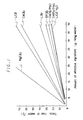
- Fig. 1 is a graph showing a relationship between the amount of exothermic compounds used in the present invention added to water and the temperature rise of the water.
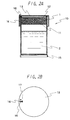
- Figs. 2A and 2B illustrate an example of the two-component type melting composition in accordance with the present invention, Figs. 2A and 2B being a cross-sectional view and a top plan view, respectively, showing a conainer wherein the exothermic compound and the water component are separately contained.
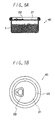
- Figs. 3A and 3B and Fig. 4 illustrate another example of the two-component type melting composition in accordance with the present invention, Figs. 3A and 3B being a cross-sectional view and a top plan view, respectively, showing a container containing the water component, and Fig. 4 being a partially broken perspective view showing a bag containing the exothermic compound.
- Figs. 5A and 5B are a cross-sectional view and a top plan view, respectively, showing another example of the container containing the exothermic compound which can be used in combination with the container containing the water component as shown in Figs. 3A and 3B.
- aqueous solid is intended to include all frozen water or water vapour, such as ice, snow and frost, which may contain impurities such as inorganic salts.
- an aqueous solid such as ice is melted by utilizing the phenomenon that the effective ingredient generates heat on dissolving into water, thereby elevating the temperature of the water.
- aqueous solution water (aqueous solution) of 0.1°C
- an aqueous solid such as ice is melted by utilizing the phenomenon that when a dispersion of the powdered effective ingredient in a volatile organic solvent is applied to ice, a large portion of the organic solvent is volatilized and the powder of the effective ingredient is brought into direct contact with the ice even if a small portion of the organic solvent remains, thereby generating heat so that an amount of ice proportional to the amount of the effective ingredient is melted into water.
- the effective ingredient used in the present invention is a compound selected from the following group: anhydrous calcium chloride (CaCl 2 ) , calcium chloride monohydrate (CaCl 2 ⁇ H 2 O) , calcium chloride dihydrate (CaCl2 ⁇ 2H2O ), calcium bromide dihydrate (CaBr 2 ⁇ 2H 2 O) , anhydrous magnesium chloride (MgCl 2 ) , anhydrous strontium chloride (SrCl 2 ) , anhydrous lithium chloride (LiCl) , lithium chloride monohydrate (LiCl ⁇ H2O) and anhydrous lithium bromide (LiBr) .
- These compounds may be used alone or in admixture.
- the above compounds are those which are solid at ordinary temperature and which have the property that they generate heat when they are dissolved in water or brought into contact with water or aqueous solids such as ice. All the compounds generate a large quantity of heat.
- Calcium chloride hexahydrate (CaCl 2 ⁇ 6H 2 O) , which has been commonly used as a melting agent for snow and ice, cannot be used in the present invention, because its dissolution in water is endothermic and the temperature of the water is lowered.
- the effective ingredient can be used in the range of from 0.03 part by weight per 100 parts by weight of water to such amount that water is saturated with the effective ingredient, thereby obtaining an aqueous solution having a temperature of 0.1° to 100°C.
- the temperature of the obtained aqueous solution is preferably not less than 10°C from the standpoint of melting capacity.
- the upper limit of the temperature is not limited but is preferably 70°C for practical use.
- the amount of the effective ingredient is preferably from 0.03 to 150 parts by weight, more preferably from 3 to 35 parts by weight, per 100 parts by weight of water. From the standpoint of melting capacity, the effective ingredient is preferably used in such an amount that the temperature of the water used is raised by at least 0.1°C, especially by at least 10°C.
- An aqueous solution of each solid compound as an effective ingredient has a pH value around neutrality and low dangerousness and toxicity.
- the amount of heat generated when the effective ingredient is dissolved into water increases with an increasing amount of the effective ingredient.
- the use of a kind of the effective ingredient causes boiling of water. For example, when 350 g of anhydrous calcium chloride is dissolved into 1 l of water of 15°C, the temperature of the water is raised till it boils.
- Anhydrous magnesium chloride, anhydrous lithium chloride and anhydrous calcium chloride are preferably used as the effective ingredient from the viewpoint that they generate a large amount of heat upon dissolving in water.
- an aqueous solution obtained by dissolving the effective ingredient into water is used immediately after the preparation thereof, i.e. in such a state that the solution retains substantially the amount of heat generated.
- the melting composition of the first invention is used in the form of a separate two-component type melting agent. That is, there are provided a closed container or bag containing a desired amount of the effective ingredient (exothermic compound) and another closed container or bag containing a desired amount of water. Both containers or bags are opened in situ in a place where melting of ice, etc. is conducted and the effective ingredient is dissolved into the water to give an aqueous solution which is immediately used to melt an aqueous solid.
- the container or bag include those made of plastic films or sheets and metal cans.
- the effective ingredient and water may be contained in single container or bag unless they mix.
- a container or bag wherein the inside is separated into two rooms by a separator can be used. The effective ingredient is contained in one room and water in the other room and both components are mixed with each other by removing the separator or by breaking it.
- the above separate two-component type melting agent is used under such a condition that water freezes
- a conventional antifreezing agent examples include alcohols such as isopropyl alcohol, glycols such as ethylene glycol and propylene glycol, and glycol ethers such as ethylene glycol monobutyl ether. These antifreezing agents may be used alone or in admixture.
- the amount of the antifreezing agent varies depending upon the temperature of the circumstance where the melting agent is used. Generally, the antifreezing agent is used in an amount of 30 to 200 parts by weight per 100 parts by weight of water to lower the freezing point of the water component to a range of -5°C to -40°C.
- Figs. 2A and 2B illustrate an example of the separate two-component type melting composition in accordance with the present invention.
- Figs. 2A and 2B are a cross-sectional view and a top plan view, respectively, showing a container containing the exothermic compound and the water component separate from each other.
- Numeral 10 indicates a cylindrical container made of a metal such as aluminum.
- the container 10 has, between its top and bottom, a sheet-like separator 11 made of a material impervious to water vapor and water, such as plastic material, for separating the exothermic compound 1 and the water component 2.
- the water component 2 is put in the container 10 and the separator 11 is bonded at its periphery to the inner wall of the container 10.
- the exothermic compound 1 in a powdery or granular form is put on the separator 11.
- the top of the container 10 is closed airtightly with a sheet-like covering 12 made of a material impervious to water vapor and water, such as plastic material.
- a lid 13 is further put on the top of the container 10.
- the lid 13 is equipped with a cutting device 14 having a length enough for its tip to reach the separator 11.
- the cutting device 14 is attached to the lid 13 with extending downward along the outer surface of the side wall of the container 10.
- Another covering 15 made of a resilient material such as plastic material and capable of closing liquid-tightly the top of the container 10 is attached detachably to the bottom of the container 10.
- the manner of using the above-mentioned two-component type melting composition is as follows: The lid 13 and the resilient covering 15 are detached from the container 10. The cutting device 14 is moved to the cutting position 17 through a slot 16 in the direction indicated by the arrow. The lid 13 with the cutting device 14 located in that position is again put on the container 10 and pushed down so that the cutting device 14 pierces through the covering 12 and the separator 11. Then the lid 13 is turned fully clockwise or anticlockwise so that the covering 12 and the separator 11 are cut off and the exothermic component 1 falls into the water component 2. The lid 13 is removed and the top of the container 10 is closed with the covering 15. The thus closed container is shaken for an appropriate time, for example, 30 to 60 seconds, thereby giving a hot water which is used to melt a solid water.
- Figs. 3A and 3B and Fig. 4 illustrate another example of the two-component type melting composition.
- Figs. 3A and 3B are a cross-sectional view and a top plan view, respectively, showing a container containing the water component and
- Fig. 4 is a partially broken perspective view showing a bag containing the exothermic compound 1.
- Numeral 20 indicates a container containing the water component.
- the container 20 is made of a metal such as aluminum and has a structure similar to a pull-top can. That is, the container 20 has a lid 21 provided with a pull ring 22 and a notched loop 23. When the pull ring 22 is pulled up, the lid 21 is cut at the notched loop 23 and the central portion of the lid 21 can be removed.
- the water component 2 is put in the container 20 and the container 20 is liquid-tightly sealed by crimping the lid 21.
- a covering 24 made of a resilient material such as plastic material and capable of closing liquid-tightly the top of the container 20 is attached detachably to the bottom of the container 20.
- the exothermic compound 2 is contained in a bag 30 made of a material impervious to water vapor and water, such as plastic material.
- the bag 30 is airtightly closed by a suitable means such as heat sealing.
- the manner of using the two-component type melting composition is as follows: The lid 21 is removed from the container 20. The bag 30 is opened and the exothermic compound 1 is added to the water component 2 in the container 20. The top of the container 20 is closed with the covering 24 and the container 20 is shaken for an appropriate time to dissolve the exothermic compound 1 into the water component 2, thereby giving a hot water.
- Figs. 5A and 5B show another example of the container containing the exothermic compound which can be used in combination with the container containing the water component as shown in Figs. 3A and 3B.
- Figs. 5A and 5B are a cross-sectional view and a top plan view, respectively, of the container.
- Numeral 40 indicates a container containing the exothermic compound 1.
- the container 40 has a structure similar to the container 20.
- the same numerals as those in Figs. 3A and 3B indicate the same elements.
- a ball mill is preferably used to disperse the effective ingredient into the organic solvent.
- the second invention is more effective because they are markedly deliquescent.
- the effective ingredient is usually used in an amount of 30 to 140 parts by weight per 100 parts by weight of the organic solvent.
- Organic solvents having a fast vaporizing rate are preferably used as the volatile organic solvent, including methanol, ethanol, benzene, toluene, petroleum benzine, petroleum ether, methyl acetate, ethyl acetate, acetone, methyl ethyl ketone, isopropyl ether and methylene chloride.
- Organic solvents having a medium vaporizing rate can be used, including isopropyl alcohol, butanol, xylene, butyl acetate, methyl isobutyl ketone, cyclohexane, ligroin and trichloroethane.
- the melting rate becomes somewhat slow.
- Organic solvents having a very slow vaporizing rate, such as kerosene can also be used though the melting rate becomes slow.
- composition of the second invention can be used in an aerosol product.
- An aerosol composition composed of a dispersion of an effective ingredient in a volatile organic solvent in accordance with the second invention and an appropriate propellant is packaged in an aerosol container with a valve and an actuating nozzle button.
- the propellant are dimethyl ether, nitrogen gas, carbon dioxide, liquefied petroleum gas and flon gases.
- the amount of the proppelant is from 20 to 300 parts by weight per 100 parts by weight of the dispersion.
- the aerosol product is preferred because of a good handling property and a good applying property.
- the compounds used as an effective ingredient in the first and second invention are chlorides or bromides.
- the compounds cause chlorine ion or bromine ion when they are dissolved in water. These anions accelerate corrosion of iron.
- a composition in accordance with the first invention or the second invention is preferably used in combination with a corrosion inhibitor.
- the corrosion inhibitor are potassium nitrite (KNO2) and sodium nitrite (NaNO2) .
- the melting compositions of the first invention and the second invention can be applied to an aqueous solid such as ice, snow or frost by any application means including spraying with a spray device or an aerosol product, brush coating and roller coating.
- the melting compositions of the first invention and the second invention are preferably used to melt frost or ice formed on window panes or mirrors of vehicles (automobiles, electric cars, etc.), houses, buildings, etc. and to melt a small amount of snow or ice on small area of places such as gateway of houses, etc.
- the melting compositions can also be used to melt frost or ice formed on the cooling coil of refrigerators and the fins of heat pump of cooling or heating apparatuses. Such frost and ice should be removed when these apparatuses get out of order.
- the melting compositions of the invention can be used to melt ice, snow or frost on any places or apparatuses.
- Both melting composition of the first invention and the second invention have a great melting capacity because of utilizing the heat generated when the exothermic solid compound is dissolved into water or brought in contact with an aqueous solid such as ice, snow or frost.
- both melting compositions of the first invention and the second invention are easy to be applied onto an aqueous solid because they are liquid, and they are easy to be handled with safety because they are nutral.
- Each melting composition was prepared by adding a given amount of an exothermic solid compound to 100 g of city water and agitating the mixture for 30 seconds to dissolve the compound into the water.
- the temperatures (maximum temperature) of the obtained melting compositions A through P were measured. As shown in Table 2, rises in temperature ranging from 1.5° to 16.5°C were observed.
- the melting compositions A through P were liquids having temperatures higher than that of the original water (of course, that of ice). Accordingly, when each of the compositions A through P was applied to ice, the ice was melted efficiently.
- the amount of each melting agent to be used is determined in consideration of a given amount of ice. For instance, in the case of using 105 g of the melting composition H (the rise in temperature: 15.5°C), about 19 g of ice could be melted by utilizing only the heat generated.
- a 1,000 ml cylindrical aluminum container 20 having the same structure as shown in Figs. 3A and 3B was charged with 700 g of water and capped with a capping machine.
- a resilient covering 24 was attached to the bottom of the container 20 by means of a cellophane tape.
- a 300 ml cylindrical aluminum container 40 having the same structure as shown in Figs. 5A and 5B was charged with 105 g of anhydrous magnesium chloride in the form of particles having a particle size of 1.5 to 3 mm and capped with a capping machine.
- a two-component type melting agent was provided.
- the water-containing container 20 was opened in an atmosphere of 15°C. When the temperature of the water was measured, it was 15°C.
- the anhydrous magnesium chloride-containing container 40 was opened and the whole amount of the anhydrous magnesium chloride was immediately added to the water in the container 20.
- the container 20 was closed with the resilient covering 24 and shaken for 60 seconds. When the temperature of the water was measured after shaking, it was 60°C.
- the obtained hot water was poured in small portions onto ice of 150 g, whereby the whole amount of ice was melted.
- a 420 ml aerosol container was charged with 152 g of each of the melting compositions R through W. After the container was fitted with an aerosol valve and closed, 152 g of a liquefied petroleum gas as a propellant was introduced into the container through the valve. Then the container was fitted with a nozzle button to give an aerosol product.
- aerosol products R', S', T', U', V' and W' corresponding to the melting compositions R, S, T, U, V and W were prepared.
Landscapes
- Chemical & Material Sciences (AREA)
- Engineering & Computer Science (AREA)
- Combustion & Propulsion (AREA)
- Materials Engineering (AREA)
- Organic Chemistry (AREA)
- Materials Applied To Surfaces To Minimize Adherence Of Mist Or Water (AREA)
- Pharmaceuticals Containing Other Organic And Inorganic Compounds (AREA)
Applications Claiming Priority (2)
| Application Number | Priority Date | Filing Date | Title |
|---|---|---|---|
| JP314890/89 | 1989-12-04 | ||
| JP1314890A JPH03174484A (ja) | 1989-12-04 | 1989-12-04 | 氷等用の融解剤 |
Publications (1)
| Publication Number | Publication Date |
|---|---|
| EP0431282A1 true EP0431282A1 (fr) | 1991-06-12 |
Family
ID=18058859
Family Applications (1)
| Application Number | Title | Priority Date | Filing Date |
|---|---|---|---|
| EP90119498A Withdrawn EP0431282A1 (fr) | 1989-12-04 | 1990-10-11 | Méthode et composition pour fondre un solide acqueux |
Country Status (6)
| Country | Link |
|---|---|
| EP (1) | EP0431282A1 (fr) |
| JP (1) | JPH03174484A (fr) |
| KR (1) | KR910012154A (fr) |
| AU (1) | AU6474690A (fr) |
| CA (1) | CA2027164A1 (fr) |
| FI (1) | FI904973A7 (fr) |
Cited By (1)
| Publication number | Priority date | Publication date | Assignee | Title |
|---|---|---|---|---|
| RU2314329C2 (ru) * | 2006-01-10 | 2008-01-10 | Открытое Акционерное Общество "Каустик" | Антигололедный препарат и способ его получения (варианты) |
Citations (3)
| Publication number | Priority date | Publication date | Assignee | Title |
|---|---|---|---|---|
| US2731353A (en) * | 1953-06-09 | 1956-01-17 | Jacob M Fain | De-icing material |
| FR2214089A1 (fr) * | 1973-01-15 | 1974-08-09 | Texaco Development Corp | |
| EP0180568A2 (fr) * | 1984-10-31 | 1986-05-07 | Makise, Masanobu | Substance provoquant le dégel |
Family Cites Families (3)
| Publication number | Priority date | Publication date | Assignee | Title |
|---|---|---|---|---|
| JPH0692577B2 (ja) * | 1986-01-13 | 1994-11-16 | 株式会社トクヤマ | 融氷雪剤 |
| JPS6397683A (ja) * | 1986-10-14 | 1988-04-28 | Chuo Riken Kk | 不凍性組成物 |
| JPS63117089A (ja) * | 1986-11-05 | 1988-05-21 | Mototada Matsushima | 液状融雪・融氷剤 |
-
1989
- 1989-12-04 JP JP1314890A patent/JPH03174484A/ja active Pending
-
1990
- 1990-10-09 FI FI904973A patent/FI904973A7/fi not_active Application Discontinuation
- 1990-10-09 CA CA002027164A patent/CA2027164A1/fr not_active Abandoned
- 1990-10-11 EP EP90119498A patent/EP0431282A1/fr not_active Withdrawn
- 1990-10-13 KR KR1019900016220A patent/KR910012154A/ko not_active Ceased
- 1990-10-18 AU AU64746/90A patent/AU6474690A/en not_active Abandoned
Patent Citations (3)
| Publication number | Priority date | Publication date | Assignee | Title |
|---|---|---|---|---|
| US2731353A (en) * | 1953-06-09 | 1956-01-17 | Jacob M Fain | De-icing material |
| FR2214089A1 (fr) * | 1973-01-15 | 1974-08-09 | Texaco Development Corp | |
| EP0180568A2 (fr) * | 1984-10-31 | 1986-05-07 | Makise, Masanobu | Substance provoquant le dégel |
Non-Patent Citations (2)
| Title |
|---|
| JAPANESE PATENT OFFICE, FILE SUPPLIER JAPS, Tokyo, JP; & JP-A-62 089 785 (MASANOBU MAKISE) * |
| JAPANESE PATENT OFFICE, FILE SUPPLIER JAPS, Tokyo, JP; & JP-A-63 097 683 (CHUO RIKEN K.K.) * |
Cited By (1)
| Publication number | Priority date | Publication date | Assignee | Title |
|---|---|---|---|---|
| RU2314329C2 (ru) * | 2006-01-10 | 2008-01-10 | Открытое Акционерное Общество "Каустик" | Антигололедный препарат и способ его получения (варианты) |
Also Published As
| Publication number | Publication date |
|---|---|
| CA2027164A1 (fr) | 1991-06-05 |
| JPH03174484A (ja) | 1991-07-29 |
| KR910012154A (ko) | 1991-08-07 |
| AU6474690A (en) | 1991-06-06 |
| FI904973L (fi) | 1991-06-05 |
| FI904973A7 (fi) | 1991-06-05 |
| FI904973A0 (fi) | 1990-10-09 |
Similar Documents
| Publication | Publication Date | Title |
|---|---|---|
| US2321023A (en) | Method of applying parasiticides | |
| KR100576185B1 (ko) | 휴대용 열원 | |
| US4234432A (en) | Powder dissemination composition | |
| US2728495A (en) | Liquid dispensing device and composition therefor | |
| US11577110B2 (en) | Post-foaming composition for protection against fire and/or heat | |
| WO2000012180A1 (fr) | Gels d'extinction d'incendie et procede de preparation et d'utilisation | |
| US4110427A (en) | Powdered solid aerosol composition and method of manufacture | |
| US3776775A (en) | Removal of ice by a self-heating mixture | |
| EP0431282A1 (fr) | Méthode et composition pour fondre un solide acqueux | |
| US3974945A (en) | Aerosol dispensing system | |
| WO2003001140A1 (fr) | Dispositif de pulverisation | |
| US4161458A (en) | Stable aqueous aerosol system with carbon dioxide propellant | |
| US2705661A (en) | Liquid dispensing system employing internally-generated gas pressure | |
| US3804759A (en) | Aerosol fire extinguisher and method | |
| US3275201A (en) | Flux composition package | |
| US5567739A (en) | Insulating foam of low thermal conductivity and method of preparation | |
| GB1570514A (en) | Fire extinguishing method and product | |
| JP2001072152A (ja) | 全量噴射型エアゾール製品 | |
| US11660486B1 (en) | Fire extinguisher and method | |
| JPH04198294A (ja) | 融解剤溶液調合セット及びエアゾル式の融解剤分散液 | |
| JP2772073B2 (ja) | 粉末エアゾール組成物 | |
| US3812043A (en) | Package for dispensing an ice-removing composition | |
| US5215674A (en) | Method for reducing the risk in shipment of liquid ammonia | |
| US3863005A (en) | Dual astringent composition | |
| JPH07241498A (ja) | 環境保全性液化ガスをプロペラントとしたエアロゾル発生方法 |
Legal Events
| Date | Code | Title | Description |
|---|---|---|---|
| PUAI | Public reference made under article 153(3) epc to a published international application that has entered the european phase |
Free format text: ORIGINAL CODE: 0009012 |
|
| AK | Designated contracting states |
Kind code of ref document: A1 Designated state(s): AT CH DE DK FR GB IT LI NL SE |
|
| 17P | Request for examination filed |
Effective date: 19911203 |
|
| 17Q | First examination report despatched |
Effective date: 19921130 |
|
| STAA | Information on the status of an ep patent application or granted ep patent |
Free format text: STATUS: THE APPLICATION IS DEEMED TO BE WITHDRAWN |
|
| 18D | Application deemed to be withdrawn |
Effective date: 19930410 |