EP0431301A1 - Matériau composite céramique mis on forme ou stratifié et méthode pour sa fabrication - Google Patents
Matériau composite céramique mis on forme ou stratifié et méthode pour sa fabrication Download PDFInfo
- Publication number
- EP0431301A1 EP0431301A1 EP90120483A EP90120483A EP0431301A1 EP 0431301 A1 EP0431301 A1 EP 0431301A1 EP 90120483 A EP90120483 A EP 90120483A EP 90120483 A EP90120483 A EP 90120483A EP 0431301 A1 EP0431301 A1 EP 0431301A1
- Authority
- EP
- European Patent Office
- Prior art keywords
- stack
- prepreg
- sheets
- edge
- article
- Prior art date
- Legal status (The legal status is an assumption and is not a legal conclusion. Google has not performed a legal analysis and makes no representation as to the accuracy of the status listed.)
- Withdrawn
Links
- 239000002131 composite material Substances 0.000 title claims abstract description 51
- 239000000919 ceramic Substances 0.000 title claims description 12
- 238000004519 manufacturing process Methods 0.000 title description 14
- 239000000835 fiber Substances 0.000 claims abstract description 56
- 239000011159 matrix material Substances 0.000 claims abstract description 38
- 238000000034 method Methods 0.000 claims abstract description 38
- 239000011153 ceramic matrix composite Substances 0.000 claims abstract description 18
- 239000012783 reinforcing fiber Substances 0.000 claims abstract description 9
- 239000010410 layer Substances 0.000 claims description 38
- 238000007596 consolidation process Methods 0.000 claims description 29
- 239000000463 material Substances 0.000 claims description 28
- 239000011521 glass Substances 0.000 claims description 25
- 239000002241 glass-ceramic Substances 0.000 claims description 16
- 238000010438 heat treatment Methods 0.000 claims description 6
- HBMJWWWQQXIZIP-UHFFFAOYSA-N silicon carbide Chemical compound [Si+]#[C-] HBMJWWWQQXIZIP-UHFFFAOYSA-N 0.000 claims description 6
- OKTJSMMVPCPJKN-UHFFFAOYSA-N Carbon Chemical compound [C] OKTJSMMVPCPJKN-UHFFFAOYSA-N 0.000 claims description 5
- 239000012784 inorganic fiber Substances 0.000 claims description 5
- 229910010271 silicon carbide Inorganic materials 0.000 claims description 5
- 239000002344 surface layer Substances 0.000 claims description 4
- XUIMIQQOPSSXEZ-UHFFFAOYSA-N Silicon Chemical compound [Si] XUIMIQQOPSSXEZ-UHFFFAOYSA-N 0.000 claims description 3
- 229910052799 carbon Inorganic materials 0.000 claims description 3
- 229910052710 silicon Inorganic materials 0.000 claims description 3
- 239000010703 silicon Substances 0.000 claims description 3
- 238000013461 design Methods 0.000 description 12
- VYPSYNLAJGMNEJ-UHFFFAOYSA-N Silicium dioxide Chemical compound O=[Si]=O VYPSYNLAJGMNEJ-UHFFFAOYSA-N 0.000 description 10
- 238000007731 hot pressing Methods 0.000 description 10
- 239000000843 powder Substances 0.000 description 8
- 238000000465 moulding Methods 0.000 description 7
- 239000000203 mixture Substances 0.000 description 6
- 239000002002 slurry Substances 0.000 description 6
- PNEYBMLMFCGWSK-UHFFFAOYSA-N aluminium oxide Inorganic materials [O-2].[O-2].[O-2].[Al+3].[Al+3] PNEYBMLMFCGWSK-UHFFFAOYSA-N 0.000 description 5
- 229910052681 coesite Inorganic materials 0.000 description 5
- 238000009734 composite fabrication Methods 0.000 description 5
- 229910052878 cordierite Inorganic materials 0.000 description 5
- 229910052906 cristobalite Inorganic materials 0.000 description 5
- JSKIRARMQDRGJZ-UHFFFAOYSA-N dimagnesium dioxido-bis[(1-oxido-3-oxo-2,4,6,8,9-pentaoxa-1,3-disila-5,7-dialuminabicyclo[3.3.1]nonan-7-yl)oxy]silane Chemical compound [Mg++].[Mg++].[O-][Si]([O-])(O[Al]1O[Al]2O[Si](=O)O[Si]([O-])(O1)O2)O[Al]1O[Al]2O[Si](=O)O[Si]([O-])(O1)O2 JSKIRARMQDRGJZ-UHFFFAOYSA-N 0.000 description 5
- 230000002787 reinforcement Effects 0.000 description 5
- 239000000377 silicon dioxide Substances 0.000 description 5
- 235000012239 silicon dioxide Nutrition 0.000 description 5
- 229910052682 stishovite Inorganic materials 0.000 description 5
- 229910052905 tridymite Inorganic materials 0.000 description 5
- 229910000323 aluminium silicate Inorganic materials 0.000 description 4
- 239000013078 crystal Substances 0.000 description 4
- HNPSIPDUKPIQMN-UHFFFAOYSA-N dioxosilane;oxo(oxoalumanyloxy)alumane Chemical compound O=[Si]=O.O=[Al]O[Al]=O HNPSIPDUKPIQMN-UHFFFAOYSA-N 0.000 description 4
- 125000006850 spacer group Chemical group 0.000 description 4
- 229910052661 anorthite Inorganic materials 0.000 description 3
- 229910052788 barium Inorganic materials 0.000 description 3
- 239000011230 binding agent Substances 0.000 description 3
- 229910052593 corundum Inorganic materials 0.000 description 3
- 238000002425 crystallisation Methods 0.000 description 3
- 230000008025 crystallization Effects 0.000 description 3
- GWWPLLOVYSCJIO-UHFFFAOYSA-N dialuminum;calcium;disilicate Chemical compound [Al+3].[Al+3].[Ca+2].[O-][Si]([O-])([O-])[O-].[O-][Si]([O-])([O-])[O-] GWWPLLOVYSCJIO-UHFFFAOYSA-N 0.000 description 3
- KZHJGOXRZJKJNY-UHFFFAOYSA-N dioxosilane;oxo(oxoalumanyloxy)alumane Chemical compound O=[Si]=O.O=[Si]=O.O=[Al]O[Al]=O.O=[Al]O[Al]=O.O=[Al]O[Al]=O KZHJGOXRZJKJNY-UHFFFAOYSA-N 0.000 description 3
- 230000000694 effects Effects 0.000 description 3
- 229910002804 graphite Inorganic materials 0.000 description 3
- 239000010439 graphite Substances 0.000 description 3
- 229910052863 mullite Inorganic materials 0.000 description 3
- 239000011226 reinforced ceramic Substances 0.000 description 3
- 239000006104 solid solution Substances 0.000 description 3
- 238000001721 transfer moulding Methods 0.000 description 3
- 229910001845 yogo sapphire Inorganic materials 0.000 description 3
- GOLCXWYRSKYTSP-UHFFFAOYSA-N Arsenious Acid Chemical compound O1[As]2O[As]1O2 GOLCXWYRSKYTSP-UHFFFAOYSA-N 0.000 description 2
- KKCBUQHMOMHUOY-UHFFFAOYSA-N Na2O Inorganic materials [O-2].[Na+].[Na+] KKCBUQHMOMHUOY-UHFFFAOYSA-N 0.000 description 2
- GWEVSGVZZGPLCZ-UHFFFAOYSA-N Titan oxide Chemical compound O=[Ti]=O GWEVSGVZZGPLCZ-UHFFFAOYSA-N 0.000 description 2
- MCMNRKCIXSYSNV-UHFFFAOYSA-N Zirconium dioxide Chemical compound O=[Zr]=O MCMNRKCIXSYSNV-UHFFFAOYSA-N 0.000 description 2
- DSAJWYNOEDNPEQ-UHFFFAOYSA-N barium atom Chemical compound [Ba] DSAJWYNOEDNPEQ-UHFFFAOYSA-N 0.000 description 2
- 238000006243 chemical reaction Methods 0.000 description 2
- 238000005056 compaction Methods 0.000 description 2
- 239000002270 dispersing agent Substances 0.000 description 2
- 238000009826 distribution Methods 0.000 description 2
- 239000002657 fibrous material Substances 0.000 description 2
- 230000009969 flowable effect Effects 0.000 description 2
- 238000007654 immersion Methods 0.000 description 2
- 238000010348 incorporation Methods 0.000 description 2
- 238000001746 injection moulding Methods 0.000 description 2
- 150000002500 ions Chemical class 0.000 description 2
- 238000011068 loading method Methods 0.000 description 2
- 229910052751 metal Inorganic materials 0.000 description 2
- 239000002184 metal Substances 0.000 description 2
- 238000001000 micrograph Methods 0.000 description 2
- 239000006060 molten glass Substances 0.000 description 2
- 230000003287 optical effect Effects 0.000 description 2
- 239000011368 organic material Substances 0.000 description 2
- 229910001732 osumilite Inorganic materials 0.000 description 2
- BASFCYQUMIYNBI-UHFFFAOYSA-N platinum Chemical compound [Pt] BASFCYQUMIYNBI-UHFFFAOYSA-N 0.000 description 2
- 238000012545 processing Methods 0.000 description 2
- 239000000725 suspension Substances 0.000 description 2
- 229910052580 B4C Inorganic materials 0.000 description 1
- 229920002430 Fibre-reinforced plastic Polymers 0.000 description 1
- FUJCRWPEOMXPAD-UHFFFAOYSA-N Li2O Inorganic materials [Li+].[Li+].[O-2] FUJCRWPEOMXPAD-UHFFFAOYSA-N 0.000 description 1
- WHXSMMKQMYFTQS-UHFFFAOYSA-N Lithium Chemical compound [Li] WHXSMMKQMYFTQS-UHFFFAOYSA-N 0.000 description 1
- FYYHWMGAXLPEAU-UHFFFAOYSA-N Magnesium Chemical compound [Mg] FYYHWMGAXLPEAU-UHFFFAOYSA-N 0.000 description 1
- 229910052581 Si3N4 Inorganic materials 0.000 description 1
- HCHKCACWOHOZIP-UHFFFAOYSA-N Zinc Chemical compound [Zn] HCHKCACWOHOZIP-UHFFFAOYSA-N 0.000 description 1
- 229910052656 albite Inorganic materials 0.000 description 1
- 229910000272 alkali metal oxide Inorganic materials 0.000 description 1
- 239000005359 alkaline earth aluminosilicate glass Substances 0.000 description 1
- 229910000287 alkaline earth metal oxide Inorganic materials 0.000 description 1
- CNLWCVNCHLKFHK-UHFFFAOYSA-N aluminum;lithium;dioxido(oxo)silane Chemical compound [Li+].[Al+3].[O-][Si]([O-])=O.[O-][Si]([O-])=O CNLWCVNCHLKFHK-UHFFFAOYSA-N 0.000 description 1
- 238000013459 approach Methods 0.000 description 1
- 239000007900 aqueous suspension Substances 0.000 description 1
- 229910052792 caesium Inorganic materials 0.000 description 1
- 229910052791 calcium Inorganic materials 0.000 description 1
- ODINCKMPIJJUCX-UHFFFAOYSA-N calcium oxide Inorganic materials [Ca]=O ODINCKMPIJJUCX-UHFFFAOYSA-N 0.000 description 1
- 230000015556 catabolic process Effects 0.000 description 1
- 229910010293 ceramic material Inorganic materials 0.000 description 1
- 239000000470 constituent Substances 0.000 description 1
- 238000010276 construction Methods 0.000 description 1
- 238000011109 contamination Methods 0.000 description 1
- 238000007796 conventional method Methods 0.000 description 1
- 239000002178 crystalline material Substances 0.000 description 1
- 238000005520 cutting process Methods 0.000 description 1
- 238000006731 degradation reaction Methods 0.000 description 1
- XUCJHNOBJLKZNU-UHFFFAOYSA-M dilithium;hydroxide Chemical compound [Li+].[Li+].[OH-] XUCJHNOBJLKZNU-UHFFFAOYSA-M 0.000 description 1
- 230000003628 erosive effect Effects 0.000 description 1
- 229910000174 eucryptite Inorganic materials 0.000 description 1
- 230000001747 exhibiting effect Effects 0.000 description 1
- 239000011151 fibre-reinforced plastic Substances 0.000 description 1
- 238000011049 filling Methods 0.000 description 1
- 239000012530 fluid Substances 0.000 description 1
- 239000011888 foil Substances 0.000 description 1
- 229910001678 gehlenite Inorganic materials 0.000 description 1
- 239000006112 glass ceramic composition Substances 0.000 description 1
- 238000000227 grinding Methods 0.000 description 1
- 230000009931 harmful effect Effects 0.000 description 1
- 239000012535 impurity Substances 0.000 description 1
- 239000003112 inhibitor Substances 0.000 description 1
- 239000007924 injection Substances 0.000 description 1
- 239000011229 interlayer Substances 0.000 description 1
- 239000006194 liquid suspension Substances 0.000 description 1
- 229910052744 lithium Inorganic materials 0.000 description 1
- 238000003754 machining Methods 0.000 description 1
- 229910052749 magnesium Inorganic materials 0.000 description 1
- 239000011777 magnesium Substances 0.000 description 1
- 238000003801 milling Methods 0.000 description 1
- 238000012986 modification Methods 0.000 description 1
- 230000004048 modification Effects 0.000 description 1
- 239000002245 particle Substances 0.000 description 1
- 230000002093 peripheral effect Effects 0.000 description 1
- 229910052697 platinum Inorganic materials 0.000 description 1
- 229920000642 polymer Polymers 0.000 description 1
- 239000004810 polytetrafluoroethylene Substances 0.000 description 1
- 229920001343 polytetrafluoroethylene Polymers 0.000 description 1
- NOTVAPJNGZMVSD-UHFFFAOYSA-N potassium monoxide Inorganic materials [K]O[K] NOTVAPJNGZMVSD-UHFFFAOYSA-N 0.000 description 1
- 239000002243 precursor Substances 0.000 description 1
- 238000003825 pressing Methods 0.000 description 1
- 239000011217 refractory ceramic matrix composite Substances 0.000 description 1
- 238000007493 shaping process Methods 0.000 description 1
- HQVNEWCFYHHQES-UHFFFAOYSA-N silicon nitride Chemical compound N12[Si]34N5[Si]62N3[Si]51N64 HQVNEWCFYHHQES-UHFFFAOYSA-N 0.000 description 1
- 238000005245 sintering Methods 0.000 description 1
- 238000004513 sizing Methods 0.000 description 1
- 229910052596 spinel Inorganic materials 0.000 description 1
- 239000011029 spinel Substances 0.000 description 1
- 238000005507 spraying Methods 0.000 description 1
- 229910052712 strontium Inorganic materials 0.000 description 1
- 238000012546 transfer Methods 0.000 description 1
- 238000009827 uniform distribution Methods 0.000 description 1
- 238000004804 winding Methods 0.000 description 1
- 229910052725 zinc Inorganic materials 0.000 description 1
- 239000011701 zinc Substances 0.000 description 1
- 229910052845 zircon Inorganic materials 0.000 description 1
- GFQYVLUOOAAOGM-UHFFFAOYSA-N zirconium(iv) silicate Chemical compound [Zr+4].[O-][Si]([O-])([O-])[O-] GFQYVLUOOAAOGM-UHFFFAOYSA-N 0.000 description 1
- 229910000500 β-quartz Inorganic materials 0.000 description 1
- 229910052644 β-spodumene Inorganic materials 0.000 description 1
Images


Classifications
-
- B—PERFORMING OPERATIONS; TRANSPORTING
- B32—LAYERED PRODUCTS
- B32B—LAYERED PRODUCTS, i.e. PRODUCTS BUILT-UP OF STRATA OF FLAT OR NON-FLAT, e.g. CELLULAR OR HONEYCOMB, FORM
- B32B18/00—Layered products essentially comprising ceramics, e.g. refractory products
-
- C—CHEMISTRY; METALLURGY
- C03—GLASS; MINERAL OR SLAG WOOL
- C03C—CHEMICAL COMPOSITION OF GLASSES, GLAZES OR VITREOUS ENAMELS; SURFACE TREATMENT OF GLASS; SURFACE TREATMENT OF FIBRES OR FILAMENTS MADE FROM GLASS, MINERALS OR SLAGS; JOINING GLASS TO GLASS OR OTHER MATERIALS
- C03C14/00—Glass compositions containing a non-glass component, e.g. compositions containing fibres, filaments, whiskers, platelets, or the like, dispersed in a glass matrix
- C03C14/002—Glass compositions containing a non-glass component, e.g. compositions containing fibres, filaments, whiskers, platelets, or the like, dispersed in a glass matrix the non-glass component being in the form of fibres, filaments, yarns, felts or woven material
-
- C—CHEMISTRY; METALLURGY
- C04—CEMENTS; CONCRETE; ARTIFICIAL STONE; CERAMICS; REFRACTORIES
- C04B—LIME, MAGNESIA; SLAG; CEMENTS; COMPOSITIONS THEREOF, e.g. MORTARS, CONCRETE OR LIKE BUILDING MATERIALS; ARTIFICIAL STONE; CERAMICS; REFRACTORIES; TREATMENT OF NATURAL STONE
- C04B35/00—Shaped ceramic products characterised by their composition; Ceramics compositions; Processing powders of inorganic compounds preparatory to the manufacturing of ceramic products
- C04B35/01—Shaped ceramic products characterised by their composition; Ceramics compositions; Processing powders of inorganic compounds preparatory to the manufacturing of ceramic products based on oxide ceramics
- C04B35/16—Shaped ceramic products characterised by their composition; Ceramics compositions; Processing powders of inorganic compounds preparatory to the manufacturing of ceramic products based on oxide ceramics based on silicates other than clay
- C04B35/18—Shaped ceramic products characterised by their composition; Ceramics compositions; Processing powders of inorganic compounds preparatory to the manufacturing of ceramic products based on oxide ceramics based on silicates other than clay rich in aluminium oxide
- C04B35/195—Alkaline earth aluminosilicates, e.g. cordierite or anorthite
-
- C—CHEMISTRY; METALLURGY
- C04—CEMENTS; CONCRETE; ARTIFICIAL STONE; CERAMICS; REFRACTORIES
- C04B—LIME, MAGNESIA; SLAG; CEMENTS; COMPOSITIONS THEREOF, e.g. MORTARS, CONCRETE OR LIKE BUILDING MATERIALS; ARTIFICIAL STONE; CERAMICS; REFRACTORIES; TREATMENT OF NATURAL STONE
- C04B35/00—Shaped ceramic products characterised by their composition; Ceramics compositions; Processing powders of inorganic compounds preparatory to the manufacturing of ceramic products
- C04B35/622—Forming processes; Processing powders of inorganic compounds preparatory to the manufacturing of ceramic products
- C04B35/626—Preparing or treating the powders individually or as batches ; preparing or treating macroscopic reinforcing agents for ceramic products, e.g. fibres; mechanical aspects section B
- C04B35/63—Preparing or treating the powders individually or as batches ; preparing or treating macroscopic reinforcing agents for ceramic products, e.g. fibres; mechanical aspects section B using additives specially adapted for forming the products, e.g.. binder binders
- C04B35/632—Organic additives
-
- C—CHEMISTRY; METALLURGY
- C04—CEMENTS; CONCRETE; ARTIFICIAL STONE; CERAMICS; REFRACTORIES
- C04B—LIME, MAGNESIA; SLAG; CEMENTS; COMPOSITIONS THEREOF, e.g. MORTARS, CONCRETE OR LIKE BUILDING MATERIALS; ARTIFICIAL STONE; CERAMICS; REFRACTORIES; TREATMENT OF NATURAL STONE
- C04B35/00—Shaped ceramic products characterised by their composition; Ceramics compositions; Processing powders of inorganic compounds preparatory to the manufacturing of ceramic products
- C04B35/622—Forming processes; Processing powders of inorganic compounds preparatory to the manufacturing of ceramic products
- C04B35/626—Preparing or treating the powders individually or as batches ; preparing or treating macroscopic reinforcing agents for ceramic products, e.g. fibres; mechanical aspects section B
- C04B35/63—Preparing or treating the powders individually or as batches ; preparing or treating macroscopic reinforcing agents for ceramic products, e.g. fibres; mechanical aspects section B using additives specially adapted for forming the products, e.g.. binder binders
- C04B35/638—Removal thereof
-
- C—CHEMISTRY; METALLURGY
- C04—CEMENTS; CONCRETE; ARTIFICIAL STONE; CERAMICS; REFRACTORIES
- C04B—LIME, MAGNESIA; SLAG; CEMENTS; COMPOSITIONS THEREOF, e.g. MORTARS, CONCRETE OR LIKE BUILDING MATERIALS; ARTIFICIAL STONE; CERAMICS; REFRACTORIES; TREATMENT OF NATURAL STONE
- C04B35/00—Shaped ceramic products characterised by their composition; Ceramics compositions; Processing powders of inorganic compounds preparatory to the manufacturing of ceramic products
- C04B35/622—Forming processes; Processing powders of inorganic compounds preparatory to the manufacturing of ceramic products
- C04B35/64—Burning or sintering processes
- C04B35/645—Pressure sintering
-
- C—CHEMISTRY; METALLURGY
- C04—CEMENTS; CONCRETE; ARTIFICIAL STONE; CERAMICS; REFRACTORIES
- C04B—LIME, MAGNESIA; SLAG; CEMENTS; COMPOSITIONS THEREOF, e.g. MORTARS, CONCRETE OR LIKE BUILDING MATERIALS; ARTIFICIAL STONE; CERAMICS; REFRACTORIES; TREATMENT OF NATURAL STONE
- C04B35/00—Shaped ceramic products characterised by their composition; Ceramics compositions; Processing powders of inorganic compounds preparatory to the manufacturing of ceramic products
- C04B35/71—Ceramic products containing macroscopic reinforcing agents
- C04B35/78—Ceramic products containing macroscopic reinforcing agents containing non-metallic materials
- C04B35/80—Fibres, filaments, whiskers, platelets, or the like
-
- C—CHEMISTRY; METALLURGY
- C03—GLASS; MINERAL OR SLAG WOOL
- C03C—CHEMICAL COMPOSITION OF GLASSES, GLAZES OR VITREOUS ENAMELS; SURFACE TREATMENT OF GLASS; SURFACE TREATMENT OF FIBRES OR FILAMENTS MADE FROM GLASS, MINERALS OR SLAGS; JOINING GLASS TO GLASS OR OTHER MATERIALS
- C03C2214/00—Nature of the non-vitreous component
- C03C2214/02—Fibres; Filaments; Yarns; Felts; Woven material
-
- C—CHEMISTRY; METALLURGY
- C03—GLASS; MINERAL OR SLAG WOOL
- C03C—CHEMICAL COMPOSITION OF GLASSES, GLAZES OR VITREOUS ENAMELS; SURFACE TREATMENT OF GLASS; SURFACE TREATMENT OF FIBRES OR FILAMENTS MADE FROM GLASS, MINERALS OR SLAGS; JOINING GLASS TO GLASS OR OTHER MATERIALS
- C03C2214/00—Nature of the non-vitreous component
- C03C2214/20—Glass-ceramics matrix
-
- C—CHEMISTRY; METALLURGY
- C03—GLASS; MINERAL OR SLAG WOOL
- C03C—CHEMICAL COMPOSITION OF GLASSES, GLAZES OR VITREOUS ENAMELS; SURFACE TREATMENT OF GLASS; SURFACE TREATMENT OF FIBRES OR FILAMENTS MADE FROM GLASS, MINERALS OR SLAGS; JOINING GLASS TO GLASS OR OTHER MATERIALS
- C03C2214/00—Nature of the non-vitreous component
- C03C2214/30—Methods of making the composites
-
- C—CHEMISTRY; METALLURGY
- C04—CEMENTS; CONCRETE; ARTIFICIAL STONE; CERAMICS; REFRACTORIES
- C04B—LIME, MAGNESIA; SLAG; CEMENTS; COMPOSITIONS THEREOF, e.g. MORTARS, CONCRETE OR LIKE BUILDING MATERIALS; ARTIFICIAL STONE; CERAMICS; REFRACTORIES; TREATMENT OF NATURAL STONE
- C04B2235/00—Aspects relating to ceramic starting mixtures or sintered ceramic products
- C04B2235/02—Composition of constituents of the starting material or of secondary phases of the final product
- C04B2235/30—Constituents and secondary phases not being of a fibrous nature
- C04B2235/32—Metal oxides, mixed metal oxides, or oxide-forming salts thereof, e.g. carbonates, nitrates, (oxy)hydroxides, chlorides
-
- C—CHEMISTRY; METALLURGY
- C04—CEMENTS; CONCRETE; ARTIFICIAL STONE; CERAMICS; REFRACTORIES
- C04B—LIME, MAGNESIA; SLAG; CEMENTS; COMPOSITIONS THEREOF, e.g. MORTARS, CONCRETE OR LIKE BUILDING MATERIALS; ARTIFICIAL STONE; CERAMICS; REFRACTORIES; TREATMENT OF NATURAL STONE
- C04B2235/00—Aspects relating to ceramic starting mixtures or sintered ceramic products
- C04B2235/02—Composition of constituents of the starting material or of secondary phases of the final product
- C04B2235/30—Constituents and secondary phases not being of a fibrous nature
- C04B2235/32—Metal oxides, mixed metal oxides, or oxide-forming salts thereof, e.g. carbonates, nitrates, (oxy)hydroxides, chlorides
- C04B2235/3205—Alkaline earth oxides or oxide forming salts thereof, e.g. beryllium oxide
- C04B2235/3208—Calcium oxide or oxide-forming salts thereof, e.g. lime
-
- C—CHEMISTRY; METALLURGY
- C04—CEMENTS; CONCRETE; ARTIFICIAL STONE; CERAMICS; REFRACTORIES
- C04B—LIME, MAGNESIA; SLAG; CEMENTS; COMPOSITIONS THEREOF, e.g. MORTARS, CONCRETE OR LIKE BUILDING MATERIALS; ARTIFICIAL STONE; CERAMICS; REFRACTORIES; TREATMENT OF NATURAL STONE
- C04B2235/00—Aspects relating to ceramic starting mixtures or sintered ceramic products
- C04B2235/02—Composition of constituents of the starting material or of secondary phases of the final product
- C04B2235/30—Constituents and secondary phases not being of a fibrous nature
- C04B2235/32—Metal oxides, mixed metal oxides, or oxide-forming salts thereof, e.g. carbonates, nitrates, (oxy)hydroxides, chlorides
- C04B2235/3231—Refractory metal oxides, their mixed metal oxides, or oxide-forming salts thereof
- C04B2235/3244—Zirconium oxides, zirconates, hafnium oxides, hafnates, or oxide-forming salts thereof
-
- C—CHEMISTRY; METALLURGY
- C04—CEMENTS; CONCRETE; ARTIFICIAL STONE; CERAMICS; REFRACTORIES
- C04B—LIME, MAGNESIA; SLAG; CEMENTS; COMPOSITIONS THEREOF, e.g. MORTARS, CONCRETE OR LIKE BUILDING MATERIALS; ARTIFICIAL STONE; CERAMICS; REFRACTORIES; TREATMENT OF NATURAL STONE
- C04B2235/00—Aspects relating to ceramic starting mixtures or sintered ceramic products
- C04B2235/02—Composition of constituents of the starting material or of secondary phases of the final product
- C04B2235/50—Constituents or additives of the starting mixture chosen for their shape or used because of their shape or their physical appearance
- C04B2235/52—Constituents or additives characterised by their shapes
- C04B2235/5208—Fibers
- C04B2235/5216—Inorganic
- C04B2235/524—Non-oxidic, e.g. borides, carbides, silicides or nitrides
- C04B2235/5244—Silicon carbide
-
- C—CHEMISTRY; METALLURGY
- C04—CEMENTS; CONCRETE; ARTIFICIAL STONE; CERAMICS; REFRACTORIES
- C04B—LIME, MAGNESIA; SLAG; CEMENTS; COMPOSITIONS THEREOF, e.g. MORTARS, CONCRETE OR LIKE BUILDING MATERIALS; ARTIFICIAL STONE; CERAMICS; REFRACTORIES; TREATMENT OF NATURAL STONE
- C04B2235/00—Aspects relating to ceramic starting mixtures or sintered ceramic products
- C04B2235/02—Composition of constituents of the starting material or of secondary phases of the final product
- C04B2235/50—Constituents or additives of the starting mixture chosen for their shape or used because of their shape or their physical appearance
- C04B2235/52—Constituents or additives characterised by their shapes
- C04B2235/5208—Fibers
- C04B2235/5216—Inorganic
- C04B2235/524—Non-oxidic, e.g. borides, carbides, silicides or nitrides
- C04B2235/5248—Carbon, e.g. graphite
-
- C—CHEMISTRY; METALLURGY
- C04—CEMENTS; CONCRETE; ARTIFICIAL STONE; CERAMICS; REFRACTORIES
- C04B—LIME, MAGNESIA; SLAG; CEMENTS; COMPOSITIONS THEREOF, e.g. MORTARS, CONCRETE OR LIKE BUILDING MATERIALS; ARTIFICIAL STONE; CERAMICS; REFRACTORIES; TREATMENT OF NATURAL STONE
- C04B2235/00—Aspects relating to ceramic starting mixtures or sintered ceramic products
- C04B2235/02—Composition of constituents of the starting material or of secondary phases of the final product
- C04B2235/50—Constituents or additives of the starting mixture chosen for their shape or used because of their shape or their physical appearance
- C04B2235/52—Constituents or additives characterised by their shapes
- C04B2235/5208—Fibers
- C04B2235/5268—Orientation of the fibers
-
- C—CHEMISTRY; METALLURGY
- C04—CEMENTS; CONCRETE; ARTIFICIAL STONE; CERAMICS; REFRACTORIES
- C04B—LIME, MAGNESIA; SLAG; CEMENTS; COMPOSITIONS THEREOF, e.g. MORTARS, CONCRETE OR LIKE BUILDING MATERIALS; ARTIFICIAL STONE; CERAMICS; REFRACTORIES; TREATMENT OF NATURAL STONE
- C04B2235/00—Aspects relating to ceramic starting mixtures or sintered ceramic products
- C04B2235/60—Aspects relating to the preparation, properties or mechanical treatment of green bodies or pre-forms
- C04B2235/616—Liquid infiltration of green bodies or pre-forms
-
- C—CHEMISTRY; METALLURGY
- C04—CEMENTS; CONCRETE; ARTIFICIAL STONE; CERAMICS; REFRACTORIES
- C04B—LIME, MAGNESIA; SLAG; CEMENTS; COMPOSITIONS THEREOF, e.g. MORTARS, CONCRETE OR LIKE BUILDING MATERIALS; ARTIFICIAL STONE; CERAMICS; REFRACTORIES; TREATMENT OF NATURAL STONE
- C04B2235/00—Aspects relating to ceramic starting mixtures or sintered ceramic products
- C04B2235/65—Aspects relating to heat treatments of ceramic bodies such as green ceramics or pre-sintered ceramics, e.g. burning, sintering or melting processes
- C04B2235/656—Aspects relating to heat treatments of ceramic bodies such as green ceramics or pre-sintered ceramics, e.g. burning, sintering or melting processes characterised by specific heating conditions during heat treatment
-
- C—CHEMISTRY; METALLURGY
- C04—CEMENTS; CONCRETE; ARTIFICIAL STONE; CERAMICS; REFRACTORIES
- C04B—LIME, MAGNESIA; SLAG; CEMENTS; COMPOSITIONS THEREOF, e.g. MORTARS, CONCRETE OR LIKE BUILDING MATERIALS; ARTIFICIAL STONE; CERAMICS; REFRACTORIES; TREATMENT OF NATURAL STONE
- C04B2235/00—Aspects relating to ceramic starting mixtures or sintered ceramic products
- C04B2235/70—Aspects relating to sintered or melt-casted ceramic products
- C04B2235/72—Products characterised by the absence or the low content of specific components, e.g. alkali metal free alumina ceramics
-
- C—CHEMISTRY; METALLURGY
- C04—CEMENTS; CONCRETE; ARTIFICIAL STONE; CERAMICS; REFRACTORIES
- C04B—LIME, MAGNESIA; SLAG; CEMENTS; COMPOSITIONS THEREOF, e.g. MORTARS, CONCRETE OR LIKE BUILDING MATERIALS; ARTIFICIAL STONE; CERAMICS; REFRACTORIES; TREATMENT OF NATURAL STONE
- C04B2237/00—Aspects relating to ceramic laminates or to joining of ceramic articles with other articles by heating
- C04B2237/30—Composition of layers of ceramic laminates or of ceramic or metallic articles to be joined by heating, e.g. Si substrates
- C04B2237/32—Ceramic
-
- C—CHEMISTRY; METALLURGY
- C04—CEMENTS; CONCRETE; ARTIFICIAL STONE; CERAMICS; REFRACTORIES
- C04B—LIME, MAGNESIA; SLAG; CEMENTS; COMPOSITIONS THEREOF, e.g. MORTARS, CONCRETE OR LIKE BUILDING MATERIALS; ARTIFICIAL STONE; CERAMICS; REFRACTORIES; TREATMENT OF NATURAL STONE
- C04B2237/00—Aspects relating to ceramic laminates or to joining of ceramic articles with other articles by heating
- C04B2237/30—Composition of layers of ceramic laminates or of ceramic or metallic articles to be joined by heating, e.g. Si substrates
- C04B2237/32—Ceramic
- C04B2237/38—Fiber or whisker reinforced
-
- C—CHEMISTRY; METALLURGY
- C04—CEMENTS; CONCRETE; ARTIFICIAL STONE; CERAMICS; REFRACTORIES
- C04B—LIME, MAGNESIA; SLAG; CEMENTS; COMPOSITIONS THEREOF, e.g. MORTARS, CONCRETE OR LIKE BUILDING MATERIALS; ARTIFICIAL STONE; CERAMICS; REFRACTORIES; TREATMENT OF NATURAL STONE
- C04B2237/00—Aspects relating to ceramic laminates or to joining of ceramic articles with other articles by heating
- C04B2237/50—Processing aspects relating to ceramic laminates or to the joining of ceramic articles with other articles by heating
- C04B2237/58—Forming a gradient in composition or in properties across the laminate or the joined articles
- C04B2237/582—Forming a gradient in composition or in properties across the laminate or the joined articles by joining layers or articles of the same composition but having different additives
-
- C—CHEMISTRY; METALLURGY
- C04—CEMENTS; CONCRETE; ARTIFICIAL STONE; CERAMICS; REFRACTORIES
- C04B—LIME, MAGNESIA; SLAG; CEMENTS; COMPOSITIONS THEREOF, e.g. MORTARS, CONCRETE OR LIKE BUILDING MATERIALS; ARTIFICIAL STONE; CERAMICS; REFRACTORIES; TREATMENT OF NATURAL STONE
- C04B2237/00—Aspects relating to ceramic laminates or to joining of ceramic articles with other articles by heating
- C04B2237/50—Processing aspects relating to ceramic laminates or to the joining of ceramic articles with other articles by heating
- C04B2237/70—Forming laminates or joined articles comprising layers of a specific, unusual thickness
- C04B2237/704—Forming laminates or joined articles comprising layers of a specific, unusual thickness of one or more of the ceramic layers or articles
-
- C—CHEMISTRY; METALLURGY
- C04—CEMENTS; CONCRETE; ARTIFICIAL STONE; CERAMICS; REFRACTORIES
- C04B—LIME, MAGNESIA; SLAG; CEMENTS; COMPOSITIONS THEREOF, e.g. MORTARS, CONCRETE OR LIKE BUILDING MATERIALS; ARTIFICIAL STONE; CERAMICS; REFRACTORIES; TREATMENT OF NATURAL STONE
- C04B2237/00—Aspects relating to ceramic laminates or to joining of ceramic articles with other articles by heating
- C04B2237/50—Processing aspects relating to ceramic laminates or to the joining of ceramic articles with other articles by heating
- C04B2237/84—Joining of a first substrate with a second substrate at least partially inside the first substrate, where the bonding area is at the inside of the first substrate, e.g. one tube inside another tube
-
- C—CHEMISTRY; METALLURGY
- C04—CEMENTS; CONCRETE; ARTIFICIAL STONE; CERAMICS; REFRACTORIES
- C04B—LIME, MAGNESIA; SLAG; CEMENTS; COMPOSITIONS THEREOF, e.g. MORTARS, CONCRETE OR LIKE BUILDING MATERIALS; ARTIFICIAL STONE; CERAMICS; REFRACTORIES; TREATMENT OF NATURAL STONE
- C04B2237/00—Aspects relating to ceramic laminates or to joining of ceramic articles with other articles by heating
- C04B2237/50—Processing aspects relating to ceramic laminates or to the joining of ceramic articles with other articles by heating
- C04B2237/86—Joining of two substrates at their largest surfaces, one surface being complete joined and covered, the other surface not, e.g. a small plate joined at it's largest surface on top of a larger plate
-
- Y—GENERAL TAGGING OF NEW TECHNOLOGICAL DEVELOPMENTS; GENERAL TAGGING OF CROSS-SECTIONAL TECHNOLOGIES SPANNING OVER SEVERAL SECTIONS OF THE IPC; TECHNICAL SUBJECTS COVERED BY FORMER USPC CROSS-REFERENCE ART COLLECTIONS [XRACs] AND DIGESTS
- Y10—TECHNICAL SUBJECTS COVERED BY FORMER USPC
- Y10S—TECHNICAL SUBJECTS COVERED BY FORMER USPC CROSS-REFERENCE ART COLLECTIONS [XRACs] AND DIGESTS
- Y10S428/00—Stock material or miscellaneous articles
- Y10S428/902—High modulus filament or fiber
-
- Y—GENERAL TAGGING OF NEW TECHNOLOGICAL DEVELOPMENTS; GENERAL TAGGING OF CROSS-SECTIONAL TECHNOLOGIES SPANNING OVER SEVERAL SECTIONS OF THE IPC; TECHNICAL SUBJECTS COVERED BY FORMER USPC CROSS-REFERENCE ART COLLECTIONS [XRACs] AND DIGESTS
- Y10—TECHNICAL SUBJECTS COVERED BY FORMER USPC
- Y10T—TECHNICAL SUBJECTS COVERED BY FORMER US CLASSIFICATION
- Y10T428/00—Stock material or miscellaneous articles
- Y10T428/23—Sheet including cover or casing
- Y10T428/232—Encased layer derived from inorganic settable ingredient
-
- Y—GENERAL TAGGING OF NEW TECHNOLOGICAL DEVELOPMENTS; GENERAL TAGGING OF CROSS-SECTIONAL TECHNOLOGIES SPANNING OVER SEVERAL SECTIONS OF THE IPC; TECHNICAL SUBJECTS COVERED BY FORMER USPC CROSS-REFERENCE ART COLLECTIONS [XRACs] AND DIGESTS
- Y10—TECHNICAL SUBJECTS COVERED BY FORMER USPC
- Y10T—TECHNICAL SUBJECTS COVERED BY FORMER US CLASSIFICATION
- Y10T428/00—Stock material or miscellaneous articles
- Y10T428/23—Sheet including cover or casing
- Y10T428/239—Complete cover or casing
-
- Y—GENERAL TAGGING OF NEW TECHNOLOGICAL DEVELOPMENTS; GENERAL TAGGING OF CROSS-SECTIONAL TECHNOLOGIES SPANNING OVER SEVERAL SECTIONS OF THE IPC; TECHNICAL SUBJECTS COVERED BY FORMER USPC CROSS-REFERENCE ART COLLECTIONS [XRACs] AND DIGESTS
- Y10—TECHNICAL SUBJECTS COVERED BY FORMER USPC
- Y10T—TECHNICAL SUBJECTS COVERED BY FORMER US CLASSIFICATION
- Y10T428/00—Stock material or miscellaneous articles
- Y10T428/24—Structurally defined web or sheet [e.g., overall dimension, etc.]
- Y10T428/24058—Structurally defined web or sheet [e.g., overall dimension, etc.] including grain, strips, or filamentary elements in respective layers or components in angular relation
-
- Y—GENERAL TAGGING OF NEW TECHNOLOGICAL DEVELOPMENTS; GENERAL TAGGING OF CROSS-SECTIONAL TECHNOLOGIES SPANNING OVER SEVERAL SECTIONS OF THE IPC; TECHNICAL SUBJECTS COVERED BY FORMER USPC CROSS-REFERENCE ART COLLECTIONS [XRACs] AND DIGESTS
- Y10—TECHNICAL SUBJECTS COVERED BY FORMER USPC
- Y10T—TECHNICAL SUBJECTS COVERED BY FORMER US CLASSIFICATION
- Y10T428/00—Stock material or miscellaneous articles
- Y10T428/24—Structurally defined web or sheet [e.g., overall dimension, etc.]
- Y10T428/24058—Structurally defined web or sheet [e.g., overall dimension, etc.] including grain, strips, or filamentary elements in respective layers or components in angular relation
- Y10T428/24074—Strand or strand-portions
-
- Y—GENERAL TAGGING OF NEW TECHNOLOGICAL DEVELOPMENTS; GENERAL TAGGING OF CROSS-SECTIONAL TECHNOLOGIES SPANNING OVER SEVERAL SECTIONS OF THE IPC; TECHNICAL SUBJECTS COVERED BY FORMER USPC CROSS-REFERENCE ART COLLECTIONS [XRACs] AND DIGESTS
- Y10—TECHNICAL SUBJECTS COVERED BY FORMER USPC
- Y10T—TECHNICAL SUBJECTS COVERED BY FORMER US CLASSIFICATION
- Y10T428/00—Stock material or miscellaneous articles
- Y10T428/24—Structurally defined web or sheet [e.g., overall dimension, etc.]
- Y10T428/24058—Structurally defined web or sheet [e.g., overall dimension, etc.] including grain, strips, or filamentary elements in respective layers or components in angular relation
- Y10T428/24074—Strand or strand-portions
- Y10T428/24083—Nonlinear strands or strand-portions
-
- Y—GENERAL TAGGING OF NEW TECHNOLOGICAL DEVELOPMENTS; GENERAL TAGGING OF CROSS-SECTIONAL TECHNOLOGIES SPANNING OVER SEVERAL SECTIONS OF THE IPC; TECHNICAL SUBJECTS COVERED BY FORMER USPC CROSS-REFERENCE ART COLLECTIONS [XRACs] AND DIGESTS
- Y10—TECHNICAL SUBJECTS COVERED BY FORMER USPC
- Y10T—TECHNICAL SUBJECTS COVERED BY FORMER US CLASSIFICATION
- Y10T428/00—Stock material or miscellaneous articles
- Y10T428/24—Structurally defined web or sheet [e.g., overall dimension, etc.]
- Y10T428/24058—Structurally defined web or sheet [e.g., overall dimension, etc.] including grain, strips, or filamentary elements in respective layers or components in angular relation
- Y10T428/24074—Strand or strand-portions
- Y10T428/24091—Strand or strand-portions with additional layer[s]
-
- Y—GENERAL TAGGING OF NEW TECHNOLOGICAL DEVELOPMENTS; GENERAL TAGGING OF CROSS-SECTIONAL TECHNOLOGIES SPANNING OVER SEVERAL SECTIONS OF THE IPC; TECHNICAL SUBJECTS COVERED BY FORMER USPC CROSS-REFERENCE ART COLLECTIONS [XRACs] AND DIGESTS
- Y10—TECHNICAL SUBJECTS COVERED BY FORMER USPC
- Y10T—TECHNICAL SUBJECTS COVERED BY FORMER US CLASSIFICATION
- Y10T428/00—Stock material or miscellaneous articles
- Y10T428/24—Structurally defined web or sheet [e.g., overall dimension, etc.]
- Y10T428/24058—Structurally defined web or sheet [e.g., overall dimension, etc.] including grain, strips, or filamentary elements in respective layers or components in angular relation
- Y10T428/24074—Strand or strand-portions
- Y10T428/24091—Strand or strand-portions with additional layer[s]
- Y10T428/24099—On each side of strands or strand-portions
-
- Y—GENERAL TAGGING OF NEW TECHNOLOGICAL DEVELOPMENTS; GENERAL TAGGING OF CROSS-SECTIONAL TECHNOLOGIES SPANNING OVER SEVERAL SECTIONS OF THE IPC; TECHNICAL SUBJECTS COVERED BY FORMER USPC CROSS-REFERENCE ART COLLECTIONS [XRACs] AND DIGESTS
- Y10—TECHNICAL SUBJECTS COVERED BY FORMER USPC
- Y10T—TECHNICAL SUBJECTS COVERED BY FORMER US CLASSIFICATION
- Y10T428/00—Stock material or miscellaneous articles
- Y10T428/24—Structurally defined web or sheet [e.g., overall dimension, etc.]
- Y10T428/24058—Structurally defined web or sheet [e.g., overall dimension, etc.] including grain, strips, or filamentary elements in respective layers or components in angular relation
- Y10T428/24124—Fibers
-
- Y—GENERAL TAGGING OF NEW TECHNOLOGICAL DEVELOPMENTS; GENERAL TAGGING OF CROSS-SECTIONAL TECHNOLOGIES SPANNING OVER SEVERAL SECTIONS OF THE IPC; TECHNICAL SUBJECTS COVERED BY FORMER USPC CROSS-REFERENCE ART COLLECTIONS [XRACs] AND DIGESTS
- Y10—TECHNICAL SUBJECTS COVERED BY FORMER USPC
- Y10T—TECHNICAL SUBJECTS COVERED BY FORMER US CLASSIFICATION
- Y10T428/00—Stock material or miscellaneous articles
- Y10T428/24—Structurally defined web or sheet [e.g., overall dimension, etc.]
- Y10T428/24132—Structurally defined web or sheet [e.g., overall dimension, etc.] including grain, strips, or filamentary elements in different layers or components parallel
-
- Y—GENERAL TAGGING OF NEW TECHNOLOGICAL DEVELOPMENTS; GENERAL TAGGING OF CROSS-SECTIONAL TECHNOLOGIES SPANNING OVER SEVERAL SECTIONS OF THE IPC; TECHNICAL SUBJECTS COVERED BY FORMER USPC CROSS-REFERENCE ART COLLECTIONS [XRACs] AND DIGESTS
- Y10—TECHNICAL SUBJECTS COVERED BY FORMER USPC
- Y10T—TECHNICAL SUBJECTS COVERED BY FORMER US CLASSIFICATION
- Y10T428/00—Stock material or miscellaneous articles
- Y10T428/24—Structurally defined web or sheet [e.g., overall dimension, etc.]
- Y10T428/24479—Structurally defined web or sheet [e.g., overall dimension, etc.] including variation in thickness
-
- Y—GENERAL TAGGING OF NEW TECHNOLOGICAL DEVELOPMENTS; GENERAL TAGGING OF CROSS-SECTIONAL TECHNOLOGIES SPANNING OVER SEVERAL SECTIONS OF THE IPC; TECHNICAL SUBJECTS COVERED BY FORMER USPC CROSS-REFERENCE ART COLLECTIONS [XRACs] AND DIGESTS
- Y10—TECHNICAL SUBJECTS COVERED BY FORMER USPC
- Y10T—TECHNICAL SUBJECTS COVERED BY FORMER US CLASSIFICATION
- Y10T428/00—Stock material or miscellaneous articles
- Y10T428/24—Structurally defined web or sheet [e.g., overall dimension, etc.]
- Y10T428/24479—Structurally defined web or sheet [e.g., overall dimension, etc.] including variation in thickness
- Y10T428/24521—Structurally defined web or sheet [e.g., overall dimension, etc.] including variation in thickness with component conforming to contour of nonplanar surface
-
- Y—GENERAL TAGGING OF NEW TECHNOLOGICAL DEVELOPMENTS; GENERAL TAGGING OF CROSS-SECTIONAL TECHNOLOGIES SPANNING OVER SEVERAL SECTIONS OF THE IPC; TECHNICAL SUBJECTS COVERED BY FORMER USPC CROSS-REFERENCE ART COLLECTIONS [XRACs] AND DIGESTS
- Y10—TECHNICAL SUBJECTS COVERED BY FORMER USPC
- Y10T—TECHNICAL SUBJECTS COVERED BY FORMER US CLASSIFICATION
- Y10T428/00—Stock material or miscellaneous articles
- Y10T428/24—Structurally defined web or sheet [e.g., overall dimension, etc.]
- Y10T428/24479—Structurally defined web or sheet [e.g., overall dimension, etc.] including variation in thickness
- Y10T428/24612—Composite web or sheet
-
- Y—GENERAL TAGGING OF NEW TECHNOLOGICAL DEVELOPMENTS; GENERAL TAGGING OF CROSS-SECTIONAL TECHNOLOGIES SPANNING OVER SEVERAL SECTIONS OF THE IPC; TECHNICAL SUBJECTS COVERED BY FORMER USPC CROSS-REFERENCE ART COLLECTIONS [XRACs] AND DIGESTS
- Y10—TECHNICAL SUBJECTS COVERED BY FORMER USPC
- Y10T—TECHNICAL SUBJECTS COVERED BY FORMER US CLASSIFICATION
- Y10T428/00—Stock material or miscellaneous articles
- Y10T428/24—Structurally defined web or sheet [e.g., overall dimension, etc.]
- Y10T428/24628—Nonplanar uniform thickness material
-
- Y—GENERAL TAGGING OF NEW TECHNOLOGICAL DEVELOPMENTS; GENERAL TAGGING OF CROSS-SECTIONAL TECHNOLOGIES SPANNING OVER SEVERAL SECTIONS OF THE IPC; TECHNICAL SUBJECTS COVERED BY FORMER USPC CROSS-REFERENCE ART COLLECTIONS [XRACs] AND DIGESTS
- Y10—TECHNICAL SUBJECTS COVERED BY FORMER USPC
- Y10T—TECHNICAL SUBJECTS COVERED BY FORMER US CLASSIFICATION
- Y10T428/00—Stock material or miscellaneous articles
- Y10T428/249921—Web or sheet containing structurally defined element or component
- Y10T428/249924—Noninterengaged fiber-containing paper-free web or sheet which is not of specified porosity
- Y10T428/249928—Fiber embedded in a ceramic, glass, or carbon matrix
- Y10T428/249929—Fibers are aligned substantially parallel
-
- Y—GENERAL TAGGING OF NEW TECHNOLOGICAL DEVELOPMENTS; GENERAL TAGGING OF CROSS-SECTIONAL TECHNOLOGIES SPANNING OVER SEVERAL SECTIONS OF THE IPC; TECHNICAL SUBJECTS COVERED BY FORMER USPC CROSS-REFERENCE ART COLLECTIONS [XRACs] AND DIGESTS
- Y10—TECHNICAL SUBJECTS COVERED BY FORMER USPC
- Y10T—TECHNICAL SUBJECTS COVERED BY FORMER US CLASSIFICATION
- Y10T428/00—Stock material or miscellaneous articles
- Y10T428/29—Coated or structually defined flake, particle, cell, strand, strand portion, rod, filament, macroscopic fiber or mass thereof
- Y10T428/2913—Rod, strand, filament or fiber
- Y10T428/2918—Rod, strand, filament or fiber including free carbon or carbide or therewith [not as steel]
-
- Y—GENERAL TAGGING OF NEW TECHNOLOGICAL DEVELOPMENTS; GENERAL TAGGING OF CROSS-SECTIONAL TECHNOLOGIES SPANNING OVER SEVERAL SECTIONS OF THE IPC; TECHNICAL SUBJECTS COVERED BY FORMER USPC CROSS-REFERENCE ART COLLECTIONS [XRACs] AND DIGESTS
- Y10—TECHNICAL SUBJECTS COVERED BY FORMER USPC
- Y10T—TECHNICAL SUBJECTS COVERED BY FORMER US CLASSIFICATION
- Y10T428/00—Stock material or miscellaneous articles
- Y10T428/30—Self-sustaining carbon mass or layer with impregnant or other layer
Definitions
- the present invention relates to a method for making a shaped ceramic composite article, and more particularly to a method for making a shaped composite comprising a ceramic matrix and refractory inorganic fiber reinforcement wherein the shaped article is of varying thickness.
- hot-pressing has been the most commonly used method for fabricating ceramic matrix composites comprising reinforcing fibers. That method typically comprises first providing a preform or "prepreg" material comprising a long or continuous fiber reinforcement impregnated with a finely divided matrix material in the form of a glass or ceramic powder, forming the impregnated fiber into sheets, and then cutting and stacking the sheets to provide a prepreg stack or preform which can be consolidated into a dense composite by hot pressing.
- the product of this process is typically a flat or curved planar article of substantially uniform cross-section.
- U.S. Patent No. 4,464,192 describes an injection molding method wherein chopped fibers or whiskers are mixed with glass powders, the mixture is heated to the softening point of the glass, and is then injected into a mold having a desired shape.
- U. S. Patent No. 4,428,763 a transfer molding method for making fiber-reinforced glass composites is disclosed wherein long fibers are aligned in a mold cavity in predetermined orientation and a glass billet is then heated and transferred as molten glass into the mold.
- the present invention provides a method by which fiber reinforced ceramic matrix composite articles comprising reinforcing fibers disposed in a controlled directions, and of arbitrary shapes and of varying thickness, may be provided. Due to the control which may be obtained over fiber direction, and the fact that extensive redistribution of the fiber reinforcement during consolidation is avoided, strong composite products of precision shape and thickness may be made.
- the method of the invention involves the production of a layered ceramic matrix composite article having a preselected thickness profile.
- the cross-sectional dimensions of the composite along axes perpendicular to the plane of the layers in the article are governed primarily or at least in part by the number of layers present in the cross-section.
- these sheets comprise inorganic reinforcing fibers impregnated with a particulate ceramic (e.g. glass) matrix material, and may be made within a desired size range in accordance with procedures conventional for ceramic matrix composite fabrication.
- a particulate ceramic e.g. glass
- the prepreg sheets made as described which are of at least two and most often of several different sizes, are next assembled to provide a multi-layer prepreg stack.
- This stack is characterized in that, through each cross-sectional dimension of the stack perpendicular to the plane of alignment of the sheets therein, the number of prepreg sheets contributing to the aggregate stack thickness is proportional to the relative thickness selected for that cross-sectional dimension in the layered composite article to be formed.
- the aggregate stack thickness is meant the aggregate or total thickness of all prepreg sheet layers present in the selected cross-sectional dimension, excluding any empty layers or voids in the stack.
- Consolidation normally comprises heating the stack to at least a temperature sufficient to soften the ceramic matrix material, while applying consolidation pressure to the stack to consolidate it into a dense, substantially void-free consolidated ceramic matrix composite article.
- the prepreg sheet stack utilized in the invention will normally comprise at least three and usually several prepreg sheets, including opposing top and bottom prepreg sheets which form the exterior facing layers of the prepreg stack. At least one and preferably both of the top and bottom sheets are sufficiently large (i.e., extend outwardly from the stack to a sufficient distance) that they will fully cover interior sheets of the stack.
- top and/or bottom facing sheets are to provide at least one and preferably two surfacing layers on the consolidated article which are substantially free of discontinuities, both in the level of fiber loading and in the prevailing direction or directions of fiber alignment on the part surface.
- both facing sheets may be edge-joined at least along a portion of the extending edges to form an envelope which wholly or partly encases the interior or core prepreg sheet layers. This provides a product with facing surfaces of high strength which are particularly resistant to fluid erosion at high temperatures and flow velocities.
- consolidation pressure is generally applied to the stack by forming die means which include opposing molds having surface contours corresponding to the surface contour selected for the final composite product. These are typically matched mold tools, such as opposing cavity molds or the like.
- the forming molds or other tooling means most preferably comprise one or more edge gap or so-called "flow choke" regions, extending outwardly from the contoured surfaces of the molds.
- the contoured surfaces define the surface configuration and edge outline for the part, while the edge gaps will contain only excess or flash material from the prepreg. Utilizing such edge gap means in combination with an appropriately designed prepreg sheet stack comprising excess prepreg flow choke material for filling the flow choke region, most preferably prior to consolidation, can yield precision composite parts exhibiting substantially improved edge quality and finish.
- the product of the process above described is a multi-layer ceramic matrix composite article with one or more smoothly curved exterior surfaces, which article is characterized by a varying cross-sectional thickness along axes perpendicular to at least one its curved surfaces.
- the varying thickness is produced at least in part by a variation in the number of layers of composite material present in the article cross-section traversed by the axes.
- the preferred composite article is further characterized in that at least one of the curved surfaces is formed of a layer of composite material comprising a ceramic matrix reinforced with long, substantially unbroken or continuous inorganic fibers, in contradistinction to chopped fibers or whiskers, the fibers being disposed in directions parallel to the curved surface.
- This layer is advantageously smooth, continuous, and relatively homogeneous with respect to the proportion and distribution of reinforcing fibers therein.
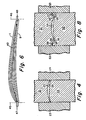
- Fig. 1 is a schematic elevational end view of the cross-sectional profile of a composite article of thin airfoil configuration provided in accordance with the invention
- Fig. 2 is a schematic elevational view in cross section of a preform stack for the fabrication of a blade of airfoil shape in accordance with the invention
- Fig. 3 is a schematic view of layup apparatus useful for composite fabrication in accordance with the invention.
- Fig. 4 is a schematic cross-sectional elevational view of consolidation mold apparatus useful for composite fabrication in accordance with the invention.
- Fig. 5 is a photomicrograph taken at 25x magnification of a portion of a cross section of an airfoil blade provided from a stacked preform in accordance with the invention
- Fig. 6 illustrates a design for a modified preform stack for the fabrication of an airfoil blade in accordance with the invention
- Fig. 7 is a photomicrograph at a magnification of 50x of a cross section of an edge segment of a second airfoil composite article provided in accordance with the invention.
- Fig. 8 is a schematic cross-sectional elevational view of modified consolidation mold apparatus useful for composite fabrication in accordance with the invention.
- the invention is not limited in its application to any particular composition or type of fiber-reinforced ceramic matrix composite material.
- the inorganic fibers presently preferred for use as reinforcement materials for ceramic matrix composites are silicon carbide fibers (also referred to as silicon oxycarbide fibers in the art), other types of fibers may alternatively be used. Examples of such fibers include fibers of carbon, alumina, B4C, BN, zircon, mullite, spinel or silicon nitride.
- a ceramic matrix material to be utilized for composite fabrication in accordance with the invention is not limited to any specific type of glass or ceramic material.
- Such glass-ceramics are disclosed, for example, in U. S. Patent No.
- glass-ceramics wherein the predominant crystal phase is selected from the group of anorthite (CaO-Al2O3-2SiO2) and its pseudo-binaries with mullite (3Al2O3.SiO2), cordierite (2MgO.2Al2O3.5SiO2), barium osumilite (BaO.2MgO.3Al2O3.9SiO2), albite solid solution (Na2O.Al2O3.6SiO2), Al2O3, SiO2, CaO.SiO2, and gehlenite (2CaO.Al2O3.SiO2).
- CaO-Al2O3-2SiO2 anorthite
- mullite 3Al2O3.SiO2
- cordierite 2MgO.2Al2O3.5SiO2
- barium osumilite BaO.2MgO.3Al2O3.9SiO2
- albite solid solution Na2O.Al2
- refractory alkaline earth aluminosilicate glass-ceramics include those comprising a predominant crystal phase consisting essentially of triclinic anorthite in combination with at least one of mullite and alpha alumina, these glass-ceramics being disclosed in U. S. Patent No. 4,755,489. Further, U. S. Patent No. 4,464,475 discloses alkaline earth aluminosilicate glass-ceramics wherein the principal crystal phase is selected from the group consisting of barium osumilite, cordierite, and stuffed cordierite, the ions comprising the stuffing ions in the stuffed cordierite compositions being selected from the group consisting of Ba, Ca, Sr and Cs. Barium-stuffed cordierite glass-ceramics, in particular, exhibit relatively low coefficients of thermal expansion and high elastic moduli.
- matrix materials comprising lithium or zinc aluminosilicate glass-ceramics may be selected.
- U. S. Patent No. 4,554,197 describes the use of glass-ceramic matrix materials of this type, which may also contain magnesium but which are typically essentially free of TiO2. These glass-ceramics are characterized by the presence of a principal crystal phase selected from the group consisting of beta-quartz solid solution (sometimes referred to as beta eucryptite solid solution) and beta spodumene solid solution.
- the method of the invention is well suited for the manufacture of composites wherein glass matrix materials are employed.
- the preferred glasses for this use are alkali-free alkaline earth aluminosilicate glasses, such glasses being substantially free of alkali metal oxides such as Na2O, Li2O, and K2O, and including one or more alkaline earth metal oxides selected from the group consisting of CaO, MgO, SrO and BaO.
- the selected reinforcing fibers will be combined with the selected ceramic matrix material in fine particulate or powdered form.
- Such particulate matrix materials may readily be produced from glasses by drigaging, grinding and/or milling.
- the fine matrix powders thus provided are most conveniently combined with the fibers to provide so-called prepreg fibers or sheets by impregnating the fibers with liquid suspensions of the powders in suitable vehicles.
- flowable suspensions of the powders which may comprise dispersants and binder constituents in addition to the vehicle and glass powder, are applied to the fibers by spraying or immersion of fibers into the suspensions.
- Fiber mats or tows impregnated with powdered glass as described can be formed into prepreg sheets suited for assembly into sheet stacks by pressing or winding the impregnated fiber material onto drums or other supports to provide green sheet prepreg which may be dried and cut to any suitable shape.
- the thickness of the sheets may of course be varied over relatively broad ranges, although it is normally preferred, from the standpoint of production cost and convenience, that the sheets utilized for a particular product configuration and its precursor sheet stack design be of approximately the same thickness.
- the method of the invention is particularly well adapted for the fabrication of layered ceramic matrix composite parts wherein the edge thickness of the part is small and the center thickness is greater than the edge thickness.
- parts of this configuration include airfoil shapes such as turbine blades or airflow deflectors.
- Fig. 1 of the drawing is a cross-sectional end view of a turbine stator blade 2 showing the thin edge configuration and somewhat thicker center thickness which are desired.
- Fig. 2 is a schematic illustration of a sheet stack 10 having a preferred design for the fabrication of a product having the cross-sectional configuration shown in Fig. 1.
- both bottom and top prepreg sheets of stack 20 shown as sheets 1 and 11, respectively, extend at least to top subsheet 10 and beyond all of the interior or core sheets 2-9.
- prepreg sheets 1, 10 and 11 will fuse along leading edge 15 and trailing edge 16 of the stack to provide a sealed outer envelope or skin of smooth and homogeneous composite material for the final composite product.
- Prepreg sheet stacks produced as herein described may be consolidated under conditions of heat and pressure conventional for composite preforms of multi-layer type.
- the layered assembly will first be subjected to a burnout treatment wherein it is heated, before or after preliminary shaping by molding or the like, to a temperature at least sufficient to remove any volatile or oxidizable binder or other organic components from the prepregs. Thereafter, a hot pressing process is carried out during which the temperature of the assembly is raised at least above the sintering temperature of the powdered matrix material and pressure is applied to eliminate voids in the material.
- crystallization of the matrix material to effect conversion to a glass-ceramic matrix is usually achieved concurrently with consolidation in the course of the hot pressing process. This simply requires a crystallization interval in the process during which the temperature of the material under consolidation is maintained at a level sufficient to promote rapid conversion to a highly crystalline material.
- prepreg sheets for a silicon carbide fiber reinforced glass-ceramic matrix composite material suitable for blade construction are first prepared in accordance with conventional practice.
- a powdered glass matrix material which is convertible by thermal crystallization to a dense refractory glass-ceramic matrix material is first prepared for incorporation into the composite.
- This glass has a composition, in weight percent, of about 39.5% SiO2, 38.5% Al2O3 , 18.4% CaO, 0.5% As2O3, and 3.0% ZrO2, and can be converted to a crystalline anorthite glass-ceramic material by appropriate heat treatment.
- a glass of this composition is first melted in a platinum crucible, with the resulting melt being converted to a glass frit by drigaging.
- the glass frit is then milled to provide a glass powder with an average particle size of about 10 microns, and is incorporated into a slurry suitable for impregnating a fiber tow material.
- the slurry is a smooth, flowable aqueous suspension of the powdered glass containing a conventional dispersant and binder.
- the reinforcing fiber selected for incorporation in the layered composite is a silicon oxycarbide fiber tow material which is commercially available as Nicalon R NLM-202 silicon carbide yarn from the Nippon Carbon Co. of Tokyo, Japan.
- a continuous strand of this yarn is coated and impregnated with the slurry of glass powder by passing the yarn through the slurry. Prior to immersion in the slurry, the yarn is passed through a flame to remove sizing and other combustible impurities from the surfaces of the fiber.
- the coated yarn thus produced is drawn through a stripping die to remove excess slurry from the fibers and is then wound around a rotating drum to form a continuous layer or sheet prepreg having unidirectional fiber orientation thereon.
- This sheet is then cut from the drum and dried flat to provide flat green prepreg mats approximately 0.050 inch in thickness wherein silicon carbide fibers are unidirectionally oriented in the mat.
- the sheets have a length of 4 inches, and range in width from about 1.5 inches for the widest sheets to approximately 0.3 inch for the narrowest sheets.
- the sheets are then arranged substantially as shown in Fig. 2 of the drawing into a stack of prepreg layers.
- the stack is formed of a bottom cut prepreg sheet 1 and top cut prepreg sheet 11 between which are positioned interior or core sheets 2-10 of varying width providing a preform of varying aggregate sheet thickness.
- some of the sheets are cut at directions transverse to the direction of fiber alignment in the prepreg, and stacked to provide a variation in the angle of reinforcing fiber direction, with respect to the long axis of the blade (0°).
- Table I below records the direction of fiber alignment for each of the cut prepreg sheets in the stack:
- a convenient method for providing a preform stack wherein prepreg sheets of varying sheet size are appropriately positioned to provide a preselected thickness profile in the finished product utilizes layup apparatus such as schematically illustrated in Fig. 3 of the drawing. As shown in Fig. 3, the layup procedure is carried out in a rectangular 3-sided metal can 30 comprising a removable metal bottom plate 32 and top plate 33. Each of the layers in sheet stack 20 is positioned at a preselected distance from side 34 of the can by interleaved temporary spacers 36.
- Each of spacers 36 which are preferably composed of an inert polymer such as PTFE, is of a preselected width appropriate to position the corresponding prepreg sheet at a preselected distance from side 34 and thus a preselected edge offset position within the stack, and each spacer has a thickness equal to the thickness of the corresponding sheet.
- the thickness through a given cross-section of a consolidated article produced from a prepreg stack such as described is not directly proportional to the aggregate sheet thickness through the initial stack.
- the final thickness T in mils may be approximated by the empirical formula wherein L is the number of prepreg layers of 0.050 inch thickness provided in the cross-section of interest. This formula can be used to determine the stacking design for a composite article of arbitrary thickness profile formed of the prepregs of this example, or simple trials may instead be employed to optimize the stack design best suited for the generation of a specific part thickness profile.
- the stack is lifted from the layup can and the spacers are removed from the stack.
- the stack is then returned to the can and processed through a burnout cycle comprising heating the stack in air to approximately 450 °C to remove organic materials from the prepreg layers.
- the resulting stack, free of organic material, is next positioned in a cavity mold for high temperature consolidation under pressure into a dense composite article.
- the mold comprises upper and lower graphite plungers each having a machined face appropriate in shape for forming, respectively, the upper and lower surfaces of a small airfoil blade having the cross-section illustrated in Fig. 1 of the drawing.
- Fig. 4 of the drawing provides a schematic cross-sectional view, not in true proportion or to scale, of a mold assembly of suitable design comprising top and bottom plungers 21 and 22 positioned slidably between retaining graphite sleeve members 23 and 24 and having machined faces 25 and 26 for achieving the desired surface figure in the preform stack during the consolidation process.
- Consolidation of the stack is achieved by inserting the plungers and side retainers with the prepreg stack in a cylindrical graphite sleeve and placing the assembly in a hot pressing furnace wherein it is heated to a temperature of 1340 °C over a heating interval of approximately 3 hours. As the peak hot pressing temperature is approached, the pressure on the preform stack is increased to a level of about 1500 psi, and is maintained for about 10 minutes at the peak temperature. Thereafter, the pressure and temperature are gradually reduced over a two-hour period until ambient conditions are reached.
- the consolidated product produced as described has a cross-sectional profile as shown in Fig. 1 of the drawing.
- the article has a smoothly varying surface profile and curvature, the flow of matrix material and fiber during the course of the consolidation being sufficient to substantially remove any evidence of ply drops from the surface of the final article.
- Fig. 5 of the drawing is an optical photomicrograph of a portion of a cross-section of the blade provided taken at a magnification of 25x. The uniform distribution of fibers and matrix within the bulk of the material and the relative smoothness and homogeneity of the surface layers on the composite part are clearly shown.
- Flashing is aggravated by the large mold traverse distances required to achieve the extensive prepreg debulking associated with the consolidation of these prepreg materials.
- the extended interval of sidewall drag experienced by the edges of the prepreg stack during stack compaction tends to draw significant amounts of matrix material and/or fibers from the edges of the stack into the plunger/sidewall interface.
- the material thus withdrawn is not readily replaced by matrix flow or fiber movement from the interior of the preform, with the result that fiber- or matrix-depleted materials frequently predominate at the leading and trailing edges of the consolidated product.
- a prepreg stack for a composite part having a selected part edge outline comprises at least one and preferably two or more prepreg layers which extend beyond the selected edge outline for the part.
- the extended layers which may be surface layers or interior layers, provide excess material, referred to as flow choke material, which protects the part edge during consolidation.
- Fig. 6 of the drawing illustrates a stacking design 40 for a prepreg stack suitable for fabricating a small airfoil blade similar in edge outline and thickness profile to the blade shown in Fig. 1.
- the design shows interference between layers in the stack; this corresponds to material which will be available to fill interlayer voids at ply drops in the course of consolidation of the prepreg sheet stack.
- top and bottom sheets 1 and 9 in the design of Fig. 6 are shown extending beyond the part edge outline indicated by broken lines 45 and 46 in the drawing. These extensions form adjunct flow choke segments 47 and 48 which will function to inhibit the outflow of fiber and or matrix materials from part edge regions adjacent 45 and 46 during subsequent consolidation of the stack.
- Fig. 7 of the drawing is an optical photomicrograph of a cross-section of a leading edge section of a small composite air foil blade made from a preform stack such as shown in Fig. 6.
- the effectiveness of the flow choke segment A in preserving the homogeneity of the composite material at edge region B of the blade is evident from this micrograph. Removal of the adjunct flow choke material, which can easily be accomplished by machining or other conventional method, assures a final part of excellent edge quality and surface homogeneity.
- Consolidation of a preform stack such as shown in Fig 6 to provide a part such as shown in Fig 7 can be conveniently accomplished utilizing opposing mold plungers wherein an edge gap region, extending beyond the surface contoured mold surfaces defining the surfaces and selected edge outline for the part, is provided.
- This edge gap or flow choke region provides limited clearance for the flow choke material, permitting that material to function as an inhibitor of the outflow of prepreg material from the stack during consolidation.
- zones within the stack corresponding to the edges of the composite part are insulated from the undesirable effects of excessive flashing of prepreg material into the plunger/sleeve interface during prepreg compaction and consolidation.
- Fig. 8 of the drawing is a schematic cross-sectional elevational view of a mold assembly comprising opposing mold plungers incorporating an edge gap as described.
- opposing top and bottom plungers 51 and 52 respectively, positioned between sleeve segments 53, comprise contoured mold surfaces 54 adapted to form opposing top and bottom surfaces of an airfoil blade.
- Extending outwardly from surfaces 54 are opposing planar surface extensions 55 and 56 forming, respectively, leading and trailing edge gap regions connecting with the leading and trailing zones of the cavity formed by contoured surfaces 54.
- Opposing shoulder sections 57 and 58 on the mold plungers act as stops limiting closure of the plungers within sleeve 53, thus controlling the size of the mold cavity and edge gap, and thereby the degree of flow choke effectiveness exhibited by the gap.
- edge gap means as above described is that loose tolerances, particularly at the sleeve/plunger interface within the molding assembly, can be tolerated without harmful effects on the edge quality of the composite parts.
- edge gap and flow choke material control the amount of flashing occurring during part consolidation without regard for the clearance provided between the mold plungers and sidewall elements of the molding assembly. Accordingly, a method for the precision fabrication of ceramic matrix composite products of thin blade or other designs which are fully homogeneous and consolidated throughout is provided.
Landscapes
- Chemical & Material Sciences (AREA)
- Engineering & Computer Science (AREA)
- Ceramic Engineering (AREA)
- Manufacturing & Machinery (AREA)
- Materials Engineering (AREA)
- Organic Chemistry (AREA)
- Structural Engineering (AREA)
- Inorganic Chemistry (AREA)
- Chemical Kinetics & Catalysis (AREA)
- Dispersion Chemistry (AREA)
- Life Sciences & Earth Sciences (AREA)
- General Chemical & Material Sciences (AREA)
- Geochemistry & Mineralogy (AREA)
- Laminated Bodies (AREA)
- Turbine Rotor Nozzle Sealing (AREA)
- Glass Compositions (AREA)
Applications Claiming Priority (2)
| Application Number | Priority Date | Filing Date | Title |
|---|---|---|---|
| US07/445,398 US5110652A (en) | 1989-12-04 | 1989-12-04 | Shaped fiber-reinforced ceramic composite article |
| US445398 | 1995-06-06 |
Publications (1)
| Publication Number | Publication Date |
|---|---|
| EP0431301A1 true EP0431301A1 (fr) | 1991-06-12 |
Family
ID=23768747
Family Applications (1)
| Application Number | Title | Priority Date | Filing Date |
|---|---|---|---|
| EP90120483A Withdrawn EP0431301A1 (fr) | 1989-12-04 | 1990-10-25 | Matériau composite céramique mis on forme ou stratifié et méthode pour sa fabrication |
Country Status (4)
| Country | Link |
|---|---|
| US (1) | US5110652A (fr) |
| EP (1) | EP0431301A1 (fr) |
| JP (1) | JPH03177334A (fr) |
| CA (1) | CA2028166A1 (fr) |
Cited By (7)
| Publication number | Priority date | Publication date | Assignee | Title |
|---|---|---|---|---|
| GB2252315A (en) * | 1991-01-31 | 1992-08-05 | Man Technologie Gmbh | Fiber-reinforced ceramics |
| EP0501729A1 (fr) * | 1991-02-28 | 1992-09-02 | British Aerospace Public Limited Company | Procédé de fabrication d'un corps en vitrocéramique |
| FR2684368A1 (fr) * | 1991-11-29 | 1993-06-04 | Aerospatiale | Procede de realisation de pieces complexes creuses par pressage uniaxial a chaud d'un materiau composite a matrice vitreuse et pieces issues du procede. |
| EP0722048A3 (fr) * | 1995-01-05 | 1996-07-24 | Res Inst Of Advanced Material | |
| EP1768893A4 (fr) * | 2004-04-22 | 2010-09-29 | Siemens Power Generation Inc | Dispositif de bord de fuite a profil aerodynamique en composite a matrice ceramique |
| GB2471119A (en) * | 2009-06-17 | 2010-12-22 | Nebb Technology As | Sintered gas turbine blade |
| EP2349686A4 (fr) * | 2008-11-13 | 2016-09-28 | Saab Ab | Procédé pour former un article composite |
Families Citing this family (24)
| Publication number | Priority date | Publication date | Assignee | Title |
|---|---|---|---|---|
| AU5725394A (en) * | 1992-10-13 | 1994-05-09 | Ushers Inc. | Improved aggregates, and apparatus and method for making same |
| US5674802A (en) * | 1992-10-13 | 1997-10-07 | Ushers, Inc. | Shares for catalyst carrier elements, and catalyst apparatuses employing same |
| US6514897B1 (en) * | 1999-01-12 | 2003-02-04 | Hyperion Catalysis International, Inc. | Carbide and oxycarbide based compositions, rigid porous structures including the same, methods of making and using the same |
| US6696047B2 (en) | 2001-09-13 | 2004-02-24 | The Procter & Gamble Company | Stable oral care compositions comprising chlorite |
| US6716782B2 (en) | 2002-08-16 | 2004-04-06 | The Boeing Company | Rigid insulation and method of producing same |
| US6777093B1 (en) * | 2003-05-22 | 2004-08-17 | United Technologies Corporation | Bond layer for silicon containing substrate |
| US7402347B2 (en) * | 2004-12-02 | 2008-07-22 | Siemens Power Generation, Inc. | In-situ formed thermal barrier coating for a ceramic component |
| US8137611B2 (en) * | 2005-03-17 | 2012-03-20 | Siemens Energy, Inc. | Processing method for solid core ceramic matrix composite airfoil |
| US7048795B1 (en) | 2005-07-27 | 2006-05-23 | Carty William M | Bonding of cement paste to porcelain shaped articles through the use of ceramic glazes |
| US20070269605A1 (en) * | 2006-05-22 | 2007-11-22 | Carty William M | Bonding of cement paste to porcelain bodies through the use of ceramic glazes |
| US20070298172A1 (en) * | 2006-06-09 | 2007-12-27 | Carty William M | Tile and substrate bonding system |
| US7708851B2 (en) * | 2005-10-25 | 2010-05-04 | General Electric Company | Process of producing a ceramic matrix composite article and article formed thereby |
| US7507466B2 (en) * | 2006-02-22 | 2009-03-24 | General Electric Company | Manufacture of CMC articles having small complex features |
| DE102008012255B4 (de) * | 2007-03-13 | 2017-03-16 | Airbus Defence and Space GmbH | Verfahren zum Herstellen eines textilen Halbzeugs mit kraftflussgerecht verlaufenden Faserfilamenten für eine kraftflussgerechte Faserverbundstruktur |
| US8247062B2 (en) * | 2009-05-12 | 2012-08-21 | Siemens Energy, Inc. | Methodology and tooling arrangements for increasing interlaminar shear strength in a ceramic matrix composite structure |
| US9446989B2 (en) | 2012-12-28 | 2016-09-20 | United Technologies Corporation | Carbon fiber-reinforced article and method therefor |
| US10358929B2 (en) | 2013-07-15 | 2019-07-23 | United Technologies Corporation | Composite airfoil |
| TWI618625B (zh) * | 2014-10-03 | 2018-03-21 | 綠點高新科技股份有限公司 | 物件的製法及其製品 |
| US10465703B2 (en) * | 2016-04-11 | 2019-11-05 | United Technologies Corporation | Airfoil |
| DE102019216849A1 (de) * | 2019-10-31 | 2021-05-06 | MTU Aero Engines AG | VERFAHREN ZUR HERSTELLUNG EINES BAUTEILS AUS EINEM SiC/SiC - FASERVERBUNDWERKSTOFF |
| US12044145B2 (en) * | 2022-05-27 | 2024-07-23 | Rtx Corporation | CMC laminate airfoil with ply drops |
| US12194691B2 (en) * | 2022-11-10 | 2025-01-14 | Rolls-Royce Plc | Method of debulking of ceramic matrix composite prepreg material |
| US20250001543A1 (en) * | 2023-06-30 | 2025-01-02 | Raytheon Technologies Corporation | Method and apparatus for forming leading and trailing edges on airfoils |
| CN119039055B (zh) * | 2024-10-30 | 2025-01-24 | 内蒙古电力(集团)有限责任公司内蒙古超高压供电分公司 | 一种含莫来石强韧层的套管及制备方法 |
Citations (5)
| Publication number | Priority date | Publication date | Assignee | Title |
|---|---|---|---|---|
| US3840418A (en) * | 1970-03-09 | 1974-10-08 | R Sabee | Method of manufacture of a sanitary article and ply having selectively thickened areas |
| US4664731A (en) * | 1985-01-07 | 1987-05-12 | The United States Of America As Represented By The Secretary Of The Navy | Pultrusion of glass and glass-ceramic matrix composites |
| FR2619745A1 (fr) * | 1987-08-28 | 1989-03-03 | United Technologies Corp | Piece en materiau composite a matrice en verre renforcee de fibres et son procede de fabrication |
| US4810167A (en) * | 1986-12-08 | 1989-03-07 | Hartzell Propeller Inc. | Composite aircraft propeller blade |
| EP0321382A1 (fr) * | 1987-12-15 | 1989-06-21 | United Technologies Corporation | Rotor pour une turbine à gaz |
Family Cites Families (14)
| Publication number | Priority date | Publication date | Assignee | Title |
|---|---|---|---|---|
| US3649425A (en) * | 1970-03-18 | 1972-03-14 | Trw Inc | Arcuate shaped composites of refractory tapes embedded in a metal matrix |
| US3765996A (en) * | 1972-04-03 | 1973-10-16 | Whittaker Corp | Unidirectional tensile test specimen incorporating integrated load pads |
| US4324843A (en) * | 1980-02-13 | 1982-04-13 | United Technologies Corporation | Continuous length silicon carbide fiber reinforced ceramic composites |
| US4314852A (en) * | 1980-05-07 | 1982-02-09 | United Technologies Corporation | Silicon carbide fiber reinforced glass composites |
| US4410635A (en) * | 1982-02-05 | 1983-10-18 | United Technologies Corporation | Discontinuous silicon carbide fiber reinforced ceramic composites |
| US4464192A (en) * | 1982-05-25 | 1984-08-07 | United Technologies Corporation | Molding process for fiber reinforced glass matrix composite articles |
| US4412854A (en) * | 1982-05-25 | 1983-11-01 | United Technologies Corporation | Method of producing fiber reinforced glass matrix composite articles of complex shape |
| US4428763A (en) * | 1982-05-25 | 1984-01-31 | United Technologies Corporation | Transfer molding method of producing fiber reinforced glass matrix composite articles |
| US4464475A (en) * | 1983-01-13 | 1984-08-07 | Corning Glass Works | Glass-ceramic articles containing osumilite |
| US4554197A (en) * | 1984-06-18 | 1985-11-19 | Corning Glass Works | Fiber reinforced glass/glass-ceramic mirror blanks |
| US4615987A (en) * | 1985-04-15 | 1986-10-07 | Corning Glass Works | Reinforcement of alkaline earth aluminosilicate glass-ceramics |
| US4755489A (en) * | 1986-12-18 | 1988-07-05 | Corning Glass Works | Reinforced calcium aluminosilicate glass-ceramics |
| US4909872A (en) * | 1987-12-15 | 1990-03-20 | United Technologies Corporation | Process for making a fiber reinforced composite article |
| JPH02228602A (ja) * | 1989-02-28 | 1990-09-11 | Omron Tateisi Electron Co | 光学素子 |
-
1989
- 1989-12-04 US US07/445,398 patent/US5110652A/en not_active Expired - Fee Related
-
1990
- 1990-10-22 CA CA002028166A patent/CA2028166A1/fr not_active Abandoned
- 1990-10-25 EP EP90120483A patent/EP0431301A1/fr not_active Withdrawn
- 1990-11-30 JP JP2341229A patent/JPH03177334A/ja active Pending
Patent Citations (5)
| Publication number | Priority date | Publication date | Assignee | Title |
|---|---|---|---|---|
| US3840418A (en) * | 1970-03-09 | 1974-10-08 | R Sabee | Method of manufacture of a sanitary article and ply having selectively thickened areas |
| US4664731A (en) * | 1985-01-07 | 1987-05-12 | The United States Of America As Represented By The Secretary Of The Navy | Pultrusion of glass and glass-ceramic matrix composites |
| US4810167A (en) * | 1986-12-08 | 1989-03-07 | Hartzell Propeller Inc. | Composite aircraft propeller blade |
| FR2619745A1 (fr) * | 1987-08-28 | 1989-03-03 | United Technologies Corp | Piece en materiau composite a matrice en verre renforcee de fibres et son procede de fabrication |
| EP0321382A1 (fr) * | 1987-12-15 | 1989-06-21 | United Technologies Corporation | Rotor pour une turbine à gaz |
Cited By (12)
| Publication number | Priority date | Publication date | Assignee | Title |
|---|---|---|---|---|
| GB2252315A (en) * | 1991-01-31 | 1992-08-05 | Man Technologie Gmbh | Fiber-reinforced ceramics |
| GB2252315B (en) * | 1991-01-31 | 1994-11-16 | Man Technologie Gmbh | Workpiece of fiber reinforced ceramic material and a method of manufacture thereof |
| EP0501729A1 (fr) * | 1991-02-28 | 1992-09-02 | British Aerospace Public Limited Company | Procédé de fabrication d'un corps en vitrocéramique |
| FR2684368A1 (fr) * | 1991-11-29 | 1993-06-04 | Aerospatiale | Procede de realisation de pieces complexes creuses par pressage uniaxial a chaud d'un materiau composite a matrice vitreuse et pieces issues du procede. |
| EP0546877A1 (fr) * | 1991-11-29 | 1993-06-16 | AEROSPATIALE Société Nationale Industrielle | Procédé de réalisation de pièces complexes creuses par pressage uniaxial à chaud d'un matériau composite à matrice vitreuse et pièces issues du procédé |
| US5397621A (en) * | 1991-11-29 | 1995-03-14 | Aerospatiale Societe Nationale Industrielle | Method of making complex hollow pieces by uniaxial hot pressing composite material with a vitreous mould and pieces derived from said method |
| EP0722048A3 (fr) * | 1995-01-05 | 1996-07-24 | Res Inst Of Advanced Material | |
| US5728445A (en) * | 1995-01-05 | 1998-03-17 | Research Institute Of Advanced Material Gas-Generator, Ltd. | Fastening member |
| EP1768893A4 (fr) * | 2004-04-22 | 2010-09-29 | Siemens Power Generation Inc | Dispositif de bord de fuite a profil aerodynamique en composite a matrice ceramique |
| EP2349686A4 (fr) * | 2008-11-13 | 2016-09-28 | Saab Ab | Procédé pour former un article composite |
| GB2471119A (en) * | 2009-06-17 | 2010-12-22 | Nebb Technology As | Sintered gas turbine blade |
| GB2471119B (en) * | 2009-06-17 | 2013-11-27 | Nebb Technology As | Rotor or stator blade and method for forming such rotor or stator blade |
Also Published As
| Publication number | Publication date |
|---|---|
| CA2028166A1 (fr) | 1991-06-05 |
| JPH03177334A (ja) | 1991-08-01 |
| US5110652A (en) | 1992-05-05 |
Similar Documents
| Publication | Publication Date | Title |
|---|---|---|
| US5110652A (en) | Shaped fiber-reinforced ceramic composite article | |
| US4428763A (en) | Transfer molding method of producing fiber reinforced glass matrix composite articles | |
| EP0509178A2 (fr) | Procédé de fabrication d'un panneau composite de matière céramique rigidifiée | |
| US3607608A (en) | Fiber-reinforced ceramics | |
| EP0343301A2 (fr) | Matériaux composites à matrice céramique hybride comprenant des additifs particulaires et méthode | |
| KR20150087264A (ko) | 3차원 유리 세라믹 제품의 제조방법 | |
| US4581053A (en) | Method of producing woven fiber reinforced glass matrix composite articles | |
| GB2120647A (en) | Method of producing fiber reinforced glass matrix composite articles of complex shape | |
| US5104830A (en) | Composite shaped articles comprising reinforced glass-ceramic matrices | |
| JPH09506328A (ja) | 注型工具 | |
| EP0426352A1 (fr) | Procédé pour la production des matériaux composites à matrice céramique | |
| US4764195A (en) | Method of forming reinforced glass composites | |
| EP0179908B1 (fr) | Procede pour former des articles composites renforces par des fibres | |
| US5399440A (en) | Composite material with a glass-ceramic or ceramic matrix obtained by the sol-gel process and reinforced by fibers based on silicon carbide, its manufacture and its applications | |
| DE69308830T2 (de) | Verfahren zur herstellung von faserverbundkörpern | |
| US5391213A (en) | Method for manufacturing fibre-reinforced structures with a glass matrix | |
| US5312787A (en) | Ceramics composite material and method of producing the same | |
| US4976761A (en) | Method for making ceramic matrix composite article | |
| US4949921A (en) | Method of molding fiber reinforced glass matrix composite articles | |
| US4786304A (en) | Composite molding process | |
| CN113149683A (zh) | 碳碳或碳陶复合材料短纤预制体及其制品以及制备方法 | |
| US4913953A (en) | Integral chopped fiber reinforced glass or glass-ceramic structures | |
| US5318860A (en) | Inorganic fiber sinter and process for producing same | |
| JPH0397640A (ja) | 強化されたガラス状マトリックスを有する複合材料及びその製造方法 | |
| GB2209159A (en) | Method of molding fiber reinforced glass matrix composite articles |
Legal Events
| Date | Code | Title | Description |
|---|---|---|---|
| PUAI | Public reference made under article 153(3) epc to a published international application that has entered the european phase |
Free format text: ORIGINAL CODE: 0009012 |
|
| AK | Designated contracting states |
Kind code of ref document: A1 Designated state(s): DE FR GB |
|
| STAA | Information on the status of an ep patent application or granted ep patent |
Free format text: STATUS: THE APPLICATION HAS BEEN WITHDRAWN |
|
| 18W | Application withdrawn |
Withdrawal date: 19910912 |