EP0431327B1 - Synthetische Vakzine zur spezifischen Induktion zytotoxischer T-Lymphozyten - Google Patents
Synthetische Vakzine zur spezifischen Induktion zytotoxischer T-Lymphozyten Download PDFInfo
- Publication number
- EP0431327B1 EP0431327B1 EP90121189A EP90121189A EP0431327B1 EP 0431327 B1 EP0431327 B1 EP 0431327B1 EP 90121189 A EP90121189 A EP 90121189A EP 90121189 A EP90121189 A EP 90121189A EP 0431327 B1 EP0431327 B1 EP 0431327B1
- Authority
- EP
- European Patent Office
- Prior art keywords
- membrane anchor
- protein
- ser
- partial sequence
- cytotoxic
- Prior art date
- Legal status (The legal status is an assumption and is not a legal conclusion. Google has not performed a legal analysis and makes no representation as to the accuracy of the status listed.)
- Expired - Lifetime
Links
Images


Classifications
-
- C—CHEMISTRY; METALLURGY
- C07—ORGANIC CHEMISTRY
- C07K—PEPTIDES
- C07K7/00—Peptides having 5 to 20 amino acids in a fully defined sequence; Derivatives thereof
- C07K7/04—Linear peptides containing only normal peptide links
- C07K7/06—Linear peptides containing only normal peptide links having 5 to 11 amino acids
-
- A—HUMAN NECESSITIES
- A61—MEDICAL OR VETERINARY SCIENCE; HYGIENE
- A61K—PREPARATIONS FOR MEDICAL, DENTAL OR TOILETRY PURPOSES
- A61K39/00—Medicinal preparations containing antigens or antibodies
- A61K39/385—Haptens or antigens, bound to carriers
-
- C—CHEMISTRY; METALLURGY
- C07—ORGANIC CHEMISTRY
- C07K—PEPTIDES
- C07K5/00—Peptides containing up to four amino acids in a fully defined sequence; Derivatives thereof
- C07K5/04—Peptides containing up to four amino acids in a fully defined sequence; Derivatives thereof containing only normal peptide links
- C07K5/08—Tripeptides
- C07K5/0802—Tripeptides with the first amino acid being neutral
- C07K5/0804—Tripeptides with the first amino acid being neutral and aliphatic
- C07K5/081—Tripeptides with the first amino acid being neutral and aliphatic the side chain containing O or S as heteroatoms, e.g. Cys, Ser
-
- A—HUMAN NECESSITIES
- A61—MEDICAL OR VETERINARY SCIENCE; HYGIENE
- A61K—PREPARATIONS FOR MEDICAL, DENTAL OR TOILETRY PURPOSES
- A61K39/00—Medicinal preparations containing antigens or antibodies
- A61K2039/60—Medicinal preparations containing antigens or antibodies characteristics by the carrier linked to the antigen
- A61K2039/6018—Lipids, e.g. in lipopeptides
-
- A—HUMAN NECESSITIES
- A61—MEDICAL OR VETERINARY SCIENCE; HYGIENE
- A61K—PREPARATIONS FOR MEDICAL, DENTAL OR TOILETRY PURPOSES
- A61K39/00—Medicinal preparations containing antigens or antibodies
- A61K2039/60—Medicinal preparations containing antigens or antibodies characteristics by the carrier linked to the antigen
- A61K2039/6031—Proteins
- A61K2039/6068—Other bacterial proteins, e.g. OMP
-
- Y—GENERAL TAGGING OF NEW TECHNOLOGICAL DEVELOPMENTS; GENERAL TAGGING OF CROSS-SECTIONAL TECHNOLOGIES SPANNING OVER SEVERAL SECTIONS OF THE IPC; TECHNICAL SUBJECTS COVERED BY FORMER USPC CROSS-REFERENCE ART COLLECTIONS [XRACs] AND DIGESTS
- Y02—TECHNOLOGIES OR APPLICATIONS FOR MITIGATION OR ADAPTATION AGAINST CLIMATE CHANGE
- Y02A—TECHNOLOGIES FOR ADAPTATION TO CLIMATE CHANGE
- Y02A50/00—TECHNOLOGIES FOR ADAPTATION TO CLIMATE CHANGE in human health protection, e.g. against extreme weather
- Y02A50/30—Against vector-borne diseases, e.g. mosquito-borne, fly-borne, tick-borne or waterborne diseases whose impact is exacerbated by climate change
Definitions
- N-termini occurring in bacterial lipoprotein such as: Y-Ser-Ser-Ser-Asn, Y-Ile-Leu-Leu-Ala, Y-Ala-Asn-Asn-Gln, Y -Asn-Ser-Asn-Ser, Y-Gly-Ala-Met-Ser, Y-Gln-Ala-Asn-Tyr, Y-Gln-Val-Asn-Asn, Y-Asp-Asn-Ser-Ser, where Y can be one of the radicals listed under formula I to VII.
- lipopentapeptides can also be used in shortened form (lipodi, lipotri or lipotetrapeptides) as membrane anchor connections.
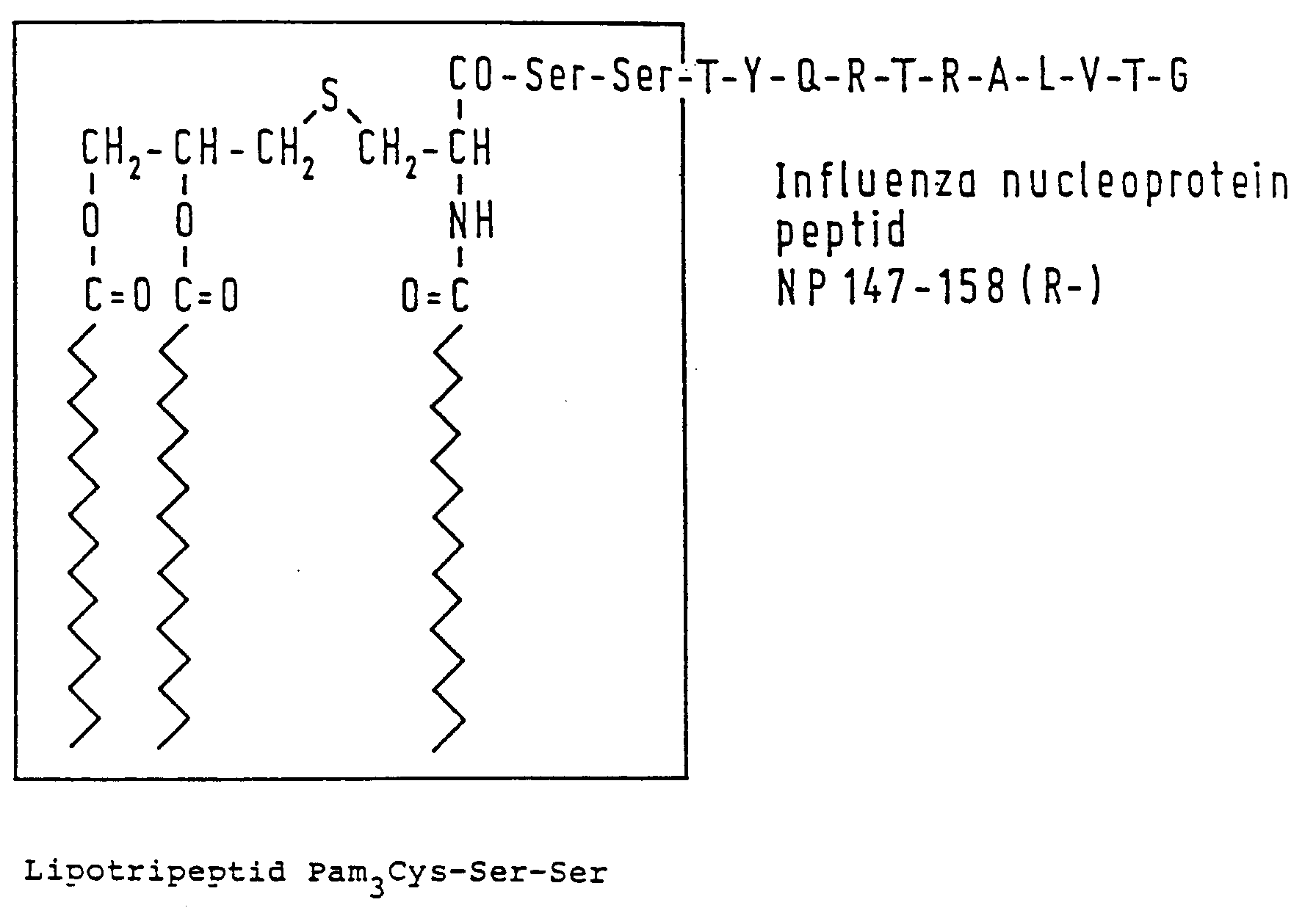
- N-Palmitoyl-S- [2,3 (bispalmitoyloxy) propyl] -cysteinyl-seryl-serine (Pam3Cys-Ser-Ser), N-palmitoyl-S- [2,3- (bispalmitoyloxy) propyl] - is very particularly preferred.
- the substituents R, R 'and R ⁇ are preferably alkyl radicals with 14 to 18 carbon atoms; alkyl radicals with 16 carbon atoms are particularly preferred.
- the substituent X is preferably formed from 1 to 2 polar amino acid residues, the serine residue being particularly preferred.
- different proteins or protein partial sequences of intracellular pathogens, virus, bacterial or parasite proteins or of tumor antigens, which are recognized by killer T cells, are suitable for coupling to the membrane anchor connection.
- Such proteins or partial sequences are distinguished by the fact that they are recognized by cytotoxic T lymphocytes together with MHC molecules (major histocompatibility complex).
- the amount of vaccine required for the safe immunization of a warm-blooded animal depends on the type of warm-blooded animal, the membrane anchor compound (s) and the protein or the partial sequence (s) of the organism against which the patient is to be immunized and is individual to be determined empirically.
- influenza A virus nucleoprotein peptide sequence was synthesized by solid phase peptide synthesis. Fmoc amino acids were used. The following side chain protection groups were used: Thr (tBu), Tyr (tBu), Arg (Pmc). 1 g of para-benzyloxybenzyl alcohol resin, loaded with 0.5 mmol of Fmoc-Gly, was used and the peptide sequence was built up after the following synthesis cycles. N activation with 50% piperidine in DMF (1 x 10 min).
- part of the peptide was obtained by trifluoroacetic acid cleavage and checked for purity by means of HPLC, MS, amino acid analysis, analysis on chiral phase and sequence analysis. The HPLC test showed a purity of over 90%.
- the tripalmitoyl-S-glycerol cysteine was coupled using the DIC / HOBT method. After four hours an equivalent of N-methylmorpholine was added and after another hour the lipopeptide resin was washed.
- the lipopeptide was 100 mg of resin separated by means of 2 ml of trifluoroacetic acid (with 100 ⁇ l thioanisole and 100 ⁇ g thiocresol) within one hour.
- trifluoroacetic acid with 100 ⁇ l thioanisole and 100 ⁇ g thiocresol
- an additional aftertreatment with trifluoroacetic acid was carried out at 50 ° C. for 30 min.
- the filtrate was evaporated, the residue was taken up in acetic acid and placed in cold ether.
- the precipitated lipopeptide was washed three times with ether and lyophilized from tert-butanol / water in a ratio of 3: 1.
- Fmoc-amino acids with the following side chain protecting groups were used: Ser (tBu), Glu (OtBu), Thr (tBu). Asn was coupled without a side chain protecting group using diisopropyl carbodiimide / HOBT.
- the Fmoc-Glu (OtBu) loading was 0.45 mmol / g.
- the peptide and Pam3Cys-Ser-Ser-Peptide were each split off from 100 mg resin with 2 ml trifluoroacetic acid with the addition of 0.1 ml thioanisole and 100 ⁇ g thiocresol within 90 min.
- the sequence was confirmed by sequence analysis of the free peptide; a uniform peak of over 90% was determined by HPLC testing. Amino acid analysis and testing for enantiomeric purity on the chiral phase gave the expected values.
- mice bred under SPF conditions were intravenously injected with 100 ⁇ g Pam3cys-Ser-Ser- [NP 147-158]. (100 ⁇ g Pam3Cys-Ser-Ser- [NP 147-158], taken up in 300 ⁇ l PBS, sonicated for 1 min). After 28 days, the mice were infected intranasally with 0.2 and 0.4 haemagglutinating units of influenza virus A / PR / 8, respectively. Analogously, mice were infected as controls, to which 300 ⁇ l PBS was administered intravenously. The course of the infection was checked using daily weight controls and the survival rate. 11 out of 12 control animals infected with 0.4 haemagglutinating units died of the virus infection after 11 days, while only 4 out of 12 of the immunized animals died.
- Another control group and a group immunized with Pam3Cys-Ser-Ser- [NP 147-158] were infected with 0.2 haemagglutinating units of the influenza virus. After 18 days, 40% of the control animals (4 out of 10 animals) were still alive, while 75% of the immunized animals were alive. On day 18, the weight difference between immunized animals and control animals was 4 g. The surviving animals in the control group continued to lose weight, while the immunized animals slowly recovered from the infection.
- the spleens were removed from the immunized or infected animals and the spleen cells were restimulated for 5 days with peptide (A to F) or with PR8-infected syngeneic stimulator cells (G, H, I).
- Graphs A, B, C and G, H, I show CTL activity on untreated ( ⁇ ) or PR8 infected ( ⁇ ) P815 (MHC: H-2 d ) target cells.
- Graphs D, E and F show CTL activity on P815 cells which have been pretreated with different concentrations of free peptide for 30 min at 37 ° C. A ratio of effector to target cell of 30: 1 was used here.
- mice Activity of cytotoxic T cells after immunization of mice with Pam3Cys-Ser-Ser- [NP 147-158] or Pam3Cys-Ser-Ser- [NP 365 - 380] (Fig. 2)
- BALB / c mice diagrams A, B) or (B6 x DBA / 2) -F1 mice (C, D) were infected with influenza A virus (A, C) or with 100 ⁇ g Pam3Cys-Ser-Ser- [NP 147-158] (picture B) or immunized with 100 ⁇ g Pam3Cys-Ser-Ser- [NP 365-380] (picture D).
- spleens were removed and the spleen cells, as described under B), in the presence of 0.8 ⁇ M NP 147-158 peptide (A, B) or 0.8 ⁇ M NP 365-380 peptide (C, D) stimulated.
- the activity of the cytotoxic T cells was then tested on untreated P815 target cells ( ⁇ ), on PR8 infected P815 target cells ( ⁇ ) and on P815 target cells preincubated with NP 147-158 peptide for 90 min at 37 ° C.
Landscapes
- Chemical & Material Sciences (AREA)
- Health & Medical Sciences (AREA)
- Life Sciences & Earth Sciences (AREA)
- Organic Chemistry (AREA)
- General Health & Medical Sciences (AREA)
- Medicinal Chemistry (AREA)
- Biophysics (AREA)
- Genetics & Genomics (AREA)
- Molecular Biology (AREA)
- Proteomics, Peptides & Aminoacids (AREA)
- Biochemistry (AREA)
- Mycology (AREA)
- Microbiology (AREA)
- Immunology (AREA)
- Pharmacology & Pharmacy (AREA)
- Epidemiology (AREA)
- Animal Behavior & Ethology (AREA)
- Public Health (AREA)
- Veterinary Medicine (AREA)
- Medicines Containing Antibodies Or Antigens For Use As Internal Diagnostic Agents (AREA)
- Medicines That Contain Protein Lipid Enzymes And Other Medicines (AREA)
- Peptides Or Proteins (AREA)
- Medicines Containing Material From Animals Or Micro-Organisms (AREA)
Description
- Die vorliegende Erfindung betrifft eine synthetische Vakzine zur spezifischen Induktion zytotoxischer T-Lymphozyten.
- Zytotoxische T-Lymphozyten (Killer-T-Zellen) stellen einen wesentlichen Teil der Immunantwort von Warmblütern gegen intrazelluläre Infektionen dar. Zytotoxische T-Lymphozyten werden normalerweise nur mittels einer in-vivo-Impfung mit infektiösen Erregern induziert (J. Bastin et al., J. Exp. Med., Vol 165, June 1987). Wegen der damit verbundenen Risiken würde ein synthetischer Impfstoff für die spezifische Induktion von zytotoxischen T-Lymphozyten eine erhebliche Verbesserung darstellen. Es wurde nun überraschenderweise gefunden, daß durch die Verwendung bestimmter Membranankerwirkstoffkonjugate enthaltend Killer-T-Zellepitope die spezifische in-vivo-Induktion von zytotoxischen T-Lymphozyten möglich ist.
- Es ist zwar bereits bekannt, daß Membranankerwirkstoffkonjugate zur Erzeugung neutralisierender Antikörper geeignet sind (vgl. Angew. Chem. 97 (1985), Nr. 10, S. 883 ff.); über eine synthetische Vakzine enthaltend Membranankerwirkstoffkonjugate zur spezifischen Induktion von zytotoxischen T-Lymphozyten wurde jedoch bisher nicht berichtet.
- Erfindungsgegenstand ist demzufolge eine synthetische Vakzine zur Induktion von zytotoxischen T-Lymphozyten, die dadurch gekennzeichnet ist, das sie aus einem Konjugat aus mindestens einer Membranankerverbindung und einem mindestens ein Killer-T-Zellepitop enthaltenden Protein eines Virus, eines Bakteriums, eines Parasiten oder eines Tumorantigens oder mindestens einer Partialsequenz enthaltend mindestens ein Killer-T-Zellepitop eines Virus-, Bakterium- oder Parasiten-Proteins oder eines Tumorantigens besteht.
- Die genannte Membranankerverbindung ist vorzugsweise ein bakterielles Lipoprotein. Besonders bevorzugt ist als Membranankerverbindung eine Verbindung der nachstehenden Formeln

in denen A Schwefel, Sauerstoff, Disulfid (-S-S-),
Methylen (-CH₂-) oder -NH- sein kann;
n = 0 bis 5, m = 1 oder 2;
C* ein asymmetrisches Kohlenstoffatom mit R- oder S-Konfiguration ist,
R, R′ und R˝ gleich oder verschieden sind und Wasserstoff oder eine Alkyl-, Alkenyl- oder Alkinylgruppe mit 7 bis 25 Kohlenstoffatomen sind, welche mit Hydroxy-, Amino-, Oxo-, Acyl-, Alkyl- oder Cycloalkylgruppen substituiert sein kann, E in Formel IX Wasserstoff oder eine beliebige Seitenkette einer natürlichen oder artifiziellen α-Aminosäure sein kann, B in Formel VI die Bedeutung jedes der in den Formeln I - V aufgeführten -(CH₂)n-(substituiertes Alkyl)-Reste haben kann und R₁ und R₂ gleich oder verschieden sind und dieselben Bedeutungen wie R, R′ und R˝ haben, aber auch -OR, -O-COR, -COOR, -NHCOR oder -CONHR sein können, wobei X eine Kette von bis zu 10 Aminosäuren ist, an die das Protein oder die Partialsequenz des Virus-, Bakterium- oder Parasiten-Proteins oder eines Tumorantigens gebunden ist, oder das Protein oder die Partialsequenz selbst ist. - Von diesen sind als Beispiele besonders hervorzuheben: In bakteriellem Lipoprotein vorkommende N-Termini, wie z.B.: Y-Ser-Ser-Ser-Asn, Y-Ile-Leu-Leu-Ala, Y-Ala-Asn-Asn-Gln, Y-Asn-Ser-Asn-Ser, Y-Gly-Ala-Met-Ser, Y-Gln-Ala-Asn-Tyr, Y-Gln-Val-Asn-Asn, Y-Asp-Asn-Ser-Ser, wobei Y einer der unter Formel I bis VII aufgeführten Reste sein kann. Diese Lipopentapeptide können auch in verkürzter Form (Lipodi-, Lipotri- oder Lipotetrapeptide) als Membranankerverbindung eingesetzt werden. Ganz besonders bevorzugt ist N-Palmitoyl-S-[2,3(bispalmitoyloxy)propyl]-cysteinyl-seryl-serin (Pam₃Cys-Ser-Ser), N-Palmitoyl-S-[2,3-(bispalmitoyloxy)propyl]-cysteinyl-seryl-glycin und N-Palmitoyl-S-[2,3-(bispalmitoyloxy)propyl]-cysteinyl-alanyl-D-isoglutamin.
- Weiterhin besonders bevorzugt sind die Verbindungen der Formeln I und III, insbesondere Verbindungen der Formel I.
- Der Substituent A ist vorzugsweise Schwefel oder Methylen, besonders bevorzugt Schwefel.
- Die Substituenten R, R′ und R˝ sind vorzugsweise Alkylreste mit 14 bis 18 C-Atomen; besonders bevorzugt sind Alkylreste mit 16 C-Atomen.
- Der Substituent X wird vorzugsweise gebildet aus 1 bis 2 polaren Aminosäureresten, besonders bevorzugt ist der Serin-Rest.
- Für die erfindungsgemäße Vakzine eignen sich zur Kopplung an die Membranankerverbindung unterschiedliche Proteine oder Protein-Partialsequenzen von intrazellulär auftretenden Krankheitserregern, Viren-, Bakterien- oder Parasiten-Proteinen oder von Tumor-Antigenen, die von Killer-T-Zellen erkannt werden.
- Solche Proteine oder Partialsequenzen (auch als Killer-T-Zell-Epitope bezeichnet) zeichnen sich dadurch aus, daß sie von zytotoxischen T-Lymphozyten zusammen mit MHC-Molekülen (major histocompatibility complex) erkannt werden.
- Die erfindungsgemäße Vakzine eignet sich zur Immunisierung gegen alle Erreger, die Killer-T-Zell-Epitope aufweisen, wie z. B. gegen Adenoviren, HIV, Influenza-Viren, LCMV, MCMV, Hepatitis-Viren, HTLV, FELV, Treponema pallidum, Gonokokkus, Bordetella pertussis, Plasmodien, Listerien, Mycobakterien oder Leishmanien. Bisher bereits bekannte Killer-T-Zell-Epitope sind die in der nachfolgenden Tabelle aufgeführten Partialsequenzen, von denen das Influenza-Nukleoprotein P₃CSS-NP 147-158 (R⁻) und die HIV-Epitope eine Sonderstellung einnehmen.
Organismus Protein von - bis Restr. Sequenz Adenovirus Db PSNTPPEI Ad5E1A HIV env (gp 120) 381-392 HLA A2 (K)NCGGEFFYCNS HIV env (gp 120) 308-322 Dd RIQRGPGRAFVTIGK HIV env (gp 120) 410-429 DR4 GSDTITLPCRIKQFINMWQE HIV gag (p17) 418-443 A2 KEGHQMKDCTERQANF HIV gag (p17) 446-460 A2 GNFLQSRPEPTAPPA HIV gag (p24) 193-203 A2 GHQAAMEMLKE HIV gag (p24) 219-233 A2 HAGPIAPGQMREPRG HIV gag (p24) 265-280 B27 KRWIILGLNKIVRMYC Influenza Nucleoprotein 82-94 HLA A2 MVVKLGEFYNQMM Influenza Matrix 57-68 HLA A2 KGILGFVFTLTV Influenza Nucleoprotein 335-349 B37 B44 SAAFEDLRVLSFIRG A2 Aw69 Influenza Hemagglutinin H3 58-73 H-2 Ad ILDGIDCTLIDALLGD Influenza Hemagglutinin H3 58-73 H-2 Ad ILDGIDCTLIDALLGD Influenza Hemagglutinin 181-204 H-2K;H-2K - 103-123 Influenza Nucleoprotein 365-379 SDYEGRLIQNSLTI Influenza Nucleoprotein 335-349 H-2b IASNENMETMESSTL Influenza Nucleoprotein 384-393 HLA B27 RYWAIRTRSG Influenza Nucleoprotein 147-158 Kd TYQRTRALV(R)TG A/NT/60/68 LCMV Nucleoprotein 118-126 Ld Lq RPQASGVYM LCMV - 278-286 H-2b VENPGGYCL - - 277-293 H-2b GVENPGGYCLTKWMILA - - 168-176 - YPHFMPTNL MCMV - 161-179 Ld GRLMYDMYPHFMPTNLGPS P815 Tumor 12-24 Ld ISTQNHRALDLVA antigen P91A Plasmodium falciparum Circumsporozoite prot. 368-390 H-2K KPKDELDYENDIEKKICKMEKCSC berghei " 249-260 Kd NDDSYIPSAEKI yoelii - 276-288 Kd NEDSYVPSAEQI Hepatitis B HBsAg 21-28 - PLGFFPDH - Mit Hilfe der erfindungsgemäßen Vakzine ist es darüber hinaus möglich, verschiedene Membranankerverbindungen, gekoppelt an verschiedene Partialsequenzen zu mischen, um eine auf ein bestimmtes Ziel optimal abgestimmte Vakzine zu erhalten. Weiterhin kann eine entsprechende Mischung zusätzlich Membranankerwirkstoffkonjugate enthalten, die die humorale Immunantwort stimulieren und zusätzlich zur Produktion von neutralisierenden Antikörpern führen (Vaccine 7, 29 - 33 (1989), Angew. Chem., Int. Ed. 24, 872 - 873 (1989)). Darüber hinaus ist es auch möglich, verschiedene Partialsequenzen kovalent zu verknüpfen und mit einer Membranankerverbindung zu verbinden.
- Erfindungsgegenstand ist weiterhin ein Verfahren zur Herstellung einer synthetischen Vakzine, das dadurch gekennzeichnet ist, daß Proteine oder Partialsequenzen von Erregern durch eine Konjugationsreaktion an die Membranankerverbindung gebunden wird. Die Konjugationsreaktion kann z. B. eine Kondensation, Addition, Substitution, Oxidation oder Disulfidbildung sein. Bevorzugte Konjugationsmethoden sind in den Beispielen wiedergegeben. Weitere Konjugationsmethoden sind in der bereits zitierten Deutschen Offenlegungsschrift 35 46 150 beschrieben.
- Die Herstellung der Membranankerverbindungen ist ebenfalls in der zuletzt genannten deutschen Offenlegungsschrift ausführlich beschrieben.
- Die gegebenenfalls nötige Trennung der Diastereomeren kann nach unterschiedlichen Methoden, wie z. B. in Hoppe-Seyler's Z. Physiolog. Chem. 364 (1983) 593 beschrieben erfolgen.
- Der Aufbau der für die Membranankerwirkstoffkonjugate einzusetzenden Partialsequenzen kann auf unterschiedliche, literaturbekannte Weise erfolgen, vgl. z. B. Wünsch et al. in Houben-Weyl, Bd. 15/1.2, Stuttgart, Thieme-Verlag oder Wünsch in Angew. Chem. 83 (1971), E. Gross und J. Meienhofer (Herausgeb.), The Peptides, Vol. 1 (1979), 2 (1979), 3 (1981) und 5 (1983) Academic Press, New York 7713 oder die Deutsche Offenlegungsschrift 35 46 150. In Beispiel 1 wird ein bevorzugtes Verfahren zur Herstellung einer Partialsequenz und eines Konjugats näher erläutert.
- Weiterhin gehören zum Erfindungsgegenstand pharmazeutische oder veterinärmedizinische Zübereitungen, die einen Gehalt an Konjugat aus mindestens einer Membranankerverbindung und mindestens einer Partialsequenz eines der genannten Proteine oder Organismen aufweisen. Normalerweise werden zusätzlich neben einem Lösungsmittel keine zusätzlichen Hilfs- und Trägerstoffe oder Adjuvanzien für die erfindungsgemäßen Zübereitungen benötigt. In manchen Fällen kann es aber sinnvoll sein, derartige Hilfs- und/oder Trägerstoffe sowie gegebenenfalls Adjuvanzien den erfindungsgemäßen Zübereitungen zuzusetzen (Anton Mayr, Gerhard Eißnen, Barbara Mayr-Bibrack, Handbuch der Schutzimpfungen in der Tiermedizin, 1984, Verlag Paul Parey, Berlin-Hamburg).
- Die Menge an Vakzine, die für eine sichere Immunisierung eines Warmblüters notwendig ist, hängt ab von der Art des Warmblüters, von der bzw. den Membranankerverbindungen und dem Protein oder der bzw. den Partialsequenzen des Organismus, gegen den immunisiert werden soll und ist im Einzelfall empirisch zu ermitteln.
- Durch die nachfolgenden Beispiele soll die Erfindung näher erläutert werden.
- Die Influenza A-Virus-Nukleoprotein-Peptidsequenz wurde durch Festphasenpeptidsynthese synthetisiert. Es wurden Fmoc-Aminosäuren benutzt. Folgende Seitenkettenschutzgruppen kamen zur Anwendung: Thr(tBu), Tyr(tBu), Arg(Pmc). Es wurde 1 g para-Benzyloxybenzylalkohol-Harz, beladen mit 0,5 mmol Fmoc-Gly eingesetzt und die Peptidsequenz nach folgenden Synthesezyklen aufgebaut. N-Aktivierung mit 50 % Piperidin in DMF (1 x 10 min). Kupplung der folgenden Aminosäure für 30 min mit BOP/HOBT [Benzotriazol-1-yl-oxy-tris-(dimethyl amino)-phosphoniumhexafluorophosphat/1-Hydroxybenzo-triazol] und Diisopropylethylamin in DMF. Es wurden jeweils Doppelkupplungen mit 3-fachem Überschuß an Fmoc-Aminosäure und 4,5-fachem Überschuß an Diisopropylethylamin (jeweils bezogen auf freie Aminogruppen am Harz) durchgeführt. Nach jeder Doppelkupplung wurde das Peptidharz je dreimal mit N-Methylpyrrolidon, Dichlormethan und N-Methylpyrrolidon gewaschen.
- Nach der Synthese der harzgebundenen Influenza A-Virus-Nukleoprotein-Sequenz wurde ein Teil des Peptids durch Trifluoressigsäurespaltung gewonnen und auf Reinheit geprüft mittels HPLC, MS, Aminosäureanalyse, Analyse auf chiraler Phase sowie Sequenzanalyse. Die HPLC-Prüfung ergab eine Reinheit von über 90 %. Nach Kupplung von zwei Serinresten [Fmoc-Ser(tBu)] an das harzgebundene Peptid, erfolgte die Kupplung des Tripalmitoyl-S-glycerincysteins nach der DIC/HOBT-Methode. Nach vier Stunden wurde ein Äquivalent N-Methylmorpholin hinzugefügt und nach einer weiteren Stunde wurde das Lipopeptid-Harz gewaschen. Das Lipopeptid wurde von 100 mg Harz mittels 2 ml Trifluoressigsäure (mit 100 µl Thioanisol und 100 µg Thiokresol) innerhalb von einer Stunde getrennt. Um die Arg(Pmc)-Schutzgruppen vollständig zu entfernen, wurde zusätzlich 30 min bei 50°C mit Trifluoressigsäure nachbehandelt. Das Filtrat wurde eingedampft, der Rückstand mit Essigsäure aufgenommen und in kalten Ether gegeben. Das ausgefallene Lipopeptid wurde 3 x mit Ether gewaschen und aus tert.-Butanol/Wasser im Verhältnis 3 : 1 lyophilisiert.
- Die Synthese erfolgte analog Beispiel 1. Es wurden Fmoc-Aminosäuren mit folgenden Seitenkettenschutzgruppen benutzt: Ser(tBu), Glu(OtBu), Thr(tBu). Asn wurde ohne Seitenkettenschutzgruppe mittels Diisopropylcarbodiimid/HOBT gekuppelt. Als Ausgangsharz wurde Fmoc-Glu(OtBu)-p-Benzyloxybenzylalkohol-Polystyrol, quervernetzt mit 1 % Divinylbenzol, eingesetzt. Die Beladung an Fmoc-Glu(OtBu) betrug 0,45 mmol/g. Die Abspaltung des Peptids und Pam₃Cys-Ser-Ser-Peptids von je 100 mg Harz erfolgte mit 2 ml Trifluoressigsäure unter Zusatz von 0,1 ml Thioanisol und 100 µg Thiokresol innerhalb von 90 min. Die Sequenz wurde durch Sequenzanalyse des freien Peptids bestätigt; durch HPLC-Prüfung wurde ein einheitlicher Peak mit über 90 % ermittelt. Aminosäurenanalyse und Prüfung auf Enantiomerenreinheit an chiraler Phase ergaben die erwarteten Werte.
- Unter SPF-Bedingungen gezüchtete, 3 Monate alte BALB/c-Inzuchtmäuse wurden intravenös mit 100 µg Pam₃cys-Ser-Ser-[NP 147-158] immunisiert. (100 µg Pam₃Cys-Ser-Ser-[NP 147-158], aufgenommen in 300 µl PBS, 1 min beschallt). Nach 28 Tagen wurden die Mäuse mit 0,2 bzw. 0,4 haemagglutinierenden Einheiten Influenza-Virus A/PR/8 intranasal infiziert. Analog wurden zur Kontrolle Mäuse infiziert, denen 300 µl PBS intravenös appliziert wurde. Der Verlauf der Infektion wurde anhand von täglichen Gewichtskontrollen und der Überlebensrate kontrolliert. 11 von 12 Kontrolltieren, die mit 0,4 haemagglutinierenden Einheiten infiziert wurden, starben nach 11 Tagen an der Virusinfektion, während von den immunisierten Tieren nur 4 von 12 starben.
- Eine weitere Kontrollgruppe und eine mit Pam₃Cys-Ser-Ser-[NP 147-158] immunisierte Gruppe wurden mit 0,2 haemagglutinierenden Einheiten Influenza-Virus infiziert. Nach 18 Tagen lebten noch 40 % der Kontrolltiere (4 von 10 Tieren), während 75 % der immunisierten Tiere lebten. Am Tag 18 betrug die Gewichtsdifferenz zwischen immunisierten Tieren und Kontrolltieren 4 g. Die überlebenden Tiere der Kontrollgruppe verloren weiter an Gewicht, während sich die immunisierten Tiere langsam von der Infektion erholten.
- Zytotoxische T-Zell-Aktivität von Milzzellen aus BALB/c-Mäusen nach Immunisierung mit freiem Peptid, Virus oder Pam₃Cys-Ser-Ser-Peptid (Fig. 1)
BALB/c-Mäuse erhielten durch intravenöse Applikation in 300 µl PBS - a) 8 x 10⁷ mit 1,6 µM Nukleoproteinpeptid 147-158 (R-) vorinkubierte, syngene Milzzellen; (A, D, G),
- b) 8 x 10⁷ mit 160 µM Pam₃Cys-Ser-Ser-[NP 147-158 (R-)]-Lipopeptid vorinkubierte, syngene Milzzellen; (C,F),
- c) 50 haemagglutinierende Einheiten von Influenza A-Virus PR/8/34; (B,E,H),
- d) 100 µg Pam₃Cys-Ser-Ser-[NP 147-158 (R-)]; (I).
- Nach 6 Tagen wurden den immunisierten bzw. infizierten Tieren die Milzen entnommen und die Milzzellen 5 Tage lang mit Peptid (A bis F) oder mit Virus PR8 infizierten, syngenen Stimulatorzellen (G,H,I) restimuliert. Dazu wurden je 2,5 x 10⁷-Zellen kultiviert in 10 ml a-MEM-Medium (Hersteller: Gibco), angereichert mit 10 % fötalem Kälberserum, 2-Mercaptoethanol, Glutamin und Antibiotika unter Zusatz von entweder 80 nM NP 147-158(R-)-Peptid (A,F) oder von 5 x 10⁶-Virus PR8-infizierten, mit 20 Gy bestrahlten syngenen Milzzellen (G,H,I). Die Infektion von Stimulator und Zielzellen wurde wie beschrieben durchgeführt (Eur. J. Immunol. 7, 630 - 635 (1977).
- Die Aktivität der zytotoxischen T-Zellen wurde durch einen ⁵¹Cr-Release-Standardtest (Eur. J. Immunol. 137, 2.676 - 2.681 (1986)) ermittelt. Schaubilder A, B, C und G, H, I zeigen die CTL-Aktivität auf unbehandelte (△) oder PR8 infizierte (▲) P815 (MHC:H-2d)-Zielzellen.
- Schaubilder D, E und F zeigen CTL-Aktivität auf P815-Zellen, die mit verschiedenen Konzentrationen von freiem Peptid 30 min bei 37°C vorbehandelt wurden. Hier wurde ein Verhältnis von Effektor zu Zielzelle 30 : 1 eingesetzt.
- Aktivität zytotoxischer T-Zellen nach Immunisierung von Mäusen mit Pam₃Cys- Ser-Ser-[NP 147-158] oder Pam₃Cys-Ser-Ser-[NP 365 - 380] (Fig. 2)
BALB/c-Mäuse (Schaubilder A,B) oder (B6 x DBA/2)-F1-Mäuse (C,D) wurden mit Influenza A-Virus (A,C) bzw. mit 100 µg Pam₃Cys-Ser-Ser-[NP 147-158] (Bild B) bzw. mit 100 µg Pam₃Cys-Ser-Ser-[NP 365-380] (Bild D) immunisiert. Nach 6 Tagen wurden die Milzen entnommen und die Milzzellen, wie unter B) beschrieben, in Gegenwart von 0,8 µM NP 147-158 Peptid (A,B) bzw. 0,8 µM NP 365-380 Peptid (C,D) stimuliert. Die Aktivität der zytotoxischen T-Zellen wurde anschließend auf unbehandelte P815-Zielzellen (△), auf PR8 infizierte P815-Zielzellen (▲) und auf 90 min bei 37°C mit NP 147-158-Peptid vorinkubierte P815-Zielzellen (■) geprüft; ebenso auf unbehandelte EL-4-(MHC H-2d)-Zellen (o), auf PR8 infizierte EL-4-Zielzellen (●), und auf 90 min bei 37°C mit NP 365-380-Peptid vorinkubierte EL-4-Zellen (◆). - Prüfung auf MHC Klasse I-Restriktion und auf Spezifität der Immunisierung mit Lipopeptid (Fig. 3)
BALB/c-Mäuse (Bilder A,B,C) oder (B6 x DBA/2)-F1-Mäuse (Bilder D-I) erhielten i.v. in 300 µl PBS 100 µg Pam₃Cys-Ser-Ser-[NP 147-158(R-)] (Bilder A,E,H) bzw. 50 µg Ser-Ser-[NP 147-158(R-)] (Bild B) bzw. 50 µg [NP 147-158(R-)] (Bild C) bzw. 50 haemagglutinierenden Einheiten Influenza PR8-Virus (Bilder D,G) bzw. 100 µg Pam₃Cys-Ser-Ser-[NP 365-380] (Bilder F,I). - Sechs Tage nach der Injektion wurden die Milzzellen, wie in Beispiel 2 beschrieben, kultiviert unter Zusatz von Nukleoprotein 147-158(R-)-Peptid (Bilder A - F), oder Nukleoprotein 365-380-Peptid (Bilder G - I). Die Aktivität der erhaltenen cytotoxischen T-Zellen wurde bestimmt gegen
- unbehandelte P815-Zielzellen (△)
- 90 min bei 37°C mit NP 147-158(R-) vorinkubierte P815-Zielzellen (■)
- 90 min bei 37°C mit NP 365-380 vorinkubierte P815-Zielzellen (□)
- unbehandelte EL-4-Zielzellen (o)
- 90 min bei 37°C mit NP 147-158(R-) vorinkubierte EL-4-Zielzellen (◇)
- 90 min bei 37°C mit NP 365-380 vorinkubierte EL-4-Zielzellen (◆).
Claims (9)
- Synthetische Vakzine zur spezifischen Induktion von zytotoxischen T-Lymphozyten, dadurch gekennzeichnet, daß sie aus einem Konjugat aus mindestens einer Membranankerverbindung und einem mindestens ein Killer-T-Zellepitop enthaltenden Protein eines Virus, eines Bakteriums, eines Parasiten oder eines Tumorantigens oder mindestens einer mindestens ein Killer-T-Zellepitop enthaltenden Partialsequenz eines Virus-, Bakterium- oder Parasiten-Proteins oder eines Tumorantigens besteht.
- Synthetische Vakzine gemäß Anspruch 1, dadurch gekennzeichnet, daß die Membranankerverbindung ein bakterielles Membran-Lipoprotein ist.
- Synthetische Vakzine gemäß Anspruch 1, dadurch gekennzeichnet, daß die Membranankerverbindung eine der nachstehenden Formeln aufweist
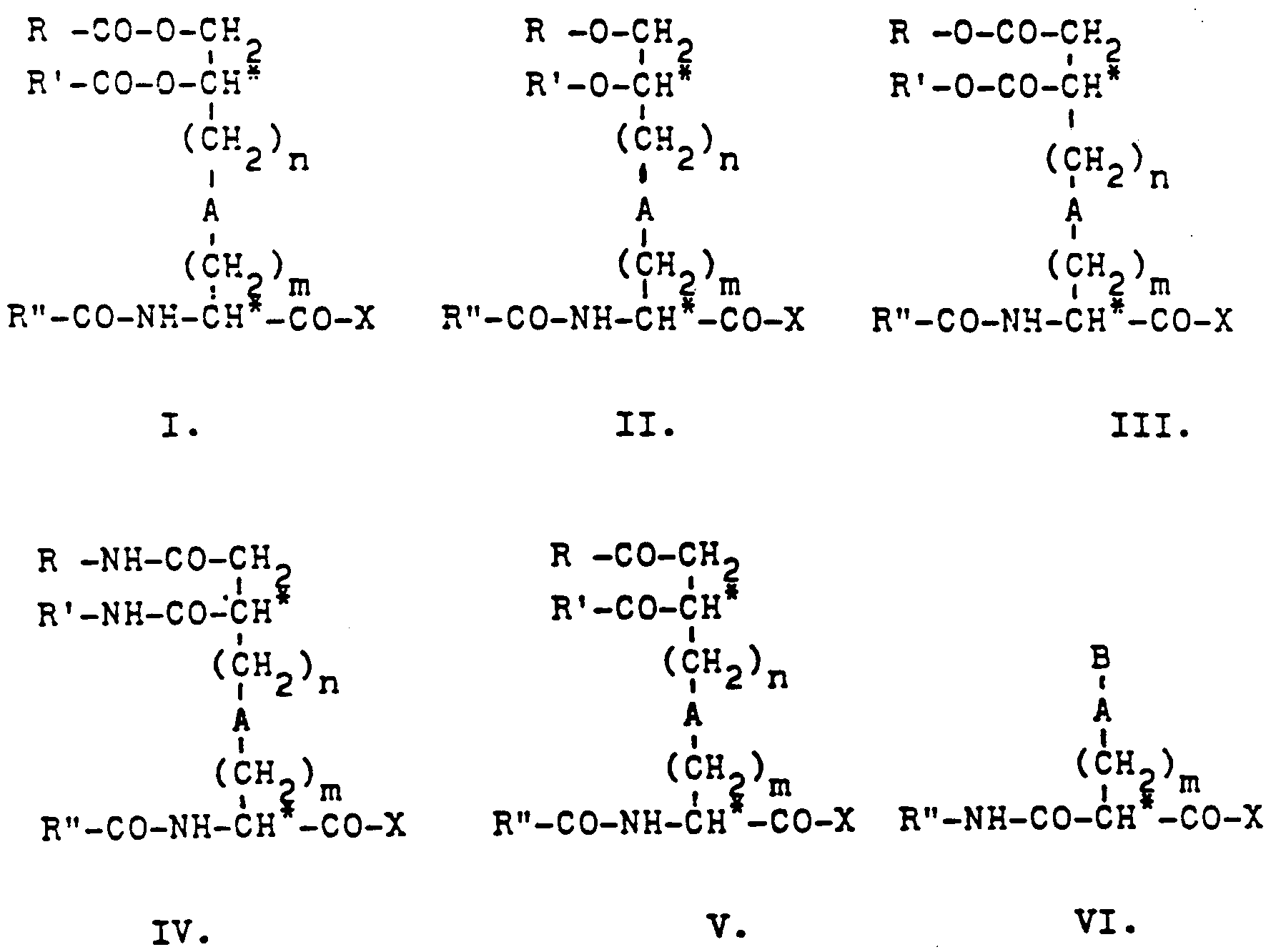
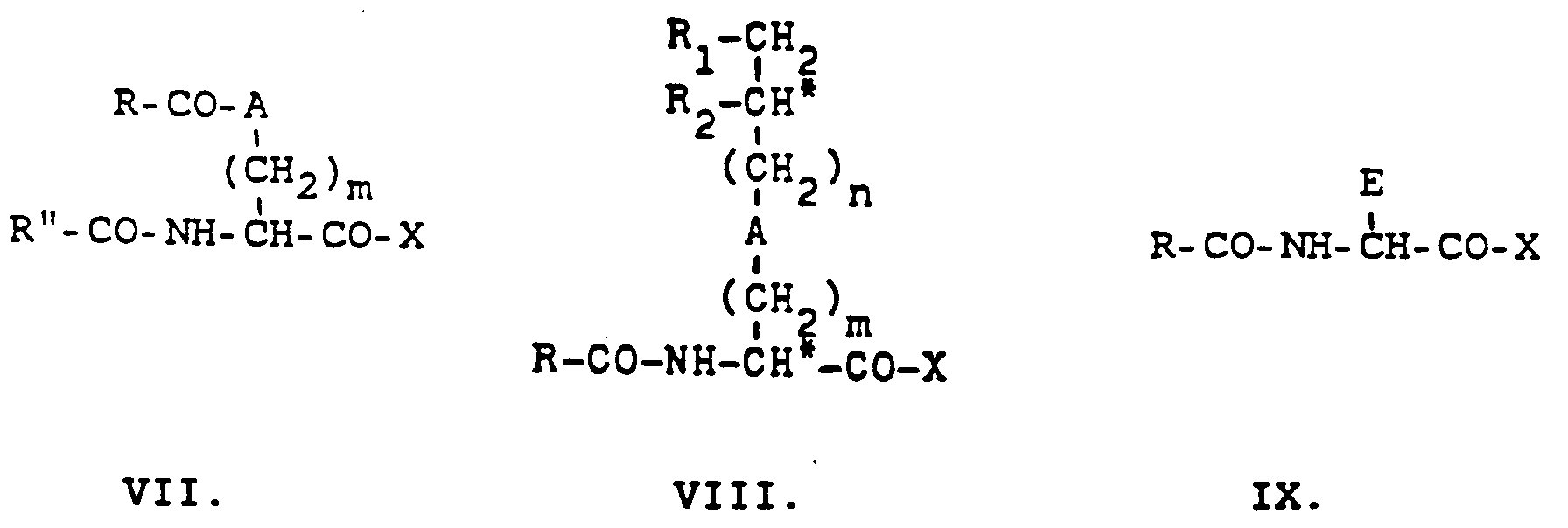
Methylen (-CH₂-) oder -NH- sein kann;
n = 0 bis 5, m = 1 oder 2;
C* ein asymmetrisches Kohlenstoffatom mit R- oder S-Konfiguration ist,
R, R′ und R˝ gleich oder verschieden sind und Wasserstoff oder eine Alkyl-, Alkenyl- oder Alkinylgruppe mit 7 bis 25 Kohlenstoffatomen sind, welche mit Hydroxy-, Amino-, Oxo-, Acyl-, Alkyl- oder Cycloalkylgruppen substituiert sein kann, E in Formel IX Wasserstoff oder eine beliebige Seitenkette einer natürlichen oder artifiziellen Aminosäure sein kann, B in Formel VI die Bedeutung jedes der in den Formeln I - V aufgeführten -(CH₂)n-(substituiertes Alkyl)-Reste haben kann und R₁ und R₂ gleich oder verschieden sind und dieselben Bedeutungen wie R, R′ und R˝ haben, aber auch -OR, -O-COR, -COOR, -NHCOR oder -CONHR sein können, wobei X eine Kette von bis zu 10 Aminosäuren ist, an die das Protein oder die Partialsequenz des Virus-, Bakterium-oder Parasiten-Proteins oder eines Tumorantigens gebunden ist, oder das Protein oder die Partialsequenz selbst ist. - Synthetische Vakzine gemäß Anspruch 1, dadurch gekennzeichnet, daß die Membranankerverbindung N-Palmitoyl-S- 2,3-(bispalmitoyloxy)-propyl cysteinyl-seryl-serin ist, wobei die Partialsequenz an den terminalen Serinrest gebunden ist.
- Synthetische Vakzine gemäß einem oder mehreren der Ansprüche 1 - 4, dadurch gekennzeichnet, daß das Protein oder die Partialsequenz von einem Adenovirus, HIV, Influenza-Virus, LCMV, MCMV, Hepatitis-Virus, HTLV, FELV, Treponema pallidum, Gonokokkus, Bordetella pertussis oder Plasmodium spec. oder einem anderen ein Killer-T-Zell-Epitop enthaltenden Pathogen stammt.
- Synthetische Vakzine gemäß einem oder mehreren der Ansprüche 1 - 5, dadurch gekennzeichnet, das ein Gemisch aus Membranankerwirkstoffkonjugaten mit verschiedenen Partialsequenzen vorliegt.
- Synthetische Vakzine gemäß Anspruch 1, dadurch gekennzeichnet, das neben Membranankerwirkstoffkonjugaten zur Induktion zytotoxischer T-Lymphozyten auch Membranankerwirkstoffkonjugate zur Erzeugung neutralisierender Antikörper vorhanden sind.
- Verfahren zur Herstellung einer synthetischen Vakzine gemäß einem oder mehreren der Ansprüche 1 - 7, dadurch gekennzeichnet, daß ein Membranankerwirkstoffkonjugat nach bekannten Methoden synthetisiert wird.
- Pharmazeutische oder veterinärmedizische Zübereitung zur Induktion von zytotoxischen T-Lymphozyten, gekennzeichnet durch einen Gehalt an einer synthetischen Vakzine gemäß einem oder mehreren der Ansprüche 1 - 7, gegebenenfalls neben üblichen Hilfs- und/oder Trägerstoffen und gegebenenfalls neben weiteren Vakzinen.
Applications Claiming Priority (2)
| Application Number | Priority Date | Filing Date | Title |
|---|---|---|---|
| DE3937412 | 1989-11-10 | ||
| DE3937412A DE3937412A1 (de) | 1989-11-10 | 1989-11-10 | Synthetische vakzine zur spezifischen induktion zytotoxischer t-lymphozyten |
Publications (3)
| Publication Number | Publication Date |
|---|---|
| EP0431327A1 EP0431327A1 (de) | 1991-06-12 |
| EP0431327B1 true EP0431327B1 (de) | 1996-04-24 |
| EP0431327B2 EP0431327B2 (de) | 2001-04-04 |
Family
ID=6393249
Family Applications (1)
| Application Number | Title | Priority Date | Filing Date |
|---|---|---|---|
| EP90121189A Expired - Lifetime EP0431327B2 (de) | 1989-11-10 | 1990-11-06 | Synthetische Vakzine zur spezifischen Induktion zytotoxischer T-Lymphozyten |
Country Status (9)
| Country | Link |
|---|---|
| EP (1) | EP0431327B2 (de) |
| JP (1) | JP3057748B2 (de) |
| AT (1) | ATE137118T1 (de) |
| DE (2) | DE3937412A1 (de) |
| DK (1) | DK0431327T4 (de) |
| ES (1) | ES2087111T5 (de) |
| GR (1) | GR3019859T3 (de) |
| IE (1) | IE74899B1 (de) |
| PT (1) | PT95824B (de) |
Cited By (2)
| Publication number | Priority date | Publication date | Assignee | Title |
|---|---|---|---|---|
| US6919203B2 (en) | 1992-08-26 | 2005-07-19 | The Scripps Research Institute | Peptides for inducing cytotoxic T lymphocyte responses to hepatitis B virus |
| US7744898B2 (en) | 1991-08-26 | 2010-06-29 | The Scripps Research Institute | Peptides for inducing cytotoxic T lymphocyte responses to hepatitis B virus |
Families Citing this family (11)
| Publication number | Priority date | Publication date | Assignee | Title |
|---|---|---|---|---|
| US5780036A (en) * | 1991-08-26 | 1998-07-14 | The Scripps Research Institute | Peptides for inducing cytotoxic T lymphocyte responses to hepattis B virus |
| US6419931B1 (en) | 1991-08-26 | 2002-07-16 | Epimmune Inc. | Compositions and methods for eliciting CTL immunity |
| US6322789B1 (en) | 1991-08-26 | 2001-11-27 | Epimmune, Inc. | HLA-restricted hepatitis B virus CTL epitopes |
| CA2081952A1 (en) * | 1991-11-08 | 1993-05-09 | John J. Donnelly | Recombinant dna sequences and plasmids for cellular immunity vaccines from bacterial toxin-antigen conjugates, and methods of their use |
| CA2085083A1 (en) * | 1991-12-18 | 1993-06-19 | Richard L. Tolman | Synthetic peptides comprising a cyclic hiv principal neutralizing determinant and a lipopeptide |
| BR9709993A (pt) | 1996-06-25 | 1999-08-10 | Stichting Inst Dierhouderij | Vacina preparação de vacina composição processo para produção de uma preparação imugênica e preparação imugênica |
| US6977074B2 (en) | 1997-07-10 | 2005-12-20 | Mannkind Corporation | Method of inducing a CTL response |
| US6861234B1 (en) | 2000-04-28 | 2005-03-01 | Mannkind Corporation | Method of epitope discovery |
| US8637305B2 (en) | 2001-11-07 | 2014-01-28 | Mannkind Corporation | Expression vectors encoding epitopes of target-associated antigens and methods for their design |
| AU2011232421B2 (en) | 2010-03-23 | 2015-08-13 | Novartis Ag | Compounds (cystein based lipopeptides) and compositions as TLR2 agonists used for treating infections, inflammations, respiratory diseases etc. |
| NL2007536C2 (en) | 2011-10-05 | 2013-04-08 | Academisch Ziekenhuis Leiden Lumc | Adjuvant compound. |
Family Cites Families (6)
| Publication number | Priority date | Publication date | Assignee | Title |
|---|---|---|---|---|
| FR2401173A1 (fr) * | 1977-06-27 | 1979-03-23 | Roussel Uclaf | Nouveaux steroides, leur procede de preparation et leur application dans la synthese de steroides marques au tritium |
| EP0203676B1 (de) * | 1985-04-19 | 1992-01-29 | The Wistar Institute Of Anatomy And Biology | Impfstoff für die Erzeugung einer gegen ein Virus schützenden immunogenen T-Zellen-Antwort |
| DE3546150A1 (de) * | 1985-06-24 | 1987-01-22 | Hoechst Ag | Membrananker-wirkstoffkonjugat, seine herstellung sowie seine verwendung |
| DE3813821A1 (de) * | 1988-04-22 | 1989-11-02 | Hoechst Ag | Synthetische vakzine gegen die maul- und klauenseuche und verfahren zu deren herstellung |
| AU2914889A (en) * | 1987-08-28 | 1989-04-17 | Board Of Regents, The University Of Texas System | Prophylaxis and therapy of acquired immunodeficiency syndrome |
| AU4030989A (en) * | 1988-02-12 | 1989-09-06 | Regents Of The University Of California, The | Use of synthetic peptides to generate and manipulate cellular immunity |
-
1989
- 1989-11-10 DE DE3937412A patent/DE3937412A1/de not_active Withdrawn
-
1990
- 1990-11-06 AT AT90121189T patent/ATE137118T1/de not_active IP Right Cessation
- 1990-11-06 ES ES90121189T patent/ES2087111T5/es not_active Expired - Lifetime
- 1990-11-06 DE DE59010300T patent/DE59010300D1/de not_active Expired - Fee Related
- 1990-11-06 EP EP90121189A patent/EP0431327B2/de not_active Expired - Lifetime
- 1990-11-06 DK DK90121189T patent/DK0431327T4/da active
- 1990-11-08 PT PT95824A patent/PT95824B/pt not_active IP Right Cessation
- 1990-11-09 IE IE405190A patent/IE74899B1/en not_active IP Right Cessation
- 1990-11-09 JP JP2302820A patent/JP3057748B2/ja not_active Expired - Fee Related
-
1996
- 1996-05-07 GR GR960401244T patent/GR3019859T3/el unknown
Cited By (3)
| Publication number | Priority date | Publication date | Assignee | Title |
|---|---|---|---|---|
| US7744898B2 (en) | 1991-08-26 | 2010-06-29 | The Scripps Research Institute | Peptides for inducing cytotoxic T lymphocyte responses to hepatitis B virus |
| US6919203B2 (en) | 1992-08-26 | 2005-07-19 | The Scripps Research Institute | Peptides for inducing cytotoxic T lymphocyte responses to hepatitis B virus |
| US7368118B2 (en) | 1992-08-26 | 2008-05-06 | The Scripps Research Institute | Peptides for inducing cytotoxic T lymphocyte responses to hepatitis B virus |
Also Published As
| Publication number | Publication date |
|---|---|
| EP0431327B2 (de) | 2001-04-04 |
| ES2087111T3 (es) | 1996-07-16 |
| IE74899B1 (en) | 1997-08-13 |
| EP0431327A1 (de) | 1991-06-12 |
| JPH0454131A (ja) | 1992-02-21 |
| GR3019859T3 (en) | 1996-08-31 |
| DK0431327T3 (da) | 1996-08-12 |
| PT95824A (pt) | 1991-09-13 |
| JP3057748B2 (ja) | 2000-07-04 |
| DE59010300D1 (de) | 1996-05-30 |
| DE3937412A1 (de) | 1991-05-16 |
| ES2087111T5 (es) | 2001-06-16 |
| IE904051A1 (en) | 1991-05-22 |
| DK0431327T4 (da) | 2001-06-18 |
| ATE137118T1 (de) | 1996-05-15 |
| PT95824B (pt) | 2001-04-30 |
Similar Documents
| Publication | Publication Date | Title |
|---|---|---|
| EP0431327B1 (de) | Synthetische Vakzine zur spezifischen Induktion zytotoxischer T-Lymphozyten | |
| DE69329677T2 (de) | Kovalente polare lipid-peptid-konjugate für biologisches targeting | |
| EP0067425B1 (de) | Gegebenenfalls geschützte Peptide, Verfahren zu ihrer Herstellung und diese enthaltende Arzneimittel | |
| DE3100974C2 (de) | ||
| DE69928938T2 (de) | Neues cyclosporin mit verbesserter wirkung | |
| DE60130192T2 (de) | Kahalalide f und verwandte verbindungen | |
| DE4320201A1 (de) | Verwendung von Cetrorelix und weiteren Nona- und Dekapeptiden zur Herstellung eines Arzneimittels zur Bekämpfung von Aids und zur Wachstumsstimulation | |
| DE3024281A1 (de) | Neue tetra- oder pentapeptide, verfahren zu deren herstellung und diese enthaltende arzneimittel | |
| DE69411342T2 (de) | Polypeptid bombesin antagonisten | |
| DE3782010T2 (de) | Vom calcitonin-gen abgeleitete peptidderivate. | |
| CH644352A5 (en) | Process for the preparation of peptides | |
| DE69131662T2 (de) | Lipopeptide, T-cytotoxische Lymphocyte aktivierend, und deren Verwendung als Vakzine | |
| DE60127113T2 (de) | Gd3-mimetische peptide | |
| DE68905552T2 (de) | Immunostimulierende peptide, deren verfahren zur herstellung und sie enthaltende pharmazeutische zusammensetzungen. | |
| WO1998051703A1 (de) | Glycokonjugate von 20(s)-camptothecin | |
| DE3619633A1 (de) | Peptide mit einfluss auf die diurese und natriurese, verfahren zu ihrer herstellung, diese enthaltende mittel und ihre verwendung | |
| DE69115539T2 (de) | Immunologische Komponente, Verfahren zur Synthese und Verwendung in Anit-Malaria-Impfstoff-Zusammensetzungen | |
| EP0338437B1 (de) | Synthetische Vakzine gegen die Maul- und Klauenseuche und Verfahren zu deren Herstellung | |
| DE69420042T2 (de) | Vielfältig verzweigte peptidkonstruktion zur bekämpfung von hiv | |
| DE3782006T2 (de) | Peptide. | |
| AU2003233377A1 (en) | Use of mixtures of lipopeptides for vaccine production | |
| DE2853002A1 (de) | Polypeptide und verfahren zu ihrer herstellung | |
| DE4039569A1 (de) | Inhibitoren retroviraler proteasen | |
| KR20200033936A (ko) | 항암 펩타이드 | |
| EP0410372A1 (de) | Verfahren zur Herstellung von humanen Spleninderivaten |
Legal Events
| Date | Code | Title | Description |
|---|---|---|---|
| PUAI | Public reference made under article 153(3) epc to a published international application that has entered the european phase |
Free format text: ORIGINAL CODE: 0009012 |
|
| 17P | Request for examination filed |
Effective date: 19901221 |
|
| AK | Designated contracting states |
Kind code of ref document: A1 Designated state(s): AT BE CH DE DK ES FR GB GR IT LI LU NL SE |
|
| 17Q | First examination report despatched |
Effective date: 19940411 |
|
| GRAH | Despatch of communication of intention to grant a patent |
Free format text: ORIGINAL CODE: EPIDOS IGRA |
|
| GRAA | (expected) grant |
Free format text: ORIGINAL CODE: 0009210 |
|
| AK | Designated contracting states |
Kind code of ref document: B1 Designated state(s): AT BE CH DE DK ES FR GB GR IT LI LU NL SE |
|
| REF | Corresponds to: |
Ref document number: 137118 Country of ref document: AT Date of ref document: 19960515 Kind code of ref document: T |
|
| REG | Reference to a national code |
Ref country code: ES Ref legal event code: BA2A Ref document number: 2087111 Country of ref document: ES Kind code of ref document: T3 |
|
| REF | Corresponds to: |
Ref document number: 59010300 Country of ref document: DE Date of ref document: 19960530 |
|
| ET | Fr: translation filed | ||
| ITF | It: translation for a ep patent filed | ||
| REG | Reference to a national code |
Ref country code: ES Ref legal event code: FG2A Ref document number: 2087111 Country of ref document: ES Kind code of ref document: T3 |
|
| GBT | Gb: translation of ep patent filed (gb section 77(6)(a)/1977) |
Effective date: 19960709 |
|
| REG | Reference to a national code |
Ref country code: GR Ref legal event code: FG4A Free format text: 3019859 |
|
| REG | Reference to a national code |
Ref country code: DK Ref legal event code: T3 |
|
| PLBI | Opposition filed |
Free format text: ORIGINAL CODE: 0009260 |
|
| PLBF | Reply of patent proprietor to notice(s) of opposition |
Free format text: ORIGINAL CODE: EPIDOS OBSO |
|
| 26 | Opposition filed |
Opponent name: PASTEUR MERIEUX SERUMS ET VACCINS Effective date: 19970124 |
|
| NLR1 | Nl: opposition has been filed with the epo |
Opponent name: PASTEUR MERIEUX SERUMS ET VACCINS |
|
| PLBF | Reply of patent proprietor to notice(s) of opposition |
Free format text: ORIGINAL CODE: EPIDOS OBSO |
|
| PLBF | Reply of patent proprietor to notice(s) of opposition |
Free format text: ORIGINAL CODE: EPIDOS OBSO |
|
| RAP2 | Party data changed (patent owner data changed or rights of a patent transferred) |
Owner name: AVENTIS PHARMA DEUTSCHLAND GMBH |
|
| PLAW | Interlocutory decision in opposition |
Free format text: ORIGINAL CODE: EPIDOS IDOP |
|
| NLT2 | Nl: modifications (of names), taken from the european patent patent bulletin |
Owner name: AVENTIS PHARMA DEUTSCHLAND GMBH |
|
| PLAW | Interlocutory decision in opposition |
Free format text: ORIGINAL CODE: EPIDOS IDOP |
|
| PUAH | Patent maintained in amended form |
Free format text: ORIGINAL CODE: 0009272 |
|
| STAA | Information on the status of an ep patent application or granted ep patent |
Free format text: STATUS: PATENT MAINTAINED AS AMENDED |
|
| 27A | Patent maintained in amended form |
Effective date: 20010404 |
|
| AK | Designated contracting states |
Kind code of ref document: B2 Designated state(s): AT BE CH DE DK ES FR GB GR IT LI LU NL SE |
|
| REG | Reference to a national code |
Ref country code: CH Ref legal event code: AEN Free format text: AUFRECHTERHALTUNG DES PATENTES IN GEAENDERTER FORM |
|
| ITF | It: translation for a ep patent filed | ||
| NLR2 | Nl: decision of opposition | ||
| ET3 | Fr: translation filed ** decision concerning opposition | ||
| REG | Reference to a national code |
Ref country code: ES Ref legal event code: DC2A Kind code of ref document: T5 Effective date: 20010523 |
|
| REG | Reference to a national code |
Ref country code: DK Ref legal event code: T4 |
|
| NLR3 | Nl: receipt of modified translations in the netherlands language after an opposition procedure | ||
| REG | Reference to a national code |
Ref country code: GB Ref legal event code: IF02 |
|
| NLS | Nl: assignments of ep-patents |
Owner name: AVENTIS PHARMA DEUTSCHLAND GMBH |
|
| GBTA | Gb: translation of amended ep patent filed (gb section 77(6)(b)/1977) | ||
| REG | Reference to a national code |
Ref country code: GB Ref legal event code: 732E |
|
| PG25 | Lapsed in a contracting state [announced via postgrant information from national office to epo] |
Ref country code: GR Free format text: THE PATENT HAS BEEN ANNULLED BY A DECISION OF A NATIONAL AUTHORITY Effective date: 20020201 |
|
| REG | Reference to a national code |
Ref country code: FR Ref legal event code: TP |
|
| PGFP | Annual fee paid to national office [announced via postgrant information from national office to epo] |
Ref country code: AT Payment date: 20051031 Year of fee payment: 16 |
|
| PGFP | Annual fee paid to national office [announced via postgrant information from national office to epo] |
Ref country code: FR Payment date: 20051103 Year of fee payment: 16 Ref country code: NL Payment date: 20051103 Year of fee payment: 16 |
|
| PGFP | Annual fee paid to national office [announced via postgrant information from national office to epo] |
Ref country code: SE Payment date: 20051104 Year of fee payment: 16 Ref country code: GB Payment date: 20051104 Year of fee payment: 16 Ref country code: CH Payment date: 20051104 Year of fee payment: 16 Ref country code: DK Payment date: 20051104 Year of fee payment: 16 |
|
| PGFP | Annual fee paid to national office [announced via postgrant information from national office to epo] |
Ref country code: LU Payment date: 20051117 Year of fee payment: 16 |
|
| PGFP | Annual fee paid to national office [announced via postgrant information from national office to epo] |
Ref country code: GR Payment date: 20051122 Year of fee payment: 16 |
|
| PGFP | Annual fee paid to national office [announced via postgrant information from national office to epo] |
Ref country code: DE Payment date: 20051130 Year of fee payment: 16 |
|
| PGFP | Annual fee paid to national office [announced via postgrant information from national office to epo] |
Ref country code: BE Payment date: 20051201 Year of fee payment: 16 |
|
| PGFP | Annual fee paid to national office [announced via postgrant information from national office to epo] |
Ref country code: ES Payment date: 20051212 Year of fee payment: 16 |
|
| NLT1 | Nl: modifications of names registered in virtue of documents presented to the patent office pursuant to art. 16 a, paragraph 1 |
Owner name: SANOFI-AVENTIS DEUTSCHLAND GMBH |
|
| PG25 | Lapsed in a contracting state [announced via postgrant information from national office to epo] |
Ref country code: AT Free format text: LAPSE BECAUSE OF NON-PAYMENT OF DUE FEES Effective date: 20061106 |
|
| PG25 | Lapsed in a contracting state [announced via postgrant information from national office to epo] |
Ref country code: SE Free format text: LAPSE BECAUSE OF NON-PAYMENT OF DUE FEES Effective date: 20061107 |
|
| PG25 | Lapsed in a contracting state [announced via postgrant information from national office to epo] |
Ref country code: BE Free format text: LAPSE BECAUSE OF NON-PAYMENT OF DUE FEES Effective date: 20061130 Ref country code: CH Free format text: LAPSE BECAUSE OF NON-PAYMENT OF DUE FEES Effective date: 20061130 Ref country code: DK Free format text: LAPSE BECAUSE OF NON-PAYMENT OF DUE FEES Effective date: 20061130 Ref country code: LI Free format text: LAPSE BECAUSE OF NON-PAYMENT OF DUE FEES Effective date: 20061130 |
|
| PGFP | Annual fee paid to national office [announced via postgrant information from national office to epo] |
Ref country code: IT Payment date: 20061130 Year of fee payment: 17 |
|
| PG25 | Lapsed in a contracting state [announced via postgrant information from national office to epo] |
Ref country code: DE Free format text: LAPSE BECAUSE OF NON-PAYMENT OF DUE FEES Effective date: 20070601 Ref country code: NL Free format text: LAPSE BECAUSE OF NON-PAYMENT OF DUE FEES Effective date: 20070601 |
|
| REG | Reference to a national code |
Ref country code: DK Ref legal event code: EBP |
|
| REG | Reference to a national code |
Ref country code: CH Ref legal event code: PL |
|
| EUG | Se: european patent has lapsed | ||
| GBPC | Gb: european patent ceased through non-payment of renewal fee |
Effective date: 20061106 |
|
| NLV4 | Nl: lapsed or anulled due to non-payment of the annual fee |
Effective date: 20070601 |
|
| REG | Reference to a national code |
Ref country code: FR Ref legal event code: ST Effective date: 20070731 |
|
| PG25 | Lapsed in a contracting state [announced via postgrant information from national office to epo] |
Ref country code: GB Free format text: LAPSE BECAUSE OF NON-PAYMENT OF DUE FEES Effective date: 20061106 |
|
| BERE | Be: lapsed |
Owner name: *SANOFI-AVENTIS DEUTSCHLAND G.M.B.H. Effective date: 20061130 |
|
| REG | Reference to a national code |
Ref country code: ES Ref legal event code: FD2A Effective date: 20061107 |
|
| PG25 | Lapsed in a contracting state [announced via postgrant information from national office to epo] |
Ref country code: FR Free format text: LAPSE BECAUSE OF NON-PAYMENT OF DUE FEES Effective date: 20061130 Ref country code: ES Free format text: LAPSE BECAUSE OF NON-PAYMENT OF DUE FEES Effective date: 20061107 |
|
| PG25 | Lapsed in a contracting state [announced via postgrant information from national office to epo] |
Ref country code: LU Free format text: LAPSE BECAUSE OF NON-PAYMENT OF DUE FEES Effective date: 20061106 |
|
| PG25 | Lapsed in a contracting state [announced via postgrant information from national office to epo] |
Ref country code: IT Free format text: LAPSE BECAUSE OF NON-PAYMENT OF DUE FEES Effective date: 20071106 |